
Digital Enterprise Research Institute

www.deri.ie

A CAPABILITY REQUIREMENTS APPROACH FOR
PREDICTING WORKER PERFORMANCE IN
CROWDSOURCING
Umair ul Hassan, Edward Curry
Digital Enterprise Research Institute
National University of Ireland, Galway

9th IEEE International Conference on Collaborative Computing:
Networking, Applications and Worksharing
Austin, Texas, United States
October 20–23, 2013
Copyright 2010 Digital Enterprise Research Institute. All rights reserved.
Agenda
Digital Enterprise Research Institute





Motivation
Background
Task Modelling





Capability Requirements





www.deri.ie

Capabilities Taxonomy

Capability Tracing
Experiment
Summary

2
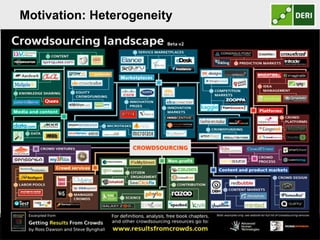
Motivation: Heterogeneity
Digital Enterprise Research Institute

www.deri.ie

3
Motivation: Task Routing
Digital Enterprise Research Institute



www.deri.ie

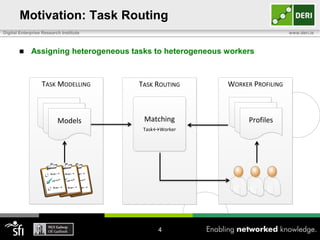
Assigning heterogeneous tasks to heterogeneous workers

TASK MODELLING
Models
Models
Models

TASK ROUTING

WORKER PROFILING

Matching

Profiles
Profiles
Profiles

Task↔Worker

4
Proposal: Performance Prediction
Digital Enterprise Research Institute



www.deri.ie

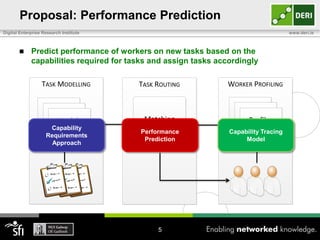
Predict performance of workers on new tasks based on the
capabilities required for tasks and assign tasks accordingly
TASK MODELLING
Models
Models
Models
Capability
Requirements
Approach

TASK ROUTING

WORKER PROFILING

Matching

Profiles
Profiles
Profiles

Task↔Worker
Performance
Prediction

Capability Tracing
Model

5
Background: Micro tasks
Digital Enterprise Research Institute



www.deri.ie

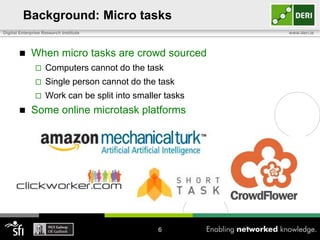
When micro tasks are crowd sourced



Single person cannot do the task





Computers cannot do the task
Work can be split into smaller tasks

Some online microtask platforms

6
Background: Micro tasks
Digital Enterprise Research Institute



www.deri.ie

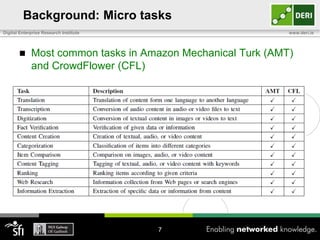
Most common tasks in Amazon Mechanical Turk (AMT)
and CrowdFlower (CFL)

7
Background: Micro tasks
Digital Enterprise Research Institute



www.deri.ie

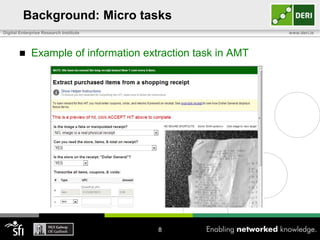
Example of information extraction task in AMT

8
Background: Micro tasks
Digital Enterprise Research Institute



www.deri.ie

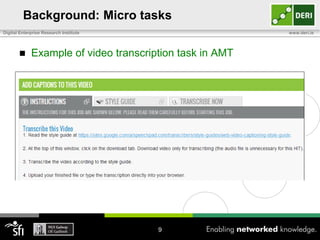
Example of video transcription task in AMT

9
Task Modelling
Digital Enterprise Research Institute

www.deri.ie



Appropriate models are needed to compare and contrast
micro tasks.



Capability Requirements approach


Capability is defined as the ability of humans to do things in
terms of both the capacity and the opportunity.



Four types of capabilities
–
–
–
–

Knowledge,
Skill,
Ability,
Other characteristics (e.g. motivation, price, etc)

10
Capability Requirements
Digital Enterprise Research Institute



www.deri.ie

Taxonomies have be used to study human task
performance, e.g.



Bloom’s taxonomy of classification of learning objectives





Fleishman’s taxonomy of human abilities
O*NET-SOC taxonomy of occupational classification

We are interested in taxonomy that


Describes tasks in terms of human capabilities



Helps in comparing tasks in terms of differences and similarities
of capabilities

11
Capabilities Taxonomy
Digital Enterprise Research Institute




www.deri.ie

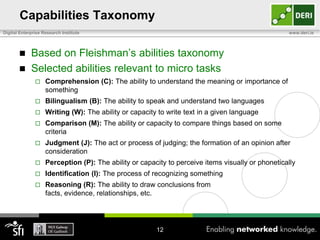
Based on Fleishman’s abilities taxonomy
Selected abilities relevant to micro tasks


Comprehension (C): The ability to understand the meaning or importance of
something



Bilingualism (B): The ability to speak and understand two languages



Writing (W): The ability or capacity to write text in a given language



Comparison (M): The ability or capacity to compare things based on some
criteria



Judgment (J): The act or process of judging; the formation of an opinion after
consideration



Perception (P): The ability or capacity to perceive items visually or phonetically



Identification (I): The process of recognizing something



Reasoning (R): The ability to draw conclusions from
facts, evidence, relationships, etc.

12
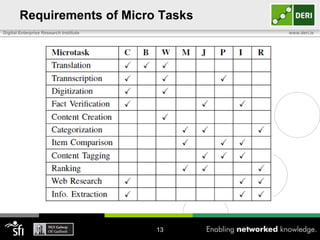
Requirements of Micro Tasks
Digital Enterprise Research Institute

www.deri.ie

13
Capability Tracing
Digital Enterprise Research Institute




www.deri.ie

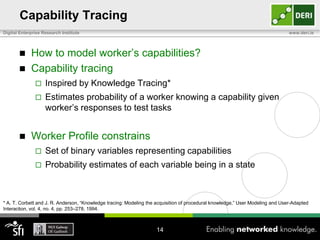
How to model worker’s capabilities?
Capability tracing





Inspired by Knowledge Tracing*
Estimates probability of a worker knowing a capability given
worker’s responses to test tasks

Worker Profile constrains


Set of binary variables representing capabilities



Probability estimates of each variable being in a state

* A. T. Corbett and J. R. Anderson, “Knowledge tracing: Modeling the acquisition of procedural knowledge,” User Modeling and User-Adapted
Interaction, vol. 4, no. 4, pp. 253–278, 1994.

14
Capability Tracing
Digital Enterprise Research Institute



www.deri.ie

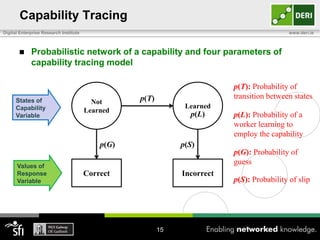
Probabilistic network of a capability and four parameters of
capability tracing model

States of
Capability
Variable

Not
Learned

p(T): Probability of
transition between states

p(T)
Learned

p(L)

p(G)
Values of
Response
Variable

p(L): Probability of a
worker learning to
employ the capability

p(S)
p(G): Probability of
guess

Correct

Incorrect

15

p(S): Probability of slip
Experiment
Digital Enterprise Research Institute



www.deri.ie

Objective





Solicit capability requirements of tasks from crowds
Evaluation of capability tracing for performance prediction

Three types of micro tasks with manually created ground
truth data



Image comparison





Fact verification
Information Extraction

37 crowd workers including


University students



Workers from Shorttask.com

16
Crowdsourcing
Digital Enterprise Research Institute




www.deri.ie

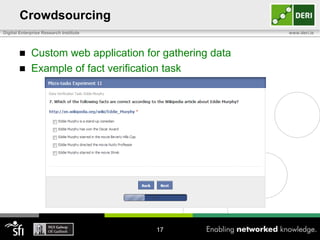
Custom web application for gathering data
Example of fact verification task

17
Capability Requirements of Tasks
Digital Enterprise Research Institute



www.deri.ie

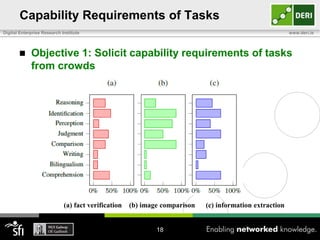
Objective 1: Solicit capability requirements of tasks
from crowds

(a) fact verification

(b) image comparison

18

(c) information extraction
Crowd Performance
Digital Enterprise Research Institute



www.deri.ie

How the crowd performed on each type of task?

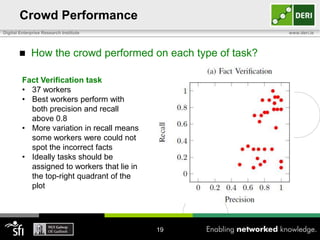
Fact Verification task
• 37 workers
• Best workers perform with
both precision and recall
above 0.8
• More variation in recall means
some workers were could not
spot the incorrect facts
• Ideally tasks should be
assigned to workers that lie in
the top-right quadrant of the
plot

19
Crowd Performance
Digital Enterprise Research Institute



www.deri.ie

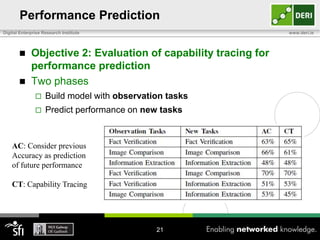
Image Comparison (20 workers) and Information Extraction (17 workers)

20
Performance Prediction
Digital Enterprise Research Institute




www.deri.ie

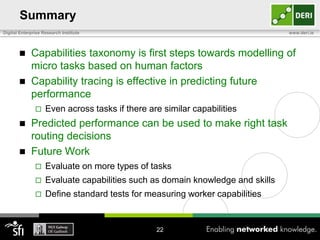
Objective 2: Evaluation of capability tracing for
performance prediction
Two phases


Build model with observation tasks



Predict performance on new tasks

AC: Consider previous
Accuracy as prediction
of future performance

CT: Capability Tracing

21
Summary
Digital Enterprise Research Institute




Capabilities taxonomy is first steps towards modelling of
micro tasks based on human factors
Capability tracing is effective in predicting future
performance





www.deri.ie

Even across tasks if there are similar capabilities

Predicted performance can be used to make right task
routing decisions
Future Work


Evaluate on more types of tasks



Evaluate capabilities such as domain knowledge and skills



Define standard tests for measuring worker capabilities

22
Further Reading
Digital Enterprise Research Institute

www.deri.ie

9th IEEE International Conference on Collaborative Computing:
Networking, Applications and Worksharing
Austin, Texas, United States
October 20–23, 2013

U. Ul Hassan and E. Curry, “A Capability Requirements Approach for Predicting
Worker Performance in Crowdsourcing,” in 9th IEEE International Conference on
Collaborative Computing: Networking, Applications and Worksharing, 2013.
http://deri.ie/users/umair-ul-hassan

23
Capability Tracing
Digital Enterprise Research Institute

www.deri.ie



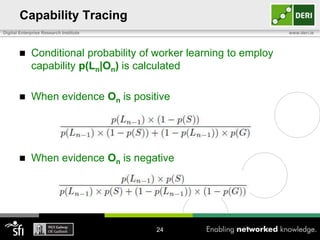
Conditional probability of worker learning to employ
capability p(Ln|On) is calculated



When evidence On is positive



When evidence On is negative

24
Capability Tracing
Digital Enterprise Research Institute

www.deri.ie



Probability of worker learning to employ capability



Performance of worker on next task

25

A Capability Requirements Approach for Predicting Worker Performance in Crowdsourcing

  • 1.
    Digital Enterprise ResearchInstitute www.deri.ie A CAPABILITY REQUIREMENTS APPROACH FOR PREDICTING WORKER PERFORMANCE IN CROWDSOURCING Umair ul Hassan, Edward Curry Digital Enterprise Research Institute National University of Ireland, Galway 9th IEEE International Conference on Collaborative Computing: Networking, Applications and Worksharing Austin, Texas, United States October 20–23, 2013 Copyright 2010 Digital Enterprise Research Institute. All rights reserved.
  • 2.
    Agenda Digital Enterprise ResearchInstitute    Motivation Background Task Modelling    Capability Requirements   www.deri.ie Capabilities Taxonomy Capability Tracing Experiment Summary 2
  • 3.
    Motivation: Heterogeneity Digital EnterpriseResearch Institute www.deri.ie 3
  • 4.
    Motivation: Task Routing DigitalEnterprise Research Institute  www.deri.ie Assigning heterogeneous tasks to heterogeneous workers TASK MODELLING Models Models Models TASK ROUTING WORKER PROFILING Matching Profiles Profiles Profiles Task↔Worker 4
  • 5.
    Proposal: Performance Prediction DigitalEnterprise Research Institute  www.deri.ie Predict performance of workers on new tasks based on the capabilities required for tasks and assign tasks accordingly TASK MODELLING Models Models Models Capability Requirements Approach TASK ROUTING WORKER PROFILING Matching Profiles Profiles Profiles Task↔Worker Performance Prediction Capability Tracing Model 5
  • 6.
    Background: Micro tasks DigitalEnterprise Research Institute  www.deri.ie When micro tasks are crowd sourced   Single person cannot do the task   Computers cannot do the task Work can be split into smaller tasks Some online microtask platforms 6
  • 7.
    Background: Micro tasks DigitalEnterprise Research Institute  www.deri.ie Most common tasks in Amazon Mechanical Turk (AMT) and CrowdFlower (CFL) 7
  • 8.
    Background: Micro tasks DigitalEnterprise Research Institute  www.deri.ie Example of information extraction task in AMT 8
  • 9.
    Background: Micro tasks DigitalEnterprise Research Institute  www.deri.ie Example of video transcription task in AMT 9
  • 10.
    Task Modelling Digital EnterpriseResearch Institute www.deri.ie  Appropriate models are needed to compare and contrast micro tasks.  Capability Requirements approach  Capability is defined as the ability of humans to do things in terms of both the capacity and the opportunity.  Four types of capabilities – – – – Knowledge, Skill, Ability, Other characteristics (e.g. motivation, price, etc) 10
  • 11.
    Capability Requirements Digital EnterpriseResearch Institute  www.deri.ie Taxonomies have be used to study human task performance, e.g.   Bloom’s taxonomy of classification of learning objectives   Fleishman’s taxonomy of human abilities O*NET-SOC taxonomy of occupational classification We are interested in taxonomy that  Describes tasks in terms of human capabilities  Helps in comparing tasks in terms of differences and similarities of capabilities 11
  • 12.
    Capabilities Taxonomy Digital EnterpriseResearch Institute   www.deri.ie Based on Fleishman’s abilities taxonomy Selected abilities relevant to micro tasks  Comprehension (C): The ability to understand the meaning or importance of something  Bilingualism (B): The ability to speak and understand two languages  Writing (W): The ability or capacity to write text in a given language  Comparison (M): The ability or capacity to compare things based on some criteria  Judgment (J): The act or process of judging; the formation of an opinion after consideration  Perception (P): The ability or capacity to perceive items visually or phonetically  Identification (I): The process of recognizing something  Reasoning (R): The ability to draw conclusions from facts, evidence, relationships, etc. 12
  • 13.
    Requirements of MicroTasks Digital Enterprise Research Institute www.deri.ie 13
  • 14.
    Capability Tracing Digital EnterpriseResearch Institute   www.deri.ie How to model worker’s capabilities? Capability tracing    Inspired by Knowledge Tracing* Estimates probability of a worker knowing a capability given worker’s responses to test tasks Worker Profile constrains  Set of binary variables representing capabilities  Probability estimates of each variable being in a state * A. T. Corbett and J. R. Anderson, “Knowledge tracing: Modeling the acquisition of procedural knowledge,” User Modeling and User-Adapted Interaction, vol. 4, no. 4, pp. 253–278, 1994. 14
  • 15.
    Capability Tracing Digital EnterpriseResearch Institute  www.deri.ie Probabilistic network of a capability and four parameters of capability tracing model States of Capability Variable Not Learned p(T): Probability of transition between states p(T) Learned p(L) p(G) Values of Response Variable p(L): Probability of a worker learning to employ the capability p(S) p(G): Probability of guess Correct Incorrect 15 p(S): Probability of slip
  • 16.
    Experiment Digital Enterprise ResearchInstitute  www.deri.ie Objective    Solicit capability requirements of tasks from crowds Evaluation of capability tracing for performance prediction Three types of micro tasks with manually created ground truth data   Image comparison   Fact verification Information Extraction 37 crowd workers including  University students  Workers from Shorttask.com 16
  • 17.
    Crowdsourcing Digital Enterprise ResearchInstitute   www.deri.ie Custom web application for gathering data Example of fact verification task 17
  • 18.
    Capability Requirements ofTasks Digital Enterprise Research Institute  www.deri.ie Objective 1: Solicit capability requirements of tasks from crowds (a) fact verification (b) image comparison 18 (c) information extraction
  • 19.
    Crowd Performance Digital EnterpriseResearch Institute  www.deri.ie How the crowd performed on each type of task? Fact Verification task • 37 workers • Best workers perform with both precision and recall above 0.8 • More variation in recall means some workers were could not spot the incorrect facts • Ideally tasks should be assigned to workers that lie in the top-right quadrant of the plot 19
  • 20.
    Crowd Performance Digital EnterpriseResearch Institute  www.deri.ie Image Comparison (20 workers) and Information Extraction (17 workers) 20
  • 21.
    Performance Prediction Digital EnterpriseResearch Institute   www.deri.ie Objective 2: Evaluation of capability tracing for performance prediction Two phases  Build model with observation tasks  Predict performance on new tasks AC: Consider previous Accuracy as prediction of future performance CT: Capability Tracing 21
  • 22.
    Summary Digital Enterprise ResearchInstitute   Capabilities taxonomy is first steps towards modelling of micro tasks based on human factors Capability tracing is effective in predicting future performance    www.deri.ie Even across tasks if there are similar capabilities Predicted performance can be used to make right task routing decisions Future Work  Evaluate on more types of tasks  Evaluate capabilities such as domain knowledge and skills  Define standard tests for measuring worker capabilities 22
  • 23.
    Further Reading Digital EnterpriseResearch Institute www.deri.ie 9th IEEE International Conference on Collaborative Computing: Networking, Applications and Worksharing Austin, Texas, United States October 20–23, 2013 U. Ul Hassan and E. Curry, “A Capability Requirements Approach for Predicting Worker Performance in Crowdsourcing,” in 9th IEEE International Conference on Collaborative Computing: Networking, Applications and Worksharing, 2013. http://deri.ie/users/umair-ul-hassan 23
  • 24.
    Capability Tracing Digital EnterpriseResearch Institute www.deri.ie  Conditional probability of worker learning to employ capability p(Ln|On) is calculated  When evidence On is positive  When evidence On is negative 24
  • 25.
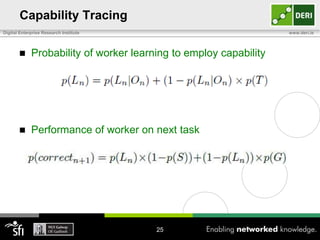
    Capability Tracing Digital EnterpriseResearch Institute www.deri.ie  Probability of worker learning to employ capability  Performance of worker on next task 25

Editor's Notes

  • #7 AMT is amazonmechincalturk
  • #8 AMT is amazonmechincalturk
  • #9 AMT is amazonmechincalturk
  • #10 AMT is amazon mechanical turk
  • #15 Probability estimates are generated while learning the model through capability tracing
  • #19 As can be seen, more than majority of workers believed that identification capability is essential for all three types of tasks. Majority of workers also agreed that the judgment and comprehension capabilities are important for the Fact Verification task. In the case of the Image Comparison task most workers specified that comparison and perception are important as well. There is general consensus between workers that comprehension, judgment and reasoning capabilities are also useful for Information Extraction tasks. We selected top-3 capabilities for each type of task for building capability tracing models.
  • #20 Interestingly, no worker achieved the highest recall for the information extraction task, which highlights the difference between workers and ground truth in terms of the entities extracted from the Wikipedia articles. Nevertheless, these distributions emphasize that in order to achieve high accuracy tasks should be assigned to workers that lie in the top-right quadrant of the plots.
  • #22 Results show that the capability tracing approach is comparable to the baseline approach in general and achieves better accuracy of prediction between similar tasks. The Fact Verification and Information Extraction tasks have similar capabilities requirements, therefore capability tracingcan better predict the performance of workers between them. The drop in prediction quality of capability tracing for Image Comparison task can be attributed to the little variation is the performance of workers on this task.
  • #25 Hide these
  • #26 Hide these