STEP 3
CONSTRUCTING AN INSTRUMENT
FOR DATA COLLECTION
SELECTING A METHOD OF DATA
COLLECTION
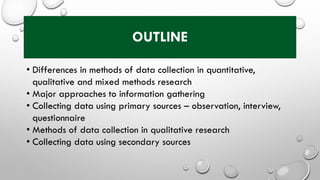
OUTLINE
• Differences in methods of data collection in quantitative,
qualitative and mixed methods research
• Major approaches to information gathering
• Collecting data using primary sources – observation, interview,
questionnaire
• Methods of data collection in qualitative research
• Collecting data using secondary sources
• Methodology: the framework associated with a particular set of
paradigmatic assumptions that you will use to conduct your research,
i.E. Scientific method, ethnography, action research.
•
• Methods: the techniques you will use to collect data, i.E. Interviewing,
surveying, participative observation.
•
• Tools: the devices you will use to help you collect data, i.E.
Questionnaires, observation checklists, interview schedules.
RESEARCH METHODS
Authors Definitions
(Nicholas, 2010) These are the tools and techniques for doing research. These are a range of tools that are used for different
types of enquiry, just as a variety of tools are used for doing different practical jobs, for example, a pick for
breaking up the ground or a rake for clearing leaves. In all cases, it is necessary to know what the correct tools
are for doing the job, and how to use them to best effect.
(Hennick,
Monique, Hutter,
Inge, Bailey, 2011)
This refers to how we gain knowledge about the world and how we collect research data.
(Greener, 2008) This refers to specific activities designed to generate data (e.g. questionnaires, interviews, focus groups,
observation).
(de Run, Ernest
Cyril, Ting, 2015)
Research methods are the tools, processes, or ways by which researchers obtain data. How are data obtained
then? In social science research, the data gathered for analysis by researchers are obtained using interview, focus
group discussion, participant observation, survey, among others. In the natural sciences, data may be obtained
using various techniques.
Example:
An ecologist might want to mark and recapture animals for population studies. A taxonomist might wish to count
the scales of fish to distinguish one species from another (morphometrics). A geologist might want to measure the
size of soil particles. Or a botanist might want to identify and count all trees in a quadrat. All of these activities
refer to methods.
(Rao, 2011) Research Method is a style of conducting a research work which is determined by the nature of the problem.
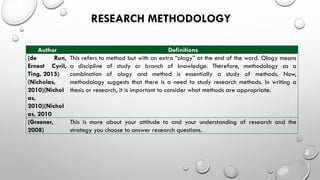
RESEARCH METHODOLOGY
Author Definitions
(de Run,
Ernest Cyril,
Ting, 2015)
(Nicholas,
2010)(Nichol
as,
2010)(Nichol
as, 2010
This refers to method but with an extra “ology” at the end of the word. Ology means
a discipline of study or branch of knowledge. Therefore, methodology as a
combination of ology and method is essentially a study of methods. Now,
methodology suggests that there is a need to study research methods. In writing a
thesis or research, it is important to consider what methods are appropriate.
(Greener,
2008)
This is more about your attitude to and your understanding of research and the
strategy you choose to answer research questions.
METHODS OF DATA COLLECTION
COLLECTING DATA USING PRIMARY SOURCES
• Observation – participant observation and non-participant observation
• Interview – unstructured and unstructured
• Questionnaire – mailed questionnaire, collective administration, online
questionnaire, administration in a public place
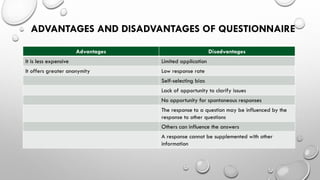
ADVANTAGES AND DISADVANTAGES OF QUESTIONNAIRE
Advantages Disadvantages
It is less expensive Limited application
It offers greater anonymity Low response rate
Self-selecting bias
Lack of opportunity to clarify issues
No opportunity for spontaneous responses
The response to a question may be influenced by the
response to other questions
Others can influence the answers
A response cannot be supplemented with other
information

9STEP-2-Conceptualizing-a-Research-Design-1.pdf

  • 1.
    STEP 3 CONSTRUCTING ANINSTRUMENT FOR DATA COLLECTION SELECTING A METHOD OF DATA COLLECTION
  • 2.
    OUTLINE • Differences inmethods of data collection in quantitative, qualitative and mixed methods research • Major approaches to information gathering • Collecting data using primary sources – observation, interview, questionnaire • Methods of data collection in qualitative research • Collecting data using secondary sources
  • 3.
    • Methodology: theframework associated with a particular set of paradigmatic assumptions that you will use to conduct your research, i.E. Scientific method, ethnography, action research. • • Methods: the techniques you will use to collect data, i.E. Interviewing, surveying, participative observation. • • Tools: the devices you will use to help you collect data, i.E. Questionnaires, observation checklists, interview schedules.
  • 4.
    RESEARCH METHODS Authors Definitions (Nicholas,2010) These are the tools and techniques for doing research. These are a range of tools that are used for different types of enquiry, just as a variety of tools are used for doing different practical jobs, for example, a pick for breaking up the ground or a rake for clearing leaves. In all cases, it is necessary to know what the correct tools are for doing the job, and how to use them to best effect. (Hennick, Monique, Hutter, Inge, Bailey, 2011) This refers to how we gain knowledge about the world and how we collect research data. (Greener, 2008) This refers to specific activities designed to generate data (e.g. questionnaires, interviews, focus groups, observation). (de Run, Ernest Cyril, Ting, 2015) Research methods are the tools, processes, or ways by which researchers obtain data. How are data obtained then? In social science research, the data gathered for analysis by researchers are obtained using interview, focus group discussion, participant observation, survey, among others. In the natural sciences, data may be obtained using various techniques. Example: An ecologist might want to mark and recapture animals for population studies. A taxonomist might wish to count the scales of fish to distinguish one species from another (morphometrics). A geologist might want to measure the size of soil particles. Or a botanist might want to identify and count all trees in a quadrat. All of these activities refer to methods. (Rao, 2011) Research Method is a style of conducting a research work which is determined by the nature of the problem.
  • 5.
    RESEARCH METHODOLOGY Author Definitions (deRun, Ernest Cyril, Ting, 2015) (Nicholas, 2010)(Nichol as, 2010)(Nichol as, 2010 This refers to method but with an extra “ology” at the end of the word. Ology means a discipline of study or branch of knowledge. Therefore, methodology as a combination of ology and method is essentially a study of methods. Now, methodology suggests that there is a need to study research methods. In writing a thesis or research, it is important to consider what methods are appropriate. (Greener, 2008) This is more about your attitude to and your understanding of research and the strategy you choose to answer research questions.
  • 6.
    METHODS OF DATACOLLECTION
  • 7.
    COLLECTING DATA USINGPRIMARY SOURCES • Observation – participant observation and non-participant observation • Interview – unstructured and unstructured • Questionnaire – mailed questionnaire, collective administration, online questionnaire, administration in a public place
  • 8.
    ADVANTAGES AND DISADVANTAGESOF QUESTIONNAIRE Advantages Disadvantages It is less expensive Limited application It offers greater anonymity Low response rate Self-selecting bias Lack of opportunity to clarify issues No opportunity for spontaneous responses The response to a question may be influenced by the response to other questions Others can influence the answers A response cannot be supplemented with other information