Artificial Intelligence
4. Knowledge Representation
Course V231
Department of Computing
Imperial College, London
Jeremy Gow
Representation
 AI agents deal with knowledge (data)
– Facts (believe & observe knowledge)
– Procedures (how to knowledge)
– Meaning (relate & define knowledge)
 Right representation is crucial
– Early realisation in AI
– Wrong choice can lead to project failure
– Active research area
Choosing a Representation
 For certain problem solving techniques
– ‘Best’ representation already known
– Often a requirement of the technique
– Or a requirement of the programming language (e.g. Prolog)
 Examples
– First order theorem proving… first order logic
– Inductive logic programming… logic programs
– Neural networks learning… neural networks
 Some general representation schemes
– Suitable for many different (and new) AI applications
Some General Representations
1. Logical Representations
2. Production Rules
3. Semantic Networks
• Conceptual graphs, frames
4. Description Logics (see textbook)
What is a Logic?
 A language with concrete rules
– No ambiguity in representation (may be other errors!)
– Allows unambiguous communication and processing
– Very unlike natural languages e.g. English
 Many ways to translate between languages
– A statement can be represented in different logics
– And perhaps differently in same logic
 Expressiveness of a logic
– How much can we say in this language?
 Not to be confused with logical reasoning
– Logics are languages, reasoning is a process (may use logic)
Syntax and Semantics
 Syntax
– Rules for constructing legal sentences in the logic
– Which symbols we can use (English: letters, punctuation)
– How we are allowed to combine symbols
 Semantics
– How we interpret (read) sentences in the logic
– Assigns a meaning to each sentence
 Example: “All lecturers are seven foot tall”
– A valid sentence (syntax)
– And we can understand the meaning (semantics)
– This sentence happens to be false (there is a counterexample)
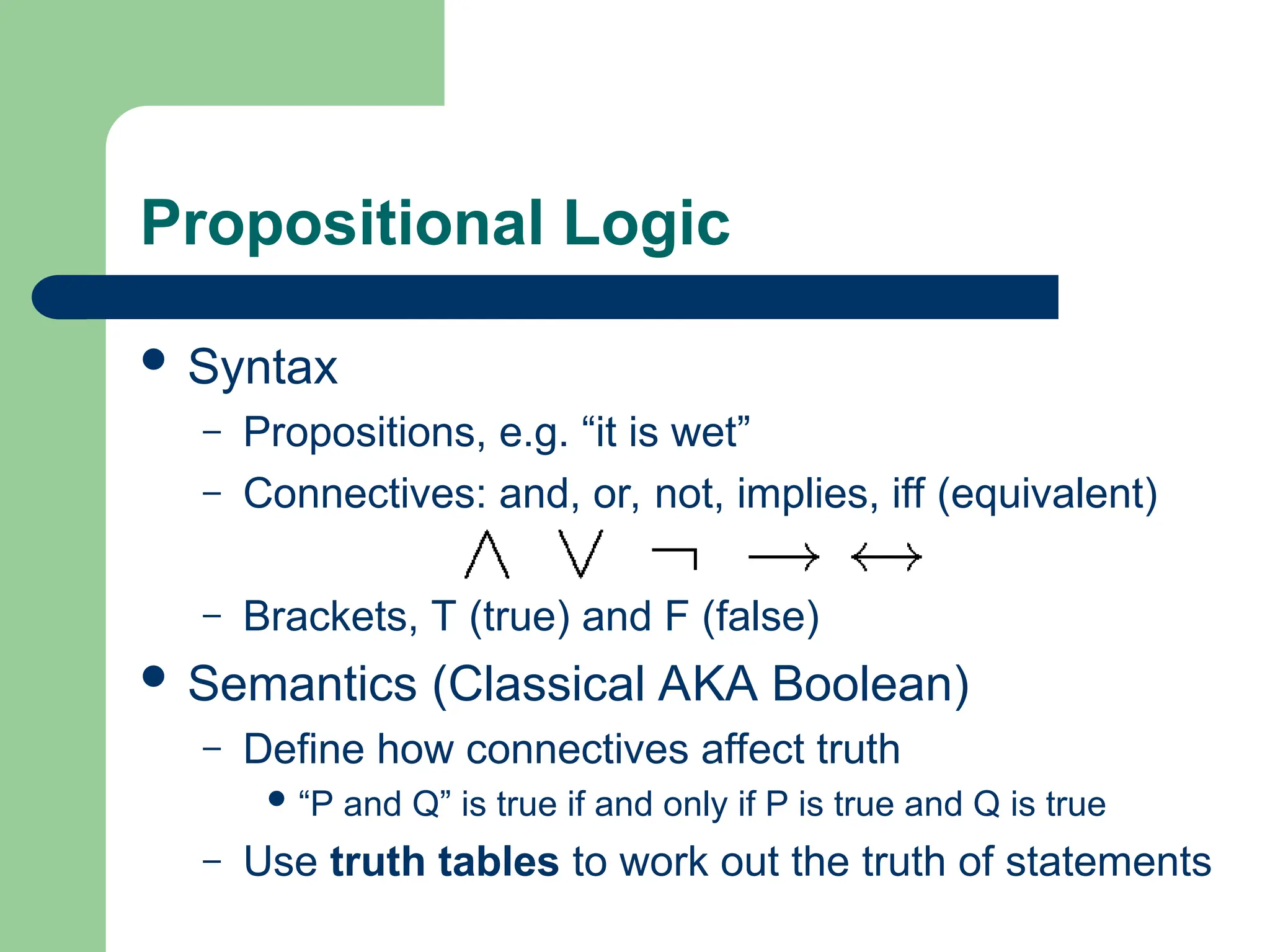
Propositional Logic
 Syntax
– Propositions, e.g. “it is wet”
– Connectives: and, or, not, implies, iff (equivalent)
– Brackets, T (true) and F (false)
 Semantics (Classical AKA Boolean)
– Define how connectives affect truth
 “P and Q” is true if and only if P is true and Q is true
– Use truth tables to work out the truth of statements
Predicate Logic
 Propositional logic combines atoms
– An atom contains no propositional connectives
– Have no structure (today_is_wet, john_likes_apples)
 Predicates allow us to talk about objects
– Properties: is_wet(today)
– Relations: likes(john, apples)
– True or false
 In predicate logic each atom is a predicate
– e.g. first order logic, higher-order logic
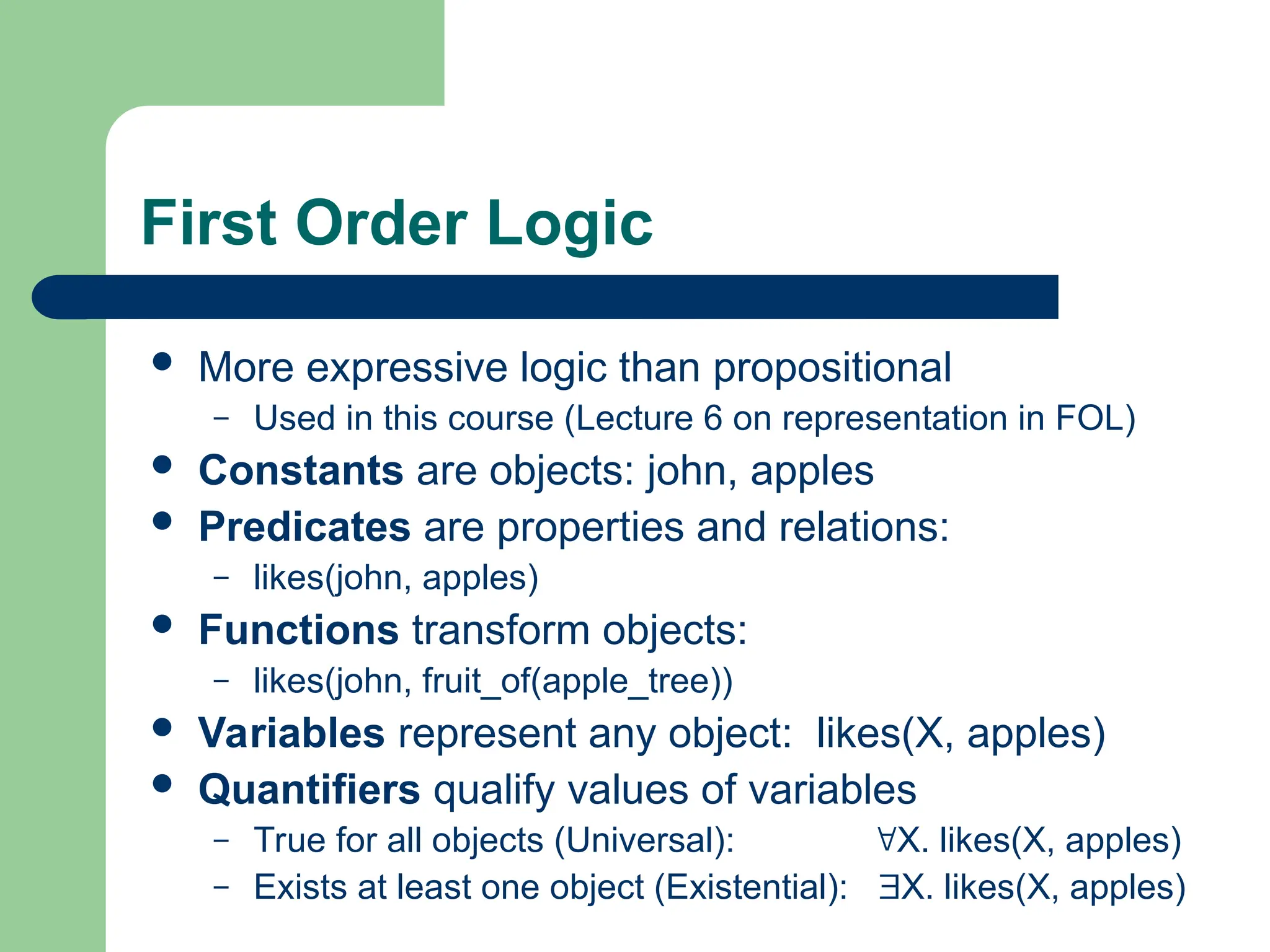
First Order Logic
 More expressive logic than propositional
– Used in this course (Lecture 6 on representation in FOL)
 Constants are objects: john, apples
 Predicates are properties and relations:
– likes(john, apples)
 Functions transform objects:
– likes(john, fruit_of(apple_tree))
 Variables represent any object: likes(X, apples)
 Quantifiers qualify values of variables
– True for all objects (Universal): X. likes(X, apples)
– Exists at least one object (Existential): X. likes(X, apples)
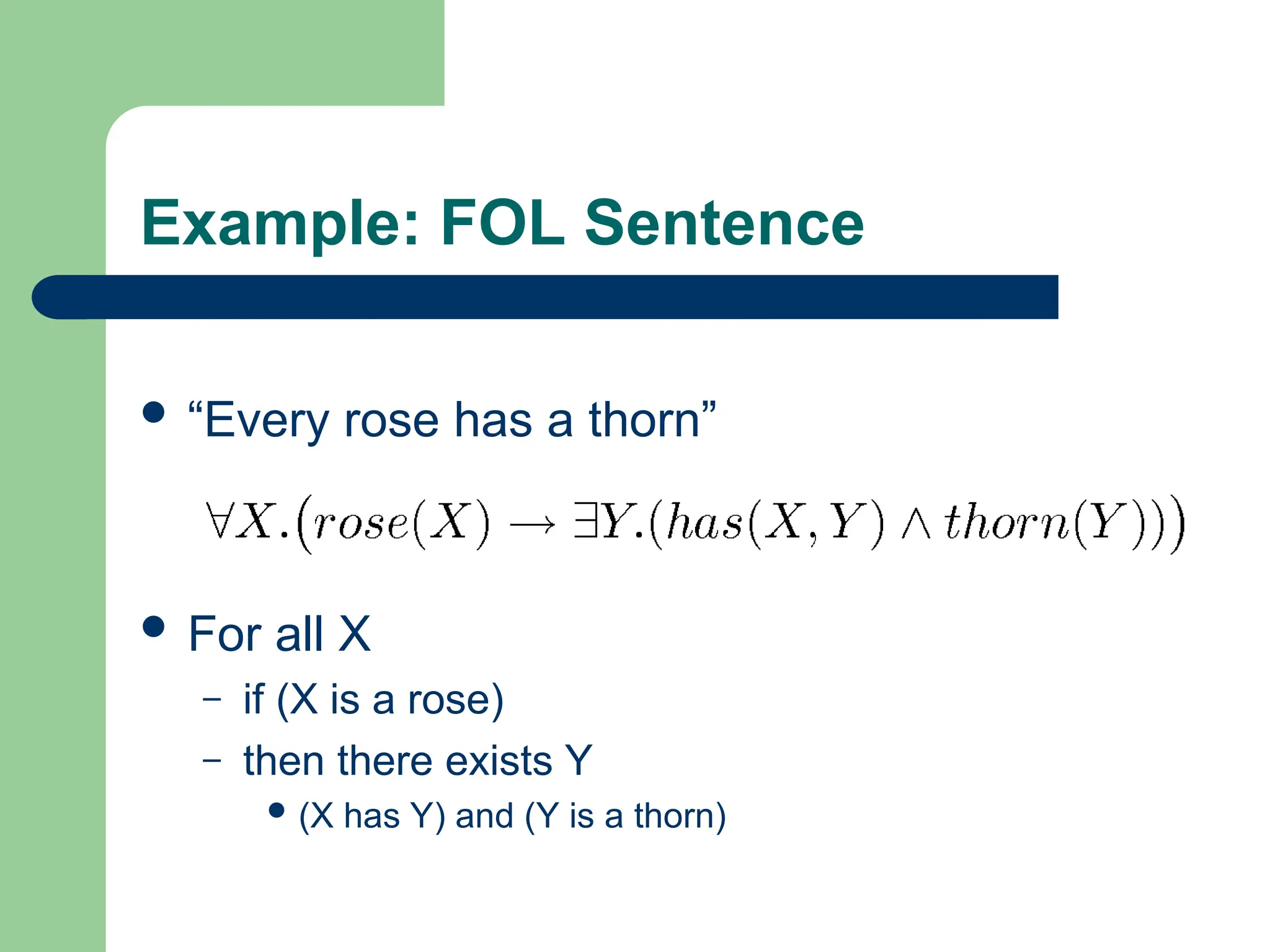
Example: FOL Sentence
 “Every rose has a thorn”
 For all X
– if (X is a rose)
– then there exists Y
 (X has Y) and (Y is a thorn)
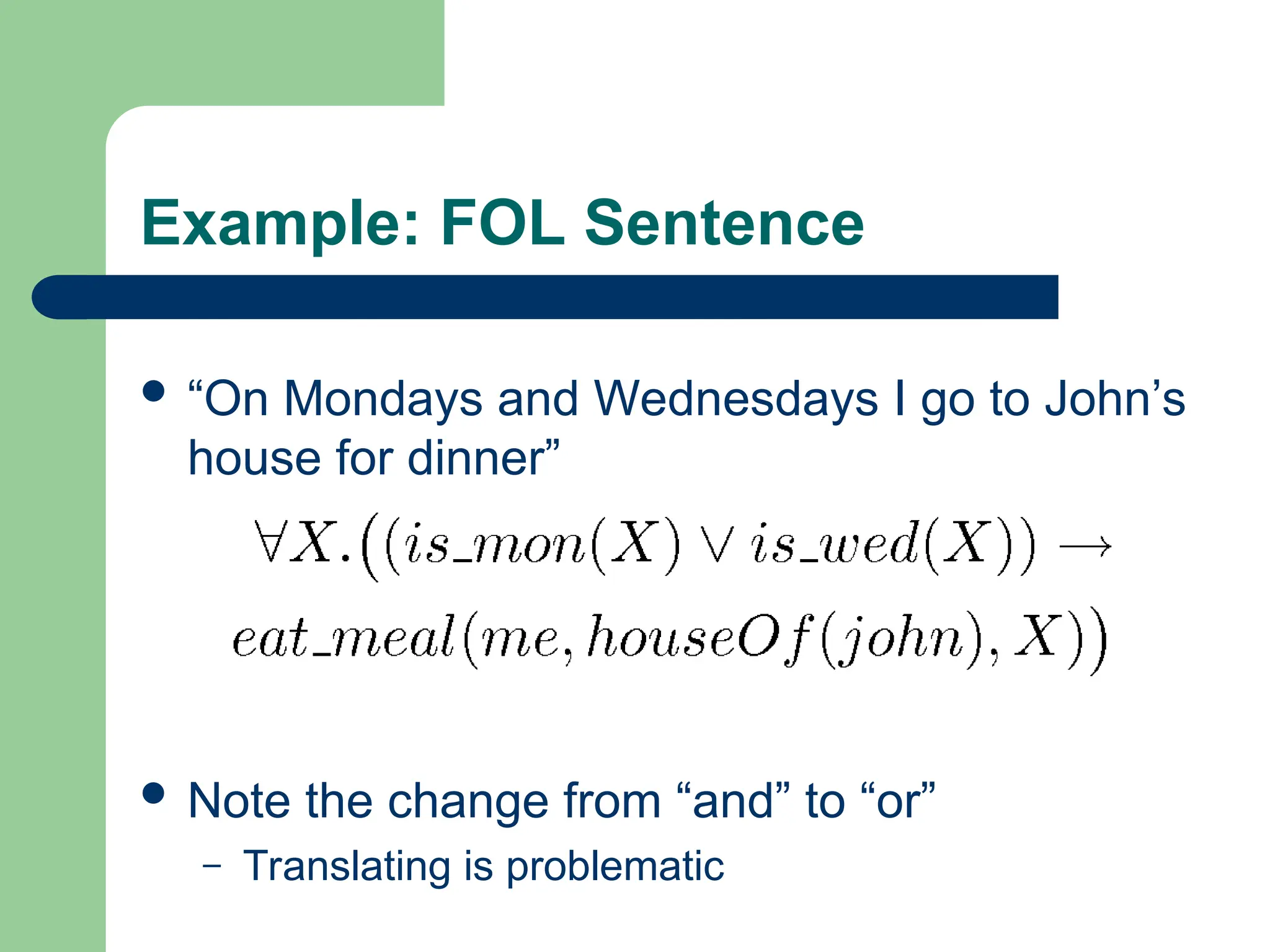
Example: FOL Sentence
 “On Mondays and Wednesdays I go to John’s
house for dinner”
 Note the change from “and” to “or”
– Translating is problematic
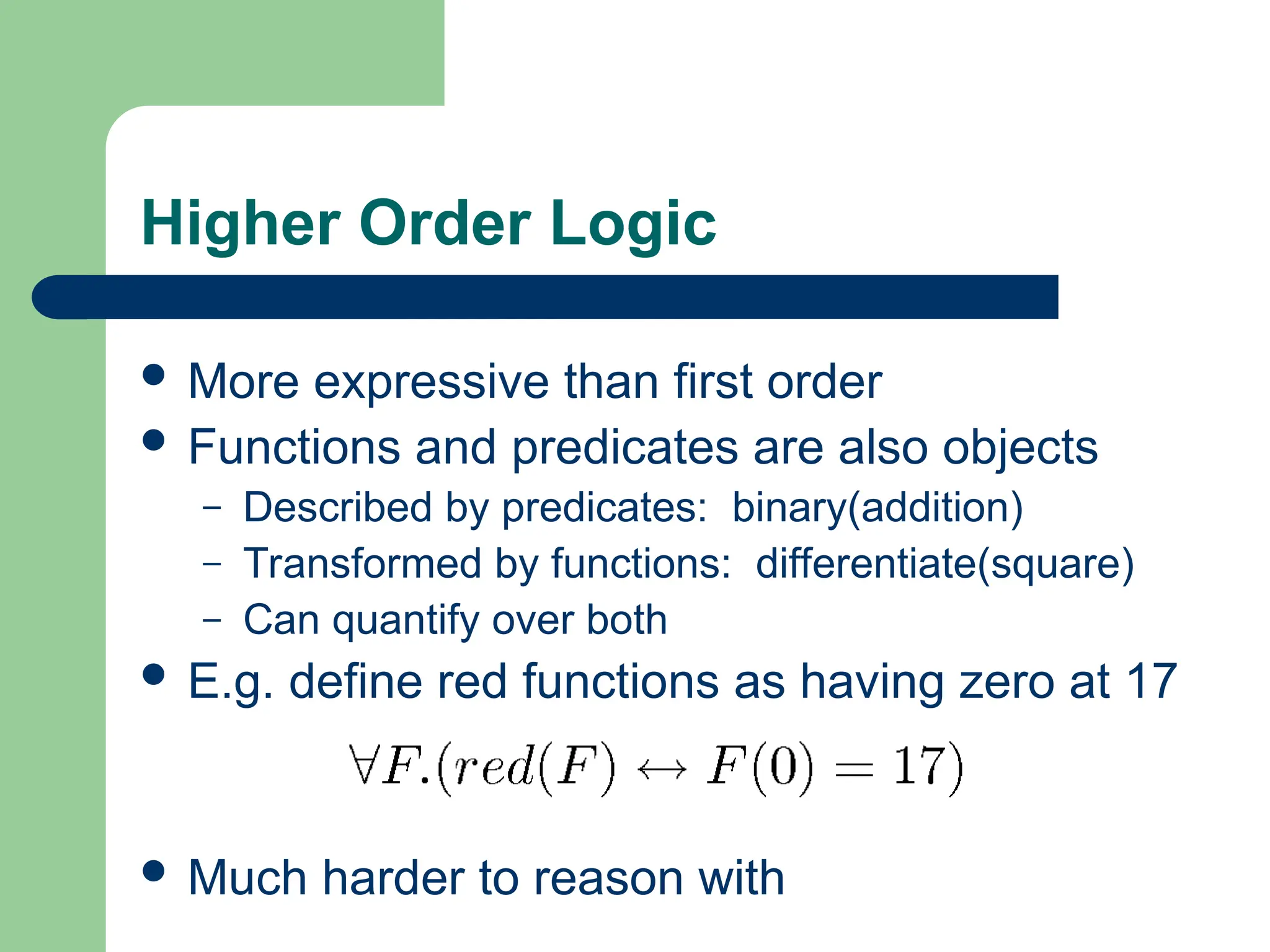
Higher Order Logic
 More expressive than first order
 Functions and predicates are also objects
– Described by predicates: binary(addition)
– Transformed by functions: differentiate(square)
– Can quantify over both
 E.g. define red functions as having zero at 17
 Much harder to reason with
Beyond True and False
 Multi-valued logics
– More than two truth values
– e.g., true, false & unknown
– Fuzzy logic uses probabilities, truth value in [0,1]
 Modal logics
– Modal operators define mode for propositions
– Epistemic logics (belief)
 e.g. p (necessarily p), p (possibly p), …
– Temporal logics (time)
 e.g. p (always p), p (eventually p), …
Logic is a Good Representation
 Fairly easy to do the translation when possible
 Branches of mathematics devoted to it
 It enables us to do logical reasoning
– Tools and techniques come for free
 Basis for programming languages
– Prolog uses logic programs (a subset of FOL)
 Prolog based on HOL
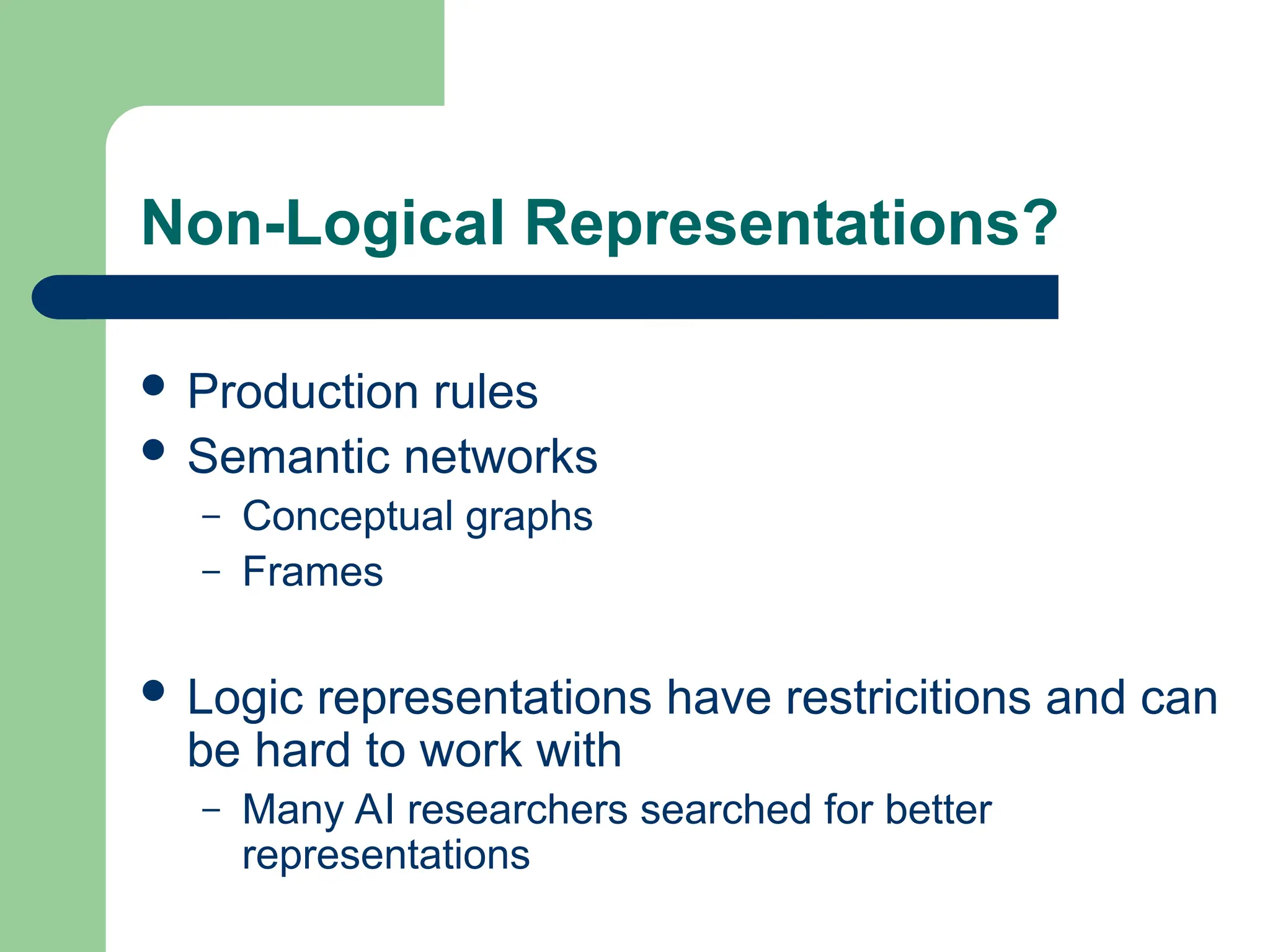
Non-Logical Representations?
 Production rules
 Semantic networks
– Conceptual graphs
– Frames
 Logic representations have restricitions and can
be hard to work with
– Many AI researchers searched for better
representations
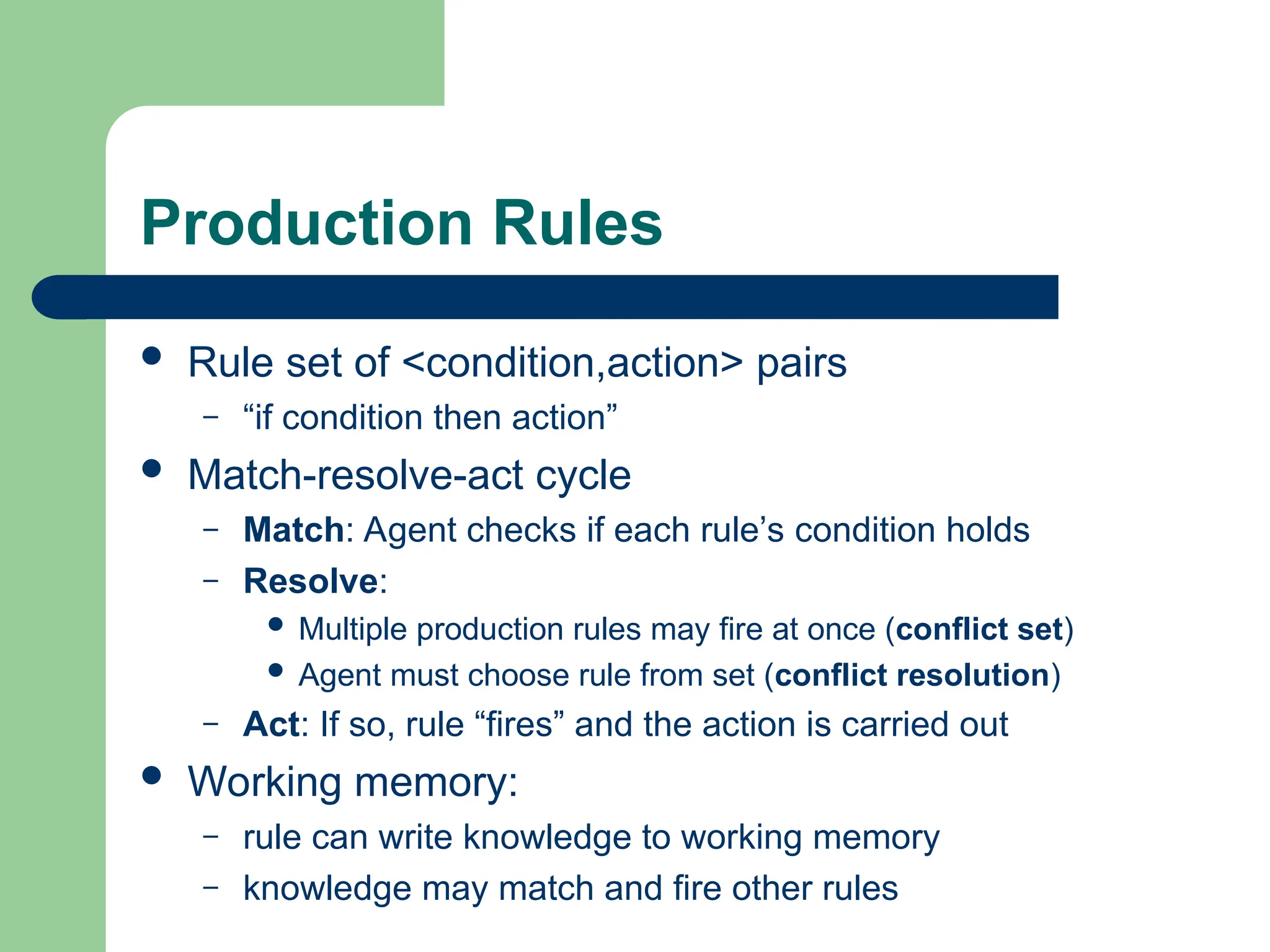
Production Rules
 Rule set of <condition,action> pairs
– “if condition then action”
 Match-resolve-act cycle
– Match: Agent checks if each rule’s condition holds
– Resolve:
 Multiple production rules may fire at once (conflict set)
 Agent must choose rule from set (conflict resolution)
– Act: If so, rule “fires” and the action is carried out
 Working memory:
– rule can write knowledge to working memory
– knowledge may match and fire other rules
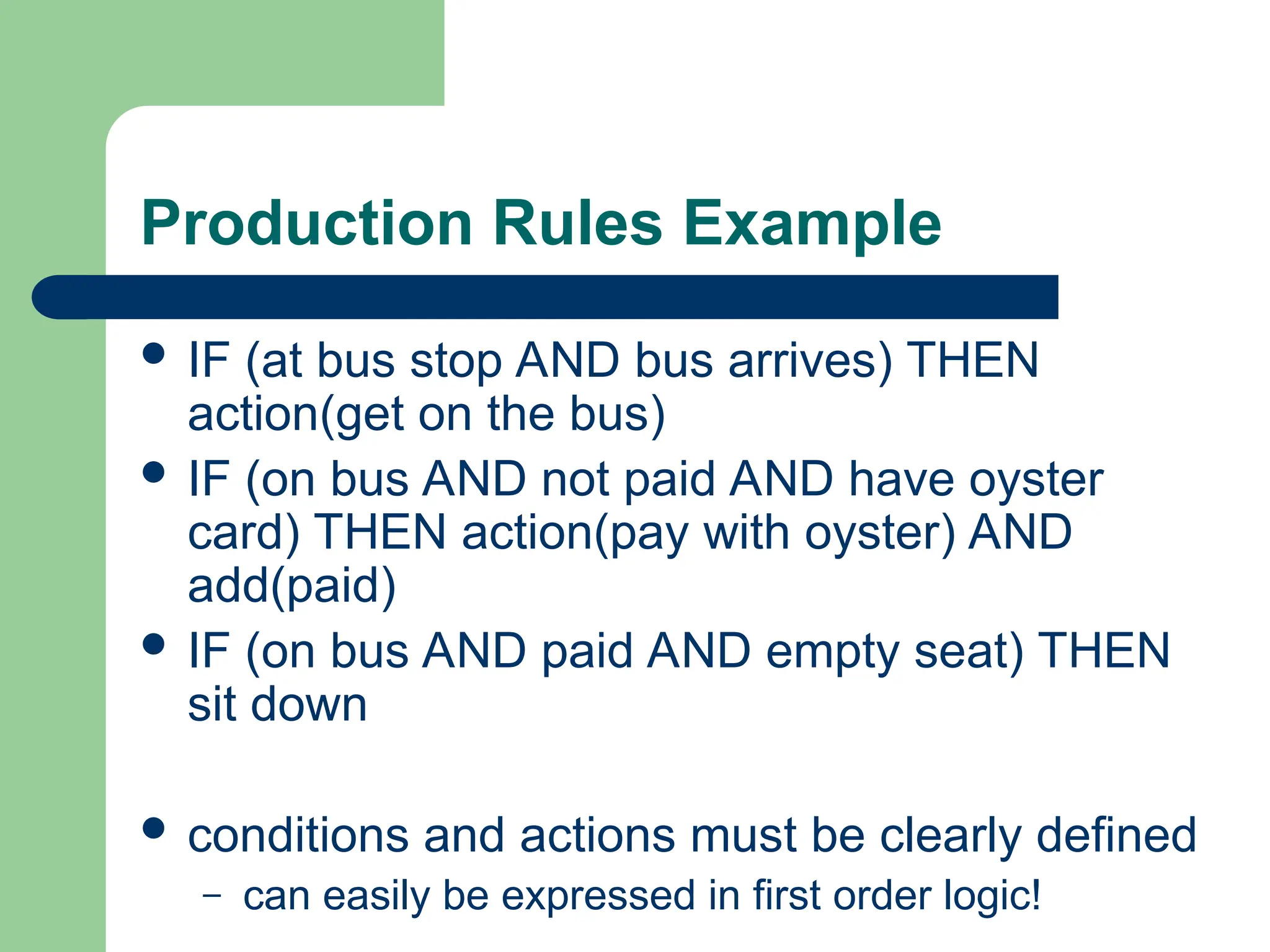
Production Rules Example
 IF (at bus stop AND bus arrives) THEN
action(get on the bus)
 IF (on bus AND not paid AND have oyster
card) THEN action(pay with oyster) AND
add(paid)
 IF (on bus AND paid AND empty seat) THEN
sit down
 conditions and actions must be clearly defined
– can easily be expressed in first order logic!
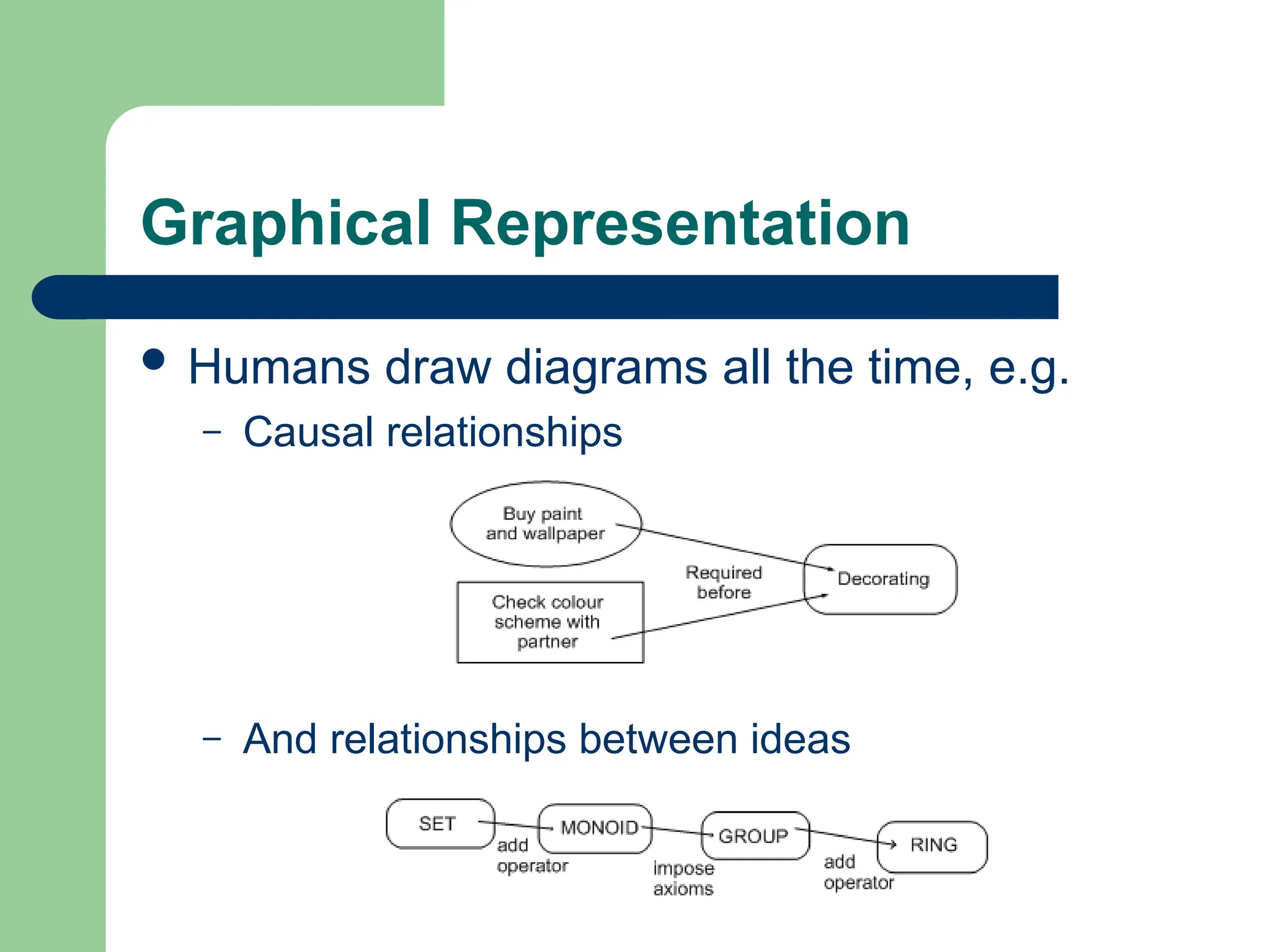
Graphical Representation
 Humans draw diagrams all the time, e.g.
– Causal relationships
– And relationships between ideas
Graphical Representation
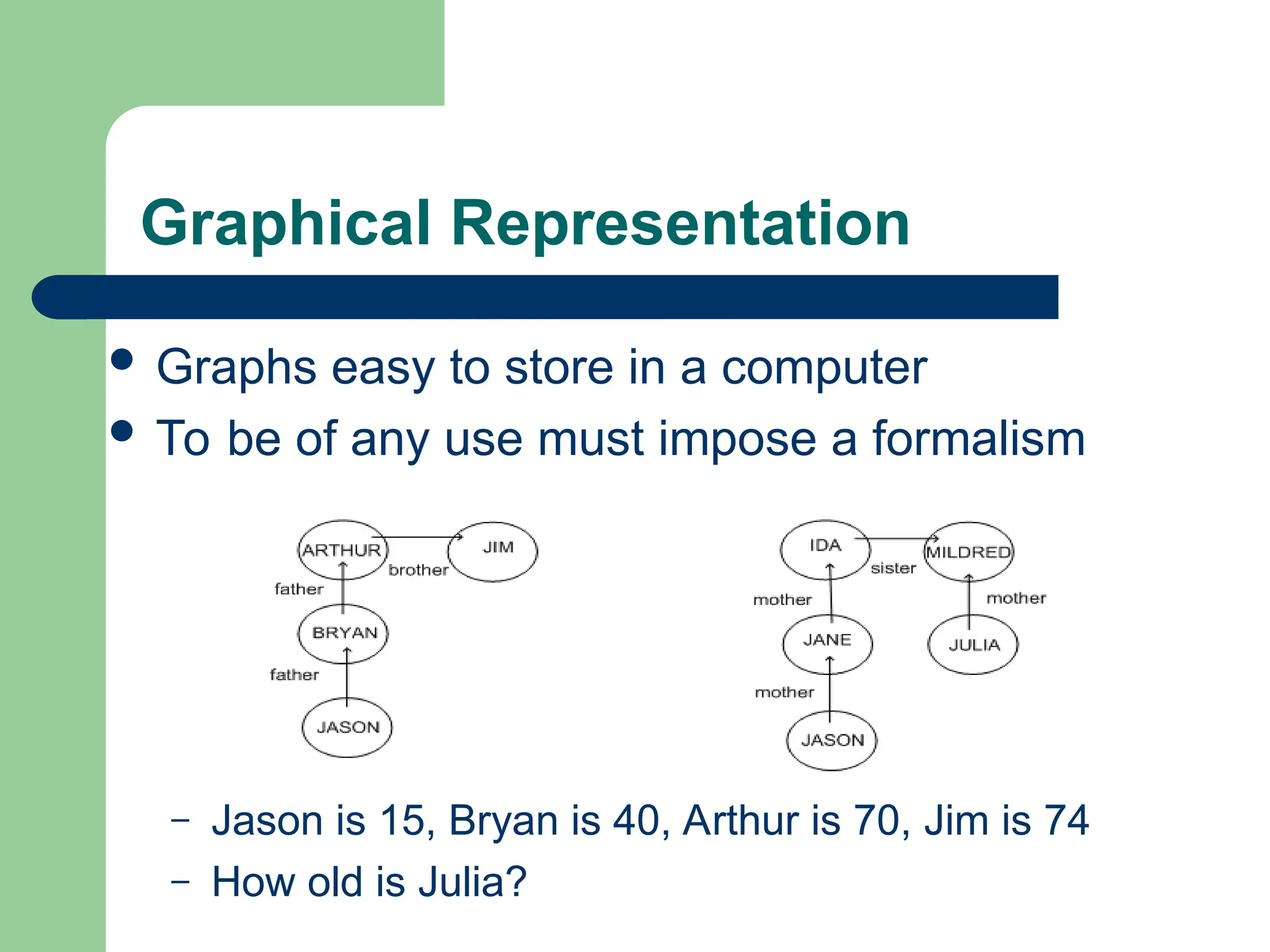
 Graphs easy to store in a computer
 To be of any use must impose a formalism
– Jason is 15, Bryan is 40, Arthur is 70, Jim is 74
– How old is Julia?
Semantic Networks
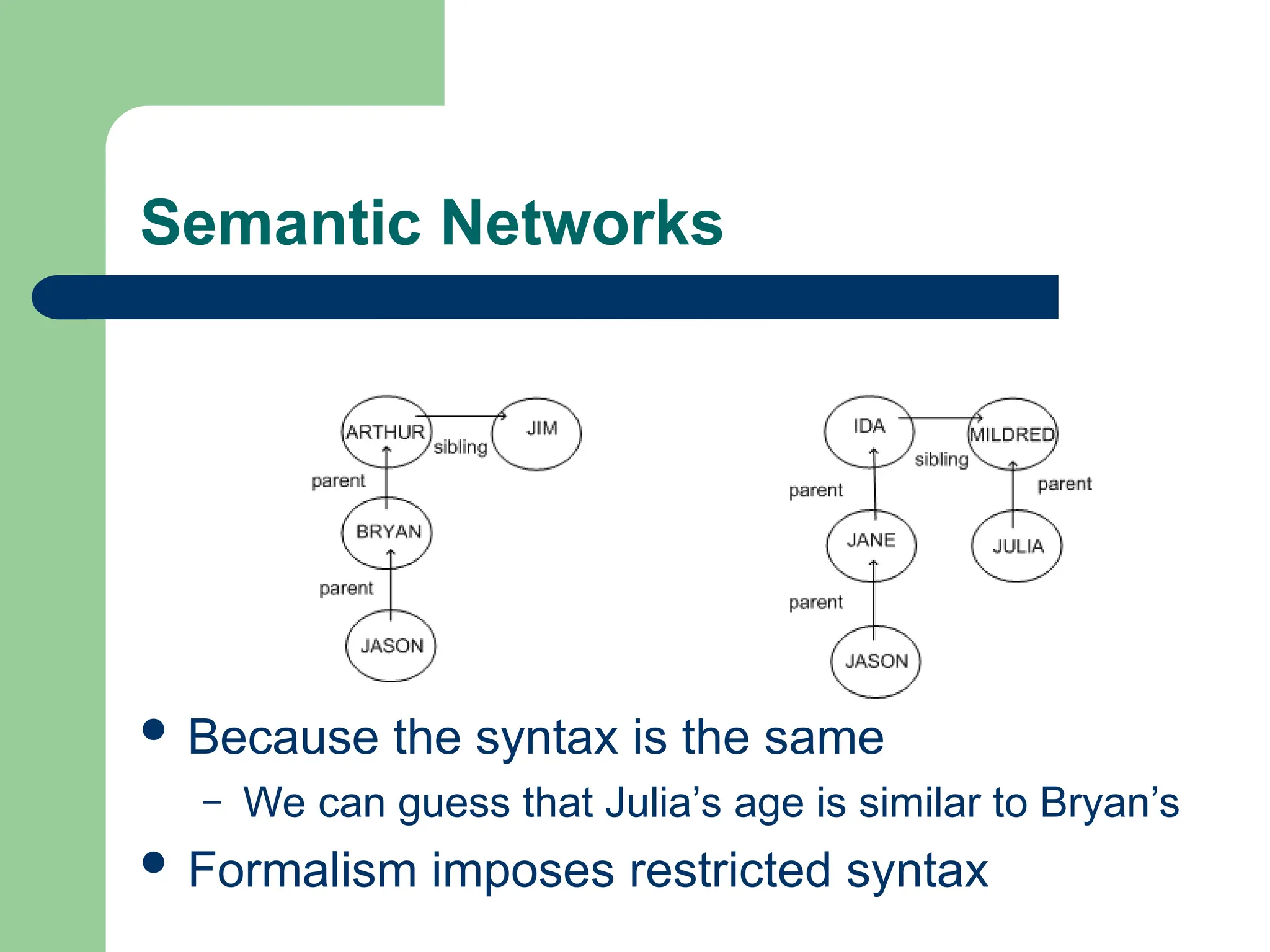
 Because the syntax is the same
– We can guess that Julia’s age is similar to Bryan’s
 Formalism imposes restricted syntax
Semantic Networks
 Graphical representation (a graph)
– Links indicate subset, member, relation, ...
 Equivalent to logical statements (usually FOL)
– Easier to understand than FOL?
– Specialised SN reasoning algorithms can be faster
 Example: natural language understanding
– Sentences with same meaning have same graphs
– e.g. Conceptual Dependency Theory (Schank)
Conceptual Graphs
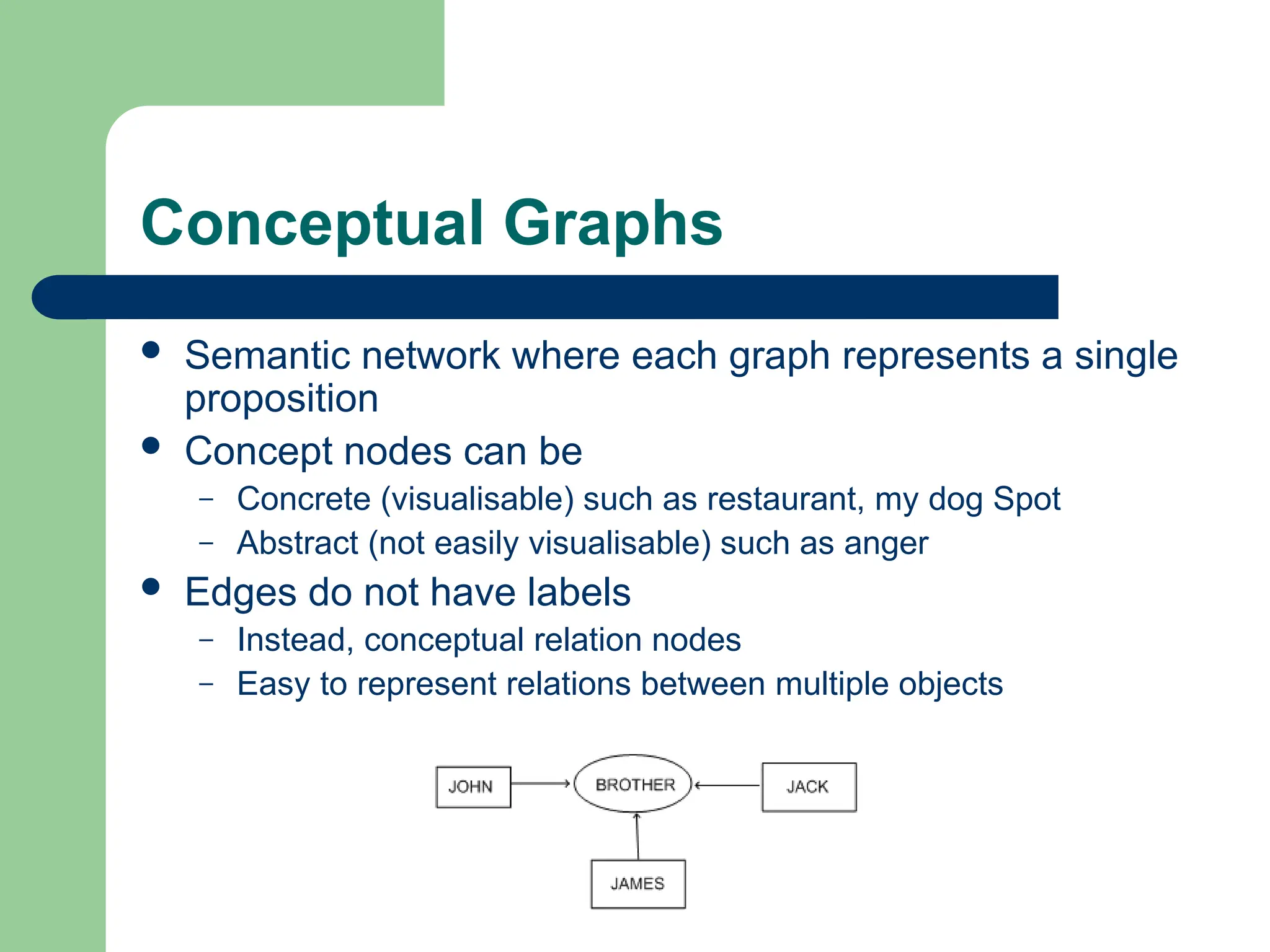
 Semantic network where each graph represents a single
proposition
 Concept nodes can be
– Concrete (visualisable) such as restaurant, my dog Spot
– Abstract (not easily visualisable) such as anger
 Edges do not have labels
– Instead, conceptual relation nodes
– Easy to represent relations between multiple objects
Frame Representations
 Semantic networks where nodes have structure
– Frame with a number of slots (age, height, ...)
– Each slot stores specific item of information
 When agent faces a new situation
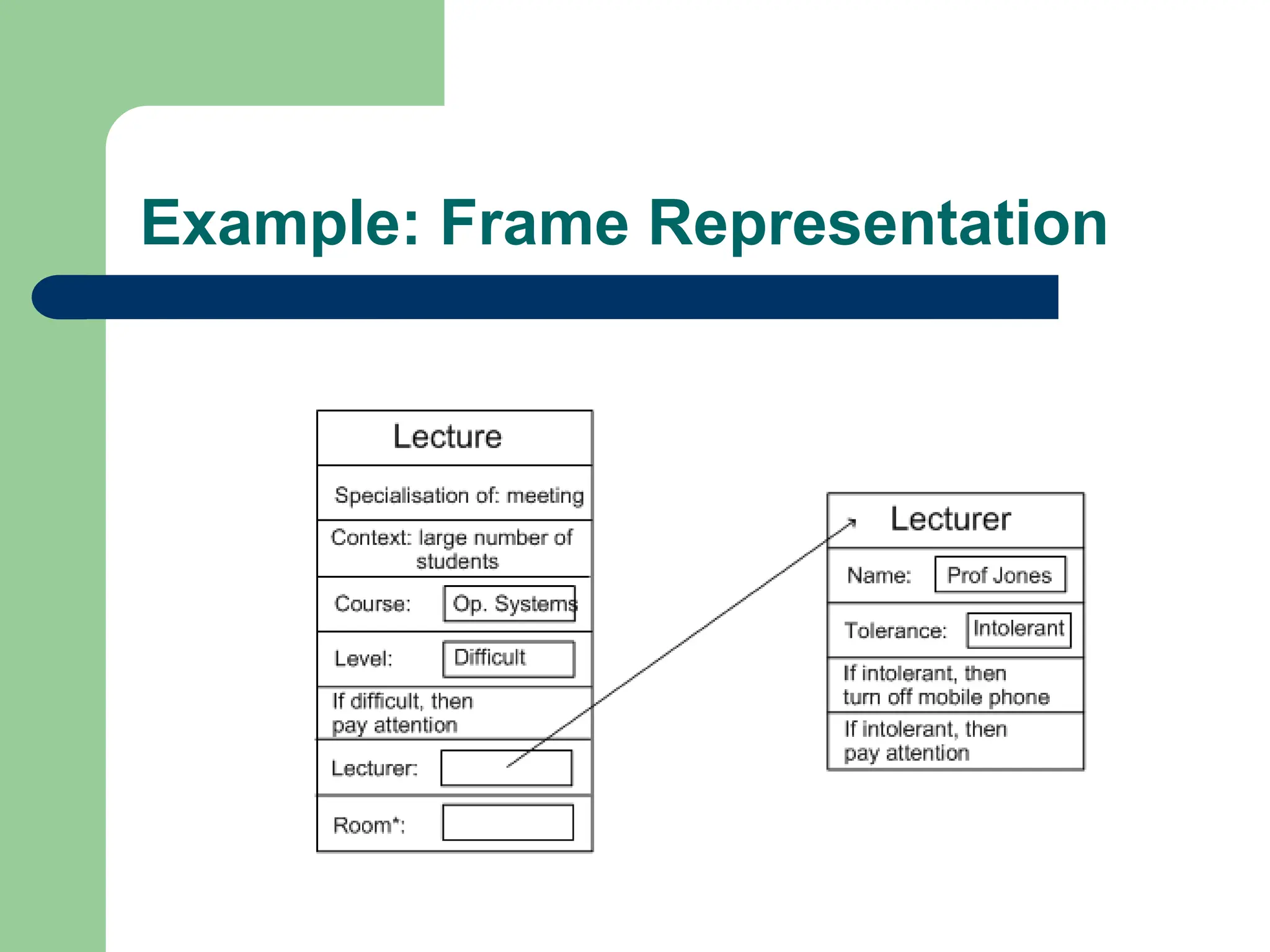
– Slots can be filled in (value may be another frame)
– Filling in may trigger actions
– May trigger retrieval of other frames
 Inheritance of properties between frames
– Very similar to objects in OOP
Example: Frame Representation
Flexibility in Frames
 Slots in a frame can contain
– Information for choosing a frame in a situation
– Relationships between this and other frames
– Procedures to carry out after various slots filled
– Default information to use where input is missing
– Blank slots: left blank unless required for a task
– Other frames, which gives a hierarchy
 Can also be expressed in first order logic
Representation & Logic
 AI wanted “non-logical representations”
– Production rules
– Semantic networks
 Conceptual graphs, frames
 But all can be expressed in first order logic!
 Best of both worlds
– Logical reading ensures representation well-defined
– Representations specialised for applications
– Can make reasoning easier, more intuitive

9_2019_01_04!07_19_02_ natural languagePM.ppt

  • 1.
    Artificial Intelligence 4. KnowledgeRepresentation Course V231 Department of Computing Imperial College, London Jeremy Gow
  • 2.
    Representation  AI agentsdeal with knowledge (data) – Facts (believe & observe knowledge) – Procedures (how to knowledge) – Meaning (relate & define knowledge)  Right representation is crucial – Early realisation in AI – Wrong choice can lead to project failure – Active research area
  • 3.
    Choosing a Representation For certain problem solving techniques – ‘Best’ representation already known – Often a requirement of the technique – Or a requirement of the programming language (e.g. Prolog)  Examples – First order theorem proving… first order logic – Inductive logic programming… logic programs – Neural networks learning… neural networks  Some general representation schemes – Suitable for many different (and new) AI applications
  • 4.
    Some General Representations 1.Logical Representations 2. Production Rules 3. Semantic Networks • Conceptual graphs, frames 4. Description Logics (see textbook)
  • 5.
    What is aLogic?  A language with concrete rules – No ambiguity in representation (may be other errors!) – Allows unambiguous communication and processing – Very unlike natural languages e.g. English  Many ways to translate between languages – A statement can be represented in different logics – And perhaps differently in same logic  Expressiveness of a logic – How much can we say in this language?  Not to be confused with logical reasoning – Logics are languages, reasoning is a process (may use logic)
  • 6.
    Syntax and Semantics Syntax – Rules for constructing legal sentences in the logic – Which symbols we can use (English: letters, punctuation) – How we are allowed to combine symbols  Semantics – How we interpret (read) sentences in the logic – Assigns a meaning to each sentence  Example: “All lecturers are seven foot tall” – A valid sentence (syntax) – And we can understand the meaning (semantics) – This sentence happens to be false (there is a counterexample)
  • 7.
    Propositional Logic  Syntax –Propositions, e.g. “it is wet” – Connectives: and, or, not, implies, iff (equivalent) – Brackets, T (true) and F (false)  Semantics (Classical AKA Boolean) – Define how connectives affect truth  “P and Q” is true if and only if P is true and Q is true – Use truth tables to work out the truth of statements
  • 8.
    Predicate Logic  Propositionallogic combines atoms – An atom contains no propositional connectives – Have no structure (today_is_wet, john_likes_apples)  Predicates allow us to talk about objects – Properties: is_wet(today) – Relations: likes(john, apples) – True or false  In predicate logic each atom is a predicate – e.g. first order logic, higher-order logic
  • 9.
    First Order Logic More expressive logic than propositional – Used in this course (Lecture 6 on representation in FOL)  Constants are objects: john, apples  Predicates are properties and relations: – likes(john, apples)  Functions transform objects: – likes(john, fruit_of(apple_tree))  Variables represent any object: likes(X, apples)  Quantifiers qualify values of variables – True for all objects (Universal): X. likes(X, apples) – Exists at least one object (Existential): X. likes(X, apples)
  • 10.
    Example: FOL Sentence “Every rose has a thorn”  For all X – if (X is a rose) – then there exists Y  (X has Y) and (Y is a thorn)
  • 11.
    Example: FOL Sentence “On Mondays and Wednesdays I go to John’s house for dinner”  Note the change from “and” to “or” – Translating is problematic
  • 12.
    Higher Order Logic More expressive than first order  Functions and predicates are also objects – Described by predicates: binary(addition) – Transformed by functions: differentiate(square) – Can quantify over both  E.g. define red functions as having zero at 17  Much harder to reason with
  • 13.
    Beyond True andFalse  Multi-valued logics – More than two truth values – e.g., true, false & unknown – Fuzzy logic uses probabilities, truth value in [0,1]  Modal logics – Modal operators define mode for propositions – Epistemic logics (belief)  e.g. p (necessarily p), p (possibly p), … – Temporal logics (time)  e.g. p (always p), p (eventually p), …
  • 14.
    Logic is aGood Representation  Fairly easy to do the translation when possible  Branches of mathematics devoted to it  It enables us to do logical reasoning – Tools and techniques come for free  Basis for programming languages – Prolog uses logic programs (a subset of FOL)  Prolog based on HOL
  • 15.
    Non-Logical Representations?  Productionrules  Semantic networks – Conceptual graphs – Frames  Logic representations have restricitions and can be hard to work with – Many AI researchers searched for better representations
  • 16.
    Production Rules  Ruleset of <condition,action> pairs – “if condition then action”  Match-resolve-act cycle – Match: Agent checks if each rule’s condition holds – Resolve:  Multiple production rules may fire at once (conflict set)  Agent must choose rule from set (conflict resolution) – Act: If so, rule “fires” and the action is carried out  Working memory: – rule can write knowledge to working memory – knowledge may match and fire other rules
  • 17.
    Production Rules Example IF (at bus stop AND bus arrives) THEN action(get on the bus)  IF (on bus AND not paid AND have oyster card) THEN action(pay with oyster) AND add(paid)  IF (on bus AND paid AND empty seat) THEN sit down  conditions and actions must be clearly defined – can easily be expressed in first order logic!
  • 18.
    Graphical Representation  Humansdraw diagrams all the time, e.g. – Causal relationships – And relationships between ideas
  • 19.
    Graphical Representation  Graphseasy to store in a computer  To be of any use must impose a formalism – Jason is 15, Bryan is 40, Arthur is 70, Jim is 74 – How old is Julia?
  • 20.
    Semantic Networks  Becausethe syntax is the same – We can guess that Julia’s age is similar to Bryan’s  Formalism imposes restricted syntax
  • 21.
    Semantic Networks  Graphicalrepresentation (a graph) – Links indicate subset, member, relation, ...  Equivalent to logical statements (usually FOL) – Easier to understand than FOL? – Specialised SN reasoning algorithms can be faster  Example: natural language understanding – Sentences with same meaning have same graphs – e.g. Conceptual Dependency Theory (Schank)
  • 22.
    Conceptual Graphs  Semanticnetwork where each graph represents a single proposition  Concept nodes can be – Concrete (visualisable) such as restaurant, my dog Spot – Abstract (not easily visualisable) such as anger  Edges do not have labels – Instead, conceptual relation nodes – Easy to represent relations between multiple objects
  • 23.
    Frame Representations  Semanticnetworks where nodes have structure – Frame with a number of slots (age, height, ...) – Each slot stores specific item of information  When agent faces a new situation – Slots can be filled in (value may be another frame) – Filling in may trigger actions – May trigger retrieval of other frames  Inheritance of properties between frames – Very similar to objects in OOP
  • 24.
  • 25.
    Flexibility in Frames Slots in a frame can contain – Information for choosing a frame in a situation – Relationships between this and other frames – Procedures to carry out after various slots filled – Default information to use where input is missing – Blank slots: left blank unless required for a task – Other frames, which gives a hierarchy  Can also be expressed in first order logic
  • 26.
    Representation & Logic AI wanted “non-logical representations” – Production rules – Semantic networks  Conceptual graphs, frames  But all can be expressed in first order logic!  Best of both worlds – Logical reading ensures representation well-defined – Representations specialised for applications – Can make reasoning easier, more intuitive