Crop Coefficients
Blaine Hanson
Department of Land, Air and Water Resources
University of California, Davis
Irrigation Water Management:
Science, Art, or Guess?
Blaine Hanson
University of California, Davis
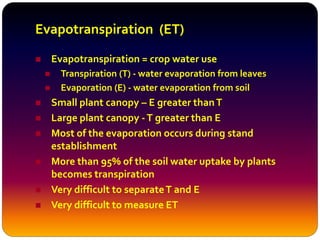
 Evapotranspiration = crop water use
 Transpiration (T) - water evaporation from leaves
 Evaporation (E) - water evaporation from soil
 Small plant canopy – E greater thanT
 Large plant canopy -T greater than E
 Most of the evaporation occurs during stand
establishment
 More than 95% of the soil water uptake by plants
becomes transpiration
 Very difficult to separateT and E
 Very difficult to measure ET
Evapotranspiration (ET)
Units of evapotranspiration
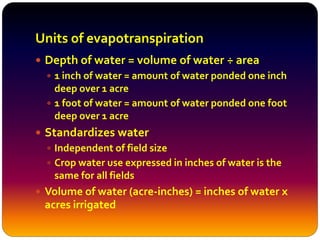
 Depth of water = volume of water ÷ area
 1 inch of water = amount of water ponded one inch
deep over 1 acre
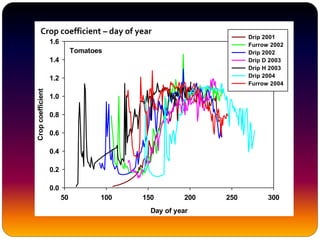
 1 foot of water = amount of water ponded one foot
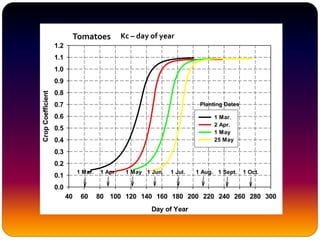
deep over 1 acre
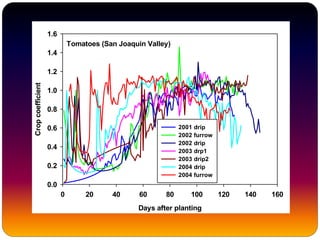
 Standardizes water
 Independent of field size
 Crop water use expressed in inches of water is the
same for all fields
 Volume of water (acre-inches) = inches of water x
acres irrigated
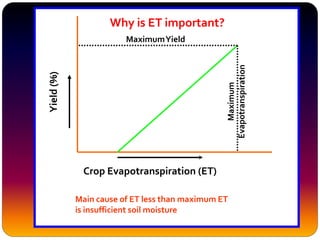
Crop Evapotranspiration (ET)
MaximumYield
Main cause of ET less than maximum ET
is insufficient soil moisture
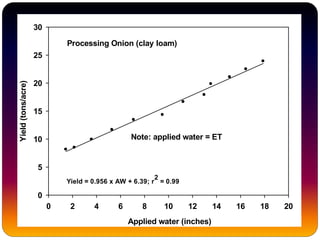
Why is ET important?
Processing Onion (clay loam)
Applied water (inches)
0 2 4 6 8 10 12 14 16 18 20
Yield(tons/acre)
0
5
10
15
20
25
30
Yield = 0.956 x AW + 6.39; r
2
= 0.99
Note: applied water = ET
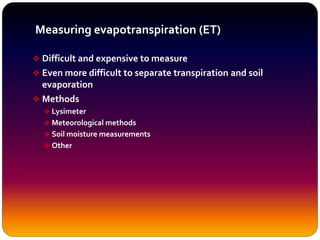
Measuring evapotranspiration (ET)
 Difficult and expensive to measure
 Even more difficult to separate transpiration and soil
evaporation
 Methods
 Lysimeter
 Meteorological methods
 Soil moisture measurements
 Other
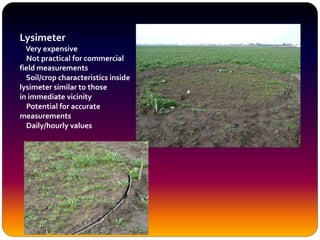
Lysimeter
Very expensive
Not practical for commercial
field measurements
Soil/crop characteristics inside
lysimeter similar to those
in immediate vicinity
Potential for accurate
measurements
Daily/hourly values
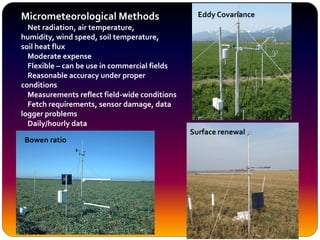
Micrometeorological Methods
Net radiation, air temperature,
humidity, wind speed, soil temperature,
soil heat flux
Moderate expense
Flexible – can be use in commercial fields
Reasonable accuracy under proper
conditions
Measurements reflect field-wide conditions
Fetch requirements, sensor damage, data
logger problems
Daily/hourly data
Eddy Covariance
Bowen ratio
Surface renewal
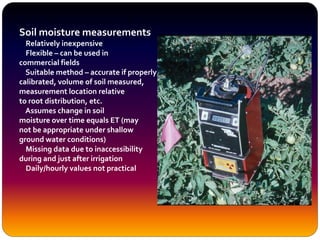
Soil moisture measurements
Relatively inexpensive
Flexible – can be used in
commercial fields
Suitable method – accurate if properly
calibrated, volume of soil measured,
measurement location relative
to root distribution, etc.
Assumes change in soil
moisture over time equals ET (may
not be appropriate under shallow
ground water conditions)
Missing data due to inaccessibility
during and just after irrigation
Daily/hourly values not practical
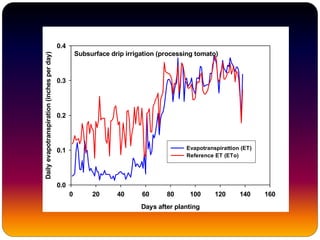
Subsurface drip irrigation (processing tomato)
Days after planting
0 20 40 60 80 100 120 140 160
Dailyevapotranspiration(inchesperday)
0.0
0.1
0.2
0.3
0.4
Evapotranspirattion (ET)
Reference ET (ETo)
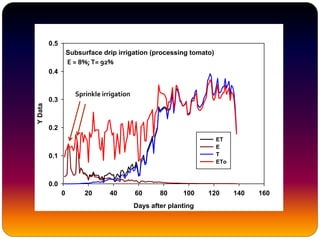
Subsurface drip irrigation (processing tomato)
Days after planting
0 20 40 60 80 100 120 140 160
YData
0.0
0.1
0.2
0.3
0.4
0.5
ET
E
T
ETo
Sprinkle irrigation
E = 8%;T= 92%
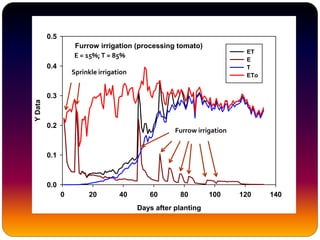
Furrow irrigation (processing tomato)
Days after planting
0 20 40 60 80 100 120 140
YData
0.0
0.1
0.2
0.3
0.4
0.5
ET
E
T
ETo
Sprinkle irrigation
Furrow irrigation
E = 15%;T = 85%
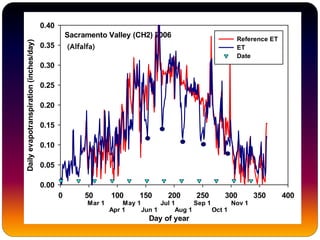
Sacramento Valley (CH2) 2006
Day of year
0 50 100 150 200 250 300 350 400
Dailyevapotranspiration(inches/day)
0.00
0.05
0.10
0.15
0.20
0.25
0.30
0.35
0.40
Reference ET
ET
Date
Jun 1
May 1 Jul 1
Aug 1
Sep 1
Apr 1
Mar 1
Oct 1
Nov 1
(Alfalfa)
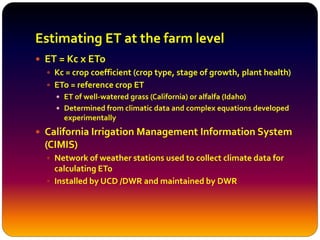
Estimating ET at the farm level
 ET = Kc x ETo
 Kc = crop coefficient (crop type, stage of growth, plant health)
 ETo = reference crop ET
 ET of well-watered grass (California) or alfalfa (Idaho)
 Determined from climatic data and complex equations developed
experimentally
 California Irrigation Management Information System
(CIMIS)
 Network of weather stations used to collect climate data for
calculating ETo
 Installed by UCD /DWR and maintained by DWR
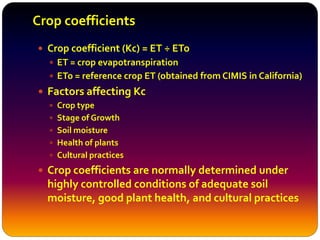
Crop coefficients
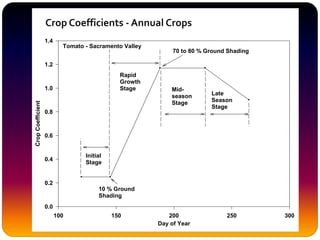
 Crop coefficient (Kc) = ET ÷ ETo
 ET = crop evapotranspiration
 ETo = reference crop ET (obtained from CIMIS in California)
 Factors affecting Kc
 Crop type
 Stage of Growth
 Soil moisture
 Health of plants
 Cultural practices
 Crop coefficients are normally determined under
highly controlled conditions of adequate soil
moisture, good plant health, and cultural practices
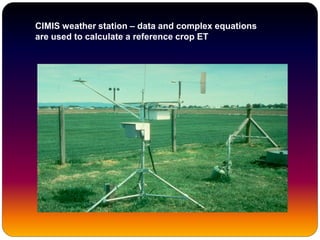
CIMIS weather station – data and complex equations
are used to calculate a reference crop ET
Day of Year
100 150 200 250 300
CropCoefficient
0.0
0.2
0.4
0.6
0.8
1.0
1.2
1.4
Tomato - Sacramento Valley
Initial
Stage
Rapid
Growth
Stage Mid-
season
Stage
Late
Season
Stage
10 % Ground
Shading
70 to 80 % Ground Shading
Crop Coefficients - Annual Crops
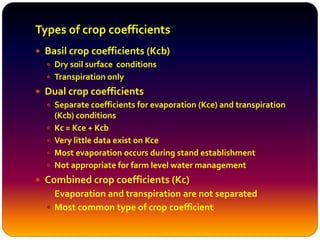
Types of crop coefficients
 Basil crop coefficients (Kcb)
 Dry soil surface conditions
 Transpiration only
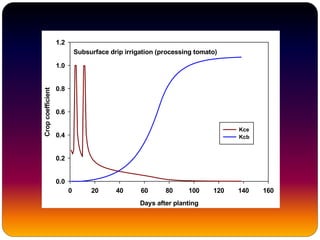
 Dual crop coefficients
 Separate coefficients for evaporation (Kce) and transpiration
(Kcb) conditions
 Kc = Kce + Kcb
 Very little data exist on Kce
 Most evaporation occurs during stand establishment
 Not appropriate for farm level water management
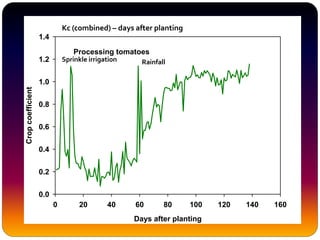
 Combined crop coefficients (Kc)
 Evaporation and transpiration are not separated
 Most common type of crop coefficient
Processing tomatoes
Days after planting
0 20 40 60 80 100 120 140 160
Cropcoefficient
0.0
0.2
0.4
0.6
0.8
1.0
1.2
1.4
Kc (combined) – days after planting
Sprinkle irrigation Rainfall
Subsurface drip irrigation (processing tomato)
Days after planting
0 20 40 60 80 100 120 140 160
Cropcoefficient
0.0
0.2
0.4
0.6
0.8
1.0
1.2
Kce
Kcb
Expressing crop coefficients (Kc)
 Kc - calendar (day of year) basis: site, time, and climate
specific
 Kc - days after planting: site, time, and climate specific
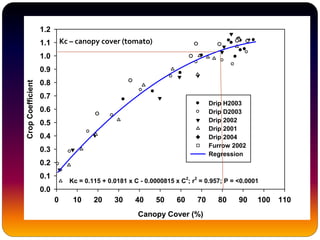
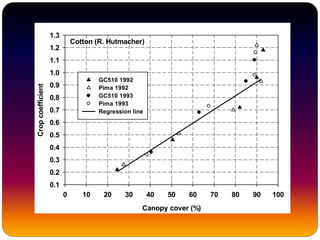
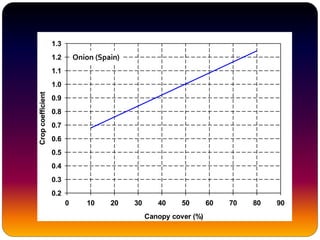
 Kc - canopy cover: universal?, limited data; requires
measuring canopy cover during the crop season
 Kc - growing degree days (heat units): universal?,
calculated values of growing degree days not available
in California
 GDD = [(Tmax –Tmin) ÷ 2] –Tbase
 Tmax = maximum daily temperature
 Tmin = minimum daily temperature
 Tbase = minimum temperature at which no plant growth occurs
Kc – day of year or days after planting
relationships
Tomatoes
Day of year
50 100 150 200 250 300
Cropcoefficient
0.0
0.2
0.4
0.6
0.8
1.0
1.2
1.4
1.6
Drip 2001
Furrow 2002
Drip 2002
Drip D 2003
Drip H 2003
Drip 2004
Furrow 2004
Crop coefficient – day of year
Day of Year
40 60 80 100 120 140 160 180 200 220 240 260 280 300
CropCoefficient
0.0
0.1
0.2
0.3
0.4
0.5
0.6
0.7
0.8
0.9
1.0
1.1
1.2
1 Mar.
2 Apr.
1 May
25 May
1 Mar. 1 Apr. 1 May 1 Jun. 1 Jul. 1 Aug. 1 Sept. 1 Oct.
Planting Dates
Tomatoes Kc – day of year
Kc – days after plantingTomatoes (San Joaquin Valley)
Days after planting
0 20 40 60 80 100 120 140 160
Cropcoefficient
0.0
0.2
0.4
0.6
0.8
1.0
1.2
1.4
1.6
2001 drip
2002 furrow
2002 drip
2003 drp1
2003 drip2
2004 drip
2004 furrow
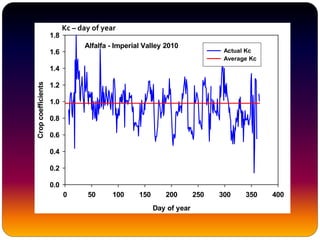
Alfalfa - Imperial Valley 2010
Day of year
0 50 100 150 200 250 300 350 400
Cropcoefficients
0.0
0.2
0.4
0.6
0.8
1.0
1.2
1.4
1.6
1.8
Actual Kc
Average Kc
Kc – day of year
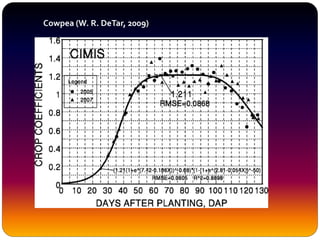
Cowpea (W. R. DeTar, 2009)
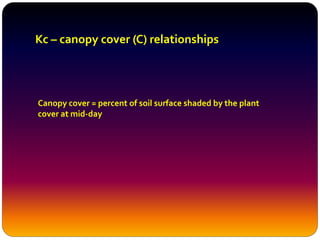
Kc – canopy cover (C) relationships
Canopy cover = percent of soil surface shaded by the plant
cover at mid-day
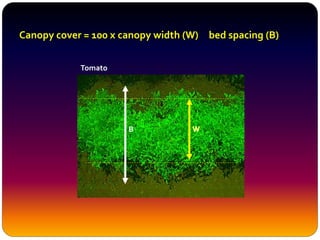
Canopy cover = 100 x canopy width (W) bed spacing (B)
B
Tomato
Canopy Cover (%)
0 10 20 30 40 50 60 70 80 90 100 110
CropCoefficient
0.0
0.1
0.2
0.3
0.4
0.5
0.6
0.7
0.8
0.9
1.0
1.1
1.2
Drip H2003
Drip D2003
Drip 2002
Drip 2001
Drip 2004
Furrow 2002
Regression
Kc = 0.115 + 0.0181 x C - 0.0000815 x C2
; r2
= 0.957; P = <0.0001
Kc – canopy cover (tomato)
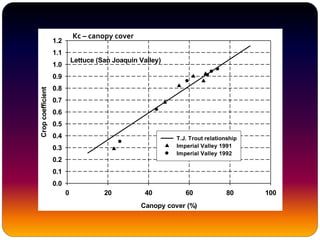
Lettuce (San Joaquin Valley)
Canopy cover (%)
0 20 40 60 80 100
Cropcoefficient
0.0
0.1
0.2
0.3
0.4
0.5
0.6
0.7
0.8
0.9
1.0
1.1
1.2
T.J. Trout relationship
Imperial Valley 1991
Imperial Valley 1992
Kc – canopy cover
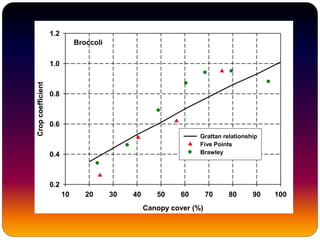
Broccoli
Canopy cover (%)
10 20 30 40 50 60 70 80 90 100
Cropcoefficient
0.2
0.4
0.6
0.8
1.0
1.2
Grattan relationship
Five Points
Brawley
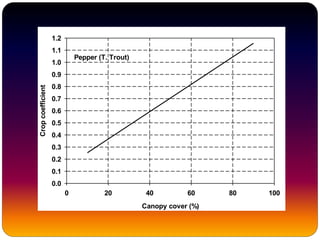
Pepper (T. Trout)
Canopy cover (%)
0 20 40 60 80 100
Cropcoefficient
0.0
0.1
0.2
0.3
0.4
0.5
0.6
0.7
0.8
0.9
1.0
1.1
1.2
Cotton (R. Hutmacher)
Canopy cover (%)
0 10 20 30 40 50 60 70 80 90 100
Cropcoefficient
0.1
0.2
0.3
0.4
0.5
0.6
0.7
0.8
0.9
1.0
1.1
1.2
1.3
GC510 1992
Pima 1992
GC510 1993
Pima 1993
Regression line
Canopy cover (%)
0 10 20 30 40 50 60 70 80 90
Cropcoefficient
0.2
0.3
0.4
0.5
0.6
0.7
0.8
0.9
1.0
1.1
1.2
1.3
Onion (Spain)
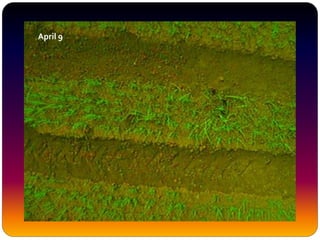
April 9
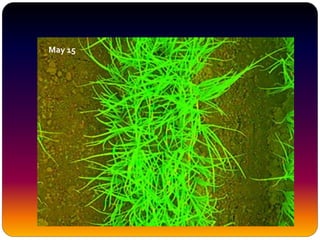
May 15
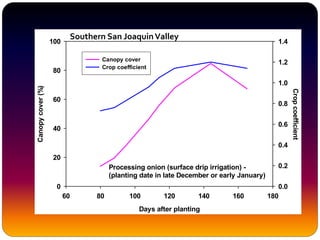
Processing onion (surface drip irrigation) -
(planting date in late December or early January)
Days after planting
60 80 100 120 140 160 180
Canopycover(%)
0
20
40
60
80
100
Cropcoefficient
0.0
0.2
0.4
0.6
0.8
1.0
1.2
1.4
Canopy cover
Crop coefficient
Southern San JoaquinValley
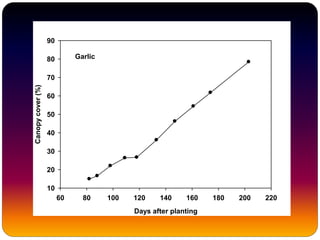
Garlic
Days after planting
60 80 100 120 140 160 180 200 220
Canopycover(%)
10
20
30
40
50
60
70
80
90
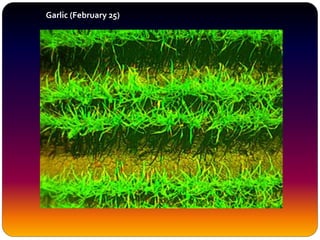
Garlic (February 25)
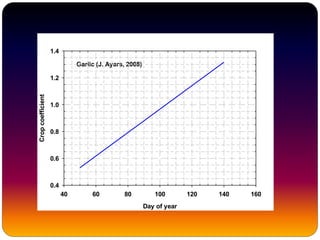
Garlic (J. Ayars, 2008)
Day of year
40 60 80 100 120 140 160
Cropcoefficient
0.4
0.6
0.8
1.0
1.2
1.4
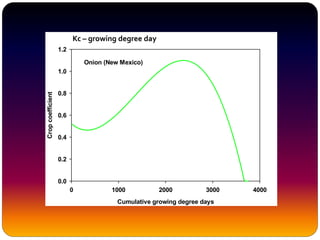
Kc – growing degree days relationships
Onion (New Mexico)
Cumulative growing degree days
0 1000 2000 3000 4000
Cropcoefficient
0.0
0.2
0.4
0.6
0.8
1.0
1.2
Kc – growing degree day
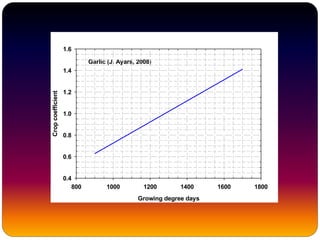
Garlic (J. Ayars, 2008)
Growing degree days
800 1000 1200 1400 1600 1800
Cropcoefficient
0.4
0.6
0.8
1.0
1.2
1.4
1.6
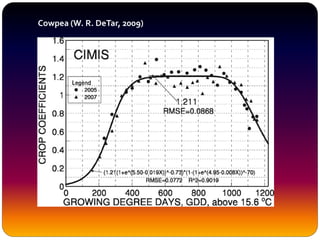
Cowpea (W. R. DeTar, 2009)
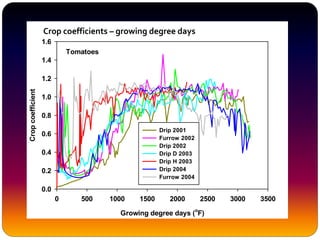
Tomatoes
Growing degree days (o
F)
0 500 1000 1500 2000 2500 3000 3500
Cropcoefficient
0.0
0.2
0.4
0.6
0.8
1.0
1.2
1.4
1.6
Drip 2001
Furrow 2002
Drip 2002
Drip D 2003
Drip H 2003
Drip 2004
Furrow 2004
Crop coefficients – growing degree days
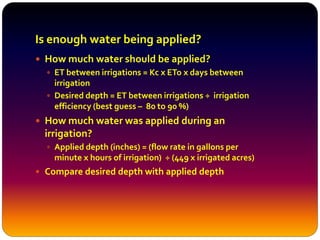
Is enough water being applied?
 How much water should be applied?
 ET between irrigations = Kc x ETo x days between
irrigation
 Desired depth = ET between irrigations ÷ irrigation
efficiency (best guess – 80 to 90 %)
 How much water was applied during an
irrigation?
 Applied depth (inches) = (flow rate in gallons per
minute x hours of irrigation) ÷ (449 x irrigated acres)
 Compare desired depth with applied depth
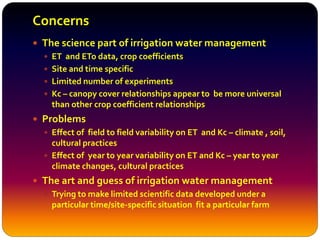
Concerns
 The science part of irrigation water management
 ET and ETo data, crop coefficients
 Site and time specific
 Limited number of experiments
 Kc – canopy cover relationships appear to be more universal
than other crop coefficient relationships
 Problems
 Effect of field to field variability on ET and Kc – climate , soil,
cultural practices
 Effect of year to year variability on ET and Kc – year to year
climate changes, cultural practices
 The art and guess of irrigation water management
 Trying to make limited scientific data developed under a
particular time/site-specific situation fit a particular farm
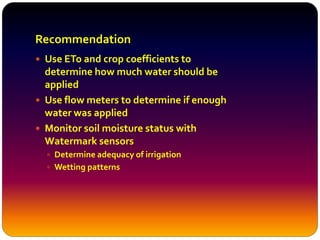
Recommendation
 Use ETo and crop coefficients to
determine how much water should be
applied
 Use flow meters to determine if enough
water was applied
 Monitor soil moisture status with
Watermark sensors
 Determine adequacy of irrigation
 Wetting patterns
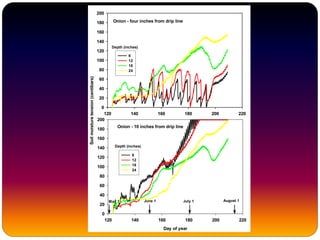
Onion - four inches from drip line
120 140 160 180 200 220
Soilmoisturetension(centibars)
0
20
40
60
80
100
120
140
160
180
200
6
12
18
24
Onion - 10 inches from drip line
Day of year
120 140 160 180 200 220
0
20
40
60
80
100
120
140
160
180
200
6
12
18
24
Depth (inches)
Depth (inches)
May 1 June 1 July 1 August 1
Life is Good

93370

  • 1.
    Crop Coefficients Blaine Hanson Departmentof Land, Air and Water Resources University of California, Davis
  • 2.
    Irrigation Water Management: Science,Art, or Guess? Blaine Hanson University of California, Davis
  • 3.
     Evapotranspiration =crop water use  Transpiration (T) - water evaporation from leaves  Evaporation (E) - water evaporation from soil  Small plant canopy – E greater thanT  Large plant canopy -T greater than E  Most of the evaporation occurs during stand establishment  More than 95% of the soil water uptake by plants becomes transpiration  Very difficult to separateT and E  Very difficult to measure ET Evapotranspiration (ET)
  • 4.
    Units of evapotranspiration Depth of water = volume of water ÷ area  1 inch of water = amount of water ponded one inch deep over 1 acre  1 foot of water = amount of water ponded one foot deep over 1 acre  Standardizes water  Independent of field size  Crop water use expressed in inches of water is the same for all fields  Volume of water (acre-inches) = inches of water x acres irrigated
  • 5.
    Crop Evapotranspiration (ET) MaximumYield Maincause of ET less than maximum ET is insufficient soil moisture Why is ET important?
  • 6.
    Processing Onion (clayloam) Applied water (inches) 0 2 4 6 8 10 12 14 16 18 20 Yield(tons/acre) 0 5 10 15 20 25 30 Yield = 0.956 x AW + 6.39; r 2 = 0.99 Note: applied water = ET
  • 7.
    Measuring evapotranspiration (ET) Difficult and expensive to measure  Even more difficult to separate transpiration and soil evaporation  Methods  Lysimeter  Meteorological methods  Soil moisture measurements  Other
  • 8.
    Lysimeter Very expensive Not practicalfor commercial field measurements Soil/crop characteristics inside lysimeter similar to those in immediate vicinity Potential for accurate measurements Daily/hourly values
  • 9.
    Micrometeorological Methods Net radiation,air temperature, humidity, wind speed, soil temperature, soil heat flux Moderate expense Flexible – can be use in commercial fields Reasonable accuracy under proper conditions Measurements reflect field-wide conditions Fetch requirements, sensor damage, data logger problems Daily/hourly data Eddy Covariance Bowen ratio Surface renewal
  • 10.
    Soil moisture measurements Relativelyinexpensive Flexible – can be used in commercial fields Suitable method – accurate if properly calibrated, volume of soil measured, measurement location relative to root distribution, etc. Assumes change in soil moisture over time equals ET (may not be appropriate under shallow ground water conditions) Missing data due to inaccessibility during and just after irrigation Daily/hourly values not practical
  • 11.
    Subsurface drip irrigation(processing tomato) Days after planting 0 20 40 60 80 100 120 140 160 Dailyevapotranspiration(inchesperday) 0.0 0.1 0.2 0.3 0.4 Evapotranspirattion (ET) Reference ET (ETo)
  • 12.
    Subsurface drip irrigation(processing tomato) Days after planting 0 20 40 60 80 100 120 140 160 YData 0.0 0.1 0.2 0.3 0.4 0.5 ET E T ETo Sprinkle irrigation E = 8%;T= 92%
  • 13.
    Furrow irrigation (processingtomato) Days after planting 0 20 40 60 80 100 120 140 YData 0.0 0.1 0.2 0.3 0.4 0.5 ET E T ETo Sprinkle irrigation Furrow irrigation E = 15%;T = 85%
  • 14.
    Sacramento Valley (CH2)2006 Day of year 0 50 100 150 200 250 300 350 400 Dailyevapotranspiration(inches/day) 0.00 0.05 0.10 0.15 0.20 0.25 0.30 0.35 0.40 Reference ET ET Date Jun 1 May 1 Jul 1 Aug 1 Sep 1 Apr 1 Mar 1 Oct 1 Nov 1 (Alfalfa)
  • 15.
    Estimating ET atthe farm level  ET = Kc x ETo  Kc = crop coefficient (crop type, stage of growth, plant health)  ETo = reference crop ET  ET of well-watered grass (California) or alfalfa (Idaho)  Determined from climatic data and complex equations developed experimentally  California Irrigation Management Information System (CIMIS)  Network of weather stations used to collect climate data for calculating ETo  Installed by UCD /DWR and maintained by DWR
  • 16.
    Crop coefficients  Cropcoefficient (Kc) = ET ÷ ETo  ET = crop evapotranspiration  ETo = reference crop ET (obtained from CIMIS in California)  Factors affecting Kc  Crop type  Stage of Growth  Soil moisture  Health of plants  Cultural practices  Crop coefficients are normally determined under highly controlled conditions of adequate soil moisture, good plant health, and cultural practices
  • 17.
    CIMIS weather station– data and complex equations are used to calculate a reference crop ET
  • 18.
    Day of Year 100150 200 250 300 CropCoefficient 0.0 0.2 0.4 0.6 0.8 1.0 1.2 1.4 Tomato - Sacramento Valley Initial Stage Rapid Growth Stage Mid- season Stage Late Season Stage 10 % Ground Shading 70 to 80 % Ground Shading Crop Coefficients - Annual Crops
  • 19.
    Types of cropcoefficients  Basil crop coefficients (Kcb)  Dry soil surface conditions  Transpiration only  Dual crop coefficients  Separate coefficients for evaporation (Kce) and transpiration (Kcb) conditions  Kc = Kce + Kcb  Very little data exist on Kce  Most evaporation occurs during stand establishment  Not appropriate for farm level water management  Combined crop coefficients (Kc)  Evaporation and transpiration are not separated  Most common type of crop coefficient
  • 20.
    Processing tomatoes Days afterplanting 0 20 40 60 80 100 120 140 160 Cropcoefficient 0.0 0.2 0.4 0.6 0.8 1.0 1.2 1.4 Kc (combined) – days after planting Sprinkle irrigation Rainfall
  • 21.
    Subsurface drip irrigation(processing tomato) Days after planting 0 20 40 60 80 100 120 140 160 Cropcoefficient 0.0 0.2 0.4 0.6 0.8 1.0 1.2 Kce Kcb
  • 22.
    Expressing crop coefficients(Kc)  Kc - calendar (day of year) basis: site, time, and climate specific  Kc - days after planting: site, time, and climate specific  Kc - canopy cover: universal?, limited data; requires measuring canopy cover during the crop season  Kc - growing degree days (heat units): universal?, calculated values of growing degree days not available in California  GDD = [(Tmax –Tmin) ÷ 2] –Tbase  Tmax = maximum daily temperature  Tmin = minimum daily temperature  Tbase = minimum temperature at which no plant growth occurs
  • 23.
    Kc – dayof year or days after planting relationships
  • 24.
    Tomatoes Day of year 50100 150 200 250 300 Cropcoefficient 0.0 0.2 0.4 0.6 0.8 1.0 1.2 1.4 1.6 Drip 2001 Furrow 2002 Drip 2002 Drip D 2003 Drip H 2003 Drip 2004 Furrow 2004 Crop coefficient – day of year
  • 25.
    Day of Year 4060 80 100 120 140 160 180 200 220 240 260 280 300 CropCoefficient 0.0 0.1 0.2 0.3 0.4 0.5 0.6 0.7 0.8 0.9 1.0 1.1 1.2 1 Mar. 2 Apr. 1 May 25 May 1 Mar. 1 Apr. 1 May 1 Jun. 1 Jul. 1 Aug. 1 Sept. 1 Oct. Planting Dates Tomatoes Kc – day of year
  • 26.
    Kc – daysafter plantingTomatoes (San Joaquin Valley) Days after planting 0 20 40 60 80 100 120 140 160 Cropcoefficient 0.0 0.2 0.4 0.6 0.8 1.0 1.2 1.4 1.6 2001 drip 2002 furrow 2002 drip 2003 drp1 2003 drip2 2004 drip 2004 furrow
  • 27.
    Alfalfa - ImperialValley 2010 Day of year 0 50 100 150 200 250 300 350 400 Cropcoefficients 0.0 0.2 0.4 0.6 0.8 1.0 1.2 1.4 1.6 1.8 Actual Kc Average Kc Kc – day of year
  • 28.
    Cowpea (W. R.DeTar, 2009)
  • 29.
    Kc – canopycover (C) relationships Canopy cover = percent of soil surface shaded by the plant cover at mid-day
  • 30.
    Canopy cover =100 x canopy width (W) bed spacing (B) B Tomato
  • 31.
    Canopy Cover (%) 010 20 30 40 50 60 70 80 90 100 110 CropCoefficient 0.0 0.1 0.2 0.3 0.4 0.5 0.6 0.7 0.8 0.9 1.0 1.1 1.2 Drip H2003 Drip D2003 Drip 2002 Drip 2001 Drip 2004 Furrow 2002 Regression Kc = 0.115 + 0.0181 x C - 0.0000815 x C2 ; r2 = 0.957; P = <0.0001 Kc – canopy cover (tomato)
  • 32.
    Lettuce (San JoaquinValley) Canopy cover (%) 0 20 40 60 80 100 Cropcoefficient 0.0 0.1 0.2 0.3 0.4 0.5 0.6 0.7 0.8 0.9 1.0 1.1 1.2 T.J. Trout relationship Imperial Valley 1991 Imperial Valley 1992 Kc – canopy cover
  • 33.
    Broccoli Canopy cover (%) 1020 30 40 50 60 70 80 90 100 Cropcoefficient 0.2 0.4 0.6 0.8 1.0 1.2 Grattan relationship Five Points Brawley
  • 34.
    Pepper (T. Trout) Canopycover (%) 0 20 40 60 80 100 Cropcoefficient 0.0 0.1 0.2 0.3 0.4 0.5 0.6 0.7 0.8 0.9 1.0 1.1 1.2
  • 35.
    Cotton (R. Hutmacher) Canopycover (%) 0 10 20 30 40 50 60 70 80 90 100 Cropcoefficient 0.1 0.2 0.3 0.4 0.5 0.6 0.7 0.8 0.9 1.0 1.1 1.2 1.3 GC510 1992 Pima 1992 GC510 1993 Pima 1993 Regression line
  • 36.
    Canopy cover (%) 010 20 30 40 50 60 70 80 90 Cropcoefficient 0.2 0.3 0.4 0.5 0.6 0.7 0.8 0.9 1.0 1.1 1.2 1.3 Onion (Spain)
  • 37.
  • 38.
  • 39.
    Processing onion (surfacedrip irrigation) - (planting date in late December or early January) Days after planting 60 80 100 120 140 160 180 Canopycover(%) 0 20 40 60 80 100 Cropcoefficient 0.0 0.2 0.4 0.6 0.8 1.0 1.2 1.4 Canopy cover Crop coefficient Southern San JoaquinValley
  • 40.
    Garlic Days after planting 6080 100 120 140 160 180 200 220 Canopycover(%) 10 20 30 40 50 60 70 80 90
  • 41.
  • 42.
    Garlic (J. Ayars,2008) Day of year 40 60 80 100 120 140 160 Cropcoefficient 0.4 0.6 0.8 1.0 1.2 1.4
  • 43.
    Kc – growingdegree days relationships
  • 44.
    Onion (New Mexico) Cumulativegrowing degree days 0 1000 2000 3000 4000 Cropcoefficient 0.0 0.2 0.4 0.6 0.8 1.0 1.2 Kc – growing degree day
  • 45.
    Garlic (J. Ayars,2008) Growing degree days 800 1000 1200 1400 1600 1800 Cropcoefficient 0.4 0.6 0.8 1.0 1.2 1.4 1.6
  • 46.
    Cowpea (W. R.DeTar, 2009)
  • 47.
    Tomatoes Growing degree days(o F) 0 500 1000 1500 2000 2500 3000 3500 Cropcoefficient 0.0 0.2 0.4 0.6 0.8 1.0 1.2 1.4 1.6 Drip 2001 Furrow 2002 Drip 2002 Drip D 2003 Drip H 2003 Drip 2004 Furrow 2004 Crop coefficients – growing degree days
  • 48.
    Is enough waterbeing applied?  How much water should be applied?  ET between irrigations = Kc x ETo x days between irrigation  Desired depth = ET between irrigations ÷ irrigation efficiency (best guess – 80 to 90 %)  How much water was applied during an irrigation?  Applied depth (inches) = (flow rate in gallons per minute x hours of irrigation) ÷ (449 x irrigated acres)  Compare desired depth with applied depth
  • 49.
    Concerns  The sciencepart of irrigation water management  ET and ETo data, crop coefficients  Site and time specific  Limited number of experiments  Kc – canopy cover relationships appear to be more universal than other crop coefficient relationships  Problems  Effect of field to field variability on ET and Kc – climate , soil, cultural practices  Effect of year to year variability on ET and Kc – year to year climate changes, cultural practices  The art and guess of irrigation water management  Trying to make limited scientific data developed under a particular time/site-specific situation fit a particular farm
  • 50.
    Recommendation  Use EToand crop coefficients to determine how much water should be applied  Use flow meters to determine if enough water was applied  Monitor soil moisture status with Watermark sensors  Determine adequacy of irrigation  Wetting patterns
  • 51.
    Onion - fourinches from drip line 120 140 160 180 200 220 Soilmoisturetension(centibars) 0 20 40 60 80 100 120 140 160 180 200 6 12 18 24 Onion - 10 inches from drip line Day of year 120 140 160 180 200 220 0 20 40 60 80 100 120 140 160 180 200 6 12 18 24 Depth (inches) Depth (inches) May 1 June 1 July 1 August 1
  • 52.