OK. So you have to do research.

         NOW WHAT?
Got your topic? Narrow it down.

Identify related ideas
Identify specific people, events, places
    For example. Your teacher wants you to research World War
     II.
        Google World War II.
        How many results did you get?
    There’s no way to do research on the whole entire war. Narrow
     it down to World War II…Europe…D-Day.
        Now Google D-Day
        How many results did you get?
        Fewer or more than World War II?
        Could you narrow D-Day down even further? How?
Now figure out some search terms.

What other terms are related to D-Day?
    People
    Places
    Dates
    Events
    Battles
Now go to Google and search for “Normandy + D-
 Day”
    How many search results were returned?
    Can you tell which are reliable?
It’s on the web so it’s reliable. Right??

There are lots of different types of websites and with
 technology today, ANYONE can make a website. Learn to
 distinguish reliable from unreliable and ONLY use reliable
 sites.
    .com – a commercial site typically sponsored by a company or for the
     purpose of making money
    .gov – a government site typically provided for informational purposes
    .edu – an educational site typically provided for educational purposes
    .org – an organization’s site typically provided for informational
     purposes of that particular organization
There are others (.net, .mil) but these are most common.
 Look over the website to determine if the site looks
 professionally made and who sponsors the page. Be
 cautious of Wikipedia.
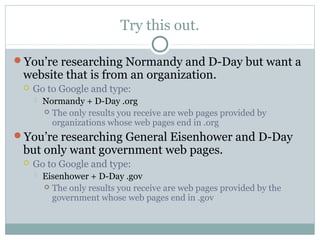
Try this out.

You’re researching Normandy and D-Day but want a
 website that is from an organization.
    Go to Google and type:
        Normandy + D-Day .org
          The only results you receive are web pages provided by
           organizations whose web pages end in .org
You’re researching General Eisenhower and D-Day
 but only want government web pages.
    Go to Google and type:
        Eisenhower + D-Day .gov
          The only results you receive are web pages provided by the
           government whose web pages end in .gov
But what about primary and secondary sources?

Confusing, I know. Let’s see if we can figure them out…


 From: http://www.library.unr.edu/instruction/help/primary.html
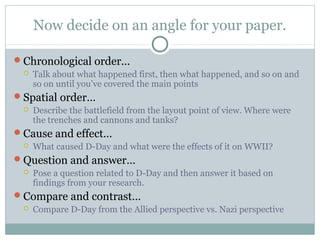
Now decide on an angle for your paper.

Chronological order…
    Talk about what happened first, then what happened, and so on and
     so on until you’ve covered the main points
Spatial order…
    Describe the battlefield from the layout point of view. Where were
     the trenches and cannons and tanks?
Cause and effect…
    What caused D-Day and what were the effects of it on WWII?
Question and answer…
    Pose a question related to D-Day and then answer it based on
     findings from your research.
Compare and contrast…
    Compare D-Day from the Allied perspective vs. Nazi perspective
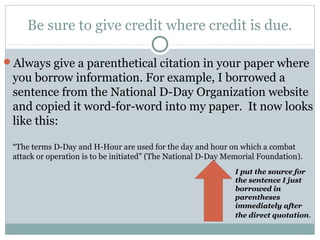
Be sure to give credit where credit is due.

Always give a parenthetical citation in your paper where
 you borrow information. For example, I borrowed a
 sentence from the National D-Day Organization website
 and copied it word-for-word into my paper. It now looks
 like this:

 “The terms D-Day and H-Hour are used for the day and hour on which a combat
 attack or operation is to be initiated” (The National D-Day Memorial Foundation).
                                                               I put the source for
                                                               the sentence I just
                                                               borrowed in
                                                               parentheses
                                                               immediately after
                                                               the direct quotation.
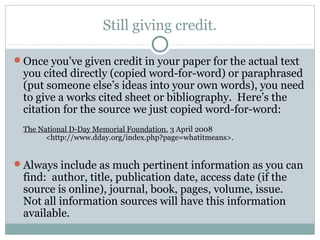
Still giving credit.

Once you’ve given credit in your paper for the actual text
 you cited directly (copied word-for-word) or paraphrased
 (put someone else’s ideas into your own words), you need
 to give a works cited sheet or bibliography. Here’s the
 citation for the source we just copied word-for-word:
 The National D-Day Memorial Foundation. 3 April 2008
       <http://www.dday.org/index.php?page=whatitmeans>.


Always include as much pertinent information as you can
 find: author, title, publication date, access date (if the
 source is online), journal, book, pages, volume, issue.
 Not all information sources will have this information
 available.
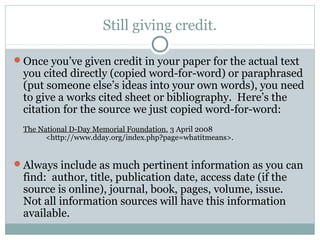
Still giving credit.

Once you’ve given credit in your paper for the actual text
 you cited directly (copied word-for-word) or paraphrased
 (put someone else’s ideas into your own words), you need
 to give a works cited sheet or bibliography. Here’s the
 citation for the source we just copied word-for-word:
 The National D-Day Memorial Foundation. 3 April 2008
       <http://www.dday.org/index.php?page=whatitmeans>.


Always include as much pertinent information as you can
 find: author, title, publication date, access date (if the
 source is online), journal, book, pages, volume, issue.
 Not all information sources will have this information
 available.

8th grade research

  • 1.
    OK. So youhave to do research. NOW WHAT?
  • 2.
    Got your topic?Narrow it down. Identify related ideas Identify specific people, events, places  For example. Your teacher wants you to research World War II.  Google World War II.  How many results did you get?  There’s no way to do research on the whole entire war. Narrow it down to World War II…Europe…D-Day.  Now Google D-Day  How many results did you get?  Fewer or more than World War II?  Could you narrow D-Day down even further? How?
  • 3.
    Now figure outsome search terms. What other terms are related to D-Day?  People  Places  Dates  Events  Battles Now go to Google and search for “Normandy + D- Day”  How many search results were returned?  Can you tell which are reliable?
  • 4.
    It’s on theweb so it’s reliable. Right?? There are lots of different types of websites and with technology today, ANYONE can make a website. Learn to distinguish reliable from unreliable and ONLY use reliable sites.  .com – a commercial site typically sponsored by a company or for the purpose of making money  .gov – a government site typically provided for informational purposes  .edu – an educational site typically provided for educational purposes  .org – an organization’s site typically provided for informational purposes of that particular organization There are others (.net, .mil) but these are most common. Look over the website to determine if the site looks professionally made and who sponsors the page. Be cautious of Wikipedia.
  • 5.
    Try this out. You’reresearching Normandy and D-Day but want a website that is from an organization.  Go to Google and type:  Normandy + D-Day .org  The only results you receive are web pages provided by organizations whose web pages end in .org You’re researching General Eisenhower and D-Day but only want government web pages.  Go to Google and type:  Eisenhower + D-Day .gov  The only results you receive are web pages provided by the government whose web pages end in .gov
  • 6.
    But what aboutprimary and secondary sources? Confusing, I know. Let’s see if we can figure them out…  From: http://www.library.unr.edu/instruction/help/primary.html
  • 7.
    Now decide onan angle for your paper. Chronological order…  Talk about what happened first, then what happened, and so on and so on until you’ve covered the main points Spatial order…  Describe the battlefield from the layout point of view. Where were the trenches and cannons and tanks? Cause and effect…  What caused D-Day and what were the effects of it on WWII? Question and answer…  Pose a question related to D-Day and then answer it based on findings from your research. Compare and contrast…  Compare D-Day from the Allied perspective vs. Nazi perspective
  • 8.
    Be sure togive credit where credit is due. Always give a parenthetical citation in your paper where you borrow information. For example, I borrowed a sentence from the National D-Day Organization website and copied it word-for-word into my paper. It now looks like this: “The terms D-Day and H-Hour are used for the day and hour on which a combat attack or operation is to be initiated” (The National D-Day Memorial Foundation). I put the source for the sentence I just borrowed in parentheses immediately after the direct quotation.
  • 9.
    Still giving credit. Onceyou’ve given credit in your paper for the actual text you cited directly (copied word-for-word) or paraphrased (put someone else’s ideas into your own words), you need to give a works cited sheet or bibliography. Here’s the citation for the source we just copied word-for-word: The National D-Day Memorial Foundation. 3 April 2008 <http://www.dday.org/index.php?page=whatitmeans>. Always include as much pertinent information as you can find: author, title, publication date, access date (if the source is online), journal, book, pages, volume, issue. Not all information sources will have this information available.
  • 10.
    Still giving credit. Onceyou’ve given credit in your paper for the actual text you cited directly (copied word-for-word) or paraphrased (put someone else’s ideas into your own words), you need to give a works cited sheet or bibliography. Here’s the citation for the source we just copied word-for-word: The National D-Day Memorial Foundation. 3 April 2008 <http://www.dday.org/index.php?page=whatitmeans>. Always include as much pertinent information as you can find: author, title, publication date, access date (if the source is online), journal, book, pages, volume, issue. Not all information sources will have this information available.