Learning Objectives:
• Learnabout life in
18th century China by
examining a series of
historical paintings
about an 18th century
Qing dynasty.
3.
Success criteria
• Studentswill be able to identify and
describe key elements in the
paintings that reflect everyday life in
18th-century Qing dynasty China.
• Students will be able to analyze the
significance of the cultural and
social activities depicted in the
paintings and explain their
relevance to life in the Qing dynasty.
• Students will be able to compare the
historical context of life in the 18th
century Qing dynasty as depicted in
the paintings with another historical
period or culture, highlighting
differences and similarities.
4.
Historical paintings fromthe 18th century
China can provide valuable insights into
various aspects of the said time period,
including its culture, society, politics, and
artistic developments. Here are some of
the things that historical paintings can tell
us about 18th century China
• Daily Life and Society
• Urban and Rural Landscapes
• Imperial Court
• Religion and Spirituality
• Artistic Styles and Techniques
• Cultural Exchange
• Historical Events
• Fashion and Textiles
• Symbolism and Allegory
• Cultural Values and Norms
What can historical
paintings tell us
about 18th century
China?
The Artistic Journeyof Xu Yang: Exploring Folded Books
Xu Yang is a renowned artist from China who has made significant contributions to the field of book art. His
work, particularly with folded books, showcases a unique blend of traditional Chinese culture and modern
artistic expression. These two-folded books not only serve as visual art pieces but also invite viewers to
engage with the narratives they contain. The intricate designs and careful craftsmanship reflect the deep
appreciation for detail and storytelling that is a hallmark of Xu Yang's artistic style.
In one of his notable works, Xu Yang intricately incorporates elements that highlight the beauty of everyday
life, much like the Spanish-style dish depicted in the image. The image shows a tortilla española, a dish rich
in flavor and culture, which can parallel the depth found in Xu Yang's work. Just as the dish combines simple
ingredients like potatoes and onions to create something delightful, Xu Yang's folded books combine layers
of meaning and aesthetics, inviting the audience to discover the stories within. This artistic dialogue
between food and art encourages students to appreciate the nuances of culture and creativity in their own
lives.
7.
Qianlong ruled from1736-1795, one of
the longest reigning emperors in
Chinese history
THE QIANLONG EMPEROR’S
SOUTHERN INSPECTION TOUR
In 1770, Xu Yang, a Qing dynasty court painter
painted a series of twelve large silk scrolls of the
Emperor Qianlong’s tour of his country.
Qianlong ruled from 1736-1795, one of the
longest reigning emperors in Chinese history.
These scrolls provide a richly detailed view of
the social and economic life along the Grand
Canal in the Southern Chinese Suzhou Province.
The original tour was made in 1750.
The paintings were commissioned by the
emperor to mark his sixtieth birthday and the
19th anniversary of his great tour. Xu Yang
painted a total of 12 scrolls. Great attention was
paid to capturing details of everyday life. The
paintings are detailed because Suzhou, the city
shown in these scrolls, was the hometown of the
artist Xu Yang.
8.
1. Who wasXu Yang?
2. What did Xu Yang Paint?
3. How can Xu Yang’s
paintings help us
understand about the
Suzhou Province?
9.
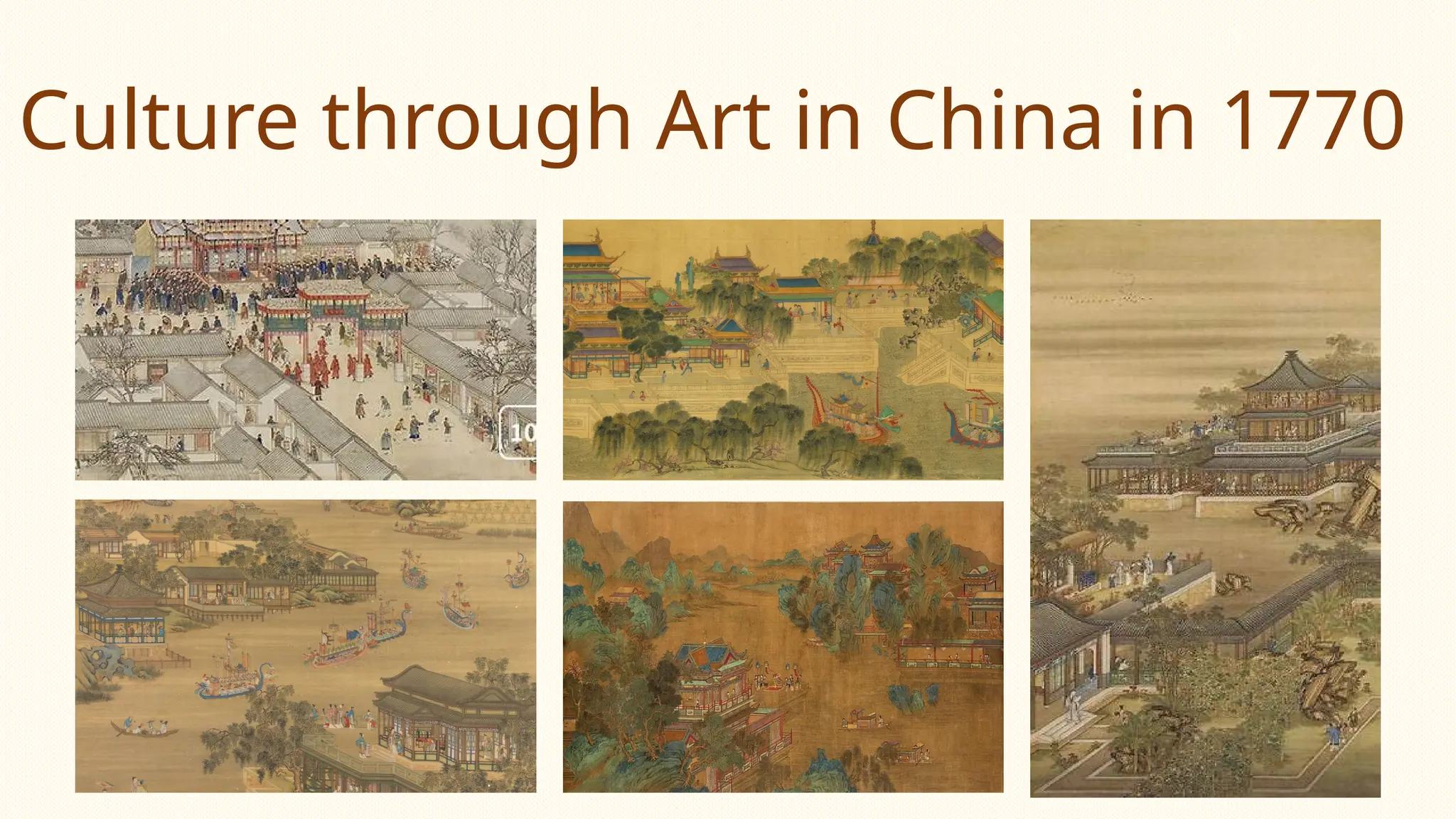
Culture Through Artin China in 1770
In 1770, China was rich in cultural traditions that were vividly expressed through various art forms. The Qing Dynasty,
which ruled during this period, witnessed a flourishing of artistic endeavors, including painting, ceramics, and textiles.
Artists often depicted scenes from daily life, historical events, and nature, showcasing the harmony and beauty of
Chinese culture. These artworks were not only a means of expression but also reflected the values and beliefs of
society, emphasizing the importance of family, respect for ancestors, and the beauty of the natural world.
Art also played a significant role in the social and political landscape of China during this time. The patronage of the
imperial court and wealthy merchants encouraged the creation of exquisite pieces that celebrated both traditional
themes and the innovations of the time. Additionally, the exchange of ideas with foreign cultures began to influence
Chinese art, leading to new styles and techniques. This blending of influences contributed to a unique artistic identity
that characterized Chinese culture in the late 18th century, leaving a lasting legacy that can still be seen in
contemporary art today.
10.
Art Forms andMaterials Used
Painting:
Artists frequently used silk and rice paper as their canvas. They employed ink and watercolors to create intricate
landscapes, portraits, and scenes depicting cultural rituals. Traditional Chinese painting emphasized brush techniques that
conveyed emotion and movement.
Ceramics:
The period is renowned for its porcelain, particularly blue and white pottery. Artisans created delicate pieces using kaolin
clay, which was fired at high temperatures. These ceramics often featured floral and geometric designs, illustrating both
nature and mythology.
Textiles:
Silk was the dominant material in textiles, used for clothing, banners, and tapestries. Weavers employed intricate patterns
and vibrant dyes, reflecting the artistry and skill of the period. The significance of these textiles extended beyond
aesthetics; they often symbolized status and wealth.
11.
Cultural Reflections
Art inthis era was not just for aesthetic pleasure; it reflected societal values and beliefs. The importance of family
and respect for ancestors was a recurring theme. Many artworks depicted familial gatherings or reverence for
historical figures, emphasizing the significance of lineage and heritage.
The Role of Patronage
The patronage of the imperial court and wealthy merchants played a crucial role in the art world. This support
encouraged the creation of exquisite pieces that celebrated traditional themes while also embracing innovations.
Artists were often commissioned to create works that highlighted the glory of the empire or depicted life in the
court.
Influence of Foreign Cultures
During this time, China began to experience an exchange of ideas with foreign cultures, which influenced its art. The
introduction of new materials and techniques led to the emergence of unique styles that blended traditional
Chinese elements with foreign influences. This fusion contributed to a distinctive artistic identity that characterized
Chinese culture in the late 18th century.
19.
• What isthe scene?
• Are there any special
man-made or natural
land feature?
• What transportation is
being used if any?
• What are people
doing?
• Are there any other
interesting elements
in the painting?
• What do you think the
houses were made of?
• Why do you think the
buildings were build
close to the canals?
• What do you see at
the top of the
painting? What does
this say about the
location of the town




![Ap art -chinese_and_korean[1]](https://cdn.slidesharecdn.com/ss_thumbnails/apart-chineseandkorean1-101220064834-phpapp01-thumbnail.jpg?width=640&height=640&fit=bounds)


![Chinese And Korean Art Slides [1]](https://cdn.slidesharecdn.com/ss_thumbnails/chineseandkoreanartslides1-100303060905-phpapp01-thumbnail.jpg?width=640&height=640&fit=bounds)


![Understanding-Conflict-and-How-to-Resolve-It_(1)[1].pptx](https://cdn.slidesharecdn.com/ss_thumbnails/understanding-conflict-and-how-to-resolve-it11-250930031203-c57caad6-thumbnail.jpg?width=640&height=640&fit=bounds)


![عربي ارادة وثبات Yvh]m , efhj.....17.pptx](https://cdn.slidesharecdn.com/ss_thumbnails/17-251006081725-4910d577-thumbnail.jpg?width=640&height=640&fit=bounds)


