Ball Mill Ventilation
GRINDING I – Training Session
Ball Mill Ventilation
KUJ - July 2012 – Grinding I - 2
General Objectives
• Gas flow is a thermal exchange support
• Heat removal in cement mills
• Heat support in raw and coal mills to dry coarse material
• Fine material transport
• Ventilation level depends on
• Workshop design: open or closed circuit
• Type of mill: compound, air swept and bi-rotator
• Nature and characteristics of the material to be ground
Ball Mill Ventilation
KUJ - July 2012 – Grinding I - 3
Objectives: Removal of fine particles
• It is essential to remove the sufficiently fine
particles, because
• They unnecessarily clutter the mill
• They reduce mill efficiency
• They may cause over-grinding
• They produce coating
• In a closed circuit, they reduce the separation efficiency by
re-agglomeration
Ball Mill Ventilation
KUJ - July 2012 – Grinding I - 4
Objectives: Cement cooling
• The purpose of cooling is even more important
• when the inlet clinker is hot
• in a closed circuit without ventilated separator
• Ventilation cooling is always preferable to water spraying
in the mill
Ex: Cement grinding with specific energy of 32 kWh/t
95% energy into heat
Cp ~ 0,75 kJ/kg°K
∆T of cement ~ 0,95 x 32 x 3600 / (1000 x 0,75) = +146°K
Specific ventilation: 0,6 Nm3/kg of dry air @ 30°C  100°C (1,3kg/Nm3)
Cp ~1,0 kJ/kg°K
∆T of cement ~ - 1,3 x 0,6 x (100 – 30) / 0,75 = -73°K
A good ventilation takes out around the half of the heat of grinding
Ball Mill Ventilation
KUJ - July 2012 – Grinding I - 5
Why do we control cement temperature?
• Attention should be paid to the outlet cement
temperature
• The mill outlet temperature should never exceed 110°C in
order to prevent excessive gypsum dehydration
(workability problems caused by false set)
• On the contrary, the temperature must not be lower than
90°C (risk of gypsum dehydration)
• Preferably the temperature should not exceed 80°C
(175°F) in the silos because otherwise, gypsum
dehydration may continue
Ball Mill Ventilation
KUJ - July 2012 – Grinding I - 6
Objectives: Drying raw materials
• Moisture reduces efficiency of grinding as it produces
coating and mud
Maximum 1,5% H2O in open circuit
2,5% H2O in close circuit
Drying chamber 1m3 for 250kg/h H2O
• Attention should be paid to the mill outlet temperature
• Mill outlet temperature must be approx. 30°C higher than the
dew point (prevent condensation in the bag filter)
• Reach low moisture content in the final product
• Avoid clogging in the silos
Ball Mill Ventilation
KUJ - July 2012 – Grinding I - 7
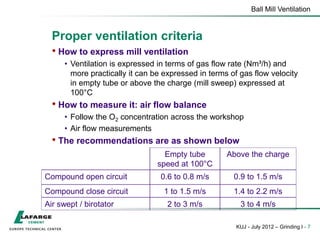
Proper ventilation criteria
• How to express mill ventilation
• Ventilation is expressed in terms of gas flow rate (Nm³/h) and
more practically it can be expressed in terms of gas flow velocity
in empty tube or above the charge (mill sweep) expressed at
100°C
• How to measure it: air flow balance
• Follow the O2 concentration across the workshop
• Air flow measurements
• The recommendations are as shown below
Empty tube
speed at 100°C
Above the charge
Compound open circuit 0.6 to 0.8 m/s 0.9 to 1.5 m/s
Compound close circuit 1 to 1.5 m/s 1.4 to 2.2 m/s
Air swept / birotator 2 to 3 m/s 3 to 4 m/s
Ball Mill Ventilation
KUJ - July 2012 – Grinding I - 8
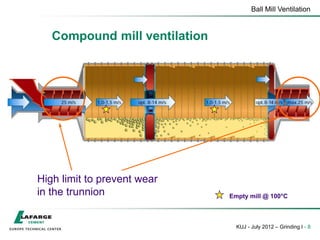
Empty mill @ 100°C
Compound mill ventilation
High limit to prevent wear
in the trunnion
Ball Mill Ventilation
KUJ - July 2012 – Grinding I - 9
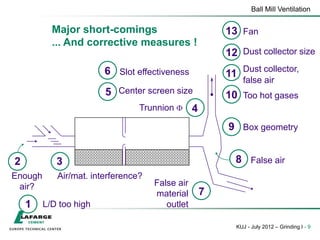
11
12 Dust collector size
Dust collector,
false air
10 Too hot gases
8 False air
9 Box geometry
7
False air
material
outlet
5 Center screen size
6 Slot effectiveness
4
Trunnion F
2
Enough
air?
3
Air/mat. interference?
1 L/D too high
13 Fan
Major short-comings
... And corrective measures !
Ball Mill Ventilation
KUJ - July 2012 – Grinding I - 10
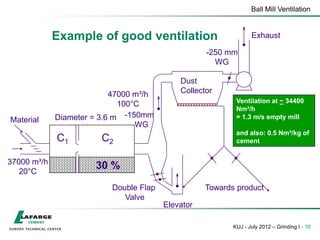
Dust
Collector
Exhaust
-250 mm
WG
C2
C1
30 %
-150mm
WG
37000 m³/h
20°C
Double Flap
Valve
Elevator
Towards product
Material
47000 m³/h
100°C Ventilation at ~ 34400
Nm³/h
= 1.3 m/s empty mill
and also: 0.5 Nm³/kg of
cement
Diameter = 3.6 m
Example of good ventilation
Ball Mill Ventilation
KUJ - July 2012 – Grinding I - 11
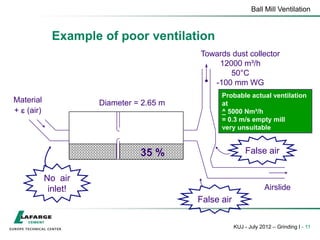
No air
inlet!
False air
False air
Material
+ e (air)
Towards dust collector
12000 m³/h
50°C
-100 mm WG
Probable actual ventilation
at
^ 5000 Nm³/h
= 0.3 m/s empty mill
very unsuitable
35 %
Airslide
Diameter = 2.65 m
Example of poor ventilation
Ball Mill Ventilation
KUJ - July 2012 – Grinding I - 12
Current control on an existing workshop
• overload at mill inlet
• slot plugging by ball or nibs
• centre screen plugging
• slot openings
• False air at outlet rotating seal
• False air at mill discharge (good work of the flap)
• False air in the filter
Ball Mill Ventilation
KUJ - July 2012 – Grinding I - 13
Ways to improve mill ventilation
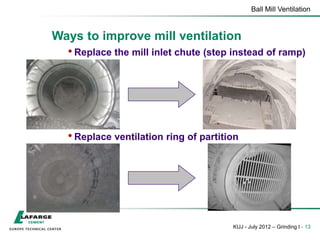
• Replace the mill inlet chute (step instead of ramp)
• Replace ventilation ring of partition
Ball Mill Ventilation
KUJ - July 2012 – Grinding I - 14
A consequence of under-ventilation
• Under-ventilated mill
• air flow over the load: 0,8 m/s, hot clinker
• Consequences
• mill outlet temperature 124 °C
• plaster false set due to excessive gypsum dehydration
3,35% of semi-hydrate instead of 1%!
Ball Mill Ventilation
KUJ - July 2012 – Grinding I - 15
A consequence of false air
Example of Le Havre plant
• False air in an Aerofall drying mill will lead to
increased costs for
• Thermal energy (drying at 400°C)
• Power consumption for ventilation
• By improving the sealing of the mill circuit, false air
was reduced by 55000 m³/h, and the gains were
40k€/year
Ball Mill Ventilation
KUJ - July 2012 – Grinding I - 16
Water Injection
• The mill ventilation system should be optimised
before considering water injection
• The water requirement to the mill should be
established by conducting a heat balance across
the mill
Ball Mill Ventilation
KUJ - July 2012 – Grinding I - 17
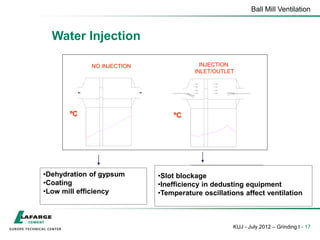
Water Injection
 Dehydratation of gypsum
 Coating
 Low mill efficiency

 Dehydratation of gypsum
Dehydratation of gypsum

 Coating
Coating

 Low mill efficiency
Low mill efficiency
 Slot blockage
 Innefficiency in
dedusting equipment
 Temperature oscilations
affects ventilation

 Slot blockage
Slot blockage

 Innefficiency in
Innefficiency in
dedusting equipment
dedusting equipment

 Temperature oscilations
Temperature oscilations
affects ventilation
affects ventilation
NO INJECTION
NO INJECTION INJECTION
INJECTION
INLET/OUTLET
INLET/OUTLET
ºC
ºC ºC
ºC
•Dehydration of gypsum
•Coating
•Low mill efficiency
•Slot blockage
•Inefficiency in dedusting equipment
•Temperature oscillations affect ventilation
Ball Mill Ventilation
KUJ - July 2012 – Grinding I - 18
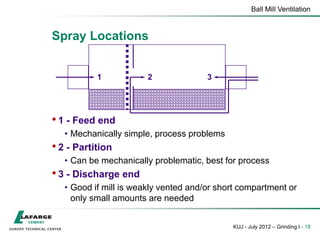
Spray Locations
• 1 - Feed end
• Mechanically simple, process problems
• 2 - Partition
• Can be mechanically problematic, best for process
• 3 - Discharge end
• Good if mill is weakly vented and/or short compartment or
only small amounts are needed
1 2 3
Ball Mill Ventilation
KUJ - July 2012 – Grinding I - 19
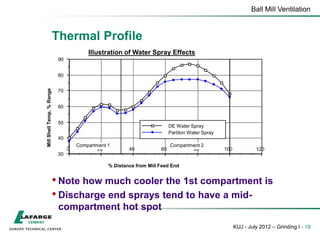
Thermal Profile
• Note how much cooler the 1st compartment is
• Discharge end sprays tend to have a mid-
compartment hot spot
120
100
80
60
40
20
0
30
40
50
60
70
80
90
DE Water Spray
Partiton Water Spray
Illustration of Water Spray Effects
% Distance from Mill Feed End
Mill
Shell
Temp,
%
Range
Compartment 1 Compartment 2
Ball Mill Ventilation
KUJ - July 2012 – Grinding I - 20
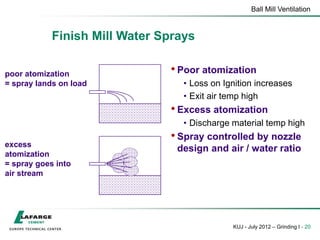
Finish Mill Water Sprays
• Poor atomization
• Loss on Ignition increases
• Exit air temp high
• Excess atomization
• Discharge material temp high
• Spray controlled by nozzle
design and air / water ratio
poor atomization
= spray lands on load
excess
atomization
= spray goes into
air stream
Ball Mill Ventilation
KUJ - July 2012 – Grinding I - 21
Water injection - Reminders
• Objective
• Decrease the temperature peak to avoid gypsum
dehydration when all action has been done on ventilation
• Current controls
• Cleaning the injection cane (good level of atomization)
• Stable flow injected
Ball Mill Ventilation
KUJ - July 2012 – Grinding I - 22
Coating and agglomeration
• Impact on separator efficiency
• Impact on ball charge efficiency
Ball Mill Ventilation
KUJ - July 2012 – Grinding I - 23
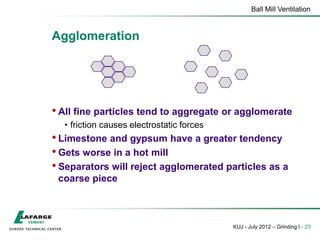
Agglomeration
• All fine particles tend to aggregate or agglomerate
• friction causes electrostatic forces
• Limestone and gypsum have a greater tendency
• Gets worse in a hot mill
• Separators will reject agglomerated particles as a
coarse piece
Ball Mill Ventilation
KUJ - July 2012 – Grinding I - 24
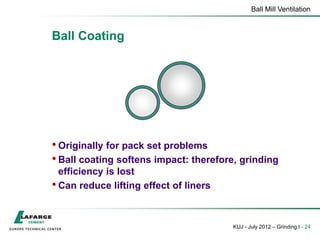
Ball Coating
• Originally for pack set problems
• Ball coating softens impact: therefore, grinding
efficiency is lost
• Can reduce lifting effect of liners
Ball Mill Ventilation
KUJ - July 2012 – Grinding I - 25
Ball Coating
• Ball coating can be a result of the following
conditions
• Too Much Moisture Input
• Poor Mill Ventilation
• Mill Overheating
• Mill Overloading
• Inadequate Grinding Aid
Adequate ventilation will help alleviate
persistent problems
Ball Mill Ventilation
KUJ - July 2012 – Grinding I - 26
Grinding Aids
• Grinding aid reduces electrostatic forces
• Most common grinding aids
• TEA (Triethanolamin)
• DEG (Diethylenglycol)
• Common Brands are Chryso and Grace
• Cost (0,6-1,2) Euro/kg
• Usage (150 - 400) g/t cement
• Before introducing new grinding aid, it needs to be
tested in the mill

827022.ppt

  • 1.
    Ball Mill Ventilation GRINDINGI – Training Session
  • 2.
    Ball Mill Ventilation KUJ- July 2012 – Grinding I - 2 General Objectives • Gas flow is a thermal exchange support • Heat removal in cement mills • Heat support in raw and coal mills to dry coarse material • Fine material transport • Ventilation level depends on • Workshop design: open or closed circuit • Type of mill: compound, air swept and bi-rotator • Nature and characteristics of the material to be ground
  • 3.
    Ball Mill Ventilation KUJ- July 2012 – Grinding I - 3 Objectives: Removal of fine particles • It is essential to remove the sufficiently fine particles, because • They unnecessarily clutter the mill • They reduce mill efficiency • They may cause over-grinding • They produce coating • In a closed circuit, they reduce the separation efficiency by re-agglomeration
  • 4.
    Ball Mill Ventilation KUJ- July 2012 – Grinding I - 4 Objectives: Cement cooling • The purpose of cooling is even more important • when the inlet clinker is hot • in a closed circuit without ventilated separator • Ventilation cooling is always preferable to water spraying in the mill Ex: Cement grinding with specific energy of 32 kWh/t 95% energy into heat Cp ~ 0,75 kJ/kg°K ∆T of cement ~ 0,95 x 32 x 3600 / (1000 x 0,75) = +146°K Specific ventilation: 0,6 Nm3/kg of dry air @ 30°C  100°C (1,3kg/Nm3) Cp ~1,0 kJ/kg°K ∆T of cement ~ - 1,3 x 0,6 x (100 – 30) / 0,75 = -73°K A good ventilation takes out around the half of the heat of grinding
  • 5.
    Ball Mill Ventilation KUJ- July 2012 – Grinding I - 5 Why do we control cement temperature? • Attention should be paid to the outlet cement temperature • The mill outlet temperature should never exceed 110°C in order to prevent excessive gypsum dehydration (workability problems caused by false set) • On the contrary, the temperature must not be lower than 90°C (risk of gypsum dehydration) • Preferably the temperature should not exceed 80°C (175°F) in the silos because otherwise, gypsum dehydration may continue
  • 6.
    Ball Mill Ventilation KUJ- July 2012 – Grinding I - 6 Objectives: Drying raw materials • Moisture reduces efficiency of grinding as it produces coating and mud Maximum 1,5% H2O in open circuit 2,5% H2O in close circuit Drying chamber 1m3 for 250kg/h H2O • Attention should be paid to the mill outlet temperature • Mill outlet temperature must be approx. 30°C higher than the dew point (prevent condensation in the bag filter) • Reach low moisture content in the final product • Avoid clogging in the silos
  • 7.
    Ball Mill Ventilation KUJ- July 2012 – Grinding I - 7 Proper ventilation criteria • How to express mill ventilation • Ventilation is expressed in terms of gas flow rate (Nm³/h) and more practically it can be expressed in terms of gas flow velocity in empty tube or above the charge (mill sweep) expressed at 100°C • How to measure it: air flow balance • Follow the O2 concentration across the workshop • Air flow measurements • The recommendations are as shown below Empty tube speed at 100°C Above the charge Compound open circuit 0.6 to 0.8 m/s 0.9 to 1.5 m/s Compound close circuit 1 to 1.5 m/s 1.4 to 2.2 m/s Air swept / birotator 2 to 3 m/s 3 to 4 m/s
  • 8.
    Ball Mill Ventilation KUJ- July 2012 – Grinding I - 8 Empty mill @ 100°C Compound mill ventilation High limit to prevent wear in the trunnion
  • 9.
    Ball Mill Ventilation KUJ- July 2012 – Grinding I - 9 11 12 Dust collector size Dust collector, false air 10 Too hot gases 8 False air 9 Box geometry 7 False air material outlet 5 Center screen size 6 Slot effectiveness 4 Trunnion F 2 Enough air? 3 Air/mat. interference? 1 L/D too high 13 Fan Major short-comings ... And corrective measures !
  • 10.
    Ball Mill Ventilation KUJ- July 2012 – Grinding I - 10 Dust Collector Exhaust -250 mm WG C2 C1 30 % -150mm WG 37000 m³/h 20°C Double Flap Valve Elevator Towards product Material 47000 m³/h 100°C Ventilation at ~ 34400 Nm³/h = 1.3 m/s empty mill and also: 0.5 Nm³/kg of cement Diameter = 3.6 m Example of good ventilation
  • 11.
    Ball Mill Ventilation KUJ- July 2012 – Grinding I - 11 No air inlet! False air False air Material + e (air) Towards dust collector 12000 m³/h 50°C -100 mm WG Probable actual ventilation at ^ 5000 Nm³/h = 0.3 m/s empty mill very unsuitable 35 % Airslide Diameter = 2.65 m Example of poor ventilation
  • 12.
    Ball Mill Ventilation KUJ- July 2012 – Grinding I - 12 Current control on an existing workshop • overload at mill inlet • slot plugging by ball or nibs • centre screen plugging • slot openings • False air at outlet rotating seal • False air at mill discharge (good work of the flap) • False air in the filter
  • 13.
    Ball Mill Ventilation KUJ- July 2012 – Grinding I - 13 Ways to improve mill ventilation • Replace the mill inlet chute (step instead of ramp) • Replace ventilation ring of partition
  • 14.
    Ball Mill Ventilation KUJ- July 2012 – Grinding I - 14 A consequence of under-ventilation • Under-ventilated mill • air flow over the load: 0,8 m/s, hot clinker • Consequences • mill outlet temperature 124 °C • plaster false set due to excessive gypsum dehydration 3,35% of semi-hydrate instead of 1%!
  • 15.
    Ball Mill Ventilation KUJ- July 2012 – Grinding I - 15 A consequence of false air Example of Le Havre plant • False air in an Aerofall drying mill will lead to increased costs for • Thermal energy (drying at 400°C) • Power consumption for ventilation • By improving the sealing of the mill circuit, false air was reduced by 55000 m³/h, and the gains were 40k€/year
  • 16.
    Ball Mill Ventilation KUJ- July 2012 – Grinding I - 16 Water Injection • The mill ventilation system should be optimised before considering water injection • The water requirement to the mill should be established by conducting a heat balance across the mill
  • 17.
    Ball Mill Ventilation KUJ- July 2012 – Grinding I - 17 Water Injection  Dehydratation of gypsum  Coating  Low mill efficiency   Dehydratation of gypsum Dehydratation of gypsum   Coating Coating   Low mill efficiency Low mill efficiency  Slot blockage  Innefficiency in dedusting equipment  Temperature oscilations affects ventilation   Slot blockage Slot blockage   Innefficiency in Innefficiency in dedusting equipment dedusting equipment   Temperature oscilations Temperature oscilations affects ventilation affects ventilation NO INJECTION NO INJECTION INJECTION INJECTION INLET/OUTLET INLET/OUTLET ºC ºC ºC ºC •Dehydration of gypsum •Coating •Low mill efficiency •Slot blockage •Inefficiency in dedusting equipment •Temperature oscillations affect ventilation
  • 18.
    Ball Mill Ventilation KUJ- July 2012 – Grinding I - 18 Spray Locations • 1 - Feed end • Mechanically simple, process problems • 2 - Partition • Can be mechanically problematic, best for process • 3 - Discharge end • Good if mill is weakly vented and/or short compartment or only small amounts are needed 1 2 3
  • 19.
    Ball Mill Ventilation KUJ- July 2012 – Grinding I - 19 Thermal Profile • Note how much cooler the 1st compartment is • Discharge end sprays tend to have a mid- compartment hot spot 120 100 80 60 40 20 0 30 40 50 60 70 80 90 DE Water Spray Partiton Water Spray Illustration of Water Spray Effects % Distance from Mill Feed End Mill Shell Temp, % Range Compartment 1 Compartment 2
  • 20.
    Ball Mill Ventilation KUJ- July 2012 – Grinding I - 20 Finish Mill Water Sprays • Poor atomization • Loss on Ignition increases • Exit air temp high • Excess atomization • Discharge material temp high • Spray controlled by nozzle design and air / water ratio poor atomization = spray lands on load excess atomization = spray goes into air stream
  • 21.
    Ball Mill Ventilation KUJ- July 2012 – Grinding I - 21 Water injection - Reminders • Objective • Decrease the temperature peak to avoid gypsum dehydration when all action has been done on ventilation • Current controls • Cleaning the injection cane (good level of atomization) • Stable flow injected
  • 22.
    Ball Mill Ventilation KUJ- July 2012 – Grinding I - 22 Coating and agglomeration • Impact on separator efficiency • Impact on ball charge efficiency
  • 23.
    Ball Mill Ventilation KUJ- July 2012 – Grinding I - 23 Agglomeration • All fine particles tend to aggregate or agglomerate • friction causes electrostatic forces • Limestone and gypsum have a greater tendency • Gets worse in a hot mill • Separators will reject agglomerated particles as a coarse piece
  • 24.
    Ball Mill Ventilation KUJ- July 2012 – Grinding I - 24 Ball Coating • Originally for pack set problems • Ball coating softens impact: therefore, grinding efficiency is lost • Can reduce lifting effect of liners
  • 25.
    Ball Mill Ventilation KUJ- July 2012 – Grinding I - 25 Ball Coating • Ball coating can be a result of the following conditions • Too Much Moisture Input • Poor Mill Ventilation • Mill Overheating • Mill Overloading • Inadequate Grinding Aid Adequate ventilation will help alleviate persistent problems
  • 26.
    Ball Mill Ventilation KUJ- July 2012 – Grinding I - 26 Grinding Aids • Grinding aid reduces electrostatic forces • Most common grinding aids • TEA (Triethanolamin) • DEG (Diethylenglycol) • Common Brands are Chryso and Grace • Cost (0,6-1,2) Euro/kg • Usage (150 - 400) g/t cement • Before introducing new grinding aid, it needs to be tested in the mill