CHAPTER 8
Compensation Administration
1
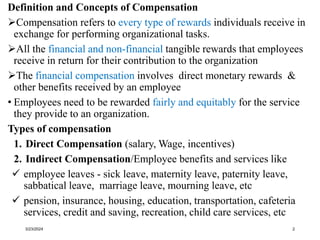
Definition and Concepts of Compensation
Compensation refers to every type of rewards individuals receive in
exchange for performing organizational tasks.
All the financial and non-financial tangible rewards that employees
receive in return for their contribution to the organization
The financial compensation involves direct monetary rewards &
other benefits received by an employee
• Employees need to be rewarded fairly and equitably for the service
they provide to an organization.
Types of compensation
1. Direct Compensation (salary, Wage, incentives)
2. Indirect Compensation/Employee benefits and services like
 employee leaves - sick leave, maternity leave, paternity leave,
sabbatical leave, marriage leave, mourning leave, etc
 pension, insurance, housing, education, transportation, cafeteria
services, credit and saving, recreation, child care services, etc
3/23/2024 2
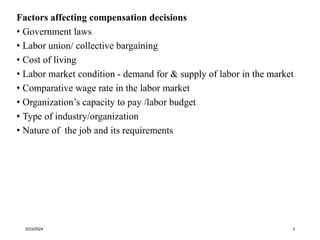
Factors affecting compensation decisions
• Government laws
• Labor union/ collective bargaining
• Cost of living
• Labor market condition - demand for & supply of labor in the market
• Comparative wage rate in the labor market
• Organization’s capacity to pay /labor budget
• Type of industry/organization
• Nature of the job and its requirements
3/23/2024 3
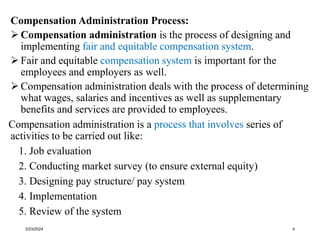
Compensation Administration Process:
 Compensation administration is the process of designing and
implementing fair and equitable compensation system.
 Fair and equitable compensation system is important for the
employees and employers as well.
 Compensation administration deals with the process of determining
what wages, salaries and incentives as well as supplementary
benefits and services are provided to employees.
Compensation administration is a process that involves series of
activities to be carried out like:
1. Job evaluation
2. Conducting market survey (to ensure external equity)
3. Designing pay structure/ pay system
4. Implementation
5. Review of the system
3/23/2024 4
1. Job evaluation
• Is a process of determining the relative value of a job in relation to
other jobs in the organization to fix remuneration/ pay
• It starts with the input/ data provided by job analysis
• It helps for fixing pay ranges and scale to different job grades and
levels
Steps in job evaluation process
1. Gather information on the job to be evaluated – this information is
is obtained from job analysis.
2. Determining factors that are to be considered in determining the
relative worth of the jobs like job duty and responsibility, working
conditions, education, skill, physical and mental effort,
experienced, etc.
3. Determining the method of evaluation like point rating method,
factor comparison, job classification, and job ranking.
4. Classifying and Grading jobs according to their relative worth
3/23/2024 5
Methods of job evaluation
I. Point rating method: a job is broken down in to factors and points
(values) are allotted to each factor and determine the value of the job
based on total points allocated to all factors. The most common job
evaluation method.
II. Simple ranking method: a job is compared with other jobs with in an
organization & given ranks from the simplest to the most complicated
ones.
III. Factor comparison method: each factor of a job is compared with the
same factor of the other jobs.
IV. Job classification method: jobs in an organization are categorized in
to different classes and grades based on the similarities and
differences
3/23/2024 6
2. Conducting pay survey
• It is used to collect comparative information on the policies, practices and
methods of wage payment from selected organizations in a given
geographic location or particular type of industry.
• Conducting wage and salary survey is useful to ensure external equity by
providing information about the labor market.
• In order for the survey to be effective, it is essential to identify the jobs to
be surveyed and also the organizations and their geographic location.
Some of the issues usually included in the survey include:
- Pay ranges (Starting wage rates and the ceil)
- Length of workday
- Overtime pay
- incentives plan
- Vacation and holyday , etc
3/23/2024 7
3. Design pay structure/ compensation system
- It involves determining pay ranges for each job class, pay level
with in a class, amount of pay increase etc.
Sound compensation system & policies must deal with the
following issues:
a) Classification and grading of jobs: defining the hierarchical
arrangement of jobs based on their relative worth
b) Pay range: determining the minimum and maximum pay scales
for a job class/grade. It is decided taking in to consideration the
worth of the job, organization’s ability to pay, government
regulations, union influences and market conditions)
c) Pay levels: pay differences within job class and job grades
d) Pay increase: the amount, how it is determined and how it ha s
to be implemented.
e) Division of the total compensation package (i.e. what portion
goes into base pay, incentive programs and benefits).
3/23/2024 8
4. Implementation and review of the system
- Providing the required compensation based on the policy
Methods of payment
There are three basic methods of payment
a) Time-based payment: it is a payment computed in terms of time such as:
hours, days, weeks, months, years, etc. Example: Monthly salary.
b) Performance-based payment method: in this method, remuneration
depends upon the quality and quantity or work.
c) Combination of time-based and output-based methods: it involves
paying salaries to employees on the basis of time (monthly) and adding
other output related payments (like bonus or commissions) to create a
financial incentive for employees.
5) Review and modify the system in light of changes like inflation, government
regulation, job requirements etc
3/23/2024 9

8. Compensation & Benefits Admnistration.ppt

  • 1.
  • 2.
    Definition and Conceptsof Compensation Compensation refers to every type of rewards individuals receive in exchange for performing organizational tasks. All the financial and non-financial tangible rewards that employees receive in return for their contribution to the organization The financial compensation involves direct monetary rewards & other benefits received by an employee • Employees need to be rewarded fairly and equitably for the service they provide to an organization. Types of compensation 1. Direct Compensation (salary, Wage, incentives) 2. Indirect Compensation/Employee benefits and services like  employee leaves - sick leave, maternity leave, paternity leave, sabbatical leave, marriage leave, mourning leave, etc  pension, insurance, housing, education, transportation, cafeteria services, credit and saving, recreation, child care services, etc 3/23/2024 2
  • 3.
    Factors affecting compensationdecisions • Government laws • Labor union/ collective bargaining • Cost of living • Labor market condition - demand for & supply of labor in the market • Comparative wage rate in the labor market • Organization’s capacity to pay /labor budget • Type of industry/organization • Nature of the job and its requirements 3/23/2024 3
  • 4.
    Compensation Administration Process: Compensation administration is the process of designing and implementing fair and equitable compensation system.  Fair and equitable compensation system is important for the employees and employers as well.  Compensation administration deals with the process of determining what wages, salaries and incentives as well as supplementary benefits and services are provided to employees. Compensation administration is a process that involves series of activities to be carried out like: 1. Job evaluation 2. Conducting market survey (to ensure external equity) 3. Designing pay structure/ pay system 4. Implementation 5. Review of the system 3/23/2024 4
  • 5.
    1. Job evaluation •Is a process of determining the relative value of a job in relation to other jobs in the organization to fix remuneration/ pay • It starts with the input/ data provided by job analysis • It helps for fixing pay ranges and scale to different job grades and levels Steps in job evaluation process 1. Gather information on the job to be evaluated – this information is is obtained from job analysis. 2. Determining factors that are to be considered in determining the relative worth of the jobs like job duty and responsibility, working conditions, education, skill, physical and mental effort, experienced, etc. 3. Determining the method of evaluation like point rating method, factor comparison, job classification, and job ranking. 4. Classifying and Grading jobs according to their relative worth 3/23/2024 5
  • 6.
    Methods of jobevaluation I. Point rating method: a job is broken down in to factors and points (values) are allotted to each factor and determine the value of the job based on total points allocated to all factors. The most common job evaluation method. II. Simple ranking method: a job is compared with other jobs with in an organization & given ranks from the simplest to the most complicated ones. III. Factor comparison method: each factor of a job is compared with the same factor of the other jobs. IV. Job classification method: jobs in an organization are categorized in to different classes and grades based on the similarities and differences 3/23/2024 6
  • 7.
    2. Conducting paysurvey • It is used to collect comparative information on the policies, practices and methods of wage payment from selected organizations in a given geographic location or particular type of industry. • Conducting wage and salary survey is useful to ensure external equity by providing information about the labor market. • In order for the survey to be effective, it is essential to identify the jobs to be surveyed and also the organizations and their geographic location. Some of the issues usually included in the survey include: - Pay ranges (Starting wage rates and the ceil) - Length of workday - Overtime pay - incentives plan - Vacation and holyday , etc 3/23/2024 7
  • 8.
    3. Design paystructure/ compensation system - It involves determining pay ranges for each job class, pay level with in a class, amount of pay increase etc. Sound compensation system & policies must deal with the following issues: a) Classification and grading of jobs: defining the hierarchical arrangement of jobs based on their relative worth b) Pay range: determining the minimum and maximum pay scales for a job class/grade. It is decided taking in to consideration the worth of the job, organization’s ability to pay, government regulations, union influences and market conditions) c) Pay levels: pay differences within job class and job grades d) Pay increase: the amount, how it is determined and how it ha s to be implemented. e) Division of the total compensation package (i.e. what portion goes into base pay, incentive programs and benefits). 3/23/2024 8
  • 9.
    4. Implementation andreview of the system - Providing the required compensation based on the policy Methods of payment There are three basic methods of payment a) Time-based payment: it is a payment computed in terms of time such as: hours, days, weeks, months, years, etc. Example: Monthly salary. b) Performance-based payment method: in this method, remuneration depends upon the quality and quantity or work. c) Combination of time-based and output-based methods: it involves paying salaries to employees on the basis of time (monthly) and adding other output related payments (like bonus or commissions) to create a financial incentive for employees. 5) Review and modify the system in light of changes like inflation, government regulation, job requirements etc 3/23/2024 9