Anthropology 152:
Culture and Humanity
Alex Golub
University of Hawai‘i at Mānoa
Introduction to the Class
Week 1 Session 1
Spring 2015
1
What is this class?
is this class?
2
How can I succeed in
it?
in it?
3
How to get an
education
education
1
What is this class?
is this class?
Anthropology 152
Culture and Humanity
Culture
Humanity
‘FGB’
Global and Multicultural
Perspectives
Global and Multicultural
Perspectives
‘FGB’“Provide thematic treatments of global
processes and cross-cultural interactions from a
variety of perspectives. Students will gain a
sense of human development from prehistory to
modern times through consideration of
narratives and artifacts from diverse cultures. At
least one component of each of these courses
will involve the indigenous cultures of Hawai'i,
the Pacific, or Asia. FGB courses cover the time
period 1500 to modern times”
2
How can I succeed in
it?
in it?
Time Commitments
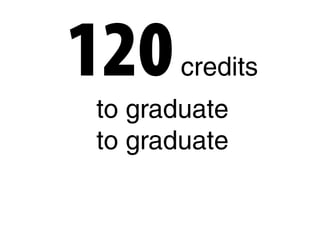
120credits
to graduate
to graduate
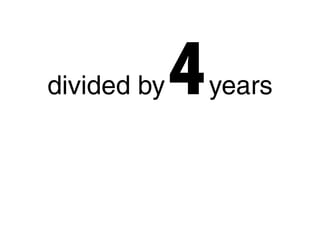
divided by 4years
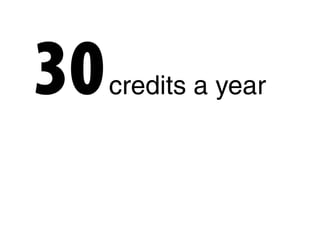
30credits a year
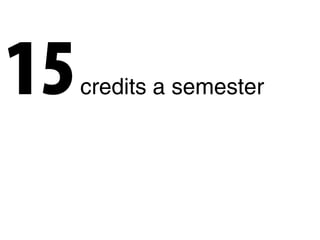
15credits a semester
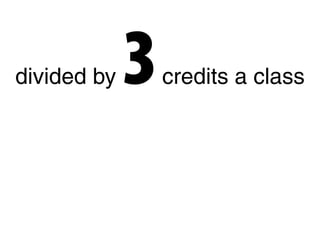
divided by 3credits a class
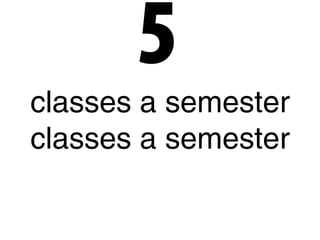
5
classes a semester
classes a semester
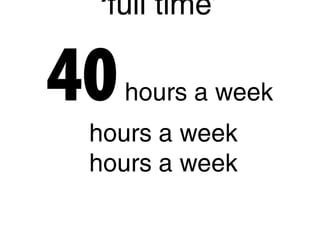
‘full time’
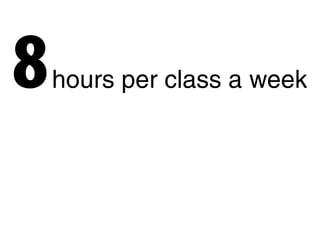
40hours a week
hours a week
hours a week
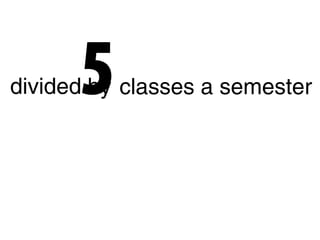
5classes a semesterdivided by
8hours per class a week
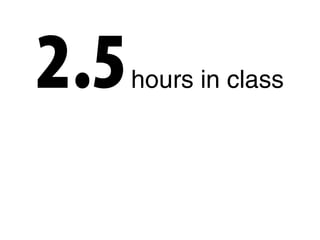
2.5hours in class
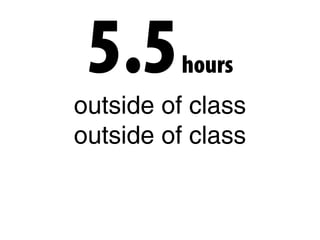
5.5hours
outside of class
outside of class
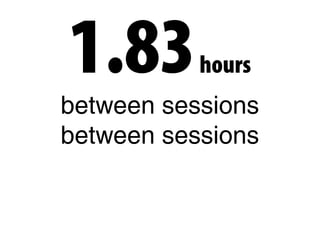
1.83hours
between sessions
between sessions
2hours
between sessions
between sessions
Grading
(where the ‘A’ is
coming from)
(where the ‘A’ is
coming from)
Clicker Questions
Midterm
Final
Culture Project
Culture Project
Culture Project
Culture Project
Attendance
10%
10%
Midterm
10%
a written description
of the way of life of a
people
a written description
of the way of life of a
people
(blah blah blah)
Midterm
10%
Final
10%
Seminar Work
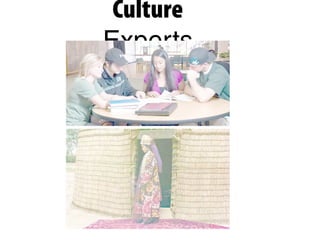
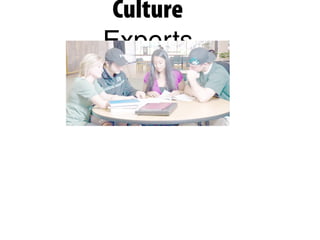
Culture
Experts
Culture
Experts
Culture
Experts
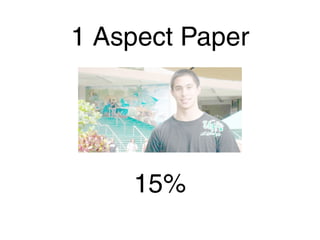
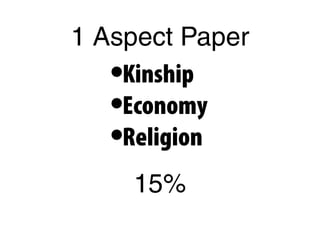
1 Aspect Paper
15%
1 Aspect Paper
15%
•Kinship
•Economy
•Religion
“Where are they
now?”
15%
6-8 smaller group
assignments
30%
3
How to get an
education
education
certification versus
education
“A liberal arts education offer[s] a broad-
based and integrated perspective on the
world and human experiences; better self-
understanding; societal, civic, and global
knowledge; an independent and inquiring
mind; a desire and capacity for life-long
learning; and valuable transferable skills.”
Liberal Arts
Fit for a free person
Not tied to vocation - flexible employment
Public use of reason for citizenship
Liberal Arts
Fit for a free person
Not tied to vocation - flexible employment
Public use of reason for citizenship
The skills needed to not be a slave
Fit for a free person
Not tied to vocation - flexible employment
Public use of reason for citizenship
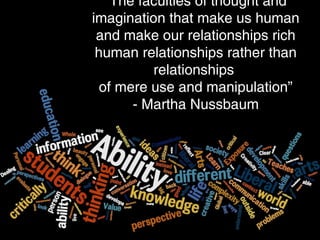
“The faculties of thought and
imagination that make us human
and make our relationships rich
human relationships rather than
relationships
of mere use and manipulation”
- Martha Nussbaum
Fit for a free person
Not tied to vocation - flexible employment
Public use of reason for citizenship
meanings, of seeking out new
connections, of investing
experience with complexity or
extension that makes it richer and
longer, even though it remains
anchored in some local bit of both
social space and social time. ”
- Andrew Abbott
Fit for a free person
Not tied to vocation - flexible employment
Public use of reason for citizenship
“To be at home in all lands and all ages;To count Nature a
familiar acquaintance,And Art an intimate friend;To gain a
standard for the appreciation of others’ workAnd the criticism of
your own;To carry the keys of the world’s library in your
pocket,And feel its resources behind you in whatever task you
undertake;To make hosts of friends . . .Who are to be leaders in
all walks of life;To lose yourself in generous enthusiasmsAnd
cooperate with others for common ends—This is the offer of the
college for the best four years of your life.”
- William DeWitt
Liberal Arts
Fit for a free person
Not tied to vocation - flexible employment
Public use of reason for citizenship
The skills needed to not be a slave
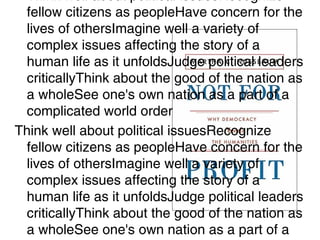
• Think well about political issuesRecognize
fellow citizens as peopleHave concern for the
lives of othersImagine well a variety of
complex issues affecting the story of a
human life as it unfoldsJudge political leaders
criticallyThink about the good of the nation as
a wholeSee one's own nation as a part of a
complicated world order
Think well about political issuesRecognize
fellow citizens as peopleHave concern for the
lives of othersImagine well a variety of
complex issues affecting the story of a
human life as it unfoldsJudge political leaders
criticallyThink about the good of the nation as
a wholeSee one's own nation as a part of a
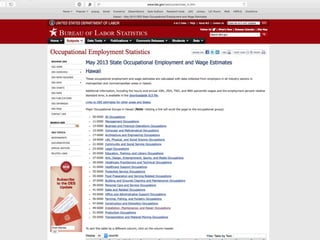
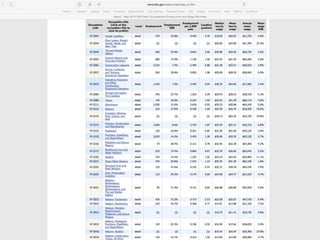
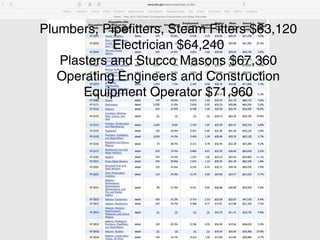
Plumbers, Pipefitters, Steam Fitters $63,120
Electrician $64,240
Plasters and Stucco Masons $67,360
Operating Engineers and Construction
Equipment Operator $71,960
Nurse Midwife $98,390
Judge $133,890
Dentist $152,000
Internist $231,000
“Being educated is your best plan for an
uncertain future”
Hobart & William Smith Colleges, business
leaders value liberal arts grads for their critical
thinking and problem-solving skills, strong writing
and speaking skills, self-discipline, exposure to
diverse ideas, and global perspective. And they
hire them because it makes good sense in a
global business environment marked by constant
change. Rather than developing a trade good for
one particular job, liberal arts graduates develop a
broad base of knowledge and skills that prepare
them for evolving challenges over the long haul.”
Source: Studley, J. (2003, Sept/Oct). Are liberal
arts dead? Careers & Colleges, 24(1), 17.
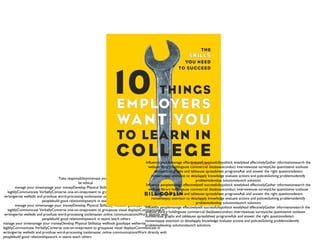
Take responsibilitymotivate yourself
be ethical
manage your timemanage your moneyDevelop Physical Skillsstay welllook goodtype wellwrite
legiblyCommunicate VerballyConverse one-on-onepresent to groupsuse visual displaysCommunicate in
writingwrite welledit and proofuse word-processing toolsmaster online communicationsWork directly with
peoplebuild good relationshipswork in teams teach others
manage your timemanage your moneyDevelop Physical Skillsstay welllook goodtype wellwrite
legiblyCommunicate VerballyConverse one-on-onepresent to groupsuse visual displaysCommunicate in
writingwrite welledit and proofuse word-processing toolsmaster online communicationsWork directly with
peoplebuild good relationshipswork in teams teach others
manage your timemanage your moneyDevelop Physical Skillsstay welllook goodtype wellwrite
legiblyCommunicate VerballyConverse one-on-onepresent to groupsuse visual displaysCommunicate in
writingwrite welledit and proofuse word-processing toolsmaster online communicationsWork directly with
peoplebuild good relationshipswork in teams teach others
Influence peoplemanage effectivelysell successfullypolitick wiselylead effectivelyGather informationsearch the
webuse library holdingsuse commercial databasesconduct interviewsuse surveysUse quantitative toolsuse
numbersuse graphs and tablesuse spreadsheet programsAsk and answer the right questionsdetect
nonsensepay attention to detailapply knowledge evaluate actions and policiesSolving problemsidentify
problemsdevelop solutionslaunch solutions
Influence peoplemanage effectivelysell successfullypolitick wiselylead effectivelyGather informationsearch the
webuse library holdingsuse commercial databasesconduct interviewsuse surveysUse quantitative toolsuse
numbersuse graphs and tablesuse spreadsheet programsAsk and answer the right questionsdetect
nonsensepay attention to detailapply knowledge evaluate actions and policiesSolving problemsidentify
problemsdevelop solutionslaunch solutions
Influence peoplemanage effectivelysell successfullypolitick wiselylead effectivelyGather informationsearch the
webuse library holdingsuse commercial databasesconduct interviewsuse surveysUse quantitative toolsuse
numbersuse graphs and tablesuse spreadsheet programsAsk and answer the right questionsdetect
nonsensepay attention to detailapply knowledge evaluate actions and policiesSolving problemsidentify
problemsdevelop solutionslaunch solutions
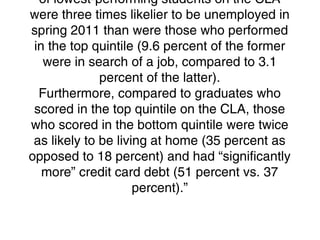
of lowest-performing students on the CLA
were three times likelier to be unemployed in
spring 2011 than were those who performed
in the top quintile (9.6 percent of the former
were in search of a job, compared to 3.1
percent of the latter).
Furthermore, compared to graduates who
scored in the top quintile on the CLA, those
who scored in the bottom quintile were twice
as likely to be living at home (35 percent as
opposed to 18 percent) and had “significantly
more” credit card debt (51 percent vs. 37
percent).”
仁
What versus How
For Next Time
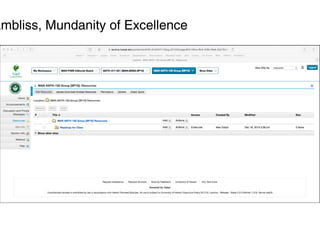
ambliss, Mundanity of Excellence

72 slides in 40 minutes

  • 1.
    Anthropology 152: Culture andHumanity Culture and Humanity Alex Golub University of Hawai‘i at Mānoa
  • 2.
    Introduction to theClass Week 1 Session 1 Spring 2015
  • 3.
    1 What is thisclass? is this class?
  • 4.
    2 How can Isucceed in it? in it?
  • 5.
    3 How to getan education education
  • 6.
    1 What is thisclass? is this class?
  • 7.
    Anthropology 152 Culture andHumanity Culture and Humanity
  • 8.
  • 9.
  • 10.
  • 11.
    ‘FGB’“Provide thematic treatmentsof global processes and cross-cultural interactions from a variety of perspectives. Students will gain a sense of human development from prehistory to modern times through consideration of narratives and artifacts from diverse cultures. At least one component of each of these courses will involve the indigenous cultures of Hawai'i, the Pacific, or Asia. FGB courses cover the time period 1500 to modern times”
  • 12.
    2 How can Isucceed in it? in it?
  • 13.
  • 14.
  • 15.
  • 16.
  • 17.
  • 18.
  • 19.
  • 20.
    ‘full time’ 40hours aweek hours a week hours a week
  • 21.
  • 22.
  • 23.
  • 24.
  • 25.
  • 26.
  • 27.
    Grading (where the ‘A’is coming from) (where the ‘A’ is coming from)
  • 28.
    Clicker Questions Midterm Final Culture Project CultureProject Culture Project Culture Project
  • 29.
  • 30.
  • 31.
  • 32.
    a written description ofthe way of life of a people a written description of the way of life of a people
  • 33.
  • 34.
  • 35.
  • 36.
  • 37.
  • 38.
  • 39.
  • 40.
  • 41.
  • 42.
  • 43.
  • 44.
    3 How to getan education education
  • 45.
  • 46.
    “A liberal artseducation offer[s] a broad- based and integrated perspective on the world and human experiences; better self- understanding; societal, civic, and global knowledge; an independent and inquiring mind; a desire and capacity for life-long learning; and valuable transferable skills.”
  • 47.
    Liberal Arts Fit fora free person Not tied to vocation - flexible employment Public use of reason for citizenship
  • 48.
    Liberal Arts Fit fora free person Not tied to vocation - flexible employment Public use of reason for citizenship The skills needed to not be a slave
  • 49.
    Fit for afree person Not tied to vocation - flexible employment Public use of reason for citizenship “The faculties of thought and imagination that make us human and make our relationships rich human relationships rather than relationships of mere use and manipulation” - Martha Nussbaum
  • 50.
    Fit for afree person Not tied to vocation - flexible employment Public use of reason for citizenship meanings, of seeking out new connections, of investing experience with complexity or extension that makes it richer and longer, even though it remains anchored in some local bit of both social space and social time. ” - Andrew Abbott
  • 51.
    Fit for afree person Not tied to vocation - flexible employment Public use of reason for citizenship “To be at home in all lands and all ages;To count Nature a familiar acquaintance,And Art an intimate friend;To gain a standard for the appreciation of others’ workAnd the criticism of your own;To carry the keys of the world’s library in your pocket,And feel its resources behind you in whatever task you undertake;To make hosts of friends . . .Who are to be leaders in all walks of life;To lose yourself in generous enthusiasmsAnd cooperate with others for common ends—This is the offer of the college for the best four years of your life.” - William DeWitt
  • 52.
    Liberal Arts Fit fora free person Not tied to vocation - flexible employment Public use of reason for citizenship The skills needed to not be a slave
  • 54.
    • Think wellabout political issuesRecognize fellow citizens as peopleHave concern for the lives of othersImagine well a variety of complex issues affecting the story of a human life as it unfoldsJudge political leaders criticallyThink about the good of the nation as a wholeSee one's own nation as a part of a complicated world order Think well about political issuesRecognize fellow citizens as peopleHave concern for the lives of othersImagine well a variety of complex issues affecting the story of a human life as it unfoldsJudge political leaders criticallyThink about the good of the nation as a wholeSee one's own nation as a part of a
  • 58.
    Plumbers, Pipefitters, SteamFitters $63,120 Electrician $64,240 Plasters and Stucco Masons $67,360 Operating Engineers and Construction Equipment Operator $71,960
  • 60.
    Nurse Midwife $98,390 Judge$133,890 Dentist $152,000 Internist $231,000
  • 61.
    “Being educated isyour best plan for an uncertain future”
  • 62.
    Hobart & WilliamSmith Colleges, business leaders value liberal arts grads for their critical thinking and problem-solving skills, strong writing and speaking skills, self-discipline, exposure to diverse ideas, and global perspective. And they hire them because it makes good sense in a global business environment marked by constant change. Rather than developing a trade good for one particular job, liberal arts graduates develop a broad base of knowledge and skills that prepare them for evolving challenges over the long haul.” Source: Studley, J. (2003, Sept/Oct). Are liberal arts dead? Careers & Colleges, 24(1), 17.
  • 64.
    Take responsibilitymotivate yourself beethical manage your timemanage your moneyDevelop Physical Skillsstay welllook goodtype wellwrite legiblyCommunicate VerballyConverse one-on-onepresent to groupsuse visual displaysCommunicate in writingwrite welledit and proofuse word-processing toolsmaster online communicationsWork directly with peoplebuild good relationshipswork in teams teach others manage your timemanage your moneyDevelop Physical Skillsstay welllook goodtype wellwrite legiblyCommunicate VerballyConverse one-on-onepresent to groupsuse visual displaysCommunicate in writingwrite welledit and proofuse word-processing toolsmaster online communicationsWork directly with peoplebuild good relationshipswork in teams teach others manage your timemanage your moneyDevelop Physical Skillsstay welllook goodtype wellwrite legiblyCommunicate VerballyConverse one-on-onepresent to groupsuse visual displaysCommunicate in writingwrite welledit and proofuse word-processing toolsmaster online communicationsWork directly with peoplebuild good relationshipswork in teams teach others Influence peoplemanage effectivelysell successfullypolitick wiselylead effectivelyGather informationsearch the webuse library holdingsuse commercial databasesconduct interviewsuse surveysUse quantitative toolsuse numbersuse graphs and tablesuse spreadsheet programsAsk and answer the right questionsdetect nonsensepay attention to detailapply knowledge evaluate actions and policiesSolving problemsidentify problemsdevelop solutionslaunch solutions Influence peoplemanage effectivelysell successfullypolitick wiselylead effectivelyGather informationsearch the webuse library holdingsuse commercial databasesconduct interviewsuse surveysUse quantitative toolsuse numbersuse graphs and tablesuse spreadsheet programsAsk and answer the right questionsdetect nonsensepay attention to detailapply knowledge evaluate actions and policiesSolving problemsidentify problemsdevelop solutionslaunch solutions Influence peoplemanage effectivelysell successfullypolitick wiselylead effectivelyGather informationsearch the webuse library holdingsuse commercial databasesconduct interviewsuse surveysUse quantitative toolsuse numbersuse graphs and tablesuse spreadsheet programsAsk and answer the right questionsdetect nonsensepay attention to detailapply knowledge evaluate actions and policiesSolving problemsidentify problemsdevelop solutionslaunch solutions
  • 65.
    of lowest-performing studentson the CLA were three times likelier to be unemployed in spring 2011 than were those who performed in the top quintile (9.6 percent of the former were in search of a job, compared to 3.1 percent of the latter). Furthermore, compared to graduates who scored in the top quintile on the CLA, those who scored in the bottom quintile were twice as likely to be living at home (35 percent as opposed to 18 percent) and had “significantly more” credit card debt (51 percent vs. 37 percent).”
  • 67.
  • 69.
  • 70.
  • 72.

Editor's Notes

  • #4 All students have 2 questions. 1: what is this class
  • #5 2 how can I succeed in it?
  • #6 and there’s a third students don’t always think about, but which I think is the most important: how will this class educate me?
  • #7 Se let’s start with 1
  • #8 This is anthropology. It’s intro to anthropology - one of the 4 subfields. Intro means its suitable for high school seniors to take.
  • #9 A tour of anthropology’s signature concept - gateway to our major
  • #10 A tour of human nature
  • #11 Fulfill global core requirement
  • #12 Here’s the technical language. Basically, a tour of the last 500 years, with some time spent on Hawaii, the Pacific, or Asia. So that’s the class.
  • #13 Now: what do you have to do to get an A?
  • #14 First, let’s talk about how much time I expect you to spend on this class.
  • #17 2 semesters, so 30/2 is 15 credits a semester
  • #21 fill time means full time people. 40 hours a week. That’s full time.
  • #24 2.5 of those 8 hours is spent in class.
  • #25 That means 5.5 hours outside class. MOST OF COLLEGE IS OUTSIDE THE CLASS. Surely you’ve noticed that. MOST LEARNING GOES ON OUTSIDE THE CLASSROOM
  • #26 5.5 hours/ divided by 3 study periods (one before each class) equals 1.83 hours of studying before class.
  • #27 I’m rounding up. I’m looking for 2 hours of studying before class.
  • #28 Now you know the time expectations. Let’s talk points
  • #30 You will have to buy a clicker. You come to class, I throw up a slide that says ‘attendance’. You click. You earn FREE POINTS for showing up. you can’t get an A if you never show up. I expect you to attend all class sessions in full. If you miss 3 or less a semester b/c of emergency, that’s fine with me -- stuff happens. Emergencies are normal. The point is: LECTURE IS NOT OPTIONAL.
  • #31 IN class, I will ask you questions. I’m not sure if you can get them wrong or not. This is basically more attendance.
  • #32 In the lecture, I will throw terms up on the screen. Typically 3-4 a class. You write them down. Or take a picture with your phone. You memorize them. You then spit them up on a multiple choice quiz.
  • #35 In the lecture, I will throw terms up on the screen. Typically 3-4 a class. You write them down. Or take a picture with your phone. You memorize them. You then spit them up on a multiple choice quiz.
  • #36 Ditto with the final. It is not cumulative. First defs on the midterm. Second set of defs on the final. The goal is not binge and purge. It is to give you practice at doing something steadily. We’ll talk more about this next time. Everything is spread out. You have to keep on showing up, day after day, and grind out that A.
  • #37 We’ll be breaking out into seminar groups. You will meet with bright and talented TAs PHILIP BROADHURST and MAURA STEPHENS. A lot of heavy stuff is going to go down in the seminars, by gum.
  • #38 In this section you will become CULTURE EXPERTS
  • #39 You will be broken into groups of 3-5 people. Just like these bright and shiny Mānoa students.
  • #40 Each group will be assigned a time and place from all over the globe from 1500 to the present. You will all do research with each other and support each other in taking lecture notes. You will complete each other. You will learn to do research in the library and develop expertise in your culture.
  • #41 Then you will each take an aspect of your culture and write a paper on it. The paper will be INDIVIDUALLY written using GROUP resources gathered in the previous weeks.
  • #42 When I lecture on kinship, someone will do a kinship paper. When I lecture on economy, someone in your group will write on economy, etc.
  • #43 Then, in the final third of class, you will collectively do a group project on where your culture is today. If you studied Uzbekistan in 1820, this paper will be on “What’s happening in Uzbekistan today”.
  • #44 Before you get to the papers there will be smaller manini research assignments. 80% of success in life is showing up, so show up for these assignments and the points won’t be an issue.
  • #56 you might be saying: I just want money
  • #70 I’ve said what anthro is and how to succeed, but I haven’t told you _how_ to succeed. We’ll do that next time.