© 2009 EMC Corporation. All rights reserved.
Introduction to Information Storage and
Management
Module 1.1
© 2009 EMC Corporation. All rights reserved. Introduction to Information Storage and Management - 2
Why Information Storage
 “Digital universe – The Information Explosion”
– 21st Century is information era
– Information is being created at ever increasing rate
– Information has become critical for success
 We live in an on-command, on-demand world
– Example: Social networking sites, e-mails, video and photo sharing
website, online shopping, search engines etc
 Information management is a big challenge
– Organization seek to Store Protect Optimize Leverage the
information optimally
© 2009 EMC Corporation. All rights reserved. Introduction to Information Storage and Management - 3
Introduction to Information Storage and Management
Upon completion of this module, you will be able to:
 Describe who is creating data and the amount of data
being created
 Describe the value of data to business
 Describe storage technology and architecture evolution
 List and explain the core elements of data center
 Describe the ILM strategy
© 2009 EMC Corporation. All rights reserved. Introduction to Information Storage and Management - 4
Lesson : Information Storage
Upon completion of this lesson, you will be able to:
 Describe the importance of information to individuals and
to businesses
 Define data and information
 Discuss the categories of data
 Describe the storage architectures and their evolution
© 2009 EMC Corporation. All rights reserved. Introduction to Information Storage and Management - 5
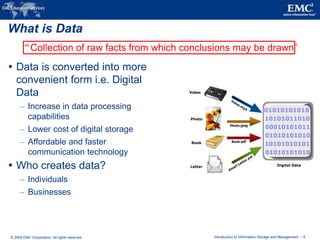
What is Data
 Data is converted into more
convenient form i.e. Digital
Data
– Increase in data processing
capabilities
– Lower cost of digital storage
– Affordable and faster
communication technology
 Who creates data?
– Individuals
– Businesses
“Collection of raw facts from which conclusions may be drawn”
01010101010
10101011010
00010101011
01010101010
10101010101
01010101010
Video
Photo
Book
Letter Digital Data
© 2009 EMC Corporation. All rights reserved. Introduction to Information Storage and Management - 6
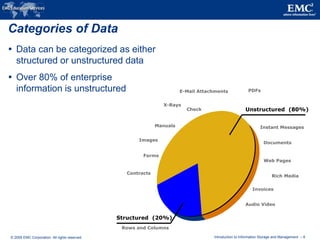
Categories of Data
 Data can be categorized as either
structured or unstructured data
 Over 80% of enterprise
information is unstructured
Rows and Columns
Contracts
Images
Manuals
X-Rays
Instant Messages
Forms
E-Mail Attachments
Check
Documents
PDFs
Web Pages
Audio Video
Invoices
Rich Media
Structured (20%)
Unstructured (80%)
© 2009 EMC Corporation. All rights reserved. Introduction to Information Storage and Management - 7
Define Information
 What do individuals/businesses
do with the data they collect?
– They turn it into “information”
– “Information is the intelligence and
knowledge derived from data”
 Businesses analyze raw data in
order to identify meaningful trends
– For example:
 Buying habits and patterns of
customers
 Health history of patients
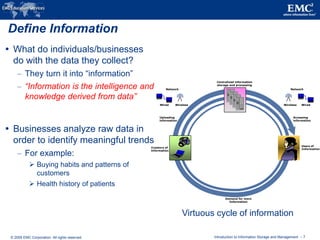
Users of
Information
Centralized information
storage and processing
Uploading
information
Accessing
information
Wired Wireless Wired
Wireless
Network Network
Demand for more
Information
Creators of
information
Virtuous cycle of information
© 2009 EMC Corporation. All rights reserved. Introduction to Information Storage and Management - 8
Value of Information to a Business
 Identifying new business opportunities
– Buying/spending patterns
 Internet stores, retail stores, supermarkets
– Customer satisfaction/service
 Tracking shipments, and deliveries
 Identifying patterns that lead to changes in existing business
– Reduced cost
 Just-in-time inventory, eliminating over-stocking of products, optimizing shipment
and delivery
– New services
 Security alerts for “stolen” credit card purchases
– Targeted marketing campaigns
 Communicate to bank customers with high account balances about a special
savings plan
 Creating a competitive advantage
© 2009 EMC Corporation. All rights reserved. Introduction to Information Storage and Management - 9
Storage
 Data created by individuals/businesses must be stored
for further processing
 Type of storage used is based on the type of data and the
rate at which it is created and used
 Examples:
– Individuals: Digital camera, Cell phone, DVD’s, Hard disk
– Businesses: Hard disk, external disk arrays, tape library
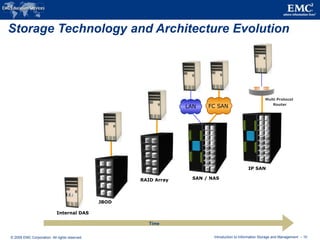
 Storage model: An evolution
– Centralized: mainframe computers
– Decentralized: Client –server model
– Centralized: Storage Networking
© 2009 EMC Corporation. All rights reserved. Introduction to Information Storage and Management - 10
Storage Technology and Architecture Evolution
IP SAN
Multi Protocol
Router
SAN / NAS
FC SAN
LAN
RAID Array
JBOD
Internal DAS
Time
© 2009 EMC Corporation. All rights reserved. Introduction to Information Storage and Management - 11
Lesson Summary
Key points covered in this lesson:
 Importance of information
 Data, information and storage
 Categories of data
 Storage architectures and their evolution
© 2009 EMC Corporation. All rights reserved. Introduction to Information Storage and Management - 12
Lesson: Data Center Infrastructure and Introduction to ILM
Upon completion of this lesson, you will be able to:
 List the five core elements of a data center infrastructure
 Describe the requirements of storage systems for
optimally supporting business activities
 Explain the importance of Information Lifecycle
Management
 List the activities in developing the ILM strategy
© 2009 EMC Corporation. All rights reserved. Introduction to Information Storage and Management - 13
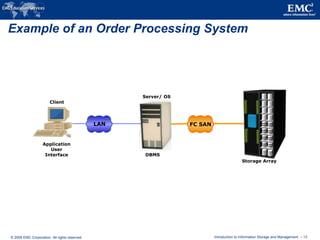
Example of an Order Processing System
LAN FC SAN
Storage Array
DBMS
Server/ OS
Application
User
Interface
Client
© 2009 EMC Corporation. All rights reserved. Introduction to Information Storage and Management - 14
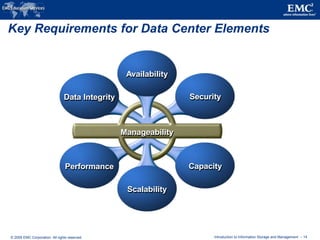
Key Requirements for Data Center Elements
Availability
Data Integrity Security
Capacity
Scalability
Performance
Manageability
© 2009 EMC Corporation. All rights reserved. Introduction to Information Storage and Management - 15
Challenges in Managing Information
 Exploding digital universe
– Multifold increase of information growth
 Increasing dependency on information
– The strategic use of information
 Changing value of information
– Information that is valuable today may become less important
tomorrow.
© 2009 EMC Corporation. All rights reserved. Introduction to Information Storage and Management - 16
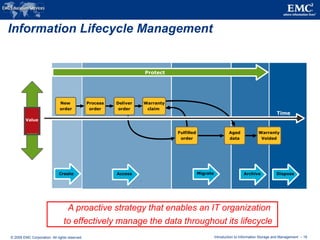
Information Lifecycle Management
Create Access Migrate Archive Dispose
New
order
Value
Process
order
Deliver
order
Warranty
claim
Fulfilled
order
Aged
data
Warranty
Voided
Protect
Time
A proactive strategy that enables an IT organization
to effectively manage the data throughout its lifecycle
© 2009 EMC Corporation. All rights reserved. Introduction to Information Storage and Management - 17
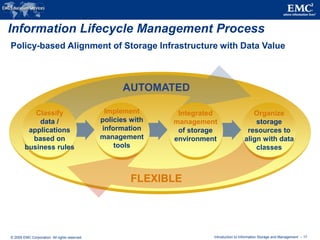
Information Lifecycle Management Process
Policy-based Alignment of Storage Infrastructure with Data Value
AUTOMATED
FLEXIBLE
Classify
data /
applications
based on
business rules
Implement
policies with
information
management
tools
Integrated
management
of storage
environment
Organize
storage
resources to
align with data
classes
© 2009 EMC Corporation. All rights reserved. Introduction to Information Storage and Management - 18
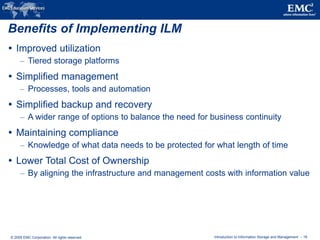
Benefits of Implementing ILM
 Improved utilization
– Tiered storage platforms
 Simplified management
– Processes, tools and automation
 Simplified backup and recovery
– A wider range of options to balance the need for business continuity
 Maintaining compliance
– Knowledge of what data needs to be protected for what length of time
 Lower Total Cost of Ownership
– By aligning the infrastructure and management costs with information value
© 2009 EMC Corporation. All rights reserved. Introduction to Information Storage and Management - 19
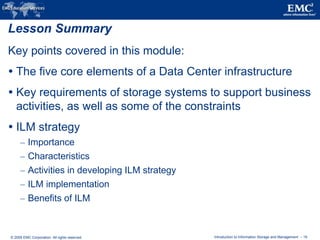
Lesson Summary
Key points covered in this module:
 The five core elements of a Data Center infrastructure
 Key requirements of storage systems to support business
activities, as well as some of the constraints
 ILM strategy
– Importance
– Characteristics
– Activities in developing ILM strategy
– ILM implementation
– Benefits of ILM
© 2009 EMC Corporation. All rights reserved. Introduction to Information Storage and Management - 20
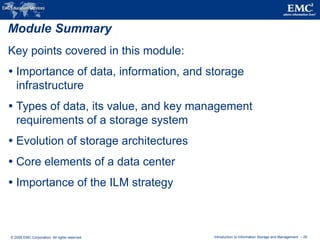
Module Summary
Key points covered in this module:
 Importance of data, information, and storage
infrastructure
 Types of data, its value, and key management
requirements of a storage system
 Evolution of storage architectures
 Core elements of a data center
 Importance of the ILM strategy
© 2009 EMC Corporation. All rights reserved. Introduction to Information Storage and Management - 21
Check Your Knowledge
 What are the two categories of data?
 What are the five core technology elements of the Data
Center Infrastructure?
 What are the seven requirements of storage technology?
 What are the benefits of ILM


70a1bee5afaa499bff2de1419845-2545809091213.ppt

  • 1.
    © 2009 EMCCorporation. All rights reserved. Introduction to Information Storage and Management Module 1.1
  • 2.
    © 2009 EMCCorporation. All rights reserved. Introduction to Information Storage and Management - 2 Why Information Storage  “Digital universe – The Information Explosion” – 21st Century is information era – Information is being created at ever increasing rate – Information has become critical for success  We live in an on-command, on-demand world – Example: Social networking sites, e-mails, video and photo sharing website, online shopping, search engines etc  Information management is a big challenge – Organization seek to Store Protect Optimize Leverage the information optimally
  • 3.
    © 2009 EMCCorporation. All rights reserved. Introduction to Information Storage and Management - 3 Introduction to Information Storage and Management Upon completion of this module, you will be able to:  Describe who is creating data and the amount of data being created  Describe the value of data to business  Describe storage technology and architecture evolution  List and explain the core elements of data center  Describe the ILM strategy
  • 4.
    © 2009 EMCCorporation. All rights reserved. Introduction to Information Storage and Management - 4 Lesson : Information Storage Upon completion of this lesson, you will be able to:  Describe the importance of information to individuals and to businesses  Define data and information  Discuss the categories of data  Describe the storage architectures and their evolution
  • 5.
    © 2009 EMCCorporation. All rights reserved. Introduction to Information Storage and Management - 5 What is Data  Data is converted into more convenient form i.e. Digital Data – Increase in data processing capabilities – Lower cost of digital storage – Affordable and faster communication technology  Who creates data? – Individuals – Businesses “Collection of raw facts from which conclusions may be drawn” 01010101010 10101011010 00010101011 01010101010 10101010101 01010101010 Video Photo Book Letter Digital Data
  • 6.
    © 2009 EMCCorporation. All rights reserved. Introduction to Information Storage and Management - 6 Categories of Data  Data can be categorized as either structured or unstructured data  Over 80% of enterprise information is unstructured Rows and Columns Contracts Images Manuals X-Rays Instant Messages Forms E-Mail Attachments Check Documents PDFs Web Pages Audio Video Invoices Rich Media Structured (20%) Unstructured (80%)
  • 7.
    © 2009 EMCCorporation. All rights reserved. Introduction to Information Storage and Management - 7 Define Information  What do individuals/businesses do with the data they collect? – They turn it into “information” – “Information is the intelligence and knowledge derived from data”  Businesses analyze raw data in order to identify meaningful trends – For example:  Buying habits and patterns of customers  Health history of patients Users of Information Centralized information storage and processing Uploading information Accessing information Wired Wireless Wired Wireless Network Network Demand for more Information Creators of information Virtuous cycle of information
  • 8.
    © 2009 EMCCorporation. All rights reserved. Introduction to Information Storage and Management - 8 Value of Information to a Business  Identifying new business opportunities – Buying/spending patterns  Internet stores, retail stores, supermarkets – Customer satisfaction/service  Tracking shipments, and deliveries  Identifying patterns that lead to changes in existing business – Reduced cost  Just-in-time inventory, eliminating over-stocking of products, optimizing shipment and delivery – New services  Security alerts for “stolen” credit card purchases – Targeted marketing campaigns  Communicate to bank customers with high account balances about a special savings plan  Creating a competitive advantage
  • 9.
    © 2009 EMCCorporation. All rights reserved. Introduction to Information Storage and Management - 9 Storage  Data created by individuals/businesses must be stored for further processing  Type of storage used is based on the type of data and the rate at which it is created and used  Examples: – Individuals: Digital camera, Cell phone, DVD’s, Hard disk – Businesses: Hard disk, external disk arrays, tape library  Storage model: An evolution – Centralized: mainframe computers – Decentralized: Client –server model – Centralized: Storage Networking
  • 10.
    © 2009 EMCCorporation. All rights reserved. Introduction to Information Storage and Management - 10 Storage Technology and Architecture Evolution IP SAN Multi Protocol Router SAN / NAS FC SAN LAN RAID Array JBOD Internal DAS Time
  • 11.
    © 2009 EMCCorporation. All rights reserved. Introduction to Information Storage and Management - 11 Lesson Summary Key points covered in this lesson:  Importance of information  Data, information and storage  Categories of data  Storage architectures and their evolution
  • 12.
    © 2009 EMCCorporation. All rights reserved. Introduction to Information Storage and Management - 12 Lesson: Data Center Infrastructure and Introduction to ILM Upon completion of this lesson, you will be able to:  List the five core elements of a data center infrastructure  Describe the requirements of storage systems for optimally supporting business activities  Explain the importance of Information Lifecycle Management  List the activities in developing the ILM strategy
  • 13.
    © 2009 EMCCorporation. All rights reserved. Introduction to Information Storage and Management - 13 Example of an Order Processing System LAN FC SAN Storage Array DBMS Server/ OS Application User Interface Client
  • 14.
    © 2009 EMCCorporation. All rights reserved. Introduction to Information Storage and Management - 14 Key Requirements for Data Center Elements Availability Data Integrity Security Capacity Scalability Performance Manageability
  • 15.
    © 2009 EMCCorporation. All rights reserved. Introduction to Information Storage and Management - 15 Challenges in Managing Information  Exploding digital universe – Multifold increase of information growth  Increasing dependency on information – The strategic use of information  Changing value of information – Information that is valuable today may become less important tomorrow.
  • 16.
    © 2009 EMCCorporation. All rights reserved. Introduction to Information Storage and Management - 16 Information Lifecycle Management Create Access Migrate Archive Dispose New order Value Process order Deliver order Warranty claim Fulfilled order Aged data Warranty Voided Protect Time A proactive strategy that enables an IT organization to effectively manage the data throughout its lifecycle
  • 17.
    © 2009 EMCCorporation. All rights reserved. Introduction to Information Storage and Management - 17 Information Lifecycle Management Process Policy-based Alignment of Storage Infrastructure with Data Value AUTOMATED FLEXIBLE Classify data / applications based on business rules Implement policies with information management tools Integrated management of storage environment Organize storage resources to align with data classes
  • 18.
    © 2009 EMCCorporation. All rights reserved. Introduction to Information Storage and Management - 18 Benefits of Implementing ILM  Improved utilization – Tiered storage platforms  Simplified management – Processes, tools and automation  Simplified backup and recovery – A wider range of options to balance the need for business continuity  Maintaining compliance – Knowledge of what data needs to be protected for what length of time  Lower Total Cost of Ownership – By aligning the infrastructure and management costs with information value
  • 19.
    © 2009 EMCCorporation. All rights reserved. Introduction to Information Storage and Management - 19 Lesson Summary Key points covered in this module:  The five core elements of a Data Center infrastructure  Key requirements of storage systems to support business activities, as well as some of the constraints  ILM strategy – Importance – Characteristics – Activities in developing ILM strategy – ILM implementation – Benefits of ILM
  • 20.
    © 2009 EMCCorporation. All rights reserved. Introduction to Information Storage and Management - 20 Module Summary Key points covered in this module:  Importance of data, information, and storage infrastructure  Types of data, its value, and key management requirements of a storage system  Evolution of storage architectures  Core elements of a data center  Importance of the ILM strategy
  • 21.
    © 2009 EMCCorporation. All rights reserved. Introduction to Information Storage and Management - 21 Check Your Knowledge  What are the two categories of data?  What are the five core technology elements of the Data Center Infrastructure?  What are the seven requirements of storage technology?  What are the benefits of ILM 