7 Steps to Permanent Weight Loss
Essential core principles of the EatingWell Diet
The EatingWell Diet is a comprehensive plan designed to help
you lose weight safely and permanently. At the core of the plan
are seven essential steps-each the result of cutting-edge
research, put into practice in real people’s lives. They’ll work for
you too!
Step 1. Make Sure You’re Ready for Change
Of course, you want to lose weight that’s why you are reading this
but to make a life plan you can stick with, you must be ready-truly
ready-to-make the commitment. Losing weight takes some time
and effort. The first step is to make sure you’re ready to get
started.
So, how do you know if you’re ready to lose weight?
Take a moment to assess what you’ll gain by losing weight and
the sacrifices you’ll need to make. Weigh the balance to make
sure you’re ready to commit before you start.
Ready-for-Change Checklist
What will you gain by losing?
What will you sacrifice?
Step 2. Set Goals
The next step on your weight-loss journey is to decide what kind
of weight loss makes sense for you. Weigh in, assess your eating
habits, and make a game plan. That will include long-term goals
and more immediate goals too.
The next step on your weight-loss journey is to decide what kind
of weight loss makes sense for you. Sketch out a long-term goal,
based on a healthy weight range (you can calculate your BMI
here). Next, calculate your current calorie needs, or
weight-maintenance number, then subtract 500 or 1,000 calories
each day to determine your daily calorie goal.
You’ll get the most out of your goals if they are realistic, specific,
and measurable. Reward yourself when you achieve them.
Revise your goals regularly to keep yourself challenged.
Calculate Your Calorie Goal
YOUR CURRENT WEIGHT X 12 = calories needed to maintain
your weight To lose 1 pound/week: Cut 500 calories/day To lose 2
pounds/week: Cut 1,000 calories/day
Step 3. Track Yourself
Self-awareness is self-motivation: by keeping track of your
behavior, you motivate yourself to change because you become
more accountable. Track yourself with a food diary and exercise
log-some of the most powerful tools for managing your weight.
Self-awareness is self-motivation; by keeping track of your
behavior, you motivate yourself to change by becoming more
accountable. Create a weight tracker to stay on top of your
progress and keep yourself motivated. Our Weight Tracker Chart
(click to download pdf) will help you put your progress in
perspective. Keep a food diary to record the foods you eat each
day-this self-awareness will help you eat less. Our Food Diary
(click to download pdf) will help you track your daily intake to see
if you are achieving your goals. Start an Activity Log (click to
download pdf) to help you make a conscious effort to build more
activity into your days. Give yourself credit for being active, and
each activity adds up!
Since your weight can fluctuate greatly from day to day, it’s not
important to weigh yourself daily-but some people find it easier to
remember that way. Try to do it at the same time of day, with the
same amount of clothing. Make sure your scale is calibrated
(reads “0” when no one stands on it) and is on a completely flat
surface.
Do I have to write everything down?
Yes, keeping a food diary takes time, especially when you’re
learning the ropes. But it works: studies show that people who
keep food diaries tend to lose more weight and keep it off longer
than those who don’t. We consider a food diary essential to the
EatingWell Diet. If you’re balking, you’re probably someone who
will benefit most from this kind of approach. It might be the first
time you’ve stepped back to look at your daily eating behavior.
You might be amazed at what it shows you about yourself! Diary
keeping gets easier over time as it becomes instinctive.
List what you eat and how much. Be specific. Write it right after
you eat (or you will forget). Record calories and keep a running
tally.
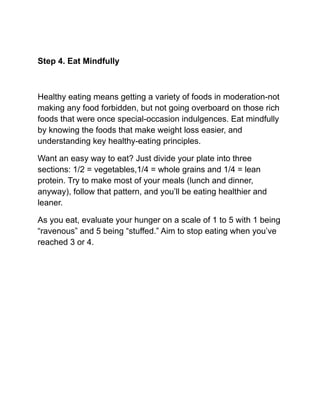
Step 4. Eat Mindfully
Healthy eating means getting a variety of foods in moderation-not
making any food forbidden, but not going overboard on those rich
foods that were once special-occasion indulgences. Eat mindfully
by knowing the foods that make weight loss easier, and
understanding key healthy-eating principles.
Want an easy way to eat? Just divide your plate into three
sections: 1/2 = vegetables,1/4 = whole grains and 1/4 = lean
protein. Try to make most of your meals (lunch and dinner,
anyway), follow that pattern, and you’ll be eating healthier and
leaner.
As you eat, evaluate your hunger on a scale of 1 to 5 with 1 being
“ravenous” and 5 being “stuffed.” Aim to stop eating when you’ve
reached 3 or 4.
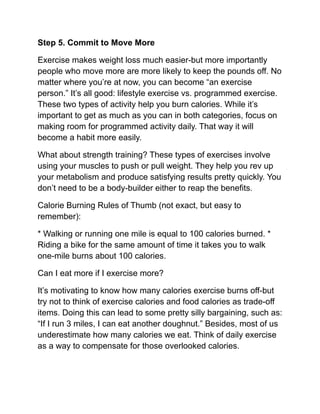
Step 5. Commit to Move More
Exercise makes weight loss much easier-but more importantly
people who move more are more likely to keep the pounds off. No
matter where you’re at now, you can become “an exercise
person.” It’s all good: lifestyle exercise vs. programmed exercise.
These two types of activity help you burn calories. While it’s
important to get as much as you can in both categories, focus on
making room for programmed activity daily. That way it will
become a habit more easily.
What about strength training? These types of exercises involve
using your muscles to push or pull weight. They help you rev up
your metabolism and produce satisfying results pretty quickly. You
don’t need to be a body-builder either to reap the benefits.
Calorie Burning Rules of Thumb (not exact, but easy to
remember):
* Walking or running one mile is equal to 100 calories burned. *
Riding a bike for the same amount of time it takes you to walk
one-mile burns about 100 calories.
Can I eat more if I exercise more?
It’s motivating to know how many calories exercise burns off-but
try not to think of exercise calories and food calories as trade-off
items. Doing this can lead to some pretty silly bargaining, such as:
“If I run 3 miles, I can eat another doughnut.” Besides, most of us
underestimate how many calories we eat. Think of daily exercise
as a way to compensate for those overlooked calories.
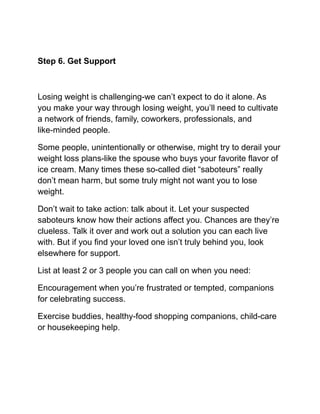
Step 6. Get Support
Losing weight is challenging-we can’t expect to do it alone. As
you make your way through losing weight, you’ll need to cultivate
a network of friends, family, coworkers, professionals, and
like-minded people.
Some people, unintentionally or otherwise, might try to derail your
weight loss plans-like the spouse who buys your favorite flavor of
ice cream. Many times these so-called diet “saboteurs” really
don’t mean harm, but some truly might not want you to lose
weight.
Don’t wait to take action: talk about it. Let your suspected
saboteurs know how their actions affect you. Chances are they’re
clueless. Talk it over and work out a solution you can each live
with. But if you find your loved one isn’t truly behind you, look
elsewhere for support.
List at least 2 or 3 people you can call on when you need:
Encouragement when you’re frustrated or tempted, companions
for celebrating success.
Exercise buddies, healthy-food shopping companions, child-care
or housekeeping help.
How do you encourage yourself toward your goals? Are you a
“cheerleader” who treats yourself with love and kindness,
cheering victories, forgiving slip-ups-or a “bad coach” who prods
with negative thoughts and berates you if you don’t perform
perfectly? Your internal thoughts can have a huge impact on your
progress. Without the support of your most important
champion-yourself-it’s easy to feel demoralized and give up.
Think of how you might offer positive words of encouragement to
someone else, then use the same language on yourself. It works!
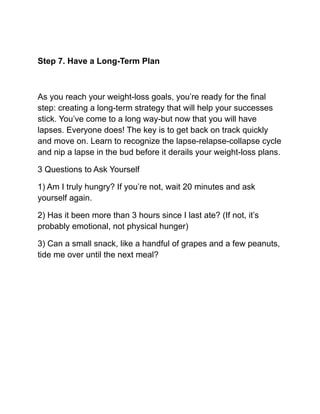
Step 7. Have a Long-Term Plan
As you reach your weight-loss goals, you’re ready for the final
step: creating a long-term strategy that will help your successes
stick. You’ve come to a long way-but now that you will have
lapses. Everyone does! The key is to get back on track quickly
and move on. Learn to recognize the lapse-relapse-collapse cycle
and nip a lapse in the bud before it derails your weight-loss plans.
3 Questions to Ask Yourself
1) Am I truly hungry? If you’re not, wait 20 minutes and ask
yourself again.
2) Has it been more than 3 hours since I last ate? (If not, it’s
probably emotional, not physical hunger)
3) Can a small snack, like a handful of grapes and a few peanuts,
tide me over until the next meal?
Step 8. Watch this Video

7 steps to permanent weight loss

  • 1.
    7 Steps toPermanent Weight Loss Essential core principles of the EatingWell Diet The EatingWell Diet is a comprehensive plan designed to help you lose weight safely and permanently. At the core of the plan are seven essential steps-each the result of cutting-edge research, put into practice in real people’s lives. They’ll work for you too!
  • 2.
    Step 1. MakeSure You’re Ready for Change Of course, you want to lose weight that’s why you are reading this but to make a life plan you can stick with, you must be ready-truly ready-to-make the commitment. Losing weight takes some time and effort. The first step is to make sure you’re ready to get started. So, how do you know if you’re ready to lose weight? Take a moment to assess what you’ll gain by losing weight and the sacrifices you’ll need to make. Weigh the balance to make sure you’re ready to commit before you start. Ready-for-Change Checklist What will you gain by losing? What will you sacrifice?
  • 3.
    Step 2. SetGoals The next step on your weight-loss journey is to decide what kind of weight loss makes sense for you. Weigh in, assess your eating habits, and make a game plan. That will include long-term goals and more immediate goals too. The next step on your weight-loss journey is to decide what kind of weight loss makes sense for you. Sketch out a long-term goal, based on a healthy weight range (you can calculate your BMI here). Next, calculate your current calorie needs, or weight-maintenance number, then subtract 500 or 1,000 calories each day to determine your daily calorie goal. You’ll get the most out of your goals if they are realistic, specific, and measurable. Reward yourself when you achieve them. Revise your goals regularly to keep yourself challenged. Calculate Your Calorie Goal YOUR CURRENT WEIGHT X 12 = calories needed to maintain your weight To lose 1 pound/week: Cut 500 calories/day To lose 2 pounds/week: Cut 1,000 calories/day
  • 4.
    Step 3. TrackYourself Self-awareness is self-motivation: by keeping track of your behavior, you motivate yourself to change because you become more accountable. Track yourself with a food diary and exercise log-some of the most powerful tools for managing your weight. Self-awareness is self-motivation; by keeping track of your behavior, you motivate yourself to change by becoming more accountable. Create a weight tracker to stay on top of your progress and keep yourself motivated. Our Weight Tracker Chart (click to download pdf) will help you put your progress in perspective. Keep a food diary to record the foods you eat each day-this self-awareness will help you eat less. Our Food Diary (click to download pdf) will help you track your daily intake to see if you are achieving your goals. Start an Activity Log (click to download pdf) to help you make a conscious effort to build more activity into your days. Give yourself credit for being active, and each activity adds up! Since your weight can fluctuate greatly from day to day, it’s not important to weigh yourself daily-but some people find it easier to remember that way. Try to do it at the same time of day, with the same amount of clothing. Make sure your scale is calibrated (reads “0” when no one stands on it) and is on a completely flat surface. Do I have to write everything down?
  • 5.
    Yes, keeping afood diary takes time, especially when you’re learning the ropes. But it works: studies show that people who keep food diaries tend to lose more weight and keep it off longer than those who don’t. We consider a food diary essential to the EatingWell Diet. If you’re balking, you’re probably someone who will benefit most from this kind of approach. It might be the first time you’ve stepped back to look at your daily eating behavior. You might be amazed at what it shows you about yourself! Diary keeping gets easier over time as it becomes instinctive. List what you eat and how much. Be specific. Write it right after you eat (or you will forget). Record calories and keep a running tally.
  • 6.
    Step 4. EatMindfully Healthy eating means getting a variety of foods in moderation-not making any food forbidden, but not going overboard on those rich foods that were once special-occasion indulgences. Eat mindfully by knowing the foods that make weight loss easier, and understanding key healthy-eating principles. Want an easy way to eat? Just divide your plate into three sections: 1/2 = vegetables,1/4 = whole grains and 1/4 = lean protein. Try to make most of your meals (lunch and dinner, anyway), follow that pattern, and you’ll be eating healthier and leaner. As you eat, evaluate your hunger on a scale of 1 to 5 with 1 being “ravenous” and 5 being “stuffed.” Aim to stop eating when you’ve reached 3 or 4.
  • 7.
    Step 5. Committo Move More Exercise makes weight loss much easier-but more importantly people who move more are more likely to keep the pounds off. No matter where you’re at now, you can become “an exercise person.” It’s all good: lifestyle exercise vs. programmed exercise. These two types of activity help you burn calories. While it’s important to get as much as you can in both categories, focus on making room for programmed activity daily. That way it will become a habit more easily. What about strength training? These types of exercises involve using your muscles to push or pull weight. They help you rev up your metabolism and produce satisfying results pretty quickly. You don’t need to be a body-builder either to reap the benefits. Calorie Burning Rules of Thumb (not exact, but easy to remember): * Walking or running one mile is equal to 100 calories burned. * Riding a bike for the same amount of time it takes you to walk one-mile burns about 100 calories. Can I eat more if I exercise more? It’s motivating to know how many calories exercise burns off-but try not to think of exercise calories and food calories as trade-off items. Doing this can lead to some pretty silly bargaining, such as: “If I run 3 miles, I can eat another doughnut.” Besides, most of us underestimate how many calories we eat. Think of daily exercise as a way to compensate for those overlooked calories.
  • 8.
    Step 6. GetSupport Losing weight is challenging-we can’t expect to do it alone. As you make your way through losing weight, you’ll need to cultivate a network of friends, family, coworkers, professionals, and like-minded people. Some people, unintentionally or otherwise, might try to derail your weight loss plans-like the spouse who buys your favorite flavor of ice cream. Many times these so-called diet “saboteurs” really don’t mean harm, but some truly might not want you to lose weight. Don’t wait to take action: talk about it. Let your suspected saboteurs know how their actions affect you. Chances are they’re clueless. Talk it over and work out a solution you can each live with. But if you find your loved one isn’t truly behind you, look elsewhere for support. List at least 2 or 3 people you can call on when you need: Encouragement when you’re frustrated or tempted, companions for celebrating success. Exercise buddies, healthy-food shopping companions, child-care or housekeeping help.
  • 9.
    How do youencourage yourself toward your goals? Are you a “cheerleader” who treats yourself with love and kindness, cheering victories, forgiving slip-ups-or a “bad coach” who prods with negative thoughts and berates you if you don’t perform perfectly? Your internal thoughts can have a huge impact on your progress. Without the support of your most important champion-yourself-it’s easy to feel demoralized and give up. Think of how you might offer positive words of encouragement to someone else, then use the same language on yourself. It works!
  • 10.
    Step 7. Havea Long-Term Plan As you reach your weight-loss goals, you’re ready for the final step: creating a long-term strategy that will help your successes stick. You’ve come to a long way-but now that you will have lapses. Everyone does! The key is to get back on track quickly and move on. Learn to recognize the lapse-relapse-collapse cycle and nip a lapse in the bud before it derails your weight-loss plans. 3 Questions to Ask Yourself 1) Am I truly hungry? If you’re not, wait 20 minutes and ask yourself again. 2) Has it been more than 3 hours since I last ate? (If not, it’s probably emotional, not physical hunger) 3) Can a small snack, like a handful of grapes and a few peanuts, tide me over until the next meal?
  • 11.
    Step 8. Watchthis Video