Chapter 3 Genetics:
Chapter 3 Genetics:
The Science of
The Science of
Heredity
Heredity
Section 1: Mendel’s Work
Section 1- Objectives:
 To describe Mendel’s genetics
To describe Mendel’s genetics
experiments
experiments
 To identify the factors that control the
To identify the factors that control the
inheritance of traits in organisms
 To explain how geneticists use symbols
To explain how geneticists use symbols
to represent alleles.
Vocab
Vocab
 1. trait
1. trait
A characteristic that an organism can
pass on to its offspring through its
genes.
genes.
 2.
2. heredity
heredity
The passing of traits from parents to
offspring.
offspring.
 3.
3. genetics
genetics
The scientific study of heredity.
 4.
4. purebred
purebred
An organism that always produces
offspring with the same form of a trait
as the parent.
as the parent.
 5.
5. gene
gene
A segment of DNA on a chromosome
that codes for a specific trait.
 6.
6. alleles
alleles
The different forms of a gene.
 7.
7. dominant allele
dominant allele
An allele whose trait always shows up in
the organism when the allele is present.
 8.
8. recessive allele
recessive allele
An allele that is masked when a
dominant allele is present.
 9.
9. hybrid
hybrid
An organism that has two different
alleles for a trait; an organism that is
heterozygous for a particular trait.
Notes
Notes
 1. _______________________ is
1. _______________________ is
called the “father of genetics”
Gregor Mendel
 2. Mendel used peas because:
2. Mendel used peas because:
– A. _________________________
A. _________________________
– B. _________________________
B. _________________________
They have many traits that exist in only 2 forms
Garden peas produce large numbers of
offspring in one generation so it is easy
to collect large amounts of data to analyze
 3. Traits are controlled by
3. Traits are controlled by
_________________ of
_____________
_____________
inheritance
genes
 4. Organisms inherit ______ allele
4. Organisms inherit ______ allele
from _________ parent.
one
each
 5. Some alleles are
5. Some alleles are
____________________and others are
__________________________.
__________________________.
dominant
recessive
Chapter 3 Genetics:
Chapter 3 Genetics:
The Science of
The Science of
Heredity
Heredity
Section 2: Probability &
Genetics
Genetics
Section 2 -Objectives:
 To describe the principles of probability
To describe the principles of probability
and how Mendel applied them to
inheritance
inheritance
 To state how geneticists use Punnett
To state how geneticists use Punnett
squares
squares
 To explain the meaning of the terms
To explain the meaning of the terms
phenotype, genotype, homozygous,
heterozygous, and codominance.
Vocab
Vocab
 10.
10. probability
probability
The likelihood that a particular event
will occur.
will occur.
 11.
11. Punnett square
Punnett square
A chart that shows all the possible
combinations of alleles that can result
from a genetic cross.
 12.
12. phenotype
phenotype
An organism’s physical appearance, or
visible traits.
visible traits.
 13.
13. genotype
genotype
An organism’s genetic makeup, or allele
combinations.
combinations.
 14.
14. homozygous
homozygous
Having two identical alleles for a trait.
 15.
15. heterozygous
heterozygous
Having two different alleles for a trait.
 16.
16. codominance
codominance
A condition in which neither of two
alleles of a gene is dominant or
recessive.
recessive.
Notes
Notes
 1. Probability is the
1. Probability is the
___________________ that a
____________________ will occur.
likelihood
particular event
 2. _____________________ was the
2. _____________________ was the
first scientist to recognize that the
________________________ of
________________________ can be
used to predict the result of genetic
crosses.
crosses.
Mendel
principles
probability
 3. Geneticists use Punnett squares to:
3. Geneticists use Punnett squares to:
– A.
A.
– B.
B.
Show all the possible outcomes of a
genetic cross
Determine the probability of a particular
outcome
 4. _________________________ is
4. _________________________ is
the physical appearance, while
________________________ is the
_______________________ make-up.
Phenotype
genotype
Genetic makeup
 5. Punnett Square
5. Punnett Square
practice:
practice:
 B-Blue
B-Blue
 b-red
b-red
 Genotype:
Genotype:
 Phenotype:
Phenotype:
B b
B
b
BB Bb
Bb bb
1 BB: 2Bb: 1bb
3 Blue, 1 red
 5. Punnett Square
5. Punnett Square
practice:
practice:
 G- Green
G- Green
 g-Yellow
g-Yellow
 Genotype:
Genotype:
 Phenotype:
Phenotype:
G g
g
g
Gg gg
Gg gg
–2 Gg: 2gg
–2 Green: 2 Yellow
Your turn. Practice sheet.
 Independent and Silent
Independent and Silent
 Refer to your notes.
Refer to your notes.
 Go over as a group.
Go over as a group.
Chapter 3 Genetics:
Chapter 3 Genetics:
The Science of
The Science of
Heredity
Heredity
Section 3: The Cell and
Inheritance
Inheritance
Section 3: The Cell and
Inheritance
Inheritance
 To describe the role of chromosomes in
To describe the role of chromosomes in
inheritance
inheritance
 To identify and describe the events
To identify and describe the events
that occur during meiosis
 17.
17. meiosis
meiosis
The process that occurs in sex cells
(sperm and egg) by which the number of
chromosomes is reduced by half.
Notes
Notes
 1. Sex cells have exactly
1. Sex cells have exactly
____________ the number of
chromosomes as ____________ cells.
half
other
 2. The chromosome theory of inheritance
2. The chromosome theory of inheritance
states:
states:
 http://www.pearsonsuccessnet.com/snpapp/iText/products/0-1
http://www.pearsonsuccessnet.com/snpapp/iText/products/0-1
3-036738-9/ch3/videoBlank.html?/ebook/products/0-13-03673
8-9/video/vtchromo.mov
Genes are carried from parents
to their offspring on chromosomes
 3. During meiosis, the chromosome:
3. During meiosis, the chromosome:
 http://www.pearsonsuccessnet.com/snpapp/iText/products/0-13-0367
http://www.pearsonsuccessnet.com/snpapp/iText/products/0-13-0367
38-9/ch3/videoBlank.html?/ebook/products/0-13-036738-9/video/vtm
eiosi.mov
eiosi.mov
 See pg. In text
See pg. In text
The chromosome pairs
separate and are distributed
to two different cells. The
resulting sex cells have only
have half as many
chromosomes as the other
cells in the organism.
 4. ____________________ are
4. ____________________ are
located on chromosomes.
Genes
 5. Our bodies have ________ pairs of
5. Our bodies have ________ pairs of
chromosomes that contain over
__________ genes.
__________ genes.
23
60,000
Chapter 3 Genetics:
Chapter 3 Genetics:
The Science of
The Science of
Heredity
Heredity
Section 4: The DNA
Section 4: The DNA
Connection
Connection
Section 4: The DNA Connection -
Objectives:
Objectives:
 To explain the term “genetic code”:
To explain the term “genetic code”:
 To describe the process by which a cell
To describe the process by which a cell
produces proteins
produces proteins
 To describe different types of
To describe different types of
mutations and how they affect an
organism.
organism.
 17.
17. messenger RNA
messenger RNA
RNA that copies the coded message
from DNA in the nucleus and carries
the message into the cytoplasm
the message into the cytoplasm.
.
 18.
18. transfer RNA
transfer RNA
RNA in the cytoplasm that carries an
amino acid to the ribosome and adds it
to the growing protein chain.
Notes
Notes
 1. The main function of genes is to:
1. The main function of genes is to:
Control the production of
proteins in the organism’s cells.
Proteins help to determine the
size, shape, and many other
traits in an organism.
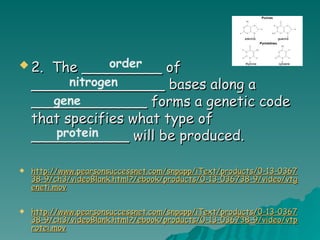
 2. The _________ of
2. The _________ of
_______________ bases along a
_____________ forms a genetic code
that specifies what type of
___________ will be produced.
 http://www.pearsonsuccessnet.com/snpapp/iText/products/0-13-0367
http://www.pearsonsuccessnet.com/snpapp/iText/products/0-13-0367
38-9/ch3/videoBlank.html?/ebook/products/0-13-036738-9/video/vtg
eneti.mov
eneti.mov
 http://www.pearsonsuccessnet.com/snpapp/iText/products/0-13-0367
http://www.pearsonsuccessnet.com/snpapp/iText/products/0-13-0367
38-9/ch3/videoBlank.html?/ebook/products/0-13-036738-9/video/vtp
rotei.mov
rotei.mov
order
nitrogen
gene
protein
 3. A _____________ is a change in a
3. A _____________ is a change in a
___________ or
___________ or
____________________.
____________________.
 DNA mutations:
DNA mutations:
http://www.youtube.com/watch?v=_ajRf8yMBe0
mutation
gene
chromosome
 4. Mutations can be:
4. Mutations can be:
 A. ____________ and an example
A. ____________ and an example
would be ______________.
 B. ____________ and an example would
B. ____________ and an example would
be ______________.
be ______________.
 C. ______________________ and an
C. ______________________ and an
example would be ______________.
Harmful
Helpful
Neither harmful or helpful
cancer
Antibiotic resistance in bacteria
A white buffalo color on
a farm (versus a white
buffalo color in the wild)

6th grade Ch 3 Genetics Notes.pptre÷eeeeeee

  • 1.
    Chapter 3 Genetics: Chapter3 Genetics: The Science of The Science of Heredity Heredity Section 1: Mendel’s Work Section 1: Mendel’s Work
  • 2.
    Section 1- Objectives: Section1- Objectives:  To describe Mendel’s genetics To describe Mendel’s genetics experiments experiments  To identify the factors that control the To identify the factors that control the inheritance of traits in organisms inheritance of traits in organisms  To explain how geneticists use symbols To explain how geneticists use symbols to represent alleles. to represent alleles.
  • 3.
    Vocab Vocab  1. trait 1.trait A characteristic that an organism can A characteristic that an organism can pass on to its offspring through its pass on to its offspring through its genes. genes.
  • 4.
     2. 2. heredity heredity Thepassing of traits from parents to The passing of traits from parents to offspring. offspring.
  • 5.
     3. 3. genetics genetics Thescientific study of heredity. The scientific study of heredity.
  • 6.
     4. 4. purebred purebred Anorganism that always produces An organism that always produces offspring with the same form of a trait offspring with the same form of a trait as the parent. as the parent.
  • 7.
     5. 5. gene gene Asegment of DNA on a chromosome A segment of DNA on a chromosome that codes for a specific trait. that codes for a specific trait.
  • 8.
     6. 6. alleles alleles Thedifferent forms of a gene. The different forms of a gene.
  • 9.
     7. 7. dominantallele dominant allele An allele whose trait always shows up in An allele whose trait always shows up in the organism when the allele is present. the organism when the allele is present.
  • 10.
     8. 8. recessiveallele recessive allele An allele that is masked when a An allele that is masked when a dominant allele is present. dominant allele is present.
  • 11.
     9. 9. hybrid hybrid Anorganism that has two different An organism that has two different alleles for a trait; an organism that is alleles for a trait; an organism that is heterozygous for a particular trait. heterozygous for a particular trait.
  • 12.
    Notes Notes  1. _______________________is 1. _______________________ is called the “father of genetics” called the “father of genetics” Gregor Mendel
  • 13.
     2. Mendelused peas because: 2. Mendel used peas because: – A. _________________________ A. _________________________ – B. _________________________ B. _________________________ They have many traits that exist in only 2 forms Garden peas produce large numbers of offspring in one generation so it is easy to collect large amounts of data to analyze
  • 14.
     3. Traitsare controlled by 3. Traits are controlled by _________________ of _________________ of _____________ _____________ inheritance genes
  • 15.
     4. Organismsinherit ______ allele 4. Organisms inherit ______ allele from _________ parent. from _________ parent. one each
  • 16.
     5. Somealleles are 5. Some alleles are ____________________and others are ____________________and others are __________________________. __________________________. dominant recessive
  • 17.
    Chapter 3 Genetics: Chapter3 Genetics: The Science of The Science of Heredity Heredity Section 2: Probability & Section 2: Probability & Genetics Genetics
  • 18.
    Section 2 -Objectives: Section2 -Objectives:  To describe the principles of probability To describe the principles of probability and how Mendel applied them to and how Mendel applied them to inheritance inheritance  To state how geneticists use Punnett To state how geneticists use Punnett squares squares  To explain the meaning of the terms To explain the meaning of the terms phenotype, genotype, homozygous, phenotype, genotype, homozygous, heterozygous, and codominance. heterozygous, and codominance.
  • 19.
    Vocab Vocab  10. 10. probability probability Thelikelihood that a particular event The likelihood that a particular event will occur. will occur.
  • 20.
     11. 11. Punnettsquare Punnett square A chart that shows all the possible A chart that shows all the possible combinations of alleles that can result combinations of alleles that can result from a genetic cross. from a genetic cross.
  • 21.
     12. 12. phenotype phenotype Anorganism’s physical appearance, or An organism’s physical appearance, or visible traits. visible traits.
  • 22.
     13. 13. genotype genotype Anorganism’s genetic makeup, or allele An organism’s genetic makeup, or allele combinations. combinations.
  • 23.
     14. 14. homozygous homozygous Havingtwo identical alleles for a trait. Having two identical alleles for a trait.
  • 24.
     15. 15. heterozygous heterozygous Havingtwo different alleles for a trait. Having two different alleles for a trait.
  • 25.
     16. 16. codominance codominance Acondition in which neither of two A condition in which neither of two alleles of a gene is dominant or alleles of a gene is dominant or recessive. recessive.
  • 26.
    Notes Notes  1. Probabilityis the 1. Probability is the ___________________ that a ___________________ that a ____________________ will occur. ____________________ will occur. likelihood particular event
  • 27.
     2. _____________________was the 2. _____________________ was the first scientist to recognize that the first scientist to recognize that the ________________________ of ________________________ of ________________________ can be ________________________ can be used to predict the result of genetic used to predict the result of genetic crosses. crosses. Mendel principles probability
  • 28.
     3. Geneticistsuse Punnett squares to: 3. Geneticists use Punnett squares to: – A. A. – B. B. Show all the possible outcomes of a genetic cross Determine the probability of a particular outcome
  • 29.
     4. _________________________is 4. _________________________ is the physical appearance, while the physical appearance, while ________________________ is the ________________________ is the _______________________ make-up. _______________________ make-up. Phenotype genotype Genetic makeup
  • 30.
     5. PunnettSquare 5. Punnett Square practice: practice:  B-Blue B-Blue  b-red b-red  Genotype: Genotype:  Phenotype: Phenotype: B b B b BB Bb Bb bb 1 BB: 2Bb: 1bb 3 Blue, 1 red
  • 31.
     5. PunnettSquare 5. Punnett Square practice: practice:  G- Green G- Green  g-Yellow g-Yellow  Genotype: Genotype:  Phenotype: Phenotype: G g g g Gg gg Gg gg –2 Gg: 2gg –2 Green: 2 Yellow
  • 32.
    Your turn. Practicesheet. Your turn. Practice sheet.  Independent and Silent Independent and Silent  Refer to your notes. Refer to your notes.  Go over as a group. Go over as a group.
  • 33.
    Chapter 3 Genetics: Chapter3 Genetics: The Science of The Science of Heredity Heredity Section 3: The Cell and Section 3: The Cell and Inheritance Inheritance
  • 34.
    Section 3: TheCell and Section 3: The Cell and Inheritance Inheritance  To describe the role of chromosomes in To describe the role of chromosomes in inheritance inheritance  To identify and describe the events To identify and describe the events that occur during meiosis that occur during meiosis
  • 35.
     17. 17. meiosis meiosis Theprocess that occurs in sex cells The process that occurs in sex cells (sperm and egg) by which the number of (sperm and egg) by which the number of chromosomes is reduced by half. chromosomes is reduced by half.
  • 36.
    Notes Notes  1. Sexcells have exactly 1. Sex cells have exactly ____________ the number of ____________ the number of chromosomes as ____________ cells. chromosomes as ____________ cells. half other
  • 37.
     2. Thechromosome theory of inheritance 2. The chromosome theory of inheritance states: states:  http://www.pearsonsuccessnet.com/snpapp/iText/products/0-1 http://www.pearsonsuccessnet.com/snpapp/iText/products/0-1 3-036738-9/ch3/videoBlank.html?/ebook/products/0-13-03673 3-036738-9/ch3/videoBlank.html?/ebook/products/0-13-03673 8-9/video/vtchromo.mov 8-9/video/vtchromo.mov Genes are carried from parents to their offspring on chromosomes
  • 38.
     3. Duringmeiosis, the chromosome: 3. During meiosis, the chromosome:  http://www.pearsonsuccessnet.com/snpapp/iText/products/0-13-0367 http://www.pearsonsuccessnet.com/snpapp/iText/products/0-13-0367 38-9/ch3/videoBlank.html?/ebook/products/0-13-036738-9/video/vtm 38-9/ch3/videoBlank.html?/ebook/products/0-13-036738-9/video/vtm eiosi.mov eiosi.mov  See pg. In text See pg. In text The chromosome pairs separate and are distributed to two different cells. The resulting sex cells have only have half as many chromosomes as the other cells in the organism.
  • 39.
     4. ____________________are 4. ____________________ are located on chromosomes. located on chromosomes. Genes
  • 40.
     5. Ourbodies have ________ pairs of 5. Our bodies have ________ pairs of chromosomes that contain over chromosomes that contain over __________ genes. __________ genes. 23 60,000
  • 41.
    Chapter 3 Genetics: Chapter3 Genetics: The Science of The Science of Heredity Heredity Section 4: The DNA Section 4: The DNA Connection Connection
  • 42.
    Section 4: TheDNA Connection - Section 4: The DNA Connection - Objectives: Objectives:  To explain the term “genetic code”: To explain the term “genetic code”:  To describe the process by which a cell To describe the process by which a cell produces proteins produces proteins  To describe different types of To describe different types of mutations and how they affect an mutations and how they affect an organism. organism.
  • 43.
     17. 17. messengerRNA messenger RNA RNA that copies the coded message RNA that copies the coded message from DNA in the nucleus and carries from DNA in the nucleus and carries the message into the cytoplasm the message into the cytoplasm. .
  • 44.
     18. 18. transferRNA transfer RNA RNA in the cytoplasm that carries an RNA in the cytoplasm that carries an amino acid to the ribosome and adds it amino acid to the ribosome and adds it to the growing protein chain. to the growing protein chain.
  • 45.
    Notes Notes  1. Themain function of genes is to: 1. The main function of genes is to: Control the production of proteins in the organism’s cells. Proteins help to determine the size, shape, and many other traits in an organism.
  • 46.
     2. The_________ of 2. The _________ of _______________ bases along a _______________ bases along a _____________ forms a genetic code _____________ forms a genetic code that specifies what type of that specifies what type of ___________ will be produced. ___________ will be produced.  http://www.pearsonsuccessnet.com/snpapp/iText/products/0-13-0367 http://www.pearsonsuccessnet.com/snpapp/iText/products/0-13-0367 38-9/ch3/videoBlank.html?/ebook/products/0-13-036738-9/video/vtg 38-9/ch3/videoBlank.html?/ebook/products/0-13-036738-9/video/vtg eneti.mov eneti.mov  http://www.pearsonsuccessnet.com/snpapp/iText/products/0-13-0367 http://www.pearsonsuccessnet.com/snpapp/iText/products/0-13-0367 38-9/ch3/videoBlank.html?/ebook/products/0-13-036738-9/video/vtp 38-9/ch3/videoBlank.html?/ebook/products/0-13-036738-9/video/vtp rotei.mov rotei.mov order nitrogen gene protein
  • 47.
     3. A_____________ is a change in a 3. A _____________ is a change in a ___________ or ___________ or ____________________. ____________________.  DNA mutations: DNA mutations: http://www.youtube.com/watch?v=_ajRf8yMBe0 http://www.youtube.com/watch?v=_ajRf8yMBe0 mutation gene chromosome
  • 48.
     4. Mutationscan be: 4. Mutations can be:  A. ____________ and an example A. ____________ and an example would be ______________. would be ______________.  B. ____________ and an example would B. ____________ and an example would be ______________. be ______________.  C. ______________________ and an C. ______________________ and an example would be ______________. example would be ______________. Harmful Helpful Neither harmful or helpful cancer Antibiotic resistance in bacteria A white buffalo color on a farm (versus a white buffalo color in the wild)