105
Journal of Business Studies, 8 (SI) 2021
SOCIAL SUSTAINABILITY WITH BUSINESSES
THROUGH CIVIL SOCIETY
ENGAGEMENT: A MISSED OPPORTUNITY
Kapila Ariyadrashana Silva
Postgraduate Institute of Management,
University of Sri Jayewardenepura.
Email: kap.silva@yahoo.com
Arosha S. Adikaram
Faculty of Management and Finance,
University of Colombo.
Email: arosha@hrm.cmb.ac.lk
J. A. S. K. Jayakody
Postgraduate Institute of Management,
University of Sri Jayewardenepura.
Abstract
The role of business organizations has been challenged owing to its adverse social
impact. Civil Society (CS) is considered as possible contender to shape business
outcomes enabling social order and social sustainability. However, CS does not
demonstrate an active interest to carry out its role, raising the question ‘How does
the civil society engages with businesses’. Theoretical lens the study primarily
employs, the Deliberative Democracy Theory (DDT) by Habermas (1996),
underscores role of CS to identify social issues and take that into deliberation
in public sphere in finding just solutions and social order. However, DDT has
not been able to explain the failure of CS to engage with businesses in finding
solutions despite businesses causing social issues. Hence, in exploring how the
civil society engages with businesses, the present study employed qualitative
research design with Multiple Embedded Case Study method. Data collected
through in-depth interviews and documents were analyzed through thematic
DOI: http://doi.org/10.4038/jbs.v8i0.69
106
Journal of Business Studies, 8 (SI) 2021
analysis method. Findings indicate CS generally comprehends business conduct
as a transactional relationship in private sphere and translate into a social issue
only when attached with sentiments and emotions that prompts engagement in
public sphere. Businesses too in general perceive society as a transactional partner
undermining human esteem, and therefore fail in enabling social sustainability
through democratic means of engagement. The study thus makes theoretical
contribution towards DDT by explaining why CS does not engage with businesses.
Furthermore, illuminate implications on Corporate Social Responsibility (CSR)
and social sustainability attempts of businesses.
Keywords: Business; Civil Society; Corporate Social Responsibility; Engagement;
	 Social Sustainability; Deliberative Democracy Theory
107
Journal of Business Studies, 8 (SI) 2021
1.	 Introduction
Societies, especially democratic societies, have moulded multitude of formal and
informal mechanisms to enable the public to engage in matters of interest, thereby
incorporating public views in governance (Goonathileke, 2014; Scherer, Rasche,
Palazzo, & Spicer, 2016). Sri Lanka, a democracy in the global south, has formal
mechanisms for Civil Society (CS) participation in decision making through
constitutional framework (Cooray,1995), Public Interest Litigation (PIL) and
public hearing (Gomez,1993; Goonathileke,2014). CS has played prominent role
in poverty alleviation (Brugmann & Prahalad, 2007), sustainability (Elkington,
2004), against corruption and for equality (Eigen, 2013). Socially sustainable
communities provide a quality of life to present whilst ensuing that to future, by
different stakeholders who compete, collaborate and collude in producing those
outcomes(Marshal,McCarthy,McGrath,Claudy,2015).Similarly,CS’sengagement
with businesses creates public opinion on the conduct of business (Chandhoke,
2005; Habermas, 2012), thereby influencing the businesses to shape its outcomes
toward public accountability and acceptability (Scholte, 2011). However, Eigen
(2013) observes CS’s failure to engage in business sphere. This stance of CS is
troubling and demands for further exploration particularly for three reasons: a)
CS has a legitimate role to identify the social issues and bring those up to broader
public discussion, seeking solutions; b) CS has potential and has demonstrated
that ability in other domains; and c) CS has a formal framework that facilitates
engagement.
Devoting attention to CS, Habermas (1996), in his Deliberative Democracy
Theory (DDT), advocates CS to bring social issues for deliberation in public
sphere, and to arrive at binding decisions and consensus agreements in finding just
solutions to the issues experienced by respective societies. Therein, he stresses the
importance of CS, media and equality among citizenry in achieving social order
and common good through deliberation. It is claimed, right deliberation process
will generate a public opinion that enables harnessing social power. Conversely,
Sri Lankan CS, notwithstanding the prevalence of conditions DDT underscores,
demonstrates an exception to the theory, has failed to engage (Hettige, 2015;
Vishvalingam, 2012) in bringing social issues by businesses to broader discussion,
and finding solutions ushering social sustainability.
108
Journal of Business Studies, 8 (SI) 2021
The rise of corporates, their dominance in social life under neoliberal regimes has
been of interest among researchers and practitioners (Chomsky,1999). Notably,
irresponsible conduct of businesses and the consequences (Carroll & Brown,
2018), hence a need to regulate business (Braithwaite & Drahos, 2000) as a state
machinery has not been able to enforce justice (Scherer, Palazzo& Matten,2014),
have drawn researchers’ attention. These adverse conducts of businesses demand
CS to engage with business to overcome problems and find solutions (Habermas,
2012; Scholte, 2011), thereby bringing economic, environmental and social
sustainability to all beings. Amartya Sen (2013), incorporates four dimensions
to social sustainability: a) Quality of life; b) Equality) Diversity and d) Social
Cohesion, and that could be challenged by unregulated business outcomes
(Scherer, et al., 2014).
Moving towards businesses that reache society through Corporate Social
Responsibility (CSR), Schwartz and Carroll (2008) depict how Value, Balance
and Accountability (VBA) demonstrates the role of business. Business actions
undertaken jointly with outside entities have produced rewarding outcomes to
business and society both (Lange, Armanios, Ceballos& Sandhu, 2015, Mirvis
& Googins, 2018). Porter and Kramer (2011) suggest that creating shared value
could enable mutual progression. CS has the ability to thematize and amplify
socialissues insearchof solutions(Habermas,1996),thus influencingtheformation
of CSR approach and the role of business (Davidson, et al., 2018). As such, the
manner businesses respond to external interests and activities, to arrive at social
acceptance, opens up an intellectual space for discussion. In this backdrop, the
aim of this paper is to explore how CS in Sri Lanka engages with businesses to
shape the business conduct when businesses are involved in unregulated conduct
causing social discontent (Kamruzzaman,2018, Porter & Kramer, 2011).
In understanding the CS’s role in addressing social issues, we employ the
Deliberative Democracy Theory (DDT) as the primary theoretical eye that
propagates CS to bring social issues for deliberation in public sphere, aiming at
will formation through collective choices, moral consensus, thereby common
good (Habermas,1996/2012). Furthermore, DDT propagates those businesses
disturb social integration by their invasion to society through colonization and
109
Journal of Business Studies, 8 (SI) 2021
commodification and expect vigilant CS to rise against those acts. Surprisingly, CS
in global south, and more particularly in Sri Lanka, has been selective in engaging
with businesses despite the businesses causing social issues (Kamruzzaman, 2018;
Vishvalingam, 2012) and DDT has not been able to explain this contradictory
social behaviour, hence forcing a challenge to our understanding of DDT.
In order to address those knowledge deficiencies arising due to DDT’s inability
to explain behaviour of certain societies, notably in global south, we draw
understandings from other domains to address the lacuna: mainly Social
Movement Theory (SMT) employing mobilization, reasons for collective action
and conditions facilitating it.
More specifically, our study focusses on profit driven corporate entities
(businesses) with private investments, as it is considered that irresponsible social
conduct of businesses mainly emanates from the excessive desire for profit and
other material gains (Carroll & Brown, 2018). The terms businesses, corporates,
firms are used interchangeably in this study.
The findings of our study will have several important implications. Among the
many criticisms towards DDT, is its over-emphasis on the deliberative process,
disregarding substantive conditions (Dryzek, 2000) and west oriented nature
(Gunarathne,2006). In locating this study in Sri Lanka, we are addressing this
criticism, by exploring social behaviour patterns in non-western societies, its CS
formations, and conditions on collective action, thereby enriching DDT. Further,
role of contemporary businesses has been challenged and redefined more often
under neoliberal regimes (Scherer, et al., 2016), hence, proliferation of scholarly
discourse in what the role of business is, how different segments in society
perceive and determine the role is a significant contribution this study would make.
Similarly, it is widely spoken that businesses’ extensions across national borders
limit the state’s writ over business (Habermas,2003; Scherer& Palazzo,2007).
Hence an alternative mechanism of influencing and defining the conduct of
business is much sought after (Widger,2016). CS stands out as an alternative force
to undertake this task (Zadek,2011). Fulfilling the need for an explanation of these
stand points, this study offers a multitude of understandings and insights into
110
Journal of Business Studies, 8 (SI) 2021
CS’s role in economic environment and social stability. More particularly on CS
behaviour towards business, how it perceives business and the process of forming
relationship in reaching social sustainability and mutually beneficial existence.
Practical significance of this study can be spelled out in the context where,
growing inequalities resulting in neoliberal economies (Edwards, 2011) and failure
of business to formulate meaningful self-initiatives to curtail social issues
(Porter&Kramer,2011).Thus,exploringintoCS’sactiveengagementwithbusiness
for common good, social sustainability would be significant for a practicing
manager enabling them to understand why, how and what influences society’s
engagement and its outcomes, thereby the ability to meet desired outcomes of
business with greater certainty.
2. Literature Review
Business organization is considered to be an entity that produces goods and
services by employing commanding system to transform resources to make profits
(Daft, 2015). Nevertheless, to be sustainable, those actions and decisions need to
be embedded in social life (Fligstein & Calder, 2015; Sayer, 2004).
Role of business is manifested by CSR, by seeking social legitimacy and social
acceptance to exist and to pursue its affairs (Castello, Etter & Nielson, 2016).
However, recent experiences reveal that businesses’ lack of democratic
accountability in governance and respect for global concerns, have become a threat
to social order and sustainability (Levy & Newell, 2002).
Diamond (1999) defines CS as a realm of organized social life that is voluntary,
self-generating, and bound by a legal order or set of shared values. Meanwhile,
Baur and Arena (2014) consider CS to be a vehicle for economic prosperity,
democracy and social order. However, Kamruzzaman (2018) cautions that CS is
more or less a western construct and its applicability in non-western countries,
global south, should be taken in their own context.
In this backdrop, the intensity of encounters between CS and business have
increased dramatically with advent of CSR (Zadek, 2011). Despite large
111
Journal of Business Studies, 8 (SI) 2021
corporations with neoliberal approaches discouraging citizenry and making
authorized society disengaged (Chomsky, 1999), evidences are emerging to s
upport how CS and businesses engage in mutually beneficial outcomes (Baur &
Arenas, 2014, Zadek, 2011).
Meanwhile, DDT explains how CS is attuned to social problems existing in the
private life sphere, distils and transmits in amplified form to the public sphere
to find solutions to problems, regaining social integration and democratization.
Moreover, DDT focuses on deliberation; a mutual communication in the public
sphere, to react to the pressures of society-wide problems and proposes opinions
to solutions. However, with commodification, business replaces mutual
understanding and social structures to be regulated by money and power where
social integration, social sustainability is eroded. Therefore, proposes a necessity
to regulate the moral and ethical role of business through deliberative acts.
Meanwhile, SMT attempts to explain the mass grouping towards protests, and
public expression of collective grievances (Della Porta & Diani, 2015). This
scholarship claims that movements develops when relatively stable social systems
are disrupted in ways that affected individuals’ psychological and quality of life.
In summary, Businesses can have better acceptance by accommodating societies
views that could lead to a mutual agreement and social order.
3. Methodology
Standing in a qualitative approach under interpretivism, we use embedded
multiple case method to explore our study aim. In order to add richness, we have
selected three cases with extensive public debate on allegations surrounding social
issues and general deviations from the theoretical eye. All three cases were widely
discussed among society, notably in the Sri Lankan Parliament, with varying
degrees and levels of CS participation, setting the stage for a robust, compelling
and broader comparative analysis, providing deeper explanations (Herriott &
Firestone, 1983). Confirming with data collection in qualitative approach,
in-depth, semi structured, face-to-face personal interviews were conducted with
51 key personnel related to the three cases. In addition, documents and audio
visuals related to the three cases were used to gather data. Participants were
112
Journal of Business Studies, 8 (SI) 2021
selected through purposive sampling to represent multiple interest groups and
for business those holding decision making roles. Given below the summary of
participants.
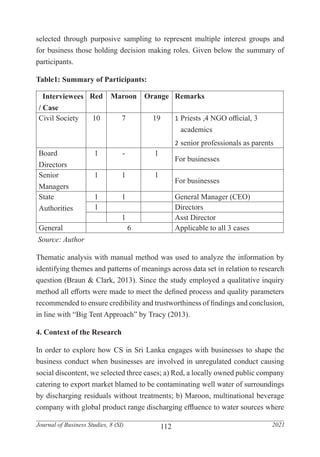
Table1: Summary of Participants:
Interviewees
/ Case
Red Maroon Orange Remarks
Civil Society 10 7 19 1	Priests ,4 NGO official, 3
academics
2	senior professionals as parents
Board
Directors
1 - 1
For businesses
Senior
Managers
1 1 1
For businesses
State
Authorities
1 1 General Manager (CEO)
1 Directors
1 Asst Director
General 6 Applicable to all 3 cases
Source: Author
Thematic analysis with manual method was used to analyze the information by
identifying themes and patterns of meanings across data set in relation to research
question (Braun & Clark, 2013). Since the study employed a qualitative inquiry
method all efforts were made to meet the defined process and quality parameters
recommended to ensure credibility and trustworthiness of findings and conclusion,
in line with “Big Tent Approach” by Tracy (2013).
4. Context of the Research
In order to explore how CS in Sri Lanka engages with businesses to shape the
business conduct when businesses are involved in unregulated conduct causing
social discontent, we selected three cases; a) Red, a locally owned public company
catering to export market blamed to be contaminating well water of surroundings
by discharging residuals without treatments; b) Maroon, multinational beverage
company with global product range discharging effluence to water sources where
113
Journal of Business Studies, 8 (SI) 2021
pipe borne distribution systems collect water; and c) Orange, more or less an
individual owned private university predominantly offering medical degree to
local market was challenged for its quality of training. For the purpose of
comparison, two incidents (Red and Maroon) purported to have originated from
a same source, water, too were analysed. Context was verified for applicability of
the phenomena and validated with literature and evidence.
Examination of data revealed extensive CS engagement in Red and Orange,
ultimately compelling business to withdraw, despite being favourably upheld
in courts of law. Whereas in Maroon, though the issue was caused by water
contamination, had minimum engagement by CS, yet with active initiatives by
business towards social sustainability it was able to come out of the crisis safely.
Upon going through a meticulous process of coding and categorizing from over
51personal interviews, 62 documents, four videos supported by thematic analysis
with manual method brought out four themes ‘Choice’, ‘Bundled opinion’, ‘Voice
forms force’ and ‘Our way at any cost’, and an overarching theme ‘Reluctant
Engagement’ explaining answers to the problem being studied.
5. Data Analysis and Findings
Our findings indicate the process through which the CS engages with businesses
to shape the business conduct when businesses are involved in unregulated
conduct causing social discontent. Based on our findings, we argue that CS
engagement with businesses, an attempt by society to organize and interpret the
conduct of business to shape business outcomes (Matten & Moon, 2008), could be
done through deliberation (Habermas, 1996) to arrive at conscious understanding
with mutual benefit.
We present our findings under the main themes that emanated from the data, which
indicate the process through which the CS engages with businesses related to
social discontent.
114
Journal of Business Studies, 8 (SI) 2021
5.1 Choice to be private or seek collective action
Data revealed that CS upon experiencing unusual outcomes translate their
experiences to a meaning and share that with others seeking shared understanding.
In Red, Nanda (a housewife in neighbourhood of factory Red, actively involved
in agitations) claimed ‘children were complaining of dizziness after a bath, and
water was smelly, verified with neighbours they too were experiencing the same’.
Sarana, (a machine operator, 30 years with children, living in ancestral property
near the factory Red) “It was not just a guess; water samples were tested at a
government lab, which confirmed water was not suitable for drinking. Our
“belief” derived from information we, the villagers, had gathered, discussed and
considered.”.
In view of verifying water quality, many had taken samples from their water
source, wells, to a laboratory to test which confirmed of the poor water quality.
This authentication and confirmation had given weight to a conclusion that the
issue was common and that needed collective effort.
Somadasa (a hardware trader, residing in the village of Red from the time of
birth); ‘In an earlier occasion too there were rumours that factory located in our
vicinity discharges their waste without treatment. We suspected it to be a cause of
the present water condition and shared our suspicions with others’.
Moving further, CS in Red had assigned value and attachment to water, as claimed
by Somadasa, ‘these are, from generations, our properties, our well water’.
Also, as stated by Nanda: ‘How can we let outsiders, the factory, to destroy our
properties’. With those opinions and sentiments of ‘our water’, CS in Red went
into engagement with the company demanding its closure.
Whereas, in Maroon, Channa (a banker with young family affected due to
Maroon) claimed of experiencing smelly pipe borne water: ‘fired few calls to
verify, they too confirmed so; since can’t take a risk, sent the children to in-laws;
disruptions or accidents happen, it’s a bother, but I found my own solution’.
Sameera ( Middle aged business executive affected by Maroon) had opted to
buy water and found solutions individually than translating to a collective action:
115
Journal of Business Studies, 8 (SI) 2021
‘experiencing unusual smell in water, checked with others too, ordered a bowser
of water to fill the tank, what to do, inconvenience and cost’. Company Maroon
had admitted it as an industrial accident and paid back the cost of damages to
authorities. Public from Maroon had comprehended the issue as a breach of
understanding (private sphere) and had sought alternatives on own, discounting
social cost.
In Orange, though state university student union, Inter University Students’
Federation (IUSF) had learnt of negotiations, were surprised by the finality in
the gazetting of the formation of a private medical college. Years later, Chamath
(an executive member of medical doctors’ union active participant in campaign
against Orange) explaining symptoms of the issue said, ‘our members brought
to our attention of imminent danger due to low quality of training at the newly
formed private medical college’.
DDT suggests that public sphere is a warning system with sensors sensitive to
society. Every routine in lifeworld is open to renovative impulses from the outer
peripheries, and if impulses contradict the accepted practices or conventions usual
processors will be replaced. Confirming with DDT, data suggests that individuals
experiencing the unusual conditions share the experiences (smelly water,
contaminated water, poor quality training to doctors, threat to free education)
with others to determine a meaning to that experience, had sought verifications
from experts, public institutions. Upon assigning the meaning to be within private
sphere as in Maroon, they had made a ‘Choice’ to remain private; however, where
termed as ‘common issue’, as in Red and Orange, made a ‘Choice’to seek collective
action, engagement. As activist Wassa (a trade union leader gave leadership in
many collective actions) claims ‘People to rise it should be a burning problem,
you must assign a human value’. Likewise, in Red and Orange, where meaning
comprehended to be challenging societal values construed to be common
(social) problems that demanded public participation, therefore, advanced to
expand boundaries to find solutions.
116
Journal of Business Studies, 8 (SI) 2021
5.2 Bundled Opinion
Advancing boundaries, in Red, CS undertook engagement initiatives, fast unto
death campaign led by a priest, street demonstration, lobbying, discussion in
public media, parliamentary debates, to take the deliberation across the public
sphere making ‘bundled opinion’. However, company did not respond, claiming
contamination was due to ground water conditions. Finally, public opinion ‘our
water’ formed social power that blocked main highway and ended up with three
deaths due to shooting by military who were called to arrest public disturbance.
That further aggravated the public opinion across the world, compelling
government to direct company to cease operations and withdraw from the location
despite cause was not proven scientifically.
Analysed data revealed that broadened attention span had extended the public
sphere where multiple stakeholders with varied interests and perceptions
interpreting and assigning meaning to the problem. They expected to arrive at an
agreement through deliberation that would find a solution to the problem faced
commonly and acceptable to a majority. In Red, CS had gone for judicial action
under the banner of “A Movement to Protect Water in Siyane” to evict the factory
from the location claiming that factory is responsible for polluting water, thus a
threat to the life of people.
In case of Orange, individually, parties had engaged on the basis of ‘Threat to
Free Education’ by IUSF, and others on ‘Patients’ Lives in Danger’. According
to student leaders ‘we compromised our theme ‘Threat to Free Education’ and
took up ‘Patients’ Lives in Danger’ to draw a wider attraction in our deliberation
efforts’. In engagement against private medical faculty, CS groups had extensive
public sphere deliberation: among professional bodies, boycotting of classes by
state medical students, trade union strikes by state medical doctors. Public media
reported extensive discussions by medical community, political parties, joint
rallies, street demonstration representing views for and against of continuance
of Orange. Some were looking from economic views ‘this move saved millions
of dollars otherwise paid for foreign universities by parents in giving medical
educations elsewhere’. More amenable groups claimed ‘if the quality is an issue
117
Journal of Business Studies, 8 (SI) 2021
that could be attended to through regulations by UGC. Orange should continue’.
Conversely, majority of active CS actors pushed for ‘Patients’ Lives in Danger’
drawing public opinion in their favour.
Nevertheless, theme formed at Maroon ‘inconvenience and cost’ did not proceed
to public agitations and remained in private sphere prompting to finding own
solutions.
5.3 Voice forming a force
CS, upon deliberation, forming topically bundled public opinion, proceeds to
generate social power which would be converted to a political power that
establishes an administrative power, through mechanisms such as rules,
procedures. Tilly (2004), drawing from SMT argues the issues and strains that
constructed and harmonized with the values and practices, rise to collectivity, and,
greater the number, the stronger the social power with those targeted groups.
For example, private medical students and more liberal CS campaigned for
‘Freedom of education’. Nevertheless, “Patients’ Lives in Danger”, led opinion
(voice) formed a more formidable force, persuading government to terminate
operations of the private university. The government’s stand waned off the force
of the judicial decision given in favour of private university due to social power of
parties (the ‘Force’ formed by the ‘Voice’) against the private university.
In Red, as an example, Ramya, a school teacher, residing in their ancestral house
in Redearth states; ‘this factory is destroying water in our wells, a rightful property
of ours, what we owned for generations. We in thousands stepped out demanding
the closure of the factory as it is a threat to all in Redearth’.
Furthermore, this aspect of social power is captioned in ‘Sunday Times’ article of
4th August 2013 titled ‘Woes of Weliveriya Water War’; two photographs side by
side captured protesting public holding placards and uniformed personnel – ‘Power
of People soon turned to the power of Police and Army’ (Wipulasena,2013).
Coombs and Holladay (2015) suggest that in activism power is enhanced through
number of participants or support of parties endorsing the cause or opinion.
118
Journal of Business Studies, 8 (SI) 2021
Convener of IUSF expressing their ability to demonstrate power: “we try to mobi-
lize as much as possible people to make our voice heard, it is a way to demonstrate
our power”.
In both Red and Orange administrative and judicial power was overridden by
public opinion generating social power, yet Maroon failed to reach that level.
5.4 Our way at any Cost
In Red, Ven. Siridhamma, a priest, declared that “we had informed them (factory)
many times but did not get any reasonable response; we were determined, despite
assurance by DIG. We told him we will not withdraw until we see the factory,
which is a menace to us, is taken out”.
Ruwan, an environmentalist, head of a Non-Government Organization (NGO),
who was present at the location when the people walked on to the streets; “I was
trying to convince the protestors to give up the roadside protest and look for legal
means to resolve but they were adamant. In the absence of intermediary role, it
was a blame game, not constructive attempt for a solution”.
Commenting later on the experience, the Mano, a senior director of the company
in Red said ‘it was a PR disaster, we under-estimated public views, loss was
enormous in terms of rupees and credibility’. Similarly, in Orange, private
university authorities declined direct engagement with opposing parties, said
‘they are stooges of power behind’, opted engagement through judicial and
administrative domains, yet could not resist the pressure surmounted by opposing
camps demanding ‘our way at any cost’. Contrastingly, company Maroon sent
its emissaries to explain the reasons, was able to create favourable opinion. This
implies if CS and business fail to engage through deliberation in finding a solution
with mutual understanding, they miss an opportunity for mutual existence; and,
when they do so engage, do gain mutual benefit.
Lalith ( an Activist from state university student union gave leadership in
campaign against Orange) commenting on engagement with Orange and on issue
with Orange students:
119
Journal of Business Studies, 8 (SI) 2021
‘We do not compromise our demand (of closing up of profit-driven business of
Orange), we are concerned for the Orange students and justice should be meted
out to them too, but it is not a common struggle, they should find a way out’.
Accordingly, as our data reveals, CS, when encountered with adverse experiences
from businesses, makes a choice whether to engage. When issue is attached with
sentiments and emotions it is translated as a social issue triggering public sphere
deliberation with active engagement forming ‘bundled opinion’ leading to a
‘voice forming force’. If issue is mere ‘transactional’, then choice is unfavourable
for CS engagement, leading to finding own solution, compromising social cost.
When parties fall short in negotiating for consensus but opt to demand ‘our way
at any cost’, it results in disintegration of shared understanding, thus leading to
overarching theme of ‘Reluctant Engagement’. DDT suggests that citizens strive
to resolve social problems by collective choice through public reasoning that is
accomplished through public deliberation. In Red, Maroon and Orange this
engagement is encouraged or discouraged under conditions that could be political,
social or economic. DDT does not sufficiently explain those antecedents for
deliberation.
6. Discussion on Findings
In the backdrop of attempts to understand CS engagement with business, the three
cases we have used, support the argument of DDT to the extent that incidents
experienced in private sphere have drawn the public attention to identify the
disruptive symptoms. Nevertheless, proceeding beyond has been constrained to
‘reluctant engagement’, subjected to the meaning offered to the symptoms and
the issues. When social issues created by businesses are comprehended by CS
as caused by typical business transactions, and termed as inconvenience or loss,
discounting social cost, CS makes a ‘choice’ to remain in private sphere finding
own solutions than by collective choice, contradicting DDT. However, those
termed as threat to life or authority, (‘Our Water’, ‘Threat to Patients’ Lives’)
assigning elements of emotions have proceeded to mobilize CS, forming
respective voices with bundled opinions for searching a collective solution. This
position stands in line with Den Hond and De Bakker (2007), where they find
120
Journal of Business Studies, 8 (SI) 2021
disturbance to psychological and quality of life as antecedents for collective action
and social movements. Further, degree of intensity and inclusivity of engagement,
mobilization of CS in finding solutions vary based on characteristics of the society.
The cases under study revealed that in making ‘bundled opinions’, manipulative
tactics were deployed to make the issue more appealing by thematizing the issue
to synthesize with already existing shared understanding in respective
communities. Thereby the rational arguments and persuasion, which are
assumptions of DDT, had subsided. Moreover, in persuading others to their view,
confrontational methods have succeeded compared to conventional methods.
In addition, ability to persuade the ‘voice to form the force’, social power, and
specific characteristics of those social units, have played a role, subsiding the
equality promoted in DDT. In transforming the public opinion into social power,
CS - driven by emotions - have contravened the DDT principals proceeded in
forcing ‘our way at any cost’ into the ultimate solution, deviating from reasoning
and consensus agreement.
Therefore, expanding DDT, findings explain, CS’s response to social issues by
businesses, restricting it to private sphere displaying a ’reluctant engagement’. In
turn it fails to shape business outcomes or to address the issue by finding solutions
aligned with social sustainability concerns. Similarly, when CS is able to be
mobilized by thematizing with threat to life and authority, engagement shifted
from reasoning and persuasion to challenging the administrative and judicial
legitimacy, and fell short of achieving consensus agreement and mutual
sustainability. Moreover, despite exercising social power in finding a solution on
collective choice and establishing common good, arbitrary solutions have been
enforced on businesses that shattered the integration and presence of legitimate
business. These outcomes confirm the stand of Mellucci (1995) on the subjective
nature of the decision to act collectively.
Meanwhile, management theorists’ underscore the integrative and interdependent
relationship of business and society for mutual success and social good (Porter &
Kramer, 2011; Schwartz & Carroll,2008). Our data reveals both Red and Orange
had not shown adequate interest in responding to CS’s opinion, engagement efforts
and adamantly stood against those, eventually having to succumbed to pressure,
121
Journal of Business Studies, 8 (SI) 2021
closing operations incurring enormous loss and tarnishing goodwill. Whereas, in
the case of Maroon, with previous experiences in engagement with the society,
they have put in place systems to integrate, and therefore was able to respond
positively offering social sustainability efforts.
In the case of businesses which serves purposes of society, receives its legitimacy
from a people’s mandate and all fronts advocate for a strong bond between business
and society for mutual successes, and broader social good (Matten & Moon,2008;
Mirvis &Googins,2018). Yet, these opportunities were missed owing to failure
in constructive engagement attempts by both business and CS, that adversely
impacted the social good and sustainability.
7. Conclusion
In conclusion, it can be stated that CS considers the adverse experiences from
the irresponsible conduct of businesses as a breach of conditions (loss) and/or
inconvenience arising from a transactional relationship. As a result, those issues
are kept in the private sphere and do not translate into a common issue in the
public sphere necessitating a collective action. Therefore, in the cases of social
issues by business CS engagement confines to interpretation and meaning giving,
finds own solution and does not follow through the “problematization” process
as DDT advocates, thus shaping the theory with new conditions of limitations.
However, we conclude by illuminating specific social conditions that facilitate
CS’s engagement with business and the conditions that compel mutual exclusivity.
Moreover, businesses’ disengagement, unwillingness and rejection to entertain
CS opinion, places business in jeopardy and as the data reveals resulted in being
compelled to close down businesses. Thereto shaping the management theory
with another dimension, the Sri Lankan business and society relationship, instead
of being interdependent and integrated (Porter & Kramer, 2011), had opted to
maintain a detached relationship.
However, the process that the society goes through to determine and demonstrate
the concerns has not been adequately explained in previous studies (O’Toole,
2019). This study explains on CS’s engagement and the manner society responds
to businesses in determining the role of businesses. It emphasizes importance of
122
Journal of Business Studies, 8 (SI) 2021
respective norms and values beside emotional elements, and found engagement to
be a reluctant attempt resulting from respective norms and values. This extends
the CSR theory with an understanding on how society comprehends and receives
role of business. Thereby, study expands and shapes the CSR theory by unearthing
the distinct nature how the businesses are comprehended by society and their
relationship, prevailing in Sri Lanka. This stand challenges basic assumptions
of DDT on social power assimilation with a deliberative process, their inability
in collectively searching solutions to problems with moral agreement hailing
common good.
The role of business under neoliberal policies and its scrutiny in the backdrop of
social acceptance, legitimacy has become a challenge (Carroll& Brown, 2018;
Scherer, et al., 2006) to practitioners across the world. Adding to it, the futility
of being detached from society and success in integrated approaches that coexist
with society (O’Toole,2019; Penrose,2009) has been emphasised.
Therefore, our study findings offer managers ways to develop frameworks through
a deliberative mechanism to integrate those social actors who have the capacity
to determine the conduct of business. Thereby creating an ability to overcome the
detach stand taken by the social actors and repositioning the business in society
that is mandated by social legitimacy. Moreover, the possibility of a defined
framework through CS engagement and deliberation to establish an interactive
relationship that permits opinion gathering and dissemination related to business
and social concerns, pave a path to CSR and social engagement, thereby social
integration and social sustainability.
Study exposes its futility to seek legitimacy through the administrative
certifications, also as consensual agreement when business’presence is challenged
by public opinion. Thereby, managers are informed of alternative paths to reach
a common understanding; lobbying, campaigns, public deliberations etc. as in
Maroon. Similarly, it revealed that certain social groups carry power centres that
could influence opinion making while certain social interests carry the ability to
instigate collective action than others. Managers can be mindful of these factors in
crisis management, public relations or even in CSR projects where to the lobbying
123
Journal of Business Studies, 8 (SI) 2021
and campaigns should be targeted at, and how the theme or cause could be used in
manipulating public opinion.
Finally, study unearthed the disastrous consequences businesses experienced
owing to its general stand taken to neglect the public and its opinion, maintain a
power hierarchy, and failure to make social presence in the value chain. Particular
experience with Maroon gave examples of a crisis management system, disaster
preparedness, gauging public concerns to rework the product lines and CSR
programs responding to environmental confrontations. Likewise, managers can
extrapolate this experience for joint programs for social labelling and
endorsements, and extend the eco system by greater social participation
throughout the value chain. Regrettably business and society both has failed to
engage with mutual respect and coherence, thus has missed the opportunity in
arriving social sustainability.
The three cases selected for the study represent social experiences that span over
five to six years -2013 to 2019, where contrasting political, economic and social
experiences had occurred. Thus, evaluating the experience with temporal
distance as a whole may have limitations. Moreover, engagement is seen as
reactiontodisturbancebybusinessnotundergeneralrelationshipmayhavelimitedthe
holistic view. However, arising from the process undertaken and its outcome,
we can recommend several paths for future studies that could enable further
explanations to the phenomenon studied.
Particularly, the theory employed in the study derives from critical theory and
seeking solution to the problem and arriving at a common agreement could be
studied from different paradigms such as Social Contract Theory, Gramsci’s
version of CS that claim to be part of state CS.
124
Journal of Business Studies, 8 (SI) 2021
References :
Baur, D. & Arenas, D. (2014). The value of unregulated business –NGO
	 interaction, A deliberative Perspective. Business & Society. 53(2),
	157-186.
Braithwaite, J., & Drahos, P. (2000). Global Business Regulation, Cambridge:
	 Cambridge University Press.
Braun, V., & Clarke, V. (2013). Successful qualitative research: A practical guide
	 for beginners. London: Sage.
Brugmann, J., & Prahalad, C. K. (2007). Co-creating business’s new social
	 compact. Harvard Business Review, retrieved from http://harvardbusiness
	 online.hbsp.harvard. edu/ hbrsa/en/issue/0702/article/
Carroll, A. B., & Brown, J. A. (2018) Corporate social responsibility: A review of
	 currentconcepts,researchandissues.InJ.Weber&D.Wasleleski.Corporate
	 social responsibility. (pp.39-69). U.K.: Emerald Publishing Co., 39-69.
Castello, I., Etter, M., & Nielsen, F. A. (2016). ‘Strategies of legitimacy through
	 social media: The networked strategy’. Journal of Management Studies,
	 53(3), 402–432. doi:10.1111 /joms. 12145
Chandhoke, N. (2005). What the hell is CS. retrieved from www.opendemocracy.
	net/democracy-open_politics/article_2375.
Chomsky, N. (1999). Profit over people: Neoliberalism and global order. NY:
	 Seven Stories Press
Coombs, W.T., & Holladay, S.J., (2015) How activists shape CSR: Insights from
	 Internet contagion and contingency theories. In Corporate Social
	 Responsibility in the Digital Age, 7, 85-97. doi.10.1108/S2043-0523
	20150000007007
Cooray, J.A.L. (1995). Constitutional and administrative law of Sri Lanka.
	 Colombo: Sumathi
125
Journal of Business Studies, 8 (SI) 2021
Daft, R. L. (2015). Management 12th Edition. Boston, MA: Cengage Learning
Davidson, D., Tanimoto, K., Jun, L., Taneja, S., Taneja, P. & Yin, J. (2018).
	 Corporate social responsibility across Asia: A review of four countries.
	 Business and Society 360(2), 73-132 Doi: 10.1108/S2514-1759201
	80000002003
Della Porta, D., & Diani, M. (Eds) (2015) The Oxford handbook of social
	 movements, UK. Oxford University Press. doi: 10.1093/oxfordhb/
	9780199678402.013.21
Den Hond, F., & De Bakker, F.G.A. (2007). Ideologically motivated activism:
	 how activist groups influence corporate social change activities, Academy
	 of Management Review. 32 (3),901-924.
Diamond, L. (1999). Developing democracy: Toward consolidation. Baltimore,
	 The Johns Hopkins University Press,
Dryzek, J. (2000). Deliberative democracy and beyond. London, Oxford
	 University Press.
Edwards, M.(Ed) (2011). Oxford Hand book of CS. NY: Oxford University Press.
Eigen, P. (2013). Organized CS for better global governance. SocialResearch,80(4),
	 1287 -1308.
Elkington, J. (2004). Enter the triple bottom line. InA. Henriques, & J. Richardson,
	 (Eds.), The triple bottom line – Does it all add up? 1-16, London:
	Earthscan.
Fligstein, N., & Calder, R. (2015). Architecture of Market, in Robert Scott and
	 Stephan Kosslyn. (eds), Emerging Trends in the Social and Behavioral
	 Sciences. NJ,John Wiley & Sons, Inc.
Gomez, M. (1993). In the public interest: Essay on public interest litigation and
	 participatory justice. Colombo. Legal Aid Center, University of Colombo.
126
Journal of Business Studies, 8 (SI) 2021
Goonetilleke, R. (2014). Public interest litigation: a species of direct democracy
	 and good governance. Sri Lanka Journal of Development Administration.
	4,83-96
Gunarathne, S.A. (2006). Public Sphere and Communicative Rationality;
	 Habermas’s Eurocentrism, Journalism and Communication Monograph,
	 8 (2), 93-156
Habermas, J. (1996). Between facts and norms: Contributions to a discourse
	 theory of lawand democracy. trns.W.Rehg. Cambridge MA: MIT Press.
Habermas, J. (2012). CS and the political public sphere. In C. Colhoun (Eds),
	 Contemporary Sociology Theory. NJ: John Wiley & Sons.
Herriott, R.E., & Firestone, W.A. (1983). Multisite qualitative policy research:
	 optimizing description and generalizability. Educational Researcher,
	12,14-19
Hettige, S. (2015). Towards a sane society. Colombo: Sarasavi Publications
Kamruzzaman, P.(Ed).( 2018).CS in the global south, UK: Routledge
Lange D., Armanios D., Ceballos J.D., & Sandhu S. (2015). From foe to friend:
	 Complexmutual adaptation of multinational corporations and non
	 governmental organizations.Business & Society, 55(8),1-32
Levy, D. L., & Newell, P. J. (2002). Business strategy and international
	 environmental governance: Towards neo-Gramscian synthesis. Global
	 Environmental Politics,2(4), 84-101
Marshall, D., McCarthy, L., McGrath, P. and Claudy, M. (2015), Going above
	 and beyond: how sustainability culture and entrepreneurial orientation
	 drive social sustainability supply chain practice adoption, Supply Chain
	 Management, 20-4,434-454.
Matten, D., & Moon, J. (2008). “Implicit” and “Explicit” CSR: A conceptual
	 framework for a comparative understanding of corporate social
	 responsibility. Academy of Management Review, 33(2), 404-424
127
Journal of Business Studies, 8 (SI) 2021
Mellucci, A. (1995). Process of Collective Identity. in Hank Johnston and Bert
	 Clandermans, Social movement & culture.279-294. Minnesota, University
	 of Minnesota Press.
Mirvis, P.& Googins, B. (2018). Engage Employees as Social Innovators.
	 California Management Review. 60(4), 25-50
O’ Toole, J. (2019). The Prospect for enlightened corporate leadership, California
	 Management Review,61(3), 72-92
Paranamanna, L. & Paranamanna, S. (2013, August 03), Weliweriya wails:
	 Plea for clean water takes a nasty turn. Daily Mirror, p. 9.
Penrose, E.T. (2009). Theory of the growth of the firm. 2nd edition, Oxford,
	 Oxford Uni Press.
Porter, M. E., & Kramer, M.R. (2011). Creating shared value. Harvard Business
	 Review, 89(1-2), 62-77
Rasche, A. & Scherer A.G. (2014). Jürgen Habermas and organization studies:
	 Contributions and future prospects, in: Adler, P. du Gay, P. Morgan,
	 G. Reed, M. (Eds.) Oxford handbook of sociology, social theory, and
	 organization studies. 158-181, NY: Oxford University Press.
Sayer, A. (2004). Moral Economy, Department of Sociology, Lancaster University
	 retrieved from, http://www.comp.lancs.ac.uk/sociology/papers/sayer-
	moral-economy.pdf
Scherer, A. G., & Palazzo, G. (2007). Towards political conception of corporate
	 responsibility. Journal of Management Studies,48, 899–931
Scherer,A. G., Palazzo, G., & Matten, D. (2014). Business firm as a political actor.
	 New theory of the firm for globalized world. Business and Society, 53(2),
	113-142
Scholte, J.A, (ed.) (2011). Building global democracy? CS and accountable global
	 governance. Cambridge: Cambridge University Press
128
Journal of Business Studies, 8 (SI) 2021
Schwartz, M., & Carroll, A. (2008). Integrating and unifying competing and
	 complementary frameworks: The Search for a common core in the
	 business and society field. Business and Society, 47(2), 148-186
Sen, A.K. (2013): The Ends and Means of Sustainability, Journal of Human
	 Development and Capabilities: A Multi-Disciplinary Journal for People
	 -Centered Development, 14:1, n6-20
Tilly, C. (2004). Social movements, 1768-2004. London: Routledge.
Tracy, S. J. (2013). Qualitative research methods, UK: Wiley–Blackwell.
Vishwalingam, A.C. (2012). Uphold law and good governance, Colombo, Citizen
	 Movement for Good Governance (CIMOG)
Widger, T. (2016). Visions of philanthronationalism: The (in)equities of
	 corporate good governance in Sri Lanka. Contemporary South Asia,
	 24(4), 400-415. doi:10.1080/ 09584935. 2016. 203861
Wipulasena, A. (2015, August 23). [Maroon] could face compensation call over
	 claimed leak. Sunday Times. Retrieved from www.sundaytimes.lk/150823/
	 news/ [Maroon]
Zadek, S. (2011). CS and markets. In Michael Edwards(Ed.). Handbook of CS,
	 428-442, NY: Oxford University Press.

69-190-1-PB.pdf

  • 1.
    105 Journal of BusinessStudies, 8 (SI) 2021 SOCIAL SUSTAINABILITY WITH BUSINESSES THROUGH CIVIL SOCIETY ENGAGEMENT: A MISSED OPPORTUNITY Kapila Ariyadrashana Silva Postgraduate Institute of Management, University of Sri Jayewardenepura. Email: kap.silva@yahoo.com Arosha S. Adikaram Faculty of Management and Finance, University of Colombo. Email: arosha@hrm.cmb.ac.lk J. A. S. K. Jayakody Postgraduate Institute of Management, University of Sri Jayewardenepura. Abstract The role of business organizations has been challenged owing to its adverse social impact. Civil Society (CS) is considered as possible contender to shape business outcomes enabling social order and social sustainability. However, CS does not demonstrate an active interest to carry out its role, raising the question ‘How does the civil society engages with businesses’. Theoretical lens the study primarily employs, the Deliberative Democracy Theory (DDT) by Habermas (1996), underscores role of CS to identify social issues and take that into deliberation in public sphere in finding just solutions and social order. However, DDT has not been able to explain the failure of CS to engage with businesses in finding solutions despite businesses causing social issues. Hence, in exploring how the civil society engages with businesses, the present study employed qualitative research design with Multiple Embedded Case Study method. Data collected through in-depth interviews and documents were analyzed through thematic DOI: http://doi.org/10.4038/jbs.v8i0.69
  • 2.
    106 Journal of BusinessStudies, 8 (SI) 2021 analysis method. Findings indicate CS generally comprehends business conduct as a transactional relationship in private sphere and translate into a social issue only when attached with sentiments and emotions that prompts engagement in public sphere. Businesses too in general perceive society as a transactional partner undermining human esteem, and therefore fail in enabling social sustainability through democratic means of engagement. The study thus makes theoretical contribution towards DDT by explaining why CS does not engage with businesses. Furthermore, illuminate implications on Corporate Social Responsibility (CSR) and social sustainability attempts of businesses. Keywords: Business; Civil Society; Corporate Social Responsibility; Engagement; Social Sustainability; Deliberative Democracy Theory
  • 3.
    107 Journal of BusinessStudies, 8 (SI) 2021 1. Introduction Societies, especially democratic societies, have moulded multitude of formal and informal mechanisms to enable the public to engage in matters of interest, thereby incorporating public views in governance (Goonathileke, 2014; Scherer, Rasche, Palazzo, & Spicer, 2016). Sri Lanka, a democracy in the global south, has formal mechanisms for Civil Society (CS) participation in decision making through constitutional framework (Cooray,1995), Public Interest Litigation (PIL) and public hearing (Gomez,1993; Goonathileke,2014). CS has played prominent role in poverty alleviation (Brugmann & Prahalad, 2007), sustainability (Elkington, 2004), against corruption and for equality (Eigen, 2013). Socially sustainable communities provide a quality of life to present whilst ensuing that to future, by different stakeholders who compete, collaborate and collude in producing those outcomes(Marshal,McCarthy,McGrath,Claudy,2015).Similarly,CS’sengagement with businesses creates public opinion on the conduct of business (Chandhoke, 2005; Habermas, 2012), thereby influencing the businesses to shape its outcomes toward public accountability and acceptability (Scholte, 2011). However, Eigen (2013) observes CS’s failure to engage in business sphere. This stance of CS is troubling and demands for further exploration particularly for three reasons: a) CS has a legitimate role to identify the social issues and bring those up to broader public discussion, seeking solutions; b) CS has potential and has demonstrated that ability in other domains; and c) CS has a formal framework that facilitates engagement. Devoting attention to CS, Habermas (1996), in his Deliberative Democracy Theory (DDT), advocates CS to bring social issues for deliberation in public sphere, and to arrive at binding decisions and consensus agreements in finding just solutions to the issues experienced by respective societies. Therein, he stresses the importance of CS, media and equality among citizenry in achieving social order and common good through deliberation. It is claimed, right deliberation process will generate a public opinion that enables harnessing social power. Conversely, Sri Lankan CS, notwithstanding the prevalence of conditions DDT underscores, demonstrates an exception to the theory, has failed to engage (Hettige, 2015; Vishvalingam, 2012) in bringing social issues by businesses to broader discussion, and finding solutions ushering social sustainability.
  • 4.
    108 Journal of BusinessStudies, 8 (SI) 2021 The rise of corporates, their dominance in social life under neoliberal regimes has been of interest among researchers and practitioners (Chomsky,1999). Notably, irresponsible conduct of businesses and the consequences (Carroll & Brown, 2018), hence a need to regulate business (Braithwaite & Drahos, 2000) as a state machinery has not been able to enforce justice (Scherer, Palazzo& Matten,2014), have drawn researchers’ attention. These adverse conducts of businesses demand CS to engage with business to overcome problems and find solutions (Habermas, 2012; Scholte, 2011), thereby bringing economic, environmental and social sustainability to all beings. Amartya Sen (2013), incorporates four dimensions to social sustainability: a) Quality of life; b) Equality) Diversity and d) Social Cohesion, and that could be challenged by unregulated business outcomes (Scherer, et al., 2014). Moving towards businesses that reache society through Corporate Social Responsibility (CSR), Schwartz and Carroll (2008) depict how Value, Balance and Accountability (VBA) demonstrates the role of business. Business actions undertaken jointly with outside entities have produced rewarding outcomes to business and society both (Lange, Armanios, Ceballos& Sandhu, 2015, Mirvis & Googins, 2018). Porter and Kramer (2011) suggest that creating shared value could enable mutual progression. CS has the ability to thematize and amplify socialissues insearchof solutions(Habermas,1996),thus influencingtheformation of CSR approach and the role of business (Davidson, et al., 2018). As such, the manner businesses respond to external interests and activities, to arrive at social acceptance, opens up an intellectual space for discussion. In this backdrop, the aim of this paper is to explore how CS in Sri Lanka engages with businesses to shape the business conduct when businesses are involved in unregulated conduct causing social discontent (Kamruzzaman,2018, Porter & Kramer, 2011). In understanding the CS’s role in addressing social issues, we employ the Deliberative Democracy Theory (DDT) as the primary theoretical eye that propagates CS to bring social issues for deliberation in public sphere, aiming at will formation through collective choices, moral consensus, thereby common good (Habermas,1996/2012). Furthermore, DDT propagates those businesses disturb social integration by their invasion to society through colonization and
  • 5.
    109 Journal of BusinessStudies, 8 (SI) 2021 commodification and expect vigilant CS to rise against those acts. Surprisingly, CS in global south, and more particularly in Sri Lanka, has been selective in engaging with businesses despite the businesses causing social issues (Kamruzzaman, 2018; Vishvalingam, 2012) and DDT has not been able to explain this contradictory social behaviour, hence forcing a challenge to our understanding of DDT. In order to address those knowledge deficiencies arising due to DDT’s inability to explain behaviour of certain societies, notably in global south, we draw understandings from other domains to address the lacuna: mainly Social Movement Theory (SMT) employing mobilization, reasons for collective action and conditions facilitating it. More specifically, our study focusses on profit driven corporate entities (businesses) with private investments, as it is considered that irresponsible social conduct of businesses mainly emanates from the excessive desire for profit and other material gains (Carroll & Brown, 2018). The terms businesses, corporates, firms are used interchangeably in this study. The findings of our study will have several important implications. Among the many criticisms towards DDT, is its over-emphasis on the deliberative process, disregarding substantive conditions (Dryzek, 2000) and west oriented nature (Gunarathne,2006). In locating this study in Sri Lanka, we are addressing this criticism, by exploring social behaviour patterns in non-western societies, its CS formations, and conditions on collective action, thereby enriching DDT. Further, role of contemporary businesses has been challenged and redefined more often under neoliberal regimes (Scherer, et al., 2016), hence, proliferation of scholarly discourse in what the role of business is, how different segments in society perceive and determine the role is a significant contribution this study would make. Similarly, it is widely spoken that businesses’ extensions across national borders limit the state’s writ over business (Habermas,2003; Scherer& Palazzo,2007). Hence an alternative mechanism of influencing and defining the conduct of business is much sought after (Widger,2016). CS stands out as an alternative force to undertake this task (Zadek,2011). Fulfilling the need for an explanation of these stand points, this study offers a multitude of understandings and insights into
  • 6.
    110 Journal of BusinessStudies, 8 (SI) 2021 CS’s role in economic environment and social stability. More particularly on CS behaviour towards business, how it perceives business and the process of forming relationship in reaching social sustainability and mutually beneficial existence. Practical significance of this study can be spelled out in the context where, growing inequalities resulting in neoliberal economies (Edwards, 2011) and failure of business to formulate meaningful self-initiatives to curtail social issues (Porter&Kramer,2011).Thus,exploringintoCS’sactiveengagementwithbusiness for common good, social sustainability would be significant for a practicing manager enabling them to understand why, how and what influences society’s engagement and its outcomes, thereby the ability to meet desired outcomes of business with greater certainty. 2. Literature Review Business organization is considered to be an entity that produces goods and services by employing commanding system to transform resources to make profits (Daft, 2015). Nevertheless, to be sustainable, those actions and decisions need to be embedded in social life (Fligstein & Calder, 2015; Sayer, 2004). Role of business is manifested by CSR, by seeking social legitimacy and social acceptance to exist and to pursue its affairs (Castello, Etter & Nielson, 2016). However, recent experiences reveal that businesses’ lack of democratic accountability in governance and respect for global concerns, have become a threat to social order and sustainability (Levy & Newell, 2002). Diamond (1999) defines CS as a realm of organized social life that is voluntary, self-generating, and bound by a legal order or set of shared values. Meanwhile, Baur and Arena (2014) consider CS to be a vehicle for economic prosperity, democracy and social order. However, Kamruzzaman (2018) cautions that CS is more or less a western construct and its applicability in non-western countries, global south, should be taken in their own context. In this backdrop, the intensity of encounters between CS and business have increased dramatically with advent of CSR (Zadek, 2011). Despite large
  • 7.
    111 Journal of BusinessStudies, 8 (SI) 2021 corporations with neoliberal approaches discouraging citizenry and making authorized society disengaged (Chomsky, 1999), evidences are emerging to s upport how CS and businesses engage in mutually beneficial outcomes (Baur & Arenas, 2014, Zadek, 2011). Meanwhile, DDT explains how CS is attuned to social problems existing in the private life sphere, distils and transmits in amplified form to the public sphere to find solutions to problems, regaining social integration and democratization. Moreover, DDT focuses on deliberation; a mutual communication in the public sphere, to react to the pressures of society-wide problems and proposes opinions to solutions. However, with commodification, business replaces mutual understanding and social structures to be regulated by money and power where social integration, social sustainability is eroded. Therefore, proposes a necessity to regulate the moral and ethical role of business through deliberative acts. Meanwhile, SMT attempts to explain the mass grouping towards protests, and public expression of collective grievances (Della Porta & Diani, 2015). This scholarship claims that movements develops when relatively stable social systems are disrupted in ways that affected individuals’ psychological and quality of life. In summary, Businesses can have better acceptance by accommodating societies views that could lead to a mutual agreement and social order. 3. Methodology Standing in a qualitative approach under interpretivism, we use embedded multiple case method to explore our study aim. In order to add richness, we have selected three cases with extensive public debate on allegations surrounding social issues and general deviations from the theoretical eye. All three cases were widely discussed among society, notably in the Sri Lankan Parliament, with varying degrees and levels of CS participation, setting the stage for a robust, compelling and broader comparative analysis, providing deeper explanations (Herriott & Firestone, 1983). Confirming with data collection in qualitative approach, in-depth, semi structured, face-to-face personal interviews were conducted with 51 key personnel related to the three cases. In addition, documents and audio visuals related to the three cases were used to gather data. Participants were
  • 8.
    112 Journal of BusinessStudies, 8 (SI) 2021 selected through purposive sampling to represent multiple interest groups and for business those holding decision making roles. Given below the summary of participants. Table1: Summary of Participants: Interviewees / Case Red Maroon Orange Remarks Civil Society 10 7 19 1 Priests ,4 NGO official, 3 academics 2 senior professionals as parents Board Directors 1 - 1 For businesses Senior Managers 1 1 1 For businesses State Authorities 1 1 General Manager (CEO) 1 Directors 1 Asst Director General 6 Applicable to all 3 cases Source: Author Thematic analysis with manual method was used to analyze the information by identifying themes and patterns of meanings across data set in relation to research question (Braun & Clark, 2013). Since the study employed a qualitative inquiry method all efforts were made to meet the defined process and quality parameters recommended to ensure credibility and trustworthiness of findings and conclusion, in line with “Big Tent Approach” by Tracy (2013). 4. Context of the Research In order to explore how CS in Sri Lanka engages with businesses to shape the business conduct when businesses are involved in unregulated conduct causing social discontent, we selected three cases; a) Red, a locally owned public company catering to export market blamed to be contaminating well water of surroundings by discharging residuals without treatments; b) Maroon, multinational beverage company with global product range discharging effluence to water sources where
  • 9.
    113 Journal of BusinessStudies, 8 (SI) 2021 pipe borne distribution systems collect water; and c) Orange, more or less an individual owned private university predominantly offering medical degree to local market was challenged for its quality of training. For the purpose of comparison, two incidents (Red and Maroon) purported to have originated from a same source, water, too were analysed. Context was verified for applicability of the phenomena and validated with literature and evidence. Examination of data revealed extensive CS engagement in Red and Orange, ultimately compelling business to withdraw, despite being favourably upheld in courts of law. Whereas in Maroon, though the issue was caused by water contamination, had minimum engagement by CS, yet with active initiatives by business towards social sustainability it was able to come out of the crisis safely. Upon going through a meticulous process of coding and categorizing from over 51personal interviews, 62 documents, four videos supported by thematic analysis with manual method brought out four themes ‘Choice’, ‘Bundled opinion’, ‘Voice forms force’ and ‘Our way at any cost’, and an overarching theme ‘Reluctant Engagement’ explaining answers to the problem being studied. 5. Data Analysis and Findings Our findings indicate the process through which the CS engages with businesses to shape the business conduct when businesses are involved in unregulated conduct causing social discontent. Based on our findings, we argue that CS engagement with businesses, an attempt by society to organize and interpret the conduct of business to shape business outcomes (Matten & Moon, 2008), could be done through deliberation (Habermas, 1996) to arrive at conscious understanding with mutual benefit. We present our findings under the main themes that emanated from the data, which indicate the process through which the CS engages with businesses related to social discontent.
  • 10.
    114 Journal of BusinessStudies, 8 (SI) 2021 5.1 Choice to be private or seek collective action Data revealed that CS upon experiencing unusual outcomes translate their experiences to a meaning and share that with others seeking shared understanding. In Red, Nanda (a housewife in neighbourhood of factory Red, actively involved in agitations) claimed ‘children were complaining of dizziness after a bath, and water was smelly, verified with neighbours they too were experiencing the same’. Sarana, (a machine operator, 30 years with children, living in ancestral property near the factory Red) “It was not just a guess; water samples were tested at a government lab, which confirmed water was not suitable for drinking. Our “belief” derived from information we, the villagers, had gathered, discussed and considered.”. In view of verifying water quality, many had taken samples from their water source, wells, to a laboratory to test which confirmed of the poor water quality. This authentication and confirmation had given weight to a conclusion that the issue was common and that needed collective effort. Somadasa (a hardware trader, residing in the village of Red from the time of birth); ‘In an earlier occasion too there were rumours that factory located in our vicinity discharges their waste without treatment. We suspected it to be a cause of the present water condition and shared our suspicions with others’. Moving further, CS in Red had assigned value and attachment to water, as claimed by Somadasa, ‘these are, from generations, our properties, our well water’. Also, as stated by Nanda: ‘How can we let outsiders, the factory, to destroy our properties’. With those opinions and sentiments of ‘our water’, CS in Red went into engagement with the company demanding its closure. Whereas, in Maroon, Channa (a banker with young family affected due to Maroon) claimed of experiencing smelly pipe borne water: ‘fired few calls to verify, they too confirmed so; since can’t take a risk, sent the children to in-laws; disruptions or accidents happen, it’s a bother, but I found my own solution’. Sameera ( Middle aged business executive affected by Maroon) had opted to buy water and found solutions individually than translating to a collective action:
  • 11.
    115 Journal of BusinessStudies, 8 (SI) 2021 ‘experiencing unusual smell in water, checked with others too, ordered a bowser of water to fill the tank, what to do, inconvenience and cost’. Company Maroon had admitted it as an industrial accident and paid back the cost of damages to authorities. Public from Maroon had comprehended the issue as a breach of understanding (private sphere) and had sought alternatives on own, discounting social cost. In Orange, though state university student union, Inter University Students’ Federation (IUSF) had learnt of negotiations, were surprised by the finality in the gazetting of the formation of a private medical college. Years later, Chamath (an executive member of medical doctors’ union active participant in campaign against Orange) explaining symptoms of the issue said, ‘our members brought to our attention of imminent danger due to low quality of training at the newly formed private medical college’. DDT suggests that public sphere is a warning system with sensors sensitive to society. Every routine in lifeworld is open to renovative impulses from the outer peripheries, and if impulses contradict the accepted practices or conventions usual processors will be replaced. Confirming with DDT, data suggests that individuals experiencing the unusual conditions share the experiences (smelly water, contaminated water, poor quality training to doctors, threat to free education) with others to determine a meaning to that experience, had sought verifications from experts, public institutions. Upon assigning the meaning to be within private sphere as in Maroon, they had made a ‘Choice’ to remain private; however, where termed as ‘common issue’, as in Red and Orange, made a ‘Choice’to seek collective action, engagement. As activist Wassa (a trade union leader gave leadership in many collective actions) claims ‘People to rise it should be a burning problem, you must assign a human value’. Likewise, in Red and Orange, where meaning comprehended to be challenging societal values construed to be common (social) problems that demanded public participation, therefore, advanced to expand boundaries to find solutions.
  • 12.
    116 Journal of BusinessStudies, 8 (SI) 2021 5.2 Bundled Opinion Advancing boundaries, in Red, CS undertook engagement initiatives, fast unto death campaign led by a priest, street demonstration, lobbying, discussion in public media, parliamentary debates, to take the deliberation across the public sphere making ‘bundled opinion’. However, company did not respond, claiming contamination was due to ground water conditions. Finally, public opinion ‘our water’ formed social power that blocked main highway and ended up with three deaths due to shooting by military who were called to arrest public disturbance. That further aggravated the public opinion across the world, compelling government to direct company to cease operations and withdraw from the location despite cause was not proven scientifically. Analysed data revealed that broadened attention span had extended the public sphere where multiple stakeholders with varied interests and perceptions interpreting and assigning meaning to the problem. They expected to arrive at an agreement through deliberation that would find a solution to the problem faced commonly and acceptable to a majority. In Red, CS had gone for judicial action under the banner of “A Movement to Protect Water in Siyane” to evict the factory from the location claiming that factory is responsible for polluting water, thus a threat to the life of people. In case of Orange, individually, parties had engaged on the basis of ‘Threat to Free Education’ by IUSF, and others on ‘Patients’ Lives in Danger’. According to student leaders ‘we compromised our theme ‘Threat to Free Education’ and took up ‘Patients’ Lives in Danger’ to draw a wider attraction in our deliberation efforts’. In engagement against private medical faculty, CS groups had extensive public sphere deliberation: among professional bodies, boycotting of classes by state medical students, trade union strikes by state medical doctors. Public media reported extensive discussions by medical community, political parties, joint rallies, street demonstration representing views for and against of continuance of Orange. Some were looking from economic views ‘this move saved millions of dollars otherwise paid for foreign universities by parents in giving medical educations elsewhere’. More amenable groups claimed ‘if the quality is an issue
  • 13.
    117 Journal of BusinessStudies, 8 (SI) 2021 that could be attended to through regulations by UGC. Orange should continue’. Conversely, majority of active CS actors pushed for ‘Patients’ Lives in Danger’ drawing public opinion in their favour. Nevertheless, theme formed at Maroon ‘inconvenience and cost’ did not proceed to public agitations and remained in private sphere prompting to finding own solutions. 5.3 Voice forming a force CS, upon deliberation, forming topically bundled public opinion, proceeds to generate social power which would be converted to a political power that establishes an administrative power, through mechanisms such as rules, procedures. Tilly (2004), drawing from SMT argues the issues and strains that constructed and harmonized with the values and practices, rise to collectivity, and, greater the number, the stronger the social power with those targeted groups. For example, private medical students and more liberal CS campaigned for ‘Freedom of education’. Nevertheless, “Patients’ Lives in Danger”, led opinion (voice) formed a more formidable force, persuading government to terminate operations of the private university. The government’s stand waned off the force of the judicial decision given in favour of private university due to social power of parties (the ‘Force’ formed by the ‘Voice’) against the private university. In Red, as an example, Ramya, a school teacher, residing in their ancestral house in Redearth states; ‘this factory is destroying water in our wells, a rightful property of ours, what we owned for generations. We in thousands stepped out demanding the closure of the factory as it is a threat to all in Redearth’. Furthermore, this aspect of social power is captioned in ‘Sunday Times’ article of 4th August 2013 titled ‘Woes of Weliveriya Water War’; two photographs side by side captured protesting public holding placards and uniformed personnel – ‘Power of People soon turned to the power of Police and Army’ (Wipulasena,2013). Coombs and Holladay (2015) suggest that in activism power is enhanced through number of participants or support of parties endorsing the cause or opinion.
  • 14.
    118 Journal of BusinessStudies, 8 (SI) 2021 Convener of IUSF expressing their ability to demonstrate power: “we try to mobi- lize as much as possible people to make our voice heard, it is a way to demonstrate our power”. In both Red and Orange administrative and judicial power was overridden by public opinion generating social power, yet Maroon failed to reach that level. 5.4 Our way at any Cost In Red, Ven. Siridhamma, a priest, declared that “we had informed them (factory) many times but did not get any reasonable response; we were determined, despite assurance by DIG. We told him we will not withdraw until we see the factory, which is a menace to us, is taken out”. Ruwan, an environmentalist, head of a Non-Government Organization (NGO), who was present at the location when the people walked on to the streets; “I was trying to convince the protestors to give up the roadside protest and look for legal means to resolve but they were adamant. In the absence of intermediary role, it was a blame game, not constructive attempt for a solution”. Commenting later on the experience, the Mano, a senior director of the company in Red said ‘it was a PR disaster, we under-estimated public views, loss was enormous in terms of rupees and credibility’. Similarly, in Orange, private university authorities declined direct engagement with opposing parties, said ‘they are stooges of power behind’, opted engagement through judicial and administrative domains, yet could not resist the pressure surmounted by opposing camps demanding ‘our way at any cost’. Contrastingly, company Maroon sent its emissaries to explain the reasons, was able to create favourable opinion. This implies if CS and business fail to engage through deliberation in finding a solution with mutual understanding, they miss an opportunity for mutual existence; and, when they do so engage, do gain mutual benefit. Lalith ( an Activist from state university student union gave leadership in campaign against Orange) commenting on engagement with Orange and on issue with Orange students:
  • 15.
    119 Journal of BusinessStudies, 8 (SI) 2021 ‘We do not compromise our demand (of closing up of profit-driven business of Orange), we are concerned for the Orange students and justice should be meted out to them too, but it is not a common struggle, they should find a way out’. Accordingly, as our data reveals, CS, when encountered with adverse experiences from businesses, makes a choice whether to engage. When issue is attached with sentiments and emotions it is translated as a social issue triggering public sphere deliberation with active engagement forming ‘bundled opinion’ leading to a ‘voice forming force’. If issue is mere ‘transactional’, then choice is unfavourable for CS engagement, leading to finding own solution, compromising social cost. When parties fall short in negotiating for consensus but opt to demand ‘our way at any cost’, it results in disintegration of shared understanding, thus leading to overarching theme of ‘Reluctant Engagement’. DDT suggests that citizens strive to resolve social problems by collective choice through public reasoning that is accomplished through public deliberation. In Red, Maroon and Orange this engagement is encouraged or discouraged under conditions that could be political, social or economic. DDT does not sufficiently explain those antecedents for deliberation. 6. Discussion on Findings In the backdrop of attempts to understand CS engagement with business, the three cases we have used, support the argument of DDT to the extent that incidents experienced in private sphere have drawn the public attention to identify the disruptive symptoms. Nevertheless, proceeding beyond has been constrained to ‘reluctant engagement’, subjected to the meaning offered to the symptoms and the issues. When social issues created by businesses are comprehended by CS as caused by typical business transactions, and termed as inconvenience or loss, discounting social cost, CS makes a ‘choice’ to remain in private sphere finding own solutions than by collective choice, contradicting DDT. However, those termed as threat to life or authority, (‘Our Water’, ‘Threat to Patients’ Lives’) assigning elements of emotions have proceeded to mobilize CS, forming respective voices with bundled opinions for searching a collective solution. This position stands in line with Den Hond and De Bakker (2007), where they find
  • 16.
    120 Journal of BusinessStudies, 8 (SI) 2021 disturbance to psychological and quality of life as antecedents for collective action and social movements. Further, degree of intensity and inclusivity of engagement, mobilization of CS in finding solutions vary based on characteristics of the society. The cases under study revealed that in making ‘bundled opinions’, manipulative tactics were deployed to make the issue more appealing by thematizing the issue to synthesize with already existing shared understanding in respective communities. Thereby the rational arguments and persuasion, which are assumptions of DDT, had subsided. Moreover, in persuading others to their view, confrontational methods have succeeded compared to conventional methods. In addition, ability to persuade the ‘voice to form the force’, social power, and specific characteristics of those social units, have played a role, subsiding the equality promoted in DDT. In transforming the public opinion into social power, CS - driven by emotions - have contravened the DDT principals proceeded in forcing ‘our way at any cost’ into the ultimate solution, deviating from reasoning and consensus agreement. Therefore, expanding DDT, findings explain, CS’s response to social issues by businesses, restricting it to private sphere displaying a ’reluctant engagement’. In turn it fails to shape business outcomes or to address the issue by finding solutions aligned with social sustainability concerns. Similarly, when CS is able to be mobilized by thematizing with threat to life and authority, engagement shifted from reasoning and persuasion to challenging the administrative and judicial legitimacy, and fell short of achieving consensus agreement and mutual sustainability. Moreover, despite exercising social power in finding a solution on collective choice and establishing common good, arbitrary solutions have been enforced on businesses that shattered the integration and presence of legitimate business. These outcomes confirm the stand of Mellucci (1995) on the subjective nature of the decision to act collectively. Meanwhile, management theorists’ underscore the integrative and interdependent relationship of business and society for mutual success and social good (Porter & Kramer, 2011; Schwartz & Carroll,2008). Our data reveals both Red and Orange had not shown adequate interest in responding to CS’s opinion, engagement efforts and adamantly stood against those, eventually having to succumbed to pressure,
  • 17.
    121 Journal of BusinessStudies, 8 (SI) 2021 closing operations incurring enormous loss and tarnishing goodwill. Whereas, in the case of Maroon, with previous experiences in engagement with the society, they have put in place systems to integrate, and therefore was able to respond positively offering social sustainability efforts. In the case of businesses which serves purposes of society, receives its legitimacy from a people’s mandate and all fronts advocate for a strong bond between business and society for mutual successes, and broader social good (Matten & Moon,2008; Mirvis &Googins,2018). Yet, these opportunities were missed owing to failure in constructive engagement attempts by both business and CS, that adversely impacted the social good and sustainability. 7. Conclusion In conclusion, it can be stated that CS considers the adverse experiences from the irresponsible conduct of businesses as a breach of conditions (loss) and/or inconvenience arising from a transactional relationship. As a result, those issues are kept in the private sphere and do not translate into a common issue in the public sphere necessitating a collective action. Therefore, in the cases of social issues by business CS engagement confines to interpretation and meaning giving, finds own solution and does not follow through the “problematization” process as DDT advocates, thus shaping the theory with new conditions of limitations. However, we conclude by illuminating specific social conditions that facilitate CS’s engagement with business and the conditions that compel mutual exclusivity. Moreover, businesses’ disengagement, unwillingness and rejection to entertain CS opinion, places business in jeopardy and as the data reveals resulted in being compelled to close down businesses. Thereto shaping the management theory with another dimension, the Sri Lankan business and society relationship, instead of being interdependent and integrated (Porter & Kramer, 2011), had opted to maintain a detached relationship. However, the process that the society goes through to determine and demonstrate the concerns has not been adequately explained in previous studies (O’Toole, 2019). This study explains on CS’s engagement and the manner society responds to businesses in determining the role of businesses. It emphasizes importance of
  • 18.
    122 Journal of BusinessStudies, 8 (SI) 2021 respective norms and values beside emotional elements, and found engagement to be a reluctant attempt resulting from respective norms and values. This extends the CSR theory with an understanding on how society comprehends and receives role of business. Thereby, study expands and shapes the CSR theory by unearthing the distinct nature how the businesses are comprehended by society and their relationship, prevailing in Sri Lanka. This stand challenges basic assumptions of DDT on social power assimilation with a deliberative process, their inability in collectively searching solutions to problems with moral agreement hailing common good. The role of business under neoliberal policies and its scrutiny in the backdrop of social acceptance, legitimacy has become a challenge (Carroll& Brown, 2018; Scherer, et al., 2006) to practitioners across the world. Adding to it, the futility of being detached from society and success in integrated approaches that coexist with society (O’Toole,2019; Penrose,2009) has been emphasised. Therefore, our study findings offer managers ways to develop frameworks through a deliberative mechanism to integrate those social actors who have the capacity to determine the conduct of business. Thereby creating an ability to overcome the detach stand taken by the social actors and repositioning the business in society that is mandated by social legitimacy. Moreover, the possibility of a defined framework through CS engagement and deliberation to establish an interactive relationship that permits opinion gathering and dissemination related to business and social concerns, pave a path to CSR and social engagement, thereby social integration and social sustainability. Study exposes its futility to seek legitimacy through the administrative certifications, also as consensual agreement when business’presence is challenged by public opinion. Thereby, managers are informed of alternative paths to reach a common understanding; lobbying, campaigns, public deliberations etc. as in Maroon. Similarly, it revealed that certain social groups carry power centres that could influence opinion making while certain social interests carry the ability to instigate collective action than others. Managers can be mindful of these factors in crisis management, public relations or even in CSR projects where to the lobbying
  • 19.
    123 Journal of BusinessStudies, 8 (SI) 2021 and campaigns should be targeted at, and how the theme or cause could be used in manipulating public opinion. Finally, study unearthed the disastrous consequences businesses experienced owing to its general stand taken to neglect the public and its opinion, maintain a power hierarchy, and failure to make social presence in the value chain. Particular experience with Maroon gave examples of a crisis management system, disaster preparedness, gauging public concerns to rework the product lines and CSR programs responding to environmental confrontations. Likewise, managers can extrapolate this experience for joint programs for social labelling and endorsements, and extend the eco system by greater social participation throughout the value chain. Regrettably business and society both has failed to engage with mutual respect and coherence, thus has missed the opportunity in arriving social sustainability. The three cases selected for the study represent social experiences that span over five to six years -2013 to 2019, where contrasting political, economic and social experiences had occurred. Thus, evaluating the experience with temporal distance as a whole may have limitations. Moreover, engagement is seen as reactiontodisturbancebybusinessnotundergeneralrelationshipmayhavelimitedthe holistic view. However, arising from the process undertaken and its outcome, we can recommend several paths for future studies that could enable further explanations to the phenomenon studied. Particularly, the theory employed in the study derives from critical theory and seeking solution to the problem and arriving at a common agreement could be studied from different paradigms such as Social Contract Theory, Gramsci’s version of CS that claim to be part of state CS.
  • 20.
    124 Journal of BusinessStudies, 8 (SI) 2021 References : Baur, D. & Arenas, D. (2014). The value of unregulated business –NGO interaction, A deliberative Perspective. Business & Society. 53(2), 157-186. Braithwaite, J., & Drahos, P. (2000). Global Business Regulation, Cambridge: Cambridge University Press. Braun, V., & Clarke, V. (2013). Successful qualitative research: A practical guide for beginners. London: Sage. Brugmann, J., & Prahalad, C. K. (2007). Co-creating business’s new social compact. Harvard Business Review, retrieved from http://harvardbusiness online.hbsp.harvard. edu/ hbrsa/en/issue/0702/article/ Carroll, A. B., & Brown, J. A. (2018) Corporate social responsibility: A review of currentconcepts,researchandissues.InJ.Weber&D.Wasleleski.Corporate social responsibility. (pp.39-69). U.K.: Emerald Publishing Co., 39-69. Castello, I., Etter, M., & Nielsen, F. A. (2016). ‘Strategies of legitimacy through social media: The networked strategy’. Journal of Management Studies, 53(3), 402–432. doi:10.1111 /joms. 12145 Chandhoke, N. (2005). What the hell is CS. retrieved from www.opendemocracy. net/democracy-open_politics/article_2375. Chomsky, N. (1999). Profit over people: Neoliberalism and global order. NY: Seven Stories Press Coombs, W.T., & Holladay, S.J., (2015) How activists shape CSR: Insights from Internet contagion and contingency theories. In Corporate Social Responsibility in the Digital Age, 7, 85-97. doi.10.1108/S2043-0523 20150000007007 Cooray, J.A.L. (1995). Constitutional and administrative law of Sri Lanka. Colombo: Sumathi
  • 21.
    125 Journal of BusinessStudies, 8 (SI) 2021 Daft, R. L. (2015). Management 12th Edition. Boston, MA: Cengage Learning Davidson, D., Tanimoto, K., Jun, L., Taneja, S., Taneja, P. & Yin, J. (2018). Corporate social responsibility across Asia: A review of four countries. Business and Society 360(2), 73-132 Doi: 10.1108/S2514-1759201 80000002003 Della Porta, D., & Diani, M. (Eds) (2015) The Oxford handbook of social movements, UK. Oxford University Press. doi: 10.1093/oxfordhb/ 9780199678402.013.21 Den Hond, F., & De Bakker, F.G.A. (2007). Ideologically motivated activism: how activist groups influence corporate social change activities, Academy of Management Review. 32 (3),901-924. Diamond, L. (1999). Developing democracy: Toward consolidation. Baltimore, The Johns Hopkins University Press, Dryzek, J. (2000). Deliberative democracy and beyond. London, Oxford University Press. Edwards, M.(Ed) (2011). Oxford Hand book of CS. NY: Oxford University Press. Eigen, P. (2013). Organized CS for better global governance. SocialResearch,80(4), 1287 -1308. Elkington, J. (2004). Enter the triple bottom line. InA. Henriques, & J. Richardson, (Eds.), The triple bottom line – Does it all add up? 1-16, London: Earthscan. Fligstein, N., & Calder, R. (2015). Architecture of Market, in Robert Scott and Stephan Kosslyn. (eds), Emerging Trends in the Social and Behavioral Sciences. NJ,John Wiley & Sons, Inc. Gomez, M. (1993). In the public interest: Essay on public interest litigation and participatory justice. Colombo. Legal Aid Center, University of Colombo.
  • 22.
    126 Journal of BusinessStudies, 8 (SI) 2021 Goonetilleke, R. (2014). Public interest litigation: a species of direct democracy and good governance. Sri Lanka Journal of Development Administration. 4,83-96 Gunarathne, S.A. (2006). Public Sphere and Communicative Rationality; Habermas’s Eurocentrism, Journalism and Communication Monograph, 8 (2), 93-156 Habermas, J. (1996). Between facts and norms: Contributions to a discourse theory of lawand democracy. trns.W.Rehg. Cambridge MA: MIT Press. Habermas, J. (2012). CS and the political public sphere. In C. Colhoun (Eds), Contemporary Sociology Theory. NJ: John Wiley & Sons. Herriott, R.E., & Firestone, W.A. (1983). Multisite qualitative policy research: optimizing description and generalizability. Educational Researcher, 12,14-19 Hettige, S. (2015). Towards a sane society. Colombo: Sarasavi Publications Kamruzzaman, P.(Ed).( 2018).CS in the global south, UK: Routledge Lange D., Armanios D., Ceballos J.D., & Sandhu S. (2015). From foe to friend: Complexmutual adaptation of multinational corporations and non governmental organizations.Business & Society, 55(8),1-32 Levy, D. L., & Newell, P. J. (2002). Business strategy and international environmental governance: Towards neo-Gramscian synthesis. Global Environmental Politics,2(4), 84-101 Marshall, D., McCarthy, L., McGrath, P. and Claudy, M. (2015), Going above and beyond: how sustainability culture and entrepreneurial orientation drive social sustainability supply chain practice adoption, Supply Chain Management, 20-4,434-454. Matten, D., & Moon, J. (2008). “Implicit” and “Explicit” CSR: A conceptual framework for a comparative understanding of corporate social responsibility. Academy of Management Review, 33(2), 404-424
  • 23.
    127 Journal of BusinessStudies, 8 (SI) 2021 Mellucci, A. (1995). Process of Collective Identity. in Hank Johnston and Bert Clandermans, Social movement & culture.279-294. Minnesota, University of Minnesota Press. Mirvis, P.& Googins, B. (2018). Engage Employees as Social Innovators. California Management Review. 60(4), 25-50 O’ Toole, J. (2019). The Prospect for enlightened corporate leadership, California Management Review,61(3), 72-92 Paranamanna, L. & Paranamanna, S. (2013, August 03), Weliweriya wails: Plea for clean water takes a nasty turn. Daily Mirror, p. 9. Penrose, E.T. (2009). Theory of the growth of the firm. 2nd edition, Oxford, Oxford Uni Press. Porter, M. E., & Kramer, M.R. (2011). Creating shared value. Harvard Business Review, 89(1-2), 62-77 Rasche, A. & Scherer A.G. (2014). Jürgen Habermas and organization studies: Contributions and future prospects, in: Adler, P. du Gay, P. Morgan, G. Reed, M. (Eds.) Oxford handbook of sociology, social theory, and organization studies. 158-181, NY: Oxford University Press. Sayer, A. (2004). Moral Economy, Department of Sociology, Lancaster University retrieved from, http://www.comp.lancs.ac.uk/sociology/papers/sayer- moral-economy.pdf Scherer, A. G., & Palazzo, G. (2007). Towards political conception of corporate responsibility. Journal of Management Studies,48, 899–931 Scherer,A. G., Palazzo, G., & Matten, D. (2014). Business firm as a political actor. New theory of the firm for globalized world. Business and Society, 53(2), 113-142 Scholte, J.A, (ed.) (2011). Building global democracy? CS and accountable global governance. Cambridge: Cambridge University Press
  • 24.
    128 Journal of BusinessStudies, 8 (SI) 2021 Schwartz, M., & Carroll, A. (2008). Integrating and unifying competing and complementary frameworks: The Search for a common core in the business and society field. Business and Society, 47(2), 148-186 Sen, A.K. (2013): The Ends and Means of Sustainability, Journal of Human Development and Capabilities: A Multi-Disciplinary Journal for People -Centered Development, 14:1, n6-20 Tilly, C. (2004). Social movements, 1768-2004. London: Routledge. Tracy, S. J. (2013). Qualitative research methods, UK: Wiley–Blackwell. Vishwalingam, A.C. (2012). Uphold law and good governance, Colombo, Citizen Movement for Good Governance (CIMOG) Widger, T. (2016). Visions of philanthronationalism: The (in)equities of corporate good governance in Sri Lanka. Contemporary South Asia, 24(4), 400-415. doi:10.1080/ 09584935. 2016. 203861 Wipulasena, A. (2015, August 23). [Maroon] could face compensation call over claimed leak. Sunday Times. Retrieved from www.sundaytimes.lk/150823/ news/ [Maroon] Zadek, S. (2011). CS and markets. In Michael Edwards(Ed.). Handbook of CS, 428-442, NY: Oxford University Press.