From Cognitive Aid to
 Resource Management
  Jesse Cirimele, Leslie Wu, Kyle Barrett, Katherine
Chen, Kyle Harrison, Larry Chu, Stu Card, Scott Klemmer
Surgery
Surgery

• Pervasive and essential
Surgery

• Pervasive and essential
• Complex
Surgery

• Pervasive and essential
• Complex
• High mortality
Types of errors

• lose time (late)
• get treatment algorithms wrong
• team communication problems
• lack of focus (miss something)
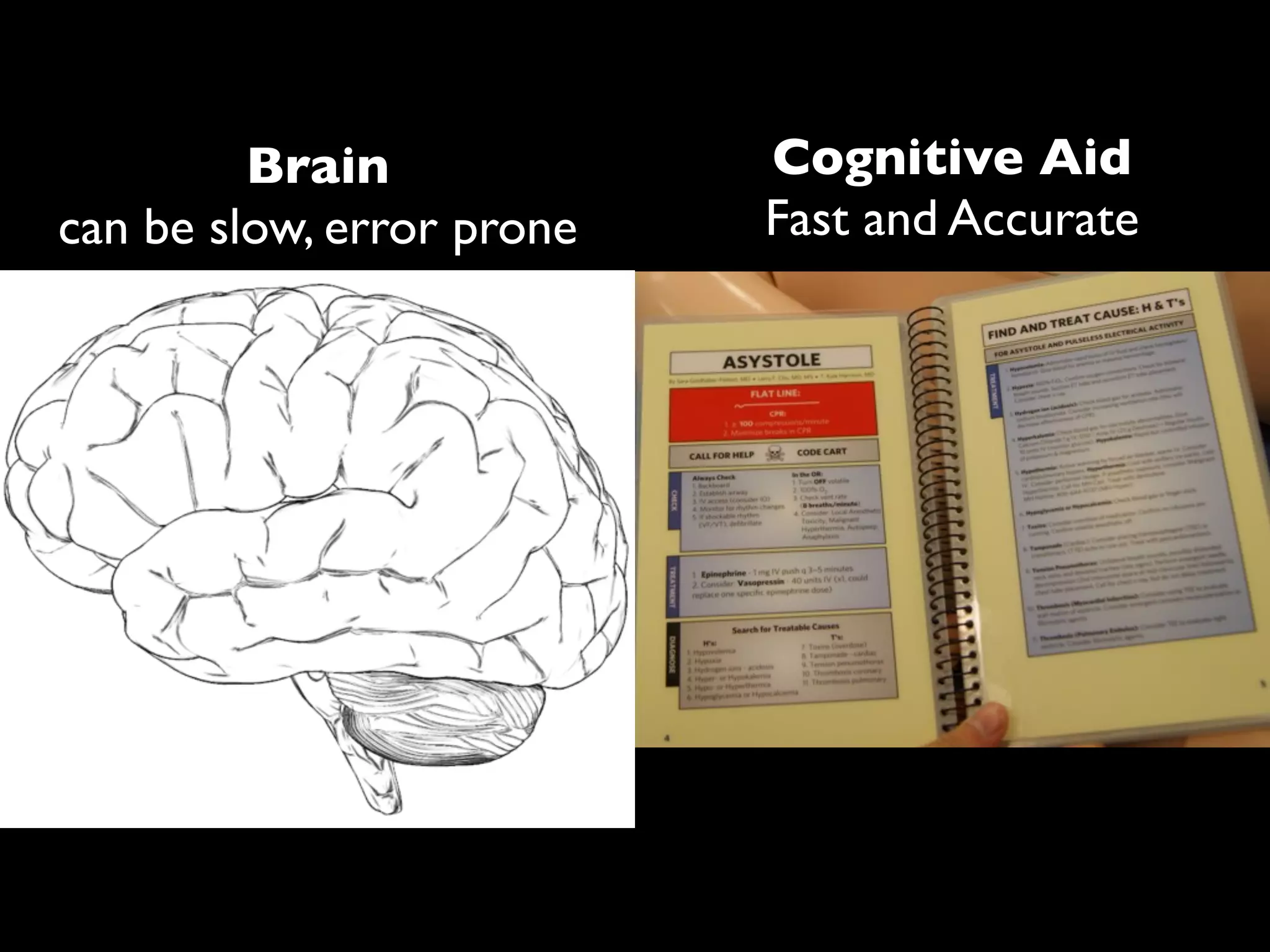
Brain
can be slow, error prone
Brain             Cognitive Aid
can be slow, error prone   Fast and Accurate
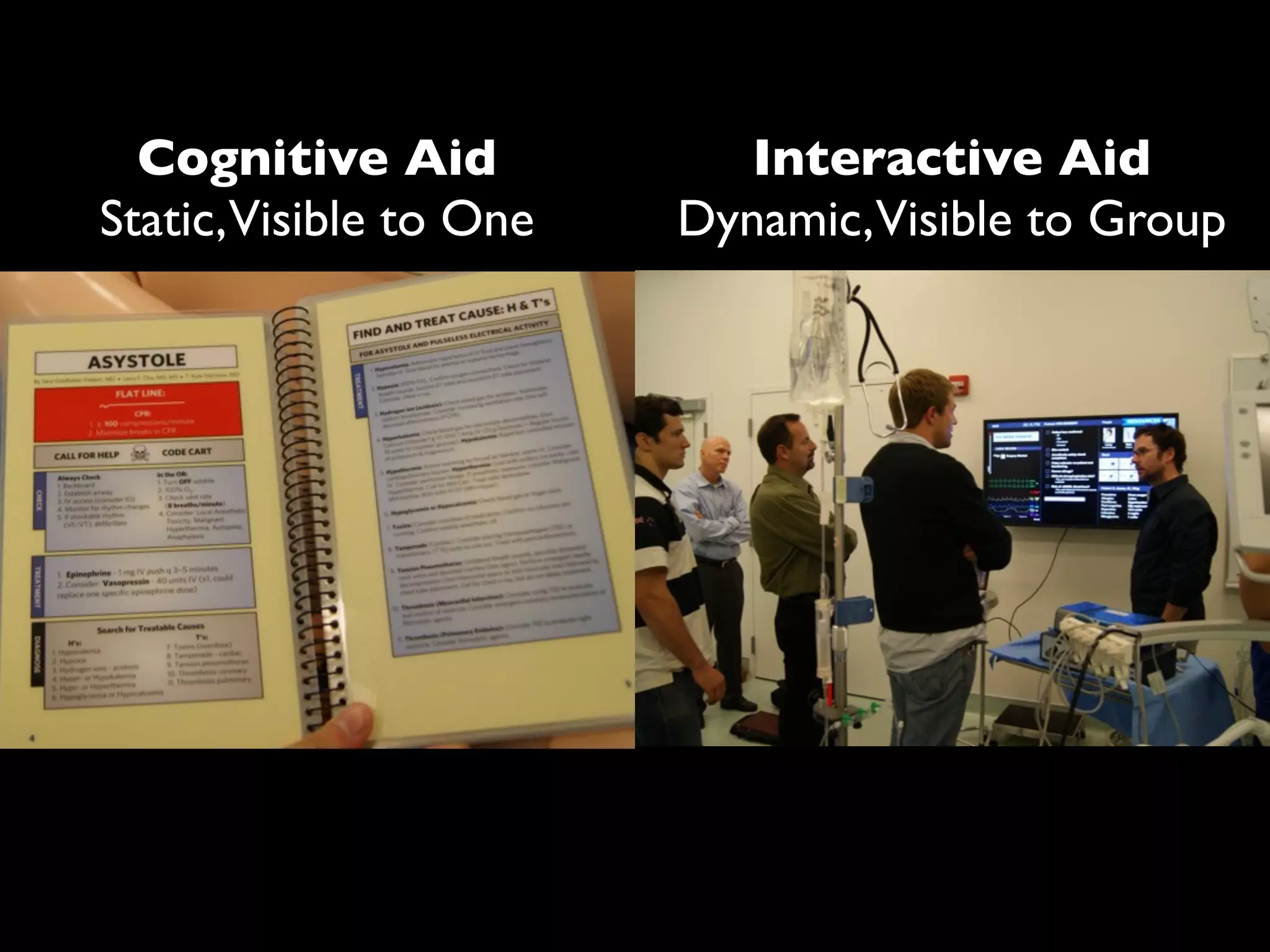
Cognitive Aid             Interactive Aid
Static, Visible to One   Dynamic,Visible to Group
Cog Aid => Resource
    Management
• cognitive aids are a resource to help the
  doctor during a crisis
• but so are
  • other people in the room
  • information about the patient
  • people on-call in case of emergency
  • communication
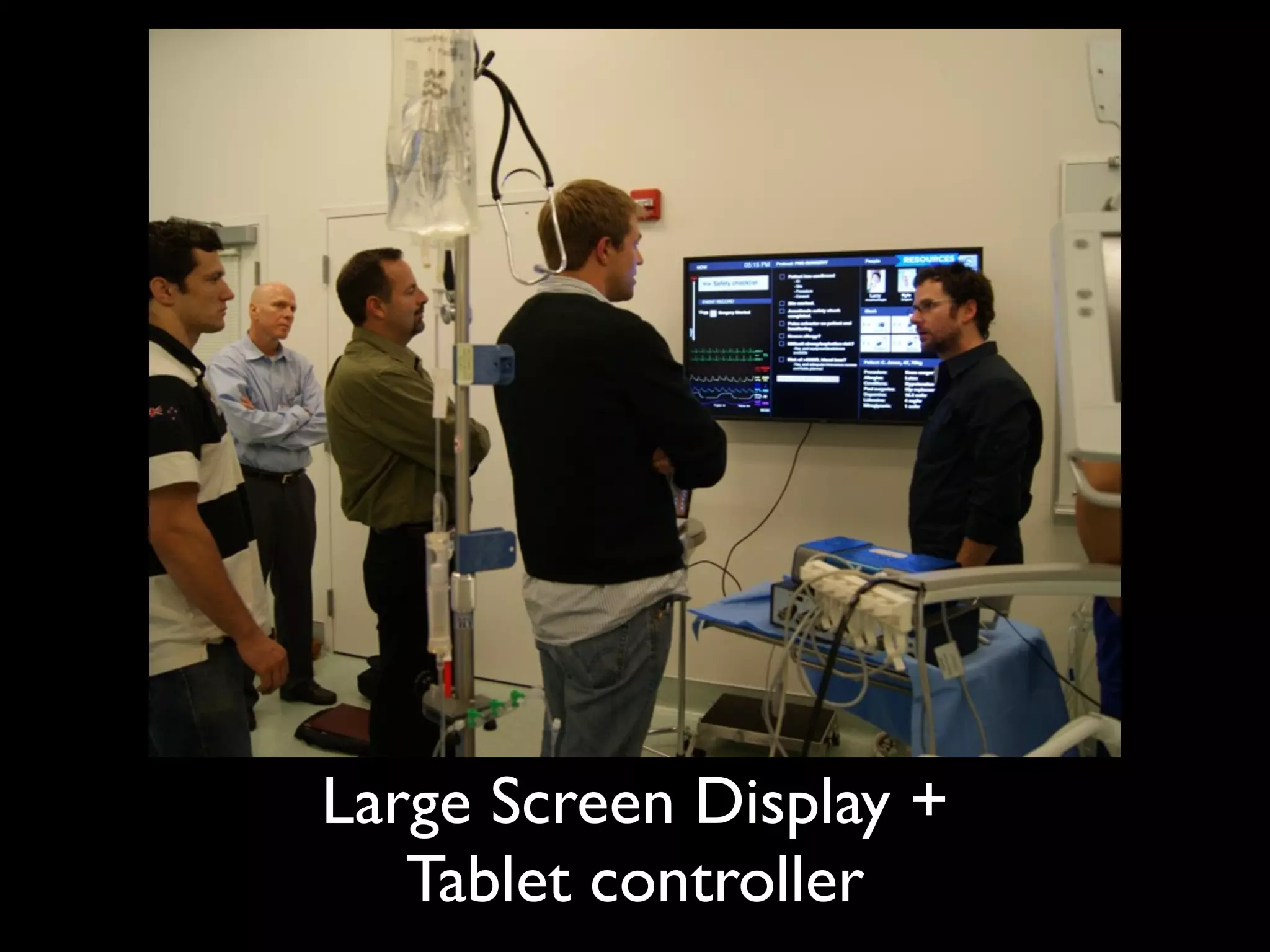
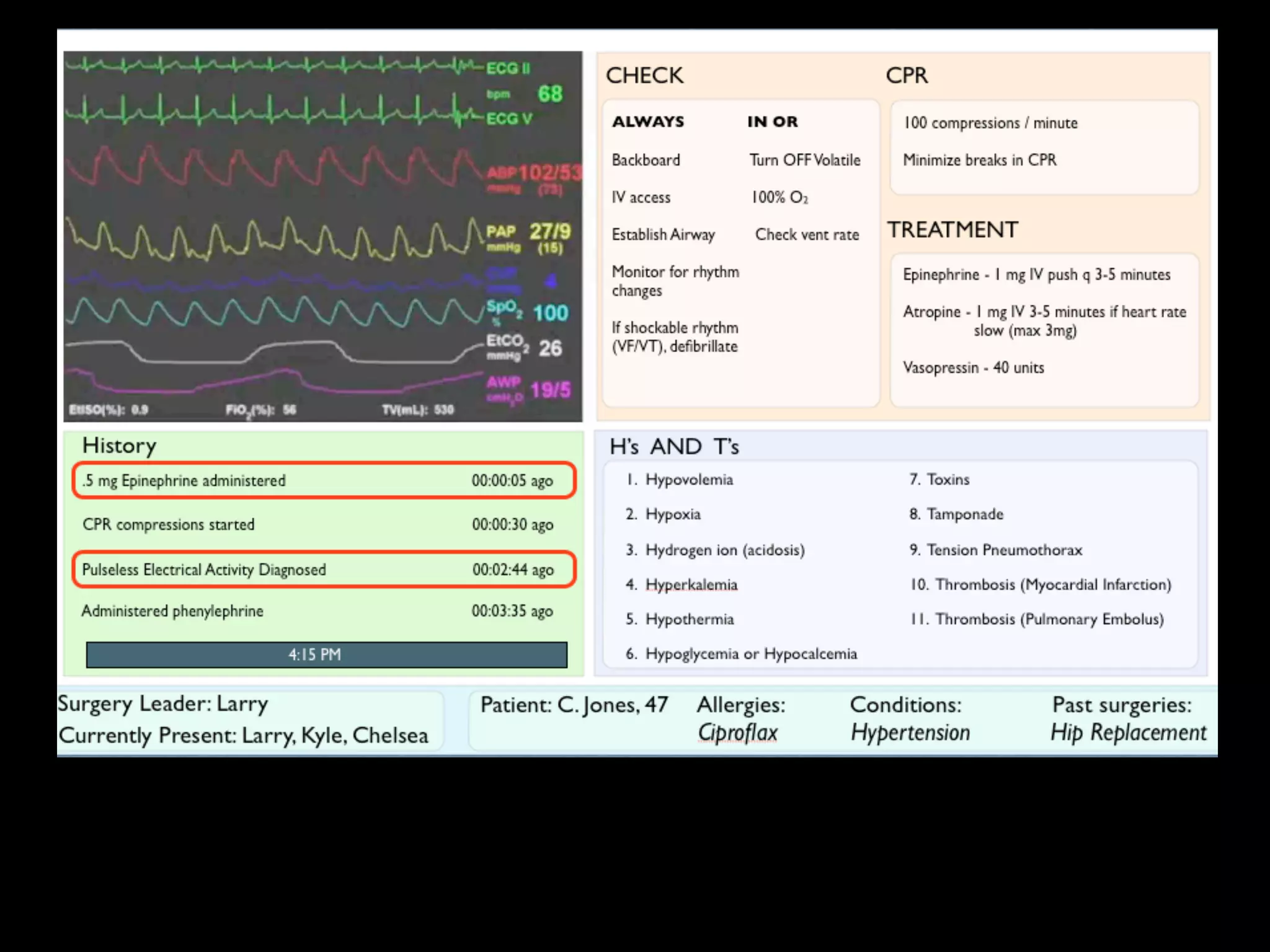
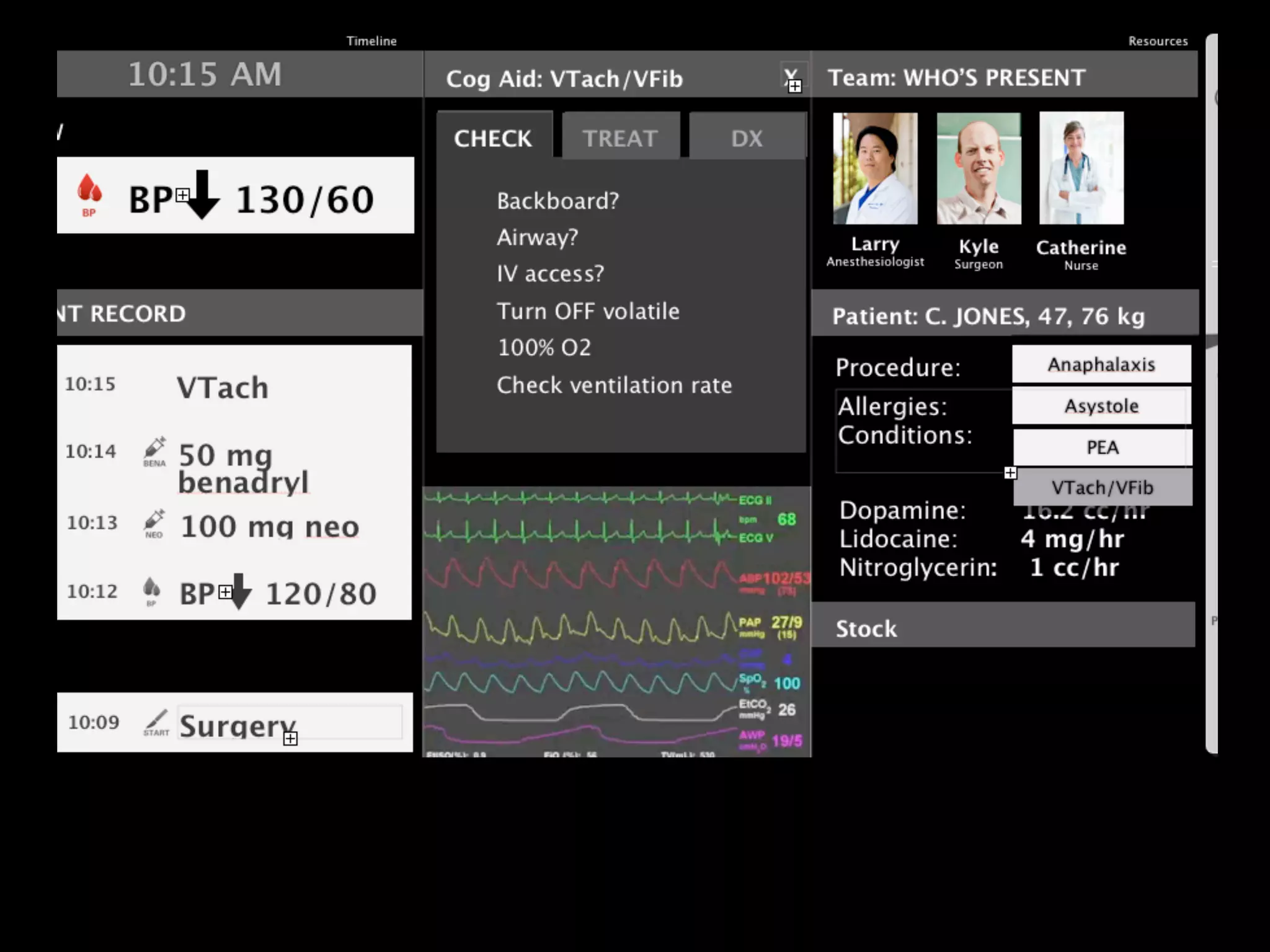
Large Screen Display +
   Tablet controller
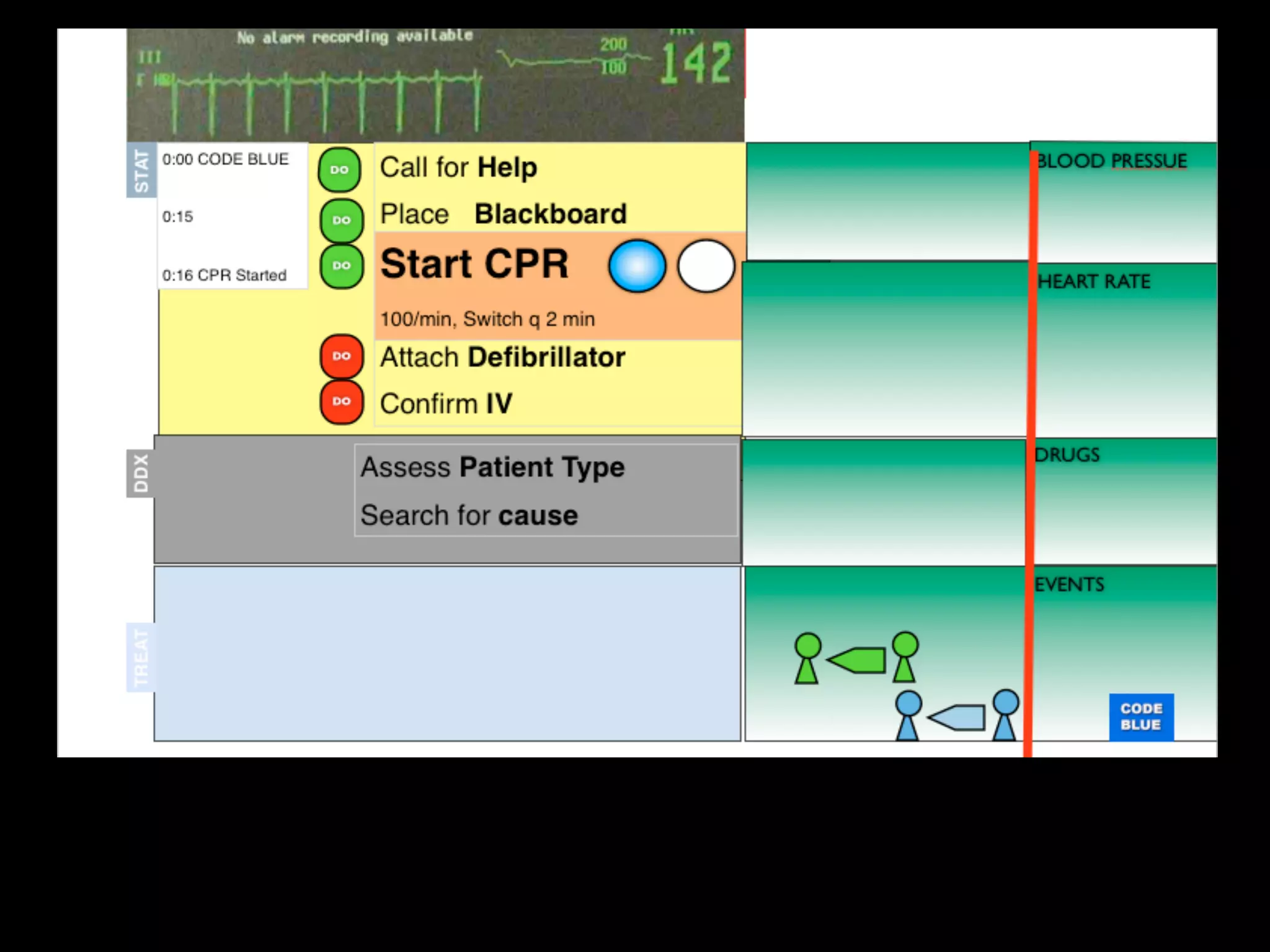
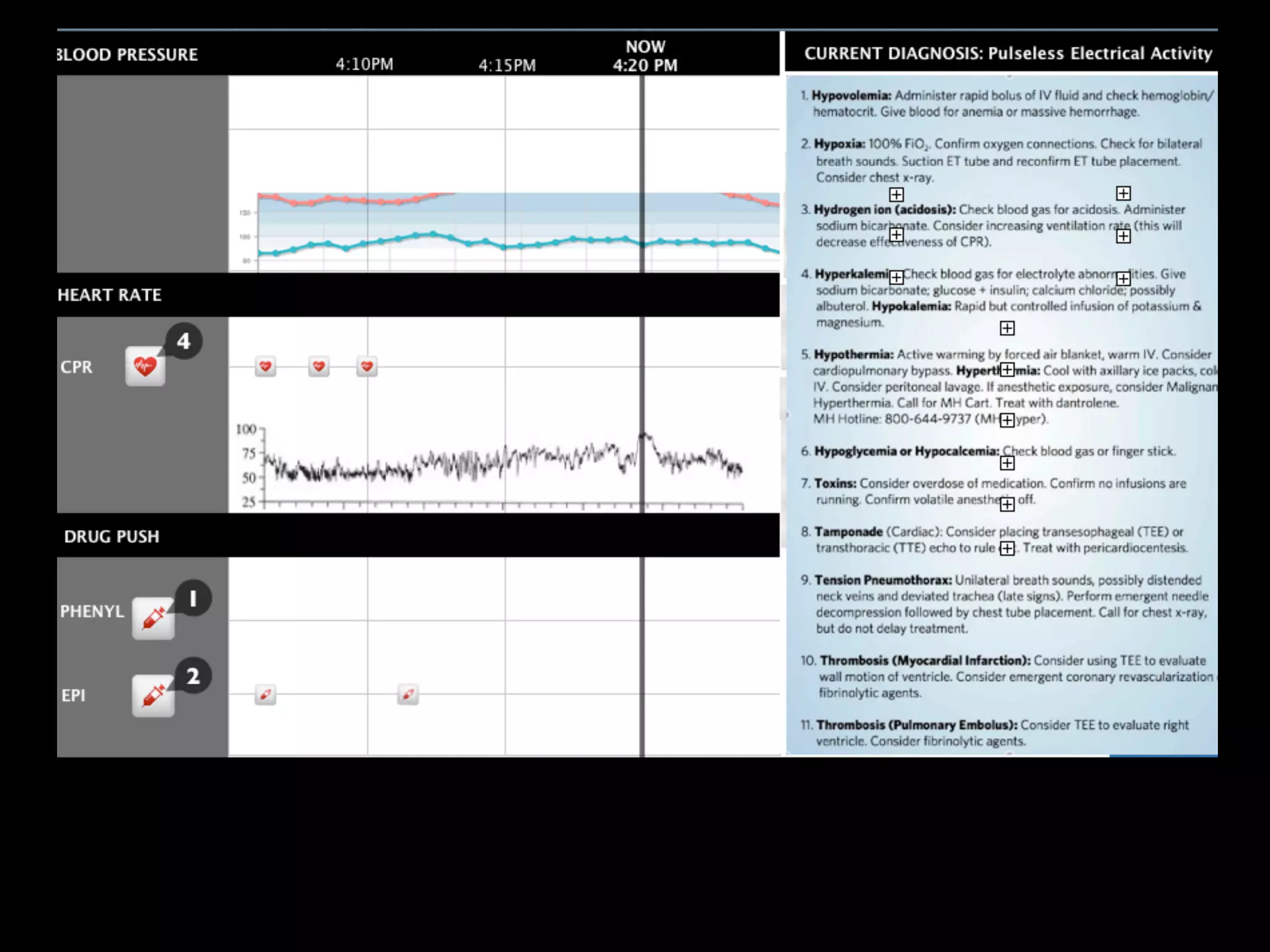
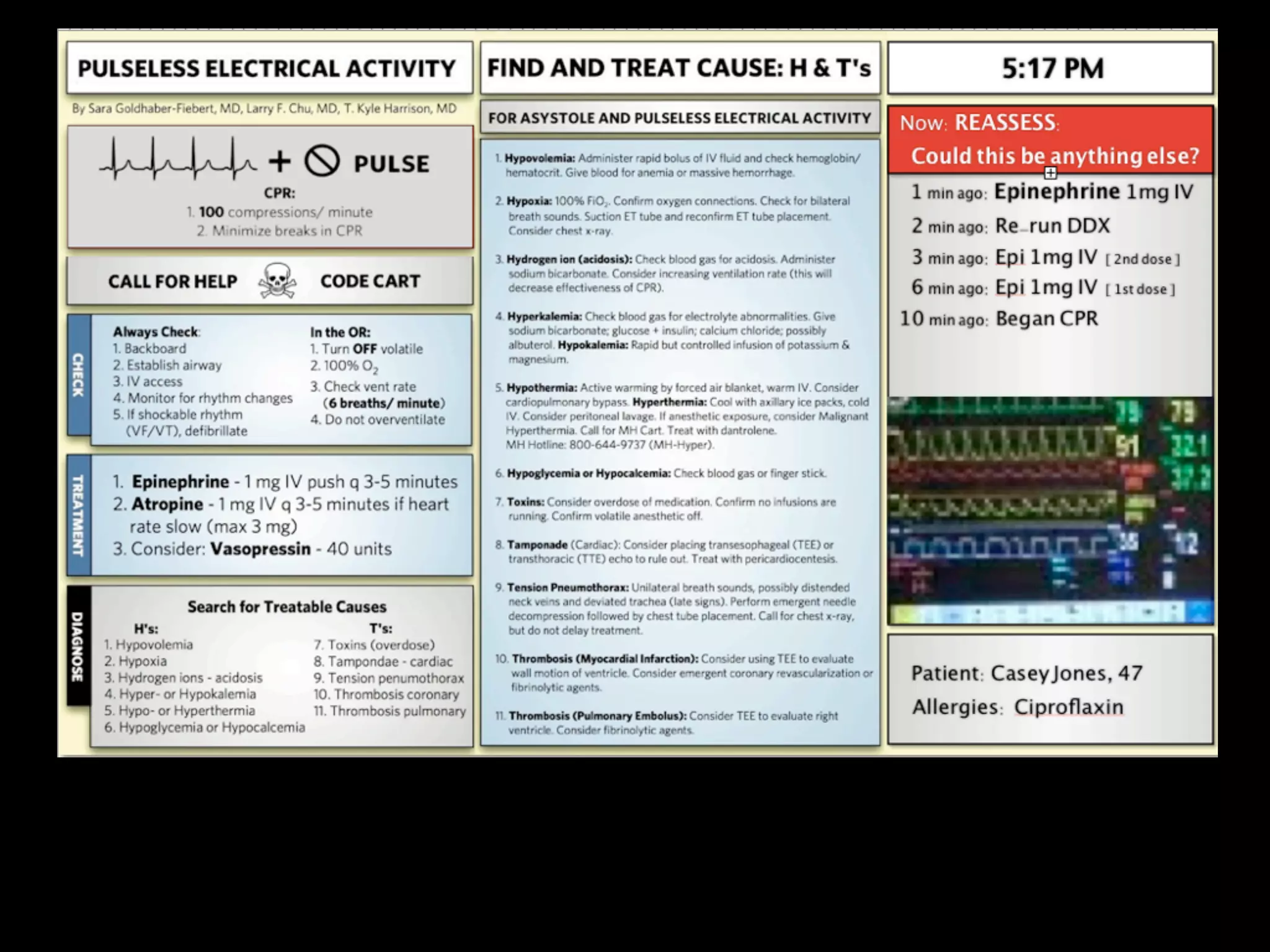
Scenario walkthrough
The Process
Prototypes,
prototypes,
prototypes
Insights
insights
insights

• Always ready
insights

• Always ready
• Nurse as primary controller
insights

• Always ready
• Nurse as primary controller
• Big display facilitates group coordination
Challenges

• life and death situations
• doctors don’t have time to treat patients
  and try out new interfaces
• patient privacy protection
The Wizard of Oz
    and the OR
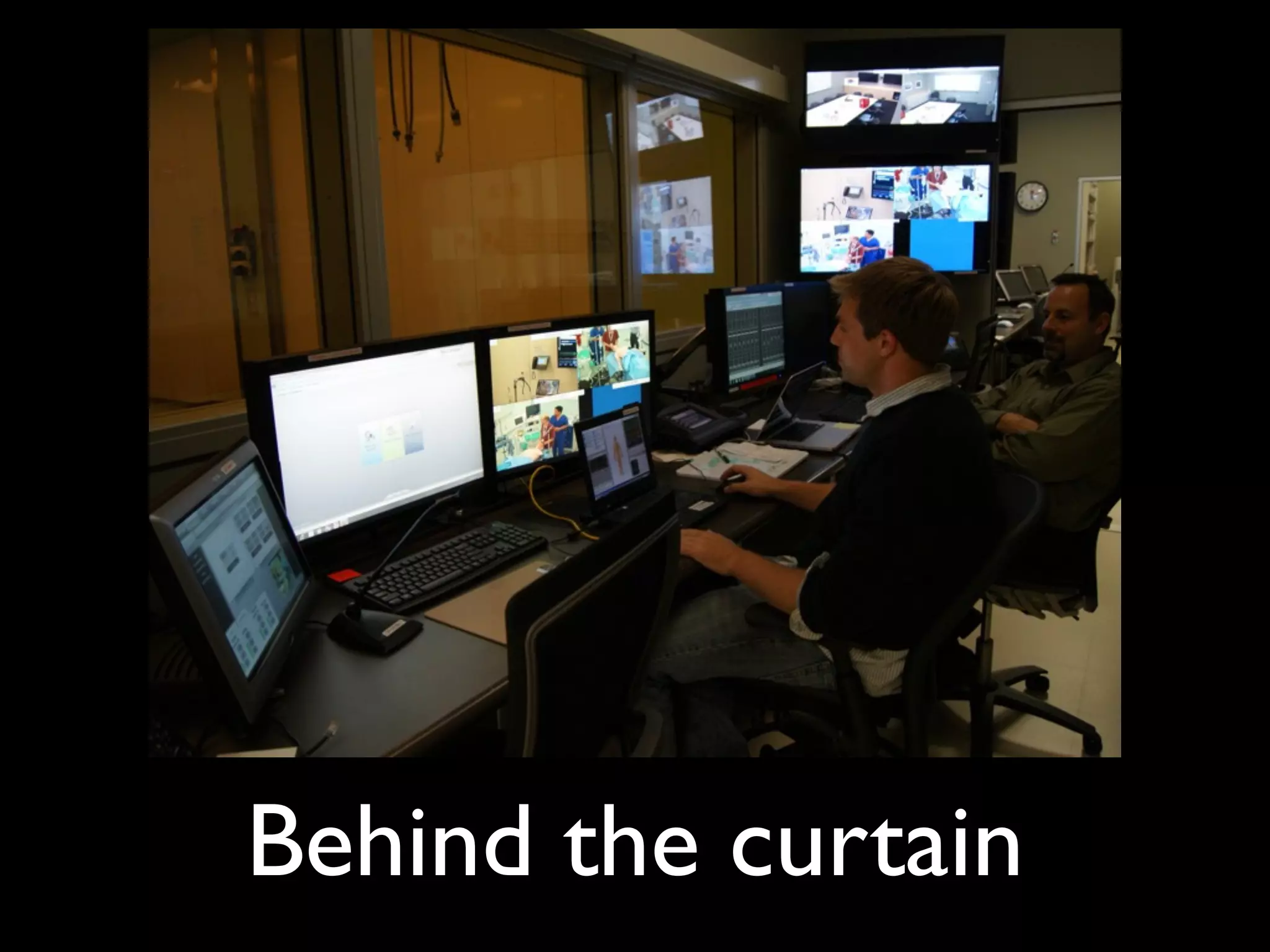
Stanford Simulation Center
Behind the curtain
Running a Scenario
Demo
 Sunday at 2:35
Demo Session #5
http://hci.stanford.edu
 http://aim.stanford.edu
Jesse Cirimele, Leslie Wu, Kyle Barrett, Katherine Chen,
  Kyle Harrison, Larry Chu, Stu Card, Scott Klemmer

6-120-1100-Cirimele

Editor's Notes

  • #2 Thanks for coming.\n
  • #3 Few application areas have more impact than surgery. Surgical procedures repair injuries from accidents, replace malfunctioning organs with functioning ones, restore function with prostheses, and heal the disfigured. Their impact on global public health is often underappreciated: A full 11% of the world’s disability-adjusted life years is attributable to conditions that can be treated with surgery. The number of surgeries performed each year is large and getting larger.  One estimate, prepared for the World Health Organization, put the number at 234 million surgical procedures per year, about one for every 25 persons and about twice the number of births.\n\nSurgery in the operating room and care in intensive care units can be complex. Many tasks, both routine and highly skilled, must be executed almost perfectly by highly-skilled teams working together in order to be successful and avoid harm to the patient. One study, for example, counted 178 tasks per day for the average patient in an Intensive Care Unit, each of which could put the patient at risk. Beyond the need for almost faultless execution, there are simply a vast number of conditions and remedies to know about.\n\nAs a comparison, mortality rates for surgery are about 300 times higher than for another inherently dangerous industry—aviation.  The odds of dying in an airplane crash about 1 in 10 million, compared to about 1 in 300 for surgery.\n
  • #4 Few application areas have more impact than surgery. Surgical procedures repair injuries from accidents, replace malfunctioning organs with functioning ones, restore function with prostheses, and heal the disfigured. Their impact on global public health is often underappreciated: A full 11% of the world’s disability-adjusted life years is attributable to conditions that can be treated with surgery. The number of surgeries performed each year is large and getting larger.  One estimate, prepared for the World Health Organization, put the number at 234 million surgical procedures per year, about one for every 25 persons and about twice the number of births.\n\nSurgery in the operating room and care in intensive care units can be complex. Many tasks, both routine and highly skilled, must be executed almost perfectly by highly-skilled teams working together in order to be successful and avoid harm to the patient. One study, for example, counted 178 tasks per day for the average patient in an Intensive Care Unit, each of which could put the patient at risk. Beyond the need for almost faultless execution, there are simply a vast number of conditions and remedies to know about.\n\nAs a comparison, mortality rates for surgery are about 300 times higher than for another inherently dangerous industry—aviation.  The odds of dying in an airplane crash about 1 in 10 million, compared to about 1 in 300 for surgery.\n
  • #5 Few application areas have more impact than surgery. Surgical procedures repair injuries from accidents, replace malfunctioning organs with functioning ones, restore function with prostheses, and heal the disfigured. Their impact on global public health is often underappreciated: A full 11% of the world’s disability-adjusted life years is attributable to conditions that can be treated with surgery. The number of surgeries performed each year is large and getting larger.  One estimate, prepared for the World Health Organization, put the number at 234 million surgical procedures per year, about one for every 25 persons and about twice the number of births.\n\nSurgery in the operating room and care in intensive care units can be complex. Many tasks, both routine and highly skilled, must be executed almost perfectly by highly-skilled teams working together in order to be successful and avoid harm to the patient. One study, for example, counted 178 tasks per day for the average patient in an Intensive Care Unit, each of which could put the patient at risk. Beyond the need for almost faultless execution, there are simply a vast number of conditions and remedies to know about.\n\nAs a comparison, mortality rates for surgery are about 300 times higher than for another inherently dangerous industry—aviation.  The odds of dying in an airplane crash about 1 in 10 million, compared to about 1 in 300 for surgery.\n
  • #6 The kinds of errors that we’ve come across\n(explain 4 types)\n
  • #7 right now what people do is they try to keep in all in their heads, but we know from psychology and experience that this this is an error prone strategy.\n\ncognitive aids (or checklists) are starting to gain traction as a great way to quickly remember exactly the steps that need to happen for a treatment algorithm.\n\nbut how do you get to the point where they have the right aid out and everyone is on the same page?\n
  • #8 in collaboration with the Anesthesia Informatics and Media lab in Stanford SOM\n\nwe set out to make an interactive cognitive aid where the steps are always at your finger tips. \n
  • #9 Along the way in trying to solve the cognitive aid problems\nwe realized the problem is actually about resource management\n\n
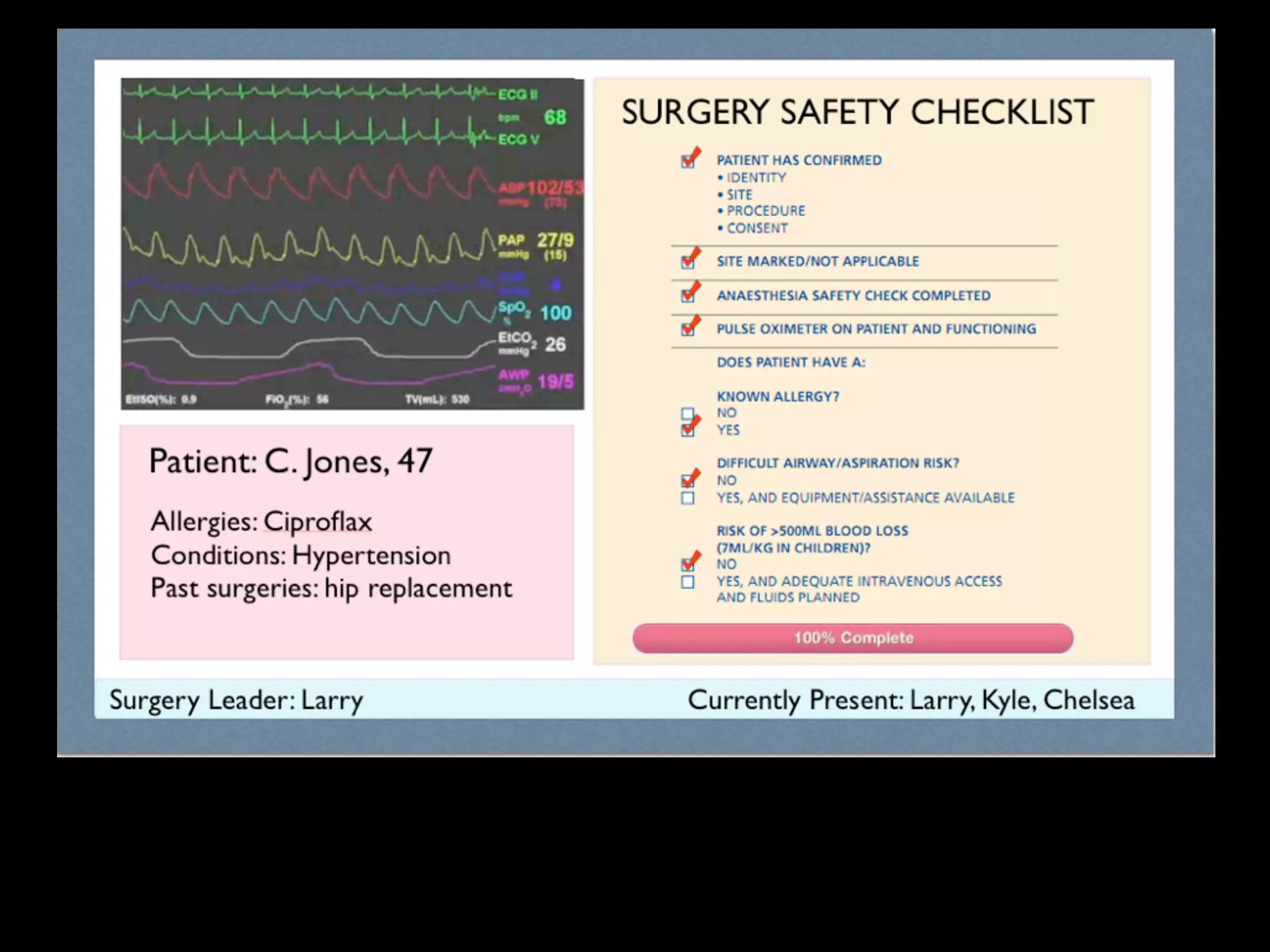
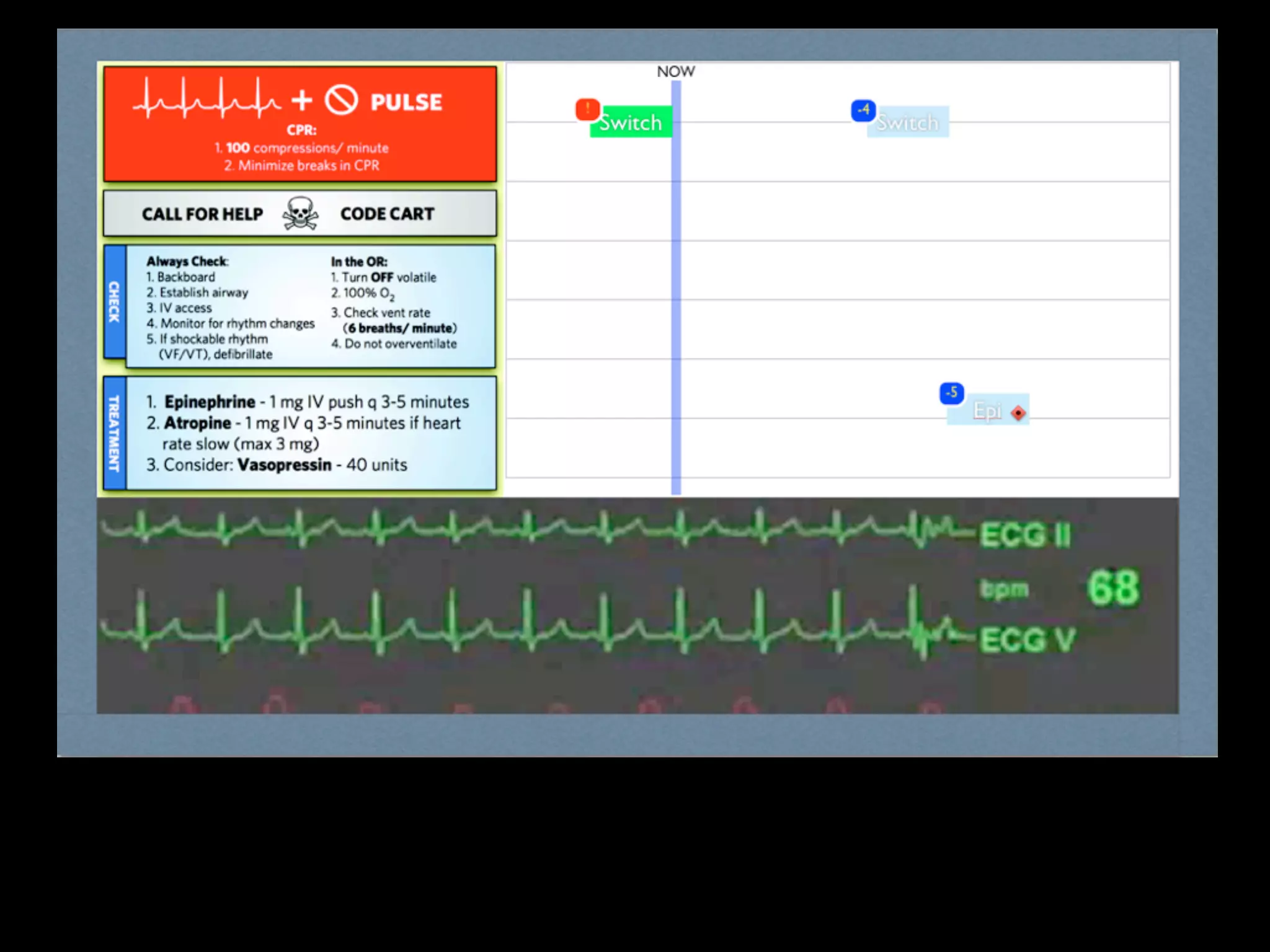
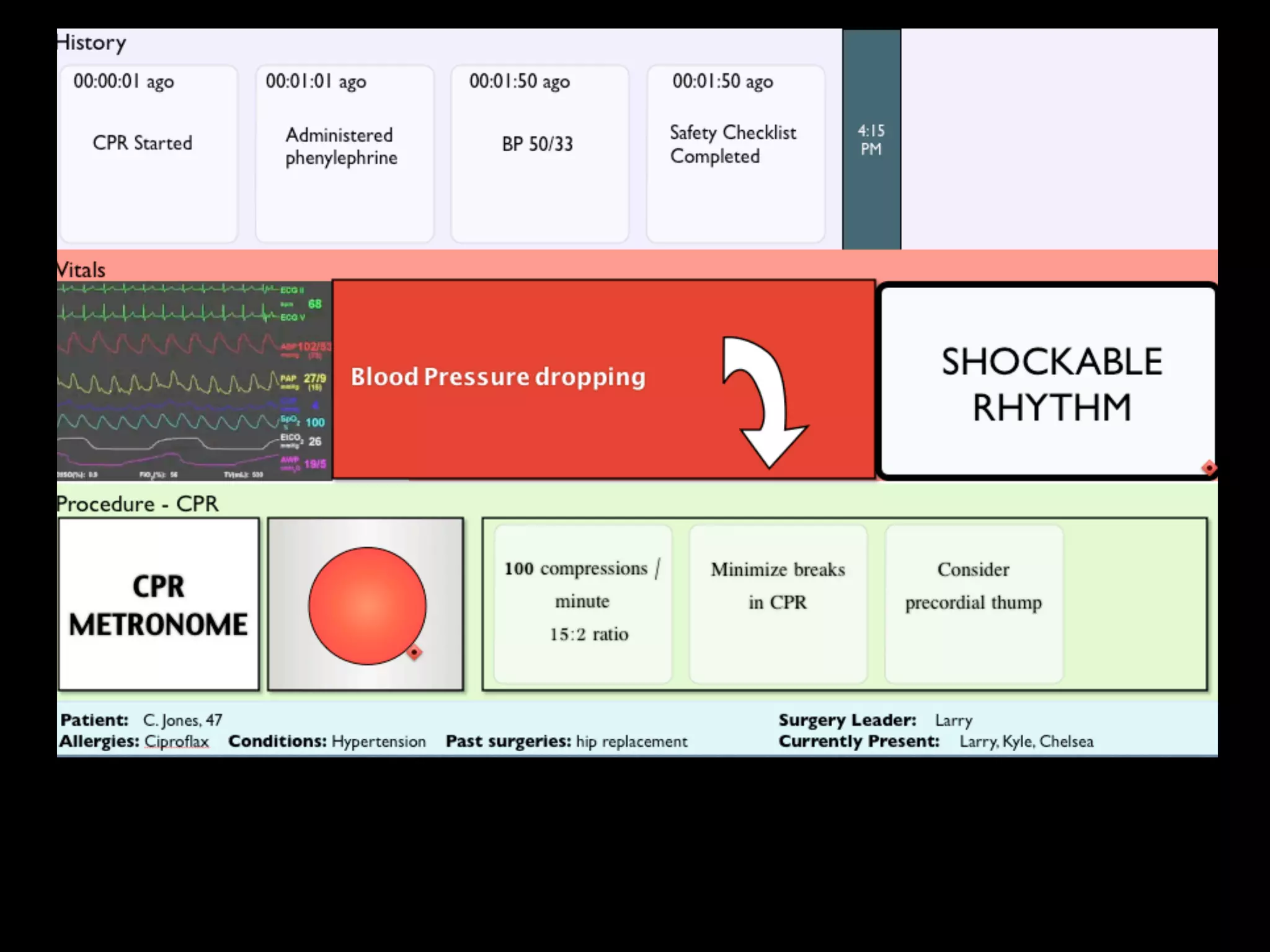
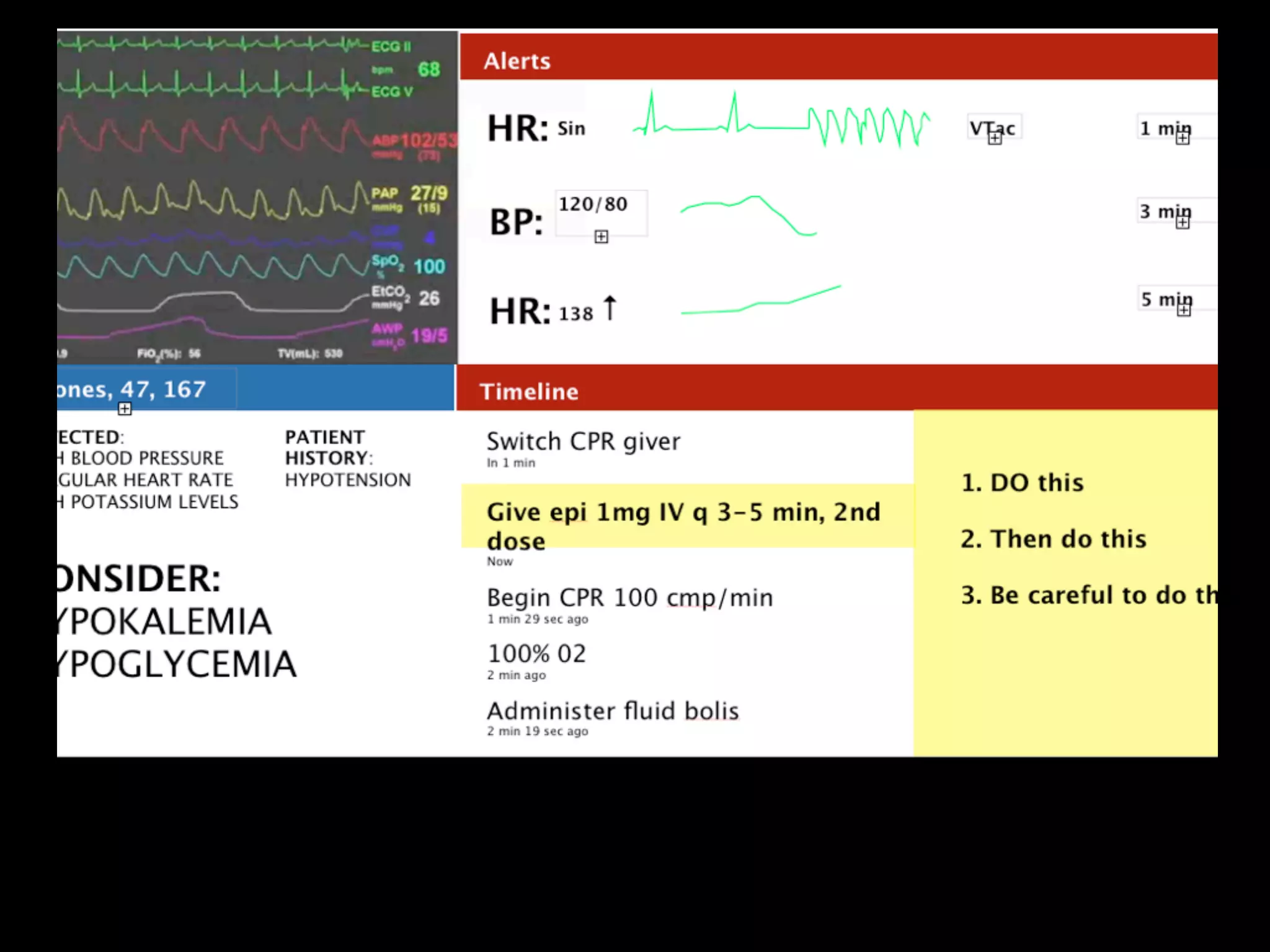
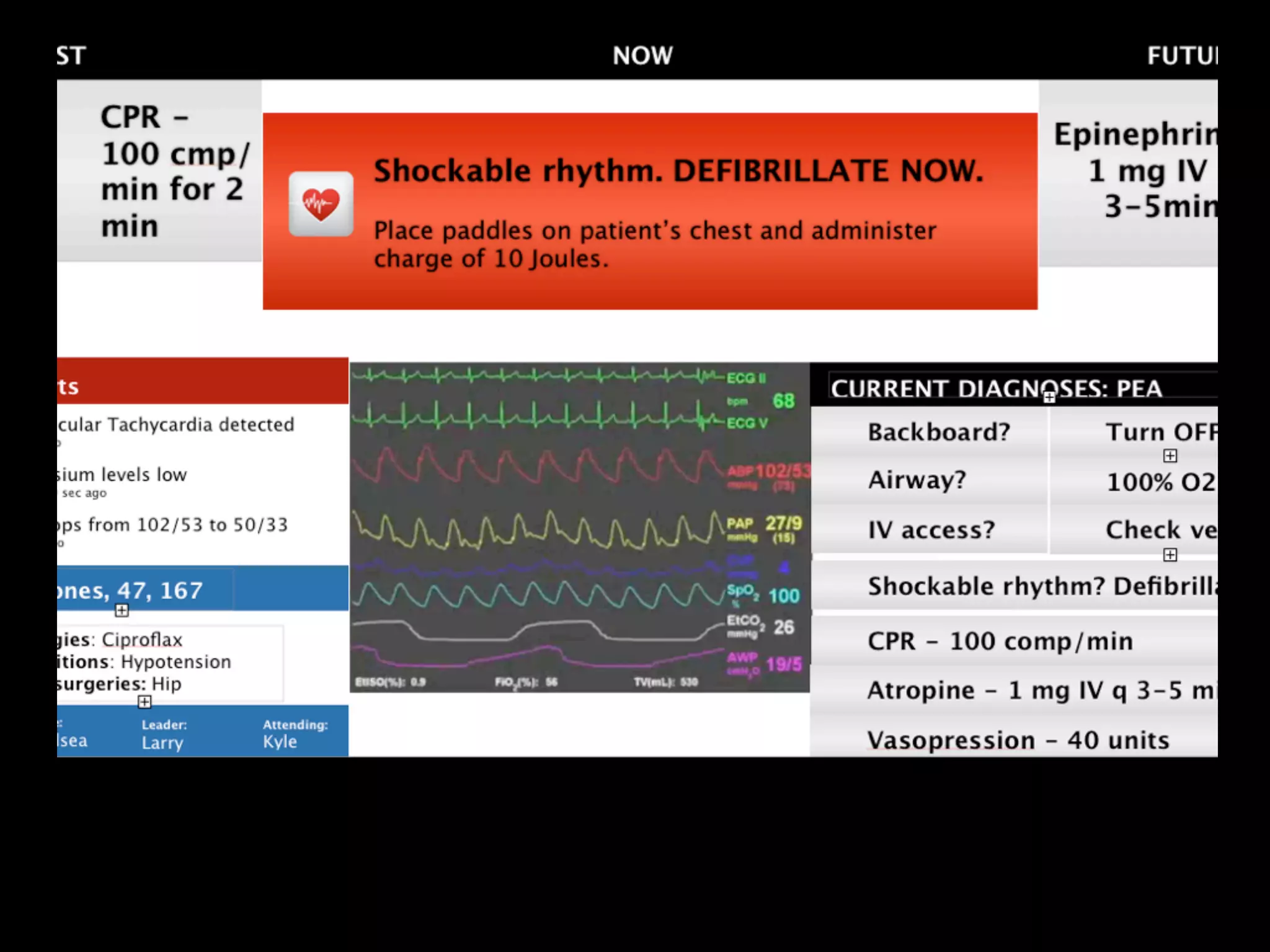
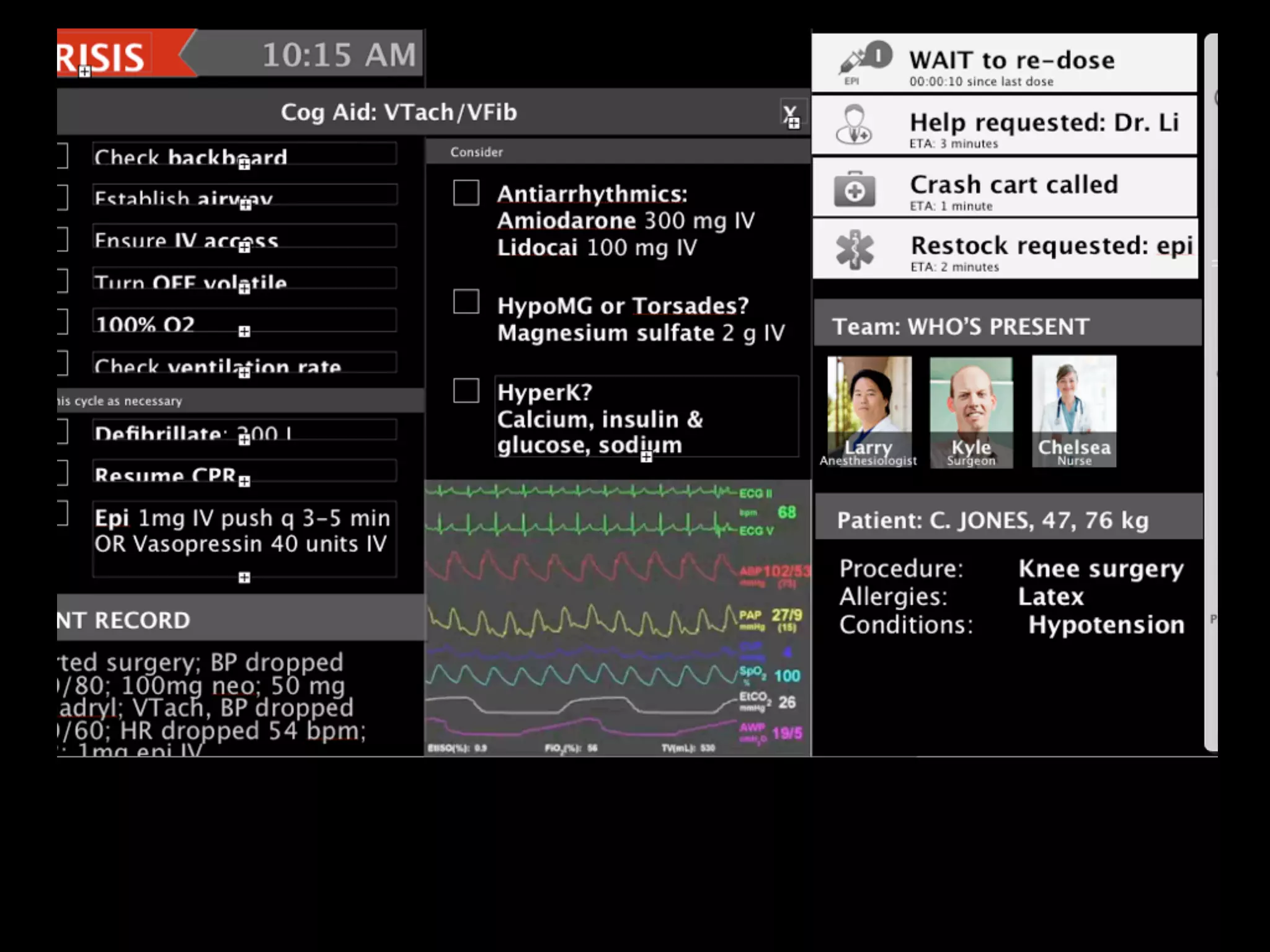
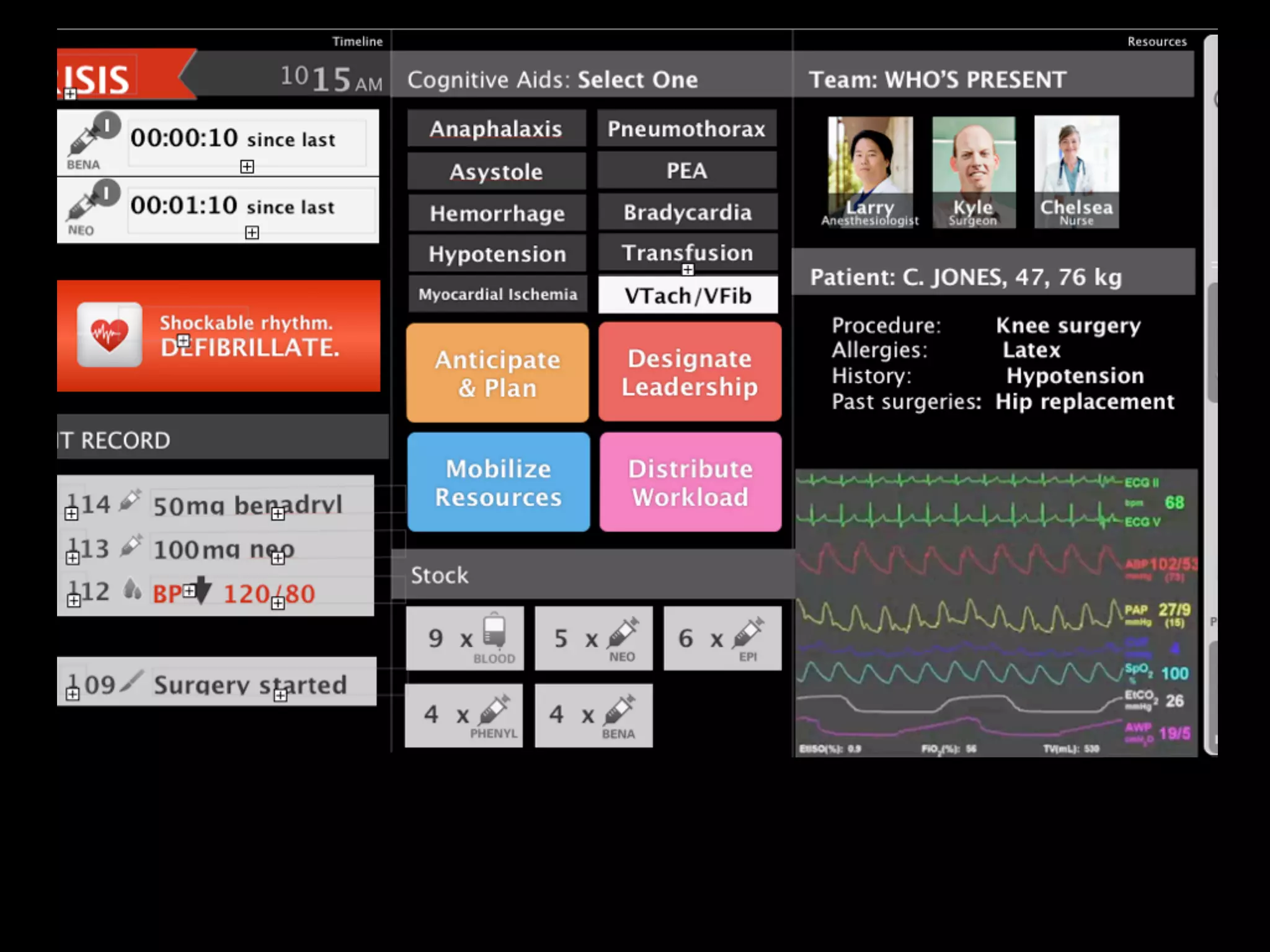
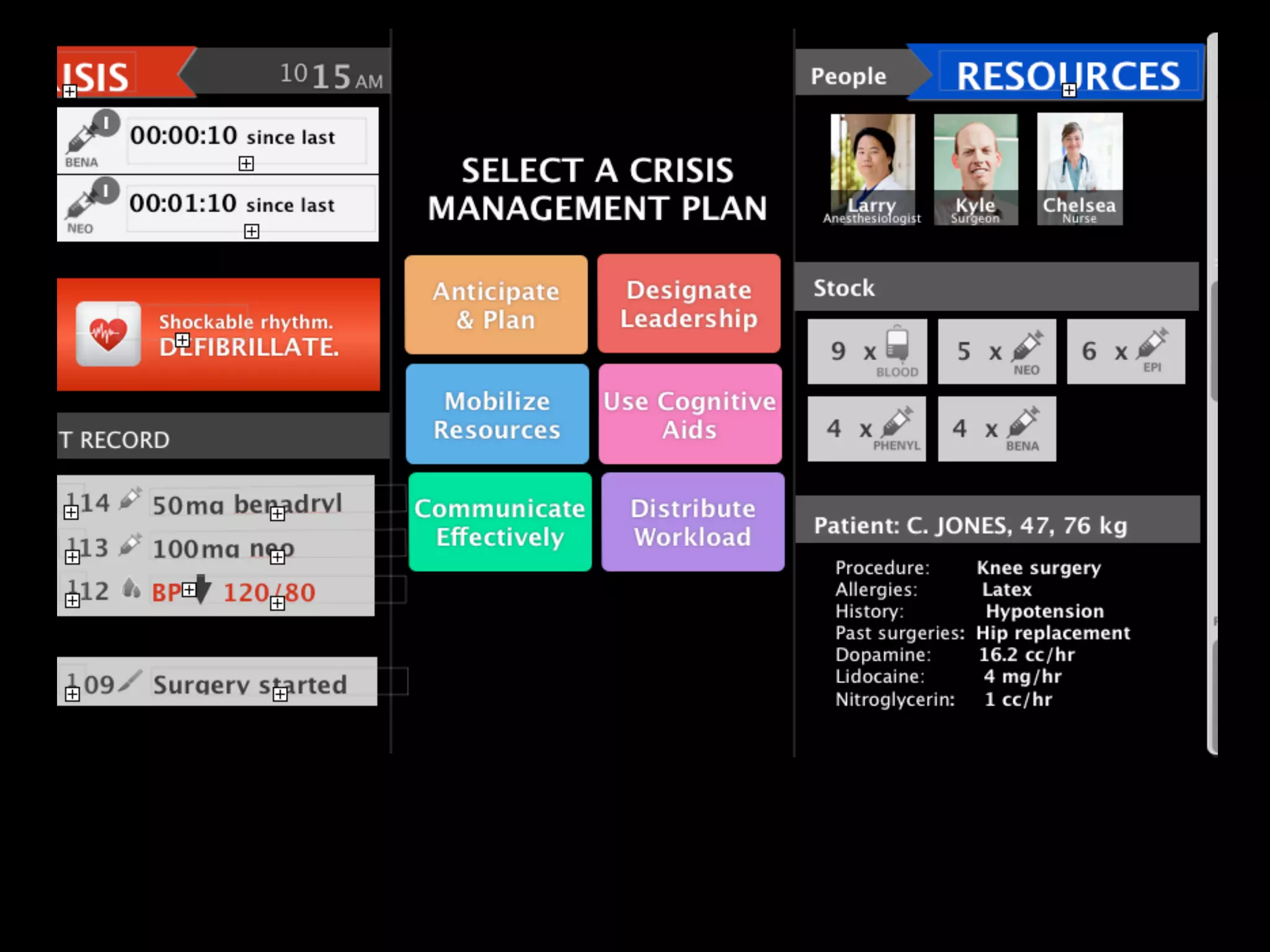
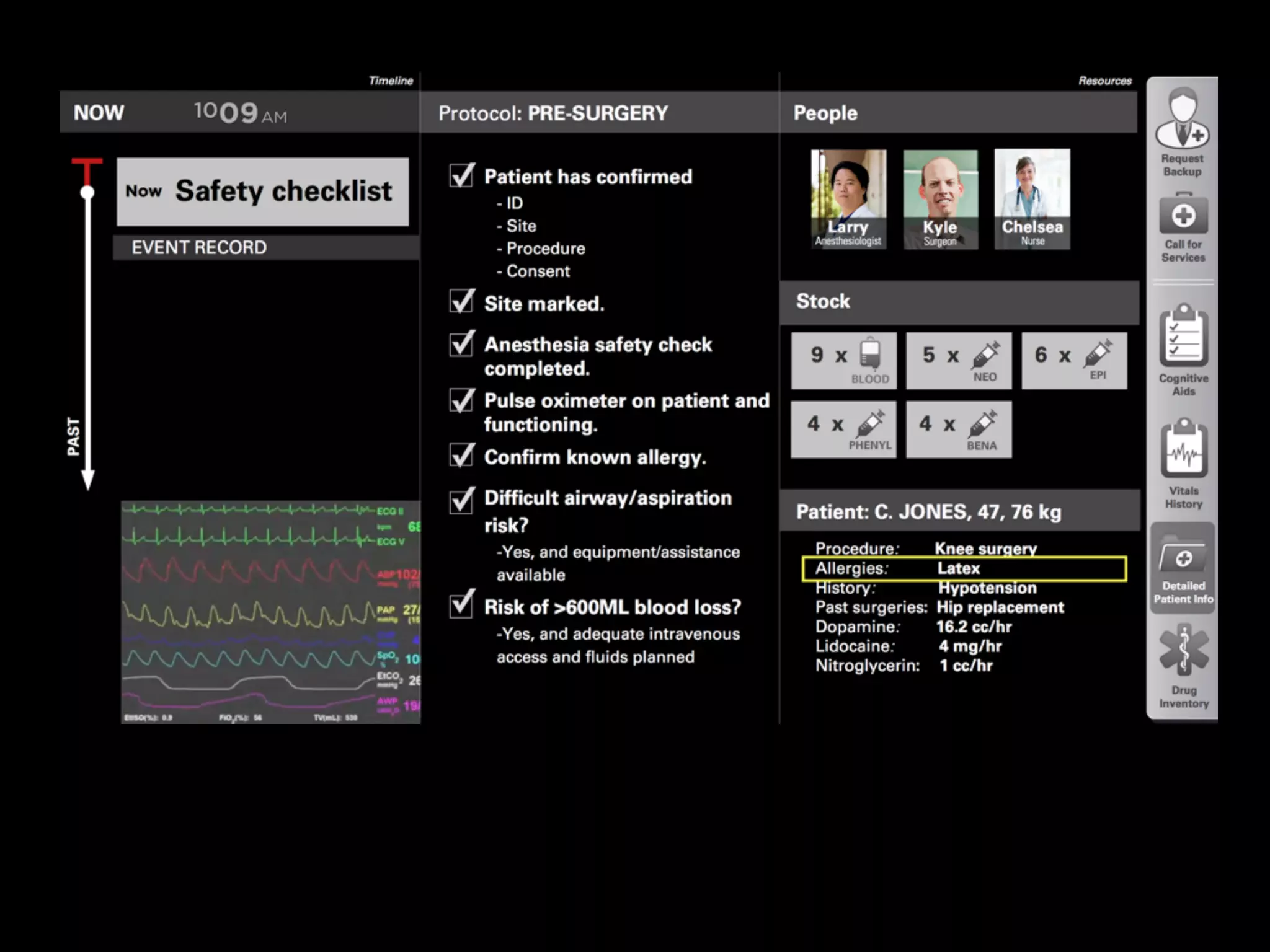
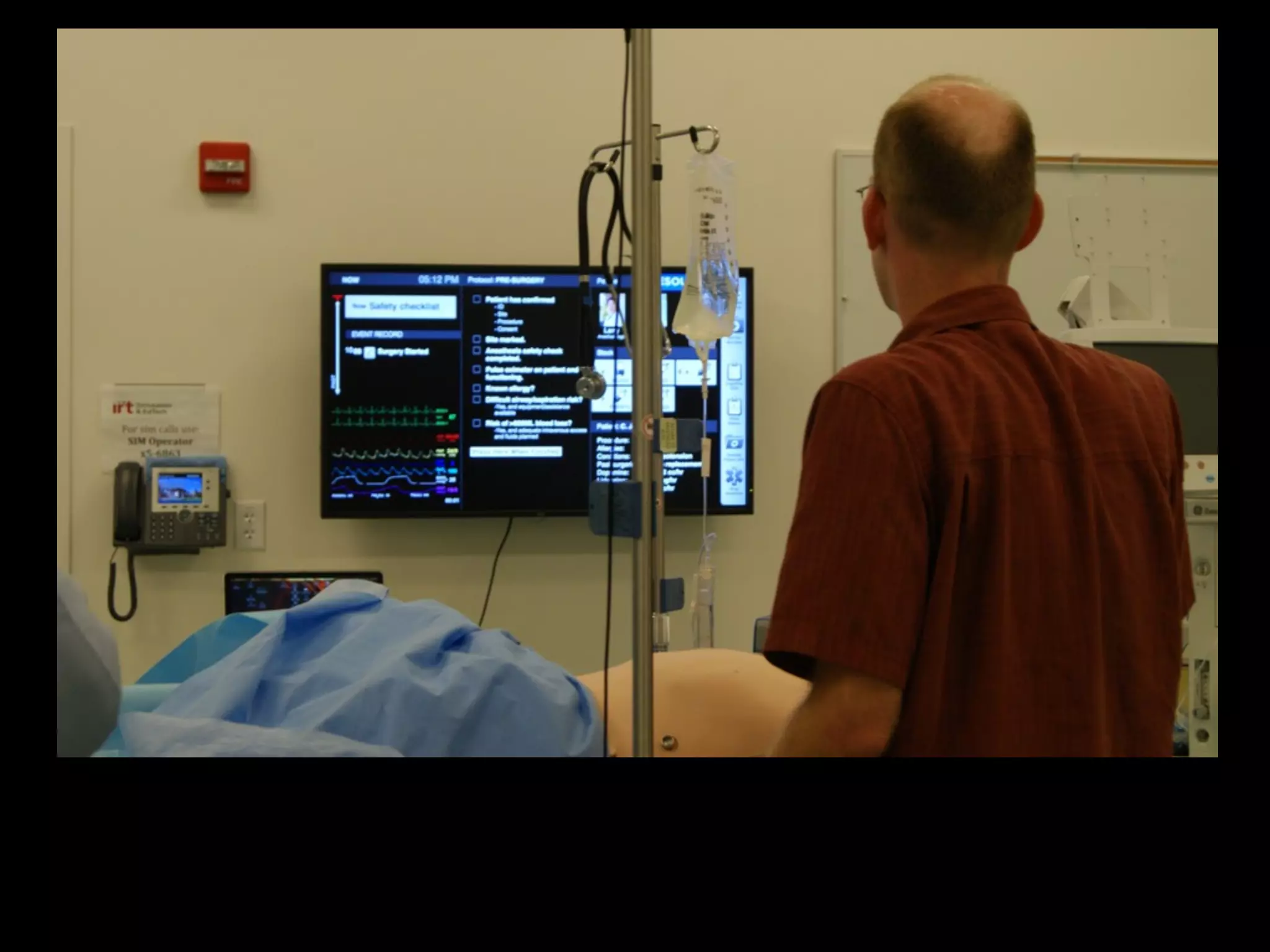
  • #10 Our design is for a linked Large Screen display and tablet computer. The display is setup so that everyone on the team can see it from their normal working place and the tablet is held by the recording nurse who previously held the paper note sheets.\n\nit’s a little difficult to see what’s going on here, so let’s do a quick walk through of the interface with an example scenario.\n
  • #11 \n
  • #12 how did we get here\n
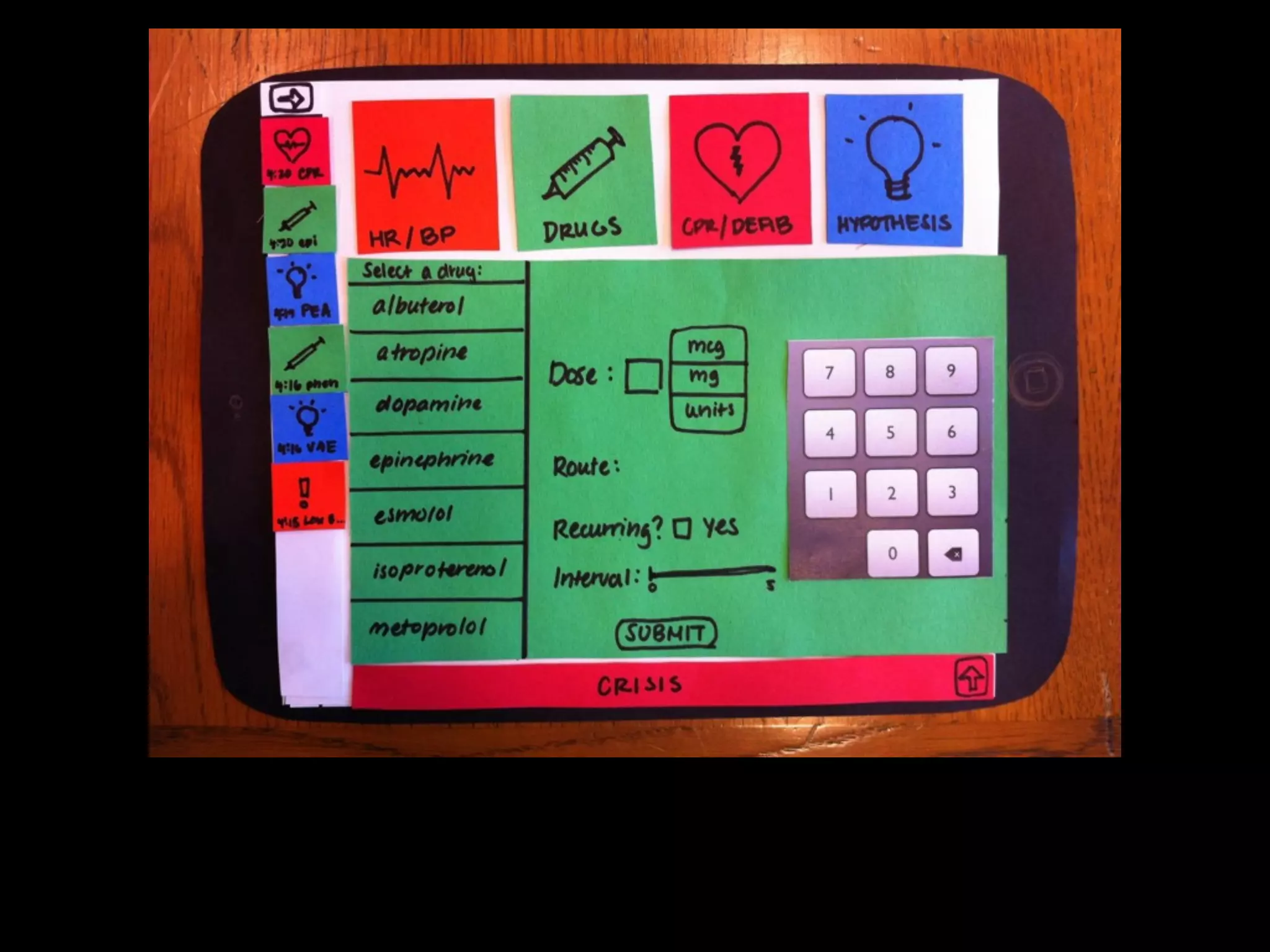
  • #13 in the last 6 months we have made more than 55 different prototypes and met with our collaborators from the medical school almost every week.\n\nprototypes are important because they are a great way to prompt conversations that you couldn’t have otherwise.... \n\n(TODO talk about how you people can’t tell you what they need, but they recognize it when they see it? something else?)\n\nfast design iterations and lots of feedback from our potential users through frequent prototype driven meetings\n
  • #14 in the last 6 months we have made more than 55 different prototypes and met with our collaborators from the medical school almost every week.\n\nprototypes are important because they are a great way to prompt conversations that you couldn’t have otherwise.... \n\n(TODO talk about how you people can’t tell you what they need, but they recognize it when they see it? something else?)\n\nfast design iterations and lots of feedback from our potential users through frequent prototype driven meetings\n
  • #15 in the last 6 months we have made more than 55 different prototypes and met with our collaborators from the medical school almost every week.\n\nprototypes are important because they are a great way to prompt conversations that you couldn’t have otherwise.... \n\n(TODO talk about how you people can’t tell you what they need, but they recognize it when they see it? something else?)\n\nfast design iterations and lots of feedback from our potential users through frequent prototype driven meetings\n
  • #16 in the last 6 months we have made more than 55 different prototypes and met with our collaborators from the medical school almost every week.\n\nprototypes are important because they are a great way to prompt conversations that you couldn’t have otherwise.... \n\n(TODO talk about how you people can’t tell you what they need, but they recognize it when they see it? something else?)\n\nfast design iterations and lots of feedback from our potential users through frequent prototype driven meetings\n
  • #17 in the last 6 months we have made more than 55 different prototypes and met with our collaborators from the medical school almost every week.\n\nprototypes are important because they are a great way to prompt conversations that you couldn’t have otherwise.... \n\n(TODO talk about how you people can’t tell you what they need, but they recognize it when they see it? something else?)\n\nfast design iterations and lots of feedback from our potential users through frequent prototype driven meetings\n
  • #18 in the last 6 months we have made more than 55 different prototypes and met with our collaborators from the medical school almost every week.\n\nprototypes are important because they are a great way to prompt conversations that you couldn’t have otherwise.... \n\n(TODO talk about how you people can’t tell you what they need, but they recognize it when they see it? something else?)\n\nfast design iterations and lots of feedback from our potential users through frequent prototype driven meetings\n
  • #19 in the last 6 months we have made more than 55 different prototypes and met with our collaborators from the medical school almost every week.\n\nprototypes are important because they are a great way to prompt conversations that you couldn’t have otherwise.... \n\n(TODO talk about how you people can’t tell you what they need, but they recognize it when they see it? something else?)\n\nfast design iterations and lots of feedback from our potential users through frequent prototype driven meetings\n
  • #20 in the last 6 months we have made more than 55 different prototypes and met with our collaborators from the medical school almost every week.\n\nprototypes are important because they are a great way to prompt conversations that you couldn’t have otherwise.... \n\n(TODO talk about how you people can’t tell you what they need, but they recognize it when they see it? something else?)\n\nfast design iterations and lots of feedback from our potential users through frequent prototype driven meetings\n
  • #21 in the last 6 months we have made more than 55 different prototypes and met with our collaborators from the medical school almost every week.\n\nprototypes are important because they are a great way to prompt conversations that you couldn’t have otherwise.... \n\n(TODO talk about how you people can’t tell you what they need, but they recognize it when they see it? something else?)\n\nfast design iterations and lots of feedback from our potential users through frequent prototype driven meetings\n
  • #22 in the last 6 months we have made more than 55 different prototypes and met with our collaborators from the medical school almost every week.\n\nprototypes are important because they are a great way to prompt conversations that you couldn’t have otherwise.... \n\n(TODO talk about how you people can’t tell you what they need, but they recognize it when they see it? something else?)\n\nfast design iterations and lots of feedback from our potential users through frequent prototype driven meetings\n
  • #23 in the last 6 months we have made more than 55 different prototypes and met with our collaborators from the medical school almost every week.\n\nprototypes are important because they are a great way to prompt conversations that you couldn’t have otherwise.... \n\n(TODO talk about how you people can’t tell you what they need, but they recognize it when they see it? something else?)\n\nfast design iterations and lots of feedback from our potential users through frequent prototype driven meetings\n
  • #24 in the last 6 months we have made more than 55 different prototypes and met with our collaborators from the medical school almost every week.\n\nprototypes are important because they are a great way to prompt conversations that you couldn’t have otherwise.... \n\n(TODO talk about how you people can’t tell you what they need, but they recognize it when they see it? something else?)\n\nfast design iterations and lots of feedback from our potential users through frequent prototype driven meetings\n
  • #25 in the last 6 months we have made more than 55 different prototypes and met with our collaborators from the medical school almost every week.\n\nprototypes are important because they are a great way to prompt conversations that you couldn’t have otherwise.... \n\n(TODO talk about how you people can’t tell you what they need, but they recognize it when they see it? something else?)\n\nfast design iterations and lots of feedback from our potential users through frequent prototype driven meetings\n
  • #26 in the last 6 months we have made more than 55 different prototypes and met with our collaborators from the medical school almost every week.\n\nprototypes are important because they are a great way to prompt conversations that you couldn’t have otherwise.... \n\n(TODO talk about how you people can’t tell you what they need, but they recognize it when they see it? something else?)\n\nfast design iterations and lots of feedback from our potential users through frequent prototype driven meetings\n
  • #27 in the last 6 months we have made more than 55 different prototypes and met with our collaborators from the medical school almost every week.\n\nprototypes are important because they are a great way to prompt conversations that you couldn’t have otherwise.... \n\n(TODO talk about how you people can’t tell you what they need, but they recognize it when they see it? something else?)\n\nfast design iterations and lots of feedback from our potential users through frequent prototype driven meetings\n
  • #28 in the last 6 months we have made more than 55 different prototypes and met with our collaborators from the medical school almost every week.\n\nprototypes are important because they are a great way to prompt conversations that you couldn’t have otherwise.... \n\n(TODO talk about how you people can’t tell you what they need, but they recognize it when they see it? something else?)\n\nfast design iterations and lots of feedback from our potential users through frequent prototype driven meetings\n
  • #29 in the last 6 months we have made more than 55 different prototypes and met with our collaborators from the medical school almost every week.\n\nprototypes are important because they are a great way to prompt conversations that you couldn’t have otherwise.... \n\n(TODO talk about how you people can’t tell you what they need, but they recognize it when they see it? something else?)\n\nfast design iterations and lots of feedback from our potential users through frequent prototype driven meetings\n
  • #30 in the last 6 months we have made more than 55 different prototypes and met with our collaborators from the medical school almost every week.\n\nprototypes are important because they are a great way to prompt conversations that you couldn’t have otherwise.... \n\n(TODO talk about how you people can’t tell you what they need, but they recognize it when they see it? something else?)\n\nfast design iterations and lots of feedback from our potential users through frequent prototype driven meetings\n
  • #31 in the last 6 months we have made more than 55 different prototypes and met with our collaborators from the medical school almost every week.\n\nprototypes are important because they are a great way to prompt conversations that you couldn’t have otherwise.... \n\n(TODO talk about how you people can’t tell you what they need, but they recognize it when they see it? something else?)\n\nfast design iterations and lots of feedback from our potential users through frequent prototype driven meetings\n
  • #32 in the last 6 months we have made more than 55 different prototypes and met with our collaborators from the medical school almost every week.\n\nprototypes are important because they are a great way to prompt conversations that you couldn’t have otherwise.... \n\n(TODO talk about how you people can’t tell you what they need, but they recognize it when they see it? something else?)\n\nfast design iterations and lots of feedback from our potential users through frequent prototype driven meetings\n
  • #33 in the last 6 months we have made more than 55 different prototypes and met with our collaborators from the medical school almost every week.\n\nprototypes are important because they are a great way to prompt conversations that you couldn’t have otherwise.... \n\n(TODO talk about how you people can’t tell you what they need, but they recognize it when they see it? something else?)\n\nfast design iterations and lots of feedback from our potential users through frequent prototype driven meetings\n
  • #34 in the last 6 months we have made more than 55 different prototypes and met with our collaborators from the medical school almost every week.\n\nprototypes are important because they are a great way to prompt conversations that you couldn’t have otherwise.... \n\n(TODO talk about how you people can’t tell you what they need, but they recognize it when they see it? something else?)\n\nfast design iterations and lots of feedback from our potential users through frequent prototype driven meetings\n
  • #35 in the last 6 months we have made more than 55 different prototypes and met with our collaborators from the medical school almost every week.\n\nprototypes are important because they are a great way to prompt conversations that you couldn’t have otherwise.... \n\n(TODO talk about how you people can’t tell you what they need, but they recognize it when they see it? something else?)\n\nfast design iterations and lots of feedback from our potential users through frequent prototype driven meetings\n
  • #36 in the last 6 months we have made more than 55 different prototypes and met with our collaborators from the medical school almost every week.\n\nprototypes are important because they are a great way to prompt conversations that you couldn’t have otherwise.... \n\n(TODO talk about how you people can’t tell you what they need, but they recognize it when they see it? something else?)\n\nfast design iterations and lots of feedback from our potential users through frequent prototype driven meetings\n
  • #37 in the last 6 months we have made more than 55 different prototypes and met with our collaborators from the medical school almost every week.\n\nprototypes are important because they are a great way to prompt conversations that you couldn’t have otherwise.... \n\n(TODO talk about how you people can’t tell you what they need, but they recognize it when they see it? something else?)\n\nfast design iterations and lots of feedback from our potential users through frequent prototype driven meetings\n
  • #38 in the last 6 months we have made more than 55 different prototypes and met with our collaborators from the medical school almost every week.\n\nprototypes are important because they are a great way to prompt conversations that you couldn’t have otherwise.... \n\n(TODO talk about how you people can’t tell you what they need, but they recognize it when they see it? something else?)\n\nfast design iterations and lots of feedback from our potential users through frequent prototype driven meetings\n
  • #39 in the last 6 months we have made more than 55 different prototypes and met with our collaborators from the medical school almost every week.\n\nprototypes are important because they are a great way to prompt conversations that you couldn’t have otherwise.... \n\n(TODO talk about how you people can’t tell you what they need, but they recognize it when they see it? something else?)\n\nfast design iterations and lots of feedback from our potential users through frequent prototype driven meetings\n
  • #40 in the last 6 months we have made more than 55 different prototypes and met with our collaborators from the medical school almost every week.\n\nprototypes are important because they are a great way to prompt conversations that you couldn’t have otherwise.... \n\n(TODO talk about how you people can’t tell you what they need, but they recognize it when they see it? something else?)\n\nfast design iterations and lots of feedback from our potential users through frequent prototype driven meetings\n
  • #41 in the last 6 months we have made more than 55 different prototypes and met with our collaborators from the medical school almost every week.\n\nprototypes are important because they are a great way to prompt conversations that you couldn’t have otherwise.... \n\n(TODO talk about how you people can’t tell you what they need, but they recognize it when they see it? something else?)\n\nfast design iterations and lots of feedback from our potential users through frequent prototype driven meetings\n
  • #42 in the last 6 months we have made more than 55 different prototypes and met with our collaborators from the medical school almost every week.\n\nprototypes are important because they are a great way to prompt conversations that you couldn’t have otherwise.... \n\n(TODO talk about how you people can’t tell you what they need, but they recognize it when they see it? something else?)\n\nfast design iterations and lots of feedback from our potential users through frequent prototype driven meetings\n
  • #43 in the last 6 months we have made more than 55 different prototypes and met with our collaborators from the medical school almost every week.\n\nprototypes are important because they are a great way to prompt conversations that you couldn’t have otherwise.... \n\n(TODO talk about how you people can’t tell you what they need, but they recognize it when they see it? something else?)\n\nfast design iterations and lots of feedback from our potential users through frequent prototype driven meetings\n
  • #44 \n
  • #45 always ready:\nby being on the wall everyone can see it\nby connecting the display to the state of the surgery, the likely relevant information is at your fingertips\n\nNurse controlling means that the using interface doesn’t distract the doctor from what’s at hand, nurse is already recording events\n\nfacilitates group coordination by keeping people on the same page and by prompting conversations.\n
  • #46 always ready:\nby being on the wall everyone can see it\nby connecting the display to the state of the surgery, the likely relevant information is at your fingertips\n\nNurse controlling means that the using interface doesn’t distract the doctor from what’s at hand, nurse is already recording events\n\nfacilitates group coordination by keeping people on the same page and by prompting conversations.\n
  • #47 always ready:\nby being on the wall everyone can see it\nby connecting the display to the state of the surgery, the likely relevant information is at your fingertips\n\nNurse controlling means that the using interface doesn’t distract the doctor from what’s at hand, nurse is already recording events\n\nfacilitates group coordination by keeping people on the same page and by prompting conversations.\n
  • #48 \n
  • #49 (ask how many people have seen the wizard of oz, wait one second for hands)\n\nin the movie people think that there’s a powerful wizard, but really it’s just a guy behind the curtain pulling levers. As you saw with all the prototypes you saw, we use this all the time in design. we make a fake version fast and pull the levers manually to prototype the experience. we had an amazing moment of synergy with larry and kyle because it turns out...\n
  • #50 they do the same thing with surgery.\n\nin the basement of this very building is a fake hospital with fake operating rooms...\n
  • #51 and people behind the curtains pulling the lever.\n\nDavid Gaba, who pioneered a lot of this at stanford, has been doing this for decades.\n
  • #52 These simulations are an essential element of medical residents training and in this project we’re going to piggy back on that to test new ideas in simulation long before they’re ready for the operating room.\n
  • #53 \n
  • #54 My name is Jesse Cirimele and I’m a PhD candidate in the Computer science department here at Stanford University.\n\nthe work i’m talking about today is a collaboration between the HCI CS group and the Anesthesia Informatics and Media lab in Stanford SOM.\n\n