Summary and conclusions
th
BORDERS
DIALOGUES
2015
European Forum
European Forum
European Forum
on Cross-Border Cooperation in a Wider Europe
6TH
ANNUAL FORUM
ON CROSS-BORDER
COOPERATION
(KOŠICE – UZHGOROD,
24 - 27 NOVEMBER 2015)
24. – 27. November 2015, Uzhgorod - Košice
on Cross-Border Cooperation in a Wider Europe
6666
3 Introductory words
5 Photo - Cross-border cafe, Košice, Club Yasmin, 24 November 2015
7 Key Points of the 6th European Forum on Cross-Border Cooperation in the Wider Europe
12 Border Dialogues Awards 2015
18 Conclusions of the 6th European Forum on Cross-Border Cooperation in a Wider Europe, 2015
19 Acknowledgements to donors, partners and supporters
3/
In 2009, at a meeting of the Norwegian Bar-
ents Secretariat (NBS), Institute for Stability
and Development (ISD) and several other or-
ganizations was formulated the idea of regular
border dialogues on efficient cross-border co-
operation along eastern EU border. In 2010, the
first of these took place in Uzhgorod, Ukraine
and Košice, Slovakia. The series continued at
EU borders with Moldova and Ukraine in Chis-
inau, Moldova, then with Russia in Elbląng, Po-
land and Kaliningrad, Russia, then in Karelia
Euroregion (Joensuu, Finland and Sortavala,
Russia), and finally in Kirkenes, Norway and
Nikel, Russia at the Barents See on the Euro-
pean Far North.
ISD was involved in preparation and organiza-
tion of all these conferences, which created a
network of professionals, civil society activists,
regional policymakers and officers of border
protection units and customs, involved in ex-
change of experience as regards cross-border
cooperation along the EU eastern border. Thus,
it was considered a great honour to join the
team of organizers of the next round of these
conferences, which symbolically returned to
where it started - to the vivid Carpathian Eu-
roregion.
In November 2015, starting in Uzhgorod and
proceeding in Košice we could meet again to
discuss with others what progress has been
made, as regards the border-crossing proce-
dures and facilities on Slovakia/Ukraine border,
as well as and in the field of cross-border coop-
eration between local administrations, compa-
nies, universities and civil society organizations
of the whole vivid Carpathian region, where
meets borders of Hungary, Poland, Romania,
Slovakia and Ukraine.
It follows from the key points of discussions
and conclusions of the conference, that this se-
ries of border dialogues should continue, while
focusing primarily on cross-border cooperation
along segments of the EU Eastern Border on its
BORDER DIALOGUES
OVERVIEW
INTRODUCTORY WORDS
OVERVIEW
/4
southern wing, which are exposed to the need
to enhance border security under the influence
of migration flow and/or even frozen conflicts,
while preserving all already achieved in culti-
vation of efficient cross-border cooperation
and mutual trust between peoples living along
the EU eastern border. It is essential to seek for
full support of EU and EEA institutions, as well
as of involved national and regional govern-
ments, and participating civil society organiza-
tions. However, these goals may hardly be
achieved without sufficient funding from all
available sources.
The team of organisers of the 6th European
Cross-Border Dialogue headed by Government
Office of the Slovak Republic and supported by
Norwegian Barents Secretariat, Uzhgorod
Branch of the National Institute for Strategic
Studies, Consulate General of the Slovak Re-
public in Uzhgorod and experts affiliated to In-
stitute for Stability and Development from the
Czech Republic and Hungary tried to do all pos-
sible to welcome and accommodate more
than 200 conference participants from 7 coun-
tries and to provide them an opportunity to
take part in 13 discussion panels and sessions.
On behalf of organizers, let me thank all distin-
guished speakers from national and regional
governments, as well as chairs, commentators
and panellists for deep insight and many in-
spiring ideas. Specific acknowledgement goes
to Norway Grants, the financial support of
which enabled this conference to happen.
Petr Jan Pajas
Chair, Board of Trustees
Institute for Stability and Development
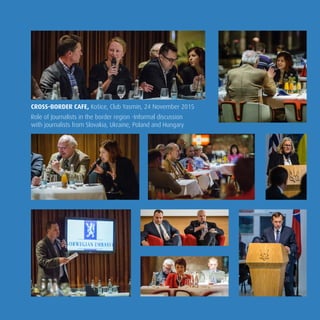
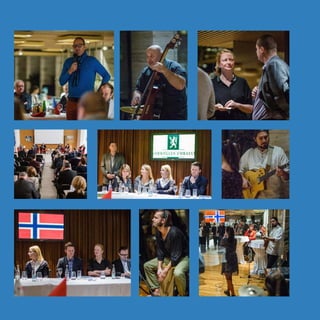
CROSS-BORDER CAFE, Košice, Club Yasmin, 24 November 2015
Role of Journalists in the border region -Informal discussion
with journalists from Slovakia, Ukraine, Poland and Hungary
/6
7 /
2
Key Points
of the 6th
European Forum on Cross-Border Cooperation in the Wider
Europe
When addressing the Border Dialogue 2015 guests
and participants, the representatives of governments
stressed the importance of the cross-border coopera-
tion, especially that with Ukraine, as a big but cur-
rently extremely challenged country, which is a wel-
comed partner to broader European free trade area.
The contemporary wave of refugees creates addition-
al tension and uncertainty as regards the fate and fu-
ture mechanisms of free movement that we all are
already used to within the Schengen Treaty Area.
Therefore, it is of great importance to make use of
good examples, like those on the Far North EU-Russia
border. And it is worth of concentration substantial fi-
nancial support from Norway Grants (NG) and other
EEA or EU resources to continued research and ex-
change of experience as regards the proper develop-
ment of the cross-border cooperation, which should
be considered as one of the crucial aspects for Eu-
rope’s security and prosperity.
Thanks to the Norway Grants in the Carpathian Eurore-
gion there are already implemented several concrete
project enabling deeper cross-border cooperation as
regards nature and cultural heritage protection. We
witness intensive tourism development supported by
Slovakia and Ukraine. Mentioned was also very good
experience with development of European Associa-
tions of Administrative Units supported by Hungary –
there is a plan to create the Rakoczi cultural route
connecting cities and communities of Poland, Slova-
kia, Hungary and Ukraine along the eastern EU border.
It was recognized that especially the Carpathian Eu-
roregion needs more intensive and concentrated de-
velopment of transportation infrastructures.
There were two main topics of the conference:
A. The Cross-Border Cooperation (CBC) as an
Important Tool of the Cooperation between
the EU and its Eastern Neighbours
B. Promotion of European Stability and
Development through Regional Cooperation
The following texts is an attempt to provide more de-
tails as regards the issues discussed on plenary panels
or on parallel sessions devoted to specific issues.
The CBC topic had several subthemes, the discussion on
which is summarized as follows:
a. Local and Regional Development on the Border
Regions
i. Cooperation of Communities on Both Sides
of the EU Eastern Border - Experience,
Challenges and Perspectives
• Discussed were the development of local and re-
gional cooperation networks and their importance
for creating or renewing bonds among those living
on both sides of the EU border.
ii. EU Border Regime and Local Border Traffic
Barriers and Opportunities
• Discussed were challenges facing the border cus-
toms and security authorities. On one side, the peo-
ple and companies call for facilitation of border
crossing. On the other side there are non-trivial se-
curity issues, risk of illegitimate trade and fear of
possible penetration of unwanted persons. All that
is exposed to limited resources and corruption op-
portunities, which make the optimal solution of the
border regime at some of EU border parts rather
/8
complicated. What may help are automatic border
checks implemented at modern border crossing fa-
cilities.
• As a separate, more political then operational issue,
appears the process of negotiations about visa fa-
cilitation or even visa-free regime on the EU border
for citizens of Ukraine. Some aspects of recent de-
velopment – sharp increase in the number of illegal
migrants, proper registering and effective returning
policy require more intense cooperation of govern-
ments and reinforcement of border control units.
b. Economic Perspectives of Cross-Border Coop-
eration
• Panel of practitioners from CBC business develop-
ment between Slovakia and Ukraine provided a
fresh insight into the issues of potential in econom-
ic regional and cross-border cooperation.
• As very important were characterized the following
proposals
- Cooperation of chambers of commerce, espe-
cially as regards exchange of information
about planned activities like economic coop-
eration forums, fairs, shows and expositions
- Creating a special border crossing corridor for
registered businessmen and employees from
border adjacent regions
- Support of international investments and crea-
tion of Greenfields or Brownfields with busi-
ness support in border regions suffering from
high unemployment rate
- More intensive cooperation as regards devel-
opment of energy transfer infrastructure and
implementation of energy saving policies
- Existence of micro-loan and granting schemes
for small and medium enterprises develop-
ment, as well as private or public funding pro-
grammes
- Support of traditional handicraft production
and related tourism opportunities
- Support of research of all factors where CBC
may have a potential for improving living
standards in regions along EU eastern border
– demographic structure of inhabitants, cultur-
al ties within broader regions, identification of
infrastructure development needs, mapping of
specific economic and human resources po-
tentials available in the regions
• As regards the specific problems of the Carpathian
Euroregion, there was mentioned high level of de-
pression and related unemployment, insufficient or
even bad transportation infrastructure. However,
reasonable potential for growth consists in invest-
ments to infrastructure, services to tourists. Last but
not least, simplified visa regulations and special
border crossing regime would allow for more inten-
sive use of highly qualified but heavily underem-
ployed human potential on Ukrainian side. These
human resources would be welcome at companies
on EU side, who often lack experts well prepared in
the fields of mathematics, natural sciences and
technologies.
• A concrete initiative of cooperation on a project
based on a reported example of a successful in-
formation technologies (IT) company from
Košice has been suggested that would result in
a cluster of companies specialized in the infor-
mation technology and cooperating with uni-
versities on both sides of the EU border.
c. Achievements and Perspectives of the Europe-
an Cross-Border Cooperation Dialogues Initiative
• The panel provided an overview of achievements
of previous five CBC Dialogues. It was stressed that
any future CBC conferences should not repeat what
has been already discussed. Making an overview of
what has been already achieved, the future confer-
ences should open new and contemporary issues,
concentrate on feasible solutions with measurable
and sustainable results. A functioning database of
9 /
measurable factors characterising the quality and
intensity of CBC in various segments of the EU east-
ern border may provide input for specific programs
supported by EU and EEA authorities, as well as
governments of neighbouring countries that would
in a broad sense focus on regional specific needs in
CBC development as proposed by local administra-
tions, businesses and citizens organizations.
• The questions were raised as regards the necessi-
ty to preserve the Schengen area functioning
without undermining already existing CBC coop-
eration. It has been also strongly recommended to
broaden the scope of the CBC Dialogues towards
southern part of the EU border, specifically along
borders with Turkey, Macedonia, Serbia, Montene-
gro and Albania.
d. Financial Support of Cross-Border Cooperation
Initiatives
• The representatives of organizations involved in im-
plementation of CBC programmes supported by
several grant making agencies (e.g. EU funds, Nor-
way Grants or the International Visegrad Fund) used
the opportunity to present the main goals, expecta-
tions and future trends as regards funding future
CBC initiatives and programs. There were raised
questions related to proper administration of the
funds. The need of providing feedback to the grant-
ees has been accentuated, which includes also the
need to invest into proper impact assessment of
funded projects and programmes.
As of the Promotion of European Stability and Develop-
ment through Regional Cooperation, there were held
two pairs of parallel sessions devoted to following sub-
themes:
a. Role of media and civil society in CBC
• The session concentrated on human profile of CBC.
A Manifest of CBC in Europe from 2007 was men-
tioned, as it states that the CBC efficiency is best
tested by existence of an intensive CBC between
civil society organizations and their promotion in
media. Besides all the factors mentioned in pre-
vious panels, the specificity of CBC in the Central
and Eastern Europe requires also a closer coop-
eration of really independent citizens organiza-
tions, which should be prevented from becoming
government dependent due to the form of their
support. We need to know, who is doing what,
which initiatives are being implemented,
planned or proposed, so that by applying synergy
effects we may properly use available financial
resources.
• A series of special tasks concerning civil society
organizations of Ukraine has been presented. It
was stressed that citizens of EU should be fully
aware of the difficult situation distressing citizens
of Ukraine as regards its economic, political and
social development in face of a long-term conflict
on the East of Ukraine and along border with
Moldavia. The civil society of Ukraine has a lot to
learn from their European counterparts as re-
gards appropriate level of cooperation with local
administration, local entrepreneurs and other lo-
cal stakeholders to become a respected partner
in regional development planning and in proper
use of all CBC benefits. It’s a difficult task, where
both media and governments with a fair support
of watchdog NGOs should cooperate without en-
dangering the national sovereignty and interna-
tional confidence.
b. Through Common Heritage towards Common
Future in the Carpathian Euroregion
• The session was a demonstration of positive ef-
fects arising from transfer of experience between
existing Euroregions - “Carpathian”, “Dniepr” and
“Dniester”. Several possibilities of strengthening
this cooperation were presented. The representa-
tives of the Euroregion “Dniester” expressed their
/10
interest to participate in preparation of the next
European CBC Dialogue as an affiliated event to
the meeting of several Euroregions representa-
tives in Vinnitsa, Ukraine.
c. Cross-Border Cooperation Opportunities for
Youth and Young People
• This session was an opportunity to learn more
about the Barents Regional Youth Council estab-
lished in 2004. This body represents inhabitants and
indigenous peoples living in the Barents Euro-Arctic
Region, which includes the most northern parts of
Norway, Finland, and European segment of Russian
Federation. The Council provides information and
guidance for youth groups, organizations and net-
works on available national and international re-
sources for funding projects. It organizes training in
project planning and creates opportunities for find-
ing and meeting possible cooperation partners both
in national and international level on a traditional
annual youth meeting.
• On the Norway-Russia border is situated the de-
partment S➢r-Varanger with the most northern Eu-
ropean port of Kirkenes, the very centre of the Bar-
ents Region. The cooperation of municipalities of
Kirkenes and Nikel, on Russian side, is very inten-
sive. Thanks to it and with full support of govern-
ments of Norway, Finland and Russia, the young
persons from Norway, Finland and Russia may of-
ten meet to dance and listen to music or otherwise
play together.
• In Kirkenes is also located the professional theatre
Samovarteateret for which it was always natural to
cooperate with Finland and especially with Russia
- a Russian part is in everything they do.
• Another experience has been communicated from
the Carpathian Euroregion established in 1993 that
covers the less developed and culturally and ethni-
cally diverse areas along the Carpathian Mountains
and borders of five countries: Hungary, Poland, Ro-
mania, Slovakia and Ukraine with overall population
of more than 15 million. There operates also the
Carpathian Foundation, which provides financial
support, training and advisory services to active
people and non-profit organizations, in order to
help improve living conditions in the region, with
special emphasis on community-based poverty al-
leviation programs in Eastern Slovakia and in
Ukraine.
d. Cross-Border Cooperation between V4 Countries
and Ukraine – Present Tools and Opportunities
and Perspectives for the Future
• This closing session was devoted to the specific
issues of CBC between Visegrad four countries –
Czech Republic, Hungary, Poland and Slovakia with
Ukraine (V4)
• From the point of view of Ukraine, the CBC with V4
is a factor related to its EU membership aspirations.
However, to fully understand the issue, one has to
take into account the fact that many EU related fea-
tures of CBC have to be also implemented on
Ukraine borders with Moldova and, last but not
least and most problematic, with Belarus and the
Russian Federation. Since 2003 there operates the
Euroregion “Dniepr”, which for many years success-
fully coordinated activities of local administration,
private sector and civil society organizations across
the borders. However, due to the outbreak of war in
Eastern Ukraine and related developments, most of
the existing CBC activities with Russia head to be
abandoned and financial support of the Euroregion
operations ceased to be actively supported by local
authorities. Certain hope for improvement is seen
with upcoming decentralization reform of Ukraine,
since with EU financial support it should give broad-
er powers to local authorities and create more ef-
fective mechanisms to involve the public sector to
the development and implementation of regional
policy. Thanks to International Visegrad Fund (IVF)
11 /
support, the Euroregion “Dniepr” was able to imple-
ment several projects on the Ukraine border with
Belarus as regards transfer of V4 experience or V4
assistance in assessment of economic reforms with
respect to the process of the European integration.
• From the V4 point of view, cooperation with Ukraine
is seen as one of its priorities. Government of
Ukraine is regularly invited to V4+ summits, and the
four countries have already agreed upon division of
their responsibilities as regards further develop-
ment of V4-UA cooperation. The IVF as the main
co-funding institution of V4 plays in this process a
special role, even if CBC remains only of peripheral
interest. As an example of V4-UA project supported
by IVF there was mentioned the Civil Servants Mo-
bility Program – a project similar to twinning pro-
grammes implemented by EU-15 with EU candi-
dates countries before the 2004 enlargement.
• The IVF plays an important role in the development
of the CBC on Ukrainian borders. Besides already
above mentioned support to the Euroregion
“Dniester”, the IVF grants enabled to determine
strategy of the development of the region, to or-
ganize study trips of experts to several Euroregions
and to implement the project Capacity Building of
Local Communities: V4 experience for EaPC. The Eu-
roregion “Dniester”, may be considered a testing
laboratory of the co-operation in zones of frozen
conflicts. However, resources provided by the IVF
cannot be sufficient for realization of bigger invest-
ment projects in border regions. Such projects will
need financial support from other EU, EEA or even
international sources. IVF grants may serve primar-
ily as a tool for connecting people, enhancing ca-
pacities and as a specific school preparing its par-
ticipants for working under much more demanding
conditions of bigger projects.
• The whole V4 group may be involved in the CBC on
its border with Ukraine in three main ways, sup-
porting:
- Immediate co-operation between border re-
gions (Euroregions, smaller units as regions,
towns or villages)
- Exchange of experience and know-how
within cross-border regions in V4 countries
(twinning, study trips etc.)
- Financing of concrete projects (IVF grants,
grants of V4 state institutions and agencies).
There are some proposals, how to enhance the effect of
V4 support:
- To pay focused attention to the CBC in V4-
Ukraine programmes as well as in V4 pro-
grammatic documents
- To consider establishment of a IVF programme
supporting specific CBC projects
- To use the Visegrad scholarship programme
for the preparation of experts dealing with the
development of the CBC
- To mediate best practices with CBC inside V4
as well as on western and southern V4 bor-
ders by supporting a platform of experts capa-
ble to facilitate exchange of experience among
Ukrainian cross-border regions
12/
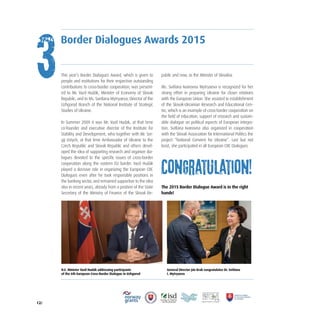
This year’s Border Dialogues Award, which is given to
people and institutions for their respective outstanding
contributions to cross-border cooperation, was present-
ed to Mr. Vazil Hudák, Minister of Economy of Slovak
Republic, and to Ms. Svetlana Mytryaeva, Director of the
Uzhgorod Branch of the National Institute of Strategic
Studies of Ukraine.
In Summer 2009 it was Mr. Vazil Hudak, at that time
co-founder and executive director of the Institute for
Stability and Development, who together with Mr. Ser-
gij Ustych, at that time Ambassador of Ukraine to the
Czech Republic and Slovak Republic and others devel-
oped the idea of supporting research and organize dia-
logues devoted to the specific issues of cross-border
cooperation along the eastern EU border. Vazil Hudák
played a decisive role in organizing the European CBC
Dialogues even after he took responsible positions in
the banking sector, and remained supportive to the idea
also in recent years, already from a position of the State
Secretary of the Ministry of Finance of the Slovak Re-
public and now, as the Minister of Slovakia.
Ms. Svitlana Ivanovna Mytryaeva is recognized for her
strong effort in preparing Ukraine for closer relations
with the European Union. She assisted in establishment
of the Slovak-Ukrainian Research and Educational Cen-
tre, which is an example of cross-border cooperation on
the field of education, support of research and sustain-
able dialogue on political aspects of European integra-
tion. Svitlana Ivanovna also organized in cooperation
with the Slovak Association for International Politics the
project “National Convent for Ukraine”. Last but not
least, she participated in all European CBC Dialogues.
The 2015 Border Dialogue Award is in the right
hands!
H.E. Minister Vazil Hudák addressing participants
of the 6th European Cross-Border Dialogue in Uzhgorod
General Director Ján Krak congratulates Dr. Svitlana
I. Mytryaeva
Border Dialogues Awards 2015
3
Congratulation!
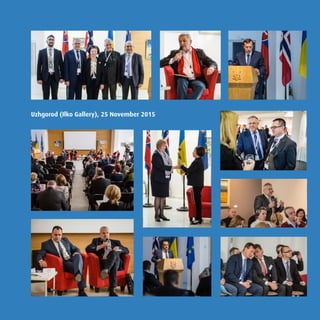
Uzhgorod (Ilko Gallery), 25 November 2015
/14
Košice (Hotel Yasmin), 26-27 November 2015
15 /
Taking into account vivid and constructive discussion in
the panels and sessions of the Sixth European Cross-
Border Cooperation Dialogue (6thECBCD), a group of
experts (Sándor Köles, Petr Pajas, Sergii Ustich and Petr
Vágner) prepared a summary of main points that were
suggested to form conference conclusions. The draft
was shortly presented and interpreted by the members
of the expert group to the conference participants on its
last plenary session. It was agreed that the conclusions
should be finalized using eventual additional opinions
and suggestions of chairpersons and commentators of
panels and sessions. During December 2015 and Janu-
ary 2016 the group received several new recommenda-
tions to the conclusions and formulation.
The final text of the conference conclusions is a follows:
Conclusion #1: People are our Treasure.
The most important value as regards the cross-border
cooperation (CBC) between peoples living along the Eu-
ropean Eastern Border (EEB) that may be attributed to
the series of six CBC Dialogues consists in the existence
of a pool of personalities – politicians, officials, entrepre-
neurs, scholars, technicians, journalist, civil society activ-
ists, artists and others, who know each other and may
thus form a fundament for further development of mu-
tual understanding and respect in people-to-people,
nation-to-nation relations across the political borders on
the East of the European Union.
This network of personalities may be used as a re-
source for continuing development of friendly and
cooperative relations between border security and
police units, local administrations, companies and
civil society organizations on both sides of the Eu-
ropean Eastern Border (EEB). This may result in
better use of human resources and economic po-
tential of border regions, leading to steady growth
of the quality of life in border regions, whose fur-
ther progress in economic, cultural, and social life
is more and more dependent on the quality and
intensity of cooperation in both directions across
borders.
Conclusion #2: The specificity of the Car-
pathian Euroregion.
The Carpathian Euroregion – a territory along the
Eastern and Central Carpathian Mountain Range –
needs additional impetus from improved cross-
border cooperation for its further development:
New projects, joint actions and initiatives, new
forms of economic and cultural cooperation, rapid
and efficient completion of insufficiently devel-
oped regional and international transportation
infrastructure, as well as increased number of
better equipped border crossing posts with in-
creased border-crossing capacities supported by
more sophisticated security measures. In order to
achieve these objectives, it’s essential to enable
full use of experience accumulated from success-
es and failures of CBC projects implemented in
other regions along the EEB. The ultimate objec-
tive of this process should be creation of legal and
administrative environment, in which the synergy
effects from all projects realized in CBC along the
EEB may be fully implemented.
Conclusions
of the 6th European Forum on Cross-Border Cooperation in a Wider
Europe, 2015
4
/16
Conclusion #3: Complex and Specific Strategy
for Financing of CBC Initiatives
The current practise shows that existing financing
tools are not adequate and far from being suffi-
cient as concerns funding of regional CBC projects
along the EEB. Thus, it appears essential to appeal
to the institutions of the European Union (EU), Eu-
ropean Economic Area (EEA), Visegrad Group coun-
tries (V4), national and regional governments
along the EEB to develop, and as early as possible,
to implement a specific strategy of how to initiate
and finance innovative and sustainable CBC activi-
ties, maximizing the synergy stemming from simi-
lar projects on one side and optimizing financing of
them on the other side.
Of special importance appears to be coordinated
support of activities on the level of communities,
civil society organization and companies involved
in CBC projects with sustainability potential. Such
projects should focus on creation of economically
sound shared cultural, social and other services:
support of tourism, building and maintenance of
transportation infrastructure, exchange of cultural
activities, joint protection of environment, and joint
industrial or agricultural enterprises. All these pro-
jects should correspond to the needs and have full
support of citizens living along the borders those
contemporary divide regions with common past.
New financing initiatives should be focused on Eu-
roregions or on concrete local projects, as well as to
support from experts and exchange of resources
between governments, regions and municipalities
along EEB and from within EU. Without strong sup-
port from EU and national governments and with-
out producing tangible and sustainable results, the
energy invested into conferences on CBC and all of
the potential created in this way may be lost.
Conclusion #4: Making Protection of the Schen-
gen Border and CBC along it an Objective of the
whole EU
We may not stay blind and deaf in face of challenges
created by conflicts affecting Ukraine and other regions
along the EEB. We must be able to face the migration
wave from Middle East countries suffering from civil
wars and terrorism, be it Afghanistan, Iraq, Pakistan,
Syria, or any other country. We should prepare ourselves
to possible future global challenges resulting from
growing tensions due to climate changes.
Thus, it appears essential to accept and implement such
measures along the EEB that would enable secure pro-
tection of the outer Schengen EU borders, while improv-
ing conditions for continual trust building through more
intensive CBC of peoples and nations living and compa-
nies operating along the EEB.
The specific attention should be given to enabling visa
provision rules for Ukrainian citizens, especially for those
with higher working potential, for students, scholars,
experts and researchers, as well as for all citizens, who
seek cooperation and/or job opportunities.
Special attendance should be given to specific border
crossing regime for citizens living within a well-defined
band along the EEB that would facilitate tourism, access
to jobs and family encounters. The CBC development
along EEB should become a clearly formulated
objective of the EU and EEA institutions with sufficient
support from various funding initiatives.
Conclusion #5: Use of Accumulated Experience
from the Series of European CBC Dialogues.
In order to enable proper use of experience accu-
mulated during the six CBC Dialogues, it is recom-
mended to initiate a special project aimed at a
17 /
team of CBC experts, who should elaborate a com-
plex of documents summarizing and illustrating
the opinions of citizens, entrepreneurs, administra-
tors, and politicians involved in CBC projects real-
izes and/or planned within regions along the EEB.
The network of experts who took part in the CBC
Dialogue series together with other regional key
stakeholders with good practice experience, spe-
cific knowledge and proven skills may be utilized
as a pool of experts for this purpose.
The project would need financial support from
available EU and/or EEA funds, as well as other
regional funds, like the International Visegrad
Fund, Black See Trust for Regional Cooperation,
Balkan Trust for Democracy and other governmen-
tal and independent foundations. It’s essential to
provide support for open and constructive discus-
sion about feasible recommendations for further
CBC improvements and about impacts of their pos-
sible implementation with those, who might be
affected or involved within the range of their re-
sponsibilities. The outcomes of this work should be
addressed to all authorities acting in the regions
along the EEB, as well as to the European Commis-
sion and European Parliament, V4 Presidency and
national governments of affected countries.
Conclusion #6: Proper Education as a Basis for CBC
in Efficient Use of Human Resources
It is important to promote cooperation between col-
leges and universities operating in the regions close to
the EEB, as well as internationally operating public and
private universities of the Wider Europe, as regards de-
velopment of innovative curricula oriented on com-
mon regional history and cultural heritage and focused
on better understanding of differences between peo-
ple living along both sides of the EEB. This should in-
clude development of university research, as well as
much broader or more intensive exchange of scholars
and students across the EEB.
Nevertheless, all CBC projects must be based on a clear
vision, measurable goals, with a road map leading to
their achievement with visible milestones alongside,
and tools for final assessment of what has been really
achieved.
Conclusion #7: Reliable Data are Important
One of the initiatives created within the European
CBC Dialogue series was an idea of creating a CBC
Index as a tool based upon usage of data collected
in a systematic and sustainable manner that provide
measurable indicators of the intensity, character and
trends in several aspects of the CBC within a set of
regions along the EEB. The database related to the
CBC Index should include also data about all existing
or planned initiatives focused to the improvement
of the quality of life in studied regions.
Since Ukraine is facing many challenges, the data-
base should include data from all Ukrainian regions
and should also reflect the new administrative
structure of Ukraine that is currently being imple-
mented. Such a database complemented with a set
of measurable indicators might serve also as a tool
for transferring good practice between regions
along EEB. This includes especially the proper use of
very positive experience of the Barents Euro-Arctic
Council as well as Euroregions on the Finland-Russia
border and those where V4 countries participate.
Conclusion #8: Moving Forward
It is understood that the Institute for Stability and Devel-
opment (ISD), as an organization that has been at the
/18
beginning of the CBC Dialogue series and participated in
setting programmes of all six conferences since 2010,
should be encouraged to continue in these efforts. How-
ever, in order not to repeat every time the same or simi-
lar issues and to provide for achieving concrete and
measurable results, it is strongly recommended to limit
the future dialogues to concrete CBC issues. Future con-
ferences should enable reaching consensus and agree-
ment on common positions or facilitate opening of joint
projects between participating organizations and authori-
ties. It’s also strongly recommended to broaden the
scope of regions along the EEB involved in this initiative,
with special emphasis to regions of the Balkan Peninsula.
The organizers of the 6th European Forum on Cross-Border Cooperation in a Wider Europe express their gratitude to the European
Economic Area & Norway Grants for the provided financial support, which made this event possible as a part of the Norway Grant
program for Slovakia.
Special thanks go to distinguished representatives of the national governments
➢	 Mr. Vazil Hudák, Minister of Economy of the Slovak Republic, (video)
➢	 Ms. Elisabeth Transtad, State Secretary of the Norwegian Ministry of Foreign Affairs
➢	 Mr. Igor Slobodník, State Secretary of the Ministry of Foreign and European Affairs of Slovak Republic
➢	 Ms. Inga Magistad, Norwegian Ambassador to the Slovak Republic
➢	 Ihor Krachkovskyi, First Secretary of the Embassy of Ukraine to the Slovak Republic
	 Mr. Lajos Szénasi, General Consul of Hungary in Košice
➢	 Mr. Ján Krak, General Director, Department of EEA and Norway Grants, Government Office of the Slovak Republic
	 Ms. Janka Burianová, General Consul of the Slovak Republic in Uzhgorod
We thank also to the representatives of regional and local administration, as well as several Euroregions:
From Norway:
➢	 Ms. Laila Dalhaug, Mr. Atle Staalesen and Mr. Kim Stenersen, Norwegian Barents Secretariat
➢	 Mr. Harald Sørensen, Municipality of Sør-Varanger kommune, Norway
From Slovakia:
➢	 Jaroslav Tešliar, Agency for the Support of Regional Development Košice
➢	 Ms. Nadežda Sirková, Municipality Ubľa, Slovak Republic
From Ukraine:
➢	 Mr. Gennady Moskal and Mr. Vladimir Chubirko, Trans-Carpathian Regional Council
➢	 Mr. Oleh Luksha, Trans-Carpathian Regional Branch of the Association of Ukrainian Cities and Communities
➢➢	 Mr. Ruslan Dzhabrailov and Mr. Serhej Tatusiak, Euroregion “Dniestr”
➢	 Mr. Borys Uvarov, Euroregion “Dniepr”,Ukraine
The discussions on the state of art and challenges on the border have been kindly supported by experts of police
and border guard units. We thank to:
➢	 Mr. Frode Berg, Former Representative of the Norwegian Border Commissioner
➢	 Mr. Ladislav Chabreček, Department of Border Police, Bureau of Border and Alien Police, Ministry of Interior, 		
Slovak Republic
➢	 Mr. Vadym Krutiy, State Border Guard Service of Ukraine
Perspectives of further funding of the cross-border initiative projects and conferences were discussed with representatives of
several foundations active on international or national level. Our gratitude for participation and encouraging words belongs to:
➢	 Ms. Ingjerd Haugen, Norway Grants, Norwegian Ministry of Foreign Affairs
➢	 Ms. Lenka Bučková, International Visegrad Fund, Slovakia
➢	 Mr. Jan Pieklo, Polish-Ukrainian Cooperation Foundation, Poland
➢	 Gabriela Szabó, Carpathian Foundation Hungary
Acknowledgements
to donors, partners and supporters
➢	 Ms. Laura Dittel, Carpathian Foundation Slovakia,
The organizers would like to thank explicitly to the representatives of other partner organizations, who kindly shared their
experience, ideas and insights with conference:
From the Czech Republic:
➢	 Mr. Petr Vágner, former director of the Institute of Stability and Development,
	 now Deputy Ambassador of the Czech Republic in Azerbaijan
➢	 Mr. Petr Pajas, Institute of Stability and Development
From Finland:
➢	 Mr. Pekka Jarviö, Jarviö Associates, Finland,
From Norway:
➢	 Ms. Inna Fyodorova, Barents Youth Cooperation Office
➢	 Ms. Theresa Haabeth Holand, Samovarteateret, Kirkenes
From Hungary:
➢	 Mr. Zoltán Barna-Lázár, Integrated Consulting Group “Ex Ante”
➢	 Mr. Sandor Köles, ISD former director, now at Robert Bosch Academy, Germany
➢	 Mr. Aron Szakacs, Agency for Sustainable Development of Carpathian Region
From Slovakia:
➢	 Ms. Tatiana Kmecová, Government Office of the Slovak Republic
➢	 Ms. Agnesa Klimova, Slovak Chamber of Commerce and Industry, Kosice Branch
➢	 Mr. Alexander Duleba, Mr. Vladimír Benč, Mr. Peter Plenta and Mr. Tomáš Strážay, Research Centre, Slovak Foreign Policy
	 Association
➢	 Mr. Jozef Ondáš, IT Valley, Košice
➢	 Mr. Ivan Hruška, Globallogic, Inc., Košice
➢	 Mr. Tomáš Petraško, Friendship Slovakia – Ukraine, n.o.
➢	 Mr. Martin Lačný, Institute of Political Sciences, University of Prešov
	 Mr. Andrej Steiner, Carpathian Development Institute
From Poland:
➢	 Ms. Malgorzata Samusjew, Association of Polish Communes, “Euroregion Baltic“
From Ukraine:
➢	 Ms. Svitlana Mytryayeva, Mr. Maksym Ivanov, Mr. Mykhaylo Bizilya and Mr. Alexander Vlasiyk,
	 National Institute for Strategic Studies, Ukraine
➢	 Mr. Otto Kovchar, Transcarpathian Chamber of Commerce and Industry, Ukraine
➢	 Mr. Sergey Ustich, Institute for Trans-Frontier Cooperation, Uzhgorod, Ukraine
➢➢	 Mr. Andriy Kyrchiv, Association of Energy Efficient Cities of Ukraine
➢	 Ms. Myroslava Lendyel, Institute of Central Europe, Ukraine
➢	 Mr. Vasyl Ilnytskyy, Newspaper “Day”, Ukraine
The team of those who devoted lot of their time and efforts to the organization and logistics of thr event was composed of:
➢	 Ms. Martina Szabóová and team – Strategic Action Unit, EEA and Norway Grants Department, Government Office
	 of the Slovak Republic
➢	 Mr. Petr Pajas, Ms. Nelly Tomčíková, Institute for Stability and Development, Czech Republic
➢	 Ms. Svitlana Mytryayeva, National Institute for Strategic Studies, Ukraine
Government Office of the Slovak Republic – Programme Operator
SK08 Cross-border Cooperation Programme
Námestie slobody 1, 813 70 Bratislava, Slovak Republic
email: eeagrants@vlada.gov.sk
web: www.eeagrants.sk / www.norwaygrants.sk
&
Institute for Stability and Development, o.p.s.
Žitná 608/27, 110 00 Praha 1- Nové Město, Czech Republic
email: info@isd-network.org
www.isd-network.org
BORDERS
DIALOGUES
2015
6TH
ANNUAL FORUM
ON CROSS-BORDER
COOPERATION
(KOŠICE – UZHOROD,
24 - 27 NOVEMBER 2015)

6466_6thborders_2015_web

  • 1.
    Summary and conclusions th BORDERS DIALOGUES 2015 EuropeanForum European Forum European Forum on Cross-Border Cooperation in a Wider Europe 6TH ANNUAL FORUM ON CROSS-BORDER COOPERATION (KOŠICE – UZHGOROD, 24 - 27 NOVEMBER 2015) 24. – 27. November 2015, Uzhgorod - Košice on Cross-Border Cooperation in a Wider Europe 6666
  • 2.
    3 Introductory words 5Photo - Cross-border cafe, Košice, Club Yasmin, 24 November 2015 7 Key Points of the 6th European Forum on Cross-Border Cooperation in the Wider Europe 12 Border Dialogues Awards 2015 18 Conclusions of the 6th European Forum on Cross-Border Cooperation in a Wider Europe, 2015 19 Acknowledgements to donors, partners and supporters
  • 3.
    3/ In 2009, ata meeting of the Norwegian Bar- ents Secretariat (NBS), Institute for Stability and Development (ISD) and several other or- ganizations was formulated the idea of regular border dialogues on efficient cross-border co- operation along eastern EU border. In 2010, the first of these took place in Uzhgorod, Ukraine and Košice, Slovakia. The series continued at EU borders with Moldova and Ukraine in Chis- inau, Moldova, then with Russia in Elbląng, Po- land and Kaliningrad, Russia, then in Karelia Euroregion (Joensuu, Finland and Sortavala, Russia), and finally in Kirkenes, Norway and Nikel, Russia at the Barents See on the Euro- pean Far North. ISD was involved in preparation and organiza- tion of all these conferences, which created a network of professionals, civil society activists, regional policymakers and officers of border protection units and customs, involved in ex- change of experience as regards cross-border cooperation along the EU eastern border. Thus, it was considered a great honour to join the team of organizers of the next round of these conferences, which symbolically returned to where it started - to the vivid Carpathian Eu- roregion. In November 2015, starting in Uzhgorod and proceeding in Košice we could meet again to discuss with others what progress has been made, as regards the border-crossing proce- dures and facilities on Slovakia/Ukraine border, as well as and in the field of cross-border coop- eration between local administrations, compa- nies, universities and civil society organizations of the whole vivid Carpathian region, where meets borders of Hungary, Poland, Romania, Slovakia and Ukraine. It follows from the key points of discussions and conclusions of the conference, that this se- ries of border dialogues should continue, while focusing primarily on cross-border cooperation along segments of the EU Eastern Border on its BORDER DIALOGUES OVERVIEW INTRODUCTORY WORDS OVERVIEW
  • 4.
    /4 southern wing, whichare exposed to the need to enhance border security under the influence of migration flow and/or even frozen conflicts, while preserving all already achieved in culti- vation of efficient cross-border cooperation and mutual trust between peoples living along the EU eastern border. It is essential to seek for full support of EU and EEA institutions, as well as of involved national and regional govern- ments, and participating civil society organiza- tions. However, these goals may hardly be achieved without sufficient funding from all available sources. The team of organisers of the 6th European Cross-Border Dialogue headed by Government Office of the Slovak Republic and supported by Norwegian Barents Secretariat, Uzhgorod Branch of the National Institute for Strategic Studies, Consulate General of the Slovak Re- public in Uzhgorod and experts affiliated to In- stitute for Stability and Development from the Czech Republic and Hungary tried to do all pos- sible to welcome and accommodate more than 200 conference participants from 7 coun- tries and to provide them an opportunity to take part in 13 discussion panels and sessions. On behalf of organizers, let me thank all distin- guished speakers from national and regional governments, as well as chairs, commentators and panellists for deep insight and many in- spiring ideas. Specific acknowledgement goes to Norway Grants, the financial support of which enabled this conference to happen. Petr Jan Pajas Chair, Board of Trustees Institute for Stability and Development
  • 5.
    CROSS-BORDER CAFE, Košice,Club Yasmin, 24 November 2015 Role of Journalists in the border region -Informal discussion with journalists from Slovakia, Ukraine, Poland and Hungary
  • 6.
  • 7.
    7 / 2 Key Points ofthe 6th European Forum on Cross-Border Cooperation in the Wider Europe When addressing the Border Dialogue 2015 guests and participants, the representatives of governments stressed the importance of the cross-border coopera- tion, especially that with Ukraine, as a big but cur- rently extremely challenged country, which is a wel- comed partner to broader European free trade area. The contemporary wave of refugees creates addition- al tension and uncertainty as regards the fate and fu- ture mechanisms of free movement that we all are already used to within the Schengen Treaty Area. Therefore, it is of great importance to make use of good examples, like those on the Far North EU-Russia border. And it is worth of concentration substantial fi- nancial support from Norway Grants (NG) and other EEA or EU resources to continued research and ex- change of experience as regards the proper develop- ment of the cross-border cooperation, which should be considered as one of the crucial aspects for Eu- rope’s security and prosperity. Thanks to the Norway Grants in the Carpathian Eurore- gion there are already implemented several concrete project enabling deeper cross-border cooperation as regards nature and cultural heritage protection. We witness intensive tourism development supported by Slovakia and Ukraine. Mentioned was also very good experience with development of European Associa- tions of Administrative Units supported by Hungary – there is a plan to create the Rakoczi cultural route connecting cities and communities of Poland, Slova- kia, Hungary and Ukraine along the eastern EU border. It was recognized that especially the Carpathian Eu- roregion needs more intensive and concentrated de- velopment of transportation infrastructures. There were two main topics of the conference: A. The Cross-Border Cooperation (CBC) as an Important Tool of the Cooperation between the EU and its Eastern Neighbours B. Promotion of European Stability and Development through Regional Cooperation The following texts is an attempt to provide more de- tails as regards the issues discussed on plenary panels or on parallel sessions devoted to specific issues. The CBC topic had several subthemes, the discussion on which is summarized as follows: a. Local and Regional Development on the Border Regions i. Cooperation of Communities on Both Sides of the EU Eastern Border - Experience, Challenges and Perspectives • Discussed were the development of local and re- gional cooperation networks and their importance for creating or renewing bonds among those living on both sides of the EU border. ii. EU Border Regime and Local Border Traffic Barriers and Opportunities • Discussed were challenges facing the border cus- toms and security authorities. On one side, the peo- ple and companies call for facilitation of border crossing. On the other side there are non-trivial se- curity issues, risk of illegitimate trade and fear of possible penetration of unwanted persons. All that is exposed to limited resources and corruption op- portunities, which make the optimal solution of the border regime at some of EU border parts rather
  • 8.
    /8 complicated. What mayhelp are automatic border checks implemented at modern border crossing fa- cilities. • As a separate, more political then operational issue, appears the process of negotiations about visa fa- cilitation or even visa-free regime on the EU border for citizens of Ukraine. Some aspects of recent de- velopment – sharp increase in the number of illegal migrants, proper registering and effective returning policy require more intense cooperation of govern- ments and reinforcement of border control units. b. Economic Perspectives of Cross-Border Coop- eration • Panel of practitioners from CBC business develop- ment between Slovakia and Ukraine provided a fresh insight into the issues of potential in econom- ic regional and cross-border cooperation. • As very important were characterized the following proposals - Cooperation of chambers of commerce, espe- cially as regards exchange of information about planned activities like economic coop- eration forums, fairs, shows and expositions - Creating a special border crossing corridor for registered businessmen and employees from border adjacent regions - Support of international investments and crea- tion of Greenfields or Brownfields with busi- ness support in border regions suffering from high unemployment rate - More intensive cooperation as regards devel- opment of energy transfer infrastructure and implementation of energy saving policies - Existence of micro-loan and granting schemes for small and medium enterprises develop- ment, as well as private or public funding pro- grammes - Support of traditional handicraft production and related tourism opportunities - Support of research of all factors where CBC may have a potential for improving living standards in regions along EU eastern border – demographic structure of inhabitants, cultur- al ties within broader regions, identification of infrastructure development needs, mapping of specific economic and human resources po- tentials available in the regions • As regards the specific problems of the Carpathian Euroregion, there was mentioned high level of de- pression and related unemployment, insufficient or even bad transportation infrastructure. However, reasonable potential for growth consists in invest- ments to infrastructure, services to tourists. Last but not least, simplified visa regulations and special border crossing regime would allow for more inten- sive use of highly qualified but heavily underem- ployed human potential on Ukrainian side. These human resources would be welcome at companies on EU side, who often lack experts well prepared in the fields of mathematics, natural sciences and technologies. • A concrete initiative of cooperation on a project based on a reported example of a successful in- formation technologies (IT) company from Košice has been suggested that would result in a cluster of companies specialized in the infor- mation technology and cooperating with uni- versities on both sides of the EU border. c. Achievements and Perspectives of the Europe- an Cross-Border Cooperation Dialogues Initiative • The panel provided an overview of achievements of previous five CBC Dialogues. It was stressed that any future CBC conferences should not repeat what has been already discussed. Making an overview of what has been already achieved, the future confer- ences should open new and contemporary issues, concentrate on feasible solutions with measurable and sustainable results. A functioning database of
  • 9.
    9 / measurable factorscharacterising the quality and intensity of CBC in various segments of the EU east- ern border may provide input for specific programs supported by EU and EEA authorities, as well as governments of neighbouring countries that would in a broad sense focus on regional specific needs in CBC development as proposed by local administra- tions, businesses and citizens organizations. • The questions were raised as regards the necessi- ty to preserve the Schengen area functioning without undermining already existing CBC coop- eration. It has been also strongly recommended to broaden the scope of the CBC Dialogues towards southern part of the EU border, specifically along borders with Turkey, Macedonia, Serbia, Montene- gro and Albania. d. Financial Support of Cross-Border Cooperation Initiatives • The representatives of organizations involved in im- plementation of CBC programmes supported by several grant making agencies (e.g. EU funds, Nor- way Grants or the International Visegrad Fund) used the opportunity to present the main goals, expecta- tions and future trends as regards funding future CBC initiatives and programs. There were raised questions related to proper administration of the funds. The need of providing feedback to the grant- ees has been accentuated, which includes also the need to invest into proper impact assessment of funded projects and programmes. As of the Promotion of European Stability and Develop- ment through Regional Cooperation, there were held two pairs of parallel sessions devoted to following sub- themes: a. Role of media and civil society in CBC • The session concentrated on human profile of CBC. A Manifest of CBC in Europe from 2007 was men- tioned, as it states that the CBC efficiency is best tested by existence of an intensive CBC between civil society organizations and their promotion in media. Besides all the factors mentioned in pre- vious panels, the specificity of CBC in the Central and Eastern Europe requires also a closer coop- eration of really independent citizens organiza- tions, which should be prevented from becoming government dependent due to the form of their support. We need to know, who is doing what, which initiatives are being implemented, planned or proposed, so that by applying synergy effects we may properly use available financial resources. • A series of special tasks concerning civil society organizations of Ukraine has been presented. It was stressed that citizens of EU should be fully aware of the difficult situation distressing citizens of Ukraine as regards its economic, political and social development in face of a long-term conflict on the East of Ukraine and along border with Moldavia. The civil society of Ukraine has a lot to learn from their European counterparts as re- gards appropriate level of cooperation with local administration, local entrepreneurs and other lo- cal stakeholders to become a respected partner in regional development planning and in proper use of all CBC benefits. It’s a difficult task, where both media and governments with a fair support of watchdog NGOs should cooperate without en- dangering the national sovereignty and interna- tional confidence. b. Through Common Heritage towards Common Future in the Carpathian Euroregion • The session was a demonstration of positive ef- fects arising from transfer of experience between existing Euroregions - “Carpathian”, “Dniepr” and “Dniester”. Several possibilities of strengthening this cooperation were presented. The representa- tives of the Euroregion “Dniester” expressed their
  • 10.
    /10 interest to participatein preparation of the next European CBC Dialogue as an affiliated event to the meeting of several Euroregions representa- tives in Vinnitsa, Ukraine. c. Cross-Border Cooperation Opportunities for Youth and Young People • This session was an opportunity to learn more about the Barents Regional Youth Council estab- lished in 2004. This body represents inhabitants and indigenous peoples living in the Barents Euro-Arctic Region, which includes the most northern parts of Norway, Finland, and European segment of Russian Federation. The Council provides information and guidance for youth groups, organizations and net- works on available national and international re- sources for funding projects. It organizes training in project planning and creates opportunities for find- ing and meeting possible cooperation partners both in national and international level on a traditional annual youth meeting. • On the Norway-Russia border is situated the de- partment S➢r-Varanger with the most northern Eu- ropean port of Kirkenes, the very centre of the Bar- ents Region. The cooperation of municipalities of Kirkenes and Nikel, on Russian side, is very inten- sive. Thanks to it and with full support of govern- ments of Norway, Finland and Russia, the young persons from Norway, Finland and Russia may of- ten meet to dance and listen to music or otherwise play together. • In Kirkenes is also located the professional theatre Samovarteateret for which it was always natural to cooperate with Finland and especially with Russia - a Russian part is in everything they do. • Another experience has been communicated from the Carpathian Euroregion established in 1993 that covers the less developed and culturally and ethni- cally diverse areas along the Carpathian Mountains and borders of five countries: Hungary, Poland, Ro- mania, Slovakia and Ukraine with overall population of more than 15 million. There operates also the Carpathian Foundation, which provides financial support, training and advisory services to active people and non-profit organizations, in order to help improve living conditions in the region, with special emphasis on community-based poverty al- leviation programs in Eastern Slovakia and in Ukraine. d. Cross-Border Cooperation between V4 Countries and Ukraine – Present Tools and Opportunities and Perspectives for the Future • This closing session was devoted to the specific issues of CBC between Visegrad four countries – Czech Republic, Hungary, Poland and Slovakia with Ukraine (V4) • From the point of view of Ukraine, the CBC with V4 is a factor related to its EU membership aspirations. However, to fully understand the issue, one has to take into account the fact that many EU related fea- tures of CBC have to be also implemented on Ukraine borders with Moldova and, last but not least and most problematic, with Belarus and the Russian Federation. Since 2003 there operates the Euroregion “Dniepr”, which for many years success- fully coordinated activities of local administration, private sector and civil society organizations across the borders. However, due to the outbreak of war in Eastern Ukraine and related developments, most of the existing CBC activities with Russia head to be abandoned and financial support of the Euroregion operations ceased to be actively supported by local authorities. Certain hope for improvement is seen with upcoming decentralization reform of Ukraine, since with EU financial support it should give broad- er powers to local authorities and create more ef- fective mechanisms to involve the public sector to the development and implementation of regional policy. Thanks to International Visegrad Fund (IVF)
  • 11.
    11 / support, theEuroregion “Dniepr” was able to imple- ment several projects on the Ukraine border with Belarus as regards transfer of V4 experience or V4 assistance in assessment of economic reforms with respect to the process of the European integration. • From the V4 point of view, cooperation with Ukraine is seen as one of its priorities. Government of Ukraine is regularly invited to V4+ summits, and the four countries have already agreed upon division of their responsibilities as regards further develop- ment of V4-UA cooperation. The IVF as the main co-funding institution of V4 plays in this process a special role, even if CBC remains only of peripheral interest. As an example of V4-UA project supported by IVF there was mentioned the Civil Servants Mo- bility Program – a project similar to twinning pro- grammes implemented by EU-15 with EU candi- dates countries before the 2004 enlargement. • The IVF plays an important role in the development of the CBC on Ukrainian borders. Besides already above mentioned support to the Euroregion “Dniester”, the IVF grants enabled to determine strategy of the development of the region, to or- ganize study trips of experts to several Euroregions and to implement the project Capacity Building of Local Communities: V4 experience for EaPC. The Eu- roregion “Dniester”, may be considered a testing laboratory of the co-operation in zones of frozen conflicts. However, resources provided by the IVF cannot be sufficient for realization of bigger invest- ment projects in border regions. Such projects will need financial support from other EU, EEA or even international sources. IVF grants may serve primar- ily as a tool for connecting people, enhancing ca- pacities and as a specific school preparing its par- ticipants for working under much more demanding conditions of bigger projects. • The whole V4 group may be involved in the CBC on its border with Ukraine in three main ways, sup- porting: - Immediate co-operation between border re- gions (Euroregions, smaller units as regions, towns or villages) - Exchange of experience and know-how within cross-border regions in V4 countries (twinning, study trips etc.) - Financing of concrete projects (IVF grants, grants of V4 state institutions and agencies). There are some proposals, how to enhance the effect of V4 support: - To pay focused attention to the CBC in V4- Ukraine programmes as well as in V4 pro- grammatic documents - To consider establishment of a IVF programme supporting specific CBC projects - To use the Visegrad scholarship programme for the preparation of experts dealing with the development of the CBC - To mediate best practices with CBC inside V4 as well as on western and southern V4 bor- ders by supporting a platform of experts capa- ble to facilitate exchange of experience among Ukrainian cross-border regions
  • 12.
    12/ This year’s BorderDialogues Award, which is given to people and institutions for their respective outstanding contributions to cross-border cooperation, was present- ed to Mr. Vazil Hudák, Minister of Economy of Slovak Republic, and to Ms. Svetlana Mytryaeva, Director of the Uzhgorod Branch of the National Institute of Strategic Studies of Ukraine. In Summer 2009 it was Mr. Vazil Hudak, at that time co-founder and executive director of the Institute for Stability and Development, who together with Mr. Ser- gij Ustych, at that time Ambassador of Ukraine to the Czech Republic and Slovak Republic and others devel- oped the idea of supporting research and organize dia- logues devoted to the specific issues of cross-border cooperation along the eastern EU border. Vazil Hudák played a decisive role in organizing the European CBC Dialogues even after he took responsible positions in the banking sector, and remained supportive to the idea also in recent years, already from a position of the State Secretary of the Ministry of Finance of the Slovak Re- public and now, as the Minister of Slovakia. Ms. Svitlana Ivanovna Mytryaeva is recognized for her strong effort in preparing Ukraine for closer relations with the European Union. She assisted in establishment of the Slovak-Ukrainian Research and Educational Cen- tre, which is an example of cross-border cooperation on the field of education, support of research and sustain- able dialogue on political aspects of European integra- tion. Svitlana Ivanovna also organized in cooperation with the Slovak Association for International Politics the project “National Convent for Ukraine”. Last but not least, she participated in all European CBC Dialogues. The 2015 Border Dialogue Award is in the right hands! H.E. Minister Vazil Hudák addressing participants of the 6th European Cross-Border Dialogue in Uzhgorod General Director Ján Krak congratulates Dr. Svitlana I. Mytryaeva Border Dialogues Awards 2015 3 Congratulation!
  • 13.
    Uzhgorod (Ilko Gallery),25 November 2015
  • 14.
    /14 Košice (Hotel Yasmin),26-27 November 2015
  • 15.
    15 / Taking intoaccount vivid and constructive discussion in the panels and sessions of the Sixth European Cross- Border Cooperation Dialogue (6thECBCD), a group of experts (Sándor Köles, Petr Pajas, Sergii Ustich and Petr Vágner) prepared a summary of main points that were suggested to form conference conclusions. The draft was shortly presented and interpreted by the members of the expert group to the conference participants on its last plenary session. It was agreed that the conclusions should be finalized using eventual additional opinions and suggestions of chairpersons and commentators of panels and sessions. During December 2015 and Janu- ary 2016 the group received several new recommenda- tions to the conclusions and formulation. The final text of the conference conclusions is a follows: Conclusion #1: People are our Treasure. The most important value as regards the cross-border cooperation (CBC) between peoples living along the Eu- ropean Eastern Border (EEB) that may be attributed to the series of six CBC Dialogues consists in the existence of a pool of personalities – politicians, officials, entrepre- neurs, scholars, technicians, journalist, civil society activ- ists, artists and others, who know each other and may thus form a fundament for further development of mu- tual understanding and respect in people-to-people, nation-to-nation relations across the political borders on the East of the European Union. This network of personalities may be used as a re- source for continuing development of friendly and cooperative relations between border security and police units, local administrations, companies and civil society organizations on both sides of the Eu- ropean Eastern Border (EEB). This may result in better use of human resources and economic po- tential of border regions, leading to steady growth of the quality of life in border regions, whose fur- ther progress in economic, cultural, and social life is more and more dependent on the quality and intensity of cooperation in both directions across borders. Conclusion #2: The specificity of the Car- pathian Euroregion. The Carpathian Euroregion – a territory along the Eastern and Central Carpathian Mountain Range – needs additional impetus from improved cross- border cooperation for its further development: New projects, joint actions and initiatives, new forms of economic and cultural cooperation, rapid and efficient completion of insufficiently devel- oped regional and international transportation infrastructure, as well as increased number of better equipped border crossing posts with in- creased border-crossing capacities supported by more sophisticated security measures. In order to achieve these objectives, it’s essential to enable full use of experience accumulated from success- es and failures of CBC projects implemented in other regions along the EEB. The ultimate objec- tive of this process should be creation of legal and administrative environment, in which the synergy effects from all projects realized in CBC along the EEB may be fully implemented. Conclusions of the 6th European Forum on Cross-Border Cooperation in a Wider Europe, 2015 4
  • 16.
    /16 Conclusion #3: Complexand Specific Strategy for Financing of CBC Initiatives The current practise shows that existing financing tools are not adequate and far from being suffi- cient as concerns funding of regional CBC projects along the EEB. Thus, it appears essential to appeal to the institutions of the European Union (EU), Eu- ropean Economic Area (EEA), Visegrad Group coun- tries (V4), national and regional governments along the EEB to develop, and as early as possible, to implement a specific strategy of how to initiate and finance innovative and sustainable CBC activi- ties, maximizing the synergy stemming from simi- lar projects on one side and optimizing financing of them on the other side. Of special importance appears to be coordinated support of activities on the level of communities, civil society organization and companies involved in CBC projects with sustainability potential. Such projects should focus on creation of economically sound shared cultural, social and other services: support of tourism, building and maintenance of transportation infrastructure, exchange of cultural activities, joint protection of environment, and joint industrial or agricultural enterprises. All these pro- jects should correspond to the needs and have full support of citizens living along the borders those contemporary divide regions with common past. New financing initiatives should be focused on Eu- roregions or on concrete local projects, as well as to support from experts and exchange of resources between governments, regions and municipalities along EEB and from within EU. Without strong sup- port from EU and national governments and with- out producing tangible and sustainable results, the energy invested into conferences on CBC and all of the potential created in this way may be lost. Conclusion #4: Making Protection of the Schen- gen Border and CBC along it an Objective of the whole EU We may not stay blind and deaf in face of challenges created by conflicts affecting Ukraine and other regions along the EEB. We must be able to face the migration wave from Middle East countries suffering from civil wars and terrorism, be it Afghanistan, Iraq, Pakistan, Syria, or any other country. We should prepare ourselves to possible future global challenges resulting from growing tensions due to climate changes. Thus, it appears essential to accept and implement such measures along the EEB that would enable secure pro- tection of the outer Schengen EU borders, while improv- ing conditions for continual trust building through more intensive CBC of peoples and nations living and compa- nies operating along the EEB. The specific attention should be given to enabling visa provision rules for Ukrainian citizens, especially for those with higher working potential, for students, scholars, experts and researchers, as well as for all citizens, who seek cooperation and/or job opportunities. Special attendance should be given to specific border crossing regime for citizens living within a well-defined band along the EEB that would facilitate tourism, access to jobs and family encounters. The CBC development along EEB should become a clearly formulated objective of the EU and EEA institutions with sufficient support from various funding initiatives. Conclusion #5: Use of Accumulated Experience from the Series of European CBC Dialogues. In order to enable proper use of experience accu- mulated during the six CBC Dialogues, it is recom- mended to initiate a special project aimed at a
  • 17.
    17 / team ofCBC experts, who should elaborate a com- plex of documents summarizing and illustrating the opinions of citizens, entrepreneurs, administra- tors, and politicians involved in CBC projects real- izes and/or planned within regions along the EEB. The network of experts who took part in the CBC Dialogue series together with other regional key stakeholders with good practice experience, spe- cific knowledge and proven skills may be utilized as a pool of experts for this purpose. The project would need financial support from available EU and/or EEA funds, as well as other regional funds, like the International Visegrad Fund, Black See Trust for Regional Cooperation, Balkan Trust for Democracy and other governmen- tal and independent foundations. It’s essential to provide support for open and constructive discus- sion about feasible recommendations for further CBC improvements and about impacts of their pos- sible implementation with those, who might be affected or involved within the range of their re- sponsibilities. The outcomes of this work should be addressed to all authorities acting in the regions along the EEB, as well as to the European Commis- sion and European Parliament, V4 Presidency and national governments of affected countries. Conclusion #6: Proper Education as a Basis for CBC in Efficient Use of Human Resources It is important to promote cooperation between col- leges and universities operating in the regions close to the EEB, as well as internationally operating public and private universities of the Wider Europe, as regards de- velopment of innovative curricula oriented on com- mon regional history and cultural heritage and focused on better understanding of differences between peo- ple living along both sides of the EEB. This should in- clude development of university research, as well as much broader or more intensive exchange of scholars and students across the EEB. Nevertheless, all CBC projects must be based on a clear vision, measurable goals, with a road map leading to their achievement with visible milestones alongside, and tools for final assessment of what has been really achieved. Conclusion #7: Reliable Data are Important One of the initiatives created within the European CBC Dialogue series was an idea of creating a CBC Index as a tool based upon usage of data collected in a systematic and sustainable manner that provide measurable indicators of the intensity, character and trends in several aspects of the CBC within a set of regions along the EEB. The database related to the CBC Index should include also data about all existing or planned initiatives focused to the improvement of the quality of life in studied regions. Since Ukraine is facing many challenges, the data- base should include data from all Ukrainian regions and should also reflect the new administrative structure of Ukraine that is currently being imple- mented. Such a database complemented with a set of measurable indicators might serve also as a tool for transferring good practice between regions along EEB. This includes especially the proper use of very positive experience of the Barents Euro-Arctic Council as well as Euroregions on the Finland-Russia border and those where V4 countries participate. Conclusion #8: Moving Forward It is understood that the Institute for Stability and Devel- opment (ISD), as an organization that has been at the
  • 18.
    /18 beginning of theCBC Dialogue series and participated in setting programmes of all six conferences since 2010, should be encouraged to continue in these efforts. How- ever, in order not to repeat every time the same or simi- lar issues and to provide for achieving concrete and measurable results, it is strongly recommended to limit the future dialogues to concrete CBC issues. Future con- ferences should enable reaching consensus and agree- ment on common positions or facilitate opening of joint projects between participating organizations and authori- ties. It’s also strongly recommended to broaden the scope of regions along the EEB involved in this initiative, with special emphasis to regions of the Balkan Peninsula.
  • 19.
    The organizers ofthe 6th European Forum on Cross-Border Cooperation in a Wider Europe express their gratitude to the European Economic Area & Norway Grants for the provided financial support, which made this event possible as a part of the Norway Grant program for Slovakia. Special thanks go to distinguished representatives of the national governments ➢ Mr. Vazil Hudák, Minister of Economy of the Slovak Republic, (video) ➢ Ms. Elisabeth Transtad, State Secretary of the Norwegian Ministry of Foreign Affairs ➢ Mr. Igor Slobodník, State Secretary of the Ministry of Foreign and European Affairs of Slovak Republic ➢ Ms. Inga Magistad, Norwegian Ambassador to the Slovak Republic ➢ Ihor Krachkovskyi, First Secretary of the Embassy of Ukraine to the Slovak Republic Mr. Lajos Szénasi, General Consul of Hungary in Košice ➢ Mr. Ján Krak, General Director, Department of EEA and Norway Grants, Government Office of the Slovak Republic Ms. Janka Burianová, General Consul of the Slovak Republic in Uzhgorod We thank also to the representatives of regional and local administration, as well as several Euroregions: From Norway: ➢ Ms. Laila Dalhaug, Mr. Atle Staalesen and Mr. Kim Stenersen, Norwegian Barents Secretariat ➢ Mr. Harald Sørensen, Municipality of Sør-Varanger kommune, Norway From Slovakia: ➢ Jaroslav Tešliar, Agency for the Support of Regional Development Košice ➢ Ms. Nadežda Sirková, Municipality Ubľa, Slovak Republic From Ukraine: ➢ Mr. Gennady Moskal and Mr. Vladimir Chubirko, Trans-Carpathian Regional Council ➢ Mr. Oleh Luksha, Trans-Carpathian Regional Branch of the Association of Ukrainian Cities and Communities ➢➢ Mr. Ruslan Dzhabrailov and Mr. Serhej Tatusiak, Euroregion “Dniestr” ➢ Mr. Borys Uvarov, Euroregion “Dniepr”,Ukraine The discussions on the state of art and challenges on the border have been kindly supported by experts of police and border guard units. We thank to: ➢ Mr. Frode Berg, Former Representative of the Norwegian Border Commissioner ➢ Mr. Ladislav Chabreček, Department of Border Police, Bureau of Border and Alien Police, Ministry of Interior, Slovak Republic ➢ Mr. Vadym Krutiy, State Border Guard Service of Ukraine Perspectives of further funding of the cross-border initiative projects and conferences were discussed with representatives of several foundations active on international or national level. Our gratitude for participation and encouraging words belongs to: ➢ Ms. Ingjerd Haugen, Norway Grants, Norwegian Ministry of Foreign Affairs ➢ Ms. Lenka Bučková, International Visegrad Fund, Slovakia ➢ Mr. Jan Pieklo, Polish-Ukrainian Cooperation Foundation, Poland ➢ Gabriela Szabó, Carpathian Foundation Hungary Acknowledgements to donors, partners and supporters
  • 20.
    ➢ Ms. LauraDittel, Carpathian Foundation Slovakia, The organizers would like to thank explicitly to the representatives of other partner organizations, who kindly shared their experience, ideas and insights with conference: From the Czech Republic: ➢ Mr. Petr Vágner, former director of the Institute of Stability and Development, now Deputy Ambassador of the Czech Republic in Azerbaijan ➢ Mr. Petr Pajas, Institute of Stability and Development From Finland: ➢ Mr. Pekka Jarviö, Jarviö Associates, Finland, From Norway: ➢ Ms. Inna Fyodorova, Barents Youth Cooperation Office ➢ Ms. Theresa Haabeth Holand, Samovarteateret, Kirkenes From Hungary: ➢ Mr. Zoltán Barna-Lázár, Integrated Consulting Group “Ex Ante” ➢ Mr. Sandor Köles, ISD former director, now at Robert Bosch Academy, Germany ➢ Mr. Aron Szakacs, Agency for Sustainable Development of Carpathian Region From Slovakia: ➢ Ms. Tatiana Kmecová, Government Office of the Slovak Republic ➢ Ms. Agnesa Klimova, Slovak Chamber of Commerce and Industry, Kosice Branch ➢ Mr. Alexander Duleba, Mr. Vladimír Benč, Mr. Peter Plenta and Mr. Tomáš Strážay, Research Centre, Slovak Foreign Policy Association ➢ Mr. Jozef Ondáš, IT Valley, Košice ➢ Mr. Ivan Hruška, Globallogic, Inc., Košice ➢ Mr. Tomáš Petraško, Friendship Slovakia – Ukraine, n.o. ➢ Mr. Martin Lačný, Institute of Political Sciences, University of Prešov Mr. Andrej Steiner, Carpathian Development Institute From Poland: ➢ Ms. Malgorzata Samusjew, Association of Polish Communes, “Euroregion Baltic“ From Ukraine: ➢ Ms. Svitlana Mytryayeva, Mr. Maksym Ivanov, Mr. Mykhaylo Bizilya and Mr. Alexander Vlasiyk, National Institute for Strategic Studies, Ukraine ➢ Mr. Otto Kovchar, Transcarpathian Chamber of Commerce and Industry, Ukraine ➢ Mr. Sergey Ustich, Institute for Trans-Frontier Cooperation, Uzhgorod, Ukraine ➢➢ Mr. Andriy Kyrchiv, Association of Energy Efficient Cities of Ukraine ➢ Ms. Myroslava Lendyel, Institute of Central Europe, Ukraine ➢ Mr. Vasyl Ilnytskyy, Newspaper “Day”, Ukraine The team of those who devoted lot of their time and efforts to the organization and logistics of thr event was composed of: ➢ Ms. Martina Szabóová and team – Strategic Action Unit, EEA and Norway Grants Department, Government Office of the Slovak Republic ➢ Mr. Petr Pajas, Ms. Nelly Tomčíková, Institute for Stability and Development, Czech Republic ➢ Ms. Svitlana Mytryayeva, National Institute for Strategic Studies, Ukraine
  • 21.
    Government Office ofthe Slovak Republic – Programme Operator SK08 Cross-border Cooperation Programme Námestie slobody 1, 813 70 Bratislava, Slovak Republic email: eeagrants@vlada.gov.sk web: www.eeagrants.sk / www.norwaygrants.sk & Institute for Stability and Development, o.p.s. Žitná 608/27, 110 00 Praha 1- Nové Město, Czech Republic email: info@isd-network.org www.isd-network.org BORDERS DIALOGUES 2015 6TH ANNUAL FORUM ON CROSS-BORDER COOPERATION (KOŠICE – UZHOROD, 24 - 27 NOVEMBER 2015)