Chapter 9
Mobile Computing and Commerce
Learning Objectives
1. Discuss the value-added attributes, benefits, and
fundamental drivers of m-commerce.
2. Describe the mobile computing environment that
supports m-commerce (i.e., devices, software,
services).
3. Describe the four major types of wireless
telecommunications networks.
4. Discuss m-commerce applications in finance.
5. Describe m-commerce applications in shopping,
advertising, and provision of content.
Learning Objectives
6. Discuss the application of m-commerce within
organizations and across the supply chain.
7. Describe consumer and personal applications of m-
commerce.
8. Understand the technologies and potential application of
location-based m-commerce.
9. Describe the major inhibitors and barriers of m-commerce.
Mobile Commerce: Attributes,
Benefits, and Drivers
• mobile commerce (m-commerce,
m-business)
Any business activity conducted over a wireless
telecommunications network or from mobile
devices.
Mobile Commerce: Attributes,
Benefits, and Drivers
• ATTRIBUTES OF M-COMMERCE
– Ubiquity
– Convenience
– Interactivity
– Personalization
– Localization
Mobile Commerce: Attributes,
Benefits, and Drivers
• DRIVERS OF M-COMMERCE
– Widespread availability of more powerful mobile devices
– The handset culture
– The service economy
– Vendors’ push
– The mobile workforce
– Increased mobility
– Improved price and performance
– Improvement of bandwidth
Mobile Computing
Components and Infrastructure
• wireless mobile computing (mobile computing)
Computing that connects a mobile device to a
network or another computing device, anytime,
anywhere.
Mobile Computing
Components and Infrastructure
• MOBILE DEVICES
– personal digital assistant (PDA)
A stand-alone handheld computer principally used for
personal information management.
– smartphone
A mobile phone with PC-like capabilities.
Mobile Computing
Components and Infrastructure
• MOBILE COMPUTING SOFTWARE
– Mobile Operating System
– Mobile Application User Interface
– microbrowser
Wireless Web browser designed to operate with small
screens and limited bandwidth and memory requirements.
Mobile Computing
Components and Infrastructure
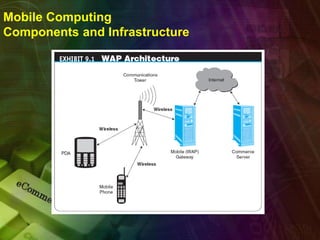
– Wireless Application Protocol (WAP)
A scripting language used to create content in the WAP
environment; based on SML, minus unnecessary content
to increase speed.
Mobile Computing
Components and Infrastructure
– Markup Languages
• Wireless Markup Language (WML)
A scripting language used to create content in the WAP
environment; based on XML, minus unnecessary content to
increase speed.
• Extensible Hypertext Markup Language (xHTML)
A general scripting language; compatible with HTML; a standard
set by W3Consortium.
Mobile Computing
Components and Infrastructure
Mobile Computing
Components and Infrastructure
• MOBILE COMPUTING SERVICES
– Short Message Service (SMS)
A service that supports the sending and receiving of short
text messages on mobile phones.
– Enhanced Messaging Service (EMS)
An extension of SMS that can send simple animation, tiny
pictures, sounds, and formatted text.
Mobile Computing
Components and Infrastructure
– Multimedia Messaging Service (MMS)
The emerging generation of wireless messaging; MMS is
able to deliver rich media.
– Location-Based Services
• global positioning system (GPS)
A worldwide satellite-based tracking system that enables users to
determine their position anywhere on the earth.
Mobile Computing
Components and Infrastructure
– Voice-Support Services
• interactive voice response (IVR)
A voice system that enables users to request and receive
information and to enter and change data through a telephone to
a computerized system.
• voice portal
A Web site with an audio interface that can be accessed through a
telephone call.
Wireless
Telecommunications Networks
• personal area network (PAN)
A wireless telecommunications network for device-
to-device connections within a very short range.
• Bluetooth
A set of telecommunications standards that enables
wireless devices to communicate with each other
over short distances.
Wireless
Telecommunications Networks
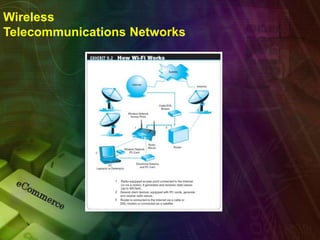
• wireless local area network (WLAN)
A telecommunications network that enables users to
make short-range wireless connections to the
Internet or another network.
• Wi-Fi (wireless fidelity)
The common name used to describe the IEEE
802.11 standard used on most WLANs.
Wireless
Telecommunications Networks
– 802.11b
The most popular Wi-Fi standard; it is inexpensive and offers
sufficient speed for most devices; however, interference can be a
problem.
– 802.11a
This Wi-Fi standard is faster than 802.11b but has a smaller range.
– 802.11g
This fast but expensive Wi-Fi standard is mostly used in businesses.
Wireless
Telecommunications Networks
Wireless
Telecommunications Networks
• MUNICIPAL WI-FI NETWORKS
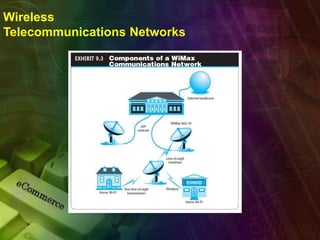
– WiMax
A wireless standard (IEEE 802.16) for making broadband
network connections over a medium-sized area such as a
city.
Wireless
Telecommunications Networks
Wireless
Telecommunications Networks
• wireless wide area network (WWAN)
A telecommunications network that offers
wireless coverage over a large geographical
area, typically over a cellular phone network.
– Physical Topology of a WWAN
• subscriber identification module (SIM) card
An extractable storage card used for identification,
customer location information, transaction processing,
secure communications, etc.
Wireless
Telecommunications Networks
– WWAN Communication Bandwidths
• 1G
The first generation of wireless technology, which was analog based.
• 2G
The second generation of digital wireless technology; accommodates
voice and text.
• 3G
The third generation of digital wireless technology; supports rich media
such as video.
• 4G
The expected next generation of wireless technology that will provide
faster display of multimedia.
Wireless
Telecommunications Networks
– WWAN Communication Protocols
• Frequency Division Multiple Access (FDMA)
• Time Division Multiple Access (TDMA)
• Code Division Multiple Access (CDMA)
– WWAN Network Systems
• Global System for Mobile Communications (GSM)
An open, nonproprietary standard for mobile voice and data
communications.
Mobile Financial Applications
• MOBILE BANKING AND FINANCIAL SERVICES
• WIRELESS ELECTRONIC PAYMENT SYSTEMS
– Wireless Bill Payments
– Closing the Digital Divide
Mobile Shopping, Advertising, and Content
Provision
• WIRELESS SHOPPING
• MOBILE AND TARGETED ADVERTISING
• mobile portal
A customer interaction channel that aggregates
content and services for mobile users.
Mobile Enterprise
and Supply Chain
• SUPPORT OF MOBILE EMPLOYEES
– Mobile Office
– Sales Force Mobilization and Automation
– Worker Support in Retailing
– Support in Operations
– Job Dispatch
– Maintenance and Repair at Remote Sites
Mobile Enterprise
and Supply Chain
• SUPPORTING OTHER TYPES OF WORK
• CUSTOMER AND PARTNER SUPPORT
• B2B M-COMMERCE AND SUPPLY CHAIN
MANAGEMENT
Mobile Consumer Services
• MOBILE ENTERTAINMENT
– Music and Video
– Mobile Games
– Mobile Gambling
Location-Based
Mobile Commerce
• location-based m-commerce
Delivery of m-commerce transactions to
individuals in a specific location, at a specific time.
– Five key factors for services provided :
1. Location
2. Navigation
3. Tracking
4. Mapping
5. Timing
Location-Based
Mobile Commerce
• THE TECHNOLOGY FOR
L-COMMERCE
– Global Positioning System
• GEOGRAPHICAL INFORMATION SYSTEM AND GPS
– Geographical information system (GIS)
A computer system capable of integrating, storing, editing, analyzing,
sharing, and displaying geographically referenced (spatial)
information.
– GPS/GIS Applications
Location-Based
Mobile Commerce
• LOCATION-BASED ADVERTISING
• telematics
The integration of computers and wireless
communications to improve information flow using
the principles of telemetry.
• OTHER APPLICATIONS OF LOCATION-BASED
SYSTEMS
Location-Based
Mobile Commerce
• BARRIERS TO LOCATION-BASED M-
COMMERCE
– Accuracy of devices
– The cost-benefit justification
– Limited network bandwidth
– Invasion of privacy
Security and Other Implementation Issues in M-
Commerce
• M-COMMERCE SECURITY ISSUES
• TECHNOLOGICAL BARRIERS TO M-
COMMERCE
• ETHICAL, LEGAL, AND HEALTH ISSUES IN M-
COMMERCE
Security and Other Implementation Issues in M-
Commerce
– Technical Limitations of Mobile Computing
• Insufficient bandwidth
• Security standards
• Power consumption
• Transmission interferences
• GPS accuracy
• WAP limitations
• Potential health hazards
• Human–computer interface
• Complexity
Managerial Issues
1. What’s our timetable?
2. Is it real or just a buzzword?
3. Is an all-in-one device a winner?
4. Which system to use?
5. Which will win the wireless race: WiMax, Wi-Fi, or
3G?
6. Which applications first?
Summary
1. M-commerce, its value-added attributes, and its
fundamental drivers.
2. The mobile computing environment that supports
m-commerce.
3. Wireless telecommunications networks.
4. Finance applications.
Summary
5. Shopping, advertising, and content-providing
applications.
6. Enterprise and SCM applications.
7. Consumer applications.
8. Location-based commerce.
9. Security and other implementation issues.

6053298.ppt

  • 1.
  • 2.
    Learning Objectives 1. Discussthe value-added attributes, benefits, and fundamental drivers of m-commerce. 2. Describe the mobile computing environment that supports m-commerce (i.e., devices, software, services). 3. Describe the four major types of wireless telecommunications networks. 4. Discuss m-commerce applications in finance. 5. Describe m-commerce applications in shopping, advertising, and provision of content.
  • 3.
    Learning Objectives 6. Discussthe application of m-commerce within organizations and across the supply chain. 7. Describe consumer and personal applications of m- commerce. 8. Understand the technologies and potential application of location-based m-commerce. 9. Describe the major inhibitors and barriers of m-commerce.
  • 4.
    Mobile Commerce: Attributes, Benefits,and Drivers • mobile commerce (m-commerce, m-business) Any business activity conducted over a wireless telecommunications network or from mobile devices.
  • 5.
    Mobile Commerce: Attributes, Benefits,and Drivers • ATTRIBUTES OF M-COMMERCE – Ubiquity – Convenience – Interactivity – Personalization – Localization
  • 6.
    Mobile Commerce: Attributes, Benefits,and Drivers • DRIVERS OF M-COMMERCE – Widespread availability of more powerful mobile devices – The handset culture – The service economy – Vendors’ push – The mobile workforce – Increased mobility – Improved price and performance – Improvement of bandwidth
  • 7.
    Mobile Computing Components andInfrastructure • wireless mobile computing (mobile computing) Computing that connects a mobile device to a network or another computing device, anytime, anywhere.
  • 8.
    Mobile Computing Components andInfrastructure • MOBILE DEVICES – personal digital assistant (PDA) A stand-alone handheld computer principally used for personal information management. – smartphone A mobile phone with PC-like capabilities.
  • 9.
    Mobile Computing Components andInfrastructure • MOBILE COMPUTING SOFTWARE – Mobile Operating System – Mobile Application User Interface – microbrowser Wireless Web browser designed to operate with small screens and limited bandwidth and memory requirements.
  • 10.
    Mobile Computing Components andInfrastructure – Wireless Application Protocol (WAP) A scripting language used to create content in the WAP environment; based on SML, minus unnecessary content to increase speed.
  • 11.
    Mobile Computing Components andInfrastructure – Markup Languages • Wireless Markup Language (WML) A scripting language used to create content in the WAP environment; based on XML, minus unnecessary content to increase speed. • Extensible Hypertext Markup Language (xHTML) A general scripting language; compatible with HTML; a standard set by W3Consortium.
  • 12.
  • 13.
    Mobile Computing Components andInfrastructure • MOBILE COMPUTING SERVICES – Short Message Service (SMS) A service that supports the sending and receiving of short text messages on mobile phones. – Enhanced Messaging Service (EMS) An extension of SMS that can send simple animation, tiny pictures, sounds, and formatted text.
  • 14.
    Mobile Computing Components andInfrastructure – Multimedia Messaging Service (MMS) The emerging generation of wireless messaging; MMS is able to deliver rich media. – Location-Based Services • global positioning system (GPS) A worldwide satellite-based tracking system that enables users to determine their position anywhere on the earth.
  • 15.
    Mobile Computing Components andInfrastructure – Voice-Support Services • interactive voice response (IVR) A voice system that enables users to request and receive information and to enter and change data through a telephone to a computerized system. • voice portal A Web site with an audio interface that can be accessed through a telephone call.
  • 16.
    Wireless Telecommunications Networks • personalarea network (PAN) A wireless telecommunications network for device- to-device connections within a very short range. • Bluetooth A set of telecommunications standards that enables wireless devices to communicate with each other over short distances.
  • 17.
    Wireless Telecommunications Networks • wirelesslocal area network (WLAN) A telecommunications network that enables users to make short-range wireless connections to the Internet or another network. • Wi-Fi (wireless fidelity) The common name used to describe the IEEE 802.11 standard used on most WLANs.
  • 18.
    Wireless Telecommunications Networks – 802.11b Themost popular Wi-Fi standard; it is inexpensive and offers sufficient speed for most devices; however, interference can be a problem. – 802.11a This Wi-Fi standard is faster than 802.11b but has a smaller range. – 802.11g This fast but expensive Wi-Fi standard is mostly used in businesses.
  • 19.
  • 20.
    Wireless Telecommunications Networks • MUNICIPALWI-FI NETWORKS – WiMax A wireless standard (IEEE 802.16) for making broadband network connections over a medium-sized area such as a city.
  • 21.
  • 22.
    Wireless Telecommunications Networks • wirelesswide area network (WWAN) A telecommunications network that offers wireless coverage over a large geographical area, typically over a cellular phone network. – Physical Topology of a WWAN • subscriber identification module (SIM) card An extractable storage card used for identification, customer location information, transaction processing, secure communications, etc.
  • 23.
    Wireless Telecommunications Networks – WWANCommunication Bandwidths • 1G The first generation of wireless technology, which was analog based. • 2G The second generation of digital wireless technology; accommodates voice and text. • 3G The third generation of digital wireless technology; supports rich media such as video. • 4G The expected next generation of wireless technology that will provide faster display of multimedia.
  • 24.
    Wireless Telecommunications Networks – WWANCommunication Protocols • Frequency Division Multiple Access (FDMA) • Time Division Multiple Access (TDMA) • Code Division Multiple Access (CDMA) – WWAN Network Systems • Global System for Mobile Communications (GSM) An open, nonproprietary standard for mobile voice and data communications.
  • 25.
    Mobile Financial Applications •MOBILE BANKING AND FINANCIAL SERVICES • WIRELESS ELECTRONIC PAYMENT SYSTEMS – Wireless Bill Payments – Closing the Digital Divide
  • 26.
    Mobile Shopping, Advertising,and Content Provision • WIRELESS SHOPPING • MOBILE AND TARGETED ADVERTISING • mobile portal A customer interaction channel that aggregates content and services for mobile users.
  • 27.
    Mobile Enterprise and SupplyChain • SUPPORT OF MOBILE EMPLOYEES – Mobile Office – Sales Force Mobilization and Automation – Worker Support in Retailing – Support in Operations – Job Dispatch – Maintenance and Repair at Remote Sites
  • 28.
    Mobile Enterprise and SupplyChain • SUPPORTING OTHER TYPES OF WORK • CUSTOMER AND PARTNER SUPPORT • B2B M-COMMERCE AND SUPPLY CHAIN MANAGEMENT
  • 29.
    Mobile Consumer Services •MOBILE ENTERTAINMENT – Music and Video – Mobile Games – Mobile Gambling
  • 30.
    Location-Based Mobile Commerce • location-basedm-commerce Delivery of m-commerce transactions to individuals in a specific location, at a specific time. – Five key factors for services provided : 1. Location 2. Navigation 3. Tracking 4. Mapping 5. Timing
  • 31.
    Location-Based Mobile Commerce • THETECHNOLOGY FOR L-COMMERCE – Global Positioning System • GEOGRAPHICAL INFORMATION SYSTEM AND GPS – Geographical information system (GIS) A computer system capable of integrating, storing, editing, analyzing, sharing, and displaying geographically referenced (spatial) information. – GPS/GIS Applications
  • 32.
    Location-Based Mobile Commerce • LOCATION-BASEDADVERTISING • telematics The integration of computers and wireless communications to improve information flow using the principles of telemetry. • OTHER APPLICATIONS OF LOCATION-BASED SYSTEMS
  • 33.
    Location-Based Mobile Commerce • BARRIERSTO LOCATION-BASED M- COMMERCE – Accuracy of devices – The cost-benefit justification – Limited network bandwidth – Invasion of privacy
  • 34.
    Security and OtherImplementation Issues in M- Commerce • M-COMMERCE SECURITY ISSUES • TECHNOLOGICAL BARRIERS TO M- COMMERCE • ETHICAL, LEGAL, AND HEALTH ISSUES IN M- COMMERCE
  • 35.
    Security and OtherImplementation Issues in M- Commerce – Technical Limitations of Mobile Computing • Insufficient bandwidth • Security standards • Power consumption • Transmission interferences • GPS accuracy • WAP limitations • Potential health hazards • Human–computer interface • Complexity
  • 36.
    Managerial Issues 1. What’sour timetable? 2. Is it real or just a buzzword? 3. Is an all-in-one device a winner? 4. Which system to use? 5. Which will win the wireless race: WiMax, Wi-Fi, or 3G? 6. Which applications first?
  • 37.
    Summary 1. M-commerce, itsvalue-added attributes, and its fundamental drivers. 2. The mobile computing environment that supports m-commerce. 3. Wireless telecommunications networks. 4. Finance applications.
  • 38.
    Summary 5. Shopping, advertising,and content-providing applications. 6. Enterprise and SCM applications. 7. Consumer applications. 8. Location-based commerce. 9. Security and other implementation issues.