Copyright © 2015 Pearson Education, Inc. Publishing as Pearson Addison-Wesley
MIS 4395.A
Structured Programming
Language
Ahmed Imran Kabir
Week 11, Inheritance
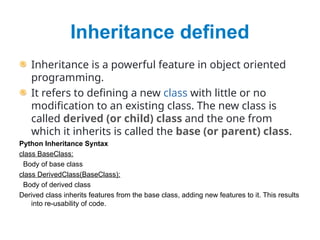
Inheritance defined
Inheritance is a powerful feature in object oriented
programming.
It refers to defining a new class with little or no
modification to an existing class. The new class is
called derived (or child) class and the one from
which it inherits is called the base (or parent) class.
Python Inheritance Syntax
class BaseClass:
Body of base class
class DerivedClass(BaseClass):
Body of derived class
Derived class inherits features from the base class, adding new features to it. This results
into re-usability of code.
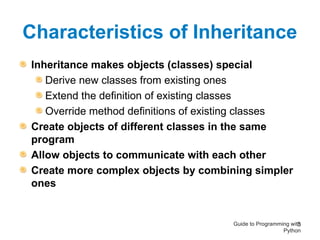
Characteristics of Inheritance
Inheritance makes objects (classes) special
Derive new classes from existing ones
Extend the definition of existing classes
Override method definitions of existing classes
Create objects of different classes in the same
program
Allow objects to communicate with each other
Create more complex objects by combining simpler
ones
Guide to Programming with
Python
3
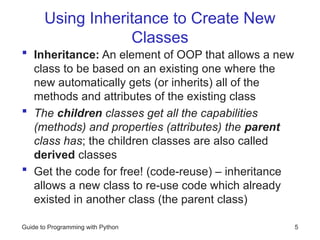
Inheritance Models “is a” Relationship
Guide to Programming with
Python
4
Car
Van Sports car Convertible
Animals
Reptile Mammals Fish
Dog Cat Human
Using Inheritance to Create New
Classes
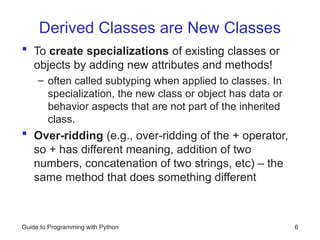
 Inheritance: An element of OOP that allows a new
class to be based on an existing one where the
new automatically gets (or inherits) all of the
methods and attributes of the existing class
 The children classes get all the capabilities
(methods) and properties (attributes) the parent
class has; the children classes are also called
derived classes
 Get the code for free! (code-reuse) – inheritance
allows a new class to re-use code which already
existed in another class (the parent class)
Guide to Programming with Python 5
Derived Classes are New Classes
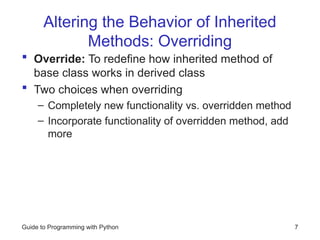
 To create specializations of existing classes or
objects by adding new attributes and methods!
– often called subtyping when applied to classes. In
specialization, the new class or object has data or
behavior aspects that are not part of the inherited
class.
 Over-ridding (e.g., over-ridding of the + operator,
so + has different meaning, addition of two
numbers, concatenation of two strings, etc) – the
same method that does something different
Guide to Programming with Python 6
Altering the Behavior of Inherited
Methods: Overriding
 Override: To redefine how inherited method of
base class works in derived class
 Two choices when overriding
– Completely new functionality vs. overridden method
– Incorporate functionality of overridden method, add
more
Guide to Programming with Python 7
Understanding Polymorphism
 Polymorphism: Aspect of object-oriented
programming that allows you to send same
message to objects of different classes, related by
inheritance, and achieve different but appropriate
results for each object
Guide to Programming with Python 8
Working with Multiple Objects
 We can have multiple objects in a program
 Message: Communication between objects; one
object sends another a message when it invokes a
method of the other
(We already know that we can exchange
information among functions through parameters
and return values)
Guide to Programming with Python 9
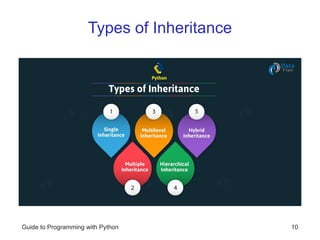
Types of Inheritance
Guide to Programming with Python 10
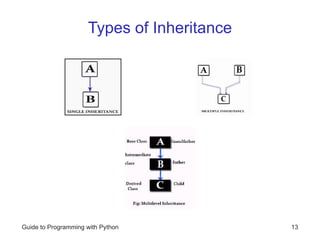
Types of Inheritance
 Single Inheritance in Python
A single Python inheritance is when a single class
inherits from a class.
 Python Multiple Inheritance
Multiple Python inheritance are when multiple
python classes inherit from a class.
 Multilevel Inheritance in Python
When one class inherits from another, which in turn
inherits from another, it is multilevel python
inheritance.
Guide to Programming with Python 11
Types of Inheritance (Cont.)
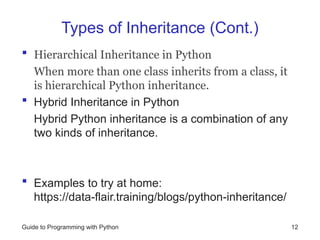
 Hierarchical Inheritance in Python
When more than one class inherits from a class, it
is hierarchical Python inheritance.
 Hybrid Inheritance in Python
Hybrid Python inheritance is a combination of any
two kinds of inheritance.
 Examples to try at home:
https://data-flair.training/blogs/python-inheritance/
Guide to Programming with Python 12
Types of Inheritance
Guide to Programming with Python 13
Python Inheritance Super Function – Super()
 With inheritance, the super() function in
python actually comes in quite handy. It allows us
to call a method from the parent class. Let’s define
a new class for this.
Guide to Programming with Python 14
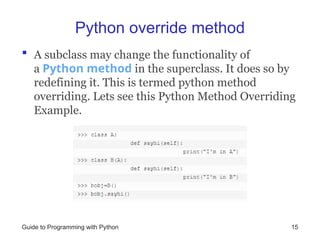
Python override method
 A subclass may change the functionality of
a Python method in the superclass. It does so by
redefining it. This is termed python method
overriding. Lets see this Python Method Overriding
Example.
Guide to Programming with Python 15
Conclusion
 For further practice on Object-oriented-
programming:
 https://en.wikipedia.org/wiki/Inheritance_(object-
oriented_programming)
 https://www.studytonight.com/python/types-of-
inheritance
 https://www.programiz.com/python-programming/
inheritance
 https://data-flair.training/blogs/python-inheritance/
Guide to Programming with Python 16

inheritance in python with full detail.ppt

  • 1.
    Copyright © 2015Pearson Education, Inc. Publishing as Pearson Addison-Wesley MIS 4395.A Structured Programming Language Ahmed Imran Kabir Week 11, Inheritance
  • 2.
    Inheritance defined Inheritance isa powerful feature in object oriented programming. It refers to defining a new class with little or no modification to an existing class. The new class is called derived (or child) class and the one from which it inherits is called the base (or parent) class. Python Inheritance Syntax class BaseClass: Body of base class class DerivedClass(BaseClass): Body of derived class Derived class inherits features from the base class, adding new features to it. This results into re-usability of code.
  • 3.
    Characteristics of Inheritance Inheritancemakes objects (classes) special Derive new classes from existing ones Extend the definition of existing classes Override method definitions of existing classes Create objects of different classes in the same program Allow objects to communicate with each other Create more complex objects by combining simpler ones Guide to Programming with Python 3
  • 4.
    Inheritance Models “isa” Relationship Guide to Programming with Python 4 Car Van Sports car Convertible Animals Reptile Mammals Fish Dog Cat Human
  • 5.
    Using Inheritance toCreate New Classes  Inheritance: An element of OOP that allows a new class to be based on an existing one where the new automatically gets (or inherits) all of the methods and attributes of the existing class  The children classes get all the capabilities (methods) and properties (attributes) the parent class has; the children classes are also called derived classes  Get the code for free! (code-reuse) – inheritance allows a new class to re-use code which already existed in another class (the parent class) Guide to Programming with Python 5
  • 6.
    Derived Classes areNew Classes  To create specializations of existing classes or objects by adding new attributes and methods! – often called subtyping when applied to classes. In specialization, the new class or object has data or behavior aspects that are not part of the inherited class.  Over-ridding (e.g., over-ridding of the + operator, so + has different meaning, addition of two numbers, concatenation of two strings, etc) – the same method that does something different Guide to Programming with Python 6
  • 7.
    Altering the Behaviorof Inherited Methods: Overriding  Override: To redefine how inherited method of base class works in derived class  Two choices when overriding – Completely new functionality vs. overridden method – Incorporate functionality of overridden method, add more Guide to Programming with Python 7
  • 8.
    Understanding Polymorphism  Polymorphism:Aspect of object-oriented programming that allows you to send same message to objects of different classes, related by inheritance, and achieve different but appropriate results for each object Guide to Programming with Python 8
  • 9.
    Working with MultipleObjects  We can have multiple objects in a program  Message: Communication between objects; one object sends another a message when it invokes a method of the other (We already know that we can exchange information among functions through parameters and return values) Guide to Programming with Python 9
  • 10.
    Types of Inheritance Guideto Programming with Python 10
  • 11.
    Types of Inheritance Single Inheritance in Python A single Python inheritance is when a single class inherits from a class.  Python Multiple Inheritance Multiple Python inheritance are when multiple python classes inherit from a class.  Multilevel Inheritance in Python When one class inherits from another, which in turn inherits from another, it is multilevel python inheritance. Guide to Programming with Python 11
  • 12.
    Types of Inheritance(Cont.)  Hierarchical Inheritance in Python When more than one class inherits from a class, it is hierarchical Python inheritance.  Hybrid Inheritance in Python Hybrid Python inheritance is a combination of any two kinds of inheritance.  Examples to try at home: https://data-flair.training/blogs/python-inheritance/ Guide to Programming with Python 12
  • 13.
    Types of Inheritance Guideto Programming with Python 13
  • 14.
    Python Inheritance SuperFunction – Super()  With inheritance, the super() function in python actually comes in quite handy. It allows us to call a method from the parent class. Let’s define a new class for this. Guide to Programming with Python 14
  • 15.
    Python override method A subclass may change the functionality of a Python method in the superclass. It does so by redefining it. This is termed python method overriding. Lets see this Python Method Overriding Example. Guide to Programming with Python 15
  • 16.
    Conclusion  For furtherpractice on Object-oriented- programming:  https://en.wikipedia.org/wiki/Inheritance_(object- oriented_programming)  https://www.studytonight.com/python/types-of- inheritance  https://www.programiz.com/python-programming/ inheritance  https://data-flair.training/blogs/python-inheritance/ Guide to Programming with Python 16