Determination of
Serum Glucose
5th Lab.
1st Stage Undergraduate Students
Lecturer's name: Msc.Hawta K. Abdulla
hawta.abdulla@su.edu.krd
2-Feb-2024
Knowledge University
College of Nursing
Nursing Departmrnt
• Background
• Glucose is a carbohydrate and energy source for
human body.
• Carbohydrate utilized mainly by cells in the form
of glucose.
• In blood quantitative estimation of glucose is
done with either whole blood, plasma, or serum
and several methods have been in use.
• Whole blood values are 10-13% lower than
Serum.
• Where does the glucose in your blood come
from?
• From your food, via the liver.
• From the breakdown of glucose stored as glycogen
in the liver.
• From protein and fat, converted in the liver to form
glucose (called gluconeogenesis).
• Methods for collecting blood for this test
1. Fasting Blood Sugar (FBS): the blood sample is collected
after the patient fasts for 6-8 hours or overnight.
2. Random Blood Sugar: blood collected any time without
prior preparation of the patient.
• Hyperglycemia:
Fasting blood glucose is more than 110 mg/dl
Occur in the following conditions:-
1- Diabetes mellitus. It’s the commonest cause of
hyperglycemia.
2- Chronic disease due to disorder of carbohydrate
metabolism.
3- Pancreatic disorders like chronic pancreatitis.
4- Stress (trauma, burns, surgery)
5- hyperactivity of thyroid or adrenal gland
• Hypoglycemia:
• Fasting blood glucose is less than 60 mg/dl.
Occur in the following conditions
1-Drug induced hypoglycemia like insulin over dose in
treatment of D.M,.
2-Fasting, starvation
3-Liver damage (alcoholism or disease)
4- several exercise
5- glycogen storage disease
Interpretation (Normal range)
Fasting blood glucose 70 – 110 mg/dl
Random blood glucose 140 – 200 mg/dl.
The appear limit increase with age and during
pregnancy.
Maintenance of a normal B. glucose level (70-110
mg/dl) is essential because some tissue for example
brain cells very dependent on extra cellular glucose
concentration.
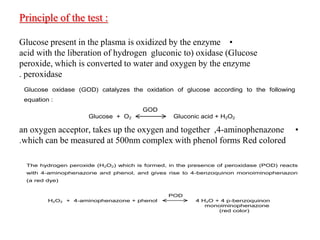
Principle of the test :
•
Glucose present in the plasma is oxidized by the enzyme
(Glucose
oxidase
(
to
gluconic
acid with the liberation of hydrogen
peroxide, which is converted to water and oxygen by the enzyme
peroxidase
.
•
4-aminophenazone
,
an oxygen acceptor, takes up the oxygen and together
with phenol forms Red colored
complex
which can be measured at 500nm
.
Glucose oxidase (GOD) catalyzes the oxidation of glucose according to the following
equation :
GOD
Glucose + O2 Gluconic acid + H2O2
The hydrogen peroxide (H2O2) which is formed, in the presence of peroxidase (POD) reacts
with 4-aminophenazone and phenol, and gives rise to 4-benzoquinon monoiminophenazon
(a red dye)
POD
H2O2 + 4-aminophenazone + phenol 4 H2O + 4 p-benzoquinon
monoiminophenazone
(red color)
•
Procedure :
•
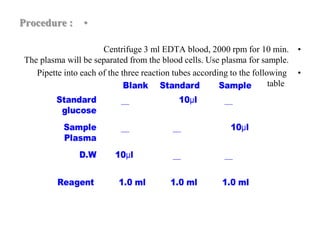
Centrifuge 3 ml EDTA blood, 2000 rpm for 10 min.
The plasma will be separated from the blood cells. Use plasma for sample.
•
Pipette into each of the three reaction tubes according to the following
table
• Mix the content of each tube well, then incubate them at 37oC for 10
minutes .
• Using cuvette tube, read the sample and standard absorbance against the
blank at 500 nm.
Calculation:
Calculate the concentration of BL in the provided fasting blood samples
using the absorbance reading of standard glucose and applying the following
equation:
Glucose (mg/dl) = (Abs. sample/Abs. standard)* standard conc. (100mgdl) .
Normal Range :
Normal (fasting BSL = 70 – 110 mg/dl)

5th Lab. glucose.ppt....................

  • 1.
    Determination of Serum Glucose 5thLab. 1st Stage Undergraduate Students Lecturer's name: Msc.Hawta K. Abdulla hawta.abdulla@su.edu.krd 2-Feb-2024 Knowledge University College of Nursing Nursing Departmrnt
  • 2.
    • Background • Glucoseis a carbohydrate and energy source for human body. • Carbohydrate utilized mainly by cells in the form of glucose. • In blood quantitative estimation of glucose is done with either whole blood, plasma, or serum and several methods have been in use. • Whole blood values are 10-13% lower than Serum.
  • 3.
    • Where doesthe glucose in your blood come from? • From your food, via the liver. • From the breakdown of glucose stored as glycogen in the liver. • From protein and fat, converted in the liver to form glucose (called gluconeogenesis).
  • 4.
    • Methods forcollecting blood for this test 1. Fasting Blood Sugar (FBS): the blood sample is collected after the patient fasts for 6-8 hours or overnight. 2. Random Blood Sugar: blood collected any time without prior preparation of the patient.
  • 5.
    • Hyperglycemia: Fasting bloodglucose is more than 110 mg/dl Occur in the following conditions:- 1- Diabetes mellitus. It’s the commonest cause of hyperglycemia. 2- Chronic disease due to disorder of carbohydrate metabolism. 3- Pancreatic disorders like chronic pancreatitis. 4- Stress (trauma, burns, surgery) 5- hyperactivity of thyroid or adrenal gland
  • 6.
    • Hypoglycemia: • Fastingblood glucose is less than 60 mg/dl. Occur in the following conditions 1-Drug induced hypoglycemia like insulin over dose in treatment of D.M,. 2-Fasting, starvation 3-Liver damage (alcoholism or disease) 4- several exercise 5- glycogen storage disease
  • 7.
    Interpretation (Normal range) Fastingblood glucose 70 – 110 mg/dl Random blood glucose 140 – 200 mg/dl. The appear limit increase with age and during pregnancy. Maintenance of a normal B. glucose level (70-110 mg/dl) is essential because some tissue for example brain cells very dependent on extra cellular glucose concentration.
  • 8.
    Principle of thetest : • Glucose present in the plasma is oxidized by the enzyme (Glucose oxidase ( to gluconic acid with the liberation of hydrogen peroxide, which is converted to water and oxygen by the enzyme peroxidase . • 4-aminophenazone , an oxygen acceptor, takes up the oxygen and together with phenol forms Red colored complex which can be measured at 500nm . Glucose oxidase (GOD) catalyzes the oxidation of glucose according to the following equation : GOD Glucose + O2 Gluconic acid + H2O2 The hydrogen peroxide (H2O2) which is formed, in the presence of peroxidase (POD) reacts with 4-aminophenazone and phenol, and gives rise to 4-benzoquinon monoiminophenazon (a red dye) POD H2O2 + 4-aminophenazone + phenol 4 H2O + 4 p-benzoquinon monoiminophenazone (red color)
  • 9.
    • Procedure : • Centrifuge 3ml EDTA blood, 2000 rpm for 10 min. The plasma will be separated from the blood cells. Use plasma for sample. • Pipette into each of the three reaction tubes according to the following table
  • 10.
    • Mix thecontent of each tube well, then incubate them at 37oC for 10 minutes . • Using cuvette tube, read the sample and standard absorbance against the blank at 500 nm. Calculation: Calculate the concentration of BL in the provided fasting blood samples using the absorbance reading of standard glucose and applying the following equation: Glucose (mg/dl) = (Abs. sample/Abs. standard)* standard conc. (100mgdl) . Normal Range : Normal (fasting BSL = 70 – 110 mg/dl)