5g Nr The Next Generation Wireless Access
Technology Paperback Erik Dahlman Stefan
Parkvall Johan Skold download
https://ebookbell.com/product/5g-nr-the-next-generation-wireless-
access-technology-paperback-erik-dahlman-stefan-parkvall-johan-
skold-10021014
Explore and download more ebooks at ebookbell.com
Here are some recommended products that we believe you will be
interested in. You can click the link to download.
5g Nr The Next Generation Wireless Access Technology 2nd Edition Erik
Dahlman
https://ebookbell.com/product/5g-nr-the-next-generation-wireless-
access-technology-2nd-edition-erik-dahlman-23284078
5g Nr The Next Generation Wireless Access Technology Dahlman
https://ebookbell.com/product/5g-nr-the-next-generation-wireless-
access-technology-dahlman-7167646
5g Nr The Next Generation Wireless Access Technology Erik Dahlman
Stefan Parkvall Johan Skold
https://ebookbell.com/product/5g-nr-the-next-generation-wireless-
access-technology-erik-dahlman-stefan-parkvall-johan-skold-33405412
5g Nr And Enhancements From R15 To R16 Hai Tang Ning Yang Zhi Zhang
https://ebookbell.com/product/5g-nr-and-enhancements-
from-r15-to-r16-hai-tang-ning-yang-zhi-zhang-46214802
5g Nr Wifi 6 And Bluetooth Le 5 A Primer On Smartphone Wireless
Technologies Douglas H Morais
https://ebookbell.com/product/5g-nr-wifi-6-and-bluetooth-
le-5-a-primer-on-smartphone-wireless-technologies-douglas-h-
morais-50710342
5g Nr Modelling In Matlab Network Architecture Protocols And Physical
Layer K H Chadwick
https://ebookbell.com/product/5g-nr-modelling-in-matlab-network-
architecture-protocols-and-physical-layer-k-h-chadwick-56719048
5g Nr Architecture Technology Implementation And Operation Of 3gpp New
Radio Standards Sassan Ahmadi
https://ebookbell.com/product/5g-nr-architecture-technology-
implementation-and-operation-of-3gpp-new-radio-standards-sassan-
ahmadi-10583452
Ngran And 5gnr 5g Radio Access Network And Radio Interface 1st Edition
Frederic Launay
https://ebookbell.com/product/ngran-and-5gnr-5g-radio-access-network-
and-radio-interface-1st-edition-frederic-launay-34242702
Locationbased Services In Cellular Networks From Gsm To 5g Nr 2nd Ed
Garca
https://ebookbell.com/product/locationbased-services-in-cellular-
networks-from-gsm-to-5g-nr-2nd-ed-garca-23518140
5G NR: The Next Generation Wireless Access
Technology
Erik Dahlman
Stefan Parkvall
Johan Sköld
2
Table of Contents
Cover image
Title page
Copyright
Preface
Acknowledgments
Abbreviations and Acronyms
Chapter 1. What Is 5G?
Abstract
1.1 3GPP and the Standardization of Mobile Communication
1.2 The Next Generation—5G/NR
Chapter 2. 5G Standardization
Abstract
2.1 Overview of Standardization and Regulation
2.2 ITU-R Activities From 3G to 5G
2.3 5G and IMT-2020
2.4 3GPP Standardization
Chapter 3. Spectrum for 5G
Abstract
3.1 Spectrum for Mobile Systems
3.2 Frequency Bands for NR
3.3 RF Exposure Above 6 GHz
Chapter 4. LTE—An Overview
Abstract
3
4.1 LTE Release 8—Basic Radio Access
4.2 LTE Evolution
4.3 Spectrum Flexibility
4.4 Multi-Antenna Enhancements
4.5 Densification, Small Cells, and Heterogeneous Deployments
4.6 Device Enhancements
4.7 New Scenarios
Chapter 5. NR Overview
Abstract
5.1 Higher-Frequency Operation and Spectrum Flexibility
5.2 Ultra-Lean Design
5.3 Forward Compatibility
5.4 Transmission Scheme, Bandwidth Parts, and Frame Structure
5.5 Duplex Schemes
5.6 Low-Latency Support
5.7 Scheduling and Data Transmission
5.8 Control Channels
5.9 Beam-Centric Design and Multi-Antenna Transmission
5.10 Initial Access
5.11 Interworking and LTE Coexistence
Chapter 6. Radio-Interface Architecture
Abstract
6.1 Overall System Architecture
6.2 Quality-Of-Service Handling
6.3 Radio Protocol Architecture
6.4 User-Plane Protocols
6.5 Control-Plane Protocols
Chapter 7. Overall Transmission Structure
Abstract
7.1 Transmission Scheme
4
7.2 Time-Domain Structure
7.3 Frequency-Domain Structure
7.4 Bandwidth Parts
7.5 Frequency-Domain Location of NR Carriers
7.6 Carrier Aggregation
7.7 Supplementary Uplink
7.8 Duplex Schemes
7.9 Antenna Ports
7.10 Quasi-Colocation
Chapter 8. Channel Sounding
Abstract
8.1 Downlink Channel Sounding—CSI-RS
8.2 Downlink Measurements and Reporting
8.3 Uplink Channel Sounding—SRS
Chapter 9. Transport-Channel Processing
Abstract
9.1 Overview
9.2 Channel Coding
9.3 Rate Matching and Physical-Layer Hybrid-ARQ Functionality
9.4 Scrambling
9.5 Modulation
9.6 Layer Mapping
9.7 Uplink DFT Precoding
9.8 Multi-Antenna Precoding
9.9 Resource Mapping
9.10 Downlink Reserved Resources
9.11 Reference Signals
Chapter 10. Physical-Layer Control Signaling
Abstract
10.1 Downlink
5
10.2 Uplink
Chapter 11. Multi-Antenna Transmission
Abstract
11.1 Introduction
11.2 Downlink Multi-Antenna Precoding
11.3 NR Uplink Multiantenna Precoding
Chapter 12. Beam Management
Abstract
12.1 Initial Beam Establishment
12.2 Beam Adjustment
12.3 Beam Recovery
Chapter 13. Retransmission Protocols
Abstract
13.1 Hybrid-ARQ With Soft Combining
13.2 RLC
13.3 PDCP
Chapter 14. Scheduling
Abstract
14.1 Dynamic Downlink Scheduling
14.2 Dynamic Uplink Scheduling
14.3 Scheduling and Dynamic TDD
14.4 Transmission Without a Dynamic Grant
14.5 Discontinuous Reception
Chapter 15. Uplink Power and Timing Control
Abstract
15.1 Uplink Power Control
15.2 Uplink Timing Control
Chapter 16. Initial Access
Abstract
6
16.1 Cell Search
16.2 Random Access
Chapter 17. LTE/NR Interworking and Coexistence
Abstract
17.1 LTE/NR Dual-Connectivity
17.2 LTE/NR Coexistence
Chapter 18. RF Characteristics
Abstract
18.1 Spectrum Flexibility Implications
18.2 RF Requirements in Different Frequency Ranges
18.3 Channel Bandwidth and Spectrum Utilization
18.4 Overall Structure of Device RF Requirements
18.5 Overall Structure of Base-Station RF Requirements
18.6 Overview of Conducted RF Requirements for NR
18.7 Conducted Output Power Level Requirements
18.8 Transmitted Signal Quality
18.9 Conducted Unwanted Emissions Requirements
18.10 Conducted Sensitivity and Dynamic Range
18.11 Receiver Susceptibility to Interfering Signals
18.12 Radiated RF Requirements for NR
18.13 Ongoing Developments of RF Requirements for NR
Chapter 19. RF Technologies at mm-Wave Frequencies
Abstract
19.1 ADC and DAC Considerations
19.2 LO Generation and Phase Noise Aspects
19.3 Power Amplifier Efficiency in Relation to Unwanted Emission
19.4 Filtering Aspects
19.5 Receiver Noise Figure, Dynamic Range, and Bandwidth Dependencies
19.6 Summary
Chapter 20. Beyond the First Release of 5G
7
Abstract
20.1 Integrated Access-Backhaul
20.2 Operation in Unlicensed Spectra
20.3 Non-orthogonal Multiple Access
20.4 Machine-Type Communication
20.5 Device-To-Device Communication
20.6 Spectrum and Duplex Flexibility
20.7 Concluding Remarks
References
Index
8
Copyright
Academic Press is an imprint of Elsevier
125 London Wall, London EC2Y 5AS, United Kingdom
525 B Street, Suite 1650, San Diego, CA 92101, United States
50 Hampshire Street, 5th Floor, Cambridge, MA 02139, United States
The Boulevard, Langford Lane, Kidlington, Oxford OX5 1GB, United Kingdom
Copyright © 2018 Elsevier Ltd. All rights reserved.
No part of this publication may be reproduced or transmitted in any form or by any means,
electronic or mechanical, including photocopying, recording, or any information storage and
retrieval system, without permission in writing from the publisher. Details on how to seek
permission, further information about the Publisher’s permissions policies and our arrangements
with organizations such as the Copyright Clearance Center and the Copyright Licensing Agency,
can be found at our website: www.elsevier.com/permissions.
This book and the individual contributions contained in it are protected under copyright by the
Publisher (other than as may be noted herein).
Notices
Knowledge and best practice in this field are constantly changing. As new research and
experience broaden our understanding, changes in research methods, professional practices, or
medical treatment may become necessary.
Practitioners and researchers must always rely on their own experience and knowledge in
evaluating and using any information, methods, compounds, or experiments described herein. In
using such information or methods they should be mindful of their own safety and the safety of
others, including parties for whom they have a professional responsibility.
To the fullest extent of the law, neither the Publisher nor the authors, contributors, or editors,
assume any liability for any injury and/or damage to persons or property as a matter of products
liability, negligence or otherwise, or from any use or operation of any methods, products,
instructions, or ideas contained in the material herein.
British Library Cataloguing-in-Publication Data
A catalogue record for this book is available from the British Library
Library of Congress Cataloging-in-Publication Data
A catalog record for this book is available from the Library of Congress
ISBN: 978-0-12-814323-0
For Information on all Academic Press publications visit our website at
https://www.elsevier.com/books-and-journals
9
Publisher: Mara Conner
Acquisition Editor: Tim Pitts
Editorial Project Manager: Joshua Mearns
Production Project Manager: Kamesh Ramajogi
Cover Designer: Greg Harris
Typeset by MPS Limited, Chennai, India
10
Preface
Long-Term Evolution (LTE) has become the most successful wireless mobile broadband technology
across the world, serving billions of users. Mobile broadband is, and will continue to be, an
important part of future cellular communication, but future wireless networks are to a large extent
also about a significantly wider range of use cases and a correspondingly wider range of
requirements. Although LTE is a very capable technology, still evolving and expected to be used for
many years to come, a new 5G radio access known as New Radio (NR) has been standardized to
meet future requirements.
This book describes NR, developed in 3GPP (Third Generation Partnership Project) as of late Spring
2018.
Chapter 1 provides a brief introduction, followed by a description of the standardization process
and relevant organizations such as the aforementioned 3GPP and ITU in Chapter 2. The frequency
bands available for mobile communication are covered in Chapter 3 together with a discussion on
the process for finding new frequency bands.
An overview of LTE and its evolution is found in Chapter 4. Although the focus of the book is
NR, a brief overview of LTE as a background to the coming chapters is relevant. One reason is that
both LTE and NR are developed by 3GPP and hence have a common background and share several
technology components. Many of the design choices in NR are also based on experience from LTE.
Furthermore, LTE continues to evolve in parallel with NR and is an important component in 5G
radio access.
Chapter 5 provides an overview of NR. It can be read on its own to get a high-level
understanding of NR, or as an introduction to the subsequent chapters.
Chapter 6 outlines the overall protocol structure in NR, followed by a description of the overall
time–frequency structure of NR in Chapter 7.
Multiantenna processing and beam-forming are integral parts of NR. The channel sounding tools
to support these functions are outlined in Chapter 8, followed by the overall transport-channel
processing in Chapter 9 and the associated control signaling in Chapter 10. How the functions are
used to support different multi-antenna schemes and beamforming functions is the topic of
Chapters 11 and 12.
Retransmission functionality and scheduling are the topics of Chapters 13 and 14, followed by
power control in Chapter 15 and initial access in Chapter 16.
Coexistence and interworking with LTE is an essential part of NR, especially in the
nonstandalone version which relies on LTE for mobility and initial access, and is covered in Chapter
17.
Radio-frequency (RF) requirements, taking into account spectrum flexibility across large
frequency ranges and multistandard radio equipment, are the topic of Chapter 18. Chapter 19
discusses the RF implementation aspects for higher frequency bands in the mm-wave range.
Finally, Chapter 20 concludes the book with an outlook to future NR releases.
11
Acknowledgments
We thank all our colleagues at Ericsson for assisting in this project by helping with contributions to
the book, giving suggestions and comments on the contents, and taking part in the huge team effort
of developing NR and the next generation of radio access for 5G.
The standardization process involves people from all parts of the world, and we acknowledge the
efforts of our colleagues in the wireless industry in general and in 3GPP RAN in particular. Without
their work and contributions to the standardization, this book would not have been possible.
Finally, we are immensely grateful to our families for bearing with us and supporting us during
the long process of writing this book.
12
Abbreviations and Acronyms
3GPP Third Generation Partnership Project
5GCN 5G Core Network
AAS Active Antenna System
ACIR Adjacent Channel Interference Ratio
ACK Acknowledgment (in ARQ protocols)
ACLR Adjacent Channel Leakage Ratio
ACS Adjacent Channel Selectivity
ADC Analog-to-Digital Converter
AF Application Function
AGC Automatic Gain Control
AM Acknowledged Mode (RLC configuration)
AM Amplitude Modulation
AMF Access and Mobility Management Function
A-MPR Additional Maximum Power Reduction
AMPS Advanced Mobile Phone System
ARI Acknowledgment Resource Indicator
ARIB Association of Radio Industries and Businesses
ARQ Automatic Repeat-reQuest
AS Access Stratum
ATIS Alliance for Telecommunications Industry Solutions
AUSF Authentication Server Function
AWGN Additive White Gaussian Noise
BC Band Category
BCCH Broadcast Control Channel
BCH Broadcast Channel
BiCMOS Bipolar Complementary Metal Oxide Semiconductor
BPSK Binary Phase-Shift Keying
BS Base Station
BW Bandwidth
BWP Bandwidth part
CA Carrier aggregation
CACLR Cumulative Adjacent Channel Leakage Ratio
CBG Codeblock group
CBGFI CBG flush information
CBGTI CBG transmit indicator
CC Component Carrier
CCCH Common Control Channel
13
CCE Control Channel Element
CCSA China Communications Standards Association
CDM Code Division Multiplexing
CDMA Code-Division Multiple Access
CEPT European Conference of Postal and Telecommunications Administration
CITEL Inter-American Telecommunication Commission
C-MTC Critical Machine-Type Communications
CMOS Complementary Metal Oxide Semiconductor
CN Core Network
CoMP Coordinated Multi-Point Transmission/Reception
COREST Control resource set
CP Cyclic Prefix
CP Compression Point
CQI Channel-Quality Indicator
CRB Common resource block
CRC Cyclic Redundancy Check
C-RNTI Cell Radio-Network Temporary Identifier
CS Capability Set (for MSR base stations)
CSI Channel-State Information
CSI-IM CSI Interference Measurement
CSI-RS CSI Reference Signals
CS-RNTI Configured scheduling RNTI
CW Continuous Wave
D2D Device-to-Device
DAC Digital-to-Analog Converter
DAI Downlink Assignment Index
D-AMPS Digital AMPS
DC Dual Connectivity
DC Direct Current
DCCH Dedicated Control Channel
DCH Dedicated Channel
DCI Downlink Control Information
DFT Discrete Fourier Transform
DFTS-OFDM DFT-Spread OFDM (DFT-precoded OFDM, see also SC-FDMA)
DL Downlink
DL-SCH Downlink Shared Channel
DM-RS Demodulation Reference Signal
DR Dynamic Range
DRX Discontinuous Reception
DTX Discontinuous Transmission
EDGE Enhanced Data Rates for GSM Evolution, Enhanced Data Rates for Global Evolution
ECC Electronic Communications Committee (of CEPT)
eIMTA Enhanced Interference Mitigation and Traffic Adaptation
14
EIRP Effective Isotropic Radiated Power
EIS Equivalent Isotropic Sensitivity
eMBB enhanced MBB
EMF Electromagnetic Field
eNB eNodeB
EN-DC E-UTRA NR Dual-Connectivity
eNodeB E-UTRAN NodeB
EPC Evolved Packet Core
ETSI European Telecommunications Standards Institute
E-UTRA Evolved UTRA
EVM Error Vector Magnitude
FCC Federal Communications Commission
FDD Frequency Division Duplex
FDM Frequency Division Multiplexing
FET Field-Effect Transistor
FDMA Frequency-Division Multiple Access
FFT Fast Fourier Transform
FoM Figure-of-Merit
FPLMTS Future Public Land Mobile Telecommunications Systems
FR1 Frequency Range 1
FR2 Frequency Range 2
GaAs Gallium Arsenide
GaN Gallium Nitride
GERAN GSM/EDGE Radio Access Network
gNB gNodeB
gNodeB generalized NodeB
GSA Global mobile Suppliers Association
GSM Global System for Mobile Communications
GSMA GSM Association
HARQ Hybrid ARQ
HBT Heterojunction Bipolar Transistor
HEMT High Electron-Mobility Transistor
HSPA High-Speed Packet Access
IC Integrated Circuit
ICNIRP International Commission on Non-Ionizing Radiation
ICS In-Channel Selectivity
IEEE Institute of Electrical and Electronics Engineers
IFFT Inverse Fast Fourier Transform
IL Insertion Loss
IMD Inter Modulation Distortion
IMT-2000 International Mobile Telecommunications 2000 (ITU’s name for the family of 3G
standards)
IMT-2020 International Mobile Telecommunications 2020 (ITU’s name for the family of 5G
standards)
15
IMT-Advanced International Mobile Telecommunications Advanced (ITU’s name for the family of
4G standards)
InGaP Indium Gallium Phosphide
IOT Internet of Things
IP Internet Protocol
IP3 3rd order Intercept Point
IR Incremental Redundancy
ITRS International Telecom Roadmap for Semiconductors
ITU International Telecommunications Union
ITU-R International Telecommunications Union-Radiocommunications Sector
KPI Key Performance Indicator
L1-RSRP Layer 1 Reference Signal Receiver Power
LC Inductor(L)-Capacitor
LAA License-Assisted Access
LCID Logical Channel Index
LDPC Low-Density Parity Check Code
LO Local Oscillator
LNA Low-Noise Amplifier
LTCC Low Temperature Co-fired Ceramic
LTE Long-Term Evolution
MAC Medium Access Control
MAC-CE MAC control element
MAN Metropolitan Area Network
MBB Mobile Broadband
MB-MSR Multi-Band Multi Standard Radio (base station)
MCG Master Cell Group
MCS Modulation and Coding Scheme
MIB Master Information Block
MMIC Monolithic Microwave Integrated Circuit
MIMO Multiple-Input Multiple-Output
mMTC massive Machine Type Communication
MPR Maximum Power Reduction
MSR Multi-Standard Radio
MTC Machine-Type Communication
MU-MIMO Multi-User MIMO
NAK Negative Acknowledgment (in ARQ protocols)
NB-IoT Narrow-Band Internet-of-Things
NDI New-Data Indicator
NEF Network exposure function
NF Noise Figure
NG The interface between the gNB and the 5G CN
NG-c The control-plane part of NG
NGMN Next Generation Mobile Networks
16
NG-u The user-plane part of NG
NMT Nordisk MobilTelefon (Nordic Mobile Telephony)
NodeB NodeB, a logical node handling transmission/reception in multiple cells. Commonly, but
not necessarily, corresponding to a base station
NOMA Nonorthogonal Multiple Access
NR New Radio
NRF NR repository function
NS Network Signaling
NZP-CSI-RS Non-zero-power CSI-RS
OBUE Operating Band Unwanted Emissions
OCC Orthogonal Cover Code
OFDM Orthogonal Frequency-Division Multiplexing
OOB Out-Of-Band (emissions)
OSDD OTA Sensitivity Direction Declarations
OTA Over-The-Air
PA Power Amplifier
PAE Power-Added Efficiency
PAPR Peak-to-Average Power Ratio
PAR Peak-to-Average Ratio (same as PAPR)
PBCH Physical Broadcast Channel
PCB Printed Circuit Board
PCCH Paging Control Channel
PCF Policy control function
PCG Project Coordination Group (in 3GPP)
PCH Paging Channel
PCI Physical Cell Identity
PDC Personal Digital Cellular
PDCCH Physical Downlink Control Channel
PDCP Packet Data Convergence Protocol
PDSCH Physical Downlink Shared Channel
PDU Protocol Data Unit
PHS Personal Handy-phone System
PHY Physical Layer
PLL Phase-Locked Loop
PM Phase Modulation
PMI Precoding-Matrix Indicator
PN Phase Noise
PRACH Physical Random-Access Channel
PRB Physical Resource Block
P-RNTI Paging RNTI
PSD Power Spectral Density
PSS Primary Synchronization Signal
PUCCH Physical Uplink Control Channel
17
PUSCH Physical Uplink Shared Channel
QAM Quadrature Amplitude Modulation
QCL Quasi Co-Location
QoS Quality-of-Service
QPSK Quadrature Phase-Shift Keying
RACH Random Access Channel
RAN Radio Access Network
RA-RNTI Random Access RNTI
RAT Radio Access Technology
RB Resource Block
RE Resource Element
RF Radio Frequency
RFIC Radio Frequency Integrated Circuit
RI Rank Indicator
RIB Radiated Interface Boundary
RIT Radio Interface Technology
RLC Radio Link Control
RMSI Remaining Minimum System Information
RNTI Radio-Network Temporary Identifier
RoAoA Range of Angle of Arrival
ROHC Robust Header Compression
RRC Radio Resource Control
RRM Radio Resource Management
RS Reference Symbol
RSPC IMT-2000 Radio Interface Specifications
RSRP Reference Signal Received Power
RV Redundancy Version
RX Receiver
SCG Secondary Cell Group
SCS Sub-Carrier Spacing
SDL Supplementary Downlink
SDMA Spatial Division Multiple Access
SDO Standards Developing Organization
SDU Service Data Unit
SEM Spectrum Emissions Mask
SFI Slot format indicator
SFI-RNTI Slot format indicator RNTI
SFN System Frame Number (in 3GPP).
SI System Information Message
SIB System Information Block
SIB1 System Information Block 1
SiGe Silicon Germanium
SINR Signal-to-Interference-and-Noise Ratio
18
SIR Signal-to-Interference Ratio
SiP System-in-Package
SI-RNTI System Information RNTI
SMF Session management function
SNDR Signal to Noise-and-Distortion Ratio
SNR Signal-to-Noise Ratio
SoC System-on-Chip
SR Scheduling Request
SRI SRS resource indicator
SRIT Set of Radio Interface Technologies
SRS Sounding Reference Signal
SS Synchronization Signal
SSB Synchronization Signal Block
SSS Secondary Synchronization Signal
SMT Surface-Mount assembly
SUL Supplementary Uplink
SU-MIMO Single-User MIMO
TAB Transceiver-Array Boundary
TACS Total Access Communication System
TCI Transmission configuration indication
TCP Transmission Control Protocol
TC-RNTI Temporary C-RNTI
TDD Time-Division Duplex
TDM Time Division Multiplexing
TDMA Time-Division Multiple Access
TD-SCDMA Time-Division-Synchronous Code-Division Multiple Access
TIA Telecommunication Industry Association
TR Technical Report
TRP Total Radiated Power
TS Technical Specification
TRS Tracking Reference Signal
TSDSI Telecommunications Standards Development Society, India
TSG Technical Specification Group
TTA Telecommunications Technology Association
TTC Telecommunications Technology Committee
TTI Transmission Time Interval
TX Transmitter
UCI Uplink Control Information
UDM Unified data management
UE User Equipment, the 3GPP name for the mobile terminal
UEM Unwanted Emissions Mask
UL Uplink
UMTS Universal Mobile Telecommunications System
19
UPF User plane function
URLLC Ultra-reliable low-latency communication
UTRA Universal Terrestrial Radio Access
V2X Vehicular-to-Anything
V2V Vehicular-to-Vehicular
VCO Voltage-Controlled Oscillator
WARC World Administrative Radio Congress
WCDMA Wideband Code-Division Multiple Access
WG Working Group
WiMAX Worldwide Interoperability for Microwave Access
WP5D Working Party 5D
WRC World Radiocommunication Conference
Xn The interface between gNBs
ZC Zadoff-Chu
ZP-CSI-RS Zero-power CSI-RS
20
C H A P T E R 1
What Is 5G?
Abstract
The chapter gives background to 5G mobile communication, describing the earlier generations
and the justification for a new generation. It describes the high-level 5G use cases, eMBB,
mMTC, and URLLC. It also describes the 3GPP process for developing the new 5G/NR radio-
access technology.
Keywords
5G; NR; 3GPP; eMBB; URLLC; mMTC; machine-type communication
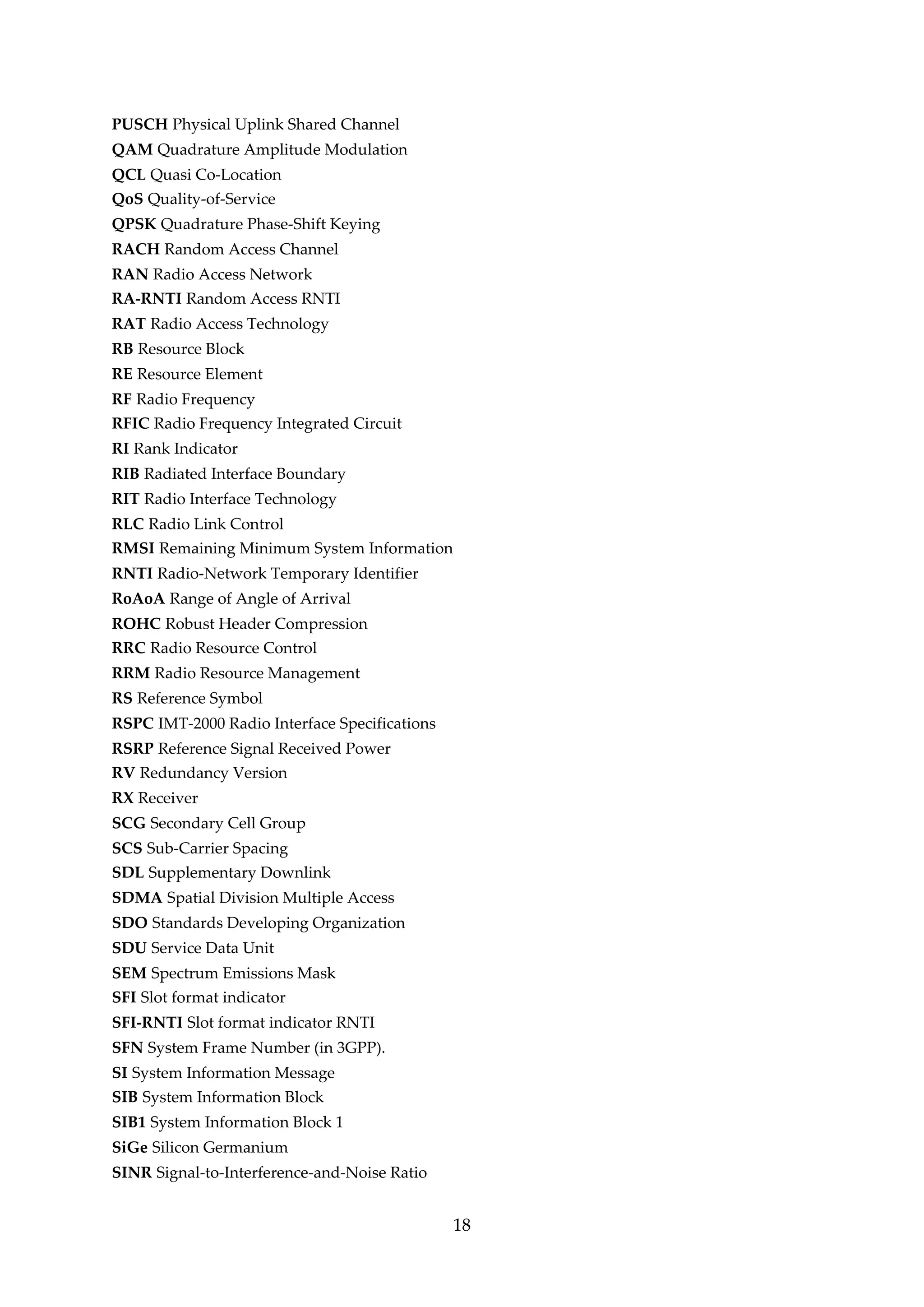
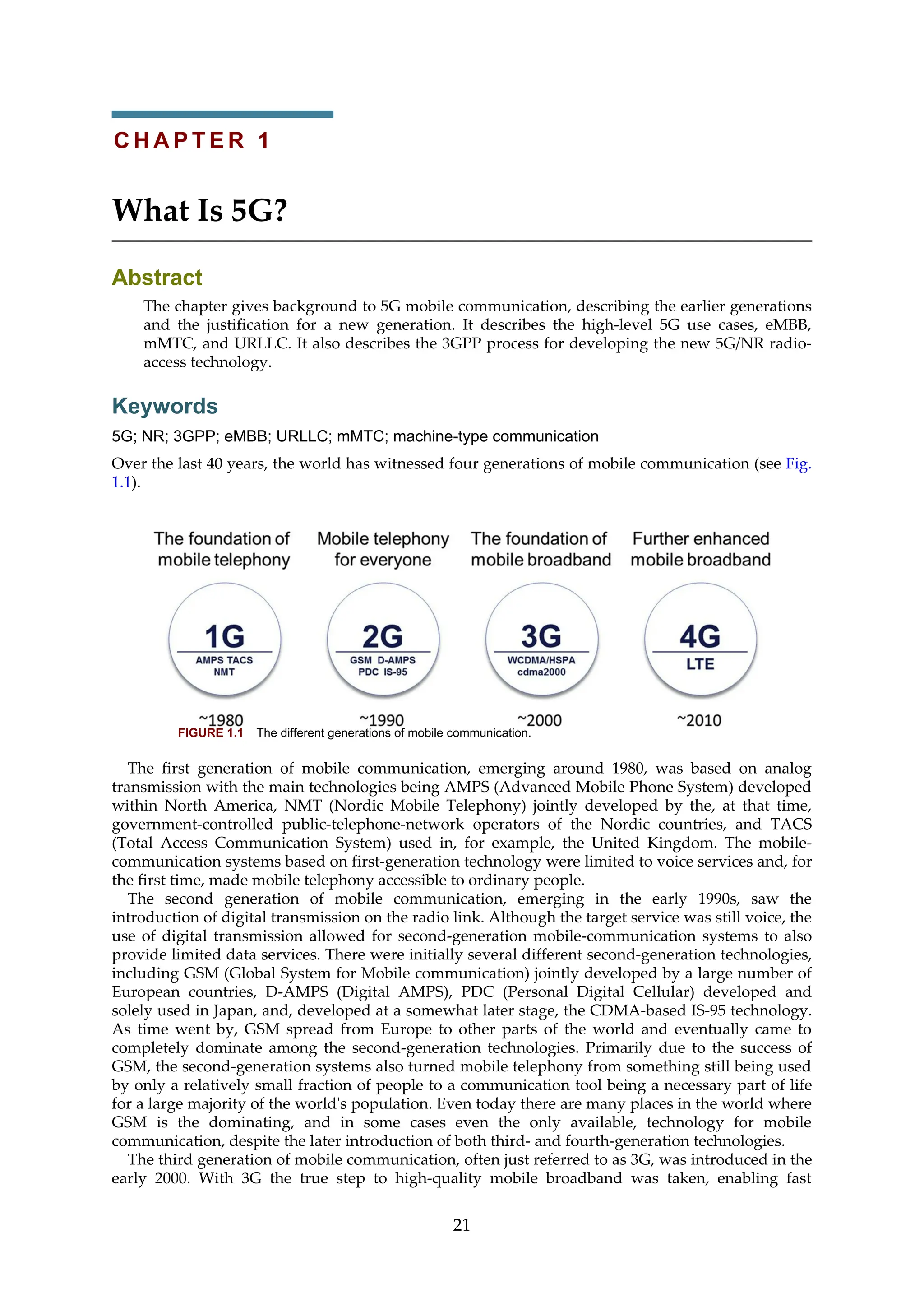
Over the last 40 years, the world has witnessed four generations of mobile communication (see Fig.
1.1).
FIGURE 1.1 The different generations of mobile communication.
The first generation of mobile communication, emerging around 1980, was based on analog
transmission with the main technologies being AMPS (Advanced Mobile Phone System) developed
within North America, NMT (Nordic Mobile Telephony) jointly developed by the, at that time,
government-controlled public-telephone-network operators of the Nordic countries, and TACS
(Total Access Communication System) used in, for example, the United Kingdom. The mobile-
communication systems based on first-generation technology were limited to voice services and, for
the first time, made mobile telephony accessible to ordinary people.
The second generation of mobile communication, emerging in the early 1990s, saw the
introduction of digital transmission on the radio link. Although the target service was still voice, the
use of digital transmission allowed for second-generation mobile-communication systems to also
provide limited data services. There were initially several different second-generation technologies,
including GSM (Global System for Mobile communication) jointly developed by a large number of
European countries, D-AMPS (Digital AMPS), PDC (Personal Digital Cellular) developed and
solely used in Japan, and, developed at a somewhat later stage, the CDMA-based IS-95 technology.
As time went by, GSM spread from Europe to other parts of the world and eventually came to
completely dominate among the second-generation technologies. Primarily due to the success of
GSM, the second-generation systems also turned mobile telephony from something still being used
by only a relatively small fraction of people to a communication tool being a necessary part of life
for a large majority of the world's population. Even today there are many places in the world where
GSM is the dominating, and in some cases even the only available, technology for mobile
communication, despite the later introduction of both third- and fourth-generation technologies.
The third generation of mobile communication, often just referred to as 3G, was introduced in the
early 2000. With 3G the true step to high-quality mobile broadband was taken, enabling fast
21
wireless internet access. This was especially enabled by the 3G evolution known as HSPA (High
Speed Packet Access) [21]. In addition, while earlier mobile-communication technologies had all
been designed for operation in paired spectrum (separate spectrum for network-to-device and
device-to-network links) based on the Frequency-Division Duplex (FDD), see Chapter 7, 3G also
saw the first introduction of mobile communication in unpaired spectrum based on the china-
developed TD-SCDMA technology based on Time Division Duplex (TDD).
We are now, and have been for several years, in the fourth-generation (4G) era of mobile
communication, represented by the LTE technology [28] LTE has followed in the steps of HSPA,
providing higher efficiency and further enhanced mobile-broadband experience in terms of higher
achievable end-user data rates. This is provided by means of OFDM-based transmission enabling
wider transmission bandwidths and more advanced multi-antenna technologies. Furthermore,
while 3G allowed for mobile communication in unpaired spectrum by means of a specific radio-
access technology (TD-SCDMA), LTE supports both FDD and TDD operation, that is, operation in
both paired and unpaired spectra, within one common radio-access technology. By means of LTE
the world has thus converged into a single global technology for mobile communication, used by
essentially all mobile-network operators and applicable to both paired and unpaired spectra. As
discussed in somewhat more detail in Chapter 4, the later evolution of LTE has also extended the
operation of mobile-communication networks into unlicensed spectra.
1.1 3GPP and the Standardization of Mobile Communication
Agreeing on multi-national technology specifications and standards has been key to the success of
mobile communication. This has allowed for the deployment and interoperability of devices and
infrastructure of different vendors and enabled devices and subscriptions to operate on a global
basis.
As already mentioned, already the first-generation NMT technology was created on a
multinational basis, allowing for devices and subscription to operate over the national borders
between the Nordic countries. The next step in multi-national specification/standardization of
mobile-communication technology took place when GSM was jointly developed between a large
number of European countries within CEPT, later renamed ETSI (European Telecommunications
Standards Institute). As a consequence of this, GSM devices and subscriptions were already from
the beginning able to operate over a large number of countries, covering a very large number of
potential users. This large common market had a profound impact on device availability, leading to
an unprecedented number of different device types and substantial reduction in device cost.
However, the final step to true global standardization of mobile communication came with the
specification of the 3G technologies, especially WCDMA. Work on 3G technology was initially also
carried out on a regional basis, that is, separately within Europe (ETSI), North America (TIA, T1P1),
Japan (ARIB), etc. However, the success of GSM had shown the importance of a large technology
footprint, especially in terms of device availability and cost. It also become clear that although work
was carried out separately within the different regional standard organizations, there were many
similarities in the underlying technology being pursued. This was especially true for Europe and
Japan which were both developing different but very similar flavors of wideband CDMA (WCDMA)
technology.
As a consequence, in 1998, the different regional standardization organizations came together and
jointly created the Third-Generation Partnership Project (3GPP) with the task of finalizing the
development of 3G technology based on WCDMA. A parallel organization (3GPP2) was somewhat
later created with the task of developing an alternative 3G technology, cdma2000, as an evolution of
second-generation IS-95. For a number of years, the two organizations (3GPP and 3GPP2) with their
respective 3G technologies (WCDMA and cdma2000) existed in parallel. However, over time 3GPP
came to completely dominate and has, despite its name, continued into the development of 4G
(LTE, and 5G) technologies. Today, 3GPP is the only significant organization developing technical
specifications for mobile communication.
1.2 The Next Generation—5G/NR
Discussions on fifth-generation (5G) mobile communication began around 2012. In many
discussions, the term 5G is used to refer to specific new 5G radio-access technology. However, 5G is
also often used in a much wider context, not just referring to a specific radio-access technology but
22
rather to a wide range of new services envisioned to be enabled by future mobile communication.
1.2.1 The 5G Use Cases
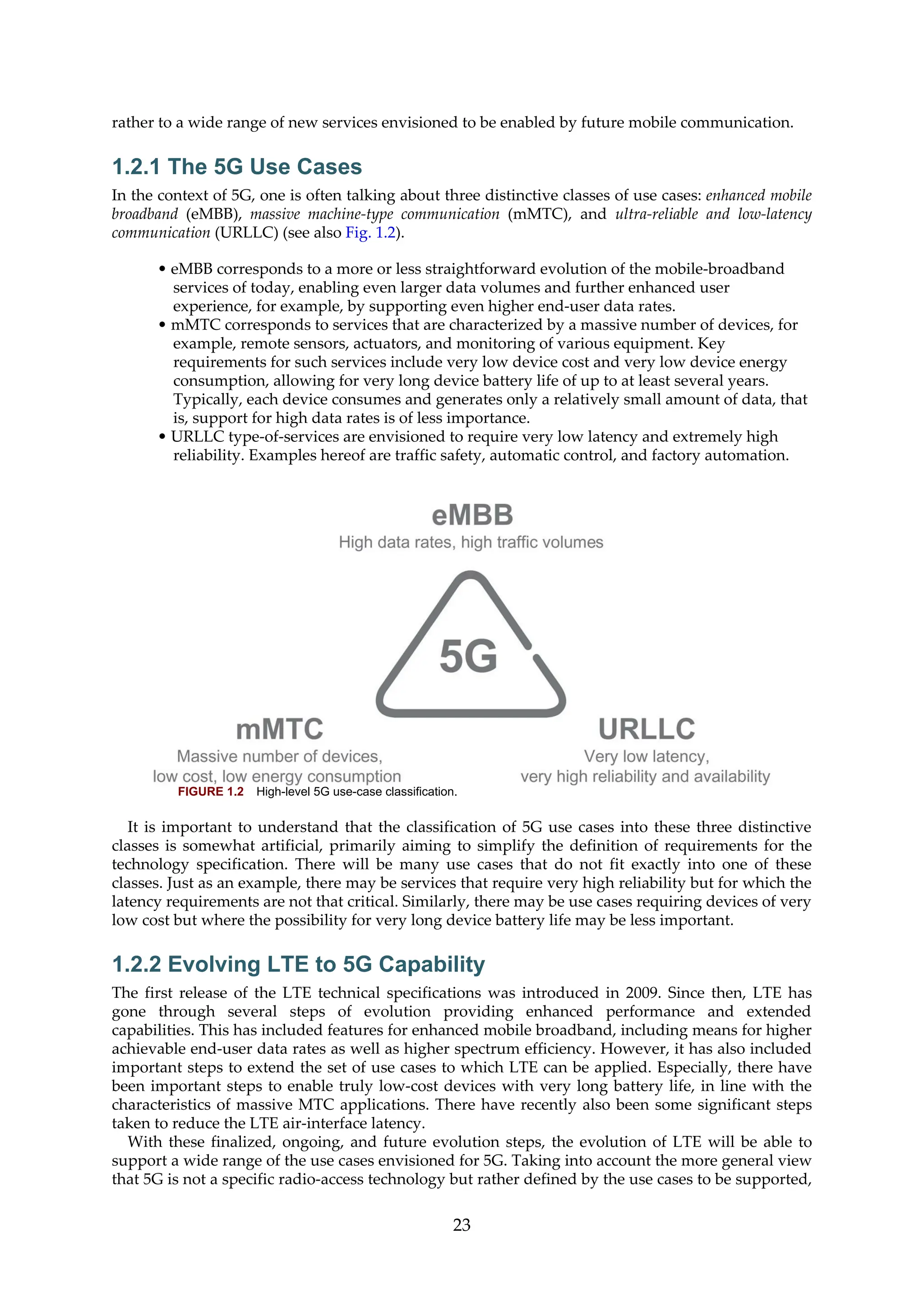
In the context of 5G, one is often talking about three distinctive classes of use cases: enhanced mobile
broadband (eMBB), massive machine-type communication (mMTC), and ultra-reliable and low-latency
communication (URLLC) (see also Fig. 1.2).
• eMBB corresponds to a more or less straightforward evolution of the mobile-broadband
services of today, enabling even larger data volumes and further enhanced user
experience, for example, by supporting even higher end-user data rates.
• mMTC corresponds to services that are characterized by a massive number of devices, for
example, remote sensors, actuators, and monitoring of various equipment. Key
requirements for such services include very low device cost and very low device energy
consumption, allowing for very long device battery life of up to at least several years.
Typically, each device consumes and generates only a relatively small amount of data, that
is, support for high data rates is of less importance.
• URLLC type-of-services are envisioned to require very low latency and extremely high
reliability. Examples hereof are traffic safety, automatic control, and factory automation.
FIGURE 1.2 High-level 5G use-case classification.
It is important to understand that the classification of 5G use cases into these three distinctive
classes is somewhat artificial, primarily aiming to simplify the definition of requirements for the
technology specification. There will be many use cases that do not fit exactly into one of these
classes. Just as an example, there may be services that require very high reliability but for which the
latency requirements are not that critical. Similarly, there may be use cases requiring devices of very
low cost but where the possibility for very long device battery life may be less important.
1.2.2 Evolving LTE to 5G Capability
The first release of the LTE technical specifications was introduced in 2009. Since then, LTE has
gone through several steps of evolution providing enhanced performance and extended
capabilities. This has included features for enhanced mobile broadband, including means for higher
achievable end-user data rates as well as higher spectrum efficiency. However, it has also included
important steps to extend the set of use cases to which LTE can be applied. Especially, there have
been important steps to enable truly low-cost devices with very long battery life, in line with the
characteristics of massive MTC applications. There have recently also been some significant steps
taken to reduce the LTE air-interface latency.
With these finalized, ongoing, and future evolution steps, the evolution of LTE will be able to
support a wide range of the use cases envisioned for 5G. Taking into account the more general view
that 5G is not a specific radio-access technology but rather defined by the use cases to be supported,
23
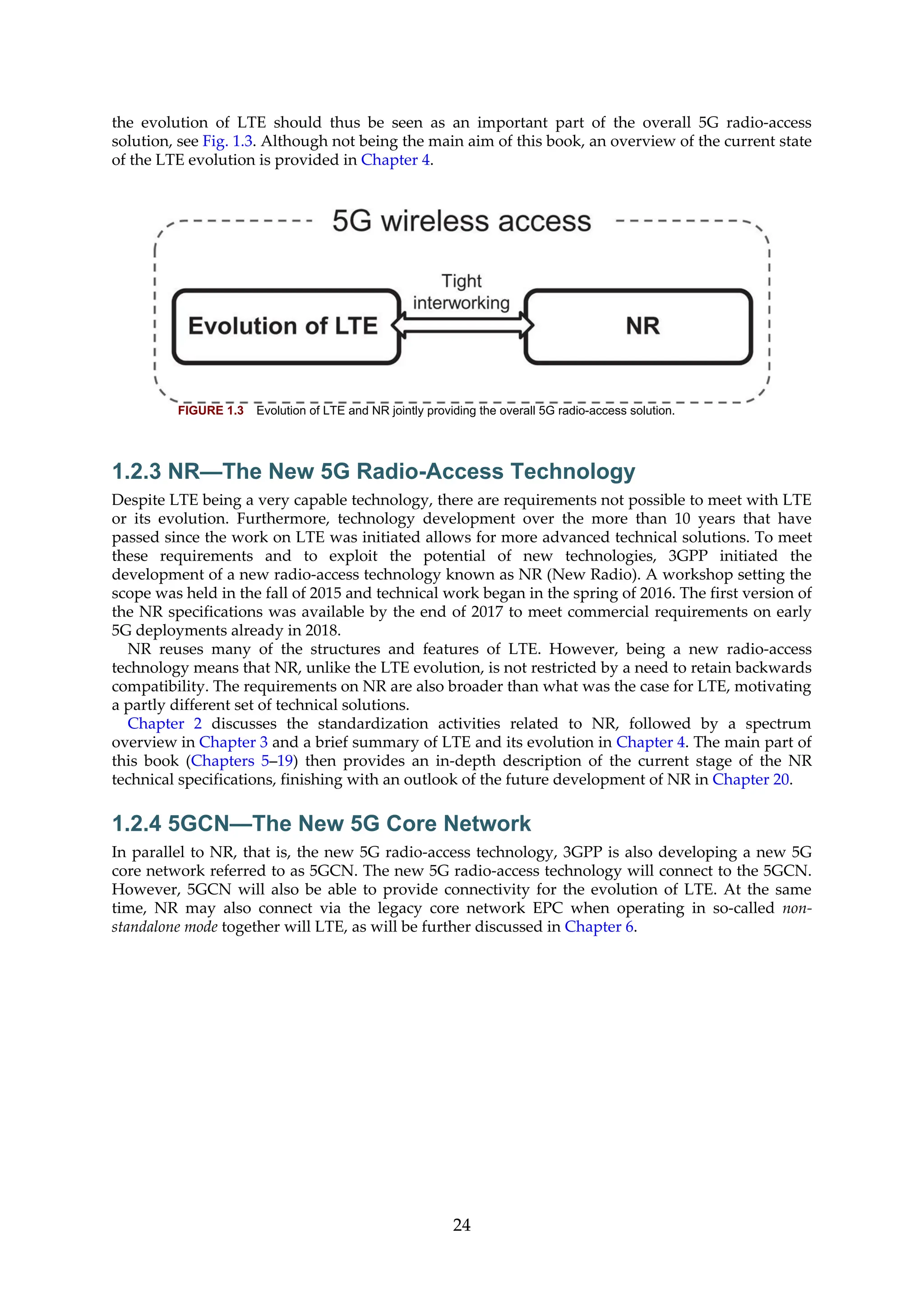
the evolution of LTE should thus be seen as an important part of the overall 5G radio-access
solution, see Fig. 1.3. Although not being the main aim of this book, an overview of the current state
of the LTE evolution is provided in Chapter 4.
FIGURE 1.3 Evolution of LTE and NR jointly providing the overall 5G radio-access solution.
1.2.3 NR—The New 5G Radio-Access Technology
Despite LTE being a very capable technology, there are requirements not possible to meet with LTE
or its evolution. Furthermore, technology development over the more than 10 years that have
passed since the work on LTE was initiated allows for more advanced technical solutions. To meet
these requirements and to exploit the potential of new technologies, 3GPP initiated the
development of a new radio-access technology known as NR (New Radio). A workshop setting the
scope was held in the fall of 2015 and technical work began in the spring of 2016. The first version of
the NR specifications was available by the end of 2017 to meet commercial requirements on early
5G deployments already in 2018.
NR reuses many of the structures and features of LTE. However, being a new radio-access
technology means that NR, unlike the LTE evolution, is not restricted by a need to retain backwards
compatibility. The requirements on NR are also broader than what was the case for LTE, motivating
a partly different set of technical solutions.
Chapter 2 discusses the standardization activities related to NR, followed by a spectrum
overview in Chapter 3 and a brief summary of LTE and its evolution in Chapter 4. The main part of
this book (Chapters 5–19) then provides an in-depth description of the current stage of the NR
technical specifications, finishing with an outlook of the future development of NR in Chapter 20.
1.2.4 5GCN—The New 5G Core Network
In parallel to NR, that is, the new 5G radio-access technology, 3GPP is also developing a new 5G
core network referred to as 5GCN. The new 5G radio-access technology will connect to the 5GCN.
However, 5GCN will also be able to provide connectivity for the evolution of LTE. At the same
time, NR may also connect via the legacy core network EPC when operating in so-called non-
standalone mode together will LTE, as will be further discussed in Chapter 6.
24
C H A P T E R 2
5G Standardization
Abstract
This chapter presents the regulation and standardization activities related to 5G NR, including
all the relevant regulation and standards bodies. The ITU-R IMT-2020 process for 5G is
presented together with the corersponding 3GPP process that led to 5G NR.
Keywords
standardization; regulation; ITU-R; IMT-2020; 3GPP; TSG RAN; 5G; NR; usage scenarios; key
capabilities; technical performance requirements
The research, development, implementation, and deployment of mobile-communication systems is
performed by the wireless industry in a coordinated international effort by which common industry
specifications that define the complete mobile-communication system are agreed. The work
depends heavily on global and regional regulation, in particular for the spectrum use that is an
essential component for all radio technologies. This chapter describes the regulatory and
standardization environment that has been, and continues to be, essential for defining the mobile-
communication systems.
2.1 Overview of Standardization and Regulation
There are a number of organizations involved in creating technical specifications and standards as
well as regulation in the mobile-communications area. These can loosely be divided into three
groups: Standards Developing Organizations, regulatory bodies and administrations, and industry
forums.
Standards Developing Organizations (SDOs) develop and agree on technical standards for mobile
communications systems, in order to make it possible for the industry to produce and deploy
standardized products and provide interoperability between those products. Most components of
mobile-communication systems, including base stations and mobile devices, are standardized to
some extent. There is also a certain degree of freedom to provide proprietary solutions in products,
but the communications protocols rely on detailed standards for obvious reasons. SDOs are usually
nonprofit industry organizations and not government controlled. They often write standards within
a certain area under mandate from governments(s) however, giving the standards a higher status.
There are nationals SDOs, but due to the global spread of communications products, most SDOs
are regional and also cooperate on a global level. As an example, the technical specifications of
GSM, WCDMA/HSPA, LTE, and NR are all created by 3GPP (Third Generation Partnership Project)
which is a global organization from seven regional and national SDOs in Europe (ETSI), Japan
(ARIB and TTC), the United States (ATIS), China (CCSA), Korea (TTA), and India (TSDSI). SDOs
tend to have a varying degree of transparency, but 3GPP is fully transparent with all technical
specifications, meeting documents, reports, and e-mail reflectors publicly available without charge
even for nonmembers.
Regulatory bodies and administrations are government-led organizations that set regulatory and
legal requirements for selling, deploying, and operating mobile systems and other
telecommunication products. One of their most important tasks is to control spectrum use and to set
licensing conditions for the mobile operators that are awarded licenses to use parts of the Radio
Frequency (RF) spectrum for mobile operations. Another task is to regulate “placing on the market”
of products through regulatory certification, by ensuring that devices, base stations, and other
equipment is type-approved and shown to meet the relevant regulation.
Spectrum regulation is handled both on a national level by national administrations, but also
through regional bodies in Europe (CEPT/ECC), the Americas (CITEL), and Asia (APT). On a global
25
level, the spectrum regulation is handled by the International Telecommunications Union (ITU). The
regulatory bodies regulate what services the spectrum is to be used for and in addition set more
detailed requirements such as limits on unwanted emissions from transmitters. They are also
indirectly involved in setting requirements on the product standards through regulation. The
involvement of ITU in setting requirements on the technologies for mobile communication is
explained further in Section 2.2.
Industry forums are industry-led groups promoting and lobbying for specific technologies or other
interests. In the mobile industry, these are often led by operators, but there are also vendors
creating industry forums. An example of such a group is GSMA (GSM Association) which is
promoting mobile-communication technologies based on GSM, WCDMA, LTE, and NR. Other
examples of industry forums are Next Generation Mobile Networks (NGMN), which is an operator
group defining requirements on the evolution of mobile systems, and 5G Americas, which is a
regional industry forum that has evolved from its predecessor 4G Americas.
Fig. 2.1 illustrates the relationship between different organizations involved in setting regulatory
and technical conditions for mobile systems. The figure also shows the mobile industry view, where
vendors develop products, place them on the market and negotiate with operators who procure and
deploy mobile systems. This process relies heavily on the technical standards published by the
SDOs, while placing products on the market relies on certification of products on a regional or
national level. Note that, in Europe, the regional SDO (ETSI) is producing the so-called harmonized
standards used for product certification (through the “CE”-mark), based on a mandate from the
regulators, in this case the European Commission. These standards are also used for certification in
many countries outside of Europe. In Fig. 2.1, full arrows indicate formal documentation such as
technical standards, recommendations, and regulatory mandates that define the technologies and
regulation. Dashed arrows show more indirect involvement through, for example, liaison
statements and white papers.
FIGURE 2.1 Simplified view of the relationship between regulatory bodies, standards developing
organizations, industry forums, and the mobile industry.
2.2 ITU-R Activities From 3G to 5G
2.2.1 The Role of ITU-R
ITU-R is the radio communications sector of the International Telecommunications Union. ITU-R is
26
responsible for ensuring efficient and economical use of the RF spectrum by all radio
communication services. The different subgroups and working parties produce reports and
recommendations that analyze and define the conditions for using the RF spectrum. The quite
ambitious goal of ITU-R is to “ensure interference-free operations of radio communication
systems,” by implementing the Radio Regulations and regional agreements. The Radio Regulations is
an international binding treaty for how RF spectrum is used. A World Radio-communication
Conference (WRC) is held every 3–4 years. At WRC the Radio Regulations are revised and updated,
resulting in revised and updated use of the RF spectrum across the world.
While the technical specification of mobile-communication technologies, such as NR, LTE, and
WCDMA/HSPA is done within 3GPP, there is a responsibility for ITU-R in the process of turning
the technologies into global standards, in particular for countries that are not covered by the SDOs
that are partners in 3GPP. ITU-R defines the spectrum for different services in the RF spectrum,
including mobile services, and some of that spectrum is particularly identified for so-called
International Mobile Telecommunications (IMT) systems. Within ITU-R, it is Working Party 5D
(WP5D) that has the responsibility for the overall radio system aspects of IMT systems, which, in
practice, corresponds to the different generations of mobile-communication systems from 3G
onwards. WP5D has the prime responsibility within ITU-R for issues related to the terrestrial
component of IMT, including technical, operational, and spectrum-related issues.
WP5D does not create the actual technical specifications for IMT, but has kept the roles of
defining IMT in cooperation with the regional standardization bodies and maintaining a set of
recommendations and reports for IMT, including a set of Radio Interface Specifications (RSPCs). These
recommendations contain “families” of Radio Interface Technologies (RITs) for each IMT generation,
all included on an equal basis. For each radio interface, the RSPC contains an overview of that radio
interface, followed by a list of references to the detailed specifications. The actual specifications are
maintained by the individual SDO and the RSPC provides references to the specifications
transposed and maintained by each SDO. The following RSPC recommendations are in existence or
planned:
• For IMT-2000: ITU-R Recommendation M.1457 [49] containing six different RITs including
the 3G technologies such as WCDMA/HSPA.
• For IMT-Advanced: ITU-R Recommendation M.2012 [45] containing two different RITs
where the most important is 4G/LTE.
• For IMT-2020: A new ITU-R Recommendation, containing the RITs for 5G technologies,
planned to be developed in 2019–20.
Each RSPC is continuously updated to reflect new developments in the referenced detailed
specifications, such as the 3GPP specifications for WCDMA and LTE. Input to the updates is
provided by the SDOs and the Partnership Projects, nowadays primarily 3GPP.
2.2.2 IMT-2000 and IMT-Advanced
Work on what corresponds to third generation of mobile communication started in the ITU-R in the
1980s. First referred to as Future Public Land Mobile Systems (FPLMTS) it was later renamed IMT-
2000. In the late 1990s, the work in ITU-R coincided with the work in different SDOs across the
world to develop a new generation of mobile systems. An RSPC for IMT-2000 was first published in
2000 and included WCDMA from 3GPP as one of the RITs.
The next step for ITU-R was to initiate work on IMT-Advanced, the term used for systems that
include new radio interfaces supporting new capabilities of systems beyond IMT-2000. The new
capabilities were defined in a framework recommendation published by the ITU-R [41] and were
demonstrated with the “van diagram” shown in Fig. 2.2. The step into IMT-Advanced capabilities
by ITU-R coincided with the step into 4G, the next generation of mobile technologies after 3G.
27
FIGURE 2.2 Illustration of capabilities of IMT-2000 and IMT-Advanced, based on the framework
described in ITU-R Recommendation M.1645 [41].
An evolution of LTE as developed by 3GPP was submitted as one candidate technology for IMT-
Advanced. While actually being a new release (Release 10) of the LTE specifications and thus an
integral part of the continuous evolution of LTE, the candidate was named LTE-Advanced for the
purpose of ITU-R submission and this name is also used in the LTE specifications from Release 10.
In parallel with the ITU-R work, 3GPP set up its own set of technical requirements for LTE-
Advanced, with the ITU-R requirements as a basis [10].
The target of the ITU-R process is always harmonization of the candidates through consensus
building. ITU-R determined that two technologies would be included in the first release of IMT-
Advanced, those two being LTE-Advanced and WirelessMAN-Advanced [37] based on the IEEE
802.16m specification. The two can be viewed as the “family” of IMT-Advanced technologies as
shown in Fig. 2.3. Note that, of these two technologies, LTE has emerged as the dominating 4G
technology by far.
FIGURE 2.3 Radio Interface Technologies IMT-Advanced.
28
2.2.3 IMT-2020 Process in ITU-R WP5D
Starting in 2012, ITU-R WP5D set the stage for the next generation of IMT systems, named IMT-
2020. It is a further development of the terrestrial component of IMT beyond the year 2020 and, in
practice, corresponds to what is more commonly referred to as “5G,” the fifth generation of mobile
systems. The framework and objective for IMT-2020 is outlined in ITU-R Recommendation M.2083
[47], often referred to as the “Vision” recommendation. The recommendation provides the first step
for defining the new developments of IMT, looking at the future roles of IMT and how it can serve
society, looking at market, user and technology trends, and spectrum implications. The user trends
for IMT together with the future role and market lead to a set of usage scenarios envisioned for both
human-centric and machine-centric communication. The usage scenarios identified are Enhanced
Mobile Broadband (eMBB), Ultra-Reliable and Low Latency Communications (URLLC), and Massive
Machine-Type Communications (mMTC).
The need for an enhanced mobile broadband experience, together with the new and broadened
usage scenarios, leads to an extended set of capabilities for IMT-2020. The Vision recommendation
[47] gives a first high-level guidance for IMT-2020 requirements by introducing a set of key
capabilities, with indicative target numbers. The key capabilities and the related usage scenarios are
discussed further in Section 2.3.
As a parallel activity, ITU-R WP5D produced a report on “Future technology trends of terrestrial
IMT systems” [43], with a focus on the time period 2015–20. It covers trends of future IMT
technology aspects by looking at the technical and operational characteristics of IMT systems and
how they are improved with the evolution of IMT technologies. In this way, the report on
technology trends relates to LTE in 3GPP Release 13 and beyond, while the Vision recommendation
looks further ahead and beyond 2020. A new aspect on IMT-2020 is that it will be capable of
operating in potential new IMT bands above 6 GHz, including mm-wave bands. With this in mind,
WP5D produced a separate report studying radio wave propagation, IMT characteristics, enabling
technologies, and deployment in frequencies above 6 GHz [44].
At WRC-15, potential new bands for IMT were discussed and an agenda item 1.13 was set up for
WRC-19, covering possible additional allocations to the mobile services and for future IMT
development. These allocations are identified in a number of frequency bands in the range between
24.25 and 86 GHz. The specific bands and their possible use globally are further discussed in
Chapter 3.
After WRC-15, ITU-R WP5D continued the process of setting requirements and defining
evaluation methodologies for IMT-2020 systems, based in the Vision recommendation [47] and the
other previous study outcomes. This step of the process was completed in mid-2017, as shown in
the IMT-2020 work plan in Fig. 2.4. The result was three documents published late in 2017 that
further define the performance and characteristics that are expected from IMT-2020 and that will be
applied in the evaluation phase:
• Technical requirements: Report ITU-R M.2410 [51] defines 13 minimum requirements related
to the technical performance of the IMT-2020 radio interface(s). The requirements are to a
large extent based on the key capabilities set out in the Vision recommendation (ITU-R,
2015c). This is further described in Section 2.3.
• Evaluation guideline: Report ITU-R M.2412 [50] defines the detailed methodology to use for
evaluating the minimum requirements, including test environments, evaluation
configurations, and channel models. More details are given in Section 2.3.
• Submission template: Report ITU-R M.2411 [52] provides a detailed template to use for
submitting a candidate technology for evaluation. It also details the evaluation criteria and
requirements on service, spectrum, and technical performance, based on the two
previously mentioned ITU-R reports M.2410 and M.2412.
29
FIGURE 2.4 Work plan for IMT-2020 in ITU-R WP5D [40].
External organizations are being informed of the IMT-2020 process through a circular letter. After
a workshop on IMT-2020 was held in October 2017, the IMT-2020 process is open for receiving
candidate proposals.
The plan, as shown in Fig. 2.4, is to start the evaluation of proposals in 2018, aiming at an
outcome with the RSPC for IMT-2020 being published early in 2020.
2.3 5G and IMT-2020
The detailed ITU-R time plan for IMT-2020 was presented above with the most important steps
summarized in Fig. 2.4. The ITU-R activities on IMT-2020 started with development of the “vision”
recommendation ITU-R M.2083 [47], outlining the expected use scenarios and corresponding
required capabilities of IMT-2020. This was followed by definition of more detailed requirements
for IMT-2020, requirements that candidate technologies are then to be evaluated against, as
documented in the evaluation guidelines. The requirements and evaluation guidelines were
finalized mid-2017.
With the requirements finalized, candidate technologies can be submitted to ITU-R. The
proposed candidate technology/technologies will be evaluated against the IMT-2020 requirements
and the technology/technologies that fulfill the requirements will be approved and published as
part of the IMT-2020 specifications in the second half of 2020. Further details on the ITU-R process
can be found in Section 2.2.3.
2.3.1 Usage Scenarios for IMT-2020
With a wide range of new use cases being one principal driver for 5G, ITU-R has defined three
usage scenarios that form a part of the IMT Vision recommendation [47]. Inputs from the mobile
industry and different regional and operator organizations were taken into the IMT-2020 process in
ITU-R WP5D, and were synthesized into the three scenarios:
• Enhanced Mobile Broadband (eMBB): With mobile broadband today being the main driver for
use of 3G and 4G mobile systems, this scenario points at its continued role as the most
important usage scenario. The demand is continuously increasing and new application
areas are emerging, setting new requirements for what ITU-R calls Enhanced Mobile
Broadband. Because of its broad and ubiquitous use, it covers a range of use cases with
different challenges, including both hotspots and wide-area coverage, with the first one
enabling high data rates, high user density, and a need for very high capacity, while the
second one stresses mobility and a seamless user experience, with lower requirements on
data rate and user density. The Enhanced Mobile Broadband scenario is in general seen as
addressing human-centric communication.
• Ultra-reliable and low-latency communications (URLLC): This scenario is intended to cover
both human- and machine-centric communication, where the latter is often referred to as
critical machine type communication (C-MTC). It is characterized by use cases with
30
stringent requirements for latency, reliability, and high availability. Examples include
vehicle-to-vehicle communication involving safety, wireless control of industrial
equipment, remote medical surgery, and distribution automation in a smart grid. An
example of a human-centric use case is 3D gaming and “tactile internet,” where the low-
latency requirement is also combined with very high data rates.
• Massive machine type communications (mMTC): This is a pure machine-centric use case,
where the main characteristic is a very large number of connected devices that typically
have very sparse transmissions of small data volumes that are not delay-sensitive. The
large number of devices can give a very high connection density locally, but it is the total
number of devices in a system that can be the real challenge and stresses the need for low
cost. Due to the possibility of remote deployment of mMTC devices, they are also required
to have a very long battery life time.
The usage scenarios are illustrated in Fig. 2.5, together with some example use cases. The three
scenarios above are not claimed to cover all possible use cases, but they provide a relevant grouping
of a majority of the presently foreseen use cases and can thus be used to identify the key capabilities
needed for the next-generation radio interface technology for IMT-2020. There will most certainly
be new use cases emerging, which we cannot foresee today or describe in any detail. This also
means that the new radio interface must have a high flexibility to adapt to new use cases and the
“space” spanned by the range of the key capabilities supported should support the related
requirements emerging from evolving use cases.
FIGURE 2.5 IMT-2020 use cases and mapping to usage scenarios. From ITU-R, Recommendation ITU-
R M.2083 [47], used with permission from the ITU.
2.3.2 Capabilities of IMT-2020
As part of developing the framework for the IMT-2020 as documented in the IMT Vision
recommendation [47], ITU-R defined a set of capabilities needed for an IMT-2020 technology to
support the 5G use cases and usage scenarios identified through the inputs from regional bodies,
research projects, operators, administrations, and other organizations. There are a total of 13
capabilities defined in ITU-R [47], where eight were selected as key capabilities. Those eight key
capabilities are illustrated through two “spider web” diagrams (see Figs. 2.6 and 2.7).
31
FIGURE 2.6 Key capabilities of IMT-2020. From ITU-R, Recommendation ITU-R M.2083 [47], used with
permission from the ITU.
FIGURE 2.7 Relation between key capabilities and the three usage scenarios of ITU-R. From ITU-R,
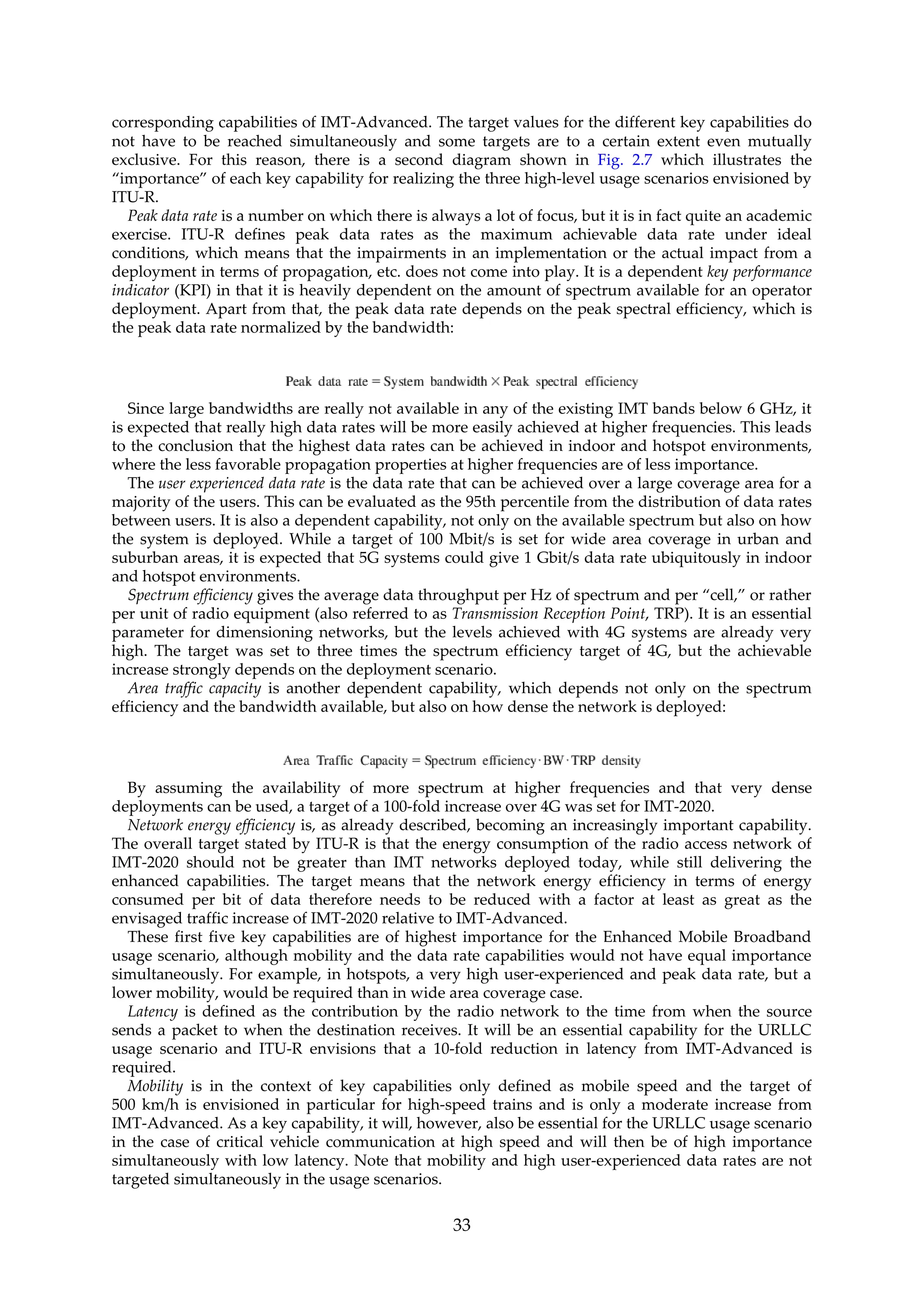
Recommendation ITU-R M.2083 [47], used with permission from the ITU.
Fig. 2.6 illustrates the key capabilities together with indicative target numbers intended to give a
first high-level guidance for the more detailed IMT-2020 requirements that are now under
development. As can be seen the target values are partly absolute and partly relative to the
32
corresponding capabilities of IMT-Advanced. The target values for the different key capabilities do
not have to be reached simultaneously and some targets are to a certain extent even mutually
exclusive. For this reason, there is a second diagram shown in Fig. 2.7 which illustrates the
“importance” of each key capability for realizing the three high-level usage scenarios envisioned by
ITU-R.
Peak data rate is a number on which there is always a lot of focus, but it is in fact quite an academic
exercise. ITU-R defines peak data rates as the maximum achievable data rate under ideal
conditions, which means that the impairments in an implementation or the actual impact from a
deployment in terms of propagation, etc. does not come into play. It is a dependent key performance
indicator (KPI) in that it is heavily dependent on the amount of spectrum available for an operator
deployment. Apart from that, the peak data rate depends on the peak spectral efficiency, which is
the peak data rate normalized by the bandwidth:
Since large bandwidths are really not available in any of the existing IMT bands below 6 GHz, it
is expected that really high data rates will be more easily achieved at higher frequencies. This leads
to the conclusion that the highest data rates can be achieved in indoor and hotspot environments,
where the less favorable propagation properties at higher frequencies are of less importance.
The user experienced data rate is the data rate that can be achieved over a large coverage area for a
majority of the users. This can be evaluated as the 95th percentile from the distribution of data rates
between users. It is also a dependent capability, not only on the available spectrum but also on how
the system is deployed. While a target of 100 Mbit/s is set for wide area coverage in urban and
suburban areas, it is expected that 5G systems could give 1 Gbit/s data rate ubiquitously in indoor
and hotspot environments.
Spectrum efficiency gives the average data throughput per Hz of spectrum and per “cell,” or rather
per unit of radio equipment (also referred to as Transmission Reception Point, TRP). It is an essential
parameter for dimensioning networks, but the levels achieved with 4G systems are already very
high. The target was set to three times the spectrum efficiency target of 4G, but the achievable
increase strongly depends on the deployment scenario.
Area traffic capacity is another dependent capability, which depends not only on the spectrum
efficiency and the bandwidth available, but also on how dense the network is deployed:
By assuming the availability of more spectrum at higher frequencies and that very dense
deployments can be used, a target of a 100-fold increase over 4G was set for IMT-2020.
Network energy efficiency is, as already described, becoming an increasingly important capability.
The overall target stated by ITU-R is that the energy consumption of the radio access network of
IMT-2020 should not be greater than IMT networks deployed today, while still delivering the
enhanced capabilities. The target means that the network energy efficiency in terms of energy
consumed per bit of data therefore needs to be reduced with a factor at least as great as the
envisaged traffic increase of IMT-2020 relative to IMT-Advanced.
These first five key capabilities are of highest importance for the Enhanced Mobile Broadband
usage scenario, although mobility and the data rate capabilities would not have equal importance
simultaneously. For example, in hotspots, a very high user-experienced and peak data rate, but a
lower mobility, would be required than in wide area coverage case.
Latency is defined as the contribution by the radio network to the time from when the source
sends a packet to when the destination receives. It will be an essential capability for the URLLC
usage scenario and ITU-R envisions that a 10-fold reduction in latency from IMT-Advanced is
required.
Mobility is in the context of key capabilities only defined as mobile speed and the target of
500 km/h is envisioned in particular for high-speed trains and is only a moderate increase from
IMT-Advanced. As a key capability, it will, however, also be essential for the URLLC usage scenario
in the case of critical vehicle communication at high speed and will then be of high importance
simultaneously with low latency. Note that mobility and high user-experienced data rates are not
targeted simultaneously in the usage scenarios.
33
Connection density is defined as the total number of connected and/or accessible devices per unit
area. The target is relevant for the mMTC usage scenario with a high density of connected devices,
but an eMBB dense indoor office can also give a high connection density.
In addition to the eight capabilities given in Fig. 2.6 there are five additional capabilities defined
in [47]:
• Spectrum and bandwidth flexibility
Spectrum and bandwidth flexibility refers to the flexibility of the system design to handle
different scenarios, and in particular to the capability to operate at different frequency
ranges, including higher frequencies and wider channel bandwidths than today.
• Reliability
Reliability relates to the capability to provide a given service with a very high level of
availability.
• Resilience
Resilience is the ability of the network to continue operating correctly during and after a
natural or man-made disturbance, such as the loss of mains power.
• Security and privacy
Security and privacy refers to several areas such as encryption and integrity protection of
user data and signaling, as well as end-user privacy, preventing unauthorized user
tracking, and protection of network against hacking, fraud, denial of service, man in the
middle attacks, etc.
• Operational lifetime
Operational life time refers to operation time per stored energy capacity. This is
particularly important for machine-type devices requiring a very long battery life (for
example more than 10 years), whose regular maintenance is difficult due to physical or
economic reasons.
Note that these capabilities are not necessarily less important than the capabilities of Fig. 2.6,
despite the fact that the latter are referred to as “key capabilities.” The main difference is that the
“key capabilities” are more easily quantifiable, while the remaining five capabilities are more of
qualitative capabilities that cannot easily be quantified.
2.3.3 IMT-2020 Performance Requirements and Evaluation
Based on the usage scenarios and capabilities described in the Vision recommendation (ITU-R,
2015c), ITU-R developed a set of minimum technical performance requirements for IMT-2020. These
are documented in ITU-R report M.2410 [51] and will serve as the baseline for the evaluation of
IMT-2020 candidate technologies (see Fig. 2.4). The report describes 14 technical parameters and the
corresponding minimum requirements. These are summarized in Table 2.1.
Table 2.1
34
The evaluation guideline of candidate radio interface technologies for IMT-2020 is documented in
ITU-R report M.2412 [50] and follows the same structure as the previous evaluation done for IMT-
Advanced. It describes the evaluation methodology for the 14 minimum technical performance
requirements, plus two additional requirements: support of a wide range of services and support of
spectrum bands.
The evaluation is done with reference to five test environments that are based on the usage
scenarios from the Vision recommendation [47]. Each test environment has a number of evaluation
configurations that describe the detailed parameters that are to be used in simulations and analysis
for the evaluation. The five test environments are:
• Indoor Hotspot-eMBB: An indoor isolated environment at offices and/or in shopping malls
based on stationary and pedestrian users with very high user density.
• Dense Urban-eMBB: An urban environment with high user density and traffic loads
focusing on pedestrian and vehicular users.
• Rural-eMBB: A rural environment with larger and continuous wide area coverage,
supporting pedestrian, vehicular, and high-speed vehicular users.
• Urban Macro-mMTC: An urban macro-environment targeting continuous coverage focusing
on a high number of connected machine type devices.
• Urban Macro-URLLC: An urban macro-environment targeting ultra-reliable and low-latency
communications.
There are three fundamental ways that requirements will be evaluated for a candidate
technology:
• Simulation: This is the most elaborate way to evaluate a requirement and it involves system-
or link-level simulations, or both, of the radio interface technology. For system-level
simulations, deployment scenarios are defined that correspond to a set of test
environments, such as indoor, dense urban, etc. Requirements that will be evaluated
through simulation are average and fifth percentile spectrum efficiency, connection
density, mobility and reliability.
• Analysis: Some requirements can be evaluated through a calculation based on radio
35
interface parameters or be derived from other performance values. Requirements that will
be evaluated through analysis are peak spectral efficiency, peak data rate, user-experienced
data rate, area traffic capacity, control and user plane latency, and mobility interruption
time.
• Inspection: Some requirements can be evaluated by reviewing and assessing the
functionality of the radio interface technology. Requirements that will be evaluated
through simulation are bandwidth, energy efficiency, support of a wide range of services,
and support of spectrum bands.
Once candidate technologies are submitted to ITU-R and have entered the process, the evaluation
phase will start. Evaluation can be done by the proponent (“self-evaluation”) or by an external
evaluation group, doing partial or complete evaluation of one or more candidate proposals.
2.4 3GPP Standardization
With a framework for IMT systems set up by the ITU-R, with spectrum made available by the WRC
and with an ever-increasing demand for better performance, the task of specifying the actual
mobile-communication technologies falls on organizations like 3GPP. More specifically, 3GPP
writes the technical specifications for 2G GSM, 3G WCDMA/HSPA, 4G LTE, and 5G NR. 3GPP
technologies are the most widely deployed in the world, with more than 95% of the world’s 7.8
billion mobile subscriptions in Q4 2017 [30]. In order to understand how 3GPP works, it is
important to also understand the process of writing specifications.
2.4.1 The 3GPP Process
Developing technical specifications for mobile communication is not a one-time job; it is an ongoing
process. The specifications are constantly evolving, trying to meet new demands for services and
features. The process is different in the different fora, but typically includes the four phases
illustrated in Fig. 2.8:
1. Requirements, where it is decided what is to be achieved by the specification.
2. Architecture, where the main building blocks and interfaces are decided.
3. Detailed specifications, where every interface is specified in detail.
4. Testing and verification, where the interface specifications are proven to work with real-life
equipment.
FIGURE 2.8 The standardization phases and iterative process.
These phases are overlapping and iterative. As an example, requirements can be added, changed,
or dropped during the later phases if the technical solutions call for it. Likewise, the technical
solution in the detailed specifications can change due to problems found in the testing and
verification phase.
The specification starts with the requirements phase, where it is decided what should be achieved
with the specification. This phase is usually relatively short.
In the architecture phase, the architecture is decided—that is, the principles of how to meet the
requirements. The architecture phase includes decisions about reference points and interfaces to be
standardized. This phase is usually quite long and may change the requirements.
After the architecture phase, the detailed specification phase starts. It is in this phase that the details
for each of the identified interfaces are specified. During the detailed specification of the interfaces,
the standards body may find that previous decisions in the architecture or even in the requirements
36
phases need to be revisited.
Finally, the testing and verification phase starts. It is usually not a part of the actual specification,
but takes place in parallel through testing by vendors and interoperability testing between vendors.
This phase is the final proof of the specification. During the testing and verification phase, errors in
the specification may still be found and those errors may change decisions in the detailed
specification. Albeit not common, changes may also need to be made to the architecture or the
requirements. To verify the specification, products are needed. Hence, the implementation of the
products starts after (or during) the detailed specification phase. The testing and verification phase
ends when there are stable test specifications that can be used to verify that the equipment is
fulfilling the technical specification.
Normally, it takes approximately one year from the time when the specification is completed
until commercial products are out on the market.
3GPP consists of three Technical Specifications Groups (TSGs) (see Fig. 2.9) where TSG RAN (Radio
Access Network) is responsible for the definition of functions, requirements, and interfaces of the
Radio Access. TSG RAN consists of six working groups (WGs):
1. RAN WG1, dealing with the physical layer specifications.
2. RAN WG2, dealing with the layer 2 and layer 3 radio interface specifications.
3. RAN WG3, dealing with the fixed RAN interfaces—for example, interfaces between nodes in
the RAN—but also the interface between the RAN and the core network.
4. RAN WG4, dealing with the radio frequency (RF) and radio resource management (RRM)
performance requirements.
5. RAN WG 5, dealing with the device conformance testing.
6. RAN WG6, dealing with standardization of GSM/EDGE (previously in a separate TSG called
GERAN) and HSPA (UTRAN).
37
FIGURE 2.9 3GPP organization.
The work in 3GPP is carried out with relevant ITU-R recommendations in mind and the result of
the work is also submitted to ITU-R as being part of IMT-2000, IMT-Advanced, and now also as a
candidate for IMT-2020 in the form of NR. The organizational partners are obliged to identify
regional requirements that may lead to options in the standard. Examples are regional frequency
bands and special protection requirements local to a region. The specifications are developed with
global roaming and circulation of devices in mind. This implies that many regional requirements in
essence will be global requirements for all devices, since a roaming device has to meet the strictest
of all regional requirements. Regional options in the specifications are thus more common for base
stations than for devices.
The specifications of all releases can be updated after each set of TSG meetings, which occur four
times a year. The 3GPP documents are divided into releases, where each release has a set of features
added compared to the previous release. The features are defined in Work Items agreed and
undertaken by the TSGs. LTE is defined from Release 8 and onwards, where Release 10 of LTE is
the first version approved by ITU-R as an IMT-Advanced technology and is therefore also the first
release named LTE-Advanced. From Release 13, the marketing name for LTE is changed to LTE-
Advanced Pro. An overview of LTE is given in Chapter 4. Further details on the LTE radio interface
can be found in [28].
The first release for NR is in 3GPP Release 15. An overview of NR is given in Chapter 5 with
further details throughout this book.
The 3GPP Technical Specifications (TS) are organized in multiple series and are numbered TS
38
XX.YYY, where XX denotes the number of the specification series and YYY is the number of the
specification within the series. The following series of specifications define the radio access
technologies in 3GPP:
• 25-series: Radio aspects for UTRA (WCDMA/HSPA);
• 45-series: Radio aspects for GSM/EDGE;
• 36-series: Radio aspects for LTE, LTE-Advanced and LTE-Advanced Pro;
• 37-series: Aspects relating to multiple radio access technologies;
• 38-series: Radio aspects for NR.
2.4.2 Specification of 5G in 3GPP as an IMT-2020 Candidate
In parallel with the definition and evaluation of the next-generation access initiated in ITU-R, 3GPP
started to define the next-generation 3GPP radio access. A workshop on 5G radio access was held in
2014 and a process to define the evaluation criteria for 5G was initiated with a second workshop in
early 2015. The evaluation will follow the same process that was used when LTE-Advanced was
evaluated and submitted to ITU-R and approved as a 4G technology as part of IMT-advanced. The
evaluation and submission of NR follows the ITU-R timeline described in Section 2.2.3.
3GPP TSG RAN documented scenarios, requirements, and evaluation criteria for the new 5G
radio access in report TR 38.913 [10] which is in general aligned with the corresponding ITU-R
reports [50,51]. As for the case of the IMT-Advanced evaluation, the corresponding 3GPP
evaluation of the next-generation radio access could have a larger scope and may have stricter
requirements than the ITU-R evaluation of candidate IMT-2020 radio interface technologies that is
defined by ITU-R WP5D.
The standardization work for NR started with a study item phase in Release 14 and continued
with development of a first set of specifications through a work item in Release 15. A first set of the
Release 15 NR specifications was published in December 2017 and the full specifications are due to
be available in mid-2018. Further details on the time plan and the content of the NR releases is given
in Chapter 5.
3GPP made a first submission of NR as an IMT-2020 candidate to the ITU-R WP5D meeting in
February 2018. NR was submitted both as an RIT by itself and as an SRIT (set of component RITs)
together with LTE. The following three candidates were submitted, all including NR as developed
by 3GPP:
• 3GPP submitted a candidate named “5G,” containing two submissions: the first submission
was an SRIT containing two component RITs, these being NR and LTE. The second
submission was a separate RIT being NR.
• Korea submitted NR as a RIT, with reference to 3GPP.
• China submitted NR as a RIT, with reference to 3GPP.
Further submissions to ITU-R will be made by 3GPP, giving more details of NR as an IMT-2020
candidate, according to the process described in Fig. 2.4. Simulations for the self-evaluations have
also started in 3GPP, targeting the evaluation phase in 2019.
39
C H A P T E R 3
Spectrum for 5G
Abstract
This chapter describes the internation al process for regulating spectrum and how the present
IMT spectrum has been assinged by the ITU-R. Based on the outcome of the most recent WRC,
the candidate 5G spectrum is presented together with all the operating bands specified for NR
in 3GPP.
Keywords
Spectrum; WRC; IMT; allocation; frequency band; operating band; RF exposure
3.1 Spectrum for Mobile Systems
Historically, the bands for the first and second generation of mobile services were assigned at
frequencies around 800–900 MHz, but also in a few lower and higher bands. When 3G (IMT-2000)
was rolled out, focus was on the 2 GHz band and with the continued expansion of IMT services
with 3G and 4G, new bands were added at both lower and higher frequencies, presently spanning
from 450 MHz to around 6 GHz. While new, previously unexploited, frequency bands are
continuously defined for new mobile generations, the bands used for previous generations are used
for the new generation as well. This was the case when 3G and 4G were introduced and it will also
be the case for 5G.
Bands at different frequencies have different characteristics. Due to the propagation properties,
bands at lower frequencies are good for wide-area coverage deployments, in urban, suburban, and
rural environments. Propagation properties of higher frequencies make them more difficult to use
for wide-area coverage and, for this reason, higher-frequency bands have to a larger extent been
used for boosting capacity in dense deployments.
With the introduction of 5G, the demanding eMBB usage scenario and related new services will
require even higher data rates and high capacity in dense deployments. While many early 5G
deployments will be in bands already used for previous mobile generations, frequency bands above
24 GHz are being looked at as a complement to the frequency bands below 6 GHz. With the 5G
requirements for extreme data rates and localized areas with very high area traffic capacity
demands, deployment using even higher frequencies, even above 60 GHz, are considered. Referring
to the wavelength, these bands are often called mm-wave bands.
New bands are defined continuously by 3GPP, mainly for the LTE specification, but now also for
the new NR specifications. Many new bands are defined for NR operation only. Both paired bands,
where separated frequency ranges are assigned for uplink and downlink, and unpaired bands with
a single shared frequency range for uplink and downlink, are included in the NR specifications.
Paired bands are used for Frequency Division Duplex (FDD) operation, while unpaired bands are
used for Time Division Duplex (TDD) operation. The duplex modes of NR are described further in
Chapter 7. Note that some unpaired bands are defined as Supplementary Downlink (SDL) or
Supplementary Uplink (SDL) bands. These bands are paired with the uplink or downlink of other
bands through carrier aggregation, as described in Section 7.6.
3.1.1 Spectrum Defined for IMT Systems by the ITU-R
The ITU-R identifies frequency bands to use for mobile service and specifically for IMT. Many of
these were originally identified for IMT-2000 (3G) and new ones came with the introduction of IMT-
Advanced (4G). The identification is however technology and generation “neutral,” since the
identification is for IMT in general, regardless of generation or Radio Interface Technology. The
global designations of spectrum for different services and applications are done within the ITU-R
40
and are documented in the ITU Radio Regulations [48] and the use of IMT bands globally is
described in ITU-R Recommendation M.1036 [46].
The frequency listings in the ITU Radio Regulations [48] do not directly list a band for IMT, but
rather allocate a band for the mobile service with a footnote stating that the band is identified for
use by administrations wishing to implement IMT. The identification is mostly by region, but is in
some cases also specified on a per-country level. All footnotes mention “IMT” only, so there is no
specific mentioning of the different generations of IMT. Once a band is assigned, it is therefore up to
the regional and local administrations to define a band for IMT use in general or for specific
generations. In many cases, regional and local assignments are “technology neutral” and allow for
any kind of IMT technology. This means that all existing IMT bands are potential bands for IMT-
2020 (5G) deployment in the same way as they have been used for previous IMT generations.
The World Administrative Radio Congress WARC-92 identified the bands 1885–2025 and 2110–
2200 MHz as intended for implementation of IMT-2000. Out of these 230 MHz of 3G spectrum, 2×
30 MHz were intended for the satellite component of IMT-2000 and the rest for the terrestrial
component. Parts of the bands were used during the 1990s for deployment of 2G cellular systems,
especially in the Americas. The first deployments of 3G in 2001–2 by Japan and Europe were done
in this band allocation, and for that reason it is often referred to as the IMT-2000 “core band.”
Additional spectrum for IMT-2000 was identified at the World Radio-communication
Conference1 WRC-2000, where it was considered that an additional need for 160 MHz of spectrum
for IMT-2000 was forecasted by the ITU-R. The identification includes the bands used for 2G mobile
systems at 806–960 and 1710–1885 MHz, and “new” 3G spectrum in the bands at 2500–2690 MHz.
The identification of bands previously assigned for 2G was also a recognition of the evolution of
existing 2G mobile systems into 3G. Additional spectrum was identified at WRC’07 for IMT,
encompassing both IMT-2000 and IMT-Advanced. The bands added were 450–470, 698–806, 2300–
2400, and 3400–3600 MHz, but the applicability of the bands varies on a regional and national basis.
At WRC’12 there were no additional spectrum allocations identified for IMT, but the issue was put
on the agenda for WRC’15. It was also determined to study the use of the band 694–790 MHz for
mobile services in Region 1 (Europe, Middle East, and Africa).
WRC’15 was an important milestone setting the stage for 5G. First a new set of bands were
identified for IMT, where many were identified for IMT on a global, or close to global, basis:
• 470–694/698 MHz (600 MHz band): Identified for some countries in Americas and the Asia-
Pacific. For Region 1, it is considered for a new agenda item for IMT at WRC-23.
• 694–790 MHz (700 MHz band): This band is now also identified fully for Region 1 and is
thereby a global IMT band.
• 1427–1518 MHz (L-band): A new global band identified in all countries.
• 3300–3400 MHz: Global band identified in many countries, but not in Europe or North
America.
• 3400–3600 MHz (C-band): Now a global band identified for all countries. The band was
already allocated in Europe.
• 3600–3700 MHz (C-band): Global band identified in many countries, but not in Africa and
some counties in Asia-Pacific. In Europe, the band has been available since WRC’07.
• 4800–4990 MHz: New band identified for a few countries in Asia-Pacific.
Especially the frequency range from 3300 to 4990 MHz is of interest for 5G, since it is new
spectrum in higher frequency bands. This implies that it fits well with the new usage scenarios
requiring high data rates and is also suitable for massive MIMO implementation, where arrays with
many elements can be implemented with reasonable size. Since it is new spectrum with no
widespread use for mobile systems today, it will be easier to assign this spectrum in larger
spectrum blocks, thereby enabling wider RF carriers and ultimately higher end-user data rates.
The second major outcome from WRC’15 concerning IMT was the new agenda item (1.13)
appointed for the next WRC, to identify high-frequency bands above 24 GHz for 5G mobile
services. These bands will be studied by ITU-R until 2019 and be considered for IMT identification
at WRC’19. The primary target for the bands is deployment of IMT-2020. A majority of the bands to
be studied are already today assigned to the mobile service on a primary basis, in most bands
together with fixed and satellite services. They consist of the following band ranges:
• 24.25–27.5 GHz;
41
• 37–40.5 GHz;
• 42.5–43.5 GHz;
• 45.5–47 GHz;
• 47.2–50.2 GHz;
• 50.4–52.6 GHz;
• 66–76 GHz;
• 81–86 GHz.
There are also bands to be studied for IMT that are presently not allocated to the mobile service
on a primary basis and where it will be investigated whether the allocation can be changed to
include mobile:
• 31.8–33.4 GHz;
• 40.5–42.5 GHz;
• 47–47.2 GHz.
The complete set of bands is illustrated in Fig. 3.1.
FIGURE 3.1 New IMT bands under study in ITU-R TG 5/1.
ITU-R has formed a special task group TG 5/1, which will conduct sharing and compatibility
studies for the new bands and prepare input for WRC’19 agenda item 1.13. The task group will
document spectrum needs, technical and operational characteristics including protection criteria for
existing services allocated in or adjacent to the bands studied, based on the studies. As an input to
the studies, technical and operational characteristics of IMT-2020 were needed. These characteristics
were provided from 3GPP as characteristics of NR, given at an early stage of standardization in
January 2017.
It should be noted that there are also a large number of other frequency bands identified for
mobile services, but not specifically for IMT. These bands are often used also for IMT on a regional or
national basis. At WRC’15, there was some interest to also study 27.5–29.5 GHz for IMT, but it was
not included in studies of 5G/IMT-2020 bands. Still, the band is planned for 5G mobiles services in
at least the US and Korea. There was also support for studies of 5G/IMT-2020 in the frequency
bands below 20 GHz, but those bands were ultimately not included. It is expected that several
bands in the range 6–20 GHz will be considered for mobile services including IMT, in addition to
the bands studied within ITU-R. One example is an FCC inquiry into new use, including next-
generation wireless broadband services, in the frequency range 5925–7125 MHz.
The somewhat diverging arrangement between regions of the frequency bands assigned to IMT
means that there is not one single band that can be used for roaming worldwide. Large efforts have,
however, been put into defining a minimum set of bands that can be used to provide truly global
roaming. In this way, multiband devices can provide efficient worldwide roaming for devices. With
many of the new bands identified at WRC’15 being global or close to global, global roaming is made
possible for devices using fewer bands and it also facilitates economy of scale for equipment and
deployment.
3.1.2 Global Spectrum Situation for 5G
There is a considerable interest globally to make spectrum available for 5G deployments. This is
driven by operators and industry organizations such as the Global mobile Suppliers Association
[35] and DIGITALEUROPE [29], but is also supported by regulatory bodies in different countries
and regions. An overview of the spectrum situation for 5G is given in [56]. In standardization, 3GPP
has focused its activities on bands where a high interest is evident (the full list of bands is in Section
3.2). The spectrum of interest can be divided into bands at low, medium, and high frequencies:
42
Low-frequency bands correspond to existing LTE bands below 2 GHz, which are suitable as a
coverage layer, providing wide and deep coverage, including indoor. The bands with highest
interest here are the 600 and 700 MHz bands, which correspond to 3GPP NR bands n71 and n28 (see
Section 3.2 for further details). Since the bands are not very wide, a maximum of 20 MHz channel
bandwidth is expected in the low-frequency bands.
For early deployment, the 600 MHz band is considered for NR in the US, while the 700 MHz
band is defined as one of the so-called pioneer bands for Europe. In addition, a number of
additional LTE bands in the below 3 GHz range are identified for possible “re-farming” and have
been assigned NR band numbers. Since the bands are in general already deployed with LTE, NR is
expected to be deployed gradually at a later stage.
Medium-frequency bands are in the range 3–6 GHz and can provide coverage, capacity, as well as
high data rates through the wider channel bandwidth possible. The highest interest globally is in
the range 3300–4200 MHz, where 3GPP has designated NR bands n77 and n78. Due to the wider
bands, channel bandwidths up to 100 MHz are possible. Up to 200 MHz per operator may be
assigned in this frequency range in the longer term, where carrier aggregation could then be used to
deploy the full bandwidth.
The range 3300–4200 MHz is of global interest, with some variations seen regionally; and 3400–
3800 MHz is a pioneer band in Europe, while China and India are planning for 3300–600 MHz and
in Japan 3600–4200 MHz is being considered. Similar frequency ranges are considered in North
America (3550–3700 MHz and initial discussions about 3700–4200 MHz), Latin America, the Middle
East, Africa, India, Australia, etc. A total of 45 countries signed up to the IMT identification of the
3300–3400 MHz band in WRC-15. There is also a large amount of interest for a higher band in China
(primarily 4800–5000 MHz) and Japan (4400–4900 MHz). In addition, there are a number of
potential LTE re-farming bands in the 2–6 GHz range that have been identified as NR bands.
High-frequency bands are in the mm-Wave range above 24 GHz. They will be best suited for
hotspot coverage with locally very high capacity and can provide very high data rates. The highest
interest is in the range 24.25–29.5 GHz, with 3GPP NR bands n257 and n258 assigned. Channel
bandwidths up to 400 MHz are defined for these bands, with even higher bandwidths possible
through carrier aggregation.
The mmWave frequency range is new for IMT deployment, as discussed above. The band 27.5–
28.35 was identified at an early stage in the US, while 24.25–27.5 GHz, also called the “26 GHz
band,” is a pioneer band for Europe, noting that not all of it may be made available for 5G. Different
parts of the larger range 24.25–29.5 GHz are being considered globally. The range 27.5–29.5 GHz is
the first range planned for Japan and 26.5–29.5 GHz in Korea. Overall, this band can be seen as
global with regional variations. The range 37–40 GHz is also planned for the US and similar ranges
around 40 GHz are considered in many other regions too, including China.
3.2 Frequency Bands for NR
NR can be deployed both in existing IMT bands and in future bands that may be identified at WRC,
or in regional bodies. The possibility of operating a radio-access technology in different frequency
bands is a fundamental aspect of global mobile services. Most 2G, 3G, and 4G devices are
multiband capable, covering bands used in the different regions of the world to provide global
roaming. From a radio-access functionality perspective, this has limited impact and the physical-
layer specifications such as those for NR do not assume any specific frequency band. Since NR
however spans such a vast range of frequencies, there are certain provisions that are intended only
for certain frequency ranges. This includes how the different NR numerologies can be applied (see
Chapter 7).
Many RF requirements are specified with different requirements across bands. This is certainly
the case for NR, but also for previous generations. Examples of band-specific RF requirements are
the allowed maximum transmit power, requirements/limits on out-of-band (OOB) emission and
receiver blocking levels. Reasons for such differences are varying external constraints, often
imposed by regulatory bodies, in other cases differences in the operational environment that are
considered during standardization.
The differences between bands are more pronounced for NR due to the very wide range of
frequency bands. For NR operation in the new mm-Wave bands above 24 GHz, both devices and
base stations will be implemented with partly novel technology and there will be a more
widespread use of massive MIMO, beam forming, and highly integrated advanced antenna
43
systems. This creates differences in how RF requirements are defined, how they are measured for
performance assessment and ultimately also what the limits for the requirements are set. Frequency
bands within the scope of the present Release 15 work in 3GPP are for this reason divided into two
frequency ranges:
• Frequency range 1 (FR1) includes all existing and new bands below 6 GHz.
• Frequency range 2 (FR2) includes new bands in the range 24.25–52.6 GHz.
These frequency ranges may be extended or complemented with new ranges in future 3GPP
releases. The impact of the frequency ranges on the RF requirements is further discussed in Chapter
18.
The frequency bands where NR will operate are in both paired and unpaired spectra, requiring
flexibility in the duplex arrangement. For this reason, NR supports both FDD and TDD operation.
Some ranges are also defined for SDL or SUL. These features are further described in Section 7.7.
3GPP defines operating bands, where each operating band is a frequency range for uplink and/or
downlink that is specified with a certain set of RF requirements. The operating bands each have a
number, where NR bands are numbered n1, n2, n3, etc. When the same frequency range is defined
as an operating band for different radio access technologies, the same number is used, but written
in a different way. 4G LTE bands are written with Arabic numerals (1, 2, 3, etc.), while 3G UTRA
bands are written with Roman numerals (I, II, II, etc.). LTE operating bands that are used with the
same arrangement for NR are often referred to as “LTE re-farming bands.”
Release 15 of the 3GPP specifications for NR includes 26 operating bands in frequency range 1
and three in frequency range 2. Bands for NR have a numbering scheme with assigned numbers
from n1 to n512 using the following rules:
1. For NR in LTE re-farming bands, the LTE band numbers are reused for NR, just adding an
“n.”
2. New bands for NR are assigned the following numbers:
– The range n65 to n256 is reserved for NR bands in frequency range 1 (some of
these bands can be used for LTE in addition).
– The range n257 to n512 is reserved for new NR bands in frequency range 2.
The scheme “conserves” band numbers and is backwards compatible with LTE (and UTRA) and
does not lead to any new LTE numbers above 256, which is the present maximum possible. Any
new LTE-only bands can also be assigned unused numbers below 65. In release 15, the operating
bands in frequency range 1 are in the range n1 to n84 as shown in Table 3.1. The bands in frequency
range 2 are in the range from n257 to n260, as shown in Table 3.2. All bands for NR are summarized
in Figs. 3.2, 3.3, and 3.4, which also show the corresponding frequency allocation defined by the
ITU-R.
Table 3.1
44
Table 3.2
FIGURE 3.2 Operating bands specified in 3GPP release 15 for NR below 1 GHz (in FR1), shown with
45
the corresponding ITU-R allocation. Not fully drawn to scale.
FIGURE 3.3 Operating bands specified in 3GPP release 15 for NR between 1 GHz and 6 GHz (in FR1),
shown with the corresponding ITU-R allocation. Not fully drawn to scale.
FIGURE 3.4 Operating bands specified in 3GPP release 15 for NR above 24 GHz (in FR2), shown with
the corresponding ITU-R allocation, also indicating which parts are for study for IMT under agenda item
1.13. Not fully drawn to scale.
Some of the frequency bands are partly or fully overlapping. In most cases this is explained by
regional differences in how the bands defined by the ITU-R are implemented. At the same time, a
high degree of commonality between the bands is desired to enable global roaming. Originating in
global, regional, and local spectrum developments, a first set of bands was specified as bands for
UTRA. The complete set of UTRA bands later transferred to the LTE specifications in 3GPP Release
8. Additional bands have been added in later releases. In release 15, many of the LTE bands are now
transferred to the NR specifications.
3.3 RF Exposure Above 6 GHz
With the expansion of the frequency ranges for 5G mobile communications to bands above 6 GHz,
existing regulations on human exposure to RF electromagnetic fields (EMFs) may restrict the
maximum output power of user devices to levels significantly lower than what are allowed for
lower frequencies.
International RF EMF exposure limits, for example those recommended by the International
Commission on Non-Ionizing Radiation (ICNIRP) and those specified by the Federal Communications
46
Commission (FCC) in the US, have been set with wide safety margins to protect against excessive
heating of tissue due to energy absorption. In the frequency range of 6–10 GHz, the basic limits
change from being specified as specific absorption rate (W/kg) to incident power density (W/m2).
This is mainly because the energy absorption in tissue becomes increasingly superficial with
increasing frequency, and thereby more difficult to measure.
It has been shown that for products intended to be used in close proximity to the body, there will
be a discontinuity in maximum allowed output power as the transition is made from specific
absorption rate to power density-based limits [27]. To be compliant with ICNIRP exposure limits at
the higher frequencies, the transmit power might have to be up to 10 dB below the power levels
used for current cellular technologies. The exposure limits above 6 GHz appear to have been set
with safety margins even larger than those used at lower frequencies, and without any obvious
scientific justification.
For the lower-frequency bands, large efforts have been spent over the years to characterize the
exposure and to set relevant limits. With a growing interest for utilizing frequency bands above
6 GHz for mobile communications, research efforts are likely to increase which eventually may lead
to revised exposure limits. In the most recent RF exposure standards published by IEEE (C95.1-
2005, C95.1-2010a), the inconsistency at the transition frequency is less evident. However, these
limits have not yet been adopted in any national regulation and it is important also that other
standardization organizations and regulators work to address this issue. If not, this might have a
large negative impact on coverage at higher frequencies, in particular for user equipment intended
to be used near the body, such as wearables, tablets, and mobile phones, for which the maximum
transmit power might be heavily limited by the current RF exposure regulations.
1The World Administrative Radio Conference (WARC) was reorganized in 1992 and became the
World Radio-communication Conference (WRC).
47
C H A P T E R 4
LTE—An Overview
Abstract
In this chapter, an overview of the 4G standard LTE and its evolution is provided in order to
give a background and set the scene for the desccription of 5G NR.
Keywords
LTE; LTE Advanced; LTE Advanced Pro; release 8; LTE evolution; License-assisted access; LAA;
V2Vm VX; D2D; sTTI
The focus of this book is NR, the new 5G radio access. Nevertheless, a brief overview of LTE as
background to the coming chapters is relevant. One reason is that both LTE and NR have been
developed by 3GPP and hence have a common background and share several technology
components. Many of the design choices in NR are also based on experience from LTE.
Furthermore, LTE continues to evolve in parallel with NR and is an important component in 5G
radio access. For a detailed description of LTE see [28].
The work on LTE was initiated in late 2004 with the overall aim of providing a new radio-access
technology focusing on packet-switched data only. The first release of the LTE specifications,
release 8, was completed in 2008 and commercial network operation began in late 2009. Release 8
has been followed by subsequent LTE releases, introducing additional functionality and capabilities
in different areas, as illustrated in Fig. 4.1. Releases 10 and 13 are particularly interesting. Release 10
is the first release of LTE-Advanced, and release 13, finalized in late 2015, is the first release of LTE-
Advanced Pro. Currently, as of this writing, 3GPP is working on release 15 which, in addition to
NR, also contains a further evolution of LTE.
FIGURE 4.1 LTE and its evolution.
4.1 LTE Release 8—Basic Radio Access
Release 8 is the first LTE release and forms the basis for all the following LTE releases. In parallel
with the LTE radio access scheme, a new core network, the Evolved Packet Core (EPC) was developed
[63].
One important requirement imposed on the LTE development was spectrum flexibility. A range
of carrier bandwidths up to and including 20 MHz is supported for carrier frequencies from below
1 GHz up to around 3 GHz. One aspect of spectrum flexibility is the support of both paired and
unpaired spectrum using Frequency-Division Duplex (FDD) and Time-Division Duplex (TDD),
respectively, with a common design, albeit two different frame structures. The focus of the
development work was primarily macronetworks with above-rooftop antennas and relatively large
cells. For TDD, the uplink–downlink allocation is therefore in essence static with the same uplink–
downlink allocation across all cells.
The basic transmission scheme in LTE is orthogonal frequency-division multiplexing (OFDM). This is
an attractive choice due to its robustness to time dispersion and ease of exploiting both the time and
48
frequency domain. Furthermore, it also allows for reasonable receiver complexity also in
combination with spatial multiplexing (MIMO) which is an inherent part of LTE. Since LTE was
primarily designed with macronetworks in mind with carrier frequencies up to a few GHz, a single
subcarrier spacing of 15 kHz and a cyclic prefix of approximately 4.7 µs1 was found to be a good
choice. In total 1200 subcarriers are used in a 20 MHz spectrum allocation.
For the uplink, where the available transmission power is significantly lower than for the
downlink, the LTE design settled for a scheme with a low peak-to-average ratio to provide a high
power-amplifier efficiency. DFT-precoded OFDM, with the same numerology as in the downlink,
was chosen to achieve this. A drawback with DFT-precoded OFDM is the larger complexity on the
receiver side, but given that LTE release 8 does not support spatial multiplexing in the uplink this
was not seen as a major problem.
In the time domain, LTE organizes transmissions into 10-ms frames, each consisting of ten 1-ms
subframes. The subframe duration of 1 ms, which corresponds to 14 OFDM symbols, is the smallest
schedulable unit in LTE.
Cell-specific reference signals is a cornerstone in LTE. The base station continuously transmits
one or more reference signals (one per layer), regardless of whether there are downlink data to
transmit or not. This is a reasonable design for the scenarios which LTE was designed for—
relatively large cells with many users per cell. The cell-specific reference signals are used for many
functions in LTE: downlink channel estimation for coherent demodulation, channel-state reporting
for scheduling purposes, correction of device-side frequency errors, initial access, and mobility
measurements to mention just a few. The reference signal density depends on the number of
transmission layers set up in a cell, but for the common case of 2×2 MIMO, every third subcarrier in
four out of 14 OFDM symbols in a subframe are used for reference signals. Thus, in the time
domain there are around 200 µs between reference signal occasions, which limits the possibilities to
switch off the transmitter to reduce power consumption.
Data transmission in LTE is primarily scheduled on a dynamic basis in both uplink and
downlink. To exploit the typically rapidly varying radio conditions, channel-dependent scheduling
can be used. For each 1-ms subframe, the scheduler controls which devices are to transmit or
receive and in what frequency resources. Different data rates can be selected by adjusting the code
rate of the Turbo code as well as varying the modulation scheme from QPSK up to 64-QAM. To
handle transmission errors, fast hybrid ARQ with soft combining is used in LTE. Upon downlink
reception the device indicates the outcome of the decoding operation to the base station, which can
retransmit erroneously received data blocks.
The scheduling decisions are provided to the device through the Physical Downlink Control
Channel (PDCCH). If there are multiple devices scheduled in the same subframe, which is a
common scenario, there are multiple PDCCHs, one per scheduled device. The first up to three
OFDM symbols of the subframe are used for transmission of downlink control channels. Each
control channel spans the full carrier bandwidth, thereby maximizing the frequency diversity. This
also implies that all devices must support the full carrier bandwidth up to the maximum value of
20 MHz. Uplink control signaling from the devices, for example hybrid-ARQ acknowledgments
and channel state information for downlink scheduling, is carried on the Physical Uplink Control
Channel (PUCCH), which has a basic duration of 1 ms.
Multiantenna schemes, and in particular single-user MIMO, are an integral part of LTE. A
number of transmission layers are mapped to up to four antennas by means of a precoder matrix of
size NA×NL, where the number of layers NL, also known as the transmission rank, is less than or
equal to the number of antennas NA. The transmission rank, as well as the exact precoder matrix,
can be selected by the network based on channel-status measurements carried out and reported by
the terminal, also known as closed-loop spatial multiplexing. There is also a possibility to operate
without closed-loop feedback for precoder selection. Up to four layers is possible in the downlink
although commercial deployments typically use only two layers. In the uplink only single-layer
transmission is possible.
In case of spatial multiplexing, by selecting rank-1 transmission, the precoder matrix, which then
becomes an NA×1 precoder vector, performs a (single-layer) beam-forming function. This type of beam-
forming can more specifically be referred to as codebook-based beam-forming as the beam-forming
can only be done according to a limited set of predefined beam-forming (precoder) vectors.
Using the basic features discussed above, LTE release 8 is in theory capable of providing peak
data rates up to 150 Mbit/s in the downlink using two-layer transmission in 20 MHz and 75 Mbit/s
49
in the uplink. Latency-wise LTE provides 8 ms roundtrip time in the hybrid-ARQ protocol and
(theoretically) less than 5 ms one-way delay in the LTE RAN. In practical deployments, including
transport and core network processing, an overall end-to-end latency of some 10 ms is not
uncommon in well-deployed networks.
4.2 LTE Evolution
Releases 8 and 9 form the foundation of LTE, providing a highly capable mobile-broadband
standard. However, to meet new requirements and expectations, the releases following the basic
ones provide additional enhancements and features in different areas. Fig. 4.2 illustrates some of the
major areas in which LTE has evolved over the 10 years since its introduction with details provided
in the following.
FIGURE 4.2 LTE evolution.
Release 10 marks the start of the LTE evolution. One of the main targets of LTE release 10 was to
ensure that the LTE radio-access technology would be fully compliant with the IMT-Advanced
requirements, thus the name LTE-Advanced is often used for LTE release 10 and later. However, in
addition to the ITU requirements, 3GPP also defined its own targets and requirements for LTE-
Advanced [10]. These targets/requirements extended the ITU requirements both in terms of being
more aggressive as well as including additional requirements. One important requirement was
backwards compatibility. Essentially this means that an earlier-release LTE device should be able to
access a carrier supporting LTE release-10 functionality, although obviously not being able to utilize
all the release-10 features of that carrier. The principle of backwards compatibility is important and
has been kept for all LTE releases, but also imposes some restrictions on the enhancements possible;
restrictions that are not present when defining a new standard such as NR.
LTE release 10 was completed in late 2010 and introduced enhanced LTE spectrum flexibility
through carrier aggregation, further extended multiantenna transmission, support for relaying, and
improvements around intercell interference coordination in heterogeneous network deployments.
Release 11 further extended the performance and capabilities of LTE. One of the most notable
features of LTE release 11, finalized in late 2012, was radio-interface functionality for coordinated
multipoint (CoMP) transmission and reception. Other examples of improvements in release 11 were
carrier-aggregation enhancements, a new control-channel structure (EPDCCH), and performance
requirements for more advanced device receivers.
Release 12 was completed in 2014 and focused on small cells with features such as dual
connectivity, small-cell on/off, and (semi-)dynamic TDD, as well as on new scenarios with
introduction of direct device-to-device communication and provisioning of complexity-reduced
machine-type communication.
Release 13, finalized at the end of 2015, marks the start of LTE Advanced Pro. It is sometimes in
marketing dubbed 4.5G and seen as an intermediate technology step between 4G defined by the
50
Exploring the Variety of Random
Documents with Different Content
CHAPTER V
THE MAN OF THE MOMENT
I
It was quite true that Faber had been summoned to Downing
Street; equally true to declare that not even the wit of that engaging
Paul Pry, Master Bertie Morris, would have divined the nature of the
interview.
Perhaps good common sense might have helped him had he
trusted to such a cicerone rather than to his ears.
Here was the head of one of the most famous engineering firms
in the world held prisoner in London during these days of national
tribulation. The house of John Faber and Son had achieved colossal
undertakings in all quarters of the globe. Its transport mechanism
was beyond question the finest in existence. The genius of it was
known to be the man who had recently sold some millions of rifles to
Germany—a man accredited by rumour with such sagacity that he
had cornered the wheat-market during the earliest days of this
memorable winter. The latter proceeding did not help his popularity
in England, though it was ignored by the politicians who invited him
to Downing Street. In a word, they desired to know how he was
going to bring his wheat into England.
Faber was some hours at the conference, and directly it was over
he left London with Rupert Trevelle, and set off for Liverpool.
Unusually quiet and obviously troubled by a "brain fit," he delved
into a mass of newspapers while the train rolled on over the frozen
fields, and it was not until they had passed Crewe that he laid the
paper aside and addressed a remark to his ready friend.
"I guess London is pretty well like a rat pit just now; at least
these newspaper men make it so. Hunger's a useful sort of dog
when his dander is risen. I suppose Miss Silvester has found that out
already?"
Trevelle, who smoked an immense cigar, and wore a fur coat with
a wonderful collar of astrachan, rose to the occasion immediately.
"We are living on a volcano," he said. "The government knows it,
and others must guess it. I am waiting every day to see the shell
burst and the lava come out. We want imagination to understand
just what is going on in England at the present time. That is where
we are short. All the way down here, I have been looking at these
cottages and asking myself in how many of them the children have
no bread this night. My God! think of the women who are bearing
the burden—but, of course, you are the man who has thought of it.
I wonder sometimes how much you would have made but for certain
things. You didn't buy corn to give it away in Stepney, Mr. Faber; that
wasn't in your mind a month ago. I'll swear you had very different
intentions."
"No need to swear at all. I'm not a philanthropist; I never was. I
bought that wheat because the cleverest weather man in New York
promised a winter which, anyway, would make the market sure. I
went in as any other speculator. How I am coming out is a different
proposition. They don't seem to think much of me in England—not
by what these writers say. I guess if I were a prize fighter, I'd be
doing better business in the popularity line."
Trevelle was a little upset about it.
"It can all be put right in a day if you wish it."
"But I don't wish it."
"I know you don't; you are wanting the girl to have the credit of
it."
"Why not? It's a bagatelle to me. And the game will soon be up. I
can feed a few thousands in London, but I can't feed a nation. Either
I send a cable to Charleston surrendering to my men or I do not. If I
do, it will cost me half my fortune; if I don't and this frost holds,
you'll see red hell in England before twenty days have run."
"Then the rumours about the strike breaking at Liverpool are
true? There is something in them?"
"There is everything in them. The government can deal with this
side if I deal with the other. It's up to me in the end and I must say
'Yes,' or 'No.' If I say 'Yes,' all America will laugh at me—if I don't,
well who's to charge me? That's the situation, that and your own
people, who are going to give the politicians their day. I tell you, it's
a considerable proposition and is going to make me older before I
have done with it."
He was unusually earnest, and his manner forbade any inquiry as
to what had happened in Downing Street, a matter Trevelle's
curiosity would have probed if it could. To be candid, this polished
gentleman, who indirectly had brought the fact of Faber's presence
in England to the notice of the government, was immensely pleased
by the part he had played in the stirring events of recent days. Not a
lover of money, but a persistent seeker after social credit, when it
could be gained by worthy ends, Trevelle had won distinction in
twenty ways: as a founder of boys' camps, an officer of Territorials,
and a promoter of some schemes which had become national. And
here he was in these critical days by the side of the man whose
genius might well be the salvation of his fellow-countrymen.
Then entered Liverpool a little late in the afternoon, and went at
once to the scene of the strike. It was bitterly cold weather, but
nothing to justify the fearsome stories which had delighted London
for some days past. The strike itself appeared to be the result as
much of lack of work as of any fundamental discontent; starvation
had been busy here, and the fruits of starvation were now to be
reaped. As in London, haggard gangs paraded the streets and
clamoured for bread; there were turbulent scenes in the darker
quarters of the city, and not a little of that unmeasured mischief
which ever treads upon the heels of want. An interview with the
men's leaders convinced Faber that America alone could unlock the
doors of this compulsory idleness, and it set his own responsibility
once more in a lurid light. Let him cable that message of surrender
and the end would be at hand; but in that case his own people
would call him a genius no more and Wall Street would deride him.
He saw himself as the enemy of the British people, dominant in
victory and yet upon the eve of a defeat which never could be
retrieved. And if this befell him a woman must answer for it—an
ancient story truly.
From Liverpool he journeyed to Fishguard, thence to the south
coast. A greater rigour of the frost was here, and it was possible for
the dreamer to understand some of those fears which had haunted
the timorous during the eventful days. Perhaps a man of large
imagination might have been justified in looking across the still seas
and asking himself what would befall the island kingdom if the
prophets were justified.
At Dover, even John Faber dreamed a dream and did not hesitate
to speak of it to Trevelle. Sleeping lightly because of the bitter cold,
he imagined that the Channel had become but a lake of black ice in
which great ships were embedded, and that far and wide over the
unbroken surface went the sledges of the adventurous. Driven to
imitate the leaders in this fair emprise, he himself embarked also
upon an ice-ship presently, and went out into the night over that
very silver streak which had been the salvation of England during the
centuries. The white cliffs behind him disappeared anon in the mist;
a great silence fell all about; he passed an ice-yacht moving before
the lightest breeze, and she was but a shadow picture. Ultima Thule
and the frozen wastes were here.
It was a dream of the darkness, and it carried him many miles
from the English shore; he perceived that the coastwise lights blazed
out as usual, and he could discern in the far distance the
magnificent beams from Cape Grisnez and nearer to them the
splendid message of the Forelands. A phantom light upon his own
ship was powerful enough to cut a golden path over the frozen sea
and show him its wonders and its solitudes. Here where great
steamers went westward to the Americas, eastward to the city's
ports; here where many thousands crossed daily at the bidding of
many interests; here a man might stand alone and hear no other
sounds than that of the freshening winds of eventide or the groaning
of the ice when the sea refuses its harbourage. A weird, wild scene,
stupendous in its suggestion, an hour of Nature's transcendent
victory. And yet but a dream of his sleep, after all.
II
Such was the vision which reality supported but ill.
There was ice in the southern harbours, but there had been ice
there before, and nothing but the imagination of discerning
journalists had bridged the peaceful seas and put upon the frozen
way the armies of the invader. Faber perceived immediately that a
few of his ice-dredges from Charleston could undo any mischief that
Nature had done, and he sent a cable to America there and then, as
a sop to the fears of the timorous rather than a measure of real
necessity.
It was odd how, through it all, this man whose name was known
to so few Englishmen had become the arbiter of the nation's destiny.
He held the bulk of the wheat which could be shipped from the West
if the men who loaded the ships were willing; with him lay that "Yes"
or "No" which should unlock the gates and bid a starving population
enter the granaries. Once in his younger days he had heard a
preacher who took for his text the words, "Sell that thou hast," and
he remembered how that this man had declared the need of an all-
embracing sacrifice once in the course of every life. The words
haunted him, and could not be stilled. He had become as a King or
Emperor of old time who could make war or end it by a word. Irony
reminded him that he was an apostle of war, and that a sentiment
which would deride it had no place in his creed. Why, and for whom,
should he beggar himself to serve this people? His financial empire
would come down with a crash if he surrendered now—he believed
that he would never surrender, and yet he sent a compromising
cable to America that day.
This was just before Trevelle and he returned to London through
a country which seemed to have no other thoughts than the
pleasures of the frost. Everywhere the villages kept carnival upon
the ice with merriment and music and the pageantry of snows.
To Faber this seemed a wonderful trait in the national character,
and not to be met by Trevelle's cheery reminiscence of the
gladiatorial salute. These people had not saluted the frost because
they believed that they were about to die, but because they thought
that the national intellect would enable them to live. It had been the
same during the Boer War and far back during the Crimea. Beneath
the veil of tribulation lay the enduring faith that the nation would
emerge, purified by the ordeal and greater for the knowledge of its
own strength.
"You see yourselves worrying through, and that's all you care
about," he said, as the morning train carried them to London, and
the daily papers were strewn about him like the monstrous leaves of
an unhealthy plant: "the skin of this nation is the thickest on the
globe, and perhaps its most wonderful asset. When you do get into
a panic, you show it chiefly in the smoking-room or over the dinner-
table. This time you've the biggest chunk to chew I can remember,
and yet you are only beginning to see how big it is. The mob is
teaching you something, and you'll learn more."
He took up a journal from the seat, and passing it over to
Trevelle, indicated some immense headlines.
"See, here! the crowd has burned down your Temple, and is
asking for another to keep 'em warm. That's British right through, I
guess, and something to go on with. It's just what a man should
expect when he turns philanthropist on his own account. You give
them what they want, and they are mad because they want it. It's a
pretty story, and you should read it. It will certainly interest you."
Trevelle took up the paper and read the report to the last line.
Yesterday at five o'clock, an enormous rabble had surrounded the
factory by Leman Street, and there being no one in charge who
could deal with them, the hooligans had set the place on fire and
burned it to the ground. From that they had gone on to other
pleasantries, chiefly connected with the philanthropic agencies in the
East End. A mission had been burned at Stepney; a boys' institute at
Bethnal Green. There was hardly a baker's shop in the locality which
had not been looted, while some of the larger stores were but
shattered ruins. The report added that a vast horde of ruffians,
numbering at least two hundred thousand men, was then marching
upon Pall Mall, and that troops were being hurried to London. It was
altogether the most sensational affair since the beginning of the
frost.
"Poor little Gabrielle!" said Trevelle, thinking first of the woman.
"I'm glad she wasn't there. This will be an awful blow to her!"
"Not if she's got the common sense I credit her with. Women's
ideals are not readily shaken, and Miss Silvester has some big ones,
which are permanent. I'll see her to-day, and we'll know what's to be
done. Tell her as much when we get to London."
"If there is any London left to get to——"
"Oh! there'll be a nook and corner somewhere. Your fellows have
a genius for dealing with mobs. I would back the police in London
against all the riff-raff east of St. Paul's. But they'll do some mischief,
none the less—and even this may not help us for the moment. Do
you guess what's in that cable, Mr. Trevelle—why, how should you?
And yet it might mean more to your people to-day than ten million
sovereigns, counted out on the floor of Westminster Hall!"
He held up the familiar dirty paper upon which the Post Office
writes the most momentous of messages, and then showed his
companion that it had come from Queenstown.
"The men on my side have given in," he said, adding nothing of
his own act in that great matter, "the steamers will be sailing inside
twenty-four hours. It's a race, sir, between me and the worst side of
your nation. And I guess I'll win."
"If you do," said Trevelle earnestly, "there is nothing our
government can do to repay the debt."
"Unless they teach the people the lesson of it; do you think it is
nothing to an American to see this great country at the mercy of the
first food panic which overtakes her? I tell you, it is as much to my
countrymen as to yours. Teach them that they have a precious
possession in this island kingdom, and you are doing a great work. I
shall be a proud man to have a hand in it——"
"You certainly will have that. It's a lesson we all need. I don't
think I could have repeated it myself, but for these weeks. Now, I
know—and the man who knows can never forget."
He fell to silence upon it, and regarding the drear country from
the blurred window, perceived a barren field and a drift of snow
falling from a sullen sky. Yet sore afflicted as she was, he
remembered that this was Mother England, and that he and
countless others had been but ungrateful sons in the days of her
glory.
Would it be otherwise when the shadows had passed?
Ah! who could tell?
BOOK IV
MERELY MEN AND WOMEN
CHAPTER I
AFTER THE DEBACLE
I
Gabrielle was at her club in Burlington Gardens when the news of
the riot in Stepney was brought by her father. She determined to go
back at once that she might know the worst.
"How can they say such things?" she protested while a footman
helped her on with her furs, and her father watched her humbly, as
latterly it was his wont to do. "Why! everything is going so well,
father. I had a perfect ovation this morning; it was nearly half an
hour before I could get away from the people. Why should they have
done this?"
Silvester said that he could not tell her. All that he knew he had
learned by the mouth of a messenger, who had been dispatched
headlong from Stepney and came panting with the news.
"You should not have listened to Mr. Faber, my dear. He is an
American, and he does not understand our people. The ticket idea
was quite wrong. It led to many jealousies, and now to this. The
people think there is a great store of bread in Leman Street, and
that it is being given only to our friends. I am sorry the story got
abroad, very sorry! Charity cannot discriminate in such times as
these."
He would have gone on to preach quite a little sermon to the hall
porter and the footmen, who told each other afterward that the
young lady gave it to him "'ot"—but Gabrielle, amazed and
chagrined beyond all experience, immediately ordered them to get a
taxi and drive without any delay to Stepney. It was then about seven
o'clock of the evening; a bitter cold night with a wraith of snow in
the air. The West End seemed entirely deserted at such an hour—
even the music-halls had no queues at their doors, while the
theatrical managers complained dolefully of their financial sorrows.
London had awakened to the truth of the situation at last, and
London was frightened. Even the unobservant Silvester could realise
the omens of menace, and say that the city was in peril.
"I don't know what it means," he told Gabrielle, as they drove,
"but I passed a regiment of cavalry as I came here, and it was going
toward Oxford Circus. Do you notice how many police there are
about, and mounted police? There is hardly a shop in the West End
which is not boarded up. Perhaps they are wise—this has taught
them what lies on the other side of Aldgate, and it is a lesson they
should have learned a long time ago. My own opinion is that we are
upon the brink of a revolution; though, of course, I would not say as
much to any of these newspaper people!"
"If you think it, father, why not say it? Surely the day has gone by
for the old foolish ideas. The government has left the people to
starve, and must take the consequences. We have done our best,
but we are not policemen. I feel tempted to go back to Hampstead
and having nothing more to do with it. Think of the ingratitude, the
shame of it all—and we have worked so hard!"
"You should not have listened to Mr. Faber, my dear; I said as
much at the beginning. He is very ignorant of English people; it was
a mistake to listen to him."
"You didn't think that on the steamer, father, when we came over
from America. You were his bravest advocate; you called him one of
the world's geniuses, I remember it."
Silvester admitted it.
"I hoped much from him. If we could have won him, it would
have been the greatest victory in the cause of peace we have ever
achieved. I fear now he must be called our evil genius. He has
undoubtedly sold all those rifles to Germany, and that is to say that
we shall have the old foolish scares again and very soon. A man like
that is a terrible instrument of mischief. I think we shall have to
dissociate ourselves from him altogether when the little girl is well
enough to leave us."
Gabrielle sighed as though all these things had become a burden
on her mind. An innate sympathy for John Faber prevented her
saying what otherwise it would have been a truth to say. How much
he could have done for them had he chosen to do it! His money
would have helped them so—an inconsequent thought, for her
charities had never wanted money.
"He was certainly wrong about the tickets," she admitted. "I know
Mr. Trevelle thought so, but he gave way. If it is really true that he is
keeping bread from the people to serve his own ends, nothing bad
enough can be said about it, but I want to know that it is true. It
has been very unkind of him to do nothing for us when he might
have done so much. My opinion of him is greatly changed; I do not
think he is really our friend."
Silvester was quite of that opinion also.
"He made us such extravagant promises. A house in the West
End, motors—every luxury. I really thought he was quite serious
when I left Ragusa. Sir Jules Achon did not wish us to go. He knows
these people; he thought I was ill-advised to give up Yonkers for
such vague promises. I wish I had listened to him now; he is still on
those delightful waters, far away from all this. We should have been
with him but for our foolish generosity."
Gabrielle avoided the difficult subject. She must have been a little
ashamed of it when she remembered the gifts John Faber had
lavished upon them already and the concern he displayed for
Maryska. The conversation, indeed, carried her back to a somewhat
commonplace reality from which she had emerged to win this
temporary triumph as a ministering angel in the East End. And now
they had burned her Temple and the idol was cast down. Her father
would send Maryska away, and they must return to the old
humdrum life. John Faber and his riches would pass as a ship of the
night. Harry Lassett and the dead leaves of a withered passion
remained.
"Oh," she said at last, "how vain is all we do! How vain, how
hopeless! We are just like ants crawling about the earth and trying
to set ourselves up for gods. We talk of peace and war, of good and
evil, of what we shall accomplish and what we have done, and then
down comes the great flat foot of circumstance and out we go. I
lose the power even to hope sometimes. Why should we not let
things drift? Who is the better for our work?"
Her father would not agree to that.
"Every stone cast into the lake of the world's ills is an asset in
humanity's balance sheet," he said. "You have cast many, Gabrielle,
and will add to the number. Look out there at those poor people. Is
it all vain when you remember how many of their kind you have
succoured? This American hardness is no good influence; I wish we
could shake it off forever. Indeed, it were better so."
"We shall do that," she said quietly. "Mr. Faber will not be many
days in England when the frost will let him get away."
He remained silent. They had passed Charing Cross, and now
their way was blocked by a vast torchlight procession of women,
debouching upon the Strand from the neighbourhood of the Old
Kent Road. It was a sorry spectacle, for here were young and old,
white-haired women with their backs bent toward the earth which
soon would receive them; drabs in rags who flaunted their tattered
beauty in the face of every male; quiet workers whose children were
starving in garrets; women from mean streets who had never
begged in all their lives; children who wondered if the end of the
world had come. Headed by a lank harridan who wore a crimson
shawl and carried an immense torch, these miserables tramped
stolidly toward the West End, seeking God knows what relief from
the shuttered houses. And after them went a dozen mounted
policemen, good-humoured, chubby-cheeked fellows, who had never
wanted bread and were never out of patience with others less
fortunate.
A thousand expressions were to be read upon the faces of this
haggard crew, and not a little fine determination. Here would be a
woman reeling in drink; yonder a young mother hardly strong
enough to walk the streets. There were sluts and shapely girls,
creatures of a shabby finery, and hopeless woebegone figures of an
unchanging poverty. From time to time wistful glances would be cast
up at the lighted windows of the houses as though succour might be
cast down thence. All moved with rapid, shuffling steps, an orderly
concourse which concealed the forces of disorder. By here and there,
some of the younger members broke into a mournful song, which
was checked at intervals to permit of the exchange of coarse wit
with the passers-by on the pavements. The whole throng seemed
driven relentlessly on toward a nameless goal which must break
their hope when at last they reached it.
"Isn't it dreadful to see them?" said Gabrielle when the last of the
procession had passed by and traffic in the Strand was resumed
once more. "This sort of thing affects me terribly; it makes me feel
sorry that there are women in the world at all. Think of the children
of such creatures! What can we hope for them?"
"It is the children for whom we must work," rejoined the father. "I
should think of England with despair if it were not for the children."
Worthy man! Despair had always been among the wares in his
basket; and yet, how often had this unhappy British people gone
laughing by with never a thought for him or his melancholy gospel?
II
The menace of the streets was not less when the women had
passed by and the traffic flowed again.
London was full of wild mobs that night; of savage men and men
made savage by hunger, and they were drifted to and fro upon the
shifting seas of authority and stranded on many a relentless shore.
There was riot, too, and upon riot, pillage and the incendiary. Now
for the first time since the winter set in, hunger drove even the
orderly to the West in the wild search for the food the East could not
give them. Long through the dark hours, in Bond Street, in Piccadilly,
by Hyde Park, away in the remotest suburbs, sleepers were
awakened to listen fearfully to the tramp of feet and the hoarse
voices of the multitudes. Those who had the curiosity to look from
their windows beheld a sky quivering with light, a glorious
iridescence above many a flaming building the rioters had fired. It
was the beginning of the end, men said; a visitation of Almighty God
against which all were impotent. Who shall wonder that those whose
faith was sure prayed for the salvation of their country in that hour
of her need?
There were enormous crowds about Aldgate, and the taxi
containing Gabrielle and her father made but slow headway. When
at last it entered Leman Street, they perceived in an instant the
whole extent of the disaster; and so irreparable it seemed that the
girl's pride broke down utterly, and she shed bitter tears of shame
and grief. How she had worked for these people! What a heroine
they had made of her! This very morning there had been a kind of
triumphal procession from the old Temple to the new. She had been
followed by a vast concourse of thankful people, who cheered her as
she went; while the bishop had addressed the throngs from the
doors of the mission, and spoken of the "noble lady," whose services
to them had been priceless. This was just eight hours ago, and now
there were but reddening ashes where the workers had stood to
give the children bread.
The cab made its way to the doors of the wrecked building and
an inspector of police received them. The few who had been
admitted within the barriers were evidently ashamed of what had
been done, but quite unable to apologise for it. The inspector put it
down to the hooligans.
"We breed too many of them in these days, sir," he said, "the
country finds it out when there's hard times, and God knows they're
hard enough now. It must have been set afire after Mr. Gedding had
locked it up for the day. There were flames as tall as chimneys
coming out of the roof when I was called."
This was a man who took tragedy as a matter of course, and
would have used the same words if St. Paul's had been burned.
When asked if the incendiary were taken, he replied that he was not,
but that acting upon "information received," he hoped to make an
arrest before morning. His anxiety for the "young lady" was real, and
he advised that she should return immediately to her home.
"Now that there's this spirit abroad, I'll answer for nothing at all,"
he said; "you'd be better the other side of Aldgate, and that's
certain. There's nothing but a pack of foreign cut-throats in the
streets to-night, and no man is safe. Just you take my advice, sir,
and come back in the morning, when they've had time to cool
awhile. This is no place for the young lady, whatever it may be for
us."
Silvester agreed with him, but he found it impossible to influence
Gabrielle. She seemed strangely moved by the melancholy glamour
of the scene; by the savage figures shadowed in the after-glow; by
the reddening skeleton of the Temple which stood up so proudly a
few hours ago. To-morrow there would be but a pit of ashes, where
to-day a sacrifice had been offered to the nation. She suffered
profoundly when she surveyed this wreck of her handiwork, and it
seemed to her that her work among the people was done.
"Let us go on to the old Temple," she said with what resignation
she could command, "if they have burned that also, then I will
return with you, father, for I can do nothing more."
Silvester disliked the idea of it. He would have been pleased
enough to have been back in his little study at Hampstead, where he
might have composed a sermon upon "ingratitude," as an obstacle;
but he had long been schooled to obedience when his daughter
commanded, and so they re-entered the cab and drove to the old
Temple. A silent multitude watched them as they went, but none
cheered. The bitter cold night either sent people to their houses,
where they might shiver upon heaps of rags, or it drove them to the
open street where many a huge fire had been kindled that the
outcasts might warm themselves. Hereabouts you would often see a
whole family lying upon a filthy pallet of straw, and so huddled
together for warmth that it had the appearance of some fearsome
animal which had crawled from the darkness to the light. The
shadows gave pictures more terrible, husbanding the dying and the
dead. Starvation abetted the rigour of the winter. Nature waged war
here in these silent alleys, and no sound attended her stealthy
victories, which were multitudinous.
In London beyond "the gate" there were other anxieties, but
these poor people knew nothing of them. War and its menace: the
chimera of fabled foes crossing the black ice in endless columns;
cannon rumbling where ships had sailed; England no longer an
island, her ramparts of blue waters gathered up; her gates thrown
open to any who would affront her—if the West End discussed all
this covertly and as though afraid, the East knew nothing of it. Here
the danger was not of to-morrow, but of to-night! The peril, ever
present, fell upon them now at the bidding of the natural law. For
the first time since the outcasts of the world had found sanctuary
beyond Aldgate, their city of refuge had been unable to feed them.
And now hunger bade them go forth to the land of promise, so near,
so rich in all they needed. Shall we wonder that starving mobs
gathered in every square; that the courts were full of desperadoes
with murder in their eyes; that even the honest would listen and
admit that this or that might be done?
Upon the other side were the police and the soldiers, many
thousands hidden prudently from the eyes of the mobs. If the
Government could do little to feed these people, it could, at least,
protect the people who were fed for the time being, at any rate.
Commanded by the "man of iron," the cavalry were marched hither
and thither, but always to form a cordon about the dangerous areas.
Special drafts of constables came from the distant suburbs to
overawe poor devils whose greatest crime was their hunger. Stepney
was besieged by authority, fearful that men would go out to get the
children bread, and ashamed that bread should be withheld. Here
had Nature's war become one of a civil people, paying a debt they
long had owed to their exacting creditors, "Want of Forethought and
Economy." The sword of a foreign enemy would have been the
lesser peril—it was evident enough now to everyone!
Through such scenes, by the dark and dangerous streets, went
Gabrielle to the ancient Temple. She found it occupied by busy
missionaries, who knew neither night nor day while the work of
mercy must go on. In and out they went as they returned from
some mean house, or set off for another. Dawn found them still at
work, the terrible dawn when the country waited for the verdict in
Nature's court, and even the dullest had come to know that this was
an island kingdom.
III
Faber and Trevelle reached Stepney early on the morning of the
following day. Gabrielle was still at the Temple and while she had
expected the visit of the resistless "inspiration," as she had come to
call Trevelle, John Faber's advent was unlooked for.
"We heard you were burned out, and came along at once," he
said, in the best of humours. "I guess you'll want all the masons
you've got, Miss Silvester, and want 'em on time. That old factory
should take five days to put up if you go the right way about it. If it
were me, I'd leave it where it is, and make 'em toe the line among
the ashes. That would teach them to behave themselves next time.
You can't burn the house that's been burned already, and if they
want to warm themselves, coal is cheaper. Say, write that upon
what's left of the door, and you'll have the laugh on them, sure!"
She was chagrined at the tone of it, but none the less, she
seemed to understand that he wished her well.
"If we rebuild, where is the money to come from?" she asked
him, helplessly. "And what is the good of it if there is no bread to
give the people? My father says the end is coming. What have we to
hope for if that is the case?"
"You have to hope for many things, my dear young lady—the
weather for one of them. Your good father is a little premature,
maybe, and is prone to believe what the newspapers tell him. The
end is coming sure enough. It's not the end he looks for by a long
way."
He glanced at Trevelle, and they smiled together. There had been
great news from Queenstown that morning. Why should they
withhold it from her?
"The fact is," said Trevelle, "the strike in America is over and the
wheat ships are sailing. You read your evening paper to-night and
see what it says. We have brains amongst us and they are busy.
That's what we've been asking for all along, in peace or war, not the
dreamers but the brains. And we've got 'em, Miss Silvester, we've
got 'em!"
He snapped his fingers, an habitual gesture, and seemed thereby
to imply that he, Rupert Trevelle, had laid down a doctrine which
henceforth must be the salvation of the British people. Gabrielle,
however, heard him a little coldly though she was full of wonder.
"I did not think you were so interested in this matter," she said.
And then, "Will you, please, tell me why the men in Liverpool are
striking still?" When the scientific exposition had left her more in
doubt than ever, she asked of her work once more. "Then it is no
good going on here if the wheat will come in," she said; "our task
will be finished then, will it not, Mr. Faber?" He shook his head at
that and told her of his fears.
"It will be a slow business. I advise you to stand by yet awhile. If
we get the cargoes slowly, as we shall have to do, the price of wheat
will still stand high, and that's no good to these people at all. Take
my advice and go on with what you are doing. The country owes
you something, sure, and it is just beginning to find that out. Did
you see your pictures in the halfpenny illustrateds, this morning? I
like those fine; I've got 'em here somewhere, and I mean to keep
'em."
Trevelle thought it wise to move away at this point, and they were
left together in the great bare hall of the Temple, whither the people
would soon be flocking for bread. A winter sun shone cold and clear
through the wide window above them; then voices echoed strangely
beneath the vault as though they were tricked by a mutual self-
restraint to an artificiality of tone foreign to them. This man had
come to love this woman passionately, and he was about to go to his
own country, never to return.
"Oh!" she cried, surprised and delighted when she beheld the
pictures, "what a dreadful guy they have made me! Now, don't you
think this sort of thing ought to be stopped?" He shook his head as
though she had disappointed him.
"I never knew a woman yet whose picture was in a newspaper
who didn't say they had guyed her. The thing seems well enough to
me, and I must keep it for a better. Say, now, you know, I'm going
away the first mail that sails. Will you give me a better portrait or
must I take this one?"
Her spirit fell though she did not dare to tell him why. He was
going, and the building her hope had raised must come crashing
down. With this was her feeling that in some way he had failed her
in the critical hours. There were men who cried out upon his
astuteness, made manifest in the hour of crisis, but she had never
heeded them.
"If you really think that you will remember my name when you
are in New York again——" Her hesitation was the complement of
the obvious, and he smiled again.
"It will be a new name. Let's hear how it sounds. Mrs. Harry
Lassett! Well, I don't like the sound of it overmuch, but I suppose it's
not my say. The wedding, I think, is for next month, is it not?"
"For the week before Lent. You will not build me a Temple now; it
would be a mockery!"
"Why, as to that, if it's a Temple for brains, I don't know that we
mightn't build it after all. That's what your country needs, Miss
Gabrielle. All the brains at work to educate the people. Sentiment
will carry you a very little way upon the road. Let your Temple go up
to the men with brains."
"Ah!" she said, "I think we are all beginning to understand that.
Even my father says that universal peace will be won by the intellect
not by the heart of the nation. You will see him before you go, of
course?"
"I shall try to; it will be a misfortune for me if I do not."
"And Maryska?"
"Ah, there you get me into harbour at once. I've been thinking
over what Mr. Trevelle has told me about your difficulties, and I
guess I'd better see you out of them by taking Maryska to New York.
Does that seem to you a wise thing to do?"
Her face became very pale, her thoughts seemed distant when
she said:
"Quite wise; she will never be well in England."
"Or happy?"
"Ah, who can say just what happiness is?"
"True enough," he replied. "We look up and down the street for it,
and sometimes it is on our own doorsteps all the time. We say that
we were happy yesterday, and talk of happy days to come when to-
day may be the happiest of our lives. Some of us are not born for
that ticket, and it's human nature which shuts us out from it. Who
knows, you and I may be among the number."
"An auspicious thing to say, remembering that I am to be married
next month."
"Pardon me, I should not have said it. It's like one of your Lord
Salisbury's 'blazing indiscretions.' You are taking the line which your
welfare dictates that you shall take. You have thought this out for
some years, I don't doubt, and you say, there is just one man in the
whole world for you. Well, that's a bid for happiness any way. I'll put
a motto to it when I cable you on your wedding day."
He held out his hand, and she took it. Their eyes met, and he
knew that he read her story.
"The Temple," he said; "I guess you'll want me to help you open
that. If you do, I'll come."
"Shall I write to Charleston?"
"Yes, to Maryska de Paleologue, who is going to keep house for
me."
Her hand fell from his and she said no more. The doors of the
Temple were already open that the hungry might enter in.
CHAPTER II
THE SHADOW IS LIFTED
I
When a woman has drifted into an engagement imposed upon
her by years of friendship, it is rare that she has the courage to
break the bonds, however irksome she may find them.
Gabrielle knew that she was drifting into this marriage with Harry
Lassett, and yet her will was paralysed. The baser appeal had
passed as a menacing wave upon a strange sea, and all that was left
was the troubled waters of the seemingly inevitable. Her love-
making had been so many hours of a dead passion, which no
pretence could reanimate. She had posed as the fond mistress of a
man whom her coldness gradually repelled until his pride revolted.
Held in his arms, treated still as the child, kissed upon her lips, all
her sentiment appealed to by his ardour, she tried to say that this
was her destiny, beyond which she might not look. Hundreds had
drifted as she into that desert of the waters where no tide of life
emerges nor harbours of a man's love are to be found. She had
been tricked by circumstance, and delusion must be paid for by the
years.
Be it said that this was chiefly an aftermath of the busy weeks.
While the shadow lay upon England, the fame of her work had
blinded her to the true meaning of the promise Harry Lassett had
won from her in an irresponsible hour. Swiftly, upon the tide of the
national misfortune, she had risen to notoriety; been applauded in
the public press and named as a heroine for her work at Stepney.
When that work was ended; when England awoke one day to the
thunders of a thanksgiving more real than any in her story, then she
learned for the first time by what means her triumph had been won,
and whose hand had guided her through the darkness.
The letter came from Paris, one of the very first the mails brought
in. Well she remembered afterwards how that there had been a bruit
of the passing of the frost many days before the deliverance came.
Crowds who had learned to say that the American engineer, John
Faber, had been the master mind during the terrible weeks; that his
were the wheat ships now coming into the ports; that his genius and
his money had accomplished miracles—these crowds heard with new
hope of his promise that the weather was breaking, and the end at
hand. Waiting patiently during the momentous hours, London slept
one night through a bitter frost to awake next day to a warm south
wind and a burning sunshine. Never shone sun so kindly upon a
people which mourned its heritage. The oldest became as children in
that hour of deliverance. The church bells rang for a peace, not with
men, but with God.
The island home! God, what it had meant to them all in the past!
And they had dwelt in ignorance; blind to their possession;
regardless of the good sea which sheltered them; of the ramparts
which were their salvation. Now, as in a flash, they perceived the
truth: the gifts were returned to them; the meanest knew that he
was free. In a frenzy which the circumstances may have justified,
men took train for the seaports and watched the passing of the ice.
They stood upon the high cliffs and beheld the sun shining upon the
open waters; lakes of golden light at the heart of the ocean—a
widening girdle of security their country had put on. The loftiest
imagination could not soar to the true heights of this revelation, or
embrace it wholly in the earlier hours. The dullest were dumb for
very fear that the Almighty would but trick them after all.
In London, it was as though the whole people took one great
breath together. Just as upon the conclusion of a peace, the church
bells were rung and the City illuminated. Vast crowds poured from
the houses, and gave themselves up to the most childish
manifestations of joy. There were scenes to disgrace the story;
scenes to lift it to great nobility. But yesterday, it had seemed to
some of these revellers that they were no longer the inhabitants of
an island which the strongest power would hesitate to assail. All the
tradition and glory of the kingdom had gone out of it—to return in a
twinkling at the passing of the frost.
Gabrielle could hear the church bells ringing in Hampstead, but
the theme of their chime was less to her than the letter which Eva
Achon had written to her from Paris—a girlish, gossiping letter, full of
inconsequential chatter about absurd people, and ending ever upon
the tonic chord of the masculine scale. Eva's Odyssey had been full
of event, but she had returned to Paris as a maiden Helen, torn by
imagination only from the phantom bridegroom of her dreams.
Incidentally, and as though it had to do with a fair in a remote
country, she spoke of the great strike and of the man whose name
was upon every tongue.
"My father thinks very highly of Mr. John Faber," she wrote. "He
would very much like to work with him. I wrote to Rupert Trevelle
about it, but he seems too busy to remember me now. It was so like
an American to spend all that money on charity and leave the people
to think he was a scoundrel. The truth came out from Mr. Morris,
who made what he called a 'great story' and sent it to America. I am
sending you the cutting from the New York Herald—it has also been
in the English Times, I think. All the English people here are gone
mad to know Mr. Faber now—they say he is one of the cleverest
men in the world, and one of the kindest. All the same, my father
says his brains are better than his money, and when you come to
think of it, I suppose that must always be the case. Even he, rich as
he is, could do little for that poor artist, Louis de Paleologue, and
now there comes the news from Montey that Claudine's fiancé has
been terribly hurt at the aviation meeting there, and is hardly
expected to live. So you see, dearest Gabrielle, his money seems to
bring ill-luck to everyone; but when he works, there is no one like
him. If only he would help father, how much he could do for the
world! But, I suppose, he is going back to America, and we shall see
him no more.
"And that reminds me. Isn't it provoking how many people we
never see any more! I have had a delicious flirtation here with a fair
man whose name I don't know. We passed each other on the stairs
of the hotel nearly every morning, and one day I dropped my bag,
and he picked it up and spoke to me. I was frightened to ask anyone
who he was, and I never saw him in the salle à manger, but he used
to pass me on the stairs—oh, quite six or seven times a day after
that; and we had such a jolly time. Then, suddenly, he went away,
never said a word to me or wrote any letter. I shall never see him
any more—mais tout bien ou rien, if it were always to be on the
stairs, I am glad that he is gone."
II
A tinkling gong called Gabrielle to lunch, and she found her father
alone in the dining-room. A mutual question as to Maryska's
whereabouts revealed the fact that she had not been seen since
breakfast and that none of the servants had news of her. Once or
twice before, when Harry Lassett had been cajoled into some wild
excursion, Maryska had spent most of the day out of doors; but both
Silvester and his daughter seemed to think that this was not such an
occasion, and they were troubled accordingly.
"I really fear that it is time that Mr. Faber took charge of her,"
Silvester said, as he sat down wearily. "She is very self-willed, and
we have no hold over her. Would Harry be responsible for this, do
you think?"
"How can he be? Is he not at Brighton? I hardly think that even
he would keep the child out without a word to us."
Silvester looked at her shrewdly. That "even he" suggested a train
of thought which had been forced upon him more than once latterly.
"Do you think it is wise for Harry to take her out at all, Gabrielle?"
he asked. "We treat her as a child, but is she one really? I hope our
confidence is not misplaced. We should incur a very grave
responsibility if it were."
Gabrielle did not like Maryska, and was hardly one to conceal her
prejudices.
"We should never have consented to receive her, father. It was all
done in such a hurry; I think we were the victims of our own good
nature. Who is she? Where does she come from? A gipsy girl,
perhaps, and one who dislikes our country, and us. It was sentiment
upon Mr. Faber's part—altruism at our expense. Of course, he talks
of taking her ultimately to New York. But is he likely to do that? Do
you believe that?"
"I must believe it or say that he has not written the truth. There
was a letter from him this morning—you will find it on my study
table. He wishes us to keep her at least for a time and until he can
make some provision for her in America. It will be possible for him to
sail to-day, he thinks, if Sir Jules Achon arrives from Cherbourg. He
appears to want to see Sir Jules very much before he goes."
"Then Maryska remains, father?"
"For the present, yes."
"And that is the last we are to see of our friend? Well, our castles
come tumbling down, at any rate. We have been his builders, but he
leaves us a wretched house. I think you would be wiser to go to
Yonkers."
"I think so, too—when you and Harry are married."
"Need Harry and I enter into the matter? I am thinking all the
time of the way these clever men make less clever people their
dupes. Sometimes I say that what I need to make a success of my
life is the help of a man of genius. I felt it every day when Mr. Faber
was here. It was to stand upon a rock and laugh when the sea
flowed all around. And you need it too, father. Think of all that good
men might do in the world if they had brains such as his behind
them. He preaches all his sermons from that text. Brains will save
the people, the country, even religion. I am sick of sentiment; it
accomplishes nothing. We have meetings and speakers, and
conferences and discussions, and the world just goes laughing by,
like a boy who passes the open door of a schoolroom. What have we
done since we left America? How have we helped our great cause?
You know what the answer must be. We have done less than
nothing, while a stranger has made our people think and learn."
He was much taken aback by her outburst, and a little at a loss. A
man of high ideals, he knew how hopeless was the task of uplifting
the people, and yet hope and endeavour were the breath of life to
him.
"Oh," he said, "I won't say that we have done nothing. This
dreadful winter is just what has been needed to make the people
think. A reaction will follow, and we shall go to them with a message
of peace they cannot resist. I am sure the truth will come home to
all now. It will be easy to say that God Almighty did not create
mankind for the shambles. What astonishes me, Gabrielle, is that in
this twentieth century it should be necessary to preach such a
doctrine at all. When you consider what universal peace would mean
in every home in the country, what it would do for the poorest, how
it would help the children, I am altogether at a loss. The thing is an
incredible anachronism giving the lie direct to Christ and His gospel.
And we are powerless to cope with it; we seem to address those
whose hearts are of stone."
"Then why do you address them? That is just what Mr. Faber
asks. Why not turn to those who can lead the people? If the great
names of Europe and America were behind you, the millennium
would come. I myself would hope more from two such men as Sir
Jules Achon and John Faber than from all the sermons in the world.
But I have become a very practical person, father. I think sometimes
I am growing terribly masculine."
"You always used to be, Gabrielle. I remember when you were
the greatest tomboy in Hampstead. That, by the way, was before
your engagement to Harry. Do you know, my dear girl, I wonder
sometimes if marriage is your destiny at all."
"If not marriage, what then, father?"
"Public work. The practice of the ideas you have just been
pleading to me."
Gabrielle shook her head. She spoke with little restraint, and in a
way that astonished him altogether.
"I don't agree with you. I believe in my heart that I am destined
to love and marriage. If it is not so, I may do something mad some
day. Sometimes I long to get away from all this; but it must be with
a man who can lead me. I shall never marry Harry—I wonder that I
have not told him so before. Perhaps I should have done so had it
not been for these awful weeks. Do you know, father, that I find life
in opposition to every convention you have taught me since I was a
child? There are no fairy godmothers in the world. Our guardian
angels might be gamblers who throw us headlong into the stream
and make wagers about our condition when we come out. We have
to decide the most momentous questions when we are still babies
and understand nothing about them. In the end it comes just to
what Mr. Faber says, our brains make or mar us; and neither you nor
I have any brains to speak of. Let us leave it there, father. I am
growing really anxious about the child, and must know the truth. If
she is not with the Bensons, I don't know where she is."
He assented, moved to some real anxiety by her obvious alarm.
They wrote a note and dispatched it to the house of their friends the
Bensons, who had shown much kindness to Maryska, but the
Welcome to our website – the perfect destination for book lovers and
knowledge seekers. We believe that every book holds a new world,
offering opportunities for learning, discovery, and personal growth.
That’s why we are dedicated to bringing you a diverse collection of
books, ranging from classic literature and specialized publications to
self-development guides and children's books.
More than just a book-buying platform, we strive to be a bridge
connecting you with timeless cultural and intellectual values. With an
elegant, user-friendly interface and a smart search system, you can
quickly find the books that best suit your interests. Additionally,
our special promotions and home delivery services help you save time
and fully enjoy the joy of reading.
Join us on a journey of knowledge exploration, passion nurturing, and
personal growth every day!
ebookbell.com

5g Nr The Next Generation Wireless Access Technology Paperback Erik Dahlman Stefan Parkvall Johan Skold
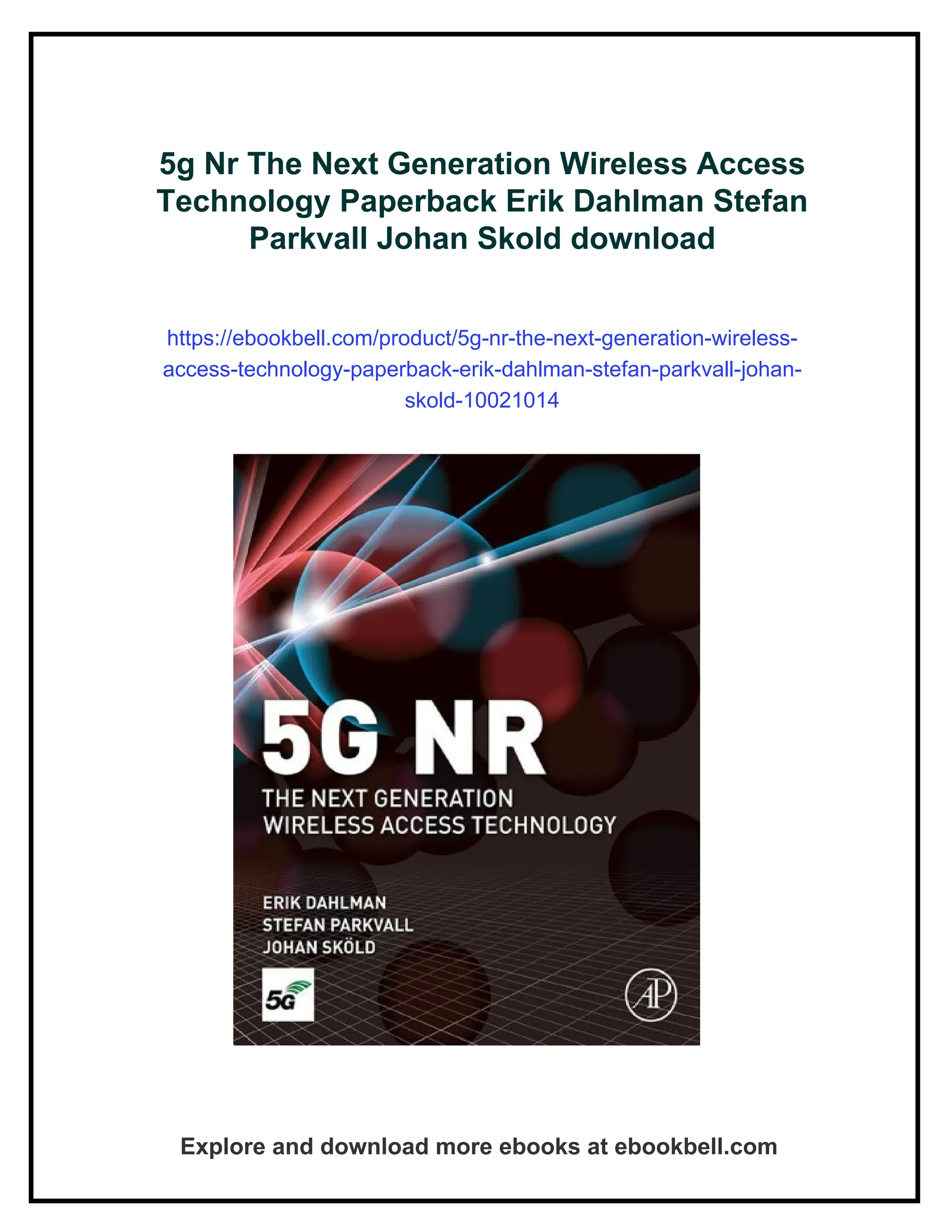
  • 1.
    5g Nr TheNext Generation Wireless Access Technology Paperback Erik Dahlman Stefan Parkvall Johan Skold download https://ebookbell.com/product/5g-nr-the-next-generation-wireless- access-technology-paperback-erik-dahlman-stefan-parkvall-johan- skold-10021014 Explore and download more ebooks at ebookbell.com
  • 2.
    Here are somerecommended products that we believe you will be interested in. You can click the link to download. 5g Nr The Next Generation Wireless Access Technology 2nd Edition Erik Dahlman https://ebookbell.com/product/5g-nr-the-next-generation-wireless- access-technology-2nd-edition-erik-dahlman-23284078 5g Nr The Next Generation Wireless Access Technology Dahlman https://ebookbell.com/product/5g-nr-the-next-generation-wireless- access-technology-dahlman-7167646 5g Nr The Next Generation Wireless Access Technology Erik Dahlman Stefan Parkvall Johan Skold https://ebookbell.com/product/5g-nr-the-next-generation-wireless- access-technology-erik-dahlman-stefan-parkvall-johan-skold-33405412 5g Nr And Enhancements From R15 To R16 Hai Tang Ning Yang Zhi Zhang https://ebookbell.com/product/5g-nr-and-enhancements- from-r15-to-r16-hai-tang-ning-yang-zhi-zhang-46214802

  • 3.
    5g Nr Wifi6 And Bluetooth Le 5 A Primer On Smartphone Wireless Technologies Douglas H Morais https://ebookbell.com/product/5g-nr-wifi-6-and-bluetooth- le-5-a-primer-on-smartphone-wireless-technologies-douglas-h- morais-50710342 5g Nr Modelling In Matlab Network Architecture Protocols And Physical Layer K H Chadwick https://ebookbell.com/product/5g-nr-modelling-in-matlab-network- architecture-protocols-and-physical-layer-k-h-chadwick-56719048 5g Nr Architecture Technology Implementation And Operation Of 3gpp New Radio Standards Sassan Ahmadi https://ebookbell.com/product/5g-nr-architecture-technology- implementation-and-operation-of-3gpp-new-radio-standards-sassan- ahmadi-10583452 Ngran And 5gnr 5g Radio Access Network And Radio Interface 1st Edition Frederic Launay https://ebookbell.com/product/ngran-and-5gnr-5g-radio-access-network- and-radio-interface-1st-edition-frederic-launay-34242702 Locationbased Services In Cellular Networks From Gsm To 5g Nr 2nd Ed Garca https://ebookbell.com/product/locationbased-services-in-cellular- networks-from-gsm-to-5g-nr-2nd-ed-garca-23518140
  • 6.
    5G NR: TheNext Generation Wireless Access Technology Erik Dahlman Stefan Parkvall Johan Sköld 2
  • 7.
    Table of Contents Coverimage Title page Copyright Preface Acknowledgments Abbreviations and Acronyms Chapter 1. What Is 5G? Abstract 1.1 3GPP and the Standardization of Mobile Communication 1.2 The Next Generation—5G/NR Chapter 2. 5G Standardization Abstract 2.1 Overview of Standardization and Regulation 2.2 ITU-R Activities From 3G to 5G 2.3 5G and IMT-2020 2.4 3GPP Standardization Chapter 3. Spectrum for 5G Abstract 3.1 Spectrum for Mobile Systems 3.2 Frequency Bands for NR 3.3 RF Exposure Above 6 GHz Chapter 4. LTE—An Overview Abstract 3
  • 8.
    4.1 LTE Release8—Basic Radio Access 4.2 LTE Evolution 4.3 Spectrum Flexibility 4.4 Multi-Antenna Enhancements 4.5 Densification, Small Cells, and Heterogeneous Deployments 4.6 Device Enhancements 4.7 New Scenarios Chapter 5. NR Overview Abstract 5.1 Higher-Frequency Operation and Spectrum Flexibility 5.2 Ultra-Lean Design 5.3 Forward Compatibility 5.4 Transmission Scheme, Bandwidth Parts, and Frame Structure 5.5 Duplex Schemes 5.6 Low-Latency Support 5.7 Scheduling and Data Transmission 5.8 Control Channels 5.9 Beam-Centric Design and Multi-Antenna Transmission 5.10 Initial Access 5.11 Interworking and LTE Coexistence Chapter 6. Radio-Interface Architecture Abstract 6.1 Overall System Architecture 6.2 Quality-Of-Service Handling 6.3 Radio Protocol Architecture 6.4 User-Plane Protocols 6.5 Control-Plane Protocols Chapter 7. Overall Transmission Structure Abstract 7.1 Transmission Scheme 4
  • 9.
    7.2 Time-Domain Structure 7.3Frequency-Domain Structure 7.4 Bandwidth Parts 7.5 Frequency-Domain Location of NR Carriers 7.6 Carrier Aggregation 7.7 Supplementary Uplink 7.8 Duplex Schemes 7.9 Antenna Ports 7.10 Quasi-Colocation Chapter 8. Channel Sounding Abstract 8.1 Downlink Channel Sounding—CSI-RS 8.2 Downlink Measurements and Reporting 8.3 Uplink Channel Sounding—SRS Chapter 9. Transport-Channel Processing Abstract 9.1 Overview 9.2 Channel Coding 9.3 Rate Matching and Physical-Layer Hybrid-ARQ Functionality 9.4 Scrambling 9.5 Modulation 9.6 Layer Mapping 9.7 Uplink DFT Precoding 9.8 Multi-Antenna Precoding 9.9 Resource Mapping 9.10 Downlink Reserved Resources 9.11 Reference Signals Chapter 10. Physical-Layer Control Signaling Abstract 10.1 Downlink 5
  • 10.
    10.2 Uplink Chapter 11.Multi-Antenna Transmission Abstract 11.1 Introduction 11.2 Downlink Multi-Antenna Precoding 11.3 NR Uplink Multiantenna Precoding Chapter 12. Beam Management Abstract 12.1 Initial Beam Establishment 12.2 Beam Adjustment 12.3 Beam Recovery Chapter 13. Retransmission Protocols Abstract 13.1 Hybrid-ARQ With Soft Combining 13.2 RLC 13.3 PDCP Chapter 14. Scheduling Abstract 14.1 Dynamic Downlink Scheduling 14.2 Dynamic Uplink Scheduling 14.3 Scheduling and Dynamic TDD 14.4 Transmission Without a Dynamic Grant 14.5 Discontinuous Reception Chapter 15. Uplink Power and Timing Control Abstract 15.1 Uplink Power Control 15.2 Uplink Timing Control Chapter 16. Initial Access Abstract 6
  • 11.
    16.1 Cell Search 16.2Random Access Chapter 17. LTE/NR Interworking and Coexistence Abstract 17.1 LTE/NR Dual-Connectivity 17.2 LTE/NR Coexistence Chapter 18. RF Characteristics Abstract 18.1 Spectrum Flexibility Implications 18.2 RF Requirements in Different Frequency Ranges 18.3 Channel Bandwidth and Spectrum Utilization 18.4 Overall Structure of Device RF Requirements 18.5 Overall Structure of Base-Station RF Requirements 18.6 Overview of Conducted RF Requirements for NR 18.7 Conducted Output Power Level Requirements 18.8 Transmitted Signal Quality 18.9 Conducted Unwanted Emissions Requirements 18.10 Conducted Sensitivity and Dynamic Range 18.11 Receiver Susceptibility to Interfering Signals 18.12 Radiated RF Requirements for NR 18.13 Ongoing Developments of RF Requirements for NR Chapter 19. RF Technologies at mm-Wave Frequencies Abstract 19.1 ADC and DAC Considerations 19.2 LO Generation and Phase Noise Aspects 19.3 Power Amplifier Efficiency in Relation to Unwanted Emission 19.4 Filtering Aspects 19.5 Receiver Noise Figure, Dynamic Range, and Bandwidth Dependencies 19.6 Summary Chapter 20. Beyond the First Release of 5G 7
  • 12.
    Abstract 20.1 Integrated Access-Backhaul 20.2Operation in Unlicensed Spectra 20.3 Non-orthogonal Multiple Access 20.4 Machine-Type Communication 20.5 Device-To-Device Communication 20.6 Spectrum and Duplex Flexibility 20.7 Concluding Remarks References Index 8
  • 13.
    Copyright Academic Press isan imprint of Elsevier 125 London Wall, London EC2Y 5AS, United Kingdom 525 B Street, Suite 1650, San Diego, CA 92101, United States 50 Hampshire Street, 5th Floor, Cambridge, MA 02139, United States The Boulevard, Langford Lane, Kidlington, Oxford OX5 1GB, United Kingdom Copyright © 2018 Elsevier Ltd. All rights reserved. No part of this publication may be reproduced or transmitted in any form or by any means, electronic or mechanical, including photocopying, recording, or any information storage and retrieval system, without permission in writing from the publisher. Details on how to seek permission, further information about the Publisher’s permissions policies and our arrangements with organizations such as the Copyright Clearance Center and the Copyright Licensing Agency, can be found at our website: www.elsevier.com/permissions. This book and the individual contributions contained in it are protected under copyright by the Publisher (other than as may be noted herein). Notices Knowledge and best practice in this field are constantly changing. As new research and experience broaden our understanding, changes in research methods, professional practices, or medical treatment may become necessary. Practitioners and researchers must always rely on their own experience and knowledge in evaluating and using any information, methods, compounds, or experiments described herein. In using such information or methods they should be mindful of their own safety and the safety of others, including parties for whom they have a professional responsibility. To the fullest extent of the law, neither the Publisher nor the authors, contributors, or editors, assume any liability for any injury and/or damage to persons or property as a matter of products liability, negligence or otherwise, or from any use or operation of any methods, products, instructions, or ideas contained in the material herein. British Library Cataloguing-in-Publication Data A catalogue record for this book is available from the British Library Library of Congress Cataloging-in-Publication Data A catalog record for this book is available from the Library of Congress ISBN: 978-0-12-814323-0 For Information on all Academic Press publications visit our website at https://www.elsevier.com/books-and-journals 9
  • 14.
    Publisher: Mara Conner AcquisitionEditor: Tim Pitts Editorial Project Manager: Joshua Mearns Production Project Manager: Kamesh Ramajogi Cover Designer: Greg Harris Typeset by MPS Limited, Chennai, India 10
  • 15.
    Preface Long-Term Evolution (LTE)has become the most successful wireless mobile broadband technology across the world, serving billions of users. Mobile broadband is, and will continue to be, an important part of future cellular communication, but future wireless networks are to a large extent also about a significantly wider range of use cases and a correspondingly wider range of requirements. Although LTE is a very capable technology, still evolving and expected to be used for many years to come, a new 5G radio access known as New Radio (NR) has been standardized to meet future requirements. This book describes NR, developed in 3GPP (Third Generation Partnership Project) as of late Spring 2018. Chapter 1 provides a brief introduction, followed by a description of the standardization process and relevant organizations such as the aforementioned 3GPP and ITU in Chapter 2. The frequency bands available for mobile communication are covered in Chapter 3 together with a discussion on the process for finding new frequency bands. An overview of LTE and its evolution is found in Chapter 4. Although the focus of the book is NR, a brief overview of LTE as a background to the coming chapters is relevant. One reason is that both LTE and NR are developed by 3GPP and hence have a common background and share several technology components. Many of the design choices in NR are also based on experience from LTE. Furthermore, LTE continues to evolve in parallel with NR and is an important component in 5G radio access. Chapter 5 provides an overview of NR. It can be read on its own to get a high-level understanding of NR, or as an introduction to the subsequent chapters. Chapter 6 outlines the overall protocol structure in NR, followed by a description of the overall time–frequency structure of NR in Chapter 7. Multiantenna processing and beam-forming are integral parts of NR. The channel sounding tools to support these functions are outlined in Chapter 8, followed by the overall transport-channel processing in Chapter 9 and the associated control signaling in Chapter 10. How the functions are used to support different multi-antenna schemes and beamforming functions is the topic of Chapters 11 and 12. Retransmission functionality and scheduling are the topics of Chapters 13 and 14, followed by power control in Chapter 15 and initial access in Chapter 16. Coexistence and interworking with LTE is an essential part of NR, especially in the nonstandalone version which relies on LTE for mobility and initial access, and is covered in Chapter 17. Radio-frequency (RF) requirements, taking into account spectrum flexibility across large frequency ranges and multistandard radio equipment, are the topic of Chapter 18. Chapter 19 discusses the RF implementation aspects for higher frequency bands in the mm-wave range. Finally, Chapter 20 concludes the book with an outlook to future NR releases. 11
  • 16.
    Acknowledgments We thank allour colleagues at Ericsson for assisting in this project by helping with contributions to the book, giving suggestions and comments on the contents, and taking part in the huge team effort of developing NR and the next generation of radio access for 5G. The standardization process involves people from all parts of the world, and we acknowledge the efforts of our colleagues in the wireless industry in general and in 3GPP RAN in particular. Without their work and contributions to the standardization, this book would not have been possible. Finally, we are immensely grateful to our families for bearing with us and supporting us during the long process of writing this book. 12
  • 17.
    Abbreviations and Acronyms 3GPPThird Generation Partnership Project 5GCN 5G Core Network AAS Active Antenna System ACIR Adjacent Channel Interference Ratio ACK Acknowledgment (in ARQ protocols) ACLR Adjacent Channel Leakage Ratio ACS Adjacent Channel Selectivity ADC Analog-to-Digital Converter AF Application Function AGC Automatic Gain Control AM Acknowledged Mode (RLC configuration) AM Amplitude Modulation AMF Access and Mobility Management Function A-MPR Additional Maximum Power Reduction AMPS Advanced Mobile Phone System ARI Acknowledgment Resource Indicator ARIB Association of Radio Industries and Businesses ARQ Automatic Repeat-reQuest AS Access Stratum ATIS Alliance for Telecommunications Industry Solutions AUSF Authentication Server Function AWGN Additive White Gaussian Noise BC Band Category BCCH Broadcast Control Channel BCH Broadcast Channel BiCMOS Bipolar Complementary Metal Oxide Semiconductor BPSK Binary Phase-Shift Keying BS Base Station BW Bandwidth BWP Bandwidth part CA Carrier aggregation CACLR Cumulative Adjacent Channel Leakage Ratio CBG Codeblock group CBGFI CBG flush information CBGTI CBG transmit indicator CC Component Carrier CCCH Common Control Channel 13
  • 18.
    CCE Control ChannelElement CCSA China Communications Standards Association CDM Code Division Multiplexing CDMA Code-Division Multiple Access CEPT European Conference of Postal and Telecommunications Administration CITEL Inter-American Telecommunication Commission C-MTC Critical Machine-Type Communications CMOS Complementary Metal Oxide Semiconductor CN Core Network CoMP Coordinated Multi-Point Transmission/Reception COREST Control resource set CP Cyclic Prefix CP Compression Point CQI Channel-Quality Indicator CRB Common resource block CRC Cyclic Redundancy Check C-RNTI Cell Radio-Network Temporary Identifier CS Capability Set (for MSR base stations) CSI Channel-State Information CSI-IM CSI Interference Measurement CSI-RS CSI Reference Signals CS-RNTI Configured scheduling RNTI CW Continuous Wave D2D Device-to-Device DAC Digital-to-Analog Converter DAI Downlink Assignment Index D-AMPS Digital AMPS DC Dual Connectivity DC Direct Current DCCH Dedicated Control Channel DCH Dedicated Channel DCI Downlink Control Information DFT Discrete Fourier Transform DFTS-OFDM DFT-Spread OFDM (DFT-precoded OFDM, see also SC-FDMA) DL Downlink DL-SCH Downlink Shared Channel DM-RS Demodulation Reference Signal DR Dynamic Range DRX Discontinuous Reception DTX Discontinuous Transmission EDGE Enhanced Data Rates for GSM Evolution, Enhanced Data Rates for Global Evolution ECC Electronic Communications Committee (of CEPT) eIMTA Enhanced Interference Mitigation and Traffic Adaptation 14
  • 19.
    EIRP Effective IsotropicRadiated Power EIS Equivalent Isotropic Sensitivity eMBB enhanced MBB EMF Electromagnetic Field eNB eNodeB EN-DC E-UTRA NR Dual-Connectivity eNodeB E-UTRAN NodeB EPC Evolved Packet Core ETSI European Telecommunications Standards Institute E-UTRA Evolved UTRA EVM Error Vector Magnitude FCC Federal Communications Commission FDD Frequency Division Duplex FDM Frequency Division Multiplexing FET Field-Effect Transistor FDMA Frequency-Division Multiple Access FFT Fast Fourier Transform FoM Figure-of-Merit FPLMTS Future Public Land Mobile Telecommunications Systems FR1 Frequency Range 1 FR2 Frequency Range 2 GaAs Gallium Arsenide GaN Gallium Nitride GERAN GSM/EDGE Radio Access Network gNB gNodeB gNodeB generalized NodeB GSA Global mobile Suppliers Association GSM Global System for Mobile Communications GSMA GSM Association HARQ Hybrid ARQ HBT Heterojunction Bipolar Transistor HEMT High Electron-Mobility Transistor HSPA High-Speed Packet Access IC Integrated Circuit ICNIRP International Commission on Non-Ionizing Radiation ICS In-Channel Selectivity IEEE Institute of Electrical and Electronics Engineers IFFT Inverse Fast Fourier Transform IL Insertion Loss IMD Inter Modulation Distortion IMT-2000 International Mobile Telecommunications 2000 (ITU’s name for the family of 3G standards) IMT-2020 International Mobile Telecommunications 2020 (ITU’s name for the family of 5G standards) 15
  • 20.
    IMT-Advanced International MobileTelecommunications Advanced (ITU’s name for the family of 4G standards) InGaP Indium Gallium Phosphide IOT Internet of Things IP Internet Protocol IP3 3rd order Intercept Point IR Incremental Redundancy ITRS International Telecom Roadmap for Semiconductors ITU International Telecommunications Union ITU-R International Telecommunications Union-Radiocommunications Sector KPI Key Performance Indicator L1-RSRP Layer 1 Reference Signal Receiver Power LC Inductor(L)-Capacitor LAA License-Assisted Access LCID Logical Channel Index LDPC Low-Density Parity Check Code LO Local Oscillator LNA Low-Noise Amplifier LTCC Low Temperature Co-fired Ceramic LTE Long-Term Evolution MAC Medium Access Control MAC-CE MAC control element MAN Metropolitan Area Network MBB Mobile Broadband MB-MSR Multi-Band Multi Standard Radio (base station) MCG Master Cell Group MCS Modulation and Coding Scheme MIB Master Information Block MMIC Monolithic Microwave Integrated Circuit MIMO Multiple-Input Multiple-Output mMTC massive Machine Type Communication MPR Maximum Power Reduction MSR Multi-Standard Radio MTC Machine-Type Communication MU-MIMO Multi-User MIMO NAK Negative Acknowledgment (in ARQ protocols) NB-IoT Narrow-Band Internet-of-Things NDI New-Data Indicator NEF Network exposure function NF Noise Figure NG The interface between the gNB and the 5G CN NG-c The control-plane part of NG NGMN Next Generation Mobile Networks 16
  • 21.
    NG-u The user-planepart of NG NMT Nordisk MobilTelefon (Nordic Mobile Telephony) NodeB NodeB, a logical node handling transmission/reception in multiple cells. Commonly, but not necessarily, corresponding to a base station NOMA Nonorthogonal Multiple Access NR New Radio NRF NR repository function NS Network Signaling NZP-CSI-RS Non-zero-power CSI-RS OBUE Operating Band Unwanted Emissions OCC Orthogonal Cover Code OFDM Orthogonal Frequency-Division Multiplexing OOB Out-Of-Band (emissions) OSDD OTA Sensitivity Direction Declarations OTA Over-The-Air PA Power Amplifier PAE Power-Added Efficiency PAPR Peak-to-Average Power Ratio PAR Peak-to-Average Ratio (same as PAPR) PBCH Physical Broadcast Channel PCB Printed Circuit Board PCCH Paging Control Channel PCF Policy control function PCG Project Coordination Group (in 3GPP) PCH Paging Channel PCI Physical Cell Identity PDC Personal Digital Cellular PDCCH Physical Downlink Control Channel PDCP Packet Data Convergence Protocol PDSCH Physical Downlink Shared Channel PDU Protocol Data Unit PHS Personal Handy-phone System PHY Physical Layer PLL Phase-Locked Loop PM Phase Modulation PMI Precoding-Matrix Indicator PN Phase Noise PRACH Physical Random-Access Channel PRB Physical Resource Block P-RNTI Paging RNTI PSD Power Spectral Density PSS Primary Synchronization Signal PUCCH Physical Uplink Control Channel 17
  • 22.
    PUSCH Physical UplinkShared Channel QAM Quadrature Amplitude Modulation QCL Quasi Co-Location QoS Quality-of-Service QPSK Quadrature Phase-Shift Keying RACH Random Access Channel RAN Radio Access Network RA-RNTI Random Access RNTI RAT Radio Access Technology RB Resource Block RE Resource Element RF Radio Frequency RFIC Radio Frequency Integrated Circuit RI Rank Indicator RIB Radiated Interface Boundary RIT Radio Interface Technology RLC Radio Link Control RMSI Remaining Minimum System Information RNTI Radio-Network Temporary Identifier RoAoA Range of Angle of Arrival ROHC Robust Header Compression RRC Radio Resource Control RRM Radio Resource Management RS Reference Symbol RSPC IMT-2000 Radio Interface Specifications RSRP Reference Signal Received Power RV Redundancy Version RX Receiver SCG Secondary Cell Group SCS Sub-Carrier Spacing SDL Supplementary Downlink SDMA Spatial Division Multiple Access SDO Standards Developing Organization SDU Service Data Unit SEM Spectrum Emissions Mask SFI Slot format indicator SFI-RNTI Slot format indicator RNTI SFN System Frame Number (in 3GPP). SI System Information Message SIB System Information Block SIB1 System Information Block 1 SiGe Silicon Germanium SINR Signal-to-Interference-and-Noise Ratio 18
  • 23.
    SIR Signal-to-Interference Ratio SiPSystem-in-Package SI-RNTI System Information RNTI SMF Session management function SNDR Signal to Noise-and-Distortion Ratio SNR Signal-to-Noise Ratio SoC System-on-Chip SR Scheduling Request SRI SRS resource indicator SRIT Set of Radio Interface Technologies SRS Sounding Reference Signal SS Synchronization Signal SSB Synchronization Signal Block SSS Secondary Synchronization Signal SMT Surface-Mount assembly SUL Supplementary Uplink SU-MIMO Single-User MIMO TAB Transceiver-Array Boundary TACS Total Access Communication System TCI Transmission configuration indication TCP Transmission Control Protocol TC-RNTI Temporary C-RNTI TDD Time-Division Duplex TDM Time Division Multiplexing TDMA Time-Division Multiple Access TD-SCDMA Time-Division-Synchronous Code-Division Multiple Access TIA Telecommunication Industry Association TR Technical Report TRP Total Radiated Power TS Technical Specification TRS Tracking Reference Signal TSDSI Telecommunications Standards Development Society, India TSG Technical Specification Group TTA Telecommunications Technology Association TTC Telecommunications Technology Committee TTI Transmission Time Interval TX Transmitter UCI Uplink Control Information UDM Unified data management UE User Equipment, the 3GPP name for the mobile terminal UEM Unwanted Emissions Mask UL Uplink UMTS Universal Mobile Telecommunications System 19
  • 24.
    UPF User planefunction URLLC Ultra-reliable low-latency communication UTRA Universal Terrestrial Radio Access V2X Vehicular-to-Anything V2V Vehicular-to-Vehicular VCO Voltage-Controlled Oscillator WARC World Administrative Radio Congress WCDMA Wideband Code-Division Multiple Access WG Working Group WiMAX Worldwide Interoperability for Microwave Access WP5D Working Party 5D WRC World Radiocommunication Conference Xn The interface between gNBs ZC Zadoff-Chu ZP-CSI-RS Zero-power CSI-RS 20
  • 25.
    C H AP T E R 1 What Is 5G? Abstract The chapter gives background to 5G mobile communication, describing the earlier generations and the justification for a new generation. It describes the high-level 5G use cases, eMBB, mMTC, and URLLC. It also describes the 3GPP process for developing the new 5G/NR radio- access technology. Keywords 5G; NR; 3GPP; eMBB; URLLC; mMTC; machine-type communication Over the last 40 years, the world has witnessed four generations of mobile communication (see Fig. 1.1). FIGURE 1.1 The different generations of mobile communication. The first generation of mobile communication, emerging around 1980, was based on analog transmission with the main technologies being AMPS (Advanced Mobile Phone System) developed within North America, NMT (Nordic Mobile Telephony) jointly developed by the, at that time, government-controlled public-telephone-network operators of the Nordic countries, and TACS (Total Access Communication System) used in, for example, the United Kingdom. The mobile- communication systems based on first-generation technology were limited to voice services and, for the first time, made mobile telephony accessible to ordinary people. The second generation of mobile communication, emerging in the early 1990s, saw the introduction of digital transmission on the radio link. Although the target service was still voice, the use of digital transmission allowed for second-generation mobile-communication systems to also provide limited data services. There were initially several different second-generation technologies, including GSM (Global System for Mobile communication) jointly developed by a large number of European countries, D-AMPS (Digital AMPS), PDC (Personal Digital Cellular) developed and solely used in Japan, and, developed at a somewhat later stage, the CDMA-based IS-95 technology. As time went by, GSM spread from Europe to other parts of the world and eventually came to completely dominate among the second-generation technologies. Primarily due to the success of GSM, the second-generation systems also turned mobile telephony from something still being used by only a relatively small fraction of people to a communication tool being a necessary part of life for a large majority of the world's population. Even today there are many places in the world where GSM is the dominating, and in some cases even the only available, technology for mobile communication, despite the later introduction of both third- and fourth-generation technologies. The third generation of mobile communication, often just referred to as 3G, was introduced in the early 2000. With 3G the true step to high-quality mobile broadband was taken, enabling fast 21
  • 26.
    wireless internet access.This was especially enabled by the 3G evolution known as HSPA (High Speed Packet Access) [21]. In addition, while earlier mobile-communication technologies had all been designed for operation in paired spectrum (separate spectrum for network-to-device and device-to-network links) based on the Frequency-Division Duplex (FDD), see Chapter 7, 3G also saw the first introduction of mobile communication in unpaired spectrum based on the china- developed TD-SCDMA technology based on Time Division Duplex (TDD). We are now, and have been for several years, in the fourth-generation (4G) era of mobile communication, represented by the LTE technology [28] LTE has followed in the steps of HSPA, providing higher efficiency and further enhanced mobile-broadband experience in terms of higher achievable end-user data rates. This is provided by means of OFDM-based transmission enabling wider transmission bandwidths and more advanced multi-antenna technologies. Furthermore, while 3G allowed for mobile communication in unpaired spectrum by means of a specific radio- access technology (TD-SCDMA), LTE supports both FDD and TDD operation, that is, operation in both paired and unpaired spectra, within one common radio-access technology. By means of LTE the world has thus converged into a single global technology for mobile communication, used by essentially all mobile-network operators and applicable to both paired and unpaired spectra. As discussed in somewhat more detail in Chapter 4, the later evolution of LTE has also extended the operation of mobile-communication networks into unlicensed spectra. 1.1 3GPP and the Standardization of Mobile Communication Agreeing on multi-national technology specifications and standards has been key to the success of mobile communication. This has allowed for the deployment and interoperability of devices and infrastructure of different vendors and enabled devices and subscriptions to operate on a global basis. As already mentioned, already the first-generation NMT technology was created on a multinational basis, allowing for devices and subscription to operate over the national borders between the Nordic countries. The next step in multi-national specification/standardization of mobile-communication technology took place when GSM was jointly developed between a large number of European countries within CEPT, later renamed ETSI (European Telecommunications Standards Institute). As a consequence of this, GSM devices and subscriptions were already from the beginning able to operate over a large number of countries, covering a very large number of potential users. This large common market had a profound impact on device availability, leading to an unprecedented number of different device types and substantial reduction in device cost. However, the final step to true global standardization of mobile communication came with the specification of the 3G technologies, especially WCDMA. Work on 3G technology was initially also carried out on a regional basis, that is, separately within Europe (ETSI), North America (TIA, T1P1), Japan (ARIB), etc. However, the success of GSM had shown the importance of a large technology footprint, especially in terms of device availability and cost. It also become clear that although work was carried out separately within the different regional standard organizations, there were many similarities in the underlying technology being pursued. This was especially true for Europe and Japan which were both developing different but very similar flavors of wideband CDMA (WCDMA) technology. As a consequence, in 1998, the different regional standardization organizations came together and jointly created the Third-Generation Partnership Project (3GPP) with the task of finalizing the development of 3G technology based on WCDMA. A parallel organization (3GPP2) was somewhat later created with the task of developing an alternative 3G technology, cdma2000, as an evolution of second-generation IS-95. For a number of years, the two organizations (3GPP and 3GPP2) with their respective 3G technologies (WCDMA and cdma2000) existed in parallel. However, over time 3GPP came to completely dominate and has, despite its name, continued into the development of 4G (LTE, and 5G) technologies. Today, 3GPP is the only significant organization developing technical specifications for mobile communication. 1.2 The Next Generation—5G/NR Discussions on fifth-generation (5G) mobile communication began around 2012. In many discussions, the term 5G is used to refer to specific new 5G radio-access technology. However, 5G is also often used in a much wider context, not just referring to a specific radio-access technology but 22
  • 27.
    rather to awide range of new services envisioned to be enabled by future mobile communication. 1.2.1 The 5G Use Cases In the context of 5G, one is often talking about three distinctive classes of use cases: enhanced mobile broadband (eMBB), massive machine-type communication (mMTC), and ultra-reliable and low-latency communication (URLLC) (see also Fig. 1.2). • eMBB corresponds to a more or less straightforward evolution of the mobile-broadband services of today, enabling even larger data volumes and further enhanced user experience, for example, by supporting even higher end-user data rates. • mMTC corresponds to services that are characterized by a massive number of devices, for example, remote sensors, actuators, and monitoring of various equipment. Key requirements for such services include very low device cost and very low device energy consumption, allowing for very long device battery life of up to at least several years. Typically, each device consumes and generates only a relatively small amount of data, that is, support for high data rates is of less importance. • URLLC type-of-services are envisioned to require very low latency and extremely high reliability. Examples hereof are traffic safety, automatic control, and factory automation. FIGURE 1.2 High-level 5G use-case classification. It is important to understand that the classification of 5G use cases into these three distinctive classes is somewhat artificial, primarily aiming to simplify the definition of requirements for the technology specification. There will be many use cases that do not fit exactly into one of these classes. Just as an example, there may be services that require very high reliability but for which the latency requirements are not that critical. Similarly, there may be use cases requiring devices of very low cost but where the possibility for very long device battery life may be less important. 1.2.2 Evolving LTE to 5G Capability The first release of the LTE technical specifications was introduced in 2009. Since then, LTE has gone through several steps of evolution providing enhanced performance and extended capabilities. This has included features for enhanced mobile broadband, including means for higher achievable end-user data rates as well as higher spectrum efficiency. However, it has also included important steps to extend the set of use cases to which LTE can be applied. Especially, there have been important steps to enable truly low-cost devices with very long battery life, in line with the characteristics of massive MTC applications. There have recently also been some significant steps taken to reduce the LTE air-interface latency. With these finalized, ongoing, and future evolution steps, the evolution of LTE will be able to support a wide range of the use cases envisioned for 5G. Taking into account the more general view that 5G is not a specific radio-access technology but rather defined by the use cases to be supported, 23
  • 28.
    the evolution ofLTE should thus be seen as an important part of the overall 5G radio-access solution, see Fig. 1.3. Although not being the main aim of this book, an overview of the current state of the LTE evolution is provided in Chapter 4. FIGURE 1.3 Evolution of LTE and NR jointly providing the overall 5G radio-access solution. 1.2.3 NR—The New 5G Radio-Access Technology Despite LTE being a very capable technology, there are requirements not possible to meet with LTE or its evolution. Furthermore, technology development over the more than 10 years that have passed since the work on LTE was initiated allows for more advanced technical solutions. To meet these requirements and to exploit the potential of new technologies, 3GPP initiated the development of a new radio-access technology known as NR (New Radio). A workshop setting the scope was held in the fall of 2015 and technical work began in the spring of 2016. The first version of the NR specifications was available by the end of 2017 to meet commercial requirements on early 5G deployments already in 2018. NR reuses many of the structures and features of LTE. However, being a new radio-access technology means that NR, unlike the LTE evolution, is not restricted by a need to retain backwards compatibility. The requirements on NR are also broader than what was the case for LTE, motivating a partly different set of technical solutions. Chapter 2 discusses the standardization activities related to NR, followed by a spectrum overview in Chapter 3 and a brief summary of LTE and its evolution in Chapter 4. The main part of this book (Chapters 5–19) then provides an in-depth description of the current stage of the NR technical specifications, finishing with an outlook of the future development of NR in Chapter 20. 1.2.4 5GCN—The New 5G Core Network In parallel to NR, that is, the new 5G radio-access technology, 3GPP is also developing a new 5G core network referred to as 5GCN. The new 5G radio-access technology will connect to the 5GCN. However, 5GCN will also be able to provide connectivity for the evolution of LTE. At the same time, NR may also connect via the legacy core network EPC when operating in so-called non- standalone mode together will LTE, as will be further discussed in Chapter 6. 24
  • 29.
    C H AP T E R 2 5G Standardization Abstract This chapter presents the regulation and standardization activities related to 5G NR, including all the relevant regulation and standards bodies. The ITU-R IMT-2020 process for 5G is presented together with the corersponding 3GPP process that led to 5G NR. Keywords standardization; regulation; ITU-R; IMT-2020; 3GPP; TSG RAN; 5G; NR; usage scenarios; key capabilities; technical performance requirements The research, development, implementation, and deployment of mobile-communication systems is performed by the wireless industry in a coordinated international effort by which common industry specifications that define the complete mobile-communication system are agreed. The work depends heavily on global and regional regulation, in particular for the spectrum use that is an essential component for all radio technologies. This chapter describes the regulatory and standardization environment that has been, and continues to be, essential for defining the mobile- communication systems. 2.1 Overview of Standardization and Regulation There are a number of organizations involved in creating technical specifications and standards as well as regulation in the mobile-communications area. These can loosely be divided into three groups: Standards Developing Organizations, regulatory bodies and administrations, and industry forums. Standards Developing Organizations (SDOs) develop and agree on technical standards for mobile communications systems, in order to make it possible for the industry to produce and deploy standardized products and provide interoperability between those products. Most components of mobile-communication systems, including base stations and mobile devices, are standardized to some extent. There is also a certain degree of freedom to provide proprietary solutions in products, but the communications protocols rely on detailed standards for obvious reasons. SDOs are usually nonprofit industry organizations and not government controlled. They often write standards within a certain area under mandate from governments(s) however, giving the standards a higher status. There are nationals SDOs, but due to the global spread of communications products, most SDOs are regional and also cooperate on a global level. As an example, the technical specifications of GSM, WCDMA/HSPA, LTE, and NR are all created by 3GPP (Third Generation Partnership Project) which is a global organization from seven regional and national SDOs in Europe (ETSI), Japan (ARIB and TTC), the United States (ATIS), China (CCSA), Korea (TTA), and India (TSDSI). SDOs tend to have a varying degree of transparency, but 3GPP is fully transparent with all technical specifications, meeting documents, reports, and e-mail reflectors publicly available without charge even for nonmembers. Regulatory bodies and administrations are government-led organizations that set regulatory and legal requirements for selling, deploying, and operating mobile systems and other telecommunication products. One of their most important tasks is to control spectrum use and to set licensing conditions for the mobile operators that are awarded licenses to use parts of the Radio Frequency (RF) spectrum for mobile operations. Another task is to regulate “placing on the market” of products through regulatory certification, by ensuring that devices, base stations, and other equipment is type-approved and shown to meet the relevant regulation. Spectrum regulation is handled both on a national level by national administrations, but also through regional bodies in Europe (CEPT/ECC), the Americas (CITEL), and Asia (APT). On a global 25
  • 30.
    level, the spectrumregulation is handled by the International Telecommunications Union (ITU). The regulatory bodies regulate what services the spectrum is to be used for and in addition set more detailed requirements such as limits on unwanted emissions from transmitters. They are also indirectly involved in setting requirements on the product standards through regulation. The involvement of ITU in setting requirements on the technologies for mobile communication is explained further in Section 2.2. Industry forums are industry-led groups promoting and lobbying for specific technologies or other interests. In the mobile industry, these are often led by operators, but there are also vendors creating industry forums. An example of such a group is GSMA (GSM Association) which is promoting mobile-communication technologies based on GSM, WCDMA, LTE, and NR. Other examples of industry forums are Next Generation Mobile Networks (NGMN), which is an operator group defining requirements on the evolution of mobile systems, and 5G Americas, which is a regional industry forum that has evolved from its predecessor 4G Americas. Fig. 2.1 illustrates the relationship between different organizations involved in setting regulatory and technical conditions for mobile systems. The figure also shows the mobile industry view, where vendors develop products, place them on the market and negotiate with operators who procure and deploy mobile systems. This process relies heavily on the technical standards published by the SDOs, while placing products on the market relies on certification of products on a regional or national level. Note that, in Europe, the regional SDO (ETSI) is producing the so-called harmonized standards used for product certification (through the “CE”-mark), based on a mandate from the regulators, in this case the European Commission. These standards are also used for certification in many countries outside of Europe. In Fig. 2.1, full arrows indicate formal documentation such as technical standards, recommendations, and regulatory mandates that define the technologies and regulation. Dashed arrows show more indirect involvement through, for example, liaison statements and white papers. FIGURE 2.1 Simplified view of the relationship between regulatory bodies, standards developing organizations, industry forums, and the mobile industry. 2.2 ITU-R Activities From 3G to 5G 2.2.1 The Role of ITU-R ITU-R is the radio communications sector of the International Telecommunications Union. ITU-R is 26
  • 31.
    responsible for ensuringefficient and economical use of the RF spectrum by all radio communication services. The different subgroups and working parties produce reports and recommendations that analyze and define the conditions for using the RF spectrum. The quite ambitious goal of ITU-R is to “ensure interference-free operations of radio communication systems,” by implementing the Radio Regulations and regional agreements. The Radio Regulations is an international binding treaty for how RF spectrum is used. A World Radio-communication Conference (WRC) is held every 3–4 years. At WRC the Radio Regulations are revised and updated, resulting in revised and updated use of the RF spectrum across the world. While the technical specification of mobile-communication technologies, such as NR, LTE, and WCDMA/HSPA is done within 3GPP, there is a responsibility for ITU-R in the process of turning the technologies into global standards, in particular for countries that are not covered by the SDOs that are partners in 3GPP. ITU-R defines the spectrum for different services in the RF spectrum, including mobile services, and some of that spectrum is particularly identified for so-called International Mobile Telecommunications (IMT) systems. Within ITU-R, it is Working Party 5D (WP5D) that has the responsibility for the overall radio system aspects of IMT systems, which, in practice, corresponds to the different generations of mobile-communication systems from 3G onwards. WP5D has the prime responsibility within ITU-R for issues related to the terrestrial component of IMT, including technical, operational, and spectrum-related issues. WP5D does not create the actual technical specifications for IMT, but has kept the roles of defining IMT in cooperation with the regional standardization bodies and maintaining a set of recommendations and reports for IMT, including a set of Radio Interface Specifications (RSPCs). These recommendations contain “families” of Radio Interface Technologies (RITs) for each IMT generation, all included on an equal basis. For each radio interface, the RSPC contains an overview of that radio interface, followed by a list of references to the detailed specifications. The actual specifications are maintained by the individual SDO and the RSPC provides references to the specifications transposed and maintained by each SDO. The following RSPC recommendations are in existence or planned: • For IMT-2000: ITU-R Recommendation M.1457 [49] containing six different RITs including the 3G technologies such as WCDMA/HSPA. • For IMT-Advanced: ITU-R Recommendation M.2012 [45] containing two different RITs where the most important is 4G/LTE. • For IMT-2020: A new ITU-R Recommendation, containing the RITs for 5G technologies, planned to be developed in 2019–20. Each RSPC is continuously updated to reflect new developments in the referenced detailed specifications, such as the 3GPP specifications for WCDMA and LTE. Input to the updates is provided by the SDOs and the Partnership Projects, nowadays primarily 3GPP. 2.2.2 IMT-2000 and IMT-Advanced Work on what corresponds to third generation of mobile communication started in the ITU-R in the 1980s. First referred to as Future Public Land Mobile Systems (FPLMTS) it was later renamed IMT- 2000. In the late 1990s, the work in ITU-R coincided with the work in different SDOs across the world to develop a new generation of mobile systems. An RSPC for IMT-2000 was first published in 2000 and included WCDMA from 3GPP as one of the RITs. The next step for ITU-R was to initiate work on IMT-Advanced, the term used for systems that include new radio interfaces supporting new capabilities of systems beyond IMT-2000. The new capabilities were defined in a framework recommendation published by the ITU-R [41] and were demonstrated with the “van diagram” shown in Fig. 2.2. The step into IMT-Advanced capabilities by ITU-R coincided with the step into 4G, the next generation of mobile technologies after 3G. 27
  • 32.
    FIGURE 2.2 Illustrationof capabilities of IMT-2000 and IMT-Advanced, based on the framework described in ITU-R Recommendation M.1645 [41]. An evolution of LTE as developed by 3GPP was submitted as one candidate technology for IMT- Advanced. While actually being a new release (Release 10) of the LTE specifications and thus an integral part of the continuous evolution of LTE, the candidate was named LTE-Advanced for the purpose of ITU-R submission and this name is also used in the LTE specifications from Release 10. In parallel with the ITU-R work, 3GPP set up its own set of technical requirements for LTE- Advanced, with the ITU-R requirements as a basis [10]. The target of the ITU-R process is always harmonization of the candidates through consensus building. ITU-R determined that two technologies would be included in the first release of IMT- Advanced, those two being LTE-Advanced and WirelessMAN-Advanced [37] based on the IEEE 802.16m specification. The two can be viewed as the “family” of IMT-Advanced technologies as shown in Fig. 2.3. Note that, of these two technologies, LTE has emerged as the dominating 4G technology by far. FIGURE 2.3 Radio Interface Technologies IMT-Advanced. 28
  • 33.
    2.2.3 IMT-2020 Processin ITU-R WP5D Starting in 2012, ITU-R WP5D set the stage for the next generation of IMT systems, named IMT- 2020. It is a further development of the terrestrial component of IMT beyond the year 2020 and, in practice, corresponds to what is more commonly referred to as “5G,” the fifth generation of mobile systems. The framework and objective for IMT-2020 is outlined in ITU-R Recommendation M.2083 [47], often referred to as the “Vision” recommendation. The recommendation provides the first step for defining the new developments of IMT, looking at the future roles of IMT and how it can serve society, looking at market, user and technology trends, and spectrum implications. The user trends for IMT together with the future role and market lead to a set of usage scenarios envisioned for both human-centric and machine-centric communication. The usage scenarios identified are Enhanced Mobile Broadband (eMBB), Ultra-Reliable and Low Latency Communications (URLLC), and Massive Machine-Type Communications (mMTC). The need for an enhanced mobile broadband experience, together with the new and broadened usage scenarios, leads to an extended set of capabilities for IMT-2020. The Vision recommendation [47] gives a first high-level guidance for IMT-2020 requirements by introducing a set of key capabilities, with indicative target numbers. The key capabilities and the related usage scenarios are discussed further in Section 2.3. As a parallel activity, ITU-R WP5D produced a report on “Future technology trends of terrestrial IMT systems” [43], with a focus on the time period 2015–20. It covers trends of future IMT technology aspects by looking at the technical and operational characteristics of IMT systems and how they are improved with the evolution of IMT technologies. In this way, the report on technology trends relates to LTE in 3GPP Release 13 and beyond, while the Vision recommendation looks further ahead and beyond 2020. A new aspect on IMT-2020 is that it will be capable of operating in potential new IMT bands above 6 GHz, including mm-wave bands. With this in mind, WP5D produced a separate report studying radio wave propagation, IMT characteristics, enabling technologies, and deployment in frequencies above 6 GHz [44]. At WRC-15, potential new bands for IMT were discussed and an agenda item 1.13 was set up for WRC-19, covering possible additional allocations to the mobile services and for future IMT development. These allocations are identified in a number of frequency bands in the range between 24.25 and 86 GHz. The specific bands and their possible use globally are further discussed in Chapter 3. After WRC-15, ITU-R WP5D continued the process of setting requirements and defining evaluation methodologies for IMT-2020 systems, based in the Vision recommendation [47] and the other previous study outcomes. This step of the process was completed in mid-2017, as shown in the IMT-2020 work plan in Fig. 2.4. The result was three documents published late in 2017 that further define the performance and characteristics that are expected from IMT-2020 and that will be applied in the evaluation phase: • Technical requirements: Report ITU-R M.2410 [51] defines 13 minimum requirements related to the technical performance of the IMT-2020 radio interface(s). The requirements are to a large extent based on the key capabilities set out in the Vision recommendation (ITU-R, 2015c). This is further described in Section 2.3. • Evaluation guideline: Report ITU-R M.2412 [50] defines the detailed methodology to use for evaluating the minimum requirements, including test environments, evaluation configurations, and channel models. More details are given in Section 2.3. • Submission template: Report ITU-R M.2411 [52] provides a detailed template to use for submitting a candidate technology for evaluation. It also details the evaluation criteria and requirements on service, spectrum, and technical performance, based on the two previously mentioned ITU-R reports M.2410 and M.2412. 29
  • 34.
    FIGURE 2.4 Workplan for IMT-2020 in ITU-R WP5D [40]. External organizations are being informed of the IMT-2020 process through a circular letter. After a workshop on IMT-2020 was held in October 2017, the IMT-2020 process is open for receiving candidate proposals. The plan, as shown in Fig. 2.4, is to start the evaluation of proposals in 2018, aiming at an outcome with the RSPC for IMT-2020 being published early in 2020. 2.3 5G and IMT-2020 The detailed ITU-R time plan for IMT-2020 was presented above with the most important steps summarized in Fig. 2.4. The ITU-R activities on IMT-2020 started with development of the “vision” recommendation ITU-R M.2083 [47], outlining the expected use scenarios and corresponding required capabilities of IMT-2020. This was followed by definition of more detailed requirements for IMT-2020, requirements that candidate technologies are then to be evaluated against, as documented in the evaluation guidelines. The requirements and evaluation guidelines were finalized mid-2017. With the requirements finalized, candidate technologies can be submitted to ITU-R. The proposed candidate technology/technologies will be evaluated against the IMT-2020 requirements and the technology/technologies that fulfill the requirements will be approved and published as part of the IMT-2020 specifications in the second half of 2020. Further details on the ITU-R process can be found in Section 2.2.3. 2.3.1 Usage Scenarios for IMT-2020 With a wide range of new use cases being one principal driver for 5G, ITU-R has defined three usage scenarios that form a part of the IMT Vision recommendation [47]. Inputs from the mobile industry and different regional and operator organizations were taken into the IMT-2020 process in ITU-R WP5D, and were synthesized into the three scenarios: • Enhanced Mobile Broadband (eMBB): With mobile broadband today being the main driver for use of 3G and 4G mobile systems, this scenario points at its continued role as the most important usage scenario. The demand is continuously increasing and new application areas are emerging, setting new requirements for what ITU-R calls Enhanced Mobile Broadband. Because of its broad and ubiquitous use, it covers a range of use cases with different challenges, including both hotspots and wide-area coverage, with the first one enabling high data rates, high user density, and a need for very high capacity, while the second one stresses mobility and a seamless user experience, with lower requirements on data rate and user density. The Enhanced Mobile Broadband scenario is in general seen as addressing human-centric communication. • Ultra-reliable and low-latency communications (URLLC): This scenario is intended to cover both human- and machine-centric communication, where the latter is often referred to as critical machine type communication (C-MTC). It is characterized by use cases with 30
  • 35.
    stringent requirements forlatency, reliability, and high availability. Examples include vehicle-to-vehicle communication involving safety, wireless control of industrial equipment, remote medical surgery, and distribution automation in a smart grid. An example of a human-centric use case is 3D gaming and “tactile internet,” where the low- latency requirement is also combined with very high data rates. • Massive machine type communications (mMTC): This is a pure machine-centric use case, where the main characteristic is a very large number of connected devices that typically have very sparse transmissions of small data volumes that are not delay-sensitive. The large number of devices can give a very high connection density locally, but it is the total number of devices in a system that can be the real challenge and stresses the need for low cost. Due to the possibility of remote deployment of mMTC devices, they are also required to have a very long battery life time. The usage scenarios are illustrated in Fig. 2.5, together with some example use cases. The three scenarios above are not claimed to cover all possible use cases, but they provide a relevant grouping of a majority of the presently foreseen use cases and can thus be used to identify the key capabilities needed for the next-generation radio interface technology for IMT-2020. There will most certainly be new use cases emerging, which we cannot foresee today or describe in any detail. This also means that the new radio interface must have a high flexibility to adapt to new use cases and the “space” spanned by the range of the key capabilities supported should support the related requirements emerging from evolving use cases. FIGURE 2.5 IMT-2020 use cases and mapping to usage scenarios. From ITU-R, Recommendation ITU- R M.2083 [47], used with permission from the ITU. 2.3.2 Capabilities of IMT-2020 As part of developing the framework for the IMT-2020 as documented in the IMT Vision recommendation [47], ITU-R defined a set of capabilities needed for an IMT-2020 technology to support the 5G use cases and usage scenarios identified through the inputs from regional bodies, research projects, operators, administrations, and other organizations. There are a total of 13 capabilities defined in ITU-R [47], where eight were selected as key capabilities. Those eight key capabilities are illustrated through two “spider web” diagrams (see Figs. 2.6 and 2.7). 31
  • 36.
    FIGURE 2.6 Keycapabilities of IMT-2020. From ITU-R, Recommendation ITU-R M.2083 [47], used with permission from the ITU. FIGURE 2.7 Relation between key capabilities and the three usage scenarios of ITU-R. From ITU-R, Recommendation ITU-R M.2083 [47], used with permission from the ITU. Fig. 2.6 illustrates the key capabilities together with indicative target numbers intended to give a first high-level guidance for the more detailed IMT-2020 requirements that are now under development. As can be seen the target values are partly absolute and partly relative to the 32
  • 37.
    corresponding capabilities ofIMT-Advanced. The target values for the different key capabilities do not have to be reached simultaneously and some targets are to a certain extent even mutually exclusive. For this reason, there is a second diagram shown in Fig. 2.7 which illustrates the “importance” of each key capability for realizing the three high-level usage scenarios envisioned by ITU-R. Peak data rate is a number on which there is always a lot of focus, but it is in fact quite an academic exercise. ITU-R defines peak data rates as the maximum achievable data rate under ideal conditions, which means that the impairments in an implementation or the actual impact from a deployment in terms of propagation, etc. does not come into play. It is a dependent key performance indicator (KPI) in that it is heavily dependent on the amount of spectrum available for an operator deployment. Apart from that, the peak data rate depends on the peak spectral efficiency, which is the peak data rate normalized by the bandwidth: Since large bandwidths are really not available in any of the existing IMT bands below 6 GHz, it is expected that really high data rates will be more easily achieved at higher frequencies. This leads to the conclusion that the highest data rates can be achieved in indoor and hotspot environments, where the less favorable propagation properties at higher frequencies are of less importance. The user experienced data rate is the data rate that can be achieved over a large coverage area for a majority of the users. This can be evaluated as the 95th percentile from the distribution of data rates between users. It is also a dependent capability, not only on the available spectrum but also on how the system is deployed. While a target of 100 Mbit/s is set for wide area coverage in urban and suburban areas, it is expected that 5G systems could give 1 Gbit/s data rate ubiquitously in indoor and hotspot environments. Spectrum efficiency gives the average data throughput per Hz of spectrum and per “cell,” or rather per unit of radio equipment (also referred to as Transmission Reception Point, TRP). It is an essential parameter for dimensioning networks, but the levels achieved with 4G systems are already very high. The target was set to three times the spectrum efficiency target of 4G, but the achievable increase strongly depends on the deployment scenario. Area traffic capacity is another dependent capability, which depends not only on the spectrum efficiency and the bandwidth available, but also on how dense the network is deployed: By assuming the availability of more spectrum at higher frequencies and that very dense deployments can be used, a target of a 100-fold increase over 4G was set for IMT-2020. Network energy efficiency is, as already described, becoming an increasingly important capability. The overall target stated by ITU-R is that the energy consumption of the radio access network of IMT-2020 should not be greater than IMT networks deployed today, while still delivering the enhanced capabilities. The target means that the network energy efficiency in terms of energy consumed per bit of data therefore needs to be reduced with a factor at least as great as the envisaged traffic increase of IMT-2020 relative to IMT-Advanced. These first five key capabilities are of highest importance for the Enhanced Mobile Broadband usage scenario, although mobility and the data rate capabilities would not have equal importance simultaneously. For example, in hotspots, a very high user-experienced and peak data rate, but a lower mobility, would be required than in wide area coverage case. Latency is defined as the contribution by the radio network to the time from when the source sends a packet to when the destination receives. It will be an essential capability for the URLLC usage scenario and ITU-R envisions that a 10-fold reduction in latency from IMT-Advanced is required. Mobility is in the context of key capabilities only defined as mobile speed and the target of 500 km/h is envisioned in particular for high-speed trains and is only a moderate increase from IMT-Advanced. As a key capability, it will, however, also be essential for the URLLC usage scenario in the case of critical vehicle communication at high speed and will then be of high importance simultaneously with low latency. Note that mobility and high user-experienced data rates are not targeted simultaneously in the usage scenarios. 33
  • 38.
    Connection density isdefined as the total number of connected and/or accessible devices per unit area. The target is relevant for the mMTC usage scenario with a high density of connected devices, but an eMBB dense indoor office can also give a high connection density. In addition to the eight capabilities given in Fig. 2.6 there are five additional capabilities defined in [47]: • Spectrum and bandwidth flexibility Spectrum and bandwidth flexibility refers to the flexibility of the system design to handle different scenarios, and in particular to the capability to operate at different frequency ranges, including higher frequencies and wider channel bandwidths than today. • Reliability Reliability relates to the capability to provide a given service with a very high level of availability. • Resilience Resilience is the ability of the network to continue operating correctly during and after a natural or man-made disturbance, such as the loss of mains power. • Security and privacy Security and privacy refers to several areas such as encryption and integrity protection of user data and signaling, as well as end-user privacy, preventing unauthorized user tracking, and protection of network against hacking, fraud, denial of service, man in the middle attacks, etc. • Operational lifetime Operational life time refers to operation time per stored energy capacity. This is particularly important for machine-type devices requiring a very long battery life (for example more than 10 years), whose regular maintenance is difficult due to physical or economic reasons. Note that these capabilities are not necessarily less important than the capabilities of Fig. 2.6, despite the fact that the latter are referred to as “key capabilities.” The main difference is that the “key capabilities” are more easily quantifiable, while the remaining five capabilities are more of qualitative capabilities that cannot easily be quantified. 2.3.3 IMT-2020 Performance Requirements and Evaluation Based on the usage scenarios and capabilities described in the Vision recommendation (ITU-R, 2015c), ITU-R developed a set of minimum technical performance requirements for IMT-2020. These are documented in ITU-R report M.2410 [51] and will serve as the baseline for the evaluation of IMT-2020 candidate technologies (see Fig. 2.4). The report describes 14 technical parameters and the corresponding minimum requirements. These are summarized in Table 2.1. Table 2.1 34
  • 39.
    The evaluation guidelineof candidate radio interface technologies for IMT-2020 is documented in ITU-R report M.2412 [50] and follows the same structure as the previous evaluation done for IMT- Advanced. It describes the evaluation methodology for the 14 minimum technical performance requirements, plus two additional requirements: support of a wide range of services and support of spectrum bands. The evaluation is done with reference to five test environments that are based on the usage scenarios from the Vision recommendation [47]. Each test environment has a number of evaluation configurations that describe the detailed parameters that are to be used in simulations and analysis for the evaluation. The five test environments are: • Indoor Hotspot-eMBB: An indoor isolated environment at offices and/or in shopping malls based on stationary and pedestrian users with very high user density. • Dense Urban-eMBB: An urban environment with high user density and traffic loads focusing on pedestrian and vehicular users. • Rural-eMBB: A rural environment with larger and continuous wide area coverage, supporting pedestrian, vehicular, and high-speed vehicular users. • Urban Macro-mMTC: An urban macro-environment targeting continuous coverage focusing on a high number of connected machine type devices. • Urban Macro-URLLC: An urban macro-environment targeting ultra-reliable and low-latency communications. There are three fundamental ways that requirements will be evaluated for a candidate technology: • Simulation: This is the most elaborate way to evaluate a requirement and it involves system- or link-level simulations, or both, of the radio interface technology. For system-level simulations, deployment scenarios are defined that correspond to a set of test environments, such as indoor, dense urban, etc. Requirements that will be evaluated through simulation are average and fifth percentile spectrum efficiency, connection density, mobility and reliability. • Analysis: Some requirements can be evaluated through a calculation based on radio 35
  • 40.
    interface parameters orbe derived from other performance values. Requirements that will be evaluated through analysis are peak spectral efficiency, peak data rate, user-experienced data rate, area traffic capacity, control and user plane latency, and mobility interruption time. • Inspection: Some requirements can be evaluated by reviewing and assessing the functionality of the radio interface technology. Requirements that will be evaluated through simulation are bandwidth, energy efficiency, support of a wide range of services, and support of spectrum bands. Once candidate technologies are submitted to ITU-R and have entered the process, the evaluation phase will start. Evaluation can be done by the proponent (“self-evaluation”) or by an external evaluation group, doing partial or complete evaluation of one or more candidate proposals. 2.4 3GPP Standardization With a framework for IMT systems set up by the ITU-R, with spectrum made available by the WRC and with an ever-increasing demand for better performance, the task of specifying the actual mobile-communication technologies falls on organizations like 3GPP. More specifically, 3GPP writes the technical specifications for 2G GSM, 3G WCDMA/HSPA, 4G LTE, and 5G NR. 3GPP technologies are the most widely deployed in the world, with more than 95% of the world’s 7.8 billion mobile subscriptions in Q4 2017 [30]. In order to understand how 3GPP works, it is important to also understand the process of writing specifications. 2.4.1 The 3GPP Process Developing technical specifications for mobile communication is not a one-time job; it is an ongoing process. The specifications are constantly evolving, trying to meet new demands for services and features. The process is different in the different fora, but typically includes the four phases illustrated in Fig. 2.8: 1. Requirements, where it is decided what is to be achieved by the specification. 2. Architecture, where the main building blocks and interfaces are decided. 3. Detailed specifications, where every interface is specified in detail. 4. Testing and verification, where the interface specifications are proven to work with real-life equipment. FIGURE 2.8 The standardization phases and iterative process. These phases are overlapping and iterative. As an example, requirements can be added, changed, or dropped during the later phases if the technical solutions call for it. Likewise, the technical solution in the detailed specifications can change due to problems found in the testing and verification phase. The specification starts with the requirements phase, where it is decided what should be achieved with the specification. This phase is usually relatively short. In the architecture phase, the architecture is decided—that is, the principles of how to meet the requirements. The architecture phase includes decisions about reference points and interfaces to be standardized. This phase is usually quite long and may change the requirements. After the architecture phase, the detailed specification phase starts. It is in this phase that the details for each of the identified interfaces are specified. During the detailed specification of the interfaces, the standards body may find that previous decisions in the architecture or even in the requirements 36
  • 41.
    phases need tobe revisited. Finally, the testing and verification phase starts. It is usually not a part of the actual specification, but takes place in parallel through testing by vendors and interoperability testing between vendors. This phase is the final proof of the specification. During the testing and verification phase, errors in the specification may still be found and those errors may change decisions in the detailed specification. Albeit not common, changes may also need to be made to the architecture or the requirements. To verify the specification, products are needed. Hence, the implementation of the products starts after (or during) the detailed specification phase. The testing and verification phase ends when there are stable test specifications that can be used to verify that the equipment is fulfilling the technical specification. Normally, it takes approximately one year from the time when the specification is completed until commercial products are out on the market. 3GPP consists of three Technical Specifications Groups (TSGs) (see Fig. 2.9) where TSG RAN (Radio Access Network) is responsible for the definition of functions, requirements, and interfaces of the Radio Access. TSG RAN consists of six working groups (WGs): 1. RAN WG1, dealing with the physical layer specifications. 2. RAN WG2, dealing with the layer 2 and layer 3 radio interface specifications. 3. RAN WG3, dealing with the fixed RAN interfaces—for example, interfaces between nodes in the RAN—but also the interface between the RAN and the core network. 4. RAN WG4, dealing with the radio frequency (RF) and radio resource management (RRM) performance requirements. 5. RAN WG 5, dealing with the device conformance testing. 6. RAN WG6, dealing with standardization of GSM/EDGE (previously in a separate TSG called GERAN) and HSPA (UTRAN). 37
  • 42.
    FIGURE 2.9 3GPPorganization. The work in 3GPP is carried out with relevant ITU-R recommendations in mind and the result of the work is also submitted to ITU-R as being part of IMT-2000, IMT-Advanced, and now also as a candidate for IMT-2020 in the form of NR. The organizational partners are obliged to identify regional requirements that may lead to options in the standard. Examples are regional frequency bands and special protection requirements local to a region. The specifications are developed with global roaming and circulation of devices in mind. This implies that many regional requirements in essence will be global requirements for all devices, since a roaming device has to meet the strictest of all regional requirements. Regional options in the specifications are thus more common for base stations than for devices. The specifications of all releases can be updated after each set of TSG meetings, which occur four times a year. The 3GPP documents are divided into releases, where each release has a set of features added compared to the previous release. The features are defined in Work Items agreed and undertaken by the TSGs. LTE is defined from Release 8 and onwards, where Release 10 of LTE is the first version approved by ITU-R as an IMT-Advanced technology and is therefore also the first release named LTE-Advanced. From Release 13, the marketing name for LTE is changed to LTE- Advanced Pro. An overview of LTE is given in Chapter 4. Further details on the LTE radio interface can be found in [28]. The first release for NR is in 3GPP Release 15. An overview of NR is given in Chapter 5 with further details throughout this book. The 3GPP Technical Specifications (TS) are organized in multiple series and are numbered TS 38
  • 43.
    XX.YYY, where XXdenotes the number of the specification series and YYY is the number of the specification within the series. The following series of specifications define the radio access technologies in 3GPP: • 25-series: Radio aspects for UTRA (WCDMA/HSPA); • 45-series: Radio aspects for GSM/EDGE; • 36-series: Radio aspects for LTE, LTE-Advanced and LTE-Advanced Pro; • 37-series: Aspects relating to multiple radio access technologies; • 38-series: Radio aspects for NR. 2.4.2 Specification of 5G in 3GPP as an IMT-2020 Candidate In parallel with the definition and evaluation of the next-generation access initiated in ITU-R, 3GPP started to define the next-generation 3GPP radio access. A workshop on 5G radio access was held in 2014 and a process to define the evaluation criteria for 5G was initiated with a second workshop in early 2015. The evaluation will follow the same process that was used when LTE-Advanced was evaluated and submitted to ITU-R and approved as a 4G technology as part of IMT-advanced. The evaluation and submission of NR follows the ITU-R timeline described in Section 2.2.3. 3GPP TSG RAN documented scenarios, requirements, and evaluation criteria for the new 5G radio access in report TR 38.913 [10] which is in general aligned with the corresponding ITU-R reports [50,51]. As for the case of the IMT-Advanced evaluation, the corresponding 3GPP evaluation of the next-generation radio access could have a larger scope and may have stricter requirements than the ITU-R evaluation of candidate IMT-2020 radio interface technologies that is defined by ITU-R WP5D. The standardization work for NR started with a study item phase in Release 14 and continued with development of a first set of specifications through a work item in Release 15. A first set of the Release 15 NR specifications was published in December 2017 and the full specifications are due to be available in mid-2018. Further details on the time plan and the content of the NR releases is given in Chapter 5. 3GPP made a first submission of NR as an IMT-2020 candidate to the ITU-R WP5D meeting in February 2018. NR was submitted both as an RIT by itself and as an SRIT (set of component RITs) together with LTE. The following three candidates were submitted, all including NR as developed by 3GPP: • 3GPP submitted a candidate named “5G,” containing two submissions: the first submission was an SRIT containing two component RITs, these being NR and LTE. The second submission was a separate RIT being NR. • Korea submitted NR as a RIT, with reference to 3GPP. • China submitted NR as a RIT, with reference to 3GPP. Further submissions to ITU-R will be made by 3GPP, giving more details of NR as an IMT-2020 candidate, according to the process described in Fig. 2.4. Simulations for the self-evaluations have also started in 3GPP, targeting the evaluation phase in 2019. 39
  • 44.
    C H AP T E R 3 Spectrum for 5G Abstract This chapter describes the internation al process for regulating spectrum and how the present IMT spectrum has been assinged by the ITU-R. Based on the outcome of the most recent WRC, the candidate 5G spectrum is presented together with all the operating bands specified for NR in 3GPP. Keywords Spectrum; WRC; IMT; allocation; frequency band; operating band; RF exposure 3.1 Spectrum for Mobile Systems Historically, the bands for the first and second generation of mobile services were assigned at frequencies around 800–900 MHz, but also in a few lower and higher bands. When 3G (IMT-2000) was rolled out, focus was on the 2 GHz band and with the continued expansion of IMT services with 3G and 4G, new bands were added at both lower and higher frequencies, presently spanning from 450 MHz to around 6 GHz. While new, previously unexploited, frequency bands are continuously defined for new mobile generations, the bands used for previous generations are used for the new generation as well. This was the case when 3G and 4G were introduced and it will also be the case for 5G. Bands at different frequencies have different characteristics. Due to the propagation properties, bands at lower frequencies are good for wide-area coverage deployments, in urban, suburban, and rural environments. Propagation properties of higher frequencies make them more difficult to use for wide-area coverage and, for this reason, higher-frequency bands have to a larger extent been used for boosting capacity in dense deployments. With the introduction of 5G, the demanding eMBB usage scenario and related new services will require even higher data rates and high capacity in dense deployments. While many early 5G deployments will be in bands already used for previous mobile generations, frequency bands above 24 GHz are being looked at as a complement to the frequency bands below 6 GHz. With the 5G requirements for extreme data rates and localized areas with very high area traffic capacity demands, deployment using even higher frequencies, even above 60 GHz, are considered. Referring to the wavelength, these bands are often called mm-wave bands. New bands are defined continuously by 3GPP, mainly for the LTE specification, but now also for the new NR specifications. Many new bands are defined for NR operation only. Both paired bands, where separated frequency ranges are assigned for uplink and downlink, and unpaired bands with a single shared frequency range for uplink and downlink, are included in the NR specifications. Paired bands are used for Frequency Division Duplex (FDD) operation, while unpaired bands are used for Time Division Duplex (TDD) operation. The duplex modes of NR are described further in Chapter 7. Note that some unpaired bands are defined as Supplementary Downlink (SDL) or Supplementary Uplink (SDL) bands. These bands are paired with the uplink or downlink of other bands through carrier aggregation, as described in Section 7.6. 3.1.1 Spectrum Defined for IMT Systems by the ITU-R The ITU-R identifies frequency bands to use for mobile service and specifically for IMT. Many of these were originally identified for IMT-2000 (3G) and new ones came with the introduction of IMT- Advanced (4G). The identification is however technology and generation “neutral,” since the identification is for IMT in general, regardless of generation or Radio Interface Technology. The global designations of spectrum for different services and applications are done within the ITU-R 40
  • 45.
    and are documentedin the ITU Radio Regulations [48] and the use of IMT bands globally is described in ITU-R Recommendation M.1036 [46]. The frequency listings in the ITU Radio Regulations [48] do not directly list a band for IMT, but rather allocate a band for the mobile service with a footnote stating that the band is identified for use by administrations wishing to implement IMT. The identification is mostly by region, but is in some cases also specified on a per-country level. All footnotes mention “IMT” only, so there is no specific mentioning of the different generations of IMT. Once a band is assigned, it is therefore up to the regional and local administrations to define a band for IMT use in general or for specific generations. In many cases, regional and local assignments are “technology neutral” and allow for any kind of IMT technology. This means that all existing IMT bands are potential bands for IMT- 2020 (5G) deployment in the same way as they have been used for previous IMT generations. The World Administrative Radio Congress WARC-92 identified the bands 1885–2025 and 2110– 2200 MHz as intended for implementation of IMT-2000. Out of these 230 MHz of 3G spectrum, 2× 30 MHz were intended for the satellite component of IMT-2000 and the rest for the terrestrial component. Parts of the bands were used during the 1990s for deployment of 2G cellular systems, especially in the Americas. The first deployments of 3G in 2001–2 by Japan and Europe were done in this band allocation, and for that reason it is often referred to as the IMT-2000 “core band.” Additional spectrum for IMT-2000 was identified at the World Radio-communication Conference1 WRC-2000, where it was considered that an additional need for 160 MHz of spectrum for IMT-2000 was forecasted by the ITU-R. The identification includes the bands used for 2G mobile systems at 806–960 and 1710–1885 MHz, and “new” 3G spectrum in the bands at 2500–2690 MHz. The identification of bands previously assigned for 2G was also a recognition of the evolution of existing 2G mobile systems into 3G. Additional spectrum was identified at WRC’07 for IMT, encompassing both IMT-2000 and IMT-Advanced. The bands added were 450–470, 698–806, 2300– 2400, and 3400–3600 MHz, but the applicability of the bands varies on a regional and national basis. At WRC’12 there were no additional spectrum allocations identified for IMT, but the issue was put on the agenda for WRC’15. It was also determined to study the use of the band 694–790 MHz for mobile services in Region 1 (Europe, Middle East, and Africa). WRC’15 was an important milestone setting the stage for 5G. First a new set of bands were identified for IMT, where many were identified for IMT on a global, or close to global, basis: • 470–694/698 MHz (600 MHz band): Identified for some countries in Americas and the Asia- Pacific. For Region 1, it is considered for a new agenda item for IMT at WRC-23. • 694–790 MHz (700 MHz band): This band is now also identified fully for Region 1 and is thereby a global IMT band. • 1427–1518 MHz (L-band): A new global band identified in all countries. • 3300–3400 MHz: Global band identified in many countries, but not in Europe or North America. • 3400–3600 MHz (C-band): Now a global band identified for all countries. The band was already allocated in Europe. • 3600–3700 MHz (C-band): Global band identified in many countries, but not in Africa and some counties in Asia-Pacific. In Europe, the band has been available since WRC’07. • 4800–4990 MHz: New band identified for a few countries in Asia-Pacific. Especially the frequency range from 3300 to 4990 MHz is of interest for 5G, since it is new spectrum in higher frequency bands. This implies that it fits well with the new usage scenarios requiring high data rates and is also suitable for massive MIMO implementation, where arrays with many elements can be implemented with reasonable size. Since it is new spectrum with no widespread use for mobile systems today, it will be easier to assign this spectrum in larger spectrum blocks, thereby enabling wider RF carriers and ultimately higher end-user data rates. The second major outcome from WRC’15 concerning IMT was the new agenda item (1.13) appointed for the next WRC, to identify high-frequency bands above 24 GHz for 5G mobile services. These bands will be studied by ITU-R until 2019 and be considered for IMT identification at WRC’19. The primary target for the bands is deployment of IMT-2020. A majority of the bands to be studied are already today assigned to the mobile service on a primary basis, in most bands together with fixed and satellite services. They consist of the following band ranges: • 24.25–27.5 GHz; 41
  • 46.
    • 37–40.5 GHz; •42.5–43.5 GHz; • 45.5–47 GHz; • 47.2–50.2 GHz; • 50.4–52.6 GHz; • 66–76 GHz; • 81–86 GHz. There are also bands to be studied for IMT that are presently not allocated to the mobile service on a primary basis and where it will be investigated whether the allocation can be changed to include mobile: • 31.8–33.4 GHz; • 40.5–42.5 GHz; • 47–47.2 GHz. The complete set of bands is illustrated in Fig. 3.1. FIGURE 3.1 New IMT bands under study in ITU-R TG 5/1. ITU-R has formed a special task group TG 5/1, which will conduct sharing and compatibility studies for the new bands and prepare input for WRC’19 agenda item 1.13. The task group will document spectrum needs, technical and operational characteristics including protection criteria for existing services allocated in or adjacent to the bands studied, based on the studies. As an input to the studies, technical and operational characteristics of IMT-2020 were needed. These characteristics were provided from 3GPP as characteristics of NR, given at an early stage of standardization in January 2017. It should be noted that there are also a large number of other frequency bands identified for mobile services, but not specifically for IMT. These bands are often used also for IMT on a regional or national basis. At WRC’15, there was some interest to also study 27.5–29.5 GHz for IMT, but it was not included in studies of 5G/IMT-2020 bands. Still, the band is planned for 5G mobiles services in at least the US and Korea. There was also support for studies of 5G/IMT-2020 in the frequency bands below 20 GHz, but those bands were ultimately not included. It is expected that several bands in the range 6–20 GHz will be considered for mobile services including IMT, in addition to the bands studied within ITU-R. One example is an FCC inquiry into new use, including next- generation wireless broadband services, in the frequency range 5925–7125 MHz. The somewhat diverging arrangement between regions of the frequency bands assigned to IMT means that there is not one single band that can be used for roaming worldwide. Large efforts have, however, been put into defining a minimum set of bands that can be used to provide truly global roaming. In this way, multiband devices can provide efficient worldwide roaming for devices. With many of the new bands identified at WRC’15 being global or close to global, global roaming is made possible for devices using fewer bands and it also facilitates economy of scale for equipment and deployment. 3.1.2 Global Spectrum Situation for 5G There is a considerable interest globally to make spectrum available for 5G deployments. This is driven by operators and industry organizations such as the Global mobile Suppliers Association [35] and DIGITALEUROPE [29], but is also supported by regulatory bodies in different countries and regions. An overview of the spectrum situation for 5G is given in [56]. In standardization, 3GPP has focused its activities on bands where a high interest is evident (the full list of bands is in Section 3.2). The spectrum of interest can be divided into bands at low, medium, and high frequencies: 42
  • 47.
    Low-frequency bands correspondto existing LTE bands below 2 GHz, which are suitable as a coverage layer, providing wide and deep coverage, including indoor. The bands with highest interest here are the 600 and 700 MHz bands, which correspond to 3GPP NR bands n71 and n28 (see Section 3.2 for further details). Since the bands are not very wide, a maximum of 20 MHz channel bandwidth is expected in the low-frequency bands. For early deployment, the 600 MHz band is considered for NR in the US, while the 700 MHz band is defined as one of the so-called pioneer bands for Europe. In addition, a number of additional LTE bands in the below 3 GHz range are identified for possible “re-farming” and have been assigned NR band numbers. Since the bands are in general already deployed with LTE, NR is expected to be deployed gradually at a later stage. Medium-frequency bands are in the range 3–6 GHz and can provide coverage, capacity, as well as high data rates through the wider channel bandwidth possible. The highest interest globally is in the range 3300–4200 MHz, where 3GPP has designated NR bands n77 and n78. Due to the wider bands, channel bandwidths up to 100 MHz are possible. Up to 200 MHz per operator may be assigned in this frequency range in the longer term, where carrier aggregation could then be used to deploy the full bandwidth. The range 3300–4200 MHz is of global interest, with some variations seen regionally; and 3400– 3800 MHz is a pioneer band in Europe, while China and India are planning for 3300–600 MHz and in Japan 3600–4200 MHz is being considered. Similar frequency ranges are considered in North America (3550–3700 MHz and initial discussions about 3700–4200 MHz), Latin America, the Middle East, Africa, India, Australia, etc. A total of 45 countries signed up to the IMT identification of the 3300–3400 MHz band in WRC-15. There is also a large amount of interest for a higher band in China (primarily 4800–5000 MHz) and Japan (4400–4900 MHz). In addition, there are a number of potential LTE re-farming bands in the 2–6 GHz range that have been identified as NR bands. High-frequency bands are in the mm-Wave range above 24 GHz. They will be best suited for hotspot coverage with locally very high capacity and can provide very high data rates. The highest interest is in the range 24.25–29.5 GHz, with 3GPP NR bands n257 and n258 assigned. Channel bandwidths up to 400 MHz are defined for these bands, with even higher bandwidths possible through carrier aggregation. The mmWave frequency range is new for IMT deployment, as discussed above. The band 27.5– 28.35 was identified at an early stage in the US, while 24.25–27.5 GHz, also called the “26 GHz band,” is a pioneer band for Europe, noting that not all of it may be made available for 5G. Different parts of the larger range 24.25–29.5 GHz are being considered globally. The range 27.5–29.5 GHz is the first range planned for Japan and 26.5–29.5 GHz in Korea. Overall, this band can be seen as global with regional variations. The range 37–40 GHz is also planned for the US and similar ranges around 40 GHz are considered in many other regions too, including China. 3.2 Frequency Bands for NR NR can be deployed both in existing IMT bands and in future bands that may be identified at WRC, or in regional bodies. The possibility of operating a radio-access technology in different frequency bands is a fundamental aspect of global mobile services. Most 2G, 3G, and 4G devices are multiband capable, covering bands used in the different regions of the world to provide global roaming. From a radio-access functionality perspective, this has limited impact and the physical- layer specifications such as those for NR do not assume any specific frequency band. Since NR however spans such a vast range of frequencies, there are certain provisions that are intended only for certain frequency ranges. This includes how the different NR numerologies can be applied (see Chapter 7). Many RF requirements are specified with different requirements across bands. This is certainly the case for NR, but also for previous generations. Examples of band-specific RF requirements are the allowed maximum transmit power, requirements/limits on out-of-band (OOB) emission and receiver blocking levels. Reasons for such differences are varying external constraints, often imposed by regulatory bodies, in other cases differences in the operational environment that are considered during standardization. The differences between bands are more pronounced for NR due to the very wide range of frequency bands. For NR operation in the new mm-Wave bands above 24 GHz, both devices and base stations will be implemented with partly novel technology and there will be a more widespread use of massive MIMO, beam forming, and highly integrated advanced antenna 43
  • 48.
    systems. This createsdifferences in how RF requirements are defined, how they are measured for performance assessment and ultimately also what the limits for the requirements are set. Frequency bands within the scope of the present Release 15 work in 3GPP are for this reason divided into two frequency ranges: • Frequency range 1 (FR1) includes all existing and new bands below 6 GHz. • Frequency range 2 (FR2) includes new bands in the range 24.25–52.6 GHz. These frequency ranges may be extended or complemented with new ranges in future 3GPP releases. The impact of the frequency ranges on the RF requirements is further discussed in Chapter 18. The frequency bands where NR will operate are in both paired and unpaired spectra, requiring flexibility in the duplex arrangement. For this reason, NR supports both FDD and TDD operation. Some ranges are also defined for SDL or SUL. These features are further described in Section 7.7. 3GPP defines operating bands, where each operating band is a frequency range for uplink and/or downlink that is specified with a certain set of RF requirements. The operating bands each have a number, where NR bands are numbered n1, n2, n3, etc. When the same frequency range is defined as an operating band for different radio access technologies, the same number is used, but written in a different way. 4G LTE bands are written with Arabic numerals (1, 2, 3, etc.), while 3G UTRA bands are written with Roman numerals (I, II, II, etc.). LTE operating bands that are used with the same arrangement for NR are often referred to as “LTE re-farming bands.” Release 15 of the 3GPP specifications for NR includes 26 operating bands in frequency range 1 and three in frequency range 2. Bands for NR have a numbering scheme with assigned numbers from n1 to n512 using the following rules: 1. For NR in LTE re-farming bands, the LTE band numbers are reused for NR, just adding an “n.” 2. New bands for NR are assigned the following numbers: – The range n65 to n256 is reserved for NR bands in frequency range 1 (some of these bands can be used for LTE in addition). – The range n257 to n512 is reserved for new NR bands in frequency range 2. The scheme “conserves” band numbers and is backwards compatible with LTE (and UTRA) and does not lead to any new LTE numbers above 256, which is the present maximum possible. Any new LTE-only bands can also be assigned unused numbers below 65. In release 15, the operating bands in frequency range 1 are in the range n1 to n84 as shown in Table 3.1. The bands in frequency range 2 are in the range from n257 to n260, as shown in Table 3.2. All bands for NR are summarized in Figs. 3.2, 3.3, and 3.4, which also show the corresponding frequency allocation defined by the ITU-R. Table 3.1 44
  • 49.
    Table 3.2 FIGURE 3.2Operating bands specified in 3GPP release 15 for NR below 1 GHz (in FR1), shown with 45
  • 50.
    the corresponding ITU-Rallocation. Not fully drawn to scale. FIGURE 3.3 Operating bands specified in 3GPP release 15 for NR between 1 GHz and 6 GHz (in FR1), shown with the corresponding ITU-R allocation. Not fully drawn to scale. FIGURE 3.4 Operating bands specified in 3GPP release 15 for NR above 24 GHz (in FR2), shown with the corresponding ITU-R allocation, also indicating which parts are for study for IMT under agenda item 1.13. Not fully drawn to scale. Some of the frequency bands are partly or fully overlapping. In most cases this is explained by regional differences in how the bands defined by the ITU-R are implemented. At the same time, a high degree of commonality between the bands is desired to enable global roaming. Originating in global, regional, and local spectrum developments, a first set of bands was specified as bands for UTRA. The complete set of UTRA bands later transferred to the LTE specifications in 3GPP Release 8. Additional bands have been added in later releases. In release 15, many of the LTE bands are now transferred to the NR specifications. 3.3 RF Exposure Above 6 GHz With the expansion of the frequency ranges for 5G mobile communications to bands above 6 GHz, existing regulations on human exposure to RF electromagnetic fields (EMFs) may restrict the maximum output power of user devices to levels significantly lower than what are allowed for lower frequencies. International RF EMF exposure limits, for example those recommended by the International Commission on Non-Ionizing Radiation (ICNIRP) and those specified by the Federal Communications 46
  • 51.
    Commission (FCC) inthe US, have been set with wide safety margins to protect against excessive heating of tissue due to energy absorption. In the frequency range of 6–10 GHz, the basic limits change from being specified as specific absorption rate (W/kg) to incident power density (W/m2). This is mainly because the energy absorption in tissue becomes increasingly superficial with increasing frequency, and thereby more difficult to measure. It has been shown that for products intended to be used in close proximity to the body, there will be a discontinuity in maximum allowed output power as the transition is made from specific absorption rate to power density-based limits [27]. To be compliant with ICNIRP exposure limits at the higher frequencies, the transmit power might have to be up to 10 dB below the power levels used for current cellular technologies. The exposure limits above 6 GHz appear to have been set with safety margins even larger than those used at lower frequencies, and without any obvious scientific justification. For the lower-frequency bands, large efforts have been spent over the years to characterize the exposure and to set relevant limits. With a growing interest for utilizing frequency bands above 6 GHz for mobile communications, research efforts are likely to increase which eventually may lead to revised exposure limits. In the most recent RF exposure standards published by IEEE (C95.1- 2005, C95.1-2010a), the inconsistency at the transition frequency is less evident. However, these limits have not yet been adopted in any national regulation and it is important also that other standardization organizations and regulators work to address this issue. If not, this might have a large negative impact on coverage at higher frequencies, in particular for user equipment intended to be used near the body, such as wearables, tablets, and mobile phones, for which the maximum transmit power might be heavily limited by the current RF exposure regulations. 1The World Administrative Radio Conference (WARC) was reorganized in 1992 and became the World Radio-communication Conference (WRC). 47
  • 52.
    C H AP T E R 4 LTE—An Overview Abstract In this chapter, an overview of the 4G standard LTE and its evolution is provided in order to give a background and set the scene for the desccription of 5G NR. Keywords LTE; LTE Advanced; LTE Advanced Pro; release 8; LTE evolution; License-assisted access; LAA; V2Vm VX; D2D; sTTI The focus of this book is NR, the new 5G radio access. Nevertheless, a brief overview of LTE as background to the coming chapters is relevant. One reason is that both LTE and NR have been developed by 3GPP and hence have a common background and share several technology components. Many of the design choices in NR are also based on experience from LTE. Furthermore, LTE continues to evolve in parallel with NR and is an important component in 5G radio access. For a detailed description of LTE see [28]. The work on LTE was initiated in late 2004 with the overall aim of providing a new radio-access technology focusing on packet-switched data only. The first release of the LTE specifications, release 8, was completed in 2008 and commercial network operation began in late 2009. Release 8 has been followed by subsequent LTE releases, introducing additional functionality and capabilities in different areas, as illustrated in Fig. 4.1. Releases 10 and 13 are particularly interesting. Release 10 is the first release of LTE-Advanced, and release 13, finalized in late 2015, is the first release of LTE- Advanced Pro. Currently, as of this writing, 3GPP is working on release 15 which, in addition to NR, also contains a further evolution of LTE. FIGURE 4.1 LTE and its evolution. 4.1 LTE Release 8—Basic Radio Access Release 8 is the first LTE release and forms the basis for all the following LTE releases. In parallel with the LTE radio access scheme, a new core network, the Evolved Packet Core (EPC) was developed [63]. One important requirement imposed on the LTE development was spectrum flexibility. A range of carrier bandwidths up to and including 20 MHz is supported for carrier frequencies from below 1 GHz up to around 3 GHz. One aspect of spectrum flexibility is the support of both paired and unpaired spectrum using Frequency-Division Duplex (FDD) and Time-Division Duplex (TDD), respectively, with a common design, albeit two different frame structures. The focus of the development work was primarily macronetworks with above-rooftop antennas and relatively large cells. For TDD, the uplink–downlink allocation is therefore in essence static with the same uplink– downlink allocation across all cells. The basic transmission scheme in LTE is orthogonal frequency-division multiplexing (OFDM). This is an attractive choice due to its robustness to time dispersion and ease of exploiting both the time and 48
  • 53.
    frequency domain. Furthermore,it also allows for reasonable receiver complexity also in combination with spatial multiplexing (MIMO) which is an inherent part of LTE. Since LTE was primarily designed with macronetworks in mind with carrier frequencies up to a few GHz, a single subcarrier spacing of 15 kHz and a cyclic prefix of approximately 4.7 µs1 was found to be a good choice. In total 1200 subcarriers are used in a 20 MHz spectrum allocation. For the uplink, where the available transmission power is significantly lower than for the downlink, the LTE design settled for a scheme with a low peak-to-average ratio to provide a high power-amplifier efficiency. DFT-precoded OFDM, with the same numerology as in the downlink, was chosen to achieve this. A drawback with DFT-precoded OFDM is the larger complexity on the receiver side, but given that LTE release 8 does not support spatial multiplexing in the uplink this was not seen as a major problem. In the time domain, LTE organizes transmissions into 10-ms frames, each consisting of ten 1-ms subframes. The subframe duration of 1 ms, which corresponds to 14 OFDM symbols, is the smallest schedulable unit in LTE. Cell-specific reference signals is a cornerstone in LTE. The base station continuously transmits one or more reference signals (one per layer), regardless of whether there are downlink data to transmit or not. This is a reasonable design for the scenarios which LTE was designed for— relatively large cells with many users per cell. The cell-specific reference signals are used for many functions in LTE: downlink channel estimation for coherent demodulation, channel-state reporting for scheduling purposes, correction of device-side frequency errors, initial access, and mobility measurements to mention just a few. The reference signal density depends on the number of transmission layers set up in a cell, but for the common case of 2×2 MIMO, every third subcarrier in four out of 14 OFDM symbols in a subframe are used for reference signals. Thus, in the time domain there are around 200 µs between reference signal occasions, which limits the possibilities to switch off the transmitter to reduce power consumption. Data transmission in LTE is primarily scheduled on a dynamic basis in both uplink and downlink. To exploit the typically rapidly varying radio conditions, channel-dependent scheduling can be used. For each 1-ms subframe, the scheduler controls which devices are to transmit or receive and in what frequency resources. Different data rates can be selected by adjusting the code rate of the Turbo code as well as varying the modulation scheme from QPSK up to 64-QAM. To handle transmission errors, fast hybrid ARQ with soft combining is used in LTE. Upon downlink reception the device indicates the outcome of the decoding operation to the base station, which can retransmit erroneously received data blocks. The scheduling decisions are provided to the device through the Physical Downlink Control Channel (PDCCH). If there are multiple devices scheduled in the same subframe, which is a common scenario, there are multiple PDCCHs, one per scheduled device. The first up to three OFDM symbols of the subframe are used for transmission of downlink control channels. Each control channel spans the full carrier bandwidth, thereby maximizing the frequency diversity. This also implies that all devices must support the full carrier bandwidth up to the maximum value of 20 MHz. Uplink control signaling from the devices, for example hybrid-ARQ acknowledgments and channel state information for downlink scheduling, is carried on the Physical Uplink Control Channel (PUCCH), which has a basic duration of 1 ms. Multiantenna schemes, and in particular single-user MIMO, are an integral part of LTE. A number of transmission layers are mapped to up to four antennas by means of a precoder matrix of size NA×NL, where the number of layers NL, also known as the transmission rank, is less than or equal to the number of antennas NA. The transmission rank, as well as the exact precoder matrix, can be selected by the network based on channel-status measurements carried out and reported by the terminal, also known as closed-loop spatial multiplexing. There is also a possibility to operate without closed-loop feedback for precoder selection. Up to four layers is possible in the downlink although commercial deployments typically use only two layers. In the uplink only single-layer transmission is possible. In case of spatial multiplexing, by selecting rank-1 transmission, the precoder matrix, which then becomes an NA×1 precoder vector, performs a (single-layer) beam-forming function. This type of beam- forming can more specifically be referred to as codebook-based beam-forming as the beam-forming can only be done according to a limited set of predefined beam-forming (precoder) vectors. Using the basic features discussed above, LTE release 8 is in theory capable of providing peak data rates up to 150 Mbit/s in the downlink using two-layer transmission in 20 MHz and 75 Mbit/s 49
  • 54.
    in the uplink.Latency-wise LTE provides 8 ms roundtrip time in the hybrid-ARQ protocol and (theoretically) less than 5 ms one-way delay in the LTE RAN. In practical deployments, including transport and core network processing, an overall end-to-end latency of some 10 ms is not uncommon in well-deployed networks. 4.2 LTE Evolution Releases 8 and 9 form the foundation of LTE, providing a highly capable mobile-broadband standard. However, to meet new requirements and expectations, the releases following the basic ones provide additional enhancements and features in different areas. Fig. 4.2 illustrates some of the major areas in which LTE has evolved over the 10 years since its introduction with details provided in the following. FIGURE 4.2 LTE evolution. Release 10 marks the start of the LTE evolution. One of the main targets of LTE release 10 was to ensure that the LTE radio-access technology would be fully compliant with the IMT-Advanced requirements, thus the name LTE-Advanced is often used for LTE release 10 and later. However, in addition to the ITU requirements, 3GPP also defined its own targets and requirements for LTE- Advanced [10]. These targets/requirements extended the ITU requirements both in terms of being more aggressive as well as including additional requirements. One important requirement was backwards compatibility. Essentially this means that an earlier-release LTE device should be able to access a carrier supporting LTE release-10 functionality, although obviously not being able to utilize all the release-10 features of that carrier. The principle of backwards compatibility is important and has been kept for all LTE releases, but also imposes some restrictions on the enhancements possible; restrictions that are not present when defining a new standard such as NR. LTE release 10 was completed in late 2010 and introduced enhanced LTE spectrum flexibility through carrier aggregation, further extended multiantenna transmission, support for relaying, and improvements around intercell interference coordination in heterogeneous network deployments. Release 11 further extended the performance and capabilities of LTE. One of the most notable features of LTE release 11, finalized in late 2012, was radio-interface functionality for coordinated multipoint (CoMP) transmission and reception. Other examples of improvements in release 11 were carrier-aggregation enhancements, a new control-channel structure (EPDCCH), and performance requirements for more advanced device receivers. Release 12 was completed in 2014 and focused on small cells with features such as dual connectivity, small-cell on/off, and (semi-)dynamic TDD, as well as on new scenarios with introduction of direct device-to-device communication and provisioning of complexity-reduced machine-type communication. Release 13, finalized at the end of 2015, marks the start of LTE Advanced Pro. It is sometimes in marketing dubbed 4.5G and seen as an intermediate technology step between 4G defined by the 50
  • 55.
    Exploring the Varietyof Random Documents with Different Content
  • 56.
    CHAPTER V THE MANOF THE MOMENT I It was quite true that Faber had been summoned to Downing Street; equally true to declare that not even the wit of that engaging Paul Pry, Master Bertie Morris, would have divined the nature of the interview. Perhaps good common sense might have helped him had he trusted to such a cicerone rather than to his ears. Here was the head of one of the most famous engineering firms in the world held prisoner in London during these days of national tribulation. The house of John Faber and Son had achieved colossal undertakings in all quarters of the globe. Its transport mechanism was beyond question the finest in existence. The genius of it was known to be the man who had recently sold some millions of rifles to Germany—a man accredited by rumour with such sagacity that he had cornered the wheat-market during the earliest days of this memorable winter. The latter proceeding did not help his popularity in England, though it was ignored by the politicians who invited him to Downing Street. In a word, they desired to know how he was going to bring his wheat into England. Faber was some hours at the conference, and directly it was over he left London with Rupert Trevelle, and set off for Liverpool. Unusually quiet and obviously troubled by a "brain fit," he delved into a mass of newspapers while the train rolled on over the frozen fields, and it was not until they had passed Crewe that he laid the paper aside and addressed a remark to his ready friend.
  • 57.
    "I guess Londonis pretty well like a rat pit just now; at least these newspaper men make it so. Hunger's a useful sort of dog when his dander is risen. I suppose Miss Silvester has found that out already?" Trevelle, who smoked an immense cigar, and wore a fur coat with a wonderful collar of astrachan, rose to the occasion immediately. "We are living on a volcano," he said. "The government knows it, and others must guess it. I am waiting every day to see the shell burst and the lava come out. We want imagination to understand just what is going on in England at the present time. That is where we are short. All the way down here, I have been looking at these cottages and asking myself in how many of them the children have no bread this night. My God! think of the women who are bearing the burden—but, of course, you are the man who has thought of it. I wonder sometimes how much you would have made but for certain things. You didn't buy corn to give it away in Stepney, Mr. Faber; that wasn't in your mind a month ago. I'll swear you had very different intentions." "No need to swear at all. I'm not a philanthropist; I never was. I bought that wheat because the cleverest weather man in New York promised a winter which, anyway, would make the market sure. I went in as any other speculator. How I am coming out is a different proposition. They don't seem to think much of me in England—not by what these writers say. I guess if I were a prize fighter, I'd be doing better business in the popularity line." Trevelle was a little upset about it. "It can all be put right in a day if you wish it." "But I don't wish it." "I know you don't; you are wanting the girl to have the credit of it."
  • 58.
    "Why not? It'sa bagatelle to me. And the game will soon be up. I can feed a few thousands in London, but I can't feed a nation. Either I send a cable to Charleston surrendering to my men or I do not. If I do, it will cost me half my fortune; if I don't and this frost holds, you'll see red hell in England before twenty days have run." "Then the rumours about the strike breaking at Liverpool are true? There is something in them?" "There is everything in them. The government can deal with this side if I deal with the other. It's up to me in the end and I must say 'Yes,' or 'No.' If I say 'Yes,' all America will laugh at me—if I don't, well who's to charge me? That's the situation, that and your own people, who are going to give the politicians their day. I tell you, it's a considerable proposition and is going to make me older before I have done with it." He was unusually earnest, and his manner forbade any inquiry as to what had happened in Downing Street, a matter Trevelle's curiosity would have probed if it could. To be candid, this polished gentleman, who indirectly had brought the fact of Faber's presence in England to the notice of the government, was immensely pleased by the part he had played in the stirring events of recent days. Not a lover of money, but a persistent seeker after social credit, when it could be gained by worthy ends, Trevelle had won distinction in twenty ways: as a founder of boys' camps, an officer of Territorials, and a promoter of some schemes which had become national. And here he was in these critical days by the side of the man whose genius might well be the salvation of his fellow-countrymen. Then entered Liverpool a little late in the afternoon, and went at once to the scene of the strike. It was bitterly cold weather, but nothing to justify the fearsome stories which had delighted London for some days past. The strike itself appeared to be the result as much of lack of work as of any fundamental discontent; starvation had been busy here, and the fruits of starvation were now to be
  • 59.
    reaped. As inLondon, haggard gangs paraded the streets and clamoured for bread; there were turbulent scenes in the darker quarters of the city, and not a little of that unmeasured mischief which ever treads upon the heels of want. An interview with the men's leaders convinced Faber that America alone could unlock the doors of this compulsory idleness, and it set his own responsibility once more in a lurid light. Let him cable that message of surrender and the end would be at hand; but in that case his own people would call him a genius no more and Wall Street would deride him. He saw himself as the enemy of the British people, dominant in victory and yet upon the eve of a defeat which never could be retrieved. And if this befell him a woman must answer for it—an ancient story truly. From Liverpool he journeyed to Fishguard, thence to the south coast. A greater rigour of the frost was here, and it was possible for the dreamer to understand some of those fears which had haunted the timorous during the eventful days. Perhaps a man of large imagination might have been justified in looking across the still seas and asking himself what would befall the island kingdom if the prophets were justified. At Dover, even John Faber dreamed a dream and did not hesitate to speak of it to Trevelle. Sleeping lightly because of the bitter cold, he imagined that the Channel had become but a lake of black ice in which great ships were embedded, and that far and wide over the unbroken surface went the sledges of the adventurous. Driven to imitate the leaders in this fair emprise, he himself embarked also upon an ice-ship presently, and went out into the night over that very silver streak which had been the salvation of England during the centuries. The white cliffs behind him disappeared anon in the mist; a great silence fell all about; he passed an ice-yacht moving before the lightest breeze, and she was but a shadow picture. Ultima Thule and the frozen wastes were here.
  • 60.
    It was adream of the darkness, and it carried him many miles from the English shore; he perceived that the coastwise lights blazed out as usual, and he could discern in the far distance the magnificent beams from Cape Grisnez and nearer to them the splendid message of the Forelands. A phantom light upon his own ship was powerful enough to cut a golden path over the frozen sea and show him its wonders and its solitudes. Here where great steamers went westward to the Americas, eastward to the city's ports; here where many thousands crossed daily at the bidding of many interests; here a man might stand alone and hear no other sounds than that of the freshening winds of eventide or the groaning of the ice when the sea refuses its harbourage. A weird, wild scene, stupendous in its suggestion, an hour of Nature's transcendent victory. And yet but a dream of his sleep, after all. II Such was the vision which reality supported but ill. There was ice in the southern harbours, but there had been ice there before, and nothing but the imagination of discerning journalists had bridged the peaceful seas and put upon the frozen way the armies of the invader. Faber perceived immediately that a few of his ice-dredges from Charleston could undo any mischief that Nature had done, and he sent a cable to America there and then, as a sop to the fears of the timorous rather than a measure of real necessity. It was odd how, through it all, this man whose name was known to so few Englishmen had become the arbiter of the nation's destiny. He held the bulk of the wheat which could be shipped from the West if the men who loaded the ships were willing; with him lay that "Yes" or "No" which should unlock the gates and bid a starving population enter the granaries. Once in his younger days he had heard a preacher who took for his text the words, "Sell that thou hast," and he remembered how that this man had declared the need of an all-
  • 61.
    embracing sacrifice oncein the course of every life. The words haunted him, and could not be stilled. He had become as a King or Emperor of old time who could make war or end it by a word. Irony reminded him that he was an apostle of war, and that a sentiment which would deride it had no place in his creed. Why, and for whom, should he beggar himself to serve this people? His financial empire would come down with a crash if he surrendered now—he believed that he would never surrender, and yet he sent a compromising cable to America that day. This was just before Trevelle and he returned to London through a country which seemed to have no other thoughts than the pleasures of the frost. Everywhere the villages kept carnival upon the ice with merriment and music and the pageantry of snows. To Faber this seemed a wonderful trait in the national character, and not to be met by Trevelle's cheery reminiscence of the gladiatorial salute. These people had not saluted the frost because they believed that they were about to die, but because they thought that the national intellect would enable them to live. It had been the same during the Boer War and far back during the Crimea. Beneath the veil of tribulation lay the enduring faith that the nation would emerge, purified by the ordeal and greater for the knowledge of its own strength. "You see yourselves worrying through, and that's all you care about," he said, as the morning train carried them to London, and the daily papers were strewn about him like the monstrous leaves of an unhealthy plant: "the skin of this nation is the thickest on the globe, and perhaps its most wonderful asset. When you do get into a panic, you show it chiefly in the smoking-room or over the dinner- table. This time you've the biggest chunk to chew I can remember, and yet you are only beginning to see how big it is. The mob is teaching you something, and you'll learn more."
  • 62.
    He took upa journal from the seat, and passing it over to Trevelle, indicated some immense headlines. "See, here! the crowd has burned down your Temple, and is asking for another to keep 'em warm. That's British right through, I guess, and something to go on with. It's just what a man should expect when he turns philanthropist on his own account. You give them what they want, and they are mad because they want it. It's a pretty story, and you should read it. It will certainly interest you." Trevelle took up the paper and read the report to the last line. Yesterday at five o'clock, an enormous rabble had surrounded the factory by Leman Street, and there being no one in charge who could deal with them, the hooligans had set the place on fire and burned it to the ground. From that they had gone on to other pleasantries, chiefly connected with the philanthropic agencies in the East End. A mission had been burned at Stepney; a boys' institute at Bethnal Green. There was hardly a baker's shop in the locality which had not been looted, while some of the larger stores were but shattered ruins. The report added that a vast horde of ruffians, numbering at least two hundred thousand men, was then marching upon Pall Mall, and that troops were being hurried to London. It was altogether the most sensational affair since the beginning of the frost. "Poor little Gabrielle!" said Trevelle, thinking first of the woman. "I'm glad she wasn't there. This will be an awful blow to her!" "Not if she's got the common sense I credit her with. Women's ideals are not readily shaken, and Miss Silvester has some big ones, which are permanent. I'll see her to-day, and we'll know what's to be done. Tell her as much when we get to London." "If there is any London left to get to——" "Oh! there'll be a nook and corner somewhere. Your fellows have a genius for dealing with mobs. I would back the police in London
  • 63.
    against all theriff-raff east of St. Paul's. But they'll do some mischief, none the less—and even this may not help us for the moment. Do you guess what's in that cable, Mr. Trevelle—why, how should you? And yet it might mean more to your people to-day than ten million sovereigns, counted out on the floor of Westminster Hall!" He held up the familiar dirty paper upon which the Post Office writes the most momentous of messages, and then showed his companion that it had come from Queenstown. "The men on my side have given in," he said, adding nothing of his own act in that great matter, "the steamers will be sailing inside twenty-four hours. It's a race, sir, between me and the worst side of your nation. And I guess I'll win." "If you do," said Trevelle earnestly, "there is nothing our government can do to repay the debt." "Unless they teach the people the lesson of it; do you think it is nothing to an American to see this great country at the mercy of the first food panic which overtakes her? I tell you, it is as much to my countrymen as to yours. Teach them that they have a precious possession in this island kingdom, and you are doing a great work. I shall be a proud man to have a hand in it——" "You certainly will have that. It's a lesson we all need. I don't think I could have repeated it myself, but for these weeks. Now, I know—and the man who knows can never forget." He fell to silence upon it, and regarding the drear country from the blurred window, perceived a barren field and a drift of snow falling from a sullen sky. Yet sore afflicted as she was, he remembered that this was Mother England, and that he and countless others had been but ungrateful sons in the days of her glory. Would it be otherwise when the shadows had passed?
  • 64.
    Ah! who couldtell? BOOK IV MERELY MEN AND WOMEN
  • 65.
    CHAPTER I AFTER THEDEBACLE I Gabrielle was at her club in Burlington Gardens when the news of the riot in Stepney was brought by her father. She determined to go back at once that she might know the worst. "How can they say such things?" she protested while a footman helped her on with her furs, and her father watched her humbly, as latterly it was his wont to do. "Why! everything is going so well, father. I had a perfect ovation this morning; it was nearly half an hour before I could get away from the people. Why should they have done this?" Silvester said that he could not tell her. All that he knew he had learned by the mouth of a messenger, who had been dispatched headlong from Stepney and came panting with the news. "You should not have listened to Mr. Faber, my dear. He is an American, and he does not understand our people. The ticket idea was quite wrong. It led to many jealousies, and now to this. The people think there is a great store of bread in Leman Street, and that it is being given only to our friends. I am sorry the story got abroad, very sorry! Charity cannot discriminate in such times as these." He would have gone on to preach quite a little sermon to the hall porter and the footmen, who told each other afterward that the young lady gave it to him "'ot"—but Gabrielle, amazed and chagrined beyond all experience, immediately ordered them to get a taxi and drive without any delay to Stepney. It was then about seven
  • 66.
    o'clock of theevening; a bitter cold night with a wraith of snow in the air. The West End seemed entirely deserted at such an hour— even the music-halls had no queues at their doors, while the theatrical managers complained dolefully of their financial sorrows. London had awakened to the truth of the situation at last, and London was frightened. Even the unobservant Silvester could realise the omens of menace, and say that the city was in peril. "I don't know what it means," he told Gabrielle, as they drove, "but I passed a regiment of cavalry as I came here, and it was going toward Oxford Circus. Do you notice how many police there are about, and mounted police? There is hardly a shop in the West End which is not boarded up. Perhaps they are wise—this has taught them what lies on the other side of Aldgate, and it is a lesson they should have learned a long time ago. My own opinion is that we are upon the brink of a revolution; though, of course, I would not say as much to any of these newspaper people!" "If you think it, father, why not say it? Surely the day has gone by for the old foolish ideas. The government has left the people to starve, and must take the consequences. We have done our best, but we are not policemen. I feel tempted to go back to Hampstead and having nothing more to do with it. Think of the ingratitude, the shame of it all—and we have worked so hard!" "You should not have listened to Mr. Faber, my dear; I said as much at the beginning. He is very ignorant of English people; it was a mistake to listen to him." "You didn't think that on the steamer, father, when we came over from America. You were his bravest advocate; you called him one of the world's geniuses, I remember it." Silvester admitted it. "I hoped much from him. If we could have won him, it would have been the greatest victory in the cause of peace we have ever
  • 67.
    achieved. I fearnow he must be called our evil genius. He has undoubtedly sold all those rifles to Germany, and that is to say that we shall have the old foolish scares again and very soon. A man like that is a terrible instrument of mischief. I think we shall have to dissociate ourselves from him altogether when the little girl is well enough to leave us." Gabrielle sighed as though all these things had become a burden on her mind. An innate sympathy for John Faber prevented her saying what otherwise it would have been a truth to say. How much he could have done for them had he chosen to do it! His money would have helped them so—an inconsequent thought, for her charities had never wanted money. "He was certainly wrong about the tickets," she admitted. "I know Mr. Trevelle thought so, but he gave way. If it is really true that he is keeping bread from the people to serve his own ends, nothing bad enough can be said about it, but I want to know that it is true. It has been very unkind of him to do nothing for us when he might have done so much. My opinion of him is greatly changed; I do not think he is really our friend." Silvester was quite of that opinion also. "He made us such extravagant promises. A house in the West End, motors—every luxury. I really thought he was quite serious when I left Ragusa. Sir Jules Achon did not wish us to go. He knows these people; he thought I was ill-advised to give up Yonkers for such vague promises. I wish I had listened to him now; he is still on those delightful waters, far away from all this. We should have been with him but for our foolish generosity." Gabrielle avoided the difficult subject. She must have been a little ashamed of it when she remembered the gifts John Faber had lavished upon them already and the concern he displayed for Maryska. The conversation, indeed, carried her back to a somewhat commonplace reality from which she had emerged to win this
  • 68.
    temporary triumph asa ministering angel in the East End. And now they had burned her Temple and the idol was cast down. Her father would send Maryska away, and they must return to the old humdrum life. John Faber and his riches would pass as a ship of the night. Harry Lassett and the dead leaves of a withered passion remained. "Oh," she said at last, "how vain is all we do! How vain, how hopeless! We are just like ants crawling about the earth and trying to set ourselves up for gods. We talk of peace and war, of good and evil, of what we shall accomplish and what we have done, and then down comes the great flat foot of circumstance and out we go. I lose the power even to hope sometimes. Why should we not let things drift? Who is the better for our work?" Her father would not agree to that. "Every stone cast into the lake of the world's ills is an asset in humanity's balance sheet," he said. "You have cast many, Gabrielle, and will add to the number. Look out there at those poor people. Is it all vain when you remember how many of their kind you have succoured? This American hardness is no good influence; I wish we could shake it off forever. Indeed, it were better so." "We shall do that," she said quietly. "Mr. Faber will not be many days in England when the frost will let him get away." He remained silent. They had passed Charing Cross, and now their way was blocked by a vast torchlight procession of women, debouching upon the Strand from the neighbourhood of the Old Kent Road. It was a sorry spectacle, for here were young and old, white-haired women with their backs bent toward the earth which soon would receive them; drabs in rags who flaunted their tattered beauty in the face of every male; quiet workers whose children were starving in garrets; women from mean streets who had never begged in all their lives; children who wondered if the end of the world had come. Headed by a lank harridan who wore a crimson
  • 69.
    shawl and carriedan immense torch, these miserables tramped stolidly toward the West End, seeking God knows what relief from the shuttered houses. And after them went a dozen mounted policemen, good-humoured, chubby-cheeked fellows, who had never wanted bread and were never out of patience with others less fortunate. A thousand expressions were to be read upon the faces of this haggard crew, and not a little fine determination. Here would be a woman reeling in drink; yonder a young mother hardly strong enough to walk the streets. There were sluts and shapely girls, creatures of a shabby finery, and hopeless woebegone figures of an unchanging poverty. From time to time wistful glances would be cast up at the lighted windows of the houses as though succour might be cast down thence. All moved with rapid, shuffling steps, an orderly concourse which concealed the forces of disorder. By here and there, some of the younger members broke into a mournful song, which was checked at intervals to permit of the exchange of coarse wit with the passers-by on the pavements. The whole throng seemed driven relentlessly on toward a nameless goal which must break their hope when at last they reached it. "Isn't it dreadful to see them?" said Gabrielle when the last of the procession had passed by and traffic in the Strand was resumed once more. "This sort of thing affects me terribly; it makes me feel sorry that there are women in the world at all. Think of the children of such creatures! What can we hope for them?" "It is the children for whom we must work," rejoined the father. "I should think of England with despair if it were not for the children." Worthy man! Despair had always been among the wares in his basket; and yet, how often had this unhappy British people gone laughing by with never a thought for him or his melancholy gospel? II
  • 70.
    The menace ofthe streets was not less when the women had passed by and the traffic flowed again. London was full of wild mobs that night; of savage men and men made savage by hunger, and they were drifted to and fro upon the shifting seas of authority and stranded on many a relentless shore. There was riot, too, and upon riot, pillage and the incendiary. Now for the first time since the winter set in, hunger drove even the orderly to the West in the wild search for the food the East could not give them. Long through the dark hours, in Bond Street, in Piccadilly, by Hyde Park, away in the remotest suburbs, sleepers were awakened to listen fearfully to the tramp of feet and the hoarse voices of the multitudes. Those who had the curiosity to look from their windows beheld a sky quivering with light, a glorious iridescence above many a flaming building the rioters had fired. It was the beginning of the end, men said; a visitation of Almighty God against which all were impotent. Who shall wonder that those whose faith was sure prayed for the salvation of their country in that hour of her need? There were enormous crowds about Aldgate, and the taxi containing Gabrielle and her father made but slow headway. When at last it entered Leman Street, they perceived in an instant the whole extent of the disaster; and so irreparable it seemed that the girl's pride broke down utterly, and she shed bitter tears of shame and grief. How she had worked for these people! What a heroine they had made of her! This very morning there had been a kind of triumphal procession from the old Temple to the new. She had been followed by a vast concourse of thankful people, who cheered her as she went; while the bishop had addressed the throngs from the doors of the mission, and spoken of the "noble lady," whose services to them had been priceless. This was just eight hours ago, and now there were but reddening ashes where the workers had stood to give the children bread.
  • 71.
    The cab madeits way to the doors of the wrecked building and an inspector of police received them. The few who had been admitted within the barriers were evidently ashamed of what had been done, but quite unable to apologise for it. The inspector put it down to the hooligans. "We breed too many of them in these days, sir," he said, "the country finds it out when there's hard times, and God knows they're hard enough now. It must have been set afire after Mr. Gedding had locked it up for the day. There were flames as tall as chimneys coming out of the roof when I was called." This was a man who took tragedy as a matter of course, and would have used the same words if St. Paul's had been burned. When asked if the incendiary were taken, he replied that he was not, but that acting upon "information received," he hoped to make an arrest before morning. His anxiety for the "young lady" was real, and he advised that she should return immediately to her home. "Now that there's this spirit abroad, I'll answer for nothing at all," he said; "you'd be better the other side of Aldgate, and that's certain. There's nothing but a pack of foreign cut-throats in the streets to-night, and no man is safe. Just you take my advice, sir, and come back in the morning, when they've had time to cool awhile. This is no place for the young lady, whatever it may be for us." Silvester agreed with him, but he found it impossible to influence Gabrielle. She seemed strangely moved by the melancholy glamour of the scene; by the savage figures shadowed in the after-glow; by the reddening skeleton of the Temple which stood up so proudly a few hours ago. To-morrow there would be but a pit of ashes, where to-day a sacrifice had been offered to the nation. She suffered profoundly when she surveyed this wreck of her handiwork, and it seemed to her that her work among the people was done.
  • 72.
    "Let us goon to the old Temple," she said with what resignation she could command, "if they have burned that also, then I will return with you, father, for I can do nothing more." Silvester disliked the idea of it. He would have been pleased enough to have been back in his little study at Hampstead, where he might have composed a sermon upon "ingratitude," as an obstacle; but he had long been schooled to obedience when his daughter commanded, and so they re-entered the cab and drove to the old Temple. A silent multitude watched them as they went, but none cheered. The bitter cold night either sent people to their houses, where they might shiver upon heaps of rags, or it drove them to the open street where many a huge fire had been kindled that the outcasts might warm themselves. Hereabouts you would often see a whole family lying upon a filthy pallet of straw, and so huddled together for warmth that it had the appearance of some fearsome animal which had crawled from the darkness to the light. The shadows gave pictures more terrible, husbanding the dying and the dead. Starvation abetted the rigour of the winter. Nature waged war here in these silent alleys, and no sound attended her stealthy victories, which were multitudinous. In London beyond "the gate" there were other anxieties, but these poor people knew nothing of them. War and its menace: the chimera of fabled foes crossing the black ice in endless columns; cannon rumbling where ships had sailed; England no longer an island, her ramparts of blue waters gathered up; her gates thrown open to any who would affront her—if the West End discussed all this covertly and as though afraid, the East knew nothing of it. Here the danger was not of to-morrow, but of to-night! The peril, ever present, fell upon them now at the bidding of the natural law. For the first time since the outcasts of the world had found sanctuary beyond Aldgate, their city of refuge had been unable to feed them. And now hunger bade them go forth to the land of promise, so near, so rich in all they needed. Shall we wonder that starving mobs gathered in every square; that the courts were full of desperadoes
  • 73.
    with murder intheir eyes; that even the honest would listen and admit that this or that might be done? Upon the other side were the police and the soldiers, many thousands hidden prudently from the eyes of the mobs. If the Government could do little to feed these people, it could, at least, protect the people who were fed for the time being, at any rate. Commanded by the "man of iron," the cavalry were marched hither and thither, but always to form a cordon about the dangerous areas. Special drafts of constables came from the distant suburbs to overawe poor devils whose greatest crime was their hunger. Stepney was besieged by authority, fearful that men would go out to get the children bread, and ashamed that bread should be withheld. Here had Nature's war become one of a civil people, paying a debt they long had owed to their exacting creditors, "Want of Forethought and Economy." The sword of a foreign enemy would have been the lesser peril—it was evident enough now to everyone! Through such scenes, by the dark and dangerous streets, went Gabrielle to the ancient Temple. She found it occupied by busy missionaries, who knew neither night nor day while the work of mercy must go on. In and out they went as they returned from some mean house, or set off for another. Dawn found them still at work, the terrible dawn when the country waited for the verdict in Nature's court, and even the dullest had come to know that this was an island kingdom. III Faber and Trevelle reached Stepney early on the morning of the following day. Gabrielle was still at the Temple and while she had expected the visit of the resistless "inspiration," as she had come to call Trevelle, John Faber's advent was unlooked for. "We heard you were burned out, and came along at once," he said, in the best of humours. "I guess you'll want all the masons you've got, Miss Silvester, and want 'em on time. That old factory
  • 74.
    should take fivedays to put up if you go the right way about it. If it were me, I'd leave it where it is, and make 'em toe the line among the ashes. That would teach them to behave themselves next time. You can't burn the house that's been burned already, and if they want to warm themselves, coal is cheaper. Say, write that upon what's left of the door, and you'll have the laugh on them, sure!" She was chagrined at the tone of it, but none the less, she seemed to understand that he wished her well. "If we rebuild, where is the money to come from?" she asked him, helplessly. "And what is the good of it if there is no bread to give the people? My father says the end is coming. What have we to hope for if that is the case?" "You have to hope for many things, my dear young lady—the weather for one of them. Your good father is a little premature, maybe, and is prone to believe what the newspapers tell him. The end is coming sure enough. It's not the end he looks for by a long way." He glanced at Trevelle, and they smiled together. There had been great news from Queenstown that morning. Why should they withhold it from her? "The fact is," said Trevelle, "the strike in America is over and the wheat ships are sailing. You read your evening paper to-night and see what it says. We have brains amongst us and they are busy. That's what we've been asking for all along, in peace or war, not the dreamers but the brains. And we've got 'em, Miss Silvester, we've got 'em!" He snapped his fingers, an habitual gesture, and seemed thereby to imply that he, Rupert Trevelle, had laid down a doctrine which henceforth must be the salvation of the British people. Gabrielle, however, heard him a little coldly though she was full of wonder.
  • 75.
    "I did notthink you were so interested in this matter," she said. And then, "Will you, please, tell me why the men in Liverpool are striking still?" When the scientific exposition had left her more in doubt than ever, she asked of her work once more. "Then it is no good going on here if the wheat will come in," she said; "our task will be finished then, will it not, Mr. Faber?" He shook his head at that and told her of his fears. "It will be a slow business. I advise you to stand by yet awhile. If we get the cargoes slowly, as we shall have to do, the price of wheat will still stand high, and that's no good to these people at all. Take my advice and go on with what you are doing. The country owes you something, sure, and it is just beginning to find that out. Did you see your pictures in the halfpenny illustrateds, this morning? I like those fine; I've got 'em here somewhere, and I mean to keep 'em." Trevelle thought it wise to move away at this point, and they were left together in the great bare hall of the Temple, whither the people would soon be flocking for bread. A winter sun shone cold and clear through the wide window above them; then voices echoed strangely beneath the vault as though they were tricked by a mutual self- restraint to an artificiality of tone foreign to them. This man had come to love this woman passionately, and he was about to go to his own country, never to return. "Oh!" she cried, surprised and delighted when she beheld the pictures, "what a dreadful guy they have made me! Now, don't you think this sort of thing ought to be stopped?" He shook his head as though she had disappointed him. "I never knew a woman yet whose picture was in a newspaper who didn't say they had guyed her. The thing seems well enough to me, and I must keep it for a better. Say, now, you know, I'm going away the first mail that sails. Will you give me a better portrait or must I take this one?"
  • 76.
    Her spirit fellthough she did not dare to tell him why. He was going, and the building her hope had raised must come crashing down. With this was her feeling that in some way he had failed her in the critical hours. There were men who cried out upon his astuteness, made manifest in the hour of crisis, but she had never heeded them. "If you really think that you will remember my name when you are in New York again——" Her hesitation was the complement of the obvious, and he smiled again. "It will be a new name. Let's hear how it sounds. Mrs. Harry Lassett! Well, I don't like the sound of it overmuch, but I suppose it's not my say. The wedding, I think, is for next month, is it not?" "For the week before Lent. You will not build me a Temple now; it would be a mockery!" "Why, as to that, if it's a Temple for brains, I don't know that we mightn't build it after all. That's what your country needs, Miss Gabrielle. All the brains at work to educate the people. Sentiment will carry you a very little way upon the road. Let your Temple go up to the men with brains." "Ah!" she said, "I think we are all beginning to understand that. Even my father says that universal peace will be won by the intellect not by the heart of the nation. You will see him before you go, of course?" "I shall try to; it will be a misfortune for me if I do not." "And Maryska?" "Ah, there you get me into harbour at once. I've been thinking over what Mr. Trevelle has told me about your difficulties, and I guess I'd better see you out of them by taking Maryska to New York. Does that seem to you a wise thing to do?"
  • 77.
    Her face becamevery pale, her thoughts seemed distant when she said: "Quite wise; she will never be well in England." "Or happy?" "Ah, who can say just what happiness is?" "True enough," he replied. "We look up and down the street for it, and sometimes it is on our own doorsteps all the time. We say that we were happy yesterday, and talk of happy days to come when to- day may be the happiest of our lives. Some of us are not born for that ticket, and it's human nature which shuts us out from it. Who knows, you and I may be among the number." "An auspicious thing to say, remembering that I am to be married next month." "Pardon me, I should not have said it. It's like one of your Lord Salisbury's 'blazing indiscretions.' You are taking the line which your welfare dictates that you shall take. You have thought this out for some years, I don't doubt, and you say, there is just one man in the whole world for you. Well, that's a bid for happiness any way. I'll put a motto to it when I cable you on your wedding day." He held out his hand, and she took it. Their eyes met, and he knew that he read her story. "The Temple," he said; "I guess you'll want me to help you open that. If you do, I'll come." "Shall I write to Charleston?" "Yes, to Maryska de Paleologue, who is going to keep house for me."
  • 78.
    Her hand fellfrom his and she said no more. The doors of the Temple were already open that the hungry might enter in.
  • 79.
    CHAPTER II THE SHADOWIS LIFTED I When a woman has drifted into an engagement imposed upon her by years of friendship, it is rare that she has the courage to break the bonds, however irksome she may find them. Gabrielle knew that she was drifting into this marriage with Harry Lassett, and yet her will was paralysed. The baser appeal had passed as a menacing wave upon a strange sea, and all that was left was the troubled waters of the seemingly inevitable. Her love- making had been so many hours of a dead passion, which no pretence could reanimate. She had posed as the fond mistress of a man whom her coldness gradually repelled until his pride revolted. Held in his arms, treated still as the child, kissed upon her lips, all her sentiment appealed to by his ardour, she tried to say that this was her destiny, beyond which she might not look. Hundreds had drifted as she into that desert of the waters where no tide of life emerges nor harbours of a man's love are to be found. She had been tricked by circumstance, and delusion must be paid for by the years. Be it said that this was chiefly an aftermath of the busy weeks. While the shadow lay upon England, the fame of her work had blinded her to the true meaning of the promise Harry Lassett had won from her in an irresponsible hour. Swiftly, upon the tide of the national misfortune, she had risen to notoriety; been applauded in the public press and named as a heroine for her work at Stepney. When that work was ended; when England awoke one day to the thunders of a thanksgiving more real than any in her story, then she
  • 80.
    learned for thefirst time by what means her triumph had been won, and whose hand had guided her through the darkness. The letter came from Paris, one of the very first the mails brought in. Well she remembered afterwards how that there had been a bruit of the passing of the frost many days before the deliverance came. Crowds who had learned to say that the American engineer, John Faber, had been the master mind during the terrible weeks; that his were the wheat ships now coming into the ports; that his genius and his money had accomplished miracles—these crowds heard with new hope of his promise that the weather was breaking, and the end at hand. Waiting patiently during the momentous hours, London slept one night through a bitter frost to awake next day to a warm south wind and a burning sunshine. Never shone sun so kindly upon a people which mourned its heritage. The oldest became as children in that hour of deliverance. The church bells rang for a peace, not with men, but with God. The island home! God, what it had meant to them all in the past! And they had dwelt in ignorance; blind to their possession; regardless of the good sea which sheltered them; of the ramparts which were their salvation. Now, as in a flash, they perceived the truth: the gifts were returned to them; the meanest knew that he was free. In a frenzy which the circumstances may have justified, men took train for the seaports and watched the passing of the ice. They stood upon the high cliffs and beheld the sun shining upon the open waters; lakes of golden light at the heart of the ocean—a widening girdle of security their country had put on. The loftiest imagination could not soar to the true heights of this revelation, or embrace it wholly in the earlier hours. The dullest were dumb for very fear that the Almighty would but trick them after all. In London, it was as though the whole people took one great breath together. Just as upon the conclusion of a peace, the church bells were rung and the City illuminated. Vast crowds poured from the houses, and gave themselves up to the most childish
  • 81.
    manifestations of joy.There were scenes to disgrace the story; scenes to lift it to great nobility. But yesterday, it had seemed to some of these revellers that they were no longer the inhabitants of an island which the strongest power would hesitate to assail. All the tradition and glory of the kingdom had gone out of it—to return in a twinkling at the passing of the frost. Gabrielle could hear the church bells ringing in Hampstead, but the theme of their chime was less to her than the letter which Eva Achon had written to her from Paris—a girlish, gossiping letter, full of inconsequential chatter about absurd people, and ending ever upon the tonic chord of the masculine scale. Eva's Odyssey had been full of event, but she had returned to Paris as a maiden Helen, torn by imagination only from the phantom bridegroom of her dreams. Incidentally, and as though it had to do with a fair in a remote country, she spoke of the great strike and of the man whose name was upon every tongue. "My father thinks very highly of Mr. John Faber," she wrote. "He would very much like to work with him. I wrote to Rupert Trevelle about it, but he seems too busy to remember me now. It was so like an American to spend all that money on charity and leave the people to think he was a scoundrel. The truth came out from Mr. Morris, who made what he called a 'great story' and sent it to America. I am sending you the cutting from the New York Herald—it has also been in the English Times, I think. All the English people here are gone mad to know Mr. Faber now—they say he is one of the cleverest men in the world, and one of the kindest. All the same, my father says his brains are better than his money, and when you come to think of it, I suppose that must always be the case. Even he, rich as he is, could do little for that poor artist, Louis de Paleologue, and now there comes the news from Montey that Claudine's fiancé has been terribly hurt at the aviation meeting there, and is hardly expected to live. So you see, dearest Gabrielle, his money seems to bring ill-luck to everyone; but when he works, there is no one like him. If only he would help father, how much he could do for the
  • 82.
    world! But, Isuppose, he is going back to America, and we shall see him no more. "And that reminds me. Isn't it provoking how many people we never see any more! I have had a delicious flirtation here with a fair man whose name I don't know. We passed each other on the stairs of the hotel nearly every morning, and one day I dropped my bag, and he picked it up and spoke to me. I was frightened to ask anyone who he was, and I never saw him in the salle à manger, but he used to pass me on the stairs—oh, quite six or seven times a day after that; and we had such a jolly time. Then, suddenly, he went away, never said a word to me or wrote any letter. I shall never see him any more—mais tout bien ou rien, if it were always to be on the stairs, I am glad that he is gone." II A tinkling gong called Gabrielle to lunch, and she found her father alone in the dining-room. A mutual question as to Maryska's whereabouts revealed the fact that she had not been seen since breakfast and that none of the servants had news of her. Once or twice before, when Harry Lassett had been cajoled into some wild excursion, Maryska had spent most of the day out of doors; but both Silvester and his daughter seemed to think that this was not such an occasion, and they were troubled accordingly. "I really fear that it is time that Mr. Faber took charge of her," Silvester said, as he sat down wearily. "She is very self-willed, and we have no hold over her. Would Harry be responsible for this, do you think?" "How can he be? Is he not at Brighton? I hardly think that even he would keep the child out without a word to us." Silvester looked at her shrewdly. That "even he" suggested a train of thought which had been forced upon him more than once latterly.
  • 83.
    "Do you thinkit is wise for Harry to take her out at all, Gabrielle?" he asked. "We treat her as a child, but is she one really? I hope our confidence is not misplaced. We should incur a very grave responsibility if it were." Gabrielle did not like Maryska, and was hardly one to conceal her prejudices. "We should never have consented to receive her, father. It was all done in such a hurry; I think we were the victims of our own good nature. Who is she? Where does she come from? A gipsy girl, perhaps, and one who dislikes our country, and us. It was sentiment upon Mr. Faber's part—altruism at our expense. Of course, he talks of taking her ultimately to New York. But is he likely to do that? Do you believe that?" "I must believe it or say that he has not written the truth. There was a letter from him this morning—you will find it on my study table. He wishes us to keep her at least for a time and until he can make some provision for her in America. It will be possible for him to sail to-day, he thinks, if Sir Jules Achon arrives from Cherbourg. He appears to want to see Sir Jules very much before he goes." "Then Maryska remains, father?" "For the present, yes." "And that is the last we are to see of our friend? Well, our castles come tumbling down, at any rate. We have been his builders, but he leaves us a wretched house. I think you would be wiser to go to Yonkers." "I think so, too—when you and Harry are married." "Need Harry and I enter into the matter? I am thinking all the time of the way these clever men make less clever people their dupes. Sometimes I say that what I need to make a success of my
  • 84.
    life is thehelp of a man of genius. I felt it every day when Mr. Faber was here. It was to stand upon a rock and laugh when the sea flowed all around. And you need it too, father. Think of all that good men might do in the world if they had brains such as his behind them. He preaches all his sermons from that text. Brains will save the people, the country, even religion. I am sick of sentiment; it accomplishes nothing. We have meetings and speakers, and conferences and discussions, and the world just goes laughing by, like a boy who passes the open door of a schoolroom. What have we done since we left America? How have we helped our great cause? You know what the answer must be. We have done less than nothing, while a stranger has made our people think and learn." He was much taken aback by her outburst, and a little at a loss. A man of high ideals, he knew how hopeless was the task of uplifting the people, and yet hope and endeavour were the breath of life to him. "Oh," he said, "I won't say that we have done nothing. This dreadful winter is just what has been needed to make the people think. A reaction will follow, and we shall go to them with a message of peace they cannot resist. I am sure the truth will come home to all now. It will be easy to say that God Almighty did not create mankind for the shambles. What astonishes me, Gabrielle, is that in this twentieth century it should be necessary to preach such a doctrine at all. When you consider what universal peace would mean in every home in the country, what it would do for the poorest, how it would help the children, I am altogether at a loss. The thing is an incredible anachronism giving the lie direct to Christ and His gospel. And we are powerless to cope with it; we seem to address those whose hearts are of stone." "Then why do you address them? That is just what Mr. Faber asks. Why not turn to those who can lead the people? If the great names of Europe and America were behind you, the millennium would come. I myself would hope more from two such men as Sir
  • 85.
    Jules Achon andJohn Faber than from all the sermons in the world. But I have become a very practical person, father. I think sometimes I am growing terribly masculine." "You always used to be, Gabrielle. I remember when you were the greatest tomboy in Hampstead. That, by the way, was before your engagement to Harry. Do you know, my dear girl, I wonder sometimes if marriage is your destiny at all." "If not marriage, what then, father?" "Public work. The practice of the ideas you have just been pleading to me." Gabrielle shook her head. She spoke with little restraint, and in a way that astonished him altogether. "I don't agree with you. I believe in my heart that I am destined to love and marriage. If it is not so, I may do something mad some day. Sometimes I long to get away from all this; but it must be with a man who can lead me. I shall never marry Harry—I wonder that I have not told him so before. Perhaps I should have done so had it not been for these awful weeks. Do you know, father, that I find life in opposition to every convention you have taught me since I was a child? There are no fairy godmothers in the world. Our guardian angels might be gamblers who throw us headlong into the stream and make wagers about our condition when we come out. We have to decide the most momentous questions when we are still babies and understand nothing about them. In the end it comes just to what Mr. Faber says, our brains make or mar us; and neither you nor I have any brains to speak of. Let us leave it there, father. I am growing really anxious about the child, and must know the truth. If she is not with the Bensons, I don't know where she is." He assented, moved to some real anxiety by her obvious alarm. They wrote a note and dispatched it to the house of their friends the Bensons, who had shown much kindness to Maryska, but the
  • 86.
    Welcome to ourwebsite – the perfect destination for book lovers and knowledge seekers. We believe that every book holds a new world, offering opportunities for learning, discovery, and personal growth. That’s why we are dedicated to bringing you a diverse collection of books, ranging from classic literature and specialized publications to self-development guides and children's books. More than just a book-buying platform, we strive to be a bridge connecting you with timeless cultural and intellectual values. With an elegant, user-friendly interface and a smart search system, you can quickly find the books that best suit your interests. Additionally, our special promotions and home delivery services help you save time and fully enjoy the joy of reading. Join us on a journey of knowledge exploration, passion nurturing, and personal growth every day! ebookbell.com