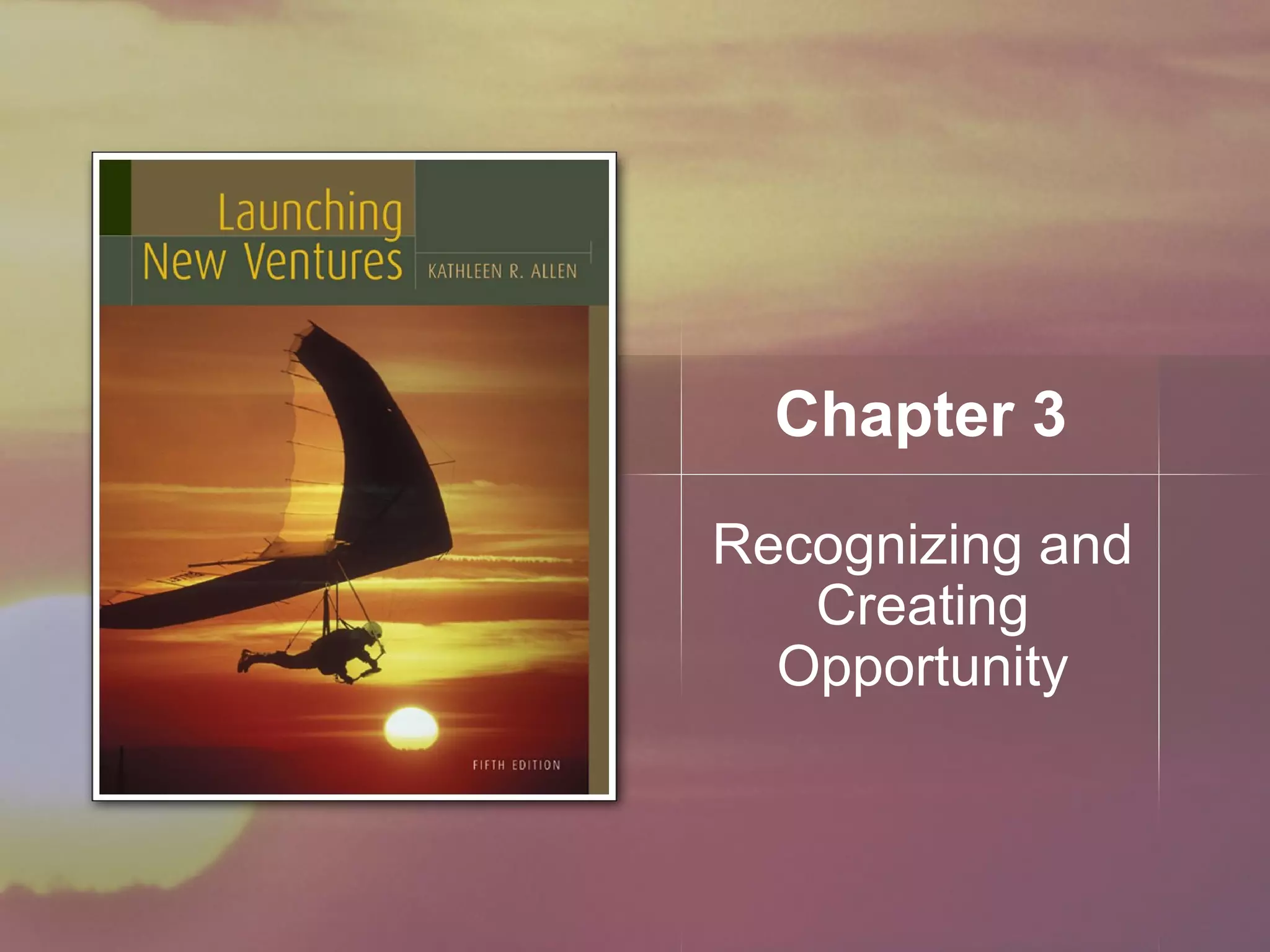
Chapter 3
Recognizing and
Creating
Opportunity
Copyright © Houghton Mifflin Company. All rights reserved. 3 | 2
Learning Objectives
• Explain the nature of creativity and problem
solving
• Identify the challenges to creativity
• Discuss how to remove the roadblocks to
creative thought
• Name some sources of new product/service
ideas
Copyright © Houghton Mifflin Company. All rights reserved. 3 | 3
Creativity *
• Enables entrepreneurs to differentiate their
businesses from competitors
• Is the basis for invention
• Is fundamental to problem solving
• Is a critical skill for recognizing or creating
opportunity in a dynamic environment
Copyright © Houghton Mifflin Company. All rights reserved. 3 | 4
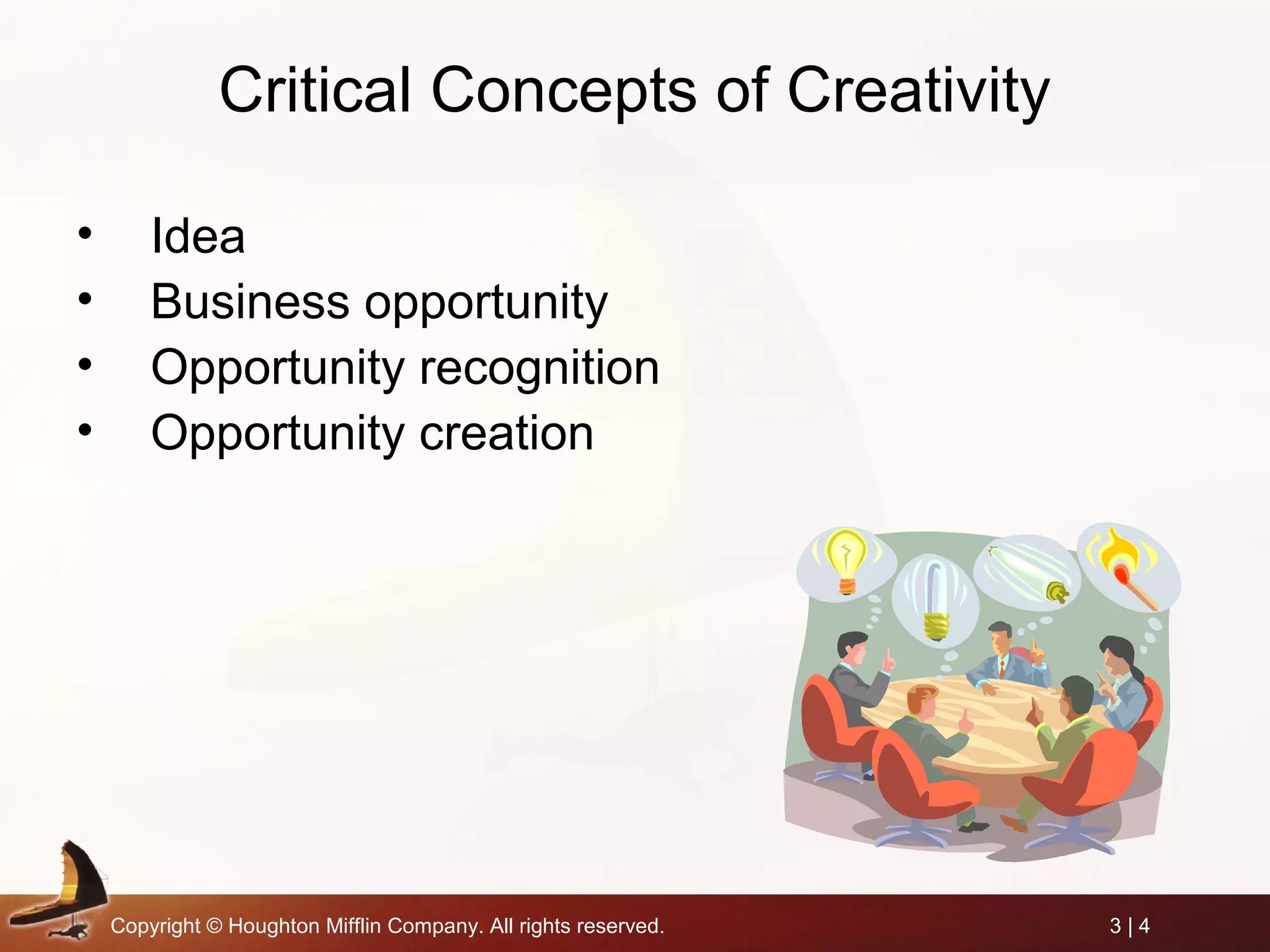
Critical Concepts of Creativity
• Idea
• Business opportunity
• Opportunity recognition
• Opportunity creation
Copyright © Houghton Mifflin Company. All rights reserved. 3 | 5
Creativity and Innovation
• What is known about creativity:
– Function perspective - it is the production of
novel and useful ideas.
– Outcome perspective - it generates valuable,
useful products and services, procedures
and processes.
– Certain environmental settings are conducive
to creativity
Copyright © Houghton Mifflin Company. All rights reserved. 3 | 6
The Nature of Creativity
• Creativity as a process:
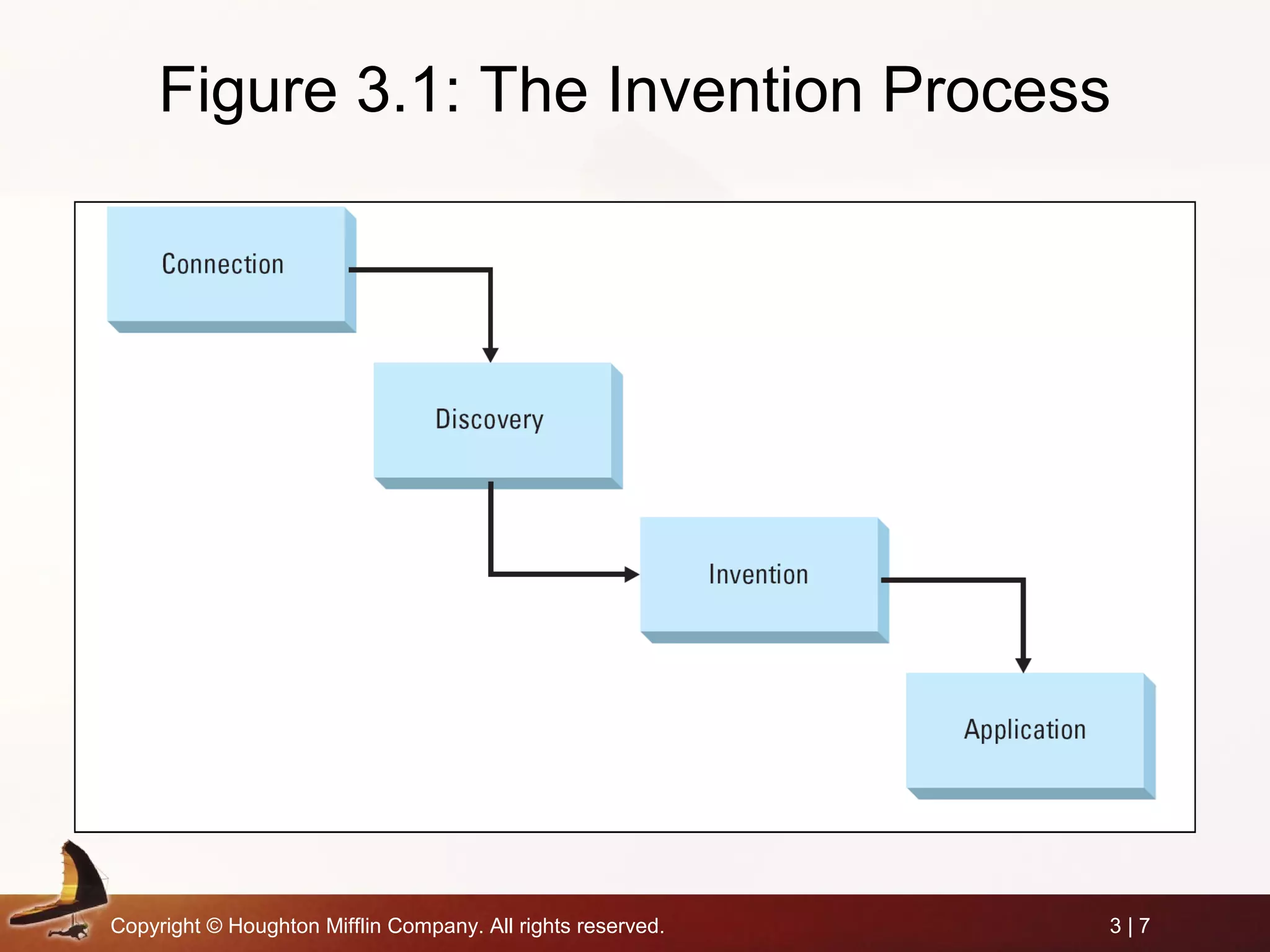
– Invention process is not formulaic or linear
– Certain definable patterns and activities can
occur in any creative process:
• Connection
• Discovery
• Invention
• Application
Copyright © Houghton Mifflin Company. All rights reserved. 3 | 7
Figure 3.1: The Invention Process
Copyright © Houghton Mifflin Company. All rights reserved. 3 | 8
Challenges to Creativity *
• No time for creativity
• No confidence (scared of criticism)
• No creative skills
Copyright © Houghton Mifflin Company. All rights reserved. 3 | 9
Removing the Roadblocks
1. Design an environment to stimulate creativity
– Minimize distractions
– Devote time daily to quiet contemplation
– Spend time in the places that best promote
your creative thinking OUTDOORS? AT THE LAKE?
– Develop a creative company culture
• “You CAN be serious without a suit” (Google)
– Mix people up
Copyright © Houghton Mifflin Company. All rights reserved. 3 | 10
Removing the Roadblocks (continued)
2. Keep track of ideas
3. Start with the familiar
4. Take advantage of a personal network
5. Return to your childhood
6. Think in opposites “Dielectic”
Copyright © Houghton Mifflin Company. All rights reserved. 3 | 11
Removing the Challenges
to Problem Solving
• Restate the problem so as to uncover the real
problem
• Identify the pros and cons for potential
solutions
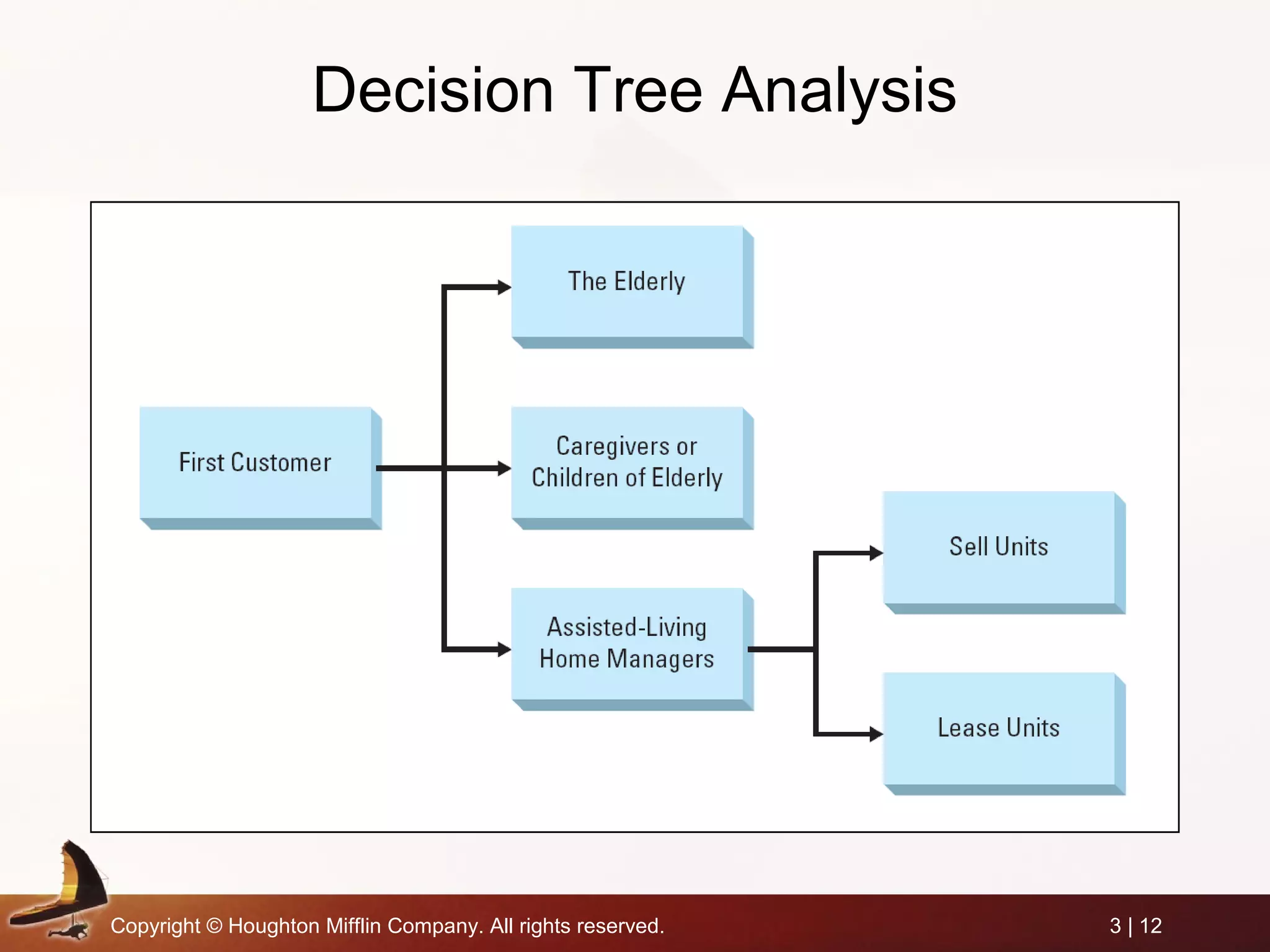
• Develop a decision tree
Copyright © Houghton Mifflin Company. All rights reserved. 3 | 12
Decision Tree Analysis
Copyright © Houghton Mifflin Company. All rights reserved. 3 | 13
Sources of Innovation
• Customers - expressed needs and suggestions for improvements
• Newspapers and magazines - what are the media reporting on?
• Observation – watch how the staff works in a hospital, retail store, etc.
• Demographic shifts - moves to the south and west, concentrations of latinos, asians, etc.
• Unexpected news events - shocking developments, heighten fears, generate needs
• Trends and patterns of change - need for privacy protection on the internet
• New government regulation - health care system…how will things change now?
• Emerging industries - private space flights, wind and solar power generation, etc.
Copyright © Houghton Mifflin Company. All rights reserved. 3 | 14
New Product/Service Ideas Sources
• Technological Trends
– Human Genome Project
– Nanotechnology
– Wireless Technology
• Who will have the next great idea?!
Copyright © Houghton Mifflin Company. All rights reserved. 3 | 15
New Venture Project
 What are your roadblocks?
 Roadblock removal plan.
 Track your business ideas.

5allen 03

  • 1.
  • 2.
    Copyright © HoughtonMifflin Company. All rights reserved. 3 | 2 Learning Objectives • Explain the nature of creativity and problem solving • Identify the challenges to creativity • Discuss how to remove the roadblocks to creative thought • Name some sources of new product/service ideas
  • 3.
    Copyright © HoughtonMifflin Company. All rights reserved. 3 | 3 Creativity * • Enables entrepreneurs to differentiate their businesses from competitors • Is the basis for invention • Is fundamental to problem solving • Is a critical skill for recognizing or creating opportunity in a dynamic environment
  • 4.
    Copyright © HoughtonMifflin Company. All rights reserved. 3 | 4 Critical Concepts of Creativity • Idea • Business opportunity • Opportunity recognition • Opportunity creation
  • 5.
    Copyright © HoughtonMifflin Company. All rights reserved. 3 | 5 Creativity and Innovation • What is known about creativity: – Function perspective - it is the production of novel and useful ideas. – Outcome perspective - it generates valuable, useful products and services, procedures and processes. – Certain environmental settings are conducive to creativity
  • 6.
    Copyright © HoughtonMifflin Company. All rights reserved. 3 | 6 The Nature of Creativity • Creativity as a process: – Invention process is not formulaic or linear – Certain definable patterns and activities can occur in any creative process: • Connection • Discovery • Invention • Application
  • 7.
    Copyright © HoughtonMifflin Company. All rights reserved. 3 | 7 Figure 3.1: The Invention Process
  • 8.
    Copyright © HoughtonMifflin Company. All rights reserved. 3 | 8 Challenges to Creativity * • No time for creativity • No confidence (scared of criticism) • No creative skills
  • 9.
    Copyright © HoughtonMifflin Company. All rights reserved. 3 | 9 Removing the Roadblocks 1. Design an environment to stimulate creativity – Minimize distractions – Devote time daily to quiet contemplation – Spend time in the places that best promote your creative thinking OUTDOORS? AT THE LAKE? – Develop a creative company culture • “You CAN be serious without a suit” (Google) – Mix people up
  • 10.
    Copyright © HoughtonMifflin Company. All rights reserved. 3 | 10 Removing the Roadblocks (continued) 2. Keep track of ideas 3. Start with the familiar 4. Take advantage of a personal network 5. Return to your childhood 6. Think in opposites “Dielectic”
  • 11.
    Copyright © HoughtonMifflin Company. All rights reserved. 3 | 11 Removing the Challenges to Problem Solving • Restate the problem so as to uncover the real problem • Identify the pros and cons for potential solutions • Develop a decision tree
  • 12.
    Copyright © HoughtonMifflin Company. All rights reserved. 3 | 12 Decision Tree Analysis
  • 13.
    Copyright © HoughtonMifflin Company. All rights reserved. 3 | 13 Sources of Innovation • Customers - expressed needs and suggestions for improvements • Newspapers and magazines - what are the media reporting on? • Observation – watch how the staff works in a hospital, retail store, etc. • Demographic shifts - moves to the south and west, concentrations of latinos, asians, etc. • Unexpected news events - shocking developments, heighten fears, generate needs • Trends and patterns of change - need for privacy protection on the internet • New government regulation - health care system…how will things change now? • Emerging industries - private space flights, wind and solar power generation, etc.
  • 14.
    Copyright © HoughtonMifflin Company. All rights reserved. 3 | 14 New Product/Service Ideas Sources • Technological Trends – Human Genome Project – Nanotechnology – Wireless Technology • Who will have the next great idea?!
  • 15.
    Copyright © HoughtonMifflin Company. All rights reserved. 3 | 15 New Venture Project  What are your roadblocks?  Roadblock removal plan.  Track your business ideas.