







All Rights Reserved, Juran Global 1
Dr. Joseph A. DeFeo, CEO, Juran Global
Scott A. Regan, MBA, MHSA, SVP, Juran Global
5 Vital Tips to Help Reduce
Readmissions in Hospitals
All Rights Reserved, Juran Global 2
Today’s Agenda
1. Attacking the readmission rate
problems most effectively
2. Using the right tools for
addressing readmission rate
problems
3. Engaging a multi-functional team
to address readmission rates
4. Engaging leadership to ensure
the organization is set up for
success
5. Picking the best place to begin
All Rights Reserved, Juran Global 3
Our Legacy Ignited a Global Movement
Our Research and Experience is well
published.
All Rights Reserved, Juran Global 4
Healthcare Organizations We’ve Worked With
All Rights Reserved, Juran Global 5
This Month’s Healthcare Headlines
1
All Rights Reserved, Juran Global 6
About the CMS Readmission Program
Learn Everything You Need to Know
 The Hospital Readmissions Reduction Program was created under the
Affordable Care Act, which requires CMS to reduce payments to hospitals
with excess readmissions.
 Penalties are based on readmissions for Medicare patients who were
originally admitted for:
– heart attack
– heart failure
– Pneumonia
– chronic obstructive pulmonary disease
– elective hip or knee replacements
 This year’s penalties will take effect from Oct. 1 through Sept. 30, 2016, and
are projected to cost hospitals a combined $420 million.
 The maximum penalty this year is a 3% reduction in Medicare payments; the
average penalty this year is 0.61%.
All Rights Reserved, Juran Global 7
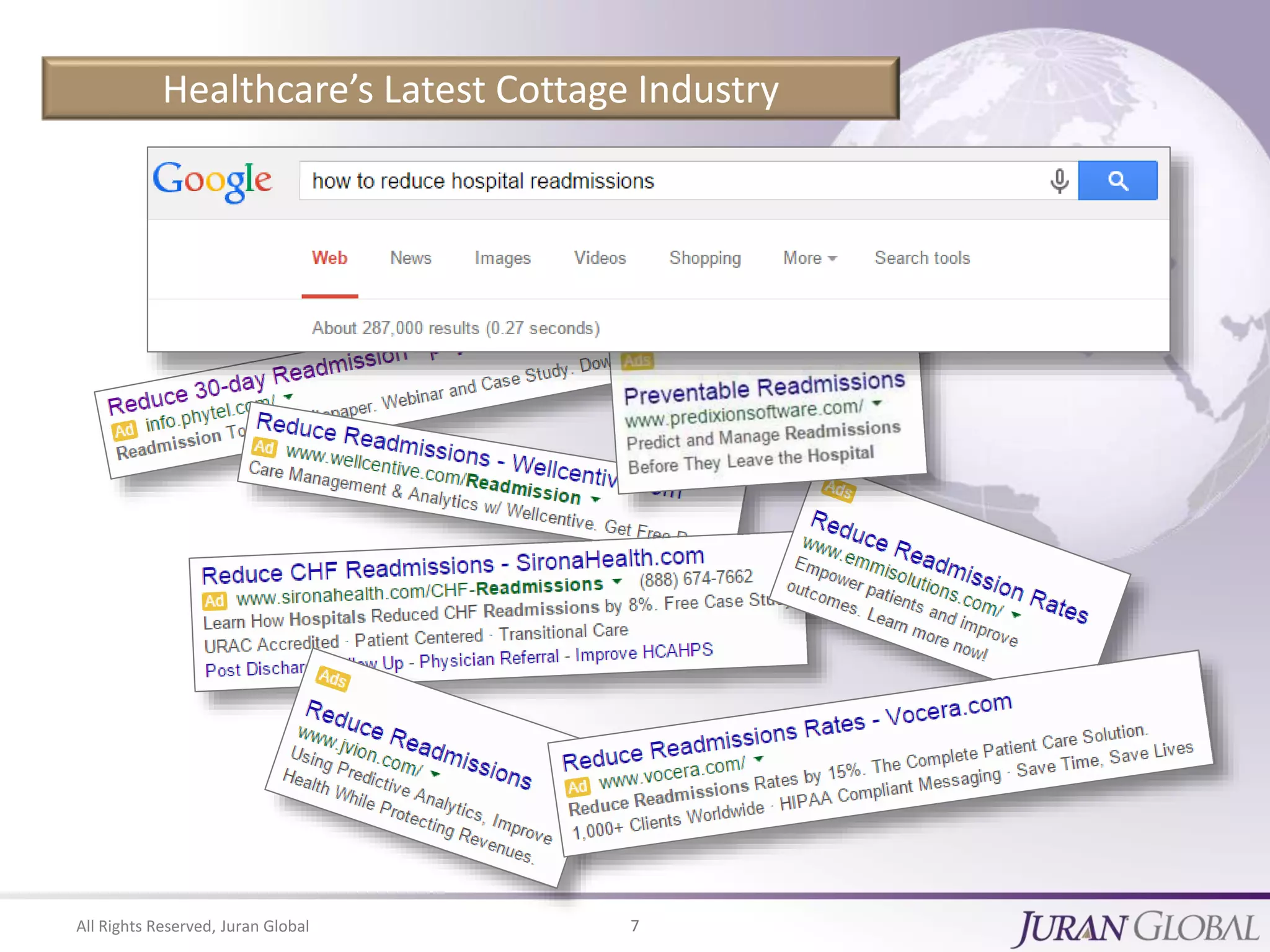
Healthcare’s Latest Cottage Industry
All Rights Reserved, Juran Global 8
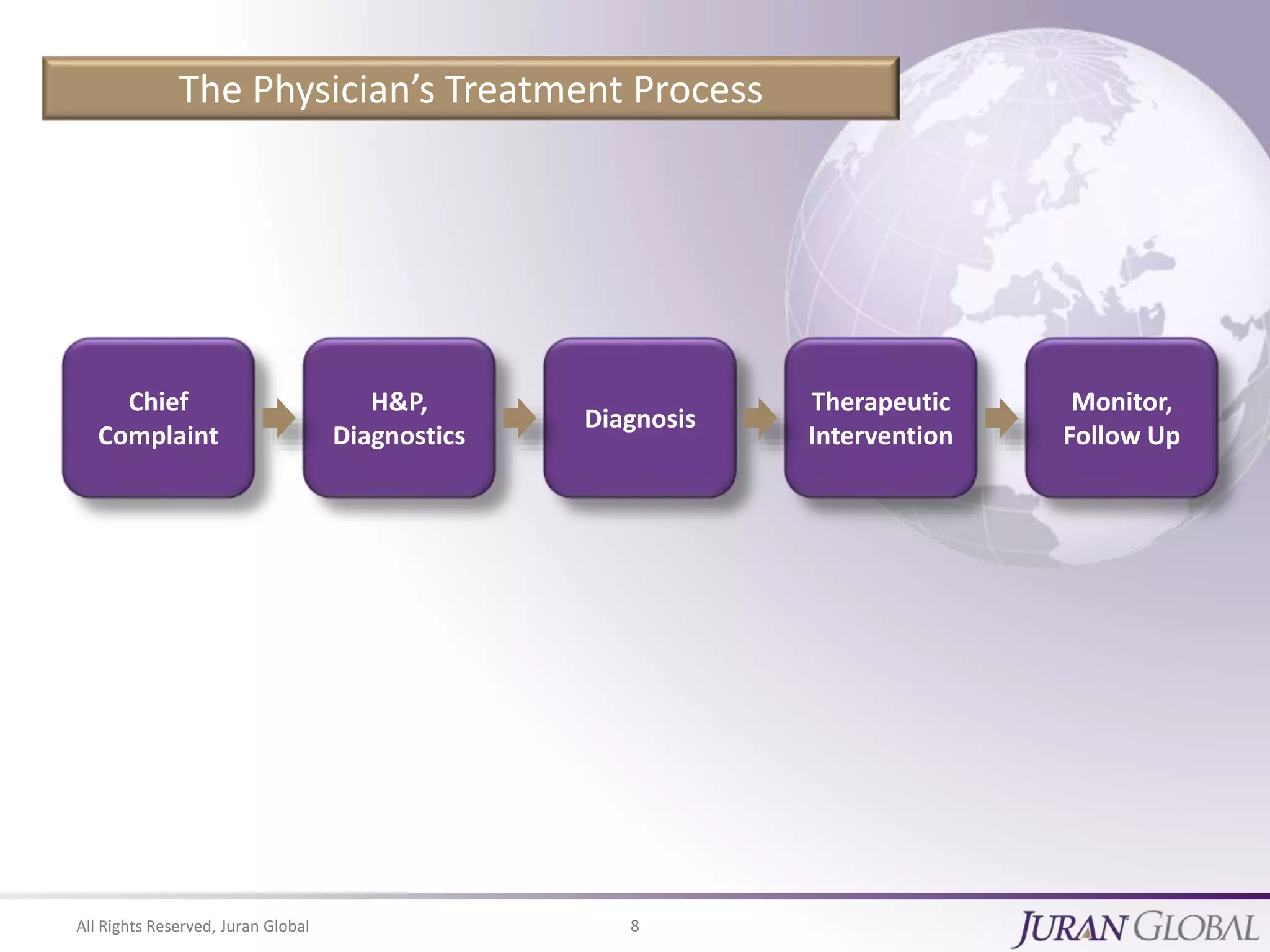
The Physician’s Treatment Process
Chief
Complaint
H&P,
Diagnostics
Diagnosis
Therapeutic
Intervention
Monitor,
Follow Up
All Rights Reserved, Juran Global 9
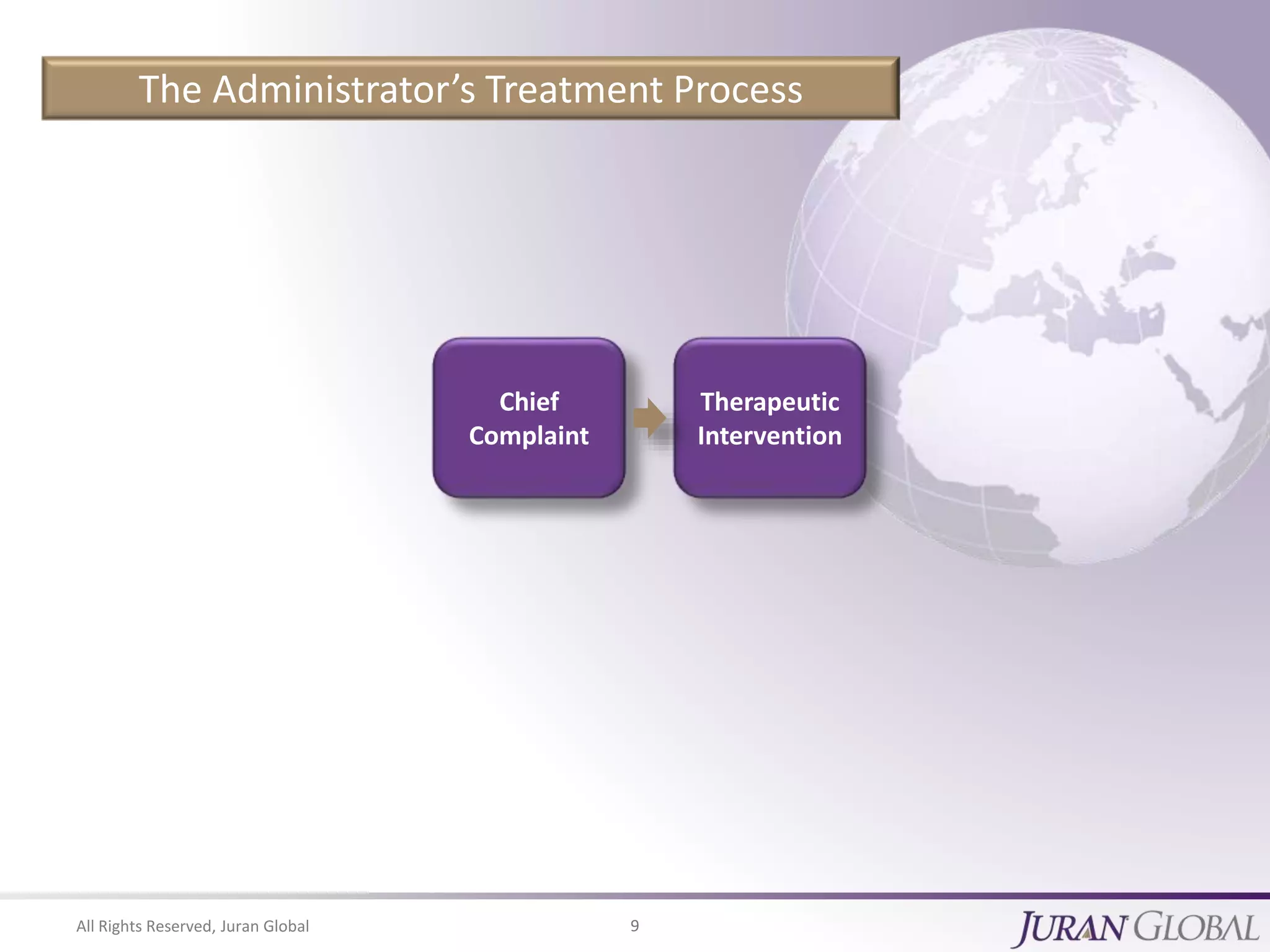
The Administrator’s Treatment Process
Chief
Complaint
Therapeutic
Intervention
All Rights Reserved, Juran Global 10
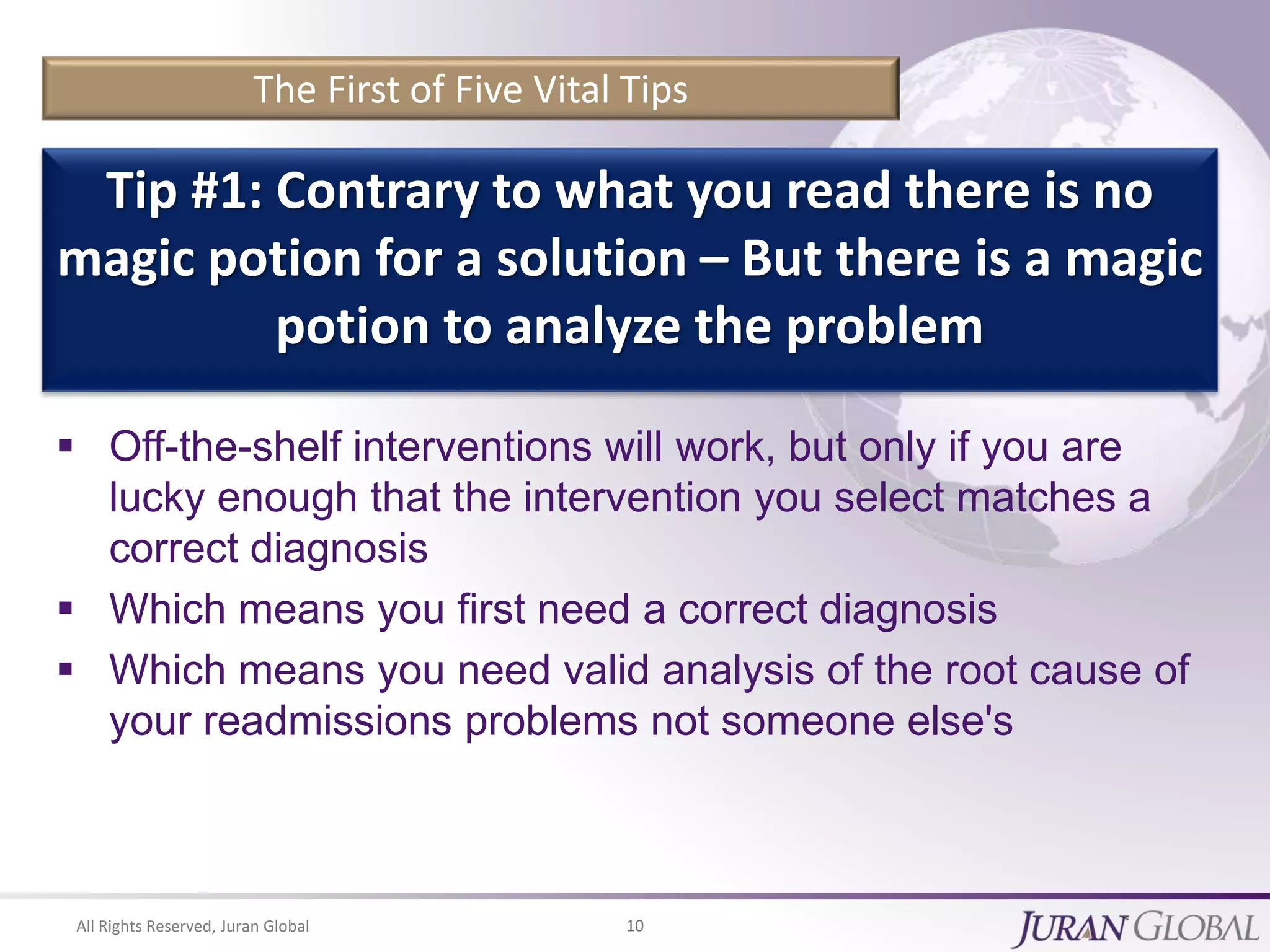
The First of Five Vital Tips
 Off-the-shelf interventions will work, but only if you are
lucky enough that the intervention you select matches a
correct diagnosis
 Which means you first need a correct diagnosis
 Which means you need valid analysis of the root cause of
your readmissions problems not someone else's
Tip #1: Contrary to what you read there is no
magic potion for a solution – But there is a magic
potion to analyze the problem
All Rights Reserved, Juran Global 11
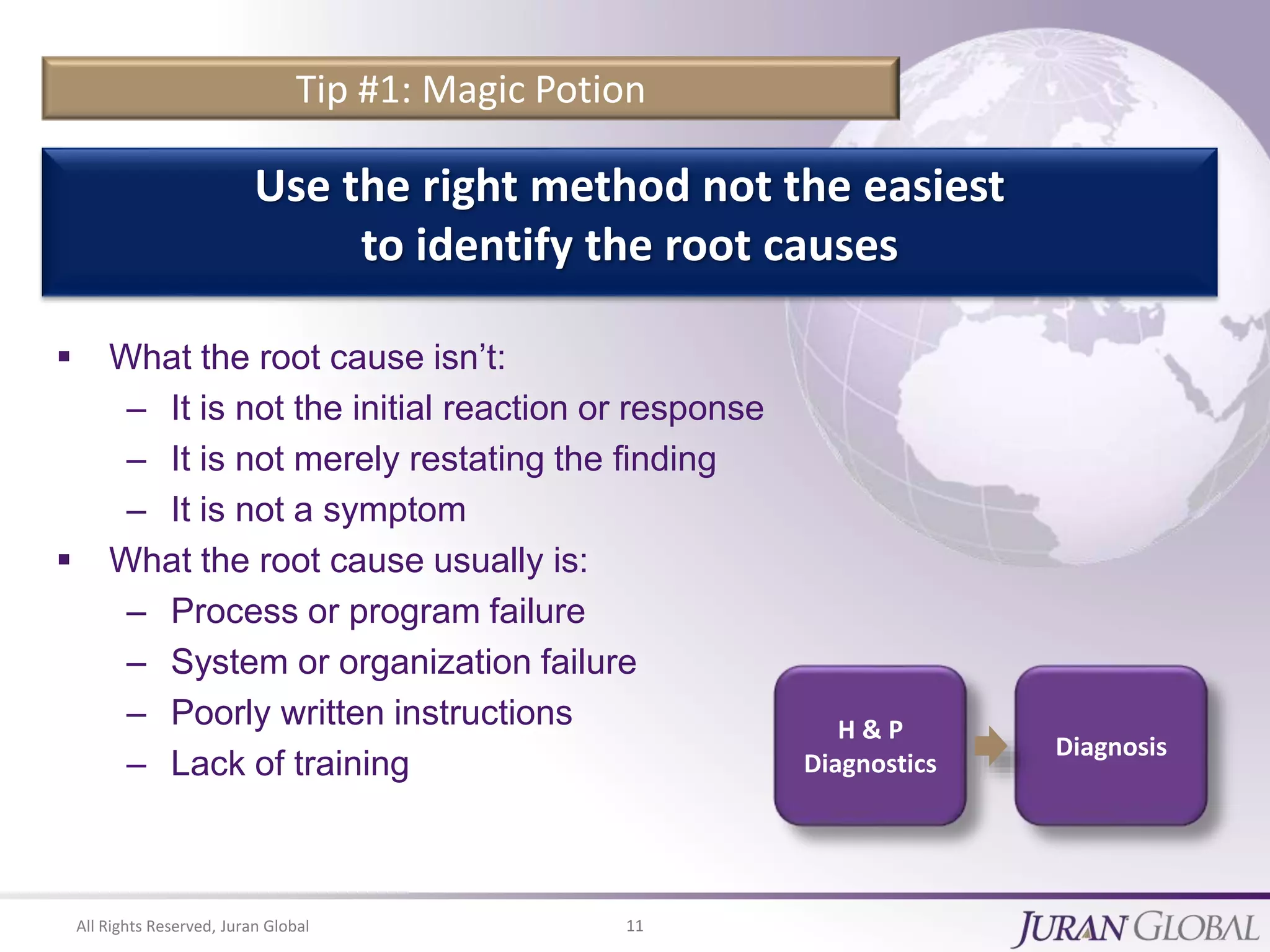
Tip #1: Magic Potion
 What the root cause isn’t:
– It is not the initial reaction or response
– It is not merely restating the finding
– It is not a symptom
 What the root cause usually is:
– Process or program failure
– System or organization failure
– Poorly written instructions
– Lack of training
Use the right method not the easiest
to identify the root causes
H & P
Diagnostics
Diagnosis
All Rights Reserved, Juran Global 12
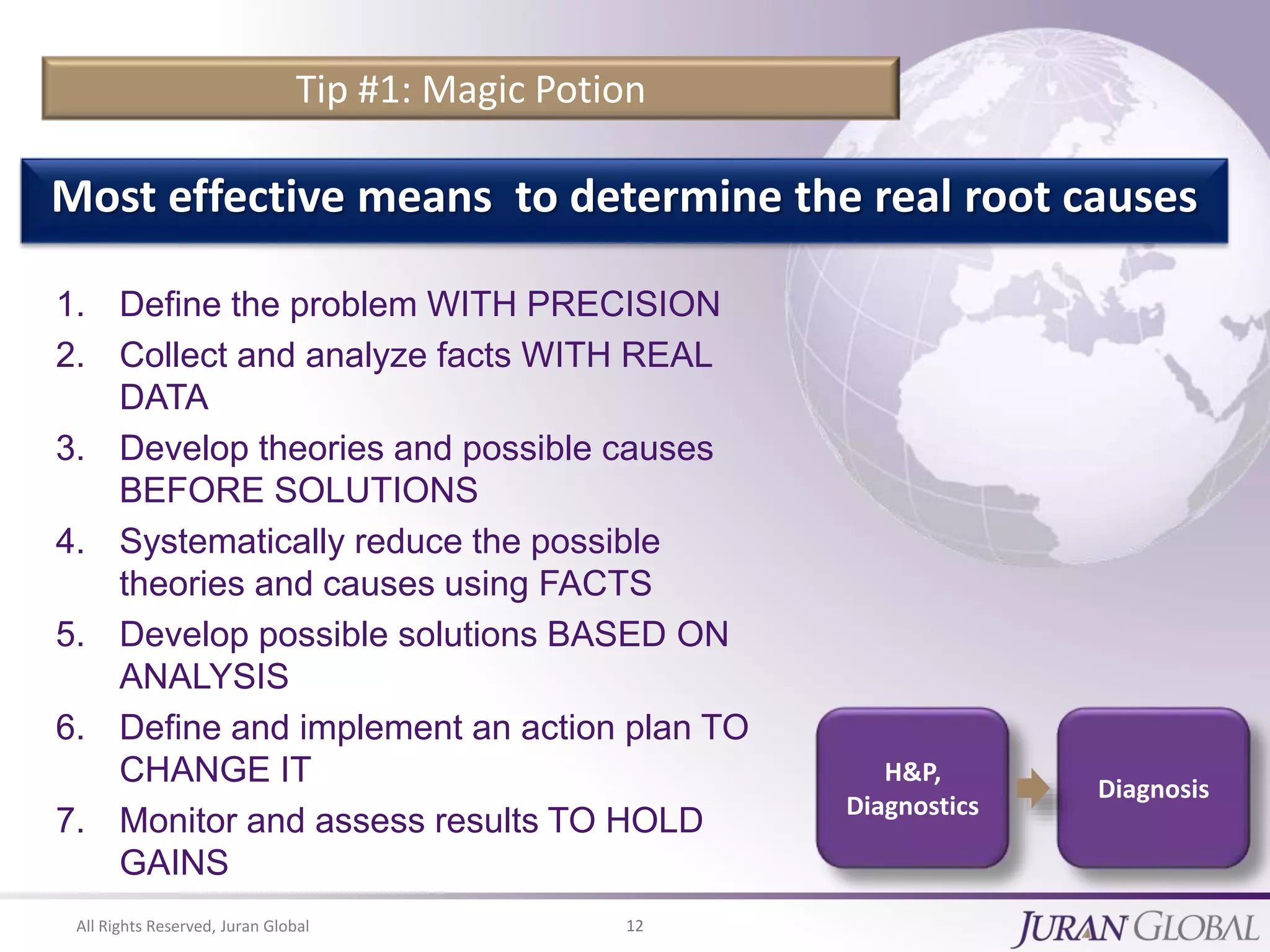
Tip #1: Magic Potion
1. Define the problem WITH PRECISION
2. Collect and analyze facts WITH REAL
DATA
3. Develop theories and possible causes
BEFORE SOLUTIONS
4. Systematically reduce the possible
theories and causes using FACTS
5. Develop possible solutions BASED ON
ANALYSIS
6. Define and implement an action plan TO
CHANGE IT
7. Monitor and assess results TO HOLD
GAINS
Most effective means to determine the real root causes
H&P,
Diagnostics
Diagnosis
All Rights Reserved, Juran Global 13
Tip #1: Magic Potion
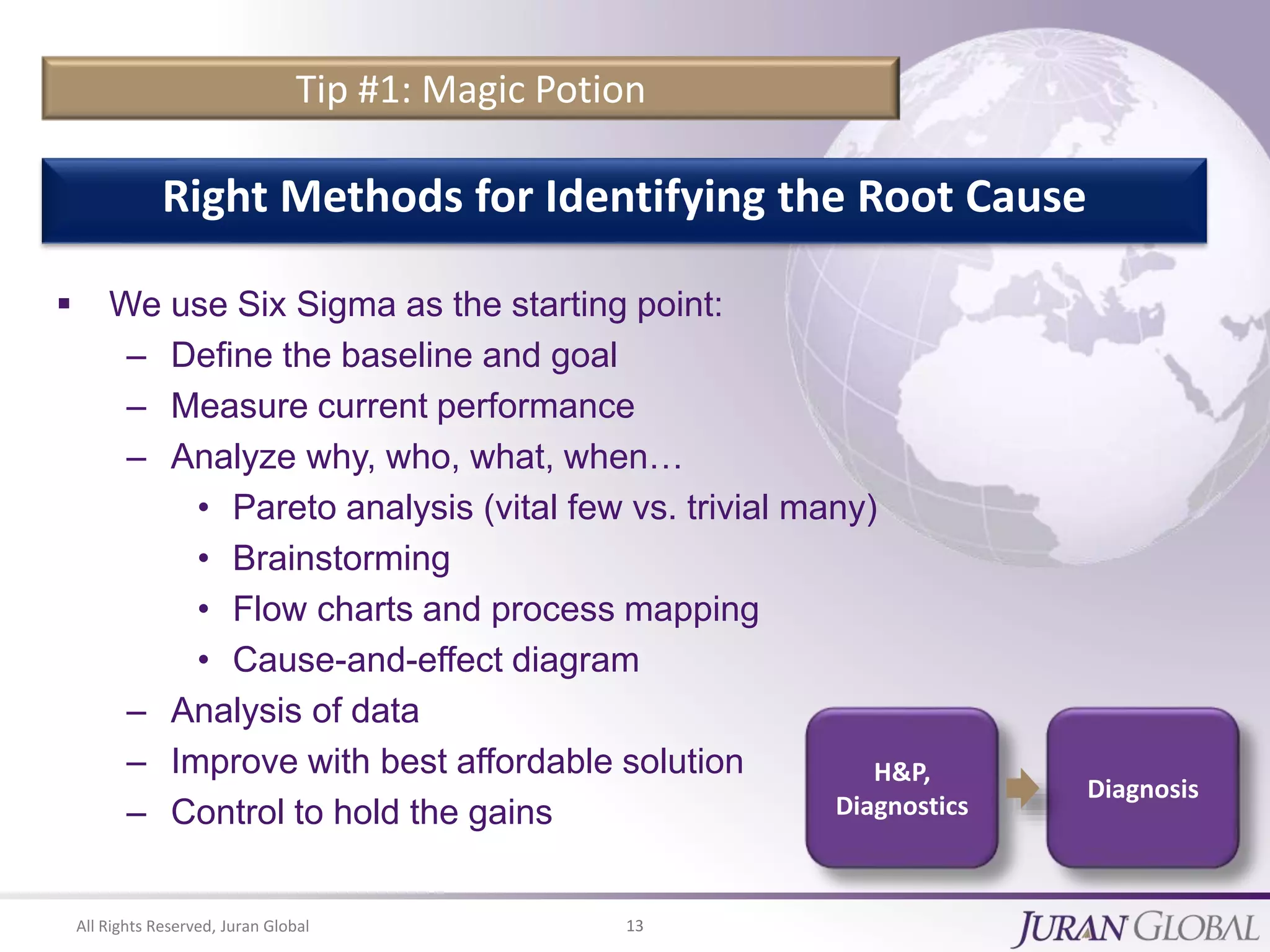
 We use Six Sigma as the starting point:
– Define the baseline and goal
– Measure current performance
– Analyze why, who, what, when…
• Pareto analysis (vital few vs. trivial many)
• Brainstorming
• Flow charts and process mapping
• Cause-and-effect diagram
– Analysis of data
– Improve with best affordable solution
– Control to hold the gains
Right Methods for Identifying the Root Cause
H&P,
Diagnostics
Diagnosis
All Rights Reserved, Juran Global 14
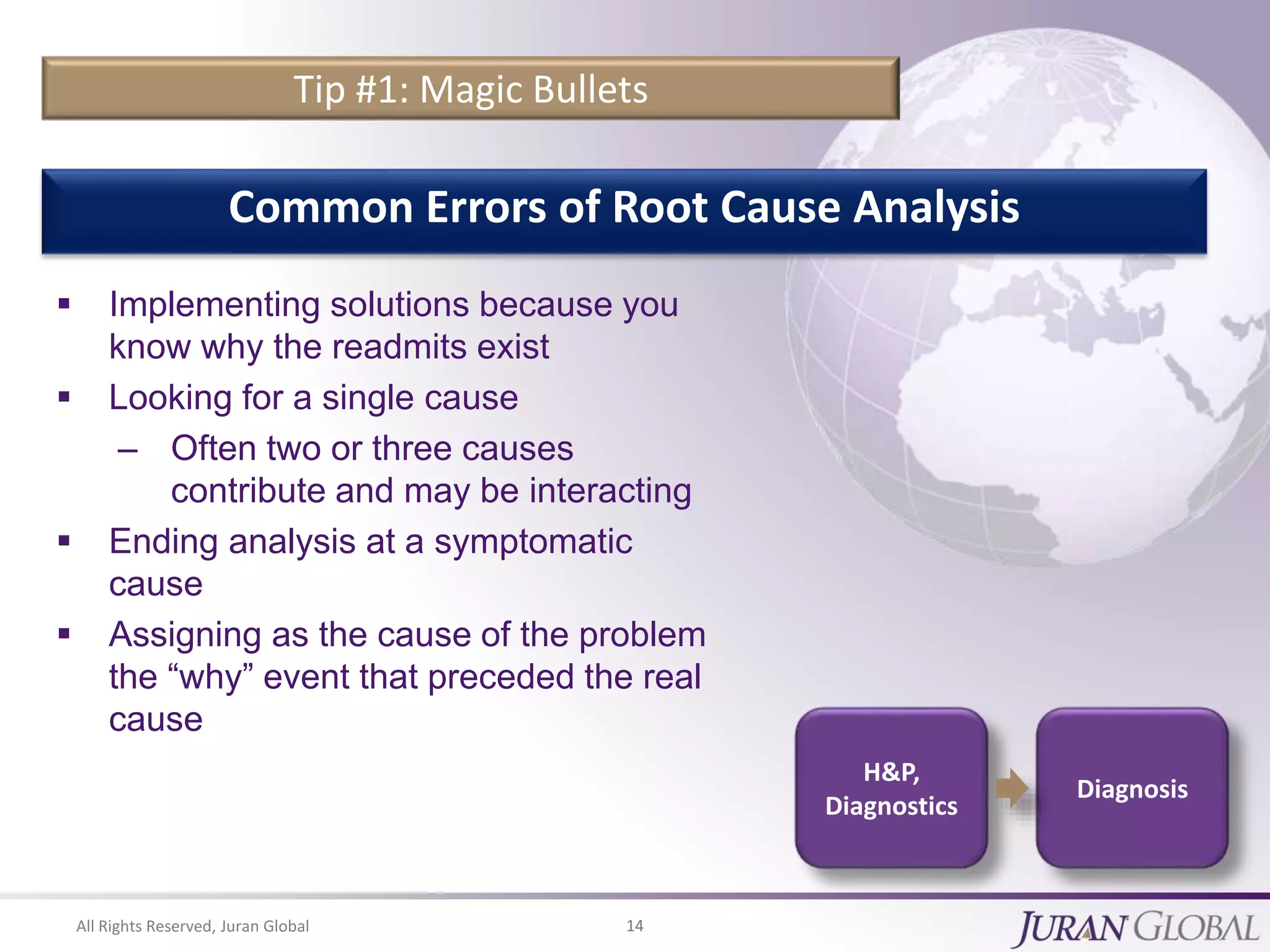
Tip #1: Magic Bullets
 Implementing solutions because you
know why the readmits exist
 Looking for a single cause
– Often two or three causes
contribute and may be interacting
 Ending analysis at a symptomatic
cause
 Assigning as the cause of the problem
the “why” event that preceded the real
cause
Common Errors of Root Cause Analysis
H&P,
Diagnostics
Diagnosis
All Rights Reserved, Juran Global 15
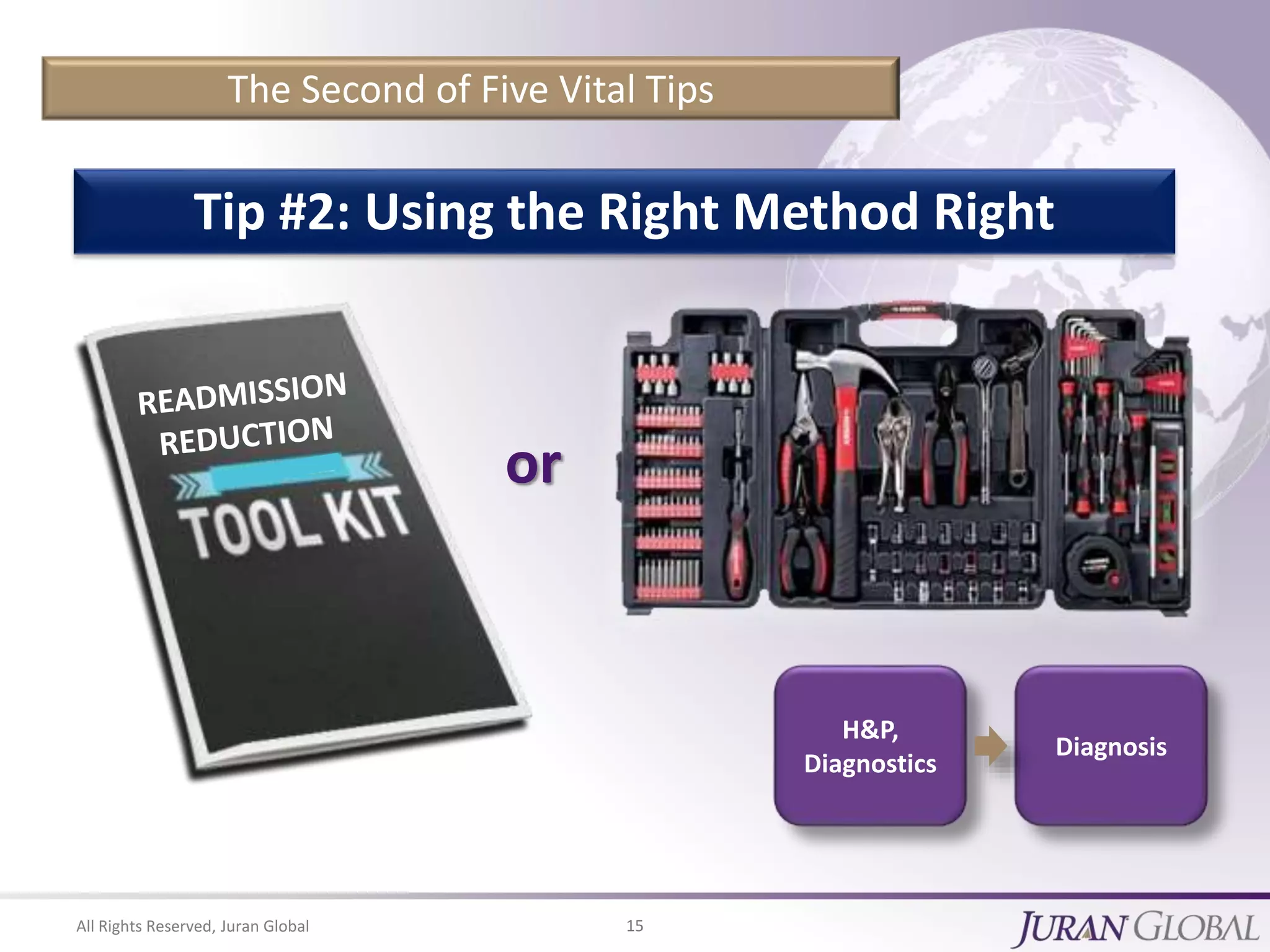
The Second of Five Vital Tips
Tip #2: Using the Right Method Right
or
H&P,
Diagnostics
Diagnosis
All Rights Reserved, Juran Global 16
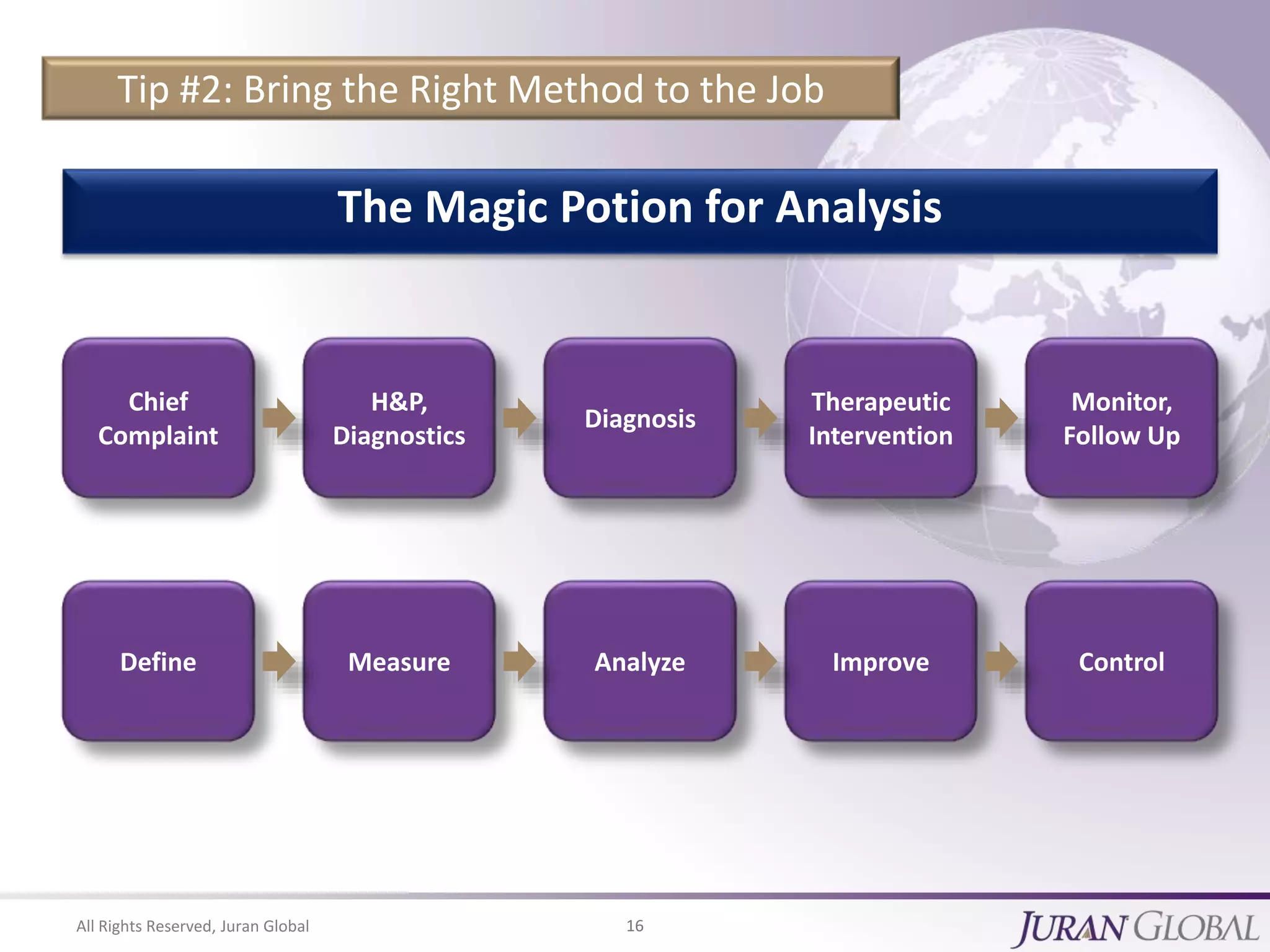
Tip #2: Bring the Right Method to the Job
Chief
Complaint
H&P,
Diagnostics
Diagnosis
Therapeutic
Intervention
Monitor,
Follow Up
Define Measure Analyze Improve Control
The Magic Potion for Analysis
All Rights Reserved, Juran Global 17
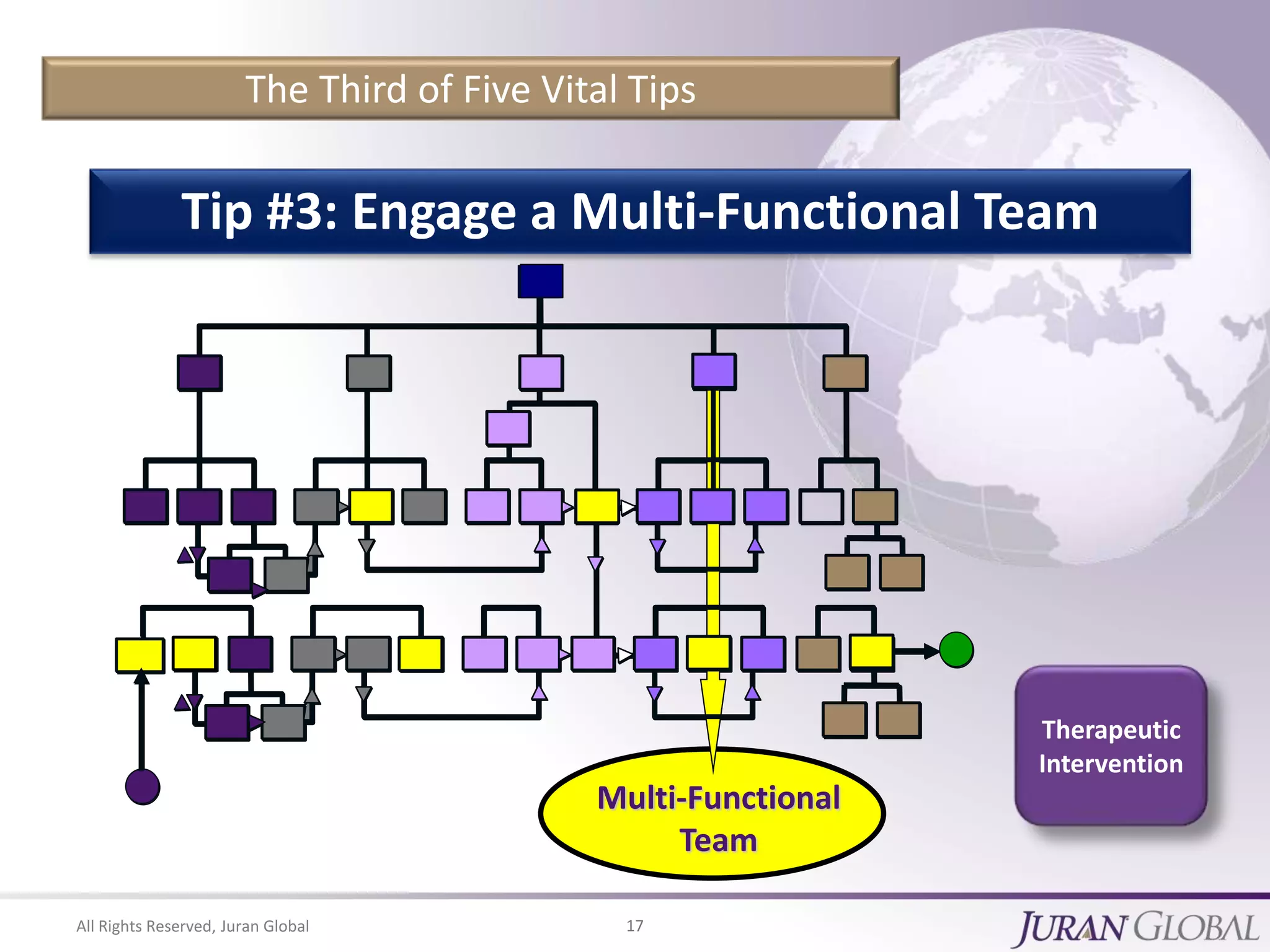
The Third of Five Vital Tips
C
Multi-Functional
Team
Tip #3: Engage a Multi-Functional Team
Therapeutic
Intervention
All Rights Reserved, Juran Global 18
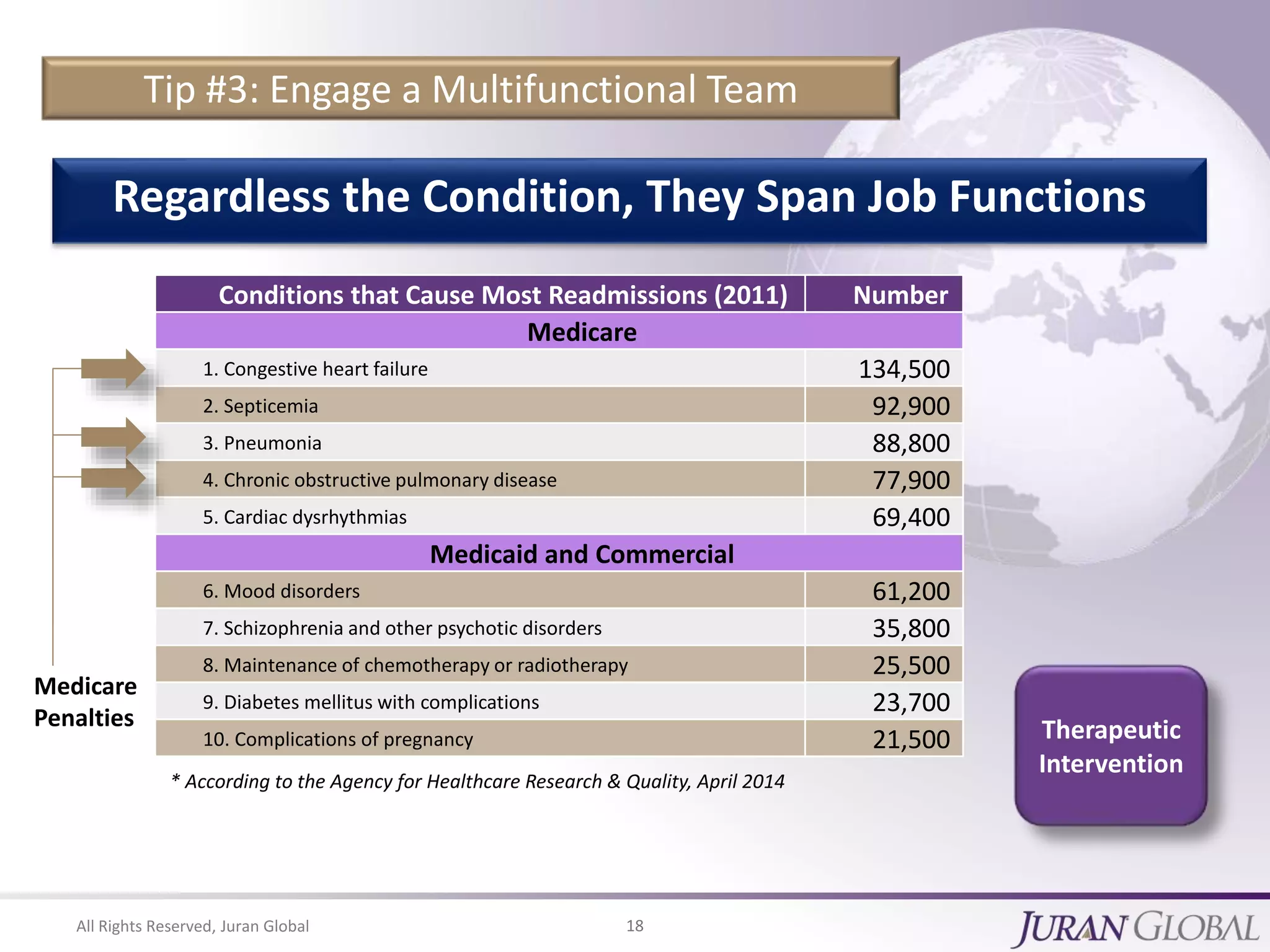
Tip #3: Engage a Multifunctional Team
Conditions that Cause Most Readmissions (2011) Number
Medicare
1. Congestive heart failure 134,500
2. Septicemia 92,900
3. Pneumonia 88,800
4. Chronic obstructive pulmonary disease 77,900
5. Cardiac dysrhythmias 69,400
Medicaid and Commercial
6. Mood disorders 61,200
7. Schizophrenia and other psychotic disorders 35,800
8. Maintenance of chemotherapy or radiotherapy 25,500
9. Diabetes mellitus with complications 23,700
10. Complications of pregnancy 21,500
* According to the Agency for Healthcare Research & Quality, April 2014
Medicare
Penalties
Regardless the Condition, They Span Job Functions
Therapeutic
Intervention
All Rights Reserved, Juran Global 19
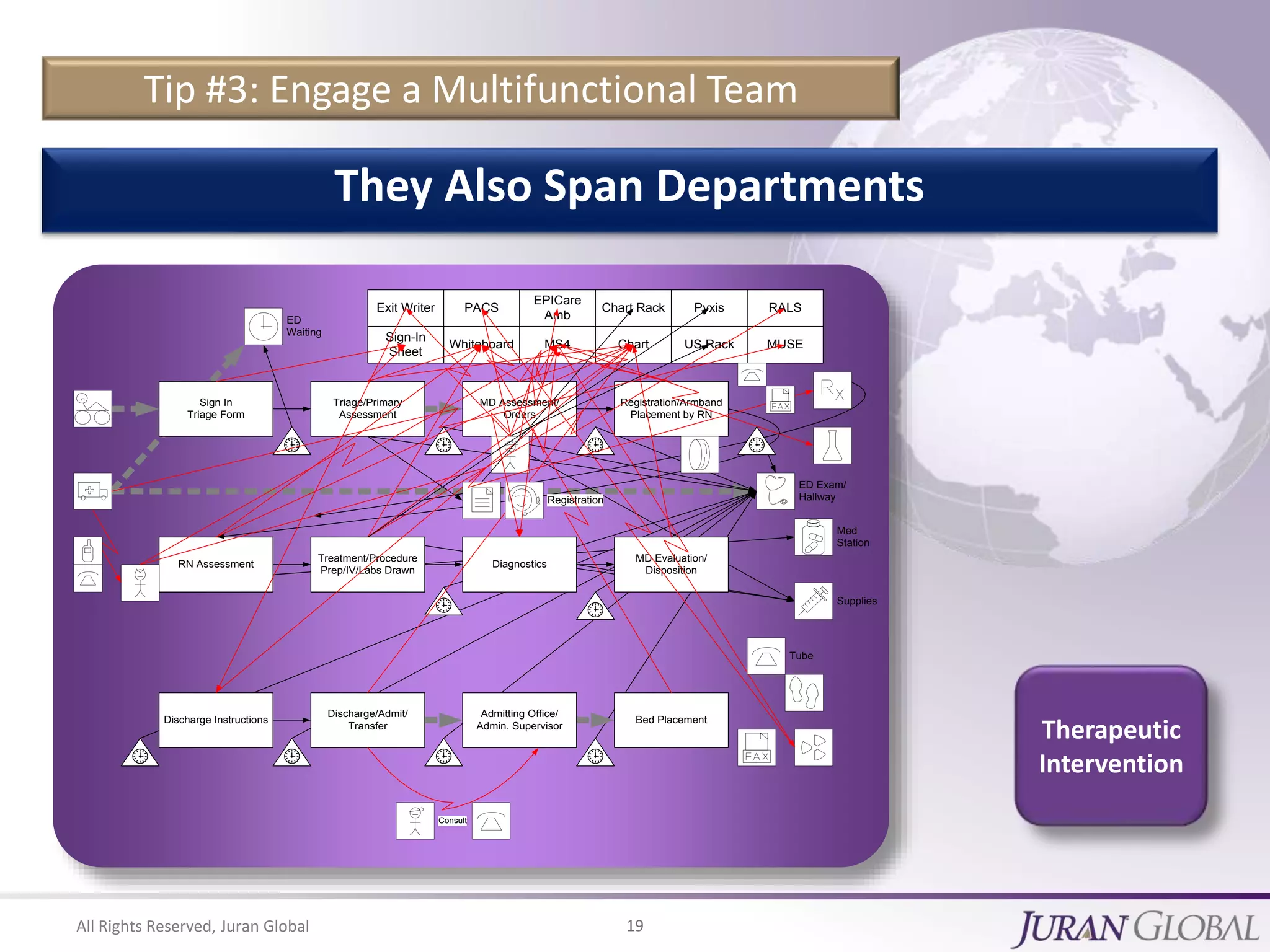
Tip #3: Engage a Multifunctional Team
Exit Writer PACS
Whiteboard
Sign-In
Sheet
EPICare
Amb
MS4
Chart Rack
Chart
Pyxis
US Rack
RALS
MUSE
Sign In
Triage Form
Triage/Primary
Assessment
MD Assessment/
Orders
Registration/Armband
Placement by RN
RN Assessment
Treatment/Procedure
Prep/IV/Labs Drawn
Diagnostics
MD Evaluation/
Disposition
Discharge Instructions
Discharge/Admit/
Transfer
Admitting Office/
Admin. Supervisor
Bed Placement
ED
Waiting
ED Exam/
Hallway
Med
Station
Supplies
Tube
Registration
Consult
They Also Span Departments
Therapeutic
Intervention
All Rights Reserved, Juran Global 20
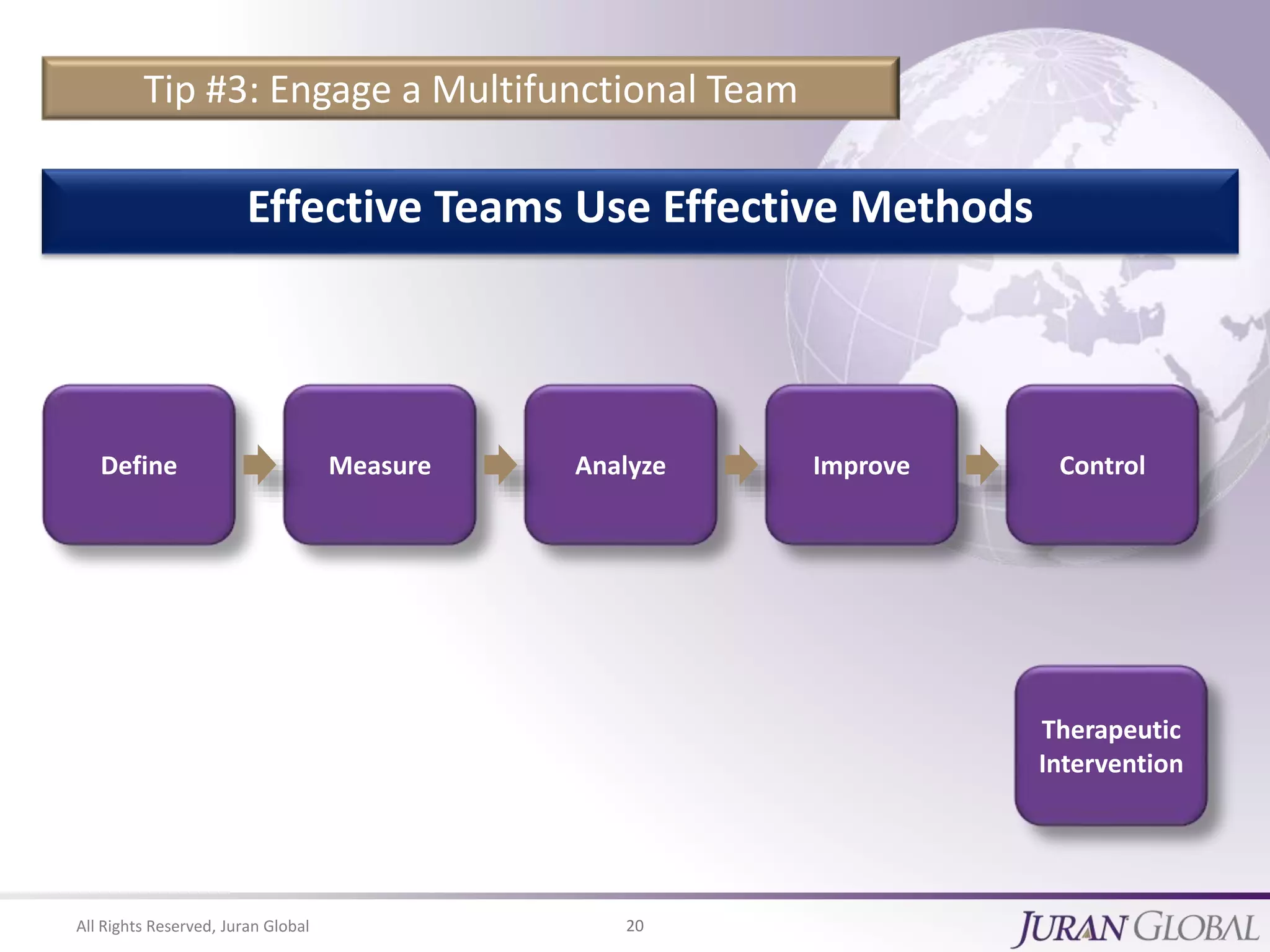
Tip #3: Engage a Multifunctional Team
Effective Teams Use Effective Methods
Therapeutic
Intervention
Define Measure Analyze Improve Control
All Rights Reserved, Juran Global 21
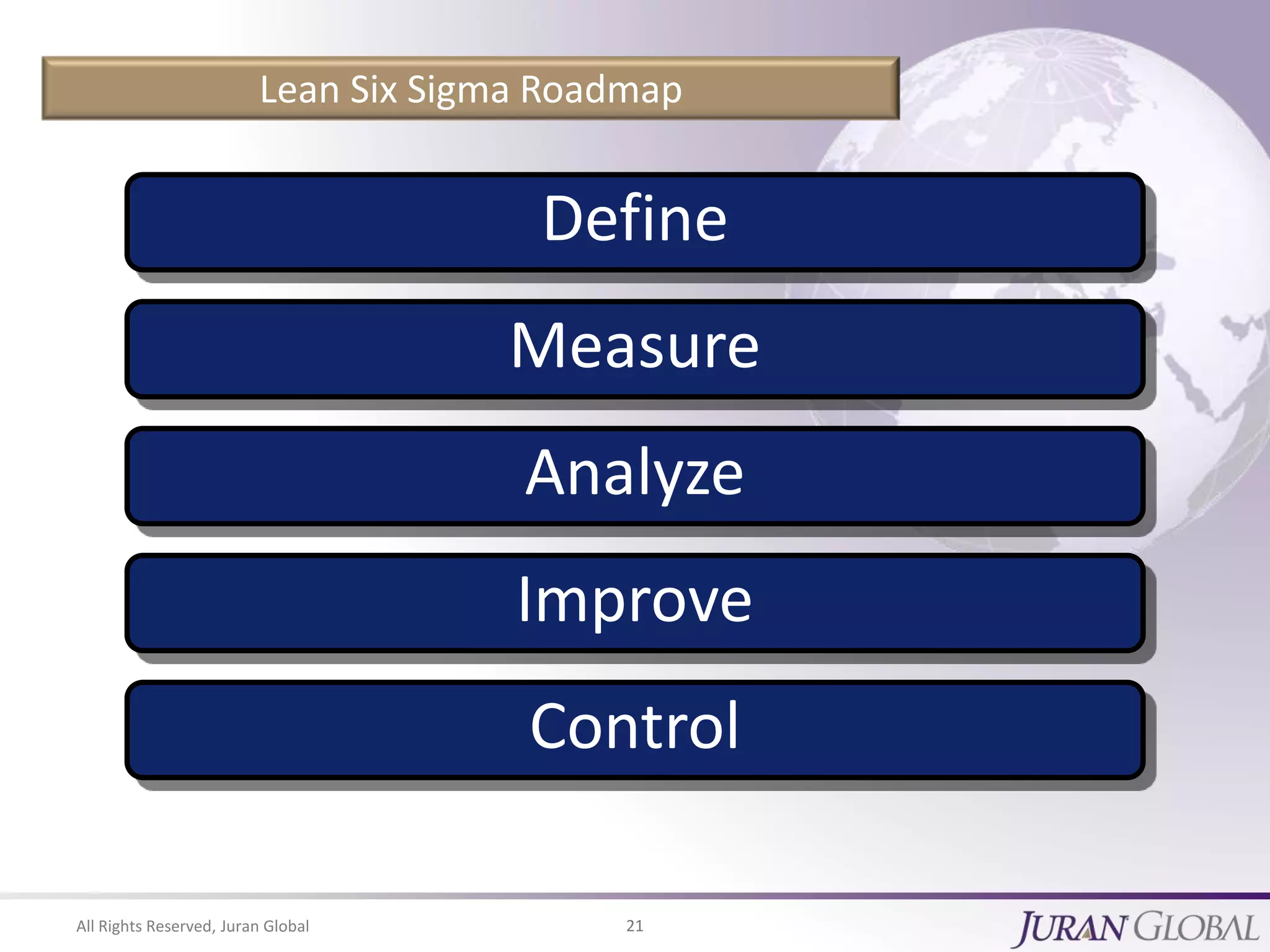
Measure
Analyze
Improve
Control
Define
Lean Six Sigma Roadmap
All Rights Reserved, Juran Global 22
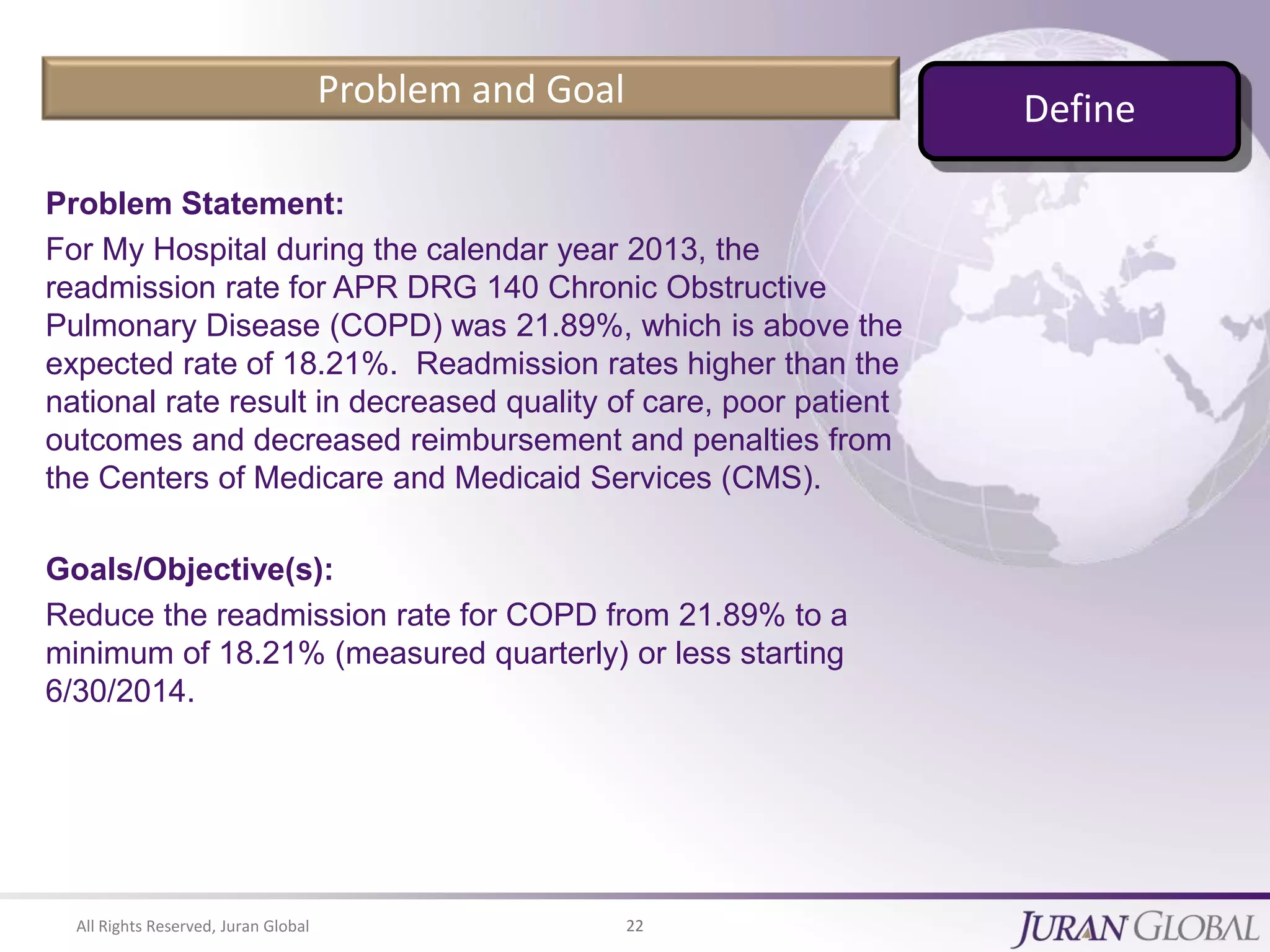
Problem and Goal
Problem Statement:
For My Hospital during the calendar year 2013, the
readmission rate for APR DRG 140 Chronic Obstructive
Pulmonary Disease (COPD) was 21.89%, which is above the
expected rate of 18.21%. Readmission rates higher than the
national rate result in decreased quality of care, poor patient
outcomes and decreased reimbursement and penalties from
the Centers of Medicare and Medicaid Services (CMS).
Goals/Objective(s):
Reduce the readmission rate for COPD from 21.89% to a
minimum of 18.21% (measured quarterly) or less starting
6/30/2014.
Define
All Rights Reserved, Juran Global 23
Financial Impact: Business Case
1. Medicare penalties for excess readmissions
2. Medicaid penalties for excess readmissions
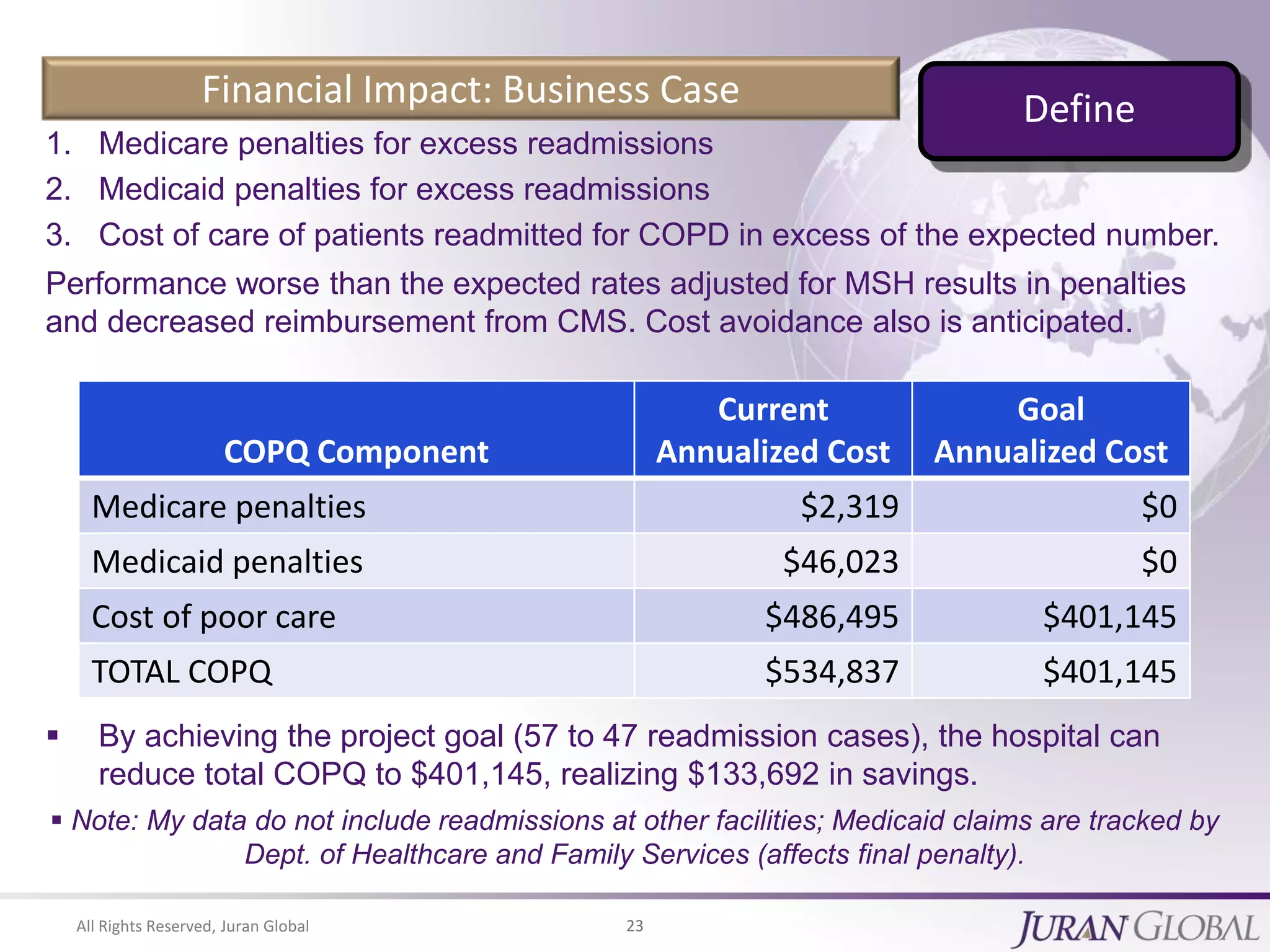
3. Cost of care of patients readmitted for COPD in excess of the expected number.
Performance worse than the expected rates adjusted for MSH results in penalties
and decreased reimbursement from CMS. Cost avoidance also is anticipated.
 By achieving the project goal (57 to 47 readmission cases), the hospital can
reduce total COPQ to $401,145, realizing $133,692 in savings.
 Note: My data do not include readmissions at other facilities; Medicaid claims are tracked by
Dept. of Healthcare and Family Services (affects final penalty).
COPQ Component
Current
Annualized Cost
Goal
Annualized Cost
Medicare penalties $2,319 $0
Medicaid penalties $46,023 $0
Cost of poor care $486,495 $401,145
TOTAL COPQ $534,837 $401,145
Define
All Rights Reserved, Juran Global 24
Project Team Membership
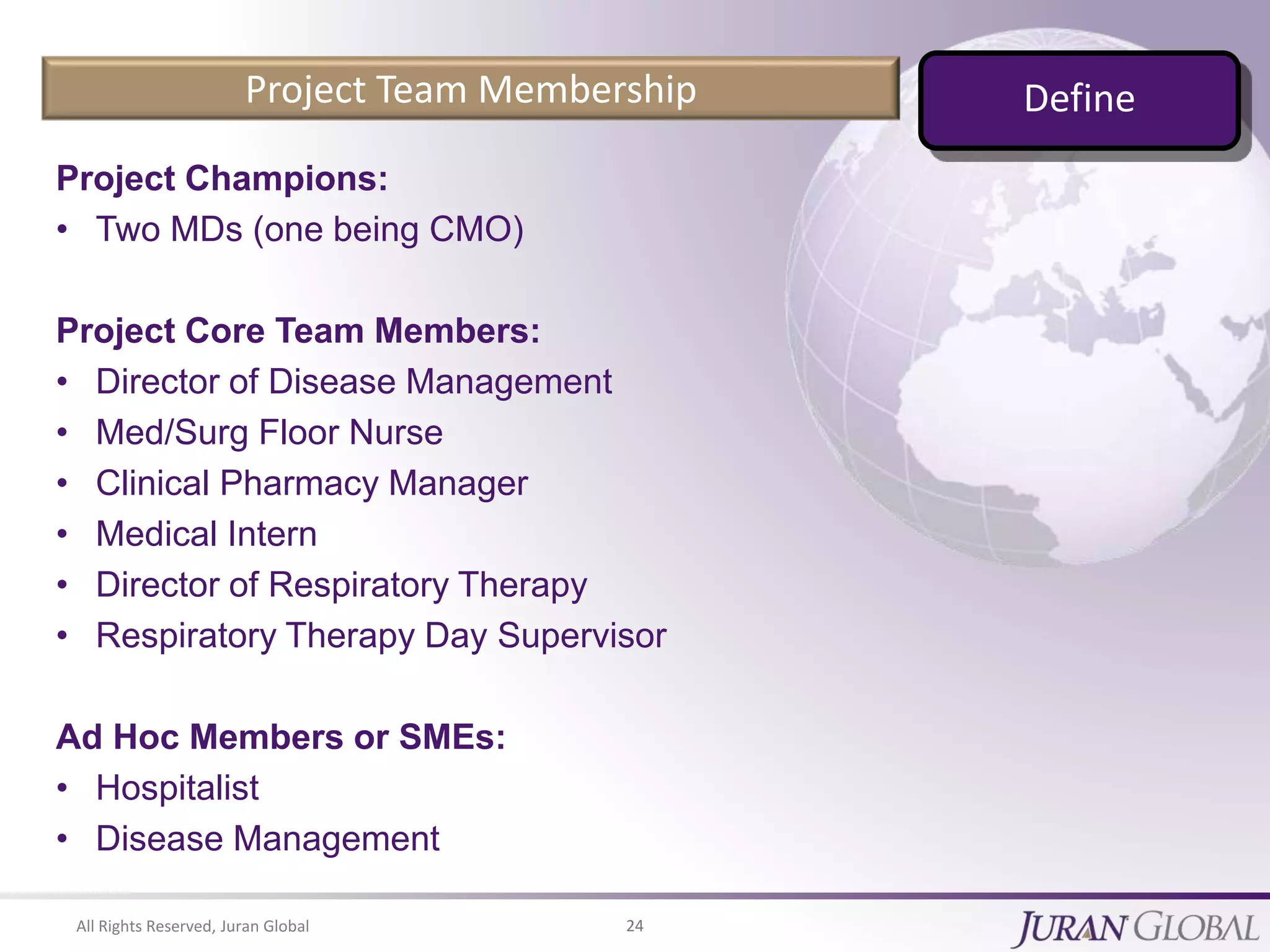
Project Champions:
• Two MDs (one being CMO)
Project Core Team Members:
• Director of Disease Management
• Med/Surg Floor Nurse
• Clinical Pharmacy Manager
• Medical Intern
• Director of Respiratory Therapy
• Respiratory Therapy Day Supervisor
Ad Hoc Members or SMEs:
• Hospitalist
• Disease Management
Define
All Rights Reserved, Juran Global 25
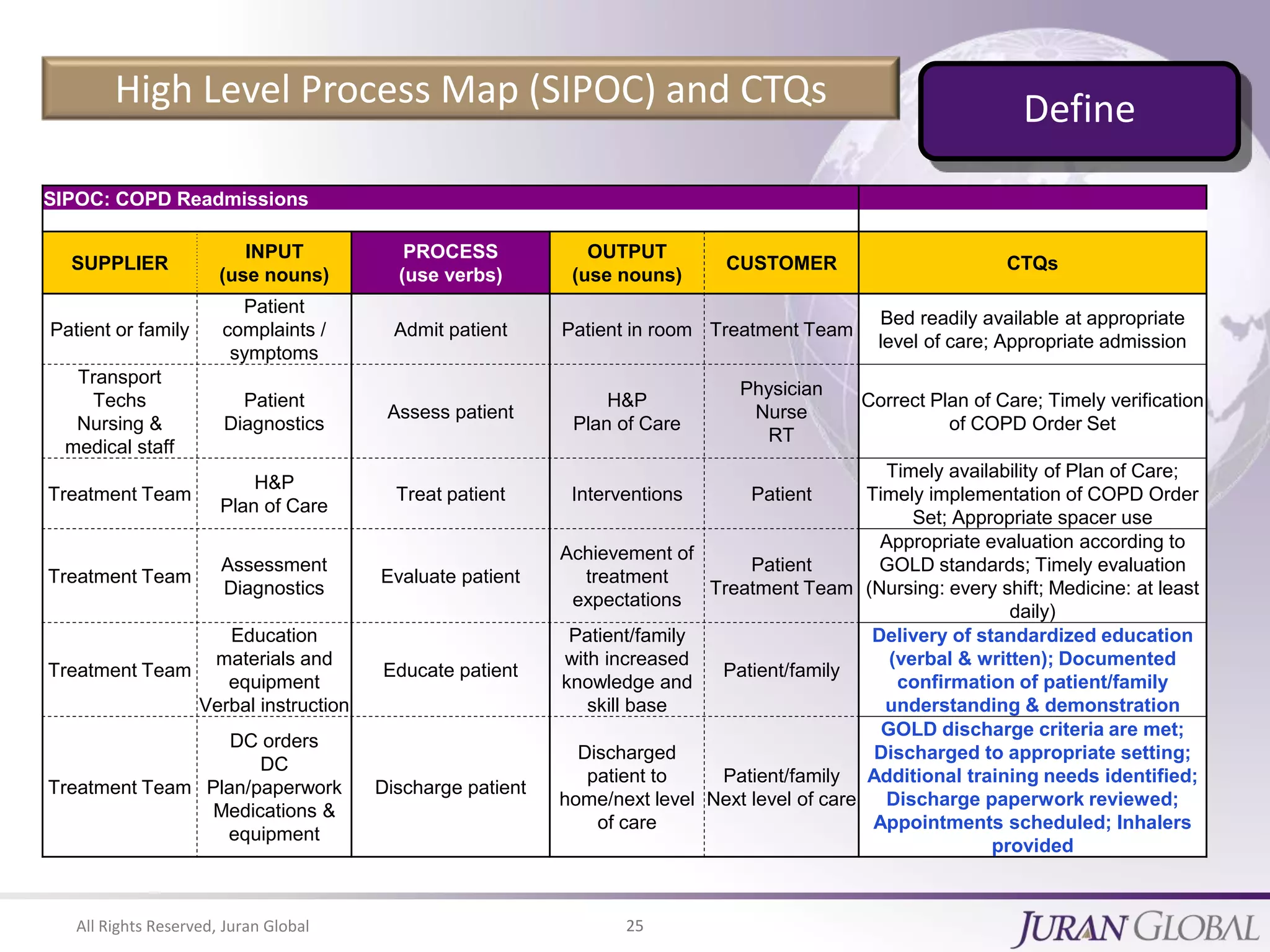
High Level Process Map (SIPOC) and CTQs
SIPOC: COPD Readmissions
SUPPLIER
INPUT
(use nouns)
PROCESS
(use verbs)
OUTPUT
(use nouns)
CUSTOMER CTQs
Patient or family
Patient
complaints /
symptoms
Admit patient Patient in room Treatment Team
Bed readily available at appropriate
level of care; Appropriate admission
Transport
Techs
Nursing &
medical staff
Patient
Diagnostics
Assess patient
H&P
Plan of Care
Physician
Nurse
RT
Correct Plan of Care; Timely verification
of COPD Order Set
Treatment Team
H&P
Plan of Care
Treat patient Interventions Patient
Timely availability of Plan of Care;
Timely implementation of COPD Order
Set; Appropriate spacer use
Treatment Team
Assessment
Diagnostics
Evaluate patient
Achievement of
treatment
expectations
Patient
Treatment Team
Appropriate evaluation according to
GOLD standards; Timely evaluation
(Nursing: every shift; Medicine: at least
daily)
Treatment Team
Education
materials and
equipment
Verbal instruction
Educate patient
Patient/family
with increased
knowledge and
skill base
Patient/family
Delivery of standardized education
(verbal & written); Documented
confirmation of patient/family
understanding & demonstration
Treatment Team
DC orders
DC
Plan/paperwork
Medications &
equipment
Discharge patient
Discharged
patient to
home/next level
of care
Patient/family
Next level of care
GOLD discharge criteria are met;
Discharged to appropriate setting;
Additional training needs identified;
Discharge paperwork reviewed;
Appointments scheduled; Inhalers
provided
Define
All Rights Reserved, Juran Global 26
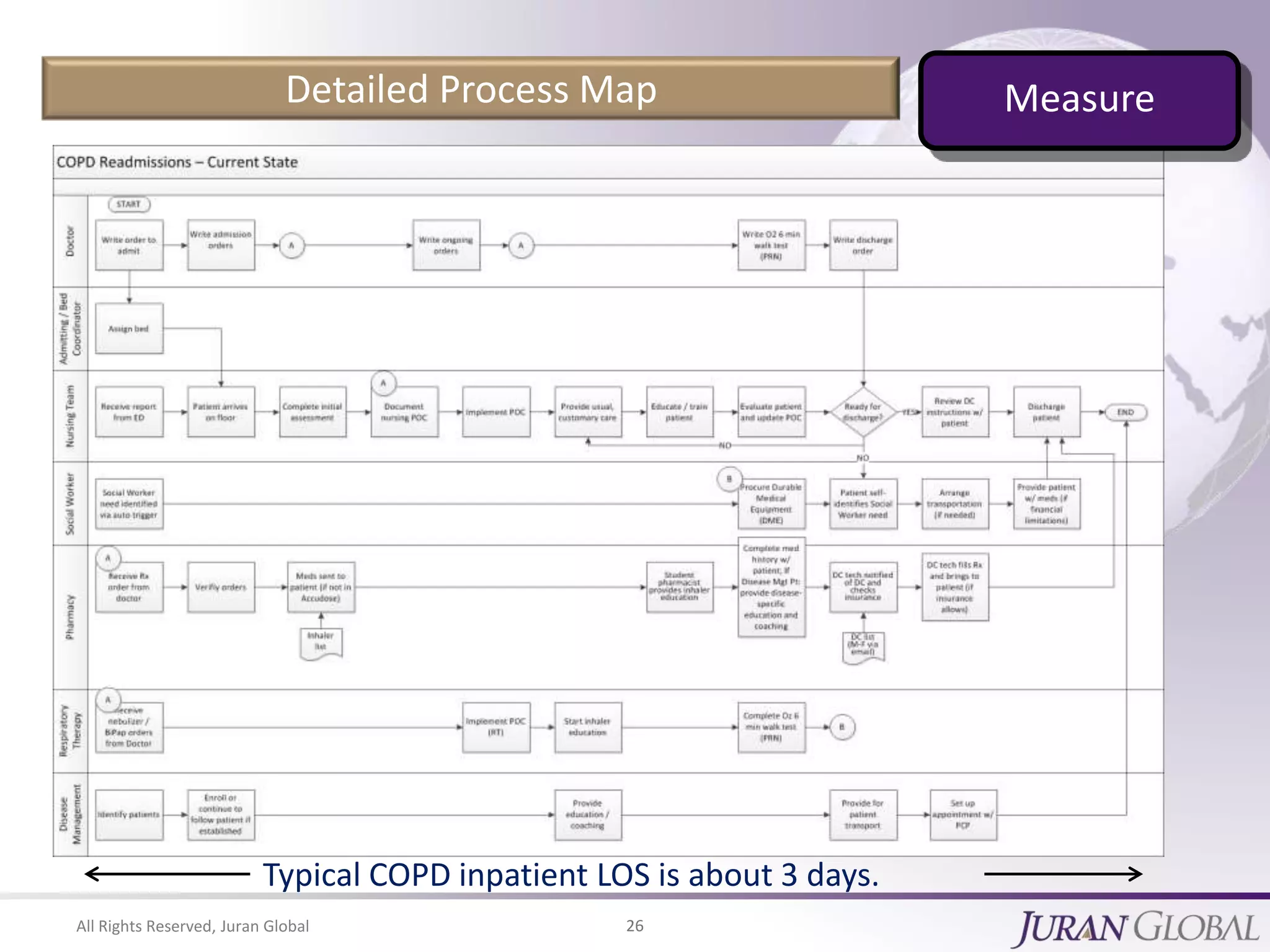
Detailed Process Map
Typical COPD inpatient LOS is about 3 days.
Measure
All Rights Reserved, Juran Global 27
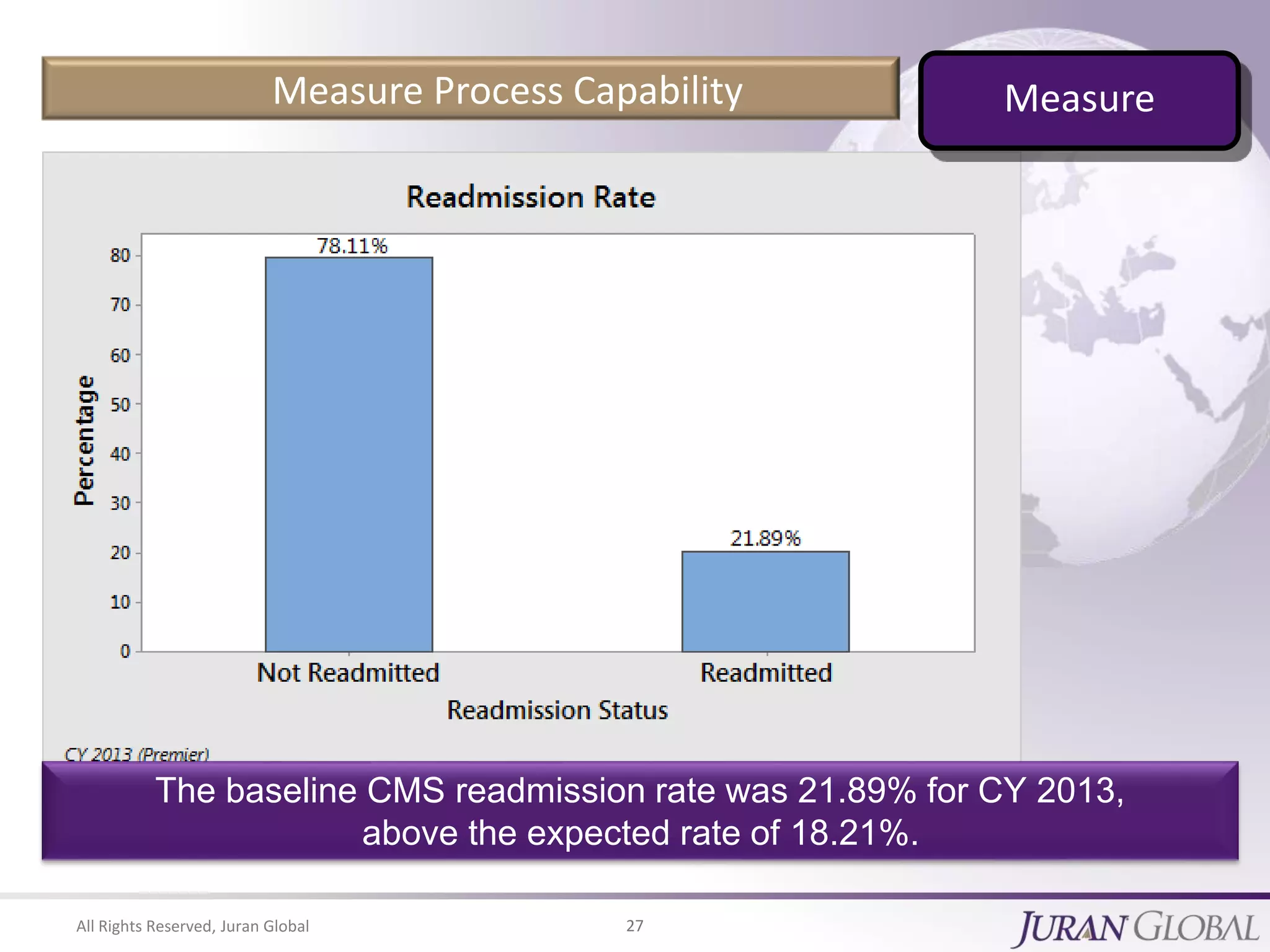
Measure Process Capability
The baseline CMS readmission rate was 21.89% for CY 2013,
above the expected rate of 18.21%.
Measure
All Rights Reserved, Juran Global 28
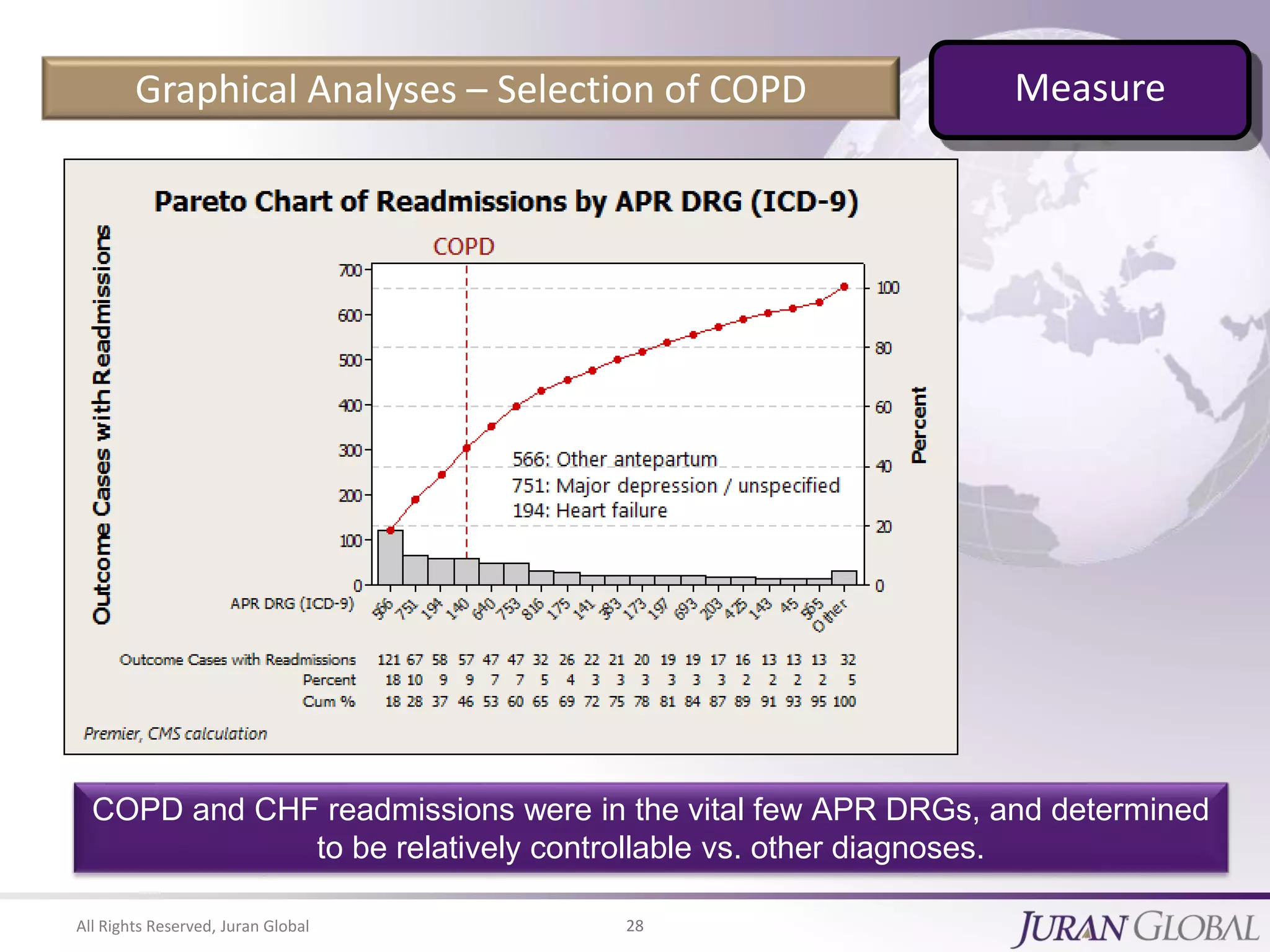
Graphical Analyses – Selection of COPD
COPD and CHF readmissions were in the vital few APR DRGs, and determined
to be relatively controllable vs. other diagnoses.
Measure
All Rights Reserved, Juran Global 29
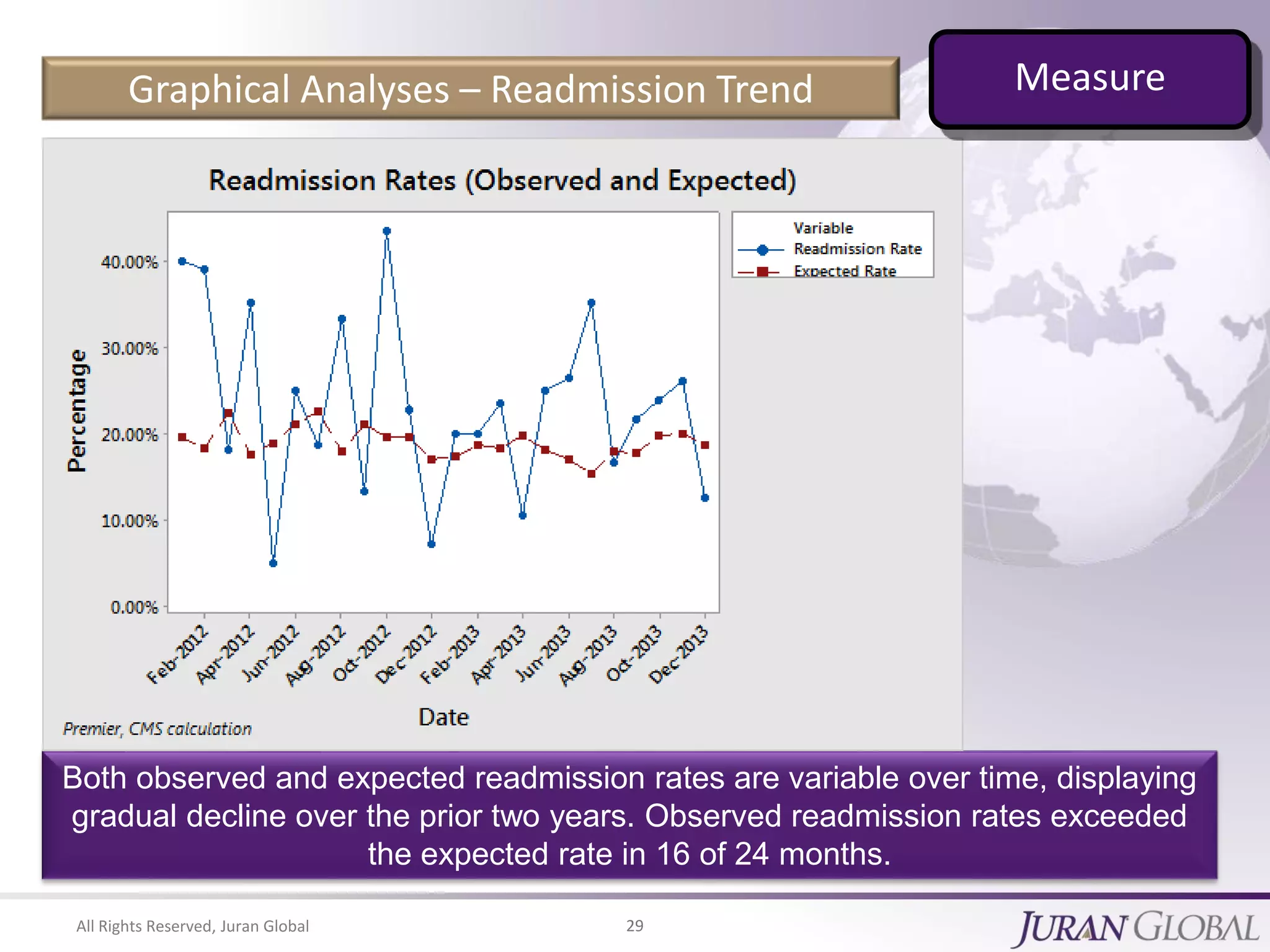
Graphical Analyses – Readmission Trend
Both observed and expected readmission rates are variable over time, displaying
gradual decline over the prior two years. Observed readmission rates exceeded
the expected rate in 16 of 24 months.
Measure
All Rights Reserved, Juran Global 30
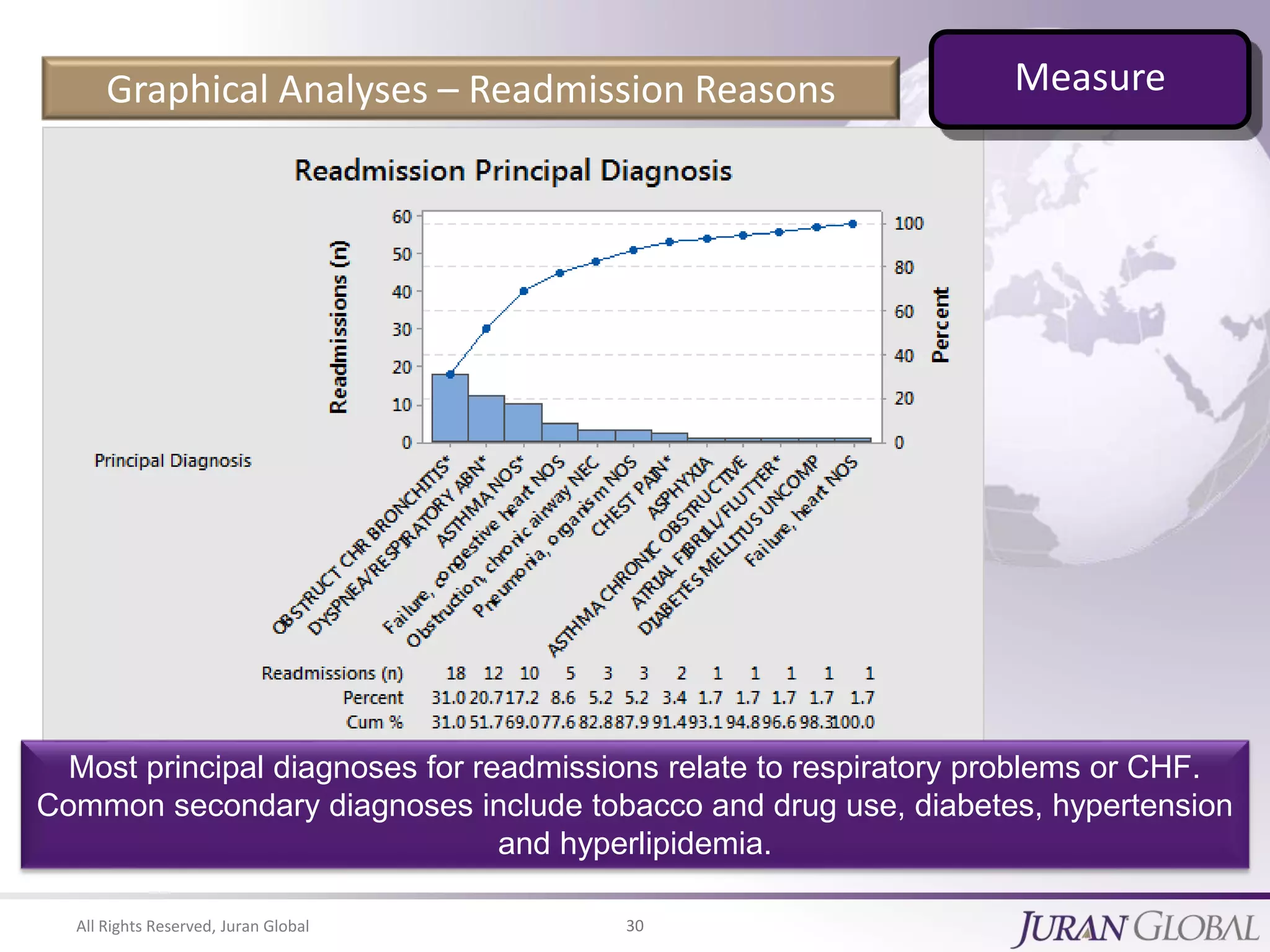
Graphical Analyses – Readmission Reasons Measure
Most principal diagnoses for readmissions relate to respiratory problems or CHF.
Common secondary diagnoses include tobacco and drug use, diabetes, hypertension
and hyperlipidemia.
All Rights Reserved, Juran Global 31
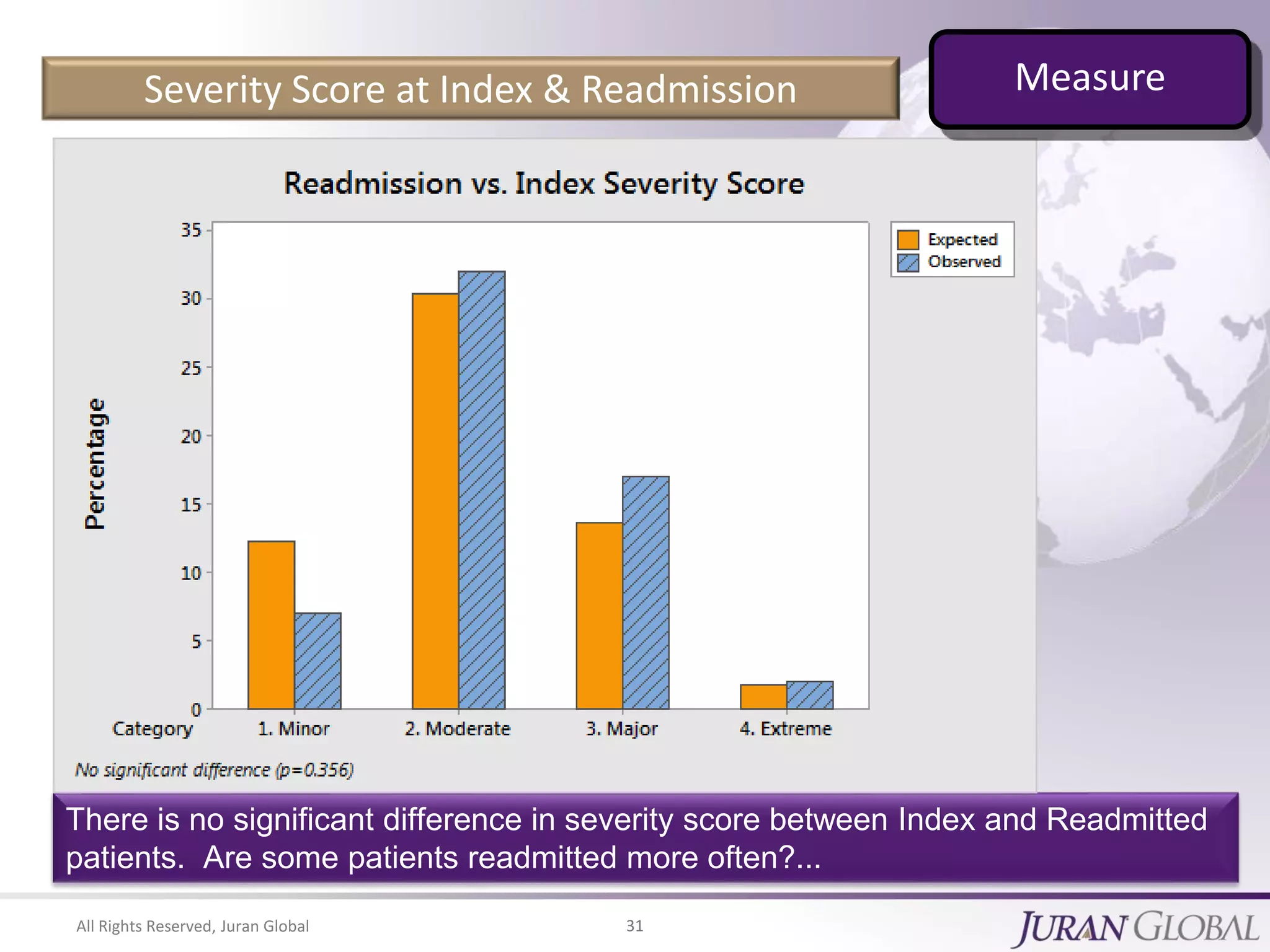
Severity Score at Index & Readmission
There is no significant difference in severity score between Index and Readmitted
patients. Are some patients readmitted more often?...
Measure
All Rights Reserved, Juran Global 32
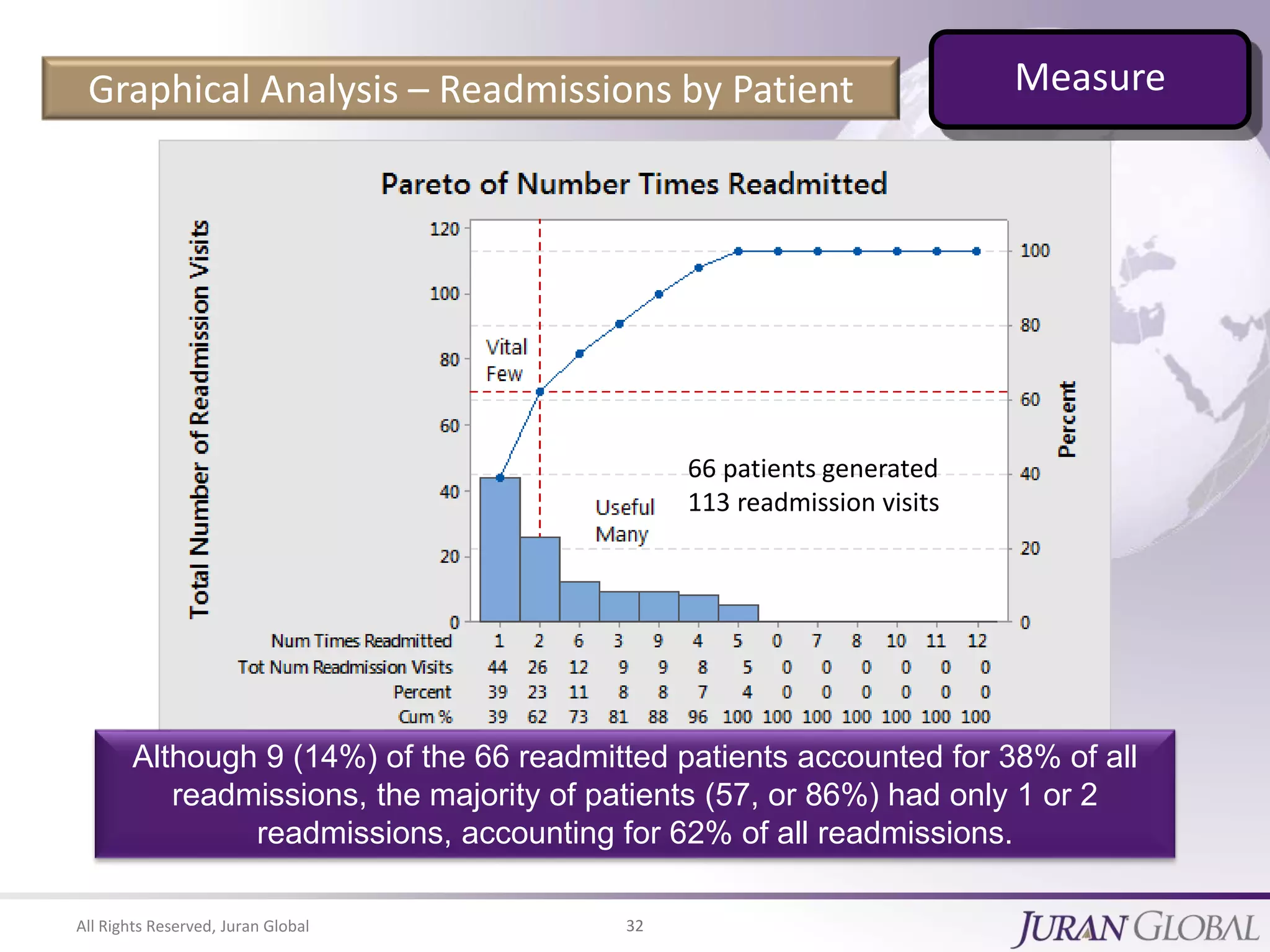
Graphical Analysis – Readmissions by Patient
Although 9 (14%) of the 66 readmitted patients accounted for 38% of all
readmissions, the majority of patients (57, or 86%) had only 1 or 2
readmissions, accounting for 62% of all readmissions.
66 patients generated
113 readmission visits
Measure
All Rights Reserved, Juran Global 33
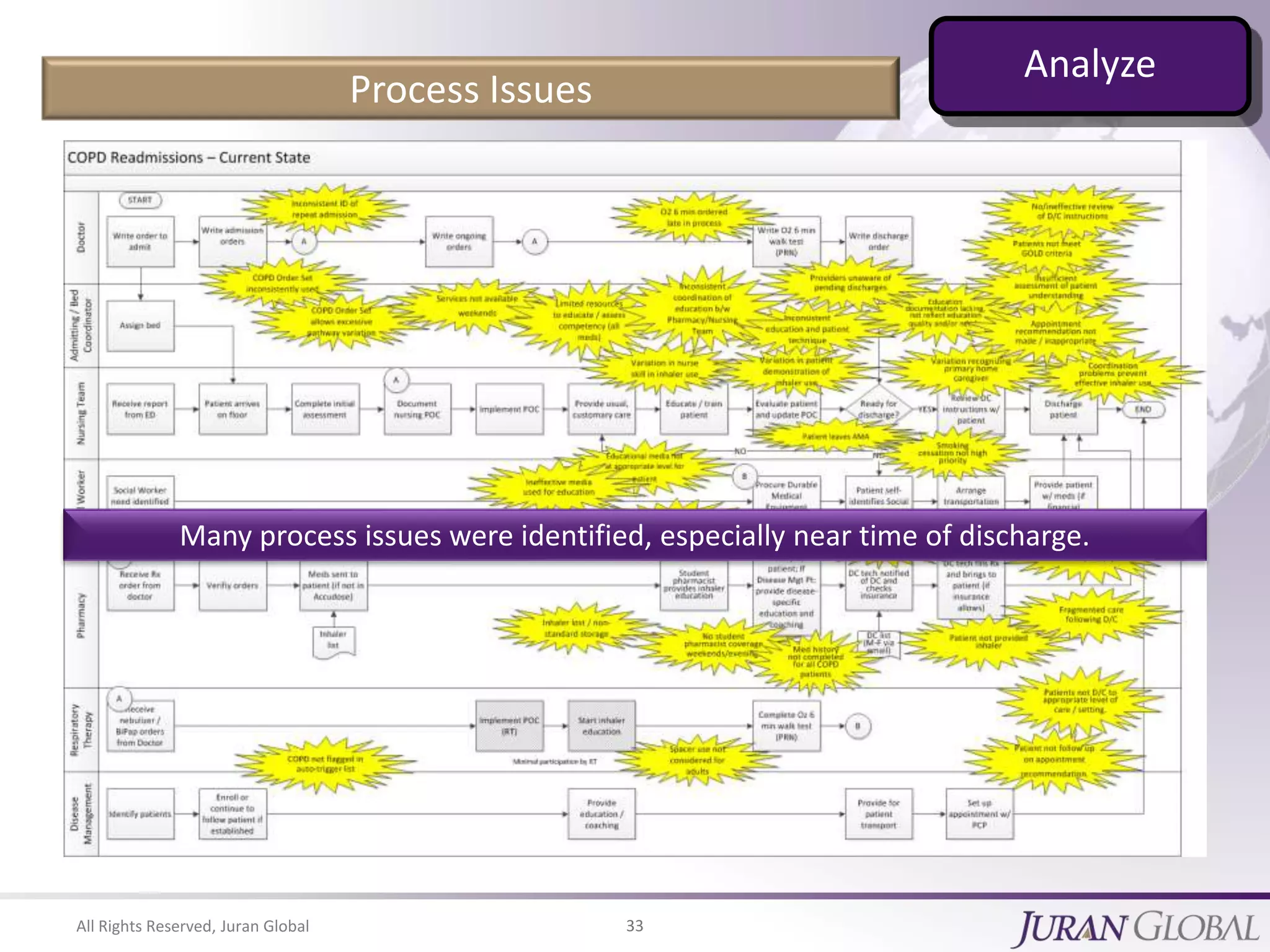
Process Issues
Analyze
Many process issues were identified, especially near time of discharge.
All Rights Reserved, Juran Global 34
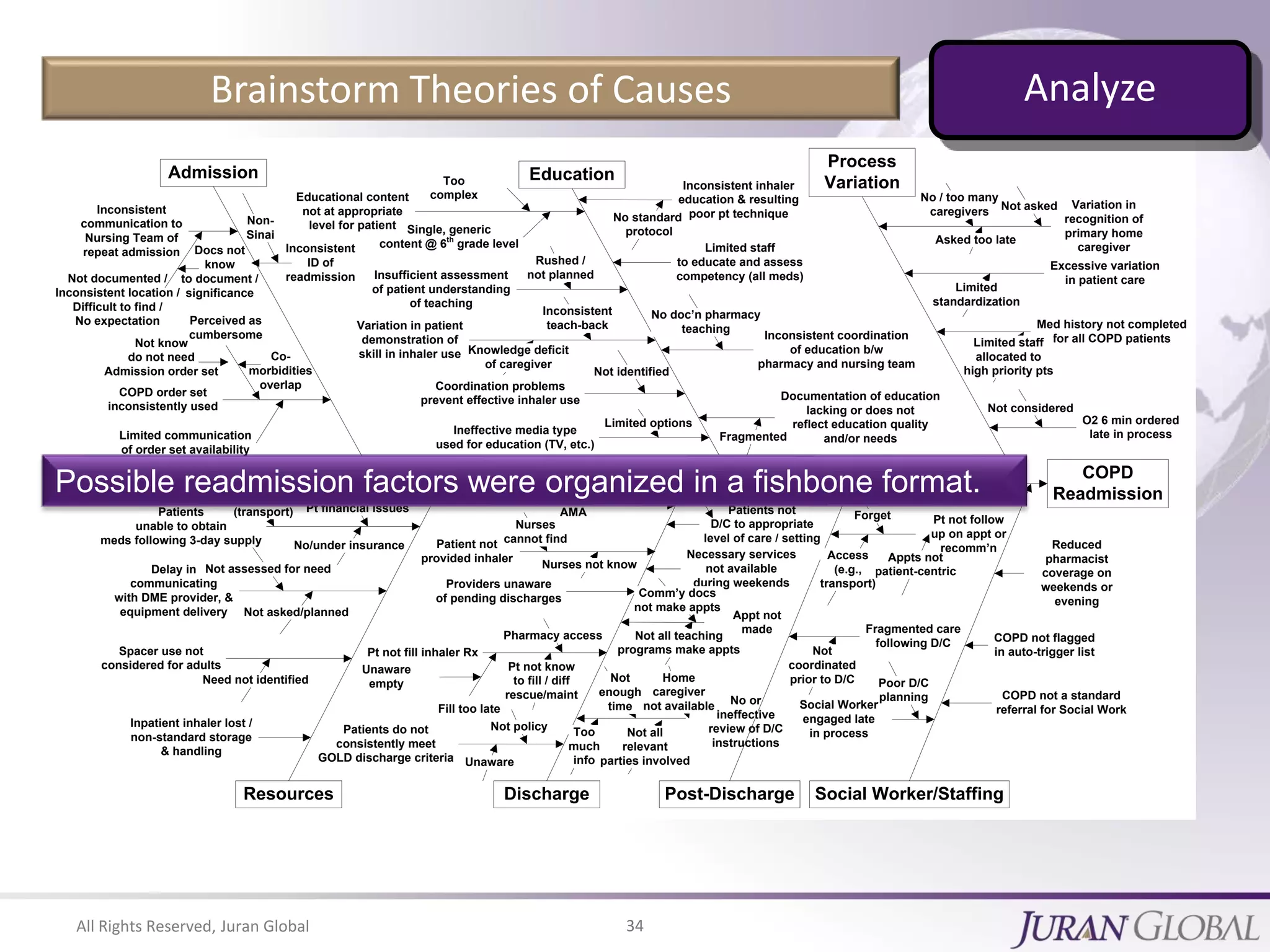
Brainstorm Theories of Causes
COPD
Readmission
Admission
Resources Discharge Post-Discharge
Fragmented care
following D/C
Patients do not
consistently meet
GOLD discharge criteria
Appt not
made
Patients
unable to obtain
meds following 3-day supply
Inconsistent coordination
of education b/w
pharmacy and nursing team
Variation in patient
demonstration of
skill in inhaler use
Inconsistent
communication to
Nursing Team of
repeat admission
Documentation of education
lacking or does not
reflect education quality
and/or needs
Patient leaves
AMA
Reduced
pharmacist
coverage on
weekends or
evening
Insufficient assessment
of patient understanding
of teaching
Limited staff
to educate and assess
competency (all meds)
Delay in
communicating
with DME provider, &
equipment delivery
Spacer use not
considered for adults
Inpatient inhaler lost /
non-standard storage
& handling
Process
Variation
Social Worker/Staffing
Education
Educational content
not at appropriate
level for patient
Ineffective media type
used for education (TV, etc.)
Smoking cessation not high priority
Coordination problems
prevent effective inhaler use
Inconsistent inhaler
education & resulting
poor pt technique
Variation in
recognition of
primary home
caregiver
Med history not completed
for all COPD patients
Patients not
D/C to appropriate
level of care / setting
Providers unaware
of pending discharges
Necessary services
not available
during weekends
Patient not
provided inhaler
COPD not flagged
in auto-trigger list
Social Worker
engaged late
in process
COPD order set
inconsistently used
Limited communication
of order set availability
O2 6 min ordered
late in process
Excessive variation
in patient care
Perceived as
cumbersome
Single, generic
content @ 6th
grade level
Too
complex
Rushed /
not planned
Knowledge deficit
of caregiver
Not identified
Limited options
No doc’n pharmacy
teaching
Fragmented
Not asked
Asked too late
Limited
standardization
Limited staff
allocated to
high priority pts
Not considered
Pt financial issues
No/under insurance
Not asked/planned
Not assessed for need
Need not identified
Appts not
patient-centric
Access
(e.g.,
transport)
Forget
Nurses
cannot find
Nurses not know
Pt not fill inhaler Rx
Pt not know
to fill / diff
rescue/maint
Pharmacy access
Unaware
empty
Not policy
Unaware
Too
much
info
Not all
relevant
parties involved
Home
caregiver
not available
Not
enough
time
Not all teaching
programs make appts
Comm’y docs
not make appts
Pt not follow
up on appt or
recomm’n
Fill too late
Docs not
know
to document /
significance
Co-
morbidities
overlap
Not know
do not need
Admission order set
Access issues
(transport)
Inconsistent
teach-back
No standard
protocol
No / too many
caregivers
No or
ineffective
review of D/C
instructions
Inconsistent
ID of
readmission
Non-
Sinai
Not documented /
Inconsistent location /
Difficult to find /
No expectation
Not
coordinated
prior to D/C Poor D/C
planning COPD not a standard
referral for Social Work
Multiple factorsPossible readmission factors were organized in a fishbone format.
Analyze
All Rights Reserved, Juran Global 35
Critical To Quality and Theories (Xs)
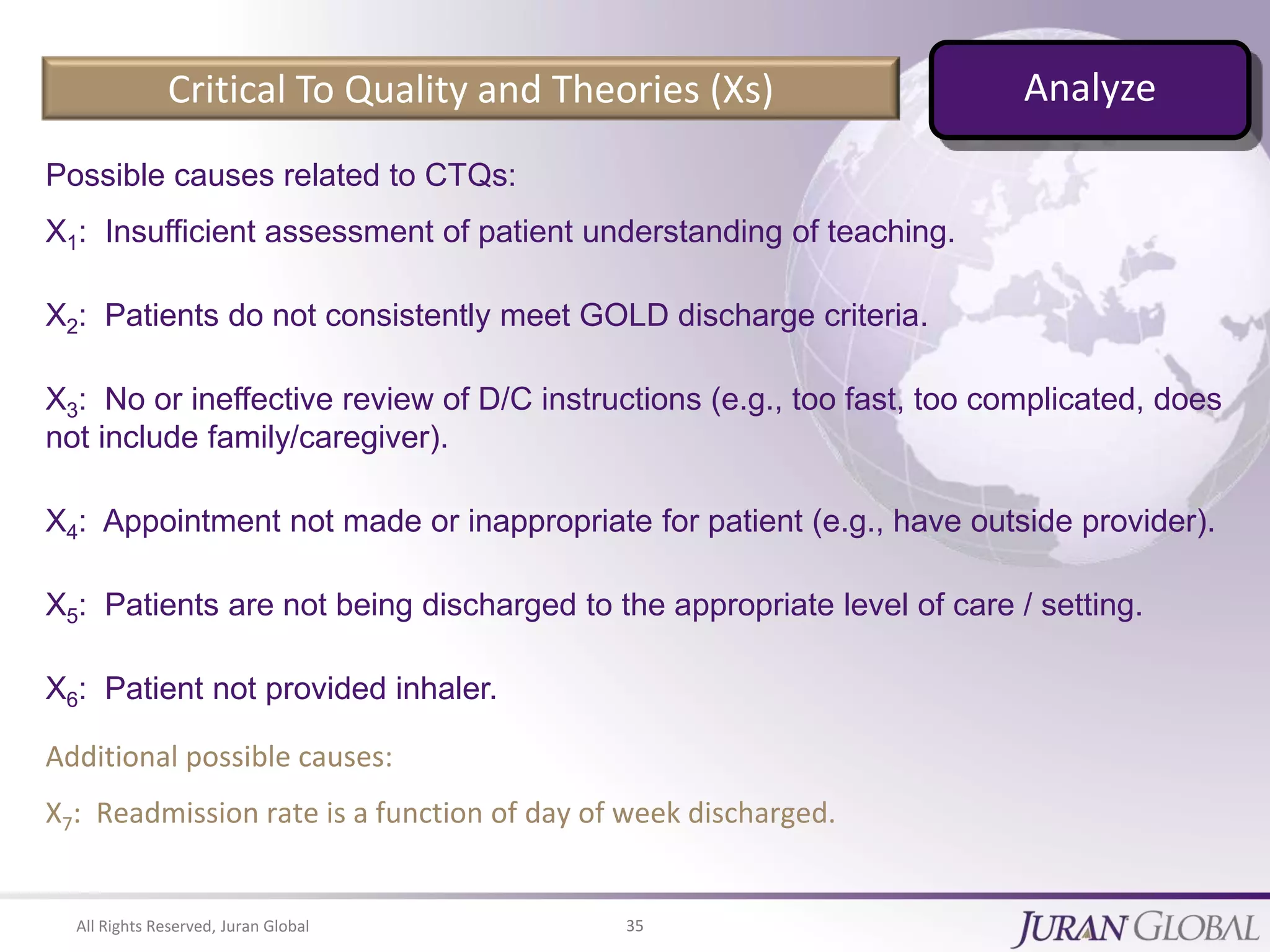
Possible causes related to CTQs:
X1: Insufficient assessment of patient understanding of teaching.
X2: Patients do not consistently meet GOLD discharge criteria.
X3: No or ineffective review of D/C instructions (e.g., too fast, too complicated, does
not include family/caregiver).
X4: Appointment not made or inappropriate for patient (e.g., have outside provider).
X5: Patients are not being discharged to the appropriate level of care / setting.
X6: Patient not provided inhaler.
Additional possible causes:
X7: Readmission rate is a function of day of week discharged.
Analyze
All Rights Reserved, Juran Global 36
Data Collection Plan for Analyze Phase
Data Collection Plan for the Analyze Phase
Ref.
Theories To Be Tested
(Selected From The C-E
Diagram, FMEA, etc.)
List Of Questions
To Answer for
Evidence of Each
Selected Theory
Results that
will support
theory
Results that
will rule out
theory
Tools To
Be Used
Data To Be Collected
Description/
Data Type
Sample
Size,
Number
of
Samples
Where/
How To
Collect
Data
Who
Will
Collect
Data
How
Will
Data
Be
Recor
ded
X1
(CTQ)
Insufficient assessment of
patient understanding /
demonstration of
standardized teaching,
including additional
training needs.
Does a second-
teach-back
improve patient
administration?
A second
teach-back
improves
patient
administration.
A second
teach-back
does not
improve
patient
administration
.
Bar chart
Categorical:
Percentage
patients with
improved
administration.
84
patients
Inhaler
instructi
on
session
Karen Excel
X6
(CTQ)
Patient not provided
inhaler.
What is the
incidence of lost or
missing inhalers?
A high number
of inhalers are
lost or missing.
A low number
of inhalers are
lost or
missing.
Bar chart
Categorical:
Count of lost or
missing
inhalers.
6 weeks
Reconci
liation
tally
Karen Excel
X7
Readmission rate is a
function of day of week
discharged.
What is the
proportion of
patients
readmitted w/in 30
days by day of
week?
Proportion
readmitted
differs by day
discharged.
No difference
in proportion
by day
discharged.
Stacked
bar chart,
Chi-
square
test
Categorical:
Number of
patients w/
Index discharge
by day of week,
and number of
these
readmitted.
All COPD
discharge
s over
prior 2
years
Premier Lynda Excel
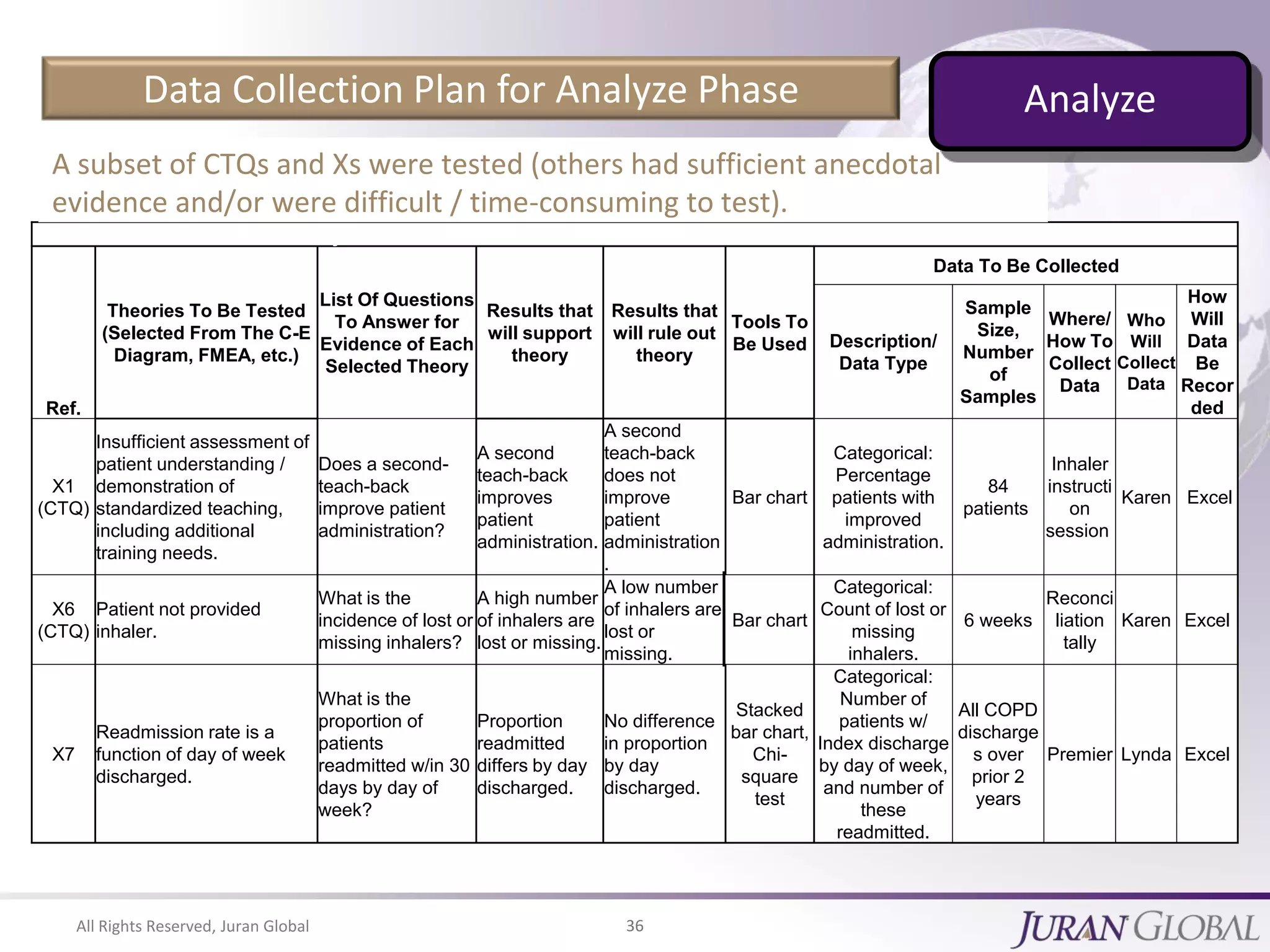
A subset of CTQs and Xs were tested (others had sufficient anecdotal
evidence and/or were difficult / time-consuming to test).
Analyze
All Rights Reserved, Juran Global 37
Test of Theories Example
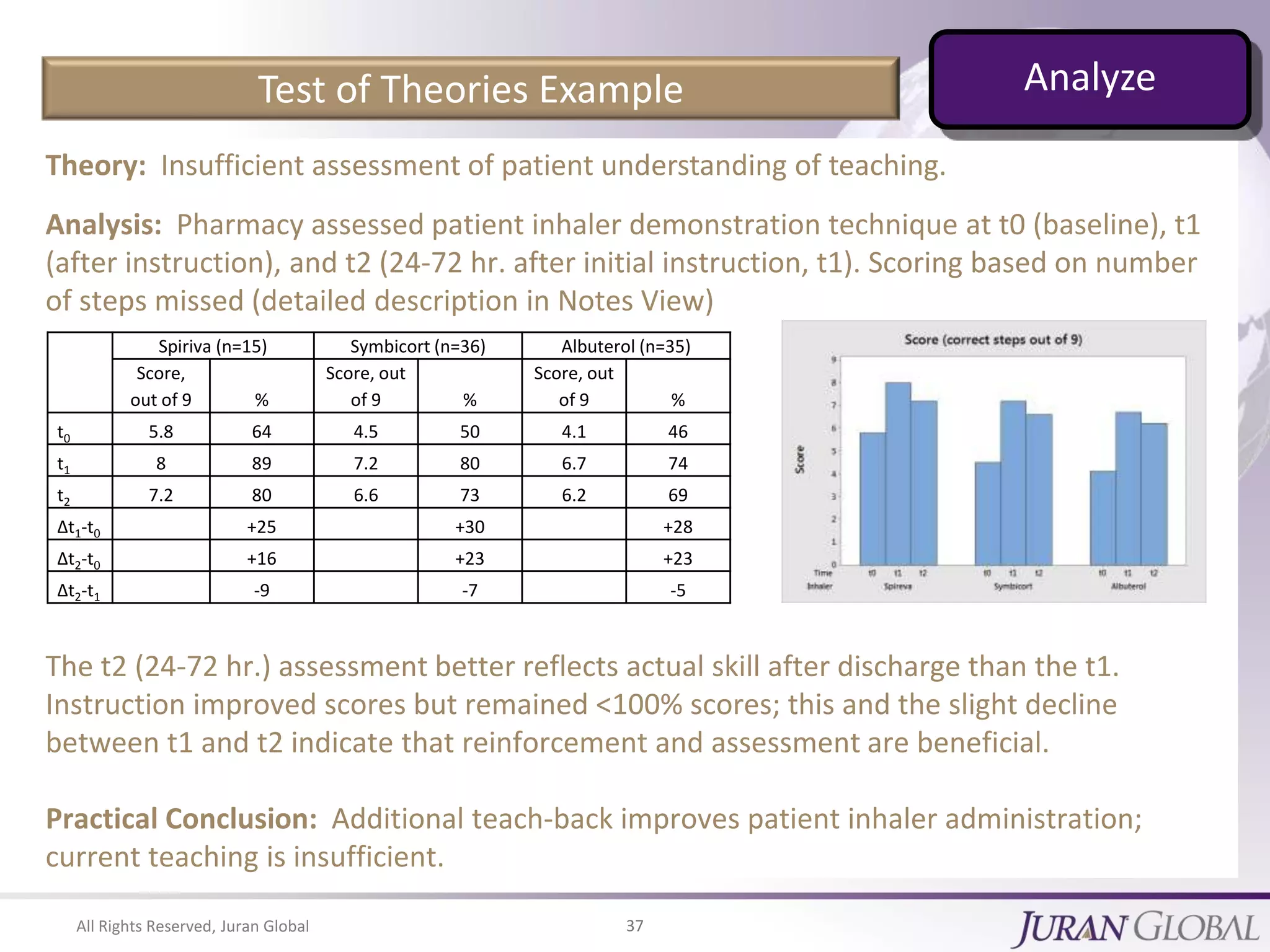
Theory: Insufficient assessment of patient understanding of teaching.
Analysis: Pharmacy assessed patient inhaler demonstration technique at t0 (baseline), t1
(after instruction), and t2 (24-72 hr. after initial instruction, t1). Scoring based on number
of steps missed (detailed description in Notes View)
The t2 (24-72 hr.) assessment better reflects actual skill after discharge than the t1.
Instruction improved scores but remained <100% scores; this and the slight decline
between t1 and t2 indicate that reinforcement and assessment are beneficial.
Practical Conclusion: Additional teach-back improves patient inhaler administration;
current teaching is insufficient.
Spiriva (n=15) Symbicort (n=36) Albuterol (n=35)
Score,
out of 9 %
Score, out
of 9 %
Score, out
of 9 %
t0 5.8 64 4.5 50 4.1 46
t1 8 89 7.2 80 6.7 74
t2 7.2 80 6.6 73 6.2 69
Δt1-t0 +25 +30 +28
Δt2-t0 +16 +23 +23
Δt2-t1 -9 -7 -5
Analyze
All Rights Reserved, Juran Global 38
CTQ and X Summary
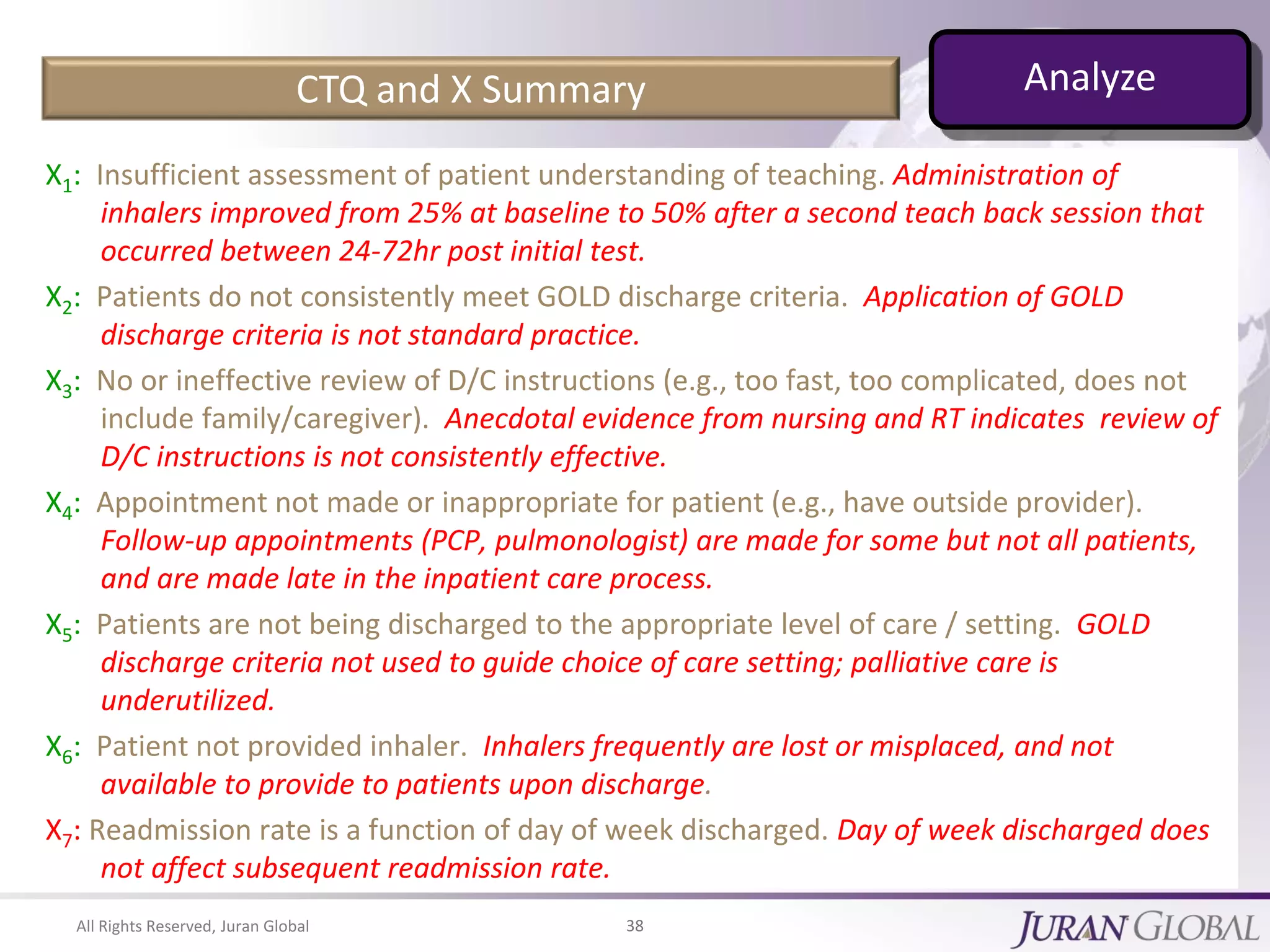
X1: Insufficient assessment of patient understanding of teaching. Administration of
inhalers improved from 25% at baseline to 50% after a second teach back session that
occurred between 24-72hr post initial test.
X2: Patients do not consistently meet GOLD discharge criteria. Application of GOLD
discharge criteria is not standard practice.
X3: No or ineffective review of D/C instructions (e.g., too fast, too complicated, does not
include family/caregiver). Anecdotal evidence from nursing and RT indicates review of
D/C instructions is not consistently effective.
X4: Appointment not made or inappropriate for patient (e.g., have outside provider).
Follow-up appointments (PCP, pulmonologist) are made for some but not all patients,
and are made late in the inpatient care process.
X5: Patients are not being discharged to the appropriate level of care / setting. GOLD
discharge criteria not used to guide choice of care setting; palliative care is
underutilized.
X6: Patient not provided inhaler. Inhalers frequently are lost or misplaced, and not
available to provide to patients upon discharge.
X7: Readmission rate is a function of day of week discharged. Day of week discharged does
not affect subsequent readmission rate.
Analyze
All Rights Reserved, Juran Global 39
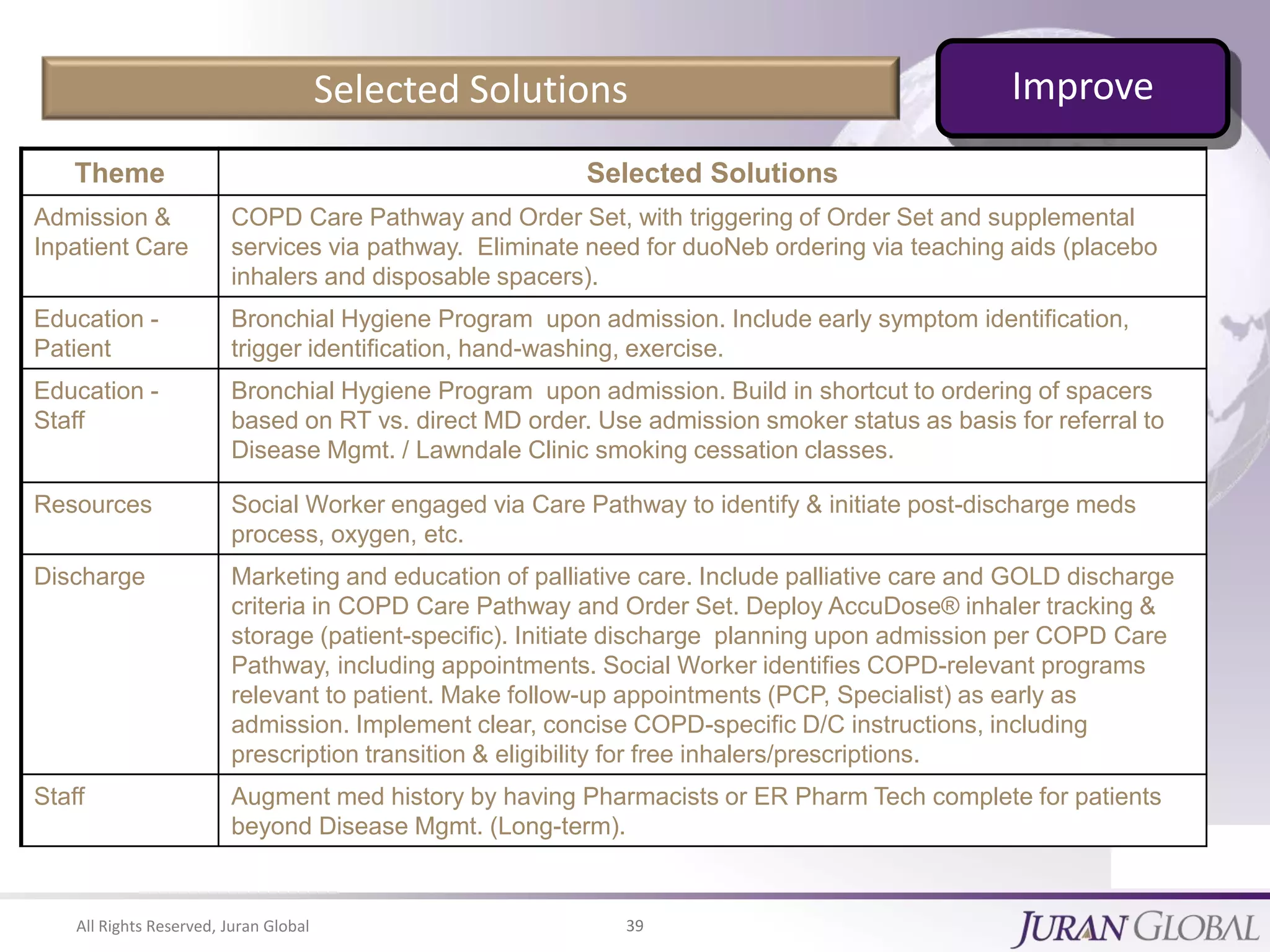
Selected Solutions
Theme Selected Solutions
Admission &
Inpatient Care
COPD Care Pathway and Order Set, with triggering of Order Set and supplemental
services via pathway. Eliminate need for duoNeb ordering via teaching aids (placebo
inhalers and disposable spacers).
Education -
Patient
Bronchial Hygiene Program upon admission. Include early symptom identification,
trigger identification, hand-washing, exercise.
Education -
Staff
Bronchial Hygiene Program upon admission. Build in shortcut to ordering of spacers
based on RT vs. direct MD order. Use admission smoker status as basis for referral to
Disease Mgmt. / Lawndale Clinic smoking cessation classes.
Resources Social Worker engaged via Care Pathway to identify & initiate post-discharge meds
process, oxygen, etc.
Discharge Marketing and education of palliative care. Include palliative care and GOLD discharge
criteria in COPD Care Pathway and Order Set. Deploy AccuDose® inhaler tracking &
storage (patient-specific). Initiate discharge planning upon admission per COPD Care
Pathway, including appointments. Social Worker identifies COPD-relevant programs
relevant to patient. Make follow-up appointments (PCP, Specialist) as early as
admission. Implement clear, concise COPD-specific D/C instructions, including
prescription transition & eligibility for free inhalers/prescriptions.
Staff Augment med history by having Pharmacists or ER Pharm Tech complete for patients
beyond Disease Mgmt. (Long-term).
Improve
All Rights Reserved, Juran Global 40
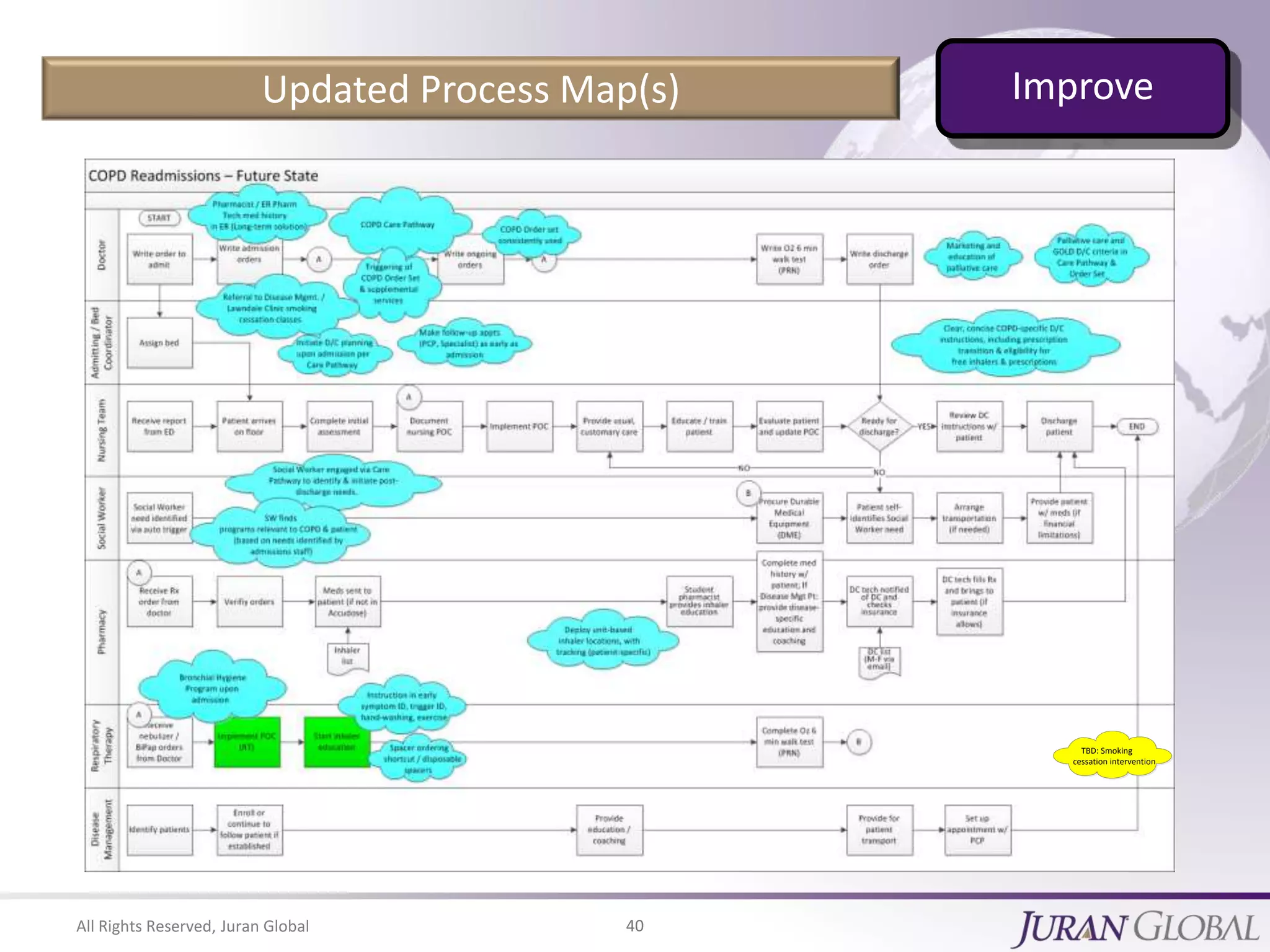
Updated Process Map(s)
TBD: Smoking
cessation intervention
Improve
All Rights Reserved, Juran Global 41
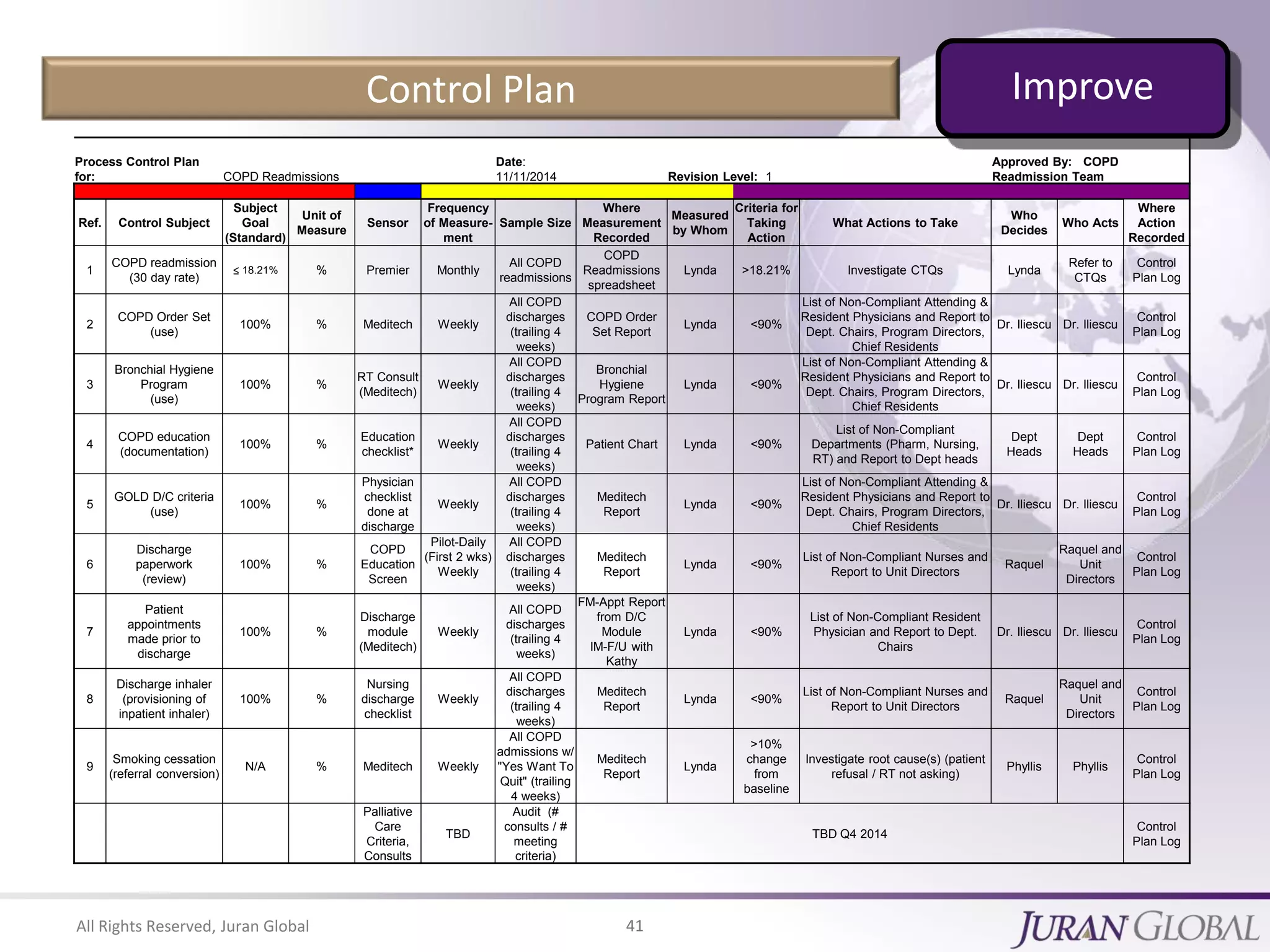
Control Plan
Process Control Plan
for: COPD Readmissions
Date:
11/11/2014 Revision Level: 1
Approved By: COPD
Readmission Team
Ref. Control Subject
Subject
Goal
(Standard)
Unit of
Measure
Sensor
Frequency
of Measure-
ment
Sample Size
Where
Measurement
Recorded
Measured
by Whom
Criteria for
Taking
Action
What Actions to Take
Who
Decides
Who Acts
Where
Action
Recorded
1
COPD readmission
(30 day rate)
≤ 18.21% % Premier Monthly
All COPD
readmissions
COPD
Readmissions
spreadsheet
Lynda >18.21% Investigate CTQs Lynda
Refer to
CTQs
Control
Plan Log
2
COPD Order Set
(use)
100% % Meditech Weekly
All COPD
discharges
(trailing 4
weeks)
COPD Order
Set Report
Lynda <90%
List of Non-Compliant Attending &
Resident Physicians and Report to
Dept. Chairs, Program Directors,
Chief Residents
Dr. Iliescu Dr. Iliescu
Control
Plan Log
3
Bronchial Hygiene
Program
(use)
100% %
RT Consult
(Meditech)
Weekly
All COPD
discharges
(trailing 4
weeks)
Bronchial
Hygiene
Program Report
Lynda <90%
List of Non-Compliant Attending &
Resident Physicians and Report to
Dept. Chairs, Program Directors,
Chief Residents
Dr. Iliescu Dr. Iliescu
Control
Plan Log
4
COPD education
(documentation)
100% %
Education
checklist*
Weekly
All COPD
discharges
(trailing 4
weeks)
Patient Chart Lynda <90%
List of Non-Compliant
Departments (Pharm, Nursing,
RT) and Report to Dept heads
Dept
Heads
Dept
Heads
Control
Plan Log
5
GOLD D/C criteria
(use)
100% %
Physician
checklist
done at
discharge
Weekly
All COPD
discharges
(trailing 4
weeks)
Meditech
Report
Lynda <90%
List of Non-Compliant Attending &
Resident Physicians and Report to
Dept. Chairs, Program Directors,
Chief Residents
Dr. Iliescu Dr. Iliescu
Control
Plan Log
6
Discharge
paperwork
(review)
100% %
COPD
Education
Screen
Pilot-Daily
(First 2 wks)
Weekly
All COPD
discharges
(trailing 4
weeks)
Meditech
Report
Lynda <90%
List of Non-Compliant Nurses and
Report to Unit Directors
Raquel
Raquel and
Unit
Directors
Control
Plan Log
7
Patient
appointments
made prior to
discharge
100% %
Discharge
module
(Meditech)
Weekly
All COPD
discharges
(trailing 4
weeks)
FM-Appt Report
from D/C
Module
IM-F/U with
Kathy
Lynda <90%
List of Non-Compliant Resident
Physician and Report to Dept.
Chairs
Dr. Iliescu Dr. Iliescu
Control
Plan Log
8
Discharge inhaler
(provisioning of
inpatient inhaler)
100% %
Nursing
discharge
checklist
Weekly
All COPD
discharges
(trailing 4
weeks)
Meditech
Report
Lynda <90%
List of Non-Compliant Nurses and
Report to Unit Directors
Raquel
Raquel and
Unit
Directors
Control
Plan Log
9
Smoking cessation
(referral conversion)
N/A % Meditech Weekly
All COPD
admissions w/
"Yes Want To
Quit" (trailing
4 weeks)
Meditech
Report
Lynda
>10%
change
from
baseline
Investigate root cause(s) (patient
refusal / RT not asking)
Phyllis Phyllis
Control
Plan Log
Palliative
Care
Criteria,
Consults
TBD
Audit (#
consults / #
meeting
criteria)
TBD Q4 2014
Control
Plan Log
Improve
All Rights Reserved, Juran Global 42
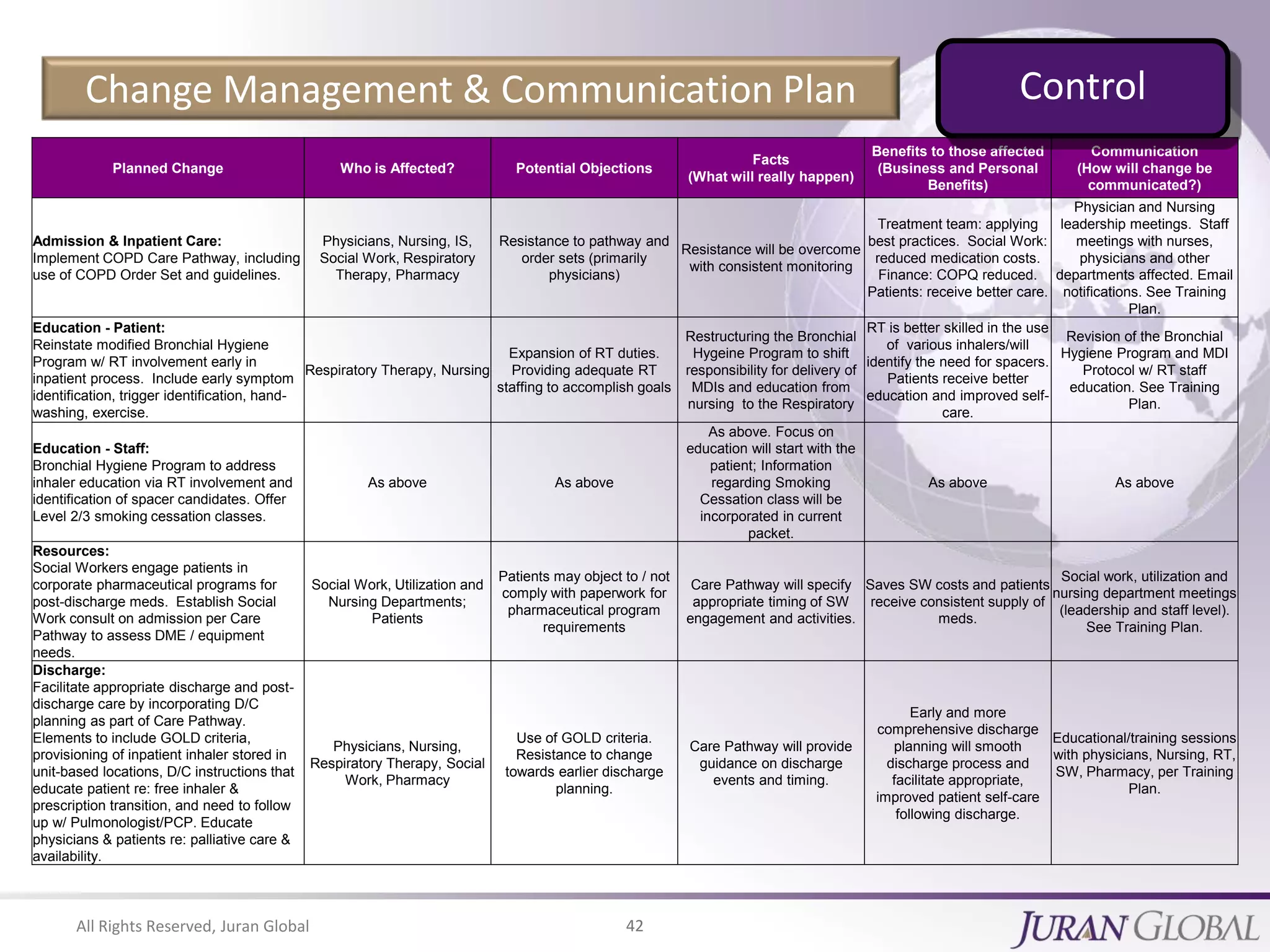
Change Management & Communication Plan
Planned Change Who is Affected? Potential Objections
Facts
(What will really happen)
Benefits to those affected
(Business and Personal
Benefits)
Communication
(How will change be
communicated?)
Admission & Inpatient Care:
Implement COPD Care Pathway, including
use of COPD Order Set and guidelines.
Physicians, Nursing, IS,
Social Work, Respiratory
Therapy, Pharmacy
Resistance to pathway and
order sets (primarily
physicians)
Resistance will be overcome
with consistent monitoring
Treatment team: applying
best practices. Social Work:
reduced medication costs.
Finance: COPQ reduced.
Patients: receive better care.
Physician and Nursing
leadership meetings. Staff
meetings with nurses,
physicians and other
departments affected. Email
notifications. See Training
Plan.
Education - Patient:
Reinstate modified Bronchial Hygiene
Program w/ RT involvement early in
inpatient process. Include early symptom
identification, trigger identification, hand-
washing, exercise.
Respiratory Therapy, Nursing
Expansion of RT duties.
Providing adequate RT
staffing to accomplish goals
Restructuring the Bronchial
Hygeine Program to shift
responsibility for delivery of
MDIs and education from
nursing to the Respiratory
RT is better skilled in the use
of various inhalers/will
identify the need for spacers.
Patients receive better
education and improved self-
care.
Revision of the Bronchial
Hygiene Program and MDI
Protocol w/ RT staff
education. See Training
Plan.
Education - Staff:
Bronchial Hygiene Program to address
inhaler education via RT involvement and
identification of spacer candidates. Offer
Level 2/3 smoking cessation classes.
As above As above
As above. Focus on
education will start with the
patient; Information
regarding Smoking
Cessation class will be
incorporated in current
packet.
As above As above
Resources:
Social Workers engage patients in
corporate pharmaceutical programs for
post-discharge meds. Establish Social
Work consult on admission per Care
Pathway to assess DME / equipment
needs.
Social Work, Utilization and
Nursing Departments;
Patients
Patients may object to / not
comply with paperwork for
pharmaceutical program
requirements
Care Pathway will specify
appropriate timing of SW
engagement and activities.
Saves SW costs and patients
receive consistent supply of
meds.
Social work, utilization and
nursing department meetings
(leadership and staff level).
See Training Plan.
Discharge:
Facilitate appropriate discharge and post-
discharge care by incorporating D/C
planning as part of Care Pathway.
Elements to include GOLD criteria,
provisioning of inpatient inhaler stored in
unit-based locations, D/C instructions that
educate patient re: free inhaler &
prescription transition, and need to follow
up w/ Pulmonologist/PCP. Educate
physicians & patients re: palliative care &
availability.
Physicians, Nursing,
Respiratory Therapy, Social
Work, Pharmacy
Use of GOLD criteria.
Resistance to change
towards earlier discharge
planning.
Care Pathway will provide
guidance on discharge
events and timing.
Early and more
comprehensive discharge
planning will smooth
discharge process and
facilitate appropriate,
improved patient self-care
following discharge.
Educational/training sessions
with physicians, Nursing, RT,
SW, Pharmacy, per Training
Plan.
Control
All Rights Reserved, Juran Global 43
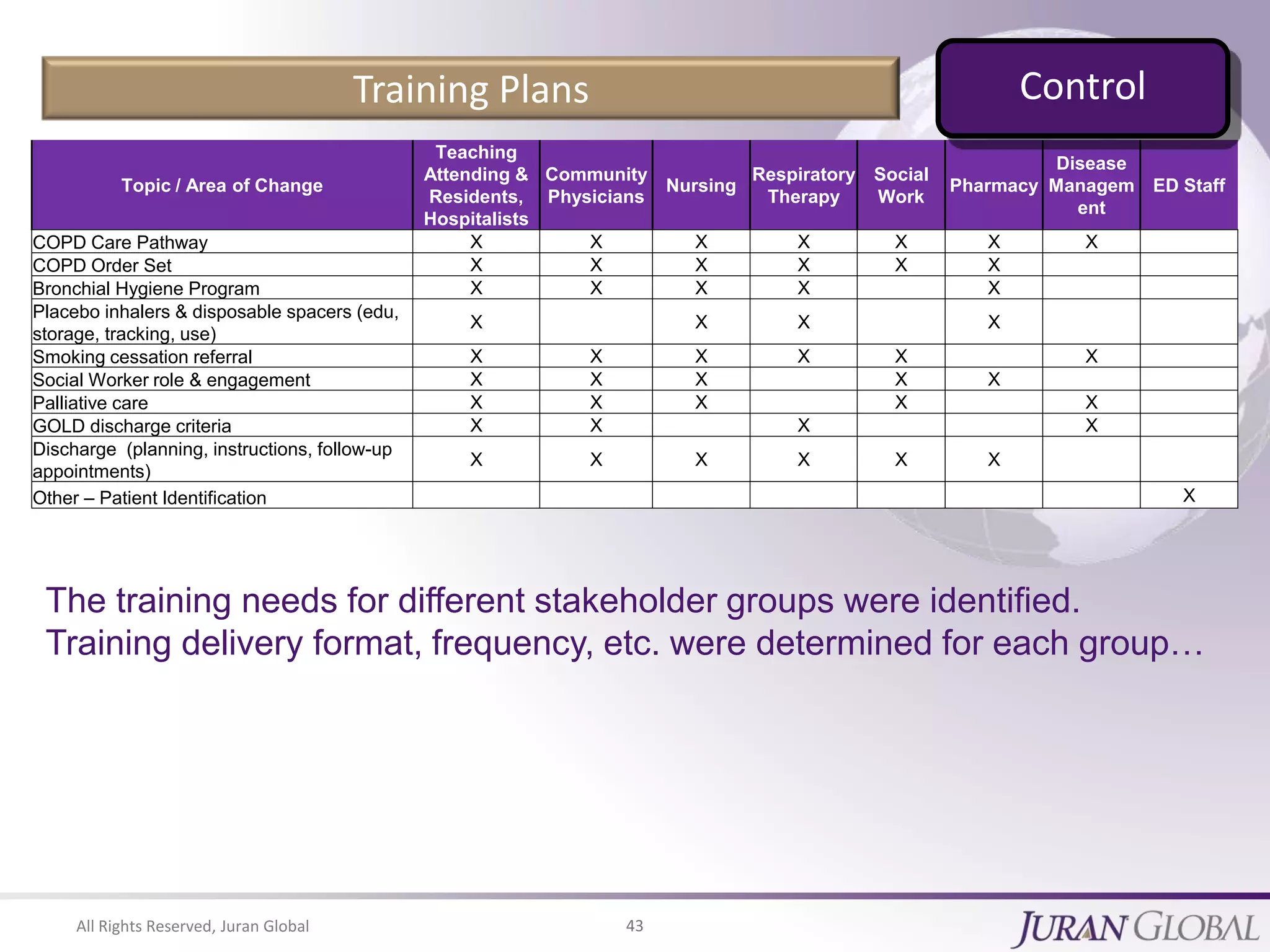
Training Plans
The training needs for different stakeholder groups were identified.
Training delivery format, frequency, etc. were determined for each group…
Topic / Area of Change
Teaching
Attending &
Residents,
Hospitalists
Community
Physicians
Nursing
Respiratory
Therapy
Social
Work
Pharmacy
Disease
Managem
ent
ED Staff
COPD Care Pathway X X X X X X X
COPD Order Set X X X X X X
Bronchial Hygiene Program X X X X X
Placebo inhalers & disposable spacers (edu,
storage, tracking, use)
X X X X
Smoking cessation referral X X X X X X
Social Worker role & engagement X X X X X
Palliative care X X X X X
GOLD discharge criteria X X X X
Discharge (planning, instructions, follow-up
appointments)
X X X X X X
Other – Patient Identification X
Control
All Rights Reserved, Juran Global 44
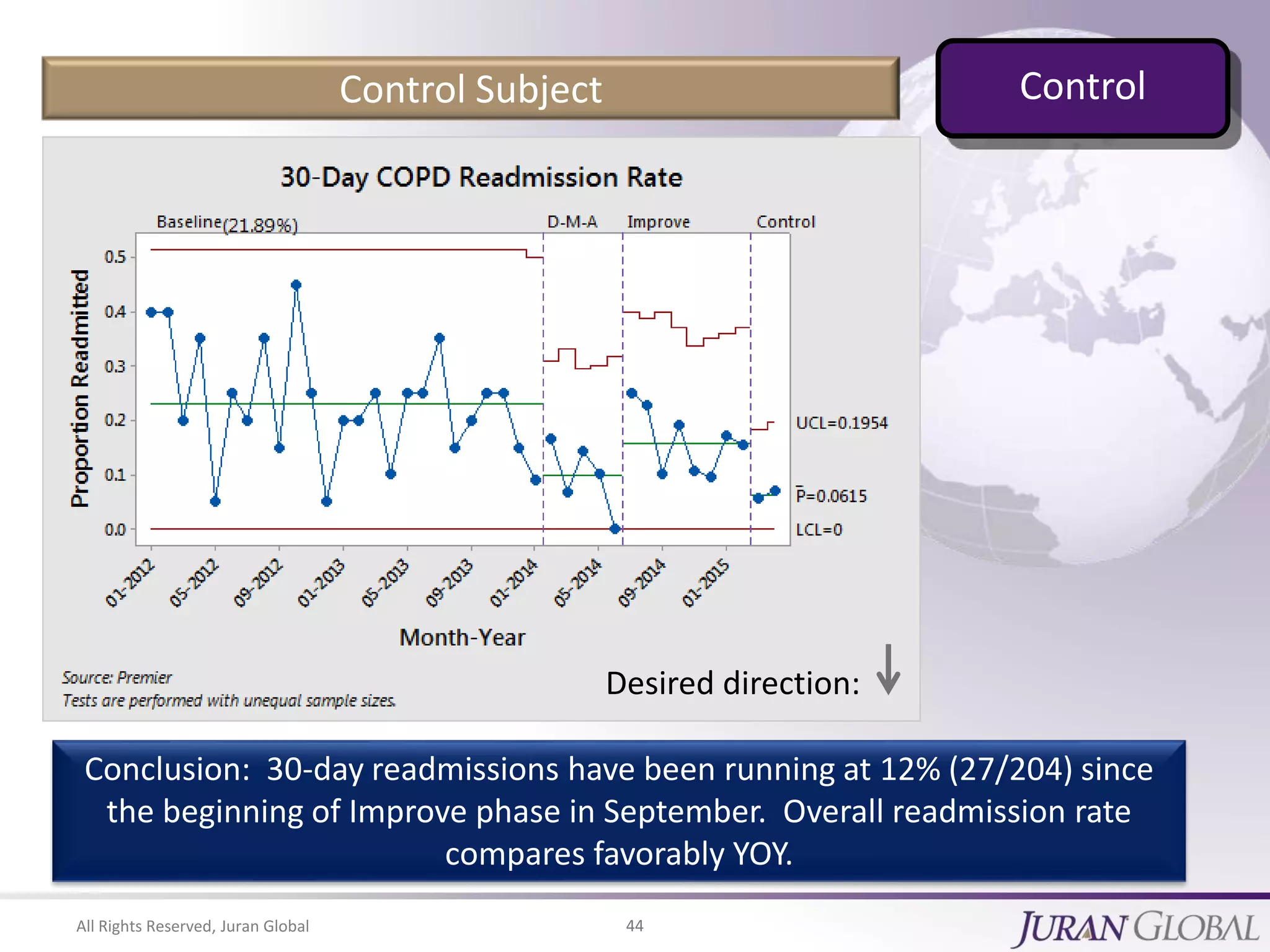
Conclusion: 30-day readmissions have been running at 12% (27/204) since
the beginning of Improve phase in September. Overall readmission rate
compares favorably YOY.
Desired direction:
Control Subject Control
All Rights Reserved, Juran Global 45
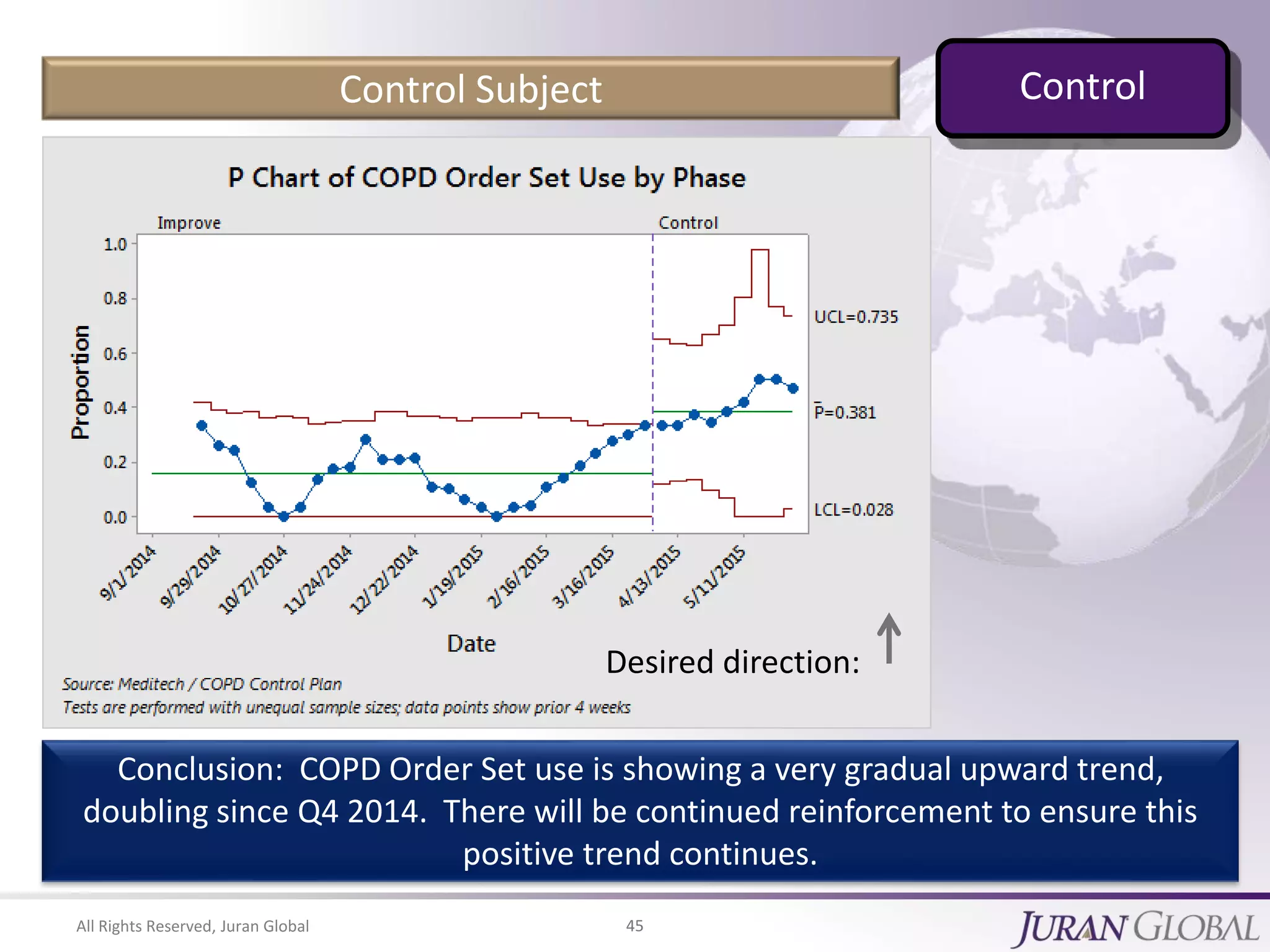
Conclusion: COPD Order Set use is showing a very gradual upward trend,
doubling since Q4 2014. There will be continued reinforcement to ensure this
positive trend continues.
Desired direction:
Control Subject Control
All Rights Reserved, Juran Global 46
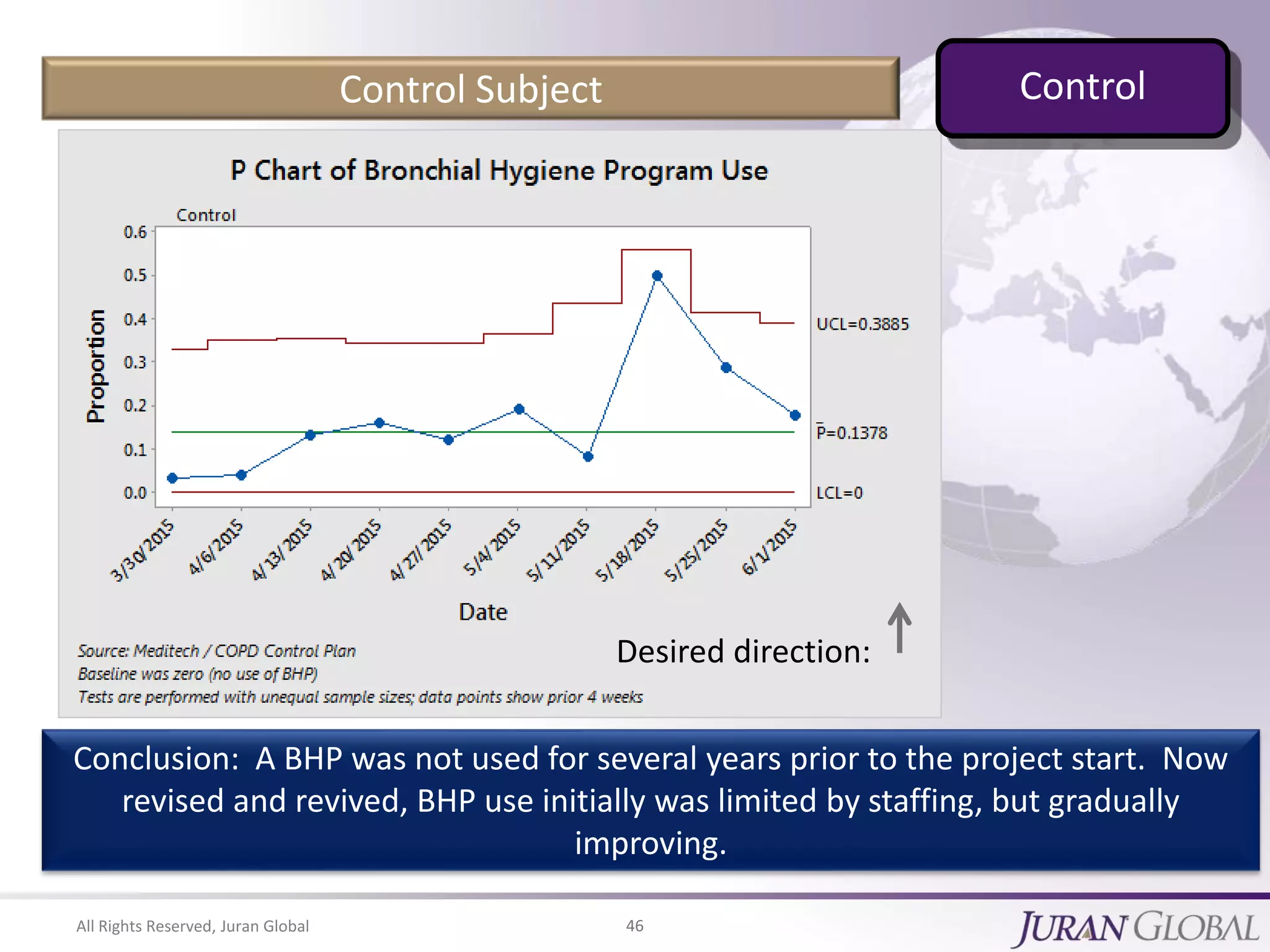
Conclusion: A BHP was not used for several years prior to the project start. Now
revised and revived, BHP use initially was limited by staffing, but gradually
improving.
Desired direction:
Control Subject Control
All Rights Reserved, Juran Global 47
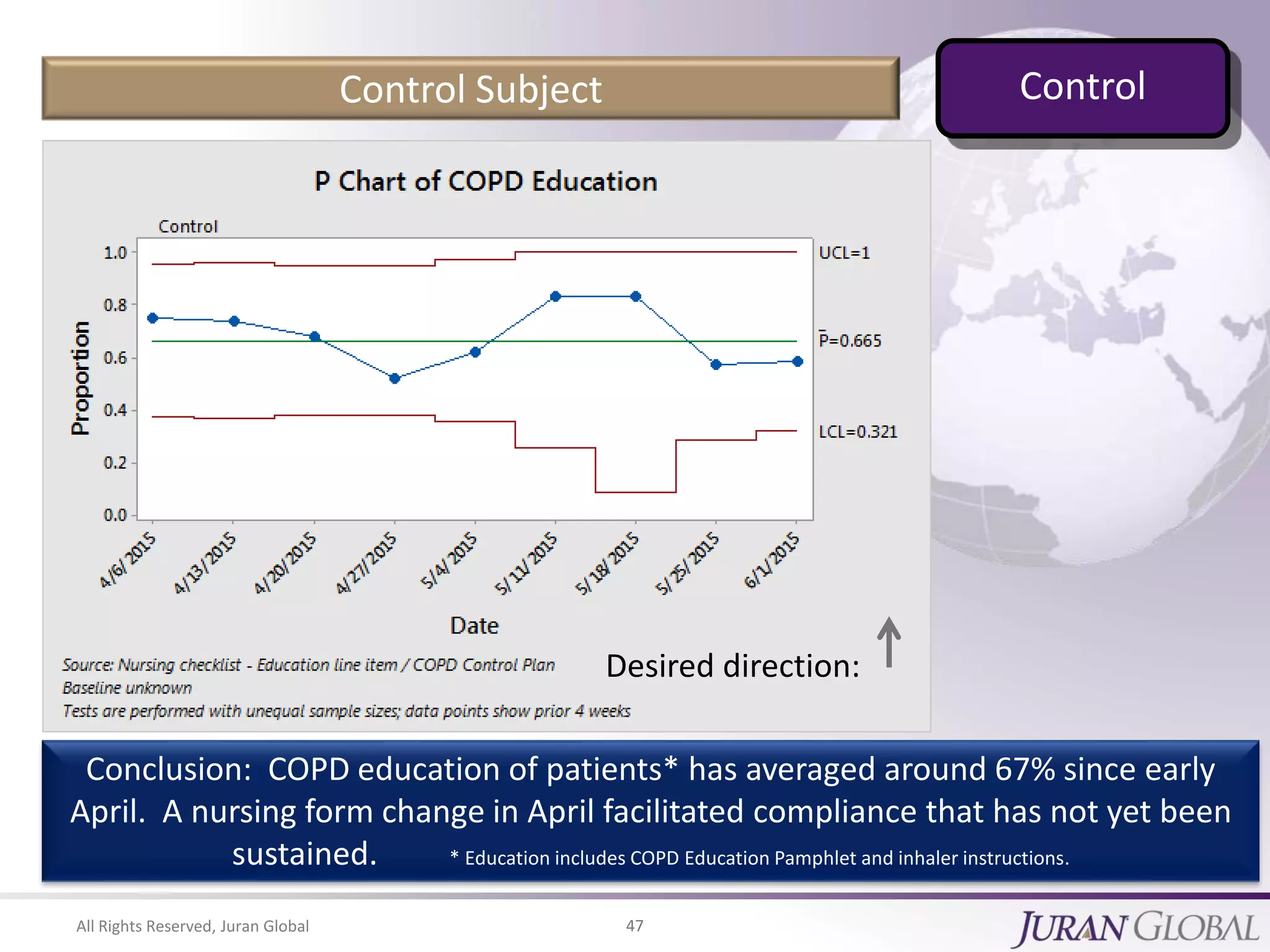
Conclusion: COPD education of patients* has averaged around 67% since early
April. A nursing form change in April facilitated compliance that has not yet been
sustained. * Education includes COPD Education Pamphlet and inhaler instructions.
Desired direction:
Control Subject Control
All Rights Reserved, Juran Global 48
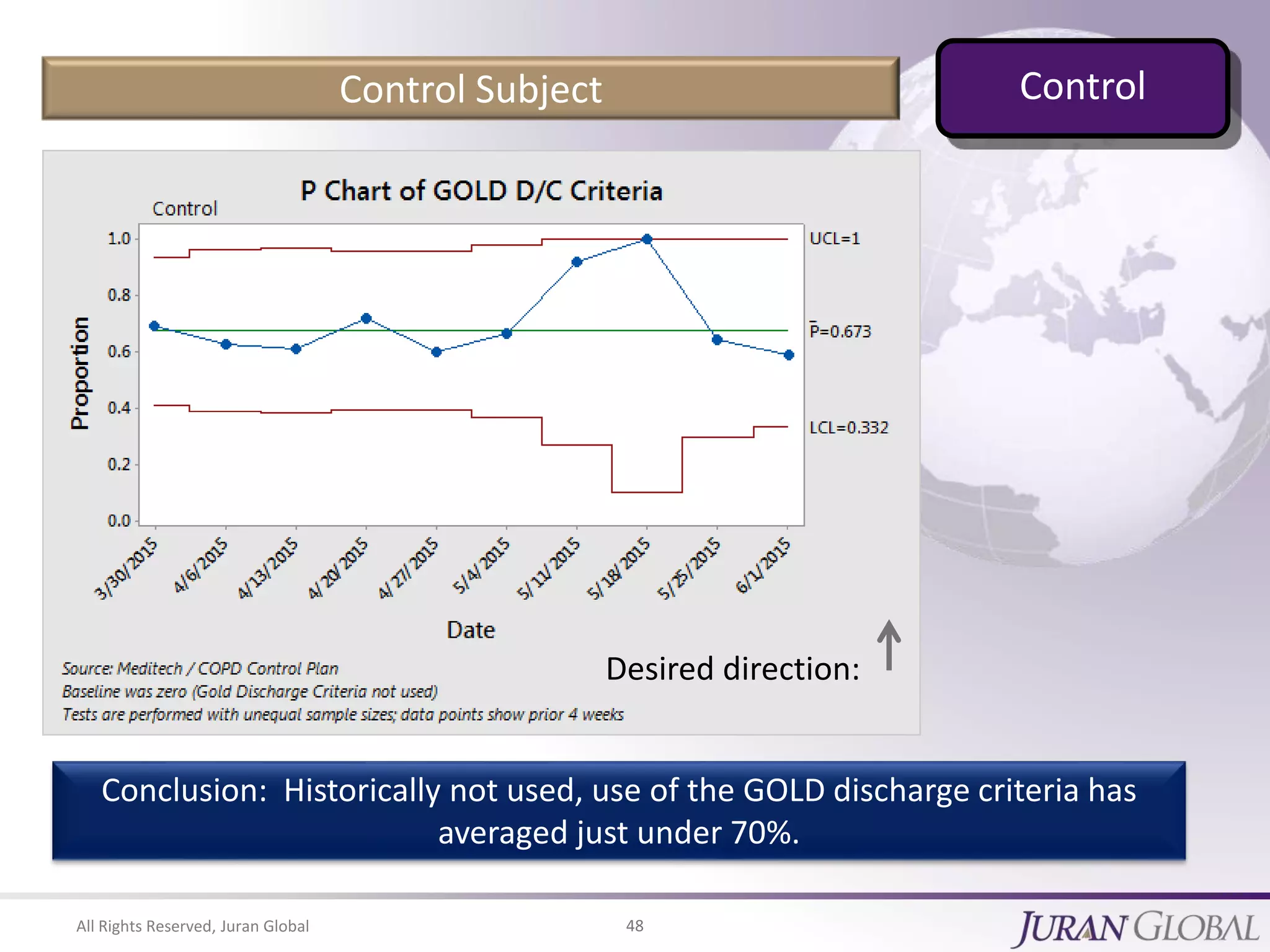
Conclusion: Historically not used, use of the GOLD discharge criteria has
averaged just under 70%.
Desired direction:
Control Subject Control
All Rights Reserved, Juran Global 49
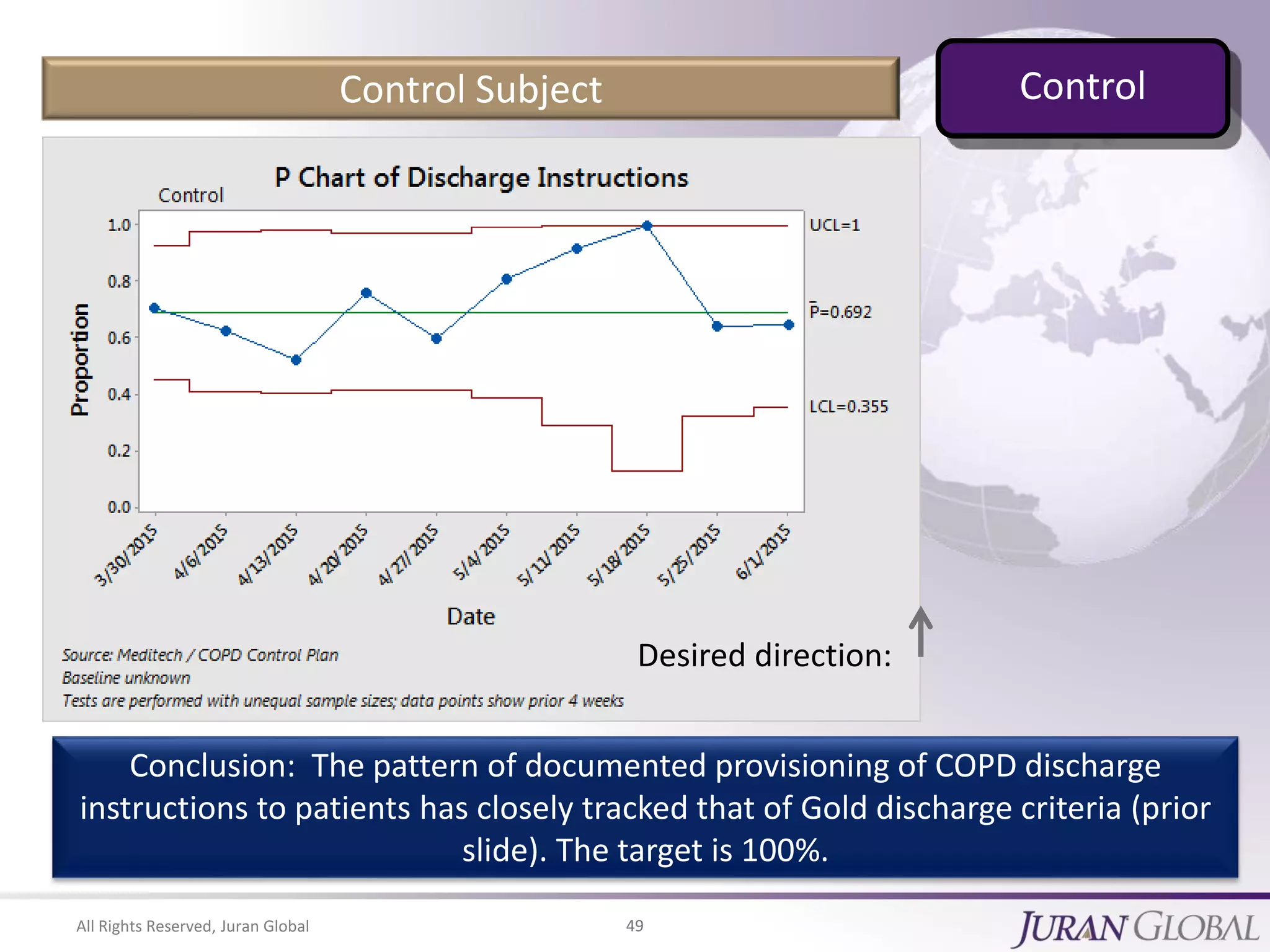
Desired direction:
Conclusion: The pattern of documented provisioning of COPD discharge
instructions to patients has closely tracked that of Gold discharge criteria (prior
slide). The target is 100%.
Control Subject Control
All Rights Reserved, Juran Global 50
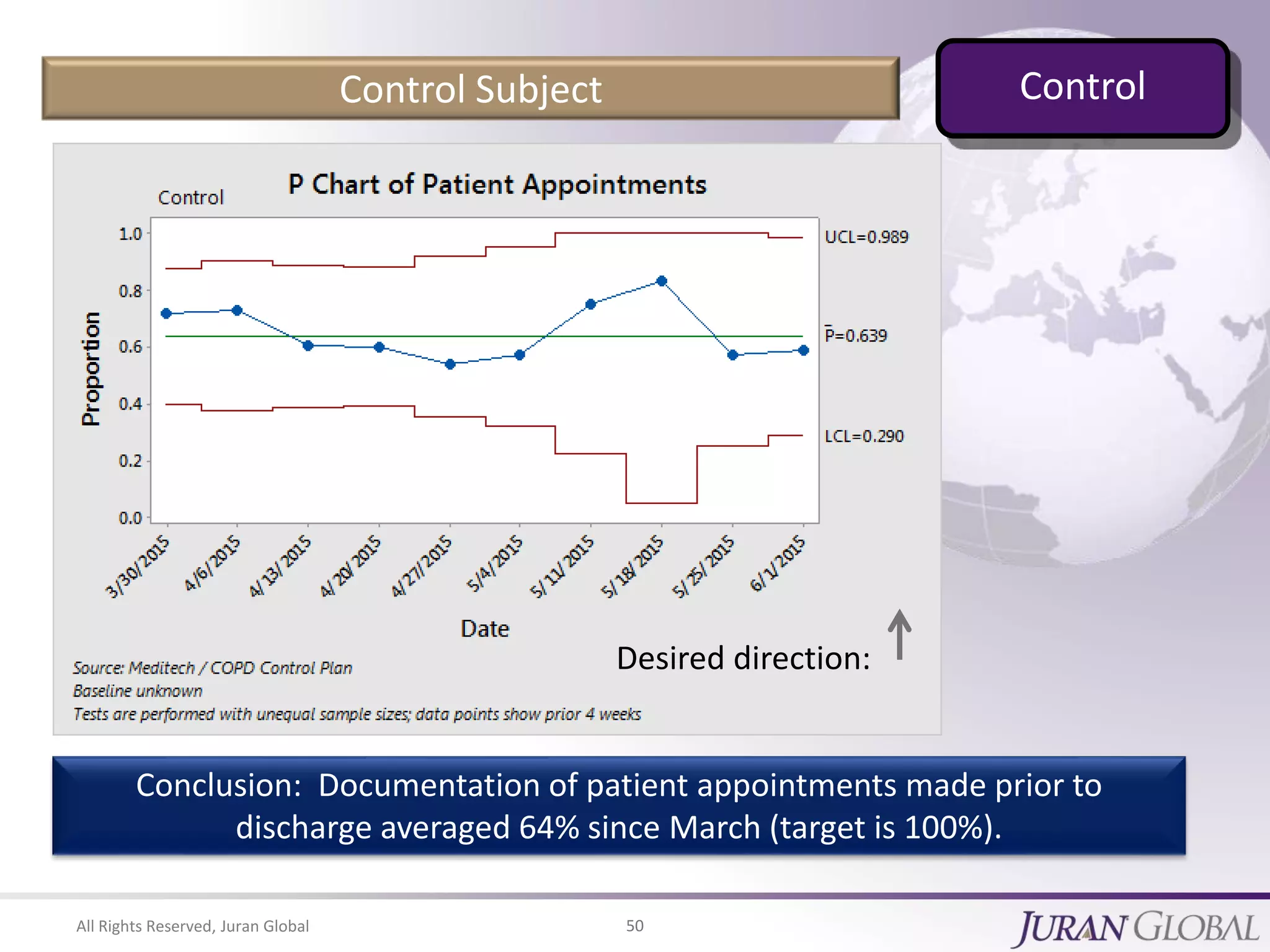
Conclusion: Documentation of patient appointments made prior to
discharge averaged 64% since March (target is 100%).
Desired direction:
Control Subject Control
All Rights Reserved, Juran Global 51
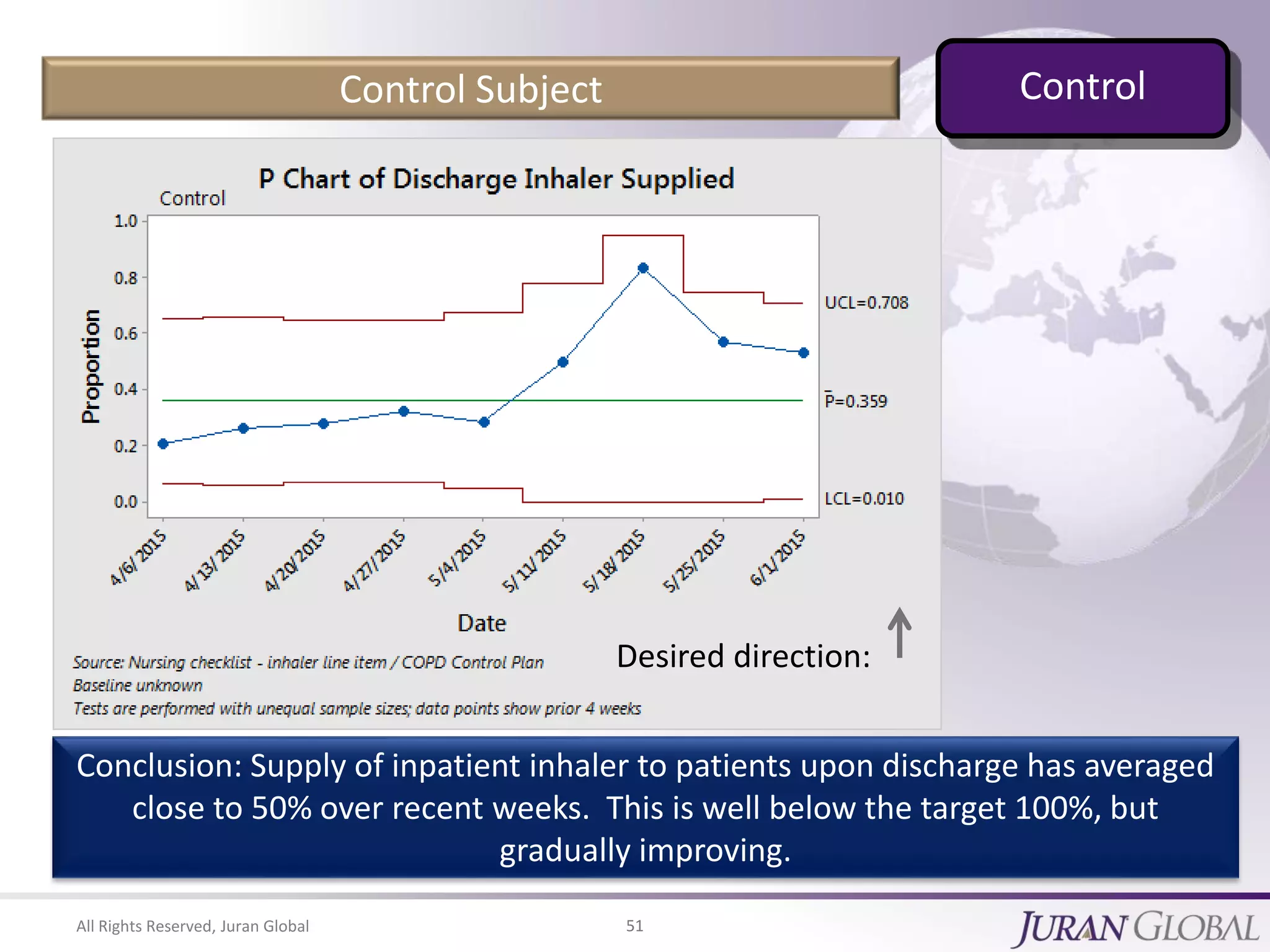
Desired direction:
Conclusion: Supply of inpatient inhaler to patients upon discharge has averaged
close to 50% over recent weeks. This is well below the target 100%, but
gradually improving.
Control Subject Control
All Rights Reserved, Juran Global 52
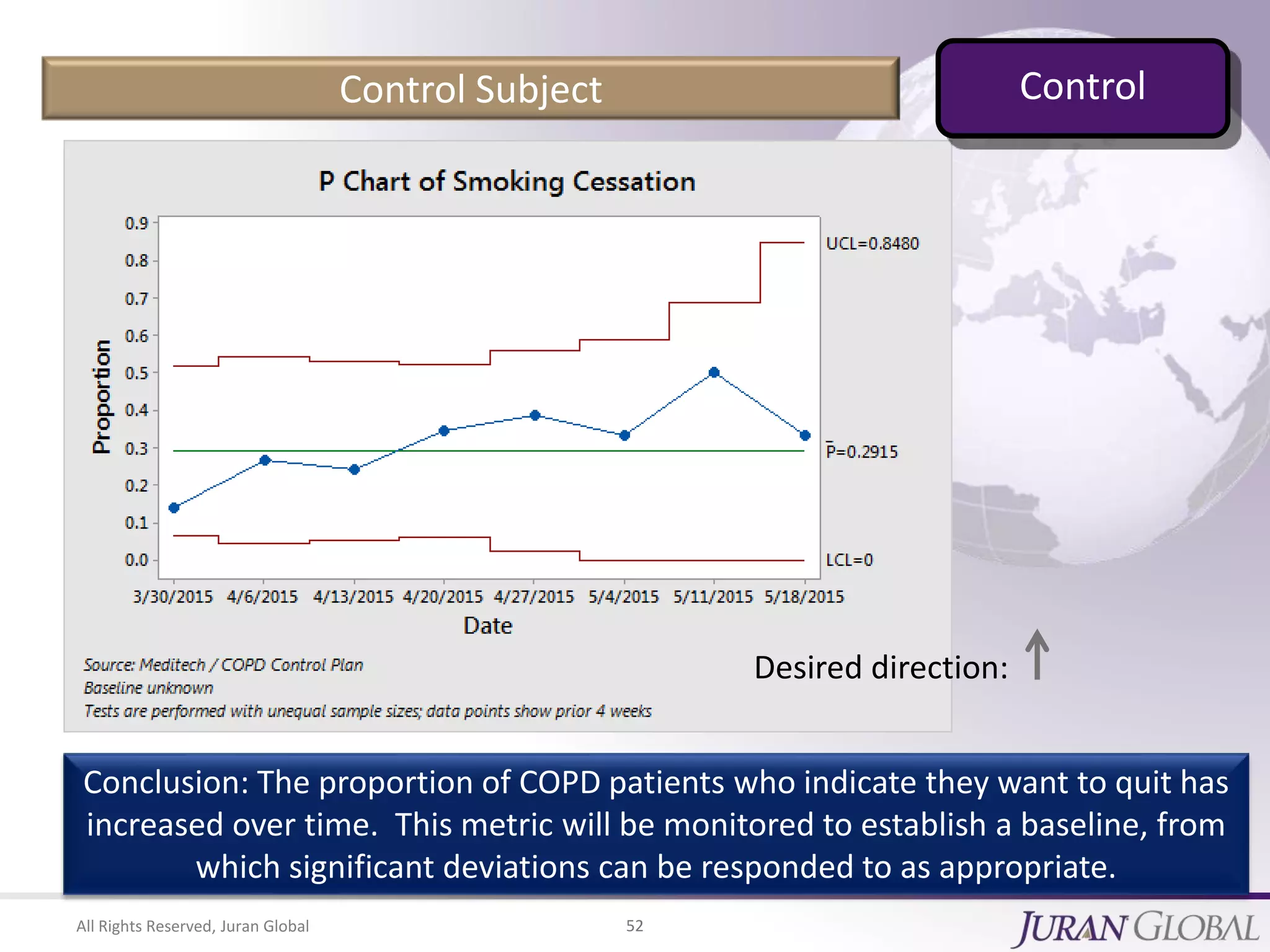
Conclusion: The proportion of COPD patients who indicate they want to quit has
increased over time. This metric will be monitored to establish a baseline, from
which significant deviations can be responded to as appropriate.
Desired direction:
Control Subject Control
All Rights Reserved, Juran Global 53
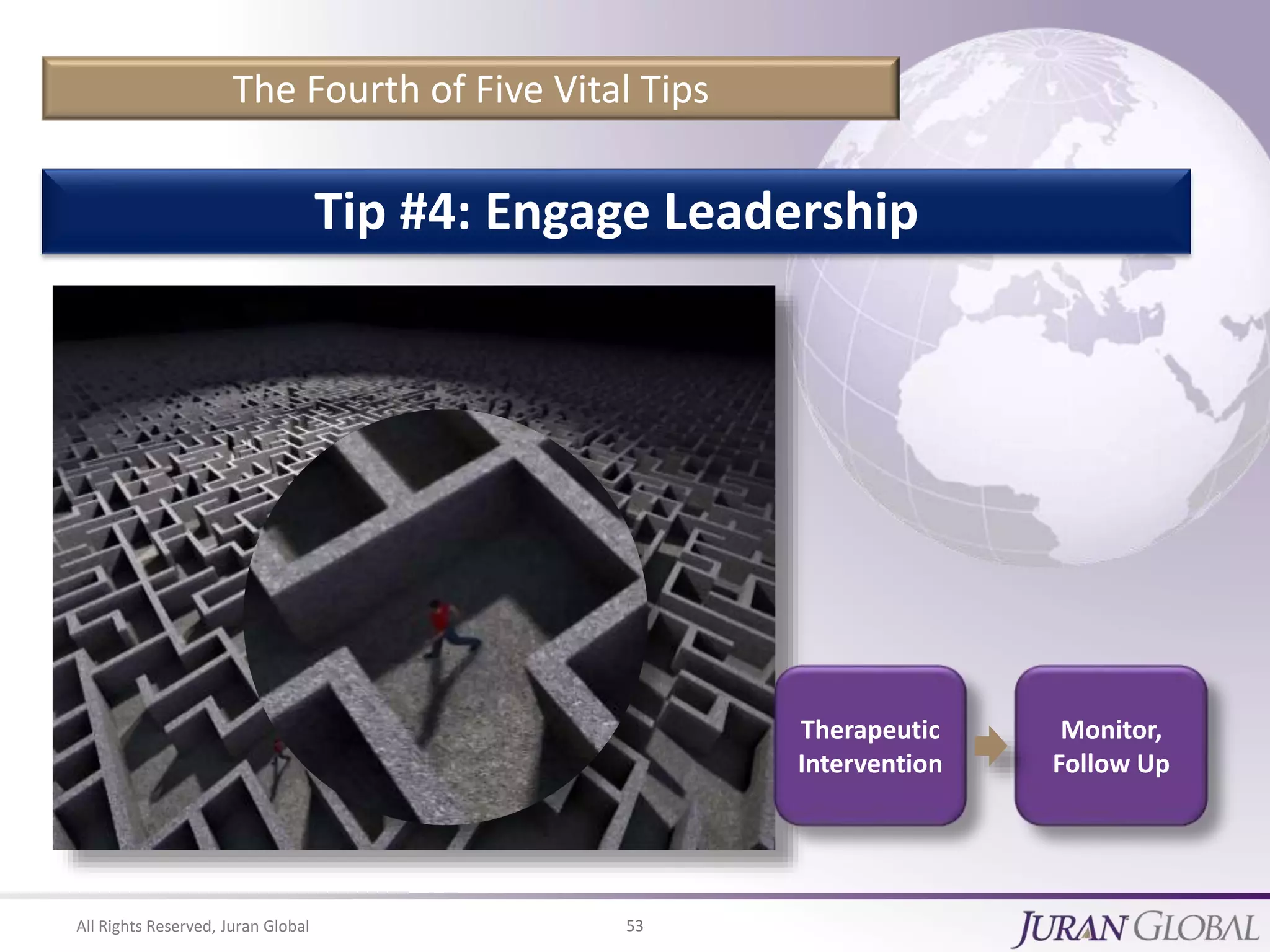
The Fourth of Five Vital Tips
Tip #4: Engage Leadership
Therapeutic
Intervention
Monitor,
Follow Up
All Rights Reserved, Juran Global 54
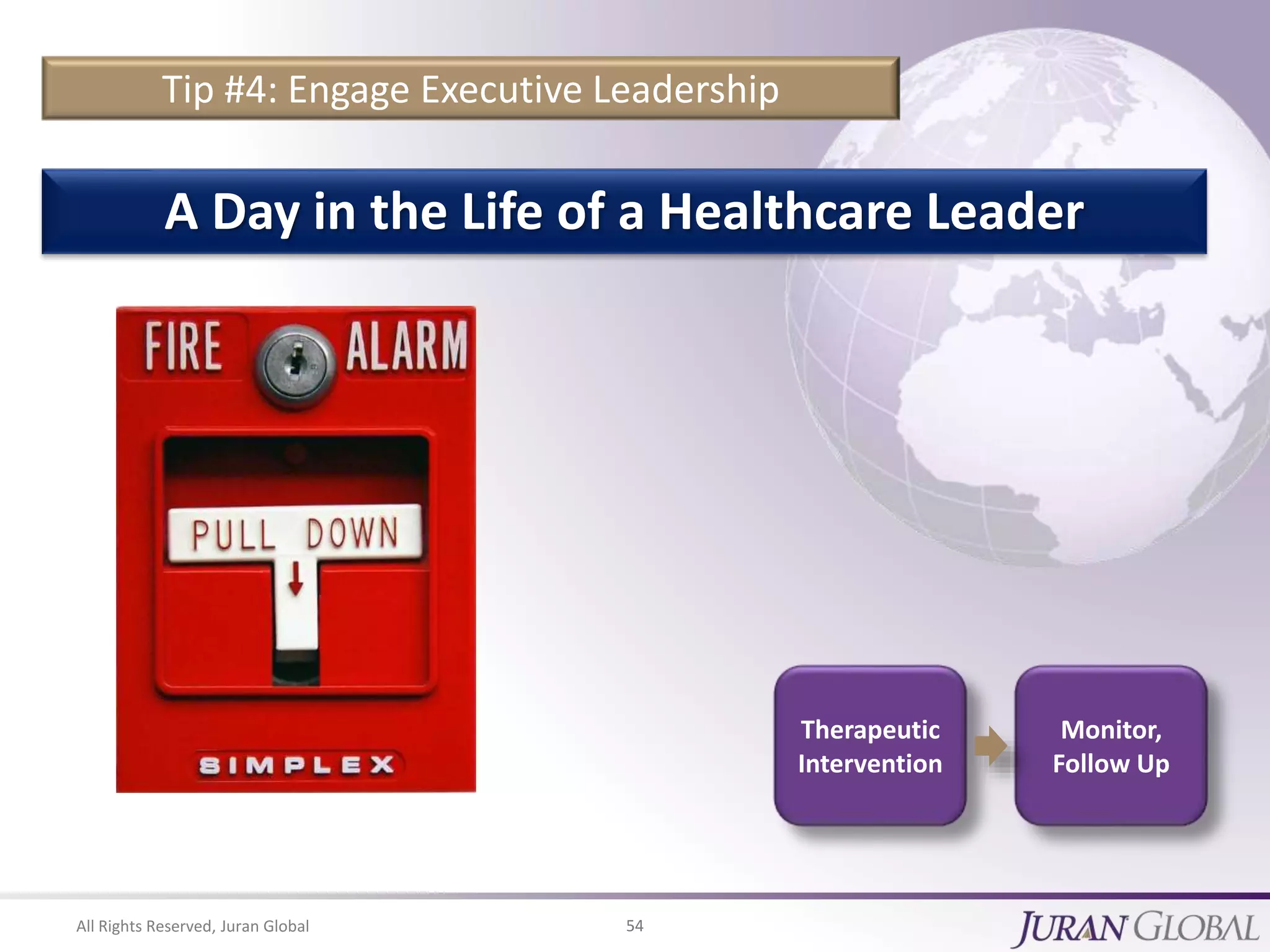
Tip #4: Engage Executive Leadership
A Day in the Life of a Healthcare Leader
Therapeutic
Intervention
Monitor,
Follow Up
All Rights Reserved, Juran Global 55
Monitor,
Follow Up
Therapeutic
Intervention
Tip #4: Engage Executive Leadership
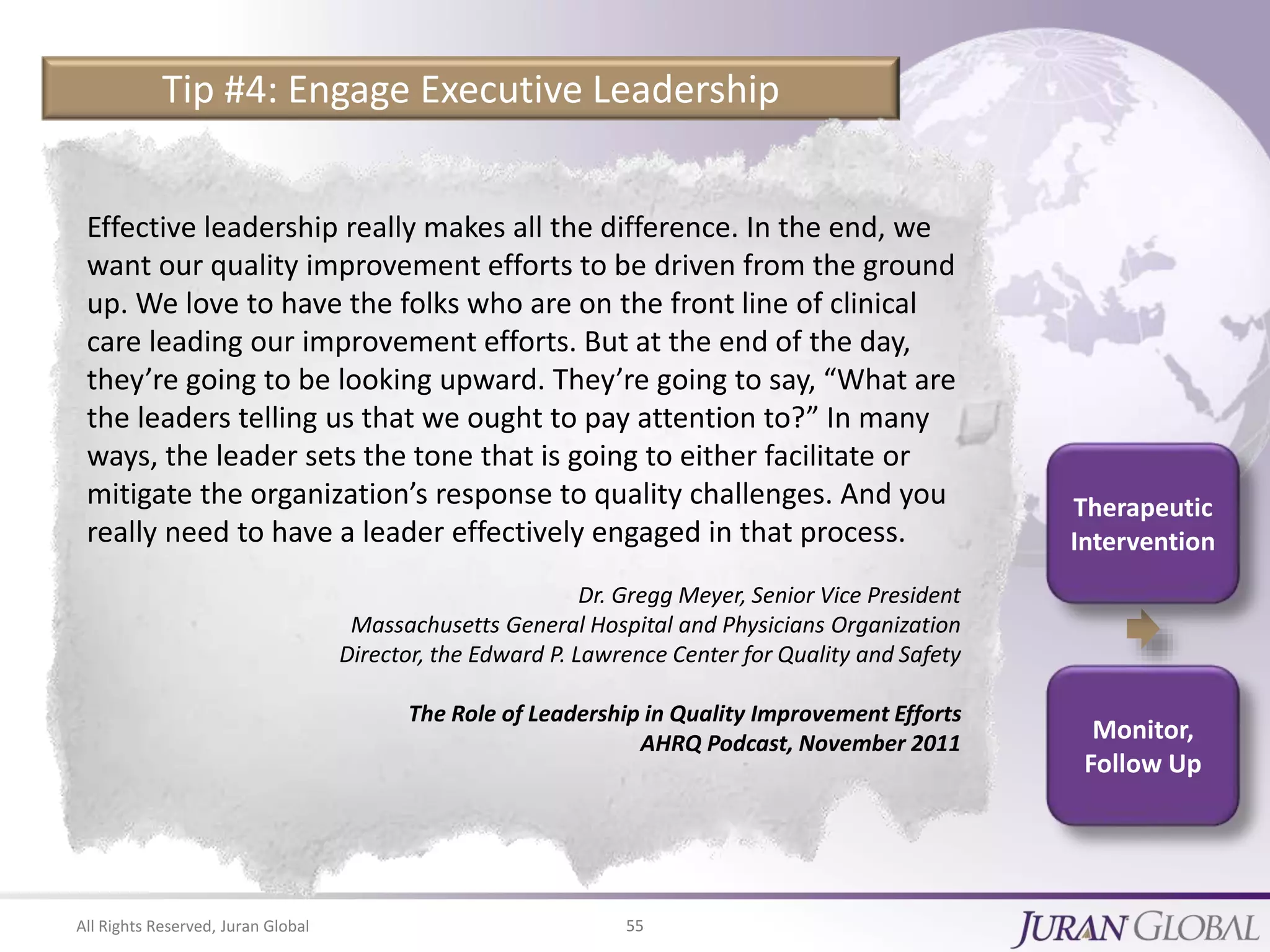
Effective leadership really makes all the difference. In the end, we
want our quality improvement efforts to be driven from the ground
up. We love to have the folks who are on the front line of clinical
care leading our improvement efforts. But at the end of the day,
they’re going to be looking upward. They’re going to say, “What are
the leaders telling us that we ought to pay attention to?” In many
ways, the leader sets the tone that is going to either facilitate or
mitigate the organization’s response to quality challenges. And you
really need to have a leader effectively engaged in that process.
Dr. Gregg Meyer, Senior Vice President
Massachusetts General Hospital and Physicians Organization
Director, the Edward P. Lawrence Center for Quality and Safety
The Role of Leadership in Quality Improvement Efforts
AHRQ Podcast, November 2011
All Rights Reserved, Juran Global 56
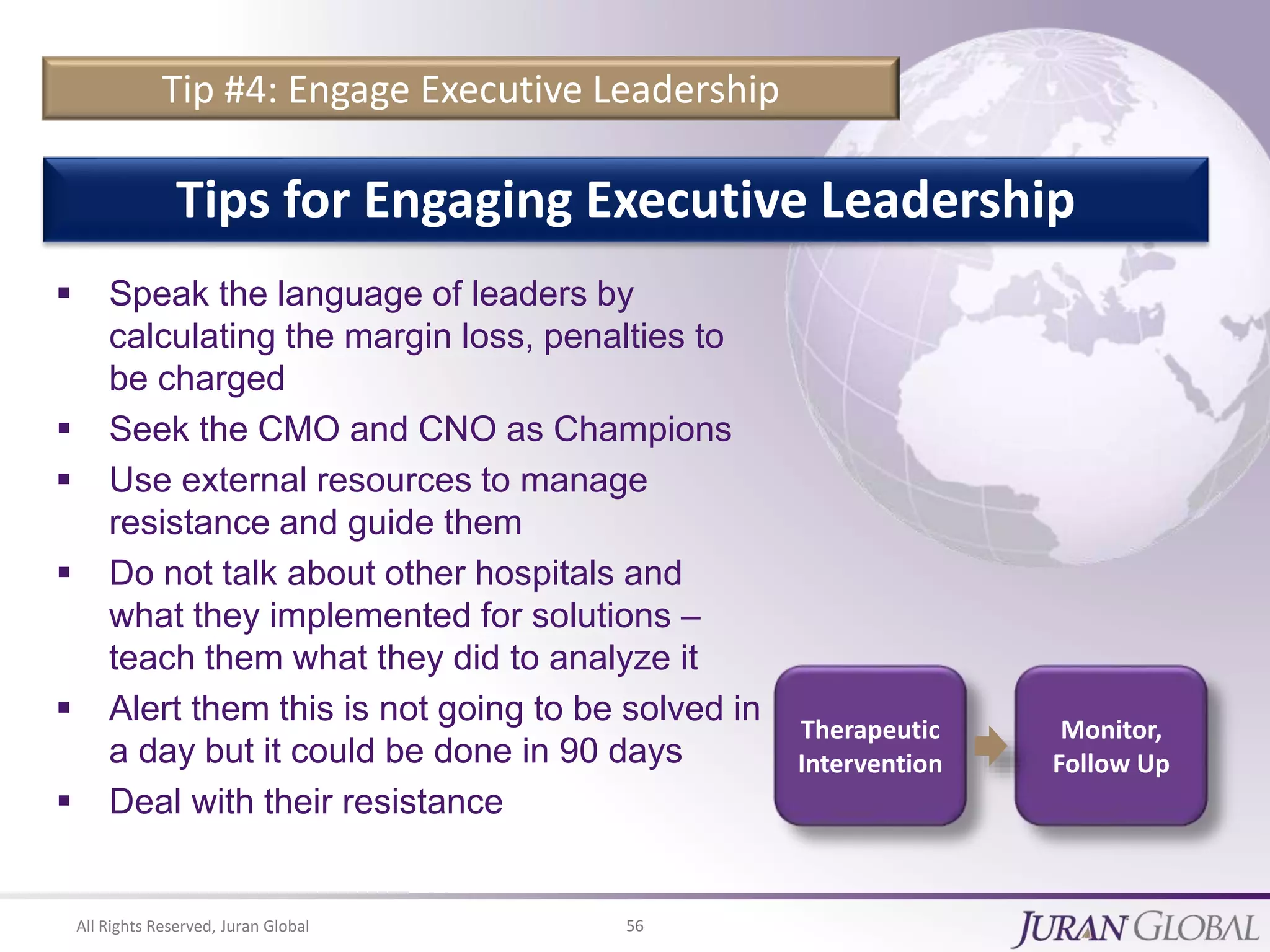
Tip #4: Engage Executive Leadership
 Speak the language of leaders by
calculating the margin loss, penalties to
be charged
 Seek the CMO and CNO as Champions
 Use external resources to manage
resistance and guide them
 Do not talk about other hospitals and
what they implemented for solutions –
teach them what they did to analyze it
 Alert them this is not going to be solved in
a day but it could be done in 90 days
 Deal with their resistance
Tips for Engaging Executive Leadership
Therapeutic
Intervention
Monitor,
Follow Up
All Rights Reserved, Juran Global 57
The Last of Five Vital Tips
Tip #5: Start with the Lowest Hanging Fruit
All Rights Reserved, Juran Global 58
Tip #5: Start with the Low-Hanging Fruit
Start with Your Biggest Penalty
 Which of these five conditions is causing the greatest pain?
– heart attack
– heart failure
– pneumonia
– chronic obstructive pulmonary disease
– elective hip or knee replacements
 Use an improvement methodology robust enough to get the job done
 Make sure your root cause analysis is thorough and complete
 Identify solutions aimed at eliminating the root cause
 Maintain a control plan
 Identify your second-biggest readmission problem and repeat
All Rights Reserved, Juran Global 59
Lessons Learned
 The root cause of your readmission problem may not be the same
root cause as any other hospital’s readmission problem
 Unless you first identify the root cause, any solution implemented is
just a roll of the dice
 Obtaining expertise on the use of root cause tools is critical to
successfully reducing your readmission rate
 It is easy to make errors when identifying root causes; these errors
lead to wasted human and financial resources
 Multi-functional issues require multi-functional teams to solve them
 Readmission root causes almost universally span departments and
units
 Tried-and-true improvement methodologies are your best approach
 If leadership is not hands on, the likelihood of success is diminished
All Rights Reserved, Juran Global 60
Connect With Us
@Juran_Institute
www.youtube.com/user/JuranInstitut
e
www.facebook.com/JuranInstitute
www.linkedin.com/company/juran-
institute
All Rights Reserved, Juran Global 61
More Resources
 business innovation
 business process
improvement
 continuous improvement
 dmaic
 juran quality handbook
 lean manufacturing
 lean six sigma
 lean transformation
 operational excellence
 process innovation
 quality assurance
 quality control
 quality improvement
 management consulting firm
 iso 9000 2015
 six sigma certification
 what is lean
 what is six sigma
Click any link for more information
All Rights Reserved, Juran Global 62
Thank You!
Copyright ©2015, Juran Institute, Inc.
For more information, please visit www.juran.com
Contact us at: info@juran.com
All Rights Reserved, Juran Global 63
Thank you
We hope to see you in our future webinars!
If you would like a copy of this
presentation or would like to
discuss this topic with your
organization, contact me at:
jdefeo@juran.com

5 Vital Tips to Help Reduce Readmissions in Hospitals

  • 1.
    All Rights Reserved,Juran Global 1 Dr. Joseph A. DeFeo, CEO, Juran Global Scott A. Regan, MBA, MHSA, SVP, Juran Global 5 Vital Tips to Help Reduce Readmissions in Hospitals
  • 2.
    All Rights Reserved,Juran Global 2 Today’s Agenda 1. Attacking the readmission rate problems most effectively 2. Using the right tools for addressing readmission rate problems 3. Engaging a multi-functional team to address readmission rates 4. Engaging leadership to ensure the organization is set up for success 5. Picking the best place to begin
  • 3.
    All Rights Reserved,Juran Global 3 Our Legacy Ignited a Global Movement Our Research and Experience is well published.
  • 4.
    All Rights Reserved,Juran Global 4 Healthcare Organizations We’ve Worked With
  • 5.
    All Rights Reserved,Juran Global 5 This Month’s Healthcare Headlines 1
  • 6.
    All Rights Reserved,Juran Global 6 About the CMS Readmission Program Learn Everything You Need to Know  The Hospital Readmissions Reduction Program was created under the Affordable Care Act, which requires CMS to reduce payments to hospitals with excess readmissions.  Penalties are based on readmissions for Medicare patients who were originally admitted for: – heart attack – heart failure – Pneumonia – chronic obstructive pulmonary disease – elective hip or knee replacements  This year’s penalties will take effect from Oct. 1 through Sept. 30, 2016, and are projected to cost hospitals a combined $420 million.  The maximum penalty this year is a 3% reduction in Medicare payments; the average penalty this year is 0.61%.
  • 7.
    All Rights Reserved,Juran Global 7 Healthcare’s Latest Cottage Industry
  • 8.
    All Rights Reserved,Juran Global 8 The Physician’s Treatment Process Chief Complaint H&P, Diagnostics Diagnosis Therapeutic Intervention Monitor, Follow Up
  • 9.
    All Rights Reserved,Juran Global 9 The Administrator’s Treatment Process Chief Complaint Therapeutic Intervention
  • 10.
    All Rights Reserved,Juran Global 10 The First of Five Vital Tips  Off-the-shelf interventions will work, but only if you are lucky enough that the intervention you select matches a correct diagnosis  Which means you first need a correct diagnosis  Which means you need valid analysis of the root cause of your readmissions problems not someone else's Tip #1: Contrary to what you read there is no magic potion for a solution – But there is a magic potion to analyze the problem
  • 11.
    All Rights Reserved,Juran Global 11 Tip #1: Magic Potion  What the root cause isn’t: – It is not the initial reaction or response – It is not merely restating the finding – It is not a symptom  What the root cause usually is: – Process or program failure – System or organization failure – Poorly written instructions – Lack of training Use the right method not the easiest to identify the root causes H & P Diagnostics Diagnosis
  • 12.
    All Rights Reserved,Juran Global 12 Tip #1: Magic Potion 1. Define the problem WITH PRECISION 2. Collect and analyze facts WITH REAL DATA 3. Develop theories and possible causes BEFORE SOLUTIONS 4. Systematically reduce the possible theories and causes using FACTS 5. Develop possible solutions BASED ON ANALYSIS 6. Define and implement an action plan TO CHANGE IT 7. Monitor and assess results TO HOLD GAINS Most effective means to determine the real root causes H&P, Diagnostics Diagnosis
  • 13.
    All Rights Reserved,Juran Global 13 Tip #1: Magic Potion  We use Six Sigma as the starting point: – Define the baseline and goal – Measure current performance – Analyze why, who, what, when… • Pareto analysis (vital few vs. trivial many) • Brainstorming • Flow charts and process mapping • Cause-and-effect diagram – Analysis of data – Improve with best affordable solution – Control to hold the gains Right Methods for Identifying the Root Cause H&P, Diagnostics Diagnosis
  • 14.
    All Rights Reserved,Juran Global 14 Tip #1: Magic Bullets  Implementing solutions because you know why the readmits exist  Looking for a single cause – Often two or three causes contribute and may be interacting  Ending analysis at a symptomatic cause  Assigning as the cause of the problem the “why” event that preceded the real cause Common Errors of Root Cause Analysis H&P, Diagnostics Diagnosis
  • 15.
    All Rights Reserved,Juran Global 15 The Second of Five Vital Tips Tip #2: Using the Right Method Right or H&P, Diagnostics Diagnosis
  • 16.
    All Rights Reserved,Juran Global 16 Tip #2: Bring the Right Method to the Job Chief Complaint H&P, Diagnostics Diagnosis Therapeutic Intervention Monitor, Follow Up Define Measure Analyze Improve Control The Magic Potion for Analysis
  • 17.
    All Rights Reserved,Juran Global 17 The Third of Five Vital Tips C Multi-Functional Team Tip #3: Engage a Multi-Functional Team Therapeutic Intervention
  • 18.
    All Rights Reserved,Juran Global 18 Tip #3: Engage a Multifunctional Team Conditions that Cause Most Readmissions (2011) Number Medicare 1. Congestive heart failure 134,500 2. Septicemia 92,900 3. Pneumonia 88,800 4. Chronic obstructive pulmonary disease 77,900 5. Cardiac dysrhythmias 69,400 Medicaid and Commercial 6. Mood disorders 61,200 7. Schizophrenia and other psychotic disorders 35,800 8. Maintenance of chemotherapy or radiotherapy 25,500 9. Diabetes mellitus with complications 23,700 10. Complications of pregnancy 21,500 * According to the Agency for Healthcare Research & Quality, April 2014 Medicare Penalties Regardless the Condition, They Span Job Functions Therapeutic Intervention
  • 19.
    All Rights Reserved,Juran Global 19 Tip #3: Engage a Multifunctional Team Exit Writer PACS Whiteboard Sign-In Sheet EPICare Amb MS4 Chart Rack Chart Pyxis US Rack RALS MUSE Sign In Triage Form Triage/Primary Assessment MD Assessment/ Orders Registration/Armband Placement by RN RN Assessment Treatment/Procedure Prep/IV/Labs Drawn Diagnostics MD Evaluation/ Disposition Discharge Instructions Discharge/Admit/ Transfer Admitting Office/ Admin. Supervisor Bed Placement ED Waiting ED Exam/ Hallway Med Station Supplies Tube Registration Consult They Also Span Departments Therapeutic Intervention
  • 20.
    All Rights Reserved,Juran Global 20 Tip #3: Engage a Multifunctional Team Effective Teams Use Effective Methods Therapeutic Intervention Define Measure Analyze Improve Control
  • 21.
    All Rights Reserved,Juran Global 21 Measure Analyze Improve Control Define Lean Six Sigma Roadmap
  • 22.
    All Rights Reserved,Juran Global 22 Problem and Goal Problem Statement: For My Hospital during the calendar year 2013, the readmission rate for APR DRG 140 Chronic Obstructive Pulmonary Disease (COPD) was 21.89%, which is above the expected rate of 18.21%. Readmission rates higher than the national rate result in decreased quality of care, poor patient outcomes and decreased reimbursement and penalties from the Centers of Medicare and Medicaid Services (CMS). Goals/Objective(s): Reduce the readmission rate for COPD from 21.89% to a minimum of 18.21% (measured quarterly) or less starting 6/30/2014. Define
  • 23.
    All Rights Reserved,Juran Global 23 Financial Impact: Business Case 1. Medicare penalties for excess readmissions 2. Medicaid penalties for excess readmissions 3. Cost of care of patients readmitted for COPD in excess of the expected number. Performance worse than the expected rates adjusted for MSH results in penalties and decreased reimbursement from CMS. Cost avoidance also is anticipated.  By achieving the project goal (57 to 47 readmission cases), the hospital can reduce total COPQ to $401,145, realizing $133,692 in savings.  Note: My data do not include readmissions at other facilities; Medicaid claims are tracked by Dept. of Healthcare and Family Services (affects final penalty). COPQ Component Current Annualized Cost Goal Annualized Cost Medicare penalties $2,319 $0 Medicaid penalties $46,023 $0 Cost of poor care $486,495 $401,145 TOTAL COPQ $534,837 $401,145 Define
  • 24.
    All Rights Reserved,Juran Global 24 Project Team Membership Project Champions: • Two MDs (one being CMO) Project Core Team Members: • Director of Disease Management • Med/Surg Floor Nurse • Clinical Pharmacy Manager • Medical Intern • Director of Respiratory Therapy • Respiratory Therapy Day Supervisor Ad Hoc Members or SMEs: • Hospitalist • Disease Management Define
  • 25.
    All Rights Reserved,Juran Global 25 High Level Process Map (SIPOC) and CTQs SIPOC: COPD Readmissions SUPPLIER INPUT (use nouns) PROCESS (use verbs) OUTPUT (use nouns) CUSTOMER CTQs Patient or family Patient complaints / symptoms Admit patient Patient in room Treatment Team Bed readily available at appropriate level of care; Appropriate admission Transport Techs Nursing & medical staff Patient Diagnostics Assess patient H&P Plan of Care Physician Nurse RT Correct Plan of Care; Timely verification of COPD Order Set Treatment Team H&P Plan of Care Treat patient Interventions Patient Timely availability of Plan of Care; Timely implementation of COPD Order Set; Appropriate spacer use Treatment Team Assessment Diagnostics Evaluate patient Achievement of treatment expectations Patient Treatment Team Appropriate evaluation according to GOLD standards; Timely evaluation (Nursing: every shift; Medicine: at least daily) Treatment Team Education materials and equipment Verbal instruction Educate patient Patient/family with increased knowledge and skill base Patient/family Delivery of standardized education (verbal & written); Documented confirmation of patient/family understanding & demonstration Treatment Team DC orders DC Plan/paperwork Medications & equipment Discharge patient Discharged patient to home/next level of care Patient/family Next level of care GOLD discharge criteria are met; Discharged to appropriate setting; Additional training needs identified; Discharge paperwork reviewed; Appointments scheduled; Inhalers provided Define
  • 26.
    All Rights Reserved,Juran Global 26 Detailed Process Map Typical COPD inpatient LOS is about 3 days. Measure
  • 27.
    All Rights Reserved,Juran Global 27 Measure Process Capability The baseline CMS readmission rate was 21.89% for CY 2013, above the expected rate of 18.21%. Measure
  • 28.
    All Rights Reserved,Juran Global 28 Graphical Analyses – Selection of COPD COPD and CHF readmissions were in the vital few APR DRGs, and determined to be relatively controllable vs. other diagnoses. Measure
  • 29.
    All Rights Reserved,Juran Global 29 Graphical Analyses – Readmission Trend Both observed and expected readmission rates are variable over time, displaying gradual decline over the prior two years. Observed readmission rates exceeded the expected rate in 16 of 24 months. Measure
  • 30.
    All Rights Reserved,Juran Global 30 Graphical Analyses – Readmission Reasons Measure Most principal diagnoses for readmissions relate to respiratory problems or CHF. Common secondary diagnoses include tobacco and drug use, diabetes, hypertension and hyperlipidemia.
  • 31.
    All Rights Reserved,Juran Global 31 Severity Score at Index & Readmission There is no significant difference in severity score between Index and Readmitted patients. Are some patients readmitted more often?... Measure
  • 32.
    All Rights Reserved,Juran Global 32 Graphical Analysis – Readmissions by Patient Although 9 (14%) of the 66 readmitted patients accounted for 38% of all readmissions, the majority of patients (57, or 86%) had only 1 or 2 readmissions, accounting for 62% of all readmissions. 66 patients generated 113 readmission visits Measure
  • 33.
    All Rights Reserved,Juran Global 33 Process Issues Analyze Many process issues were identified, especially near time of discharge.
  • 34.
    All Rights Reserved,Juran Global 34 Brainstorm Theories of Causes COPD Readmission Admission Resources Discharge Post-Discharge Fragmented care following D/C Patients do not consistently meet GOLD discharge criteria Appt not made Patients unable to obtain meds following 3-day supply Inconsistent coordination of education b/w pharmacy and nursing team Variation in patient demonstration of skill in inhaler use Inconsistent communication to Nursing Team of repeat admission Documentation of education lacking or does not reflect education quality and/or needs Patient leaves AMA Reduced pharmacist coverage on weekends or evening Insufficient assessment of patient understanding of teaching Limited staff to educate and assess competency (all meds) Delay in communicating with DME provider, & equipment delivery Spacer use not considered for adults Inpatient inhaler lost / non-standard storage & handling Process Variation Social Worker/Staffing Education Educational content not at appropriate level for patient Ineffective media type used for education (TV, etc.) Smoking cessation not high priority Coordination problems prevent effective inhaler use Inconsistent inhaler education & resulting poor pt technique Variation in recognition of primary home caregiver Med history not completed for all COPD patients Patients not D/C to appropriate level of care / setting Providers unaware of pending discharges Necessary services not available during weekends Patient not provided inhaler COPD not flagged in auto-trigger list Social Worker engaged late in process COPD order set inconsistently used Limited communication of order set availability O2 6 min ordered late in process Excessive variation in patient care Perceived as cumbersome Single, generic content @ 6th grade level Too complex Rushed / not planned Knowledge deficit of caregiver Not identified Limited options No doc’n pharmacy teaching Fragmented Not asked Asked too late Limited standardization Limited staff allocated to high priority pts Not considered Pt financial issues No/under insurance Not asked/planned Not assessed for need Need not identified Appts not patient-centric Access (e.g., transport) Forget Nurses cannot find Nurses not know Pt not fill inhaler Rx Pt not know to fill / diff rescue/maint Pharmacy access Unaware empty Not policy Unaware Too much info Not all relevant parties involved Home caregiver not available Not enough time Not all teaching programs make appts Comm’y docs not make appts Pt not follow up on appt or recomm’n Fill too late Docs not know to document / significance Co- morbidities overlap Not know do not need Admission order set Access issues (transport) Inconsistent teach-back No standard protocol No / too many caregivers No or ineffective review of D/C instructions Inconsistent ID of readmission Non- Sinai Not documented / Inconsistent location / Difficult to find / No expectation Not coordinated prior to D/C Poor D/C planning COPD not a standard referral for Social Work Multiple factorsPossible readmission factors were organized in a fishbone format. Analyze
  • 35.
    All Rights Reserved,Juran Global 35 Critical To Quality and Theories (Xs) Possible causes related to CTQs: X1: Insufficient assessment of patient understanding of teaching. X2: Patients do not consistently meet GOLD discharge criteria. X3: No or ineffective review of D/C instructions (e.g., too fast, too complicated, does not include family/caregiver). X4: Appointment not made or inappropriate for patient (e.g., have outside provider). X5: Patients are not being discharged to the appropriate level of care / setting. X6: Patient not provided inhaler. Additional possible causes: X7: Readmission rate is a function of day of week discharged. Analyze
  • 36.
    All Rights Reserved,Juran Global 36 Data Collection Plan for Analyze Phase Data Collection Plan for the Analyze Phase Ref. Theories To Be Tested (Selected From The C-E Diagram, FMEA, etc.) List Of Questions To Answer for Evidence of Each Selected Theory Results that will support theory Results that will rule out theory Tools To Be Used Data To Be Collected Description/ Data Type Sample Size, Number of Samples Where/ How To Collect Data Who Will Collect Data How Will Data Be Recor ded X1 (CTQ) Insufficient assessment of patient understanding / demonstration of standardized teaching, including additional training needs. Does a second- teach-back improve patient administration? A second teach-back improves patient administration. A second teach-back does not improve patient administration . Bar chart Categorical: Percentage patients with improved administration. 84 patients Inhaler instructi on session Karen Excel X6 (CTQ) Patient not provided inhaler. What is the incidence of lost or missing inhalers? A high number of inhalers are lost or missing. A low number of inhalers are lost or missing. Bar chart Categorical: Count of lost or missing inhalers. 6 weeks Reconci liation tally Karen Excel X7 Readmission rate is a function of day of week discharged. What is the proportion of patients readmitted w/in 30 days by day of week? Proportion readmitted differs by day discharged. No difference in proportion by day discharged. Stacked bar chart, Chi- square test Categorical: Number of patients w/ Index discharge by day of week, and number of these readmitted. All COPD discharge s over prior 2 years Premier Lynda Excel A subset of CTQs and Xs were tested (others had sufficient anecdotal evidence and/or were difficult / time-consuming to test). Analyze
  • 37.
    All Rights Reserved,Juran Global 37 Test of Theories Example Theory: Insufficient assessment of patient understanding of teaching. Analysis: Pharmacy assessed patient inhaler demonstration technique at t0 (baseline), t1 (after instruction), and t2 (24-72 hr. after initial instruction, t1). Scoring based on number of steps missed (detailed description in Notes View) The t2 (24-72 hr.) assessment better reflects actual skill after discharge than the t1. Instruction improved scores but remained <100% scores; this and the slight decline between t1 and t2 indicate that reinforcement and assessment are beneficial. Practical Conclusion: Additional teach-back improves patient inhaler administration; current teaching is insufficient. Spiriva (n=15) Symbicort (n=36) Albuterol (n=35) Score, out of 9 % Score, out of 9 % Score, out of 9 % t0 5.8 64 4.5 50 4.1 46 t1 8 89 7.2 80 6.7 74 t2 7.2 80 6.6 73 6.2 69 Δt1-t0 +25 +30 +28 Δt2-t0 +16 +23 +23 Δt2-t1 -9 -7 -5 Analyze
  • 38.
    All Rights Reserved,Juran Global 38 CTQ and X Summary X1: Insufficient assessment of patient understanding of teaching. Administration of inhalers improved from 25% at baseline to 50% after a second teach back session that occurred between 24-72hr post initial test. X2: Patients do not consistently meet GOLD discharge criteria. Application of GOLD discharge criteria is not standard practice. X3: No or ineffective review of D/C instructions (e.g., too fast, too complicated, does not include family/caregiver). Anecdotal evidence from nursing and RT indicates review of D/C instructions is not consistently effective. X4: Appointment not made or inappropriate for patient (e.g., have outside provider). Follow-up appointments (PCP, pulmonologist) are made for some but not all patients, and are made late in the inpatient care process. X5: Patients are not being discharged to the appropriate level of care / setting. GOLD discharge criteria not used to guide choice of care setting; palliative care is underutilized. X6: Patient not provided inhaler. Inhalers frequently are lost or misplaced, and not available to provide to patients upon discharge. X7: Readmission rate is a function of day of week discharged. Day of week discharged does not affect subsequent readmission rate. Analyze
  • 39.
    All Rights Reserved,Juran Global 39 Selected Solutions Theme Selected Solutions Admission & Inpatient Care COPD Care Pathway and Order Set, with triggering of Order Set and supplemental services via pathway. Eliminate need for duoNeb ordering via teaching aids (placebo inhalers and disposable spacers). Education - Patient Bronchial Hygiene Program upon admission. Include early symptom identification, trigger identification, hand-washing, exercise. Education - Staff Bronchial Hygiene Program upon admission. Build in shortcut to ordering of spacers based on RT vs. direct MD order. Use admission smoker status as basis for referral to Disease Mgmt. / Lawndale Clinic smoking cessation classes. Resources Social Worker engaged via Care Pathway to identify & initiate post-discharge meds process, oxygen, etc. Discharge Marketing and education of palliative care. Include palliative care and GOLD discharge criteria in COPD Care Pathway and Order Set. Deploy AccuDose® inhaler tracking & storage (patient-specific). Initiate discharge planning upon admission per COPD Care Pathway, including appointments. Social Worker identifies COPD-relevant programs relevant to patient. Make follow-up appointments (PCP, Specialist) as early as admission. Implement clear, concise COPD-specific D/C instructions, including prescription transition & eligibility for free inhalers/prescriptions. Staff Augment med history by having Pharmacists or ER Pharm Tech complete for patients beyond Disease Mgmt. (Long-term). Improve
  • 40.
    All Rights Reserved,Juran Global 40 Updated Process Map(s) TBD: Smoking cessation intervention Improve
  • 41.
    All Rights Reserved,Juran Global 41 Control Plan Process Control Plan for: COPD Readmissions Date: 11/11/2014 Revision Level: 1 Approved By: COPD Readmission Team Ref. Control Subject Subject Goal (Standard) Unit of Measure Sensor Frequency of Measure- ment Sample Size Where Measurement Recorded Measured by Whom Criteria for Taking Action What Actions to Take Who Decides Who Acts Where Action Recorded 1 COPD readmission (30 day rate) ≤ 18.21% % Premier Monthly All COPD readmissions COPD Readmissions spreadsheet Lynda >18.21% Investigate CTQs Lynda Refer to CTQs Control Plan Log 2 COPD Order Set (use) 100% % Meditech Weekly All COPD discharges (trailing 4 weeks) COPD Order Set Report Lynda <90% List of Non-Compliant Attending & Resident Physicians and Report to Dept. Chairs, Program Directors, Chief Residents Dr. Iliescu Dr. Iliescu Control Plan Log 3 Bronchial Hygiene Program (use) 100% % RT Consult (Meditech) Weekly All COPD discharges (trailing 4 weeks) Bronchial Hygiene Program Report Lynda <90% List of Non-Compliant Attending & Resident Physicians and Report to Dept. Chairs, Program Directors, Chief Residents Dr. Iliescu Dr. Iliescu Control Plan Log 4 COPD education (documentation) 100% % Education checklist* Weekly All COPD discharges (trailing 4 weeks) Patient Chart Lynda <90% List of Non-Compliant Departments (Pharm, Nursing, RT) and Report to Dept heads Dept Heads Dept Heads Control Plan Log 5 GOLD D/C criteria (use) 100% % Physician checklist done at discharge Weekly All COPD discharges (trailing 4 weeks) Meditech Report Lynda <90% List of Non-Compliant Attending & Resident Physicians and Report to Dept. Chairs, Program Directors, Chief Residents Dr. Iliescu Dr. Iliescu Control Plan Log 6 Discharge paperwork (review) 100% % COPD Education Screen Pilot-Daily (First 2 wks) Weekly All COPD discharges (trailing 4 weeks) Meditech Report Lynda <90% List of Non-Compliant Nurses and Report to Unit Directors Raquel Raquel and Unit Directors Control Plan Log 7 Patient appointments made prior to discharge 100% % Discharge module (Meditech) Weekly All COPD discharges (trailing 4 weeks) FM-Appt Report from D/C Module IM-F/U with Kathy Lynda <90% List of Non-Compliant Resident Physician and Report to Dept. Chairs Dr. Iliescu Dr. Iliescu Control Plan Log 8 Discharge inhaler (provisioning of inpatient inhaler) 100% % Nursing discharge checklist Weekly All COPD discharges (trailing 4 weeks) Meditech Report Lynda <90% List of Non-Compliant Nurses and Report to Unit Directors Raquel Raquel and Unit Directors Control Plan Log 9 Smoking cessation (referral conversion) N/A % Meditech Weekly All COPD admissions w/ "Yes Want To Quit" (trailing 4 weeks) Meditech Report Lynda >10% change from baseline Investigate root cause(s) (patient refusal / RT not asking) Phyllis Phyllis Control Plan Log Palliative Care Criteria, Consults TBD Audit (# consults / # meeting criteria) TBD Q4 2014 Control Plan Log Improve
  • 42.
    All Rights Reserved,Juran Global 42 Change Management & Communication Plan Planned Change Who is Affected? Potential Objections Facts (What will really happen) Benefits to those affected (Business and Personal Benefits) Communication (How will change be communicated?) Admission & Inpatient Care: Implement COPD Care Pathway, including use of COPD Order Set and guidelines. Physicians, Nursing, IS, Social Work, Respiratory Therapy, Pharmacy Resistance to pathway and order sets (primarily physicians) Resistance will be overcome with consistent monitoring Treatment team: applying best practices. Social Work: reduced medication costs. Finance: COPQ reduced. Patients: receive better care. Physician and Nursing leadership meetings. Staff meetings with nurses, physicians and other departments affected. Email notifications. See Training Plan. Education - Patient: Reinstate modified Bronchial Hygiene Program w/ RT involvement early in inpatient process. Include early symptom identification, trigger identification, hand- washing, exercise. Respiratory Therapy, Nursing Expansion of RT duties. Providing adequate RT staffing to accomplish goals Restructuring the Bronchial Hygeine Program to shift responsibility for delivery of MDIs and education from nursing to the Respiratory RT is better skilled in the use of various inhalers/will identify the need for spacers. Patients receive better education and improved self- care. Revision of the Bronchial Hygiene Program and MDI Protocol w/ RT staff education. See Training Plan. Education - Staff: Bronchial Hygiene Program to address inhaler education via RT involvement and identification of spacer candidates. Offer Level 2/3 smoking cessation classes. As above As above As above. Focus on education will start with the patient; Information regarding Smoking Cessation class will be incorporated in current packet. As above As above Resources: Social Workers engage patients in corporate pharmaceutical programs for post-discharge meds. Establish Social Work consult on admission per Care Pathway to assess DME / equipment needs. Social Work, Utilization and Nursing Departments; Patients Patients may object to / not comply with paperwork for pharmaceutical program requirements Care Pathway will specify appropriate timing of SW engagement and activities. Saves SW costs and patients receive consistent supply of meds. Social work, utilization and nursing department meetings (leadership and staff level). See Training Plan. Discharge: Facilitate appropriate discharge and post- discharge care by incorporating D/C planning as part of Care Pathway. Elements to include GOLD criteria, provisioning of inpatient inhaler stored in unit-based locations, D/C instructions that educate patient re: free inhaler & prescription transition, and need to follow up w/ Pulmonologist/PCP. Educate physicians & patients re: palliative care & availability. Physicians, Nursing, Respiratory Therapy, Social Work, Pharmacy Use of GOLD criteria. Resistance to change towards earlier discharge planning. Care Pathway will provide guidance on discharge events and timing. Early and more comprehensive discharge planning will smooth discharge process and facilitate appropriate, improved patient self-care following discharge. Educational/training sessions with physicians, Nursing, RT, SW, Pharmacy, per Training Plan. Control
  • 43.
    All Rights Reserved,Juran Global 43 Training Plans The training needs for different stakeholder groups were identified. Training delivery format, frequency, etc. were determined for each group… Topic / Area of Change Teaching Attending & Residents, Hospitalists Community Physicians Nursing Respiratory Therapy Social Work Pharmacy Disease Managem ent ED Staff COPD Care Pathway X X X X X X X COPD Order Set X X X X X X Bronchial Hygiene Program X X X X X Placebo inhalers & disposable spacers (edu, storage, tracking, use) X X X X Smoking cessation referral X X X X X X Social Worker role & engagement X X X X X Palliative care X X X X X GOLD discharge criteria X X X X Discharge (planning, instructions, follow-up appointments) X X X X X X Other – Patient Identification X Control
  • 44.
    All Rights Reserved,Juran Global 44 Conclusion: 30-day readmissions have been running at 12% (27/204) since the beginning of Improve phase in September. Overall readmission rate compares favorably YOY. Desired direction: Control Subject Control
  • 45.
    All Rights Reserved,Juran Global 45 Conclusion: COPD Order Set use is showing a very gradual upward trend, doubling since Q4 2014. There will be continued reinforcement to ensure this positive trend continues. Desired direction: Control Subject Control
  • 46.
    All Rights Reserved,Juran Global 46 Conclusion: A BHP was not used for several years prior to the project start. Now revised and revived, BHP use initially was limited by staffing, but gradually improving. Desired direction: Control Subject Control
  • 47.
    All Rights Reserved,Juran Global 47 Conclusion: COPD education of patients* has averaged around 67% since early April. A nursing form change in April facilitated compliance that has not yet been sustained. * Education includes COPD Education Pamphlet and inhaler instructions. Desired direction: Control Subject Control
  • 48.
    All Rights Reserved,Juran Global 48 Conclusion: Historically not used, use of the GOLD discharge criteria has averaged just under 70%. Desired direction: Control Subject Control
  • 49.
    All Rights Reserved,Juran Global 49 Desired direction: Conclusion: The pattern of documented provisioning of COPD discharge instructions to patients has closely tracked that of Gold discharge criteria (prior slide). The target is 100%. Control Subject Control
  • 50.
    All Rights Reserved,Juran Global 50 Conclusion: Documentation of patient appointments made prior to discharge averaged 64% since March (target is 100%). Desired direction: Control Subject Control
  • 51.
    All Rights Reserved,Juran Global 51 Desired direction: Conclusion: Supply of inpatient inhaler to patients upon discharge has averaged close to 50% over recent weeks. This is well below the target 100%, but gradually improving. Control Subject Control
  • 52.
    All Rights Reserved,Juran Global 52 Conclusion: The proportion of COPD patients who indicate they want to quit has increased over time. This metric will be monitored to establish a baseline, from which significant deviations can be responded to as appropriate. Desired direction: Control Subject Control
  • 53.
    All Rights Reserved,Juran Global 53 The Fourth of Five Vital Tips Tip #4: Engage Leadership Therapeutic Intervention Monitor, Follow Up
  • 54.
    All Rights Reserved,Juran Global 54 Tip #4: Engage Executive Leadership A Day in the Life of a Healthcare Leader Therapeutic Intervention Monitor, Follow Up
  • 55.
    All Rights Reserved,Juran Global 55 Monitor, Follow Up Therapeutic Intervention Tip #4: Engage Executive Leadership Effective leadership really makes all the difference. In the end, we want our quality improvement efforts to be driven from the ground up. We love to have the folks who are on the front line of clinical care leading our improvement efforts. But at the end of the day, they’re going to be looking upward. They’re going to say, “What are the leaders telling us that we ought to pay attention to?” In many ways, the leader sets the tone that is going to either facilitate or mitigate the organization’s response to quality challenges. And you really need to have a leader effectively engaged in that process. Dr. Gregg Meyer, Senior Vice President Massachusetts General Hospital and Physicians Organization Director, the Edward P. Lawrence Center for Quality and Safety The Role of Leadership in Quality Improvement Efforts AHRQ Podcast, November 2011
  • 56.
    All Rights Reserved,Juran Global 56 Tip #4: Engage Executive Leadership  Speak the language of leaders by calculating the margin loss, penalties to be charged  Seek the CMO and CNO as Champions  Use external resources to manage resistance and guide them  Do not talk about other hospitals and what they implemented for solutions – teach them what they did to analyze it  Alert them this is not going to be solved in a day but it could be done in 90 days  Deal with their resistance Tips for Engaging Executive Leadership Therapeutic Intervention Monitor, Follow Up
  • 57.
    All Rights Reserved,Juran Global 57 The Last of Five Vital Tips Tip #5: Start with the Lowest Hanging Fruit
  • 58.
    All Rights Reserved,Juran Global 58 Tip #5: Start with the Low-Hanging Fruit Start with Your Biggest Penalty  Which of these five conditions is causing the greatest pain? – heart attack – heart failure – pneumonia – chronic obstructive pulmonary disease – elective hip or knee replacements  Use an improvement methodology robust enough to get the job done  Make sure your root cause analysis is thorough and complete  Identify solutions aimed at eliminating the root cause  Maintain a control plan  Identify your second-biggest readmission problem and repeat
  • 59.
    All Rights Reserved,Juran Global 59 Lessons Learned  The root cause of your readmission problem may not be the same root cause as any other hospital’s readmission problem  Unless you first identify the root cause, any solution implemented is just a roll of the dice  Obtaining expertise on the use of root cause tools is critical to successfully reducing your readmission rate  It is easy to make errors when identifying root causes; these errors lead to wasted human and financial resources  Multi-functional issues require multi-functional teams to solve them  Readmission root causes almost universally span departments and units  Tried-and-true improvement methodologies are your best approach  If leadership is not hands on, the likelihood of success is diminished
  • 60.
    All Rights Reserved,Juran Global 60 Connect With Us @Juran_Institute www.youtube.com/user/JuranInstitut e www.facebook.com/JuranInstitute www.linkedin.com/company/juran- institute
  • 61.
    All Rights Reserved,Juran Global 61 More Resources  business innovation  business process improvement  continuous improvement  dmaic  juran quality handbook  lean manufacturing  lean six sigma  lean transformation  operational excellence  process innovation  quality assurance  quality control  quality improvement  management consulting firm  iso 9000 2015  six sigma certification  what is lean  what is six sigma Click any link for more information
  • 62.
    All Rights Reserved,Juran Global 62 Thank You! Copyright ©2015, Juran Institute, Inc. For more information, please visit www.juran.com Contact us at: info@juran.com
  • 63.
    All Rights Reserved,Juran Global 63 Thank you We hope to see you in our future webinars! If you would like a copy of this presentation or would like to discuss this topic with your organization, contact me at: jdefeo@juran.com

Editor's Notes

  • #38 Between January and mid-May, pharmacy assessed patients’ inhaler administration technique. Patients were asked to demonstrate their technique and pharmacy scored how many steps they missed (t0). The patient was then corrected on the steps they missed and pharmacy instructed the patient on the correct administration technique. Patient was asked to do a teach-back. Pharmacy again scored the patient on what steps were missed (t1) and corrected the patient. The patient was asked to perform a third demonstration (t2) between 24-72 hours after t1. Pharmacy would again correct the patient’s technique and instruct on the proper technique. Karen wanted t2 to occur 72 hours after the t1 since it would be more representative of real life when a patient is discharged and needs to retain the proper technique. However, patients were being discharged less than 72 hours from t1. Therefore, the time period was augmented to 24-72hr post-demonstration. The table below includes patients with COPD and asthma and completed all demonstration sessions. An explanation for the lower score at t2 was possibly due to those patients who had coordination issues or had a need for further education.