All Rights Reserved, Juran Global
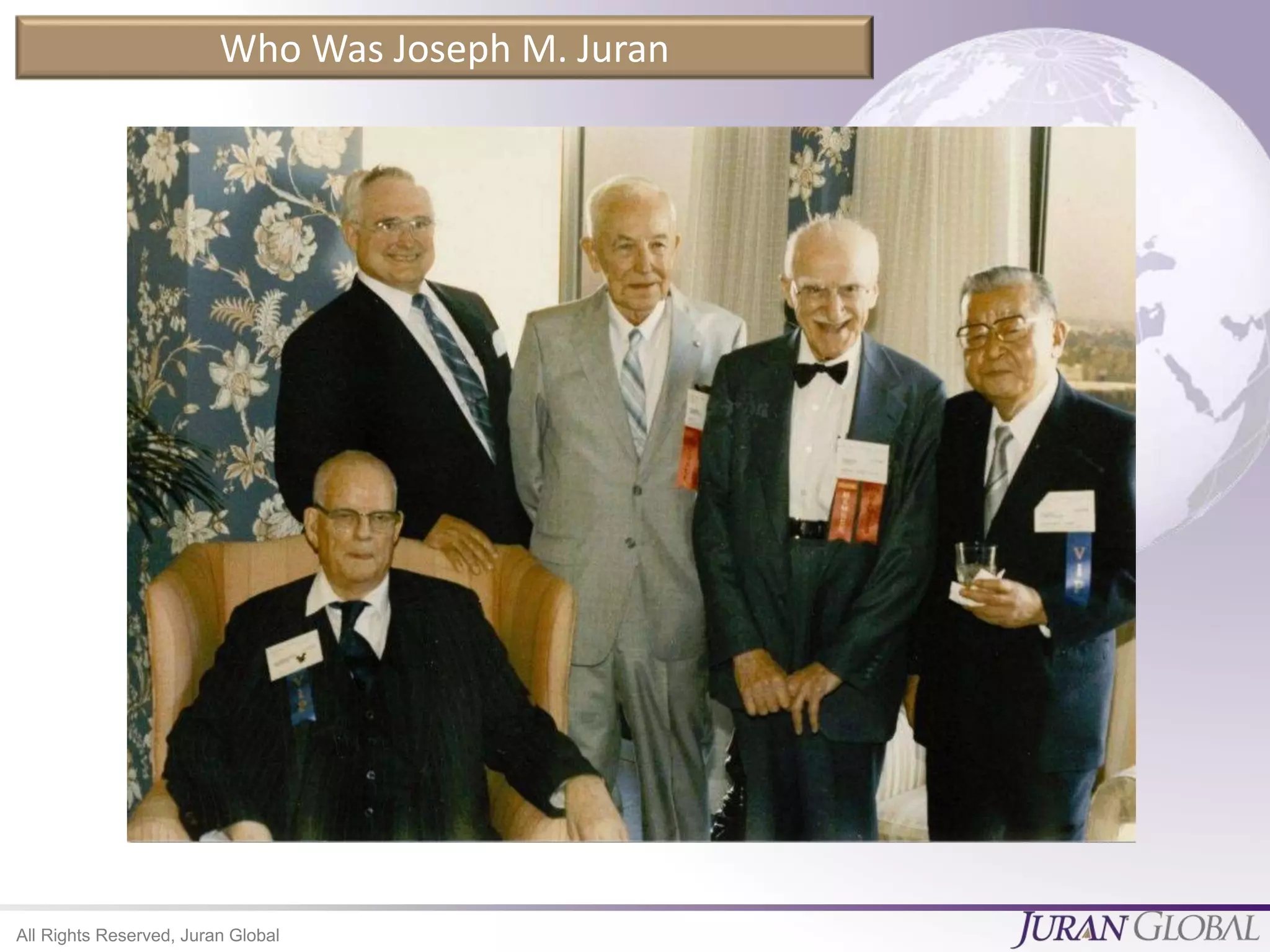
Who Was Joseph M. Juran
All Rights Reserved, Juran Global
1904
Born in Braila,
Romania
December 24,
1904, in a tiny,
one-story
masonry house
Childhood & Young Adulthood: (1904-1920)
The “M” in
Joseph M. Juran
stands for Moses 1912
His family
immigrated to
America when
he was 8 years
old
1920
Graduated from
Minneapolis
South High
School
He was
one of six
children
All Rights Reserved, Juran Global
He was a very
talented chess
player, playing
mentally with his
brother after
“lights out”
1920
Enrolled at the
University of
Minnesota and
was the first in
his family to
pursue higher
education
Childhood & Young Adulthood: (1904-1920)
He skipped the
equivalent of
four grade levels
in school
because of his
proficiency in
math and
science
His brother was
Academy Award
winner Nathan
H. Juran
His first job was
selling copies of
the Minneapolis
Tribune with his
older brother,
Rudy, when they
were ages 11
and 8
All Rights Reserved, Juran Global
1924
His first full-time
job was
troubleshooting
in the Complaint
Department at
Western Electric
1924
Worked at Hawthorne Works, a
factory complex of Western Electric,
where he worked along with Walter
Shewhart, developer of the statistical
control chart. Dr. W. Edwards Deming
worked at the same plant during the
summers of 1925 and 1926, though
they did not meet until the 1940s in
Washington, D.C.
Early Adulthood: (1921-1940)
Received a B.S. in
electrical
engineering from
the University of
Minnesota
1925
Had about 16 jobs during his time in
Minneapolis, including a grocery clerk,
an ice house bookkeeper, member of
the Prohibition Committee, delivery
boy, and chess column editor for the
Minneapolis Star
All Rights Reserved, Juran Global
1931
Enrolled in Loyola
University Chicago
School of Law to
pursue a law
degree as a back-
up plan during the
Great Depression
Wrote a pamphlet
entitled "Statistical
Methods Applied to
Manufacturing
Problems“
19281926
Early Adulthood: (1921-1940)
1926
One of three
people assigned
to a new
department at
Western Electric
to carry out
statistical quality
control
Married Sadie
Shapiro, and was
married for almost
82 years
They had four
children: Robert,
Sylvia, Charles, and
Donald
All Rights Reserved, Juran Global
1937
Became chief
of Industrial
Engineering at
Western
Electric’s New
York office
He created the Pareto
Principle which is used to
separate the “vital few”
from the “useful many”
1936
Received his
Doctorate of
Jurisprudence;
Admitted to
the Illinois bar,
but never
practiced law
Early Adulthood: (1921-1940)
Left his job at Western Electric to work in Washington, D.C. upon
invitation by the government to participate in the Lend-Lease
administration during World War II. The telegram that was sent to
Western Electric requesting the loan of his services stated that it would
be for only 6 weeks. He departed on his 37th birthday and commenced
work on Christmas day, 1941. He was officially placed on government
payroll effective January 14, 1942. He resigned the day after the
Japanese surrender on August 14, 1945
1941
All Rights Reserved, Juran Global
By the end of
World War II, Dr.
Juran was a well-
known and
highly-regarded
statistician and
industrial
engineering
theorist
Middle Adulthood: (1941-1978)
He joined the faculty of
New York University as an
adjunct professor in the
Department of Industrial
Engineering where he
stayed until 1951
1945 1951
Published the
first Quality
Control
Handbook
Left Washington, D.C. to study
quality management with the
intention that the best way to
support his family going forward
was through freelance quality
management consulting
1945
All Rights Reserved, Juran Global
Middle Adulthood: (1941-1978)
Dr. Juran was invited by the
Japanese Union of Scientists
and Engineers (JUSE) to make
nine visits to Japan to teach
and demonstrate his quality
management methods
1952
Invitations to
Japan were also
extended from
Toyota,
Matsushita, and
Bridgestone
The principles that Dr.
Juran taught in Japan
helped many
companies there, like
the automaker Toyota
to become global
leaders in their
industries
Dr. Juran brought
an overhead
projector to
Japan for a
public lecture. At
that time, it was
the only such
machine in the
entire country
Published
Universals in
Management
Planning and
Controlling
1954
All Rights Reserved, Juran Global
The Juran Trilogy®
All Rights Reserved, Juran Global
Middle Adulthood: (1941-1978)
1954
Started courses
in quality
management in
Japan for top
and middle
managers
Juran’s course
“Managing for
Quality” has been
taught to more than
100,000 people in
over 40 countries 1956
Published
Improving the
Relationship
between Staff
and Line
Published Cultural
Patterns and
Quality Control
1957 1957
Published
Industrial
Diagnostics - A
Systematic
Approach to
Management
Problem-Solving
All Rights Reserved, Juran Global
1963
Quality Control
Handbook,
Second Edition
was published
Middle Adulthood: (1941-1978)
Published
Japan
Revisited
1961
Published
Pioneering in
Quality Control
1962
Published
Different to You
but Alike to Me
1963 1964
Published
Managerial
Breakthrough
which was the
first book to
provide step-by-
step sequence
for breakthrough
improvement
Was a contributing
author and editor
of “Management's
Corner” in
Industrial Quality
Control for 16
years 1964
Published
The Two
Worlds of
Quality
Control
All Rights Reserved, Juran Global
1966
During a visit to
Japan, Dr. Juran
learned about the
Japanese concept
of quality circles,
which he then
brought to the
West
Middle Adulthood: (1941-1978)
Published
Whose
Quality
Costs?
1965
Was the first to
add the human
dimension to
quality
management
Was the first to
conclude cultural
resistance to
change was a
major problem in
reforming quality
practices
1966
Published
So, You Want To
Be a Quality
Control
Consultant
Published Quality
Problems, Remedies and
Nostrums
1966
All Rights Reserved, Juran Global
1968
Became
the eighth
honorary
member of
ASQ
1967
Published
The QC Circle
Phenomenon
Middle Adulthood: (1941-1978)
During a presentation to the Kyoto University in Japan, Dr. Juran
was asked if he would lend his name to a new quality prize to be
awarded to companies that had won the Deming Prize for the
second time. Dr. Juran graciously declined, suggesting they name
the new prize the Japan Prize. Later he realized he must have
misunderstood the question and regretted the naming outcome.
1966 1967
Published
The Japanese
QC Circles:
Questions and
Answers
1968
Published
Operator
Errors -
Time for a
New Look
All Rights Reserved, Juran Global
Published
Mobilizing
for the
1970s
1969 1970
Published
Quality
Planning and
Analysis as the
first textbook
for quality
engineers
1970
Published
Consumerism
and Product
Quality
Published Quality
Control in Service
Industries
1973
Middle Adulthood: (1941-1978)
1973
Published
The Taylor
System and
Quality
Control
Quality
Control
Handbook,
Third Edition
was
published
1973
All Rights Reserved, Juran Global
1975
Published
Quality Control
of Service in
1974 Japanese
Symposium
Published
The Non-
Pareto
Principle;
Mea Culpa
1975 1976
Published
Khrushchev's
Venture into
Quality
Improvement
Published
That
Uninterested
Top
Management
1977
Middle Adulthood: (1941-1978)
Published A Visit
to Complex
Systems, Inc.
1980
His mission for the
Juran Institute was
to “improve the
quality of society”
1979
Founded the Juran
Institute
All Rights Reserved, Juran Global
1981
He received the emperor’s
award of the Order of the
Sacred Treasure, Second
Class for the development of
Quality in Japan. The Second
Class is the highest award
that may be given to a non-
Japanese
Helped to create
the U.S. Malcolm
Baldrige National
Quality Award
Later Years: (1979-2008)
Published
Product
Quality - A
Prescription
for the West
1981
When introducing Dr.
Juran at the Annual
Quality Congress in
1986, a previous ASQ
president compared
him to a baseball
player that played
every position
1984
Published
Japanese
and Western
Quality - a
Contrast
The Juran Trilogy® was
published and was
accepted worldwide as
the basis for quality
management
1986
All Rights Reserved, Juran Global
Juran’s Quality
Control Handbook,
Fourth Edition was
published
1988 1988
Awarded membership in
the National Academy of
Engineering for
“pioneering contributions
in developing the practice
of statistical quality
control, and in developing
engineering design
principles based on
statistical concepts”
1990
He traveled
internationally
until age 86
Later Years: (1979-2008)
Published
Strategies
for World-
Class
Quality
1991 1992
Awarded the National Medal of
Technology by President George H.
W. Bush, for “his lifetime work of
providing the key principles and
methods by which enterprises
manage the quality of their
products and processes, enhancing
their ability to compete in the global
marketplace”
Awarded the European
Organization for
Quality’s medal, “in
recognition of his
valuable contributions
to quality in Europe”
1993
All Rights Reserved, Juran Global
Published The
Japanese
Revolution in
Quality
Remembrance and
Prognosis
Later Years: (1979-2008)
1993
Published Made
in USA: A
Renaissance in
Quality
and published
Address to the
Business Round
Table
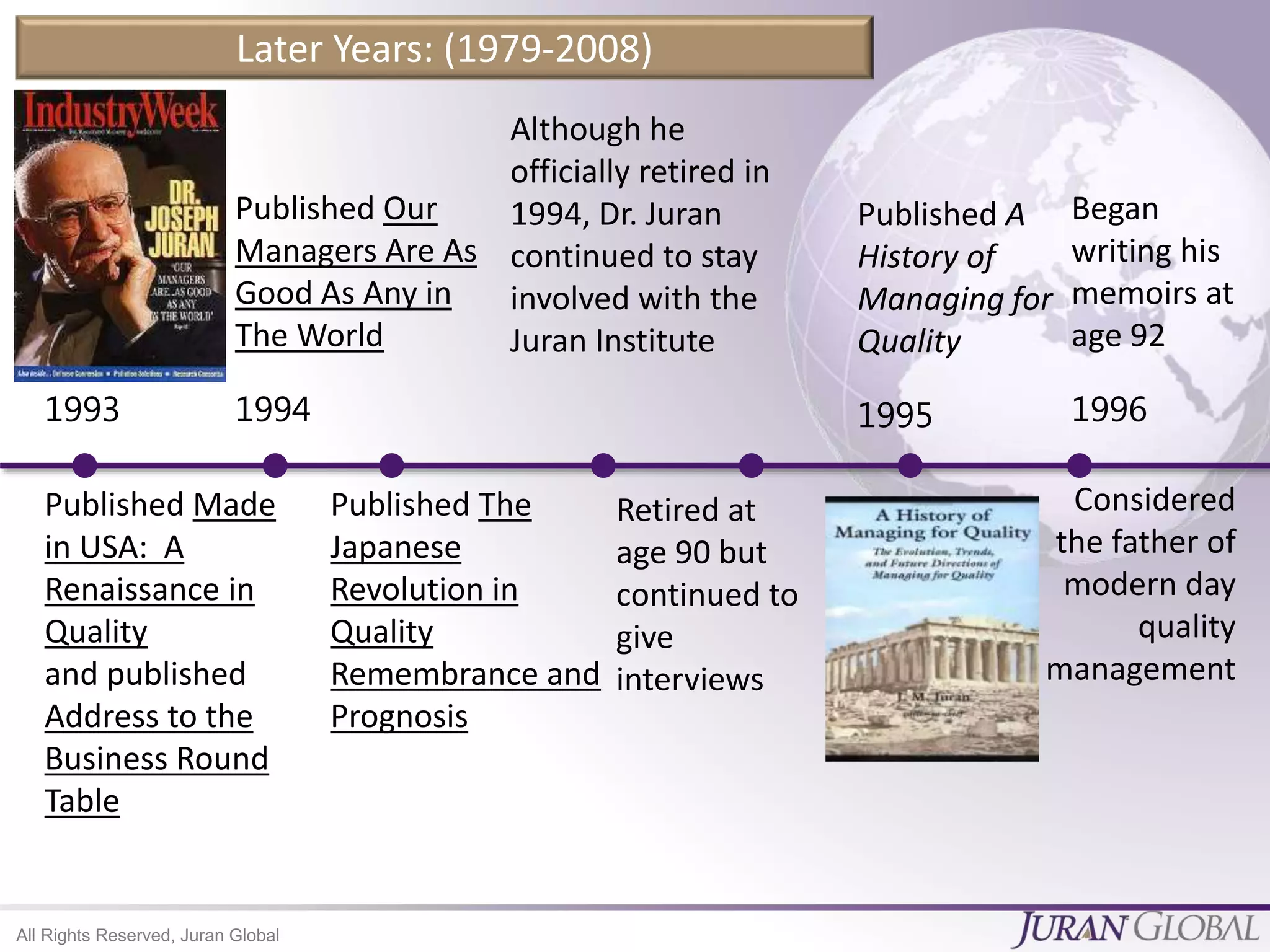
Published Our
Managers Are As
Good As Any in
The World
1994
Although he
officially retired in
1994, Dr. Juran
continued to stay
involved with the
Juran Institute
Retired at
age 90 but
continued to
give
interviews
Began
writing his
memoirs at
age 92
1996
Considered
the father of
modern day
quality
management
Published A
History of
Managing for
Quality
1995
All Rights Reserved, Juran Global
Received over 40
honorary doctorates,
honorary
memberships,
medals, and plaques
Later Years: (1979-2008)
Author of more
than 20 books
Visited Sweden
over 30 times
Juran’s Quality
Handbook, Fifth
Edition was
published
1998 2002
Published his
memoirs, Architect of
Quality at age 97
All Rights Reserved, Juran Global
2008
Passed away at age
103 after 82 years
of marriage. He was
survived by Sadie, his
four children, nine
grandchildren and ten
great grandchildren.
2004
Published
The Juran
Generation
Later Years: (1979-2008)
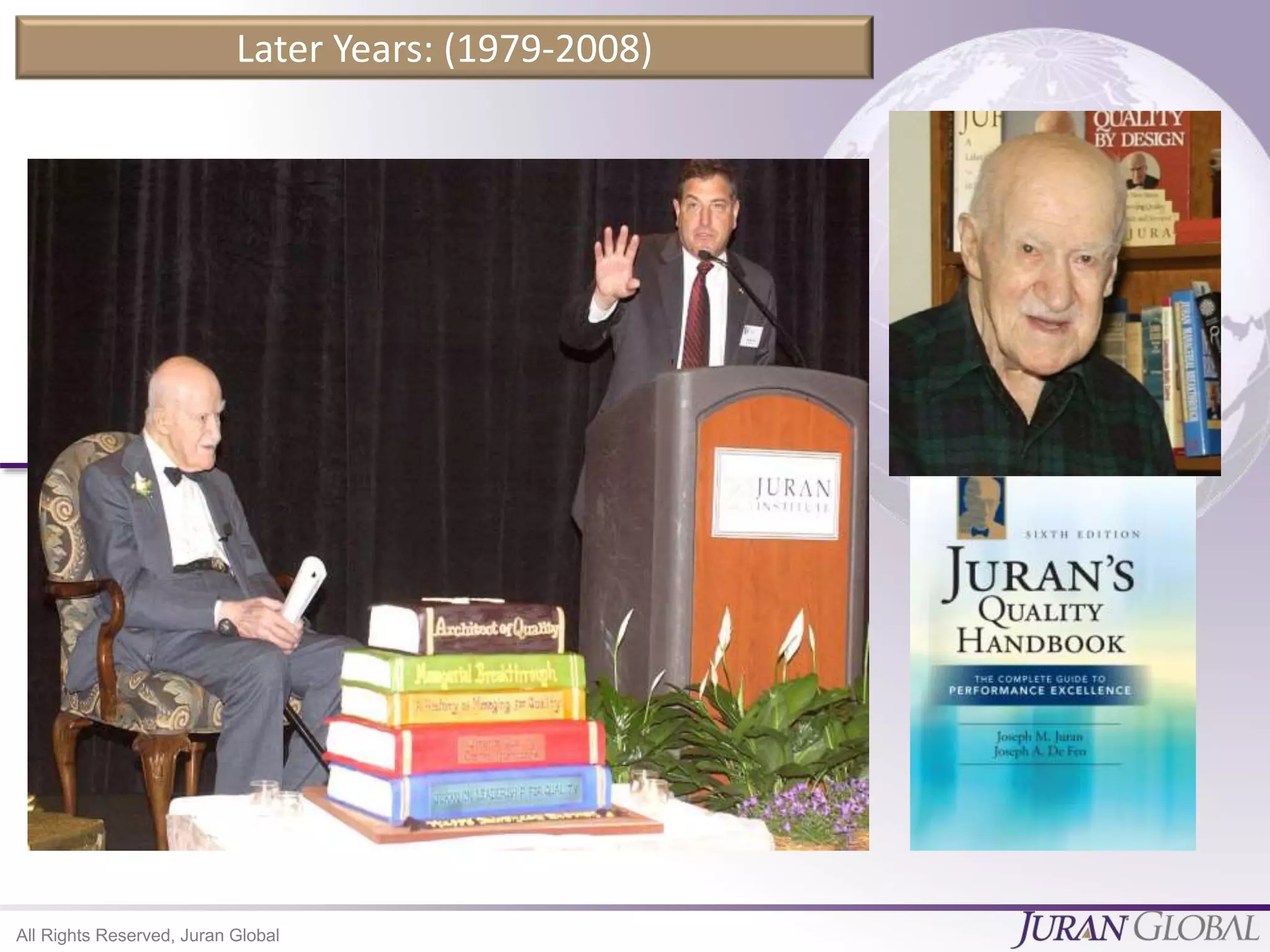
The Juran Institute’s 25th
anniversary also served as
Dr. Juran’s 100th birthday
party
The University of
Minnesota
named the
“Joseph M. Juran
Center for
Leadership in
Quality
Fellowships”
All Rights Reserved, Juran Global
Noteworthy Quotes by Dr. Juran
"It is most important
that top management
be quality-minded. In
the absence of sincere
manifestation of
interest at the top, little
will happen below."
“My job of contributing to the
welfare of my fellow man is the
great unfinished business.”
“If America does not
speed up its efforts to
improve quality the
Japanese will overtake
us in 10 years.” - 1969
“Goal setting has traditionally
been based on past
performance. This practice has
tended to perpetuate the sins of
the past.”
“All improvement happens
project by project and in no
other way.”
Thank you &
Happy Birthday
Dr. Juran
To learn more about
Dr. Juran please just Google him or
contact us.
All Rights Reserved, Juran Global
Happy New Year
Thank you for joining this special webinar.
Keep an eye on your Inbox for a notification of our
upcoming webinars for 2016 beginning with
Our first of the year:
“MANAGING BIG DATA”
Happy Holidays!
Juran Global
All Rights Reserved, Juran Global
Connect With Us
@Juran_Institute
www.youtube.com/user/JuranInstitut
e
www.facebook.com/JuranInstitute
www.linkedin.com/company/juran-
institute
All Rights Reserved, Juran Global
More Resources
 business innovation
 business process improvement
 continuous improvement
 dmaic
 juran quality handbook
 lean manufacturing
 lean six sigma
 lean transformation
 operational excellence
 process innovation
 quality assurance
 quality control
 quality improvement
 management consulting firm
 iso 9000 2015
 six sigma certification
 what is lean
 what is six sigma
Click any link for more information
All Rights Reserved, Juran Global
Thank You!
Copyright ©2015, Juran Institute, Inc.
For more information, please visit www.juran.com
Contact us at: info@juran.com

103 Reasons to Celebrate Dr. Juran’s Birthday

  • 1.
  • 2.
    All Rights Reserved,Juran Global Who Was Joseph M. Juran
  • 3.
    All Rights Reserved,Juran Global 1904 Born in Braila, Romania December 24, 1904, in a tiny, one-story masonry house Childhood & Young Adulthood: (1904-1920) The “M” in Joseph M. Juran stands for Moses 1912 His family immigrated to America when he was 8 years old 1920 Graduated from Minneapolis South High School He was one of six children
  • 4.
    All Rights Reserved,Juran Global He was a very talented chess player, playing mentally with his brother after “lights out” 1920 Enrolled at the University of Minnesota and was the first in his family to pursue higher education Childhood & Young Adulthood: (1904-1920) He skipped the equivalent of four grade levels in school because of his proficiency in math and science His brother was Academy Award winner Nathan H. Juran His first job was selling copies of the Minneapolis Tribune with his older brother, Rudy, when they were ages 11 and 8
  • 5.
    All Rights Reserved,Juran Global 1924 His first full-time job was troubleshooting in the Complaint Department at Western Electric 1924 Worked at Hawthorne Works, a factory complex of Western Electric, where he worked along with Walter Shewhart, developer of the statistical control chart. Dr. W. Edwards Deming worked at the same plant during the summers of 1925 and 1926, though they did not meet until the 1940s in Washington, D.C. Early Adulthood: (1921-1940) Received a B.S. in electrical engineering from the University of Minnesota 1925 Had about 16 jobs during his time in Minneapolis, including a grocery clerk, an ice house bookkeeper, member of the Prohibition Committee, delivery boy, and chess column editor for the Minneapolis Star
  • 6.
    All Rights Reserved,Juran Global 1931 Enrolled in Loyola University Chicago School of Law to pursue a law degree as a back- up plan during the Great Depression Wrote a pamphlet entitled "Statistical Methods Applied to Manufacturing Problems“ 19281926 Early Adulthood: (1921-1940) 1926 One of three people assigned to a new department at Western Electric to carry out statistical quality control Married Sadie Shapiro, and was married for almost 82 years They had four children: Robert, Sylvia, Charles, and Donald
  • 7.
    All Rights Reserved,Juran Global 1937 Became chief of Industrial Engineering at Western Electric’s New York office He created the Pareto Principle which is used to separate the “vital few” from the “useful many” 1936 Received his Doctorate of Jurisprudence; Admitted to the Illinois bar, but never practiced law Early Adulthood: (1921-1940) Left his job at Western Electric to work in Washington, D.C. upon invitation by the government to participate in the Lend-Lease administration during World War II. The telegram that was sent to Western Electric requesting the loan of his services stated that it would be for only 6 weeks. He departed on his 37th birthday and commenced work on Christmas day, 1941. He was officially placed on government payroll effective January 14, 1942. He resigned the day after the Japanese surrender on August 14, 1945 1941
  • 8.
    All Rights Reserved,Juran Global By the end of World War II, Dr. Juran was a well- known and highly-regarded statistician and industrial engineering theorist Middle Adulthood: (1941-1978) He joined the faculty of New York University as an adjunct professor in the Department of Industrial Engineering where he stayed until 1951 1945 1951 Published the first Quality Control Handbook Left Washington, D.C. to study quality management with the intention that the best way to support his family going forward was through freelance quality management consulting 1945
  • 9.
    All Rights Reserved,Juran Global Middle Adulthood: (1941-1978) Dr. Juran was invited by the Japanese Union of Scientists and Engineers (JUSE) to make nine visits to Japan to teach and demonstrate his quality management methods 1952 Invitations to Japan were also extended from Toyota, Matsushita, and Bridgestone The principles that Dr. Juran taught in Japan helped many companies there, like the automaker Toyota to become global leaders in their industries Dr. Juran brought an overhead projector to Japan for a public lecture. At that time, it was the only such machine in the entire country Published Universals in Management Planning and Controlling 1954
  • 10.
    All Rights Reserved,Juran Global The Juran Trilogy®
  • 11.
    All Rights Reserved,Juran Global Middle Adulthood: (1941-1978) 1954 Started courses in quality management in Japan for top and middle managers Juran’s course “Managing for Quality” has been taught to more than 100,000 people in over 40 countries 1956 Published Improving the Relationship between Staff and Line Published Cultural Patterns and Quality Control 1957 1957 Published Industrial Diagnostics - A Systematic Approach to Management Problem-Solving
  • 12.
    All Rights Reserved,Juran Global 1963 Quality Control Handbook, Second Edition was published Middle Adulthood: (1941-1978) Published Japan Revisited 1961 Published Pioneering in Quality Control 1962 Published Different to You but Alike to Me 1963 1964 Published Managerial Breakthrough which was the first book to provide step-by- step sequence for breakthrough improvement Was a contributing author and editor of “Management's Corner” in Industrial Quality Control for 16 years 1964 Published The Two Worlds of Quality Control
  • 13.
    All Rights Reserved,Juran Global 1966 During a visit to Japan, Dr. Juran learned about the Japanese concept of quality circles, which he then brought to the West Middle Adulthood: (1941-1978) Published Whose Quality Costs? 1965 Was the first to add the human dimension to quality management Was the first to conclude cultural resistance to change was a major problem in reforming quality practices 1966 Published So, You Want To Be a Quality Control Consultant Published Quality Problems, Remedies and Nostrums 1966
  • 14.
    All Rights Reserved,Juran Global 1968 Became the eighth honorary member of ASQ 1967 Published The QC Circle Phenomenon Middle Adulthood: (1941-1978) During a presentation to the Kyoto University in Japan, Dr. Juran was asked if he would lend his name to a new quality prize to be awarded to companies that had won the Deming Prize for the second time. Dr. Juran graciously declined, suggesting they name the new prize the Japan Prize. Later he realized he must have misunderstood the question and regretted the naming outcome. 1966 1967 Published The Japanese QC Circles: Questions and Answers 1968 Published Operator Errors - Time for a New Look
  • 15.
    All Rights Reserved,Juran Global Published Mobilizing for the 1970s 1969 1970 Published Quality Planning and Analysis as the first textbook for quality engineers 1970 Published Consumerism and Product Quality Published Quality Control in Service Industries 1973 Middle Adulthood: (1941-1978) 1973 Published The Taylor System and Quality Control Quality Control Handbook, Third Edition was published 1973
  • 16.
    All Rights Reserved,Juran Global 1975 Published Quality Control of Service in 1974 Japanese Symposium Published The Non- Pareto Principle; Mea Culpa 1975 1976 Published Khrushchev's Venture into Quality Improvement Published That Uninterested Top Management 1977 Middle Adulthood: (1941-1978) Published A Visit to Complex Systems, Inc. 1980 His mission for the Juran Institute was to “improve the quality of society” 1979 Founded the Juran Institute
  • 17.
    All Rights Reserved,Juran Global 1981 He received the emperor’s award of the Order of the Sacred Treasure, Second Class for the development of Quality in Japan. The Second Class is the highest award that may be given to a non- Japanese Helped to create the U.S. Malcolm Baldrige National Quality Award Later Years: (1979-2008) Published Product Quality - A Prescription for the West 1981 When introducing Dr. Juran at the Annual Quality Congress in 1986, a previous ASQ president compared him to a baseball player that played every position 1984 Published Japanese and Western Quality - a Contrast The Juran Trilogy® was published and was accepted worldwide as the basis for quality management 1986
  • 18.
    All Rights Reserved,Juran Global Juran’s Quality Control Handbook, Fourth Edition was published 1988 1988 Awarded membership in the National Academy of Engineering for “pioneering contributions in developing the practice of statistical quality control, and in developing engineering design principles based on statistical concepts” 1990 He traveled internationally until age 86 Later Years: (1979-2008) Published Strategies for World- Class Quality 1991 1992 Awarded the National Medal of Technology by President George H. W. Bush, for “his lifetime work of providing the key principles and methods by which enterprises manage the quality of their products and processes, enhancing their ability to compete in the global marketplace” Awarded the European Organization for Quality’s medal, “in recognition of his valuable contributions to quality in Europe” 1993
  • 19.
    All Rights Reserved,Juran Global Published The Japanese Revolution in Quality Remembrance and Prognosis Later Years: (1979-2008) 1993 Published Made in USA: A Renaissance in Quality and published Address to the Business Round Table Published Our Managers Are As Good As Any in The World 1994 Although he officially retired in 1994, Dr. Juran continued to stay involved with the Juran Institute Retired at age 90 but continued to give interviews Began writing his memoirs at age 92 1996 Considered the father of modern day quality management Published A History of Managing for Quality 1995
  • 20.
    All Rights Reserved,Juran Global Received over 40 honorary doctorates, honorary memberships, medals, and plaques Later Years: (1979-2008) Author of more than 20 books Visited Sweden over 30 times Juran’s Quality Handbook, Fifth Edition was published 1998 2002 Published his memoirs, Architect of Quality at age 97
  • 21.
    All Rights Reserved,Juran Global 2008 Passed away at age 103 after 82 years of marriage. He was survived by Sadie, his four children, nine grandchildren and ten great grandchildren. 2004 Published The Juran Generation Later Years: (1979-2008) The Juran Institute’s 25th anniversary also served as Dr. Juran’s 100th birthday party The University of Minnesota named the “Joseph M. Juran Center for Leadership in Quality Fellowships”
  • 22.
    All Rights Reserved,Juran Global Noteworthy Quotes by Dr. Juran "It is most important that top management be quality-minded. In the absence of sincere manifestation of interest at the top, little will happen below." “My job of contributing to the welfare of my fellow man is the great unfinished business.” “If America does not speed up its efforts to improve quality the Japanese will overtake us in 10 years.” - 1969 “Goal setting has traditionally been based on past performance. This practice has tended to perpetuate the sins of the past.” “All improvement happens project by project and in no other way.” Thank you & Happy Birthday Dr. Juran To learn more about Dr. Juran please just Google him or contact us.
  • 23.
    All Rights Reserved,Juran Global Happy New Year Thank you for joining this special webinar. Keep an eye on your Inbox for a notification of our upcoming webinars for 2016 beginning with Our first of the year: “MANAGING BIG DATA” Happy Holidays! Juran Global
  • 24.
    All Rights Reserved,Juran Global Connect With Us @Juran_Institute www.youtube.com/user/JuranInstitut e www.facebook.com/JuranInstitute www.linkedin.com/company/juran- institute
  • 25.
    All Rights Reserved,Juran Global More Resources  business innovation  business process improvement  continuous improvement  dmaic  juran quality handbook  lean manufacturing  lean six sigma  lean transformation  operational excellence  process innovation  quality assurance  quality control  quality improvement  management consulting firm  iso 9000 2015  six sigma certification  what is lean  what is six sigma Click any link for more information
  • 26.
    All Rights Reserved,Juran Global Thank You! Copyright ©2015, Juran Institute, Inc. For more information, please visit www.juran.com Contact us at: info@juran.com

Editor's Notes

  • #4 Caption on family photo reads: “The family in Gura Humora in about 1910. They include Mother; Rudolph, 9; Rebecca, 8; myself, 6; and Nathan, 3. Dad had already emigrated to the United States in 1909. My little sisters Minerva and Charlotte were born in the U.S.”
  • #6 Photo caption: Chess tournament at Hawthorne in 1927.
  • #7 Photo shows Dr. Juran with Sadie in 1927, shortly after their wedding. When Robert Arnold Juran was born on June 11, 1928 at North Chicago Hospital, the hospital bill was $50. In 1928, when he was eligible to vote in his first election, he voted for Herbert Hoover.
  • #8 On the Pareto Principle (80/20 Rule): In the early 1900s, the 80-20 rule was attributed to Vilfredo Pareto, an Italian economist, when he observed that twenty percent of people owned eighty percent of the wealth. In 1937, Dr. Juran created the “Pareto principle,” which millions of managers rely on to help separate the “vital few” from the “useful many” in their activities. This is also commonly referred to as the 80-20 principle. Its universal application makes it one of the most useful concepts and tools of modern-day management. It is commonly referred to as Juran’s Pareto Principle.
  • #10 1954- Published “Universals in Management Planning and Controlling” When can we hold a man responsible? The answer lies in a universal which is extremely simple and valuable to apply. We can hold the individual responsible provided: 1. He knows what he is supposed to do. 2. He knows what he is doing. 3. It is within his personal control to regulate what he is doing. If all these conditions are present simultaneously, then we are warranted in holding him responsible. If any one of them is absent, we are unable to hold him responsible to the degree that there is such an absence. Photo caption: Dr. Juran presenting a lecture to a group in Japan during 1957. Note the overhead projector on his desk.
  • #12 1956- Published “Improving the Relationship between Staff and Line” Cultural patterns are a vital factor in resistance to technical change, and there are established ways for the technical expert to deal successfully with these cultural patterns. Any individual derives his attitude toward change from his own point of view, not from the view of the proponent of change. These same experiences and solutions have direct application to the industrial problems of the staff and line relationship. In fact, the universal nature of the principals involved suggested their adoption as training material for business schools, executive training programs, and company training programs generally. 1957- Published “Cultural Patterns and Quality Control” Introduction of modern quality control techniques has an impact on the factory in two aspects: The technical aspect, involving change in processes, instruments records, and other technical features of the operation. The social aspect, involving changes in human, status, habits, relationships, scale of values, language, and other features of the cultural pattern of the shop. 1957- Published “Industrial Diagnostics - A Systematic Approach to Management Problem-Solving” Industrial problems classify themselves, for planning purposes, into two major groups: problems of maintaining the status quo, and problems of changing the status quo. Dr. Juran discusses these problems in detail, including how to become aware of, identify, diagnose them.
  • #13 1961- Published “Japan Revisited” Prior to World War II, if one had taken an international public opinion poll on the product quality reputation of the various industrialized countries, the rankings would very likely have shown Switzerland at the top, followed by various other Western countries, and with Japan at the bottom. Now, two decades later, Japan has climbed that ranking, rung by rung, until it has arrived at a position of respect in most product categories, and to a position of leadership in some. It is truly an outstanding achievement. To the outside observer it demonstrates what men of energy can do when they recognize a major problem and mobilize their resources to solve it. 1963- Published “Different to You but Alike to Me” In this publication, Dr. Juran visits four different organizations and reviews four very different processes, each resulting in different products. The technical problems of materials, process and product do indeed vary, as do the human problems which are rooted in the different cultures of these diverse industries. Common to all four of these was processes, however, were product variability traceable to the variability of a “sheet,” such that the reduction of product variability must be preceded by reduction of variability in the sheet. The Measurement of the sheet, analysis to determine patterns of variability, discussion of findings, proof or denial of theories, and action to remove the variability is outlined. 1964- Published Managerial Breakthrough which was the first book to provide step-by-step sequence for breakthrough improvement Dr. Juran contends that the manager's basic function is to create change ("breakthrough") or prevent it ("control"), and demonstrates that each process is unvaryingly governed by a universal sequence of events. The book describes the issues that arise whenever organizations introduce change; how to master an unvarying sequence of events that will enable an organization to overcome resistance to change, and break through to ever higher levels of performance; how to achieve breakthrough in every area that determines a company's success; and when it's better to initiate change and when it's better to prevent it. 1964- Published “The Two Worlds of Quality Control” This publication by Dr. Juran discusses the nature of the list of the quality activities or specialties which collectively make up the quality function.
  • #14 1965- Published “Whose Quality Costs?” This follow-up publication to “The Two Worlds of Quality Control” further divulges into the ever-broadening role of the quality function, including quality control, reliability, quality management, and more. He suggests the first step to contributing to your organization’s business strategy is to put together the story of cost of service as seen by the customer. 1966- Published “Quality Problems, Remedies and Nostrums” Dr. Juran lists the essential prerequisites to conducting a motivational program and proposes modifications for using the Zero Defects programs wherever these prerequisites are met.
  • #15 1967- Published “The Japanese QC Circles: Questions and Answers” This Q&A on Quality Circles is based on a 1966 visit to Stockholm, Sweden, when Dr. Juran presented at the EOQC Conference on establishing responsibilities for quality and reliability assurance. The Q&As were originally a discussion that took place after the lecture. 1967- Published “The QC Circle Phenomenon” The QC Circle is a small group of departmental work leaders and line operators who have volunteered to spent time outside of their regular hours to help solve departmental quality problems. The QC Circle movement originated in Japan about four years before this article was published. Dr. Juran claims that the Japanese are headed for world quality leadership, and will attain it in the next two decades, because no one else is moving there at the same pace. 1968- Published “Operator Errors - Time for a New Look” In this article, Dr. Juran states that it is time for theoreticians and practitioners to wade into the subject of “operator error”, to think it through, and to put together the factual data needed to identify and quantify the elements which make up this concept. Dr. Juran describes his own analysis of some of the possible causes of operator error, and suggests that this idea needs to be studied further.
  • #16 1969- Published “Mobilizing for the 1970s” In this article Dr. Juran addresses the apprehension regarding the quality of products and services as a new decade approaches. He states that quality has not been going downhill, despite worry from the public. He provides suggestions for how to revise quality policies and goals, including revising the company’s quality mission and rethinking how employees are trained for quality. 1970- Published Quality Planning and Analysis as the first textbook on quality This book provides comprehensive coverage and reflects modern thinking on quality in the 90's and into the 21st century. It gives balanced coverage of the impact of quality on all organizational activities - managerial, statistical, and technical - which organizations need to achieve quality objectives. The systems approach is threaded throughout the book by discussing quality assessment, key quality processes, and the quality activities in 11 functional areas of an organization. There is also detailed discussion of quality planning, control, and improvement processes. 1970- Published “Consumerism and Product Quality” In this article Dr. Juran discusses the trend of consumerism. He describes the growing amount of consumer grievances in detail and obstacles to resolving the grievances. He also makes predictions about which trends will dominate the service industry, and provides constructive actions companies can take. 1973- Published “Quality Control in Service Industries” All institutions face problems of attaining quality. In the case of the manufacturing industries, extensive work has been done to identify the quality problems which are common to all manufacture, and to discover common solutions to these problems. This search for commonality has led to identification and successful application of various universals of quality control. Some of these universals (e.g., process capability, the Pareto Principle, quality cost analysis, statistical methodology) have been of great aid to practitioners. The present article examines the problems of commonality as it applies to quality control in service industries. 1973- Published “The Taylor System and Quality Control” In this article, the Frederick Taylor’s scientific approach to management is discussed. Dr. Juran claims that a counterrevolution was needed, because these practices did not make use of employees’ education or creativity. Dr. Juran identifies some of the major steps being taken to dismantle the outdated aspects of the Taylor system. 1973- Quality Control Handbook, Third Edition was published Perhaps  the finest book on quality ever written to give managers the know-how they need to manage for quality through the next decade.
  • #17 1975- Published “Quality Control of Service in 1974 Japanese Symposium” The first conference ever devoted to quality control in service industries was held on October 23, 24 and 25, 1974, at Keidanren Kaikan in Tokyo, Japan. The meeting, organized by the Union of Japanese Scientists and Engineers (JUSE), featured a total of 15 papers from a wide variety of service industries. There were three supplemental lectures by QC experts, along with some commentary by the moderators. Dr. Juran’s role was to offer brief reviews at the end of each half day’s session plus a comprehensive critique to close the conference. In this report, he provides a brief summary of the scope of each of the papers. Following this, he generalizes from the points made in the papers and in the associated discussions. 1975- Published “The Non-Pareto Principle; Mea Culpa” Dr. Juran uses this article to explain some of the misconceptions regarding the Pareto Principle. He describes how it was actually misnamed, because Vilfredo Pareto’s principle was only intended to be applied to the field of economics. He also states that many men have observed this phenomenon over the centuries. 1976- Published “Khrushchev's Venture into Quality Improvement” This article summarizes part of the biography, Khrushchev Remembers, which Dr. Juran relates to the evolution of quality control. Khrushchev was given the responsibility of improving the quality of tires in Ukraine. He set up a quality improvement committee, visited the tire factory, and discovered the cause for the poor quality tires. 1977- Published “That Uninterested Top Management” In this publication, Dr. Juran discusses the conflicting opinions of quality specialists and upper managers regarding quality. He presents several cases in which he witnessed companies that had problems securing upper managers’ interest in quality. He then provides some suggestions for how to resolve this issue.
  • #18 1981- Published “Product Quality - A Prescription for the West” This article discusses Dr. Juran’s concern that the West was in serious trouble with respect to product quality. He believed a major reason was the immediate threat posed by the Japanese revolution in quality. Dr. Juran explains why Japan has been so successful in terms of quality and changes that can be implemented in the West. 1984- Published “Japanese and Western Quality - a Contrast” This case study contrasts the quality differences between color television sets in Japan and in the West. At the time of publication, the color TV was a complex piece of equipment which embodied some of the most advanced technology of the time 1986- The Juran Trilogy® was published and was accepted worldwide as the basis for quality management. The  trilogy is as follows: Quality Planning – the process for preparing to meet quality goals. The end result is a process capable of meeting quality goals under operating conditions. Quality Control – the process for meeting quality goals under operations. The end result is conduct of operations in accordance with the quality plan. Quality Improvement – the process for breaking through to unprecedented levels of performance. The end result is conduct of operations at levels of quality distinctly superior to planned performance. Photo caption: Dr. Juran wearing the Order of the Sacred Treasure
  • #19 1988- Juran’s Quality Control Handbook, Fourth Edition was published Since publication of the third edition of Juran's classic in 1974, the entire field of quality control had undergone a series of unprecedented changes-due largely to (1) intensified competition, which has resulted in huge loses in market shares and massive exports of jobs and (2) expanded government regulation, with accompanying growth in the number of lawsuits and the size of the awards. This updated and revised new edition offers, in ready-reference form, the know-how managers need in industry today and in the years ahead to keep their quality competitive at minimum cost. 1991- Published “Strategies for World-Class Quality” In this publication Dr. Juran provides “lessons from the ‘80s” and “prognosis for the ‘90s”. He describes the achievements of two Baldrige Award winners, why they were successful, and lessons to take away. Dr. Juran gives his predictions for the next decade (the ‘90s), and one of these was that Baldrige Award would become a “major rallying point for a renaissance in quality in the U.S. industry”.
  • #20 1993- Published “Made in USA: A Renaissance in Quality” In this article, Dr. Juran describes how the quality movement in Japan began. He admits that although many people claim that Japan’s success was due to the lectures he and Dr. Edwards Deming gave, he believes that even without their assistance Japan would have still led the world in quality, even if it took a little more time and work. He explains why the United States has fallen behind provides guidelines for CEOs who want to lead a revolution in managing for quality. 1994 - Published “Our Managers Are As Good As Any in The World” In this interview, Dr. Joseph Juran talks to IndustryWeek about what it will take for U.S. industry to catch up in the global quality marathon. He touches on points such as the importance of senior leadership’s involvement in quality, reengineering, and the origins of quality management in Japan. Dr. Juran appeared on the cover of IndustryWeek at the time the interview was published. 1994- Published “The Japanese Revolution in Quality Remembrance and Prognosis” This is necessarily a highly personalized account of the evolution of Japanese quality control as witnessed by Dr. Juran, an interested observer who had also been, since 1954, a participant in this same evolution. The goal of this report was to be of assistance to the readers of the Japanese journal, Statistical Quality Control, by providing an outsider's addendum to the main narrative which the Japanese authors prepared.
  • #21 1998- Juran’s Quality Handbook, Fifth Edition was published In the decade that passed since the publication of the Fourth Edition, the importance of quality continued to grow rapidly. To some extent, that growth was due in part to the continuing growth in complexity of products and systems, society’s growing dependence on them, and, thus, society’s growing dependence on those “quality dikes.” The book was divided into four broad categories, The Managerial Group, The Functional Group, the Industry Group, and The International Group. 2003- Published his memoirs, Architect of Quality at age 97 In Architect of Quality, the man who helped invent and champion quality management systems, quality circles, and teams long before they became standard practice tells the inspiring story of his life. Juran relates a classic American tale of a Romanian immigrant who overcame dire poverty and a childhood in a tar paper shack to make a profound impact on business and society. He candidly describes his rapid success and dramatic failure in his early years at Western Electric's famed Hawthorne plant and relives his experiences working on the war effort in Washington, DC, in the '40s and then advising postwar Japan on how to rebuild itself. Juran describes how he developed the core ideas behind the quality movement that started more than 60 years ago and now finds expression in the Six Sigma quality improvement movement.
  • #22 2004 - Published “A Close Shave” This publication was an excerpt from Dr. Juran’s memoirs, Architect of Quality, and this selection was actually edited out of the final published book. It describes the time that Dr. Juran examined the test the Gillette Co. was using to evaluate the quality of shaves made by razor blades. His analysis led to extensive changes in the design of the test, which in turn contributed to a remarkable improvement in shaving comfort. 2004- Published “The Juran Generation” This article was published before Dr. Juran’s 100th birthday. The author, Amy Holgate, celebrates Dr. Juran’s by writing about his career, his accomplishments and sharing some of his advice. In the article, Dr. Juran explained that his work will never be done, and he planned to go on as long as the years are granted to him. Sadie also passed away in 2008, on December 2nd; she was 103 years and 259 days old.