
SVEN AND OLE
DO PROJECT MANAGEMENT
IN HEALTH AND HUMAN SERVICES
MSSA, March, 2014
David Swenson, PhD LP
Brandon Olson, PhD http://faculty.css.edu/bolson1/presentations/MSSAPM.pdf
Objectives
 Reimagine Work in Health and Human Services
 Define Project Management and Project Management Processes
 Appreciate Balancing the Variables in Project Management
 Understand Common Causes of Project Failure
 Identify Solutions to Improve Project Success Rates
 Apply Project Management Practice to Health and Human Services
Objectives
 Reimagine Work in Health and Humans Services
 Define Project Management and Project Management Processes
 Appreciate Balancing the Variables in Project Management
 Understand Common Causes of Project Failure
 Identify Solutions to Improve Project Success Rates
 Apply Project Management Practice to Health and Human Services
Common Activities in HHS
 Promotional campaign for new
mental health services
 Developing an interactive website
for services
 Constructing a social media crisis
monitoring system
 Revising a hiring protocol for new
staff
 Designing an assessment
procedure for determining
amenability to treatment
 Surveying a rural community for
mental health needs
 Developing a day treatment
handbook for delivery in schools
 Determining feasibility of
expanding MH services to in-
home
 Implementing health information
technology
 Training staff in using the DSM-5
 Other
.
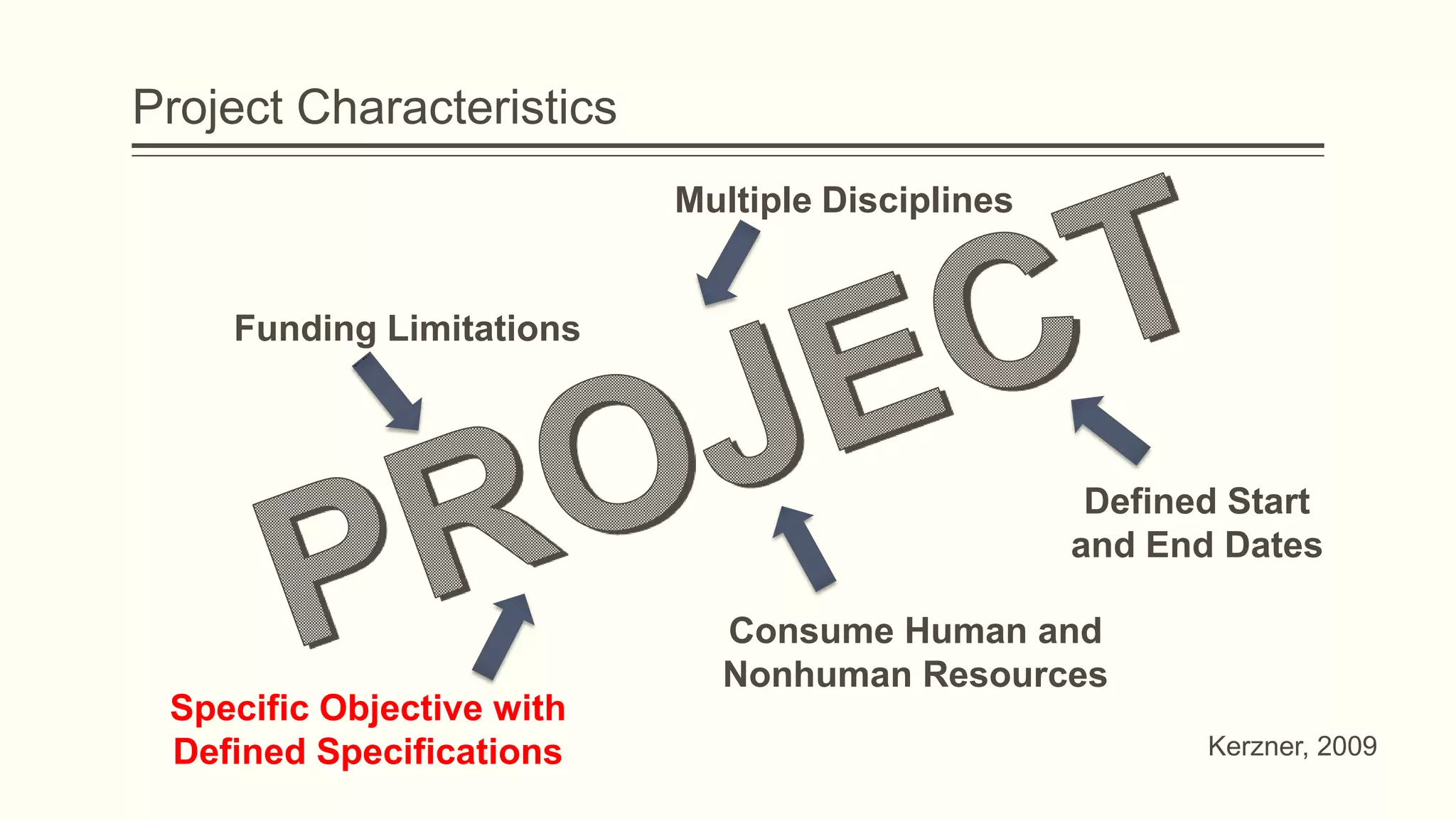
Project Characteristics
Kerzner, 2009
Specific Objective with
Defined Specifications
Defined Start
and End Dates
Funding Limitations
Consume Human and
Nonhuman Resources
Multiple Disciplines
Objectives
 Reimagine Work in Health and Humans Services
 Define Project Management and Project Management Processes
 Appreciate Balancing the Variables in Project Management
 Understand Common Causes of Project Failure
 Identify Solutions to Improve Project Success Rates
 Apply Project Management Practice to Health and Human Services
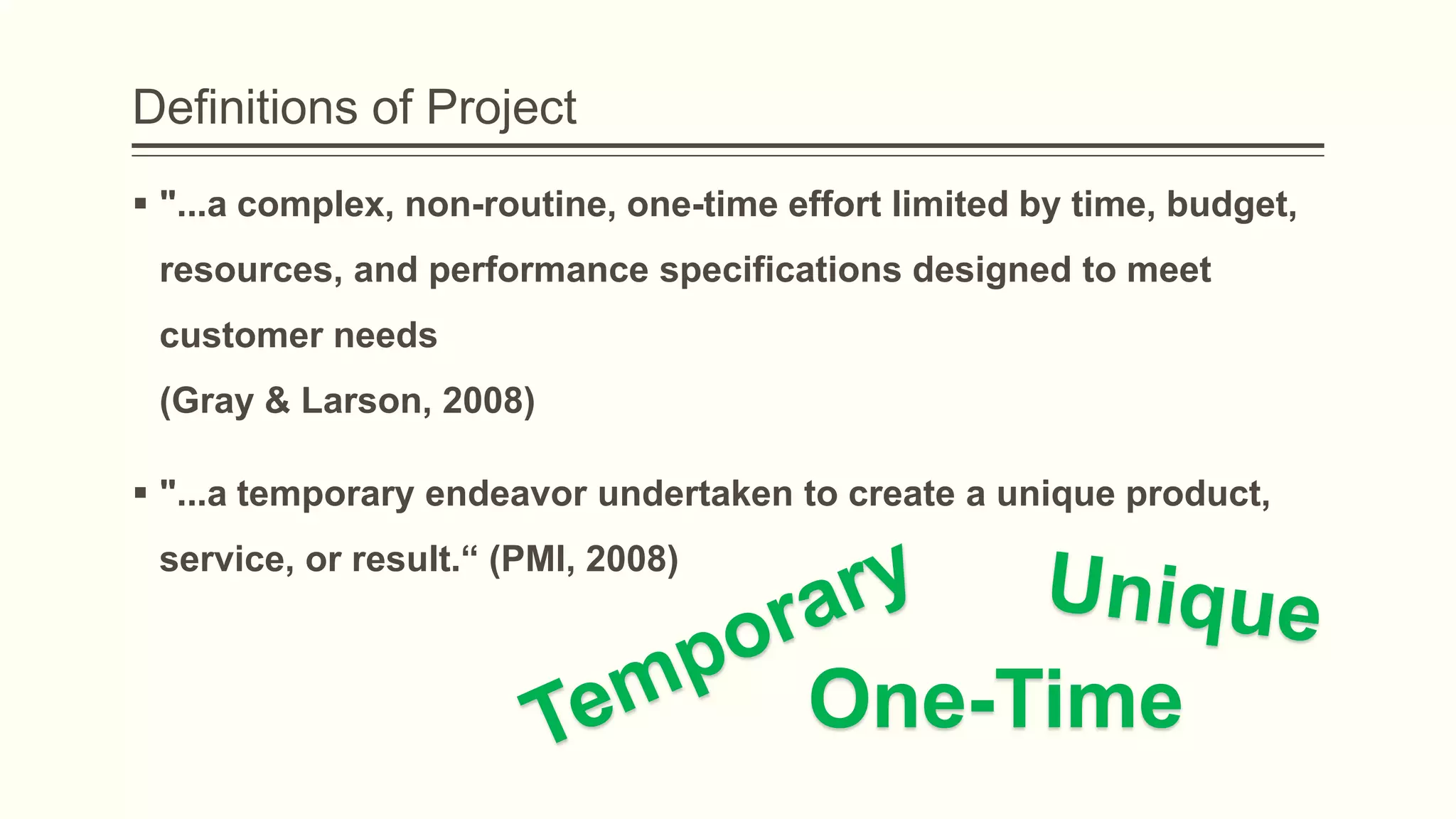
Definitions of Project
 "...a complex, non-routine, one-time effort limited by time, budget,
resources, and performance specifications designed to meet
customer needs
(Gray & Larson, 2008)
 "...a temporary endeavor undertaken to create a unique product,
service, or result.“ (PMI, 2008)
One-Time
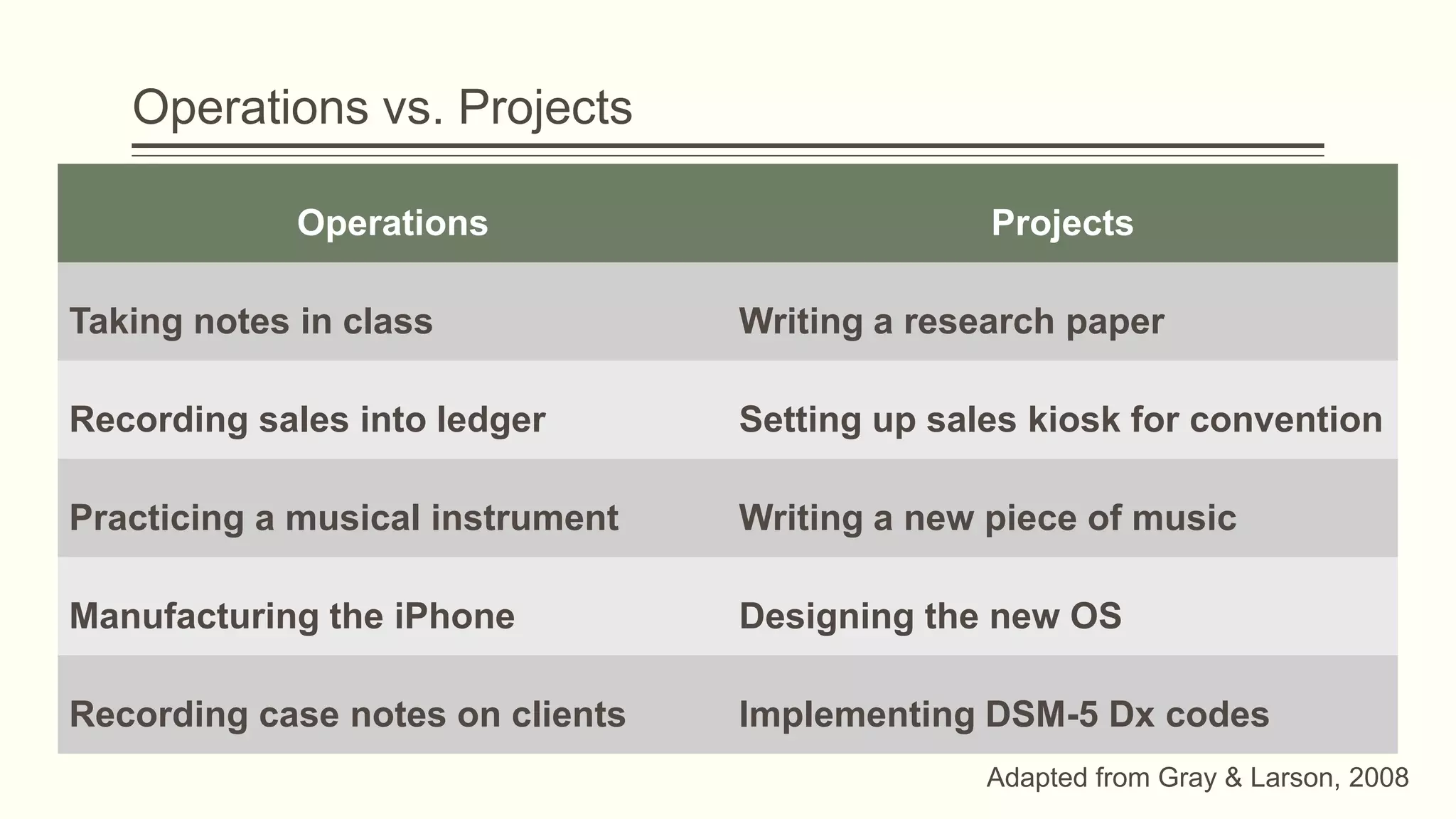
Operations vs. Projects
Operations Projects
Taking notes in class Writing a research paper
Recording sales into ledger Setting up sales kiosk for convention
Practicing a musical instrument Writing a new piece of music
Manufacturing the iPhone Designing the new OS
Recording case notes on clients Implementing DSM-5 Dx codes
Adapted from Gray & Larson, 2008
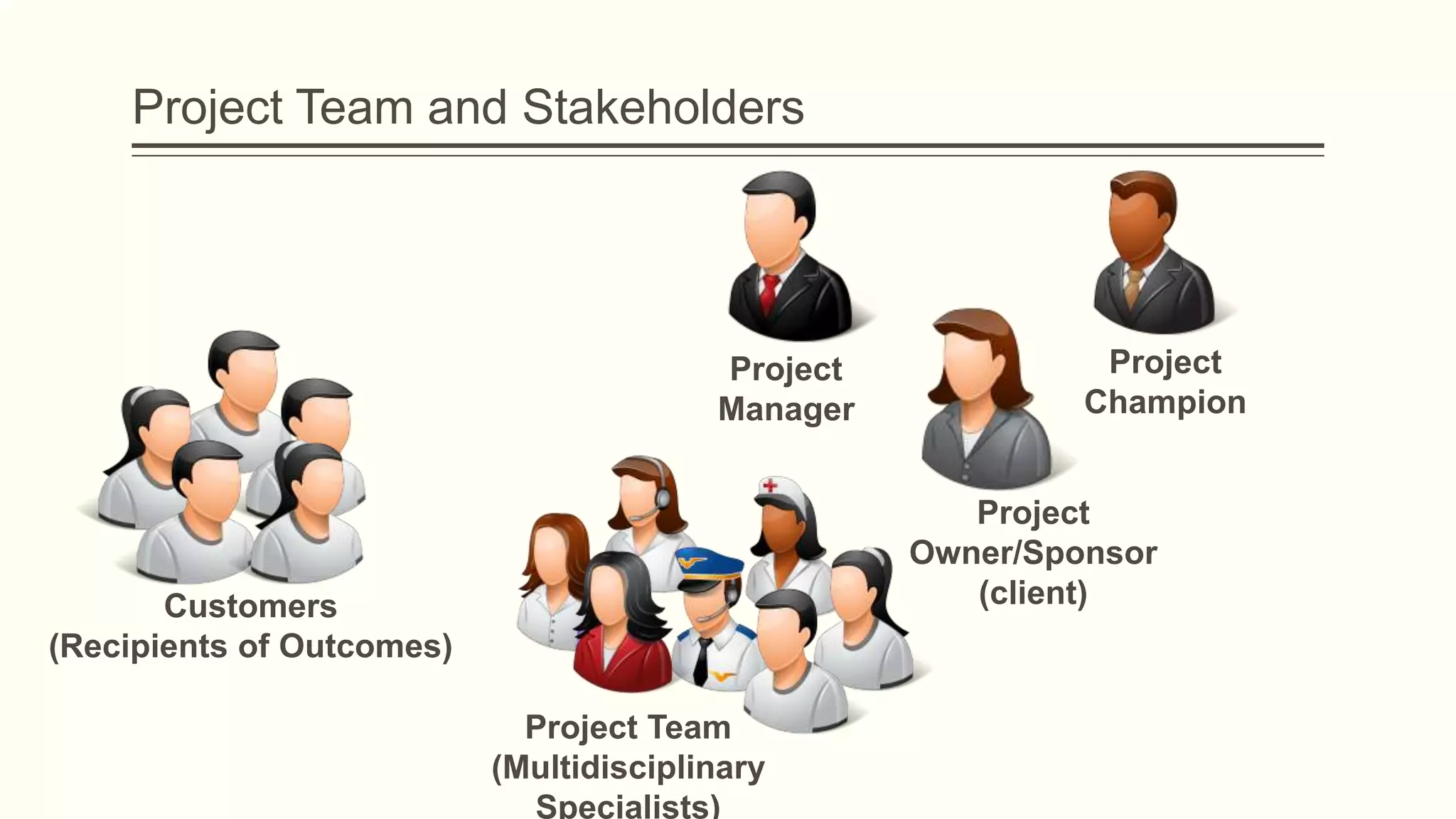
Project Team and Stakeholders
Project
Champion
Project
Owner/Sponsor
(client)
Project
Manager
Project Team
(Multidisciplinary
Specialists)
Customers
(Recipients of Outcomes)
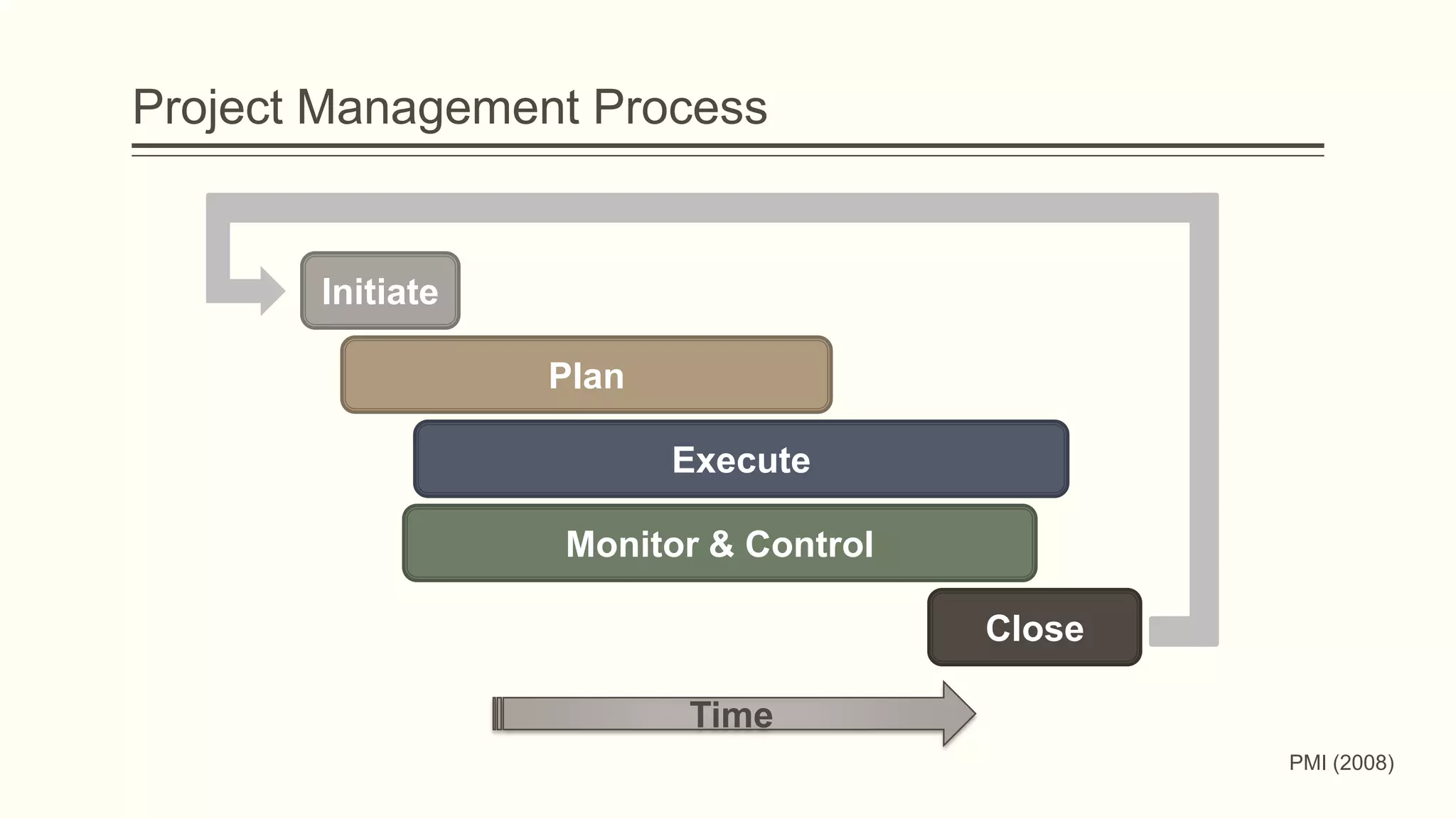
Project Management Process
Initiate
Plan
Execute
Monitor & Control
Close
Time
PMI (2008)
Benefits
 Drive Change
 Goal-Oriented
 Scalable
 Simplifies Complexity
 Proven Best Practices
 Cross-Functional
 Flexible
 Temporary and Informal Structures
Objectives
 Reimagine Work in Health and Humans Services
 Define Project Management and Project Management Processes
 Appreciate Balancing the Variables in Project Management
 Understand Common Causes of Project Failure
 Identify Solutions to Improve Project Success Rates
 Apply Project Management Practice to Health and Human Services
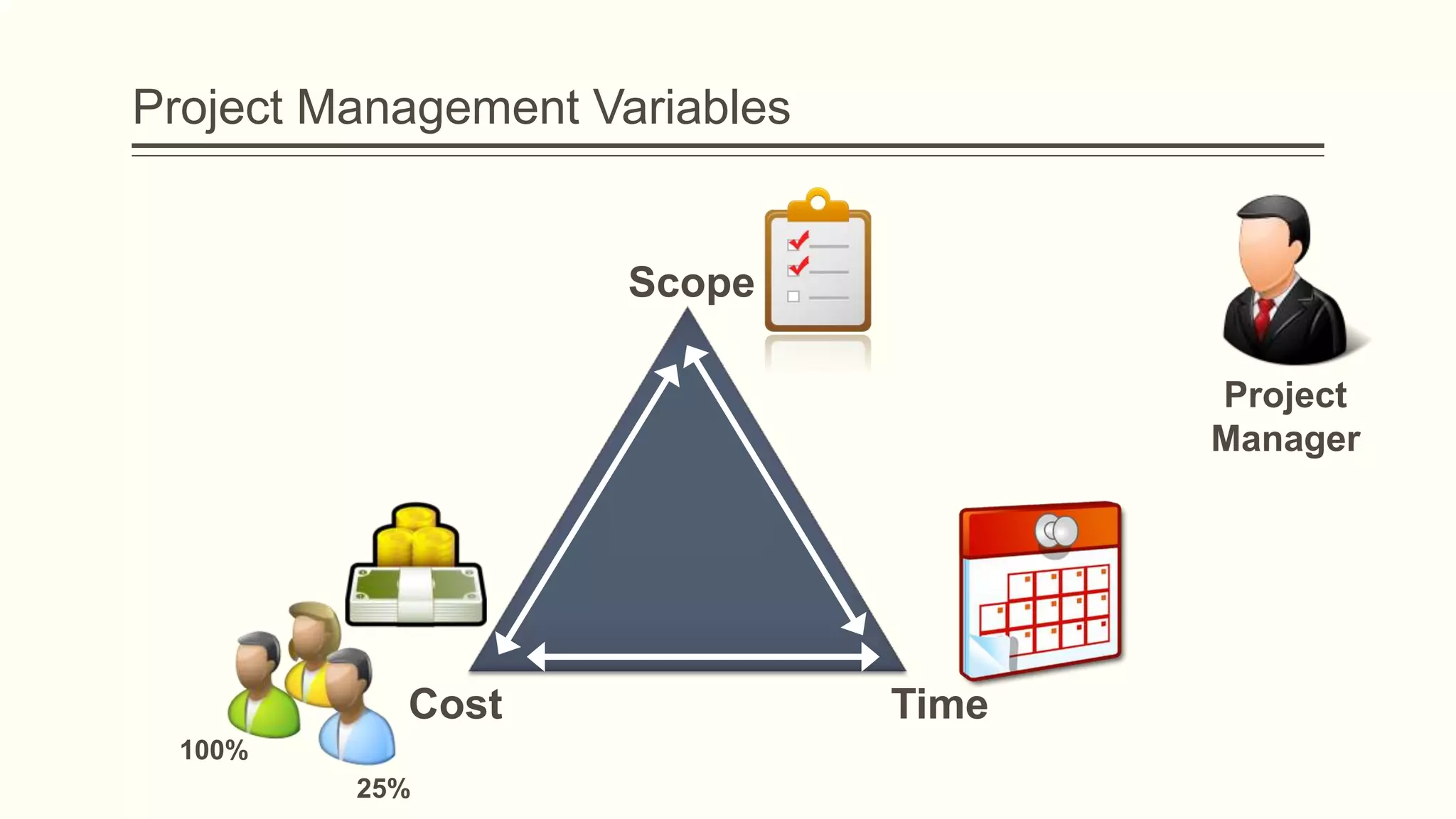
Project Management Variables
Scope
TimeCost
Project
Manager
25%
100%
Project Variables in HHS Work
 Types of projects
 Experience of what happens when these variables are not
managed effectively
 No organization identifiers please
.
Objectives
 Reimagine Work in Health and Humans Services
 Define Project Management and Project Management Processes
 Appreciate Balancing the Variables in Project Management
 Understand Common Causes of Project Failure
 Identify Solutions to Improve Project Success Rates
 Apply Project Management Practice to Health and Human Services
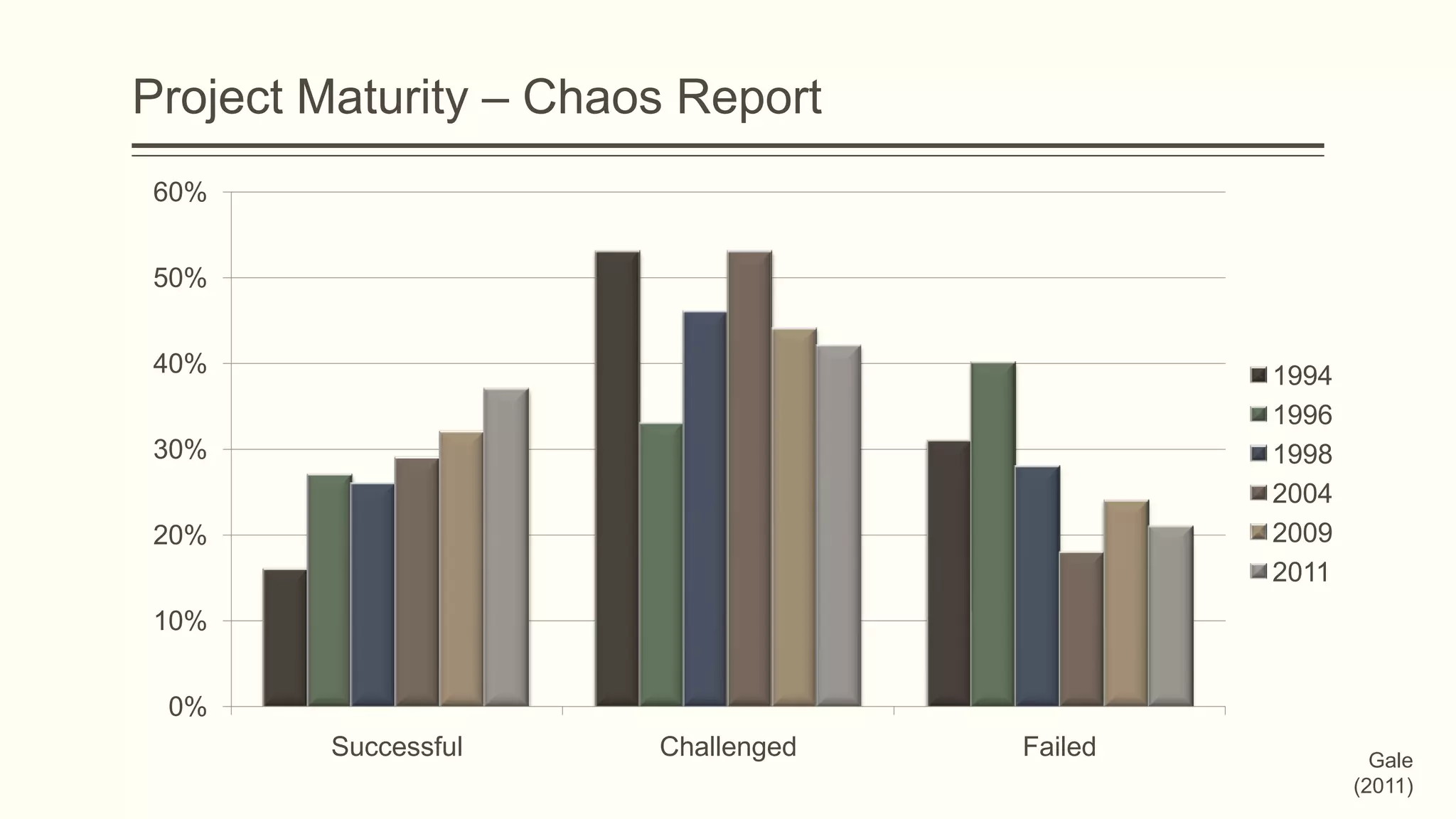
Project Maturity – Chaos Report
0%
10%
20%
30%
40%
50%
60%
Successful Challenged Failed
1994
1996
1998
2004
2009
2011
Gale
(2011)
Sources of Project Failures
1. No project champion
2. Process shortcuts
3. Unable to manage expectations
4. Variable lock-in
5. Poor estimating techniques
6. Over optimism
7. Resource assumptions
8. Inadequate people management
skills
9. Unable to adapt to change
10. Insufficient resources
Adapted from Whitten & Bentley, 2007
Objectives
 Reimagine Work in Health and Humans Services
 Define Project Management and Project Management Processes
 Appreciate Balancing the Variables in Project Management
 Understand Common Causes of Project Failure
 Identify Solutions to Improve Project Success Rates
 Apply Project Management Practice to Health and
Human Services
Best Practices to Limit Project Failures
 Engage Project Champion
 Develop and Follow Methodology
 Task and Activity Ownership
 Manage Project Variables
 Stakeholder Expectations Management
 Project Team Communications
 External Stakeholders
 Internal Project Team
Objectives
 Reimagine Work in Health and Humans Services
 Define Project Management and Project Management Processes
 Appreciate Balancing the Variables in Project Management
 Understand Common Causes of Project Failure
 Identify Solutions to Improve Project Success Rates
 Apply Project Management Practice to Health and
Human Services
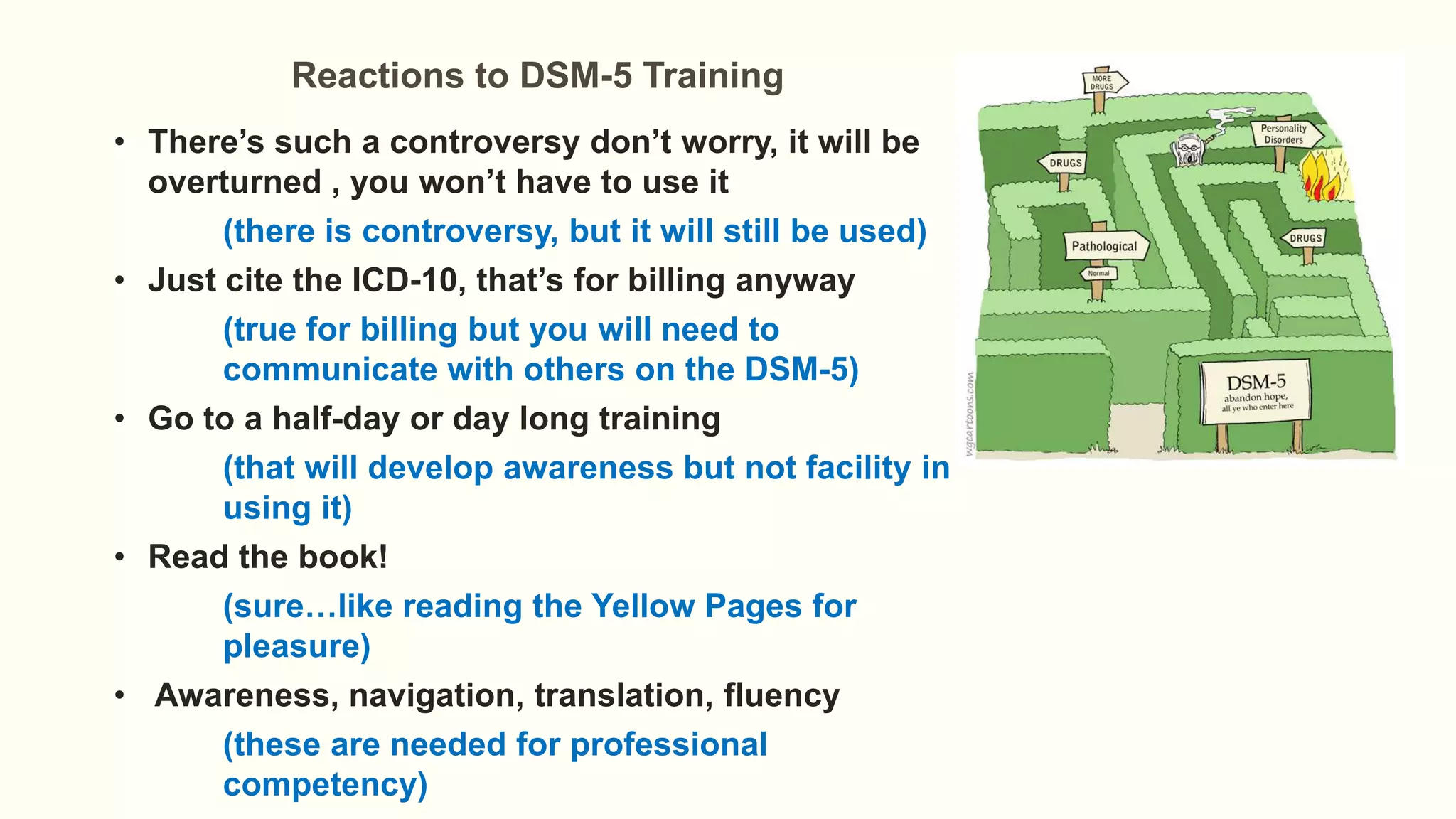
Reactions to DSM-5 Training
• There’s such a controversy don’t worry, it will be
overturned , you won’t have to use it
(there is controversy, but it will still be used)
• Just cite the ICD-10, that’s for billing anyway
(true for billing but you will need to
communicate with others on the DSM-5)
• Go to a half-day or day long training
(that will develop awareness but not facility in
using it)
• Read the book!
(sure…like reading the Yellow Pages for
pleasure)
• Awareness, navigation, translation, fluency
(these are needed for professional
competency)
Case Study
 Problem: Most mental health providers will be required to use DSM-5 diagnostic
codes by October 1, 2014; staff must be skilled in using them by that date
 Project: Develop a training program for 18 mental health providers to competency
level in using the DSM-5
 Considerations:
 Use in-house trainer for ongoing training support for staff (requires trainer to be
proficient in DSM-5)
 All staff need DSM-5 manuals
 Library needs supplementary DSM-5 training materials
 Schedule training and supplementary practice times
 Develop metrics to determine competency and monitor use
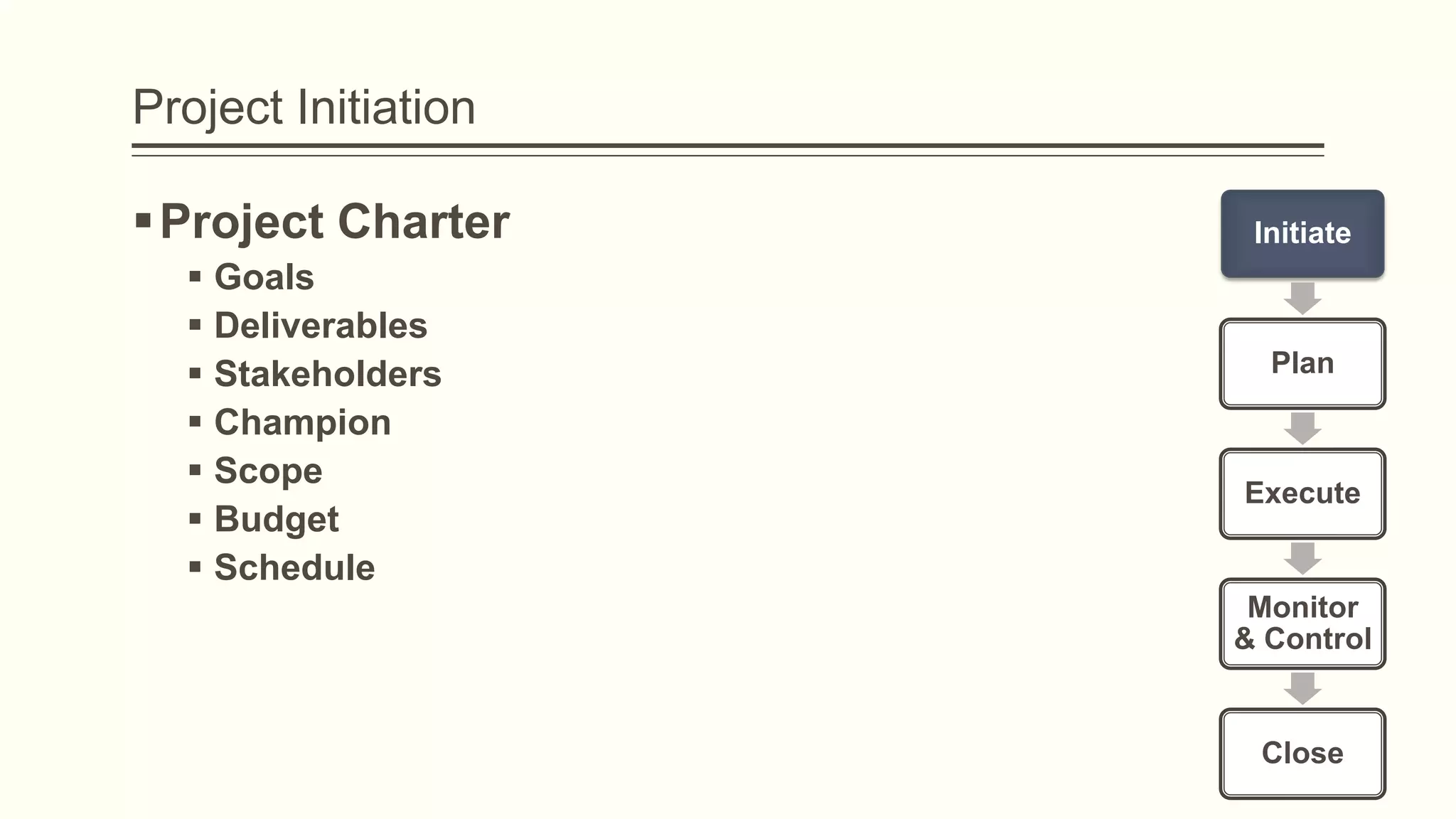
Project Initiation
Project Charter
 Goals
 Deliverables
 Stakeholders
 Champion
 Scope
 Budget
 Schedule
Initiate
Plan
Execute
Monitor
& Control
Close
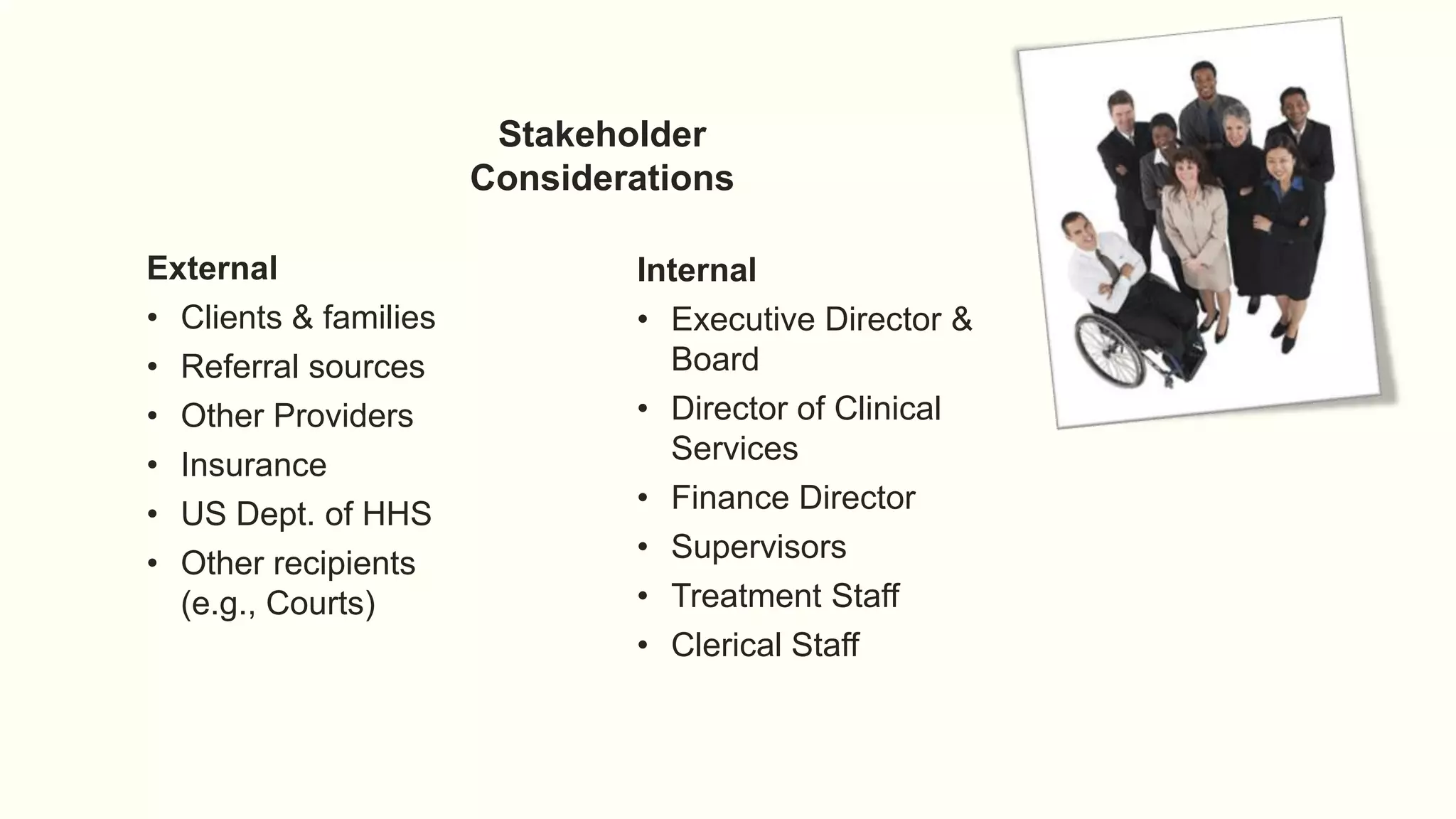
Stakeholder
Considerations
External
• Clients & families
• Referral sources
• Other Providers
• Insurance
• US Dept. of HHS
• Other recipients
(e.g., Courts)
Internal
• Executive Director &
Board
• Director of Clinical
Services
• Finance Director
• Supervisors
• Treatment Staff
• Clerical Staff
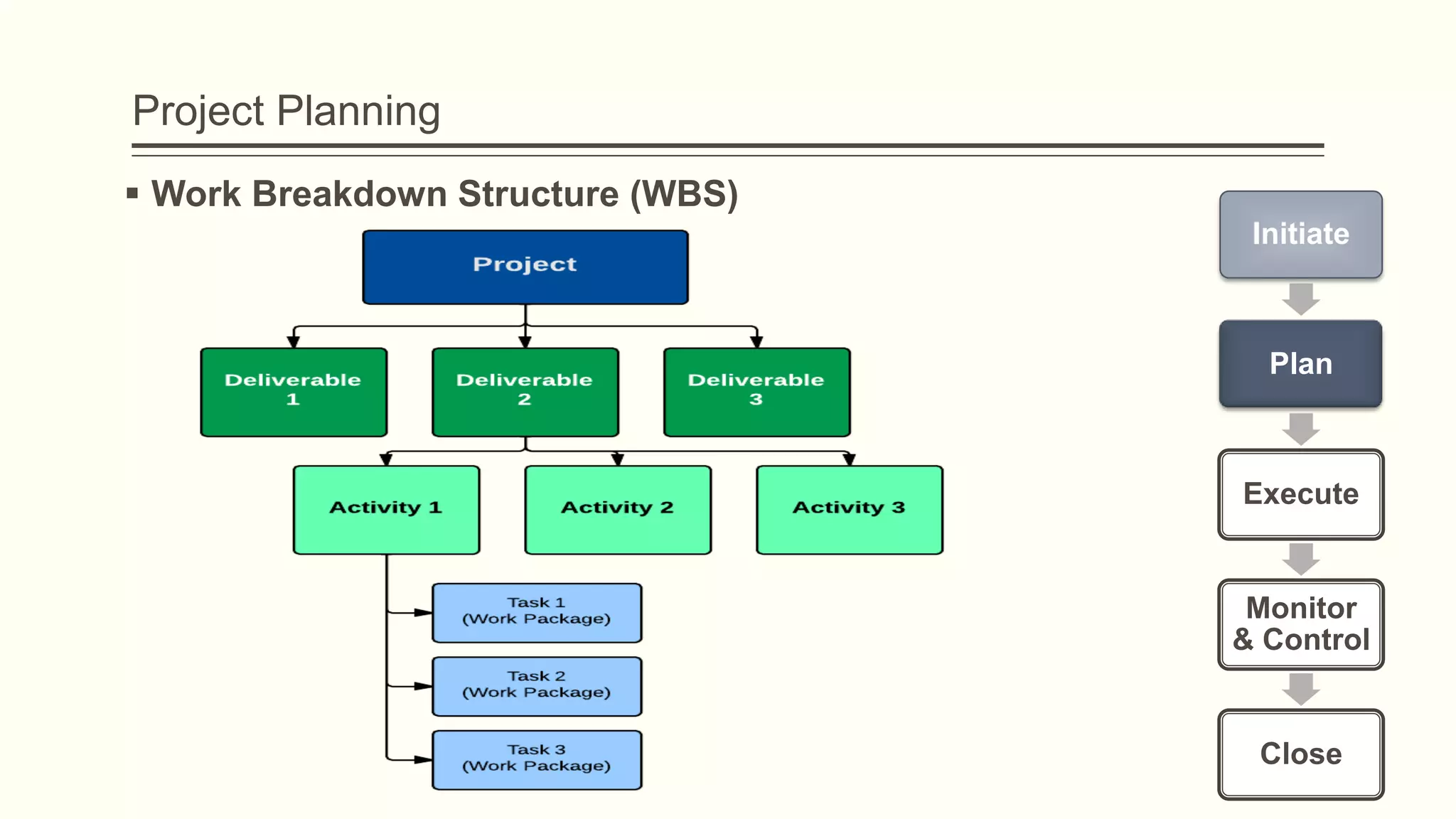
Project Planning
 Work Breakdown Structure (WBS)
Initiate
Plan
Execute
Monitor
& Control
Close
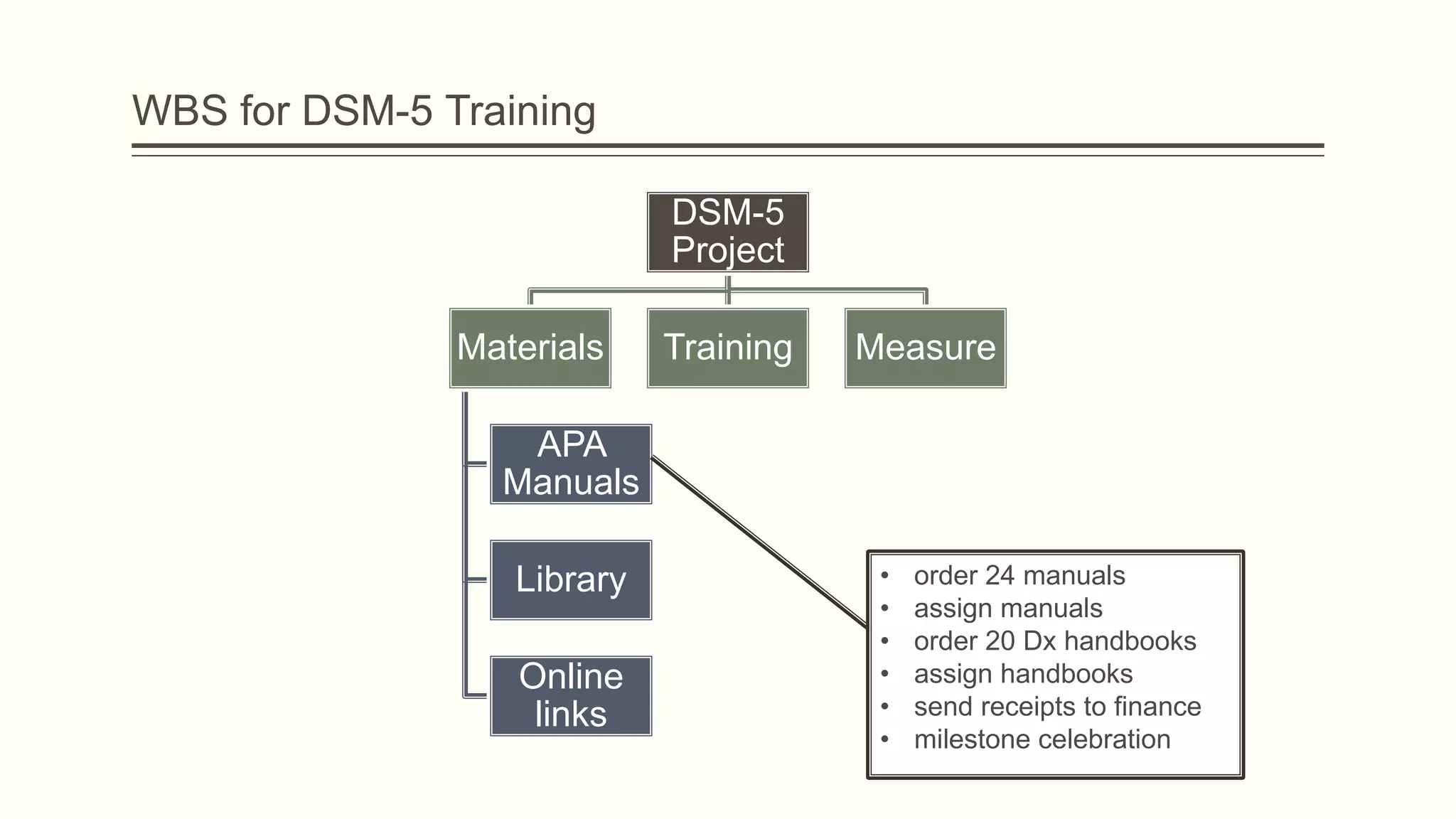
WBS for DSM-5 Training
DSM-5
Project
Materials
APA
Manuals
Library
Online
links
Training Measure
• order 24 manuals
• assign manuals
• order 20 Dx handbooks
• assign handbooks
• send receipts to finance
• milestone celebration
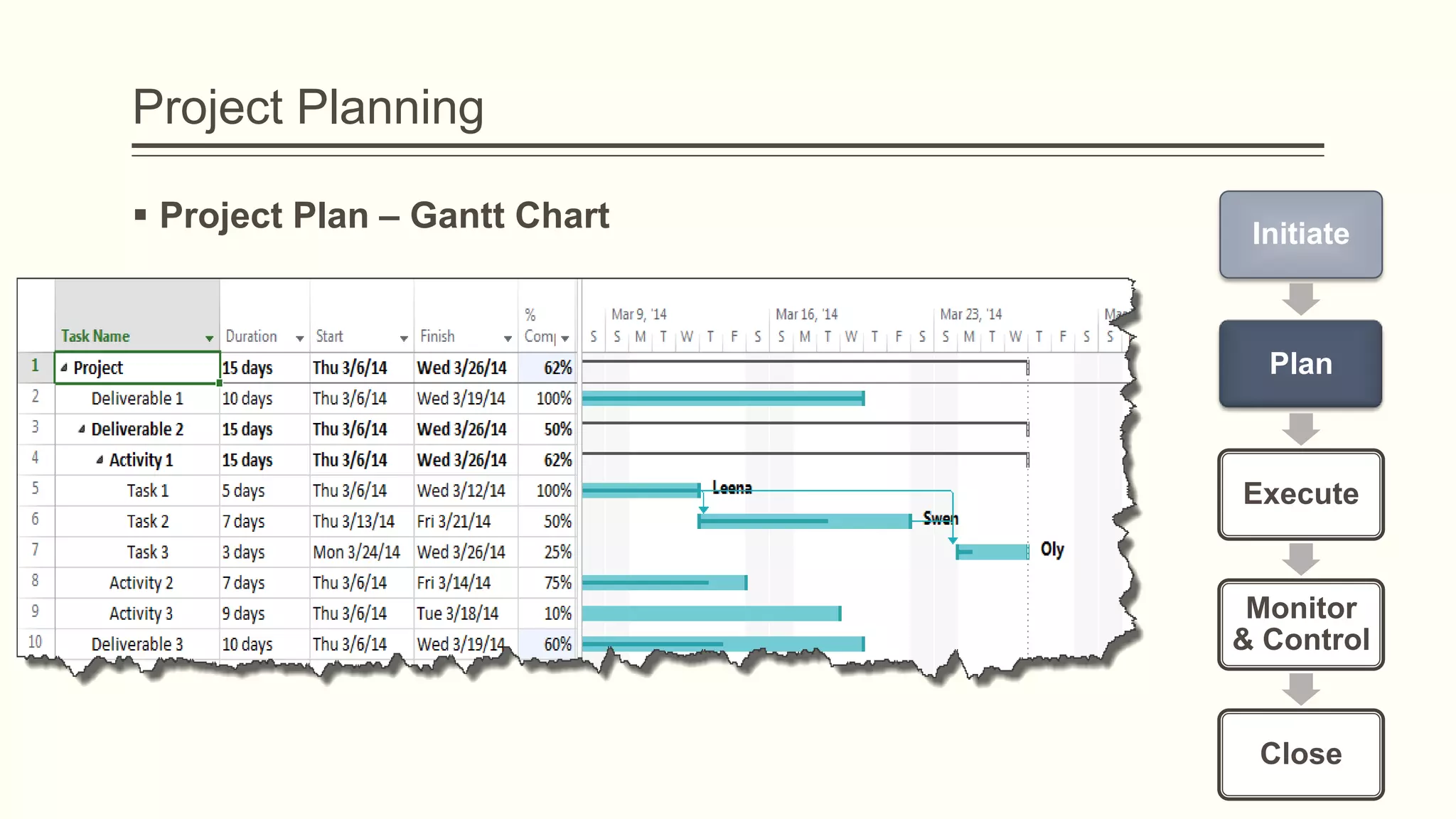
Project Planning
 Project Plan – Gantt Chart Initiate
Plan
Execute
Monitor
& Control
Close
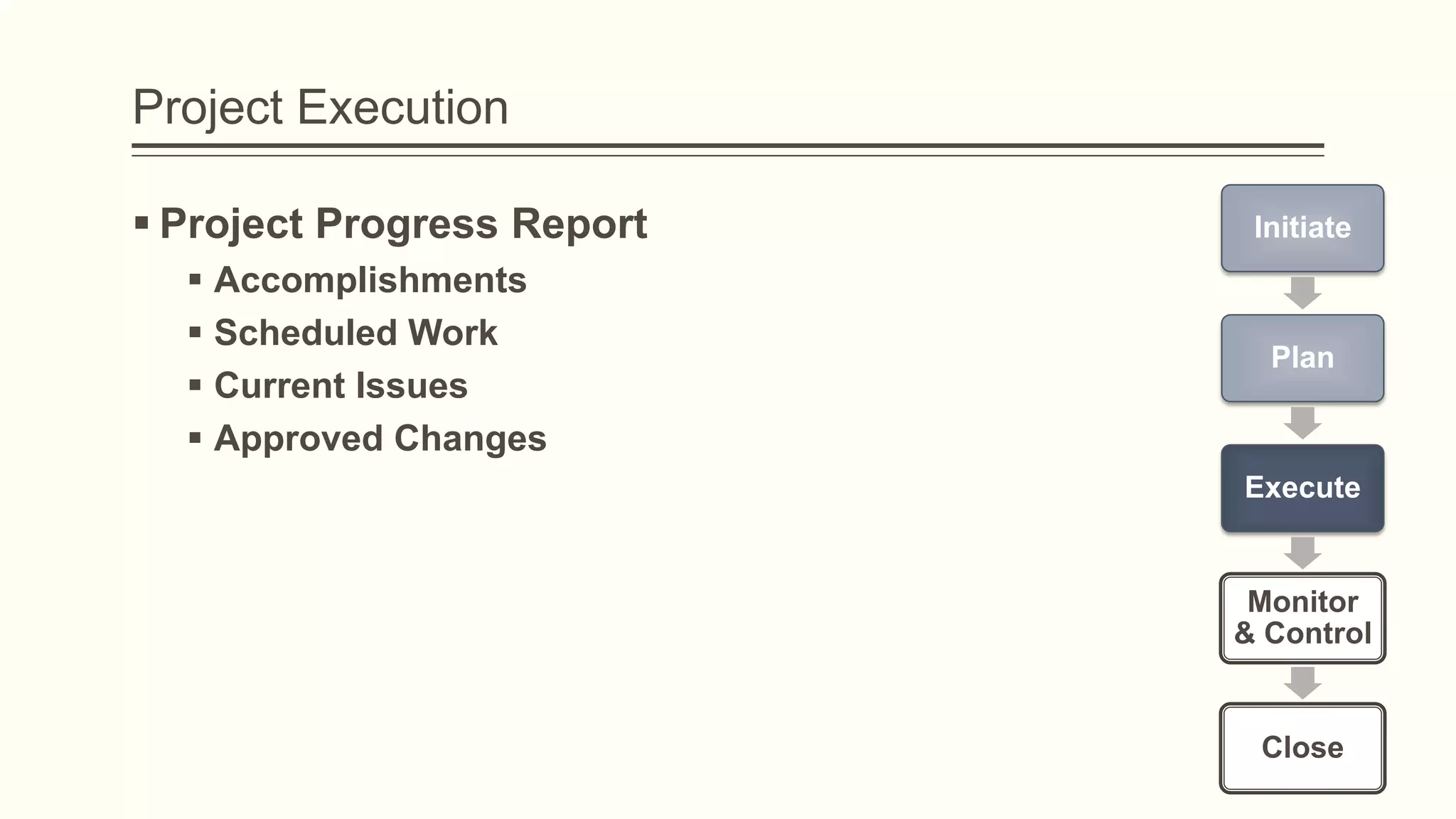
Project Execution
 Project Progress Report
 Accomplishments
 Scheduled Work
 Current Issues
 Approved Changes
Initiate
Plan
Execute
Monitor
& Control
Close
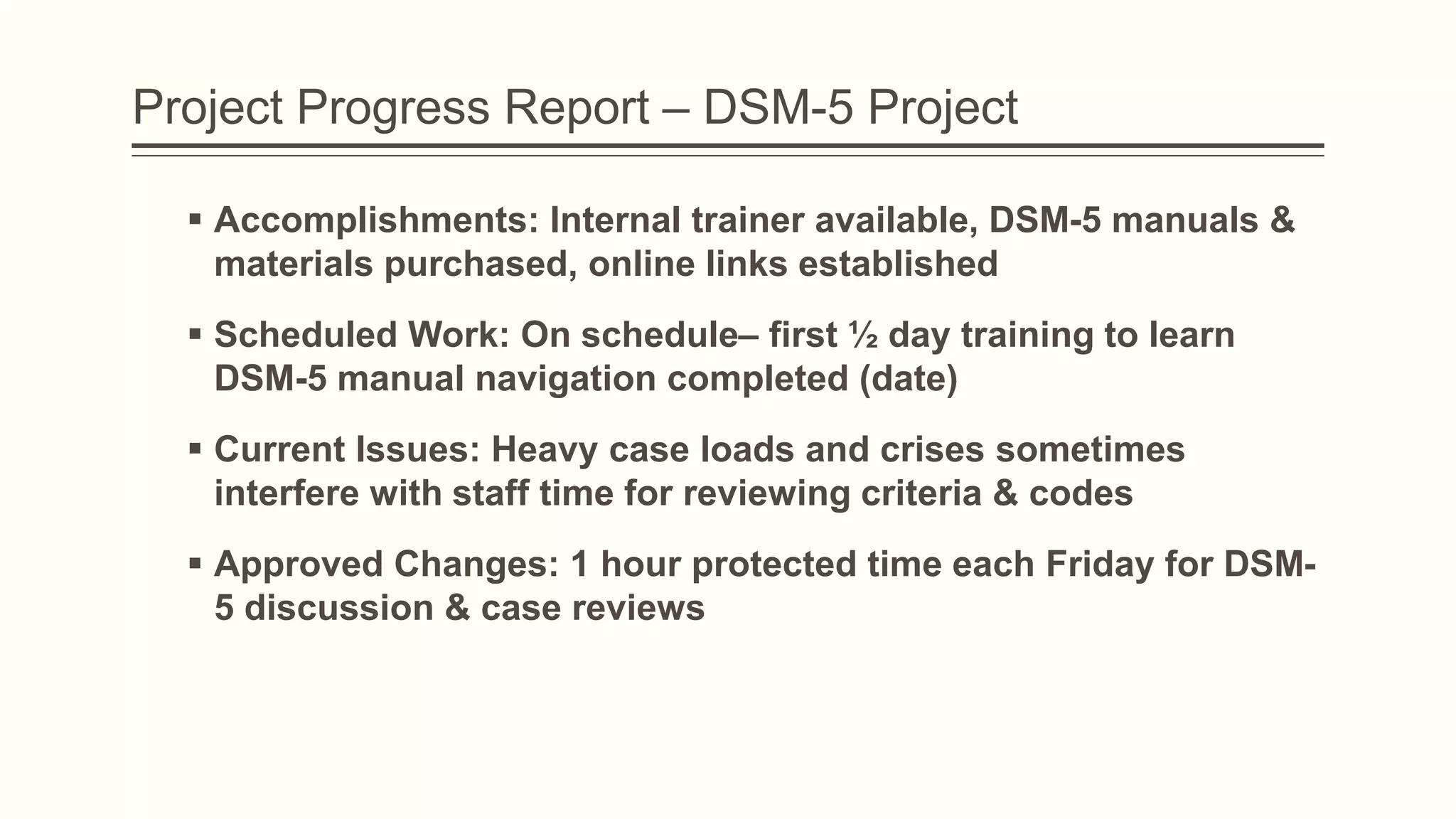
Project Progress Report – DSM-5 Project
 Accomplishments: Internal trainer available, DSM-5 manuals &
materials purchased, online links established
 Scheduled Work: On schedule– first ½ day training to learn
DSM-5 manual navigation completed (date)
 Current Issues: Heavy case loads and crises sometimes
interfere with staff time for reviewing criteria & codes
 Approved Changes: 1 hour protected time each Friday for DSM-
5 discussion & case reviews
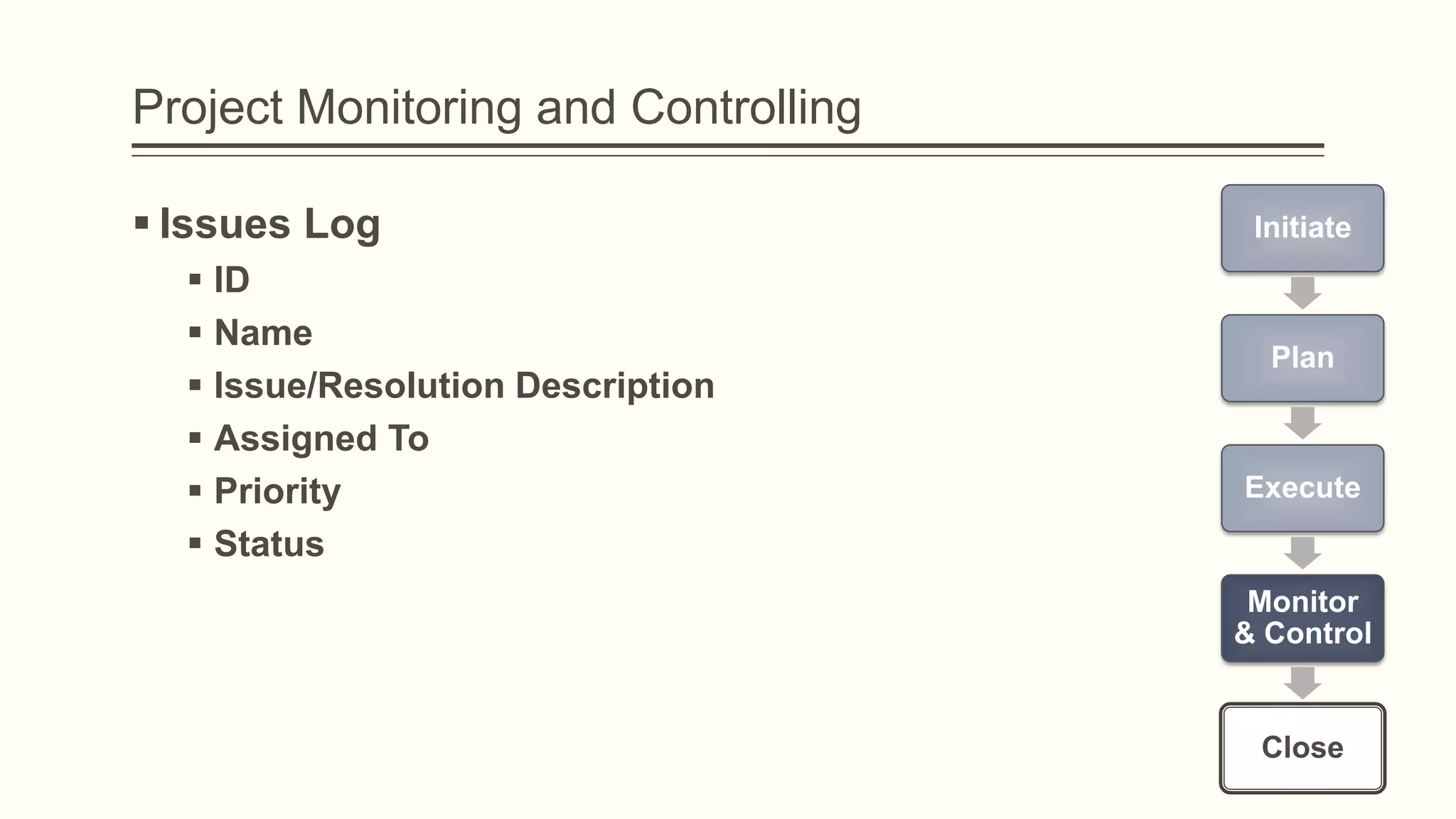
Project Monitoring and Controlling
 Issues Log
 ID
 Name
 Issue/Resolution Description
 Assigned To
 Priority
 Status
Initiate
Plan
Execute
Monitor
& Control
Close
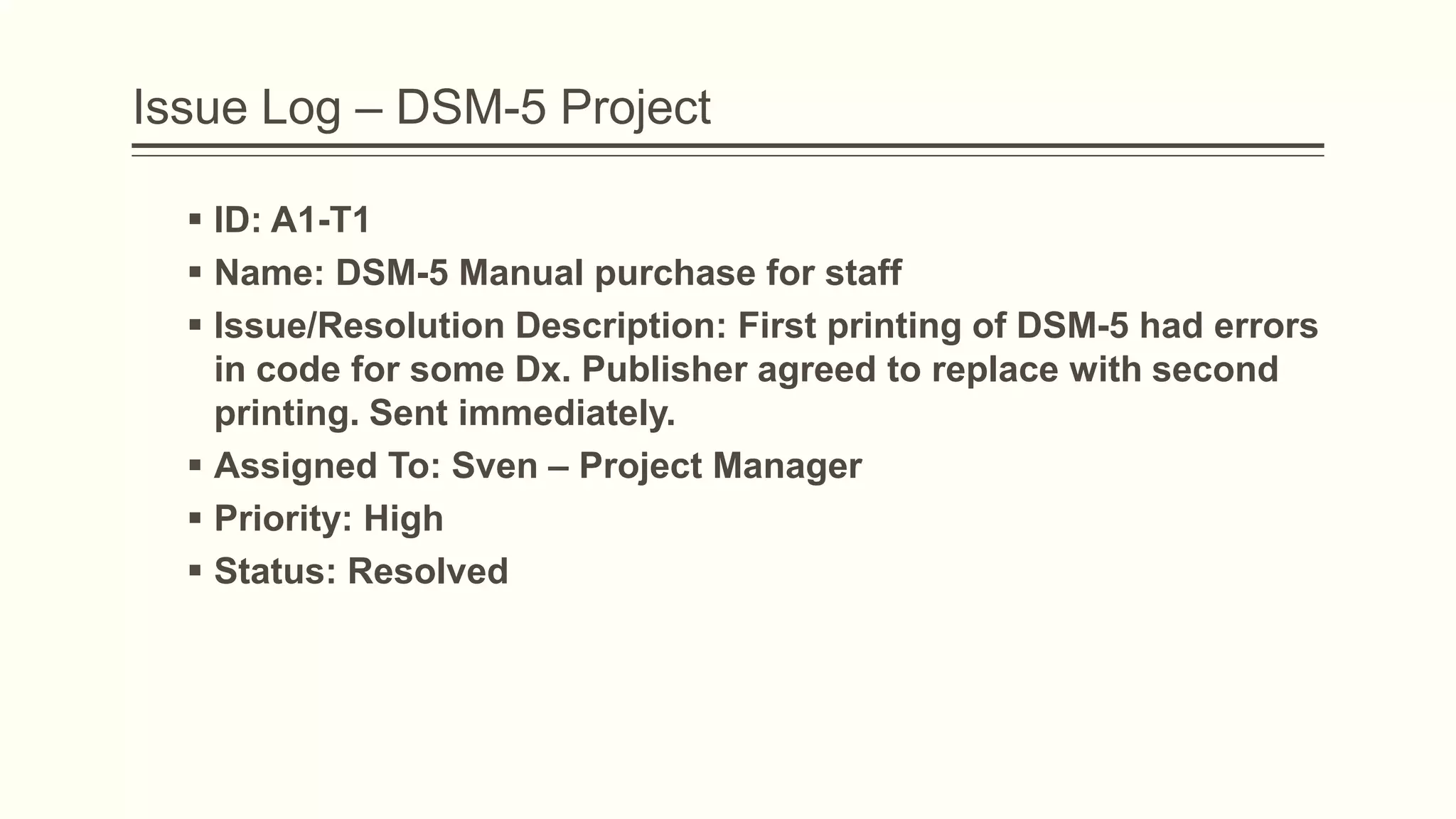
Issue Log – DSM-5 Project
 ID: A1-T1
 Name: DSM-5 Manual purchase for staff
 Issue/Resolution Description: First printing of DSM-5 had errors
in code for some Dx. Publisher agreed to replace with second
printing. Sent immediately.
 Assigned To: Sven – Project Manager
 Priority: High
 Status: Resolved
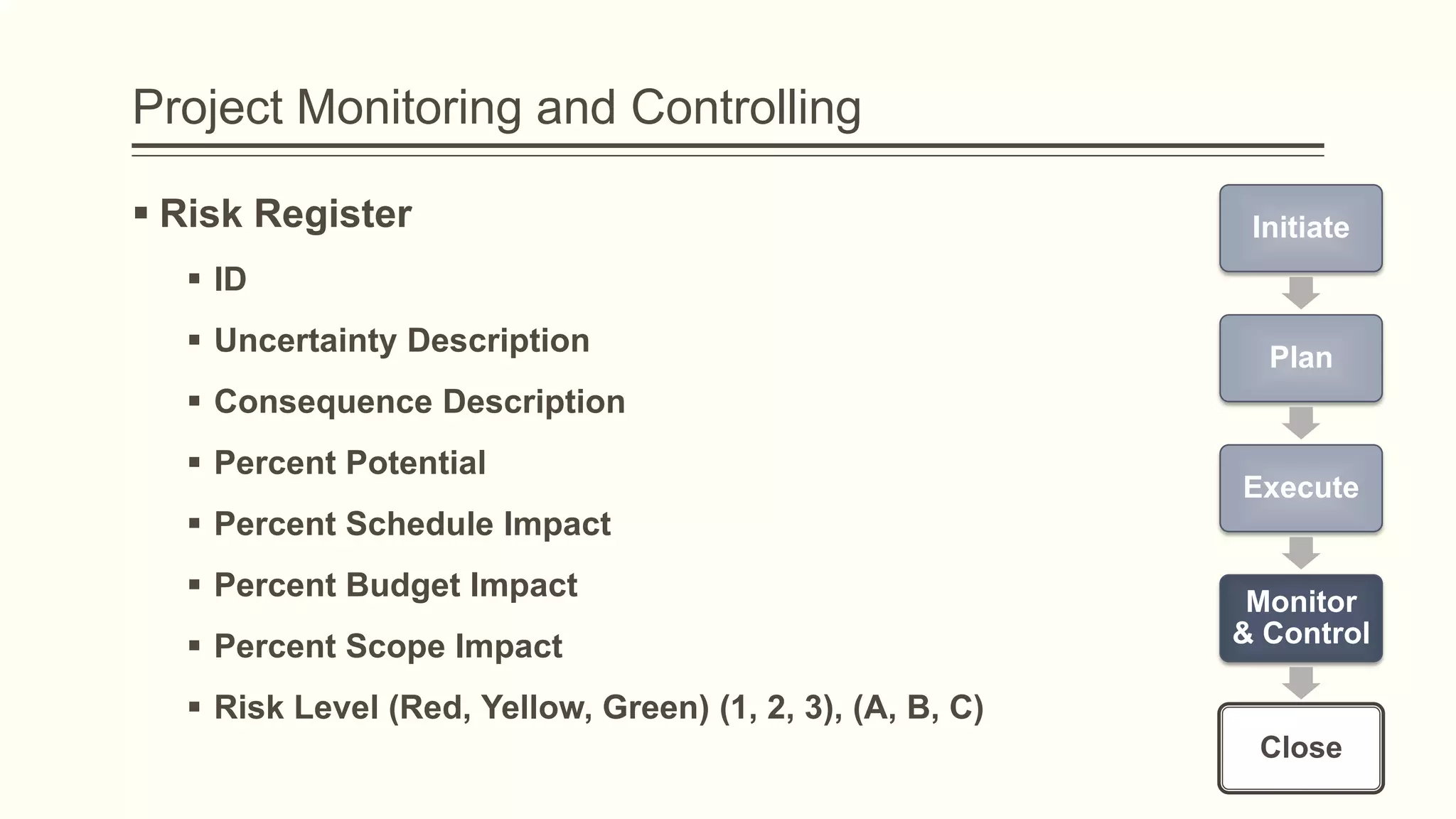
Project Monitoring and Controlling
 Risk Register
 ID
 Uncertainty Description
 Consequence Description
 Percent Potential
 Percent Schedule Impact
 Percent Budget Impact
 Percent Scope Impact
 Risk Level (Red, Yellow, Green) (1, 2, 3), (A, B, C)
Initiate
Plan
Execute
Monitor
& Control
Close
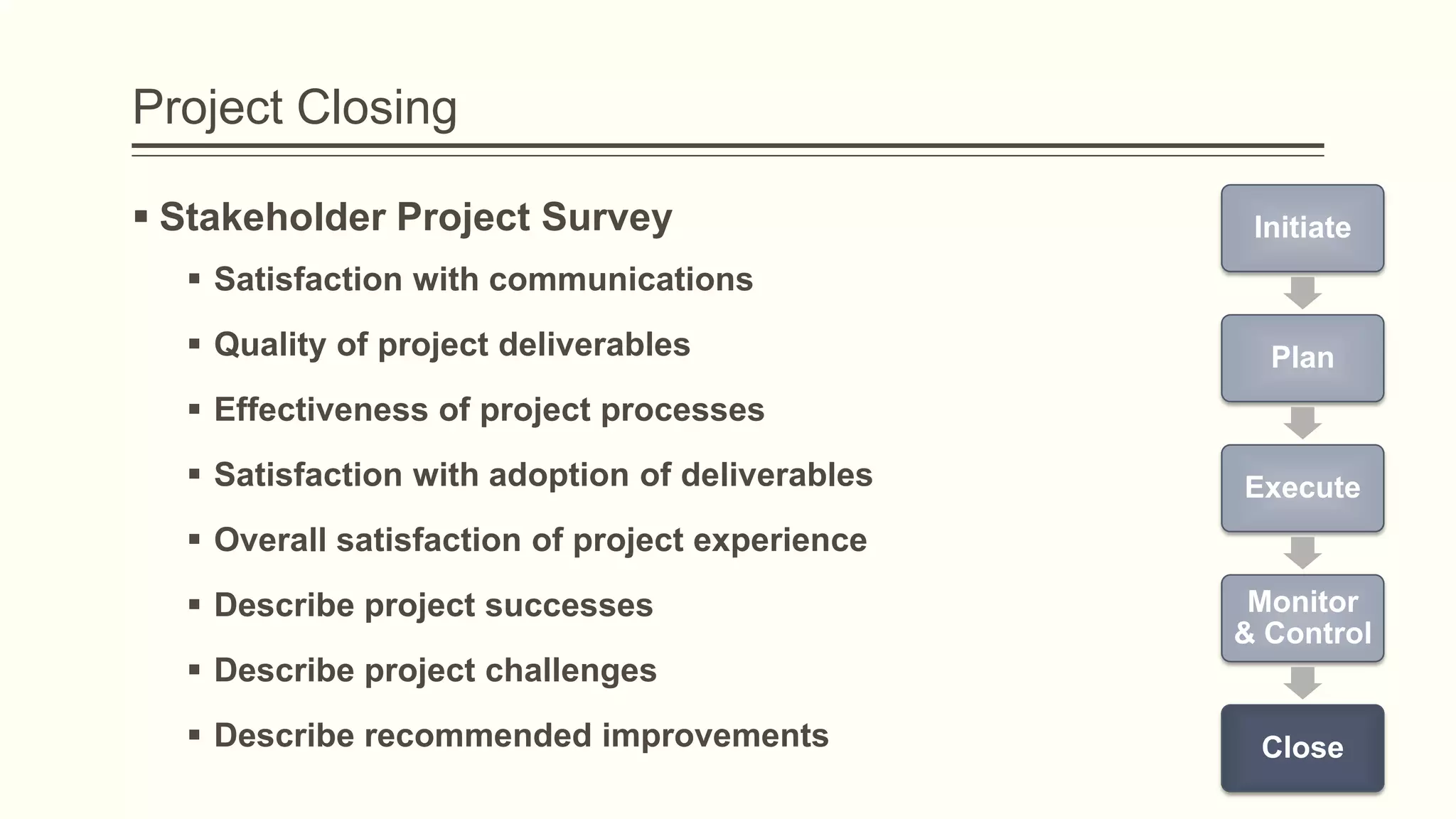
Project Closing
 Stakeholder Project Survey
 Satisfaction with communications
 Quality of project deliverables
 Effectiveness of project processes
 Satisfaction with adoption of deliverables
 Overall satisfaction of project experience
 Describe project successes
 Describe project challenges
 Describe recommended improvements
Initiate
Plan
Execute
Monitor
& Control
Close
Questions

Project Management in Health and Human Services

  • 1.
    SVEN AND OLE DOPROJECT MANAGEMENT IN HEALTH AND HUMAN SERVICES MSSA, March, 2014 David Swenson, PhD LP Brandon Olson, PhD http://faculty.css.edu/bolson1/presentations/MSSAPM.pdf
  • 2.
    Objectives  Reimagine Workin Health and Human Services  Define Project Management and Project Management Processes  Appreciate Balancing the Variables in Project Management  Understand Common Causes of Project Failure  Identify Solutions to Improve Project Success Rates  Apply Project Management Practice to Health and Human Services
  • 3.
    Objectives  Reimagine Workin Health and Humans Services  Define Project Management and Project Management Processes  Appreciate Balancing the Variables in Project Management  Understand Common Causes of Project Failure  Identify Solutions to Improve Project Success Rates  Apply Project Management Practice to Health and Human Services
  • 4.
    Common Activities inHHS  Promotional campaign for new mental health services  Developing an interactive website for services  Constructing a social media crisis monitoring system  Revising a hiring protocol for new staff  Designing an assessment procedure for determining amenability to treatment  Surveying a rural community for mental health needs  Developing a day treatment handbook for delivery in schools  Determining feasibility of expanding MH services to in- home  Implementing health information technology  Training staff in using the DSM-5  Other .
  • 5.
    Project Characteristics Kerzner, 2009 SpecificObjective with Defined Specifications Defined Start and End Dates Funding Limitations Consume Human and Nonhuman Resources Multiple Disciplines
  • 6.
    Objectives  Reimagine Workin Health and Humans Services  Define Project Management and Project Management Processes  Appreciate Balancing the Variables in Project Management  Understand Common Causes of Project Failure  Identify Solutions to Improve Project Success Rates  Apply Project Management Practice to Health and Human Services
  • 7.
    Definitions of Project "...a complex, non-routine, one-time effort limited by time, budget, resources, and performance specifications designed to meet customer needs (Gray & Larson, 2008)  "...a temporary endeavor undertaken to create a unique product, service, or result.“ (PMI, 2008) One-Time
  • 8.
    Operations vs. Projects OperationsProjects Taking notes in class Writing a research paper Recording sales into ledger Setting up sales kiosk for convention Practicing a musical instrument Writing a new piece of music Manufacturing the iPhone Designing the new OS Recording case notes on clients Implementing DSM-5 Dx codes Adapted from Gray & Larson, 2008
  • 9.
    Project Team andStakeholders Project Champion Project Owner/Sponsor (client) Project Manager Project Team (Multidisciplinary Specialists) Customers (Recipients of Outcomes)
  • 10.
  • 11.
    Benefits  Drive Change Goal-Oriented  Scalable  Simplifies Complexity  Proven Best Practices  Cross-Functional  Flexible  Temporary and Informal Structures
  • 12.
    Objectives  Reimagine Workin Health and Humans Services  Define Project Management and Project Management Processes  Appreciate Balancing the Variables in Project Management  Understand Common Causes of Project Failure  Identify Solutions to Improve Project Success Rates  Apply Project Management Practice to Health and Human Services
  • 13.
  • 14.
    Project Variables inHHS Work  Types of projects  Experience of what happens when these variables are not managed effectively  No organization identifiers please .
  • 15.
    Objectives  Reimagine Workin Health and Humans Services  Define Project Management and Project Management Processes  Appreciate Balancing the Variables in Project Management  Understand Common Causes of Project Failure  Identify Solutions to Improve Project Success Rates  Apply Project Management Practice to Health and Human Services
  • 16.
    Project Maturity –Chaos Report 0% 10% 20% 30% 40% 50% 60% Successful Challenged Failed 1994 1996 1998 2004 2009 2011 Gale (2011)
  • 17.
    Sources of ProjectFailures 1. No project champion 2. Process shortcuts 3. Unable to manage expectations 4. Variable lock-in 5. Poor estimating techniques 6. Over optimism 7. Resource assumptions 8. Inadequate people management skills 9. Unable to adapt to change 10. Insufficient resources Adapted from Whitten & Bentley, 2007
  • 18.
    Objectives  Reimagine Workin Health and Humans Services  Define Project Management and Project Management Processes  Appreciate Balancing the Variables in Project Management  Understand Common Causes of Project Failure  Identify Solutions to Improve Project Success Rates  Apply Project Management Practice to Health and Human Services
  • 19.
    Best Practices toLimit Project Failures  Engage Project Champion  Develop and Follow Methodology  Task and Activity Ownership  Manage Project Variables  Stakeholder Expectations Management  Project Team Communications  External Stakeholders  Internal Project Team
  • 20.
    Objectives  Reimagine Workin Health and Humans Services  Define Project Management and Project Management Processes  Appreciate Balancing the Variables in Project Management  Understand Common Causes of Project Failure  Identify Solutions to Improve Project Success Rates  Apply Project Management Practice to Health and Human Services
  • 21.
    Reactions to DSM-5Training • There’s such a controversy don’t worry, it will be overturned , you won’t have to use it (there is controversy, but it will still be used) • Just cite the ICD-10, that’s for billing anyway (true for billing but you will need to communicate with others on the DSM-5) • Go to a half-day or day long training (that will develop awareness but not facility in using it) • Read the book! (sure…like reading the Yellow Pages for pleasure) • Awareness, navigation, translation, fluency (these are needed for professional competency)
  • 22.
    Case Study  Problem:Most mental health providers will be required to use DSM-5 diagnostic codes by October 1, 2014; staff must be skilled in using them by that date  Project: Develop a training program for 18 mental health providers to competency level in using the DSM-5  Considerations:  Use in-house trainer for ongoing training support for staff (requires trainer to be proficient in DSM-5)  All staff need DSM-5 manuals  Library needs supplementary DSM-5 training materials  Schedule training and supplementary practice times  Develop metrics to determine competency and monitor use
  • 23.
    Project Initiation Project Charter Goals  Deliverables  Stakeholders  Champion  Scope  Budget  Schedule Initiate Plan Execute Monitor & Control Close
  • 24.
    Stakeholder Considerations External • Clients &families • Referral sources • Other Providers • Insurance • US Dept. of HHS • Other recipients (e.g., Courts) Internal • Executive Director & Board • Director of Clinical Services • Finance Director • Supervisors • Treatment Staff • Clerical Staff
  • 25.
    Project Planning  WorkBreakdown Structure (WBS) Initiate Plan Execute Monitor & Control Close
  • 26.
    WBS for DSM-5Training DSM-5 Project Materials APA Manuals Library Online links Training Measure • order 24 manuals • assign manuals • order 20 Dx handbooks • assign handbooks • send receipts to finance • milestone celebration
  • 27.
    Project Planning  ProjectPlan – Gantt Chart Initiate Plan Execute Monitor & Control Close
  • 28.
    Project Execution  ProjectProgress Report  Accomplishments  Scheduled Work  Current Issues  Approved Changes Initiate Plan Execute Monitor & Control Close
  • 29.
    Project Progress Report– DSM-5 Project  Accomplishments: Internal trainer available, DSM-5 manuals & materials purchased, online links established  Scheduled Work: On schedule– first ½ day training to learn DSM-5 manual navigation completed (date)  Current Issues: Heavy case loads and crises sometimes interfere with staff time for reviewing criteria & codes  Approved Changes: 1 hour protected time each Friday for DSM- 5 discussion & case reviews
  • 30.
    Project Monitoring andControlling  Issues Log  ID  Name  Issue/Resolution Description  Assigned To  Priority  Status Initiate Plan Execute Monitor & Control Close
  • 31.
    Issue Log –DSM-5 Project  ID: A1-T1  Name: DSM-5 Manual purchase for staff  Issue/Resolution Description: First printing of DSM-5 had errors in code for some Dx. Publisher agreed to replace with second printing. Sent immediately.  Assigned To: Sven – Project Manager  Priority: High  Status: Resolved
  • 32.
    Project Monitoring andControlling  Risk Register  ID  Uncertainty Description  Consequence Description  Percent Potential  Percent Schedule Impact  Percent Budget Impact  Percent Scope Impact  Risk Level (Red, Yellow, Green) (1, 2, 3), (A, B, C) Initiate Plan Execute Monitor & Control Close
  • 33.
    Project Closing  StakeholderProject Survey  Satisfaction with communications  Quality of project deliverables  Effectiveness of project processes  Satisfaction with adoption of deliverables  Overall satisfaction of project experience  Describe project successes  Describe project challenges  Describe recommended improvements Initiate Plan Execute Monitor & Control Close
  • 34.