STRATEGIC MONITORING, EVALUATION, AND
CONTROL
STRATEGIC MONITORING,
EVALUATION, AND CONTROL
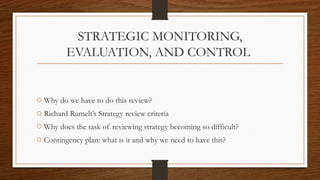
o Why do we have to do this review?
o Richard Rumelt’s Strategy review criteria
o Why does the task of reviewing strategy becoming so difficult?
o Contingency plan: what is it and why we need to have this?
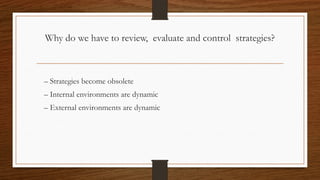
Why do we have to review, evaluate and control strategies?
– Strategies become obsolete
– Internal environments are dynamic
– External environments are dynamic
STRATEGIC MONITORING,
EVALUATION, AND CONTROL
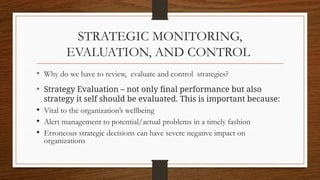
• Why do we have to review, evaluate and control strategies?
• Strategy Evaluation – not only final performance but also
strategy it self should be evaluated. This is important because:
• Vital to the organization’s wellbeing
• Alert management to potential/actual problems in a timely fashion
• Erroneous strategic decisions can have severe negative impact on
organizations
STRATEGIC MONITORING,
EVALUATION, AND CONTROL
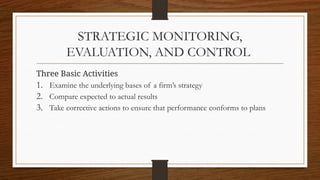
Three Basic Activities
1. Examine the underlying bases of a firm’s strategy
2. Compare expected to actual results
3. Take corrective actions to ensure that performance conforms to plans
CRITERIA FOR EVALUATING STRATEGY
• Please see Rumelts 4 criteria below for evaluating strategy
Strategy Review, Evaluation, and Control - Richard Rumelt offered four criteria that
could be used to evaluate a strategy: consistency, consonance, feasibility, and
advantage.
STRATEGIC MANAGEMENT Ch 9 7
Consonance
Consistency
Feasibility
Advantage
Rumelt’s
4 Criteria
Richard Rumelt- a known strategist
Rumelt’s
4 Criteria - Consistency
Consistency
• Strategy should not present inconsistent goals and policies
• Inconsistent goals and policies lead to wrong direction because they cause
confusion
• The strategy that you pursue should not be in clash/conflict with any internal
environmental variables (goals, policies, mission, vision, systems, culture etc)
Rumelt’s
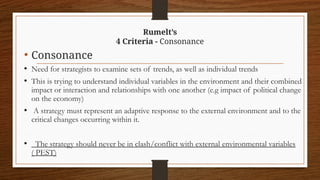
4 Criteria - Consonance
• Consonance
• Need for strategists to examine sets of trends, as well as individual trends
• This is trying to understand individual variables in the environment and their combined
impact or interaction and relationships with one another (e.g impact of political change
on the economy)
• A strategy must represent an adaptive response to the external environment and to the
critical changes occurring within it.
• The strategy should never be in clash/conflict with external environmental variables
( PEST)
Rumelt’s
4 Criteria - Feasibility
• Feasibility - can we do it? Do we have the
resources that it takes?
• Neither overtax resources nor create unsolvable subproblems
• The final broad test of strategy is its feasibility; that is, can the strategy be
attempted within the physical, human, and financial resources of the enterprise?
• The strategy must be doable !
Rumelt’s
4 Criteria - Advantage
• Advantage – will this strategy create a competitive
advantage to our company?
• Creation or maintenance of competitive advantage is an important considertion
• A strategy must provide for the creation and/or maintenance of a competitive
advantage in a selected area of activity. Competitive advantages normally are the
result of superiority in one of three areas: (1) resources, (2) skills, or (3) position.
• The strategy must being in some benefits !
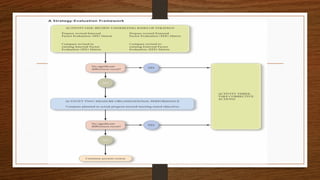
Strategy Evaluation Framework
Measuring Organizational Performance
• Compare expected to actual results
• Investigate deviations from plan
• Evaluate individual performance
• Examine progress toward stated objectives
Contingency Planning
• You should always have contingency plans (plan B)!
• These are alternative plans that can be put into effect if
certain key events do not occur as expected
Difficulties of Strategy review and Evaluation
• Strategy review/evaluation/monitoring/control: is not an easy task
• Especially, in modern day business, this dusty is becoming so cumbersome
• Why?
Ans. The environment has become so unstable (so dynamic)
Difficulties of strategy review, evaluation and control
• Strategy evaluation is becoming increasingly difficult with the passage of time, for
many reasons.
• In previous times, domestic and world economies were more stable in years past,
product life cycles were longer, product development cycles were longer,
technological advancement was slower, and change occurred less frequently, there
were fewer competitors, foreign companies (in non western countries) were weak,
and there were more regulated industries.
• Nonetheless, that’s not the reality in today’s business dynamics making strategy
evaluation a challenge to managers.
Difficulties of strategy review, evaluation and control
Other reasons why strategy evaluation is more difficult today include the following trends:
• A dramatic increase in the environment’s complexity
• The increasing difficulty of predicting the future with accuracy
• The increasing number of variables (environmental variables)
• The rapid rate of obsolescence of even the best plans
• The increase in the number of both domestic and world events affecting organizations
• The decreasing time span for which planning can be done with any degree of certainty
• The End!

5. Strategy Review evaluation and control.pptx

  • 1.
  • 2.
    STRATEGIC MONITORING, EVALUATION, ANDCONTROL o Why do we have to do this review? o Richard Rumelt’s Strategy review criteria o Why does the task of reviewing strategy becoming so difficult? o Contingency plan: what is it and why we need to have this?
  • 3.
    Why do wehave to review, evaluate and control strategies? – Strategies become obsolete – Internal environments are dynamic – External environments are dynamic
  • 4.
    STRATEGIC MONITORING, EVALUATION, ANDCONTROL • Why do we have to review, evaluate and control strategies? • Strategy Evaluation – not only final performance but also strategy it self should be evaluated. This is important because: • Vital to the organization’s wellbeing • Alert management to potential/actual problems in a timely fashion • Erroneous strategic decisions can have severe negative impact on organizations
  • 5.
    STRATEGIC MONITORING, EVALUATION, ANDCONTROL Three Basic Activities 1. Examine the underlying bases of a firm’s strategy 2. Compare expected to actual results 3. Take corrective actions to ensure that performance conforms to plans
  • 6.
    CRITERIA FOR EVALUATINGSTRATEGY • Please see Rumelts 4 criteria below for evaluating strategy
  • 7.
    Strategy Review, Evaluation,and Control - Richard Rumelt offered four criteria that could be used to evaluate a strategy: consistency, consonance, feasibility, and advantage. STRATEGIC MANAGEMENT Ch 9 7 Consonance Consistency Feasibility Advantage Rumelt’s 4 Criteria Richard Rumelt- a known strategist
  • 8.
    Rumelt’s 4 Criteria -Consistency Consistency • Strategy should not present inconsistent goals and policies • Inconsistent goals and policies lead to wrong direction because they cause confusion • The strategy that you pursue should not be in clash/conflict with any internal environmental variables (goals, policies, mission, vision, systems, culture etc)
  • 9.
    Rumelt’s 4 Criteria -Consonance • Consonance • Need for strategists to examine sets of trends, as well as individual trends • This is trying to understand individual variables in the environment and their combined impact or interaction and relationships with one another (e.g impact of political change on the economy) • A strategy must represent an adaptive response to the external environment and to the critical changes occurring within it. • The strategy should never be in clash/conflict with external environmental variables ( PEST)
  • 10.
    Rumelt’s 4 Criteria -Feasibility • Feasibility - can we do it? Do we have the resources that it takes? • Neither overtax resources nor create unsolvable subproblems • The final broad test of strategy is its feasibility; that is, can the strategy be attempted within the physical, human, and financial resources of the enterprise? • The strategy must be doable !
  • 11.
    Rumelt’s 4 Criteria -Advantage • Advantage – will this strategy create a competitive advantage to our company? • Creation or maintenance of competitive advantage is an important considertion • A strategy must provide for the creation and/or maintenance of a competitive advantage in a selected area of activity. Competitive advantages normally are the result of superiority in one of three areas: (1) resources, (2) skills, or (3) position. • The strategy must being in some benefits !
  • 12.
  • 13.
    Measuring Organizational Performance •Compare expected to actual results • Investigate deviations from plan • Evaluate individual performance • Examine progress toward stated objectives
  • 14.
    Contingency Planning • Youshould always have contingency plans (plan B)! • These are alternative plans that can be put into effect if certain key events do not occur as expected
  • 15.
    Difficulties of Strategyreview and Evaluation • Strategy review/evaluation/monitoring/control: is not an easy task • Especially, in modern day business, this dusty is becoming so cumbersome • Why? Ans. The environment has become so unstable (so dynamic)
  • 16.
    Difficulties of strategyreview, evaluation and control • Strategy evaluation is becoming increasingly difficult with the passage of time, for many reasons. • In previous times, domestic and world economies were more stable in years past, product life cycles were longer, product development cycles were longer, technological advancement was slower, and change occurred less frequently, there were fewer competitors, foreign companies (in non western countries) were weak, and there were more regulated industries. • Nonetheless, that’s not the reality in today’s business dynamics making strategy evaluation a challenge to managers.
  • 17.
    Difficulties of strategyreview, evaluation and control Other reasons why strategy evaluation is more difficult today include the following trends: • A dramatic increase in the environment’s complexity • The increasing difficulty of predicting the future with accuracy • The increasing number of variables (environmental variables) • The rapid rate of obsolescence of even the best plans • The increase in the number of both domestic and world events affecting organizations • The decreasing time span for which planning can be done with any degree of certainty
  • 18.