5-Research Methodology (Quantitative and Qualitative Approach-Data Collection, Analysis and Interpretation).pdf
1.
Quantitative and QualitativeApproach-Data Collection,
Analysis and Interpretation:
The Data Collection Methods;
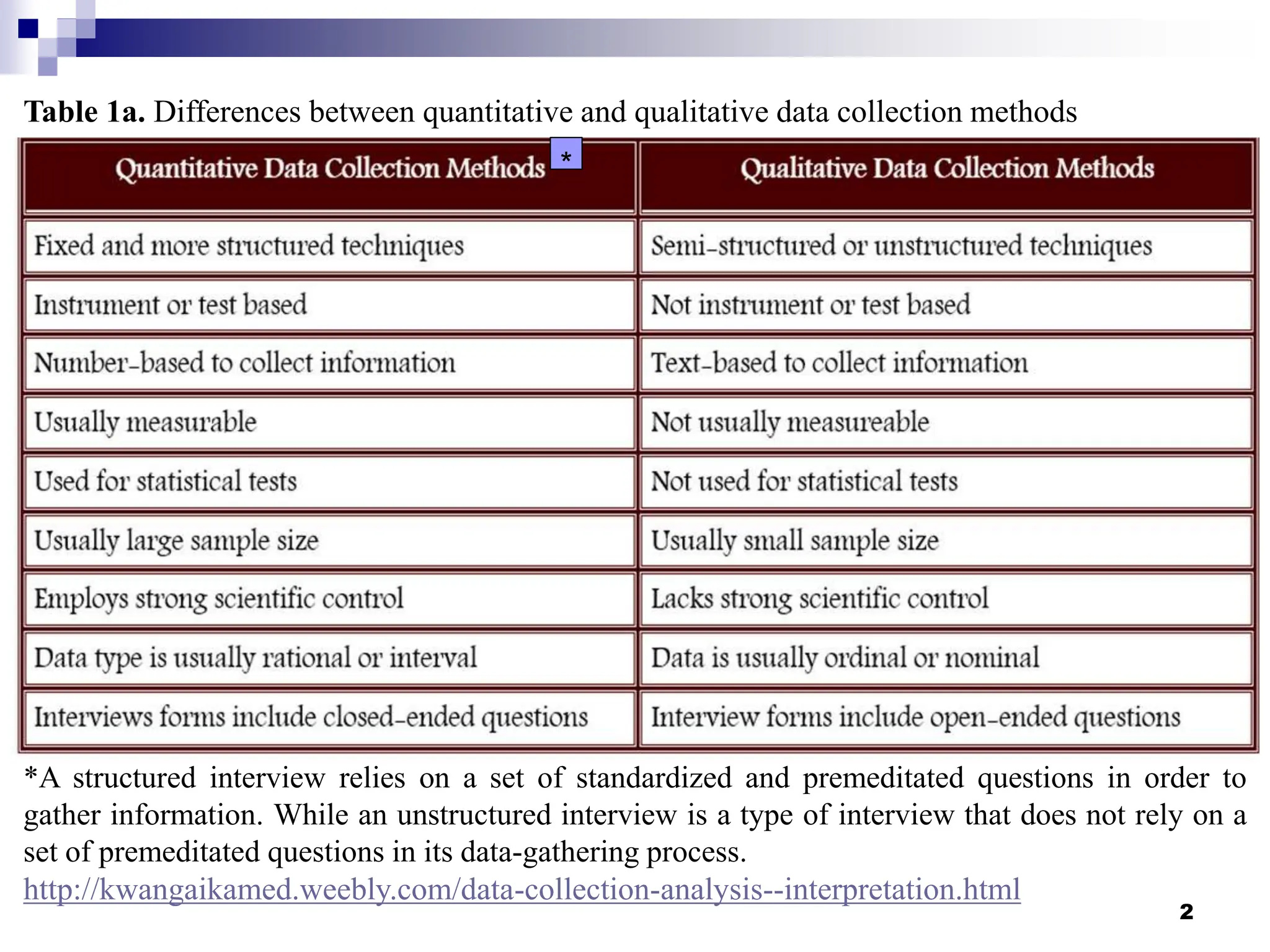
• The general differences between quantitative data and
qualitative data collection methods are summarized in
following Table
Tables 1a and 1b Down Loaded from Web
• Some common forms of data collections methods
under each approach will be discussed here:
o Quantitative Research Approach-Data
Collection
In quantitative research approach
Data collection relies heavily on random
sampling and structured data collection
methods 1
2.
Table 1a. Differencesbetween quantitative and qualitative data collection methods
2
*A structured interview relies on a set of standardized and premeditated questions in order to
gather information. While an unstructured interview is a type of interview that does not rely on a
set of premeditated questions in its data-gathering process.
http://kwangaikamed.weebly.com/data-collection-analysis--interpretation.html
*
3.
3
Table 1b. Qualitativevs. quantitative data: what's the difference?
https://www.fullstory.com/blog/qualitative-vs-quantitative-data/
4.
Introduction to Research
(ScientificInquiry)
Each strategy of inquiry - true experiment,
quasi-experiment or non-experiment employs
several unique ways of data collection tools
Some of which are given in the following
figure
Fig 1 Down Loaded from Web
o Qualitative Research Approach-Data Collection
In qualitative research approach
Data collection is usually unstructured and
data is collected for non-numerical analysis
Usually, the methods of data collection all the
strategies of qualitative inquiry-ethnography,
phenomenological, grounded theory, narrative
and case studies-are similar
4
Also, inqualitative research, multiple methods
of data collection or collection of data from
multiple sources is practiced
This is called triangulation and is employed in
order to collect data that
provide sufficient data
provide more information on a phenomenon
or
enhance deeper analysis and understanding
of a research study
Types of triangulation may include
method triangulation
source triangulation
analysis triangulation and 6
7.
even theorytriangulation (Denzin, 1978;
Patton, 1999)
All forms of data gathering done in a
research study form what is known as
a bricolage - a French for DIY or "do-it-
yourself projects"
Main forms of data collection under each
strategy are given in the following chart:
Fig 2 Down Loaded from Web
o Data Analysis and Interpretation
Figs 3 and 4 Down Loaded from Web
After identifying
a research topic
doing a literature background research
7
establishing philosophicalassumptions and
focus problem
deciding on an appropriate research paradigm
(hypothesis) and methodology with specific
purpose
designing a research plan and collecting
sufficient data
the next step in the research process is data
analysis and interpretation
which precedes reporting of research
Therefore data analysis is a process that involves
examining and molding collected data for
interpretation to
discover relevant information
draw or propose conclusions and 11
12.
.
support decision-makingto solve a research
problem
This involves interpreting data to answer research
questions and making research findings be ready
for dissemination
Data analysis also serves as a reference for future
data collection and other research activities
During data analysis (Bala, 2005):
data collected is transformed into information
and knowledge about a research performed
relationships between variables are explored
meanings are identified and information is
interpreted
12
13.
Like otherresearch methods, data analysis
procedures in quantitative research approach are
different from those in qualitative research
approach
The general differences of data analysis
procedures between these two approaches are
summarized in the Chart (Bala, 2005) and a Table
Chart 5 Down Loaded from Web
Table 2 Down Loaded from Web
Now we briefly describe some specific methods
of data analysis under each approach
o Quantitative Research Approach - Data Analysis
Statistical analysis is the usual method used in
quantitative research approach
13
14.
Chart 5. Dataanalysis procedures. http://kwangaikamed.weebly.com/data-collection-analysis-
-interpretation.html
(Theory of interpretation) (Related to signs and symbols)
Istiarah
14
15.
Table 2. Generaldifferences of data analysis procedures between these two approaches.
15
16.
However, quantitativedata can be analyzed in
several ways
Data collected has a certain level of
measurements which initially influences the
analysis
The identification of a particular level of
measurement is the usually the first step in
quantitative data analysis
The four levels of measurements include
(Yamashita & Espinosa, 2015)
Nominal Data: basic classification data; lack
logical order - e.g. male or female
Ordinal Data: has logical order but lack
constant differences between values - e.g.
Pizza size (large, medium, small)
16
17.
Interval Data:has logical order, is
continuous, has standardized differences
between values but lacks natural zero - e.g.
Celsius degrees
Ratio Data: has logical order, is continuous,
has standardized differences between values,
and has a natural zero - e.g. height, weight,
age, length
After identifying a level of measurement, the
next step is now to use a specific analysis
technique in analyzing data
There are several procedures that can be used to
analyze data
Main ones include (Yamashita & Espinosa,
2015): 17
18.
o Data Tabulation- e.g. frequency distributions
and percent distributions
o Data Descriptive - Mean, median, mode,
minimum and maximum values, etc.
o Data Disaggregation - tabulation of data
across multiple categories
o Moderate and Advanced Analytical Methods
- (regression, correlation, variance analysis)
The above methods can be used invariably by all
different true experimental, quasi-experimental
and non-experimental quantitative research
strategies
18
19.
o Qualitative ResearchApproach - Data Analysis
Textual data analysis is the usual method used in
qualitative research approach
This involves identifying patterns and themes in
data collected and then
examining and interpreting these patterns and
themes
to draw meaning and answer research
questions
The five strategies of qualitative research
mentioned:
Ethnography - the scientific description of
peoples and cultures with their customs,
habits, and mutual differences
19
20.
20
Phenomenological -to explain the nature of
things through the way people experience
them
Grounded theory - attempts to unravel the
meanings of people's interactions, social
actions, and experiences
Narrative and case studies - to explore and
conceptualize human experience as it is
represented in textual form
However, preliminary and some general steps in
data analysis are common to all. These include
(Yamashita & Espinosa, 2015):
i. Immediate processing and recording of data
(important information, date/time details,
observations, etc.)
ii. Commencement of data analysis soon after
collection
21.
. iii. Reductionof data to meaningful information
iv. Identification of meaningful patterns and
themes” via
Content analysis achieved by:
▫ Coding the data for certain words or
content
▫ Identifying their patterns
▫ Interpreting their meanings
Thematic analysis achieved by
▫ grouping data into themes that answers
research problem
v. Display of data which include organizing data
in forms of graphics, maps, tables, etc., to
draw conclusions
vi. Drawing of conclusion and verification 21
22.
Graphical representationis a way of analyzing
numerical data
It exhibits the relation between data, ideas,
information and concepts in a diagram
It is easy to understand and it is one of the most
important learning strategies
It always depends on the type of information in
a particular domain
There are different types of graphical
representation. Some of them are as follows
Line Graphs - Linear graphs are used to
display the continuous data and it is useful
for predicting the future events over time
Bar Graphs - Bar Graph is used to display
the category of data and it compares the data
using solid bars to represent the quantities
22
23.
Histograms -The graph that uses bars to
represent the frequency of numerical data that
are organized into intervals
Since all the intervals are equal and
continuous, all the bars have the same
width
Line Plot - It shows the frequency of data on
a given number line
‘ x ‘ is placed above a number line each
time when that data occurs again
Frequency Table - The table shows the
number of pieces of data that falls within the
given interval
Circle Graph - Also known as pie chart that
shows the relationships of the parts of the
whole 23
24.
The circleis considered with 100% and the
categories occupied is represented with that
specific percentage like 15%, 56% etc.
Stem and Leaf Plot - In stem and leaf plot ,
the data are organized from least value to the
greatest value
The digits of the least place values from the
leaves and the next place value digit forms
the stems
Box and Whisker Plot - The plot diagram
summarizes the data by dividing into four
parts
Box and whisker shows the range (spread)
and the middle (median) of the data
Figs 4A and B and 5A, B and C Down
Loaded from Web 24
25.
25
Fig 4A. Displayof data by different types of graphical presentation.
https://byjus.com/maths/graphical-representation/
26.
26
Fig 4B. Displayof data by different types of graphical presentation.
https://byjus.com/maths/graphical-representation/
27.
27
Fig 5A. Graphicalrepresentation of analyzed survey data on working conditions within
biomedical research in the UK.
https://www.blendspace.com/lessons/b_GC7HHbxB68Tw/topic-using-graphs-to-display-
data-in-graphical-ways
28.
28
Fig 5B. Graphicalrepresentation of analyzed survey data on working conditions within
biomedical research in the UK.
https://www.blendspace.com/lessons/b_GC7HHbxB68Tw/topic-using-graphs-to-display-data-
in-graphical-ways
29.
Fig 5C. Graphicalrepresentation of analyzed survey data on working conditions within
biomedical research in the UK.
https://www.blendspace.com/lessons/b_GC7HHbxB68Tw/topic-using-graphs-to-display-
data-in-graphical-ways
29
30.
o Data Interpretation
“All meanings, we know, depend on the key of
interpretation” - George Eliot (Pen name of an
English Victorian novelist, Mary Ann Evans known
for the psychological depth of her characters and her
descriptions of English rural life)
Methods of Data Interpretation
Direct visual observations of raw data
After organizing the data in tables
After making graphical representations
After calculations using numerical/statistical
methods
Data
Data is known to be crude information and not
knowledge by itself
The sequence from data to knowledge is
from data to information 30
31.
from Informationto Facts and finally
from Facts to Knowledge
Data becomes information, when it becomes
relevant to your decision problem
Information becomes fact, when the data can
support it
Facts are what the data reveals
However the decisive instrumental (i.e.
applied) knowledge is expressed together
with some statistical degree of confidence
Fact becomes knowledge, when it is used in
the successful completion of a decision
process
Massive amount of facts are integrated as
knowledge
Fig 6 Down Loaded from Web 31
32.
Fig 6. Levelsthrough which data becomes knowledge.
https://www.slideshare.net/bala1957/research-data-interpretation
32
Transforming Data into Knowledge:
To be effectively used in making
decisions, data must go through a
transformation process that involves
six basic steps:
1) Data collection
2) Data organization
3) Data processing
4) Data integration
5) Data reporting and finally
6) Data utilization
33.
Why Interpretation?
Interpretation is essential for the simple
reason that the usefulness and utility of
research findings lie in proper interpretation
It is being considered a basic component of
research process
Researcher must pay attention to the
following points for correct interpretation:
i. At the start, researcher must invariably
satisfy himself that
(a) the data are appropriate, trustworthy
and adequate for drawing inferences
(b) the data reflect good homogeneity and
that
(c) proper analysis has been done through
statistical methods
33
34.
ii. The researchermust remain cautious about
the errors that can possibly arise in the
process of interpreting results
One should always remember that even if the
data are properly collected and analyzed
wrong interpretation would lead to inaccurate
conclusions
Therefore, it is absolutely essential that the task
of interpretation be accomplished with patience
in an impartial manner and also in correct
perspective
Data Interpretation Methods
o Data interpretation may be the most important
key in proving or disproving your hypothesis
o It is important to select the proper statistical tool
to make useful interpretation of data 34
35.
If animproper data analysis method has been
selected, the results may be suspected and
lack credibility
Decision making process must be based on
data neither on personal opinion nor on any
belief
What is Statistical Data Analysis?
Data are not information!
To determine what statistical data analysis is,
one must first define statistics
Statistics is a set of methods that are used
to collect, analyze, present, and interpret
data
Kinds of Statistical Analysis
Frequency distributions 35
36.
Graphs andgraphing
Measures of central tendency and
variability
Measures of relations
Analysis of differences
Analysis of variance and related methods
Profile analysis
Multivariate analysis
o Drawing Conclusions
The final step in the research process,
conclusion provides a significant and vital
opportunity
to explain to the reader exactly what the
research means to the various audiences
who have an interest in the research i.e.36
37.
significance ofstudy
The conclusion provides the potential
to explore in depth and detail the broader
implications of the findings
▫ while stating the limitations of the
research
▫ clearly describing the parameters and
▫ recommendations for future research
x------------------x------------------x-------------------x
37




![ict_presentation_final_final_final[1].pptx](https://cdn.slidesharecdn.com/ss_thumbnails/ictpresentationfinalfinalfinal1-251230145259-2b4839bd-thumbnail.jpg?width=640&height=640&fit=bounds)


