As you progressthrough this course, you will need to
understand clearly what context, audience and purpose
mean.
2
KEY TERM:
context: the situation or
background to a text or its writer.
On a general level, this might be
'the writer’s childhood’ or 'Canada,
1920s', but it might also be more
specific, for example, 'a party which
takes place at the height of the
Mexican Revolution'.
• When you write any text,
identifying audience, context
and purpose is vital.
WHY IS IT IMPORTANT TO
UNDERSTAND THESE KEY IDEAS?
3.
3
KEY TERM:
audience: thereader(s) of, or
listener(s) to, a text. This can apply
both to an individual ('Uncle Joe'),
or to a group (middle-aged women
who like sporty cars).
KEY TERM:
purpose: the reason why a text
has been written, and what the
writer is seeking to achieve. This
might be a general intention (to
entertain with a humorous account)
or more specific (to persuade an
employer to give you an interview).
WHY DOES KNOWINGABOUT
THESE THINGS MATTER?
If you understand the context, audience and purpose of a text
you need to write, it will help you to:
• include the relevant content (for example, the speech from
the prompt wouldn't be much use if the student wrote about
his favourite music!)
• write in the correct style (for example, writing for people your
own age will have a different tone than when you write for
people much older or younger than you) use techniques that
will help you achieve the required purpose (explanations tend
to require factual information, and some detail about
processes; persuasive texts might address the audience
directly, have a 'call to action' and so on). 5
6.
WHY DOES KNOWINGABOUT
THESE THINGS MATTER? CONT.
If you understand the context, audience and purpose of a text
you are reading, it will help you to:
• understand the mood or tone created
• identify the ways the writer has achieved their purpose
• engage emotionally with or understand the views expressed.
6
KEY TERM:
tone: the voice or level of feeling,
closely linked to the mood created
KEY TERM:
mood: the atmosphere or feeling
created by a text or elements of a
text
7.
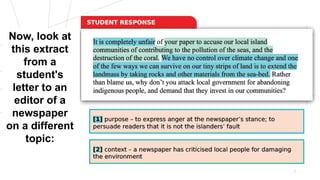
Now, look at
thisextract
from a
student's
letter to an
editor of a
newspaper
on a different
topic:
7
8.
What do youlearn about the audience and
purposes here?
a) What- or who- is the audience for this text? Look
at the personal and possessive pronouns: 'your
paper', 'our local island', 'we have no control’.
b) A key feature of persuasive texts is often a 'call
to action' (a request for the reader/audience to
do something or change their behaviour). What
is the call to action here?
c) How would you describe the mood or tone of the
writer of the letter to the editor of the 8
9.
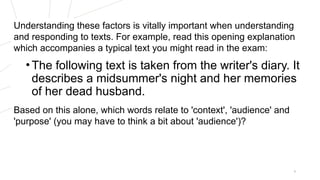
Understanding these factorsis vitally important when understanding
and responding to texts. For example, read this opening explanation
which accompanies a typical text you might read in the exam:
•The following text is taken from the writer's diary. It
describes a midsummer's night and her memories
of her dead husband.
Based on this alone, which words relate to 'context', 'audience' and
'purpose' (you may have to think a bit about 'audience')?
9
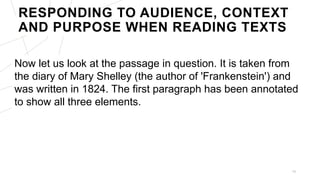
10.
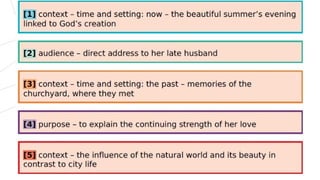
Now let uslook at the passage in question. It is taken from
the diary of Mary Shelley (the author of 'Frankenstein') and
was written in 1824. The first paragraph has been annotated
to show all three elements.
10
RESPONDING TO AUDIENCE, CONTEXT
AND PURPOSE WHEN READING TEXTS
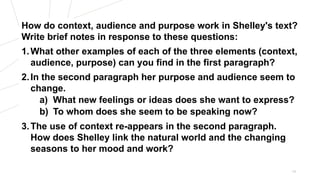
How do context,audience and purpose work in Shelley's text?
Write brief notes in response to these questions:
1.What other examples of each of the three elements (context,
audience, purpose) can you find in the first paragraph?
2.In the second paragraph her purpose and audience seem to
change.
a) What new feelings or ideas does she want to express?
b) To whom does she seem to be speaking now?
3.The use of context re-appears in the second paragraph.
How does Shelley link the natural world and the changing
seasons to her mood and work?
13