Our Solar System consists of our star, the Sun, and its orbiting planets (including Earth), along with numerous moons, asteroids, comet material,
rocks, and dust. Our Sun is just one star among the hundreds of billions of stars in our Milky Way Galaxy. If we shrink the Sun down to smaller than
a grain of sand, we can imagine our Solar System to be small enough to fit onto the palm of your hand. Pluto would orbit about an inch from the
middle of your palm.
On that scale with our Solar System in your hand, the Milky Way Galaxy, with its 200 – 400 billion stars, would span North America (see the
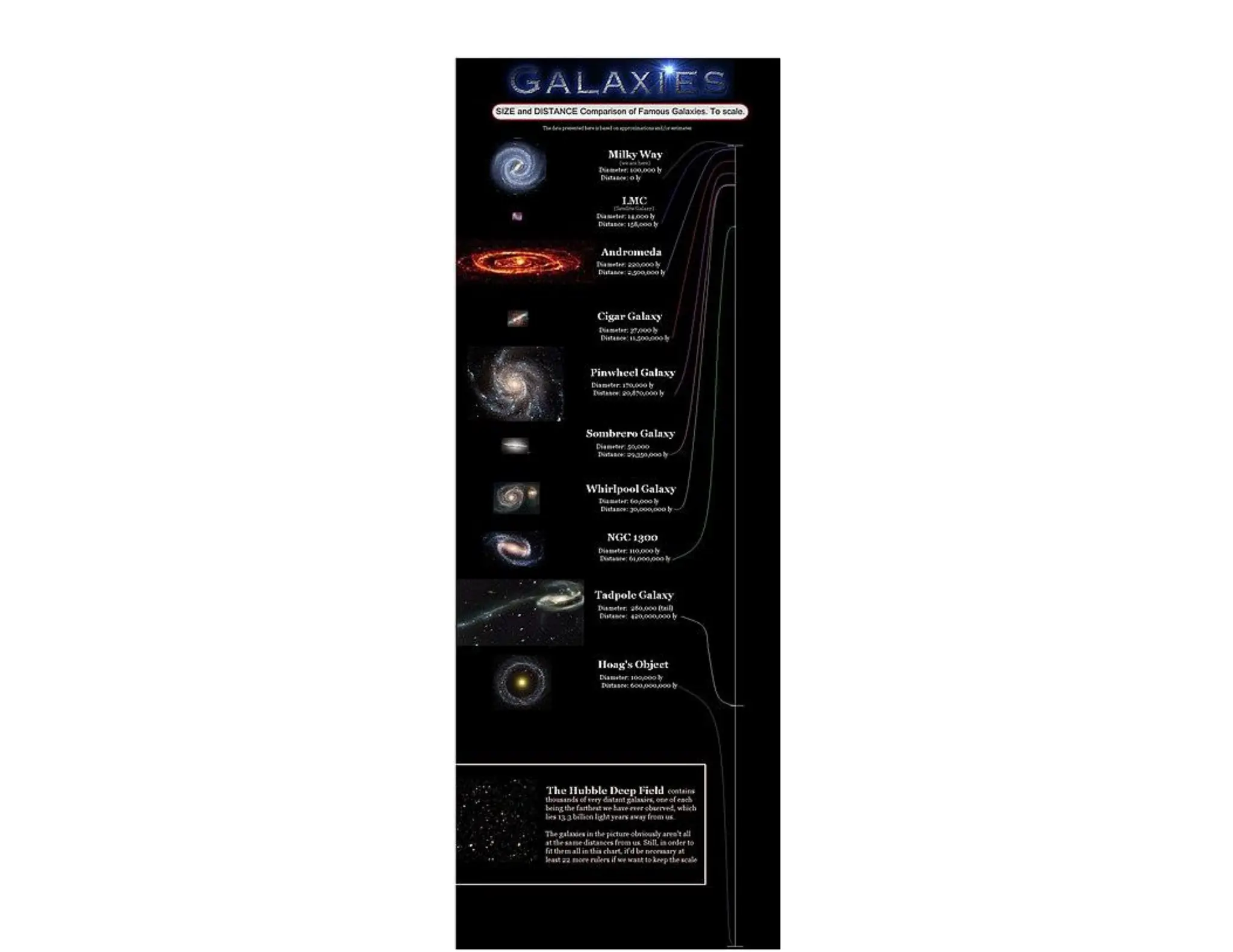
illustration on the right). Galaxies come in many sizes. The Milky Way is big, but some galaxies, like our Andromeda Galaxy neighbor, are much
larger.
The universe is all of the galaxies – billions of them! NASA’s telescopes allow us to study galaxies beyond our own in exquisite detail, and to
explore the most distant reaches of the observable universe. The Hubble Space Telescope made one of the deepest images of the universe, called
the Hubble Extreme Deep Field (image at the top of this article). Soon the James Webb Space Telescope will be exploring galaxies forming at the
very beginning of the universe.
You are one of the billions of people on our Earth. Our Earth orbits the Sun in our Solar System. Our Sun is one star among the billions in the Milky
Way Galaxy. Our Milky Way Galaxy is one among the billions of galaxies in our Universe. You are unique in the Universe!
the Milky Way
A galaxy is a huge collection of gas, dust, and billions of stars and their solar systems. A galaxy is held together by gravity.
Our galaxy, the Milky Way, also has a supermassive black hole in the middle
Image Galaxy Constellation Origin of name Notes
Andromeda
Galaxy
Andromeda
Andromeda, which is shortened from
"Andromeda Galaxy", gets its name from the
area of the sky in which it appears, the
constellation of Andromeda.
Andromeda is the closest big galaxy to the Milky Way and
is expected to collide with the Milky Way around 4 billion
years from now. The two will eventually merge into a
single new galaxy called Milkomeda.
Antennae
Galaxies
Corvus Looks are similar to an insect's antennae.
Black Eye
Galaxy
Coma Berenices
It has a spectacular dark band of absorbing
dust in front of the galaxy's bright nucleus,
giving rise to its nicknames of the "Black
Eye" or "Evil Eye" galaxy.
Bode's
Galaxy
Ursa Major
Named for Johann Elert Bode who
discovered this galaxy in 1774.
Butterfly
Galaxies
Virgo Looks are similar to a butterfly.
Cartwheel
Galaxy
Sculptor
Its visual appearance is similar to that of a
spoked cartwheel.
Cigar Galaxy Ursa Major Appears similar in shape to a cigar.
Circinus
Galaxy
Circinus
Named after the constellation it is located in
(Circinus).
Comet
Galaxy
Sculptor
This galaxy is named after its unusual
appearance, looking like a comet.
The comet effect is caused by tidal stripping by its galaxy
cluster, Abell 2667.
Cosmos
Redshift 7
Sextans
The name of this galaxy is based on
a redshift (z) measurement of nearly 7
(actually, z = 6.604).[2]
Galaxy Cosmos Redshift 7 is reported to be the brightest
of distant galaxies (z > 6) and to contain some of the
earliest first stars (first generation; Population III) that
produced the chemical elements needed for the later
formation of planets and life as we know it.[2]
Hoag's
Object
Serpens Caput
This is named after Art Hoag, who
discovered this ring galaxy.
It is of the subtype Hoag-type galaxy, and may in fact be
a polar-ring galaxy with the ring in the plane of rotation of
the central object.
Large
Magellanic
Cloud
Dorado/Mensa Named after Ferdinand Magellan
This is the fourth largest galaxy in the Local Group, and
forms a pair with the SMC, and from recent research, may
not be part of the Milky Way system of satellites at all.[3]
Mice
Galaxies
Coma Berenices Looks are similar to a mouse.
Small
Magellanic
Cloud
Tucana Named after Ferdinand Magellan
This forms a pair with the LMC, and from recent research,
may not be part of the Milky Way system of satellites at all.
Mayall's
Object
Ursa Major
This is named after Nicholas Mayall, of
the Lick Observatory, who discovered it.[4][5][6]
Also called VV 32 and Arp 148, this is a very peculiar
looking object, and is likely to be not one galaxy, but two
galaxies undergoing a collision. Event in images is a
spindle shape and a ring shape.
Milky Way Sagittarius (centre)
The appearance from Earth of the galaxy –
a band of light.
The galaxy containing the Sun and its Solar System, and
therefore Earth.
Pinwheel
Galaxy
Ursa Major Similar in appearance to a pinwheel (toy).
Sombrero
Galaxy
Virgo Similar in appearance to a sombrero.
Sunflower
Galaxy
Canes Venatici Similar in appearance to a sunflower.
Tadpole
Galaxy
Draco
The name comes from the resemblance of
the galaxy to a tadpole.
This shape resulted from tidal interaction that drew out a
long tidal tail.
Whirlpool
Galaxy
Canes Venatici
From the whirlpool appearance this
gravitationally disturbed galaxy exhibits.
The Milky Way is the galaxy that contains
the Solar System, with the name describing
the galaxy's appearance from Earth: a hazy
band of light seen in the night sky formed
from stars that cannot be individually
distinguished by the naked eye.
Age: 13.51 billion years
Stars: 250 billion ± 150 billion
Did you know: The shape of the Milky Way
was discovered by Edwin Hubble.
A Galaxy is a huge collection of gas, dust,
and billions of stars and their solar systems.
The Universe is everything we can touch,
feel, sense, measure or detect. It includes
living things, planets, stars, galaxies, dust
clouds, light, and even time. ...
The Universe contains billions of galaxies,
each containing millions or billions of stars.
The space between the stars and galaxies is
largely empty.

426166415-Galaxy-Definition white dwarfs Star sports track pants for men and women who are you too cycl

  • 7.
    Our Solar Systemconsists of our star, the Sun, and its orbiting planets (including Earth), along with numerous moons, asteroids, comet material, rocks, and dust. Our Sun is just one star among the hundreds of billions of stars in our Milky Way Galaxy. If we shrink the Sun down to smaller than a grain of sand, we can imagine our Solar System to be small enough to fit onto the palm of your hand. Pluto would orbit about an inch from the middle of your palm. On that scale with our Solar System in your hand, the Milky Way Galaxy, with its 200 – 400 billion stars, would span North America (see the illustration on the right). Galaxies come in many sizes. The Milky Way is big, but some galaxies, like our Andromeda Galaxy neighbor, are much larger. The universe is all of the galaxies – billions of them! NASA’s telescopes allow us to study galaxies beyond our own in exquisite detail, and to explore the most distant reaches of the observable universe. The Hubble Space Telescope made one of the deepest images of the universe, called the Hubble Extreme Deep Field (image at the top of this article). Soon the James Webb Space Telescope will be exploring galaxies forming at the very beginning of the universe. You are one of the billions of people on our Earth. Our Earth orbits the Sun in our Solar System. Our Sun is one star among the billions in the Milky Way Galaxy. Our Milky Way Galaxy is one among the billions of galaxies in our Universe. You are unique in the Universe! the Milky Way A galaxy is a huge collection of gas, dust, and billions of stars and their solar systems. A galaxy is held together by gravity. Our galaxy, the Milky Way, also has a supermassive black hole in the middle Image Galaxy Constellation Origin of name Notes
  • 8.
    Andromeda Galaxy Andromeda Andromeda, which isshortened from "Andromeda Galaxy", gets its name from the area of the sky in which it appears, the constellation of Andromeda. Andromeda is the closest big galaxy to the Milky Way and is expected to collide with the Milky Way around 4 billion years from now. The two will eventually merge into a single new galaxy called Milkomeda. Antennae Galaxies Corvus Looks are similar to an insect's antennae. Black Eye Galaxy Coma Berenices It has a spectacular dark band of absorbing dust in front of the galaxy's bright nucleus, giving rise to its nicknames of the "Black Eye" or "Evil Eye" galaxy. Bode's Galaxy Ursa Major Named for Johann Elert Bode who discovered this galaxy in 1774. Butterfly Galaxies Virgo Looks are similar to a butterfly. Cartwheel Galaxy Sculptor Its visual appearance is similar to that of a spoked cartwheel. Cigar Galaxy Ursa Major Appears similar in shape to a cigar.
  • 9.
    Circinus Galaxy Circinus Named after theconstellation it is located in (Circinus). Comet Galaxy Sculptor This galaxy is named after its unusual appearance, looking like a comet. The comet effect is caused by tidal stripping by its galaxy cluster, Abell 2667. Cosmos Redshift 7 Sextans The name of this galaxy is based on a redshift (z) measurement of nearly 7 (actually, z = 6.604).[2] Galaxy Cosmos Redshift 7 is reported to be the brightest of distant galaxies (z > 6) and to contain some of the earliest first stars (first generation; Population III) that produced the chemical elements needed for the later formation of planets and life as we know it.[2] Hoag's Object Serpens Caput This is named after Art Hoag, who discovered this ring galaxy. It is of the subtype Hoag-type galaxy, and may in fact be a polar-ring galaxy with the ring in the plane of rotation of the central object. Large Magellanic Cloud Dorado/Mensa Named after Ferdinand Magellan This is the fourth largest galaxy in the Local Group, and forms a pair with the SMC, and from recent research, may not be part of the Milky Way system of satellites at all.[3] Mice Galaxies Coma Berenices Looks are similar to a mouse. Small Magellanic Cloud Tucana Named after Ferdinand Magellan This forms a pair with the LMC, and from recent research, may not be part of the Milky Way system of satellites at all.
  • 10.
    Mayall's Object Ursa Major This isnamed after Nicholas Mayall, of the Lick Observatory, who discovered it.[4][5][6] Also called VV 32 and Arp 148, this is a very peculiar looking object, and is likely to be not one galaxy, but two galaxies undergoing a collision. Event in images is a spindle shape and a ring shape. Milky Way Sagittarius (centre) The appearance from Earth of the galaxy – a band of light. The galaxy containing the Sun and its Solar System, and therefore Earth. Pinwheel Galaxy Ursa Major Similar in appearance to a pinwheel (toy). Sombrero Galaxy Virgo Similar in appearance to a sombrero. Sunflower Galaxy Canes Venatici Similar in appearance to a sunflower. Tadpole Galaxy Draco The name comes from the resemblance of the galaxy to a tadpole. This shape resulted from tidal interaction that drew out a long tidal tail. Whirlpool Galaxy Canes Venatici From the whirlpool appearance this gravitationally disturbed galaxy exhibits.
  • 15.
    The Milky Wayis the galaxy that contains the Solar System, with the name describing the galaxy's appearance from Earth: a hazy band of light seen in the night sky formed from stars that cannot be individually distinguished by the naked eye. Age: 13.51 billion years Stars: 250 billion ± 150 billion Did you know: The shape of the Milky Way was discovered by Edwin Hubble.
  • 16.
    A Galaxy isa huge collection of gas, dust, and billions of stars and their solar systems. The Universe is everything we can touch, feel, sense, measure or detect. It includes living things, planets, stars, galaxies, dust clouds, light, and even time. ... The Universe contains billions of galaxies, each containing millions or billions of stars. The space between the stars and galaxies is largely empty.