Adaptive Path’s Guide to
Experience Mapping
Brandi Kinard, Kyle Miller,
Kaelan O’Fallon, Danielle Oliveras
Overview: Experience Mapping
● The value of Experience Mapping
○ Shows the archetypal journey of customers going to achieve a goal
or satisfy a need.
○ Builds knowledge and consensus across teams and stakeholders
● Focus on the interconnectedness of channels and touchpoints
○ Channel: medium of interaction with users or customers
○ Touchpoint: A point of interaction between a person and any
agent/artifact of an organization
Overview: Experience Mapping
● Part one of two phases is the “activity” phase of the experience
map.
○ A collaborative, iterative process for synthesizing and visualizing the
holistic consumer.
● Then it goes into the “artifact” phase
○ An experience map presents key insights into your consumers’
complete experience.
● The four steps are:
○ Uncover the Truth
○ Chart the Course
○ Tell the Story
○ Use Your Map
Step One: Uncover the Truth
● The Activity phase
● Big picture of how and why customers are interacting with different
channels, touchpoints, products, and services.
● Discovery with Rigor
○ Research to understand both the customer experience and context around it
○ Triangulate your problem and know the full picture.
○ Build an authentic story
Step One: Uncover the Truth
● The Building Blocks of Experience Mapping
○ Challenging to uncover critical information about the customers’ experience.
○ Use building blocks as core framework to guide the process
■ Key blocks are: Doing, Thinking, and Feeling
● Doing: Actions, key behaviors?
● Thinking: Fram and evaluations, expectations
● Feeling: Emotions, highs, lows
■ Secondary blocks are: Place, Time, Devices, Relationships, Channels, and
Touchpoints
Step One: Uncover the Truth
● Quantitative Research
○ Web analytics, customer satisfaction data, creating surveys, and
gathering data.
● Qualitative Research:
○ Having conversations, focus on a story that is relevant to the
product / service / problem area
○ Interview / observe customers in their natural settings.
○ Foster an engaging conversation rather than pointed questions
Step Two: Chart the Course
“This is not a solo adventure”
● Basic Framework
○ The Lens
■ The lens is the filter through which you view the journey, such as persona, more general experience,
principles or a value proposition.
○ The Customer Journey
■ Depicts the range of interactions customers have across channels, touchpoints, time and space in pursuit of
satisfying one or more needs.
○ The Takeaways
■ Summarizing the key findings from the experience mapping process.
●
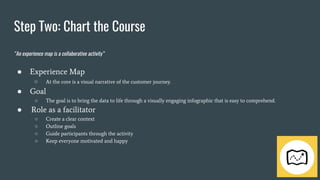
Step Two: Chart the Course
“An experience map is a collaborative activity”
● Experience Map
○ At the core is a visual narrative of the customer journey.
● Goal
○ The goal is to bring the data to life through a visually engaging infographic that is easy to comprehend.
● Role as a facilitator
○ Create a clear context
○ Outline goals
○ Guide participants through the activity
○ Keep everyone motivated and happy
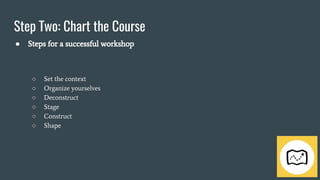
Step Two: Chart the Course
● Steps for a successful workshop
○ Set the context
○ Organize yourselves
○ Deconstruct
○ Stage
○ Construct
○ Shape
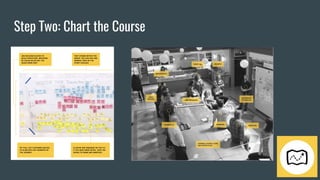
Step Two: Chart the Course
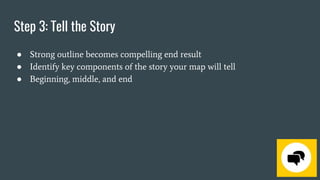
Step 3: Tell the Story
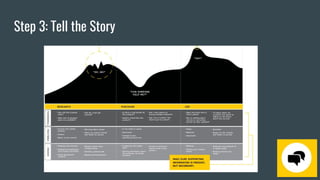
● Strong outline becomes compelling end result
● Identify key components of the story your map will tell
● Beginning, middle, and end
Step 3: Tell the Story
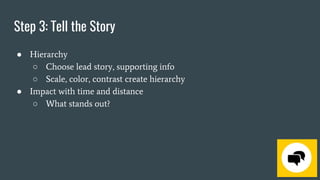
● Hierarchy
○ Choose lead story, supporting info
○ Scale, color, contrast create hierarchy
● Impact with time and distance
○ What stands out?
Step 3: Tell the Story
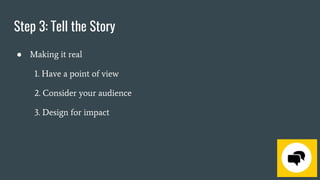
● Making it real
1. Have a point of view
2. Consider your audience
3. Design for impact
Step 3: Tell the Story
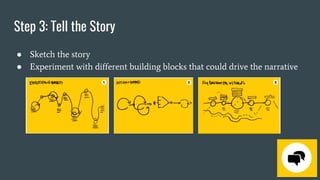
● Sketch the story
● Experiment with different building blocks that could drive the narrative
Step 3: Tell the Story
Step 4: Use Your Map
● Analyze customer behavior
● You see the world as customers do
● Embracing the ongoing challenge of understanding your customers’
needs
Step 4: Use Your Map
● See the issue(s)
● Prioritize customer value
● Address the issue(s)
● Helps you identify high-value areas of opportunity
Step 4: Use Your Map
● A sequence of pre-visualizing
● Making rapid ideation of future experiences grounded in the insights of
your customer journey
Step 4: Use Your Map
● define the ideal customer journey
● What customers would ideally do, think, and feel as they interact along
the journey
“Happy Mapping”
Acknowledgements
Not Pictured:
Bryn Bowman, Pam Daghlian,
Rae Brune, Toi Valentine,
Gabrielle Parsons, Evi Hui,
Shahrzad Samadzadeh and
Jason Ham.

4 steps slides

  • 1.
    Adaptive Path’s Guideto Experience Mapping Brandi Kinard, Kyle Miller, Kaelan O’Fallon, Danielle Oliveras
  • 2.
    Overview: Experience Mapping ●The value of Experience Mapping ○ Shows the archetypal journey of customers going to achieve a goal or satisfy a need. ○ Builds knowledge and consensus across teams and stakeholders ● Focus on the interconnectedness of channels and touchpoints ○ Channel: medium of interaction with users or customers ○ Touchpoint: A point of interaction between a person and any agent/artifact of an organization
  • 3.
    Overview: Experience Mapping ●Part one of two phases is the “activity” phase of the experience map. ○ A collaborative, iterative process for synthesizing and visualizing the holistic consumer. ● Then it goes into the “artifact” phase ○ An experience map presents key insights into your consumers’ complete experience. ● The four steps are: ○ Uncover the Truth ○ Chart the Course ○ Tell the Story ○ Use Your Map
  • 4.
    Step One: Uncoverthe Truth ● The Activity phase ● Big picture of how and why customers are interacting with different channels, touchpoints, products, and services. ● Discovery with Rigor ○ Research to understand both the customer experience and context around it ○ Triangulate your problem and know the full picture. ○ Build an authentic story
  • 5.
    Step One: Uncoverthe Truth ● The Building Blocks of Experience Mapping ○ Challenging to uncover critical information about the customers’ experience. ○ Use building blocks as core framework to guide the process ■ Key blocks are: Doing, Thinking, and Feeling ● Doing: Actions, key behaviors? ● Thinking: Fram and evaluations, expectations ● Feeling: Emotions, highs, lows ■ Secondary blocks are: Place, Time, Devices, Relationships, Channels, and Touchpoints
  • 6.
    Step One: Uncoverthe Truth ● Quantitative Research ○ Web analytics, customer satisfaction data, creating surveys, and gathering data. ● Qualitative Research: ○ Having conversations, focus on a story that is relevant to the product / service / problem area ○ Interview / observe customers in their natural settings. ○ Foster an engaging conversation rather than pointed questions
  • 7.
    Step Two: Chartthe Course “This is not a solo adventure” ● Basic Framework ○ The Lens ■ The lens is the filter through which you view the journey, such as persona, more general experience, principles or a value proposition. ○ The Customer Journey ■ Depicts the range of interactions customers have across channels, touchpoints, time and space in pursuit of satisfying one or more needs. ○ The Takeaways ■ Summarizing the key findings from the experience mapping process. ●
  • 8.
    Step Two: Chartthe Course “An experience map is a collaborative activity” ● Experience Map ○ At the core is a visual narrative of the customer journey. ● Goal ○ The goal is to bring the data to life through a visually engaging infographic that is easy to comprehend. ● Role as a facilitator ○ Create a clear context ○ Outline goals ○ Guide participants through the activity ○ Keep everyone motivated and happy
  • 9.
    Step Two: Chartthe Course ● Steps for a successful workshop ○ Set the context ○ Organize yourselves ○ Deconstruct ○ Stage ○ Construct ○ Shape
  • 10.
    Step Two: Chartthe Course
  • 11.
    Step 3: Tellthe Story ● Strong outline becomes compelling end result ● Identify key components of the story your map will tell ● Beginning, middle, and end
  • 12.
    Step 3: Tellthe Story ● Hierarchy ○ Choose lead story, supporting info ○ Scale, color, contrast create hierarchy ● Impact with time and distance ○ What stands out?
  • 13.
    Step 3: Tellthe Story ● Making it real 1. Have a point of view 2. Consider your audience 3. Design for impact
  • 14.
    Step 3: Tellthe Story ● Sketch the story ● Experiment with different building blocks that could drive the narrative
  • 15.
    Step 3: Tellthe Story
  • 16.
    Step 4: UseYour Map ● Analyze customer behavior ● You see the world as customers do ● Embracing the ongoing challenge of understanding your customers’ needs
  • 17.
    Step 4: UseYour Map ● See the issue(s) ● Prioritize customer value ● Address the issue(s) ● Helps you identify high-value areas of opportunity
  • 18.
    Step 4: UseYour Map ● A sequence of pre-visualizing ● Making rapid ideation of future experiences grounded in the insights of your customer journey
  • 19.
    Step 4: UseYour Map ● define the ideal customer journey ● What customers would ideally do, think, and feel as they interact along the journey “Happy Mapping”
  • 20.
    Acknowledgements Not Pictured: Bryn Bowman,Pam Daghlian, Rae Brune, Toi Valentine, Gabrielle Parsons, Evi Hui, Shahrzad Samadzadeh and Jason Ham.