The relationship of motor skills and adaptive behavior skills in
young children with autism spectrum disorders§
Megan MacDonald a,
*, Catherine Lord b,1
, Dale Ulrich c
a
Oregon State University, School of Biological & Population Health Sciences, 202 Women’s Building, Corvallis, OR 97331, United States
b
Weill Cornell Medical College, New York Presbyterian Hospital, Center for Autism and the Developing Brain, 21 Bloomingdale Road,
White Plains, NY 10605, United States
c
University of Michigan, School of Kinesiology, 1402 Washington Heights, Ann Arbor, MI, United States
Research in Autism Spectrum Disorders 7 (2013) 1383–1390
A R T I C L E I N F O
Article history:
Received 9 April 2013
Received in revised form 28 June 2013
Accepted 30 July 2013
Keywords:
Autism
Motor skills
Young children
Adaptive behavior
A B S T R A C T
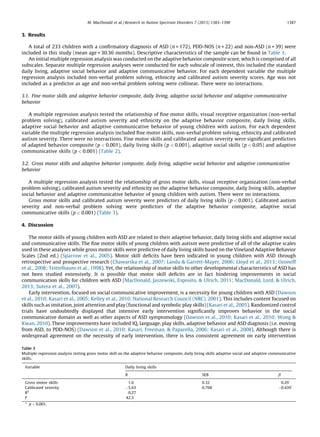
Objective: To determine the relationship of motor skills and adaptive behavior skills in
young children with autism.
Design: A multiple regression analysis tested the relationship of motor skills on the
adaptive behavior composite, daily living, adaptive social and adaptive communicative
skills holding constant age, non-verbal problem solving, and calibrated autism severity.
Setting: Majority of the data collected took place in an autism clinic.
Participants: A cohort of 233 young children with ASD (n = 172), PDD-NOS (n = 22) and
non-ASD (developmental delay, n = 39) between the ages of 14–49 months were recruited
from early intervention studies and clinical referrals. Children with non-ASD (develop-
mental delay) were included in this study to provide a range of scores indicted through
calibrated autism severity.
Interventions: Not applicable.
Main outcome measures: The primary outcome measures in this study were adaptive
behavior skills.
Results: Fine motor skills significantly predicted all adaptive behavior skills (p < 0.01).
Gross motor skills were predictive of daily living skills (p < 0.05). Children with weaker
motor skills displayed greater deficits in adaptive behavior skills.
Conclusions: The fine and gross motor skills are significantly related to adaptive behavior
skills in young children with autism spectrum disorder. There is more to focus on and new
avenues to explore in the realm of discovering how to implement early intervention and
rehabilitation for young children with autism and motor skills need to be a part of the
discussion.
ß 2013 Elsevier Ltd. All rights reserved.
§
Support for this project was provided in part from funding awarded to Dr. Lord from the Simons Foundation, First Words and the following grants:
NICHD U19 HD35482-01. The Neurobiology and Genetic of Autism 06/01/97–05/31/07 (Lord). NIMH RO1 MH081873-01A1. Longitudinal Studies of Autism
Spectrum Disorders: 2–23. 09/01/08–05/31/13 (Lord). Blue Cross Blue Shield Foundation of Michigan Grant number 1687.SAP (MacDonald).
* Corresponding author. Tel.: +541 737 3273; fax: +1 541 737 5513.
E-mail address: megan.macdonald@oregonstate.edu (M. MacDonald).
1
Dr. Lord receives royalties from Western Psychological Service for the sale of diagnostic instruments which she has co-authored. Dr. Lord donates all
royalties from these projects and clinics to not-for-profit autism charities, specifically Have Dreams which is located in Chicago, IL. Have Dreams offers
wraparound services for children and adults with autism. Dr. MacDonald and Dr. Ulrich have no disclosures.
Contents lists available at ScienceDirect
Research in Autism Spectrum Disorders
Journal homepage: http://ees.elsevier.com/RASD/default.asp
1750-9467/$ – see front matter ß 2013 Elsevier Ltd. All rights reserved.
http://dx.doi.org/10.1016/j.rasd.2013.07.020
1. Introduction
Autism spectrum disorder (ASD) is a pervasive developmental disorder characterized by deficits in social
communicative skills and repetitive or restricted interests (APA, 1994, 2000, 2013). ASD affects 1 in 88 individuals (CDC,
2012) and a recent national survey indicated that ASD affects 1 in 50 school-aged children (Blumberg et al., 2013). In
addition to the hallmark characteristics of ASD, social communicative deficits, children also display motor skill deficits
(Landa & Garrett-Mayer, 2006; Lloyd, MacDonald, & Lord, 2013; Provost, Heimerl, & Lopez, 2007; Provost, Lopez, &
Heimerl, 2007; Teitelbaum, Teitelbaum, Nye, Fryman, & Maurer, 1998; Yirmiya & Ozonoff, 2007). In fact, in some of the
original clinical descriptions of what is now called ASD, Asperger attached considerable weight to motor clumsiness
(Frith, 1991).
Motor skill deficits appear early in life for many young children with ASD, and become prominent around 14–24 months
of age (Chawarska et al., 2007). Delayed infant motor milestones have been reported and these late milestones (especially
walking) have acted as initial developmental concerns to parents, who later received an ASD diagnosis for their child
(Chawarska et al., 2007; Flanagan, Landa, Bhat, & Bauman, 2012; Landa & Garrett-Mayer, 2006; Lloyd et al., 2013; Teitelbaum
et al., 1998).
For the most part the use of motor skill performance in an ASD diagnosis is embedded in gestures, stereotypies and
imitation (Lord et al., 2000; Luyster et al., 2009). However it has been suggested that one of the earliest detectable signs and a
cardinal feature of the disability may reside in motor skill ability early in life (Flanagan et al., 2012; Fournier, Hass, Naik,
Lodha, & Cauraugh, 2010; Sutera, Pandey, Esser, & Rosenthal, 2007; Teittelbaum, Teittelbaum, Nye, Fryman, & Maurer, 1998).
When a group of children at high-risk for ASD (children who had a sibling diagnosed with ASD), were studied prospectively
three groups emerged for comparison, children with language delay, ASD and typical development (Landa & Garrett-Mayer,
2006). Deficits in fine motor skills were evident in children with ASD at 6 months of age and significantly worsened fine and
gross motor skills were evident at 14 and 24 months of age (Landa & Garrett-Mayer, 2006). This prospective study suggested
early motor skill deficits as a potential diagnostic distinction between children with ASD and children with other
developmental delays (language delay) (Landa & Garrett-Mayer, 2006). These findings corroborated previous studies
suggesting motor skill delays early in development may act as some of the first signs for developmental concern
(Teittelbaum et al., 1998). Through video analysis Teitelbaum et al. (1998) found oral motor deficits as well as delays in
motor milestones such as lying, righting, sitting, crawling and walking were present in young children with ASD long before a
diagnosis was conclusive.
In a large cross-sectional study of young children with ASD (n = 162, aged 14–36 months) fine and gross motor skill
deficits became significantly worse within a short chronological timeframe (6–18 months) (Lloyd et al., 2013). The same
study confirmed cross-sectional findings through a longitudinal analysis of children who had two motor skill assessments
approximately one-year apart. When the same children were studied over time, they displayed significantly worse motor
skill deficits as they aged (Lloyd et al., 2013).
Other motor deficits areas have been found in gait and postural control. Children with ASD (aged 4–6 years) demonstrated
a short step length and irregular body oscillations during locomotion consistent with a less stable and more variable posture
compared to a control group without a disability (Vernazza-Martin et al., 2005). Young children with ASD (<2 years)
displayed similar gait and postural control deficits (Esposito & Venuti, 2008). At 20 months of age children with ASD showed
deficits in gait parameters which included performing abnormal heel-to-toe patterns, odd arm posturing and generally
higher frequencies of anomalies in movement including waddle walking (Esposito & Venuti, 2008). Postural sway in school-
aged children with ASD was significantly greater than typically developed controls in mediolateral, anteroposterior and
normalized sway (Fournier, Hass, et al., 2010; Fournier, Kimberg, et al., 2010; Memari et al., 2013). Similarly, postural sway in
the mediolateral direction was greater in children with autism during dynamic movements such as walking (Fournier,
Kimberg, et al., 2010).
Consistent with other motor skill deficits at a young age, motor planning deficits were evident when children with ASD
were unable translate motor intention into a global motor action (mean age 7.6 years), but rather treated each motor task
involved in an overall action as an independent task (Fabbri-Destro, Cattaneo, Boria, & Rizzolatti, 2009). Vernazza-Martin
et al. (2005) found that young children with ASD (4–6 years) had difficulty defining the goal of the motor action. Even when
the task was adapted in a highly motivating fashion, children appeared to understand the instruction, marked in their
purposeful action of moving toward the object, but the final motor goal could not be completed, indicating shortfalls in
motor planning (Vernazza-Martin et al., 2005). These children were able to perform simple motor tasks but unable to chain
multiple motor tasks together into a more complex motor action.
Descriptive studies have clearly demonstrated that motor skill deficits exist in children with ASD at a young age and have
even gone so far as to suggest early motor skill deficits as a preliminary diagnostic marker and a cardinal characteristic of the
disability (Flanagan et al., 2012; Fournier, Hass, et al., 2010; Matson, Mahan, Fodstad, Hess, & Neal, 2010; Teittelbaum et al.,
1998). These deficits in young children with autism range in nature and across tasks (Berkeley, Zittel, Pitney, & Nichols, 2001;
Rinehart et al., 2006; Staples & Reid, 2010; Sutera et al., 2007; Teittelbaum et al., 1998; Vernazza-Martin et al., 2005). Even
though evidence suggests motor deficits are prominent and pervasive across time and age very little has been discussed in
terms of how motor skill deficits interact with the core-characteristics of autism, deficits in social communication skills
(Berkeley et al., 2001; Fournier, Hass, et al., 2010; Landa & Garrett-Mayer, 2006; Staples & Reid, 2010). It is well known that
deficits in social communicative skills are core diagnostic characteristics of ASD. For young children this includes skills such
M. MacDonald et al. / Research in Autism Spectrum Disorders 7 (2013) 1383–13901384
as imitation, joint attention, general social interactions with others, as well as functional and symbolic play (Kasari et al.,
2005).
The importance of improving social communicative skills in children with autism early in life has been clearly indicated
(Dawson et al., 2010; Helt et al., 2008; Kasari et al., 2005; Kasari, Paparella, Freeman, & Jahromi, 2008; Kasari, Gulsrud, Wong,
Kwon, & Locke, 2010; Kelley, Naigles, & Fein, 2010; Wong & Kwan, 2010). The purpose of this study is to test the relationship
of fine and gross motor skills on the behavior composite, daily living, adaptive social and communicative skills of children
with autism. It is hypothesized that children with better motor skills will have better adaptive behavior skills.
2. Method
2.1. Participants
The Institutional Review Board approved all methods and procedures for this study. Young children with ASD, pervasive
developmental disorder-not otherwise specified (PDD-NOS) and non-ASD (developmental delay) between the ages of 12–60
months were recruited from early intervention studies and clinical referrals to university-based clinics. Generally, children
were recruited through autism support groups, study flyers and clinical referrals from pediatricians and teachers were
informed of the study during clinical visits.
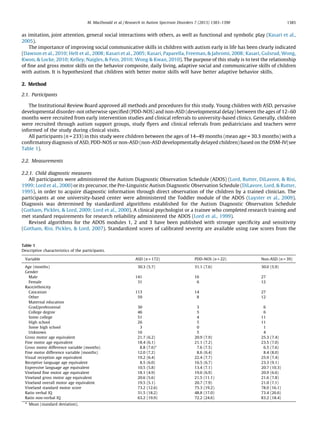
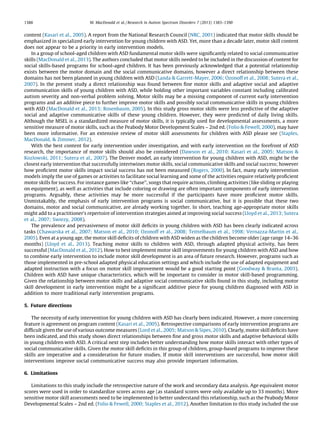
All participants (n = 233) in this study were children between the ages of 14–49 months (mean age = 30.3 months) with a
confirmatory diagnosis of ASD, PDD-NOS or non-ASD (non-ASD developmentally delayed children) based on the DSM-IV(see
Table 1).
2.2. Measurements
2.2.1. Child diagnostic measures
All participants were administered the Autism Diagnostic Observation Schedule (ADOS) (Lord, Rutter, DiLavore, & Risi,
1999; Lord et al., 2000) or its precursor, the Pre-Linguistic Autism Diagnostic Observation Schedule (DiLavore, Lord, & Rutter,
1995), in order to acquire diagnostic information through direct observation of the children by a trained clinician. The
participants at one university-based center were administered the Toddler module of the ADOS (Luyster et al., 2009).
Diagnosis was determined by standardized algorithms established for the Autism Diagnostic Observation Schedule
(Gotham, Pickles, & Lord, 2009; Lord et al., 2000). A clinical psychologist or a trainee who completed research training and
met standard requirements for research reliability administered the ADOS (Lord et al., 1999).
Revised algorithms for the ADOS modules 1, 2 and 3 have been published with stronger specificity and sensitivity
(Gotham, Risi, Pickles, & Lord, 2007). Standardized scores of calibrated severity are available using raw scores from the
Table 1
Descriptive characteristics of the participants.
Variable ASD (n = 172) PDD-NOS (n = 22) Non-ASD (n = 39)
Age (months) 30.3 (5.7) 31.1 (7.6) 30.0 (5.9)
Gender
Male 141 16 27
Female 31 6 12
Race/ethnicity
Caucasian 113 14 27
Other 59 8 12
Maternal education
Grad/professional 30 3 6
College degree 46 5 6
Some college 51 4 11
High school 26 5 11
Some high school 3 0 1
Unknown 16 5 4
Gross motor age equivalent 21.7 (6.2) 20.9 (7.9) 25.3 (7.4)
Fine motor age equivalent 18.4 (6.1) 21.1 (7.2) 23.5 (7.0)
Gross motor difference variable (months) 8.8 (7.6)a
7.6 (7.5) 6.5 (7.6)
Fine motor difference variable (months) 12.0 (7.2) 8.6 (6.4) 8.4 (8.0)
Visual reception age equivalent 19.2 (6.4) 22.4 (7.7) 25.9 (7.4)
Receptive language age equivalent 8.5 (6.0) 16.5 (6.7) 23.3 (9.1)
Expressive language age equivalent 10.5 (5.8) 13.4 (7.1) 20.7 (10.3)
Vineland fine motor age equivalent 18.1 (4.9) 19.6 (6.9) 20.9 (6.6)
Vineland gross motor age equivalent 20.6 (5.6) 21.5 (11.1) 21.6 (7.8)
Vineland overall motor age equivalent 19.5 (5.1) 20.7 (7.9) 21.0 (7.1)
Vineland standard motor score 73.2 (12.6) 75.3 (19.2) 78.0 (16.1)
Ratio verbal IQ 31.5 (18.2) 48.8 (17.0) 73.4 (26.6)
Ratio non-verbal IQ 63.2 (19.9) 72.2 (24.6) 83.2 (18.4)
a
Mean (standard deviation).
M. MacDonald et al. / Research in Autism Spectrum Disorders 7 (2013) 1383–1390 1385
revised algorithms of the ADOS (Gotham et al., 2009). Calibrated autism severity scores have been indicated optimal for
comparisons of assessments across time (and age), and to identify different trajectories of autism severity independent of
verbal IQ (Gotham et al., 2009).
Each member of the research team, at all centers, established inter-rater reliability exceeding 90% exact agreement
(k > 0.70) for all items on the ADI-R and 80% exact agreement (k > 0.60) on codes for the PL-ADOS, ADOS, and Toddler
module for three consecutive administrations before the study began. Reliability was maintained over time through
consensus coding of approximately every sixth administration with a second rater who was blind to referral status.
2.2.2. Developmental level measurement
The Mullen Scales of Early Learning (MSEL) (Mullen, 1995) was used to assess cognitive development. This test of
development provides reliable and valid information for children from birth to 68 months of age. The subscales on the MSEL
are organized into 5 domains: gross motor, fine motor, visual reception (nonverbal problem solving), receptive language, and
expressive language. An early learning composite score is derived from the fine motor, visual reception, receptive language
and expressive language scales.
2.2.3. Adaptive skills
The Vineland Adaptive Behavior Scales, 2nd ed. (VABS) (Sparrow, Cicchetti, & Balla, 2005) were used to assess adaptive
skills. The VABS is a standardized parent-report measure of everyday adaptive functioning and yields domain scores in the
areas of communication, daily living skills, social skills, and motor development (fine motor and gross motor). A standardized
behavior composite score is derived from all domains. This assessment was administered by interview or over the phone, to
the parent or primary caregiver of the participant.
2.2.4. Motor skill measurement
The gross motor and fine motor scales of the MSEL were used to assess motor skills (Mullen, 1995). A gross motor and fine
motor age equivalent score was used for analysis as standardized T-scores are not provided for children beyond 33 months of
age on the gross motor scale, even though most children with ASD did not meet the ceiling requirements for this scale.
2.2.5. Data reduction
All examiners strictly adhered to the standardized procedures outlined in each respective test manual. As indicated in the
measurement description, research reliability and inter-rater reliability was established for the ADOS. Autism cut-off was
based on standardized algorithms (Gotham et al., 2007; Lord et al., 2000). These algorithms included scores based on social
communication, repetitive and restricted interests and stereotyped behaviors. Experienced administrators familiar in
working with young children with autism conducted all assessments. Included in the descriptive characteristics of the
sample is an age difference score – the age difference score was calculated based on the chronological age of the participant
and the child’s motor skill age based on MSEL norms (Mullen, 1995) (see Table 2).
2.3. Data analysis
Data analysis tested the relationship of fine and gross motor skills on the adaptive behavior composite, adaptive social,
adaptive communicative and daily living skills of children with ASD, non-ASD and PDD-NOS. Adaptive behavior, adaptive
social, adaptive communicative and daily living skills were indicated through the standardized scales of the Vineland
Adaptive Behavior Scales (VABS) (Sparrow et al., 2005). A multiple regression analysis was conducted on for each respective
dependent variable.
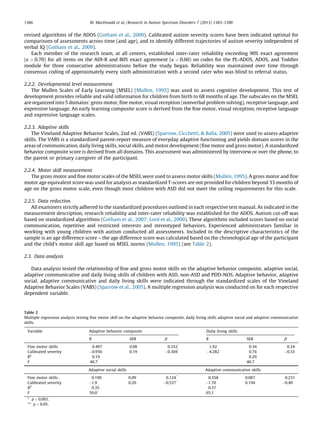
Table 2
Multiple regression analysis testing fine motor skill on the adaptive behavior composite, daily living skills adaptive social and adaptive communicative
skills.
Variable Adaptive behavior composite Daily living skills
B SEB b B SEB b
Fine motor skills 0.497 0.08 0.352*
1.92 0.34 0.34
Calibrated severity À0.956 0.19 À0.304*
À4.282 0.76 À0.33
R2
0.19 0.29
F 46.7*
46.7
Adaptive social skills Adaptive communicative skills
Fine motor skills 0.196 0.09 0.124**
0.358 0.087 0.231
Calibrated severity À1.9 0.20 À0.537*
À1.70 0.194 À0.49
R2
0.35 0.37
F 59.0*
65.1
* p < 0.001.
** p < 0.05.
M. MacDonald et al. / Research in Autism Spectrum Disorders 7 (2013) 1383–13901386
3. Results
A total of 233 children with a confirmatory diagnosis of ASD (n = 172), PDD-NOS (n = 22) and non-ASD (n = 39) were
included in this study (mean age = 30.36 months). Descriptive characteristics of the sample can be found in Table 1.
An initial multiple regression analysis was conducted on the adaptive behavior composite score, which is comprised of all
subscales. Separate multiple regression analyses were conducted for each subscale of interest, this included the standard
daily living, adaptive social behavior and adaptive communicative behavior. For each dependent variable the multiple
regression analysis included non-verbal problem solving, ethnicity and calibrated autism severity scores. Age was not
included as a predictor as age and non-verbal problem solving were collinear. There were no interactions.
3.1. Fine motor skills and adaptive behavior composite, daily living, adaptive social behavior and adaptive communicative
behavior
A multiple regression analysis tested the relationship of fine motor skills, visual receptive organization (non-verbal
problem solving), calibrated autism severity and ethnicity on the adaptive behavior composite, daily living skills,
adaptive social behavior and adaptive communicative behavior of young children with autism. For each dependent
variable the multiple regression analysis included fine motor skills, non-verbal problem solving, ethnicity and calibrated
autism severity. There were no interactions. Fine motor skills and calibrated autism severity were significant predictors
of adapted behavior composite (p < 0.001), daily living skills (p < 0.001), adaptive social skills (p < 0.05) and adaptive
communicative skills (p < 0.001) (Table 2).
3.2. Gross motor skills and adaptive behavior composite, daily living, adaptive social behavior and adaptive communicative
behavior
A multiple regression analysis tested the relationship of gross motor skills, visual receptive organization (non-verbal
problem solving), calibrated autism severity and ethnicity on the adaptive behavior composite, daily living skills, adaptive
social behavior and adaptive communicative behavior of young children with autism. There were no interactions.
Gross motor skills and calibrated autism severity were predictors of daily living skills (p < 0.001). Calibrated autism
severity and non-verbal problem solving were predictors of the adaptive behavior composite, adaptive social
communicative skills (p < 0.001) (Table 3).
4. Discussion
The motor skills of young children with ASD are related to their adaptive behavior, daily living skills and adaptive social
and communicative skills. The fine motor skills of young children with autism were predictive of all of the adaptive scales
used in these analyses while gross motor skills were predictive of daily living skills based on the Vineland Adaptive Behavior
Scales (2nd ed.) (Sparrow et al., 2005). Motor skill deficits have been indicated in young children with ASD through
retrospective and prospective research (Chawarska et al., 2007; Landa & Garrett-Mayer, 2006; Lloyd et al., 2013; Ozonoff
et al., 2008; Teittelbaum et al., 1998). Yet, the relationship of motor skills to other developmental characteristics of ASD has
not been studied extensively. It is possible that motor skill deficits are in fact hindering improvements in social
communication skills for children with ASD (MacDonald, Jaszewski, Esposito, & Ulrich, 2011; MacDonald, Lord, & Ulrich,
2013; Sutera et al., 2007).
Early intervention, focused on social communicative improvement, is a necessity for young children with ASD (Dawson
et al., 2010; Kasari et al., 2005; Kelley et al., 2010; National Research Council (NRC), 2001). This includes content focused on
skills such as imitation, joint attention and play (functional and symbolic play skills) (Kasari et al., 2005). Randomized control
trials have undoubtedly displayed that intensive early intervention significantly improves behavior in the social
communicative domain as well as other aspects of ASD symptomology (Dawson et al., 2010; Kasari et al., 2010; Wong &
Kwan, 2010). These improvements have included IQ, language, play skills, adaptive behavior and ASD diagnosis (i.e. moving
from ASD, to PDD-NOS) (Dawson et al., 2010; Kasari, Freeman, & Paparella, 2006; Kasari et al., 2008). Although there is
widespread agreement on the necessity of early intervention, there is less consistent agreement on early intervention
Table 3
Multiple regression analysis testing gross motor skill on the adaptive behavior composite, daily living skills adaptive social and adaptive communicative
skills.
Variable Daily living skills
B SEB b
Gross motor skills 1.6 0.32 0.29*
Calibrated severity À5.63 0.768 À0.439*
R2
0.27
F 42.5*
* p < 0.001.
M. MacDonald et al. / Research in Autism Spectrum Disorders 7 (2013) 1383–1390 1387
content (Kasari et al., 2005). A report from the National Research Council (NRC, 2001) indicated that motor skills should be
emphasized in specialized early intervention for young children with ASD. Yet, more than a decade later, motor skill content
does not appear to be a priority in early intervention models.
In a group of school-aged children with ASD fundamental motor skills were significantly related to social communicative
skills (MacDonald et al., 2013). The authors concluded that motor skills needed to be included in the discussion of content for
social skills-based programs for school-aged children. It has been previously acknowledged that a potential relationship
exists between the motor domain and the social communicative domains, however a direct relationship between these
domains has not been planned in young children with ASD (Landa & Garrett-Mayer, 2006; Ozonoff et al., 2008; Sutera et al.,
2007). In the present study a direct relationship was found between fine motor skills and adaptive social and adaptive
communication skills of young children with ASD, while holding other important variables constant including calibrated
autism severity and non-verbal problem solving. Motor skills may be a missing component of current early intervention
programs and an additive piece to further improve motor skills and possibly social communicative skills in young children
with ASD (MacDonald et al., 2013; Rosenbaum, 2005). In this study gross motor skills were less predictive of the adaptive
social and adaptive communicative skills of these young children. However, they were predicted of daily living skills.
Although the MSEL is a standardized measure of motor skills, it is typically used for developmental assessments, a more
sensitive measure of motor skills, such as the Peabody Motor Development Scales – 2nd ed. (Folio & Fewell, 2000), may have
been more informative. For an extensive review of motor skill assessments for children with ASD please see (Staples,
MacDonald, & Zimmer, 2012).
With the best content for early intervention under investigation, and with early intervention on the forefront of ASD
research, the importance of motor skills should also be considered (Dawson et al., 2010; Kasari et al., 2005; Matson &
Kozlowski, 2011; Sutera et al., 2007). The Denver model, an early intervention for young children with ASD, might be the
closest early intervention that successfully intertwines motor skills, social communicative skills and social success; however
how proficient motor skills impact social success has not been measured (Rogers, 2000). In fact, many early intervention
models imply the use of games or activities to facilitate social learning and some of the activities require relatively proficient
motor skills for success. For instance games like ‘‘chase’’, songs that require actions, climbing activities (like sliding or playing
on equipment), as well as activities that include coloring or drawing are often important components of early intervention
programs. Arguably, these activities may be more successful if the participants have more proficient motor skills.
Unmistakably, the emphasis of early intervention programs is social communicative, but it is possible that these two
domains, motor and social communicative, are already working together. In short, teaching age-appropriate motor skills
might add to a practitioner’s repertoire of intervention strategies aimed at improving social success (Lloyd et al., 2013; Sutera
et al., 2007; Swiezy, 2008).
The prevalence and pervasiveness of motor skill deficits in young children with ASD has been clearly indicated across
tasks (Chawarska et al., 2007; Matson et al., 2010; Ozonoff et al., 2008; Teittelbaum et al., 1998; Vernazza-Martin et al.,
2005). Even at a young age, the motor skill deficits of children with ASD widen as the children become older (age range 14–36
months) (Lloyd et al., 2013). Teaching motor skills to children with ASD, through adapted physical activity, has been
successful (MacDonald et al., 2012). How to best implement motor skill improvements for young children with ASD and how
to combine early intervention to include motor skill development is an area of future research. However, programs such as
those implemented in pre-school adapted physical education settings and which include the use of adapted equipment and
adapted instruction with a focus on motor skill improvement would be a good starting point (Goodway & Branta, 2003).
Children with ASD have unique characteristics, which will be important to consider in motor skill-based programming.
Given the relationship between motor skills and adaptive social communicative skills found in this study, including motor
skill development in early intervention might be a significant additive piece for young children diagnosed with ASD in
addition to more traditional early intervention programs.
5. Future directions
The necessity of early intervention for young children with ASD has clearly been indicated. However, a more concerning
feature is agreement on program content (Kasari et al., 2005). Retrospective comparisons of early intervention programs are
difficult given the use of various outcome measures (Lord et al., 2005; Matson & Sipes, 2010). Clearly, motor skill deficits have
been indicated, and this study shows direct relationships between fine and gross motor skills and adaptive behavioral skills
in young children with ASD. A critical next step includes better understanding how motor skills interact with other types of
social communicative skills. Given the motor skill deficits in this group of children, group-based programs to improve these
skills are imperative and a consideration for future studies. If motor skill interventions are successful, how motor skill
interventions improve social communicative success may also provide important information.
6. Limitations
Limitations to this study include the retrospective nature of the work and secondary data analysis. Age equivalent motor
scores were used in order to standardize scores across age (as standard scores were only available up to 33 months). More
sensitive motor skill assessments need to be implemented to better understand this relationship, such as the Peabody Motor
Developmental Scales – 2nd ed. (Folio & Fewell, 2000; Staples et al., 2012). Another limitation to this study included the use
M. MacDonald et al. / Research in Autism Spectrum Disorders 7 (2013) 1383–13901388
of motor skills in the adaptive behavior composite score derived from the Vineland Adaptive Behavior Scales. Although the
specific motor scales of the Vineland were not assessed, motor scales are embedded in the adaptive behavior composite
score. Another limitation to this study included the administration of the Vineland Adaptive Behavior Scales. It appears that
the Vineland was implemented using two different methods, face-to-face interview and over-the-phone administration.
Although similar, the reliability of these methods has not been tested, to our knowledge.
7. Conclusion
The findings of this study acknowledge that a relationship exists between motor skills and the core characteristics of ASD,
deficits in the social and communicative domain. Motor skills need to be considered and included in early intervention
programming.
References
American Psychological Association (APA). (1994). Diagnostic and statistical manual of mental disorders (4th ed.). Washington, DC: APA.
APA. (2000). Diagnostic and statistical manual of mental disorders (4th, text rev. ed.). Washington, DC: APA.
APA. (2013). Diagnostic and statistical manual of mental disorders (5th ed.). Washington, DC: APA.
Berkeley, S. L., Zittel, L. L., Pitney, L. V., & Nichols, S. E. (2001). Locomotor and object control skills of children diagnosed with autism. Adapted Physical Activity
Quarterly, 18(4), 405–416.
Blumberg, S., Bramlett, M., Kogan, M., Schieve, L., Jones, J., & Lu, M. (2013). Changes in prevalence of parent-reported autism spectrum disorder in school-aged U.S
children: 2007 to 2011–2012. National Health Statistics Report, 65.
Center for Disease Control and Prevention (CDC). (2012). Prevalence of autism spectrum spectrum disorders- autism and developmental monitoring network, 14
sites, United States, 2008. MMWR, 61(SS03), 1–19.
Chawarska, K., Paul, R., Klin, A., Hannigen, S., Dichtel, L., & Volkmar, F. (2007). Parental recognition of developmental problems in toddlers with autism spectrum
disorders. Journal of Autism and Developmental Disorders, 37(1), 62–72.
Dawson, G., Rogers, S., Munson, J., Smith, M., Winter, J., Greenson, J., et al. (2010). Randomized, controlled trial of an intervention for infants with autism: The Early
Start Denver Model. Pediatrics, 125(1), 17–23.
DiLavore, P. C., Lord, C., & Rutter, M. (1995). Pre-linguistic autism diagnostic observation schedule (PLADOS). Journal of Autism and Developmental Disorders, 25(4),
355–379.
Esposito, G., & Venuti, P. (2008). Analysis of toddlers’ gait after six months on independent walking to identify autism: A preliminary study. Perceptual and Motor
Skills, 106, 259–269.
Fabbri-Destro, M., Cattaneo, L., Boria, S., & Rizzolatti, G. (2009). Planning action in autism. Experimental Brain Research, 192(3), 521–525.
Flanagan, J., Landa, R., Bhat, A., & Bauman, M. (2012). Head lag in infants at risk for autism: A prelminary study. The American Journal of Occupational Therapy, 66(5),
577–585 http://dx.doi.org/10.5014/ajot.2012.004192
Folio, M., & Fewell, R. (2000). Peabody developmental motor scales (2nd ed.). San Antonio, TX: Pearson.
Fournier, K., Hass, C., Naik, S., Lodha, N., & Cauraugh, J. (2010). Motor coordination in autism spectrum disorders: A synthesis and meta-analysis. Journal of Autism
and Development Disorders, 40(10), 1227–1240 http://dx.doi.org/10.1007/s10803-010-0981-3
Fournier, K., Kimberg, C., Radonovich, K., Tillman, M., Chow, J., Lewis, M., et al. (2010). Increased static and dynamic postural control in children with autism
spectrum disorder. Gait Posture, 32(1), 6–9 http://dx.doi.org/10.1016/j.gaitpost.2010.02.007
Frith, U. (1991). Autism and Asperger syndrome. Cambridge: Cambridge University Press.
Goodway, J., & Branta, C. (2003). Influence of a motor skill intervention on fundamental motor skill development of disadvantaged preschool children. Research
Quarterly for Exercise and Sport, 74(1), 36–46.
Gotham, K., Pickles, A., & Lord, C. (2009). Standardizing ADOS scores for a measure of severity in autism spectrum disorders. Journal of Autism and Developmental
Disorders, 39(5), 693–705 http://dx.doi.org/10.1007/s10803-008-0674-3
Gotham, K., Risi, S., Pickles, A., & Lord, C. (2007). The autism diagnostic observation schedule: Revised algorithms for improved validity. Journal of Autism and
Development Disorders, 37(4), 613–627 http://dx.doi.org/10.1007/s10803-006-0280-1
Helt, M., Kelley, E., Kinsbourne, M., Pandey, J., Boorstein, H., Herbert, M., et al. (2008). Can children with autism recover? If so, how?. Neuropsychological Review, 18,
339–366.
Kasari, C., Freeman, S., & Paparella, T. (2006). Joint attention and symbolic play in young children with autism: a randomized controlled intervention study. Journal
of Child Psychology and Psychiatry, 47(6), 611–620.
Kasari, C., Freeman, S., Paperella, T., Wong, C., Kwon, S., & Gultrud, A. (2005). Early intervention of core deficits in autism. Clinical Neuropsychiatry, 2(6), 380–388.
Kasari, C., Gulsrud, A., Wong, C., Kwon, S., & Locke, J. (2010). Randomized controlled caregiver mediated joint engagement intervention for toddlers with autism.
Journal of Autism and Development Disorders, 40(9), 1045–1056 http://dx.doi.org/10.1007/s10803-010-0955-5
Kasari, C., Paparella, T., Freeman, S., & Jahromi, L. (2008). Language outcome in autism: Randomized comparison of joint attention and play interventions. Journal of
Consulting and Clinical Psychology, 75(1), 125–137.
Kelley, E., Naigles, L., & Fein, D. (2010). An in-depth examination of optimal outcome children with a history of autism spectrum disorders. Research in Autism
Spectrum Disorders, 4, 526–538.
Landa, R., & Garrett-Mayer, E. (2006). Development in infants with autism spectrum disorders: A prospective study. Journal of Child Psychology and Psychiatry,
47(6), 629–638 http://dx.doi.org/10.1111/j. 1469-7610.2006.01531.x
Lloyd, M., MacDonald, M., & Lord, C. (2013). Motor skills of toddlers with autism spectrum disorders. Autism, 17(2), 133–146 http://dx.doi.org/10.1177/
1362361311402230
Lord, C., Risi, S., Lambrecht, L., Cook, E., Leventhal, B., DiLavore, P., et al. (2000). The autism diagnostic observation schedule-generic: A standard measure of social
and communication deficits associated with the spectrum of autism. Journal of Autism and Developmental Disorders, 30(3), 205–223.
Lord, C., Rutter, M., DiLavore, P. C., & Risi, S. (1999). Autism diagnostic observation schedule. Los Angeles: Western Psychological Services.
Lord, C., Wagner, A., Rogers, S., Szatmari, P., Aman, M., Charman, T., et al. (2005). Challenges in evaluating psychosocial interventions for autistic spectrum
disorders. Journal of Autism and Developmental Disorders, 35(6), 695–708 http://dx.doi.org/10.1007/s10803-005-0017-6
Luyster, R., Gotham, K., Guthrie, W., Coffing, M., Petrak, R., Pierce, K., et al. (2009). The autism diagnostic observation schedule-toddler module: A new module of a
standardized diagnostic measure for autism spectrum disorders. Journal of Autism and Developmental Disorders, 39(9), 1305–1320 http://dx.doi.org/10.1007/
s10803-009-0746-z
MacDonald, M., Esposito, P., Hauck, J., Jeong, I., Hornyak, J., Argento, A., et al. (2012). Successful bicycle training for youth with Down syndrome and autism
spectrum disorders. Focus on Autism and Other Developmental Disabilities http://dx.doi.org/10.1177/1088357611428333
MacDonald, M., Jaszewski, C., Esposito, P., & Ulrich, D. (2011). The effect of learning to ride a two-wheel bicycle on the social development of children with autism
spectrum disorder: A qualitative study. Paleastra, 25(4), 37–42.
MacDonald, M., Lord, C., & Ulrich, D. (2013). The relationship of motor skills and social communicative skills in school-aged children with autism spectrum
disorder. Adapted Physical Activity Quarterly.
M. MacDonald et al. / Research in Autism Spectrum Disorders 7 (2013) 1383–1390 1389
Matson, J., & Kozlowski, A. M. (2011). The increasing prevalence of autism spectrum disorders. Research in Autism Spectrum Disorders, 5, 418–425http://dx.doi.org/
10.1016/j.rasd.2010.06.004.
Matson, J., Mahan, S., Fodstad, J. C., Hess, J. A., & Neal, D. (2010). Motor skills abilities in toddlers with autistic disorder, pervasive developmental disorder-not
otherwise specified and atypical development. Research in Autism Spectrum Disorders, 4, 444–449.
Matson, J., & Sipes, M. (2010). Methods of early diagnosis and tracking for autism and pervasive developmental disorder not othewise specified (PDDNOS). Journal
of Developmental and Physical Disabilities, 22, 343–358 http://dx.doi.org/10.1007/s10882-009-9184-2
Memari, A., Ghanouni, P., Gharibzadeh, S., Eghlidi, J., Ziaee, V., & Moshayedi, P. (2013). Postural sway patterns in children with autism spectrum disorder compared
with typically developing children. Research in Autism Spectrum Disorders, 7, 325–332 http://dx.doi.org/10.1016/j.rasd.2012.09.010
Mullen, E. (1995). Mullen scales of early learning (AGS ed.). Circle Pines, MN: American Guidance Services.
National Research Council (NRC). (2001). Educating children with autism: Report of the committee on educational interventions in children with autism. Washington,
DC: National Academy Press.
Ozonoff, S., Young, G. S., Goldring, S., Greiss-Hess, L., Herrera, A. M., Steele, J., et al. (2008). Gross motor development, movement abnormalities, and early
identification of autism. Journal of Autism and Developmental Disorders, 38, 644–656.
Provost, B., Heimerl, S., & Lopez, B. R. (2007). Levels of gross and fine motor development in young children with autism spectrum disorder. Physical and
Occupational Therapy in Pediatrics27(3).
Provost, B., Lopez, B. R., & Heimerl, S. (2007). A comparison in motor delays in young children: Autism spectrum disorder, developmental delay and developmental
concerns. Journal of Autism and Developmental Disorders, 37, 321–328.
Rinehart, N., Tonge, B., Bradshaw, J., Iansek, R., Enticott, P., & Johnson, K. (2006). Movement related potential in high-functioning autism and Asperger’s disorder.
Developmental Medicine and Child Neurology, 48, 272–277.
Rogers, S. (2000). Interventions that facilitate socialization in children with autism. Journal of Autism and Developmental Disorders, 30(5), 399–409.
Rosenbaum, D. (2005). The Cinderella of psychology: The neglect of motor control in the science of mental life and behavior. American Psychologist, 60(4), 308–317
http://dx.doi.org/10.1037/0003-066X.60.4.308
Sparrow, S., Cicchetti, D., & Balla, D. (2005). Vineland-II adaptive behavior scales. Circles Pines, MN: American Guidance Service.
Staples, K., MacDonald, M., & Zimmer, C. (2012). Assessment of motor behavior among children and adolescents with autism spectrum disorder. International
Review of Research in Developmental Disabilities, 42, 179–214 http://dx.doi.org/10.1016/B978-0-12-394284-5. 00007-3
Staples, K., & Reid, G. (2010). Fundamental movement skills and autism spectrum disorders. Journal of Autism and Developmental Disorders, 40(2), 209–217.
Sutera, S., Pandey, J., Esser, E. L., & Rosenthal, M. A. (2007). Predictors of optimal outcome in toddlers diagnosed with autism spectrum disorders. Journal of Autism
and Developmental Disorders, 37(1), 98–107 http://dx.doi.org/10.1007/s10803-006-0340-6
Swiezy, N. (2008). Bridging for success in autism: Training and collaboration across medical, educational, and community systems. Child and Adolescent Psychiatric
Clinics of North America17(4).
Teitelbaum, P., Teitelbaum, O., Nye, J., Fryman, J., & Maurer, R. G. (1998). Movement analysis in infancy may be useful for early diagnosis of autism. Psychology, 95,
13982–13987.
Teittelbaum, P., Teittelbaum, O., Nye, J., Fryman, J., & Maurer, R. (1998). Movement analysis in infancy may be useful for early diagnosis of autism. Psychology, 95,
13982–13987.
Vernazza-Martin, S., Martin, N., Vernazza, A., Lepellec-Muller, A., Rufo, M., Massion, J., et al. (2005). Goal directed locomotion and balance control in autistic
children. Journal of Autism and Developmental Disorders, 35(1), 91–102.
Wong, V. C. N., & Kwan, Q. K. (2010). Randomized controlled trial for early intervention for autism: A pilot study of the autism 1-2-3 Project. Journal of Autism and
Developmental Disorders, 40, 677–688.
Yirmiya, N., & Ozonoff, S. (2007). The very early autism phenotype. Journal of Autism and Developmental Disabilities, 37(1), 1–11 http://dx.doi.org/10.1007/s10803-
006-0329-1
M. MacDonald et al. / Research in Autism Spectrum Disorders 7 (2013) 1383–13901390

4

  • 1.
    The relationship ofmotor skills and adaptive behavior skills in young children with autism spectrum disorders§ Megan MacDonald a, *, Catherine Lord b,1 , Dale Ulrich c a Oregon State University, School of Biological & Population Health Sciences, 202 Women’s Building, Corvallis, OR 97331, United States b Weill Cornell Medical College, New York Presbyterian Hospital, Center for Autism and the Developing Brain, 21 Bloomingdale Road, White Plains, NY 10605, United States c University of Michigan, School of Kinesiology, 1402 Washington Heights, Ann Arbor, MI, United States Research in Autism Spectrum Disorders 7 (2013) 1383–1390 A R T I C L E I N F O Article history: Received 9 April 2013 Received in revised form 28 June 2013 Accepted 30 July 2013 Keywords: Autism Motor skills Young children Adaptive behavior A B S T R A C T Objective: To determine the relationship of motor skills and adaptive behavior skills in young children with autism. Design: A multiple regression analysis tested the relationship of motor skills on the adaptive behavior composite, daily living, adaptive social and adaptive communicative skills holding constant age, non-verbal problem solving, and calibrated autism severity. Setting: Majority of the data collected took place in an autism clinic. Participants: A cohort of 233 young children with ASD (n = 172), PDD-NOS (n = 22) and non-ASD (developmental delay, n = 39) between the ages of 14–49 months were recruited from early intervention studies and clinical referrals. Children with non-ASD (develop- mental delay) were included in this study to provide a range of scores indicted through calibrated autism severity. Interventions: Not applicable. Main outcome measures: The primary outcome measures in this study were adaptive behavior skills. Results: Fine motor skills significantly predicted all adaptive behavior skills (p < 0.01). Gross motor skills were predictive of daily living skills (p < 0.05). Children with weaker motor skills displayed greater deficits in adaptive behavior skills. Conclusions: The fine and gross motor skills are significantly related to adaptive behavior skills in young children with autism spectrum disorder. There is more to focus on and new avenues to explore in the realm of discovering how to implement early intervention and rehabilitation for young children with autism and motor skills need to be a part of the discussion. ß 2013 Elsevier Ltd. All rights reserved. § Support for this project was provided in part from funding awarded to Dr. Lord from the Simons Foundation, First Words and the following grants: NICHD U19 HD35482-01. The Neurobiology and Genetic of Autism 06/01/97–05/31/07 (Lord). NIMH RO1 MH081873-01A1. Longitudinal Studies of Autism Spectrum Disorders: 2–23. 09/01/08–05/31/13 (Lord). Blue Cross Blue Shield Foundation of Michigan Grant number 1687.SAP (MacDonald). * Corresponding author. Tel.: +541 737 3273; fax: +1 541 737 5513. E-mail address: megan.macdonald@oregonstate.edu (M. MacDonald). 1 Dr. Lord receives royalties from Western Psychological Service for the sale of diagnostic instruments which she has co-authored. Dr. Lord donates all royalties from these projects and clinics to not-for-profit autism charities, specifically Have Dreams which is located in Chicago, IL. Have Dreams offers wraparound services for children and adults with autism. Dr. MacDonald and Dr. Ulrich have no disclosures. Contents lists available at ScienceDirect Research in Autism Spectrum Disorders Journal homepage: http://ees.elsevier.com/RASD/default.asp 1750-9467/$ – see front matter ß 2013 Elsevier Ltd. All rights reserved. http://dx.doi.org/10.1016/j.rasd.2013.07.020
  • 2.
    1. Introduction Autism spectrumdisorder (ASD) is a pervasive developmental disorder characterized by deficits in social communicative skills and repetitive or restricted interests (APA, 1994, 2000, 2013). ASD affects 1 in 88 individuals (CDC, 2012) and a recent national survey indicated that ASD affects 1 in 50 school-aged children (Blumberg et al., 2013). In addition to the hallmark characteristics of ASD, social communicative deficits, children also display motor skill deficits (Landa & Garrett-Mayer, 2006; Lloyd, MacDonald, & Lord, 2013; Provost, Heimerl, & Lopez, 2007; Provost, Lopez, & Heimerl, 2007; Teitelbaum, Teitelbaum, Nye, Fryman, & Maurer, 1998; Yirmiya & Ozonoff, 2007). In fact, in some of the original clinical descriptions of what is now called ASD, Asperger attached considerable weight to motor clumsiness (Frith, 1991). Motor skill deficits appear early in life for many young children with ASD, and become prominent around 14–24 months of age (Chawarska et al., 2007). Delayed infant motor milestones have been reported and these late milestones (especially walking) have acted as initial developmental concerns to parents, who later received an ASD diagnosis for their child (Chawarska et al., 2007; Flanagan, Landa, Bhat, & Bauman, 2012; Landa & Garrett-Mayer, 2006; Lloyd et al., 2013; Teitelbaum et al., 1998). For the most part the use of motor skill performance in an ASD diagnosis is embedded in gestures, stereotypies and imitation (Lord et al., 2000; Luyster et al., 2009). However it has been suggested that one of the earliest detectable signs and a cardinal feature of the disability may reside in motor skill ability early in life (Flanagan et al., 2012; Fournier, Hass, Naik, Lodha, & Cauraugh, 2010; Sutera, Pandey, Esser, & Rosenthal, 2007; Teittelbaum, Teittelbaum, Nye, Fryman, & Maurer, 1998). When a group of children at high-risk for ASD (children who had a sibling diagnosed with ASD), were studied prospectively three groups emerged for comparison, children with language delay, ASD and typical development (Landa & Garrett-Mayer, 2006). Deficits in fine motor skills were evident in children with ASD at 6 months of age and significantly worsened fine and gross motor skills were evident at 14 and 24 months of age (Landa & Garrett-Mayer, 2006). This prospective study suggested early motor skill deficits as a potential diagnostic distinction between children with ASD and children with other developmental delays (language delay) (Landa & Garrett-Mayer, 2006). These findings corroborated previous studies suggesting motor skill delays early in development may act as some of the first signs for developmental concern (Teittelbaum et al., 1998). Through video analysis Teitelbaum et al. (1998) found oral motor deficits as well as delays in motor milestones such as lying, righting, sitting, crawling and walking were present in young children with ASD long before a diagnosis was conclusive. In a large cross-sectional study of young children with ASD (n = 162, aged 14–36 months) fine and gross motor skill deficits became significantly worse within a short chronological timeframe (6–18 months) (Lloyd et al., 2013). The same study confirmed cross-sectional findings through a longitudinal analysis of children who had two motor skill assessments approximately one-year apart. When the same children were studied over time, they displayed significantly worse motor skill deficits as they aged (Lloyd et al., 2013). Other motor deficits areas have been found in gait and postural control. Children with ASD (aged 4–6 years) demonstrated a short step length and irregular body oscillations during locomotion consistent with a less stable and more variable posture compared to a control group without a disability (Vernazza-Martin et al., 2005). Young children with ASD (<2 years) displayed similar gait and postural control deficits (Esposito & Venuti, 2008). At 20 months of age children with ASD showed deficits in gait parameters which included performing abnormal heel-to-toe patterns, odd arm posturing and generally higher frequencies of anomalies in movement including waddle walking (Esposito & Venuti, 2008). Postural sway in school- aged children with ASD was significantly greater than typically developed controls in mediolateral, anteroposterior and normalized sway (Fournier, Hass, et al., 2010; Fournier, Kimberg, et al., 2010; Memari et al., 2013). Similarly, postural sway in the mediolateral direction was greater in children with autism during dynamic movements such as walking (Fournier, Kimberg, et al., 2010). Consistent with other motor skill deficits at a young age, motor planning deficits were evident when children with ASD were unable translate motor intention into a global motor action (mean age 7.6 years), but rather treated each motor task involved in an overall action as an independent task (Fabbri-Destro, Cattaneo, Boria, & Rizzolatti, 2009). Vernazza-Martin et al. (2005) found that young children with ASD (4–6 years) had difficulty defining the goal of the motor action. Even when the task was adapted in a highly motivating fashion, children appeared to understand the instruction, marked in their purposeful action of moving toward the object, but the final motor goal could not be completed, indicating shortfalls in motor planning (Vernazza-Martin et al., 2005). These children were able to perform simple motor tasks but unable to chain multiple motor tasks together into a more complex motor action. Descriptive studies have clearly demonstrated that motor skill deficits exist in children with ASD at a young age and have even gone so far as to suggest early motor skill deficits as a preliminary diagnostic marker and a cardinal characteristic of the disability (Flanagan et al., 2012; Fournier, Hass, et al., 2010; Matson, Mahan, Fodstad, Hess, & Neal, 2010; Teittelbaum et al., 1998). These deficits in young children with autism range in nature and across tasks (Berkeley, Zittel, Pitney, & Nichols, 2001; Rinehart et al., 2006; Staples & Reid, 2010; Sutera et al., 2007; Teittelbaum et al., 1998; Vernazza-Martin et al., 2005). Even though evidence suggests motor deficits are prominent and pervasive across time and age very little has been discussed in terms of how motor skill deficits interact with the core-characteristics of autism, deficits in social communication skills (Berkeley et al., 2001; Fournier, Hass, et al., 2010; Landa & Garrett-Mayer, 2006; Staples & Reid, 2010). It is well known that deficits in social communicative skills are core diagnostic characteristics of ASD. For young children this includes skills such M. MacDonald et al. / Research in Autism Spectrum Disorders 7 (2013) 1383–13901384
  • 3.
    as imitation, jointattention, general social interactions with others, as well as functional and symbolic play (Kasari et al., 2005). The importance of improving social communicative skills in children with autism early in life has been clearly indicated (Dawson et al., 2010; Helt et al., 2008; Kasari et al., 2005; Kasari, Paparella, Freeman, & Jahromi, 2008; Kasari, Gulsrud, Wong, Kwon, & Locke, 2010; Kelley, Naigles, & Fein, 2010; Wong & Kwan, 2010). The purpose of this study is to test the relationship of fine and gross motor skills on the behavior composite, daily living, adaptive social and communicative skills of children with autism. It is hypothesized that children with better motor skills will have better adaptive behavior skills. 2. Method 2.1. Participants The Institutional Review Board approved all methods and procedures for this study. Young children with ASD, pervasive developmental disorder-not otherwise specified (PDD-NOS) and non-ASD (developmental delay) between the ages of 12–60 months were recruited from early intervention studies and clinical referrals to university-based clinics. Generally, children were recruited through autism support groups, study flyers and clinical referrals from pediatricians and teachers were informed of the study during clinical visits. All participants (n = 233) in this study were children between the ages of 14–49 months (mean age = 30.3 months) with a confirmatory diagnosis of ASD, PDD-NOS or non-ASD (non-ASD developmentally delayed children) based on the DSM-IV(see Table 1). 2.2. Measurements 2.2.1. Child diagnostic measures All participants were administered the Autism Diagnostic Observation Schedule (ADOS) (Lord, Rutter, DiLavore, & Risi, 1999; Lord et al., 2000) or its precursor, the Pre-Linguistic Autism Diagnostic Observation Schedule (DiLavore, Lord, & Rutter, 1995), in order to acquire diagnostic information through direct observation of the children by a trained clinician. The participants at one university-based center were administered the Toddler module of the ADOS (Luyster et al., 2009). Diagnosis was determined by standardized algorithms established for the Autism Diagnostic Observation Schedule (Gotham, Pickles, & Lord, 2009; Lord et al., 2000). A clinical psychologist or a trainee who completed research training and met standard requirements for research reliability administered the ADOS (Lord et al., 1999). Revised algorithms for the ADOS modules 1, 2 and 3 have been published with stronger specificity and sensitivity (Gotham, Risi, Pickles, & Lord, 2007). Standardized scores of calibrated severity are available using raw scores from the Table 1 Descriptive characteristics of the participants. Variable ASD (n = 172) PDD-NOS (n = 22) Non-ASD (n = 39) Age (months) 30.3 (5.7) 31.1 (7.6) 30.0 (5.9) Gender Male 141 16 27 Female 31 6 12 Race/ethnicity Caucasian 113 14 27 Other 59 8 12 Maternal education Grad/professional 30 3 6 College degree 46 5 6 Some college 51 4 11 High school 26 5 11 Some high school 3 0 1 Unknown 16 5 4 Gross motor age equivalent 21.7 (6.2) 20.9 (7.9) 25.3 (7.4) Fine motor age equivalent 18.4 (6.1) 21.1 (7.2) 23.5 (7.0) Gross motor difference variable (months) 8.8 (7.6)a 7.6 (7.5) 6.5 (7.6) Fine motor difference variable (months) 12.0 (7.2) 8.6 (6.4) 8.4 (8.0) Visual reception age equivalent 19.2 (6.4) 22.4 (7.7) 25.9 (7.4) Receptive language age equivalent 8.5 (6.0) 16.5 (6.7) 23.3 (9.1) Expressive language age equivalent 10.5 (5.8) 13.4 (7.1) 20.7 (10.3) Vineland fine motor age equivalent 18.1 (4.9) 19.6 (6.9) 20.9 (6.6) Vineland gross motor age equivalent 20.6 (5.6) 21.5 (11.1) 21.6 (7.8) Vineland overall motor age equivalent 19.5 (5.1) 20.7 (7.9) 21.0 (7.1) Vineland standard motor score 73.2 (12.6) 75.3 (19.2) 78.0 (16.1) Ratio verbal IQ 31.5 (18.2) 48.8 (17.0) 73.4 (26.6) Ratio non-verbal IQ 63.2 (19.9) 72.2 (24.6) 83.2 (18.4) a Mean (standard deviation). M. MacDonald et al. / Research in Autism Spectrum Disorders 7 (2013) 1383–1390 1385
  • 4.
    revised algorithms ofthe ADOS (Gotham et al., 2009). Calibrated autism severity scores have been indicated optimal for comparisons of assessments across time (and age), and to identify different trajectories of autism severity independent of verbal IQ (Gotham et al., 2009). Each member of the research team, at all centers, established inter-rater reliability exceeding 90% exact agreement (k > 0.70) for all items on the ADI-R and 80% exact agreement (k > 0.60) on codes for the PL-ADOS, ADOS, and Toddler module for three consecutive administrations before the study began. Reliability was maintained over time through consensus coding of approximately every sixth administration with a second rater who was blind to referral status. 2.2.2. Developmental level measurement The Mullen Scales of Early Learning (MSEL) (Mullen, 1995) was used to assess cognitive development. This test of development provides reliable and valid information for children from birth to 68 months of age. The subscales on the MSEL are organized into 5 domains: gross motor, fine motor, visual reception (nonverbal problem solving), receptive language, and expressive language. An early learning composite score is derived from the fine motor, visual reception, receptive language and expressive language scales. 2.2.3. Adaptive skills The Vineland Adaptive Behavior Scales, 2nd ed. (VABS) (Sparrow, Cicchetti, & Balla, 2005) were used to assess adaptive skills. The VABS is a standardized parent-report measure of everyday adaptive functioning and yields domain scores in the areas of communication, daily living skills, social skills, and motor development (fine motor and gross motor). A standardized behavior composite score is derived from all domains. This assessment was administered by interview or over the phone, to the parent or primary caregiver of the participant. 2.2.4. Motor skill measurement The gross motor and fine motor scales of the MSEL were used to assess motor skills (Mullen, 1995). A gross motor and fine motor age equivalent score was used for analysis as standardized T-scores are not provided for children beyond 33 months of age on the gross motor scale, even though most children with ASD did not meet the ceiling requirements for this scale. 2.2.5. Data reduction All examiners strictly adhered to the standardized procedures outlined in each respective test manual. As indicated in the measurement description, research reliability and inter-rater reliability was established for the ADOS. Autism cut-off was based on standardized algorithms (Gotham et al., 2007; Lord et al., 2000). These algorithms included scores based on social communication, repetitive and restricted interests and stereotyped behaviors. Experienced administrators familiar in working with young children with autism conducted all assessments. Included in the descriptive characteristics of the sample is an age difference score – the age difference score was calculated based on the chronological age of the participant and the child’s motor skill age based on MSEL norms (Mullen, 1995) (see Table 2). 2.3. Data analysis Data analysis tested the relationship of fine and gross motor skills on the adaptive behavior composite, adaptive social, adaptive communicative and daily living skills of children with ASD, non-ASD and PDD-NOS. Adaptive behavior, adaptive social, adaptive communicative and daily living skills were indicated through the standardized scales of the Vineland Adaptive Behavior Scales (VABS) (Sparrow et al., 2005). A multiple regression analysis was conducted on for each respective dependent variable. Table 2 Multiple regression analysis testing fine motor skill on the adaptive behavior composite, daily living skills adaptive social and adaptive communicative skills. Variable Adaptive behavior composite Daily living skills B SEB b B SEB b Fine motor skills 0.497 0.08 0.352* 1.92 0.34 0.34 Calibrated severity À0.956 0.19 À0.304* À4.282 0.76 À0.33 R2 0.19 0.29 F 46.7* 46.7 Adaptive social skills Adaptive communicative skills Fine motor skills 0.196 0.09 0.124** 0.358 0.087 0.231 Calibrated severity À1.9 0.20 À0.537* À1.70 0.194 À0.49 R2 0.35 0.37 F 59.0* 65.1 * p < 0.001. ** p < 0.05. M. MacDonald et al. / Research in Autism Spectrum Disorders 7 (2013) 1383–13901386
  • 5.
    3. Results A totalof 233 children with a confirmatory diagnosis of ASD (n = 172), PDD-NOS (n = 22) and non-ASD (n = 39) were included in this study (mean age = 30.36 months). Descriptive characteristics of the sample can be found in Table 1. An initial multiple regression analysis was conducted on the adaptive behavior composite score, which is comprised of all subscales. Separate multiple regression analyses were conducted for each subscale of interest, this included the standard daily living, adaptive social behavior and adaptive communicative behavior. For each dependent variable the multiple regression analysis included non-verbal problem solving, ethnicity and calibrated autism severity scores. Age was not included as a predictor as age and non-verbal problem solving were collinear. There were no interactions. 3.1. Fine motor skills and adaptive behavior composite, daily living, adaptive social behavior and adaptive communicative behavior A multiple regression analysis tested the relationship of fine motor skills, visual receptive organization (non-verbal problem solving), calibrated autism severity and ethnicity on the adaptive behavior composite, daily living skills, adaptive social behavior and adaptive communicative behavior of young children with autism. For each dependent variable the multiple regression analysis included fine motor skills, non-verbal problem solving, ethnicity and calibrated autism severity. There were no interactions. Fine motor skills and calibrated autism severity were significant predictors of adapted behavior composite (p < 0.001), daily living skills (p < 0.001), adaptive social skills (p < 0.05) and adaptive communicative skills (p < 0.001) (Table 2). 3.2. Gross motor skills and adaptive behavior composite, daily living, adaptive social behavior and adaptive communicative behavior A multiple regression analysis tested the relationship of gross motor skills, visual receptive organization (non-verbal problem solving), calibrated autism severity and ethnicity on the adaptive behavior composite, daily living skills, adaptive social behavior and adaptive communicative behavior of young children with autism. There were no interactions. Gross motor skills and calibrated autism severity were predictors of daily living skills (p < 0.001). Calibrated autism severity and non-verbal problem solving were predictors of the adaptive behavior composite, adaptive social communicative skills (p < 0.001) (Table 3). 4. Discussion The motor skills of young children with ASD are related to their adaptive behavior, daily living skills and adaptive social and communicative skills. The fine motor skills of young children with autism were predictive of all of the adaptive scales used in these analyses while gross motor skills were predictive of daily living skills based on the Vineland Adaptive Behavior Scales (2nd ed.) (Sparrow et al., 2005). Motor skill deficits have been indicated in young children with ASD through retrospective and prospective research (Chawarska et al., 2007; Landa & Garrett-Mayer, 2006; Lloyd et al., 2013; Ozonoff et al., 2008; Teittelbaum et al., 1998). Yet, the relationship of motor skills to other developmental characteristics of ASD has not been studied extensively. It is possible that motor skill deficits are in fact hindering improvements in social communication skills for children with ASD (MacDonald, Jaszewski, Esposito, & Ulrich, 2011; MacDonald, Lord, & Ulrich, 2013; Sutera et al., 2007). Early intervention, focused on social communicative improvement, is a necessity for young children with ASD (Dawson et al., 2010; Kasari et al., 2005; Kelley et al., 2010; National Research Council (NRC), 2001). This includes content focused on skills such as imitation, joint attention and play (functional and symbolic play skills) (Kasari et al., 2005). Randomized control trials have undoubtedly displayed that intensive early intervention significantly improves behavior in the social communicative domain as well as other aspects of ASD symptomology (Dawson et al., 2010; Kasari et al., 2010; Wong & Kwan, 2010). These improvements have included IQ, language, play skills, adaptive behavior and ASD diagnosis (i.e. moving from ASD, to PDD-NOS) (Dawson et al., 2010; Kasari, Freeman, & Paparella, 2006; Kasari et al., 2008). Although there is widespread agreement on the necessity of early intervention, there is less consistent agreement on early intervention Table 3 Multiple regression analysis testing gross motor skill on the adaptive behavior composite, daily living skills adaptive social and adaptive communicative skills. Variable Daily living skills B SEB b Gross motor skills 1.6 0.32 0.29* Calibrated severity À5.63 0.768 À0.439* R2 0.27 F 42.5* * p < 0.001. M. MacDonald et al. / Research in Autism Spectrum Disorders 7 (2013) 1383–1390 1387
  • 6.
    content (Kasari etal., 2005). A report from the National Research Council (NRC, 2001) indicated that motor skills should be emphasized in specialized early intervention for young children with ASD. Yet, more than a decade later, motor skill content does not appear to be a priority in early intervention models. In a group of school-aged children with ASD fundamental motor skills were significantly related to social communicative skills (MacDonald et al., 2013). The authors concluded that motor skills needed to be included in the discussion of content for social skills-based programs for school-aged children. It has been previously acknowledged that a potential relationship exists between the motor domain and the social communicative domains, however a direct relationship between these domains has not been planned in young children with ASD (Landa & Garrett-Mayer, 2006; Ozonoff et al., 2008; Sutera et al., 2007). In the present study a direct relationship was found between fine motor skills and adaptive social and adaptive communication skills of young children with ASD, while holding other important variables constant including calibrated autism severity and non-verbal problem solving. Motor skills may be a missing component of current early intervention programs and an additive piece to further improve motor skills and possibly social communicative skills in young children with ASD (MacDonald et al., 2013; Rosenbaum, 2005). In this study gross motor skills were less predictive of the adaptive social and adaptive communicative skills of these young children. However, they were predicted of daily living skills. Although the MSEL is a standardized measure of motor skills, it is typically used for developmental assessments, a more sensitive measure of motor skills, such as the Peabody Motor Development Scales – 2nd ed. (Folio & Fewell, 2000), may have been more informative. For an extensive review of motor skill assessments for children with ASD please see (Staples, MacDonald, & Zimmer, 2012). With the best content for early intervention under investigation, and with early intervention on the forefront of ASD research, the importance of motor skills should also be considered (Dawson et al., 2010; Kasari et al., 2005; Matson & Kozlowski, 2011; Sutera et al., 2007). The Denver model, an early intervention for young children with ASD, might be the closest early intervention that successfully intertwines motor skills, social communicative skills and social success; however how proficient motor skills impact social success has not been measured (Rogers, 2000). In fact, many early intervention models imply the use of games or activities to facilitate social learning and some of the activities require relatively proficient motor skills for success. For instance games like ‘‘chase’’, songs that require actions, climbing activities (like sliding or playing on equipment), as well as activities that include coloring or drawing are often important components of early intervention programs. Arguably, these activities may be more successful if the participants have more proficient motor skills. Unmistakably, the emphasis of early intervention programs is social communicative, but it is possible that these two domains, motor and social communicative, are already working together. In short, teaching age-appropriate motor skills might add to a practitioner’s repertoire of intervention strategies aimed at improving social success (Lloyd et al., 2013; Sutera et al., 2007; Swiezy, 2008). The prevalence and pervasiveness of motor skill deficits in young children with ASD has been clearly indicated across tasks (Chawarska et al., 2007; Matson et al., 2010; Ozonoff et al., 2008; Teittelbaum et al., 1998; Vernazza-Martin et al., 2005). Even at a young age, the motor skill deficits of children with ASD widen as the children become older (age range 14–36 months) (Lloyd et al., 2013). Teaching motor skills to children with ASD, through adapted physical activity, has been successful (MacDonald et al., 2012). How to best implement motor skill improvements for young children with ASD and how to combine early intervention to include motor skill development is an area of future research. However, programs such as those implemented in pre-school adapted physical education settings and which include the use of adapted equipment and adapted instruction with a focus on motor skill improvement would be a good starting point (Goodway & Branta, 2003). Children with ASD have unique characteristics, which will be important to consider in motor skill-based programming. Given the relationship between motor skills and adaptive social communicative skills found in this study, including motor skill development in early intervention might be a significant additive piece for young children diagnosed with ASD in addition to more traditional early intervention programs. 5. Future directions The necessity of early intervention for young children with ASD has clearly been indicated. However, a more concerning feature is agreement on program content (Kasari et al., 2005). Retrospective comparisons of early intervention programs are difficult given the use of various outcome measures (Lord et al., 2005; Matson & Sipes, 2010). Clearly, motor skill deficits have been indicated, and this study shows direct relationships between fine and gross motor skills and adaptive behavioral skills in young children with ASD. A critical next step includes better understanding how motor skills interact with other types of social communicative skills. Given the motor skill deficits in this group of children, group-based programs to improve these skills are imperative and a consideration for future studies. If motor skill interventions are successful, how motor skill interventions improve social communicative success may also provide important information. 6. Limitations Limitations to this study include the retrospective nature of the work and secondary data analysis. Age equivalent motor scores were used in order to standardize scores across age (as standard scores were only available up to 33 months). More sensitive motor skill assessments need to be implemented to better understand this relationship, such as the Peabody Motor Developmental Scales – 2nd ed. (Folio & Fewell, 2000; Staples et al., 2012). Another limitation to this study included the use M. MacDonald et al. / Research in Autism Spectrum Disorders 7 (2013) 1383–13901388
  • 7.
    of motor skillsin the adaptive behavior composite score derived from the Vineland Adaptive Behavior Scales. Although the specific motor scales of the Vineland were not assessed, motor scales are embedded in the adaptive behavior composite score. Another limitation to this study included the administration of the Vineland Adaptive Behavior Scales. It appears that the Vineland was implemented using two different methods, face-to-face interview and over-the-phone administration. Although similar, the reliability of these methods has not been tested, to our knowledge. 7. Conclusion The findings of this study acknowledge that a relationship exists between motor skills and the core characteristics of ASD, deficits in the social and communicative domain. Motor skills need to be considered and included in early intervention programming. References American Psychological Association (APA). (1994). Diagnostic and statistical manual of mental disorders (4th ed.). Washington, DC: APA. APA. (2000). Diagnostic and statistical manual of mental disorders (4th, text rev. ed.). Washington, DC: APA. APA. (2013). Diagnostic and statistical manual of mental disorders (5th ed.). Washington, DC: APA. Berkeley, S. L., Zittel, L. L., Pitney, L. V., & Nichols, S. E. (2001). Locomotor and object control skills of children diagnosed with autism. Adapted Physical Activity Quarterly, 18(4), 405–416. Blumberg, S., Bramlett, M., Kogan, M., Schieve, L., Jones, J., & Lu, M. (2013). Changes in prevalence of parent-reported autism spectrum disorder in school-aged U.S children: 2007 to 2011–2012. National Health Statistics Report, 65. Center for Disease Control and Prevention (CDC). (2012). Prevalence of autism spectrum spectrum disorders- autism and developmental monitoring network, 14 sites, United States, 2008. MMWR, 61(SS03), 1–19. Chawarska, K., Paul, R., Klin, A., Hannigen, S., Dichtel, L., & Volkmar, F. (2007). Parental recognition of developmental problems in toddlers with autism spectrum disorders. Journal of Autism and Developmental Disorders, 37(1), 62–72. Dawson, G., Rogers, S., Munson, J., Smith, M., Winter, J., Greenson, J., et al. (2010). Randomized, controlled trial of an intervention for infants with autism: The Early Start Denver Model. Pediatrics, 125(1), 17–23. DiLavore, P. C., Lord, C., & Rutter, M. (1995). Pre-linguistic autism diagnostic observation schedule (PLADOS). Journal of Autism and Developmental Disorders, 25(4), 355–379. Esposito, G., & Venuti, P. (2008). Analysis of toddlers’ gait after six months on independent walking to identify autism: A preliminary study. Perceptual and Motor Skills, 106, 259–269. Fabbri-Destro, M., Cattaneo, L., Boria, S., & Rizzolatti, G. (2009). Planning action in autism. Experimental Brain Research, 192(3), 521–525. Flanagan, J., Landa, R., Bhat, A., & Bauman, M. (2012). Head lag in infants at risk for autism: A prelminary study. The American Journal of Occupational Therapy, 66(5), 577–585 http://dx.doi.org/10.5014/ajot.2012.004192 Folio, M., & Fewell, R. (2000). Peabody developmental motor scales (2nd ed.). San Antonio, TX: Pearson. Fournier, K., Hass, C., Naik, S., Lodha, N., & Cauraugh, J. (2010). Motor coordination in autism spectrum disorders: A synthesis and meta-analysis. Journal of Autism and Development Disorders, 40(10), 1227–1240 http://dx.doi.org/10.1007/s10803-010-0981-3 Fournier, K., Kimberg, C., Radonovich, K., Tillman, M., Chow, J., Lewis, M., et al. (2010). Increased static and dynamic postural control in children with autism spectrum disorder. Gait Posture, 32(1), 6–9 http://dx.doi.org/10.1016/j.gaitpost.2010.02.007 Frith, U. (1991). Autism and Asperger syndrome. Cambridge: Cambridge University Press. Goodway, J., & Branta, C. (2003). Influence of a motor skill intervention on fundamental motor skill development of disadvantaged preschool children. Research Quarterly for Exercise and Sport, 74(1), 36–46. Gotham, K., Pickles, A., & Lord, C. (2009). Standardizing ADOS scores for a measure of severity in autism spectrum disorders. Journal of Autism and Developmental Disorders, 39(5), 693–705 http://dx.doi.org/10.1007/s10803-008-0674-3 Gotham, K., Risi, S., Pickles, A., & Lord, C. (2007). The autism diagnostic observation schedule: Revised algorithms for improved validity. Journal of Autism and Development Disorders, 37(4), 613–627 http://dx.doi.org/10.1007/s10803-006-0280-1 Helt, M., Kelley, E., Kinsbourne, M., Pandey, J., Boorstein, H., Herbert, M., et al. (2008). Can children with autism recover? If so, how?. Neuropsychological Review, 18, 339–366. Kasari, C., Freeman, S., & Paparella, T. (2006). Joint attention and symbolic play in young children with autism: a randomized controlled intervention study. Journal of Child Psychology and Psychiatry, 47(6), 611–620. Kasari, C., Freeman, S., Paperella, T., Wong, C., Kwon, S., & Gultrud, A. (2005). Early intervention of core deficits in autism. Clinical Neuropsychiatry, 2(6), 380–388. Kasari, C., Gulsrud, A., Wong, C., Kwon, S., & Locke, J. (2010). Randomized controlled caregiver mediated joint engagement intervention for toddlers with autism. Journal of Autism and Development Disorders, 40(9), 1045–1056 http://dx.doi.org/10.1007/s10803-010-0955-5 Kasari, C., Paparella, T., Freeman, S., & Jahromi, L. (2008). Language outcome in autism: Randomized comparison of joint attention and play interventions. Journal of Consulting and Clinical Psychology, 75(1), 125–137. Kelley, E., Naigles, L., & Fein, D. (2010). An in-depth examination of optimal outcome children with a history of autism spectrum disorders. Research in Autism Spectrum Disorders, 4, 526–538. Landa, R., & Garrett-Mayer, E. (2006). Development in infants with autism spectrum disorders: A prospective study. Journal of Child Psychology and Psychiatry, 47(6), 629–638 http://dx.doi.org/10.1111/j. 1469-7610.2006.01531.x Lloyd, M., MacDonald, M., & Lord, C. (2013). Motor skills of toddlers with autism spectrum disorders. Autism, 17(2), 133–146 http://dx.doi.org/10.1177/ 1362361311402230 Lord, C., Risi, S., Lambrecht, L., Cook, E., Leventhal, B., DiLavore, P., et al. (2000). The autism diagnostic observation schedule-generic: A standard measure of social and communication deficits associated with the spectrum of autism. Journal of Autism and Developmental Disorders, 30(3), 205–223. Lord, C., Rutter, M., DiLavore, P. C., & Risi, S. (1999). Autism diagnostic observation schedule. Los Angeles: Western Psychological Services. Lord, C., Wagner, A., Rogers, S., Szatmari, P., Aman, M., Charman, T., et al. (2005). Challenges in evaluating psychosocial interventions for autistic spectrum disorders. Journal of Autism and Developmental Disorders, 35(6), 695–708 http://dx.doi.org/10.1007/s10803-005-0017-6 Luyster, R., Gotham, K., Guthrie, W., Coffing, M., Petrak, R., Pierce, K., et al. (2009). The autism diagnostic observation schedule-toddler module: A new module of a standardized diagnostic measure for autism spectrum disorders. Journal of Autism and Developmental Disorders, 39(9), 1305–1320 http://dx.doi.org/10.1007/ s10803-009-0746-z MacDonald, M., Esposito, P., Hauck, J., Jeong, I., Hornyak, J., Argento, A., et al. (2012). Successful bicycle training for youth with Down syndrome and autism spectrum disorders. Focus on Autism and Other Developmental Disabilities http://dx.doi.org/10.1177/1088357611428333 MacDonald, M., Jaszewski, C., Esposito, P., & Ulrich, D. (2011). The effect of learning to ride a two-wheel bicycle on the social development of children with autism spectrum disorder: A qualitative study. Paleastra, 25(4), 37–42. MacDonald, M., Lord, C., & Ulrich, D. (2013). The relationship of motor skills and social communicative skills in school-aged children with autism spectrum disorder. Adapted Physical Activity Quarterly. M. MacDonald et al. / Research in Autism Spectrum Disorders 7 (2013) 1383–1390 1389
  • 8.
    Matson, J., &Kozlowski, A. M. (2011). The increasing prevalence of autism spectrum disorders. Research in Autism Spectrum Disorders, 5, 418–425http://dx.doi.org/ 10.1016/j.rasd.2010.06.004. Matson, J., Mahan, S., Fodstad, J. C., Hess, J. A., & Neal, D. (2010). Motor skills abilities in toddlers with autistic disorder, pervasive developmental disorder-not otherwise specified and atypical development. Research in Autism Spectrum Disorders, 4, 444–449. Matson, J., & Sipes, M. (2010). Methods of early diagnosis and tracking for autism and pervasive developmental disorder not othewise specified (PDDNOS). Journal of Developmental and Physical Disabilities, 22, 343–358 http://dx.doi.org/10.1007/s10882-009-9184-2 Memari, A., Ghanouni, P., Gharibzadeh, S., Eghlidi, J., Ziaee, V., & Moshayedi, P. (2013). Postural sway patterns in children with autism spectrum disorder compared with typically developing children. Research in Autism Spectrum Disorders, 7, 325–332 http://dx.doi.org/10.1016/j.rasd.2012.09.010 Mullen, E. (1995). Mullen scales of early learning (AGS ed.). Circle Pines, MN: American Guidance Services. National Research Council (NRC). (2001). Educating children with autism: Report of the committee on educational interventions in children with autism. Washington, DC: National Academy Press. Ozonoff, S., Young, G. S., Goldring, S., Greiss-Hess, L., Herrera, A. M., Steele, J., et al. (2008). Gross motor development, movement abnormalities, and early identification of autism. Journal of Autism and Developmental Disorders, 38, 644–656. Provost, B., Heimerl, S., & Lopez, B. R. (2007). Levels of gross and fine motor development in young children with autism spectrum disorder. Physical and Occupational Therapy in Pediatrics27(3). Provost, B., Lopez, B. R., & Heimerl, S. (2007). A comparison in motor delays in young children: Autism spectrum disorder, developmental delay and developmental concerns. Journal of Autism and Developmental Disorders, 37, 321–328. Rinehart, N., Tonge, B., Bradshaw, J., Iansek, R., Enticott, P., & Johnson, K. (2006). Movement related potential in high-functioning autism and Asperger’s disorder. Developmental Medicine and Child Neurology, 48, 272–277. Rogers, S. (2000). Interventions that facilitate socialization in children with autism. Journal of Autism and Developmental Disorders, 30(5), 399–409. Rosenbaum, D. (2005). The Cinderella of psychology: The neglect of motor control in the science of mental life and behavior. American Psychologist, 60(4), 308–317 http://dx.doi.org/10.1037/0003-066X.60.4.308 Sparrow, S., Cicchetti, D., & Balla, D. (2005). Vineland-II adaptive behavior scales. Circles Pines, MN: American Guidance Service. Staples, K., MacDonald, M., & Zimmer, C. (2012). Assessment of motor behavior among children and adolescents with autism spectrum disorder. International Review of Research in Developmental Disabilities, 42, 179–214 http://dx.doi.org/10.1016/B978-0-12-394284-5. 00007-3 Staples, K., & Reid, G. (2010). Fundamental movement skills and autism spectrum disorders. Journal of Autism and Developmental Disorders, 40(2), 209–217. Sutera, S., Pandey, J., Esser, E. L., & Rosenthal, M. A. (2007). Predictors of optimal outcome in toddlers diagnosed with autism spectrum disorders. Journal of Autism and Developmental Disorders, 37(1), 98–107 http://dx.doi.org/10.1007/s10803-006-0340-6 Swiezy, N. (2008). Bridging for success in autism: Training and collaboration across medical, educational, and community systems. Child and Adolescent Psychiatric Clinics of North America17(4). Teitelbaum, P., Teitelbaum, O., Nye, J., Fryman, J., & Maurer, R. G. (1998). Movement analysis in infancy may be useful for early diagnosis of autism. Psychology, 95, 13982–13987. Teittelbaum, P., Teittelbaum, O., Nye, J., Fryman, J., & Maurer, R. (1998). Movement analysis in infancy may be useful for early diagnosis of autism. Psychology, 95, 13982–13987. Vernazza-Martin, S., Martin, N., Vernazza, A., Lepellec-Muller, A., Rufo, M., Massion, J., et al. (2005). Goal directed locomotion and balance control in autistic children. Journal of Autism and Developmental Disorders, 35(1), 91–102. Wong, V. C. N., & Kwan, Q. K. (2010). Randomized controlled trial for early intervention for autism: A pilot study of the autism 1-2-3 Project. Journal of Autism and Developmental Disorders, 40, 677–688. Yirmiya, N., & Ozonoff, S. (2007). The very early autism phenotype. Journal of Autism and Developmental Disabilities, 37(1), 1–11 http://dx.doi.org/10.1007/s10803- 006-0329-1 M. MacDonald et al. / Research in Autism Spectrum Disorders 7 (2013) 1383–13901390