Welcome to our Bible Study
25 January 2015
3rd Sunday in Ordinary Time B
In preparation for this Sunday’s Liturgy
In aid of focusing our homilies and sharing
Prepared by Fr. Cielo. R. Almazan, OFM
1st Reading: Jonah 3:1-5.10
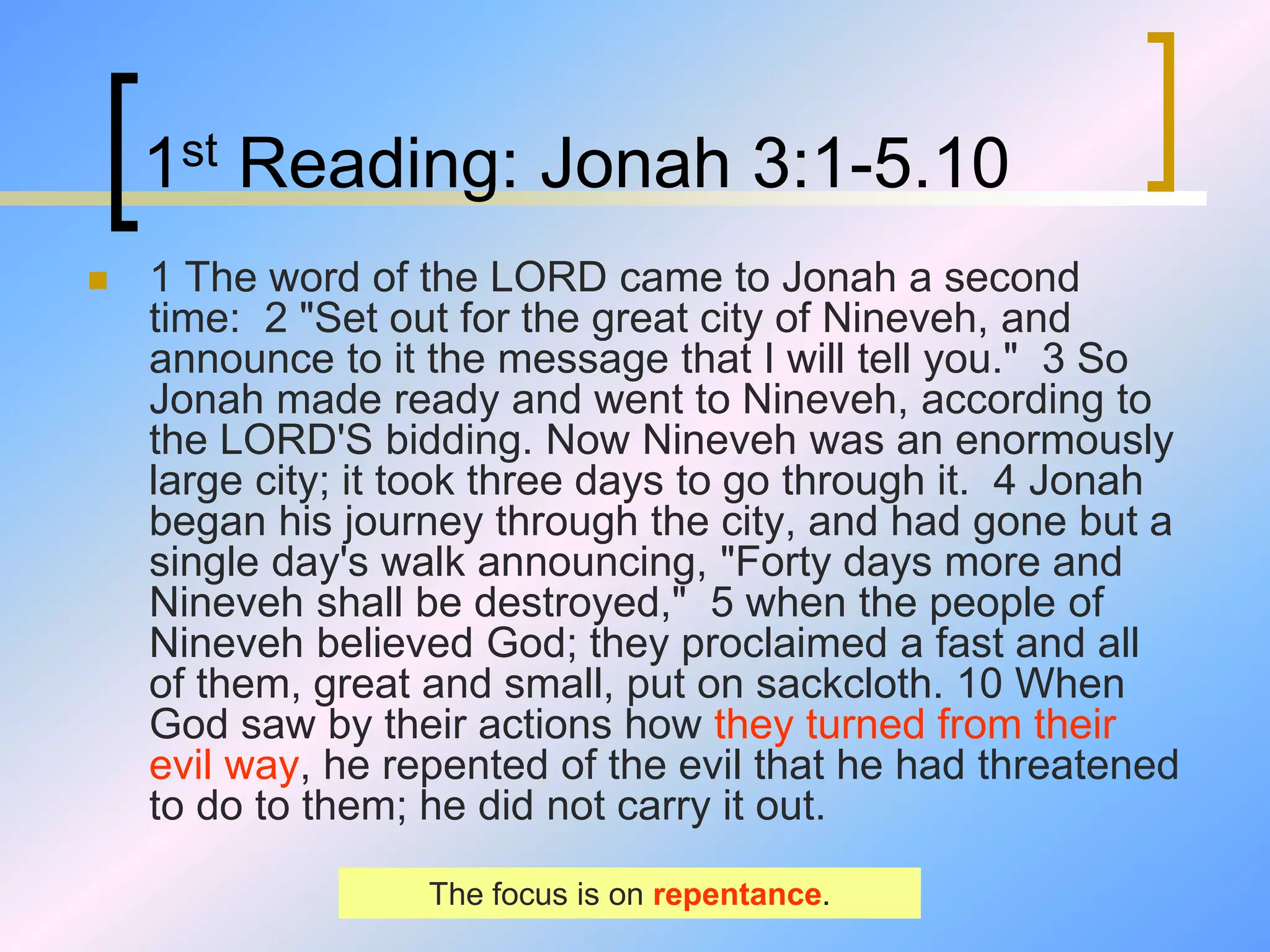
 1 The word of the LORD came to Jonah a second
time: 2 "Set out for the great city of Nineveh, and
announce to it the message that I will tell you." 3 So
Jonah made ready and went to Nineveh, according to
the LORD'S bidding. Now Nineveh was an enormously
large city; it took three days to go through it. 4 Jonah
began his journey through the city, and had gone but a
single day's walk announcing, "Forty days more and
Nineveh shall be destroyed," 5 when the people of
Nineveh believed God; they proclaimed a fast and all
of them, great and small, put on sackcloth. 10 When
God saw by their actions how they turned from their
evil way, he repented of the evil that he had threatened
to do to them; he did not carry it out.
The focus is on repentance.
1st Reading: Jonah 3:1-5.10
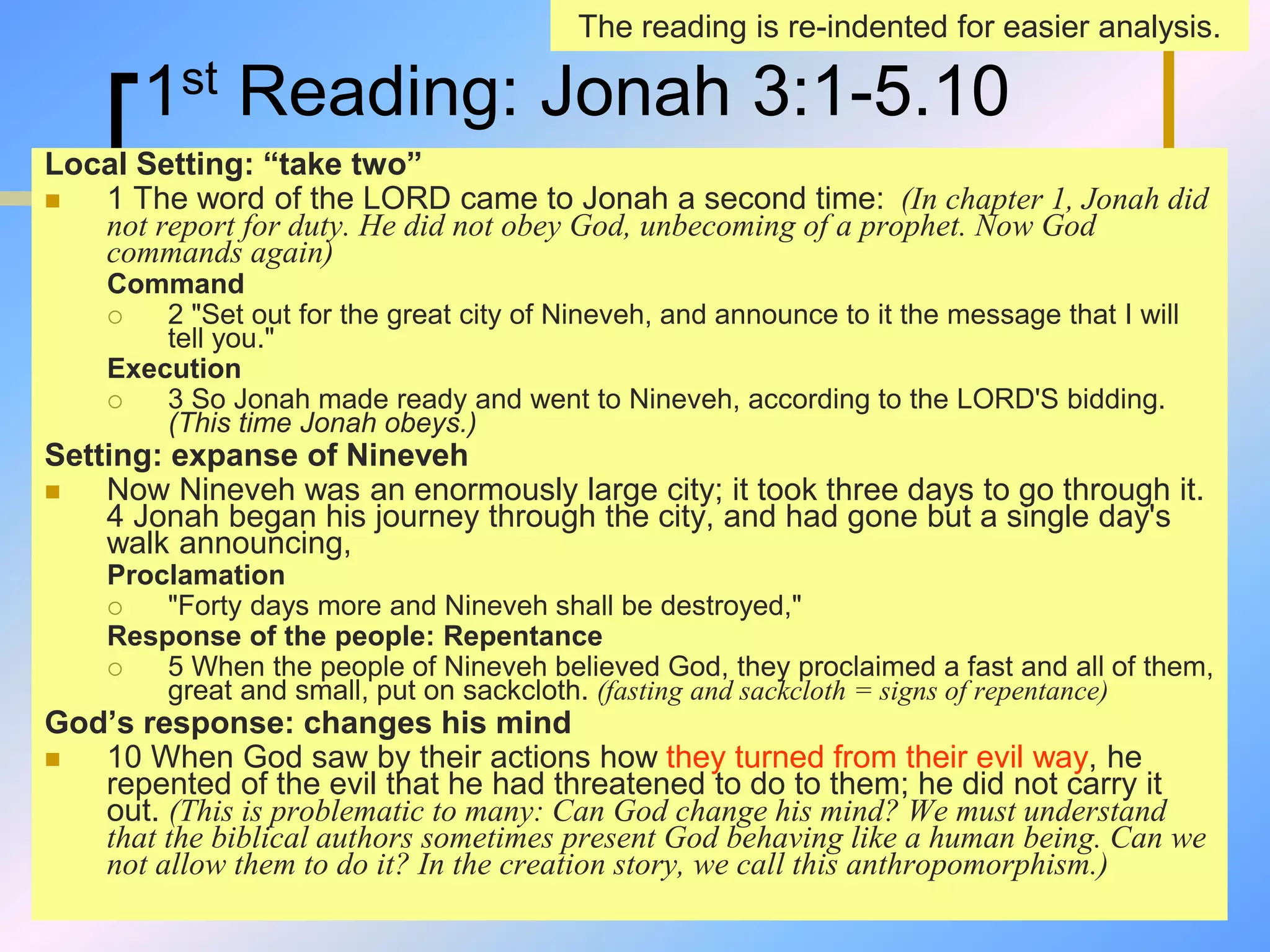
Local Setting: “take two”
 1 The word of the LORD came to Jonah a second time: (In chapter 1, Jonah did
not report for duty. He did not obey God, unbecoming of a prophet. Now God
commands again)
Command
 2 "Set out for the great city of Nineveh, and announce to it the message that I will
tell you."
Execution
 3 So Jonah made ready and went to Nineveh, according to the LORD'S bidding.
(This time Jonah obeys.)
Setting: expanse of Nineveh
 Now Nineveh was an enormously large city; it took three days to go through it.
4 Jonah began his journey through the city, and had gone but a single day's
walk announcing,
Proclamation
 "Forty days more and Nineveh shall be destroyed,"
Response of the people: Repentance
 5 When the people of Nineveh believed God, they proclaimed a fast and all of them,
great and small, put on sackcloth. (fasting and sackcloth = signs of repentance)
God’s response: changes his mind
 10 When God saw by their actions how they turned from their evil way, he
repented of the evil that he had threatened to do to them; he did not carry it
out. (This is problematic to many: Can God change his mind? We must understand
that the biblical authors sometimes present God behaving like a human being. Can we
not allow them to do it? In the creation story, we call this anthropomorphism.)
The reading is re-indented for easier analysis.
1st Reading: Jonah 3:1-5.10
Local Setting: take two
 1 The word of the LORD came to Jonah a
second time:
Command
 2 "Set out for the great city of Nineveh, and
announce to it the message that I will tell
you."
Execution
 3 So Jonah made ready and went to
Nineveh, according to the LORD'S bidding.
Setting: expanse of Nineveh
 Now Nineveh was an enormously large city;
it took three days to go through it. 4 Jonah
began his journey through the city, and had
gone but a single day's walk announcing,
Proclamation
 "Forty days more and Nineveh shall be
destroyed,"
Response of the people: Repentance
 5 When the people of Nineveh believed
God, they proclaimed a fast and all of them,
great and small, put on sackcloth. (fasting
and sackcloth = signs of repentance)
God’s response: changes his mind
 10 When God saw by their actions how
they turned from their evil way, he repented
of the evil that he had threatened to do to
them; he did not carry it out.
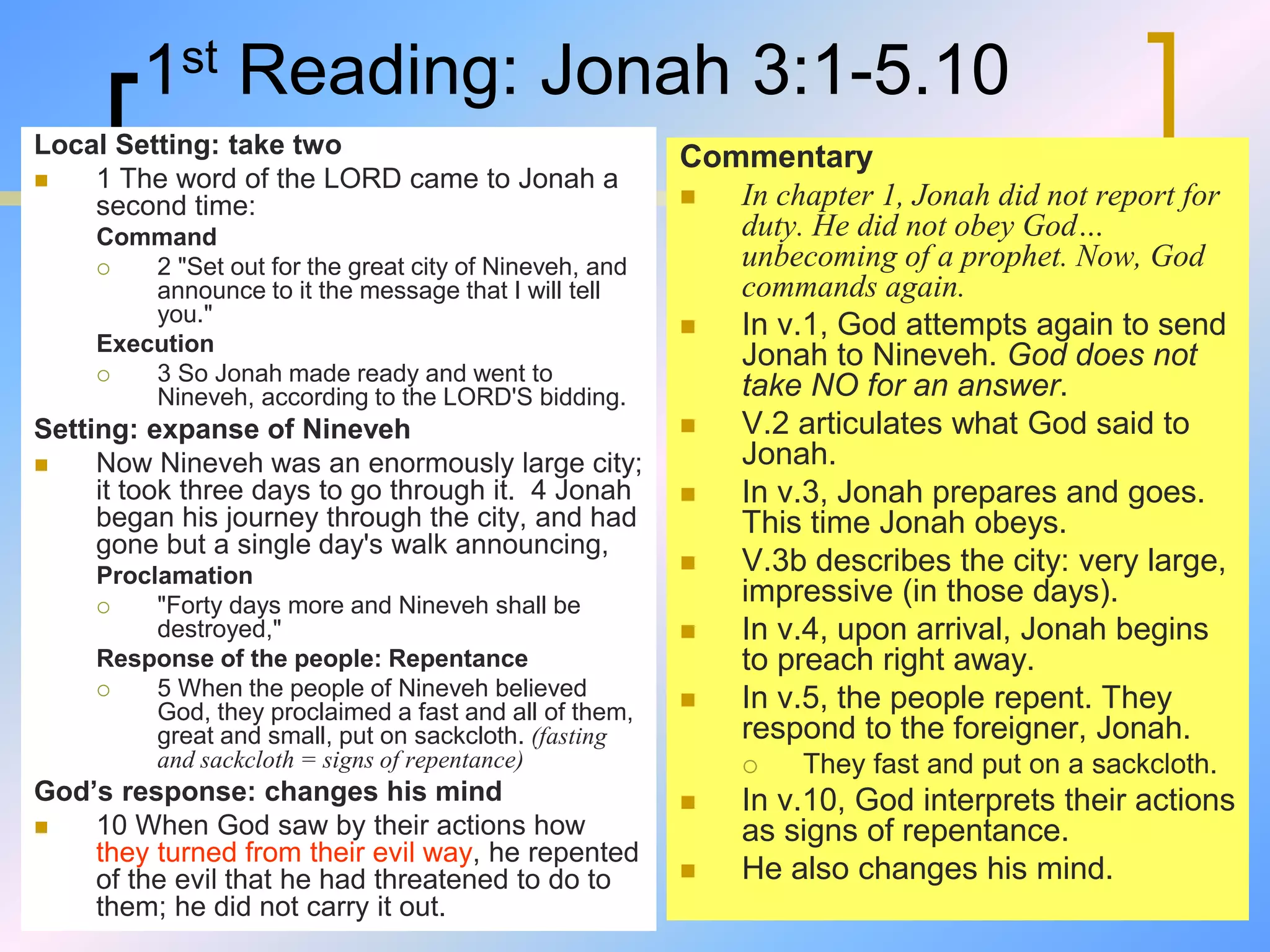
Commentary
 In chapter 1, Jonah did not report for
duty. He did not obey God…
unbecoming of a prophet. Now, God
commands again.
 In v.1, God attempts again to send
Jonah to Nineveh. God does not
take NO for an answer.
 V.2 articulates what God said to
Jonah.
 In v.3, Jonah prepares and goes.
This time Jonah obeys.
 V.3b describes the city: very large,
impressive (in those days).
 In v.4, upon arrival, Jonah begins
to preach right away.
 In v.5, the people repent. They
respond to the foreigner, Jonah.
 They fast and put on a sackcloth.
 In v.10, God interprets their actions
as signs of repentance.
 He also changes his mind.
Reflections on the 1st reading
 Repentance is turning away from evil.
 We stop violating the rights of others, etc.,
and the rights of God.
 We need prophets (teacher, priest, activist) to
shake us, to move our conscience, to touch
our heart.
 Have you changed because a prophet came
to correct you?
Resp. Ps 25:4-5. 6-7. 8-9
 R. (4a) Teach me your ways, O Lord.
4 Your ways, O LORD, make known to me;
teach me your paths,
5 Guide me in your truth and teach me,
for you are God my savior.
 6 Remember that your compassion, O LORD,
and your love are from of old.
7 In your kindness remember me,
because of your goodness, O LORD.
 8 Good and upright is the LORD;
thus he shows sinners the way.
9 He guides the humble to justice
and teaches the humble his way.
Resp. Ps 25:4-5. 6-7. 8-9
 R. (4a) Teach me your ways, O
Lord.
4 Your ways, O LORD, make
known to me;
teach me your paths,
5 Guide me in your truth and teach
me,
for you are God my savior.
 6 Remember that your compassion,
O LORD,
and your love are from of old.
7 In your kindness remember me,
because of your goodness, O
LORD.
 8 Good and upright is the LORD;
thus he shows sinners the way.
9 He guides the humble to justice
and teaches the humble his way.
Commentary
 In vv.4-5, the psalmist prays
that he may learn God’s ways.
 God’s ways lead to the truth.
 In vv.6-7, the psalmist prays
for God’s compassion, love,
and kindness.
 He recognizes himself as a
sinner.
 In vv.8-9, the psalmist affirms
the Lord, who is responsive.
 God is good.
 He shows sinners the right
paths. V.8
 He guides the humble (lowly,
poor) to attain justice. V.9
Reflections on the Psalm
 Like the Psalmist, we should pray to find the right
paths.
 We must recognize that we have many
questionable decisions, moves, etc. that put us and
others to danger, with costly consequences.
 Humbly, we ask for guidance.
 In prayer, we discern where God is leading us to
justice.
 Do you pray? Is God part of your agenda?
 Is your behavior improving?
2nd Reading: 1 Cor 7:29-31
 29 I tell you, brothers, the time is
running out. From now on, let those
having wives act as not having them,
30 those weeping as not weeping,
those rejoicing as not rejoicing, those
buying as not owning, 31 those using
the world as not using it fully. For the
world in its present form is passing
away.
The theme is the temporariness of this world.
2nd Reading: 1 Cor 7:29-31
 29 I tell you, brothers, the time is running
out. From now on, let
 those having wives act as not having them, 30
 those weeping as not weeping,
 those rejoicing as not rejoicing,
 those buying as not owning, 31
 those using the world as not using it fully.
 For the world in its present form is passing
away.
The reading is re-indented for easier reading and analysis.
2nd Reading: 1 Cor 7:29-31
 29 I tell you, brothers,
the time is running out.
From now on, let
 those having wives act
as not having them, 30
 those weeping as not
weeping,
 those rejoicing as not
rejoicing,
 those buying as not
owning, 31
 those using the world as
not using it fully.
 For the world in its
present form is passing
away.
Commentary:
 In the reading, we get a taste of
Paul’s eschatology (theology of
end times).
 Belief in the end times is translated
into 5 behaviors.
 Is there anything wrong with
having a wife, weeping, rejoicing,
buying, etc?
 Nothing really, but the challenge of
Paul is that Christians should pay
attention to what is coming, not to
what we are preoccupied with
right now.
Reflections on the second reading
 Many of us are engaged in many activities.
 Though legitimate, like loving a wife or one’s family,
being in solidarity with the disaffected and celebrating
with those who receive God’s blessings, treating
ourselves with a new dress or pair of shoes, we must
not forget that we are living in a passing world.
 We must participate in the birthing of the new world,
designed by God.
 We must know God’s design to be able to engage
properly.
 Who will help you know God’s design? The tele-
evangelist, your favorite religious website, etc?
 We, Catholics, discern God’s great plan through our
Church.
Gospel Reading: Mk 1:14-20
 14 After John had been arrested, Jesus came to Galilee
proclaiming the gospel of God: 15 "This is the time of
fulfillment. The kingdom of God is at hand. Repent, and
believe in the gospel." 16 As he passed by the Sea of
Galilee, he saw Simon and his brother Andrew casting
their nets into the sea; they were fishermen. 17 Jesus
said to them, "Come after me, and I will make you
fishers of men." 18 Then they abandoned their nets and
followed him. 19 He walked along a little farther and
saw James, the son of Zebedee, and his brother John.
They too were in a boat mending their nets. 20 Then he
called them. So they left their father Zebedee in the boat
along with the hired men and followed him.
The focus is the kingdom of God.
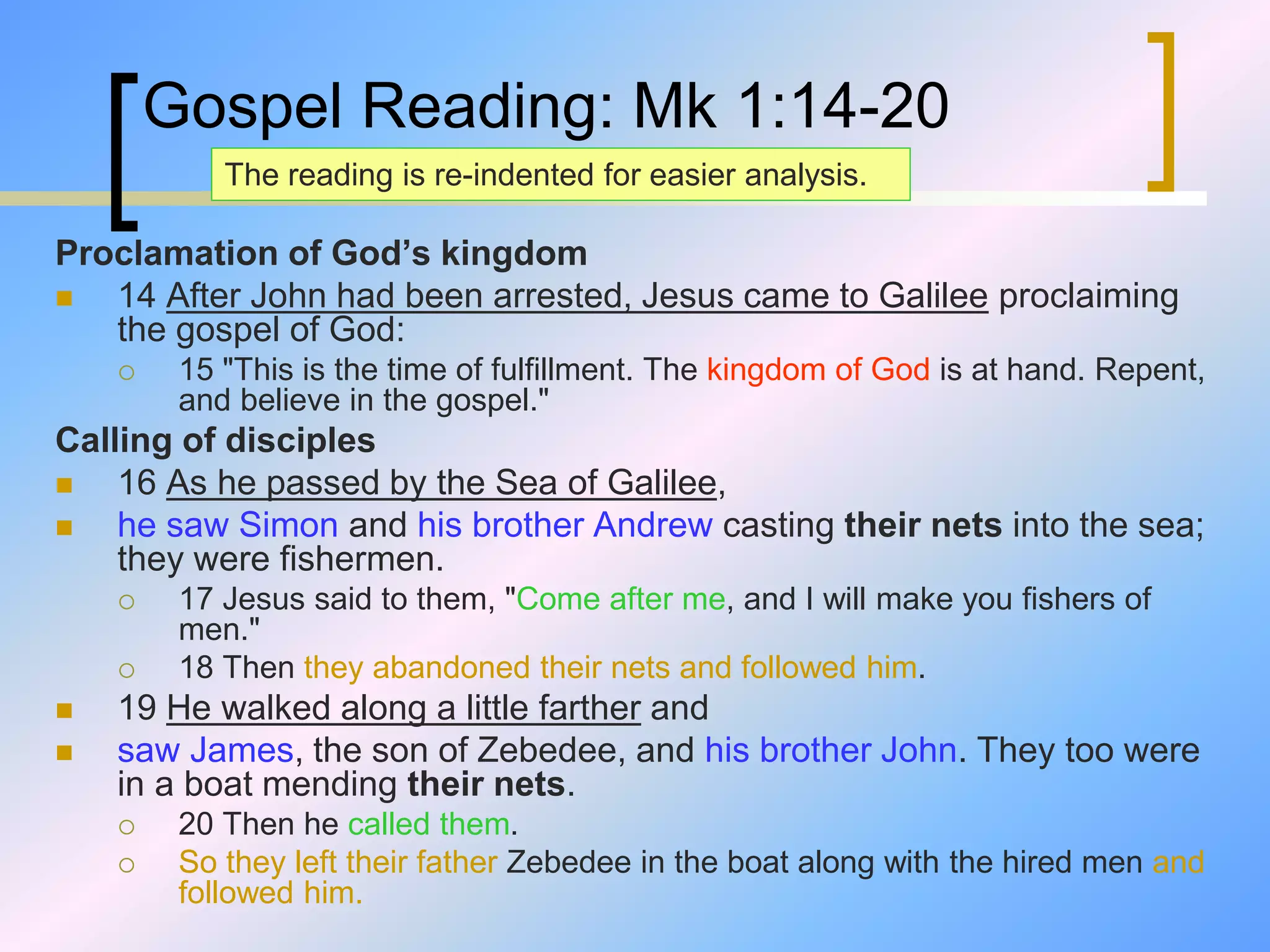
Gospel Reading: Mk 1:14-20
Proclamation of God’s kingdom
 14 After John had been arrested, Jesus came to Galilee proclaiming
the gospel of God:
 15 "This is the time of fulfillment. The kingdom of God is at hand. Repent,
and believe in the gospel."
Calling of disciples
 16 As he passed by the Sea of Galilee,
 he saw Simon and his brother Andrew casting their nets into the sea;
they were fishermen.
 17 Jesus said to them, "Come after me, and I will make you fishers of
men."
 18 Then they abandoned their nets and followed him.
 19 He walked along a little farther and
 saw James, the son of Zebedee, and his brother John. They too were
in a boat mending their nets.
 20 Then he called them.
 So they left their father Zebedee in the boat along with the hired men and
followed him.
The reading is re-indented for easier analysis.
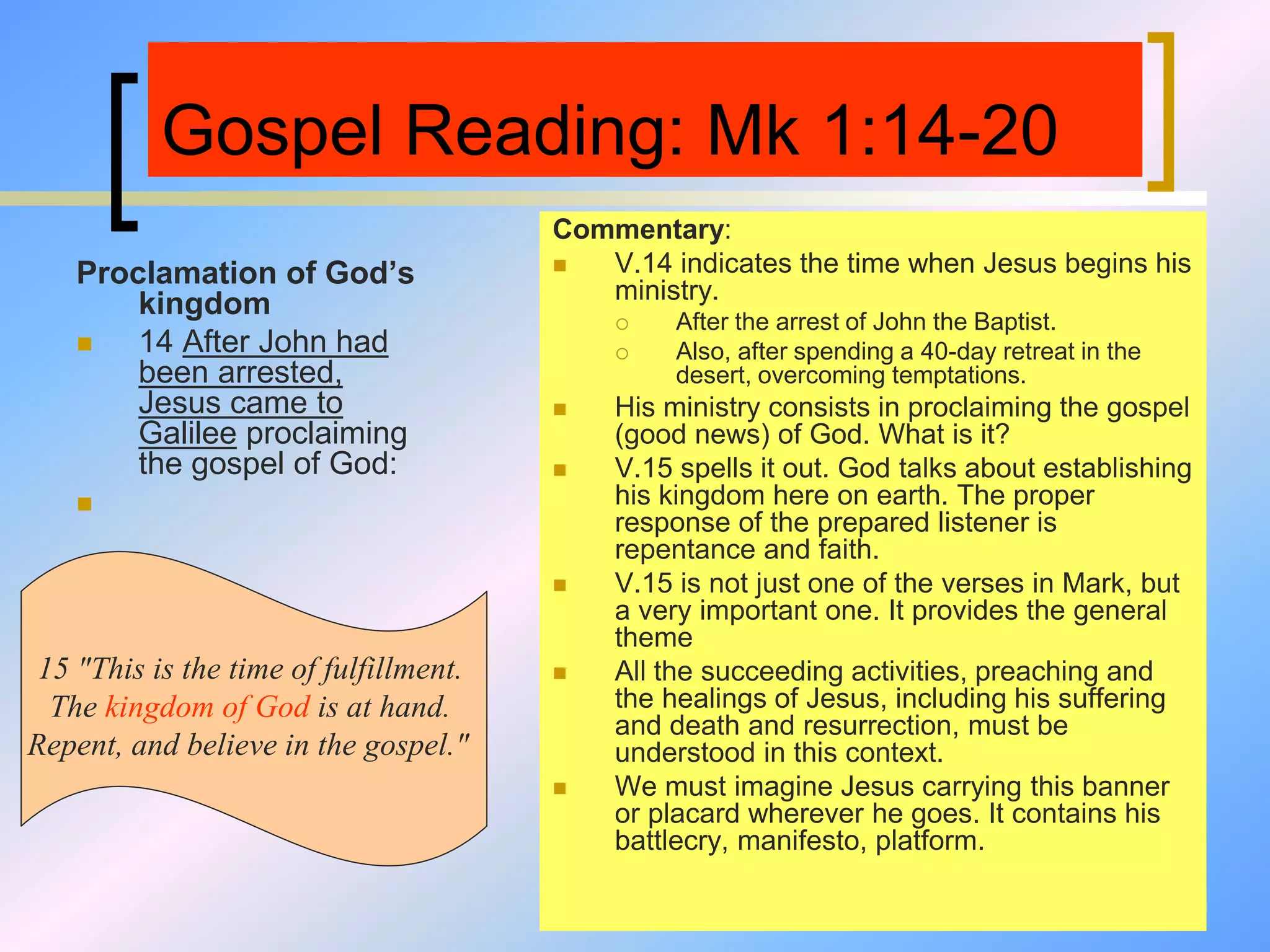
Gospel Reading: Mk 1:14-20
Proclamation of God’s
kingdom
 14 After John had
been arrested,
Jesus came to
Galilee proclaiming
the gospel of God:

Commentary:
 V.14 indicates the time when Jesus begins his
ministry.
 After the arrest of John the Baptist.
 Also, after spending a 40-day retreat in the
desert, overcoming temptations.
 His ministry consists in proclaiming the gospel
(good news) of God. What is it?
 V.15 spells it out. God talks about establishing
his kingdom here on earth. The proper
response of the prepared listener is
repentance and faith.
 V.15 is not just one of the verses in Mark, but
a very important one. It provides the general
theme
 All the succeeding activities, preaching and
the healings of Jesus, including his suffering
and death and resurrection, must be
understood in this context.
 We must imagine Jesus carrying this banner
or placard wherever he goes. It contains his
battlecry, manifesto, platform.
15 "This is the time of fulfillment.
The kingdom of God is at hand.
Repent, and believe in the gospel."
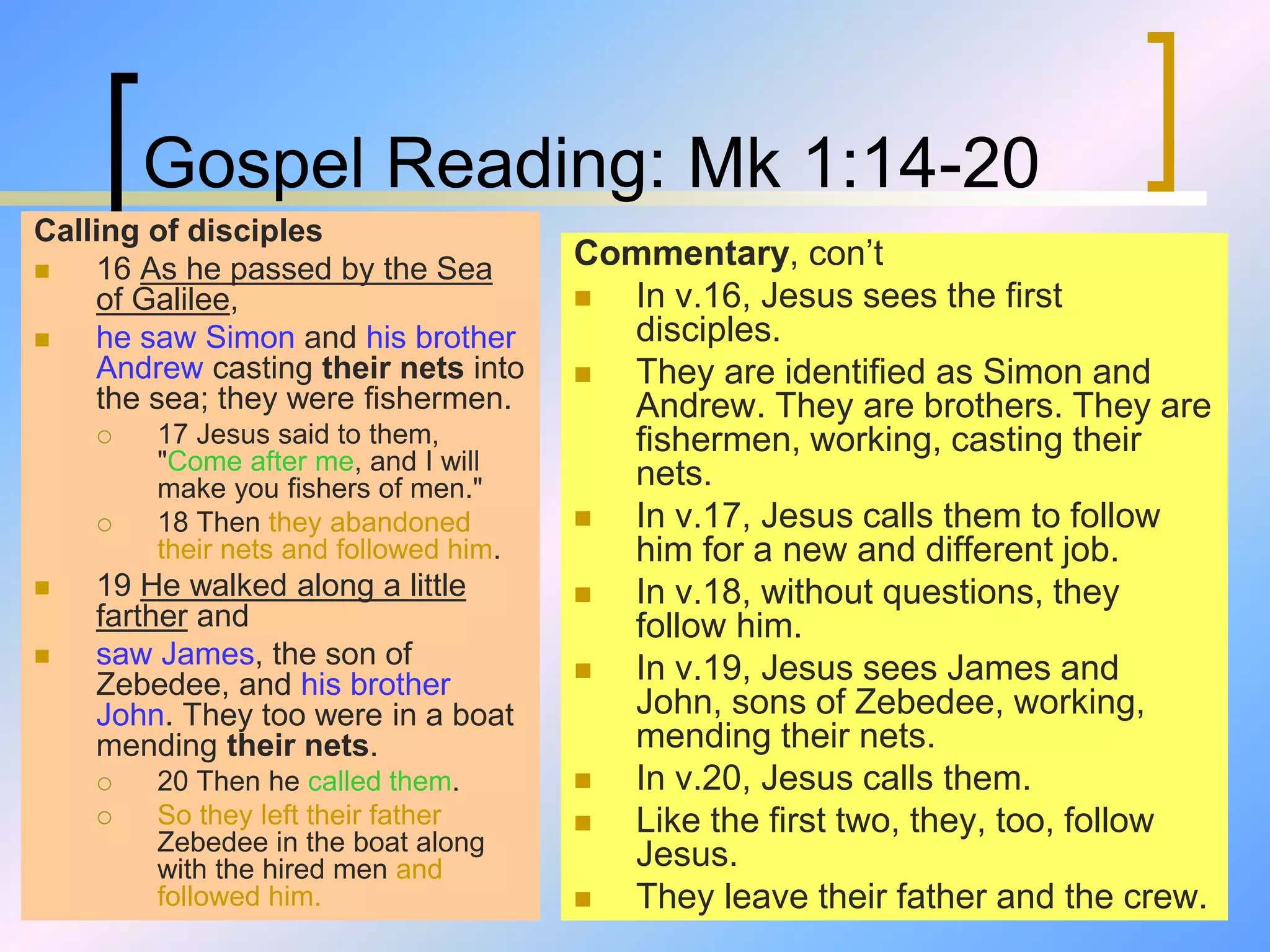
Gospel Reading: Mk 1:14-20
Calling of disciples
 16 As he passed by the Sea
of Galilee,
 he saw Simon and his brother
Andrew casting their nets into
the sea; they were fishermen.
 17 Jesus said to them,
"Come after me, and I will
make you fishers of men."
 18 Then they abandoned
their nets and followed him.
 19 He walked along a little
farther and
 saw James, the son of
Zebedee, and his brother
John. They too were in a boat
mending their nets.
 20 Then he called them.
 So they left their father
Zebedee in the boat along
with the hired men and
followed him.
Commentary, con’t
 In v.16, Jesus sees the first
disciples.
 They are identified as Simon and
Andrew. They are brothers. They are
fishermen, working, casting their
nets.
 In v.17, Jesus calls them to follow
him for a new and different job.
 In v.18, without questions, they
follow him.
 In v.19, Jesus sees James and
John, sons of Zebedee, working,
mending their nets.
 In v.20, Jesus calls them.
 Like the first two, they, too, follow
Jesus.
 They leave their father and the crew.
Reflections on the gospel
 Like the first disciples, we, Christians, are called to
participate in the mission of Christ.
 Our mission is to proclaim the good news and establish
God’s kingdom.
 We, Christians, are not bystanders.
 To engage fully, we must leave our loved ones and
belongings behind. Be detach from them.
 Are you an evangelizer with a lot of freedom to follow
Christ?
 Are you willing to be the standard bearer of Christ?
Tying the three readings and Psalms
 The first reading tells of the need to repent from evil
deeds or else…destruction. (very negative, threatening)
 The psalm prays for guidance to right paths.
 The second reading tells of the need to change
priorities (repent) because of the coming end.
(negative also, threatening)
 The gospel reading asks us to repent because of
the kingdom of God. (positive, encouraging)
How to develop your homily / sharing
 Have you been invited to enter the seminary or
the convent?
 Or, have you been tempted to join a
congregation?
 Whether you are a priest, religious or lay, you are
called to participate in the mission of Christ, by
virtue of your baptism.
 The Church, in which you are a member, serves
the interests of the kingdom of God.
 According to the readings, what is our mission?
 In the first reading, we are called to preach
repentance.
 Like Jonah, we have to follow God’s instructions. We
have to report to work no matter how hard, distant and
time consuming it is.
 Our mission is to induce sincere repentance and make
people go back to God.
 We cannot dispel God’s threat for the unrepentant.
(Destruction).
 Sin leads to perdition.
 Can you tell your kids, friends and neighbors, that if
they don’t make up, they will break up?
 There are consequences if you don’t.
 In the gospel reading, we must realize that
missionary work is not voluntary.
 It is an invitation. It is a calling.
 It is Christ who calls, “Come, follow me.”
 We respond right away without if’s and but’s,
without dillydallying.
 We don’t delay because Christ is always on
the go, holding his banner, “The kingdom of
God is at hand. Repent…”
 In the second reading, to be effective evangelizers, we
must know our priorities. We must have higher values.
 We must not be bogged down by lesser concerns.
 We must see a greater good than just the good of our
family, wife and friends, club or parish.
 Our horizon must encompass community and global
concerns.
 We must go beyond our old world, which is passing
now, and contribute to the completion of the new
world.
 How are you as a Christian?
 Are you involved in the Church?
 Can you work with your fellow evangelizers?
 Are you proud to join in the mission of Christ in
the context of your Church?
 How much time do you dedicate for your
formation?
 How much time do you do community service?
 How many people have you brought back to
the Church, to God?
 The eucharist is the reward of our
missionary work.
 We can pretty well say our mission is
successful, when the people we touch, now
receive the eucharist properly disposed and
with sincere hearts.
 No one should be allowed to pose as a
missionary if he does not receive, show
respect to the holy eucharist.
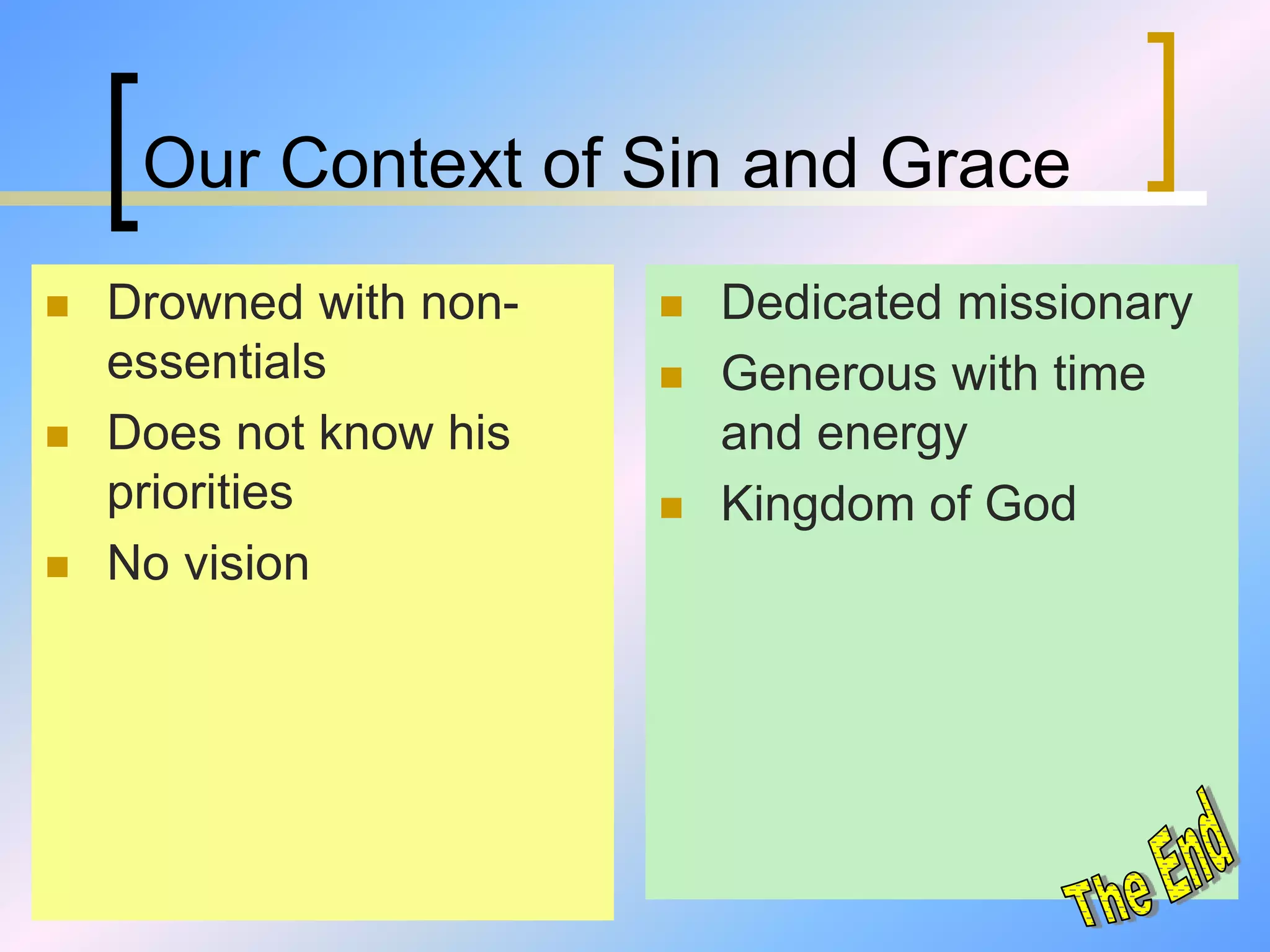
Our Context of Sin and Grace
 Drowned with non-
essentials
 Does not know his
priorities
 No vision
 Dedicated missionary
 Generous with time
and energy
 Kingdom of God
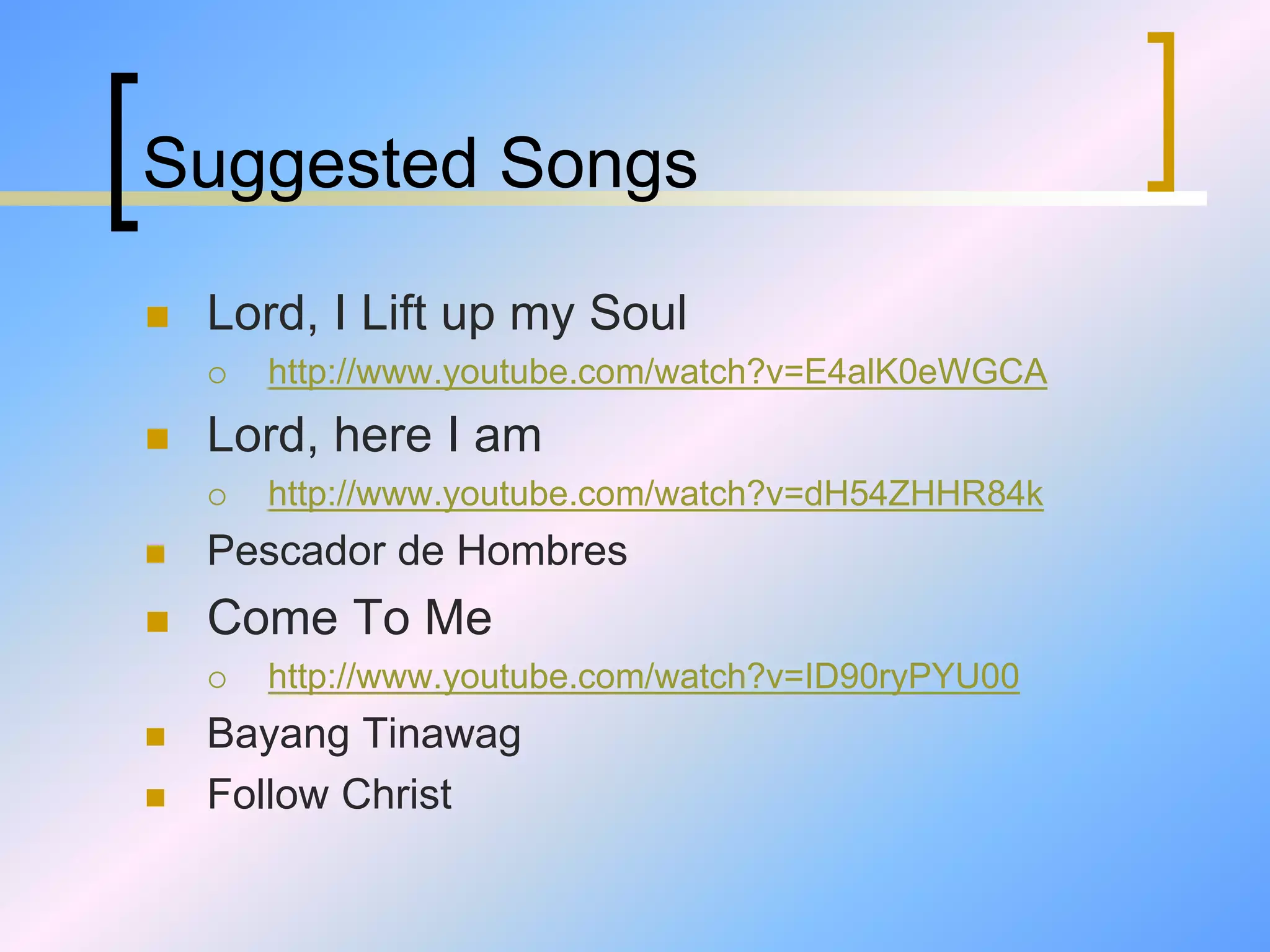
Suggested Songs
 Lord, I Lift up my Soul
 http://www.youtube.com/watch?v=E4alK0eWGCA
 Lord, here I am
 http://www.youtube.com/watch?v=dH54ZHHR84k
 Pescador de Hombres
 Come To Me
 http://www.youtube.com/watch?v=ID90ryPYU00
 Bayang Tinawag
 Follow Christ

3rd Sunday B

  • 1.
    Welcome to ourBible Study 25 January 2015 3rd Sunday in Ordinary Time B In preparation for this Sunday’s Liturgy In aid of focusing our homilies and sharing Prepared by Fr. Cielo. R. Almazan, OFM
  • 2.
    1st Reading: Jonah3:1-5.10  1 The word of the LORD came to Jonah a second time: 2 "Set out for the great city of Nineveh, and announce to it the message that I will tell you." 3 So Jonah made ready and went to Nineveh, according to the LORD'S bidding. Now Nineveh was an enormously large city; it took three days to go through it. 4 Jonah began his journey through the city, and had gone but a single day's walk announcing, "Forty days more and Nineveh shall be destroyed," 5 when the people of Nineveh believed God; they proclaimed a fast and all of them, great and small, put on sackcloth. 10 When God saw by their actions how they turned from their evil way, he repented of the evil that he had threatened to do to them; he did not carry it out. The focus is on repentance.
  • 3.
    1st Reading: Jonah3:1-5.10 Local Setting: “take two”  1 The word of the LORD came to Jonah a second time: (In chapter 1, Jonah did not report for duty. He did not obey God, unbecoming of a prophet. Now God commands again) Command  2 "Set out for the great city of Nineveh, and announce to it the message that I will tell you." Execution  3 So Jonah made ready and went to Nineveh, according to the LORD'S bidding. (This time Jonah obeys.) Setting: expanse of Nineveh  Now Nineveh was an enormously large city; it took three days to go through it. 4 Jonah began his journey through the city, and had gone but a single day's walk announcing, Proclamation  "Forty days more and Nineveh shall be destroyed," Response of the people: Repentance  5 When the people of Nineveh believed God, they proclaimed a fast and all of them, great and small, put on sackcloth. (fasting and sackcloth = signs of repentance) God’s response: changes his mind  10 When God saw by their actions how they turned from their evil way, he repented of the evil that he had threatened to do to them; he did not carry it out. (This is problematic to many: Can God change his mind? We must understand that the biblical authors sometimes present God behaving like a human being. Can we not allow them to do it? In the creation story, we call this anthropomorphism.) The reading is re-indented for easier analysis.
  • 4.
    1st Reading: Jonah3:1-5.10 Local Setting: take two  1 The word of the LORD came to Jonah a second time: Command  2 "Set out for the great city of Nineveh, and announce to it the message that I will tell you." Execution  3 So Jonah made ready and went to Nineveh, according to the LORD'S bidding. Setting: expanse of Nineveh  Now Nineveh was an enormously large city; it took three days to go through it. 4 Jonah began his journey through the city, and had gone but a single day's walk announcing, Proclamation  "Forty days more and Nineveh shall be destroyed," Response of the people: Repentance  5 When the people of Nineveh believed God, they proclaimed a fast and all of them, great and small, put on sackcloth. (fasting and sackcloth = signs of repentance) God’s response: changes his mind  10 When God saw by their actions how they turned from their evil way, he repented of the evil that he had threatened to do to them; he did not carry it out. Commentary  In chapter 1, Jonah did not report for duty. He did not obey God… unbecoming of a prophet. Now, God commands again.  In v.1, God attempts again to send Jonah to Nineveh. God does not take NO for an answer.  V.2 articulates what God said to Jonah.  In v.3, Jonah prepares and goes. This time Jonah obeys.  V.3b describes the city: very large, impressive (in those days).  In v.4, upon arrival, Jonah begins to preach right away.  In v.5, the people repent. They respond to the foreigner, Jonah.  They fast and put on a sackcloth.  In v.10, God interprets their actions as signs of repentance.  He also changes his mind.
  • 5.
    Reflections on the1st reading  Repentance is turning away from evil.  We stop violating the rights of others, etc., and the rights of God.  We need prophets (teacher, priest, activist) to shake us, to move our conscience, to touch our heart.  Have you changed because a prophet came to correct you?
  • 6.
    Resp. Ps 25:4-5.6-7. 8-9  R. (4a) Teach me your ways, O Lord. 4 Your ways, O LORD, make known to me; teach me your paths, 5 Guide me in your truth and teach me, for you are God my savior.  6 Remember that your compassion, O LORD, and your love are from of old. 7 In your kindness remember me, because of your goodness, O LORD.  8 Good and upright is the LORD; thus he shows sinners the way. 9 He guides the humble to justice and teaches the humble his way.
  • 7.
    Resp. Ps 25:4-5.6-7. 8-9  R. (4a) Teach me your ways, O Lord. 4 Your ways, O LORD, make known to me; teach me your paths, 5 Guide me in your truth and teach me, for you are God my savior.  6 Remember that your compassion, O LORD, and your love are from of old. 7 In your kindness remember me, because of your goodness, O LORD.  8 Good and upright is the LORD; thus he shows sinners the way. 9 He guides the humble to justice and teaches the humble his way. Commentary  In vv.4-5, the psalmist prays that he may learn God’s ways.  God’s ways lead to the truth.  In vv.6-7, the psalmist prays for God’s compassion, love, and kindness.  He recognizes himself as a sinner.  In vv.8-9, the psalmist affirms the Lord, who is responsive.  God is good.  He shows sinners the right paths. V.8  He guides the humble (lowly, poor) to attain justice. V.9
  • 8.
    Reflections on thePsalm  Like the Psalmist, we should pray to find the right paths.  We must recognize that we have many questionable decisions, moves, etc. that put us and others to danger, with costly consequences.  Humbly, we ask for guidance.  In prayer, we discern where God is leading us to justice.  Do you pray? Is God part of your agenda?  Is your behavior improving?
  • 9.
    2nd Reading: 1Cor 7:29-31  29 I tell you, brothers, the time is running out. From now on, let those having wives act as not having them, 30 those weeping as not weeping, those rejoicing as not rejoicing, those buying as not owning, 31 those using the world as not using it fully. For the world in its present form is passing away. The theme is the temporariness of this world.
  • 10.
    2nd Reading: 1Cor 7:29-31  29 I tell you, brothers, the time is running out. From now on, let  those having wives act as not having them, 30  those weeping as not weeping,  those rejoicing as not rejoicing,  those buying as not owning, 31  those using the world as not using it fully.  For the world in its present form is passing away. The reading is re-indented for easier reading and analysis.
  • 11.
    2nd Reading: 1Cor 7:29-31  29 I tell you, brothers, the time is running out. From now on, let  those having wives act as not having them, 30  those weeping as not weeping,  those rejoicing as not rejoicing,  those buying as not owning, 31  those using the world as not using it fully.  For the world in its present form is passing away. Commentary:  In the reading, we get a taste of Paul’s eschatology (theology of end times).  Belief in the end times is translated into 5 behaviors.  Is there anything wrong with having a wife, weeping, rejoicing, buying, etc?  Nothing really, but the challenge of Paul is that Christians should pay attention to what is coming, not to what we are preoccupied with right now.
  • 12.
    Reflections on thesecond reading  Many of us are engaged in many activities.  Though legitimate, like loving a wife or one’s family, being in solidarity with the disaffected and celebrating with those who receive God’s blessings, treating ourselves with a new dress or pair of shoes, we must not forget that we are living in a passing world.  We must participate in the birthing of the new world, designed by God.  We must know God’s design to be able to engage properly.  Who will help you know God’s design? The tele- evangelist, your favorite religious website, etc?  We, Catholics, discern God’s great plan through our Church.
  • 13.
    Gospel Reading: Mk1:14-20  14 After John had been arrested, Jesus came to Galilee proclaiming the gospel of God: 15 "This is the time of fulfillment. The kingdom of God is at hand. Repent, and believe in the gospel." 16 As he passed by the Sea of Galilee, he saw Simon and his brother Andrew casting their nets into the sea; they were fishermen. 17 Jesus said to them, "Come after me, and I will make you fishers of men." 18 Then they abandoned their nets and followed him. 19 He walked along a little farther and saw James, the son of Zebedee, and his brother John. They too were in a boat mending their nets. 20 Then he called them. So they left their father Zebedee in the boat along with the hired men and followed him. The focus is the kingdom of God.
  • 14.
    Gospel Reading: Mk1:14-20 Proclamation of God’s kingdom  14 After John had been arrested, Jesus came to Galilee proclaiming the gospel of God:  15 "This is the time of fulfillment. The kingdom of God is at hand. Repent, and believe in the gospel." Calling of disciples  16 As he passed by the Sea of Galilee,  he saw Simon and his brother Andrew casting their nets into the sea; they were fishermen.  17 Jesus said to them, "Come after me, and I will make you fishers of men."  18 Then they abandoned their nets and followed him.  19 He walked along a little farther and  saw James, the son of Zebedee, and his brother John. They too were in a boat mending their nets.  20 Then he called them.  So they left their father Zebedee in the boat along with the hired men and followed him. The reading is re-indented for easier analysis.
  • 15.
    Gospel Reading: Mk1:14-20 Proclamation of God’s kingdom  14 After John had been arrested, Jesus came to Galilee proclaiming the gospel of God:  Commentary:  V.14 indicates the time when Jesus begins his ministry.  After the arrest of John the Baptist.  Also, after spending a 40-day retreat in the desert, overcoming temptations.  His ministry consists in proclaiming the gospel (good news) of God. What is it?  V.15 spells it out. God talks about establishing his kingdom here on earth. The proper response of the prepared listener is repentance and faith.  V.15 is not just one of the verses in Mark, but a very important one. It provides the general theme  All the succeeding activities, preaching and the healings of Jesus, including his suffering and death and resurrection, must be understood in this context.  We must imagine Jesus carrying this banner or placard wherever he goes. It contains his battlecry, manifesto, platform. 15 "This is the time of fulfillment. The kingdom of God is at hand. Repent, and believe in the gospel."
  • 16.
    Gospel Reading: Mk1:14-20 Calling of disciples  16 As he passed by the Sea of Galilee,  he saw Simon and his brother Andrew casting their nets into the sea; they were fishermen.  17 Jesus said to them, "Come after me, and I will make you fishers of men."  18 Then they abandoned their nets and followed him.  19 He walked along a little farther and  saw James, the son of Zebedee, and his brother John. They too were in a boat mending their nets.  20 Then he called them.  So they left their father Zebedee in the boat along with the hired men and followed him. Commentary, con’t  In v.16, Jesus sees the first disciples.  They are identified as Simon and Andrew. They are brothers. They are fishermen, working, casting their nets.  In v.17, Jesus calls them to follow him for a new and different job.  In v.18, without questions, they follow him.  In v.19, Jesus sees James and John, sons of Zebedee, working, mending their nets.  In v.20, Jesus calls them.  Like the first two, they, too, follow Jesus.  They leave their father and the crew.
  • 17.
    Reflections on thegospel  Like the first disciples, we, Christians, are called to participate in the mission of Christ.  Our mission is to proclaim the good news and establish God’s kingdom.  We, Christians, are not bystanders.  To engage fully, we must leave our loved ones and belongings behind. Be detach from them.  Are you an evangelizer with a lot of freedom to follow Christ?  Are you willing to be the standard bearer of Christ?
  • 18.
    Tying the threereadings and Psalms  The first reading tells of the need to repent from evil deeds or else…destruction. (very negative, threatening)  The psalm prays for guidance to right paths.  The second reading tells of the need to change priorities (repent) because of the coming end. (negative also, threatening)  The gospel reading asks us to repent because of the kingdom of God. (positive, encouraging)
  • 19.
    How to developyour homily / sharing  Have you been invited to enter the seminary or the convent?  Or, have you been tempted to join a congregation?  Whether you are a priest, religious or lay, you are called to participate in the mission of Christ, by virtue of your baptism.  The Church, in which you are a member, serves the interests of the kingdom of God.  According to the readings, what is our mission?
  • 20.
     In thefirst reading, we are called to preach repentance.  Like Jonah, we have to follow God’s instructions. We have to report to work no matter how hard, distant and time consuming it is.  Our mission is to induce sincere repentance and make people go back to God.  We cannot dispel God’s threat for the unrepentant. (Destruction).  Sin leads to perdition.  Can you tell your kids, friends and neighbors, that if they don’t make up, they will break up?  There are consequences if you don’t.
  • 21.
     In thegospel reading, we must realize that missionary work is not voluntary.  It is an invitation. It is a calling.  It is Christ who calls, “Come, follow me.”  We respond right away without if’s and but’s, without dillydallying.  We don’t delay because Christ is always on the go, holding his banner, “The kingdom of God is at hand. Repent…”
  • 22.
     In thesecond reading, to be effective evangelizers, we must know our priorities. We must have higher values.  We must not be bogged down by lesser concerns.  We must see a greater good than just the good of our family, wife and friends, club or parish.  Our horizon must encompass community and global concerns.  We must go beyond our old world, which is passing now, and contribute to the completion of the new world.
  • 23.
     How areyou as a Christian?  Are you involved in the Church?  Can you work with your fellow evangelizers?  Are you proud to join in the mission of Christ in the context of your Church?  How much time do you dedicate for your formation?  How much time do you do community service?  How many people have you brought back to the Church, to God?
  • 24.
     The eucharistis the reward of our missionary work.  We can pretty well say our mission is successful, when the people we touch, now receive the eucharist properly disposed and with sincere hearts.  No one should be allowed to pose as a missionary if he does not receive, show respect to the holy eucharist.
  • 25.
    Our Context ofSin and Grace  Drowned with non- essentials  Does not know his priorities  No vision  Dedicated missionary  Generous with time and energy  Kingdom of God
  • 26.
    Suggested Songs  Lord,I Lift up my Soul  http://www.youtube.com/watch?v=E4alK0eWGCA  Lord, here I am  http://www.youtube.com/watch?v=dH54ZHHR84k  Pescador de Hombres  Come To Me  http://www.youtube.com/watch?v=ID90ryPYU00  Bayang Tinawag  Follow Christ