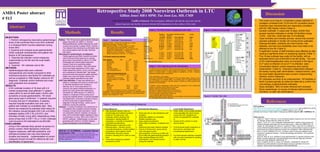
Retrospective Study 2008 Norovirus Outbreak in LTC  Gillian Jones MBA MPH; Tae Joon Lee, MD, CMD  UMC-IRB # 09-0250   Conflict of Interest:  The investigators affiliated with both the university and the  subject long term care facility, however retained full independence in the conduct of this study.   AMDA Poster abstract  # 513 References Abstract Setting:   This 16 day acute gastroenteritis outbreak began December 29, 2008 in a 152-bed Medicaid/Medicare certified detached for-profit nursing home facility in eastern North Carolina.  The midsized free standing for-profit facility has two nursing stations with six halls. See floor plan below.  Retrospective epidemiologic investigation:  Facility approval and East Carolina University Internal Review Board approval for exempt study status was granted on March 18, 2009.  Discharged and current patient data from medical charts and supporting related documents were reviewed.  Also interviewed were local health department (LHD), state health department (SHD), and D), key NH staff, and a sampling of infected staff.  Key facility personnel were interviewed to gather pertinent patient care costs and facility revenue and outbreak related expenditures and costs. AGE Case definition:  A case was defined as a patient or employee with onset of vomitus and/or diarrheal symptoms with vomiting or diarrhea, two or more loose stools in a minimum two gastro-intestinal episodes in a twenty four hour period with onset during December 29, 2008-January 15, 2009 in a resident or employee of the nursing home during the outbreak period. To prevent possible misclassification, exclusions included a history of recent loose stool or gastrointestinal diagnosis in the last 30 days,  and/or use of antibiotics during the outbreak.  Analysis:   A variety of analyses were performed on 125 patients with complete records including.  Analyses included simple descriptive, t-tests, non-parametric tests for medians, chi-square tests, and multivariate logistic regression using a combination of using  JMP 9 and PASW v17 (REFS ) software.  Epidemiologic curves were generated with GOATv2.1/EpiInfo software. Costs summarized on Excel software.  CDC guidance: http://www.cdc.gov/ncidod/dvrd/revb/gastro/norovirus-factsheet.htm  (last modified Feb, 2010)   http://www.cdc.gov/mmwr/pdf/rr/rr6003.pdf  MMWR, March 4, 2011; 60 (3).  Norwalk-Like Viruses: Public Health Consequences MMWR, June 01, 2001 ; 50(RR09);1-18 . Other sources: Heijne JC, Teunis P, Morroy G, et al. Enhanced hygiene measures and norovirus during an outbreak.  Emerg Infect Dis . 2009;15(1):24-30.  Jiang X, Turf E, Hu J, et al. Outbreaks of gastroenteritis in elderly nursing homes and retirement facilities associated with human caliciviruses.  J Med Virol  1996;50:335--41. Kaplan JE, Schonberger LB, Varano G, Jackman N, Bied J, Gary GW. An outbreak of acute nonbacterial gastroenteritis in a nursing home. demonstration of person-to-person transmission by temporal clustering of cases.  Am J Epidemiol . 1982;116(6):940-948 Marx A, Lee BY, Wettstein ZS, et al. . Economic value of norovirus outbreak control measures in healthcare settings , J Clinical Microbiology and Infection . 2010 published Online Oct. 26.  Shay DK, Noel JS, et al. Outbreak of acute gastroenteritis in a geriatric long-term-care facility: combined application of epidemiological and molecular diagnostic methods.  Infect Cont Hosp Epidemiol  1999;20:306--11.  Rao S, Scattolini de Gier N, Caram LB, Frederick J, Moorefield M, Woods CW. Adherence to self-quarantine recommendations during an outbreak of norovirus infection.  Infect Control Hosp Epidemiol . 2009;30(9):896-899.  Methods OBJECTIVES:  1. Perform retrospective descriptive epidemiologic study of lab confirmed Noro-virus (NV) outbreak in a midsized North Carolina detached nursing home (NH) 2. Examine and compare acute gastroenteritis (AGE) outbreak characteristics and patient risk factors in NV transmission 3.  Describe the infection control measures implemented by the NH and the local health department 4.  Examine  NV outbreak cost to NH.  METHODS:  Epidemiological data were collected retrospectively and results compared to other individual long term care facility NV outbreaks as well as compared to 1982 Kaplan criteria for NV diagnosis. Outbreak control methods and costs were assessed and compared.  RESULTS:  A NV outbreak duration of 16 days with 2.5 median symptomatic days affected 71 patient cases (56.8 %) and 24 staff cases (19.8%) with symptoms of acute gastroenteritis.  NV strain geno group type II confirmed. 11 patients required in-house oral and IV rehydration, 6 patients required hospital evaluation and care, and 1 patient with multiple co-morbidities died.  Risk factors (as measured by adjusted odds ratios) for NV infection include females (OR 3.39; p=0.006), diabetes mellitus (OR 2.76; p=0.031), and Activities of Daily Living (ADL) Dependency index score of less than 5 (OR 7.18; p = 0.04). Outbreak cost incurred to NH estimated to be $34,000.  CONCLUSIONS:  Group II NV outbreak likely spread via person-to-person contact. Multi-disciplinary enhanced hygiene measures, staff self-quarantine, and admissions/visitors ban may have lessened duration and severity.  Implementation of control measures should not wait for reference lab viral identification of specimens.  Table 3:  CDC Reporting and NV Identification  Figure 1. Onset Curve by Date Table 1:  Outbreak Characteristics  Table 2:  NV Risk Factors (unadjusted odds ratio)  Outbreak Duration:  16 days (Dec 29, 2008-Jan 13, 2009)  Peak illness onset date:  January 6, 2009  Median duration of illness :  2.5 days (range 0.5- 9 days)  Mean duration first 20 case-patients:  4.35 days Female/Male   Median # days ill:  3 days/1 day (p=0.002) † Median no. Co-Morbidities:  1.8 (range 0-4) Median #  stools in a 24 period :  3.5 (range 2-6) Median days duration of diarrhea :  2.1 (range 1-5)  71 Ill Patients meeting case definition   Case- patients  n/N  (%) Attack Rate     7 1/12  (56.8%) Re-Infections   4/71   (5.6%) Diarrhea   67/71  (94%) Nausea   9/71  (13%) Vomiting   49/71  (69%) Abdominal cramps   2/71  (3%) Low Temperature 99-101  31/71  (44%) Health care Interventions/Acuity   Clear Liquids & OTC medications  7/71  (10%) Oral hydration   8/71  (11%) Treated in-house IV hydration  6/71  (8%) Hospital transfer for IV hydration  6/71  (8%) Mortality   1/71  (1.4%) Staff Attack Rate     24/121  (19.8%) Diarrhea   17/24  (71%) Vomitus   19/24  (79%) Mean #Days Ill &Absent From Work: 2.5 days (0.5 to 7 days) † Categories of primary diagnoses were considered: CVA, diabetes mellitus, hypertension,  Alzheimers/Dementia/ Organic Brain, Renal Failure/Kidney Disease, Heart Disease/CHF, Other UNIT II Station UNIT I Station Symptom  No symptom OR (95% interval) p-value     n=71 (%) n=54 (%) Female*     61 (85.9) 36 (66.7) 3.39 (1.38-8.33) 0.006 Caucasian    28 (39.4) 24 (44.4) 1.23 (0.59-2.52) 0.57 Sick Roommate  39 (54.9) 24 (44.4) 1.52 (0.75-3.1) 0.25 Private Room 11 (15.5) 4 (7.4) 2.29 (0.69-7.64) 0.17 Unit I   47 (66.2) 27 (50.0) 1.95 (0.94-4.05) 0.068 Unit II   25 (35.2) 27 (50.0) 0.54 (0.26-1.12) 0.097 Diabetes*   29 (40.9) 7 (13.0) 2.76 (1.07-7.1) 0.031 ALZ/Dementia  27 (38.0) 13 (24.1) 1.89 (0.86-4.15) 0.11 Renal Failure/ 7 (9.9) 6 (11.1) 0.84 (0.26-2.66) 0.76 Kidney Disease CVD/CVA   13 (18.3) 12 (22.2) 0.77 (0.32-1.85) 0.55 HTN   19 (26.8) 14 (25.9) 1.02 (0.45-2.28) 0.97 HD/CHF   13 (18.3) 13 (24.1) 0.69 (0.29-1.64) 0.40 Other DX   31 (43.7) 19 (35.2) 1.39 (0.67-2.88) 0.38 ADL Score < 5  8 (11.3) 1 (1.9) 7.18 (1.01-59.38) 0.042 * Statistically significant findings Jan 2, 2009 Day 5  Clinical  outbreak protocol  begins Jan 5, 2009 Day 8  Ban on ad-missions & transfers begins NV lab confirmed Enhanced  hygiene measures begun  Jan 11, 2009 Day 14 Last new case reported.  Discussion 2008 NV LTC OUTBREAK – animated infection transmission  video:  To view the internet video of an animated room by room time lapsed infection sequence showing rate and pattern of spread please enter the following hyperlink. The sequence repeats several times. and will play automatically on Windows media player.  http://personal.ecu.edu/brinkleyjresearch/outbreak.avi Table 4:  Infection Control & Prevention Measures  Dec 29, 2008 Day 1 Index case reported  NURSING HOMES 30% of 1996-2000 Reported GE Outbreaks   Results In 2009 CDC launched National Outbreak Reporting System (NORS) and CaliciNet as a national surveillance systems for enteric disease & NV outbreaks.  However,  reporting is done on a voluntary basis . 21 states certified for CaliciNet as of 1/2011.  Norovirus outbreaks are likely grossly underreported.  Lab confirmations:  stool samples Virus may be identified in stools through RT-PCR and antigen assays. However, this is not routinely done in an outbreak setting.  For example, only 2 of 17 North Carolina long term care facilities reporting NV outbreaks between 12/2008 and 2/2009 submitted stool samples for NV confirmation.  In addition, several epidemiologic criteria have been proposed for use in determining whether an outbreak of gastroenteritis of viral origin. Kaplan's criteria for this purpose are as follows:  a mean (or median) illness duration of 12 to 60 hours,  a mean (or median) incubation period of 24 to 48 hours,  more than 50% of people with vomiting, and  4) no bacterial agent previously found. Although highly specific, these criteria are not very sensitive, and therefore the possibility of a viral etiology should  not  be discarded  Figure 2. Facility Floor plan NV infected cases State reference lab confirmed NV cases Asymptomatic residents The onset curve (Figure 1) illustrates a steep outbreak of contagion consistent with 12-24 hour NV incubation period. Outbreak case characteristics are reasonably consistent with the 1982 Kaplan criteria (Table 3).  Duration outbreak  in cases was 16 days, shorter than several reported outbreaks in similar US facilities (range 13-63).  Last new  onset was day 14 of outbreak. Case morbidity and mortality are less  severe than several reported outbreaks in similar US nursing home outbreaks. Disproportionately, residents who were women, had diabetes, and had more disabilities were more likely to be affected by the NV (Table 2).  A significant number of staff members were affected as well, causing a significant strain on caregiving capacity (Table 1). This 16-day outbreak was costly for the facility, with an estimated direct cost of $34,000 to the NH facility.  The cost of ED visits/hospitalization were not included in this figure. A 2 nd  wave re-infection (5 out of 71 re-infected)  seen. Coordinated infection control measures were quickly implemented  (Table 4).  Extensive collaboration between the facility nursing staff, administrator, medical director, and the local health department were crucial in implementing infection control measures.  NV outbreaks are likely to be underreported.  NH facilities in North Carolina typically do utilize the state lab to confirm the viral etiology of gastroenteritis outbreaks.  Study strengths:  98% of charts retrieved and reviewed.  Study weaknesses: no survey of infected staff and family members, no staff  lab confirmations.  Clinical Measures Administrative Measures Local Health Department After bacterial infection ruled out, clinical triage and treatment protocol orders for 5 acuity levels: mild, moderate, severe (needing oral rehydration), needing facility IV rehydration, or transfer to hospital for rehydration/complications. Staff education in-services on the following topics:  infection control, universal precautions, contact isolation precautions, hand hygiene, fomite disinfectants, Norovirus clinical protocol, cohorting the ill, when to miss work.  Twice daily monitoring of patient symptoms by DON Seven day ban on new admissions and transfers Restricted visitation to immediate families members only Signs posted at entrances  Active daily surveillance  of patients and staff  Additional hand wash stations installed Closure of dining room, group activity room and group events.  Self quarantine  at home by ill staff until 48 hrs after last gastroenteritis symptom Daily meeting between the DON, administrator, and medical director during the outbreak Public health communicable disease nurse specialist site visit to review county and CDC guidelines for control of suspected NV outbreak in . Review of NV controls in a food service facility.  Environmental health inspections of food service, icemakers and housekeeping departments Five fecal sample collection requests with one extra requested for sending to state viral lab.

3.10 Nv Poster Draft

  • 1.
    Retrospective Study 2008Norovirus Outbreak in LTC Gillian Jones MBA MPH; Tae Joon Lee, MD, CMD UMC-IRB # 09-0250 Conflict of Interest: The investigators affiliated with both the university and the subject long term care facility, however retained full independence in the conduct of this study. AMDA Poster abstract # 513 References Abstract Setting: This 16 day acute gastroenteritis outbreak began December 29, 2008 in a 152-bed Medicaid/Medicare certified detached for-profit nursing home facility in eastern North Carolina. The midsized free standing for-profit facility has two nursing stations with six halls. See floor plan below. Retrospective epidemiologic investigation: Facility approval and East Carolina University Internal Review Board approval for exempt study status was granted on March 18, 2009. Discharged and current patient data from medical charts and supporting related documents were reviewed. Also interviewed were local health department (LHD), state health department (SHD), and D), key NH staff, and a sampling of infected staff. Key facility personnel were interviewed to gather pertinent patient care costs and facility revenue and outbreak related expenditures and costs. AGE Case definition: A case was defined as a patient or employee with onset of vomitus and/or diarrheal symptoms with vomiting or diarrhea, two or more loose stools in a minimum two gastro-intestinal episodes in a twenty four hour period with onset during December 29, 2008-January 15, 2009 in a resident or employee of the nursing home during the outbreak period. To prevent possible misclassification, exclusions included a history of recent loose stool or gastrointestinal diagnosis in the last 30 days,  and/or use of antibiotics during the outbreak. Analysis: A variety of analyses were performed on 125 patients with complete records including. Analyses included simple descriptive, t-tests, non-parametric tests for medians, chi-square tests, and multivariate logistic regression using a combination of using JMP 9 and PASW v17 (REFS ) software. Epidemiologic curves were generated with GOATv2.1/EpiInfo software. Costs summarized on Excel software. CDC guidance: http://www.cdc.gov/ncidod/dvrd/revb/gastro/norovirus-factsheet.htm (last modified Feb, 2010) http://www.cdc.gov/mmwr/pdf/rr/rr6003.pdf MMWR, March 4, 2011; 60 (3). Norwalk-Like Viruses: Public Health Consequences MMWR, June 01, 2001 ; 50(RR09);1-18 . Other sources: Heijne JC, Teunis P, Morroy G, et al. Enhanced hygiene measures and norovirus during an outbreak. Emerg Infect Dis . 2009;15(1):24-30. Jiang X, Turf E, Hu J, et al. Outbreaks of gastroenteritis in elderly nursing homes and retirement facilities associated with human caliciviruses. J Med Virol 1996;50:335--41. Kaplan JE, Schonberger LB, Varano G, Jackman N, Bied J, Gary GW. An outbreak of acute nonbacterial gastroenteritis in a nursing home. demonstration of person-to-person transmission by temporal clustering of cases. Am J Epidemiol . 1982;116(6):940-948 Marx A, Lee BY, Wettstein ZS, et al. . Economic value of norovirus outbreak control measures in healthcare settings , J Clinical Microbiology and Infection . 2010 published Online Oct. 26. Shay DK, Noel JS, et al. Outbreak of acute gastroenteritis in a geriatric long-term-care facility: combined application of epidemiological and molecular diagnostic methods. Infect Cont Hosp Epidemiol 1999;20:306--11. Rao S, Scattolini de Gier N, Caram LB, Frederick J, Moorefield M, Woods CW. Adherence to self-quarantine recommendations during an outbreak of norovirus infection. Infect Control Hosp Epidemiol . 2009;30(9):896-899. Methods OBJECTIVES: 1. Perform retrospective descriptive epidemiologic study of lab confirmed Noro-virus (NV) outbreak in a midsized North Carolina detached nursing home (NH) 2. Examine and compare acute gastroenteritis (AGE) outbreak characteristics and patient risk factors in NV transmission 3. Describe the infection control measures implemented by the NH and the local health department 4. Examine NV outbreak cost to NH. METHODS: Epidemiological data were collected retrospectively and results compared to other individual long term care facility NV outbreaks as well as compared to 1982 Kaplan criteria for NV diagnosis. Outbreak control methods and costs were assessed and compared. RESULTS: A NV outbreak duration of 16 days with 2.5 median symptomatic days affected 71 patient cases (56.8 %) and 24 staff cases (19.8%) with symptoms of acute gastroenteritis. NV strain geno group type II confirmed. 11 patients required in-house oral and IV rehydration, 6 patients required hospital evaluation and care, and 1 patient with multiple co-morbidities died. Risk factors (as measured by adjusted odds ratios) for NV infection include females (OR 3.39; p=0.006), diabetes mellitus (OR 2.76; p=0.031), and Activities of Daily Living (ADL) Dependency index score of less than 5 (OR 7.18; p = 0.04). Outbreak cost incurred to NH estimated to be $34,000. CONCLUSIONS: Group II NV outbreak likely spread via person-to-person contact. Multi-disciplinary enhanced hygiene measures, staff self-quarantine, and admissions/visitors ban may have lessened duration and severity. Implementation of control measures should not wait for reference lab viral identification of specimens. Table 3: CDC Reporting and NV Identification Figure 1. Onset Curve by Date Table 1: Outbreak Characteristics Table 2: NV Risk Factors (unadjusted odds ratio) Outbreak Duration: 16 days (Dec 29, 2008-Jan 13, 2009) Peak illness onset date: January 6, 2009 Median duration of illness : 2.5 days (range 0.5- 9 days) Mean duration first 20 case-patients: 4.35 days Female/Male Median # days ill: 3 days/1 day (p=0.002) † Median no. Co-Morbidities: 1.8 (range 0-4) Median # stools in a 24 period : 3.5 (range 2-6) Median days duration of diarrhea : 2.1 (range 1-5) 71 Ill Patients meeting case definition Case- patients n/N (%) Attack Rate 7 1/12 (56.8%) Re-Infections 4/71 (5.6%) Diarrhea 67/71 (94%) Nausea 9/71 (13%) Vomiting 49/71 (69%) Abdominal cramps 2/71 (3%) Low Temperature 99-101 31/71 (44%) Health care Interventions/Acuity Clear Liquids & OTC medications 7/71 (10%) Oral hydration 8/71 (11%) Treated in-house IV hydration 6/71 (8%) Hospital transfer for IV hydration 6/71 (8%) Mortality 1/71 (1.4%) Staff Attack Rate 24/121 (19.8%) Diarrhea 17/24 (71%) Vomitus 19/24 (79%) Mean #Days Ill &Absent From Work: 2.5 days (0.5 to 7 days) † Categories of primary diagnoses were considered: CVA, diabetes mellitus, hypertension, Alzheimers/Dementia/ Organic Brain, Renal Failure/Kidney Disease, Heart Disease/CHF, Other UNIT II Station UNIT I Station Symptom No symptom OR (95% interval) p-value n=71 (%) n=54 (%) Female* 61 (85.9) 36 (66.7) 3.39 (1.38-8.33) 0.006 Caucasian 28 (39.4) 24 (44.4) 1.23 (0.59-2.52) 0.57 Sick Roommate 39 (54.9) 24 (44.4) 1.52 (0.75-3.1) 0.25 Private Room 11 (15.5) 4 (7.4) 2.29 (0.69-7.64) 0.17 Unit I 47 (66.2) 27 (50.0) 1.95 (0.94-4.05) 0.068 Unit II 25 (35.2) 27 (50.0) 0.54 (0.26-1.12) 0.097 Diabetes* 29 (40.9) 7 (13.0) 2.76 (1.07-7.1) 0.031 ALZ/Dementia 27 (38.0) 13 (24.1) 1.89 (0.86-4.15) 0.11 Renal Failure/ 7 (9.9) 6 (11.1) 0.84 (0.26-2.66) 0.76 Kidney Disease CVD/CVA 13 (18.3) 12 (22.2) 0.77 (0.32-1.85) 0.55 HTN 19 (26.8) 14 (25.9) 1.02 (0.45-2.28) 0.97 HD/CHF 13 (18.3) 13 (24.1) 0.69 (0.29-1.64) 0.40 Other DX 31 (43.7) 19 (35.2) 1.39 (0.67-2.88) 0.38 ADL Score < 5 8 (11.3) 1 (1.9) 7.18 (1.01-59.38) 0.042 * Statistically significant findings Jan 2, 2009 Day 5 Clinical outbreak protocol begins Jan 5, 2009 Day 8 Ban on ad-missions & transfers begins NV lab confirmed Enhanced hygiene measures begun Jan 11, 2009 Day 14 Last new case reported. Discussion 2008 NV LTC OUTBREAK – animated infection transmission video: To view the internet video of an animated room by room time lapsed infection sequence showing rate and pattern of spread please enter the following hyperlink. The sequence repeats several times. and will play automatically on Windows media player. http://personal.ecu.edu/brinkleyjresearch/outbreak.avi Table 4: Infection Control & Prevention Measures Dec 29, 2008 Day 1 Index case reported NURSING HOMES 30% of 1996-2000 Reported GE Outbreaks Results In 2009 CDC launched National Outbreak Reporting System (NORS) and CaliciNet as a national surveillance systems for enteric disease & NV outbreaks. However, reporting is done on a voluntary basis . 21 states certified for CaliciNet as of 1/2011. Norovirus outbreaks are likely grossly underreported. Lab confirmations: stool samples Virus may be identified in stools through RT-PCR and antigen assays. However, this is not routinely done in an outbreak setting. For example, only 2 of 17 North Carolina long term care facilities reporting NV outbreaks between 12/2008 and 2/2009 submitted stool samples for NV confirmation. In addition, several epidemiologic criteria have been proposed for use in determining whether an outbreak of gastroenteritis of viral origin. Kaplan's criteria for this purpose are as follows: a mean (or median) illness duration of 12 to 60 hours, a mean (or median) incubation period of 24 to 48 hours, more than 50% of people with vomiting, and 4) no bacterial agent previously found. Although highly specific, these criteria are not very sensitive, and therefore the possibility of a viral etiology should not be discarded Figure 2. Facility Floor plan NV infected cases State reference lab confirmed NV cases Asymptomatic residents The onset curve (Figure 1) illustrates a steep outbreak of contagion consistent with 12-24 hour NV incubation period. Outbreak case characteristics are reasonably consistent with the 1982 Kaplan criteria (Table 3). Duration outbreak in cases was 16 days, shorter than several reported outbreaks in similar US facilities (range 13-63). Last new onset was day 14 of outbreak. Case morbidity and mortality are less severe than several reported outbreaks in similar US nursing home outbreaks. Disproportionately, residents who were women, had diabetes, and had more disabilities were more likely to be affected by the NV (Table 2). A significant number of staff members were affected as well, causing a significant strain on caregiving capacity (Table 1). This 16-day outbreak was costly for the facility, with an estimated direct cost of $34,000 to the NH facility. The cost of ED visits/hospitalization were not included in this figure. A 2 nd wave re-infection (5 out of 71 re-infected) seen. Coordinated infection control measures were quickly implemented (Table 4). Extensive collaboration between the facility nursing staff, administrator, medical director, and the local health department were crucial in implementing infection control measures. NV outbreaks are likely to be underreported. NH facilities in North Carolina typically do utilize the state lab to confirm the viral etiology of gastroenteritis outbreaks. Study strengths: 98% of charts retrieved and reviewed. Study weaknesses: no survey of infected staff and family members, no staff lab confirmations. Clinical Measures Administrative Measures Local Health Department After bacterial infection ruled out, clinical triage and treatment protocol orders for 5 acuity levels: mild, moderate, severe (needing oral rehydration), needing facility IV rehydration, or transfer to hospital for rehydration/complications. Staff education in-services on the following topics: infection control, universal precautions, contact isolation precautions, hand hygiene, fomite disinfectants, Norovirus clinical protocol, cohorting the ill, when to miss work. Twice daily monitoring of patient symptoms by DON Seven day ban on new admissions and transfers Restricted visitation to immediate families members only Signs posted at entrances Active daily surveillance of patients and staff Additional hand wash stations installed Closure of dining room, group activity room and group events. Self quarantine at home by ill staff until 48 hrs after last gastroenteritis symptom Daily meeting between the DON, administrator, and medical director during the outbreak Public health communicable disease nurse specialist site visit to review county and CDC guidelines for control of suspected NV outbreak in . Review of NV controls in a food service facility. Environmental health inspections of food service, icemakers and housekeeping departments Five fecal sample collection requests with one extra requested for sending to state viral lab.