THE CRYING CHILD
PRESENTERS: SERIAL NUMBER 44, 58 AND 72
MODERATOR: DR. BABA JIBRIN
DEPARTMENT OF PAEDIATRICS
USMANU DANFODIYO UNIVERSITY, SOKOTO
2
Outline
 Introduction/definition of crying child
 Epidemiology
 Types of cry
 Effect of excessive crying in infants
 Why is child crying
 Evaluation of a crying child
 Conclusion
 References
13/12/2021
The Crying Child
3
Introduction
 Crying is the shedding of tears in response to an emotional state, pain, or physical
irritation of the eye
 It is the normal physiological response to many stimuli in nonverbal children
 In babies, cry has crucial role in soliciting attention and care from adults
 A child is a human being between birth and puberty (< 18 years)
 Healthy children cry for about 3 hours per day on an average at 6 weeks of age
with the peak occurrence between 3 PM and 11 PM
 Incessant crying is one of the common reasons for many emergency visits during
infancy which often lead to considerable parental stress and anxiety
13/12/2021
The Crying Child
4
Epidemiology
 The incidence varies from 1.5% to 11.9% depending on
the case definitions and age group
 It is high in infants below 3 months of age and
decreases considerably beyond 6 months of age.
 Reported incidence of serious underlying organic
causes is around 5 to 10% in babies with incessant
crying
13/12/2021
The Crying Child
5
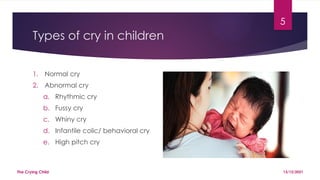
Types of cry in children
1. Normal cry
2. Abnormal cry
a. Rhythmic cry
b. Fussy cry
c. Whiny cry
d. Infantile colic/ behavioral cry
e. High pitch cry
13/12/2021
The Crying Child
6
Abnormal cry
 These are types of babies’ cry that are unusual and
denote abnormality and pathology in the baby, such
as pain or insect bite
 It can be:
ļ‚§ A high pitch cry or
ļ‚§ An incessant or inconsolable cry
13/12/2021
The Crying Child
7
Abnormal cry
A. Rhythmic cry
 This is a repetitive pattern of cry where the baby make sounds like ā€œnehā€
due to the baby trying to suck and putting the tongue on the roof of the
mouth
 It is usually short, low pitched cries that rise and fall
 This type of cry denotes hunger
B. Fussy cry
 This happens when the baby is not hungry and has been in a single
position for long
 They tend to make a fuss with short low pitch cries which can be consoled
by changing their position or giving a new toy. This denote boredom
13/12/2021
The Crying Child
8
Abnormal cry
C. Whiny cry
 This cry is a nasal cry ,that sounds like they are saying ā€œowhā€ and look
like a yawn
 This type of cry builds in intensity with time
 This denotes tiredness and means the baby needs to take a nap

D. Infantile colic/Behavioural cries
 This is defined as a paroxysmal crying of more than 3hours a day
occurring for more than 3days a week lasting for more than 3weeks in
an otherwise healthy child who is older than 3 weeks and younger
than 4 months of age
13/12/2021
The Crying Child
9
Abnormal cry
 Some consider colic as a spectrum ranging between normal cry
and a distinct behavioral syndrome
 Colic is a diagnosis of exclusion made after careful history taking
and clinical examination and ruling out any organic cause
 Colic is the leading of incessant cry
E. High pitch cry
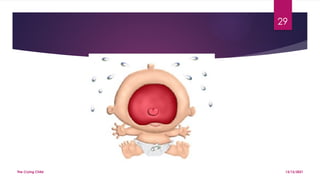
 This type of cry pierces the ears , characterized by loud shrieks
accompanied by a baby arching its back and grunting
 it means a baby is in pain

13/12/2021
The Crying Child
10
Abnormal cry
 This type of cry can also be experienced
after a vaccine shot
 it is usually fierce but shortlived
F. Incessant/inconsolable cry
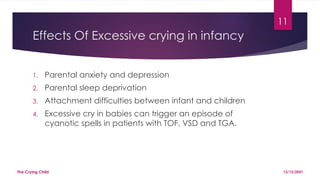
 This is the type of cry that is difficult to
console
 it goes on for a long time with grunts
and stuttering breath after
 This type of cry denotes pain and
significant discomfort
 Infantile colic is the commonest cause
 This type of cry can also be experienced
after a vaccine shot 13/12/2021
The Crying Child
11
Effects Of Excessive crying in infancy
1. Parental anxiety and depression
2. Parental sleep deprivation
3. Attachment difficulties between infant and children
4. Excessive cry in babies can trigger an episode of
cyanotic spells in patients with TOF, VSD and TGA.
13/12/2021
The Crying Child
12
Why is child crying
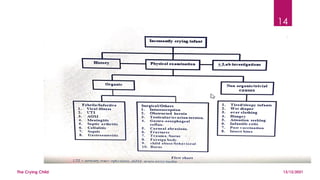
 The causes are divided into
a) Organic
1. Viral illness
2. UTI
3. Meningitis
4. AOM
5. Septic arthritis
6. Cellulitis
7. sepsis
b) Non-organic/trivial cause
1. Hunger
2. Wet diaper
3. Tiredness/sleepiness
4. Attention seeking
5. Infantile colic
6. Overclothing
7. Insect bite/post vaccination
13/12/2021
The Crying Child
13
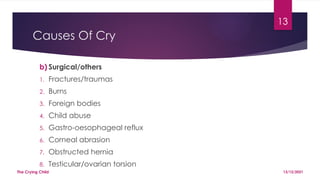
Causes Of Cry
b) Surgical/others
1. Fractures/traumas
2. Burns
3. Foreign bodies
4. Child abuse
5. Gastro-oesophageal reflux
6. Corneal abrasion
7. Obstructed hernia
8. Testicular/ovarian torsion
13/12/2021
The Crying Child
14
13/12/2021
The Crying Child
15
Evaluation of a crying child
 History
 Physical examination
 Investigations
 Treatment
13/12/2021
The Crying Child
16
Evaluation of a crying child
 History
ļ‚§ Comprehensive history taking and physical examination should
be the cornerstone in approaching a crying infant
ļ‚§ Duration
ļ‚§ Frequency
ļ‚§ Periodicity and
ļ‚§ Intensity of crying episodes
ļ‚§ Aggravating and alleviating factors should be recorded
13/12/2021
The Crying Child
17
Evaluation of a crying child
 A good History should also focus on
ļ‚§ Age
ļ‚§ comorbid medical conditions
ļ‚§ sibling and family history
ļ‚§ recent vaccination
ļ‚§ photophobia, feeding and sleeping behaviour
ļ‚§ It is also important to assess the mother – infant relationship,
maternal fatigue and stress
ļ‚§ Parents are excellent observers and are often able to find subtle
signs and symptoms
13/12/2021
The Crying Child
18
Evaluation of a crying child
 Physical examination.
ļ‚§ Physical examination ascertains whether the child is
healthy or ill- looking
ļ‚§ Vital signs should be recorded and the entire body,
including genitals, should be thoroughly inspected
ļ‚§ Eyelids have to be everted for ocular foreign bodies
ļ‚§ Infants who continue to cry throughout the initial
assessment should be observed further and re-
examined during normal periods
13/12/2021
The Crying Child
19
Evaluation of a crying child
For example
 high pitched incessant cry may indicate central nervous
system infection.
 A continuous cry associated with grunting may indicate
respiratory infection / foreign body.
 Screaming with pulling at the ears may indicate AOM
 Intermittent bouts of crying associated with pallor, with the
knees drawn up over the abdomen may indicate
intussusception
 Paroxysmal crying episodes in an otherwise healthy infant less
than 4 months of age typically occurring in the late
afternoon and evening suggest infantile colic
13/12/2021
The Crying Child
20
Evaluation of a crying child
 Detailed observation of cry often gives diagnostic clues
 Physical examination should be systematic including
head to foot examination
 Some parts of examination may be repeated if required
as examining a fussy infant is not easy
13/12/2021
The Crying Child
21
Evaluation of a crying child
 Investigations
 The clinical assessment should guide decision making about sequential
investigations.
 The yield of the laboratory investigations vary with the context of
screening test or confirmation test.
1. Corneal fluorescence test; for screening for corneal abrasion
2. Abdominal ultrasound; intussusception
3. blood cultures; sepsis
4. Urine MCS
5. Stool MCS
6. Gastric washout
7. Ear swab MCS 13/12/2021
The Crying Child
22
Treatment
 Crying is a 'common denominator’ for a variety of illnesses and
physiological disturbances
 Management of these incessant crying episodes will depend on the
diagnosis obtained
 Ruling out apparent causes of crying such as hunger, sleepiness and
tiredness is the first step in treating an infant with persistent crying
 In febrile crying infants with or without a focus of infection, the
management should be based on any standard guidelines for sepsis
work up.
 Other surgical and miscellaneous conditions should be managed
accordingly.
13/12/2021
The Crying Child
23
Treatment
 Treatment strategies for infant colic include drugs, dietary
modifications and behavioral interventions.
 Behavioral interventions should be tried first as it has documented
efficacy.
 If they fail to produce relief, drug and dietary management may
be tried.
 Dicyclomine has been shown to effectively reduce infant crying in
two randomized controlled trial
13/12/2021
The Crying Child
24
Treatment
 Supportive care is very essential when no underlying medical
cause is found
 Mother’s emotional state and the mother–baby relationship should
be addressed
 Ensure that the baby is adequately fed and rested. Some general

measures such as firmly holding the baby, swaddling, massaging,
singing and playing white noise may be tried
 White noise has a soothing effect on crying and irritable infants
13/12/2021
The Crying Child
25
Prevention
 General health promotion and health education.
 Specific protection- immunisation .
 Treatment of specific disease.
 Limitation of disability
 Rehabilitation
13/12/2021
The Crying Child
26
Conclusion
 Crying is a normal part of your baby’s development
and is normal for all babies from all cultural
backgrounds
 An inconsolable cry without any obvious causes such as
hunger, thirst, loneliness, wet diaper, loud noise, requires
detailed search for a medical cause
13/12/2021
The Crying Child
27
References
 The evaluation and management of an incessantly crying infant
Jayavardhana Arumugam1, S Sivandam2, A M Vijayalakshmi3 Sri
Lanka Journal of Child Health 2012; 41(4): 192-198
 Encyclopedia on early childhood education
 Kiwix the medical encyclopedia
13/12/2021
The Crying Child
28
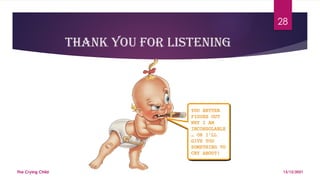
THANK YOU FOR LISTENING
13/12/2021
The Crying Child
The Crying Child
29
13/12/2021
The Crying Child
30
13/12/2021
CLINICAL PRESENTATION
• PARALYTIC POLIOMYELITIS
• Is the least common form (<1%)
• It's characterized by descending asymmetric acute flacid paralysis
(AFP)
• Proximal muscles are affected earlier than the distal muscles
• paralysis starts at hip and proceed towards extremities giving rise to
the characteristics tripod sign (child sits with flexed hip, both arms are
extended towards the back for support
The Crying Child
32
13/12/2021
• Sites involved can be spinal, bulbar or
bulbospinal and the nature of paralysis varies
accordingly
• The disease progression is typically biphasic,
aseptic meningitis occurs followed by recovery
and then fever with paralytic features 1-2 days
after
The Crying Child
33
13/12/2021
• Sites involved can be spinal, bulbar or
bulbospinal and the nature of paralysis
varies accordingly
• The disease progression is typically
biphasic, aseptic meningitis occurs
followed by recovery and then fever with
paralytic features 1-2 days after
The Crying Child
34
13/12/2021
TREATMENT
• There is no specific antiviral treatment for poliomyelitis
• The management is supportive and aim at limiting progression of the
disease
• All intramuscular injections and surgical procedures are
contraindicated during the acute phase of the disease especially in
the first week of the illness as they might result in the progression of
disease
The Crying Child
36
13/12/2021
TREATMENT
• ABORTIVE POLIOMYELITIS
• Supportive treatment with analgesics, sedatives and bed rest untill
child's temperature is normal
• Careful neurologic and musculoskeletal examination should be
performed 2 months later to detect any minor involvement
The Crying Child
38
13/12/2021
TREATMENT
• NONPARALYTIC POLIOMYELITIS
• Similar to that of avortive form
• Analgesics for relief for the discomfort of muscle tightness and spasm
of the neck, trunk and extremities
• Hot packs for 15-30 minutes every 2-4 hours
• Hot tube bath and firm bed
• Patient should be carefully examined every 2 months after apparent
recovery to detect minor residual effect that may cause postural
problems in later years
The Crying Child
40
13/12/2021
• PARALYTIC POLIOMYELITIS
• Mechanical ventilation is often needed in
• patients with bulbar paralysis. Tracheostomy care is
• often needed in patients requiring long-term ventilatory
• support. Phys ical therapy is indicated in cases of
• paralytic disease. In paralytic disease, provide frequent
• mobilization to avoid development of chronic decubitus
• ulcerations. Active and passive motion exercises are
• indicated during the convalescent stage.
The Crying Child
42
13/12/2021
e. Faecal
• impaction is frequent in cases of paralytic disease and
• can be treated with laxatives as soon as it develops. A
• multidisciplinary approach with the Phys iotherapist,
• Pulmonologist, Neurologist, Immunologist, and
• Infectious Diseases Specialist is essential.
• Diet: Patients with poliomyelitis are prone to develop
• constipation, therefore a diet rich in fibre is usually
• indicated.
• Other supportive care: Patients with poliomyelitis may
• develop bladder dysfunction for which catheterization is
• frequently required or manual compression of the
• bladder.
• Prevention; Two types of vaccines
The Crying Child
44
13/12/2021
• GENERAL HEALTH PROMOTION
• Health education
• Environmental sanitation
• Personal hygiene
• SPECIFIC PROTECTION
• ..

3.THE CRYING CHILD paediatric presentation.pptx

  • 1.
    THE CRYING CHILD PRESENTERS:SERIAL NUMBER 44, 58 AND 72 MODERATOR: DR. BABA JIBRIN DEPARTMENT OF PAEDIATRICS USMANU DANFODIYO UNIVERSITY, SOKOTO
  • 2.
    2 Outline  Introduction/definition ofcrying child  Epidemiology  Types of cry  Effect of excessive crying in infants  Why is child crying  Evaluation of a crying child  Conclusion  References 13/12/2021 The Crying Child
  • 3.
    3 Introduction  Crying isthe shedding of tears in response to an emotional state, pain, or physical irritation of the eye  It is the normal physiological response to many stimuli in nonverbal children  In babies, cry has crucial role in soliciting attention and care from adults  A child is a human being between birth and puberty (< 18 years)  Healthy children cry for about 3 hours per day on an average at 6 weeks of age with the peak occurrence between 3 PM and 11 PM  Incessant crying is one of the common reasons for many emergency visits during infancy which often lead to considerable parental stress and anxiety 13/12/2021 The Crying Child
  • 4.
    4 Epidemiology  The incidencevaries from 1.5% to 11.9% depending on the case definitions and age group  It is high in infants below 3 months of age and decreases considerably beyond 6 months of age.  Reported incidence of serious underlying organic causes is around 5 to 10% in babies with incessant crying 13/12/2021 The Crying Child
  • 5.
    5 Types of cryin children 1. Normal cry 2. Abnormal cry a. Rhythmic cry b. Fussy cry c. Whiny cry d. Infantile colic/ behavioral cry e. High pitch cry 13/12/2021 The Crying Child
  • 6.
    6 Abnormal cry  Theseare types of babies’ cry that are unusual and denote abnormality and pathology in the baby, such as pain or insect bite  It can be: ļ‚§ A high pitch cry or ļ‚§ An incessant or inconsolable cry 13/12/2021 The Crying Child
  • 7.
    7 Abnormal cry A. Rhythmiccry  This is a repetitive pattern of cry where the baby make sounds like ā€œnehā€ due to the baby trying to suck and putting the tongue on the roof of the mouth  It is usually short, low pitched cries that rise and fall  This type of cry denotes hunger B. Fussy cry  This happens when the baby is not hungry and has been in a single position for long  They tend to make a fuss with short low pitch cries which can be consoled by changing their position or giving a new toy. This denote boredom 13/12/2021 The Crying Child
  • 8.
    8 Abnormal cry C. Whinycry  This cry is a nasal cry ,that sounds like they are saying ā€œowhā€ and look like a yawn  This type of cry builds in intensity with time  This denotes tiredness and means the baby needs to take a nap D. Infantile colic/Behavioural cries  This is defined as a paroxysmal crying of more than 3hours a day occurring for more than 3days a week lasting for more than 3weeks in an otherwise healthy child who is older than 3 weeks and younger than 4 months of age 13/12/2021 The Crying Child
  • 9.
    9 Abnormal cry  Someconsider colic as a spectrum ranging between normal cry and a distinct behavioral syndrome  Colic is a diagnosis of exclusion made after careful history taking and clinical examination and ruling out any organic cause  Colic is the leading of incessant cry E. High pitch cry  This type of cry pierces the ears , characterized by loud shrieks accompanied by a baby arching its back and grunting  it means a baby is in pain 13/12/2021 The Crying Child
  • 10.
    10 Abnormal cry  Thistype of cry can also be experienced after a vaccine shot  it is usually fierce but shortlived F. Incessant/inconsolable cry  This is the type of cry that is difficult to console  it goes on for a long time with grunts and stuttering breath after  This type of cry denotes pain and significant discomfort  Infantile colic is the commonest cause  This type of cry can also be experienced after a vaccine shot 13/12/2021 The Crying Child
  • 11.
    11 Effects Of Excessivecrying in infancy 1. Parental anxiety and depression 2. Parental sleep deprivation 3. Attachment difficulties between infant and children 4. Excessive cry in babies can trigger an episode of cyanotic spells in patients with TOF, VSD and TGA. 13/12/2021 The Crying Child
  • 12.
    12 Why is childcrying  The causes are divided into a) Organic 1. Viral illness 2. UTI 3. Meningitis 4. AOM 5. Septic arthritis 6. Cellulitis 7. sepsis b) Non-organic/trivial cause 1. Hunger 2. Wet diaper 3. Tiredness/sleepiness 4. Attention seeking 5. Infantile colic 6. Overclothing 7. Insect bite/post vaccination 13/12/2021 The Crying Child
  • 13.
    13 Causes Of Cry b)Surgical/others 1. Fractures/traumas 2. Burns 3. Foreign bodies 4. Child abuse 5. Gastro-oesophageal reflux 6. Corneal abrasion 7. Obstructed hernia 8. Testicular/ovarian torsion 13/12/2021 The Crying Child
  • 14.
  • 15.
    15 Evaluation of acrying child  History  Physical examination  Investigations  Treatment 13/12/2021 The Crying Child
  • 16.
    16 Evaluation of acrying child  History ļ‚§ Comprehensive history taking and physical examination should be the cornerstone in approaching a crying infant ļ‚§ Duration ļ‚§ Frequency ļ‚§ Periodicity and ļ‚§ Intensity of crying episodes ļ‚§ Aggravating and alleviating factors should be recorded 13/12/2021 The Crying Child
  • 17.
    17 Evaluation of acrying child  A good History should also focus on ļ‚§ Age ļ‚§ comorbid medical conditions ļ‚§ sibling and family history ļ‚§ recent vaccination ļ‚§ photophobia, feeding and sleeping behaviour ļ‚§ It is also important to assess the mother – infant relationship, maternal fatigue and stress ļ‚§ Parents are excellent observers and are often able to find subtle signs and symptoms 13/12/2021 The Crying Child
  • 18.
    18 Evaluation of acrying child  Physical examination. ļ‚§ Physical examination ascertains whether the child is healthy or ill- looking ļ‚§ Vital signs should be recorded and the entire body, including genitals, should be thoroughly inspected ļ‚§ Eyelids have to be everted for ocular foreign bodies ļ‚§ Infants who continue to cry throughout the initial assessment should be observed further and re- examined during normal periods 13/12/2021 The Crying Child
  • 19.
    19 Evaluation of acrying child For example  high pitched incessant cry may indicate central nervous system infection.  A continuous cry associated with grunting may indicate respiratory infection / foreign body.  Screaming with pulling at the ears may indicate AOM  Intermittent bouts of crying associated with pallor, with the knees drawn up over the abdomen may indicate intussusception  Paroxysmal crying episodes in an otherwise healthy infant less than 4 months of age typically occurring in the late afternoon and evening suggest infantile colic 13/12/2021 The Crying Child
  • 20.
    20 Evaluation of acrying child  Detailed observation of cry often gives diagnostic clues  Physical examination should be systematic including head to foot examination  Some parts of examination may be repeated if required as examining a fussy infant is not easy 13/12/2021 The Crying Child
  • 21.
    21 Evaluation of acrying child  Investigations  The clinical assessment should guide decision making about sequential investigations.  The yield of the laboratory investigations vary with the context of screening test or confirmation test. 1. Corneal fluorescence test; for screening for corneal abrasion 2. Abdominal ultrasound; intussusception 3. blood cultures; sepsis 4. Urine MCS 5. Stool MCS 6. Gastric washout 7. Ear swab MCS 13/12/2021 The Crying Child
  • 22.
    22 Treatment  Crying isa 'common denominator’ for a variety of illnesses and physiological disturbances  Management of these incessant crying episodes will depend on the diagnosis obtained  Ruling out apparent causes of crying such as hunger, sleepiness and tiredness is the first step in treating an infant with persistent crying  In febrile crying infants with or without a focus of infection, the management should be based on any standard guidelines for sepsis work up.  Other surgical and miscellaneous conditions should be managed accordingly. 13/12/2021 The Crying Child
  • 23.
    23 Treatment  Treatment strategiesfor infant colic include drugs, dietary modifications and behavioral interventions.  Behavioral interventions should be tried first as it has documented efficacy.  If they fail to produce relief, drug and dietary management may be tried.  Dicyclomine has been shown to effectively reduce infant crying in two randomized controlled trial 13/12/2021 The Crying Child
  • 24.
    24 Treatment  Supportive careis very essential when no underlying medical cause is found  Mother’s emotional state and the mother–baby relationship should be addressed  Ensure that the baby is adequately fed and rested. Some general measures such as firmly holding the baby, swaddling, massaging, singing and playing white noise may be tried  White noise has a soothing effect on crying and irritable infants 13/12/2021 The Crying Child
  • 25.
    25 Prevention  General healthpromotion and health education.  Specific protection- immunisation .  Treatment of specific disease.  Limitation of disability  Rehabilitation 13/12/2021 The Crying Child
  • 26.
    26 Conclusion  Crying isa normal part of your baby’s development and is normal for all babies from all cultural backgrounds  An inconsolable cry without any obvious causes such as hunger, thirst, loneliness, wet diaper, loud noise, requires detailed search for a medical cause 13/12/2021 The Crying Child
  • 27.
    27 References  The evaluationand management of an incessantly crying infant Jayavardhana Arumugam1, S Sivandam2, A M Vijayalakshmi3 Sri Lanka Journal of Child Health 2012; 41(4): 192-198  Encyclopedia on early childhood education  Kiwix the medical encyclopedia 13/12/2021 The Crying Child
  • 28.
    28 THANK YOU FORLISTENING 13/12/2021 The Crying Child
  • 29.
  • 30.
  • 31.
    CLINICAL PRESENTATION • PARALYTICPOLIOMYELITIS • Is the least common form (<1%) • It's characterized by descending asymmetric acute flacid paralysis (AFP) • Proximal muscles are affected earlier than the distal muscles • paralysis starts at hip and proceed towards extremities giving rise to the characteristics tripod sign (child sits with flexed hip, both arms are extended towards the back for support
  • 32.
    The Crying Child 32 13/12/2021 •Sites involved can be spinal, bulbar or bulbospinal and the nature of paralysis varies accordingly • The disease progression is typically biphasic, aseptic meningitis occurs followed by recovery and then fever with paralytic features 1-2 days after
  • 33.
    The Crying Child 33 13/12/2021 •Sites involved can be spinal, bulbar or bulbospinal and the nature of paralysis varies accordingly • The disease progression is typically biphasic, aseptic meningitis occurs followed by recovery and then fever with paralytic features 1-2 days after
  • 34.
  • 35.
    TREATMENT • There isno specific antiviral treatment for poliomyelitis • The management is supportive and aim at limiting progression of the disease • All intramuscular injections and surgical procedures are contraindicated during the acute phase of the disease especially in the first week of the illness as they might result in the progression of disease
  • 36.
  • 37.
    TREATMENT • ABORTIVE POLIOMYELITIS •Supportive treatment with analgesics, sedatives and bed rest untill child's temperature is normal • Careful neurologic and musculoskeletal examination should be performed 2 months later to detect any minor involvement
  • 38.
  • 39.
    TREATMENT • NONPARALYTIC POLIOMYELITIS •Similar to that of avortive form • Analgesics for relief for the discomfort of muscle tightness and spasm of the neck, trunk and extremities • Hot packs for 15-30 minutes every 2-4 hours • Hot tube bath and firm bed • Patient should be carefully examined every 2 months after apparent recovery to detect minor residual effect that may cause postural problems in later years
  • 40.
  • 41.
    • PARALYTIC POLIOMYELITIS •Mechanical ventilation is often needed in • patients with bulbar paralysis. Tracheostomy care is • often needed in patients requiring long-term ventilatory • support. Phys ical therapy is indicated in cases of • paralytic disease. In paralytic disease, provide frequent • mobilization to avoid development of chronic decubitus • ulcerations. Active and passive motion exercises are • indicated during the convalescent stage.
  • 42.
  • 43.
    e. Faecal • impactionis frequent in cases of paralytic disease and • can be treated with laxatives as soon as it develops. A • multidisciplinary approach with the Phys iotherapist, • Pulmonologist, Neurologist, Immunologist, and • Infectious Diseases Specialist is essential. • Diet: Patients with poliomyelitis are prone to develop • constipation, therefore a diet rich in fibre is usually • indicated. • Other supportive care: Patients with poliomyelitis may • develop bladder dysfunction for which catheterization is • frequently required or manual compression of the • bladder. • Prevention; Two types of vaccines
  • 44.
    The Crying Child 44 13/12/2021 •GENERAL HEALTH PROMOTION • Health education • Environmental sanitation • Personal hygiene • SPECIFIC PROTECTION • ..

Editor's Notes

  • #21Ā If there are no clues in the patient's history or by physical examination suggesting a specific infection or area of suspicion, it is unlikely that diagnostic studies will be helpful in identifying the aetiology. A period of observation or follow up would be desirable in those cases till diagnosis is established. At times negative results help in ruling out serious illness and for reassurance before discharge.
  • #23Ā Risk of apnoea and seizures should be considered before recommending dicyclomine
  • #24Ā . Parents and care givers should be given an explanation about normal crying and sleep patterns, and to recognize needs and discomforts of the baby