David Shanks
Mid-America Environmental Compliance Conference
3 April 2014
Solvent Wipe Exclusion
 Conditional exclusion
from hazardous waste
rules
 Final rule 31July
2013
 40 CFR 261.4
 (a)(26) reused wipes
 (b)(18) disposable
 Not effective in
authorized states until
adopted
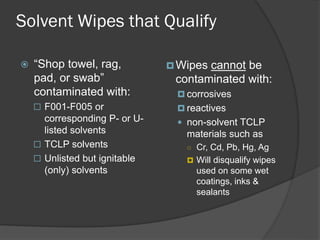
Solvent Wipes that Qualify
 “Shop towel, rag,
pad, or swab”
contaminated with:
 F001-F005 or
corresponding P- or U-
listed solvents
 TCLP solvents
 Unlisted but ignitable
(only) solvents
Wipes cannot be
contaminated with:
 corrosives
 reactives
 non-solvent TCLP
materials such as
○ Cr, Cd, Pb, Hg, Ag
 Will disqualify wipes
used on some wet
coatings, inks &
sealants
Accumulation Requirements
Time limit:
May accumulate “up to 180 days from start date
of accumulation for each container prior to being
sent” for disposal/cleaning
No separate storage area timeframes
 No free liquids in container (paint filter test)
 “…at the point of being transported for disposal
or cleaning”
 Non-leaking closed container, marked
“Excluded Solvent-Contaminated Wipes”
Closed Containers
Hazardous Waste Rules Solvent Wipe Rule
40 CFR 265.173(a)
Container must be “closed”
 MO relies on 12/3/09 and
11/3/11 EPA Closed
Container Guidance:
○ For solvent-contaminated wipes
without free liquids: “…complete
contact between the lid and the
rim all the way around the top”
pg. 11
 KS guidance HW-2005-G1
○ KDHE says it parallels federal
wipes rule, but beware of “end of
shift” closure in HW-2005-G1
40 CFR 261.4(a)(26)(i)
 “…container is considered closed
when there is complete contact
between the fitted lid and the rim…
 …when wipes are no longer being
accumulated or when the container
is being transported, the container
must be sealed with all lids properly
and securely affixed to the
container and all openings tightly
bound or closed sufficiently to
prevent leaks and emissions”
Disposal/Laundry Requirements
Disposable Wipes (cannot
contain trichloroethylene)
Reusable Wipes
 Regulated municipal
(MSW) or hazardous
waste landfill or
 Regulated municipal,
hazardous waste, or BIF
combustor
 Laundry or dry cleaning
facility
 Any wastewater discharge
must be CWA-regulated
 State guidance documents
generally already required
CWA regulated discharges
○ MO: hazardous waste
program publication 146
www.dnr.mo.gov/pubs/pub146.pdf
○ KS: HW-1995-G2
Other Disposal Options
 Under this rule, generators are allowed to:
 Continue managing qualifying wipes on-site and
off-site as fully regulated hazardous waste, or
 Manage wipes on-site under conditionally
excluded waste rules, but send them to a RCRA
TSD facility. A viable option if:
○ Company-specific disposal policy or practice
dictates TSDF disposal, or
○ Sanitary landfill or BIF operator does not accept
conditionally exempt solvent wipes
- Kansas Tech. Guidance Doc. HW-1995-G2 lists 18 KS
municipal landfills that can accept disposable wipes
Paperwork
 No hazardous waste manifest required
 DOT compliance
 Virgin pre-moistened wipes are generally shipped
as ORM-D Consumer Commodity.
 Do used solvent wipes need shipping papers?
 Some used wipes may be “solids containing
flammable liquids, n.o.s.”
 Depends on solvent
 See 49 CFR 172.102, Special Provision 47
Paperwork
 Recordkeeping for condition exemption:
Name and address of receiving facility
Description of process used to ensure no free
liquids at the point of being transported
Documentation of compliance with 180 day time
limit
 Can take many forms, such as: service contract or
invoices that describe frequency of pickup, log of
container start dates, or accumulation start date
labels on each container. EPA preamble pg. 46459.
State Adoption
 Effective in Iowa
 on federal rule effective date of Jan. 31, 2014
 Authorized states can choose whether to adopt
this federal exclusion
 KS adoption in work, but KDHE Mgt Policy 2013-P3
allows use of federal exclusion after Jan. 31, 2014
 MO: part of 2014 proposal package. Commission
approved necessity finding Feb. 20, 2014
 NE plans to adopt, but March 2014 guidance says:
○ follow haz waste rules for disposables and NDEQ
guidance for reusables (CWA & closed containers) until
then
 Elsewhere: final in FL, proposed in MS and IL
Environmental Protection
 EPA risk assessment work for MSW landfill
and combustor disposal was extensive
○ First proposed 2003
○ More detailed risk assessment and Notice of Data
Availability released in 2009
 Comments were extensive, due to battle between
industrial laundries and disposable wipe manufacturers
over market share
○ Risk assessment updated in 2012. TCE risk re-
evaluated.
 Result: lined sanitary landfills and MSW combustors
prevent migration/releases of solvent in used wipes
(other than TCE)
Solvent Wipe Take-Aways
 Watch for KS, MO, & NE rulemaking
 Consider whether the conditional exclusion is
worth the effort
 Not all wipes qualify
 For low volume shops, 180 day time limit may be less than your
present satellite area accumulation time
 Risk of employee confusion if an additional type of waste
management is in the same work area as ordinary hazardous
waste
 EPA estimated national cost saving: $21.7 to
$27.8 million/year

Federal Solvent Wipe Rule; Shanks, David; Boeing; 2014 Mid-America Environmental Compliance Seminar in Overland Park, KS, April 3-4

  • 1.
    David Shanks Mid-America EnvironmentalCompliance Conference 3 April 2014
  • 2.
    Solvent Wipe Exclusion Conditional exclusion from hazardous waste rules  Final rule 31July 2013  40 CFR 261.4  (a)(26) reused wipes  (b)(18) disposable  Not effective in authorized states until adopted
  • 3.
    Solvent Wipes thatQualify  “Shop towel, rag, pad, or swab” contaminated with:  F001-F005 or corresponding P- or U- listed solvents  TCLP solvents  Unlisted but ignitable (only) solvents Wipes cannot be contaminated with:  corrosives  reactives  non-solvent TCLP materials such as ○ Cr, Cd, Pb, Hg, Ag  Will disqualify wipes used on some wet coatings, inks & sealants
  • 4.
    Accumulation Requirements Time limit: Mayaccumulate “up to 180 days from start date of accumulation for each container prior to being sent” for disposal/cleaning No separate storage area timeframes  No free liquids in container (paint filter test)  “…at the point of being transported for disposal or cleaning”  Non-leaking closed container, marked “Excluded Solvent-Contaminated Wipes”
  • 5.
    Closed Containers Hazardous WasteRules Solvent Wipe Rule 40 CFR 265.173(a) Container must be “closed”  MO relies on 12/3/09 and 11/3/11 EPA Closed Container Guidance: ○ For solvent-contaminated wipes without free liquids: “…complete contact between the lid and the rim all the way around the top” pg. 11  KS guidance HW-2005-G1 ○ KDHE says it parallels federal wipes rule, but beware of “end of shift” closure in HW-2005-G1 40 CFR 261.4(a)(26)(i)  “…container is considered closed when there is complete contact between the fitted lid and the rim…  …when wipes are no longer being accumulated or when the container is being transported, the container must be sealed with all lids properly and securely affixed to the container and all openings tightly bound or closed sufficiently to prevent leaks and emissions”
  • 6.
    Disposal/Laundry Requirements Disposable Wipes(cannot contain trichloroethylene) Reusable Wipes  Regulated municipal (MSW) or hazardous waste landfill or  Regulated municipal, hazardous waste, or BIF combustor  Laundry or dry cleaning facility  Any wastewater discharge must be CWA-regulated  State guidance documents generally already required CWA regulated discharges ○ MO: hazardous waste program publication 146 www.dnr.mo.gov/pubs/pub146.pdf ○ KS: HW-1995-G2
  • 7.
    Other Disposal Options Under this rule, generators are allowed to:  Continue managing qualifying wipes on-site and off-site as fully regulated hazardous waste, or  Manage wipes on-site under conditionally excluded waste rules, but send them to a RCRA TSD facility. A viable option if: ○ Company-specific disposal policy or practice dictates TSDF disposal, or ○ Sanitary landfill or BIF operator does not accept conditionally exempt solvent wipes - Kansas Tech. Guidance Doc. HW-1995-G2 lists 18 KS municipal landfills that can accept disposable wipes
  • 8.
    Paperwork  No hazardouswaste manifest required  DOT compliance  Virgin pre-moistened wipes are generally shipped as ORM-D Consumer Commodity.  Do used solvent wipes need shipping papers?  Some used wipes may be “solids containing flammable liquids, n.o.s.”  Depends on solvent  See 49 CFR 172.102, Special Provision 47
  • 9.
    Paperwork  Recordkeeping forcondition exemption: Name and address of receiving facility Description of process used to ensure no free liquids at the point of being transported Documentation of compliance with 180 day time limit  Can take many forms, such as: service contract or invoices that describe frequency of pickup, log of container start dates, or accumulation start date labels on each container. EPA preamble pg. 46459.
  • 10.
    State Adoption  Effectivein Iowa  on federal rule effective date of Jan. 31, 2014  Authorized states can choose whether to adopt this federal exclusion  KS adoption in work, but KDHE Mgt Policy 2013-P3 allows use of federal exclusion after Jan. 31, 2014  MO: part of 2014 proposal package. Commission approved necessity finding Feb. 20, 2014  NE plans to adopt, but March 2014 guidance says: ○ follow haz waste rules for disposables and NDEQ guidance for reusables (CWA & closed containers) until then  Elsewhere: final in FL, proposed in MS and IL
  • 11.
    Environmental Protection  EPArisk assessment work for MSW landfill and combustor disposal was extensive ○ First proposed 2003 ○ More detailed risk assessment and Notice of Data Availability released in 2009  Comments were extensive, due to battle between industrial laundries and disposable wipe manufacturers over market share ○ Risk assessment updated in 2012. TCE risk re- evaluated.  Result: lined sanitary landfills and MSW combustors prevent migration/releases of solvent in used wipes (other than TCE)
  • 12.
    Solvent Wipe Take-Aways Watch for KS, MO, & NE rulemaking  Consider whether the conditional exclusion is worth the effort  Not all wipes qualify  For low volume shops, 180 day time limit may be less than your present satellite area accumulation time  Risk of employee confusion if an additional type of waste management is in the same work area as ordinary hazardous waste  EPA estimated national cost saving: $21.7 to $27.8 million/year