3G module tutorial


                                                   Linux
       Plug in the device, and execute dmesg in console. With this we can see if we have
the drivers of the device installed or not.

     $:/etc$ dmesg
     generic-usb 0003:05C6:F006.0003: hiddev96,hidraw2: USB HID v1.10 Device
     [SimTech, Incorporated SimTech SIM5218] on usb-0000:00:1d.1-1/input0


         Not recognize the device, we install the necessary drivers.

         Execute lsusb, this command show a list of devices connected to USB port:

         $:/etc$ lsusb
               Bus 005   Device      001:   ID   1d6b:0001   Linux Foundation 1.1 root hub
               Bus 004   Device      001:   ID   1d6b:0001   Linux Foundation 1.1 root hub
               Bus 003   Device      008:   ID   05c6:f006   Qualcomm, Inc.
               Bus 003   Device      001:   ID   1d6b:0001   Linux Foundation 1.1 root hub
               Bus 002   Device      002:   ID   0e6a:6001   Megawin Technology Co., Ltd
               Bus 002   Device      001:   ID   1d6b:0001   Linux Foundation 1.1 root hub
               Bus 001   Device      001:   ID   1d6b:0002   Linux Foundation 2.0 root hub


         In this list, we can see:
                the vendor: 0x05c6
                the product: 0xf006

       With this parameters we will configure the file modules in path /etc/. For
configuring we have to execute:
         $:sudo gedit /etc/modules


     #   /etc/modules: kernel modules to load at boot time.
     #
     #   This file contains the names of kernel modules that should be loaded
     #   at boot time, one per line. Lines beginning with "#" are ignored.
     #   Parameters can be specified after the module name.

     lp

     usbserial vendor=0x05c6 product=0xf006


                                                     - 1-
3G module tutorial


       Execute dmesg:

[   2210.084352]   generic ttyUSB0: generic converter now disconnected from ttyUSB0
[   2210.084373]   usbserial_generic 1-3:1.0: device disconnected
[   2215.008545]   usb 1-3: new high speed USB device using ehci_hcd and address 5
[   2215.142637]   usb 1-3: configuration #1 chosen from 1 choice
[   2215.145180]   usbserial_generic 1-3:1.0: generic converter detected
[   2215.145280]   usb 1-3: generic converter now attached to ttyUSB0
[   2215.145361]   usbserial_generic 1-3:1.1: generic converter detected
[   2215.145436]   usb 1-3: generic converter now attached to ttyUSB1
[   2215.145515]   usbserial_generic 1-3:1.2: generic converter detected
[   2215.145591]   usb 1-3: generic converter now attached to ttyUSB2
[   2215.145678]   usbserial_generic 1-3:1.3: generic converter detected
[   2215.145758]   usb 1-3: generic converter now attached to ttyUSB3
[   2215.145853]   usbserial_generic 1-3:1.4: generic converter detected
[   2215.145933]   usb 1-3: generic converter now attached to ttyUSB4


       We can communicate with the device using AT commands, for this we use Cutecom
for example:


                                          - 2-
3G module tutorial


       Now the computer recognize the module SIM5218. We can use this module in
different ways.

       For use as a modem, we must follow these steps:

   •   Installing Wvdial in our Linux distribution, if not installed:
       sudo apt-get install wvdial

   •   Configuring WvDial:

       1. Once you have run wvdialconf, you need to edit the /etc/wvdial.conf file to
          reflect the phone number to dial, and your username and password.
       2. Open up /etc/wvdial.conf in your favorite text editor. It should look something like
          this:

                           [Dialer]
                           Modem = /dev/ttyUSB2
                           Modem Type = Analog Modem
                           Baud = 115200
                           ISDN = 0
                           Stupid mode = 1
                           Idle Seconds = 0
                           Init2 = ATZ
                           Init4 = AT+CGDCONT=1,"IP","my_APN"
                           Password = "my_password"
                           Phone = number of telephone
                           Username = "my_username"
                           Dial Command = ATD


       3. Save your changes and exit out of the text editor.


                                                - 3-
3G module tutorial


  •   Run wvdial


$:/etc$ wvdial /etc/wvdial.conf
--> WvDial: Internet dialer version 1.60
--> Warning: section [Dialer /etc/wvdial.conf] does not exist in wvdial.conf.
--> Cannot get information for serial port.
--> Initializing modem.
--> Sending: ATZ
ATZ
OK
--> Sending: ATZ
ATZ
OK
--> Sending: AT+CGDCONT=1,"IP","internet"
AT+CGDCONT=1,"IP","internet"
OK
--> Modem initialized.
--> Sending: ATD*99***1#
--> Waiting for carrier.
ATD*99***1#
CONNECT 115200


                                     - 4-
3G module tutorial


                                     Windows XP


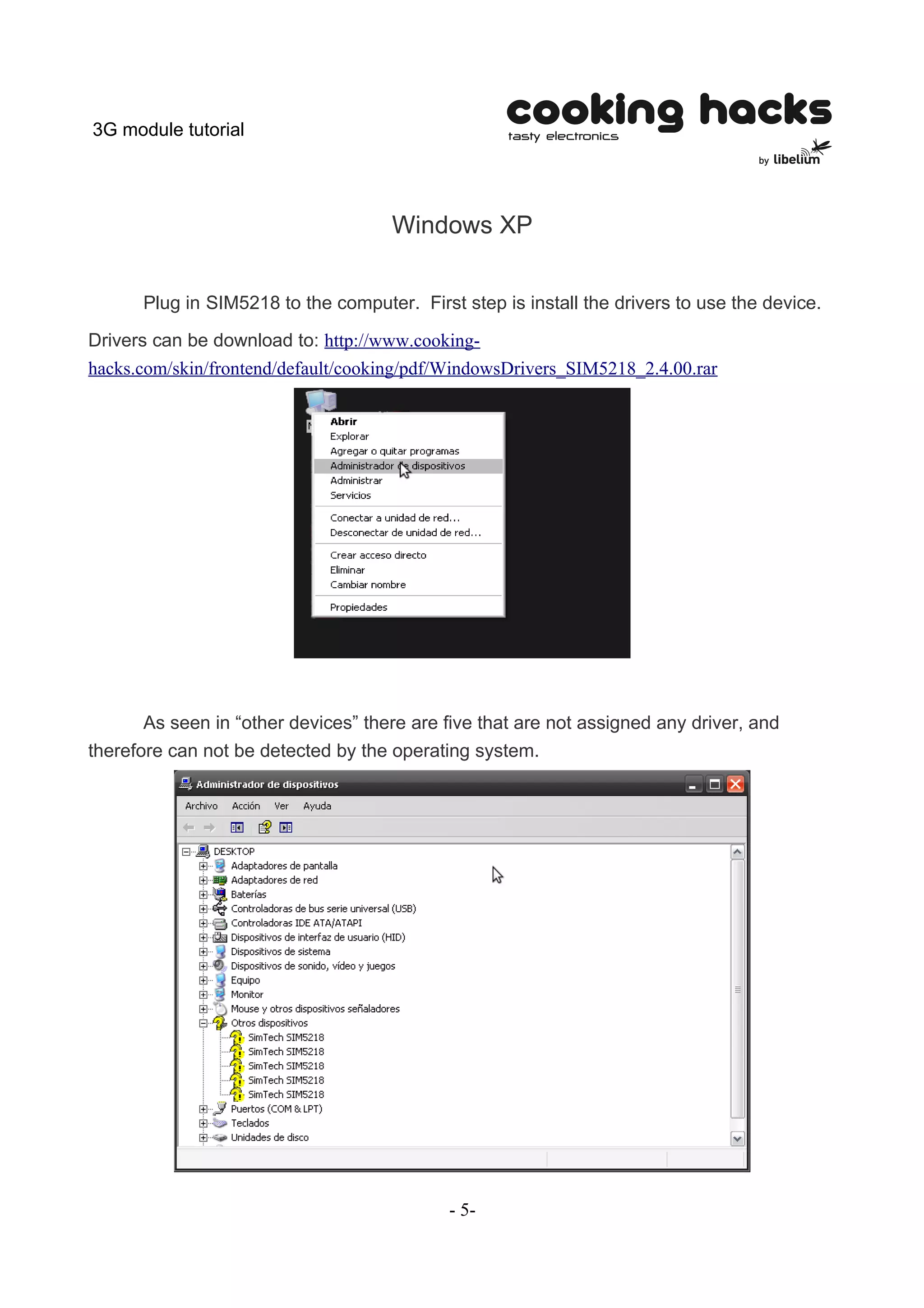
      Plug in SIM5218 to the computer. First step is install the drivers to use the device.

Drivers can be download to: http://www.cooking-
hacks.com/skin/frontend/default/cooking/pdf/WindowsDrivers_SIM5218_2.4.00.rar


       As seen in “other devices” there are five that are not assigned any driver, and
therefore can not be detected by the operating system.


                                            - 5-
3G module tutorial


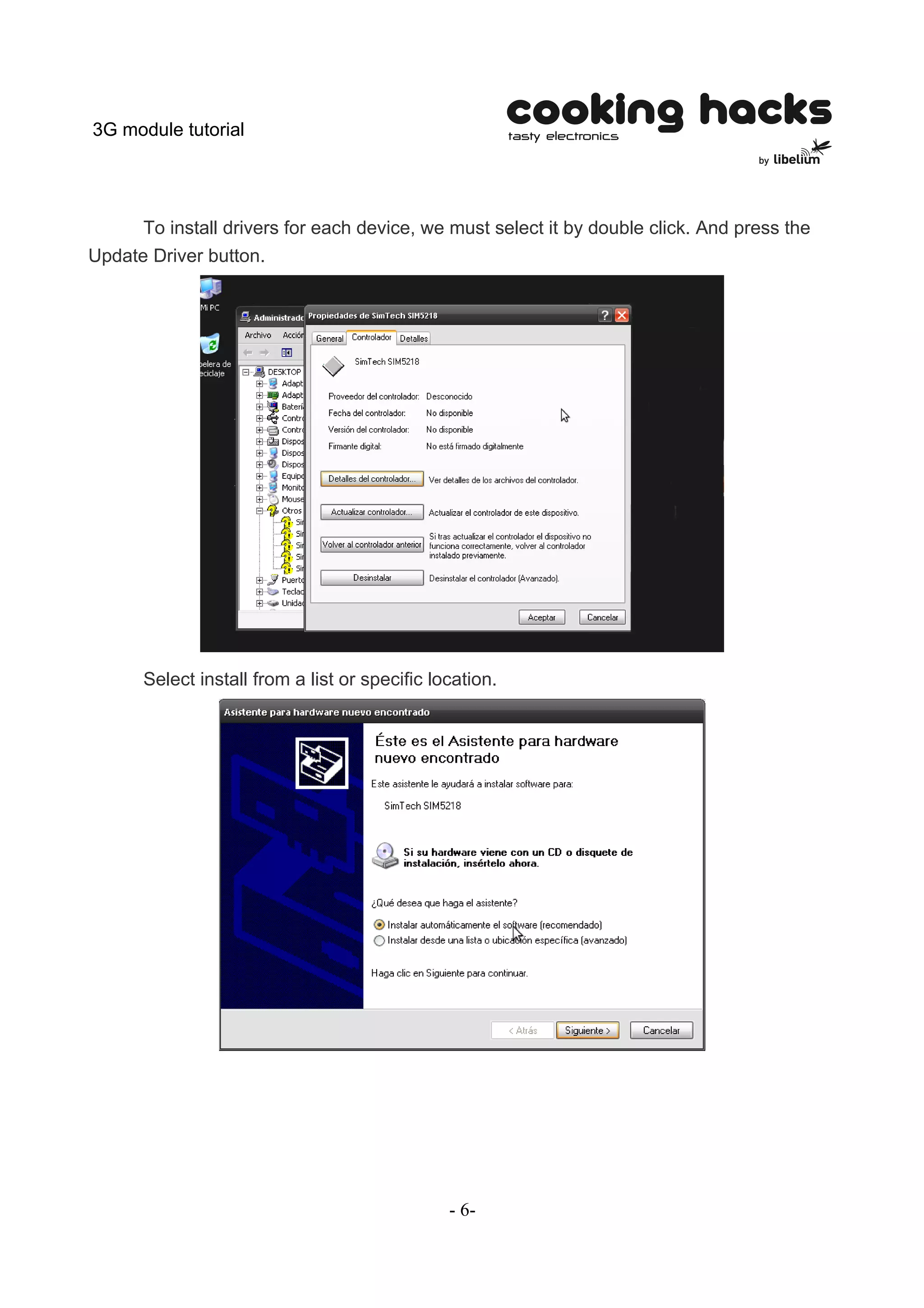
      To install drivers for each device, we must select it by double click. And press the
Update Driver button.


      Select install from a list or specific location.


                                               - 6-
3G module tutorial


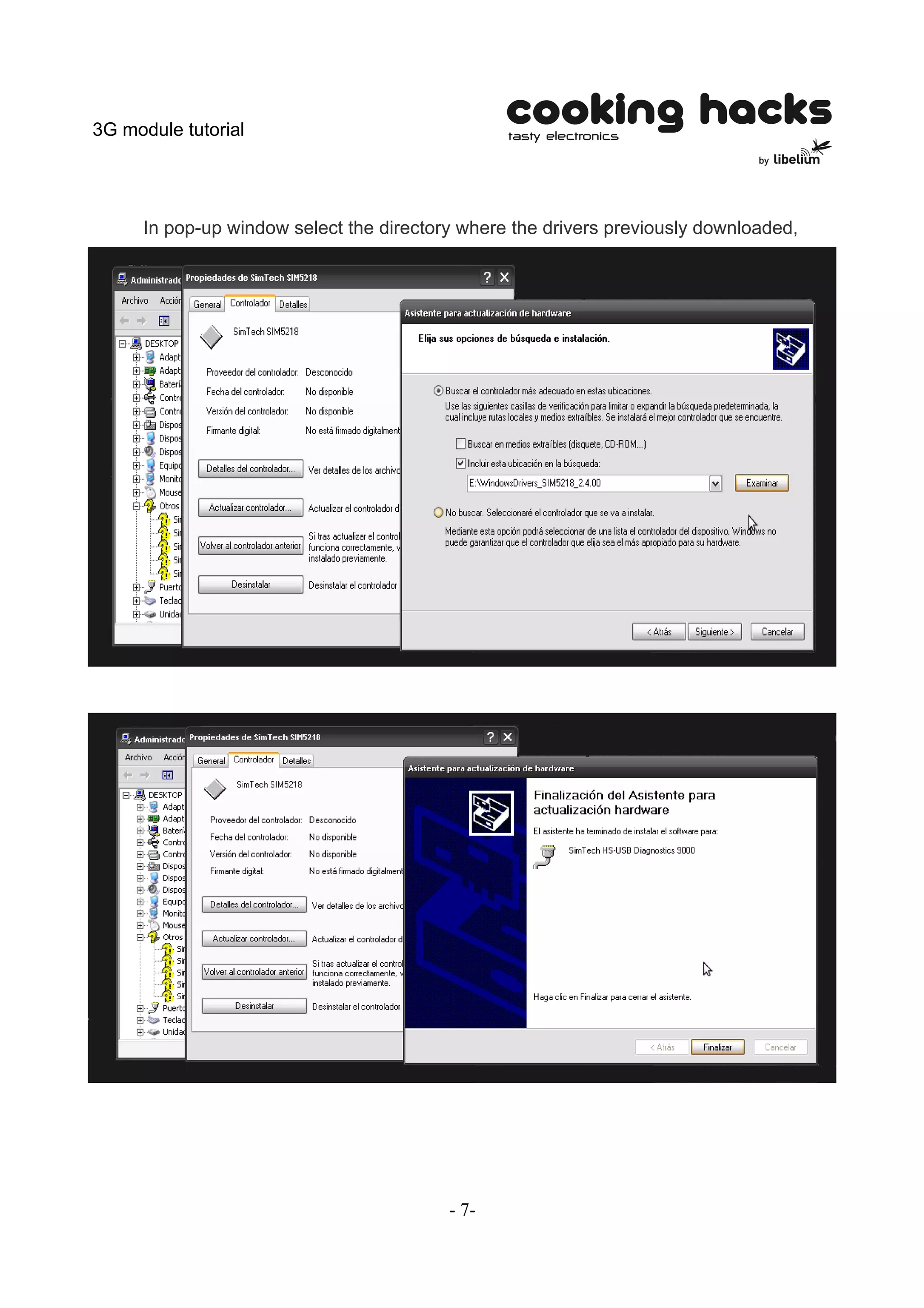
      In pop-up window select the directory where the drivers previously downloaded,


                                          - 7-
3G module tutorial


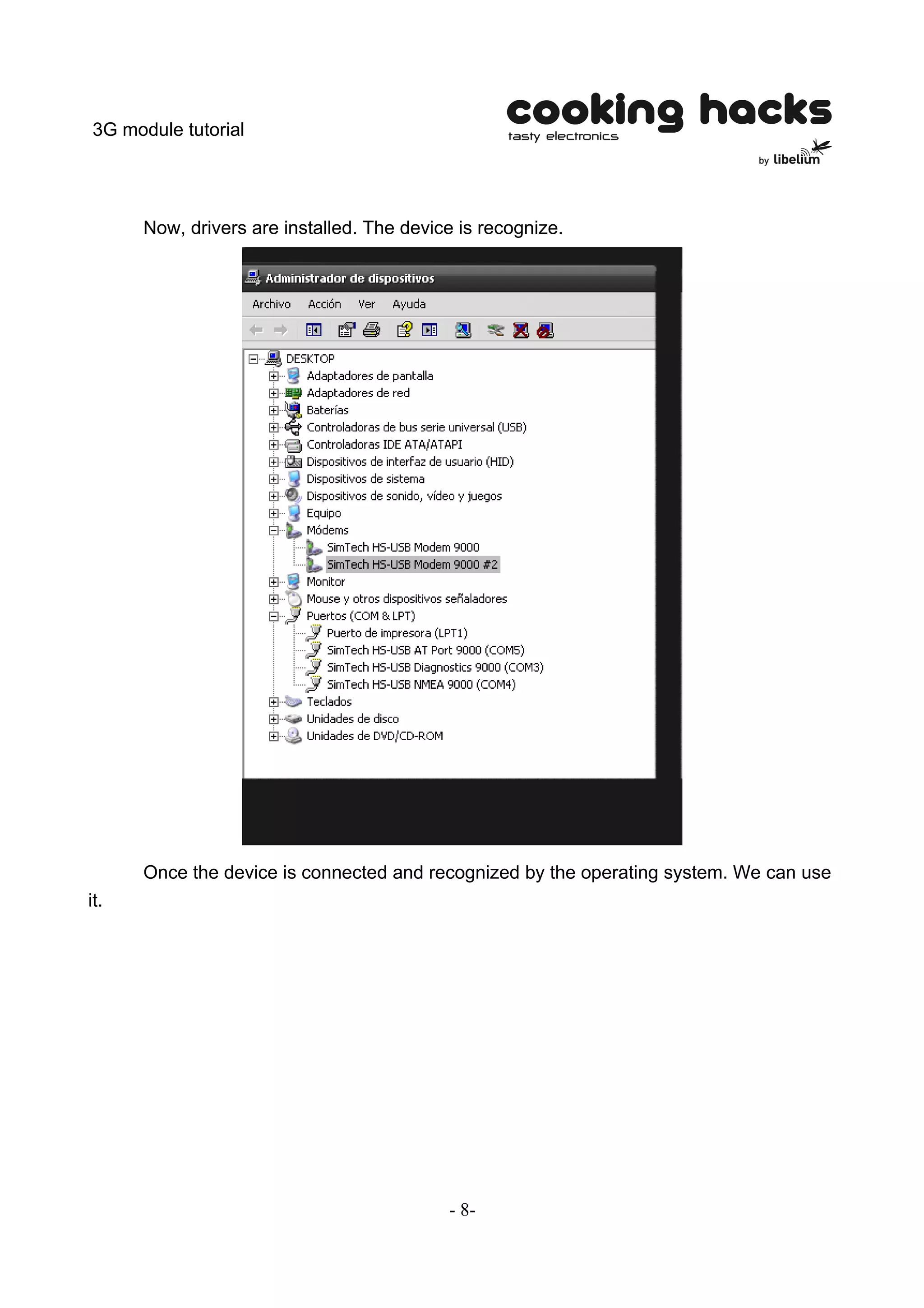
      Now, drivers are installed. The device is recognize.


      Once the device is connected and recognized by the operating system. We can use
it.


                                           - 8-
3G module tutorial


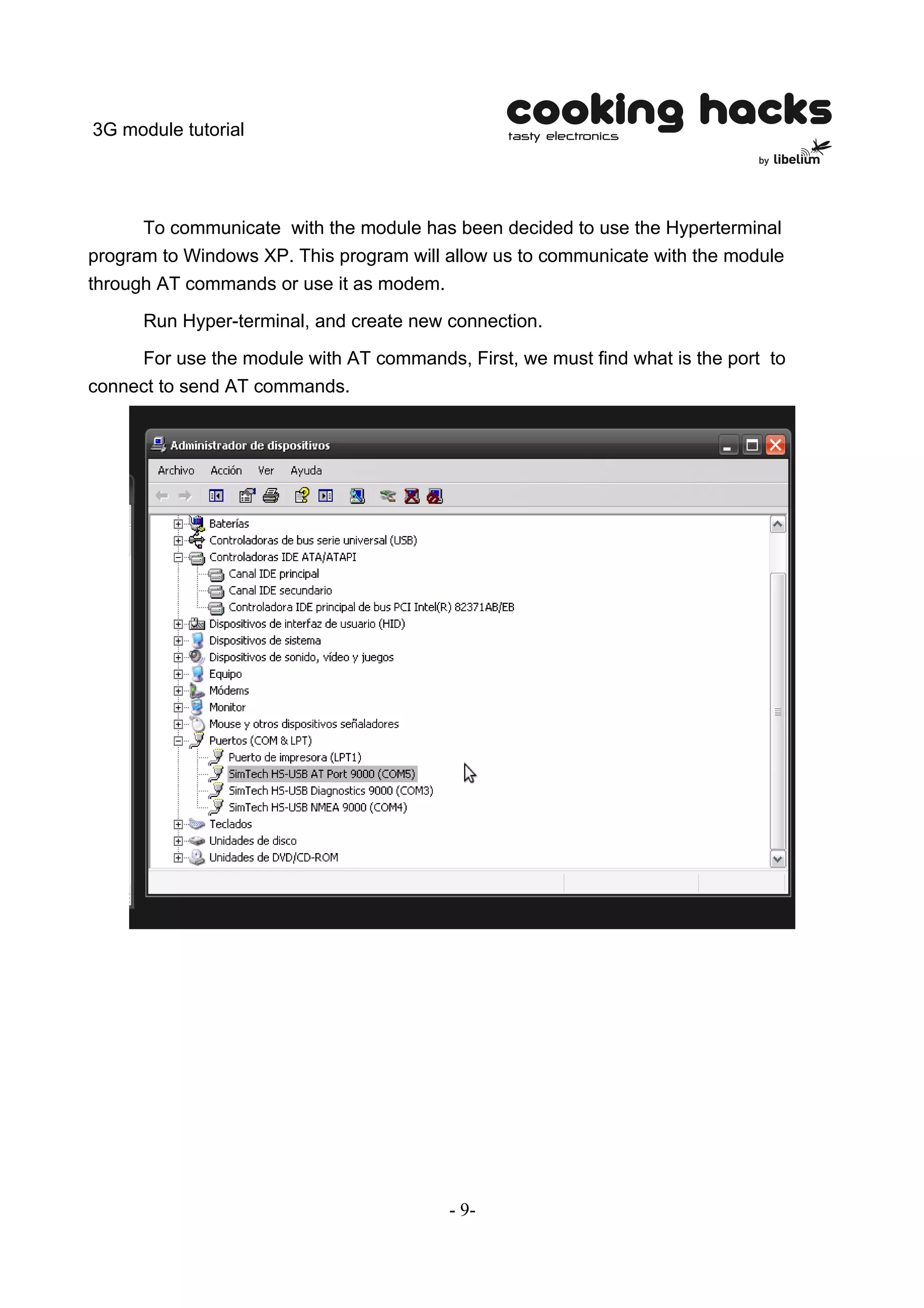
      To communicate with the module has been decided to use the Hyperterminal
program to Windows XP. This program will allow us to communicate with the module
through AT commands or use it as modem.

      Run Hyper-terminal, and create new connection.

     For use the module with AT commands, First, we must find what is the port to
connect to send AT commands.


                                         - 9-
3G module tutorial


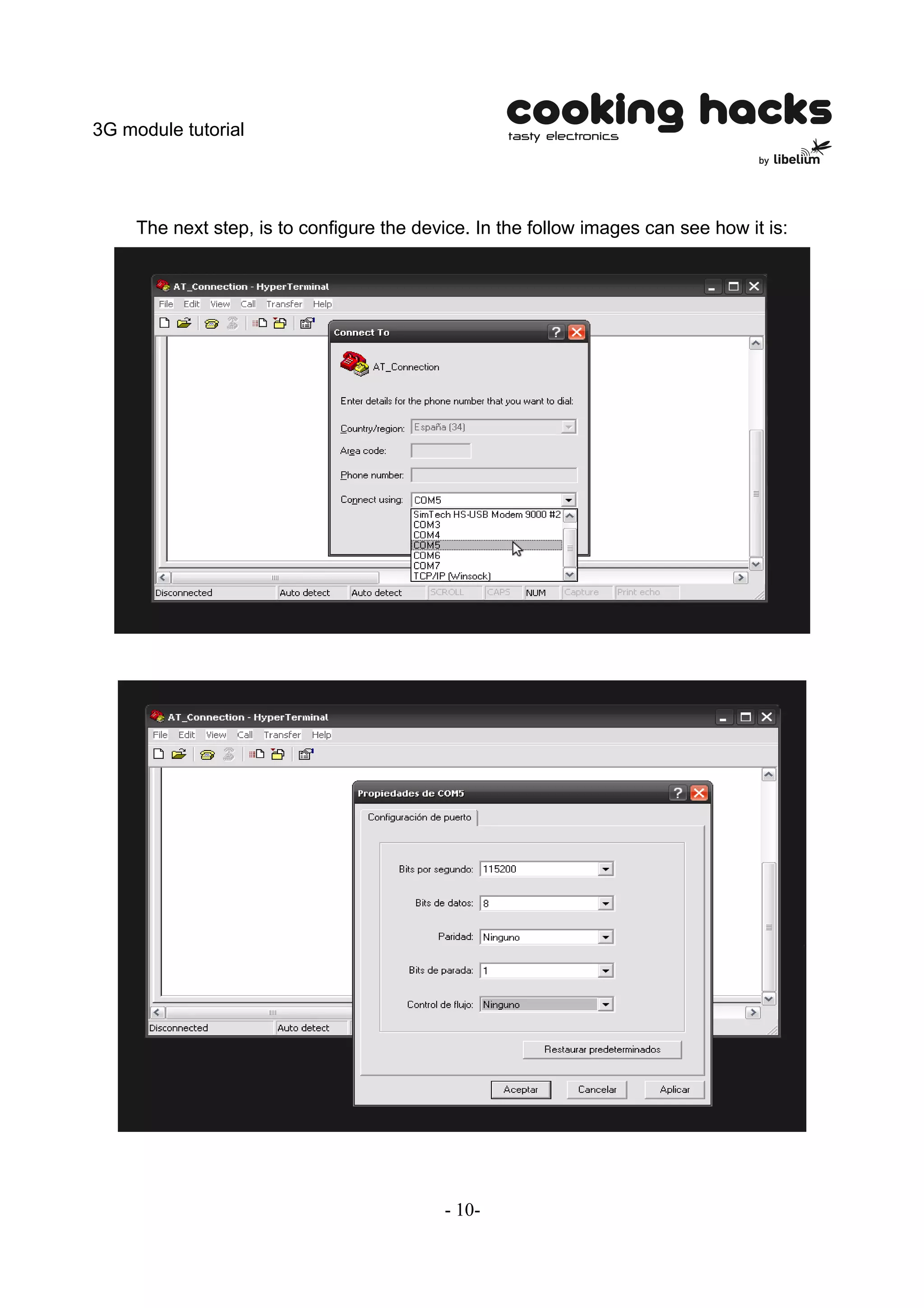
     The next step, is to configure the device. In the follow images can see how it is:


                                           - 10-
3G module tutorial


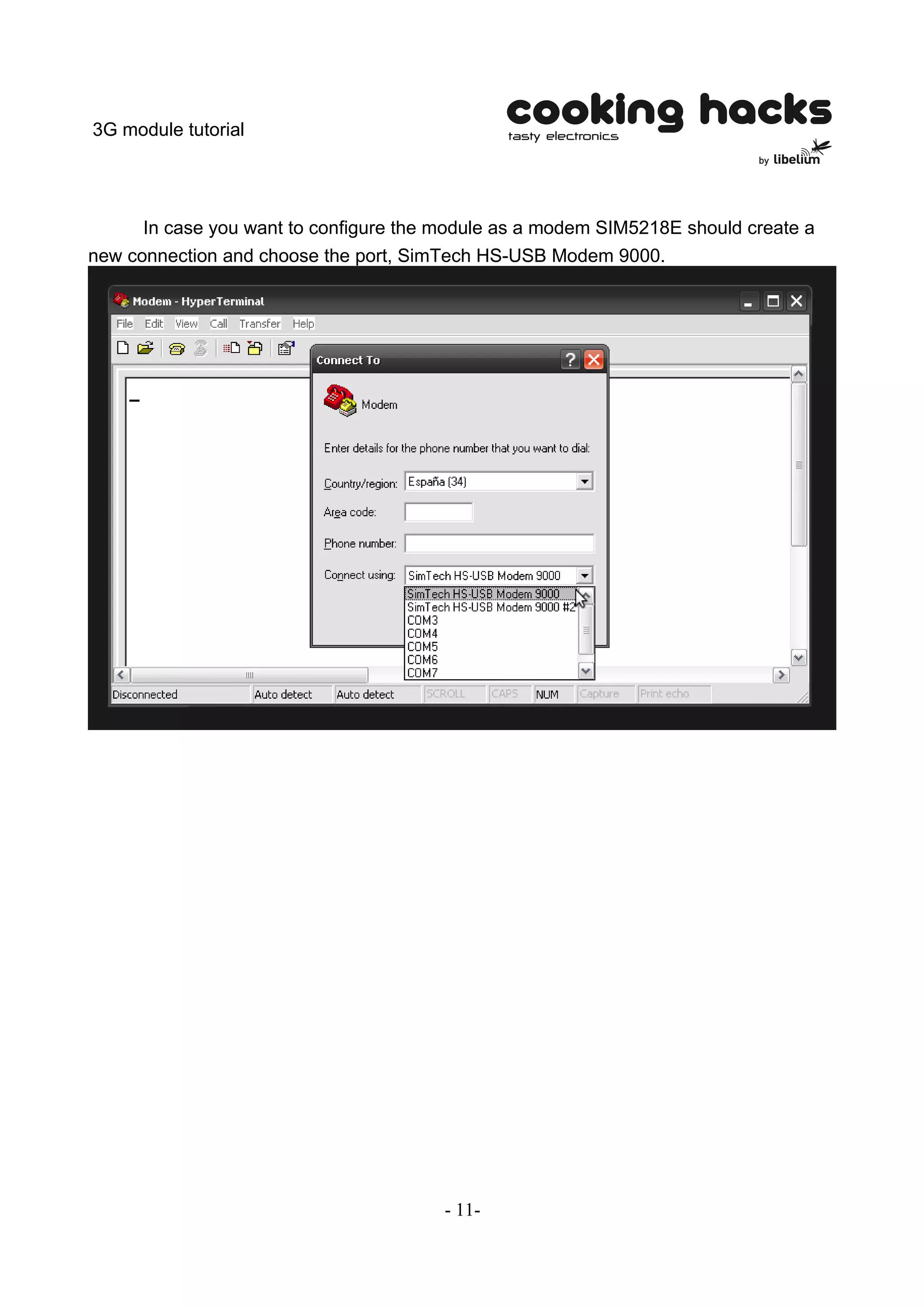
      In case you want to configure the module as a modem SIM5218E should create a
new connection and choose the port, SimTech HS-USB Modem 9000.


                                        - 11-
3G module tutorial


                                      Windows 7


     Plug in SIM5218 to the computer. Check drivers are installed, if they is not installed,
you must do it.

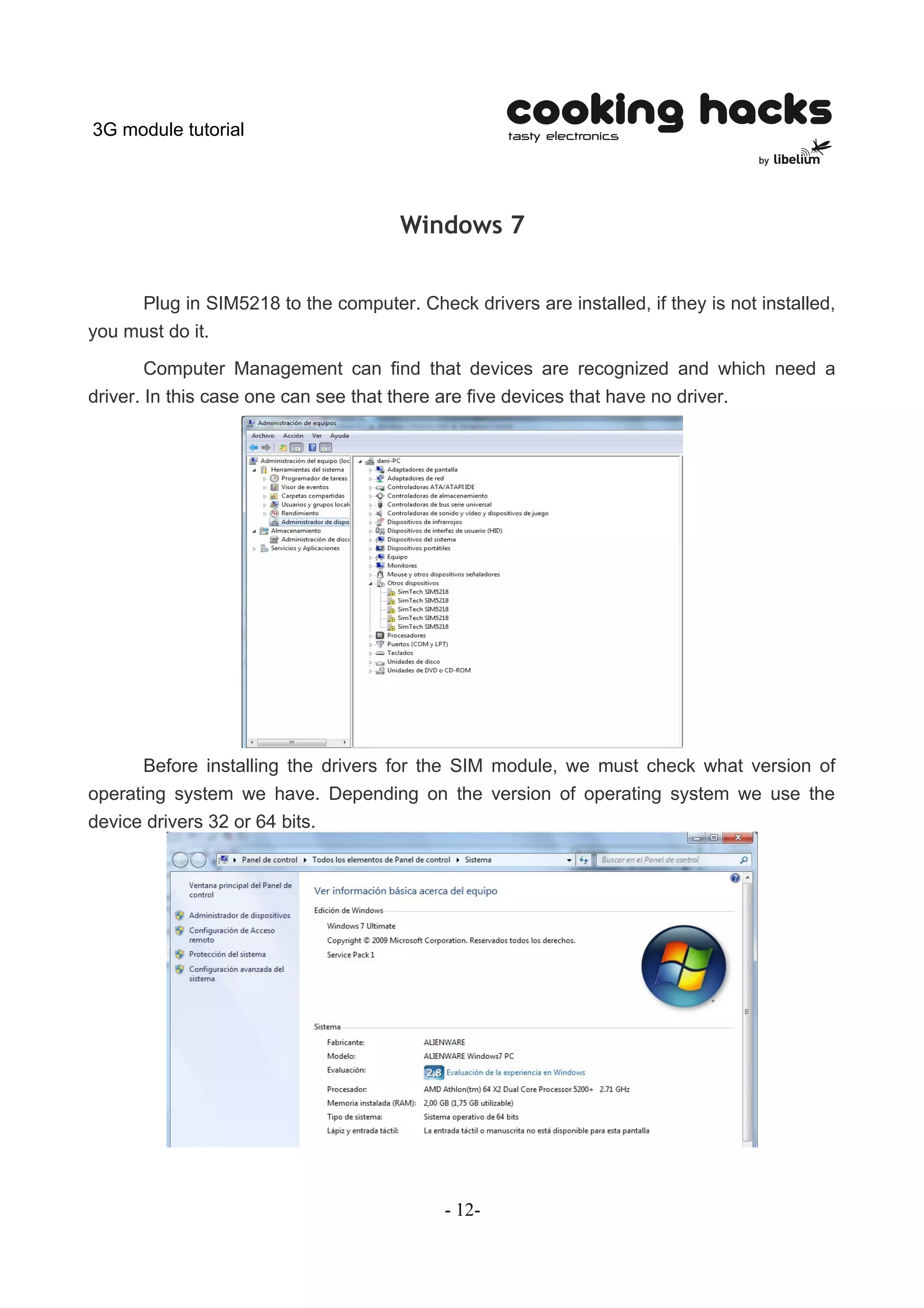
        Computer Management can find that devices are recognized and which need a
driver. In this case one can see that there are five devices that have no driver.


       Before installing the drivers for the SIM module, we must check what version of
operating system we have. Depending on the version of operating system we use the
device drivers 32 or 64 bits.


                                           - 12-
3G module tutorial


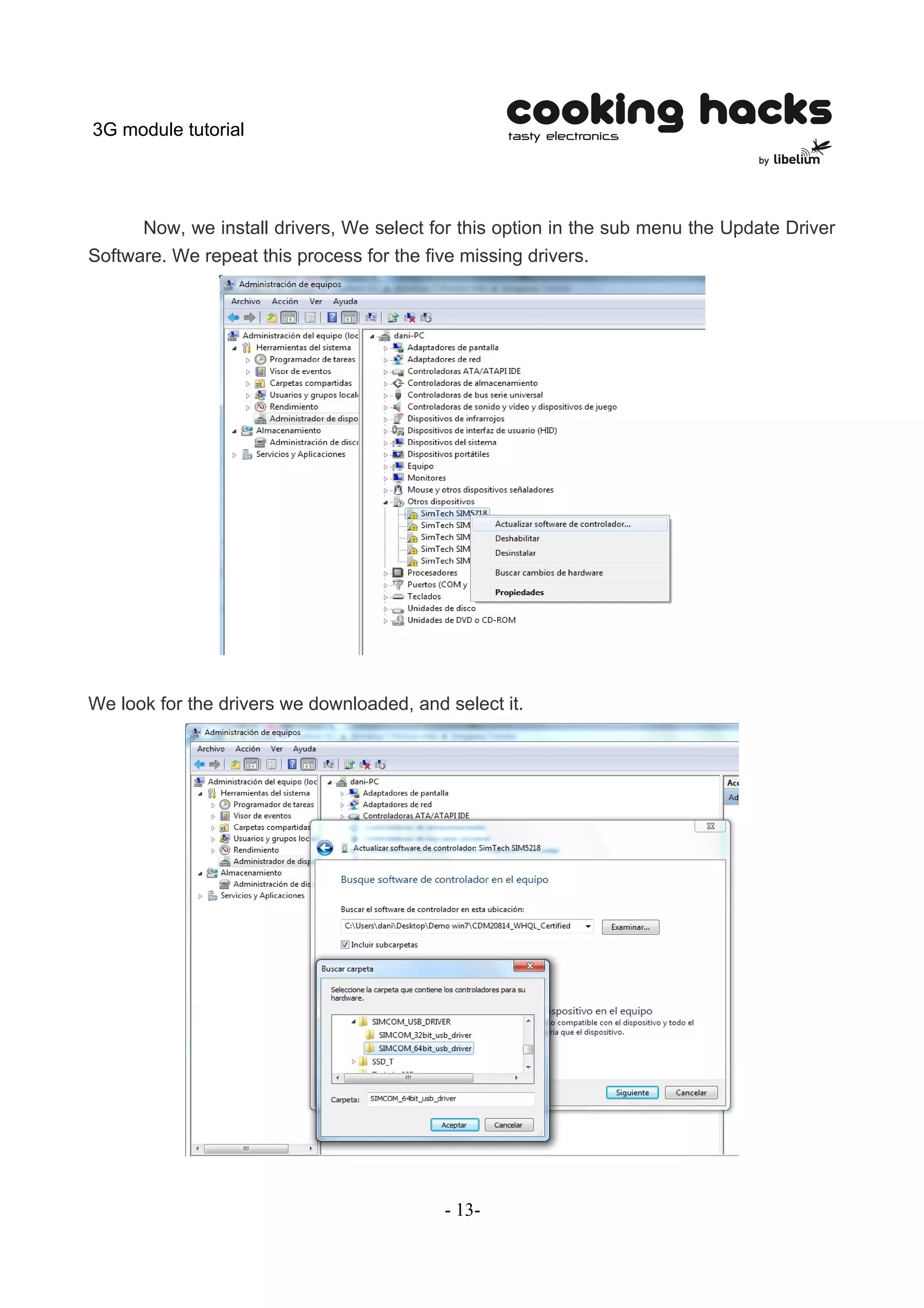
      Now, we install drivers, We select for this option in the sub menu the Update Driver
Software. We repeat this process for the five missing drivers.


We look for the drivers we downloaded, and select it.


                                           - 13-
3G module tutorial


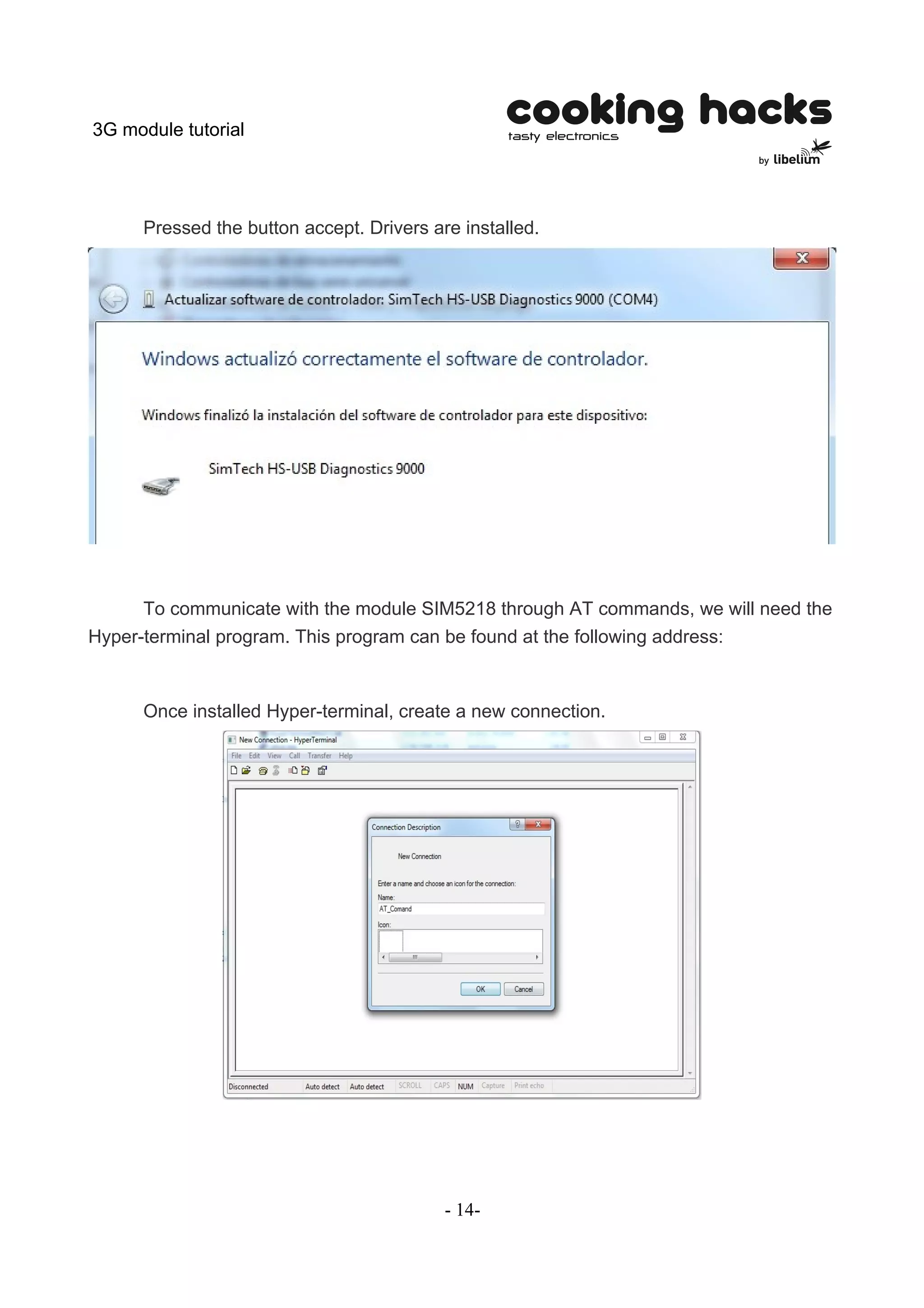
      Pressed the button accept. Drivers are installed.


      To communicate with the module SIM5218 through AT commands, we will need the
Hyper-terminal program. This program can be found at the following address:


      Once installed Hyper-terminal, create a new connection.


                                           - 14-
3G module tutorial


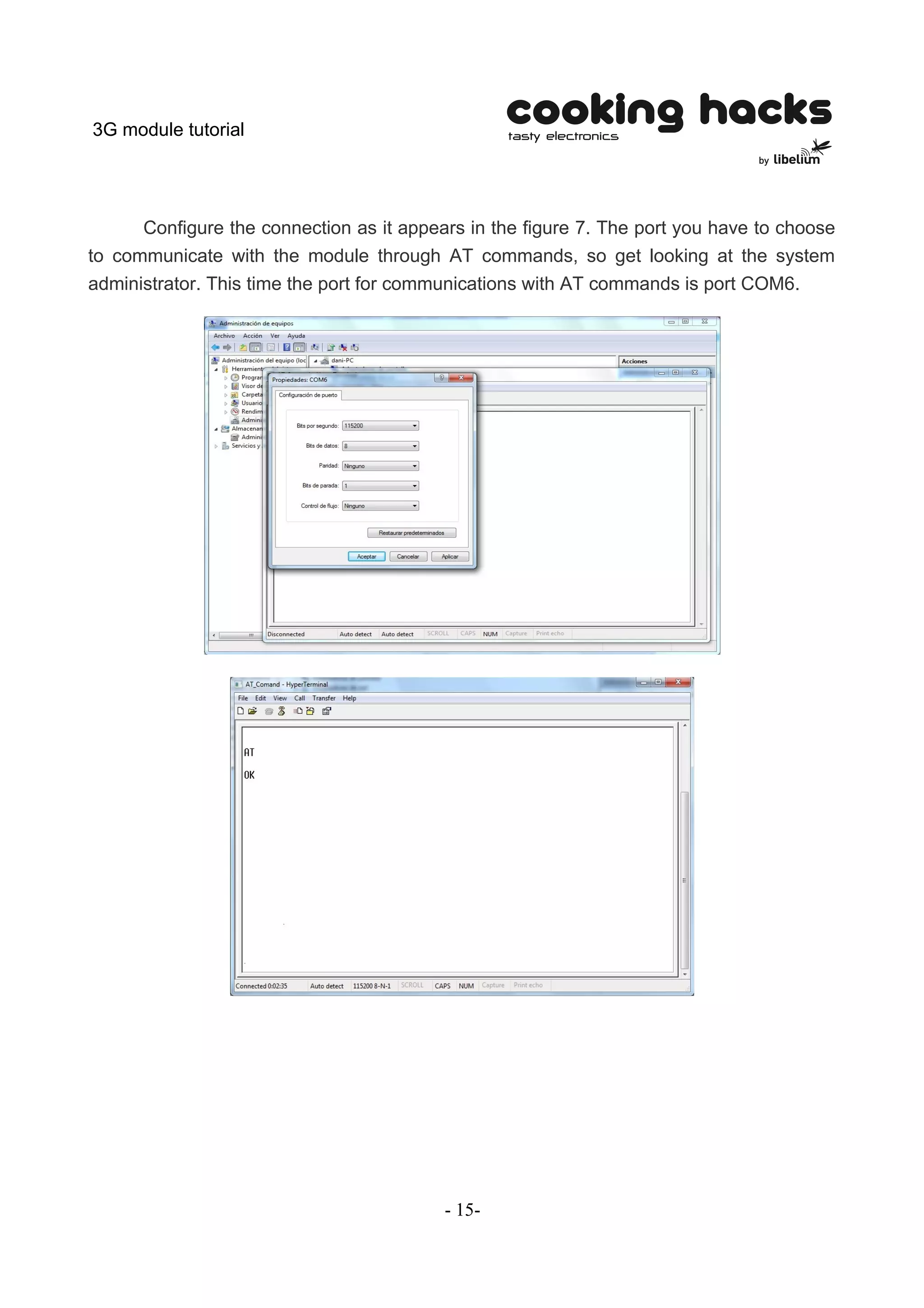
      Configure the connection as it appears in the figure 7. The port you have to choose
to communicate with the module through AT commands, so get looking at the system
administrator. This time the port for communications with AT commands is port COM6.


                                          - 15-
3G module tutorial


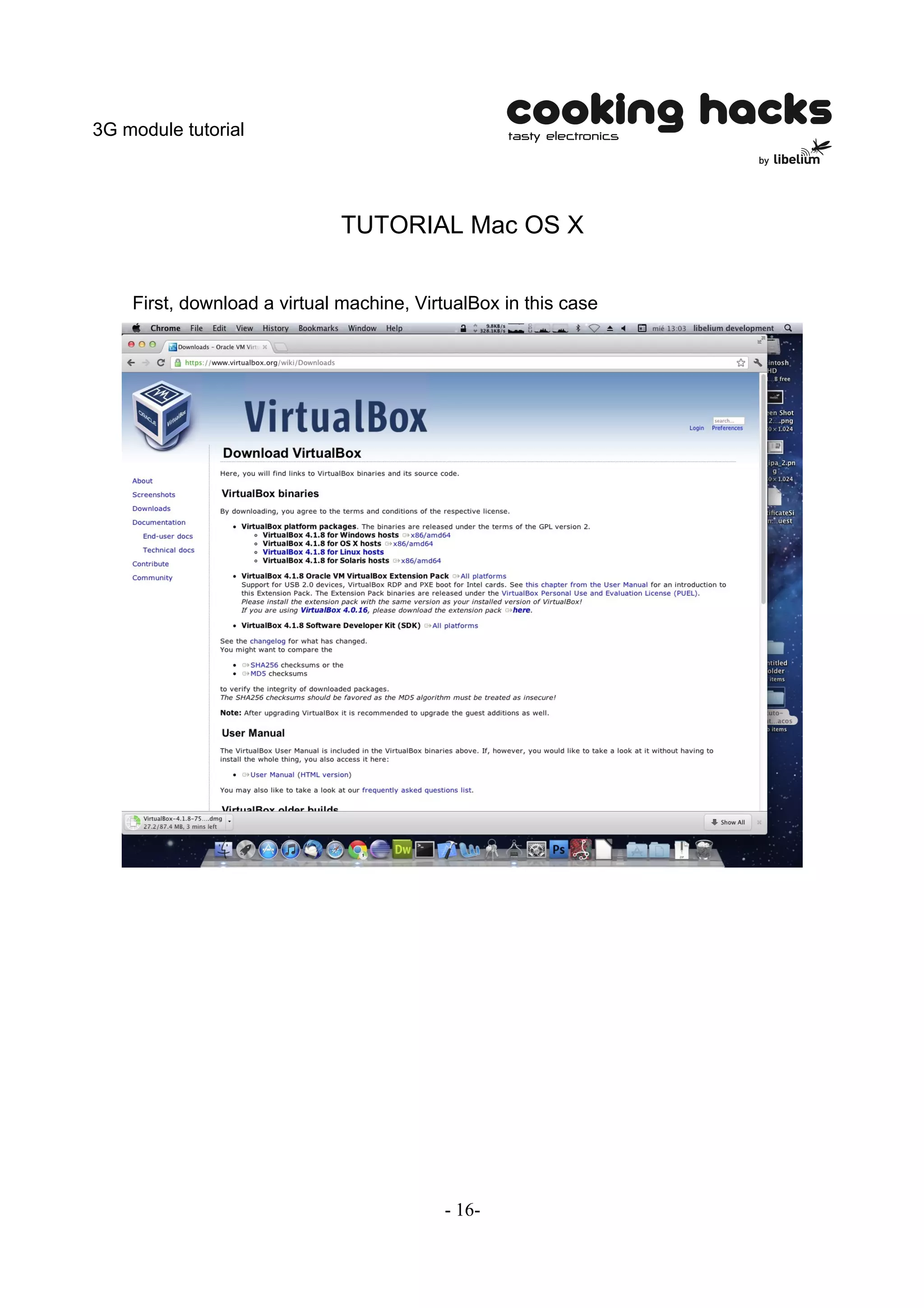
                             TUTORIAL Mac OS X


    First, download a virtual machine, VirtualBox in this case


                                          - 16-
3G module tutorial


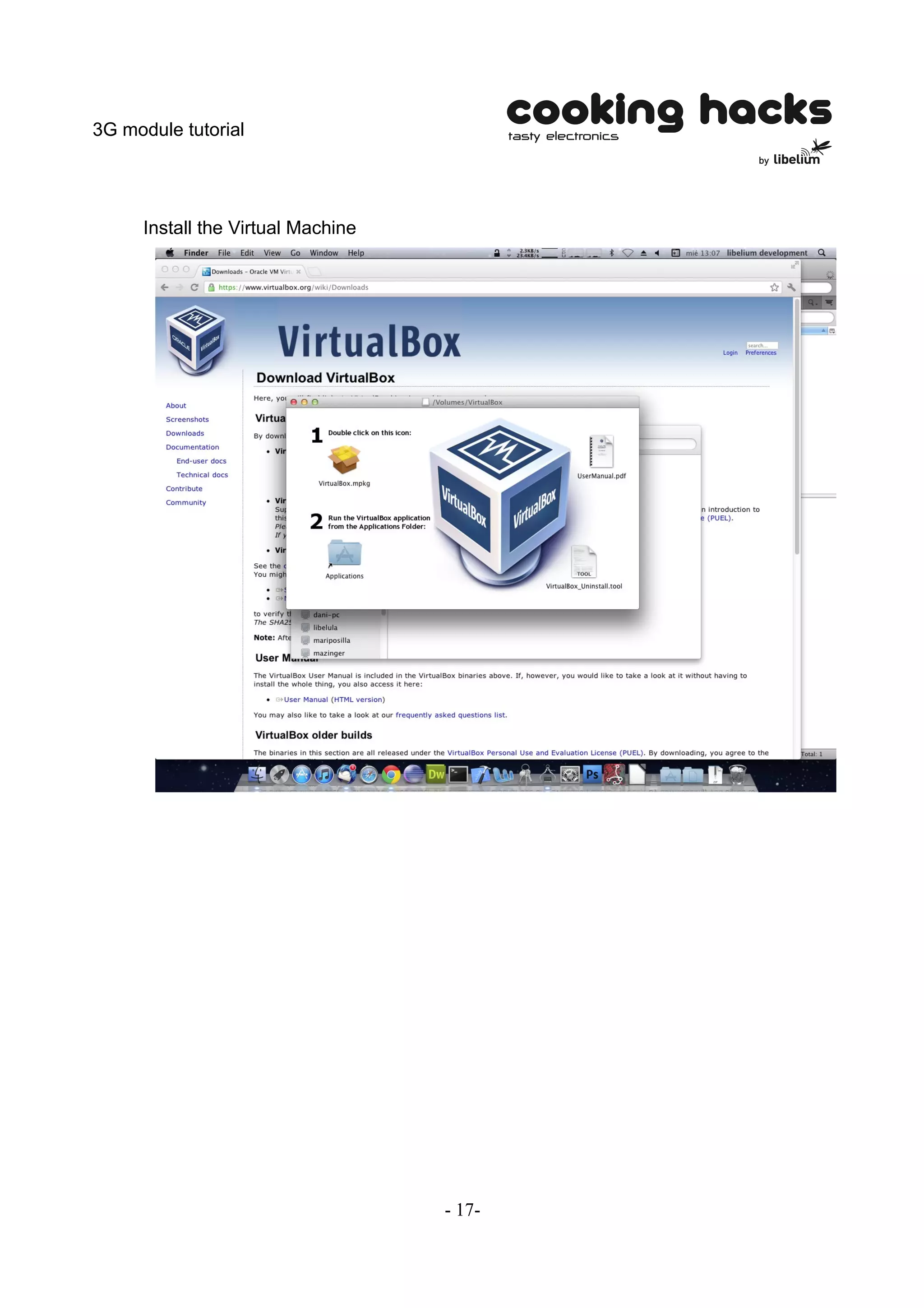
      Install the Virtual Machine


                                    - 17-
3G module tutorial


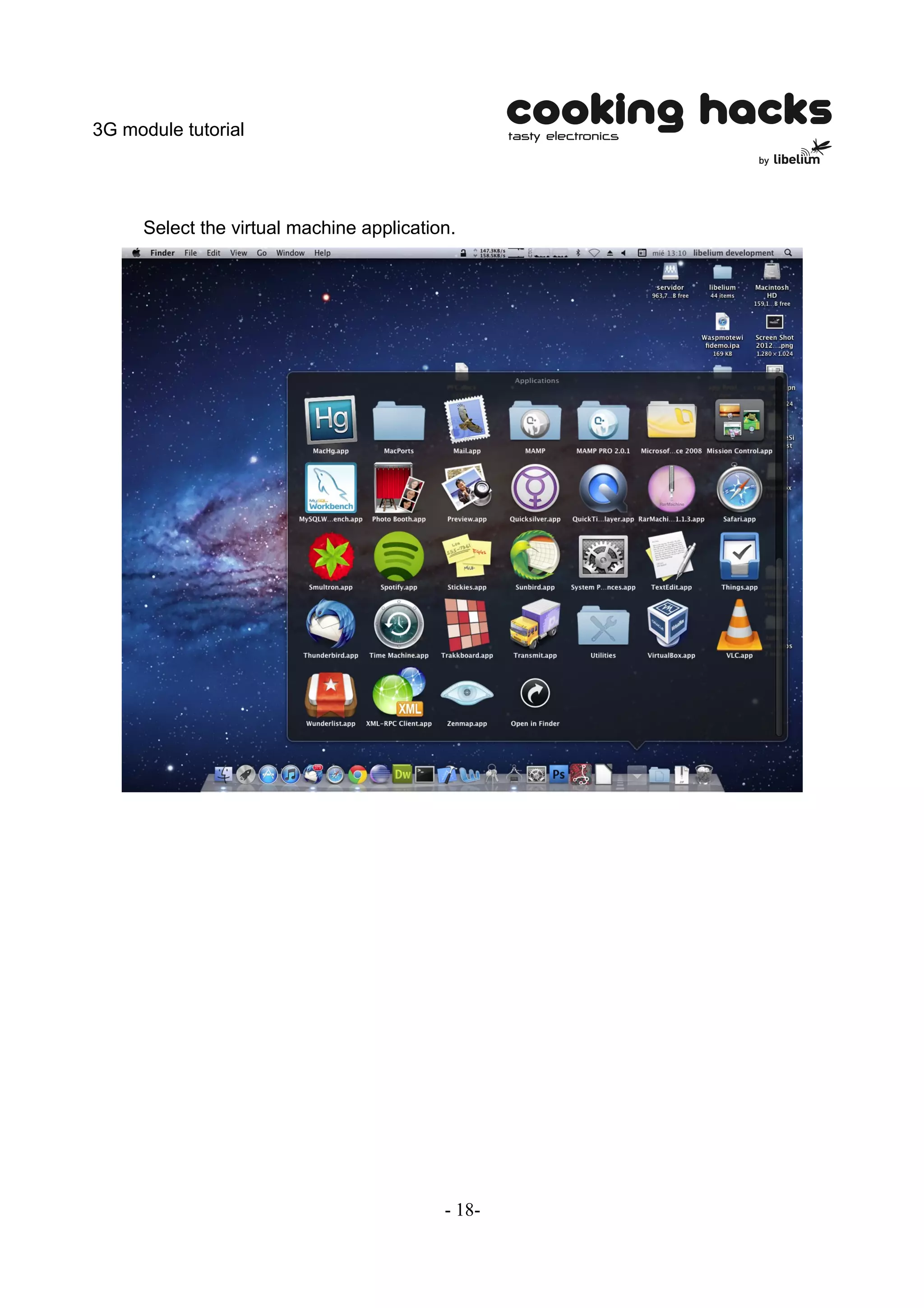
      Select the virtual machine application.


                                           - 18-
3G module tutorial


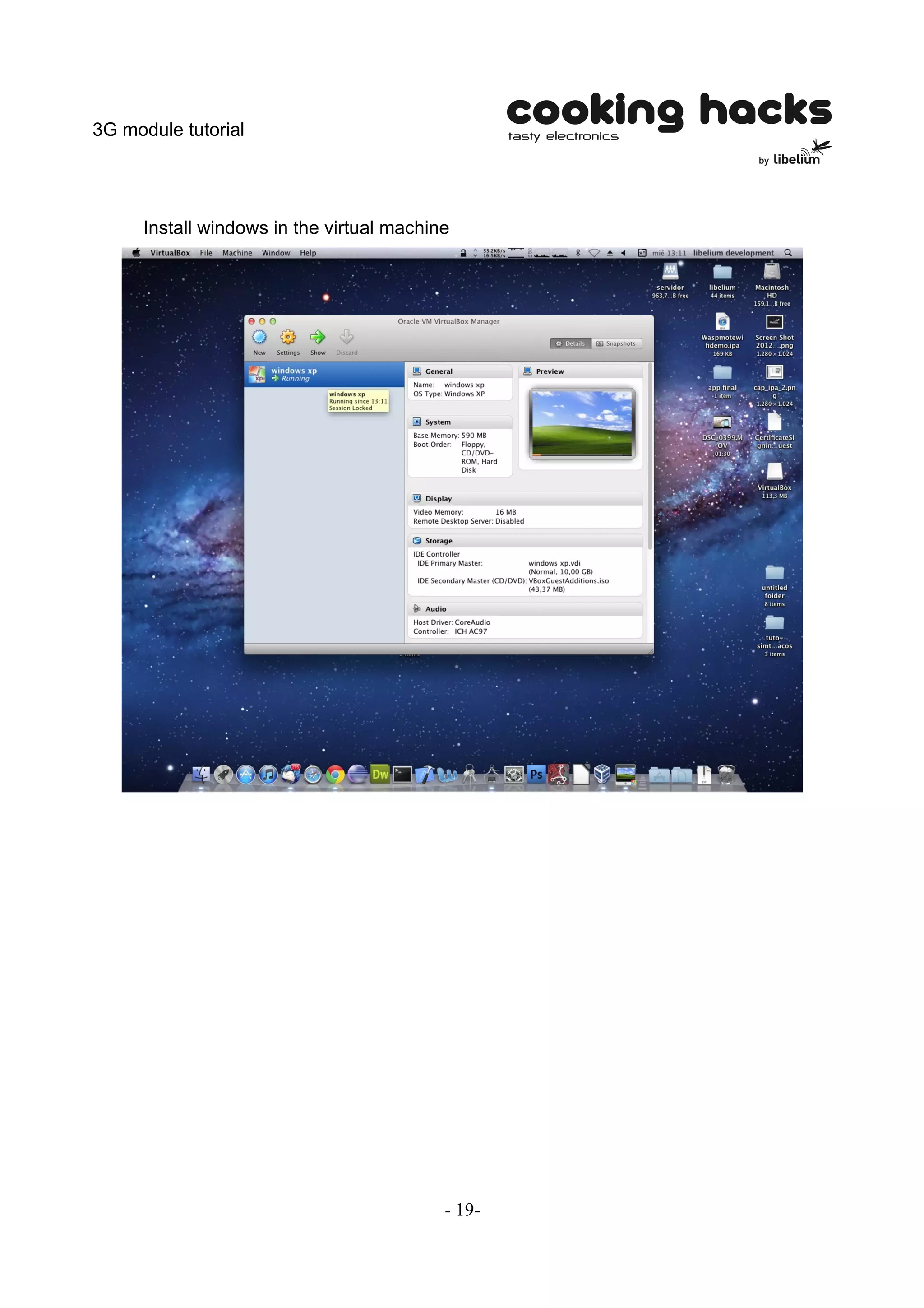
      Install windows in the virtual machine


                                           - 19-
3G module tutorial


      Run windows into the virtual machine


                                         - 20-
3G module tutorial


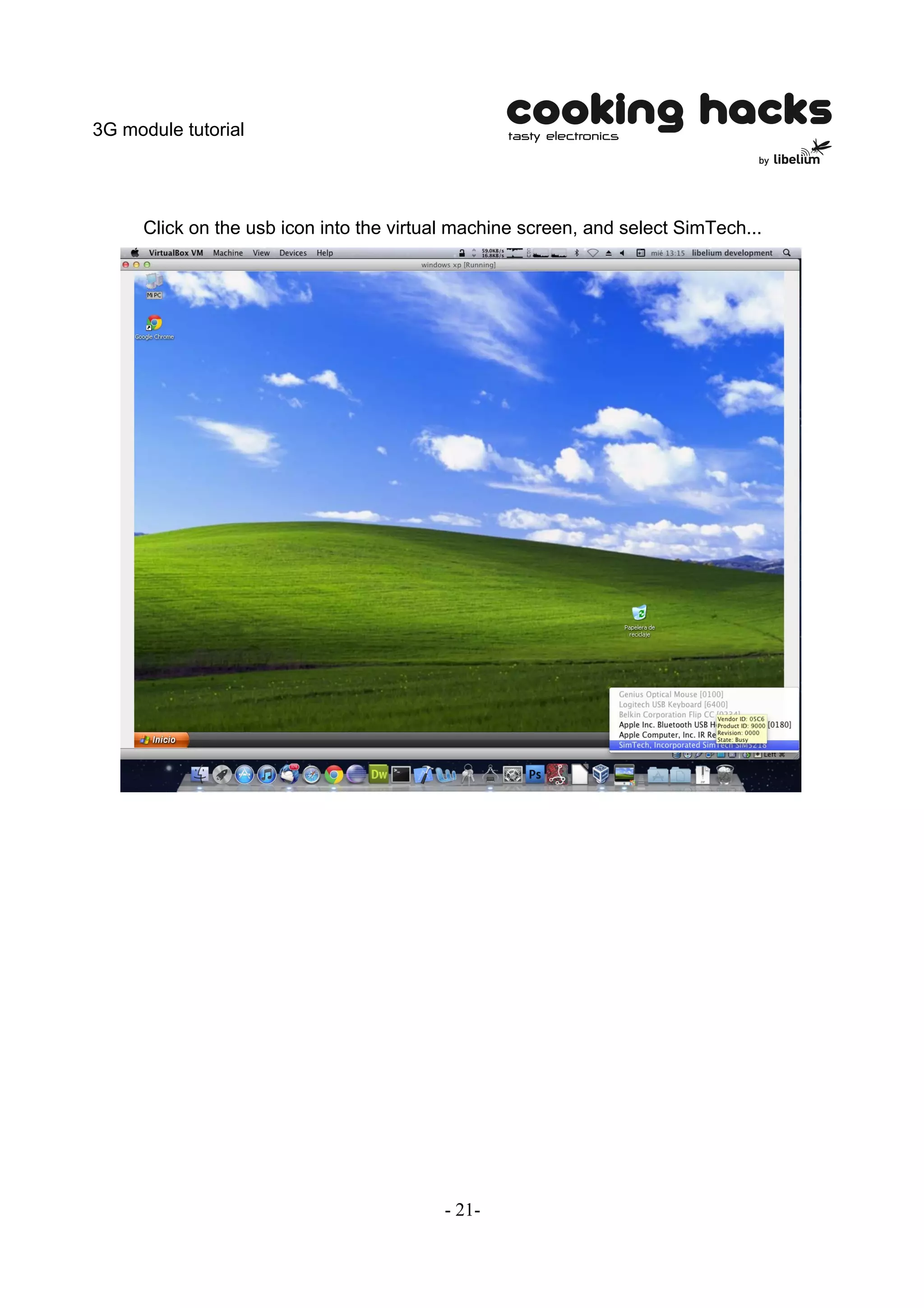
      Click on the usb icon into the virtual machine screen, and select SimTech...


                                           - 21-
3G module tutorial


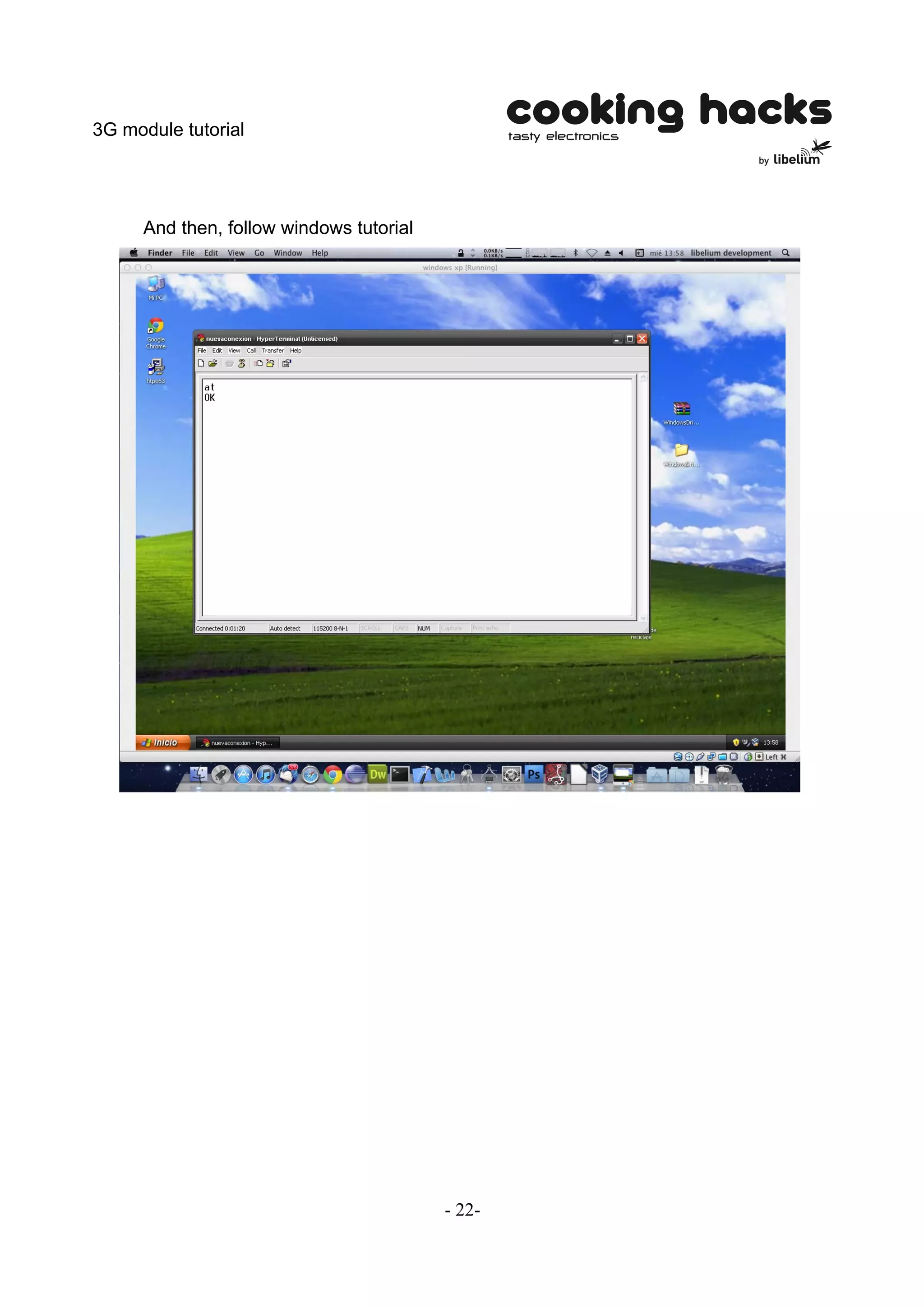
      And then, follow windows tutorial


                                          - 22-

3 g modem_tutorial

  • 1.
    3G module tutorial Linux Plug in the device, and execute dmesg in console. With this we can see if we have the drivers of the device installed or not. $:/etc$ dmesg generic-usb 0003:05C6:F006.0003: hiddev96,hidraw2: USB HID v1.10 Device [SimTech, Incorporated SimTech SIM5218] on usb-0000:00:1d.1-1/input0 Not recognize the device, we install the necessary drivers. Execute lsusb, this command show a list of devices connected to USB port: $:/etc$ lsusb Bus 005 Device 001: ID 1d6b:0001 Linux Foundation 1.1 root hub Bus 004 Device 001: ID 1d6b:0001 Linux Foundation 1.1 root hub Bus 003 Device 008: ID 05c6:f006 Qualcomm, Inc. Bus 003 Device 001: ID 1d6b:0001 Linux Foundation 1.1 root hub Bus 002 Device 002: ID 0e6a:6001 Megawin Technology Co., Ltd Bus 002 Device 001: ID 1d6b:0001 Linux Foundation 1.1 root hub Bus 001 Device 001: ID 1d6b:0002 Linux Foundation 2.0 root hub In this list, we can see: the vendor: 0x05c6 the product: 0xf006 With this parameters we will configure the file modules in path /etc/. For configuring we have to execute: $:sudo gedit /etc/modules # /etc/modules: kernel modules to load at boot time. # # This file contains the names of kernel modules that should be loaded # at boot time, one per line. Lines beginning with "#" are ignored. # Parameters can be specified after the module name. lp usbserial vendor=0x05c6 product=0xf006 - 1-
  • 2.
    3G module tutorial Execute dmesg: [ 2210.084352] generic ttyUSB0: generic converter now disconnected from ttyUSB0 [ 2210.084373] usbserial_generic 1-3:1.0: device disconnected [ 2215.008545] usb 1-3: new high speed USB device using ehci_hcd and address 5 [ 2215.142637] usb 1-3: configuration #1 chosen from 1 choice [ 2215.145180] usbserial_generic 1-3:1.0: generic converter detected [ 2215.145280] usb 1-3: generic converter now attached to ttyUSB0 [ 2215.145361] usbserial_generic 1-3:1.1: generic converter detected [ 2215.145436] usb 1-3: generic converter now attached to ttyUSB1 [ 2215.145515] usbserial_generic 1-3:1.2: generic converter detected [ 2215.145591] usb 1-3: generic converter now attached to ttyUSB2 [ 2215.145678] usbserial_generic 1-3:1.3: generic converter detected [ 2215.145758] usb 1-3: generic converter now attached to ttyUSB3 [ 2215.145853] usbserial_generic 1-3:1.4: generic converter detected [ 2215.145933] usb 1-3: generic converter now attached to ttyUSB4 We can communicate with the device using AT commands, for this we use Cutecom for example: - 2-
  • 3.
    3G module tutorial Now the computer recognize the module SIM5218. We can use this module in different ways. For use as a modem, we must follow these steps: • Installing Wvdial in our Linux distribution, if not installed: sudo apt-get install wvdial • Configuring WvDial: 1. Once you have run wvdialconf, you need to edit the /etc/wvdial.conf file to reflect the phone number to dial, and your username and password. 2. Open up /etc/wvdial.conf in your favorite text editor. It should look something like this: [Dialer] Modem = /dev/ttyUSB2 Modem Type = Analog Modem Baud = 115200 ISDN = 0 Stupid mode = 1 Idle Seconds = 0 Init2 = ATZ Init4 = AT+CGDCONT=1,"IP","my_APN" Password = "my_password" Phone = number of telephone Username = "my_username" Dial Command = ATD 3. Save your changes and exit out of the text editor. - 3-
  • 4.
    3G module tutorial • Run wvdial $:/etc$ wvdial /etc/wvdial.conf --> WvDial: Internet dialer version 1.60 --> Warning: section [Dialer /etc/wvdial.conf] does not exist in wvdial.conf. --> Cannot get information for serial port. --> Initializing modem. --> Sending: ATZ ATZ OK --> Sending: ATZ ATZ OK --> Sending: AT+CGDCONT=1,"IP","internet" AT+CGDCONT=1,"IP","internet" OK --> Modem initialized. --> Sending: ATD*99***1# --> Waiting for carrier. ATD*99***1# CONNECT 115200 - 4-
  • 5.
    3G module tutorial Windows XP Plug in SIM5218 to the computer. First step is install the drivers to use the device. Drivers can be download to: http://www.cooking- hacks.com/skin/frontend/default/cooking/pdf/WindowsDrivers_SIM5218_2.4.00.rar As seen in “other devices” there are five that are not assigned any driver, and therefore can not be detected by the operating system. - 5-
  • 6.
    3G module tutorial To install drivers for each device, we must select it by double click. And press the Update Driver button. Select install from a list or specific location. - 6-
  • 7.
    3G module tutorial In pop-up window select the directory where the drivers previously downloaded, - 7-
  • 8.
    3G module tutorial Now, drivers are installed. The device is recognize. Once the device is connected and recognized by the operating system. We can use it. - 8-
  • 9.
    3G module tutorial To communicate with the module has been decided to use the Hyperterminal program to Windows XP. This program will allow us to communicate with the module through AT commands or use it as modem. Run Hyper-terminal, and create new connection. For use the module with AT commands, First, we must find what is the port to connect to send AT commands. - 9-
  • 10.
    3G module tutorial The next step, is to configure the device. In the follow images can see how it is: - 10-
  • 11.
    3G module tutorial In case you want to configure the module as a modem SIM5218E should create a new connection and choose the port, SimTech HS-USB Modem 9000. - 11-
  • 12.
    3G module tutorial Windows 7 Plug in SIM5218 to the computer. Check drivers are installed, if they is not installed, you must do it. Computer Management can find that devices are recognized and which need a driver. In this case one can see that there are five devices that have no driver. Before installing the drivers for the SIM module, we must check what version of operating system we have. Depending on the version of operating system we use the device drivers 32 or 64 bits. - 12-
  • 13.
    3G module tutorial Now, we install drivers, We select for this option in the sub menu the Update Driver Software. We repeat this process for the five missing drivers. We look for the drivers we downloaded, and select it. - 13-
  • 14.
    3G module tutorial Pressed the button accept. Drivers are installed. To communicate with the module SIM5218 through AT commands, we will need the Hyper-terminal program. This program can be found at the following address: Once installed Hyper-terminal, create a new connection. - 14-
  • 15.
    3G module tutorial Configure the connection as it appears in the figure 7. The port you have to choose to communicate with the module through AT commands, so get looking at the system administrator. This time the port for communications with AT commands is port COM6. - 15-
  • 16.
    3G module tutorial TUTORIAL Mac OS X First, download a virtual machine, VirtualBox in this case - 16-
  • 17.
    3G module tutorial Install the Virtual Machine - 17-
  • 18.
    3G module tutorial Select the virtual machine application. - 18-
  • 19.
    3G module tutorial Install windows in the virtual machine - 19-
  • 20.
    3G module tutorial Run windows into the virtual machine - 20-
  • 21.
    3G module tutorial Click on the usb icon into the virtual machine screen, and select SimTech... - 21-
  • 22.
    3G module tutorial And then, follow windows tutorial - 22-