THE SECOND WONDER
The Seven Countries in
our project announce
the winners of the
Second Wonder of our
Region, The Tastiest
Traditional Food.
In This Issue
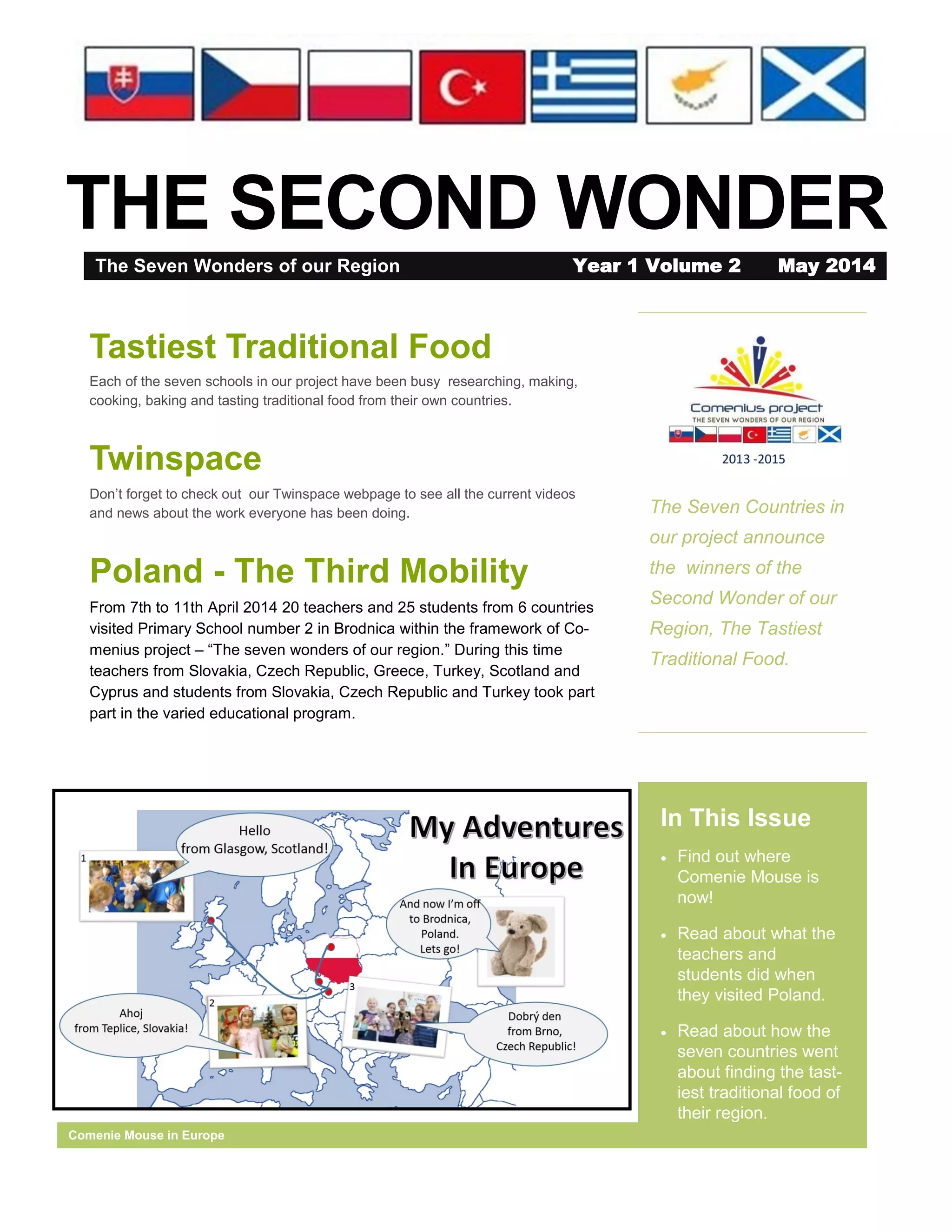
 Find out where
Comenie Mouse is
now!
 Read about what the
teachers and
students did when
they visited Poland.
 Read about how the
seven countries went
about finding the tast-
iest traditional food of
their region.
Comenie Mouse in Europe
Tastiest Traditional Food
Each of the seven schools in our project have been busy researching, making,
cooking, baking and tasting traditional food from their own countries.
Twinspace
Don’t forget to check out our Twinspace webpage to see all the current videos
and news about the work everyone has been doing.
Poland - The Third Mobility
From 7th to 11th April 2014 20 teachers and 25 students from 6 countries
visited Primary School number 2 in Brodnica within the framework of Co-
menius project – “The seven wonders of our region.” During this time
teachers from Slovakia, Czech Republic, Greece, Turkey, Scotland and
Cyprus and students from Slovakia, Czech Republic and Turkey took part
part in the varied educational program.
The Seven Wonders of our Region Year 1 Volume 2 May 2014
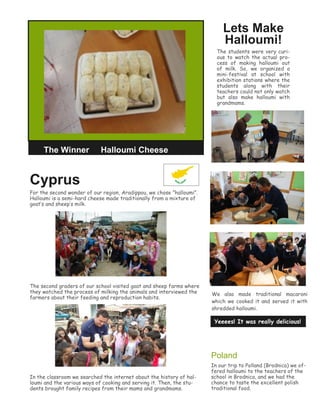
Cyprus
For the second wonder of our region, Aradippou, we chose ”halloumi”.
Halloumi is a semi-hard cheese made traditionally from a mixture of
goat’s and sheep’s milk.
The second graders of our school visited goat and sheep farms where
they watched the process of milking the animals and interviewed the
farmers about their feeding and reproduction habits.
In the classroom we searched the internet about the history of hal-
loumi and the various ways of cooking and serving it. Then, the stu-
dents brought family recipes from their mams and grandmams.
Lets Make
Halloumi!
The students were very curi-
ous to watch the actual pro-
cess of making halloumi out
of milk. So, we organized a
mini-festival at school with
exhibition stations where the
students along with their
teachers could not only watch
but also make halloumi with
grandmams.
Yeeees! It was really delicious!
The Winner Halloumi Cheese
We also made traditional macaroni
which we cooked it and served it with
shredded halloumi.
Poland
In our trip to Polland (Brodnica) we of-
fered halloumi to the teachers of the
school in Brodnica, and we had the
chance to taste the excellent polish
traditional food.
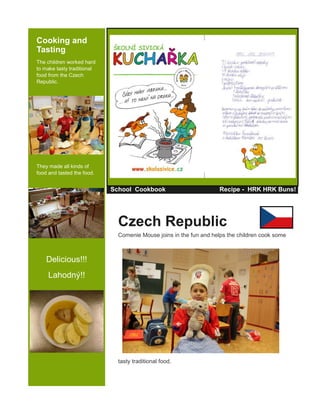
Cooking and
Tasting
The children worked hard
to make tasty traditional
food from the Czech
Republic.
They made all kinds of
food and tasted the food.
Delicious!!!
Lahodný!!
School Cookbook Recipe - HRK HRK Buns!
Czech Republic
Comenie Mouse joins in the fun and helps the children cook some
tasty traditional food.
Greece
Workshops
First we visited educational workshops where we dis-
cussed about healthy and unhealthy eating, played games
and participated in educational activities.
Posters and Recipes
Then, at school, our pupils collected traditional Greek rec-
ipes, made posters and presented them to their class-
mates. We have also started preparing an e book with the
most famous Greek recipes. Our cook book will be ready
by the end of the school year.
Cooking and
Tasting
Finally, on 28/2/2014,
each class cooked a dish
at school which the
pupils tasted at the end
of the school day.
All pupils and teachers
did their best to
prepare the dishes in
the classrooms and all
dishes were equally
tasteful.
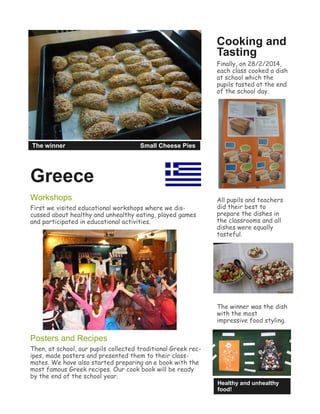
The winner was the dish
with the most
impressive food styling.
Healthy and unhealthy
food!
The winner Small Cheese Pies
Cooking and
Tasting
There is no canteen in
our school where it
would be possible to
cook together so
students worked in
groups or individually in
their houses to cook-
tasty traditional food.
This task caused a lot
of interesting
impressions among the
children.
Students documented
their work with short
films, multimedia
presentations, photos.
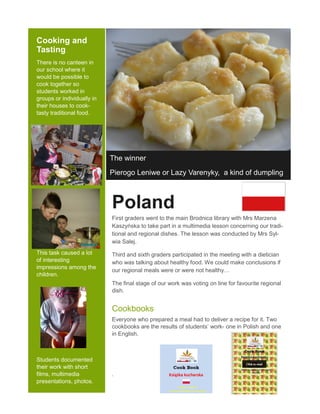
The winner
Pierogo Leniwe or Lazy Varenyky, a kind of dumpling
Poland
First graders went to the main Brodnica library with Mrs Marzena
Kaszyńska to take part in a multimedia lesson concerning our tradi-
tional and regional dishes. The lesson was conducted by Mrs Syl-
wia Salej.
Third and sixth graders participated in the meeting with a dietician
who was talking about healthy food. We could make conclusions if
our regional meals were or were not healthy…
The final stage of our work was voting on line for favourite regional
dish.
Cookbooks
Everyone who prepared a meal had to deliver a recipe for it. Two
cookbooks are the results of students’ work- one in Polish and one
in English.
.
Turkey
Firstly, Comenius group updated the
Comenius board with the presentation of
second wonder. They wrote what they
thought of food. They also collected our local
food and presented on the board. They also
collected proverbs about food in our culture.
Restaurant Visit
Second stop was a restaurant. We cooked “Tuzda Balık” (Fish in Salt). It is
another special taste in our vicinity as our town is by the Salt Lake and salt
production is so common and the town is also by the Hirfanlı Dam and carp is a
typical fish living there. Fish in Salt is totally a natural dish for us. It takes about 4
hours to roast but an unforgetable taste. We ate it there and we hope to host you
in that restaurant too.
Survey
Comenius group held a
survey among almost all
students and teachers to
learn “the most delicious
food” of our town. They
collected 10 local dishes
and the winner was
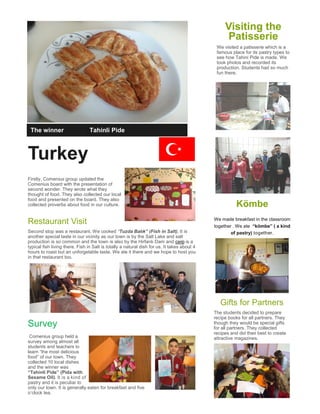
“Tahinli Pide” (Pida with
Sesame Oil). It is a kind of
pastry and it is peculiar to
only our town. It is generally eaten for breakfast and five
o’clock tea.
Visiting the
Patisserie
We visited a patisserie which is a
famous place for its pastry types to
see how Tahini Pide is made. We
took photos and recorded its
production. Students had so much
fun there.
The winner “Tahinli Pide
Kömbe
We made breakfast in the classroom
together . We ate “kömbe” ( a kind
of pastry) together.
Gifts for Partners
The students decided to prepare
recipe books for all partners. They
though they would be special gifts
for all partners. They collected
recipes and did their best to create
attractive magazines.
Researching
Tasty
Traditional Food
We Slovaks like to eat
delicious meals and so
our searching has been
very interesting and
tasteful. All the classes
have searched for the
most delicious traditional
meal. Each class has
chosen its own most
delicious meal, they have
chosen a cooking team
and the team has made
a poster about the chosen
meal.
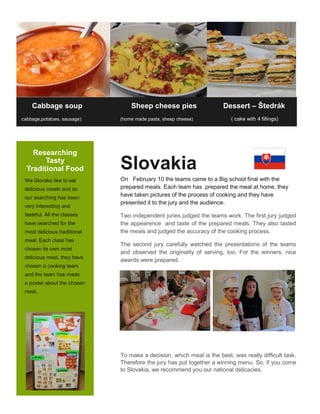
Cabbage soup Sheep cheese pies Dessert – Štedrák
(cabbage,potatoes, sausage) (home made pasta, sheep cheese) ( cake with 4 fillings)
Slovakia
On February 10 the teams came to a Big school final with the
prepared meals. Each team has prepared the meal at home, they
have taken pictures of the process of cooking and they have
presented it to the jury and the audience.
Two independent juries judged the teams work. The first jury judged
the appearence and taste of the prepared meals. They also tasted
the meals and judged the accuracy of the cooking process.
The second jury carefully watched the presentations of the teams
and observed the originality of serving, too. For the winners, nice
awards were prepared.
To make a decision, which meal is the best, was really difficult task.
Therefore the jury has put together a winning menu. So, if you come
to Slovakia, we recommend you our national delicacies.
Scotland
Primary 4 from Blackfriars Primary School
conducted a survey of the children and families
from their school . They wanted to find the
favourite traditional meals which the children
and their families liked to eat at home. The chil-
dren then made a menu consisting of 7 of the
favourite meals.
Preparing the Food
They wrote letters to the local community to ask
for help to prepare the food. Mrs Stallan, Mrs
McCleary and Ms Benzie cooked some of the
food. Our local bakery and our local shop
helped too. And our Dinner Ladies cooked fish
and chips for us.
Tasting
They invited children from each class to
taste the food and choose their favourite
meal. They counted the results and the
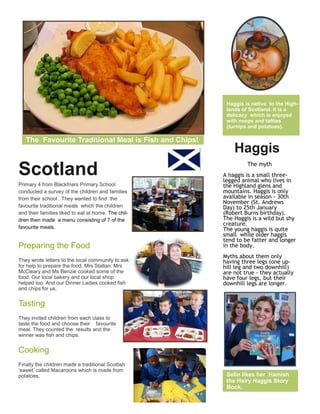
winner was fish and chips.
Cooking
Finally the children made a traditional Scottish
‘sweet’ called Macaroons which is made from
potatoes.
Haggishat is a
haggis?
The myth
A haggis is a small three-
legged animal who lives in
the Highland glens and
mountains. Haggis is only
available in season - 30th
November (St. Andrews
Day) to 25th January
(Robert Burns birthday).
The Haggis is a wild but shy
creature.
The young haggis is quite
small while older haggis
tend to be fatter and longer
in the body.
Myths about them only
having three legs (one up-
hill leg and two downhill)
are not true - they actually
have four legs, but their
downhill legs are longer.
Haggis is native to the High-
lands of Scotland. It is a
delicacy which is enjoyed
with neeps and tatties
(turnips and potatoes).
The Favourite Traditional Meal is Fish and Chips!
Selin likes her Hamish
the Hairy Haggis Story
Book.
Twinspace
Find out more about
Comenie Mouse’s adven-
tures in Europe by visiting
Twinspace.
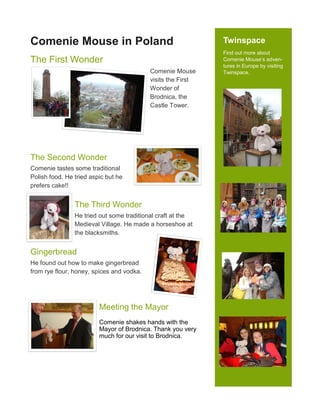
Comenie Mouse in Poland
The First Wonder
Comenie Mouse
visits the First
Wonder of
Brodnica, the
Castle Tower.
The Second Wonder
Comenie tastes some traditional
Polish food. He tried aspic but he
prefers cake!!
The Third Wonder
He tried out some traditional craft at the
Medieval Village. He made a horseshoe at
the blacksmiths.
Gingerbread
He found out how to make gingerbread
from rye flour, honey, spices and vodka.
Meeting the Mayor
Comenie shakes hands with the
Mayor of Brodnica. Thank you very
much for our visit to Brodnica.
From 7th to 11th April 2014
20 teachers and 25 students
from 6 countries visited Pri-
mary School number 2 in
Brodnica within the frame-
work of Comenius project –
“The seven wonders of our
region.” During this time
teachers from Slovakia,
Czech Republic, Greece,
Turkey, Scotland and Cy-
prus and students from Slo-
vakia, Czech Republic and
Turkey took part part in the
varied educational program.
They got to know the region
by visiting our town and
Toruń, taking part in the
workshops prepared for
them in our school. Further-
more, they participated in
practical classes in Foluszek
settlement where the histo-
ry and everyday life in the
past of our region were pre-
sented.
We also visited Bobrowo
where the Easter Palm pre-
pared by students and
teachers was presented and
it was awarded by the Coun-
ty Head. The whole group
visited the Town Hall and
was the Brodnica Mayor
guests. Participants of the
meeting had the opportunity
to talk to the Mayor about
their impressions and re-
marks concerning Brodnica.
Integration of students with
Polish families was a very
important element during the
visit because Polish families
hosted students from other
countries. This time spent in
Brodnica made a big impact
on the participants. Our coat
of arms- the right open
hand turned out to be not
only the symbol but the
proof of our hospitality and
openness.
Poland - The Third Mobility
Monday, 7th April 2014
Program at Primary School number 2, visit-
ing the school
Workshop 1 for teachers and students- the
presentation of partnership schools
Sightseeing of Brodnica- visiting some
wonders of our region
Performance of school theatre and artistic
group Niedźwiadki
Dinner at school- traditional Polish food
Tuesday, 8th April 2014
 Workshop 2 for teachers. Topic: The work system and educational stages in a
primary school.
 Sport activities for students
 Workshop for teachers and students –
preparing the Easter Palm for the con-
test
 Bowling at town gym OSiR
Wednesday, 9th
April 2014
Trip to Toruń:
 visiting the Copernicus House,
 history and baking of Toruń ginger-
bread,
 sightseeing of Toruń old town
Thursday 10th April 2014
 Trip to Foluszek settlement- tradition-
al craftsmanship
 Meeting at Brodnica Mayor’s
Friday, 11th
April 2014
 Participation in the Easter palm con-
test
 Multimedia presentations concerning
 seven wonders of our region
 Coordinators meeting

2nd wonder ejournal

  • 1.
    THE SECOND WONDER TheSeven Countries in our project announce the winners of the Second Wonder of our Region, The Tastiest Traditional Food. In This Issue  Find out where Comenie Mouse is now!  Read about what the teachers and students did when they visited Poland.  Read about how the seven countries went about finding the tast- iest traditional food of their region. Comenie Mouse in Europe Tastiest Traditional Food Each of the seven schools in our project have been busy researching, making, cooking, baking and tasting traditional food from their own countries. Twinspace Don’t forget to check out our Twinspace webpage to see all the current videos and news about the work everyone has been doing. Poland - The Third Mobility From 7th to 11th April 2014 20 teachers and 25 students from 6 countries visited Primary School number 2 in Brodnica within the framework of Co- menius project – “The seven wonders of our region.” During this time teachers from Slovakia, Czech Republic, Greece, Turkey, Scotland and Cyprus and students from Slovakia, Czech Republic and Turkey took part part in the varied educational program. The Seven Wonders of our Region Year 1 Volume 2 May 2014
  • 2.
    Cyprus For the secondwonder of our region, Aradippou, we chose ”halloumi”. Halloumi is a semi-hard cheese made traditionally from a mixture of goat’s and sheep’s milk. The second graders of our school visited goat and sheep farms where they watched the process of milking the animals and interviewed the farmers about their feeding and reproduction habits. In the classroom we searched the internet about the history of hal- loumi and the various ways of cooking and serving it. Then, the stu- dents brought family recipes from their mams and grandmams. Lets Make Halloumi! The students were very curi- ous to watch the actual pro- cess of making halloumi out of milk. So, we organized a mini-festival at school with exhibition stations where the students along with their teachers could not only watch but also make halloumi with grandmams. Yeeees! It was really delicious! The Winner Halloumi Cheese We also made traditional macaroni which we cooked it and served it with shredded halloumi. Poland In our trip to Polland (Brodnica) we of- fered halloumi to the teachers of the school in Brodnica, and we had the chance to taste the excellent polish traditional food.
  • 3.
    Cooking and Tasting The childrenworked hard to make tasty traditional food from the Czech Republic. They made all kinds of food and tasted the food. Delicious!!! Lahodný!! School Cookbook Recipe - HRK HRK Buns! Czech Republic Comenie Mouse joins in the fun and helps the children cook some tasty traditional food.
  • 4.
    Greece Workshops First we visitededucational workshops where we dis- cussed about healthy and unhealthy eating, played games and participated in educational activities. Posters and Recipes Then, at school, our pupils collected traditional Greek rec- ipes, made posters and presented them to their class- mates. We have also started preparing an e book with the most famous Greek recipes. Our cook book will be ready by the end of the school year. Cooking and Tasting Finally, on 28/2/2014, each class cooked a dish at school which the pupils tasted at the end of the school day. All pupils and teachers did their best to prepare the dishes in the classrooms and all dishes were equally tasteful. The winner was the dish with the most impressive food styling. Healthy and unhealthy food! The winner Small Cheese Pies
  • 5.
    Cooking and Tasting There isno canteen in our school where it would be possible to cook together so students worked in groups or individually in their houses to cook- tasty traditional food. This task caused a lot of interesting impressions among the children. Students documented their work with short films, multimedia presentations, photos. The winner Pierogo Leniwe or Lazy Varenyky, a kind of dumpling Poland First graders went to the main Brodnica library with Mrs Marzena Kaszyńska to take part in a multimedia lesson concerning our tradi- tional and regional dishes. The lesson was conducted by Mrs Syl- wia Salej. Third and sixth graders participated in the meeting with a dietician who was talking about healthy food. We could make conclusions if our regional meals were or were not healthy… The final stage of our work was voting on line for favourite regional dish. Cookbooks Everyone who prepared a meal had to deliver a recipe for it. Two cookbooks are the results of students’ work- one in Polish and one in English. .
  • 6.
    Turkey Firstly, Comenius groupupdated the Comenius board with the presentation of second wonder. They wrote what they thought of food. They also collected our local food and presented on the board. They also collected proverbs about food in our culture. Restaurant Visit Second stop was a restaurant. We cooked “Tuzda Balık” (Fish in Salt). It is another special taste in our vicinity as our town is by the Salt Lake and salt production is so common and the town is also by the Hirfanlı Dam and carp is a typical fish living there. Fish in Salt is totally a natural dish for us. It takes about 4 hours to roast but an unforgetable taste. We ate it there and we hope to host you in that restaurant too. Survey Comenius group held a survey among almost all students and teachers to learn “the most delicious food” of our town. They collected 10 local dishes and the winner was “Tahinli Pide” (Pida with Sesame Oil). It is a kind of pastry and it is peculiar to only our town. It is generally eaten for breakfast and five o’clock tea. Visiting the Patisserie We visited a patisserie which is a famous place for its pastry types to see how Tahini Pide is made. We took photos and recorded its production. Students had so much fun there. The winner “Tahinli Pide Kömbe We made breakfast in the classroom together . We ate “kömbe” ( a kind of pastry) together. Gifts for Partners The students decided to prepare recipe books for all partners. They though they would be special gifts for all partners. They collected recipes and did their best to create attractive magazines.
  • 7.
    Researching Tasty Traditional Food We Slovakslike to eat delicious meals and so our searching has been very interesting and tasteful. All the classes have searched for the most delicious traditional meal. Each class has chosen its own most delicious meal, they have chosen a cooking team and the team has made a poster about the chosen meal. Cabbage soup Sheep cheese pies Dessert – Štedrák (cabbage,potatoes, sausage) (home made pasta, sheep cheese) ( cake with 4 fillings) Slovakia On February 10 the teams came to a Big school final with the prepared meals. Each team has prepared the meal at home, they have taken pictures of the process of cooking and they have presented it to the jury and the audience. Two independent juries judged the teams work. The first jury judged the appearence and taste of the prepared meals. They also tasted the meals and judged the accuracy of the cooking process. The second jury carefully watched the presentations of the teams and observed the originality of serving, too. For the winners, nice awards were prepared. To make a decision, which meal is the best, was really difficult task. Therefore the jury has put together a winning menu. So, if you come to Slovakia, we recommend you our national delicacies.
  • 8.
    Scotland Primary 4 fromBlackfriars Primary School conducted a survey of the children and families from their school . They wanted to find the favourite traditional meals which the children and their families liked to eat at home. The chil- dren then made a menu consisting of 7 of the favourite meals. Preparing the Food They wrote letters to the local community to ask for help to prepare the food. Mrs Stallan, Mrs McCleary and Ms Benzie cooked some of the food. Our local bakery and our local shop helped too. And our Dinner Ladies cooked fish and chips for us. Tasting They invited children from each class to taste the food and choose their favourite meal. They counted the results and the winner was fish and chips. Cooking Finally the children made a traditional Scottish ‘sweet’ called Macaroons which is made from potatoes. Haggishat is a haggis? The myth A haggis is a small three- legged animal who lives in the Highland glens and mountains. Haggis is only available in season - 30th November (St. Andrews Day) to 25th January (Robert Burns birthday). The Haggis is a wild but shy creature. The young haggis is quite small while older haggis tend to be fatter and longer in the body. Myths about them only having three legs (one up- hill leg and two downhill) are not true - they actually have four legs, but their downhill legs are longer. Haggis is native to the High- lands of Scotland. It is a delicacy which is enjoyed with neeps and tatties (turnips and potatoes). The Favourite Traditional Meal is Fish and Chips! Selin likes her Hamish the Hairy Haggis Story Book.
  • 9.
    Twinspace Find out moreabout Comenie Mouse’s adven- tures in Europe by visiting Twinspace. Comenie Mouse in Poland The First Wonder Comenie Mouse visits the First Wonder of Brodnica, the Castle Tower. The Second Wonder Comenie tastes some traditional Polish food. He tried aspic but he prefers cake!! The Third Wonder He tried out some traditional craft at the Medieval Village. He made a horseshoe at the blacksmiths. Gingerbread He found out how to make gingerbread from rye flour, honey, spices and vodka. Meeting the Mayor Comenie shakes hands with the Mayor of Brodnica. Thank you very much for our visit to Brodnica.
  • 10.
    From 7th to11th April 2014 20 teachers and 25 students from 6 countries visited Pri- mary School number 2 in Brodnica within the frame- work of Comenius project – “The seven wonders of our region.” During this time teachers from Slovakia, Czech Republic, Greece, Turkey, Scotland and Cy- prus and students from Slo- vakia, Czech Republic and Turkey took part part in the varied educational program. They got to know the region by visiting our town and Toruń, taking part in the workshops prepared for them in our school. Further- more, they participated in practical classes in Foluszek settlement where the histo- ry and everyday life in the past of our region were pre- sented. We also visited Bobrowo where the Easter Palm pre- pared by students and teachers was presented and it was awarded by the Coun- ty Head. The whole group visited the Town Hall and was the Brodnica Mayor guests. Participants of the meeting had the opportunity to talk to the Mayor about their impressions and re- marks concerning Brodnica. Integration of students with Polish families was a very important element during the visit because Polish families hosted students from other countries. This time spent in Brodnica made a big impact on the participants. Our coat of arms- the right open hand turned out to be not only the symbol but the proof of our hospitality and openness. Poland - The Third Mobility Monday, 7th April 2014 Program at Primary School number 2, visit- ing the school Workshop 1 for teachers and students- the presentation of partnership schools Sightseeing of Brodnica- visiting some wonders of our region Performance of school theatre and artistic group Niedźwiadki Dinner at school- traditional Polish food Tuesday, 8th April 2014  Workshop 2 for teachers. Topic: The work system and educational stages in a primary school.  Sport activities for students  Workshop for teachers and students – preparing the Easter Palm for the con- test  Bowling at town gym OSiR Wednesday, 9th April 2014 Trip to Toruń:  visiting the Copernicus House,  history and baking of Toruń ginger- bread,  sightseeing of Toruń old town Thursday 10th April 2014  Trip to Foluszek settlement- tradition- al craftsmanship  Meeting at Brodnica Mayor’s Friday, 11th April 2014  Participation in the Easter palm con- test  Multimedia presentations concerning  seven wonders of our region  Coordinators meeting