-ISD Model of T&D
-Organizing Training Department
5/10/2023
BBA 212
Introduction ofTraining
NeedforTraining
ObjectivesofTraining
ImportanceofTraining
TypesofTraining
5/10/2023
BBA 212
5/10/2023
BBA 212
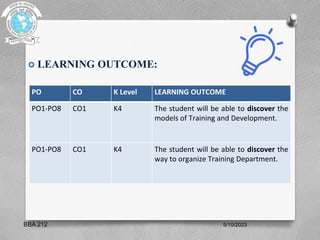
 LEARNING OUTCOME:
PO CO K Level LEARNING OUTCOME
PO1-PO8 CO1 K4 The student will be able to discover the
models of Training and Development.
PO1-PO8 CO1 K4 The student will be able to discover the
way to organize Training Department.
Lecture Outline
5/10/2023
BBA 212
• Concept of System Model
• Concept of Instructional System Development
Model
• Concept of Transitional Model
• Organizing Training Department
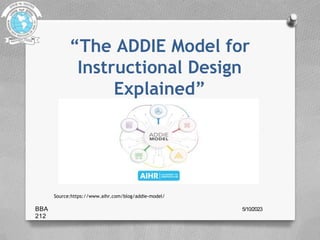
“The ADDIE Model for
Instructional Design
Explained”
Source:https://www.aihr.com/blog/addie-model/
BBA
212
5/10/2023
Models of Organising Training
Department
The three model of organizing training are:
1. System Model
2. Instructional System Development Model
3. Transitional Model
BBA
212
5/10/2023
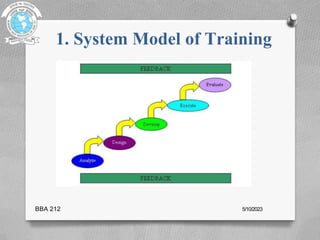
1. System Model of Training
 A system is a combination of things or parts that must work
together to perform a particular function. An organization is a
system and training is a sub-system of the organization.
 System Approach can be used to examine broad issues like
objectives, functions, and aim.
 It establishes a logical relationship between the sequential stages
in the process of training need analysis (TNA), formulating,
delivering, and evaluating.
 There are four necessary inputs i.e. technology, man, material,
time required in every system to produce products or services.
BBA
212
5/10/2023
1. System Model of Training
BBA 212 5/10/2023
2. Instructional System
Development Model
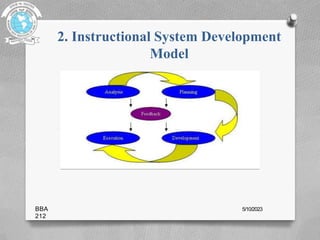
 This model is widely used nowadays in the organization because it is
concerned with the training need on the job performance.
 Training objectives are defined on the basis of job
responsibilities and job description and on the basis of the defined
objectives individual progress
is measured.
 This model also helps in determining and developing the favorable
strategies, sequencing the content, and delivering media for the types
of training objectives to be achieved.
BBA
212
5/10/2023
2. Instructional System Development
Model
BBA
212
5/10/2023
3. Transitional Model
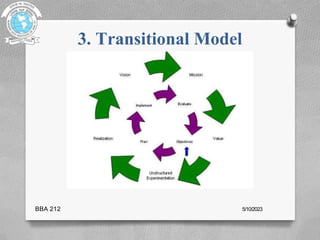
• The transitional model focuses on the organization as a
whole.
• The outer loop describes the vision, mission and values
of the organization on the basis of which training model
i.e. inner loop is executed.
BBA
212
5/10/2023
3. Transitional Model
BBA 212 5/10/2023
Organizing Training Department
Training is a sub-system of the organization
because the departments such as, marketing
and sales, HR, production, finance, etc.,
depends on training for its survival.
Training is a transforming process that
requires some input and in turn it produces
output in the form of knowledge, skills, and
attitudes (KSAs).
BBA
212
5/10/2023
SELECTING AND
PREPARING THE
TRAINING SITE
5/10/2023
BBA
212
Recognizing the trainee, learning can be facilitated through both
mental and physical involvement, it is important to consider this when
choosing, designing or deciding a training space.
Because training classes nowadays involve online learning,
teamwork, physical movement and quite contemplation, spaces need
flexible furniture and equipment that can be moved within the class.
The key is to have a classroom that is able to accommodate a wide
variety of activities and instructor-learner, learner-learner and learner
content interaction.

5/10/2023
BBA
212
TRAINING SITE
-refers to the room where training will be
conducted.
Features of a good training site
1.It is comfortable and accessible.
2.It is quite private, and free from
interruptions. 3.It has sufficient space
for trainees to move
around easily.
5/10/2023
BBA
212
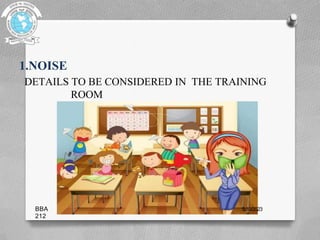
DETAILS TO BE CONSIDERED IN THE TRAINING
ROOM
1.NOISE
5/10/2023
BBA
212
5/10/2023
BBA
212
for noise from
Check
heating and air conditioning
systems, and
and outside the
corridors
building.
5/10/2023
BBA
212
2. COLORS
5/10/2023
BBA
212
Pastel hues such as oranges, greens,
blues, and yellows are warm colors
variation of white are cold and sterile.
Blacks and brown shades will close
the room psychologically and become
fatiguing.
5/10/2023
BBA
212
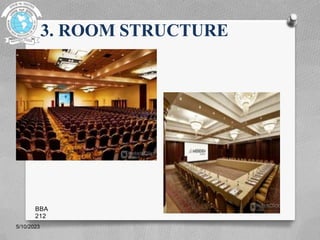
3. ROOM STRUCTURE
5/10/2023
BBA
212
Use rooms that
are somewhat square
in shape.
5/10/2023
BBA
212
4. LIGHTING
5/10/2023
BBA
212
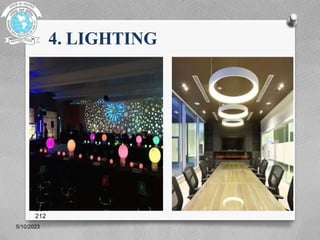
The main source of light
should be fluorescent
Incandescent lighting
lights.
should
be spread throughout the room
and used with dimmers.
5/10/2023
BBA
212
5. WALL and FLOOR COVERING
5/10/2023
BBA
212
Only meeting related
materials should be
on the wall.
5/10/2023
BBA
212
6.MEETING ROOM CHAIRS
5/10/2023
BBA
212
Chairs should have
wheels and swivels, and
backs
support
that
for the
provide
lower
lumbar region.
5/10/2023
BBA
212
7. GLARE
5/10/2023
BBA
212
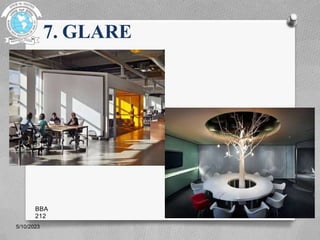
Check and eliminates
glare from metal surfaces,
TV monitors, and mirrors.
5/10/2023
BBA
212
8. CEILING
5/10/2023
BBA
212
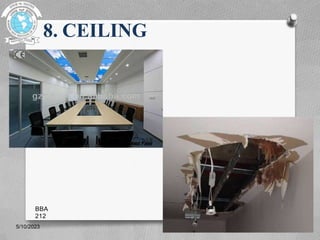
Ten-foot-high ceiling
are preferable.
5/10/2023
BBA
212
9.ELECTRICAL OUTLET
5/10/2023
BBA
212
Outlets should be available
every six feet around the room.
Make sure that outlets are
available for trainees to plug in
their laptops, if necessary.
5/10/2023
BBA
212
10. ACOUSTICS
5/10/2023
BBA
212
Check the bounce or
absorption of sound
from the walls, ceiling,
floor, and furniture.
5/10/2023
BBA
212
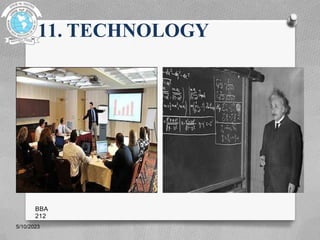
11. TECHNOLOGY
5/10/2023
BBA
212
that the
Check
permanent screens
room has
and a
computer with internet access
for the trainer (if necessary).
5/10/2023
BBA
212
SEATING ARRANGEMENT
Seating arrangement at the training
site should be based on understanding of
the desired type of trainee interaction and
trainee- trainer interaction.
5/10/2023
BBA
212
Types of Seating Arrangement
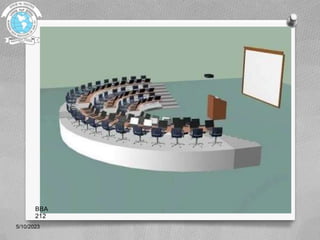
1.Fan-type seating
Conducive in allowing trainees to see from
any point in the room. Trainees can easily
switch from listening to a presentation to
practicing in groups. And trainees can
communicate easily with everyone in the
room.
5/10/2023
BBA
212
5/10/2023
BBA
212
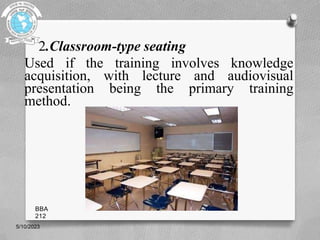
2.Classroom-type seating
Used if the training involves knowledge
acquisition, with lecture and audiovisual
presentation being the primary training
method.
5/10/2023
BBA
212
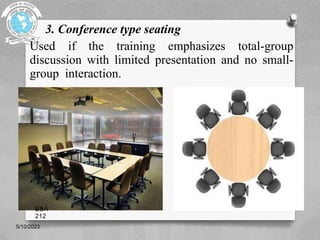
3. Conference type seating
Used if the training emphasizes total-group
discussion with limited presentation and no small-
group interaction.

5/10/2023
BBA
212
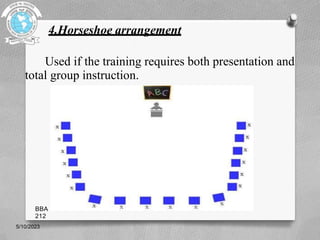
4.Horseshoe arrangement
Used if the training requires both presentation and
total group instruction.
5/10/2023
BBA
212
CLOSURE
“ By failing to prepare,
you are preparing to
fail.”
-Benjamin Franklin
5/10/2023
BBA
212
5/10/2023
BBA
212
Summary
Training is imparted to employees for whom the training
needs have been recognized. Training needs can arise for
employees at all levels. The determination of training needs
and organization of training programmes would vary from
organization to organization. A training and development
programme must clearly lay down its objectives.
5/10/2023
BBA
212
Suggested Readings
• Blanchard, N. P., & Thacker, J. W., Effective Training:
Systems, Strategies and Practices, New York: Pearson
Education.
• Tapomoy Deb, Training and Development : Concepts
& Applications, Ane Book India.
• https://www.aihr.com/blog/addie-model/
5/10/2023
BBA 212

2.ISD Model of T&D.pptx

  • 1.
    -ISD Model ofT&D -Organizing Training Department 5/10/2023 BBA 212
  • 2.
  • 3.
    5/10/2023 BBA 212  LEARNINGOUTCOME: PO CO K Level LEARNING OUTCOME PO1-PO8 CO1 K4 The student will be able to discover the models of Training and Development. PO1-PO8 CO1 K4 The student will be able to discover the way to organize Training Department.
  • 4.
    Lecture Outline 5/10/2023 BBA 212 •Concept of System Model • Concept of Instructional System Development Model • Concept of Transitional Model • Organizing Training Department
  • 5.
    “The ADDIE Modelfor Instructional Design Explained” Source:https://www.aihr.com/blog/addie-model/ BBA 212 5/10/2023
  • 6.
    Models of OrganisingTraining Department The three model of organizing training are: 1. System Model 2. Instructional System Development Model 3. Transitional Model BBA 212 5/10/2023
  • 7.
    1. System Modelof Training  A system is a combination of things or parts that must work together to perform a particular function. An organization is a system and training is a sub-system of the organization.  System Approach can be used to examine broad issues like objectives, functions, and aim.  It establishes a logical relationship between the sequential stages in the process of training need analysis (TNA), formulating, delivering, and evaluating.  There are four necessary inputs i.e. technology, man, material, time required in every system to produce products or services. BBA 212 5/10/2023
  • 8.
    1. System Modelof Training BBA 212 5/10/2023
  • 9.
    2. Instructional System DevelopmentModel  This model is widely used nowadays in the organization because it is concerned with the training need on the job performance.  Training objectives are defined on the basis of job responsibilities and job description and on the basis of the defined objectives individual progress is measured.  This model also helps in determining and developing the favorable strategies, sequencing the content, and delivering media for the types of training objectives to be achieved. BBA 212 5/10/2023
  • 10.
    2. Instructional SystemDevelopment Model BBA 212 5/10/2023
  • 11.
    3. Transitional Model •The transitional model focuses on the organization as a whole. • The outer loop describes the vision, mission and values of the organization on the basis of which training model i.e. inner loop is executed. BBA 212 5/10/2023
  • 12.
  • 13.
    Organizing Training Department Trainingis a sub-system of the organization because the departments such as, marketing and sales, HR, production, finance, etc., depends on training for its survival. Training is a transforming process that requires some input and in turn it produces output in the form of knowledge, skills, and attitudes (KSAs). BBA 212 5/10/2023
  • 14.
  • 15.
    Recognizing the trainee,learning can be facilitated through both mental and physical involvement, it is important to consider this when choosing, designing or deciding a training space. Because training classes nowadays involve online learning, teamwork, physical movement and quite contemplation, spaces need flexible furniture and equipment that can be moved within the class. The key is to have a classroom that is able to accommodate a wide variety of activities and instructor-learner, learner-learner and learner content interaction. 5/10/2023 BBA 212
  • 16.
    TRAINING SITE -refers tothe room where training will be conducted. Features of a good training site 1.It is comfortable and accessible. 2.It is quite private, and free from interruptions. 3.It has sufficient space for trainees to move around easily. 5/10/2023 BBA 212
  • 17.
    DETAILS TO BECONSIDERED IN THE TRAINING ROOM 1.NOISE 5/10/2023 BBA 212
  • 18.
  • 19.
    for noise from Check heatingand air conditioning systems, and and outside the corridors building. 5/10/2023 BBA 212
  • 20.
  • 21.
    Pastel hues suchas oranges, greens, blues, and yellows are warm colors variation of white are cold and sterile. Blacks and brown shades will close the room psychologically and become fatiguing. 5/10/2023 BBA 212
  • 22.
  • 23.
    Use rooms that aresomewhat square in shape. 5/10/2023 BBA 212
  • 24.
  • 25.
    The main sourceof light should be fluorescent Incandescent lighting lights. should be spread throughout the room and used with dimmers. 5/10/2023 BBA 212
  • 26.
    5. WALL andFLOOR COVERING 5/10/2023 BBA 212
  • 27.
    Only meeting related materialsshould be on the wall. 5/10/2023 BBA 212
  • 28.
  • 29.
    Chairs should have wheelsand swivels, and backs support that for the provide lower lumbar region. 5/10/2023 BBA 212
  • 30.
  • 31.
    Check and eliminates glarefrom metal surfaces, TV monitors, and mirrors. 5/10/2023 BBA 212
  • 32.
  • 33.
  • 34.
  • 35.
    Outlets should beavailable every six feet around the room. Make sure that outlets are available for trainees to plug in their laptops, if necessary. 5/10/2023 BBA 212
  • 36.
  • 37.
    Check the bounceor absorption of sound from the walls, ceiling, floor, and furniture. 5/10/2023 BBA 212
  • 38.
  • 39.
    that the Check permanent screens roomhas and a computer with internet access for the trainer (if necessary). 5/10/2023 BBA 212
  • 40.
    SEATING ARRANGEMENT Seating arrangementat the training site should be based on understanding of the desired type of trainee interaction and trainee- trainer interaction. 5/10/2023 BBA 212
  • 41.
    Types of SeatingArrangement 1.Fan-type seating Conducive in allowing trainees to see from any point in the room. Trainees can easily switch from listening to a presentation to practicing in groups. And trainees can communicate easily with everyone in the room. 5/10/2023 BBA 212
  • 42.
  • 43.
    2.Classroom-type seating Used ifthe training involves knowledge acquisition, with lecture and audiovisual presentation being the primary training method. 5/10/2023 BBA 212
  • 44.
    3. Conference typeseating Used if the training emphasizes total-group discussion with limited presentation and no small- group interaction. 5/10/2023 BBA 212
  • 45.
    4.Horseshoe arrangement Used ifthe training requires both presentation and total group instruction. 5/10/2023 BBA 212
  • 46.
    CLOSURE “ By failingto prepare, you are preparing to fail.” -Benjamin Franklin 5/10/2023 BBA 212
  • 47.
  • 48.
    Summary Training is impartedto employees for whom the training needs have been recognized. Training needs can arise for employees at all levels. The determination of training needs and organization of training programmes would vary from organization to organization. A training and development programme must clearly lay down its objectives. 5/10/2023 BBA 212

  • 49.
    Suggested Readings • Blanchard,N. P., & Thacker, J. W., Effective Training: Systems, Strategies and Practices, New York: Pearson Education. • Tapomoy Deb, Training and Development : Concepts & Applications, Ane Book India. • https://www.aihr.com/blog/addie-model/ 5/10/2023 BBA 212