

Padova – 14 giugno 2023
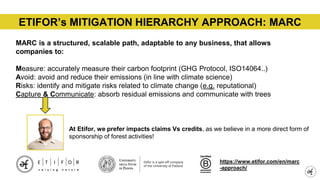
ETIFOR’s MITIGATION HIERARCHY APPROACH: MARC
https://www.etifor.com/it/approccio-marc/
MARC is a structured, scalable path, adaptable to any business, that allows
companies to:
Measure: accurately measure their carbon footprint (GHG Protocol, ISO14064..)
Avoid: avoid and reduce their emissions (in line with climate science)
Risks: identify and mitigate risks related to climate change (e.g. reputational)
Capture & Communicate: absorb residual emissions and communicate with trees
https://www.etifor.com/en/marc
-approach/
At Etifor, we prefer impacts claims Vs credits, as we believe in a more direct form of
sponsorship of forest activities!
What you will learn today
• What is compensation
• Ingredients for a good compensation
• Markets & tools
• How to choose & communicate a compensation project
AGENDA
COMPENSATION =
offsetting =
neutralization =
beyond value chain mitigation =
give back,
with more words:
= a counterbalance of an organization’s impacts that occurs
by paying another organization to reduce, avoid, or remove
impacts:
_CO2 emissions = e.g. CO2 captured or avoid
_water impacts = e.g. water infiltrated
_biodiversity impacts = e.g. habitat restored
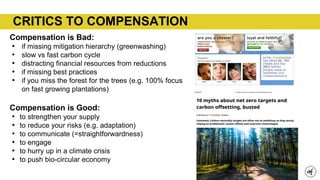
CRITICS TO COMPENSATION
Compensation is Bad:
• if missing mitigation hierarchy (greenwashing)
• slow vs fast carbon cycle
• distracting financial resources from reductions
• if missing best practices
• if you miss the forest for the trees (e.g. 100% focus
on fast growing plantations)
Compensation is Good:
• to strengthen your supply
• to reduce your risks (e.g. adaptation)
• to communicate (=straightforwardness)
• to engage
• to hurry up in a climate crisis
• to push bio-circular economy
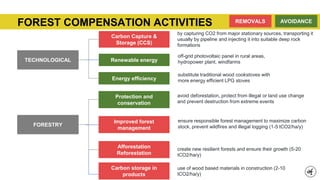
FOREST COMPENSATION ACTIVITIES
Renewable energy
Energy efficiency
Improved forest
management
Protection and
conservation
Afforestation
Reforestation
TECHNOLOGICAL
FORESTRY
AVOIDANCE
REMOVALS
Carbon Capture &
Storage (CCS)
by capturing CO2 from major stationary sources, transporting it
usually by pipeline and injecting it into suitable deep rock
formations
off-grid photovoltaic panel in rural areas,
hydropower plant, windfarms
substitute traditional wood cookstoves with
more energy efficient LPG stoves
avoid deforestation, protect from illegal or land use change
and prevent destruction from extreme events
ensure responsible forest management to maximize carbon
stock, prevent wildfires and illegal logging (1-5 tCO2/ha/y)
create new resilient forests and ensure their growth (5-20
tCO2/ha/y)
Carbon storage in
products
use of wood based materials in construction (2-10
tCO2/ha/y)
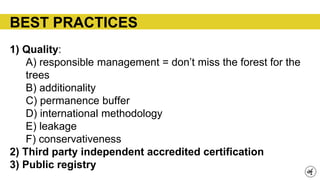
BEST PRACTICES
1) Quality:
A) responsible management = don’t miss the forest for the
trees
B) additionality
C) permanence buffer
D) international methodology
E) leakage
F) conservativeness
2) Third party independent accredited certification
3) Public registry
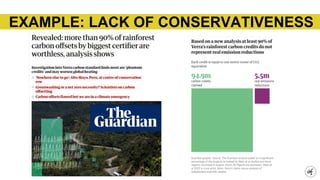
EXAMPLE: LACK OF CONSERVATIVENESS
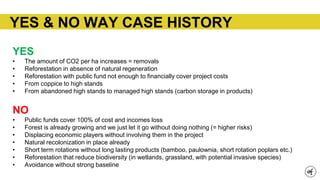
YES & NO WAY CASE HISTORY
YES
• The amount of CO2 per ha increases = removals
• Reforestation in absence of natural regeneration
• Reforestation with public fund not enough to financially cover project costs
• From coppice to high stands
• From abandoned high stands to managed high stands (carbon storage in products)
NO
• Public funds cover 100% of cost and incomes loss
• Forest is already growing and we just let it go without doing nothing (= higher risks)
• Displacing economic players without involving them in the project
• Natural recolonization in place already
• Short term rotations without long lasting products (bamboo, paulownia, short rotation poplars etc.)
• Reforestation that reduce biodiversity (in wetlands, grassland, with potential invasive species)
• Avoidance without strong baseline
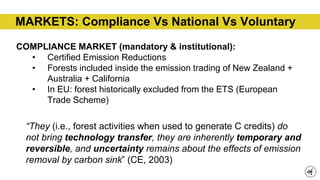
MARKETS: Compliance Vs National Vs Voluntary
COMPLIANCE MARKET (mandatory & institutional):
• Certified Emission Reductions
• Forests included inside the emission trading of New Zealand +
Australia + California
• In EU: forest historically excluded from the ETS (European
Trade Scheme)
“They (i.e., forest activities when used to generate C credits) do
not bring technology transfer, they are inherently temporary and
reversible, and uncertainty remains about the effects of emission
removal by carbon sink” (CE, 2003)
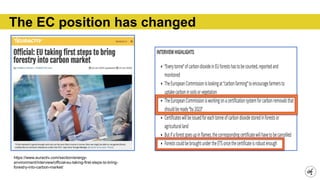
https://www.euractiv.com/section/energy-
environment/interview/official-eu-taking-first-steps-to-bring-
forestry-into-carbon-market/
The EC position has changed
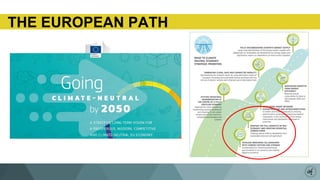
THE EUROPEAN PATH
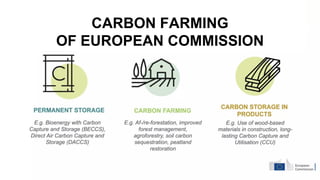
CARBON FARMING
OF EUROPEAN COMMISSION
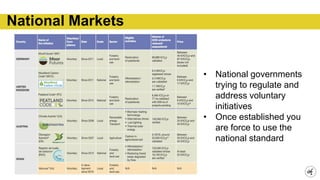
National Markets
• National governments
trying to regulate and
address voluntary
initiatives
• Once established you
are force to use the
national standard
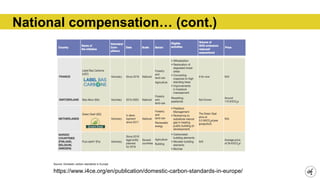
National compensation… (cont.)
Source: Domestic carbon standards in Europe
https://www.i4ce.org/en/publication/domestic-carbon-standards-in-europe/
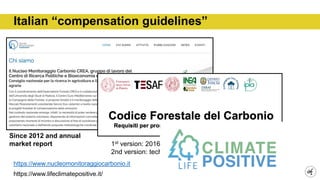
https://www.nucleomonitoraggiocarbonio.it
https://www.lifeclimatepositive.it/
Since 2012 and annual
market report 1st version: 2016;
2nd version: technically approved in January 2023
Italian “compensation guidelines”
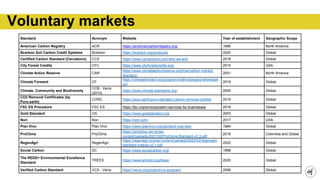
Voluntary markets
Standard Acronym Website Year of establishment Geographic Scope
American Carbon Registry ACR https://americancarbonregistry.org/ 1996 North America
Bcarbon Soil Carbon Credit Systems Bcarbon https://bcarbon.org/protocols 2020 Global
Certified Carbon Standard (Cercabono) CCS https://www.cercarbono.com/who-we-are/ 2018 Global
City Forest Credits CFC https://www.cityforestcredits.org/ 2015 USA
Climate Action Reserve CAR
https://www.climateactionreserve.org/how/carbon-market-
directory/
2001 North America
Climate Forward CF
https://climateforward.org/program/methodologies/reforestati
on/
2019 Global
Climate, Community and Biodiversity
CCB - Verra
(2014)
https://www.climate-standards.org/ 2005 Global
CO2 Removal Certificates (by
Puro.earth)
CORC https://puro.earth/puro-standard-carbon-removal-credits/ 2019 Global
FSC ES Procedure FSC ES https://fsc.org/en/ecosystem-services-for-businesses 2018 Global
Gold Standard GS https://www.goldstandard.org/ 2003 Global
Nori Nori https://nori.com/ 2017 USA
Plan Vivo Plan Vivo https://www.planvivo.org/standard-overview 1994 Global
ProClima ProClima
https://proclima.net.co/wp-
content/uploads/2021/02/ProClima-Standard-v2.3.pdf
2018 Colombia and Global
RegenAgri RegenAgri
https://regenagri.org/wp-content/uploads/2022/02/regenagri-
standard-criteria-v2.1.pdf
2022 Global
Social Carbon SC https://www.socialcarbon.org/ 1998 Global
The REDD+ Environmental Excellence
Standard
TREES https://www.artredd.org/trees/ 2020 Global
Verified Carbon Standard VCS - Verra https://verra.org/project/vcs-program/ 2006 Global
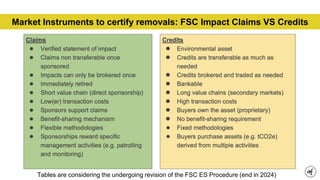
Market Instruments to certify removals: FSC Impact Claims VS Credits
Tables are considering the undergoing revision of the FSC ES Procedure (end in 2024)
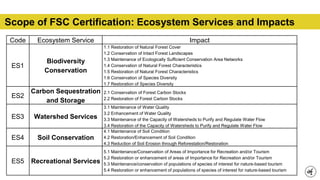
Scope of FSC Certification: Ecosystem Services and Impacts
Code Ecosystem Service Impact
ES1
Biodiversity
Conservation
1.1 Restoration of Natural Forest Cover
1.2 Conservation of Intact Forest Landscapes
1.3 Maintenance of Ecologically Sufficient Conservation Area Networks
1.4 Conservation of Natural Forest Characteristics
1.5 Restoration of Natural Forest Characteristics
1.6 Conservation of Species Diversity
1.7 Restoration of Species Diversity
ES2
Carbon Sequestration
and Storage
2.1 Conservation of Forest Carbon Stocks
2.2 Restoration of Forest Carbon Stocks
ES3 Watershed Services
3.1 Maintenance of Water Quality
3.2 Enhancement of Water Quality
3.3 Maintenance of the Capacity of Watersheds to Purify and Regulate Water Flow
3.4 Restoration of the Capacity of Watersheds to Purify and Regulate Water Flow
ES4 Soil Conservation
4.1 Maintenance of Soil Condition
4.2 Restoration/Enhancement of Soil Condition
4.3 Reduction of Soil Erosion through Reforestation/Restoration
ES5 Recreational Services
5.1 Maintenance/Conservation of Areas of Importance for Recreation and/or Tourism
5.2 Restoration or enhancement of areas of Importance for Recreation and/or Tourism
5.3 Maintenance/conservation of populations of species of interest for nature-based tourism
5.4 Restoration or enhancement of populations of species of interest for nature-based tourism
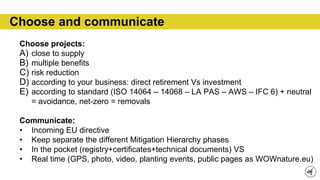
Choose and communicate
Choose projects:
A) close to supply
B) multiple benefits
C) risk reduction
D) according to your business: direct retirement Vs investment
E) according to standard (ISO 14064 – 14068 – LA PAS – AWS – IFC 6) + neutral
= avoidance, net-zero = removals
Communicate:
• Incoming EU directive
• Keep separate the different Mitigation Hierarchy phases
• In the pocket (registry+certificates+technical documents) VS
• Real time (GPS, photo, video, planting events, public pages as WOWnature.eu)
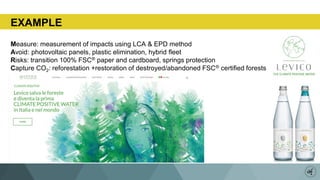
EXAMPLE
Measure: measurement of impacts using LCA & EPD method
Avoid: photovoltaic panels, plastic elimination, hybrid fleet
Risks: transition 100% FSC® paper and cardboard, springs protection
Capture CO2: reforestation +restoration of destroyed/abandoned FSC® certified forests
www.etifor.com – www.wownature.eu
INFO:
wesley.snell@etifor.com +39 391 329 3172
lucio.brotto@etifor.com +39 331 567 4189
valerio.scartezzini@etifor.com +39 338 831 5562
THANK YOU!

Sequestro del carbonio in ambito forestale e nature-based-solutions

  • 1.
    Padova – 14giugno 2023
  • 2.
    ETIFOR’s MITIGATION HIERARCHYAPPROACH: MARC https://www.etifor.com/it/approccio-marc/ MARC is a structured, scalable path, adaptable to any business, that allows companies to: Measure: accurately measure their carbon footprint (GHG Protocol, ISO14064..) Avoid: avoid and reduce their emissions (in line with climate science) Risks: identify and mitigate risks related to climate change (e.g. reputational) Capture & Communicate: absorb residual emissions and communicate with trees https://www.etifor.com/en/marc -approach/ At Etifor, we prefer impacts claims Vs credits, as we believe in a more direct form of sponsorship of forest activities!
  • 3.
    What you willlearn today • What is compensation • Ingredients for a good compensation • Markets & tools • How to choose & communicate a compensation project AGENDA
  • 4.
    COMPENSATION = offsetting = neutralization= beyond value chain mitigation = give back, with more words: = a counterbalance of an organization’s impacts that occurs by paying another organization to reduce, avoid, or remove impacts: _CO2 emissions = e.g. CO2 captured or avoid _water impacts = e.g. water infiltrated _biodiversity impacts = e.g. habitat restored
  • 5.
    CRITICS TO COMPENSATION Compensationis Bad: • if missing mitigation hierarchy (greenwashing) • slow vs fast carbon cycle • distracting financial resources from reductions • if missing best practices • if you miss the forest for the trees (e.g. 100% focus on fast growing plantations) Compensation is Good: • to strengthen your supply • to reduce your risks (e.g. adaptation) • to communicate (=straightforwardness) • to engage • to hurry up in a climate crisis • to push bio-circular economy
  • 6.
    FOREST COMPENSATION ACTIVITIES Renewableenergy Energy efficiency Improved forest management Protection and conservation Afforestation Reforestation TECHNOLOGICAL FORESTRY AVOIDANCE REMOVALS Carbon Capture & Storage (CCS) by capturing CO2 from major stationary sources, transporting it usually by pipeline and injecting it into suitable deep rock formations off-grid photovoltaic panel in rural areas, hydropower plant, windfarms substitute traditional wood cookstoves with more energy efficient LPG stoves avoid deforestation, protect from illegal or land use change and prevent destruction from extreme events ensure responsible forest management to maximize carbon stock, prevent wildfires and illegal logging (1-5 tCO2/ha/y) create new resilient forests and ensure their growth (5-20 tCO2/ha/y) Carbon storage in products use of wood based materials in construction (2-10 tCO2/ha/y)
  • 7.
    BEST PRACTICES 1) Quality: A)responsible management = don’t miss the forest for the trees B) additionality C) permanence buffer D) international methodology E) leakage F) conservativeness 2) Third party independent accredited certification 3) Public registry
  • 8.
    EXAMPLE: LACK OFCONSERVATIVENESS
  • 9.
    YES & NOWAY CASE HISTORY YES • The amount of CO2 per ha increases = removals • Reforestation in absence of natural regeneration • Reforestation with public fund not enough to financially cover project costs • From coppice to high stands • From abandoned high stands to managed high stands (carbon storage in products) NO • Public funds cover 100% of cost and incomes loss • Forest is already growing and we just let it go without doing nothing (= higher risks) • Displacing economic players without involving them in the project • Natural recolonization in place already • Short term rotations without long lasting products (bamboo, paulownia, short rotation poplars etc.) • Reforestation that reduce biodiversity (in wetlands, grassland, with potential invasive species) • Avoidance without strong baseline
  • 10.
    MARKETS: Compliance VsNational Vs Voluntary COMPLIANCE MARKET (mandatory & institutional): • Certified Emission Reductions • Forests included inside the emission trading of New Zealand + Australia + California • In EU: forest historically excluded from the ETS (European Trade Scheme) “They (i.e., forest activities when used to generate C credits) do not bring technology transfer, they are inherently temporary and reversible, and uncertainty remains about the effects of emission removal by carbon sink” (CE, 2003)
  • 11.
  • 12.
  • 13.
  • 14.
    National Markets • Nationalgovernments trying to regulate and address voluntary initiatives • Once established you are force to use the national standard
  • 15.
    National compensation… (cont.) Source:Domestic carbon standards in Europe https://www.i4ce.org/en/publication/domestic-carbon-standards-in-europe/
  • 16.
    https://www.nucleomonitoraggiocarbonio.it https://www.lifeclimatepositive.it/ Since 2012 andannual market report 1st version: 2016; 2nd version: technically approved in January 2023 Italian “compensation guidelines”
  • 17.
    Voluntary markets Standard AcronymWebsite Year of establishment Geographic Scope American Carbon Registry ACR https://americancarbonregistry.org/ 1996 North America Bcarbon Soil Carbon Credit Systems Bcarbon https://bcarbon.org/protocols 2020 Global Certified Carbon Standard (Cercabono) CCS https://www.cercarbono.com/who-we-are/ 2018 Global City Forest Credits CFC https://www.cityforestcredits.org/ 2015 USA Climate Action Reserve CAR https://www.climateactionreserve.org/how/carbon-market- directory/ 2001 North America Climate Forward CF https://climateforward.org/program/methodologies/reforestati on/ 2019 Global Climate, Community and Biodiversity CCB - Verra (2014) https://www.climate-standards.org/ 2005 Global CO2 Removal Certificates (by Puro.earth) CORC https://puro.earth/puro-standard-carbon-removal-credits/ 2019 Global FSC ES Procedure FSC ES https://fsc.org/en/ecosystem-services-for-businesses 2018 Global Gold Standard GS https://www.goldstandard.org/ 2003 Global Nori Nori https://nori.com/ 2017 USA Plan Vivo Plan Vivo https://www.planvivo.org/standard-overview 1994 Global ProClima ProClima https://proclima.net.co/wp- content/uploads/2021/02/ProClima-Standard-v2.3.pdf 2018 Colombia and Global RegenAgri RegenAgri https://regenagri.org/wp-content/uploads/2022/02/regenagri- standard-criteria-v2.1.pdf 2022 Global Social Carbon SC https://www.socialcarbon.org/ 1998 Global The REDD+ Environmental Excellence Standard TREES https://www.artredd.org/trees/ 2020 Global Verified Carbon Standard VCS - Verra https://verra.org/project/vcs-program/ 2006 Global
  • 18.
    Market Instruments tocertify removals: FSC Impact Claims VS Credits Tables are considering the undergoing revision of the FSC ES Procedure (end in 2024)
  • 19.
    Scope of FSCCertification: Ecosystem Services and Impacts Code Ecosystem Service Impact ES1 Biodiversity Conservation 1.1 Restoration of Natural Forest Cover 1.2 Conservation of Intact Forest Landscapes 1.3 Maintenance of Ecologically Sufficient Conservation Area Networks 1.4 Conservation of Natural Forest Characteristics 1.5 Restoration of Natural Forest Characteristics 1.6 Conservation of Species Diversity 1.7 Restoration of Species Diversity ES2 Carbon Sequestration and Storage 2.1 Conservation of Forest Carbon Stocks 2.2 Restoration of Forest Carbon Stocks ES3 Watershed Services 3.1 Maintenance of Water Quality 3.2 Enhancement of Water Quality 3.3 Maintenance of the Capacity of Watersheds to Purify and Regulate Water Flow 3.4 Restoration of the Capacity of Watersheds to Purify and Regulate Water Flow ES4 Soil Conservation 4.1 Maintenance of Soil Condition 4.2 Restoration/Enhancement of Soil Condition 4.3 Reduction of Soil Erosion through Reforestation/Restoration ES5 Recreational Services 5.1 Maintenance/Conservation of Areas of Importance for Recreation and/or Tourism 5.2 Restoration or enhancement of areas of Importance for Recreation and/or Tourism 5.3 Maintenance/conservation of populations of species of interest for nature-based tourism 5.4 Restoration or enhancement of populations of species of interest for nature-based tourism
  • 20.
    Choose and communicate Chooseprojects: A) close to supply B) multiple benefits C) risk reduction D) according to your business: direct retirement Vs investment E) according to standard (ISO 14064 – 14068 – LA PAS – AWS – IFC 6) + neutral = avoidance, net-zero = removals Communicate: • Incoming EU directive • Keep separate the different Mitigation Hierarchy phases • In the pocket (registry+certificates+technical documents) VS • Real time (GPS, photo, video, planting events, public pages as WOWnature.eu)
  • 21.
    EXAMPLE Measure: measurement ofimpacts using LCA & EPD method Avoid: photovoltaic panels, plastic elimination, hybrid fleet Risks: transition 100% FSC® paper and cardboard, springs protection Capture CO2: reforestation +restoration of destroyed/abandoned FSC® certified forests
  • 22.
    www.etifor.com – www.wownature.eu INFO: wesley.snell@etifor.com+39 391 329 3172 lucio.brotto@etifor.com +39 331 567 4189 valerio.scartezzini@etifor.com +39 338 831 5562 THANK YOU!