ChatGPT said:
Discover 2 essential Python libraries for data analytics that boost data handling, visualization, and insights with powerful, efficient tools.
Essential Python
Libraries forData
Analytics
Python stands as the top language for data science, boasting over 137,000
libraries. This presentation focuses on core libraries that are essential for
data manipulation, analysis, and visualization.
2.
NumPy: Foundation forNumerical
Computing
NumPy provides fast N-dimensional arrays and a comprehensive suite of
mathematical functions. It's crucial for linear algebra, Fourier transforms, and
random sampling, offering superior performance over traditional Python lists.
With over 2.4 billion downloads and 25,000 GitHub stars, NumPy is the
backbone of numerical operations in Python's data ecosystem.
3.
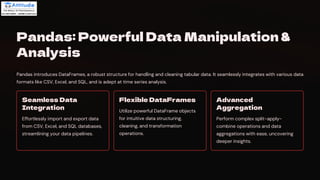
Pandas: Powerful DataManipulation &
Analysis
Pandas introduces DataFrames, a robust structure for handling and cleaning tabular data. It seamlessly integrates with various data
formats like CSV, Excel, and SQL, and is adept at time series analysis.
Seamless Data
Integration
Effortlessly import and export data
from CSV, Excel, and SQL databases,
streamlining your data pipelines.
Flexible DataFrames
Utilize powerful DataFrame objects
for intuitive data structuring,
cleaning, and transformation
operations.
Advanced
Aggregation
Perform complex split-apply-
combine operations and data
aggregations with ease, uncovering
deeper insights.
4.
Matplotlib: Versatile DataVisualization
Matplotlib is the foundational library for creating static, animated, and interactive plots in Python. Its extensive customization options allow for precise control over every aspect of
your visualizations.
It supports a wide array of plot types, including line plots, histograms, scatter plots, and
heatmaps, serving as the base for other visualization libraries like Seaborn.
5.
Seaborn: Statistical DataVisualization
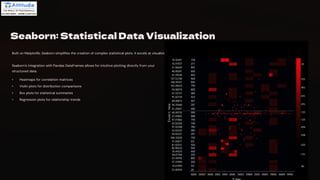
Built on Matplotlib, Seaborn simplifies the creation of complex statistical plots. It excels at visualizing relationships between variables, making it ideal for exploratory data analysis.
Seaborn's integration with Pandas DataFrames allows for intuitive plotting directly from your
structured data.
• Heatmaps for correlation matrices
• Violin plots for distribution comparisons
• Box plots for statistical summaries
• Regression plots for relationship trends
6.
SciPy: Scientific Computing&
Advanced Math
SciPy extends NumPy's capabilities by providing modules for optimization, integration, interpolation, and more. It's a cornerstone
for advanced scientific computing and engineering.
Optimization
Algorithms for minimizing or maximizing objective
functions.
Integration
Numerical integration of functions and differential
equations.
Signal Processing
Tools for analyzing and manipulating signals.
Statistics
Extensive statistical functions and distributions.
7.
Scikit-learn: Machine LearningMade Easy
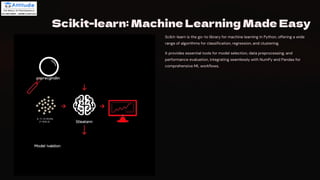
Scikit-learn is the go-to library for machine learning in Python, offering a wide
range of algorithms for classification, regression, and clustering.
It provides essential tools for model selection, data preprocessing, and
performance evaluation, integrating seamlessly with NumPy and Pandas for
comprehensive ML workflows.
8.
Summary & NextSteps
Python's rich ecosystem, powered by these essential libraries, empowers data analytics and machine learning projects. Mastering them will accelerate your journey to data-driven
insights.
Explore Interactive Analysis
Dive deeper into your data with Jupyter Notebooks, an interactive
environment perfect for experimentation and sharing.
9.
THANK YOU
Thank youfor joining us today. We hope you found this presentation valuable. We wish you all the best.
For more information, or visit our website:- Attitude Academy



![python libray for data analytics seaborn[1].pptx](https://cdn.slidesharecdn.com/ss_thumbnails/pythonseaborn1-241222125910-e118d8f2-thumbnail.jpg?width=640&height=640&fit=bounds)


