RENAISSANCE VOCAL
MUSIC
The Golden Age of Polyphony
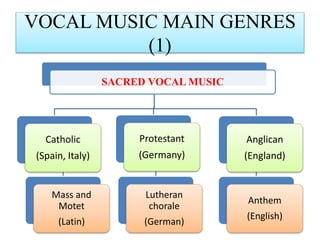
VOCAL MUSIC MAIN GENRES
(1)
SACRED VOCAL MUSIC
Catholic
(Spain, Italy)
Mass and
Motet
(Latin)
Protestant
(Germany)
Lutheran
chorale
(German)
Anglican
(England)
Anthem
(English)
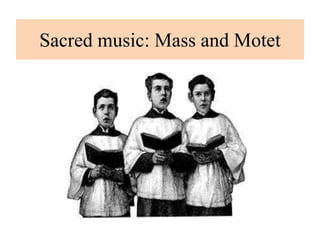
Sacred music: Mass and Motet
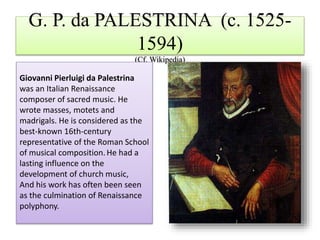
G. P. da PALESTRINA (c. 1525-
1594)
(Cf. Wikipedia)
Giovanni Pierluigi da Palestrina
was an Italian Renaissance
composer of sacred music. He
wrote masses, motets and
madrigals. He is considered as the
best-known 16th-century
representative of the Roman School
of musical composition.He had a
lasting influence on the
development of church music,
And his work has often been seen
as the culmination of Renaissance
polyphony.
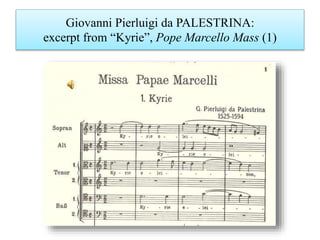
Giovanni Pierluigi da PALESTRINA:
excerpt from “Kyrie”, Pope Marcello Mass (1)
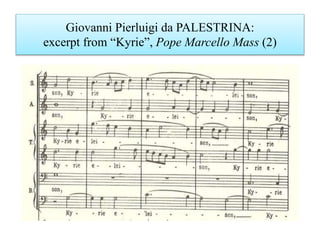
Giovanni Pierluigi da PALESTRINA:
excerpt from “Kyrie”, Pope Marcello Mass (2)
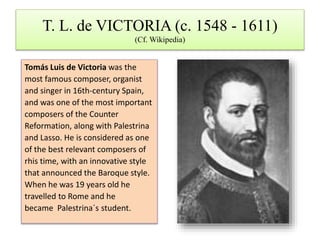
T. L. de VICTORIA (c. 1548 - 1611)
(Cf. Wikipedia)
Tomás Luis de Victoria was the
most famous composer, organist
and singer in 16th-century Spain,
and was one of the most important
composers of the Counter
Reformation, along with Palestrina
and Lasso. He is considered as one
of the best relevant composers of
rhis time, with an innovative style
that announced the Baroque style.
When he was 19 years old he
travelled to Rome and he
became Palestrina´s student.
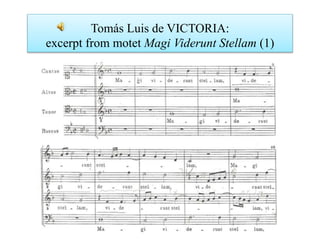
Tomás Luis de VICTORIA:
excerpt from motet Magi Viderunt Stellam (1)
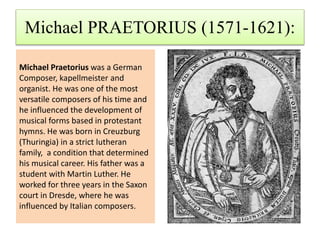
Michael PRAETORIUS (1571-1621):
Michael Praetorius was a German
Composer, kapellmeister and
organist. He was one of the most
versatile composers of his time and
he influenced the development of
musical forms based in protestant
hymns. He was born in Creuzburg
(Thuringia) in a strict lutheran
family, a condition that determined
his musical career. His father was a
student with Martin Luther. He
worked for three years in the Saxon
court in Dresde, where he was
influenced by Italian composers.
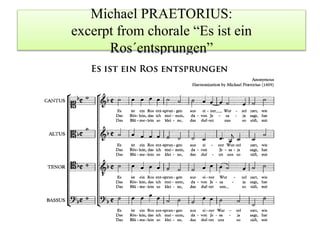
Michael PRAETORIUS:
excerpt from chorale “Es ist ein
Ros´entsprungen”
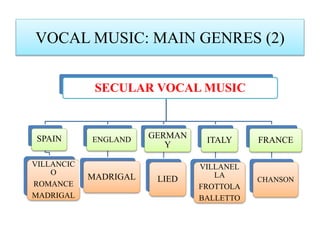
VOCAL MUSIC: MAIN GENRES (2)
SECULAR VOCAL MUSIC
SPAIN
VILLANCIC
O
ROMANCE
MADRIGAL
ENGLAND
MADRIGAL
GERMAN
Y
LIED
ITALY
VILLANEL
LA
FROTTOLA
BALLETTO
FRANCE
CHANSON
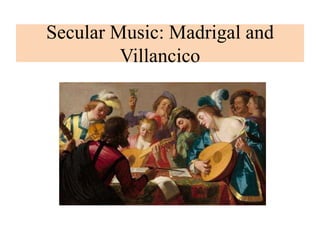
Secular Music: Madrigal and
Villancico
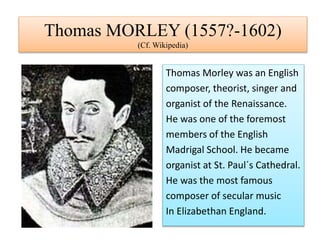
Thomas MORLEY (1557?-1602)
(Cf. Wikipedia)
Thomas Morley was an English
composer, theorist, singer and
organist of the Renaissance.
He was one of the foremost
members of the English
Madrigal School. He became
organist at St. Paul´s Cathedral.
He was the most famous
composer of secular music
In Elizabethan England.
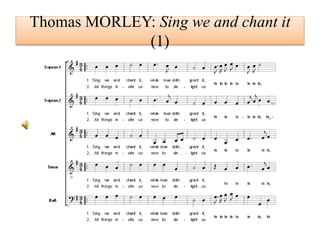
Thomas MORLEY: Sing we and chant it
(1)
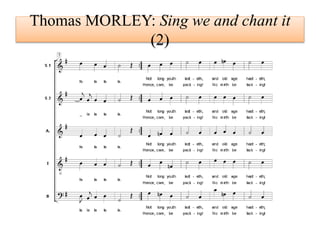
Thomas MORLEY: Sing we and chant it
(2)
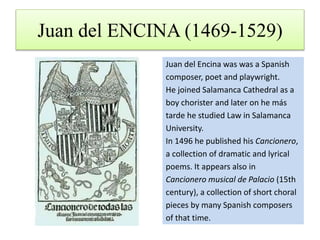
Juan del ENCINA (1469-1529)
Juan del Encina was was a Spanish
composer, poet and playwright.
He joined Salamanca Cathedral as a
boy chorister and later on he más
tarde he studied Law in Salamanca
University.
In 1496 he published his Cancionero,
a collection of dramatic and lyrical
poems. It appears also in
Cancionero musical de Palacio (15th
century), a collection of short choral
pieces by many Spanish composers
of that time.
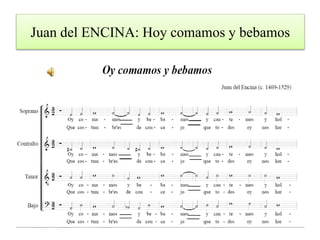
Juan del ENCINA: Hoy comamos y bebamos

2b - RENAISSANCE VOCAL MUSIC.pptx

  • 1.
  • 2.
    VOCAL MUSIC MAINGENRES (1) SACRED VOCAL MUSIC Catholic (Spain, Italy) Mass and Motet (Latin) Protestant (Germany) Lutheran chorale (German) Anglican (England) Anthem (English)
  • 3.
  • 4.
    G. P. daPALESTRINA (c. 1525- 1594) (Cf. Wikipedia) Giovanni Pierluigi da Palestrina was an Italian Renaissance composer of sacred music. He wrote masses, motets and madrigals. He is considered as the best-known 16th-century representative of the Roman School of musical composition.He had a lasting influence on the development of church music, And his work has often been seen as the culmination of Renaissance polyphony.
  • 5.
    Giovanni Pierluigi daPALESTRINA: excerpt from “Kyrie”, Pope Marcello Mass (1)
  • 6.
    Giovanni Pierluigi daPALESTRINA: excerpt from “Kyrie”, Pope Marcello Mass (2)
  • 7.
    T. L. deVICTORIA (c. 1548 - 1611) (Cf. Wikipedia) Tomás Luis de Victoria was the most famous composer, organist and singer in 16th-century Spain, and was one of the most important composers of the Counter Reformation, along with Palestrina and Lasso. He is considered as one of the best relevant composers of rhis time, with an innovative style that announced the Baroque style. When he was 19 years old he travelled to Rome and he became Palestrina´s student.
  • 8.
    Tomás Luis deVICTORIA: excerpt from motet Magi Viderunt Stellam (1)
  • 9.
    Michael PRAETORIUS (1571-1621): MichaelPraetorius was a German Composer, kapellmeister and organist. He was one of the most versatile composers of his time and he influenced the development of musical forms based in protestant hymns. He was born in Creuzburg (Thuringia) in a strict lutheran family, a condition that determined his musical career. His father was a student with Martin Luther. He worked for three years in the Saxon court in Dresde, where he was influenced by Italian composers.
  • 10.
    Michael PRAETORIUS: excerpt fromchorale “Es ist ein Ros´entsprungen”
  • 11.
    VOCAL MUSIC: MAINGENRES (2) SECULAR VOCAL MUSIC SPAIN VILLANCIC O ROMANCE MADRIGAL ENGLAND MADRIGAL GERMAN Y LIED ITALY VILLANEL LA FROTTOLA BALLETTO FRANCE CHANSON
  • 12.
  • 13.
    Thomas MORLEY (1557?-1602) (Cf.Wikipedia) Thomas Morley was an English composer, theorist, singer and organist of the Renaissance. He was one of the foremost members of the English Madrigal School. He became organist at St. Paul´s Cathedral. He was the most famous composer of secular music In Elizabethan England.
  • 14.
    Thomas MORLEY: Singwe and chant it (1)
  • 15.
    Thomas MORLEY: Singwe and chant it (2)
  • 16.
    Juan del ENCINA(1469-1529) Juan del Encina was was a Spanish composer, poet and playwright. He joined Salamanca Cathedral as a boy chorister and later on he más tarde he studied Law in Salamanca University. In 1496 he published his Cancionero, a collection of dramatic and lyrical poems. It appears also in Cancionero musical de Palacio (15th century), a collection of short choral pieces by many Spanish composers of that time.
  • 17.
    Juan del ENCINA:Hoy comamos y bebamos