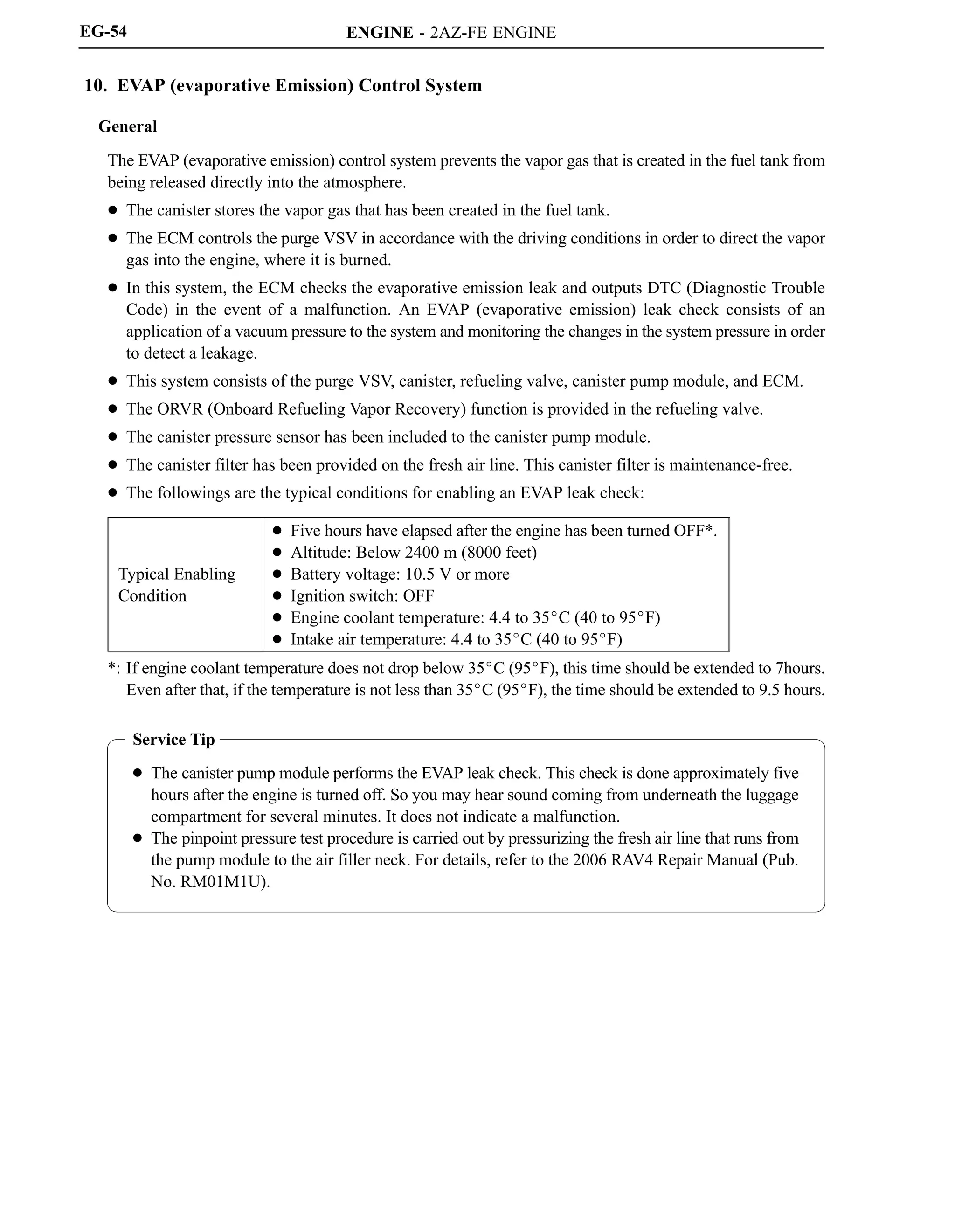
NEW MODEL OUTLINE
01MMO40Y
01MMO39Y
Torque
(N.m) (ft.lbf)
240
220
200
180
160
140
180
160
140
120
100
1000
Output
(HP) (kW)
180
160
140
120
100
80
60
40
20
0
140
120
100
80
60
40
20
0
2000 3000 4000 5000 6000 7000
Engine Speed (rpm)
 2AZ-FE Engine   2GR-FE Engine 
Torque
(N.m) (ft.lbf)
340
320
300
280
260
240
260
240
220
200
180
1000
Output
(HP) (kW)
280
260
240
220
100
80
60
40
20
0
140
120
100
80
60
40
20
0
2000 3000 4000 5000 6000 7000
Engine Speed (rpm)
200
180
160
140
120
200
180
160
MO-29
PERFORMANCE
Power Train
Engine
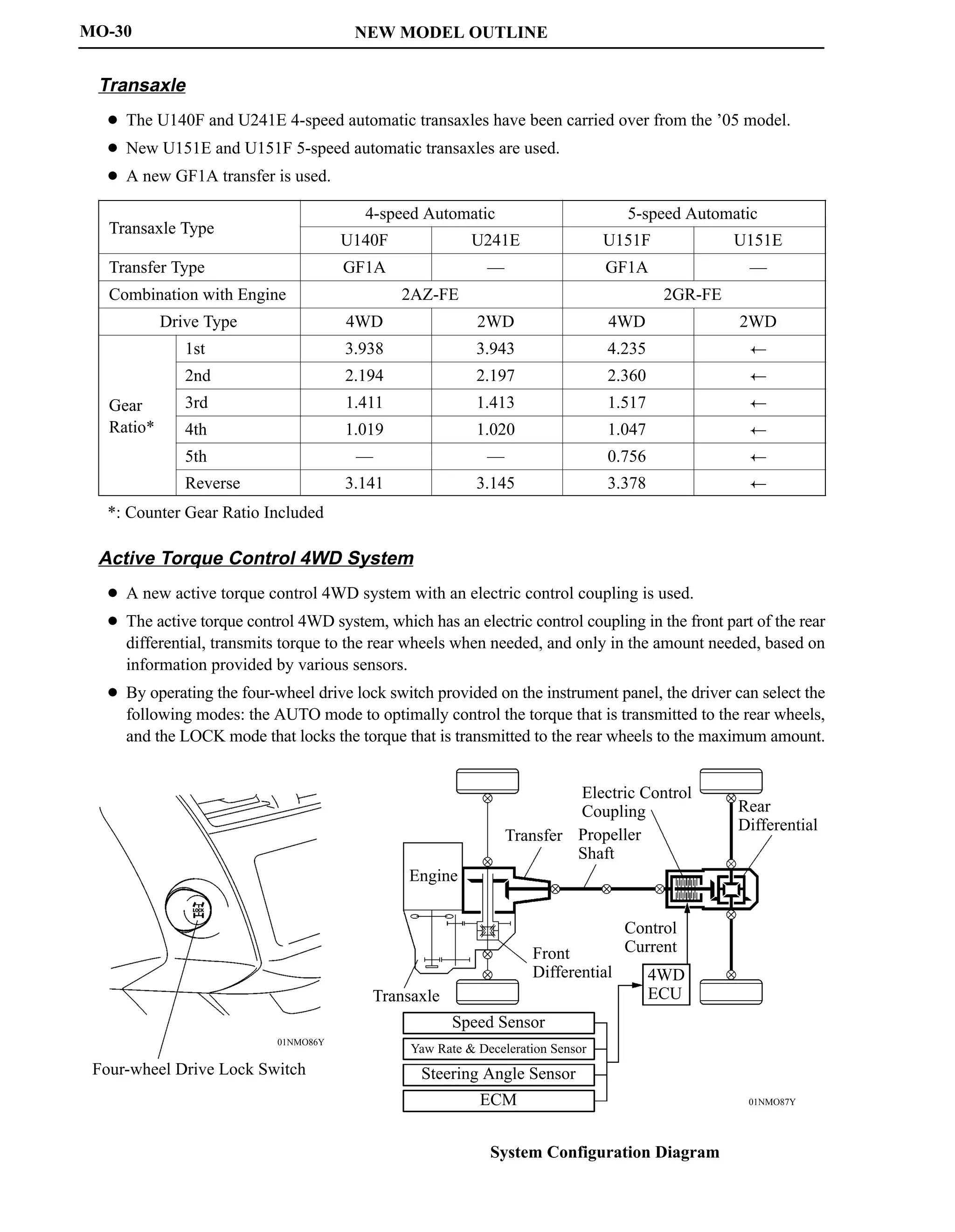
 The 2AZ-FE engine has been carried over from the ’05 model. This engine realizes high performance,
quietness, fuel economy, and clean emissions through the use of the VVT-i (Variable Valve
Timing-intelligent) system, DIS (Direct Ignition System), and ETCS-i (Electronic Throttle Control
System-intelligent).
 A new 2GR-FE engine is used. It realizes high performance, quietness, fuel economy, and clean emission
through the use of the Dual VVT-i (Dual Variable Valve Timing-intelligent) system, DIS, and ETCS-i.
Engine Type 2AZ-FE 2GR-FE
No. of Cyls.  Arrangement 4-cylinder, In-line Type 6-cylinder, V Type
Valve Mechanism
16-valve DOHC,
Chain Drive (with VVT-i)
24-valve DOHC,
Chain Drive (with Dual VVT-i)
Displacement cm3 (cu. in.) 2362 (144.2) 3456 (210.9)
Bore x Stroke mm (in.) 88.5 x 96.0 (3.48 x 3.78) 94.0 x 83.0 (3.70 x 3.27)
Compression Ratio 9.8 : 1 10.8 : 1
Maximum Output [SAE-NET]*
124 kW @ 6000 rpm
(166 HP @ 6000 rpm)
200 kW @ 6200 rpm
(268 HP @ 6200 rpm)
Maximum Torque [SAE-NET]*
224 N.m @ 4000 rpm
(165 ft.lbf @ 4000 rpm)
336 N.m @ 4700 rpm
(248 ft.lbf @ 4700 rpm)
*: Maximum output and torque rating are determined by revised SAE J1349 standard.
NEW MODEL OUTLINE
01NMO87Y
01NMO86Y
Four-wheel Drive Lock Switch
Electric Control
Coupling
Propeller
Shaft
Transfer
Engine
Transaxle
Front
Differential
Control
Current
4WD
ECU
Rear
Differential
Speed Sensor
Yaw Rate  Deceleration Sensor
Steering Angle Sensor
ECM
System Configuration Diagram
MO-30
Transaxle
 The U140F and U241E 4-speed automatic transaxles have been carried over from the ’05 model.
 New U151E and U151F 5-speed automatic transaxles are used.
 A new GF1A transfer is used.
Transaxle Type
4-speed Automatic 5-speed Automatic
Transaxle Type
U140F U241E U151F U151E
Transfer Type GF1A — GF1A —
Combination with Engine 2AZ-FE 2GR-FE
Drive Type 4WD 2WD 4WD 2WD
1st 3.938 3.943 4.235 
2nd 2.194 2.197 2.360 
Gear 3rd 1.411 1.413 1.517 
Gear
Ratio* 4th 1.019 1.020 1.047 
5th — — 0.756 
Reverse 3.141 3.145 3.378 
*: Counter Gear Ratio Included
Active Torque Control 4WD System
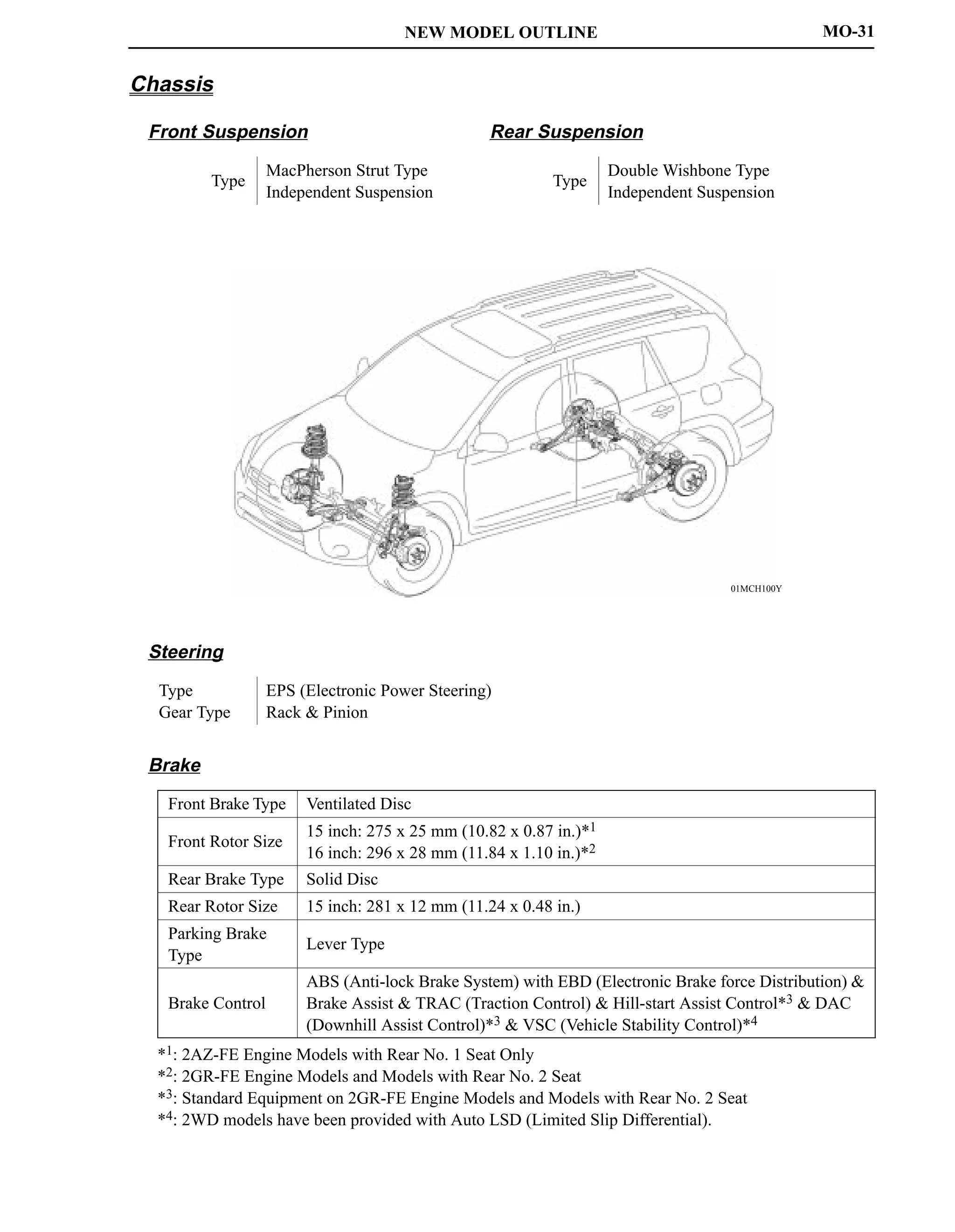
 A new active torque control 4WD system with an electric control coupling is used.
 The active torque control 4WD system, which has an electric control coupling in the front part of the rear
differential, transmits torque to the rear wheels when needed, and only in the amount needed, based on
information provided by various sensors.
 By operating the four-wheel drive lock switch provided on the instrument panel, the driver can select the
following modes: the AUTO mode to optimally control the torque that is transmitted to the rear wheels,
and the LOCK mode that locks the torque that is transmitted to the rear wheels to the maximum amount.
NEW MODEL OUTLINE
01MCH100Y
MO-31
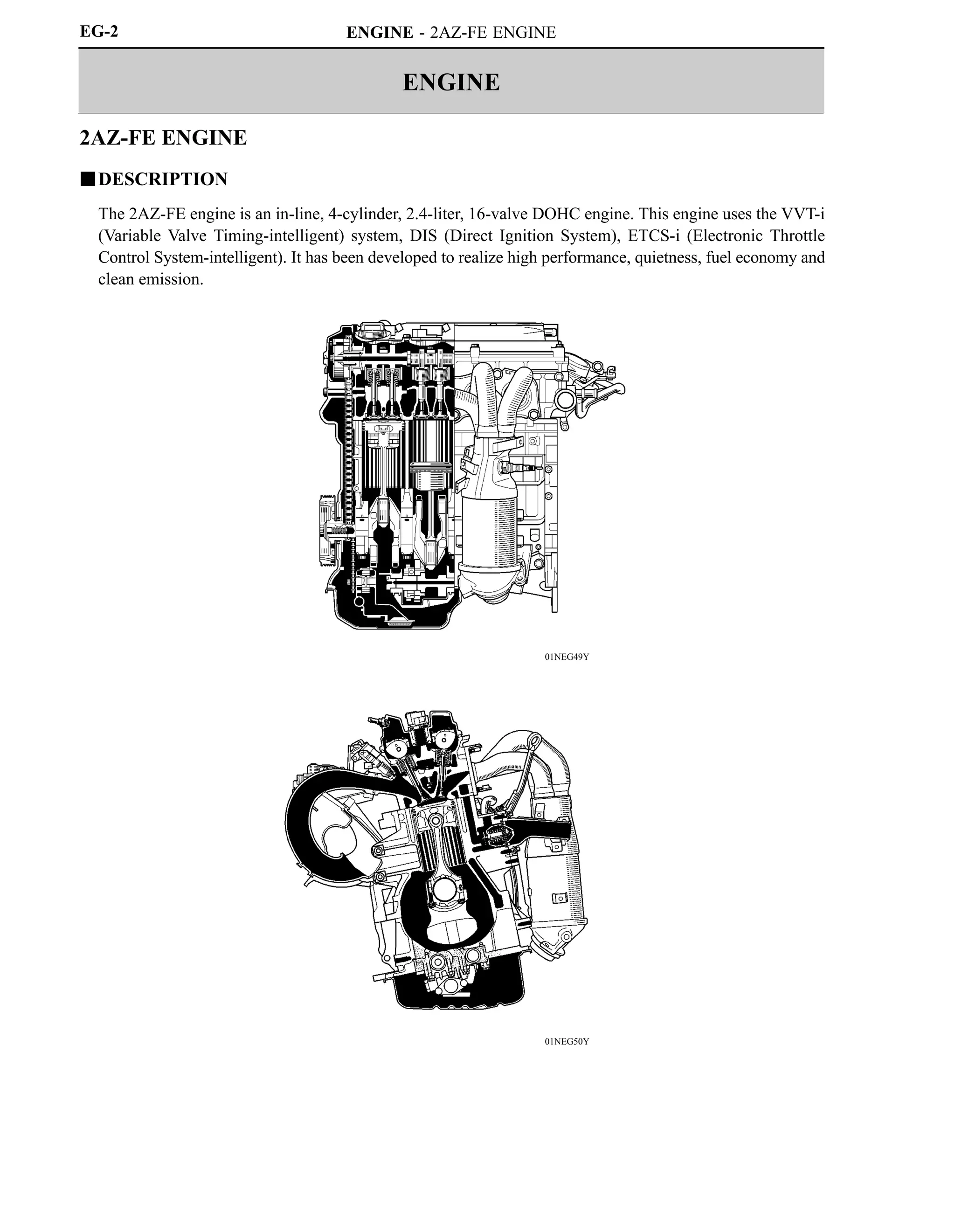
Chassis
Front Suspension Rear Suspension
Type
MacPherson Strut Type
Independent Suspension
Type
Double Wishbone Type
Independent Suspension
Steering
Type
Gear Type
EPS (Electronic Power Steering)
Rack  Pinion
Brake
Front Brake Type Ventilated Disc
Front Rotor Size
15 inch: 275 x 25 mm (10.82 x 0.87 in.)*1
16 inch: 296 x 28 mm (11.84 x 1.10 in.)*2
Rear Brake Type Solid Disc
Rear Rotor Size 15 inch: 281 x 12 mm (11.24 x 0.48 in.)
Parking Brake
Type
Lever Type
Brake Control
ABS (Anti-lock Brake System) with EBD (Electronic Brake force Distribution) 
Brake Assist  TRAC (Traction Control)  Hill-start Assist Control*3  DAC
(Downhill Assist Control)*3  VSC (Vehicle Stability Control)*4
*1: 2AZ-FE Engine Models with Rear No. 1 Seat Only
*2: 2GR-FE Engine Models and Models with Rear No. 2 Seat
*3: Standard Equipment on 2GR-FE Engine Models and Models with Rear No. 2 Seat
*4: 2WD models have been provided with Auto LSD (Limited Slip Differential).
NEW MODEL OUTLINE
01NMO88Y 01NMO89Y
Standstill
’06 Model
Slow Backward Movement
’05 Model
MO-32
Enhanced VSC System
 The enhanced VSC (Vehicle Stability Control) system is standard equipment on all models.
 In addition to the ABS, TRAC, and VSC controls provided by the conventional system, the enhanced
VSC system effects cooperative control with the EPS (Electric Power Steering) and active torque control
4WD system in order to realize excellent driving stability and maneuverability.
 See CH-92 for details on the enhanced VSC system.
Hill-start Assist Control
 The hill-start assist control is standard equipment on the 2GR-FE engine models and the models with rear
No. 2 seat.
 When the driver transfers his/her foot from the brake pedal to the accelerator pedal while starting off on
an uphill, the hill-start assist control momentarily maintains the hydraulic pressure in the wheel cylinders
of the four wheels, in order to prevent the vehicle from rolling backward.
 The hill-start assist control used on the ’06 model effects control to prevent the vehicle from rolling
backward. This control has evolved further from the hill-start assist control of the ’05 model, which
slowed the backward rolling of the vehicle while starting off on a hill.
 See CH-120 for details on the hill-start assist control.
ENGINE
ENGINE - 2AZ-FE ENGINE
01NEG49Y
01NEG50Y
EG-2
2AZ-FE ENGINE
DESCRIPTION
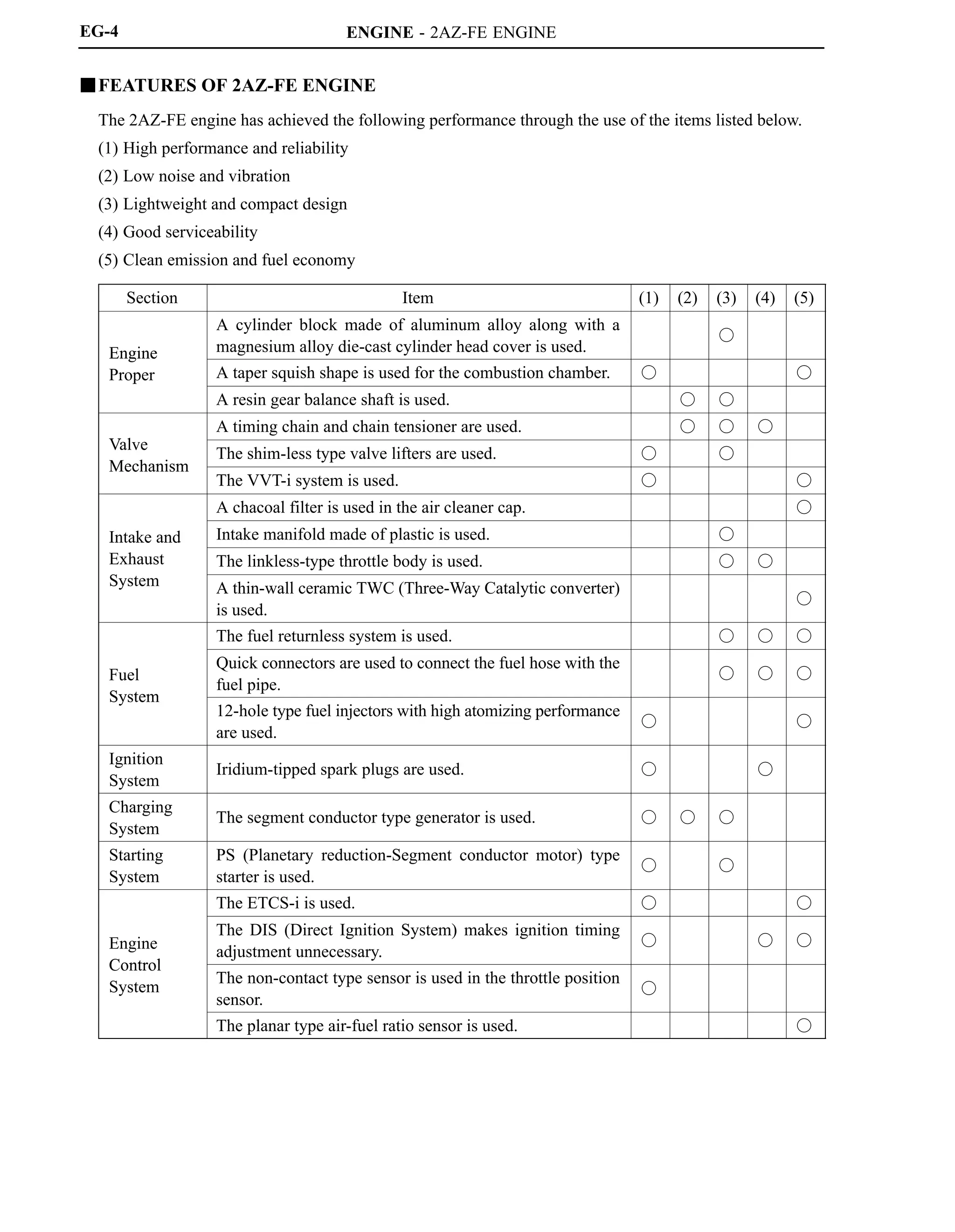
The 2AZ-FE engine is an in-line, 4-cylinder, 2.4-liter, 16-valve DOHC engine. This engine uses the VVT-i
(Variable Valve Timing-intelligent) system, DIS (Direct Ignition System), ETCS-i (Electronic Throttle
Control System-intelligent). It has been developed to realize high performance, quietness, fuel economy and
clean emission.
ENGINE - 2AZ-FE ENGINE
01MEG02Y
 Valve Timing 
: Intake Valve Opening Angle
: Exhaust Valve Opening Angle
VVT-i Operation
Range
VVT-i Operation
Range
TDC
3 3
43
65
25
45
BDC
EG-3
 Engine Specifications 
No. of Cyls.  Arrangement 4-cylinder, In-line
Valve Mechanism 16-valve DOHC, Chain Drive (with VVT-i)
Combustion Chamber Pentroof Type
Manifolds Cross-flow
Fuel System SFI
Ignition System DIS
Displacement cm3 (cu. in.) 2362 (144.1)
Bore x Stroke mm (in.) 88.5 x 96.0 (3.48 x 3.78)
Compression Ratio 9.8 : 1
Max. Output*1 (SAE-NET) 124 kW @ 6000 rpm (166 HP @ 6000 rpm)
Max. Torque*1 (SAE-NET) 224 N.m @ 4000 rpm (165 ft-lbf @ 4000 rpm)
Intake
Open 3 - 43 BTDC
Valve Timing
Intake
Close 65 - 25 ABDC
Valve Timing
Exhaust
Open 45 BBDC
Exhaust
Close 3 ATDC
Firing Order 1 - 3 - 4 - 2
Research Octane Number 91 or higher
Octane Rating 87 or higher
Oil Grade ILSAC
Tailpipe Emission Regulation ULEV-II, SFTP
Evaporative Emission Regulation LEV-II, ORVR
Engine Service Mass*2 (Reference) kg (lb) 138 (304.2)
*1: Maximum output and torque rating is determined by revised SAE J1349 standard.
*2: Weight shows the figure with oil and water fully filled.
ENGINE - 2AZ-FE ENGINE
EG-4
FEATURES OF 2AZ-FE ENGINE
The 2AZ-FE engine has achieved the following performance through the use of the items listed below.
(1) High performance and reliability
(2) Low noise and vibration
(3) Lightweight and compact design
(4) Good serviceability
(5) Clean emission and fuel economy
Section Item (1) (2) (3) (4) (5)
Engine
A cylinder block made of aluminum alloy along with a
magnesium alloy die-cast cylinder head cover is used.

Engine
Proper A taper squish shape is used for the combustion chamber.  
p
A resin gear balance shaft is used.  
V l
A timing chain and chain tensioner are used.   
Valve
Mechanism
The shim-less type valve lifters are used.  
Mechanism
The VVT-i system is used.  
A chacoal filter is used in the air cleaner cap. 
Intake and Intake manifold made of plastic is used. 
Intake and
Exhaust
S
The linkless-type throttle body is used.  
System A thin-wall ceramic TWC (Three-Way Catalytic converter)
is used.

The fuel returnless system is used.   
Fuel
System
Quick connectors are used to connect the fuel hose with the
fuel pipe.
  
System
12-hole type fuel injectors with high atomizing performance
are used.
 
Ignition
System
Iridium-tipped spark plugs are used.  
Charging
System
The segment conductor type generator is used.   
Starting
System
PS (Planetary reduction-Segment conductor motor) type
starter is used.
 
The ETCS-i is used.  
Engine
Control
The DIS (Direct Ignition System) makes ignition timing
adjustment unnecessary.
  
Control
System
The non-contact type sensor is used in the throttle position
sensor.

The planar type air-fuel ratio sensor is used.
ENGINE - 2AZ-FE ENGINE
DR011EG20
Cylinder Head Cover
Cylinder Head Cover Gasket
02AEG02Y
02AEG01Y
Cylinder
Bore Side
Front
Outer
Side
Shim
A
A
A - A Cross Section
EG-5
ENGINE PROPER
1. Cylinder Head Cover
 A lightweight magnesium alloy die-cast
cylinder head cover is used.
 Acrylic rubber, which excels in heat resistance
and reliability, is used for the cylinder head
cover gasket.
2. Cylinder Head Gasket
A steel-laminate type cylinder head gasket is used. A shim has been added around the cylinder bore to
increase the sealing surface, thus improving the sealing performance and durability.
ENGINE - 2AZ-FE ENGINE
208EG67
DR011EG21
Exhaust Side
Intake Side
A
A
A - A Cross Section
Injector
IN
EX
Bypass
Passage
Taper Squish
EG-6
3. Cylinder Head
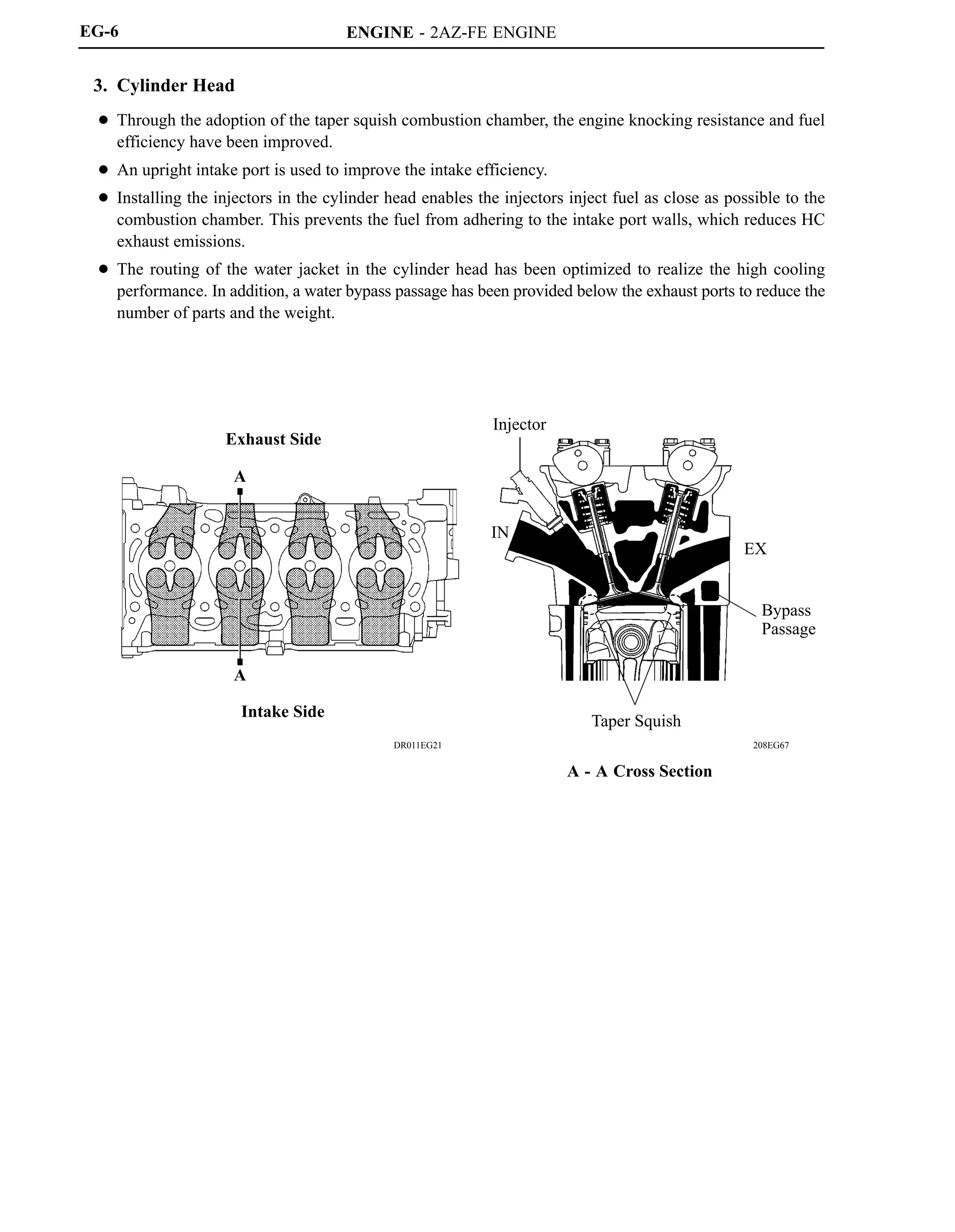
 Through the adoption of the taper squish combustion chamber, the engine knocking resistance and fuel
efficiency have been improved.
 An upright intake port is used to improve the intake efficiency.
 Installing the injectors in the cylinder head enables the injectors inject fuel as close as possible to the
combustion chamber. This prevents the fuel from adhering to the intake port walls, which reduces HC
exhaust emissions.
 The routing of the water jacket in the cylinder head has been optimized to realize the high cooling
performance. In addition, a water bypass passage has been provided below the exhaust ports to reduce the
number of parts and the weight.
ENGINE - 2AZ-FE ENGINE
DR011EG22
01NEG26Y
 Air Flow During Engine Revolution 
Water Pump
Swirl Chamber
Crankshaft
Bearing Cap
Plastic Region
Tightening Bolts
Thermostat Housing
Air Conditioning
Compressor Brackets
Air Passage Holes
Air Flow
NOTICE
Never attempt to machine the cylinder because it has a thin liner thickness.
EG-7
4. Cylinder Block
 Lightweight aluminum alloy is used for the cylinder block.
 By producing the thin cast-iron liners and cylinder block as a unit, compaction is realized.
 Air passage holes are provided in the crankshaft bearing area of the cylinder block. As a result, the air at
the bottom of the cylinder flows smoother, and pumping loss (back pressure at the bottom of the piston
generated by the piston’s reciprocal movement) is reduced to improve the engine’s output.
 The oil filter and the air conditioning compressor brackets are integrated into the crankcase. Also, the
water pump swirl chamber and thermostat housing are integrated into the cylinder block.
ENGINE - 2AZ-FE ENGINE
01NEG27Y
Irregularly shaped
outer casting
surface of liner
Cylinder Block
Liner
A
A
A - A Cross Section
01NEG28Y
Water Jacket
Spacer
Water Jacket
A - A Cross Section
A
A
EG-8
 The liners are the spiny-type, which have been manufactured so that their casting exteriors form large
irregular surfaces in order to enhance the adhesion between the liners and the aluminum cylinder block.
The enhanced adhesion helps heat dissipation, resulting in a lower overall temperature and heat
deformation of the cylinder bores.
 Water jacket spacers are provided in the water jacket of the cylinder block.
 They suppress the water flow in the center of the water jackets, guide the coolant above and below the
cylinder bores, and ensure uniform temperature distribution. As a result, the viscosity of the engine oil that
acts as a lubricant between the bore walls and the pistons can be lowered, thus reducing friction.
ENGINE - 2AZ-FE ENGINE
01MEG01Y
Taper Squish Shape
: Resin Coating
240EG45
Plastic Region Tightening Bolts
EG-9
5. Piston
 The piston is made of aluminum alloy and skirt area is made compact and lightweight.
 The piston head portion uses a taper squish shape to improve the fuel combustion efficiency.
 The piston skirt has been coated with resin to reduce the friction loss.
6. Connecting Rod
 The connecting rods and caps are made of
high-strength steel for weight reduction.
 Nut-less type plastic region tightening bolts are
used on the connecting rod for a lighter design.
 The connecting rod bearings are reduced in
width to reduce friction.
ENGINE - 2AZ-FE ENGINE
01NEG31Y
No.1 Journal
Balance Shaft Drive Gear
Oil Hole
Crank Pin
Balance Weight
01NEG32Y
: Resin Gear
Balance Shaft
Housing
Balance Shaft No.1
Balance Shaft No.2
Crankshaft
Balance Shaft Drive Gear
EG-10
7. Crankshaft
 The forged crankshaft has 5 journals and 8 balance weights.
 The crankshaft is made of forged steel.
 Pin and journal fillets are roll-finished to maintain adequate strength.
 The balance shaft drive gear is provided for the crankshaft.
8. Balance Shaft
General
 A balance shaft is used to reduce vibrations.
 The crankshaft directly drives the No. 1 balance shaft.
 In addition, a resin gear is used on the driven side to suppress noise and offer lightweight design.
ENGINE - 2AZ-FE ENGINE
286EG71
Top Dead Center
Point of Max. Speed
Bottom Dead Center
Point of
Max. Speed
Point of
Max. Speed
90
286EG72
Inertial Force of Cylinders
No.2 and No.3
Combined Inertial Force of
All Cylinders
Unbalanced Secondary
Inertial Force
Inertial Force of Cylinder
No.1 and No.4
Force Inertial force that cannot be canceled
Crankshaft Angle
- 90 90 270
180
0
- 180
Inertial Force Generated by the In-line 4 Cylinders
286EG73
0 90 180 270
A
B
C
D
E
Inertial Force of Balancer
Crankshaft Angle
Secondary Inertial Force
Mass Direction of
Balance Shaft
Inertial Force of
Balancer
Mass Direction of Balance Shaft at Crankshaft Angle
EG-11
Operation
In the in-line 4-cylinder engine, the crankshaft
angle for cylinders No.1 and No.4 are exactly at
the opposite (180) position of cylinders No.2
and No.3. Therefore, the inertial force of the
pistons and the connecting rods of the former 2
cylinders and of the latter 2 cylinders almost
cancel each other. However, because the position
at which the piston reaches its maximum speed
is located toward the top dead center from the
center of the stroke, the upward inertial force is
greater than the downward inertial force. This
unbalanced secondary inertial force is generated
twice for each rotation of the crankshaft.
To cancel the unbalanced secondary inertial force, 2 balance shafts are rotated twice for each rotation of
the crankshaft and generate inertial force in the opposite direction. Also, in order to cancel the inertial force
generated by the balance shaft itself, the balance shaft actually consists of 2 shafts rotating in opposite
directions.
ENGINE - 2AZ-FE ENGINE
240EG46
181EG10
VVT-i Controller
Intake Camshaft Exhaust
Camshaft
Chain
Tensioner
Chain Damper
Chain Slipper
Camshaft
Valve
Lifter
Service Tip
The adjustment of the valve clearance is accomplished by selecting and replacing the appropriate
valve lifters.
A total of 35 valve lifters are available in 0.02 mm (0.008 in.) increments, from 5.06 mm (0.199 in.)
to 5.74 mm (0.226 in.). For details, refer to 2006 RAV4 Repair Manual (Pub. No. RM01M1U).
EG-12
VALVE MECHANISM
1. General
 The VVT-i system is used to improve fuel economy, engine performance and reduce exhaust emissions.
For details of VVT-i system, see page EG-48.
 The intake and exhaust camshafts are driven by a timing chain.
 Along with the increase in the amount of valve lift, the shim-less type valve lifter is used. This valve lifter
increases the cam contact surface.
ENGINE - 2AZ-FE ENGINE
181EG11
VVT-i Controller
Intake Camshaft
Timing Rotor
Exhaust Camshaft
Timing Sprocket
185EG25
181EG14
Cam Spring
Cam
Plunger
Spring
Chain
Tensioner
Chain Damper
Oil Jet
Chain Tensioner
Chain Slipper
EG-13
2. Camshaft
 The intake camshaft is provided with timing rotor to trigger the camshaft position sensor.
 In conjunction with the adoption of the VVT-i system, an oil passage is provided in the intake camshaft
in order to supply engine oil pressure to the VVT-i system.
 A VVT-i controller has been installed on the front of the intake camshaft to vary the timing of the intake
valves.
3. Timing Chain
 A roller chain with an 8 mm (0.315 in.) pitch is used to make the engine more compact.
 The timing chain is lubricated by an oil jet.
 The chain tensioner uses a spring and oil pressure to maintain proper chain tension at all times.
 The chain tensioner suppresses noise generated by the timing chain.
 A ratchet type non-return mechanism is used.
 To achieve excellent serviceability, the chain tensioner is constructed so that it can be removed and
installed from the outside of the timing chain cover.
ENGINE - 2AZ-FE ENGINE
208EG07
VVT-i Controller
Camshaft Timing
Oil Control Valve
Oil Return
Hole
Oil Pump
Oil Filter
Chain
Tensioner
01NEG33Y
Bypass
Valve
Relief
Valve
Main Oil Hole
Oil Filter
Oil Pump
Oil Strainer
Chain
Tensioner
Cylinder Head
Exhaust
Camshaft
Journal
Oil Control
Valve
VVT-i Controller
Oil Pan
Intake
Camshaft
Journal
Crankshaft
Journal
Crankshaft
Pin
Oil Jet
Piston
Cylinder
Block
Barance
Shaft
Timing
Chain
EG-14
LUBRICATION SYSTEM
1. General
 The lubrication circuit is fully pressurized and oil passes through an oil filter.
 The trochoid gear type oil pump is chain-driven by the crankshaft.
 The oil filter is attached downward from the crankcase to improve serviceability.
 Along with the adoption of the VVT-i system, the cylinder head is provided with a VVT-i controller and
a camshaft timing oil control valve. This system is operated by the engine oil.
 Oil Circuit
ENGINE - 2AZ-FE ENGINE
01NEG34Y
Oil Jets
Check
Valve Oil
Bottom Side View Oil Jet Cross Section
EG-15
 Oil Capacity 
Liters (US qts, Imp. qts)
Dry 5.0 (5.3, 4.4)
with Oil Filter 4.3 (4.5, 3.8)
without Oil Filter 4.1 (3.8, 3.1)
2. Oil Jet
 Piston oil jets for cooling and lubricating the pistons are used in the cylinder block.
 These oil jets contain a check valve to prevent oil from being fed when the oil pressure is low. This prevents
the overall oil pressure in the engine from dropping.
ENGINE - 2AZ-FE ENGINE
01NEG35Y
Throttle Body
To Heater Core
To Radiator
Thermostat
From Radiator
Water Pump
Bypass Passage
01NEG59Y
Bypass Passage
Cylinder Head
Water Pump
Cylinder Block
Thermostat
Reservoir
Tank
Radiator
Throttle
Body
Heater Core
EG-16
COOLING SYSTEM
 The cooling system uses a pressurized forced-circulation system with pressurized reservoir tank.
 A thermostat with a bypass valve is located on the water inlet housing to maintain suitable temperature
distribution in the cooling system.
 An aluminum radiator core is used for weight reduction.
 The flow of the engine coolant makes a U-turn in the cylinder block to ensure a smooth flow of the engine
coolant. In addition, a bypass passage is enclosed in the cylinder head and the cylinder block.
 Warm water from the engine is sent to the throttle body to prevent freeze-up.
 The TOYOTA genuine Super Long Life Coolant (SLLC) is used.
 System Diagram
ENGINE - 2AZ-FE ENGINE EG-17
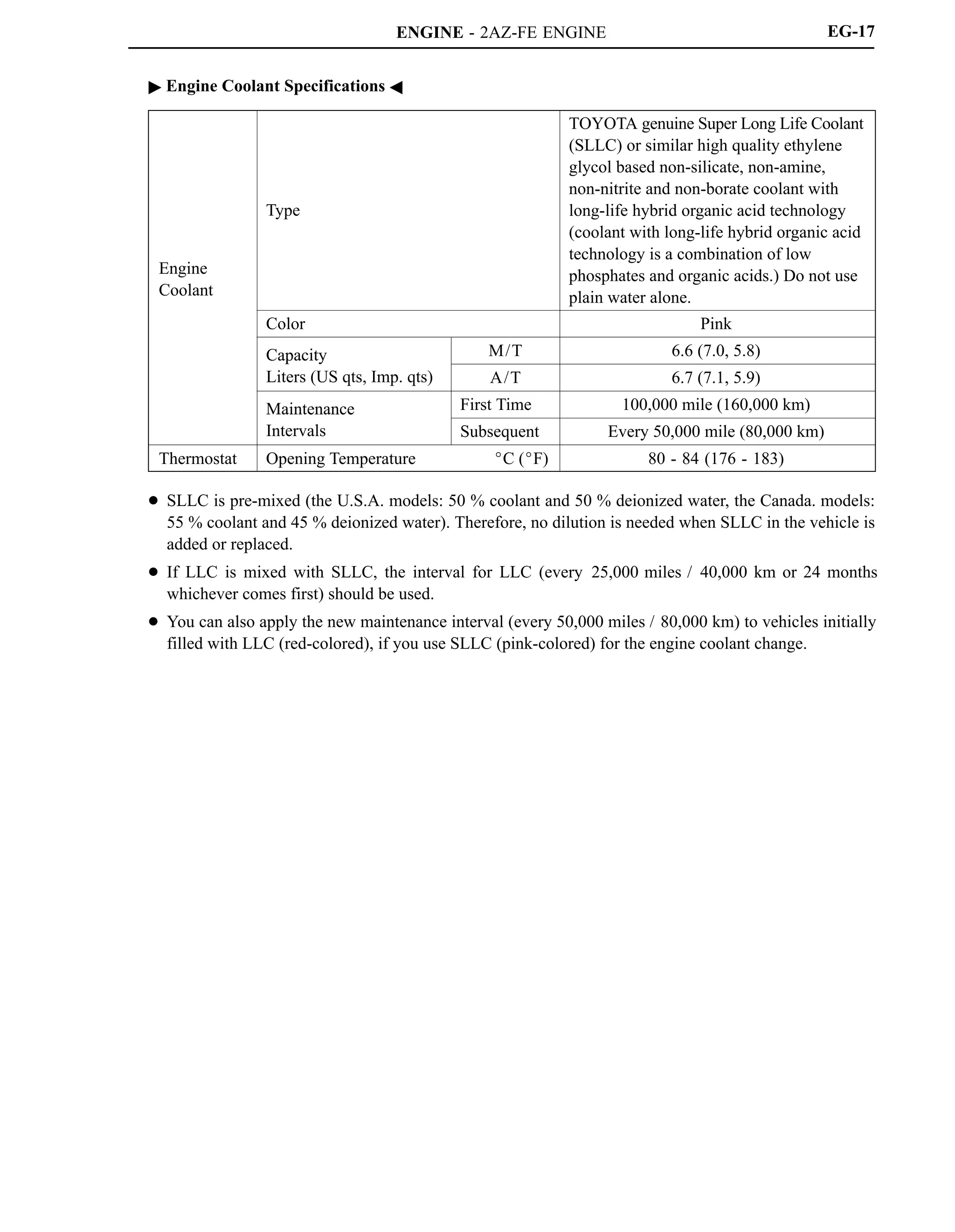
 Engine Coolant Specifications 
Engine
Coolant
Type
TOYOTA genuine Super Long Life Coolant
(SLLC) or similar high quality ethylene
glycol based non-silicate, non-amine,
non-nitrite and non-borate coolant with
long-life hybrid organic acid technology
(coolant with long-life hybrid organic acid
technology is a combination of low
phosphates and organic acids.) Do not use
plain water alone.
Color Pink
Capacity M/T 6.6 (7.0, 5.8)
Capacity
Liters (US qts, Imp. qts) A/T 6.7 (7.1, 5.9)
Maintenance First Time 100,000 mile (160,000 km)
Maintenance
Intervals Subsequent Every 50,000 mile (80,000 km)
Thermostat Opening Temperature C (F) 80 - 84 (176 - 183)
 SLLC is pre-mixed (the U.S.A. models: 50 % coolant and 50 % deionized water, the Canada. models:
55 % coolant and 45 % deionized water). Therefore, no dilution is needed when SLLC in the vehicle is
added or replaced.
 If LLC is mixed with SLLC, the interval for LLC (every 25,000 miles / 40,000 km or 24 months
whichever comes first) should be used.
 You can also apply the new maintenance interval (every 50,000 miles / 80,000 km) to vehicles initially
filled with LLC (red-colored), if you use SLLC (pink-colored) for the engine coolant change.
ENGINE - 2AZ-FE ENGINE
01MEG32Y
Exhaust Manifold
Intake Manifold
Main Muffler
Sub Muffler
TWC
Air Cleaner
TWC
EG-18
INTAKE AND EXHAUST SYSTEM
1. General
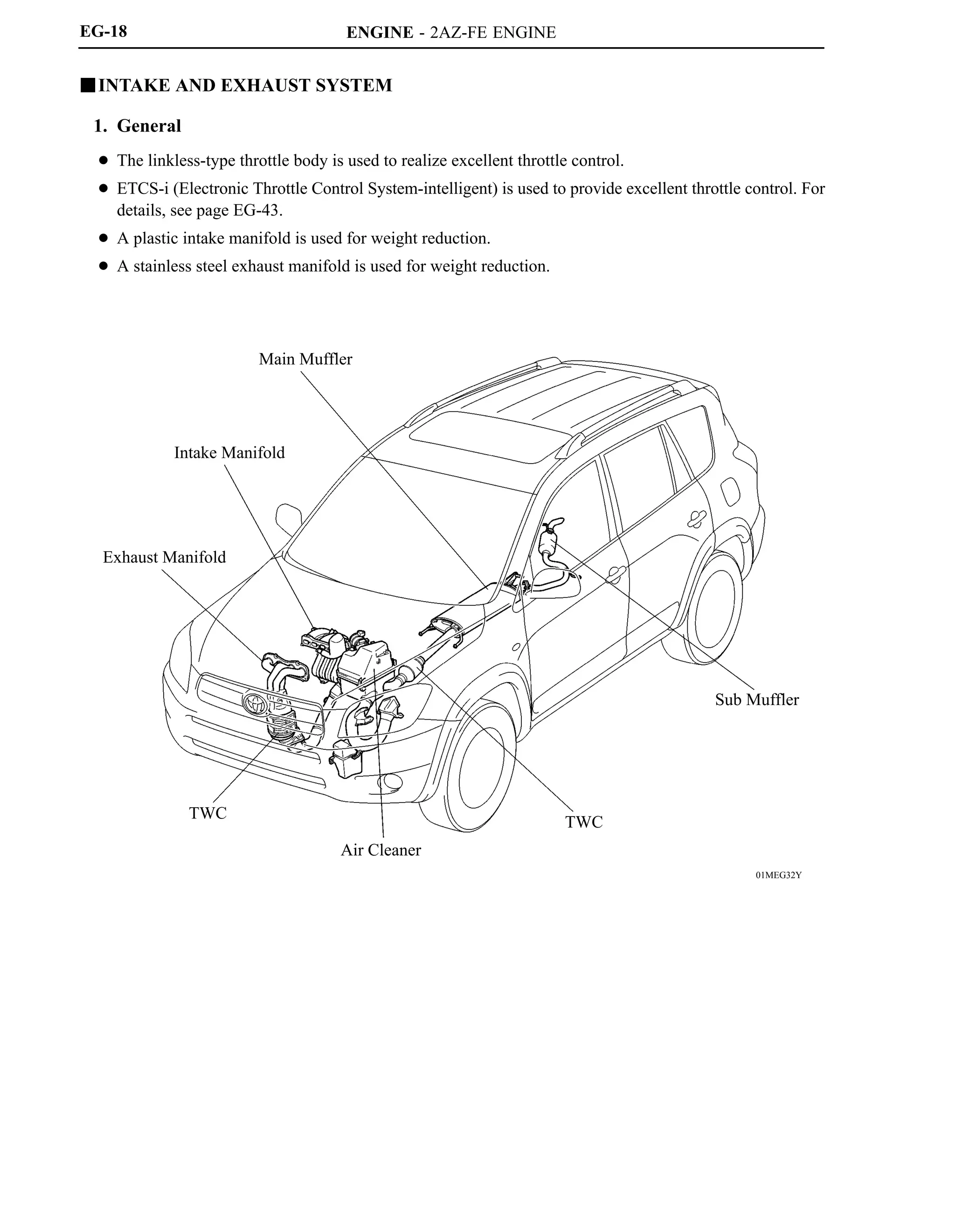
 The linkless-type throttle body is used to realize excellent throttle control.
 ETCS-i (Electronic Throttle Control System-intelligent) is used to provide excellent throttle control. For
details, see page EG-43.
 A plastic intake manifold is used for weight reduction.
 A stainless steel exhaust manifold is used for weight reduction.
ENGINE - 2AZ-FE ENGINE
01MEG10Y
Charcoal Filter
Air Cleaner Cap
Air Cleaner Element
(Nonwoven Fabric)
Service Tip
The charcoal filter, which is maintenance-free, cannot be removed from the air cleaner cap.
01NEG42Y
Throttle Position
Sensor
Throttle Control Motor
EG-19
2. Air Cleaner
 A nonwoven, full-fabric type air cleaner element is used.
 A charcoal filter, which adsorbs the HC that accumulates in the intake system when the engine is stopped,
is used in the air cleaner cap in order to reduce evaporative emissions.
3. Throttle Body
 The linkless-type throttle body is used and it realizes excellent throttle control.
 A DC motor with excellent response and minimal power consumption is used for the throttle control motor.
The ECM performs the duty ratio control of the direction and the amperage of the current that flows to
the throttle control motor in order to regulate the opening angle of the throttle valve.
ENGINE - 2AZ-FE ENGINE
01NEG37Y
Mesh Type Gasket
01NEG38Y
TWC
EG-20
4. Intake Manifold
 The intake manifold has been made of plastic to reduce the weight and the amount of heat transferred from
the cylinder head. As a result, it has become possible to reduce the intake air temperature and improve the
intake volumetric efficiency.
 A mesh type gasket is used, in order to reduce the intake noise.
5. Exhaust Manifold
A stainless steel exhaust manifold is used for improving the warm-up of TWC (Three-Way Catalytic
converter) and for weight reduction.
ENGINE - 2AZ-FE ENGINE
01MEG33Y
Ball Joint
Spring
Gasket
Bolt
Sub Muffler
Ball Joint
Main Muffler
TWC
Ball Joint
EG-21
6. Exhaust Pipe
 The exhaust pipe uses two ball joints in order to achieve a simple construction and ensured reliability.
 The TWC can improve exhaust emission by optimizing the cell density and the wall thickness.
ENGINE - 2AZ-FE ENGINE
01MEG30Y
Fuel Pump Assembly
 Fuel Filter
 Pressure Regulator
Quick Connector
Injector
Fuel Tank
Canister
EG-22
FUEL SYSTEM
1. General
 The fuel returnless system is used to reduce evaporative emissions.
 A fuel cut control is used to stop the fuel pump when the SRS airbag is deployed in a front or side collision.
For details, see page EG-53.
 A quick connector is used in the fuel main pipe to improve serviceability.
 The 12-hole type fuel injector is used.
 The ORVR (On-board Refueling Vapor Recovery) system is used. For details, see page EG-54.
ENGINE - 2AZ-FE ENGINE
185EG16
Pulsation
Dumper
Pressure Regulator
Fuel Pump
Assembly
Fuel Tank
Fuel Filter
Fuel Pump
DR011EG18
EG-23
2. Fuel Returnless System
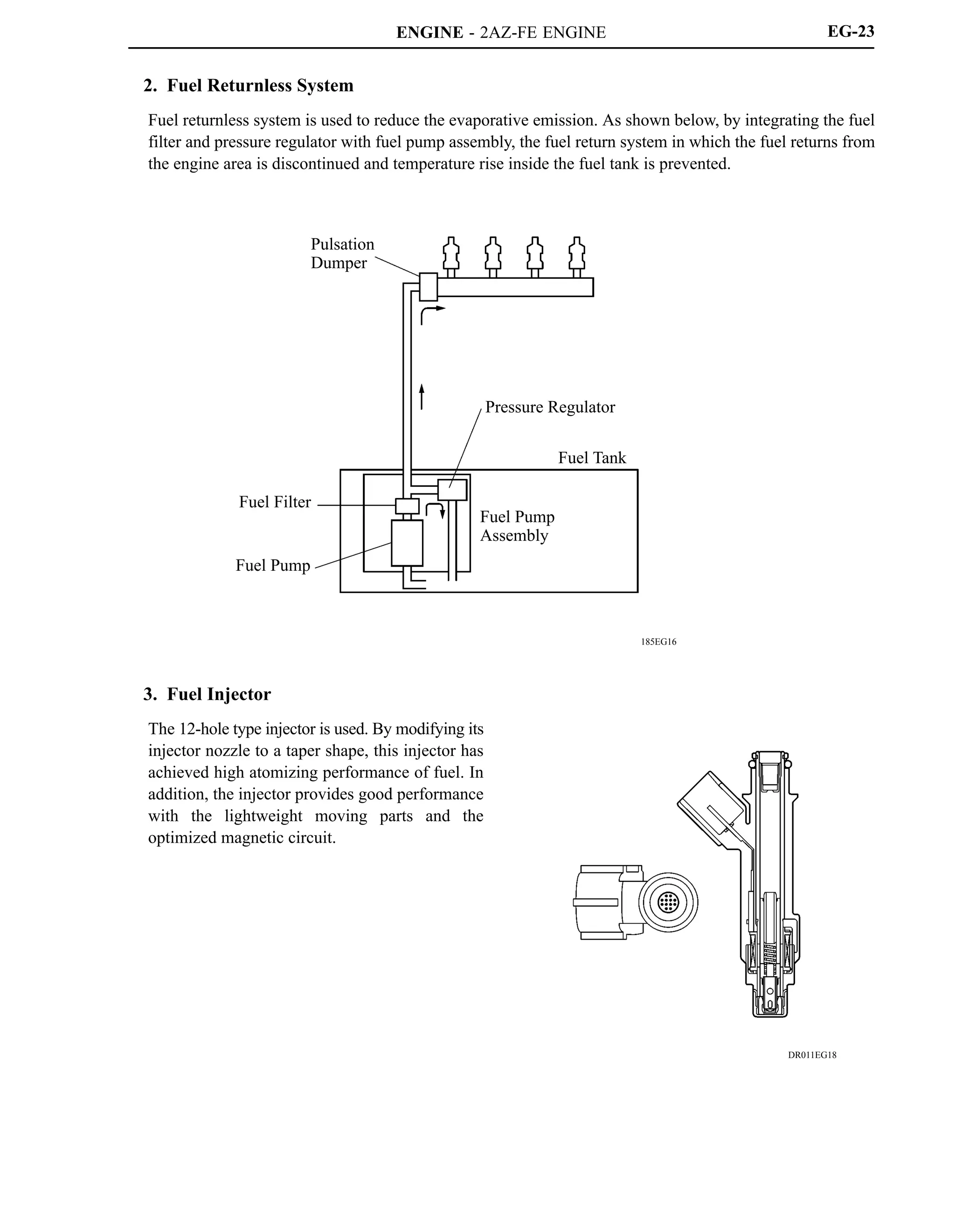
Fuel returnless system is used to reduce the evaporative emission. As shown below, by integrating the fuel
filter and pressure regulator with fuel pump assembly, the fuel return system in which the fuel returns from
the engine area is discontinued and temperature rise inside the fuel tank is prevented.
3. Fuel Injector
The 12-hole type injector is used. By modifying its
injector nozzle to a taper shape, this injector has
achieved high atomizing performance of fuel. In
addition, the injector provides good performance
with the lightweight moving parts and the
optimized magnetic circuit.
ENGINE - 2AZ-FE ENGINE
165EG25
Camshaft
Position
Sensor
Crankshaft
Position
Sensor
Various
Sensor
G2
NE
ECM
IGT1
IGT2
IGT3
IGT4
IGF
+B
Ignition Coil
(with Igniter)
No.1 Cylinder
No.2 Cylinder
No.3 Cylinder
No.4 Cylinder
185EG38
0.7 mm
(0.028 in.)
Iridium Tip
EG-24
IGNITION SYSTEM
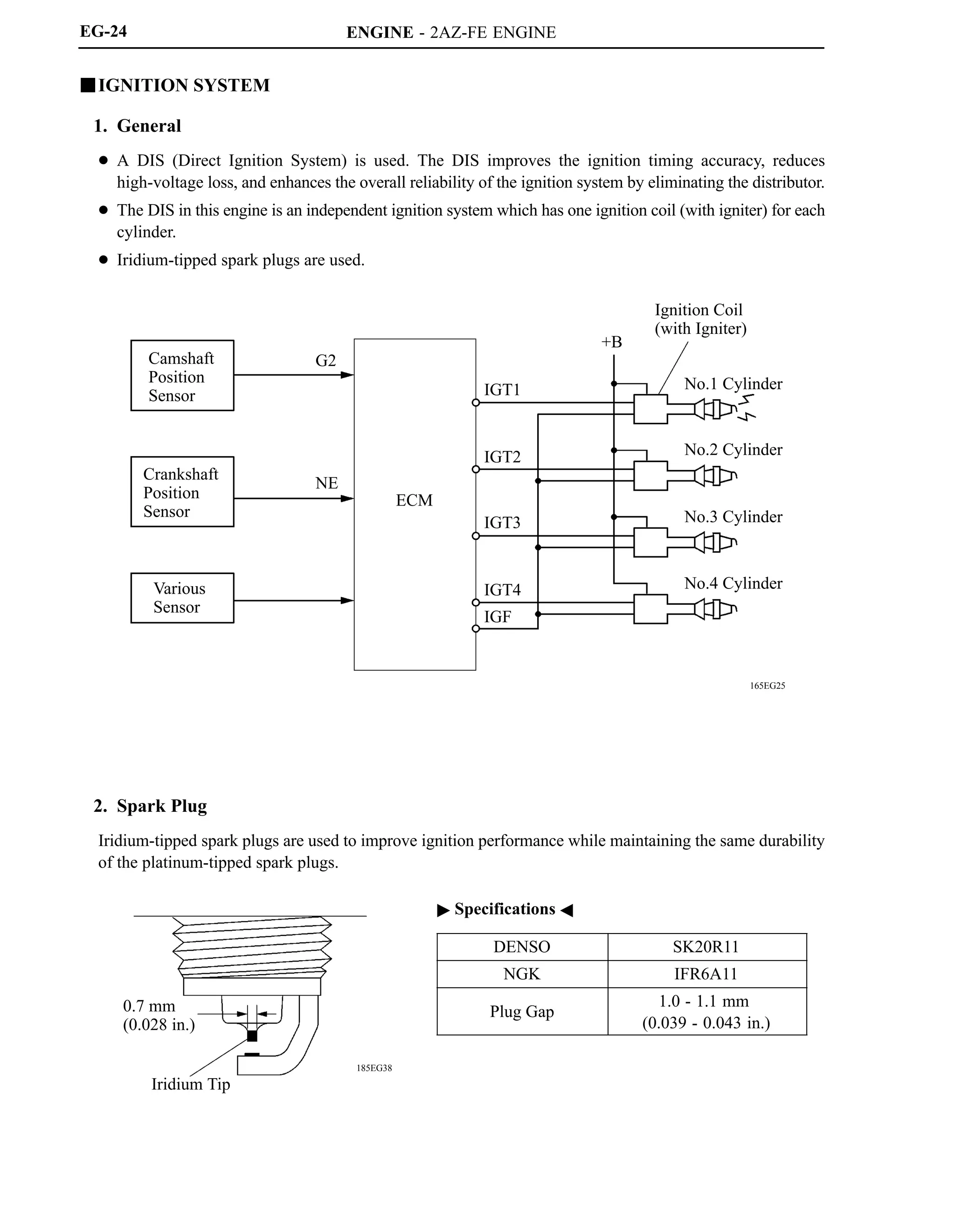
1. General
 A DIS (Direct Ignition System) is used. The DIS improves the ignition timing accuracy, reduces
high-voltage loss, and enhances the overall reliability of the ignition system by eliminating the distributor.
 The DIS in this engine is an independent ignition system which has one ignition coil (with igniter) for each
cylinder.
 Iridium-tipped spark plugs are used.
2. Spark Plug
Iridium-tipped spark plugs are used to improve ignition performance while maintaining the same durability
of the platinum-tipped spark plugs.
 Specifications 
DENSO SK20R11
NGK IFR6A11
Plug Gap
1.0 - 1.1 mm
(0.039 - 0.043 in.)
ENGINE - 2AZ-FE ENGINE
206EG40
206EG41
206EG42
Stator Segment
Conductor
Stator
Joined
Joined Segment
Conductor System
Segment
Conductor
Stator Stator
Conductor
Wire
Conductor Wire
A
A
A - A Cross
Section
Segment Conductor Type Generator
B
B
B - B Cross
Section
Conventional Type Generator
Winding System
Stator
Segment
Conductor
Cross Section
Stator of Segment Conductor Type Generator
EG-25
CHARGING SYSTEM
1. Segment Conductor Type Generator
 A compact and lightweight segment conductor type generator that generates high amperage output in a
highly efficient manner is used.
 This generator has a joined segment conductor system in which multiple segment conductors are welded
together to form the stator. Compared to the conventional winding system, the electrical resistance is
reduced due to the shape of the segment conductors, and their arrangement helps to make the generator
compact.
 Specifications 
Type SE0
Rated Voltage 12 V
Rated Output 100 A
Initial Output Starting Speed Max. 1,500 rpm
ENGINE - 2AZ-FE ENGINE
01NEG45Y
Regulator
B
M
IG
RLO
L
Ignition Switch
To Discharge
Warning Light
Generator
ECM
281EG13
281EG12
Coil Spring
Pulley
Helical Coil Type One-way Clutch
EG-26
 Wiring Diagram 
2. Generator Pulley
 A helical coil type one-way clutch is used on the generator pulley in order to reduce the load that acts on
the auxiliary equipment belt.
 The pulley mounting nut and the generator pulley have been integrated to achieve a compact construction.
ENGINE - 2AZ-FE ENGINE
01NEG46Y
Armature
Surface Commutator
Permanent Magnet
Brush
Length
EG-27
STARTING SYSTEM
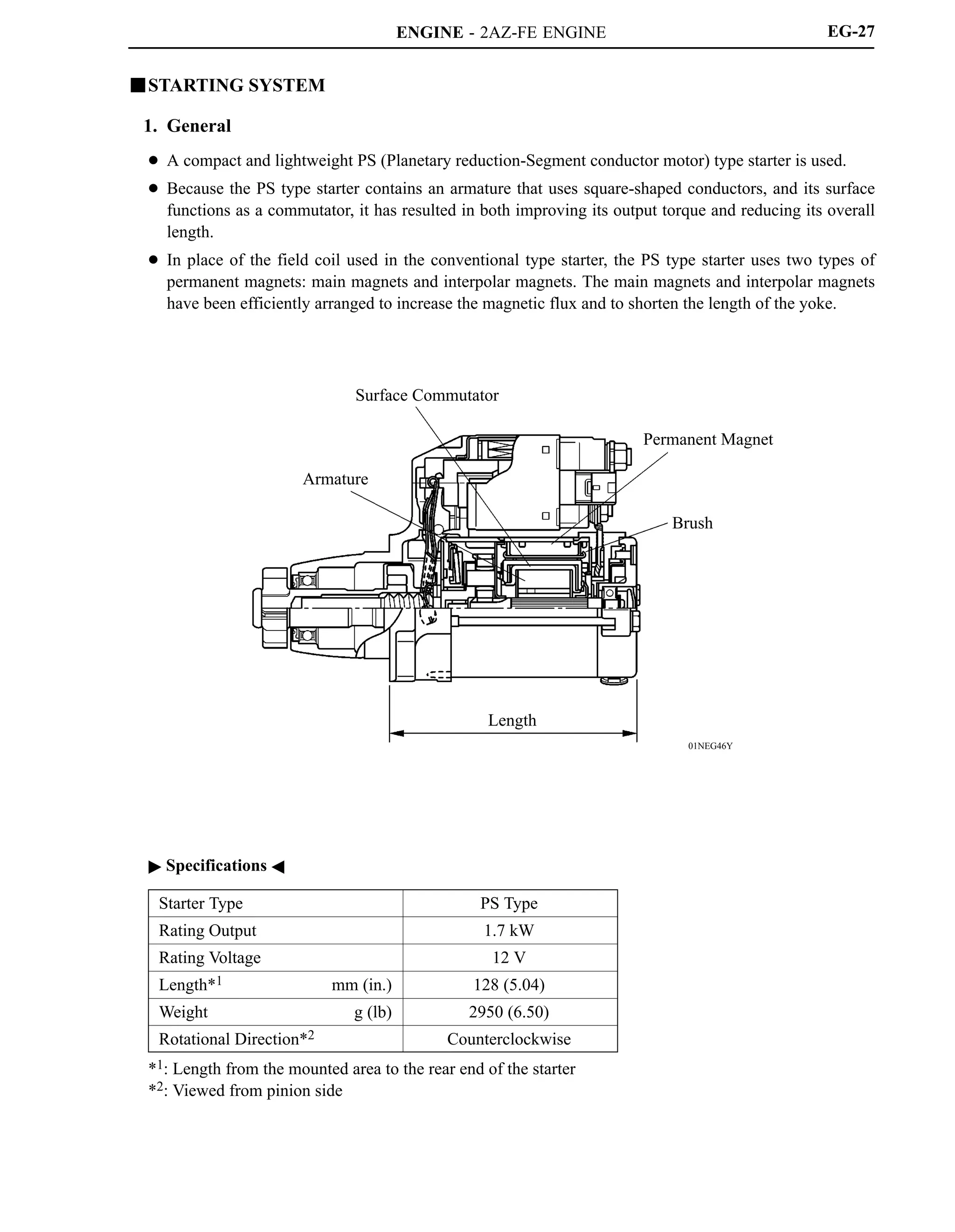
1. General
 A compact and lightweight PS (Planetary reduction-Segment conductor motor) type starter is used.
 Because the PS type starter contains an armature that uses square-shaped conductors, and its surface
functions as a commutator, it has resulted in both improving its output torque and reducing its overall
length.
 In place of the field coil used in the conventional type starter, the PS type starter uses two types of
permanent magnets: main magnets and interpolar magnets. The main magnets and interpolar magnets
have been efficiently arranged to increase the magnetic flux and to shorten the length of the yoke.
 Specifications 
Starter Type PS Type
Rating Output 1.7 kW
Rating Voltage 12 V
Length*1 mm (in.) 128 (5.04)
Weight g (lb) 2950 (6.50)
Rotational Direction*2 Counterclockwise
*1: Length from the mounted area to the rear end of the starter
*2: Viewed from pinion side
ENGINE - 2AZ-FE ENGINE
206EG20
Conventional Type
A - A
Cross Section
(PS Type)
B - B
Cross Section
(Conventional Type)
B
B
A
A
Armature
Armature
Brush
Commutator
Brush
Surface Commutator
Square-shaped
Conductor
Round-shaped
Conductor
PS Type
222EG15
Main Magnet Interpolar Magnet
Yoke
Main Magnet
Armature
Cross Section of Yoke
Magnetic Flux Generated by
Relationship between Main Magnets
Magnetic Flux Generated
by Interpolar Magnets
N
N
N
S
S
S
EG-28
2. Construction
 Instead of constructing the armature coil with conventional type round-shaped conductor wires, the PS
type starter uses square conductors. With this type of construction, the same conditions that are realized
by winding numerous round-shaped conductor wires can be achieved without increasing the mass. As a
result, the output torque has been increased, and the armature coil has been made more compact.
 Because the surface of the square-shaped conductors that are used in the armature coil functions as a
commutator, the overall length of the PS type starter has been shortened.
 Instead of the field coils used in the conventional type starter, the PS type starter uses two types of
permanent magnets: the main magnets and the interpolar magnets. The main and interpolar magnets are
arranged alternately inside the yoke, allowing the magnetic flux that is generated between the main and
interpolar magnets to be added to the magnetic flux that is generated by the main magnets.
In addition to increasing the amount of magnetic flux, this construction shortens the overall length of the
yoke.
ENGINE - 2AZ-FE ENGINE
240EG98
Idler Pulley for Automatic Tensioner
Generator Pulley
Water Pump Pulley
Air Conditioning
Compressor Pulley
Crankshaft Pulley
Idler Pulley
258RV77
Arm Idler Pulley
Tensioner
A - A Cross Section
A
A
EG-29
SERPENTINE BELT DRIVE SYSTEM
1. General
 Accessory components are driven by a serpentine belt consisting of a single V-ribbed belt. It reduces the
overall engine length, weight and the number of engine parts.
 An automatic tensioner eliminates the need for tension adjustment.
2. Automatic Tensioner
The automatic tensioner consists of an idler pulley and a tensioner. The idler pulley maintains belt tension
by the force of the spring that is located in the tensioner.
ENGINE - 2AZ-FE ENGINE
EG-30
ENGINE CONTROL SYSTEM
1. General
The engine control system for the 2AZ-FE engine has the following systems.
System Outline
SFI
Sequential Multiport
Fuel Injection
 An L-type SFI system directly detects the intake air volume with a hot-wire
type mass air flow meter.
 The fuel injection system is a sequential multiport fuel injection system.
ESA
Electronic Spark
Advance
Ignition timing is determined by the ECM based on signals from various sensors.
The ECM corrects ignition timing in response to engine knocking.
ETCS-i
Electronic
Optimally controls the throttle valve opening in accordance with the amount of
accelerator pedal effort and the condition of the engine and the vehicle.
Electronic
Throttle Control
System-intelligent
(See page-43)
 A linkless-type is used, without an accelerator cable.
 An accelerator pedal position sensor is provided on the accelerator pedal.
 A non-contact type throttle position sensor and accelerator pedal position
sensor are used.
VVT-i
Variable Valve
Timing-intelligent
(See page EG-48)
Controls the intake camshaft to an optimal valve timing in accordance with the
engine condition.
Air-fuel Ratio
Sensor, Oxygen
Sensor Heater
Control
Maintains the temperature of the air-fuel ratio sensor or oxygen sensor at an
appropriate level to realize accuracy of detection of the oxygen concentration in
the exhaust gas.
Air Conditioning
Cut-off Control
By turning the air conditioning compressor ON or OFF in accordance with the
engine condition, drivability is maintained.
Cooling Fan Control
(See page EG-52)
Radiator cooling fan operation is controlled by signals from ECM based on the
engine coolant temperature sensor signal and the condition of the air
conditioning operation.
Fuel Pump Control
(See page EG-53)
 Fuel pump operation is controlled by signal from the ECM.
 The fuel pump is stopped when the SRS driver’s and front passenger’s airbags
are deployed.
Evapotative Emission
The ECM controls the purge flow of evaporative emissions (HC) in the canister
in accordance with engine conditions.
Evapotative Emission
Control
(See page EG-54)
Approximately five hours after the ignition switch has been turned OFF, the
ECM operates the canister pump module to detect any evaporative emission
leakage occurring in the EVAP (evaporative emission) control system through
changes in the 0.02 in. leak pressure.
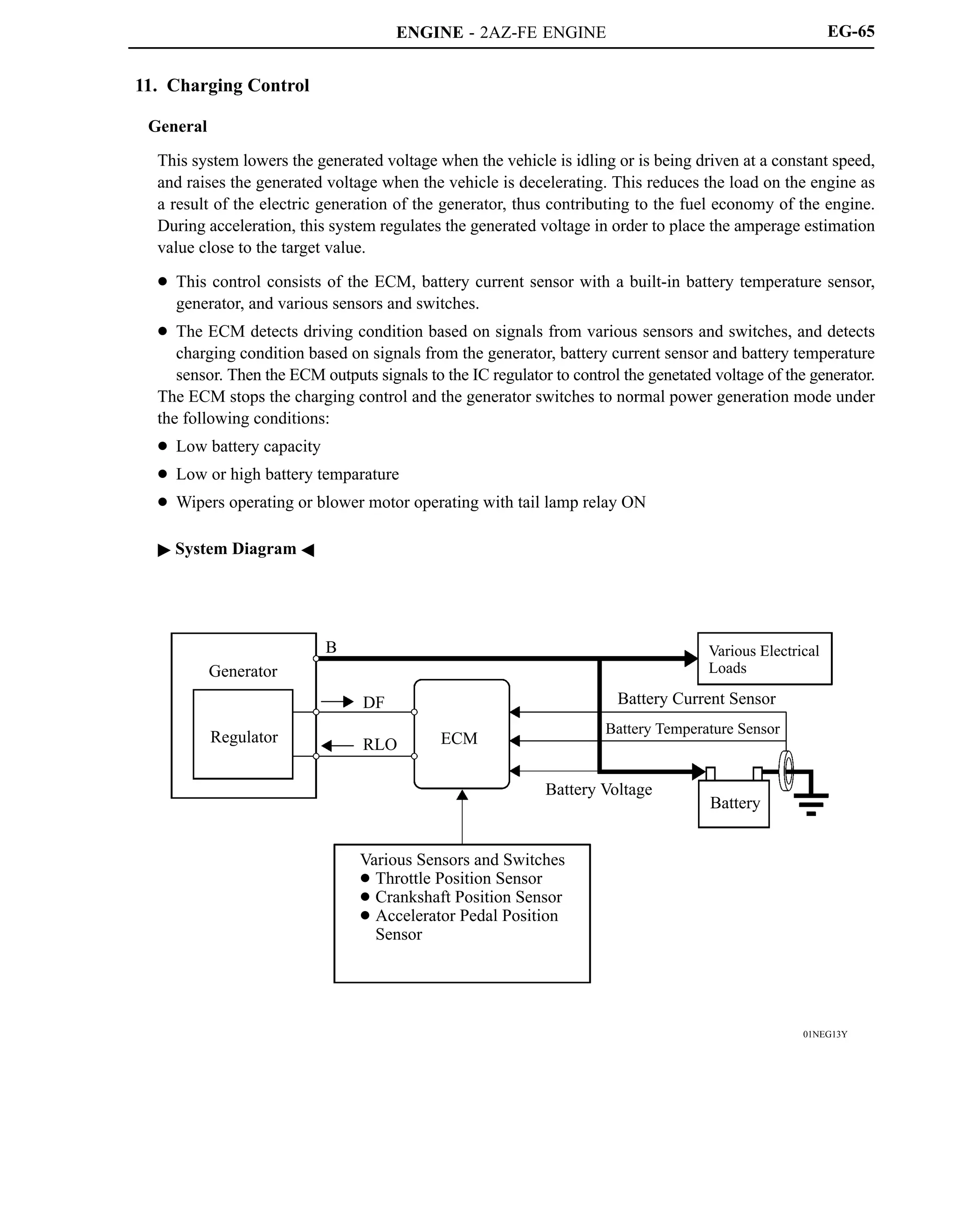
Charging Control
(See page EG-65)
The ECM regulates the charging voltage of the generator in accordance with the
driving conditions and the charging state of the battery.
(Continued)
ENGINE - 2AZ-FE ENGINE EG-31
System Outline
Engine
Immobilizer*2
Prohibits fuel delivery and ignition if an attempt is made to start the engine with
an invalid ignition key.
Diagnosis
(See page EG-67)
When the ECM detects a malfunction, the ECM diagnoses and memorizes the
failed section.
Fail-safe
(See page EG-67)
When the ECM detects a malfunction, the ECM stops or controls the engine
according to the data already stored in memory.
*2: Models with Engine Immobilizer System
ENGINE - 2AZ-FE ENGINE
01MEG04Y
SENSORS ACTUATORS
MASS AIR FLOW METER
INTAKE AIR TEMPERATURE
SENSOR
ENGIEN COOLANT
TEMPERATURE SENSOR
THROTTLE POSITION
SENSOR
CRANKSHAFT POSITION
SENSOR
CAMSHAFT POSITION
SENSOR
ACCELERATOR PEDAL
POSITION SENSOR
AIR-FUEL RATIO SENSOR
(Bank 1, Sensor 1)
HEATED OXYGEN SENSOR
(Bank 1, Sensor 2)
KNOCK SENSOR
COMBINATION METER
 Vehicle Speed Signal
IGNITION SWITCH
 Ignition Signal
 Starter Signal
PARK/NEUTRAL POSITION
SWITCH
TRANSMISSION CONTROL
SWITCH
CRUISE CONTROL SWITCH
VG
THA
THW
VTA1
VTA2
NE
G2
VPA
VPA2
A1A
OX1B
KNK1
SPD
IGSW
STA
D, 2, L
R, P, N
3
CCS
ECM
#10
#20
#30
#40
IGT1 
IGT4
IGF1
M
OC1
FC
HA1A
HT1B
SFI
No.1 INJECTOR
No.2 INJECTOR
No.3 INJECTOR
No.4 INJECTOR
ESA
IGNITION COIL
with IGNITER
SPARK PLUGS
ETCS-i
THROTTLE CONTROL
MOTOR
VVT-i
CAMSHAFT TIMING OIL
CONTROL VALVE
FUEL PUMP CONTROL
CIRCUIT OPENING
RELAY
AIR-FUEL RATIO AND
HEATED OXYGEN SENSOR
HEATER CONTROL
AIR-FUEL RATIO SENSOR
HEATER (Bank1, Sensor1)
HEATED OXYGEN SENSOR
HEATER (Bank1, Sensor2)
EG-32
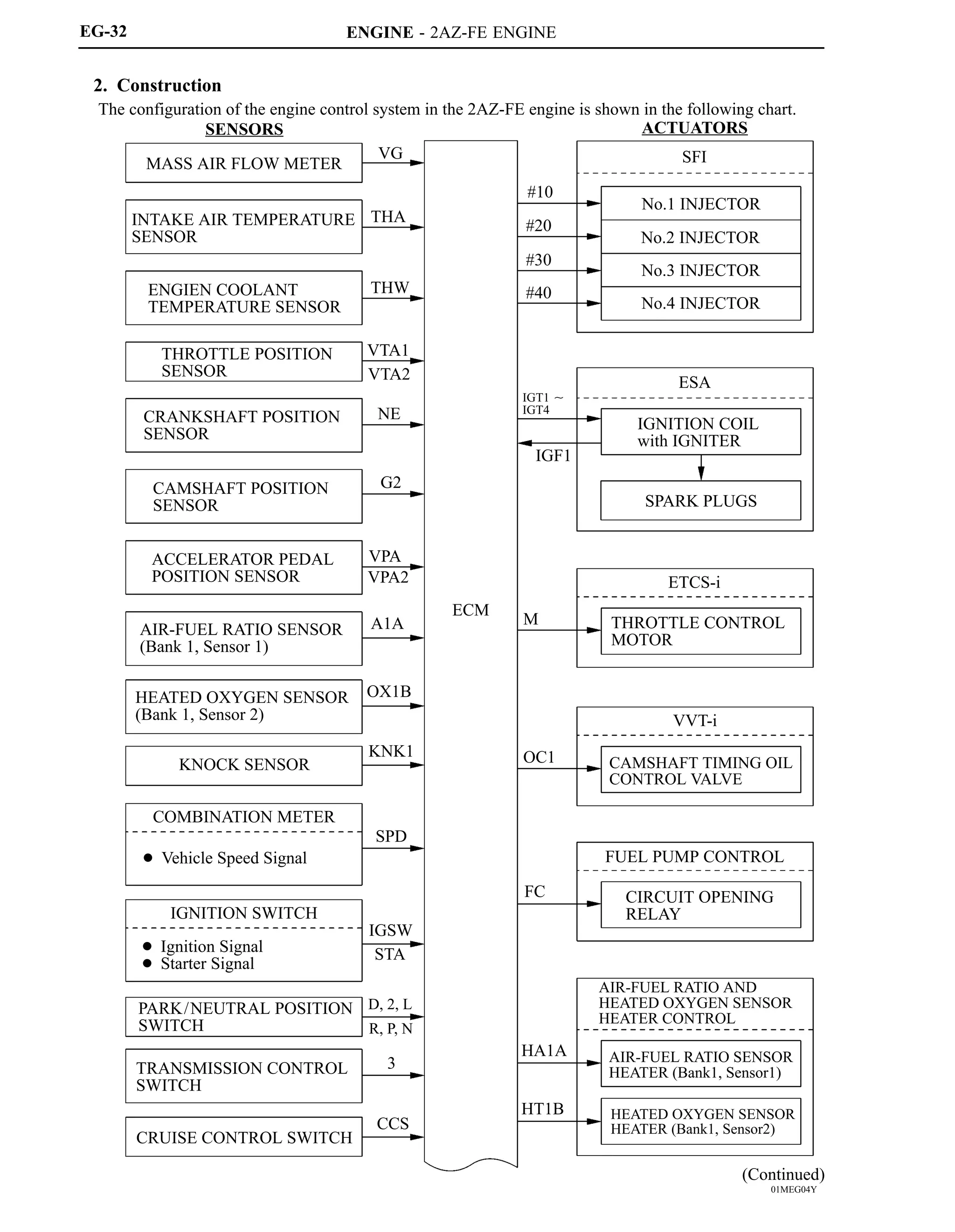
2. Construction
The configuration of the engine control system in the 2AZ-FE engine is shown in the following chart.
(Continued)
ENGINE - 2AZ-FE ENGINE
01MEG05Y
DEFGGER SWITCH
TAIL LIGHT SWITCH
STOP LIGHT SWITCH
CURRENT SENSOR
CANISTER PUMP MODULE
CANISTER PRESSURE
SENSOR
TRANSPONDER KEY ECU*
AIRBAG SENSOR ASSEMBLY
EPS ECU
AIR CONDITIONING ECU
SKID CONTROL ECU
DLC3
BATTERY
ELS1
ELS3
STP
ST1-
THB
VCIB
PPMP
IMI
IMO
CANH,
CANL
TC
TACH
BATT
ECM
FANH
FANL
MPMP
VPMP
PRG
RLO
DF
MREL
+B
W
COOLING FAN CONTROL
COOLING FAN RELAY No.1
COOLING FAN RELAY No.2
COOLING FAN RELAY No.3
EVAPORATIVE EMISSION
CONTROL
CANISTER PUMP MODULE
LEAK DETECTION PUMP
VENT VALVE
GENERATOR
MAIN RELAY
COMBINATION METER
MIL
PURGE VSV
: CAN
EG-33
*: Models with Engine Immobilizer System
ENGINE - 2AZ-FE ENGINE
01MEG09Y
Accelerator Pedal
Position Sensor
Generator
MIL
DLC3
Park/Neutral
Position Switch
Ignition
Switch
Circuit Opening Relay
ECM
Battery
Throttle
Position
Sensor
Throttle
Control
Motor
Purge VSV
Mass Air Flow Meter
 Intake Air Temperature
Sensor
Camshaft Position
Sensor
Camshaft
Timing
Oil Control
Valve
Ignition Coil
with Igniter
Injector
Knock Sensor
Engine
Coolant
Temperature
Sensor
Crankshaft Position
Sensor
Canister
Filter
Fuel Pump
Canister Pump Module
 Vent Valve
 Leak Detection Pump
 Canister Pressure Sensor
TWCs
Heated Oxygen Sensor
(Bank 1, Sensor 2)
Air-fuel Ratio Sensor
(Bank 1, Sensor 1)
EG-34
3. Engine Control System Diagram
ENGINE - 2AZ-FE ENGINE
01MEG31Y
DLC3
Accelerator Pedal
Position Sensor
Mass Air Flow Meter
(Built-in Intake Air
Temperature Sensor)
VSV (for EVAP)
Battery Current
Sensor
Fuel Pump
Canister Pump Module
 Vent Valve
 Leak Detection Pump
 Canister Pressure Sensor
ECM
Heated Oxygen Sensor
(Bank 1, Sensor 2)
Air Fuel Ratio Sensor
(Bank 1, Sensor 1)
Camshaft Timing
Oil Control Valve
Injector Knock Sensor
Ignition Coil with Igniter
Throttle Position
Sensor
Camshaft Position
Sensor
Water Temperature
Sensor
Crakshaft Position
Sensor
EG-35
4. Layout of Main Components
ENGINE - 2AZ-FE ENGINE
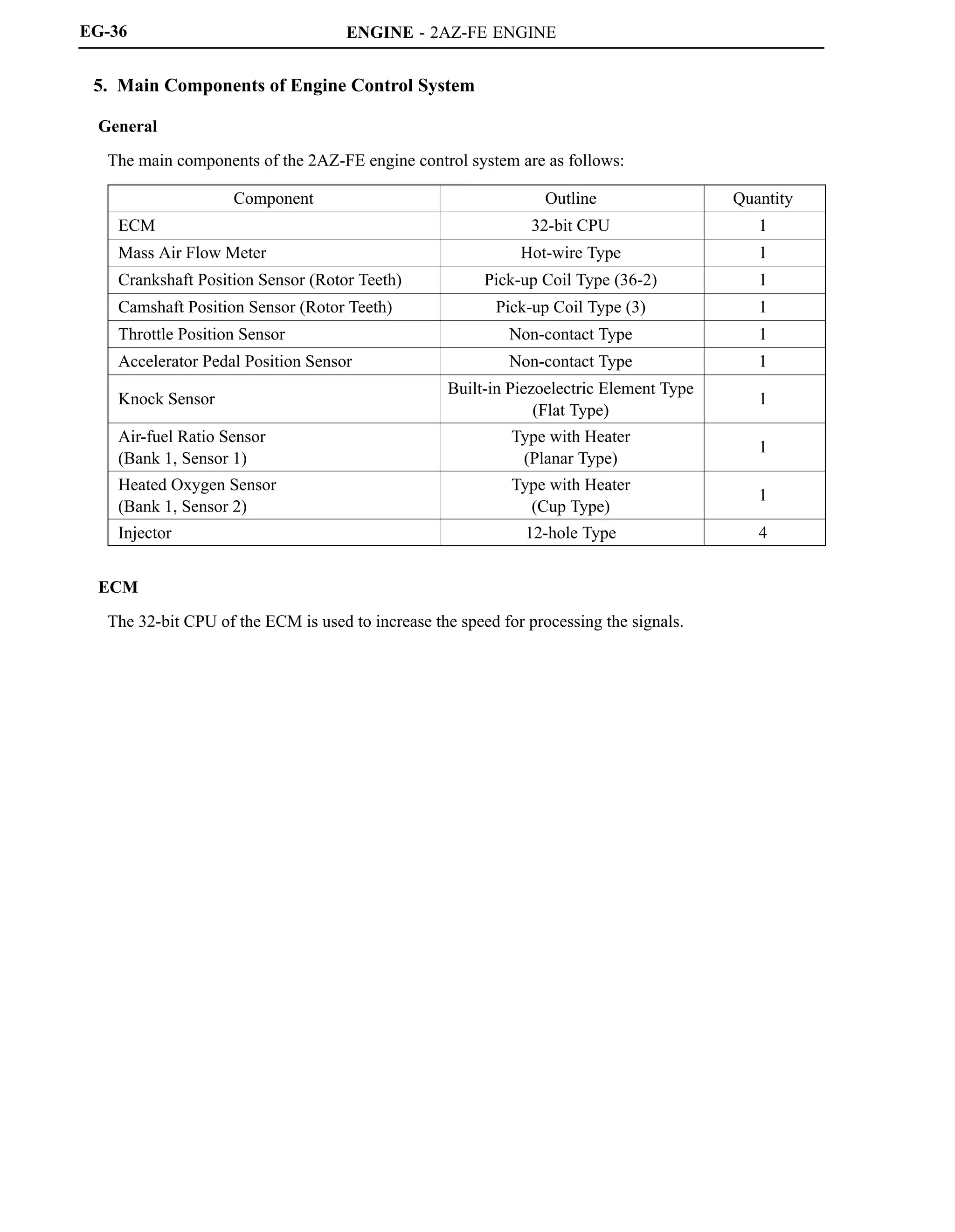
EG-36
5. Main Components of Engine Control System
General
The main components of the 2AZ-FE engine control system are as follows:
Component Outline Quantity
ECM 32-bit CPU 1
Mass Air Flow Meter Hot-wire Type 1
Crankshaft Position Sensor (Rotor Teeth) Pick-up Coil Type (36-2) 1
Camshaft Position Sensor (Rotor Teeth) Pick-up Coil Type (3) 1
Throttle Position Sensor Non-contact Type 1
Accelerator Pedal Position Sensor Non-contact Type 1
Knock Sensor
Built-in Piezoelectric Element Type
(Flat Type)
1
Air-fuel Ratio Sensor
(Bank 1, Sensor 1)
Type with Heater
(Planar Type)
1
Heated Oxygen Sensor
(Bank 1, Sensor 2)
Type with Heater
(Cup Type)
1
Injector 12-hole Type 4
ECM
The 32-bit CPU of the ECM is used to increase the speed for processing the signals.
ENGINE - 2AZ-FE ENGINE
00REG21Y
D13N11
Air-fuel
Ratio
Sensor
A1A+
(3.3V)
A1A-
(2.9V)
ECM
Heated
Oxygen
Sensor
OX1B
EX1B
ECM
Air-fuel Ratio Sensor Circuit Heated Oxygen Sensor
: Air-fuel Ratio Sensor
: Heated Oxygen Sensor
Air-fuel Ratio Sensor Data
Displayed on Hand-held
Tester
4.2
2.2
11 (Rich) 14.7 19 (Lean)
0.1
1
Heated Oxygen
Sensor Output (V)
Air-fuel Ratio
EG-37
Air-fuel Ratio Sensor and Heated Oxygen Sensor
1) General
 The air-fuel ratio sensor and heated oxygen sensor differ in output characteristics.
 Approximately 0.4V is constantly applied to the air-fuel ratio sensor, which outputs an amperage that
varies in accordance with the oxygen concentration in the exhaust emission. The ECM converts the
changes in the output amperage into voltage in order to linearly detect the present air-fuel ratio. The
air-fuel ratio sensor data is read out by the hand-held tester.
 The output voltage of the heated oxygen sensor changes in accordance with the oxygen concentration
in the exhaust emission. The ECM uses this output voltage to determine whether the present air-fuel
ratio is richer or leaner than the stoichiometric air-fuel ratio.
ENGINE - 2AZ-FE ENGINE
271EG45
Alumina
Dilation Layer
Alumina
Platinum
Electrode
Sensor Element (Zirconia)
Heater
Atmosphere
Platinum
Electrode
Heater
Atmosphere
Sensor Element
(Zirconia)
Planar Type Air-fuel Ratio Sensor Cup Type Heated Oxygen Sensor
204EG54
Temperature Sensing
Element
Platinum Hot-wire
Element
Air Flow
Intake Air
Temperature
Sensor
EG-38
2) Construction
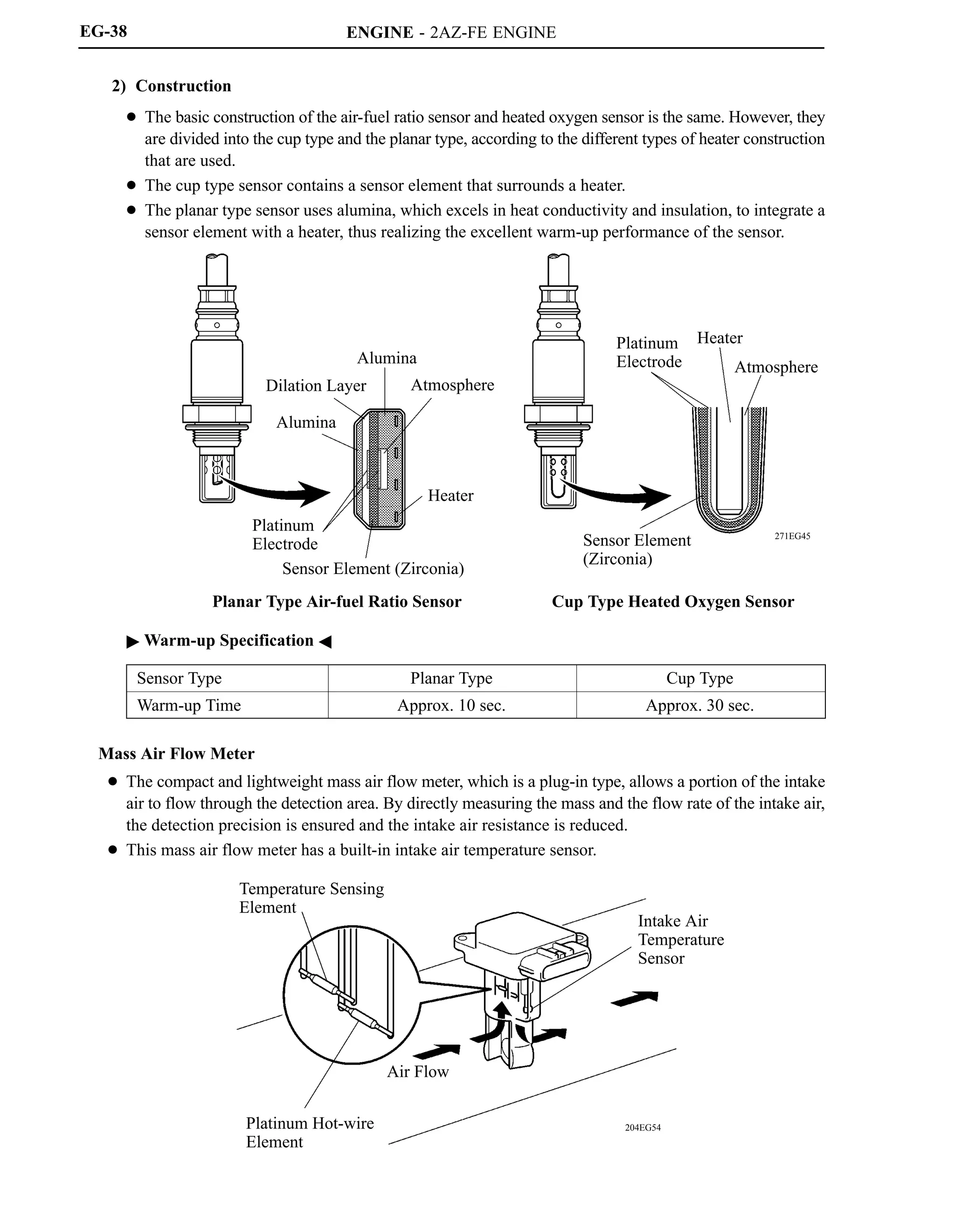
 The basic construction of the air-fuel ratio sensor and heated oxygen sensor is the same. However, they
are divided into the cup type and the planar type, according to the different types of heater construction
that are used.
 The cup type sensor contains a sensor element that surrounds a heater.
 The planar type sensor uses alumina, which excels in heat conductivity and insulation, to integrate a
sensor element with a heater, thus realizing the excellent warm-up performance of the sensor.
 Warm-up Specification 
Sensor Type Planar Type Cup Type
Warm-up Time Approx. 10 sec. Approx. 30 sec.
Mass Air Flow Meter
 The compact and lightweight mass air flow meter, which is a plug-in type, allows a portion of the intake
air to flow through the detection area. By directly measuring the mass and the flow rate of the intake air,
the detection precision is ensured and the intake air resistance is reduced.
 This mass air flow meter has a built-in intake air temperature sensor.
ENGINE - 2AZ-FE ENGINE
214CE04
: Conventional Type
: Flat Type
(V)
Voltage
Frequency (Hz)
A
B
A:Detection Band of
Conventional Type
B: Detection Band of
Flat Type
Characteristic of Knock Sensor
214CE01
214CE02
Steel Weight
Insulator
Piezoelectric
Element
Open/Short Circuit
Detection Resistor
Flat Type Knock Sensor
(Non-resonant Type)
Piezoelectric
Element
Vibration Plate
Conventional Type Knock Sensor
(Resonant Type)
EG-39
Knock Sensor (Flat Type)
1) General
In the conventional type knock sensor (resonant type), a vibration plate which has the same resonance
point as the knocking frequency of the engine is built in and can detect the vibration in this frequency
band.
On the other hand, a flat type knock sensor (non-resonant type) has the ability to detect vibration in a
wider frequency band from about 6 kHz to 15 kHz, and has the following features.
 The engine knocking frequency will change a bit depending on the engine speed. The flat type knock
sensor can detect the vibration even when the engine knocking frequency is changed. Thus the
vibration detection ability is increased compared to the conventional type knock sensor, and a more
precise ignition timing control is possible.
2) Construction
 The flat type knock sensor is installed on the engine through the stud bolt installed on the cylinder
block. For this reason, a hole for the stud bolt is running through the center of the sensor.
 Inside of the sensor, a steel weight is located on the upper portion and a piezoelectric element is located
under the weight through the insulator.
 The open/short circuit detection resistor is integrated.
ENGINE - 2AZ-FE ENGINE
214CE08
Steel Weight
Inertia
Piezoelectric
Element
214CE06
Knock Sensor
200 kΩ
Piezoelectric
Element
Open/Short Circuit
Detection Resistor
KNK1
EKNK
ECM
5 V
200 kΩ
IC
Service Tip
 In accordance with the adoption of an open/short circuit detection resistor, the inspection
method for the sensor has been changed. For details, refer to the 2006 RAV4 Repair Manual
(Pub. No. RM01M1U).
 To prevent the water accumulation in the connecter, make sure to install the flat type knock
sensor in the position as shown in the following illustration.
251EG12
10
10
Knock Sensor
EG-40
3) Operation
The knocking vibration is transmitted to the
steel weight and its inertia applies pressure to
the piezoelectric element. The action
generates electromotive force.
4) Open/Short Circuit Detection Resistor
While the ignition is ON, the open/short circuit detection resistor in the knock sensor and the resistor
in the ECM keep constant the voltage at the terminal KNK1 of engine.
An IC (Integrated Circuit) in the ECM is always monitoring the voltage of the terminal KNK1. If the
open/short circuit occurs between the knock sensor and the ECM, the voltage of the terminal KNK1 will
change and the ECM detects the open/short circuit and stores DTC (Diagnostic Trouble Code).
ENGINE - 2AZ-FE ENGINE
01NEG43Y
238EG79
230LX12
Throttle Body
Throttle Position
Sensor Portion
Throttle Control
Motor
Magnetic
Yoke
Hall IC
Cross Section
Throttle Position
Sensor
Magnetic Yoke
Hall
IC
Hall
IC
VTA1
ETA
VCTA
VTA2
ECM
Output
Voltage
(V)
5
0
Fully Close
10 90 ()
Fully Open
VTA2
VTA1
Throttle Valve Opening Angle
Service Tip
The inspection method differs from the conventional contact type throttle position sensor because
this non-contact type sensor uses a Hall IC.
For details, refer to the 2006 RAV4 Repair Manual (Pub. No. RM01M1U).
EG-41
Throttle Position Sensor
The throttle position sensor is mounted on the throttle body to detect the opening angle of the throttle valve.
The throttle position sensor converts the magnetic flux density that changes when the magnetic yoke
(located on the same axis as the throttle shaft) rotates around the Hall IC into electric signals to operate the
throttle control motor.
ENGINE - 2AZ-FE ENGINE
00SEG39Y
228TU25
228TU24
A
A
Internal Construction
A - A Cross Section
Accelerator
Pedal Arm
Hall IC
Magnetic Yoke
Accelerator Pedal
Position Sensor
Magnetic Yoke
Hall
IC
Hall
IC
VPA
EPA
VCPA
VPA2
EPA2
ECM Output
Voltage
(V)
5
0
VPA2
VPA
Fully Close Fully Open
90
Accelerator Pedal Depressed Angle
VCP2
Service Tip
The inspection method differs from the conventional contact type accelerator pedal position sensor
because this non-contact type sensor uses a Hall IC.
For details, refer to the 2006 RAV4 Repair Manual (Pab. No. RM01M0U).
EG-42
Accelerator Pedal Position Sensor
The non-contact type accelerator pedal position sensor uses a Hall IC.
 The magnetic yoke that is mounted at the accelerator pedal arm rotates around the Hall IC in accordance
with the amount of effort that is applied to the accelerator pedal. The Hall IC converts the changes in the
magnetic flux at that time into electrical signals, and outputs them as accelerator pedal effort to the ECM.
 The Hall IC contains circuits for the main and sub signals. It converts the accelerator pedal depressed
angles into electric signals with two differing characteristics and outputs them to the ECM.
ENGINE - 2AZ-FE ENGINE
00REG17Y
Accelerator Pedal
Position Sensor
Throttle Valve
Throttle Position Sensor
Throttle
Control
Motor
Mass Air
Flow Meter
ECM
Skid
Control
ECU
Ignition
Coil
Fuel
Injector
: CAN
EG-43
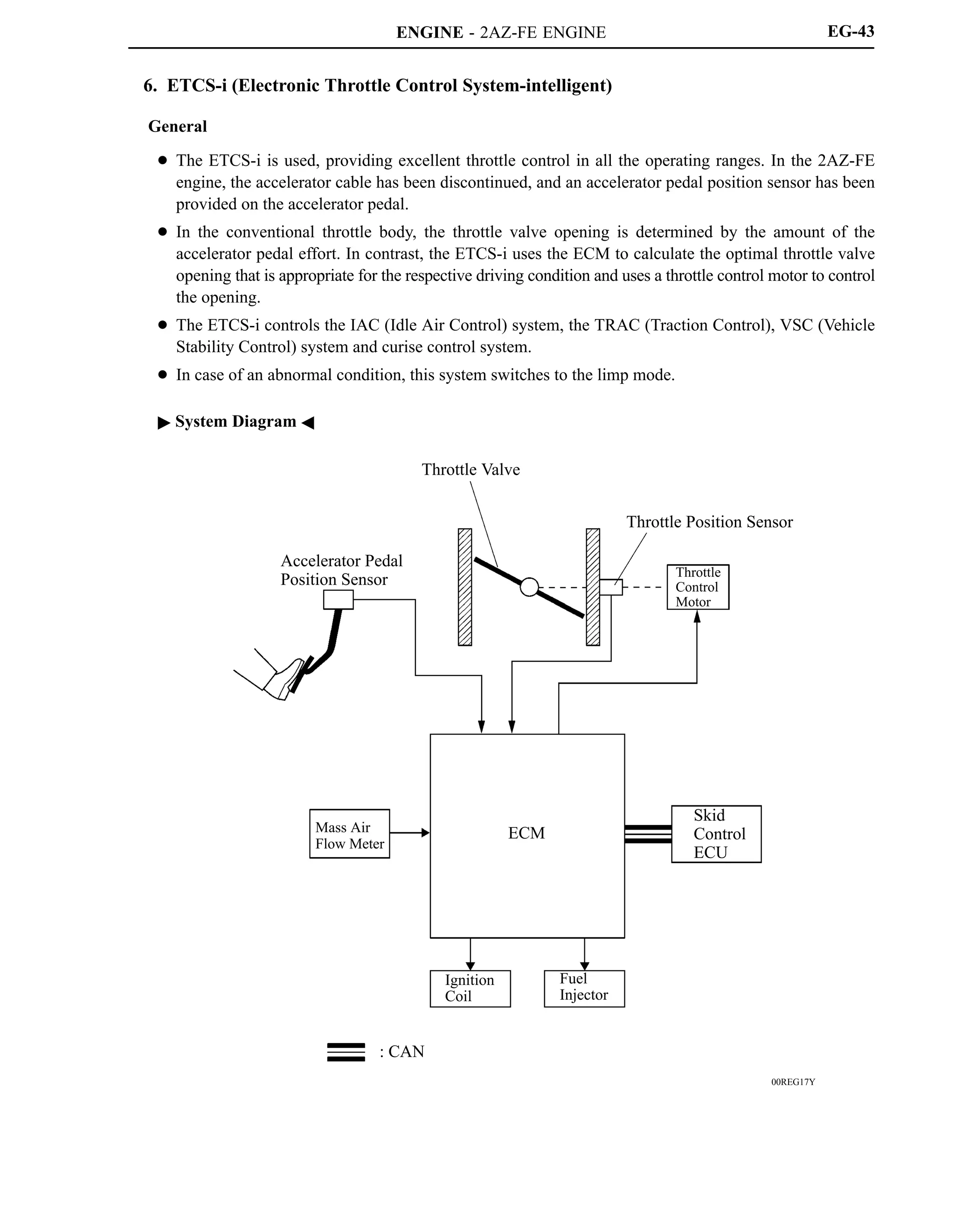
6. ETCS-i (Electronic Throttle Control System-intelligent)
General
 The ETCS-i is used, providing excellent throttle control in all the operating ranges. In the 2AZ-FE
engine, the accelerator cable has been discontinued, and an accelerator pedal position sensor has been
provided on the accelerator pedal.
 In the conventional throttle body, the throttle valve opening is determined by the amount of the
accelerator pedal effort. In contrast, the ETCS-i uses the ECM to calculate the optimal throttle valve
opening that is appropriate for the respective driving condition and uses a throttle control motor to control
the opening.
 The ETCS-i controls the IAC (Idle Air Control) system, the TRAC (Traction Control), VSC (Vehicle
Stability Control) system and curise control system.
 In case of an abnormal condition, this system switches to the limp mode.
 System Diagram
ENGINE - 2AZ-FE ENGINE
Throttle Body
Throttle Position
Sensor Portion
Reduction
Gears
Throttle Valve
Magnetic Yoke
Hall IC
Throttle Control
Motor
A
View from A
Cross Section 01NEG44Y
EG-44
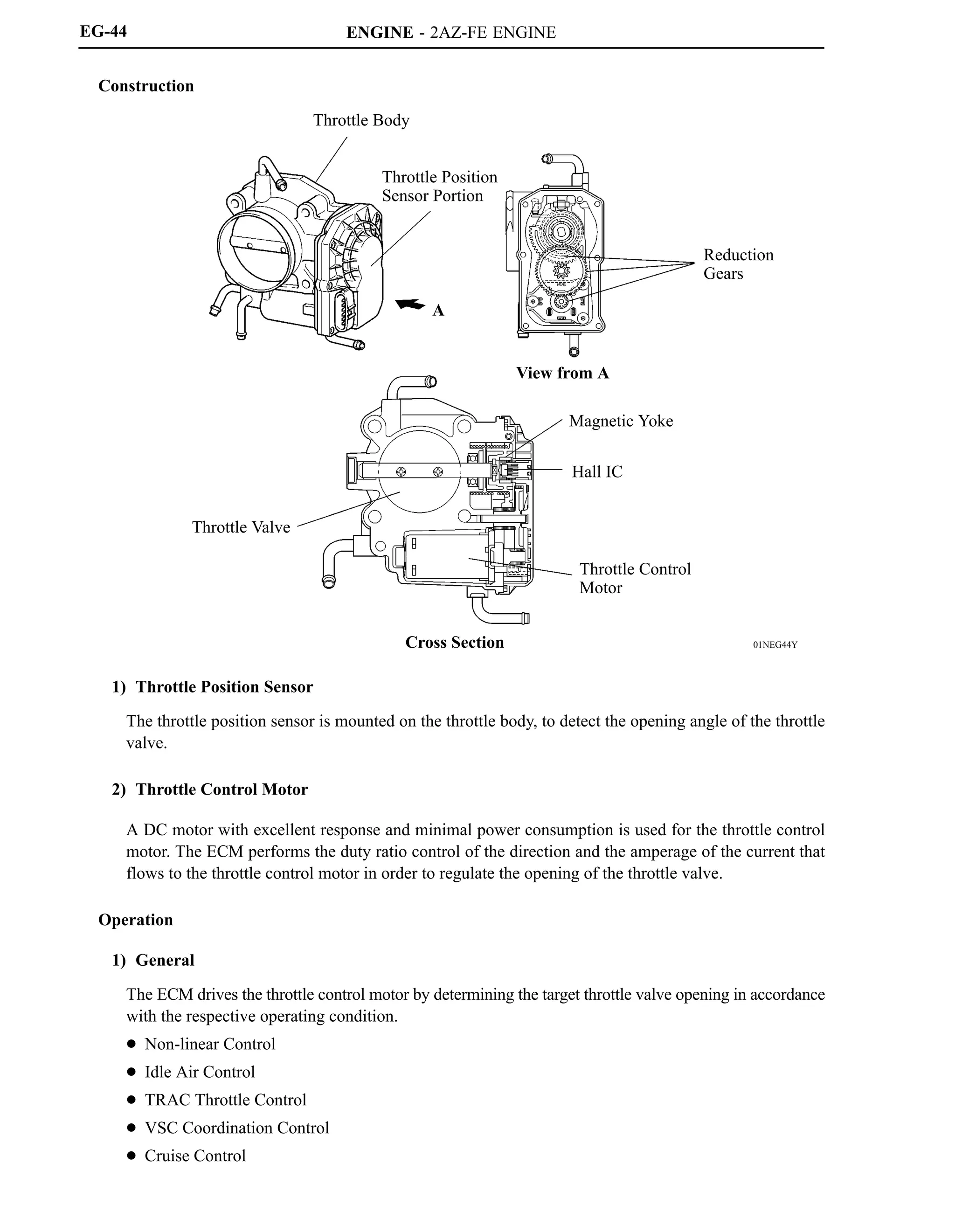
Construction
1) Throttle Position Sensor
The throttle position sensor is mounted on the throttle body, to detect the opening angle of the throttle
valve.
2) Throttle Control Motor
A DC motor with excellent response and minimal power consumption is used for the throttle control
motor. The ECM performs the duty ratio control of the direction and the amperage of the current that
flows to the throttle control motor in order to regulate the opening of the throttle valve.
Operation
1) General
The ECM drives the throttle control motor by determining the target throttle valve opening in accordance
with the respective operating condition.
 Non-linear Control
 Idle Air Control
 TRAC Throttle Control
 VSC Coordination Control
 Cruise Control
ENGINE - 2AZ-FE ENGINE
005EG13Y
: With Control
: Without Control
Vehicle’s
Longitudinal G
Throttle Valve
Opening Angle
Accelerator Pedal
Depressed Angle

0

0

0 Time 
EG-45
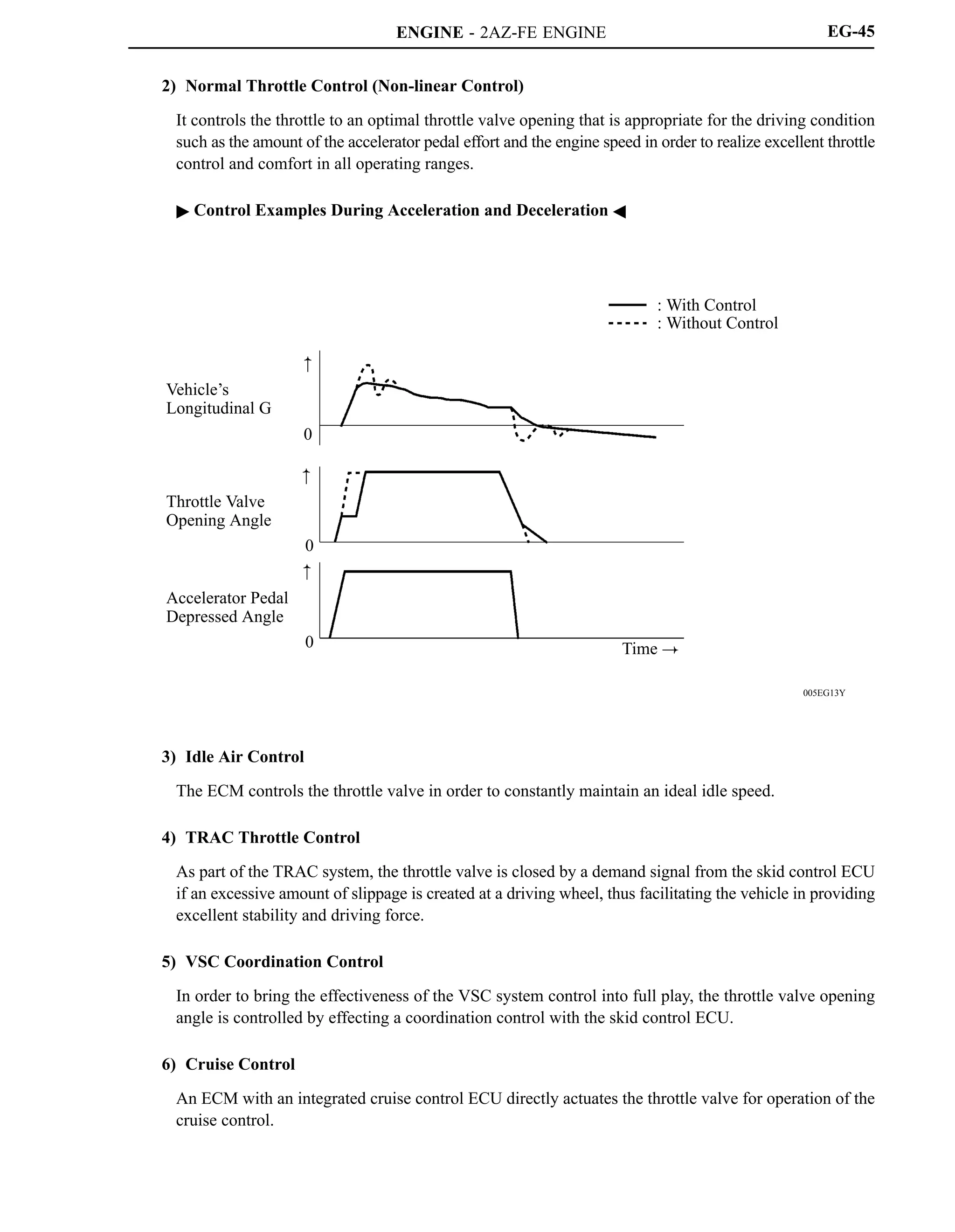
2) Normal Throttle Control (Non-linear Control)
It controls the throttle to an optimal throttle valve opening that is appropriate for the driving condition
such as the amount of the accelerator pedal effort and the engine speed in order to realize excellent throttle
control and comfort in all operating ranges.
 Control Examples During Acceleration and Deceleration 
3) Idle Air Control
The ECM controls the throttle valve in order to constantly maintain an ideal idle speed.
4) TRAC Throttle Control
As part of the TRAC system, the throttle valve is closed by a demand signal from the skid control ECU
if an excessive amount of slippage is created at a driving wheel, thus facilitating the vehicle in providing
excellent stability and driving force.
5) VSC Coordination Control
In order to bring the effectiveness of the VSC system control into full play, the throttle valve opening
angle is controlled by effecting a coordination control with the skid control ECU.
6) Cruise Control
An ECM with an integrated cruise control ECU directly actuates the throttle valve for operation of the
cruise control.
ENGINE - 2AZ-FE ENGINE
199EG45
ECM
Accelerator Pedal
Position Sensor
Main
Sub Main
Sub
Throttle
Position
Sensor
Open
Throttle Valve Return
Spring
Throttle
Control
Motor
Accelerator Pedal Throttle Body
199EG46
Accelerator Pedal Throttle Body
ECM
Accelerator Pedal
Position Sensor
Main
Sub
Close by
Return Spring
Main
Sub
Throttle
Position
Sensor
Throttle Valve Return
Spring
Throttle
Control
Motor
EG-46
Fail-safe of Accelerator Pedal Position Sensor
 The accelerator pedal position sensor is comprised of two (main, sub) sensor circuits. If a malfunction
occurs in either one of the sensor circuits, the ECM detects the abnormal signal voltage difference
between these two sensor circuits and switches to the limp mode. In the limp mode, the remaining circuit
is used to calculate the accelerator pedal depressed angle, in order to operate the vehicle under the limp
mode control.
 If both circuits have malfunctions, the ECM detects the abnormal signal voltage from these two sensor
circuits and stops the throttle control. At this time, the vehicle can be driven within its idling range.
ENGINE - 2AZ-FE ENGINE
199EG47
Injectors ECM Ignition Coils
Accelerator Pedal
Position Sensor
Main
Sub Main
Sub
Return to
Prescribed Angle
Throttle Valve
Return
Spring
Throttle
Control
Motor
Accelerator Pedal Throttle Body
EG-47
Fail-safe of Throttle Position Sensor
 The throttle position sensor is comprised of two (main, sub) sensor circuits. If a malfunction occurs in
either one or both of the sensor circuits, the ECM detects the abnormal signal voltage difference between
these two sensor circuits, cuts off the current to the throttle control motor, and switches to the limp mode.
Then, the force of the return spring causes the throttle valve to return and stay at the prescribed opening
angle. At this time, the vehicle can be driven in the limp mode while the engine output is regulated
through the control of the fuel injection (intermittent fuel-cut) and ignition timing in accordance with the
accelerator opening.
 The same control as above is effected if the ECM detects a malfunction in the throttle control motor
system.
ENGINE - 2AZ-FE ENGINE
DR011EG25
Camshaft Position Sensor
Engine Coolant
Temperature Sensor
Crankshaft
Position Sensor
Camshaft Timing
Oil Control Valve
Throttle Position
Sensor
ECM
Mass Air Flow Meter Vehicle Speed Signal
221EG16
Crankshaft Position Sensor
Mass Air Flow Meter
Throttle Position Sensor
Engine Coolant Temp. Sensor
Camshaft Position Sensor
Vehicle Speed Signal
ECM
Target Valve Timing
Feedback
Correction
Actual Valve Timing
Duty-cycle
Control
Camshaft Timing
Oil Control Valve
EG-48
7. VVT-i (Variable Valve Timing-intelligent) System
General
 The VVT-i system is designed to control the intake camshaft within a range of 40 (of Crankshaft Angle)
to provide valve timing that is optimally suited to the engine condition. This realizes proper torque in
all the speed ranges as well as realizing excellent fuel economy, and reducing exhaust emissions.
 Using the engine speed signal, vehicle speed signal, and the signals from mass air flow meter, throttle
position sensor and engine coolant temperature sensor, the ECM can calculate optimal valve timing for
each driving condition and controls the camshaft timing oil control valve. In addition, the ECM uses
signals from the camshaft position sensor and crankshaft position sensor to detect the actual valve timing,
thus providing feedback control to achieve the target valve timing.
ENGINE - 2AZ-FE ENGINE
185EG48
185EG49
185EG50
287EG34
185EG48
185EG48
TDC
Latest Timing
EX IN
BDC
To Advance Side
EX IN
EX IN
To Advance Side
EX IN
To Retard Side
Latest Timing
EX IN
Latest Timing
EX IN
EG-49
Effectiveness of the VVT-i System
Operation State Objective Effect
 During Idling
 At Light Load
Minimizing overlap to
reduce blowback to the
intake side
 Stabilized idling rpm
 Better fuel economy
At Medium Load
Increasing overlap
increases internal EGR,
reducing pumping loss
 Better fuel economy
 Improved emission
control
In Low to Medium
Speed Range with
Heavy Load
Advancing the intake
valve close timing for
volumetric efficiency
improvement
Improved torque in low
to medium speed range
In High Speed Range
with Heavy Load
Retarding the intake
valve close timing for
volumetric efficiency
improvement
Improved output
At LowTemperature
Minimizing overlap to
prevent blowback to
the intake side leads to
the lean burning
condition, and
stabilizes the idling
speed at fast idle
 Stabilized fast
idle rpm
 Better fuel economy
 Upon Starting
 Stopping the
Engine
Minimizing overlap to
minimize blowback to
the intake side
Improved startability
ENGINE - 2AZ-FE ENGINE
169EG36
Housing
Lock Pin
Intake Camshaft
Vane (Fixed on Intake Camshaft)
Oil Pressure
At a Stop In Operation
Lock Pin
221EG17
To VVT-i Controller
(Advance Side)
To VVT-i Controller
(Retard Side)
Sleeve
Spring
Drain
Oil Pressure
Drain
Spool Valve
Coil
Plunger
EG-50
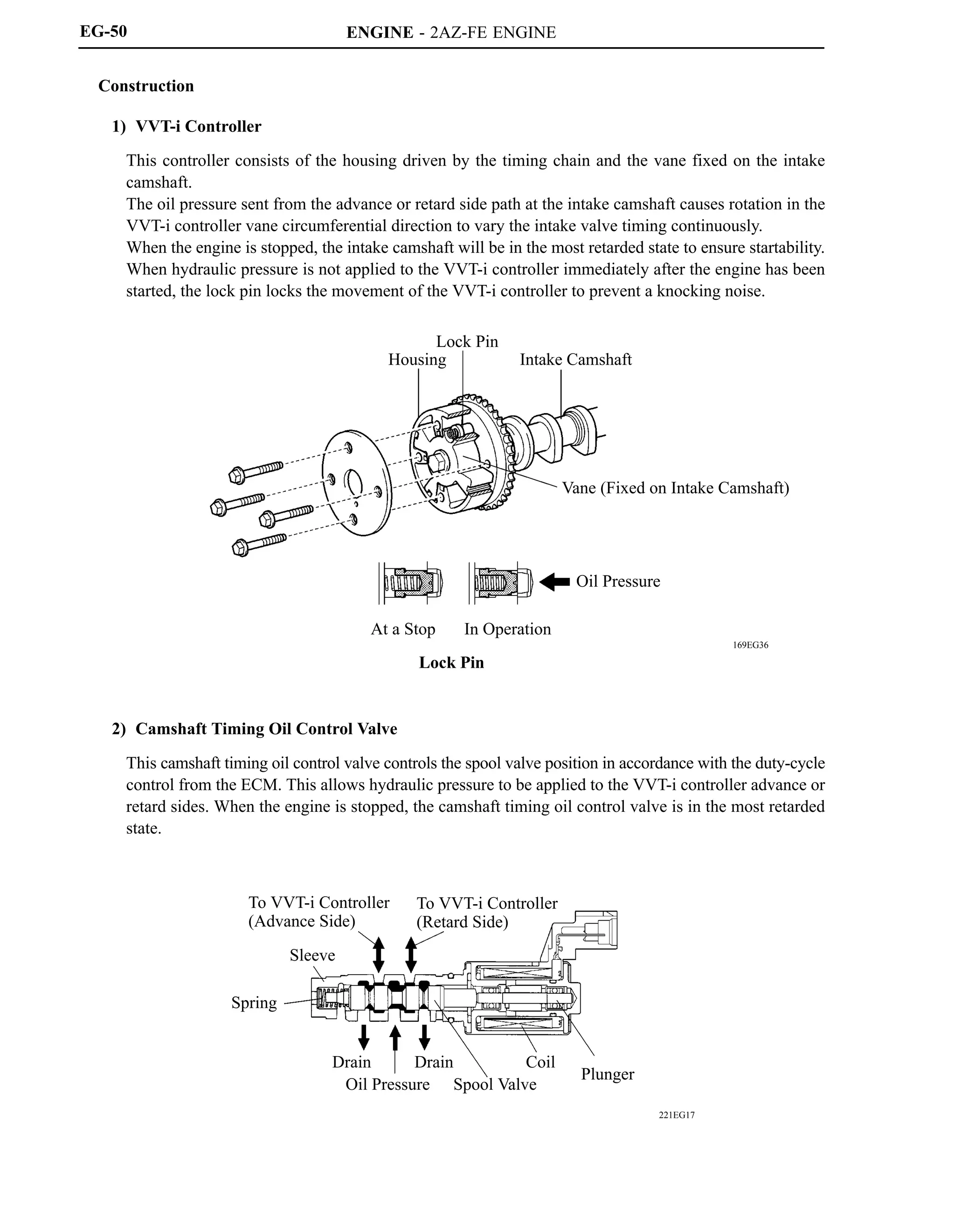
Construction
1) VVT-i Controller
This controller consists of the housing driven by the timing chain and the vane fixed on the intake
camshaft.
The oil pressure sent from the advance or retard side path at the intake camshaft causes rotation in the
VVT-i controller vane circumferential direction to vary the intake valve timing continuously.
When the engine is stopped, the intake camshaft will be in the most retarded state to ensure startability.
When hydraulic pressure is not applied to the VVT-i controller immediately after the engine has been
started, the lock pin locks the movement of the VVT-i controller to prevent a knocking noise.
2) Camshaft Timing Oil Control Valve
This camshaft timing oil control valve controls the spool valve position in accordance with the duty-cycle
control from the ECM. This allows hydraulic pressure to be applied to the VVT-i controller advance or
retard sides. When the engine is stopped, the camshaft timing oil control valve is in the most retarded
state.
ENGINE - 2AZ-FE ENGINE
198EG35
Vane
Rotation Direction
Oil Pressure
ECM
IN Drain
198EG36
Vane
Rotation Direction
Oil Pressure
Drain IN
ECM
EG-51
Operation
1) Advance
When the camshaft timing oil control valve is operated as illustrated below by the advance signals from
the ECM, the resultant oil pressure is applied to the advance side vane chamber to rotate the camshaft
in the advance direction.
2) Retard
When the camshaft timing oil control valve is operated as illustrated below by the retard signals from
the ECM, the resultant oil pressure is applied to the retard side vane chamber to rotate the camshaft in
the retard direction.
3) Hold
After reaching the target timing, the valve timing is held by keeping the camshaft timing oil control valve
in the neutral position unless the traveling state changes.
This adjusts the valve timing at the desired target position and prevents the engine oil from running out
when it is unnecessary.
ENGINE - 2AZ-FE ENGINE
01NEG09Y
01NEG10Y
Air
Conditioning
ECU
Engine Coolant
Temperature Sensor
FANL
ECM
FANH
Cooling Fan
Relay No.3
Cooling Fan
Motor No.2
Cooling Fan
Relay No.1
Cooling Fan
Motor No.1
Low Speed (Series Connection)
High Speed (Parallel Connection)
Air
Conditioning
ECU
Engine Coolant
Temperature Sensor
FANL
ECM
FANH
Cooling Fan
Relay No.3
Cooling Fan
Motor No.2
Cooling Fan
Relay No.1
Cooling Fan
Relay No.2
Cooling Fan
Motor No.1
: CAN
Cooling Fan
Relay No.2
EG-52
8. Cooling Fan Control
On the models with air conditioning, the ECM controls the operation of the cooling fan in two speeds (Low
and High) based on the engine coolant temperature sensor signal and the air conditioning ECU signal. This
control is accomplished by operating the 2 fan motors in 2 stages through low speed (series connection) and
high speed (parallel connection).
 Wiring Diagram 
 Cooling Fan Operation 
Air Conditioning Condition Engine Coolant Temperature C (F)
A/C Compressor Refrigerant Pressure 94 (201.2) or lower 95.5 (203.9) or higher
OFF 1.2 MPa (12.5 kgf/cm2, 178 psi) or lower OFF High
ON
1.2 MPa (12.5 kgf/cm2, 178 psi) or lower Low High
ON
1.2 MPa (12.5 kgf/cm2, 178 psi) or higher High High
ENGINE - 2AZ-FE ENGINE
00REG18Y
Front Airbag
Sensor
(RH and LH)
Curtain Shield
Airbag Sensor*
(RH and LH)
Airbag
Sensor
Side Airbag
Sensor*
(RH or LH)
ECM
Circuit
Opening
Relay
Fuel
Pump
Motor
: CAN
EG-53
9. Fuel Pump Control
A fuel cut control is used to stop the fuel pump when the SRS airbag is deployed at the front collision. In this
system, the airbag deployment signal from the airbag sensor is detected by the ECM, which turns OFF the
circuit opening relay.
After the fuel cut control has been activated, turning the ignition switch from OFF to ON cancels the fuel cut
control, and the engine can be restarted.
*: Models with SRS Driver, Front Passenger, Side and Curtain Shield Airbags
ENGINE - 2AZ-FE ENGINE
Service Tip
 The canister pump module performs the EVAP leak check. This check is done approximately five
hours after the engine is turned off. So you may hear sound coming from underneath the luggage
compartment for several minutes. It does not indicate a malfunction.
 The pinpoint pressure test procedure is carried out by pressurizing the fresh air line that runs from
the pump module to the air filler neck. For details, refer to the 2006 RAV4 Repair Manual (Pub.
No. RM01M1U).
EG-54
10. EVAP (evaporative Emission) Control System
General
The EVAP (evaporative emission) control system prevents the vapor gas that is created in the fuel tank from
being released directly into the atmosphere.
 The canister stores the vapor gas that has been created in the fuel tank.
 The ECM controls the purge VSV in accordance with the driving conditions in order to direct the vapor
gas into the engine, where it is burned.
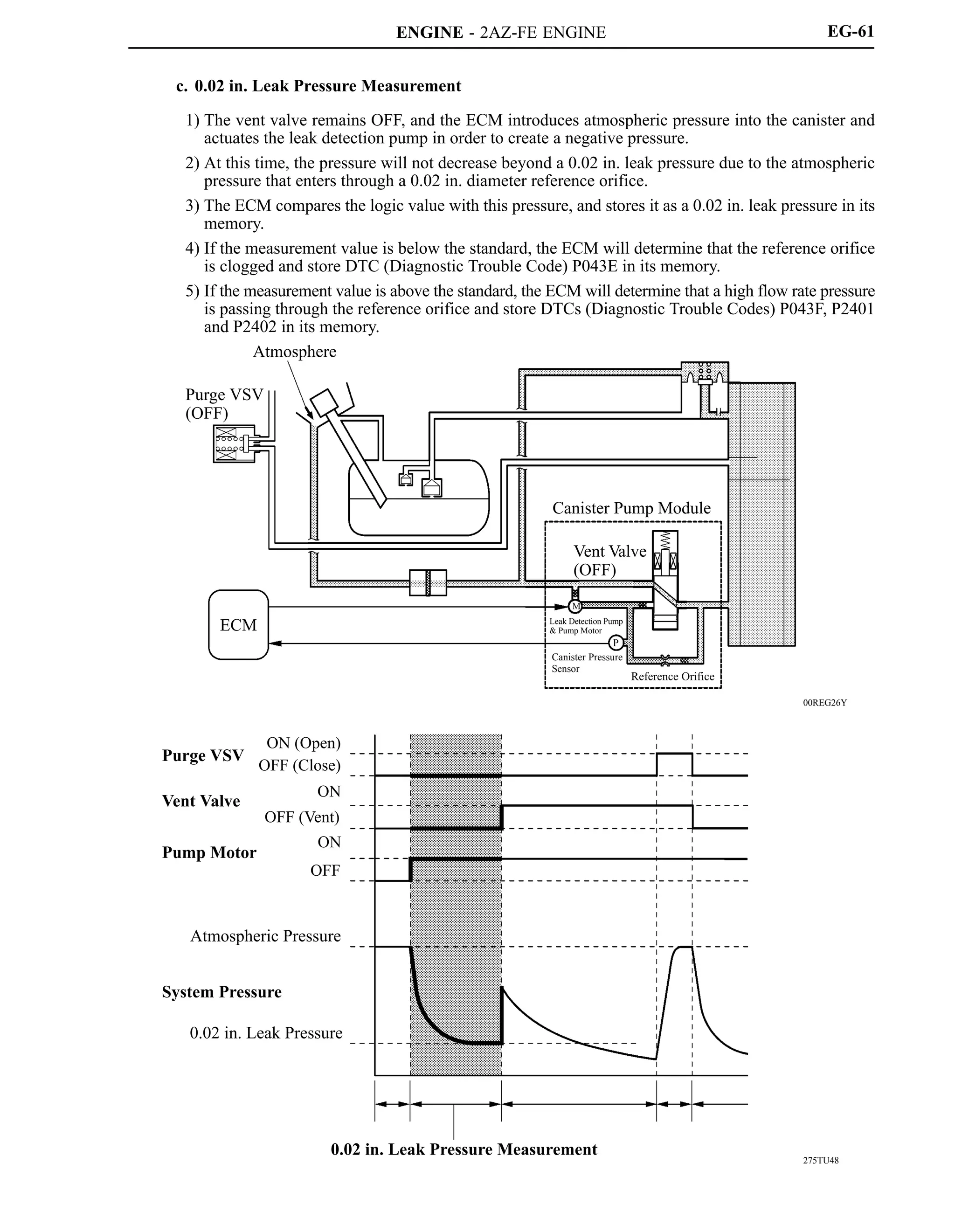
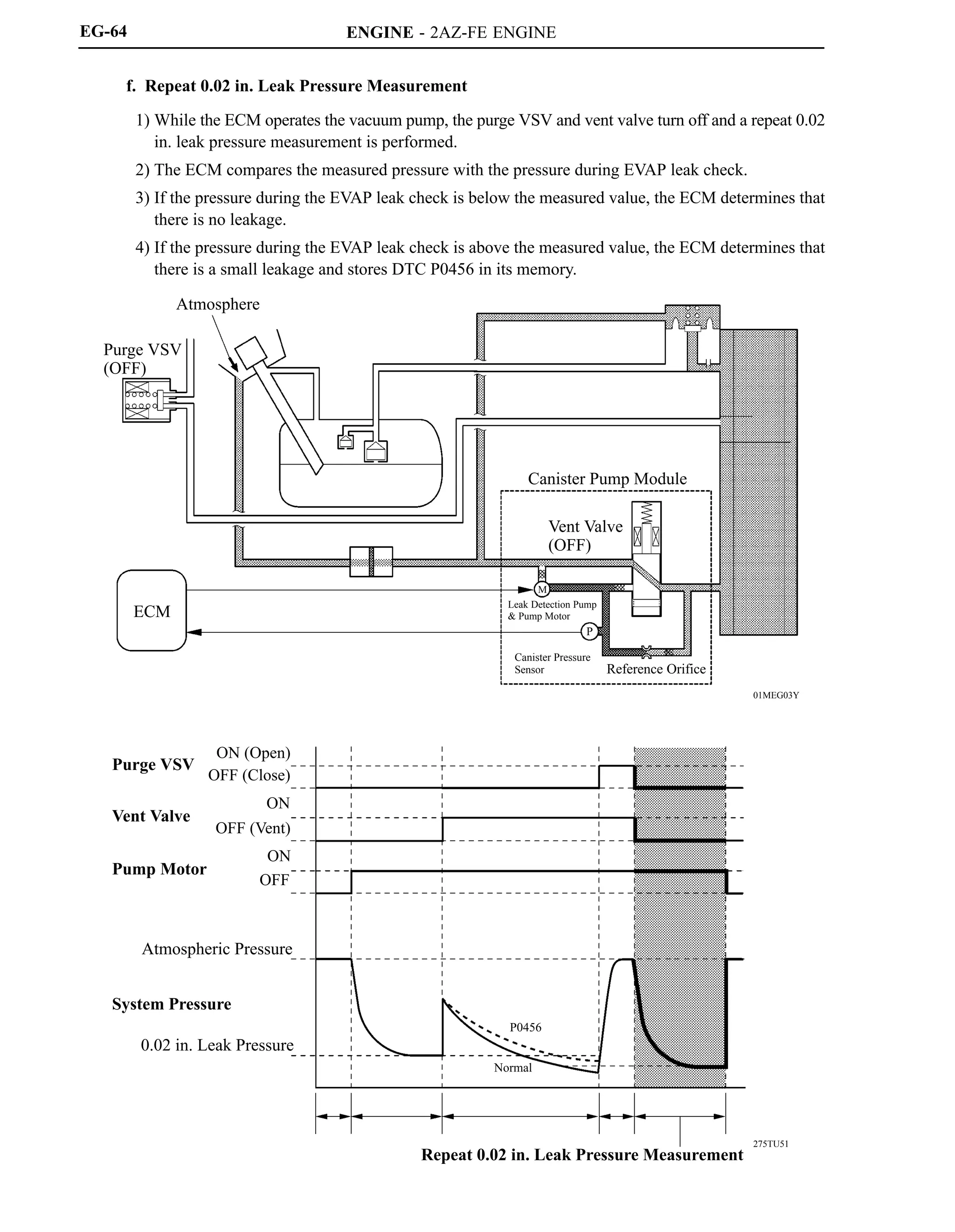
 In this system, the ECM checks the evaporative emission leak and outputs DTC (Diagnostic Trouble
Code) in the event of a malfunction. An EVAP (evaporative emission) leak check consists of an
application of a vacuum pressure to the system and monitoring the changes in the system pressure in order
to detect a leakage.
 This system consists of the purge VSV, canister, refueling valve, canister pump module, and ECM.
 The ORVR (Onboard Refueling Vapor Recovery) function is provided in the refueling valve.
 The canister pressure sensor has been included to the canister pump module.
 The canister filter has been provided on the fresh air line. This canister filter is maintenance-free.
 The followings are the typical conditions for enabling an EVAP leak check:
Typical Enabling
Condition
 Five hours have elapsed after the engine has been turned OFF*.
 Altitude: Below 2400 m (8000 feet)
 Battery voltage: 10.5 V or more
 Ignition switch: OFF
 Engine coolant temperature: 4.4 to 35C (40 to 95F)
 Intake air temperature: 4.4 to 35C (40 to 95F)
*: If engine coolant temperature does not drop below 35C (95F), this time should be extended to 7hours.
Even after that, if the temperature is not less than 35C (95F), the time should be extended to 9.5 hours.
ENGINE - 2AZ-FE ENGINE
00REG22Y
To Intake Manifold
Purge VSV
Purge Air
Line
ECM
Fuel Tank
Canister Filter
Fresh Air Line
Refueling Valve
Canister Pump Module
Vent
Valve
Leak Detection Pump
 Pump Motor
Canister
Pressure Sensor
Canister
P
M
EG-55
System Diagram
Function of Main Components
Component Function
Canister
Contains activated charcoal to absorb the vapor gas that is created in the
fuel tank.
Refueling
Controls the flow rate of the vapor gas from the fuel tank to the canister
when the system is purging or during refueling.
Refueling
Valve
Restrictor Passage
Prevents a large amount of vacuum during purge operation or system
monitoring operation from affecting the pressure in the fuel tank.
Fresh Air Line
Fresh air goes into the canister and the cleaned drain air goes out into
the atmosphere.
Vent Valve
Opens and closes the fresh air line in accordance with the signals from
the ECM.
Canister
Pump Module
Leak Detection
Pump
Applies vacuum pressure to the EVAP control system in accordance
with the signals from the ECM.
p
Canister
Pressure Sensor
Detects the pressure in the EVAP control system and sends the signals
to the ECM.
Purge VSV
Opens in accordance with the signals from the ECM when the system
is purging, in order to send the vapor gas that was absorbed by the
canister into the intake manifold. In system monitoring mode, this valve
controls the introduction of the vacuum into the fuel tank.
Canister Filter Prevents dust and debris in the fresh air from entering the system.
ECM
Controls the canister pump module and purge VSV in accordance with
the signals from various sensors, in order to achieve a purge volume that
suits the driving conditions. In addition, the ECM monitors the system
for any leakage and outputs a DTC if a malfunction is found.
ENGINE - 2AZ-FE ENGINE
D13N07
285EG76
Chamber A
Fresh Air Line
Refueling
Valve (Open)
Chamber B
From Fuel
Tank
Internal Pressure
Canister
To Fuel
Tank
Positive Pressure
(Fuel Tank Pressure)
Restrictor Passage
Negative Pressure
(Intake Manifold Pressure)
During Refueling During Purge Operation or
System Monitoring Operation
228TU119
Fuel Tank Cap Fresh Air
Fuel Inlet Pipe
To Canister
Cleaned Drain Air
EG-56
Construction and Operation
1) Refueling Valve
The refueling valve consists of the chamber A, chamber B, and restrictor passage. A constant
atmospheric pressure is applied to the chamber A.
 During refueling, the internal pressure of the fuel tank increases. This pressure causes the refueling
valve to lift up, allowing the vapor gas to enter the canister.
 The restrictor passage prevents the large amount of vacuum that is created during purge operation or
system monitoring operation from entering the fuel tank, and limits the flow of the vapor gas from the
fuel tank to the canister. If a large volume of vapor gas recirculates into the intake manifold, it will
affect the air-fuel ratio control of the engine. Therefore, the role of the restrictor passage is to help
prevent this from occurring.
2) Fuel Inlet (Fresh Air Line)
In accordance with the change of structure of the EVAP control system, the location of a fresh air line
inlet has been changed from the air cleaner section to the near fuel inlet. The flesh air from the atmosphere
and drain air cleaned by the canister will go in and out of the system through the passage shown below.
ENGINE - 2AZ-FE ENGINE
279EG26
D13N17
279EG25
Fresh Air
Canister
Pressure Sensor
Leak Detection Pump
 Pump Motor
 Vane Pump
Canister
Pressure Sensor
Vent Valve
Fresh Air
Canister
Canister Pump Module
Fresh Air
Vent Valve
Filter
Filter
M
Leak Detection Pump
 Pump Motor
Canister
Pressure Sensor
P
Reference Orifice
[0.5 mm (0.02 in.) Diameter]
Filter
To Canister
EG-57
3) Canister Pump Module
Canister pump module consists of the vent valve, leak detection pump, and canister pressure sensor.
 The vent valve switches the passages in accordance with the signals received from the ECM.
 A DC type brushless motor is used for the pump motor.
 A vane type vacuum pump is used.
 Simple Diagram
ENGINE - 2AZ-FE ENGINE
00REG23Y
To Intake Manifold
Atmosphere
Purge VSV
(Open)
ECM
00REG24Y
Close
Open
EG-58
System Operation
1) Purge Flow Control
When the engine has satisfied the predetermined conditions (closed loop, engine coolant temperature
above 74C (165F), etc.), the stored vapor gas are purged from the canister whenever the purge VSV
is opened by the ECM.
The ECM will change the duty ratio cycle of the purge VSV, thus controlling purge flow volume. Purge
flow volume is determined by intake manifold pressure and the duty ratio cycle of the purge VSV.
Atmospheric pressure is allowed into the canister to ensure that purge flow is constantly maintained
whenever purge vacuum is applied to the canister.
2) ORVR (On-board Refueling Vapor Recovery)
When the internal pressure of the fuel tank increases during refueling, this pressure causes the diaphragm
in the refueling valve to lift up, allowing the vapor gas to enter the canister. Because the vent valve is
always open (even when the engine is stopped) when the system is in a mode other than the monitoring
mode, the air that has been cleaned through the canister is discharged outside the vehicle via the fresh
air line. If the vehicle is refueled in the monitoring mode, the ECM will recognize the refueling by way
of the canister pressure sensor, which detects the sudden pressure increase in the fuel tank, and will open
the vent valve.
ENGINE - 2AZ-FE ENGINE
275TU47
Purge
VSV
Vent
Valve
Pump Motor
System
Pressure
ON (Open)
OFF (Close)
ON
OFF (Vent)
ON
OFF
Atmospheric Pressure
0.02 in. Leak Pressure
1) 2) 3) 4) 5) 6)
EG-59
3) EVAP Leak Check
a. General
The EVAP leak check operates in accordance with the following timing chart:
 Timing Chart 
Order Operation Description Time
1)
Atmospheric Pressure
Measurement
ECM turns vent valve OFF (vent) and measures EVAP
control system pressure to memorize atmospheric pressure.
10 sec.
2)
0.02 in. Leak
Pressure Measurement
Leak detection pump creates negative pressure (vacuum)
through 0.02 in. orifice and the pressure is measured. ECM
determines this as 0.02 in. leak pressure.
60 sec.
3) EVAP Leak Check
Leak detection pump creates negative pressure (vacuum) in
EVAP control system and EVAP control system pressure is
measured. If stabilized pressure is larger than 0.02 in. leak
pressure, ECM determines EVAP control system has a
leakage.
If EVAP control system pressure does not stabilize within 12
minutes, ECM cancels EVAP monitor.
Within
12 min.
4) Purge VSV Monitor
ECM opens purge VSV and measures EVAP control system
pressure increase. If increase is large, ECM interprets this as
normal.
10 sec.
5)
Repeat 0.02 in. Leak
Pressure Measurement
Leak detection pump creates negative pressure (vacuum)
through 0.02 in. orifice and pressure is measured. ECM
determines this as 0.02 in. leak pressure.
60 sec.
6) Final Check
ECM measures atmospheric pressure and records monitor
result.
—
ENGINE - 2AZ-FE ENGINE
00REG25Y
D13N22
Atmosphere
Purge VSV
(OFF)
ECM
Canister Pump Module
Vent Valve
(OFF)
Leak Detection Pump
 Pump Motor
Canister
Pressure Sensor
Purge VSV
Vent Valve
Pump Motor
System Pressure
ON (Open)
OFF (Close)
ON
OFF (Vent)
ON
OFF
Atmospheric Pressure
0.02 in. Leak Pressure
Atmospheric Pressure Measurement
P
M
EG-60
b. Atmospheric Pressure Measurement
1) When the ignition switch is turned OFF, the purge VSV and vent valve are turned OFF. Therefore,
the atmospheric pressure is introduced into the canister.
2) The ECM measures the atmospheric pressure through the signals provided by the canister pressure
sensor.
3) If the measurement value is out of standards, the ECM actuates the leak detection pump in order
to monitor the changes in the pressure.
ENGINE - 2AZ-FE ENGINE
00REG26Y
275TU48
Atmosphere
Purge VSV
(OFF)
ECM
Canister Pump Module
Vent Valve
(OFF)
Leak Detection Pump
 Pump Motor
Canister Pressure
Sensor
Reference Orifice
Purge VSV
Vent Valve
Pump Motor
System Pressure
ON (Open)
OFF (Close)
ON
OFF (Vent)
ON
OFF
Atmospheric Pressure
0.02 in. Leak Pressure
0.02 in. Leak Pressure Measurement
M
P
EG-61
c. 0.02 in. Leak Pressure Measurement
1) The vent valve remains OFF, and the ECM introduces atmospheric pressure into the canister and
actuates the leak detection pump in order to create a negative pressure.
2) At this time, the pressure will not decrease beyond a 0.02 in. leak pressure due to the atmospheric
pressure that enters through a 0.02 in. diameter reference orifice.
3) The ECM compares the logic value with this pressure, and stores it as a 0.02 in. leak pressure in its
memory.
4) If the measurement value is below the standard, the ECM will determine that the reference orifice
is clogged and store DTC (Diagnostic Trouble Code) P043E in its memory.
5) If the measurement value is above the standard, the ECM will determine that a high flow rate pressure
is passing through the reference orifice and store DTCs (Diagnostic Trouble Codes) P043F, P2401
and P2402 in its memory.
ENGINE - 2AZ-FE ENGINE
00REG27Y
275TU49
Purge VSV
(OFF)
Atmosphere
ECM
Canister Pump Module
Vent Valve
(ON)
Leak Detection Pump
 Pump Motor
Canister
Pressure Sensor
M
P
Reference Orifice
Vacuum
Purge VSV
Vent Valve
Pump Motor
System Pressure
OFF (Close)
ON (Open)
ON
OFF (Vent)
ON
OFF
Atmospheric Pressure
0.02 in. Leak Pressure
EVAP Leak Check
P0455
P0456
Normal
EG-62
d. EVAP Leak Check
1) While actuating the leak detection pump, the ECM turns ON the vent valve in order to introduce a
vacuum into the canister.
2) When the pressure in the system stabilizes, the ECM compares this pressure with the 0.02 in. leak
pressure in order to check for a leakage.
3) If the measurement value is below the 0.02 in. leak pressure, the ECM determines that there is no
leakage.
4) If the measurement value is above the 0.02 in. leak pressure and near atmospheric pressure, the ECM
determines that there is a gross leakage (large hole) and stores DTC P0455 in its memory.
5) If the measurement value is above the 0.02 in. leak pressure, the ECM determines that there is a small
leakage and stores DTC P0456 in its memory.
ENGINE - 2AZ-FE ENGINE
00REG28Y
275TU50
M
P
Atmosphere
Atmosphere
Purge VSV
(ON)
ECM
Canister Pump Module
Vent Valve
(ON)
Leak Detection Pump
 Pump Motor
Canister
Pressure Sensor
Purge VSV Monitor
P0441
Normal
Purge VSV
Vent Valve
Pump Motor
System Pressure
ON (Open)
OFF (Close)
ON
OFF (Vent)
ON
OFF
Atmospheric Pressure
0.02 in. Leak Pressure
EG-63
e. Purge VSV Monitor
1) After completing an EVAP leak check, the ECM turns ON (open) the purge VSV with the leak
detection pump actuated, and introduces the atmospheric pressure from the intake manifold to the
canister.
2) If the pressure change at this time is within the normal range, the ECM determines the condition to
be normal.
3) If the pressure is out of the normal range, the ECM will stop the purge VSV monitor and store DTC
P0441 in its memory.
ENGINE - 2AZ-FE ENGINE
01MEG03Y
275TU51
Repeat 0.02 in. Leak Pressure Measurement
Atmosphere
Purge VSV
(OFF)
ECM
Canister Pump Module
Vent Valve
(OFF)
Leak Detection Pump
 Pump Motor
Canister Pressure
Sensor Reference Orifice
Purge VSV
Vent Valve
Pump Motor
System Pressure
ON (Open)
OFF (Close)
ON
OFF (Vent)
ON
OFF
Atmospheric Pressure
0.02 in. Leak Pressure
P0456
Normal
M
P
EG-64
f. Repeat 0.02 in. Leak Pressure Measurement
1) While the ECM operates the vacuum pump, the purge VSV and vent valve turn off and a repeat 0.02
in. leak pressure measurement is performed.
2) The ECM compares the measured pressure with the pressure during EVAP leak check.
3) If the pressure during the EVAP leak check is below the measured value, the ECM determines that
there is no leakage.
4) If the pressure during the EVAP leak check is above the measured value, the ECM determines that
there is a small leakage and stores DTC P0456 in its memory.
ENGINE - 2AZ-FE ENGINE
01NEG13Y
Generator
Regulator
B
DF
RLO ECM
Various Electrical
Loads
Battery Current Sensor
Battery Temperature Sensor
Battery Voltage
Battery
Various Sensors and Switches
 Throttle Position Sensor
 Crankshaft Position Sensor
 Accelerator Pedal Position
Sensor
EG-65
11. Charging Control
General
This system lowers the generated voltage when the vehicle is idling or is being driven at a constant speed,
and raises the generated voltage when the vehicle is decelerating. This reduces the load on the engine as
a result of the electric generation of the generator, thus contributing to the fuel economy of the engine.
During acceleration, this system regulates the generated voltage in order to place the amperage estimation
value close to the target value.
 This control consists of the ECM, battery current sensor with a built-in battery temperature sensor,
generator, and various sensors and switches.
 The ECM detects driving condition based on signals from various sensors and switches, and detects
charging condition based on signals from the generator, battery current sensor and battery temperature
sensor. Then the ECM outputs signals to the IC regulator to control the genetated voltage of the generator.
The ECM stops the charging control and the generator switches to normal power generation mode under
the following conditions:
 Low battery capacity
 Low or high battery temparature
 Wipers operating or blower motor operating with tail lamp relay ON
 System Diagram
ENGINE - 2AZ-FE ENGINE
258AS61
281EG86
Output
Voltage
5 (V)
0
- 100 Current +100 (A)
Characteristic of Current Sensor
288EG61C
(C)
60
Battery Temperature
0
Resistance
(kΩ)
6
EG-66
Battery Current Sensor
Installed on the negative terminal of the battery, this sensor detects the amount of charging and discharging
amperage of the battery and sends signal to the ECM. Based on this signal, the ECM calculates the battery
capacity. A Hall IC is used for detecting the amount of charging and discharging amperage. The changes
that occur in the magnetic flux density in the core as a result of the charging and amperage of the battery
are converted and output as voltage.
Batter Temperature Sensor
 The battery temperature sensor is built into the battery current sensor.
 The battery characteristic (battery internal resistance) of taking in current for charging varies according
to battery electrolyte temperature. If the electrolyte temperature is too low or too high, the battery internal
resistance will increase, resulting in early deterioration. To prevent this, the battery temperature sensor
changes its resistance as shown below to detect the temperature.
ENGINE - 2AZ-FE ENGINE
Service Tip
To clear the DTC that is stored in the ECM, use a hand-held tester or disconnect the battery terminal
or remove the EFI fuse for 1 minute or longer.
EG-67
Fail-safe
Due to a failure in the battery current sensor or battery temperature sensor, the ECM may determine the
necessity of performing a fail-safe operation. Then, the ECM stops the charging control and the generator
switches to the normal power generation mode.
When the ECM detects a malfunction in a sensor, the ECM memorizes the DTC (Diagnostic Trouble Code).
The MIL (Malfunction Indicator Lamp) does not illuminate.
 DTC Chart 
DTC No. Detection Item DTC No. Detection Item
P0516
Battery Temperature Sensor
Circuit Low
P1551
Battery Current Sensor
Circuit Low
P0517
Battery Temperature Sensor
Circuit High
P1552
Battery Current Sensor
Circuit High
P0560 System Voltage P1602 Detection of Battery
P1550
Battery Current Sensor
Circuit
12. Diagnosis
 When the ECM detects a malfunction, the ECM makes a diagnosis and memorizes the failed section.
Furthermore, the MIL in the combination meter illuminates or blinks to inform the driver.
 The ECM will also store the DTCs of the malfunctions. The DTCs can be accessed by the use of the
hand-held tester.
 For details, refer to the 2006 RAV4 Repair Manual (Pub. No. RM01M1U).
13. Fail-safe
When a malfunction is detected at any of the sensors, there is a possibility of an engine or other malfunction
occurring if the ECM were to continue to control the engine control system in the normal way. To prevent
such a problem, the fail-safe function of the ECM either relies on the data stored in memory to allow the
engine control system to continue operating, or stops the engine if a hazard is anticipated. For details, refer
to the 2006 RAV4 Repair Manual (Pub. No. RM01M1U).

2AZ-FE.pdf

  • 1.
    NEW MODEL OUTLINE 01MMO40Y 01MMO39Y Torque (N.m)(ft.lbf) 240 220 200 180 160 140 180 160 140 120 100 1000 Output (HP) (kW) 180 160 140 120 100 80 60 40 20 0 140 120 100 80 60 40 20 0 2000 3000 4000 5000 6000 7000 Engine Speed (rpm) 2AZ-FE Engine 2GR-FE Engine Torque (N.m) (ft.lbf) 340 320 300 280 260 240 260 240 220 200 180 1000 Output (HP) (kW) 280 260 240 220 100 80 60 40 20 0 140 120 100 80 60 40 20 0 2000 3000 4000 5000 6000 7000 Engine Speed (rpm) 200 180 160 140 120 200 180 160 MO-29 PERFORMANCE Power Train Engine The 2AZ-FE engine has been carried over from the ’05 model. This engine realizes high performance, quietness, fuel economy, and clean emissions through the use of the VVT-i (Variable Valve Timing-intelligent) system, DIS (Direct Ignition System), and ETCS-i (Electronic Throttle Control System-intelligent). A new 2GR-FE engine is used. It realizes high performance, quietness, fuel economy, and clean emission through the use of the Dual VVT-i (Dual Variable Valve Timing-intelligent) system, DIS, and ETCS-i. Engine Type 2AZ-FE 2GR-FE No. of Cyls. Arrangement 4-cylinder, In-line Type 6-cylinder, V Type Valve Mechanism 16-valve DOHC, Chain Drive (with VVT-i) 24-valve DOHC, Chain Drive (with Dual VVT-i) Displacement cm3 (cu. in.) 2362 (144.2) 3456 (210.9) Bore x Stroke mm (in.) 88.5 x 96.0 (3.48 x 3.78) 94.0 x 83.0 (3.70 x 3.27) Compression Ratio 9.8 : 1 10.8 : 1 Maximum Output [SAE-NET]* 124 kW @ 6000 rpm (166 HP @ 6000 rpm) 200 kW @ 6200 rpm (268 HP @ 6200 rpm) Maximum Torque [SAE-NET]* 224 N.m @ 4000 rpm (165 ft.lbf @ 4000 rpm) 336 N.m @ 4700 rpm (248 ft.lbf @ 4700 rpm) *: Maximum output and torque rating are determined by revised SAE J1349 standard.
  • 2.
    NEW MODEL OUTLINE 01NMO87Y 01NMO86Y Four-wheelDrive Lock Switch Electric Control Coupling Propeller Shaft Transfer Engine Transaxle Front Differential Control Current 4WD ECU Rear Differential Speed Sensor Yaw Rate Deceleration Sensor Steering Angle Sensor ECM System Configuration Diagram MO-30 Transaxle The U140F and U241E 4-speed automatic transaxles have been carried over from the ’05 model. New U151E and U151F 5-speed automatic transaxles are used. A new GF1A transfer is used. Transaxle Type 4-speed Automatic 5-speed Automatic Transaxle Type U140F U241E U151F U151E Transfer Type GF1A — GF1A — Combination with Engine 2AZ-FE 2GR-FE Drive Type 4WD 2WD 4WD 2WD 1st 3.938 3.943 4.235 2nd 2.194 2.197 2.360 Gear 3rd 1.411 1.413 1.517 Gear Ratio* 4th 1.019 1.020 1.047 5th — — 0.756 Reverse 3.141 3.145 3.378 *: Counter Gear Ratio Included Active Torque Control 4WD System A new active torque control 4WD system with an electric control coupling is used. The active torque control 4WD system, which has an electric control coupling in the front part of the rear differential, transmits torque to the rear wheels when needed, and only in the amount needed, based on information provided by various sensors. By operating the four-wheel drive lock switch provided on the instrument panel, the driver can select the following modes: the AUTO mode to optimally control the torque that is transmitted to the rear wheels, and the LOCK mode that locks the torque that is transmitted to the rear wheels to the maximum amount.
  • 3.
    NEW MODEL OUTLINE 01MCH100Y MO-31 Chassis FrontSuspension Rear Suspension Type MacPherson Strut Type Independent Suspension Type Double Wishbone Type Independent Suspension Steering Type Gear Type EPS (Electronic Power Steering) Rack Pinion Brake Front Brake Type Ventilated Disc Front Rotor Size 15 inch: 275 x 25 mm (10.82 x 0.87 in.)*1 16 inch: 296 x 28 mm (11.84 x 1.10 in.)*2 Rear Brake Type Solid Disc Rear Rotor Size 15 inch: 281 x 12 mm (11.24 x 0.48 in.) Parking Brake Type Lever Type Brake Control ABS (Anti-lock Brake System) with EBD (Electronic Brake force Distribution) Brake Assist TRAC (Traction Control) Hill-start Assist Control*3 DAC (Downhill Assist Control)*3 VSC (Vehicle Stability Control)*4 *1: 2AZ-FE Engine Models with Rear No. 1 Seat Only *2: 2GR-FE Engine Models and Models with Rear No. 2 Seat *3: Standard Equipment on 2GR-FE Engine Models and Models with Rear No. 2 Seat *4: 2WD models have been provided with Auto LSD (Limited Slip Differential).
  • 4.
    NEW MODEL OUTLINE 01NMO88Y01NMO89Y Standstill ’06 Model Slow Backward Movement ’05 Model MO-32 Enhanced VSC System The enhanced VSC (Vehicle Stability Control) system is standard equipment on all models. In addition to the ABS, TRAC, and VSC controls provided by the conventional system, the enhanced VSC system effects cooperative control with the EPS (Electric Power Steering) and active torque control 4WD system in order to realize excellent driving stability and maneuverability. See CH-92 for details on the enhanced VSC system. Hill-start Assist Control The hill-start assist control is standard equipment on the 2GR-FE engine models and the models with rear No. 2 seat. When the driver transfers his/her foot from the brake pedal to the accelerator pedal while starting off on an uphill, the hill-start assist control momentarily maintains the hydraulic pressure in the wheel cylinders of the four wheels, in order to prevent the vehicle from rolling backward. The hill-start assist control used on the ’06 model effects control to prevent the vehicle from rolling backward. This control has evolved further from the hill-start assist control of the ’05 model, which slowed the backward rolling of the vehicle while starting off on a hill. See CH-120 for details on the hill-start assist control.
  • 5.
    ENGINE ENGINE - 2AZ-FEENGINE 01NEG49Y 01NEG50Y EG-2 2AZ-FE ENGINE DESCRIPTION The 2AZ-FE engine is an in-line, 4-cylinder, 2.4-liter, 16-valve DOHC engine. This engine uses the VVT-i (Variable Valve Timing-intelligent) system, DIS (Direct Ignition System), ETCS-i (Electronic Throttle Control System-intelligent). It has been developed to realize high performance, quietness, fuel economy and clean emission.
  • 6.
    ENGINE - 2AZ-FEENGINE 01MEG02Y Valve Timing : Intake Valve Opening Angle : Exhaust Valve Opening Angle VVT-i Operation Range VVT-i Operation Range TDC 3 3 43 65 25 45 BDC EG-3 Engine Specifications No. of Cyls. Arrangement 4-cylinder, In-line Valve Mechanism 16-valve DOHC, Chain Drive (with VVT-i) Combustion Chamber Pentroof Type Manifolds Cross-flow Fuel System SFI Ignition System DIS Displacement cm3 (cu. in.) 2362 (144.1) Bore x Stroke mm (in.) 88.5 x 96.0 (3.48 x 3.78) Compression Ratio 9.8 : 1 Max. Output*1 (SAE-NET) 124 kW @ 6000 rpm (166 HP @ 6000 rpm) Max. Torque*1 (SAE-NET) 224 N.m @ 4000 rpm (165 ft-lbf @ 4000 rpm) Intake Open 3 - 43 BTDC Valve Timing Intake Close 65 - 25 ABDC Valve Timing Exhaust Open 45 BBDC Exhaust Close 3 ATDC Firing Order 1 - 3 - 4 - 2 Research Octane Number 91 or higher Octane Rating 87 or higher Oil Grade ILSAC Tailpipe Emission Regulation ULEV-II, SFTP Evaporative Emission Regulation LEV-II, ORVR Engine Service Mass*2 (Reference) kg (lb) 138 (304.2) *1: Maximum output and torque rating is determined by revised SAE J1349 standard. *2: Weight shows the figure with oil and water fully filled.
  • 7.
    ENGINE - 2AZ-FEENGINE EG-4 FEATURES OF 2AZ-FE ENGINE The 2AZ-FE engine has achieved the following performance through the use of the items listed below. (1) High performance and reliability (2) Low noise and vibration (3) Lightweight and compact design (4) Good serviceability (5) Clean emission and fuel economy Section Item (1) (2) (3) (4) (5) Engine A cylinder block made of aluminum alloy along with a magnesium alloy die-cast cylinder head cover is used. Engine Proper A taper squish shape is used for the combustion chamber. p A resin gear balance shaft is used. V l A timing chain and chain tensioner are used. Valve Mechanism The shim-less type valve lifters are used. Mechanism The VVT-i system is used. A chacoal filter is used in the air cleaner cap. Intake and Intake manifold made of plastic is used. Intake and Exhaust S The linkless-type throttle body is used. System A thin-wall ceramic TWC (Three-Way Catalytic converter) is used. The fuel returnless system is used. Fuel System Quick connectors are used to connect the fuel hose with the fuel pipe. System 12-hole type fuel injectors with high atomizing performance are used. Ignition System Iridium-tipped spark plugs are used. Charging System The segment conductor type generator is used. Starting System PS (Planetary reduction-Segment conductor motor) type starter is used. The ETCS-i is used. Engine Control The DIS (Direct Ignition System) makes ignition timing adjustment unnecessary. Control System The non-contact type sensor is used in the throttle position sensor. The planar type air-fuel ratio sensor is used.
  • 8.
    ENGINE - 2AZ-FEENGINE DR011EG20 Cylinder Head Cover Cylinder Head Cover Gasket 02AEG02Y 02AEG01Y Cylinder Bore Side Front Outer Side Shim A A A - A Cross Section EG-5 ENGINE PROPER 1. Cylinder Head Cover A lightweight magnesium alloy die-cast cylinder head cover is used. Acrylic rubber, which excels in heat resistance and reliability, is used for the cylinder head cover gasket. 2. Cylinder Head Gasket A steel-laminate type cylinder head gasket is used. A shim has been added around the cylinder bore to increase the sealing surface, thus improving the sealing performance and durability.
  • 9.
    ENGINE - 2AZ-FEENGINE 208EG67 DR011EG21 Exhaust Side Intake Side A A A - A Cross Section Injector IN EX Bypass Passage Taper Squish EG-6 3. Cylinder Head Through the adoption of the taper squish combustion chamber, the engine knocking resistance and fuel efficiency have been improved. An upright intake port is used to improve the intake efficiency. Installing the injectors in the cylinder head enables the injectors inject fuel as close as possible to the combustion chamber. This prevents the fuel from adhering to the intake port walls, which reduces HC exhaust emissions. The routing of the water jacket in the cylinder head has been optimized to realize the high cooling performance. In addition, a water bypass passage has been provided below the exhaust ports to reduce the number of parts and the weight.
  • 10.
    ENGINE - 2AZ-FEENGINE DR011EG22 01NEG26Y Air Flow During Engine Revolution Water Pump Swirl Chamber Crankshaft Bearing Cap Plastic Region Tightening Bolts Thermostat Housing Air Conditioning Compressor Brackets Air Passage Holes Air Flow NOTICE Never attempt to machine the cylinder because it has a thin liner thickness. EG-7 4. Cylinder Block Lightweight aluminum alloy is used for the cylinder block. By producing the thin cast-iron liners and cylinder block as a unit, compaction is realized. Air passage holes are provided in the crankshaft bearing area of the cylinder block. As a result, the air at the bottom of the cylinder flows smoother, and pumping loss (back pressure at the bottom of the piston generated by the piston’s reciprocal movement) is reduced to improve the engine’s output. The oil filter and the air conditioning compressor brackets are integrated into the crankcase. Also, the water pump swirl chamber and thermostat housing are integrated into the cylinder block.
  • 11.
    ENGINE - 2AZ-FEENGINE 01NEG27Y Irregularly shaped outer casting surface of liner Cylinder Block Liner A A A - A Cross Section 01NEG28Y Water Jacket Spacer Water Jacket A - A Cross Section A A EG-8 The liners are the spiny-type, which have been manufactured so that their casting exteriors form large irregular surfaces in order to enhance the adhesion between the liners and the aluminum cylinder block. The enhanced adhesion helps heat dissipation, resulting in a lower overall temperature and heat deformation of the cylinder bores. Water jacket spacers are provided in the water jacket of the cylinder block. They suppress the water flow in the center of the water jackets, guide the coolant above and below the cylinder bores, and ensure uniform temperature distribution. As a result, the viscosity of the engine oil that acts as a lubricant between the bore walls and the pistons can be lowered, thus reducing friction.
  • 12.
    ENGINE - 2AZ-FEENGINE 01MEG01Y Taper Squish Shape : Resin Coating 240EG45 Plastic Region Tightening Bolts EG-9 5. Piston The piston is made of aluminum alloy and skirt area is made compact and lightweight. The piston head portion uses a taper squish shape to improve the fuel combustion efficiency. The piston skirt has been coated with resin to reduce the friction loss. 6. Connecting Rod The connecting rods and caps are made of high-strength steel for weight reduction. Nut-less type plastic region tightening bolts are used on the connecting rod for a lighter design. The connecting rod bearings are reduced in width to reduce friction.
  • 13.
    ENGINE - 2AZ-FEENGINE 01NEG31Y No.1 Journal Balance Shaft Drive Gear Oil Hole Crank Pin Balance Weight 01NEG32Y : Resin Gear Balance Shaft Housing Balance Shaft No.1 Balance Shaft No.2 Crankshaft Balance Shaft Drive Gear EG-10 7. Crankshaft The forged crankshaft has 5 journals and 8 balance weights. The crankshaft is made of forged steel. Pin and journal fillets are roll-finished to maintain adequate strength. The balance shaft drive gear is provided for the crankshaft. 8. Balance Shaft General A balance shaft is used to reduce vibrations. The crankshaft directly drives the No. 1 balance shaft. In addition, a resin gear is used on the driven side to suppress noise and offer lightweight design.
  • 14.
    ENGINE - 2AZ-FEENGINE 286EG71 Top Dead Center Point of Max. Speed Bottom Dead Center Point of Max. Speed Point of Max. Speed 90 286EG72 Inertial Force of Cylinders No.2 and No.3 Combined Inertial Force of All Cylinders Unbalanced Secondary Inertial Force Inertial Force of Cylinder No.1 and No.4 Force Inertial force that cannot be canceled Crankshaft Angle - 90 90 270 180 0 - 180 Inertial Force Generated by the In-line 4 Cylinders 286EG73 0 90 180 270 A B C D E Inertial Force of Balancer Crankshaft Angle Secondary Inertial Force Mass Direction of Balance Shaft Inertial Force of Balancer Mass Direction of Balance Shaft at Crankshaft Angle EG-11 Operation In the in-line 4-cylinder engine, the crankshaft angle for cylinders No.1 and No.4 are exactly at the opposite (180) position of cylinders No.2 and No.3. Therefore, the inertial force of the pistons and the connecting rods of the former 2 cylinders and of the latter 2 cylinders almost cancel each other. However, because the position at which the piston reaches its maximum speed is located toward the top dead center from the center of the stroke, the upward inertial force is greater than the downward inertial force. This unbalanced secondary inertial force is generated twice for each rotation of the crankshaft. To cancel the unbalanced secondary inertial force, 2 balance shafts are rotated twice for each rotation of the crankshaft and generate inertial force in the opposite direction. Also, in order to cancel the inertial force generated by the balance shaft itself, the balance shaft actually consists of 2 shafts rotating in opposite directions.
  • 15.
    ENGINE - 2AZ-FEENGINE 240EG46 181EG10 VVT-i Controller Intake Camshaft Exhaust Camshaft Chain Tensioner Chain Damper Chain Slipper Camshaft Valve Lifter Service Tip The adjustment of the valve clearance is accomplished by selecting and replacing the appropriate valve lifters. A total of 35 valve lifters are available in 0.02 mm (0.008 in.) increments, from 5.06 mm (0.199 in.) to 5.74 mm (0.226 in.). For details, refer to 2006 RAV4 Repair Manual (Pub. No. RM01M1U). EG-12 VALVE MECHANISM 1. General The VVT-i system is used to improve fuel economy, engine performance and reduce exhaust emissions. For details of VVT-i system, see page EG-48. The intake and exhaust camshafts are driven by a timing chain. Along with the increase in the amount of valve lift, the shim-less type valve lifter is used. This valve lifter increases the cam contact surface.
  • 16.
    ENGINE - 2AZ-FEENGINE 181EG11 VVT-i Controller Intake Camshaft Timing Rotor Exhaust Camshaft Timing Sprocket 185EG25 181EG14 Cam Spring Cam Plunger Spring Chain Tensioner Chain Damper Oil Jet Chain Tensioner Chain Slipper EG-13 2. Camshaft The intake camshaft is provided with timing rotor to trigger the camshaft position sensor. In conjunction with the adoption of the VVT-i system, an oil passage is provided in the intake camshaft in order to supply engine oil pressure to the VVT-i system. A VVT-i controller has been installed on the front of the intake camshaft to vary the timing of the intake valves. 3. Timing Chain A roller chain with an 8 mm (0.315 in.) pitch is used to make the engine more compact. The timing chain is lubricated by an oil jet. The chain tensioner uses a spring and oil pressure to maintain proper chain tension at all times. The chain tensioner suppresses noise generated by the timing chain. A ratchet type non-return mechanism is used. To achieve excellent serviceability, the chain tensioner is constructed so that it can be removed and installed from the outside of the timing chain cover.
  • 17.
    ENGINE - 2AZ-FEENGINE 208EG07 VVT-i Controller Camshaft Timing Oil Control Valve Oil Return Hole Oil Pump Oil Filter Chain Tensioner 01NEG33Y Bypass Valve Relief Valve Main Oil Hole Oil Filter Oil Pump Oil Strainer Chain Tensioner Cylinder Head Exhaust Camshaft Journal Oil Control Valve VVT-i Controller Oil Pan Intake Camshaft Journal Crankshaft Journal Crankshaft Pin Oil Jet Piston Cylinder Block Barance Shaft Timing Chain EG-14 LUBRICATION SYSTEM 1. General The lubrication circuit is fully pressurized and oil passes through an oil filter. The trochoid gear type oil pump is chain-driven by the crankshaft. The oil filter is attached downward from the crankcase to improve serviceability. Along with the adoption of the VVT-i system, the cylinder head is provided with a VVT-i controller and a camshaft timing oil control valve. This system is operated by the engine oil. Oil Circuit
  • 18.
    ENGINE - 2AZ-FEENGINE 01NEG34Y Oil Jets Check Valve Oil Bottom Side View Oil Jet Cross Section EG-15 Oil Capacity Liters (US qts, Imp. qts) Dry 5.0 (5.3, 4.4) with Oil Filter 4.3 (4.5, 3.8) without Oil Filter 4.1 (3.8, 3.1) 2. Oil Jet Piston oil jets for cooling and lubricating the pistons are used in the cylinder block. These oil jets contain a check valve to prevent oil from being fed when the oil pressure is low. This prevents the overall oil pressure in the engine from dropping.
  • 19.
    ENGINE - 2AZ-FEENGINE 01NEG35Y Throttle Body To Heater Core To Radiator Thermostat From Radiator Water Pump Bypass Passage 01NEG59Y Bypass Passage Cylinder Head Water Pump Cylinder Block Thermostat Reservoir Tank Radiator Throttle Body Heater Core EG-16 COOLING SYSTEM The cooling system uses a pressurized forced-circulation system with pressurized reservoir tank. A thermostat with a bypass valve is located on the water inlet housing to maintain suitable temperature distribution in the cooling system. An aluminum radiator core is used for weight reduction. The flow of the engine coolant makes a U-turn in the cylinder block to ensure a smooth flow of the engine coolant. In addition, a bypass passage is enclosed in the cylinder head and the cylinder block. Warm water from the engine is sent to the throttle body to prevent freeze-up. The TOYOTA genuine Super Long Life Coolant (SLLC) is used. System Diagram
  • 20.
    ENGINE - 2AZ-FEENGINE EG-17 Engine Coolant Specifications Engine Coolant Type TOYOTA genuine Super Long Life Coolant (SLLC) or similar high quality ethylene glycol based non-silicate, non-amine, non-nitrite and non-borate coolant with long-life hybrid organic acid technology (coolant with long-life hybrid organic acid technology is a combination of low phosphates and organic acids.) Do not use plain water alone. Color Pink Capacity M/T 6.6 (7.0, 5.8) Capacity Liters (US qts, Imp. qts) A/T 6.7 (7.1, 5.9) Maintenance First Time 100,000 mile (160,000 km) Maintenance Intervals Subsequent Every 50,000 mile (80,000 km) Thermostat Opening Temperature C (F) 80 - 84 (176 - 183) SLLC is pre-mixed (the U.S.A. models: 50 % coolant and 50 % deionized water, the Canada. models: 55 % coolant and 45 % deionized water). Therefore, no dilution is needed when SLLC in the vehicle is added or replaced. If LLC is mixed with SLLC, the interval for LLC (every 25,000 miles / 40,000 km or 24 months whichever comes first) should be used. You can also apply the new maintenance interval (every 50,000 miles / 80,000 km) to vehicles initially filled with LLC (red-colored), if you use SLLC (pink-colored) for the engine coolant change.
  • 21.
    ENGINE - 2AZ-FEENGINE 01MEG32Y Exhaust Manifold Intake Manifold Main Muffler Sub Muffler TWC Air Cleaner TWC EG-18 INTAKE AND EXHAUST SYSTEM 1. General The linkless-type throttle body is used to realize excellent throttle control. ETCS-i (Electronic Throttle Control System-intelligent) is used to provide excellent throttle control. For details, see page EG-43. A plastic intake manifold is used for weight reduction. A stainless steel exhaust manifold is used for weight reduction.
  • 22.
    ENGINE - 2AZ-FEENGINE 01MEG10Y Charcoal Filter Air Cleaner Cap Air Cleaner Element (Nonwoven Fabric) Service Tip The charcoal filter, which is maintenance-free, cannot be removed from the air cleaner cap. 01NEG42Y Throttle Position Sensor Throttle Control Motor EG-19 2. Air Cleaner A nonwoven, full-fabric type air cleaner element is used. A charcoal filter, which adsorbs the HC that accumulates in the intake system when the engine is stopped, is used in the air cleaner cap in order to reduce evaporative emissions. 3. Throttle Body The linkless-type throttle body is used and it realizes excellent throttle control. A DC motor with excellent response and minimal power consumption is used for the throttle control motor. The ECM performs the duty ratio control of the direction and the amperage of the current that flows to the throttle control motor in order to regulate the opening angle of the throttle valve.
  • 23.
    ENGINE - 2AZ-FEENGINE 01NEG37Y Mesh Type Gasket 01NEG38Y TWC EG-20 4. Intake Manifold The intake manifold has been made of plastic to reduce the weight and the amount of heat transferred from the cylinder head. As a result, it has become possible to reduce the intake air temperature and improve the intake volumetric efficiency. A mesh type gasket is used, in order to reduce the intake noise. 5. Exhaust Manifold A stainless steel exhaust manifold is used for improving the warm-up of TWC (Three-Way Catalytic converter) and for weight reduction.
  • 24.
    ENGINE - 2AZ-FEENGINE 01MEG33Y Ball Joint Spring Gasket Bolt Sub Muffler Ball Joint Main Muffler TWC Ball Joint EG-21 6. Exhaust Pipe The exhaust pipe uses two ball joints in order to achieve a simple construction and ensured reliability. The TWC can improve exhaust emission by optimizing the cell density and the wall thickness.
  • 25.
    ENGINE - 2AZ-FEENGINE 01MEG30Y Fuel Pump Assembly Fuel Filter Pressure Regulator Quick Connector Injector Fuel Tank Canister EG-22 FUEL SYSTEM 1. General The fuel returnless system is used to reduce evaporative emissions. A fuel cut control is used to stop the fuel pump when the SRS airbag is deployed in a front or side collision. For details, see page EG-53. A quick connector is used in the fuel main pipe to improve serviceability. The 12-hole type fuel injector is used. The ORVR (On-board Refueling Vapor Recovery) system is used. For details, see page EG-54.
  • 26.
    ENGINE - 2AZ-FEENGINE 185EG16 Pulsation Dumper Pressure Regulator Fuel Pump Assembly Fuel Tank Fuel Filter Fuel Pump DR011EG18 EG-23 2. Fuel Returnless System Fuel returnless system is used to reduce the evaporative emission. As shown below, by integrating the fuel filter and pressure regulator with fuel pump assembly, the fuel return system in which the fuel returns from the engine area is discontinued and temperature rise inside the fuel tank is prevented. 3. Fuel Injector The 12-hole type injector is used. By modifying its injector nozzle to a taper shape, this injector has achieved high atomizing performance of fuel. In addition, the injector provides good performance with the lightweight moving parts and the optimized magnetic circuit.
  • 27.
    ENGINE - 2AZ-FEENGINE 165EG25 Camshaft Position Sensor Crankshaft Position Sensor Various Sensor G2 NE ECM IGT1 IGT2 IGT3 IGT4 IGF +B Ignition Coil (with Igniter) No.1 Cylinder No.2 Cylinder No.3 Cylinder No.4 Cylinder 185EG38 0.7 mm (0.028 in.) Iridium Tip EG-24 IGNITION SYSTEM 1. General A DIS (Direct Ignition System) is used. The DIS improves the ignition timing accuracy, reduces high-voltage loss, and enhances the overall reliability of the ignition system by eliminating the distributor. The DIS in this engine is an independent ignition system which has one ignition coil (with igniter) for each cylinder. Iridium-tipped spark plugs are used. 2. Spark Plug Iridium-tipped spark plugs are used to improve ignition performance while maintaining the same durability of the platinum-tipped spark plugs. Specifications DENSO SK20R11 NGK IFR6A11 Plug Gap 1.0 - 1.1 mm (0.039 - 0.043 in.)
  • 28.
    ENGINE - 2AZ-FEENGINE 206EG40 206EG41 206EG42 Stator Segment Conductor Stator Joined Joined Segment Conductor System Segment Conductor Stator Stator Conductor Wire Conductor Wire A A A - A Cross Section Segment Conductor Type Generator B B B - B Cross Section Conventional Type Generator Winding System Stator Segment Conductor Cross Section Stator of Segment Conductor Type Generator EG-25 CHARGING SYSTEM 1. Segment Conductor Type Generator A compact and lightweight segment conductor type generator that generates high amperage output in a highly efficient manner is used. This generator has a joined segment conductor system in which multiple segment conductors are welded together to form the stator. Compared to the conventional winding system, the electrical resistance is reduced due to the shape of the segment conductors, and their arrangement helps to make the generator compact. Specifications Type SE0 Rated Voltage 12 V Rated Output 100 A Initial Output Starting Speed Max. 1,500 rpm
  • 29.
    ENGINE - 2AZ-FEENGINE 01NEG45Y Regulator B M IG RLO L Ignition Switch To Discharge Warning Light Generator ECM 281EG13 281EG12 Coil Spring Pulley Helical Coil Type One-way Clutch EG-26 Wiring Diagram 2. Generator Pulley A helical coil type one-way clutch is used on the generator pulley in order to reduce the load that acts on the auxiliary equipment belt. The pulley mounting nut and the generator pulley have been integrated to achieve a compact construction.
  • 30.
    ENGINE - 2AZ-FEENGINE 01NEG46Y Armature Surface Commutator Permanent Magnet Brush Length EG-27 STARTING SYSTEM 1. General A compact and lightweight PS (Planetary reduction-Segment conductor motor) type starter is used. Because the PS type starter contains an armature that uses square-shaped conductors, and its surface functions as a commutator, it has resulted in both improving its output torque and reducing its overall length. In place of the field coil used in the conventional type starter, the PS type starter uses two types of permanent magnets: main magnets and interpolar magnets. The main magnets and interpolar magnets have been efficiently arranged to increase the magnetic flux and to shorten the length of the yoke. Specifications Starter Type PS Type Rating Output 1.7 kW Rating Voltage 12 V Length*1 mm (in.) 128 (5.04) Weight g (lb) 2950 (6.50) Rotational Direction*2 Counterclockwise *1: Length from the mounted area to the rear end of the starter *2: Viewed from pinion side
  • 31.
    ENGINE - 2AZ-FEENGINE 206EG20 Conventional Type A - A Cross Section (PS Type) B - B Cross Section (Conventional Type) B B A A Armature Armature Brush Commutator Brush Surface Commutator Square-shaped Conductor Round-shaped Conductor PS Type 222EG15 Main Magnet Interpolar Magnet Yoke Main Magnet Armature Cross Section of Yoke Magnetic Flux Generated by Relationship between Main Magnets Magnetic Flux Generated by Interpolar Magnets N N N S S S EG-28 2. Construction Instead of constructing the armature coil with conventional type round-shaped conductor wires, the PS type starter uses square conductors. With this type of construction, the same conditions that are realized by winding numerous round-shaped conductor wires can be achieved without increasing the mass. As a result, the output torque has been increased, and the armature coil has been made more compact. Because the surface of the square-shaped conductors that are used in the armature coil functions as a commutator, the overall length of the PS type starter has been shortened. Instead of the field coils used in the conventional type starter, the PS type starter uses two types of permanent magnets: the main magnets and the interpolar magnets. The main and interpolar magnets are arranged alternately inside the yoke, allowing the magnetic flux that is generated between the main and interpolar magnets to be added to the magnetic flux that is generated by the main magnets. In addition to increasing the amount of magnetic flux, this construction shortens the overall length of the yoke.
  • 32.
    ENGINE - 2AZ-FEENGINE 240EG98 Idler Pulley for Automatic Tensioner Generator Pulley Water Pump Pulley Air Conditioning Compressor Pulley Crankshaft Pulley Idler Pulley 258RV77 Arm Idler Pulley Tensioner A - A Cross Section A A EG-29 SERPENTINE BELT DRIVE SYSTEM 1. General Accessory components are driven by a serpentine belt consisting of a single V-ribbed belt. It reduces the overall engine length, weight and the number of engine parts. An automatic tensioner eliminates the need for tension adjustment. 2. Automatic Tensioner The automatic tensioner consists of an idler pulley and a tensioner. The idler pulley maintains belt tension by the force of the spring that is located in the tensioner.
  • 33.
    ENGINE - 2AZ-FEENGINE EG-30 ENGINE CONTROL SYSTEM 1. General The engine control system for the 2AZ-FE engine has the following systems. System Outline SFI Sequential Multiport Fuel Injection An L-type SFI system directly detects the intake air volume with a hot-wire type mass air flow meter. The fuel injection system is a sequential multiport fuel injection system. ESA Electronic Spark Advance Ignition timing is determined by the ECM based on signals from various sensors. The ECM corrects ignition timing in response to engine knocking. ETCS-i Electronic Optimally controls the throttle valve opening in accordance with the amount of accelerator pedal effort and the condition of the engine and the vehicle. Electronic Throttle Control System-intelligent (See page-43) A linkless-type is used, without an accelerator cable. An accelerator pedal position sensor is provided on the accelerator pedal. A non-contact type throttle position sensor and accelerator pedal position sensor are used. VVT-i Variable Valve Timing-intelligent (See page EG-48) Controls the intake camshaft to an optimal valve timing in accordance with the engine condition. Air-fuel Ratio Sensor, Oxygen Sensor Heater Control Maintains the temperature of the air-fuel ratio sensor or oxygen sensor at an appropriate level to realize accuracy of detection of the oxygen concentration in the exhaust gas. Air Conditioning Cut-off Control By turning the air conditioning compressor ON or OFF in accordance with the engine condition, drivability is maintained. Cooling Fan Control (See page EG-52) Radiator cooling fan operation is controlled by signals from ECM based on the engine coolant temperature sensor signal and the condition of the air conditioning operation. Fuel Pump Control (See page EG-53) Fuel pump operation is controlled by signal from the ECM. The fuel pump is stopped when the SRS driver’s and front passenger’s airbags are deployed. Evapotative Emission The ECM controls the purge flow of evaporative emissions (HC) in the canister in accordance with engine conditions. Evapotative Emission Control (See page EG-54) Approximately five hours after the ignition switch has been turned OFF, the ECM operates the canister pump module to detect any evaporative emission leakage occurring in the EVAP (evaporative emission) control system through changes in the 0.02 in. leak pressure. Charging Control (See page EG-65) The ECM regulates the charging voltage of the generator in accordance with the driving conditions and the charging state of the battery. (Continued)
  • 34.
    ENGINE - 2AZ-FEENGINE EG-31 System Outline Engine Immobilizer*2 Prohibits fuel delivery and ignition if an attempt is made to start the engine with an invalid ignition key. Diagnosis (See page EG-67) When the ECM detects a malfunction, the ECM diagnoses and memorizes the failed section. Fail-safe (See page EG-67) When the ECM detects a malfunction, the ECM stops or controls the engine according to the data already stored in memory. *2: Models with Engine Immobilizer System
  • 35.
    ENGINE - 2AZ-FEENGINE 01MEG04Y SENSORS ACTUATORS MASS AIR FLOW METER INTAKE AIR TEMPERATURE SENSOR ENGIEN COOLANT TEMPERATURE SENSOR THROTTLE POSITION SENSOR CRANKSHAFT POSITION SENSOR CAMSHAFT POSITION SENSOR ACCELERATOR PEDAL POSITION SENSOR AIR-FUEL RATIO SENSOR (Bank 1, Sensor 1) HEATED OXYGEN SENSOR (Bank 1, Sensor 2) KNOCK SENSOR COMBINATION METER Vehicle Speed Signal IGNITION SWITCH Ignition Signal Starter Signal PARK/NEUTRAL POSITION SWITCH TRANSMISSION CONTROL SWITCH CRUISE CONTROL SWITCH VG THA THW VTA1 VTA2 NE G2 VPA VPA2 A1A OX1B KNK1 SPD IGSW STA D, 2, L R, P, N 3 CCS ECM #10 #20 #30 #40 IGT1 IGT4 IGF1 M OC1 FC HA1A HT1B SFI No.1 INJECTOR No.2 INJECTOR No.3 INJECTOR No.4 INJECTOR ESA IGNITION COIL with IGNITER SPARK PLUGS ETCS-i THROTTLE CONTROL MOTOR VVT-i CAMSHAFT TIMING OIL CONTROL VALVE FUEL PUMP CONTROL CIRCUIT OPENING RELAY AIR-FUEL RATIO AND HEATED OXYGEN SENSOR HEATER CONTROL AIR-FUEL RATIO SENSOR HEATER (Bank1, Sensor1) HEATED OXYGEN SENSOR HEATER (Bank1, Sensor2) EG-32 2. Construction The configuration of the engine control system in the 2AZ-FE engine is shown in the following chart. (Continued)
  • 36.
    ENGINE - 2AZ-FEENGINE 01MEG05Y DEFGGER SWITCH TAIL LIGHT SWITCH STOP LIGHT SWITCH CURRENT SENSOR CANISTER PUMP MODULE CANISTER PRESSURE SENSOR TRANSPONDER KEY ECU* AIRBAG SENSOR ASSEMBLY EPS ECU AIR CONDITIONING ECU SKID CONTROL ECU DLC3 BATTERY ELS1 ELS3 STP ST1- THB VCIB PPMP IMI IMO CANH, CANL TC TACH BATT ECM FANH FANL MPMP VPMP PRG RLO DF MREL +B W COOLING FAN CONTROL COOLING FAN RELAY No.1 COOLING FAN RELAY No.2 COOLING FAN RELAY No.3 EVAPORATIVE EMISSION CONTROL CANISTER PUMP MODULE LEAK DETECTION PUMP VENT VALVE GENERATOR MAIN RELAY COMBINATION METER MIL PURGE VSV : CAN EG-33 *: Models with Engine Immobilizer System
  • 37.
    ENGINE - 2AZ-FEENGINE 01MEG09Y Accelerator Pedal Position Sensor Generator MIL DLC3 Park/Neutral Position Switch Ignition Switch Circuit Opening Relay ECM Battery Throttle Position Sensor Throttle Control Motor Purge VSV Mass Air Flow Meter Intake Air Temperature Sensor Camshaft Position Sensor Camshaft Timing Oil Control Valve Ignition Coil with Igniter Injector Knock Sensor Engine Coolant Temperature Sensor Crankshaft Position Sensor Canister Filter Fuel Pump Canister Pump Module Vent Valve Leak Detection Pump Canister Pressure Sensor TWCs Heated Oxygen Sensor (Bank 1, Sensor 2) Air-fuel Ratio Sensor (Bank 1, Sensor 1) EG-34 3. Engine Control System Diagram
  • 38.
    ENGINE - 2AZ-FEENGINE 01MEG31Y DLC3 Accelerator Pedal Position Sensor Mass Air Flow Meter (Built-in Intake Air Temperature Sensor) VSV (for EVAP) Battery Current Sensor Fuel Pump Canister Pump Module Vent Valve Leak Detection Pump Canister Pressure Sensor ECM Heated Oxygen Sensor (Bank 1, Sensor 2) Air Fuel Ratio Sensor (Bank 1, Sensor 1) Camshaft Timing Oil Control Valve Injector Knock Sensor Ignition Coil with Igniter Throttle Position Sensor Camshaft Position Sensor Water Temperature Sensor Crakshaft Position Sensor EG-35 4. Layout of Main Components
  • 39.
    ENGINE - 2AZ-FEENGINE EG-36 5. Main Components of Engine Control System General The main components of the 2AZ-FE engine control system are as follows: Component Outline Quantity ECM 32-bit CPU 1 Mass Air Flow Meter Hot-wire Type 1 Crankshaft Position Sensor (Rotor Teeth) Pick-up Coil Type (36-2) 1 Camshaft Position Sensor (Rotor Teeth) Pick-up Coil Type (3) 1 Throttle Position Sensor Non-contact Type 1 Accelerator Pedal Position Sensor Non-contact Type 1 Knock Sensor Built-in Piezoelectric Element Type (Flat Type) 1 Air-fuel Ratio Sensor (Bank 1, Sensor 1) Type with Heater (Planar Type) 1 Heated Oxygen Sensor (Bank 1, Sensor 2) Type with Heater (Cup Type) 1 Injector 12-hole Type 4 ECM The 32-bit CPU of the ECM is used to increase the speed for processing the signals.
  • 40.
    ENGINE - 2AZ-FEENGINE 00REG21Y D13N11 Air-fuel Ratio Sensor A1A+ (3.3V) A1A- (2.9V) ECM Heated Oxygen Sensor OX1B EX1B ECM Air-fuel Ratio Sensor Circuit Heated Oxygen Sensor : Air-fuel Ratio Sensor : Heated Oxygen Sensor Air-fuel Ratio Sensor Data Displayed on Hand-held Tester 4.2 2.2 11 (Rich) 14.7 19 (Lean) 0.1 1 Heated Oxygen Sensor Output (V) Air-fuel Ratio EG-37 Air-fuel Ratio Sensor and Heated Oxygen Sensor 1) General The air-fuel ratio sensor and heated oxygen sensor differ in output characteristics. Approximately 0.4V is constantly applied to the air-fuel ratio sensor, which outputs an amperage that varies in accordance with the oxygen concentration in the exhaust emission. The ECM converts the changes in the output amperage into voltage in order to linearly detect the present air-fuel ratio. The air-fuel ratio sensor data is read out by the hand-held tester. The output voltage of the heated oxygen sensor changes in accordance with the oxygen concentration in the exhaust emission. The ECM uses this output voltage to determine whether the present air-fuel ratio is richer or leaner than the stoichiometric air-fuel ratio.
  • 41.
    ENGINE - 2AZ-FEENGINE 271EG45 Alumina Dilation Layer Alumina Platinum Electrode Sensor Element (Zirconia) Heater Atmosphere Platinum Electrode Heater Atmosphere Sensor Element (Zirconia) Planar Type Air-fuel Ratio Sensor Cup Type Heated Oxygen Sensor 204EG54 Temperature Sensing Element Platinum Hot-wire Element Air Flow Intake Air Temperature Sensor EG-38 2) Construction The basic construction of the air-fuel ratio sensor and heated oxygen sensor is the same. However, they are divided into the cup type and the planar type, according to the different types of heater construction that are used. The cup type sensor contains a sensor element that surrounds a heater. The planar type sensor uses alumina, which excels in heat conductivity and insulation, to integrate a sensor element with a heater, thus realizing the excellent warm-up performance of the sensor. Warm-up Specification Sensor Type Planar Type Cup Type Warm-up Time Approx. 10 sec. Approx. 30 sec. Mass Air Flow Meter The compact and lightweight mass air flow meter, which is a plug-in type, allows a portion of the intake air to flow through the detection area. By directly measuring the mass and the flow rate of the intake air, the detection precision is ensured and the intake air resistance is reduced. This mass air flow meter has a built-in intake air temperature sensor.
  • 42.
    ENGINE - 2AZ-FEENGINE 214CE04 : Conventional Type : Flat Type (V) Voltage Frequency (Hz) A B A:Detection Band of Conventional Type B: Detection Band of Flat Type Characteristic of Knock Sensor 214CE01 214CE02 Steel Weight Insulator Piezoelectric Element Open/Short Circuit Detection Resistor Flat Type Knock Sensor (Non-resonant Type) Piezoelectric Element Vibration Plate Conventional Type Knock Sensor (Resonant Type) EG-39 Knock Sensor (Flat Type) 1) General In the conventional type knock sensor (resonant type), a vibration plate which has the same resonance point as the knocking frequency of the engine is built in and can detect the vibration in this frequency band. On the other hand, a flat type knock sensor (non-resonant type) has the ability to detect vibration in a wider frequency band from about 6 kHz to 15 kHz, and has the following features. The engine knocking frequency will change a bit depending on the engine speed. The flat type knock sensor can detect the vibration even when the engine knocking frequency is changed. Thus the vibration detection ability is increased compared to the conventional type knock sensor, and a more precise ignition timing control is possible. 2) Construction The flat type knock sensor is installed on the engine through the stud bolt installed on the cylinder block. For this reason, a hole for the stud bolt is running through the center of the sensor. Inside of the sensor, a steel weight is located on the upper portion and a piezoelectric element is located under the weight through the insulator. The open/short circuit detection resistor is integrated.
  • 43.
    ENGINE - 2AZ-FEENGINE 214CE08 Steel Weight Inertia Piezoelectric Element 214CE06 Knock Sensor 200 kΩ Piezoelectric Element Open/Short Circuit Detection Resistor KNK1 EKNK ECM 5 V 200 kΩ IC Service Tip In accordance with the adoption of an open/short circuit detection resistor, the inspection method for the sensor has been changed. For details, refer to the 2006 RAV4 Repair Manual (Pub. No. RM01M1U). To prevent the water accumulation in the connecter, make sure to install the flat type knock sensor in the position as shown in the following illustration. 251EG12 10 10 Knock Sensor EG-40 3) Operation The knocking vibration is transmitted to the steel weight and its inertia applies pressure to the piezoelectric element. The action generates electromotive force. 4) Open/Short Circuit Detection Resistor While the ignition is ON, the open/short circuit detection resistor in the knock sensor and the resistor in the ECM keep constant the voltage at the terminal KNK1 of engine. An IC (Integrated Circuit) in the ECM is always monitoring the voltage of the terminal KNK1. If the open/short circuit occurs between the knock sensor and the ECM, the voltage of the terminal KNK1 will change and the ECM detects the open/short circuit and stores DTC (Diagnostic Trouble Code).
  • 44.
    ENGINE - 2AZ-FEENGINE 01NEG43Y 238EG79 230LX12 Throttle Body Throttle Position Sensor Portion Throttle Control Motor Magnetic Yoke Hall IC Cross Section Throttle Position Sensor Magnetic Yoke Hall IC Hall IC VTA1 ETA VCTA VTA2 ECM Output Voltage (V) 5 0 Fully Close 10 90 () Fully Open VTA2 VTA1 Throttle Valve Opening Angle Service Tip The inspection method differs from the conventional contact type throttle position sensor because this non-contact type sensor uses a Hall IC. For details, refer to the 2006 RAV4 Repair Manual (Pub. No. RM01M1U). EG-41 Throttle Position Sensor The throttle position sensor is mounted on the throttle body to detect the opening angle of the throttle valve. The throttle position sensor converts the magnetic flux density that changes when the magnetic yoke (located on the same axis as the throttle shaft) rotates around the Hall IC into electric signals to operate the throttle control motor.
  • 45.
    ENGINE - 2AZ-FEENGINE 00SEG39Y 228TU25 228TU24 A A Internal Construction A - A Cross Section Accelerator Pedal Arm Hall IC Magnetic Yoke Accelerator Pedal Position Sensor Magnetic Yoke Hall IC Hall IC VPA EPA VCPA VPA2 EPA2 ECM Output Voltage (V) 5 0 VPA2 VPA Fully Close Fully Open 90 Accelerator Pedal Depressed Angle VCP2 Service Tip The inspection method differs from the conventional contact type accelerator pedal position sensor because this non-contact type sensor uses a Hall IC. For details, refer to the 2006 RAV4 Repair Manual (Pab. No. RM01M0U). EG-42 Accelerator Pedal Position Sensor The non-contact type accelerator pedal position sensor uses a Hall IC. The magnetic yoke that is mounted at the accelerator pedal arm rotates around the Hall IC in accordance with the amount of effort that is applied to the accelerator pedal. The Hall IC converts the changes in the magnetic flux at that time into electrical signals, and outputs them as accelerator pedal effort to the ECM. The Hall IC contains circuits for the main and sub signals. It converts the accelerator pedal depressed angles into electric signals with two differing characteristics and outputs them to the ECM.
  • 46.
    ENGINE - 2AZ-FEENGINE 00REG17Y Accelerator Pedal Position Sensor Throttle Valve Throttle Position Sensor Throttle Control Motor Mass Air Flow Meter ECM Skid Control ECU Ignition Coil Fuel Injector : CAN EG-43 6. ETCS-i (Electronic Throttle Control System-intelligent) General The ETCS-i is used, providing excellent throttle control in all the operating ranges. In the 2AZ-FE engine, the accelerator cable has been discontinued, and an accelerator pedal position sensor has been provided on the accelerator pedal. In the conventional throttle body, the throttle valve opening is determined by the amount of the accelerator pedal effort. In contrast, the ETCS-i uses the ECM to calculate the optimal throttle valve opening that is appropriate for the respective driving condition and uses a throttle control motor to control the opening. The ETCS-i controls the IAC (Idle Air Control) system, the TRAC (Traction Control), VSC (Vehicle Stability Control) system and curise control system. In case of an abnormal condition, this system switches to the limp mode. System Diagram
  • 47.
    ENGINE - 2AZ-FEENGINE Throttle Body Throttle Position Sensor Portion Reduction Gears Throttle Valve Magnetic Yoke Hall IC Throttle Control Motor A View from A Cross Section 01NEG44Y EG-44 Construction 1) Throttle Position Sensor The throttle position sensor is mounted on the throttle body, to detect the opening angle of the throttle valve. 2) Throttle Control Motor A DC motor with excellent response and minimal power consumption is used for the throttle control motor. The ECM performs the duty ratio control of the direction and the amperage of the current that flows to the throttle control motor in order to regulate the opening of the throttle valve. Operation 1) General The ECM drives the throttle control motor by determining the target throttle valve opening in accordance with the respective operating condition. Non-linear Control Idle Air Control TRAC Throttle Control VSC Coordination Control Cruise Control
  • 48.
    ENGINE - 2AZ-FEENGINE 005EG13Y : With Control : Without Control Vehicle’s Longitudinal G Throttle Valve Opening Angle Accelerator Pedal Depressed Angle 0 0 0 Time EG-45 2) Normal Throttle Control (Non-linear Control) It controls the throttle to an optimal throttle valve opening that is appropriate for the driving condition such as the amount of the accelerator pedal effort and the engine speed in order to realize excellent throttle control and comfort in all operating ranges. Control Examples During Acceleration and Deceleration 3) Idle Air Control The ECM controls the throttle valve in order to constantly maintain an ideal idle speed. 4) TRAC Throttle Control As part of the TRAC system, the throttle valve is closed by a demand signal from the skid control ECU if an excessive amount of slippage is created at a driving wheel, thus facilitating the vehicle in providing excellent stability and driving force. 5) VSC Coordination Control In order to bring the effectiveness of the VSC system control into full play, the throttle valve opening angle is controlled by effecting a coordination control with the skid control ECU. 6) Cruise Control An ECM with an integrated cruise control ECU directly actuates the throttle valve for operation of the cruise control.
  • 49.
    ENGINE - 2AZ-FEENGINE 199EG45 ECM Accelerator Pedal Position Sensor Main Sub Main Sub Throttle Position Sensor Open Throttle Valve Return Spring Throttle Control Motor Accelerator Pedal Throttle Body 199EG46 Accelerator Pedal Throttle Body ECM Accelerator Pedal Position Sensor Main Sub Close by Return Spring Main Sub Throttle Position Sensor Throttle Valve Return Spring Throttle Control Motor EG-46 Fail-safe of Accelerator Pedal Position Sensor The accelerator pedal position sensor is comprised of two (main, sub) sensor circuits. If a malfunction occurs in either one of the sensor circuits, the ECM detects the abnormal signal voltage difference between these two sensor circuits and switches to the limp mode. In the limp mode, the remaining circuit is used to calculate the accelerator pedal depressed angle, in order to operate the vehicle under the limp mode control. If both circuits have malfunctions, the ECM detects the abnormal signal voltage from these two sensor circuits and stops the throttle control. At this time, the vehicle can be driven within its idling range.
  • 50.
    ENGINE - 2AZ-FEENGINE 199EG47 Injectors ECM Ignition Coils Accelerator Pedal Position Sensor Main Sub Main Sub Return to Prescribed Angle Throttle Valve Return Spring Throttle Control Motor Accelerator Pedal Throttle Body EG-47 Fail-safe of Throttle Position Sensor The throttle position sensor is comprised of two (main, sub) sensor circuits. If a malfunction occurs in either one or both of the sensor circuits, the ECM detects the abnormal signal voltage difference between these two sensor circuits, cuts off the current to the throttle control motor, and switches to the limp mode. Then, the force of the return spring causes the throttle valve to return and stay at the prescribed opening angle. At this time, the vehicle can be driven in the limp mode while the engine output is regulated through the control of the fuel injection (intermittent fuel-cut) and ignition timing in accordance with the accelerator opening. The same control as above is effected if the ECM detects a malfunction in the throttle control motor system.
  • 51.
    ENGINE - 2AZ-FEENGINE DR011EG25 Camshaft Position Sensor Engine Coolant Temperature Sensor Crankshaft Position Sensor Camshaft Timing Oil Control Valve Throttle Position Sensor ECM Mass Air Flow Meter Vehicle Speed Signal 221EG16 Crankshaft Position Sensor Mass Air Flow Meter Throttle Position Sensor Engine Coolant Temp. Sensor Camshaft Position Sensor Vehicle Speed Signal ECM Target Valve Timing Feedback Correction Actual Valve Timing Duty-cycle Control Camshaft Timing Oil Control Valve EG-48 7. VVT-i (Variable Valve Timing-intelligent) System General The VVT-i system is designed to control the intake camshaft within a range of 40 (of Crankshaft Angle) to provide valve timing that is optimally suited to the engine condition. This realizes proper torque in all the speed ranges as well as realizing excellent fuel economy, and reducing exhaust emissions. Using the engine speed signal, vehicle speed signal, and the signals from mass air flow meter, throttle position sensor and engine coolant temperature sensor, the ECM can calculate optimal valve timing for each driving condition and controls the camshaft timing oil control valve. In addition, the ECM uses signals from the camshaft position sensor and crankshaft position sensor to detect the actual valve timing, thus providing feedback control to achieve the target valve timing.
  • 52.
    ENGINE - 2AZ-FEENGINE 185EG48 185EG49 185EG50 287EG34 185EG48 185EG48 TDC Latest Timing EX IN BDC To Advance Side EX IN EX IN To Advance Side EX IN To Retard Side Latest Timing EX IN Latest Timing EX IN EG-49 Effectiveness of the VVT-i System Operation State Objective Effect During Idling At Light Load Minimizing overlap to reduce blowback to the intake side Stabilized idling rpm Better fuel economy At Medium Load Increasing overlap increases internal EGR, reducing pumping loss Better fuel economy Improved emission control In Low to Medium Speed Range with Heavy Load Advancing the intake valve close timing for volumetric efficiency improvement Improved torque in low to medium speed range In High Speed Range with Heavy Load Retarding the intake valve close timing for volumetric efficiency improvement Improved output At LowTemperature Minimizing overlap to prevent blowback to the intake side leads to the lean burning condition, and stabilizes the idling speed at fast idle Stabilized fast idle rpm Better fuel economy Upon Starting Stopping the Engine Minimizing overlap to minimize blowback to the intake side Improved startability
  • 53.
    ENGINE - 2AZ-FEENGINE 169EG36 Housing Lock Pin Intake Camshaft Vane (Fixed on Intake Camshaft) Oil Pressure At a Stop In Operation Lock Pin 221EG17 To VVT-i Controller (Advance Side) To VVT-i Controller (Retard Side) Sleeve Spring Drain Oil Pressure Drain Spool Valve Coil Plunger EG-50 Construction 1) VVT-i Controller This controller consists of the housing driven by the timing chain and the vane fixed on the intake camshaft. The oil pressure sent from the advance or retard side path at the intake camshaft causes rotation in the VVT-i controller vane circumferential direction to vary the intake valve timing continuously. When the engine is stopped, the intake camshaft will be in the most retarded state to ensure startability. When hydraulic pressure is not applied to the VVT-i controller immediately after the engine has been started, the lock pin locks the movement of the VVT-i controller to prevent a knocking noise. 2) Camshaft Timing Oil Control Valve This camshaft timing oil control valve controls the spool valve position in accordance with the duty-cycle control from the ECM. This allows hydraulic pressure to be applied to the VVT-i controller advance or retard sides. When the engine is stopped, the camshaft timing oil control valve is in the most retarded state.
  • 54.
    ENGINE - 2AZ-FEENGINE 198EG35 Vane Rotation Direction Oil Pressure ECM IN Drain 198EG36 Vane Rotation Direction Oil Pressure Drain IN ECM EG-51 Operation 1) Advance When the camshaft timing oil control valve is operated as illustrated below by the advance signals from the ECM, the resultant oil pressure is applied to the advance side vane chamber to rotate the camshaft in the advance direction. 2) Retard When the camshaft timing oil control valve is operated as illustrated below by the retard signals from the ECM, the resultant oil pressure is applied to the retard side vane chamber to rotate the camshaft in the retard direction. 3) Hold After reaching the target timing, the valve timing is held by keeping the camshaft timing oil control valve in the neutral position unless the traveling state changes. This adjusts the valve timing at the desired target position and prevents the engine oil from running out when it is unnecessary.
  • 55.
    ENGINE - 2AZ-FEENGINE 01NEG09Y 01NEG10Y Air Conditioning ECU Engine Coolant Temperature Sensor FANL ECM FANH Cooling Fan Relay No.3 Cooling Fan Motor No.2 Cooling Fan Relay No.1 Cooling Fan Motor No.1 Low Speed (Series Connection) High Speed (Parallel Connection) Air Conditioning ECU Engine Coolant Temperature Sensor FANL ECM FANH Cooling Fan Relay No.3 Cooling Fan Motor No.2 Cooling Fan Relay No.1 Cooling Fan Relay No.2 Cooling Fan Motor No.1 : CAN Cooling Fan Relay No.2 EG-52 8. Cooling Fan Control On the models with air conditioning, the ECM controls the operation of the cooling fan in two speeds (Low and High) based on the engine coolant temperature sensor signal and the air conditioning ECU signal. This control is accomplished by operating the 2 fan motors in 2 stages through low speed (series connection) and high speed (parallel connection). Wiring Diagram Cooling Fan Operation Air Conditioning Condition Engine Coolant Temperature C (F) A/C Compressor Refrigerant Pressure 94 (201.2) or lower 95.5 (203.9) or higher OFF 1.2 MPa (12.5 kgf/cm2, 178 psi) or lower OFF High ON 1.2 MPa (12.5 kgf/cm2, 178 psi) or lower Low High ON 1.2 MPa (12.5 kgf/cm2, 178 psi) or higher High High
  • 56.
    ENGINE - 2AZ-FEENGINE 00REG18Y Front Airbag Sensor (RH and LH) Curtain Shield Airbag Sensor* (RH and LH) Airbag Sensor Side Airbag Sensor* (RH or LH) ECM Circuit Opening Relay Fuel Pump Motor : CAN EG-53 9. Fuel Pump Control A fuel cut control is used to stop the fuel pump when the SRS airbag is deployed at the front collision. In this system, the airbag deployment signal from the airbag sensor is detected by the ECM, which turns OFF the circuit opening relay. After the fuel cut control has been activated, turning the ignition switch from OFF to ON cancels the fuel cut control, and the engine can be restarted. *: Models with SRS Driver, Front Passenger, Side and Curtain Shield Airbags
  • 57.
    ENGINE - 2AZ-FEENGINE Service Tip The canister pump module performs the EVAP leak check. This check is done approximately five hours after the engine is turned off. So you may hear sound coming from underneath the luggage compartment for several minutes. It does not indicate a malfunction. The pinpoint pressure test procedure is carried out by pressurizing the fresh air line that runs from the pump module to the air filler neck. For details, refer to the 2006 RAV4 Repair Manual (Pub. No. RM01M1U). EG-54 10. EVAP (evaporative Emission) Control System General The EVAP (evaporative emission) control system prevents the vapor gas that is created in the fuel tank from being released directly into the atmosphere. The canister stores the vapor gas that has been created in the fuel tank. The ECM controls the purge VSV in accordance with the driving conditions in order to direct the vapor gas into the engine, where it is burned. In this system, the ECM checks the evaporative emission leak and outputs DTC (Diagnostic Trouble Code) in the event of a malfunction. An EVAP (evaporative emission) leak check consists of an application of a vacuum pressure to the system and monitoring the changes in the system pressure in order to detect a leakage. This system consists of the purge VSV, canister, refueling valve, canister pump module, and ECM. The ORVR (Onboard Refueling Vapor Recovery) function is provided in the refueling valve. The canister pressure sensor has been included to the canister pump module. The canister filter has been provided on the fresh air line. This canister filter is maintenance-free. The followings are the typical conditions for enabling an EVAP leak check: Typical Enabling Condition Five hours have elapsed after the engine has been turned OFF*. Altitude: Below 2400 m (8000 feet) Battery voltage: 10.5 V or more Ignition switch: OFF Engine coolant temperature: 4.4 to 35C (40 to 95F) Intake air temperature: 4.4 to 35C (40 to 95F) *: If engine coolant temperature does not drop below 35C (95F), this time should be extended to 7hours. Even after that, if the temperature is not less than 35C (95F), the time should be extended to 9.5 hours.
  • 58.
    ENGINE - 2AZ-FEENGINE 00REG22Y To Intake Manifold Purge VSV Purge Air Line ECM Fuel Tank Canister Filter Fresh Air Line Refueling Valve Canister Pump Module Vent Valve Leak Detection Pump Pump Motor Canister Pressure Sensor Canister P M EG-55 System Diagram Function of Main Components Component Function Canister Contains activated charcoal to absorb the vapor gas that is created in the fuel tank. Refueling Controls the flow rate of the vapor gas from the fuel tank to the canister when the system is purging or during refueling. Refueling Valve Restrictor Passage Prevents a large amount of vacuum during purge operation or system monitoring operation from affecting the pressure in the fuel tank. Fresh Air Line Fresh air goes into the canister and the cleaned drain air goes out into the atmosphere. Vent Valve Opens and closes the fresh air line in accordance with the signals from the ECM. Canister Pump Module Leak Detection Pump Applies vacuum pressure to the EVAP control system in accordance with the signals from the ECM. p Canister Pressure Sensor Detects the pressure in the EVAP control system and sends the signals to the ECM. Purge VSV Opens in accordance with the signals from the ECM when the system is purging, in order to send the vapor gas that was absorbed by the canister into the intake manifold. In system monitoring mode, this valve controls the introduction of the vacuum into the fuel tank. Canister Filter Prevents dust and debris in the fresh air from entering the system. ECM Controls the canister pump module and purge VSV in accordance with the signals from various sensors, in order to achieve a purge volume that suits the driving conditions. In addition, the ECM monitors the system for any leakage and outputs a DTC if a malfunction is found.
  • 59.
    ENGINE - 2AZ-FEENGINE D13N07 285EG76 Chamber A Fresh Air Line Refueling Valve (Open) Chamber B From Fuel Tank Internal Pressure Canister To Fuel Tank Positive Pressure (Fuel Tank Pressure) Restrictor Passage Negative Pressure (Intake Manifold Pressure) During Refueling During Purge Operation or System Monitoring Operation 228TU119 Fuel Tank Cap Fresh Air Fuel Inlet Pipe To Canister Cleaned Drain Air EG-56 Construction and Operation 1) Refueling Valve The refueling valve consists of the chamber A, chamber B, and restrictor passage. A constant atmospheric pressure is applied to the chamber A. During refueling, the internal pressure of the fuel tank increases. This pressure causes the refueling valve to lift up, allowing the vapor gas to enter the canister. The restrictor passage prevents the large amount of vacuum that is created during purge operation or system monitoring operation from entering the fuel tank, and limits the flow of the vapor gas from the fuel tank to the canister. If a large volume of vapor gas recirculates into the intake manifold, it will affect the air-fuel ratio control of the engine. Therefore, the role of the restrictor passage is to help prevent this from occurring. 2) Fuel Inlet (Fresh Air Line) In accordance with the change of structure of the EVAP control system, the location of a fresh air line inlet has been changed from the air cleaner section to the near fuel inlet. The flesh air from the atmosphere and drain air cleaned by the canister will go in and out of the system through the passage shown below.
  • 60.
    ENGINE - 2AZ-FEENGINE 279EG26 D13N17 279EG25 Fresh Air Canister Pressure Sensor Leak Detection Pump Pump Motor Vane Pump Canister Pressure Sensor Vent Valve Fresh Air Canister Canister Pump Module Fresh Air Vent Valve Filter Filter M Leak Detection Pump Pump Motor Canister Pressure Sensor P Reference Orifice [0.5 mm (0.02 in.) Diameter] Filter To Canister EG-57 3) Canister Pump Module Canister pump module consists of the vent valve, leak detection pump, and canister pressure sensor. The vent valve switches the passages in accordance with the signals received from the ECM. A DC type brushless motor is used for the pump motor. A vane type vacuum pump is used. Simple Diagram
  • 61.
    ENGINE - 2AZ-FEENGINE 00REG23Y To Intake Manifold Atmosphere Purge VSV (Open) ECM 00REG24Y Close Open EG-58 System Operation 1) Purge Flow Control When the engine has satisfied the predetermined conditions (closed loop, engine coolant temperature above 74C (165F), etc.), the stored vapor gas are purged from the canister whenever the purge VSV is opened by the ECM. The ECM will change the duty ratio cycle of the purge VSV, thus controlling purge flow volume. Purge flow volume is determined by intake manifold pressure and the duty ratio cycle of the purge VSV. Atmospheric pressure is allowed into the canister to ensure that purge flow is constantly maintained whenever purge vacuum is applied to the canister. 2) ORVR (On-board Refueling Vapor Recovery) When the internal pressure of the fuel tank increases during refueling, this pressure causes the diaphragm in the refueling valve to lift up, allowing the vapor gas to enter the canister. Because the vent valve is always open (even when the engine is stopped) when the system is in a mode other than the monitoring mode, the air that has been cleaned through the canister is discharged outside the vehicle via the fresh air line. If the vehicle is refueled in the monitoring mode, the ECM will recognize the refueling by way of the canister pressure sensor, which detects the sudden pressure increase in the fuel tank, and will open the vent valve.
  • 62.
    ENGINE - 2AZ-FEENGINE 275TU47 Purge VSV Vent Valve Pump Motor System Pressure ON (Open) OFF (Close) ON OFF (Vent) ON OFF Atmospheric Pressure 0.02 in. Leak Pressure 1) 2) 3) 4) 5) 6) EG-59 3) EVAP Leak Check a. General The EVAP leak check operates in accordance with the following timing chart: Timing Chart Order Operation Description Time 1) Atmospheric Pressure Measurement ECM turns vent valve OFF (vent) and measures EVAP control system pressure to memorize atmospheric pressure. 10 sec. 2) 0.02 in. Leak Pressure Measurement Leak detection pump creates negative pressure (vacuum) through 0.02 in. orifice and the pressure is measured. ECM determines this as 0.02 in. leak pressure. 60 sec. 3) EVAP Leak Check Leak detection pump creates negative pressure (vacuum) in EVAP control system and EVAP control system pressure is measured. If stabilized pressure is larger than 0.02 in. leak pressure, ECM determines EVAP control system has a leakage. If EVAP control system pressure does not stabilize within 12 minutes, ECM cancels EVAP monitor. Within 12 min. 4) Purge VSV Monitor ECM opens purge VSV and measures EVAP control system pressure increase. If increase is large, ECM interprets this as normal. 10 sec. 5) Repeat 0.02 in. Leak Pressure Measurement Leak detection pump creates negative pressure (vacuum) through 0.02 in. orifice and pressure is measured. ECM determines this as 0.02 in. leak pressure. 60 sec. 6) Final Check ECM measures atmospheric pressure and records monitor result. —
  • 63.
    ENGINE - 2AZ-FEENGINE 00REG25Y D13N22 Atmosphere Purge VSV (OFF) ECM Canister Pump Module Vent Valve (OFF) Leak Detection Pump Pump Motor Canister Pressure Sensor Purge VSV Vent Valve Pump Motor System Pressure ON (Open) OFF (Close) ON OFF (Vent) ON OFF Atmospheric Pressure 0.02 in. Leak Pressure Atmospheric Pressure Measurement P M EG-60 b. Atmospheric Pressure Measurement 1) When the ignition switch is turned OFF, the purge VSV and vent valve are turned OFF. Therefore, the atmospheric pressure is introduced into the canister. 2) The ECM measures the atmospheric pressure through the signals provided by the canister pressure sensor. 3) If the measurement value is out of standards, the ECM actuates the leak detection pump in order to monitor the changes in the pressure.
  • 64.
    ENGINE - 2AZ-FEENGINE 00REG26Y 275TU48 Atmosphere Purge VSV (OFF) ECM Canister Pump Module Vent Valve (OFF) Leak Detection Pump Pump Motor Canister Pressure Sensor Reference Orifice Purge VSV Vent Valve Pump Motor System Pressure ON (Open) OFF (Close) ON OFF (Vent) ON OFF Atmospheric Pressure 0.02 in. Leak Pressure 0.02 in. Leak Pressure Measurement M P EG-61 c. 0.02 in. Leak Pressure Measurement 1) The vent valve remains OFF, and the ECM introduces atmospheric pressure into the canister and actuates the leak detection pump in order to create a negative pressure. 2) At this time, the pressure will not decrease beyond a 0.02 in. leak pressure due to the atmospheric pressure that enters through a 0.02 in. diameter reference orifice. 3) The ECM compares the logic value with this pressure, and stores it as a 0.02 in. leak pressure in its memory. 4) If the measurement value is below the standard, the ECM will determine that the reference orifice is clogged and store DTC (Diagnostic Trouble Code) P043E in its memory. 5) If the measurement value is above the standard, the ECM will determine that a high flow rate pressure is passing through the reference orifice and store DTCs (Diagnostic Trouble Codes) P043F, P2401 and P2402 in its memory.
  • 65.
    ENGINE - 2AZ-FEENGINE 00REG27Y 275TU49 Purge VSV (OFF) Atmosphere ECM Canister Pump Module Vent Valve (ON) Leak Detection Pump Pump Motor Canister Pressure Sensor M P Reference Orifice Vacuum Purge VSV Vent Valve Pump Motor System Pressure OFF (Close) ON (Open) ON OFF (Vent) ON OFF Atmospheric Pressure 0.02 in. Leak Pressure EVAP Leak Check P0455 P0456 Normal EG-62 d. EVAP Leak Check 1) While actuating the leak detection pump, the ECM turns ON the vent valve in order to introduce a vacuum into the canister. 2) When the pressure in the system stabilizes, the ECM compares this pressure with the 0.02 in. leak pressure in order to check for a leakage. 3) If the measurement value is below the 0.02 in. leak pressure, the ECM determines that there is no leakage. 4) If the measurement value is above the 0.02 in. leak pressure and near atmospheric pressure, the ECM determines that there is a gross leakage (large hole) and stores DTC P0455 in its memory. 5) If the measurement value is above the 0.02 in. leak pressure, the ECM determines that there is a small leakage and stores DTC P0456 in its memory.
  • 66.
    ENGINE - 2AZ-FEENGINE 00REG28Y 275TU50 M P Atmosphere Atmosphere Purge VSV (ON) ECM Canister Pump Module Vent Valve (ON) Leak Detection Pump Pump Motor Canister Pressure Sensor Purge VSV Monitor P0441 Normal Purge VSV Vent Valve Pump Motor System Pressure ON (Open) OFF (Close) ON OFF (Vent) ON OFF Atmospheric Pressure 0.02 in. Leak Pressure EG-63 e. Purge VSV Monitor 1) After completing an EVAP leak check, the ECM turns ON (open) the purge VSV with the leak detection pump actuated, and introduces the atmospheric pressure from the intake manifold to the canister. 2) If the pressure change at this time is within the normal range, the ECM determines the condition to be normal. 3) If the pressure is out of the normal range, the ECM will stop the purge VSV monitor and store DTC P0441 in its memory.
  • 67.
    ENGINE - 2AZ-FEENGINE 01MEG03Y 275TU51 Repeat 0.02 in. Leak Pressure Measurement Atmosphere Purge VSV (OFF) ECM Canister Pump Module Vent Valve (OFF) Leak Detection Pump Pump Motor Canister Pressure Sensor Reference Orifice Purge VSV Vent Valve Pump Motor System Pressure ON (Open) OFF (Close) ON OFF (Vent) ON OFF Atmospheric Pressure 0.02 in. Leak Pressure P0456 Normal M P EG-64 f. Repeat 0.02 in. Leak Pressure Measurement 1) While the ECM operates the vacuum pump, the purge VSV and vent valve turn off and a repeat 0.02 in. leak pressure measurement is performed. 2) The ECM compares the measured pressure with the pressure during EVAP leak check. 3) If the pressure during the EVAP leak check is below the measured value, the ECM determines that there is no leakage. 4) If the pressure during the EVAP leak check is above the measured value, the ECM determines that there is a small leakage and stores DTC P0456 in its memory.
  • 68.
    ENGINE - 2AZ-FEENGINE 01NEG13Y Generator Regulator B DF RLO ECM Various Electrical Loads Battery Current Sensor Battery Temperature Sensor Battery Voltage Battery Various Sensors and Switches Throttle Position Sensor Crankshaft Position Sensor Accelerator Pedal Position Sensor EG-65 11. Charging Control General This system lowers the generated voltage when the vehicle is idling or is being driven at a constant speed, and raises the generated voltage when the vehicle is decelerating. This reduces the load on the engine as a result of the electric generation of the generator, thus contributing to the fuel economy of the engine. During acceleration, this system regulates the generated voltage in order to place the amperage estimation value close to the target value. This control consists of the ECM, battery current sensor with a built-in battery temperature sensor, generator, and various sensors and switches. The ECM detects driving condition based on signals from various sensors and switches, and detects charging condition based on signals from the generator, battery current sensor and battery temperature sensor. Then the ECM outputs signals to the IC regulator to control the genetated voltage of the generator. The ECM stops the charging control and the generator switches to normal power generation mode under the following conditions: Low battery capacity Low or high battery temparature Wipers operating or blower motor operating with tail lamp relay ON System Diagram
  • 69.
    ENGINE - 2AZ-FEENGINE 258AS61 281EG86 Output Voltage 5 (V) 0 - 100 Current +100 (A) Characteristic of Current Sensor 288EG61C (C) 60 Battery Temperature 0 Resistance (kΩ) 6 EG-66 Battery Current Sensor Installed on the negative terminal of the battery, this sensor detects the amount of charging and discharging amperage of the battery and sends signal to the ECM. Based on this signal, the ECM calculates the battery capacity. A Hall IC is used for detecting the amount of charging and discharging amperage. The changes that occur in the magnetic flux density in the core as a result of the charging and amperage of the battery are converted and output as voltage. Batter Temperature Sensor The battery temperature sensor is built into the battery current sensor. The battery characteristic (battery internal resistance) of taking in current for charging varies according to battery electrolyte temperature. If the electrolyte temperature is too low or too high, the battery internal resistance will increase, resulting in early deterioration. To prevent this, the battery temperature sensor changes its resistance as shown below to detect the temperature.
  • 70.
    ENGINE - 2AZ-FEENGINE Service Tip To clear the DTC that is stored in the ECM, use a hand-held tester or disconnect the battery terminal or remove the EFI fuse for 1 minute or longer. EG-67 Fail-safe Due to a failure in the battery current sensor or battery temperature sensor, the ECM may determine the necessity of performing a fail-safe operation. Then, the ECM stops the charging control and the generator switches to the normal power generation mode. When the ECM detects a malfunction in a sensor, the ECM memorizes the DTC (Diagnostic Trouble Code). The MIL (Malfunction Indicator Lamp) does not illuminate. DTC Chart DTC No. Detection Item DTC No. Detection Item P0516 Battery Temperature Sensor Circuit Low P1551 Battery Current Sensor Circuit Low P0517 Battery Temperature Sensor Circuit High P1552 Battery Current Sensor Circuit High P0560 System Voltage P1602 Detection of Battery P1550 Battery Current Sensor Circuit 12. Diagnosis When the ECM detects a malfunction, the ECM makes a diagnosis and memorizes the failed section. Furthermore, the MIL in the combination meter illuminates or blinks to inform the driver. The ECM will also store the DTCs of the malfunctions. The DTCs can be accessed by the use of the hand-held tester. For details, refer to the 2006 RAV4 Repair Manual (Pub. No. RM01M1U). 13. Fail-safe When a malfunction is detected at any of the sensors, there is a possibility of an engine or other malfunction occurring if the ECM were to continue to control the engine control system in the normal way. To prevent such a problem, the fail-safe function of the ECM either relies on the data stored in memory to allow the engine control system to continue operating, or stops the engine if a hazard is anticipated. For details, refer to the 2006 RAV4 Repair Manual (Pub. No. RM01M1U).