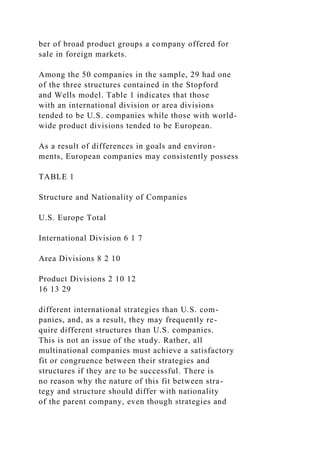
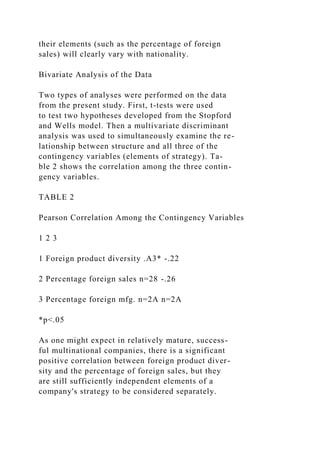
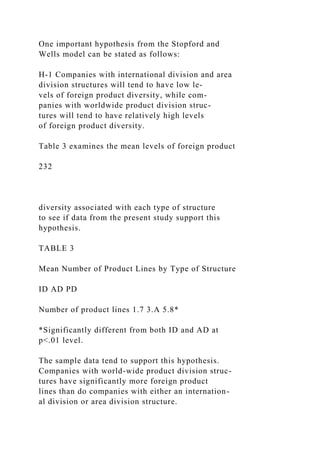
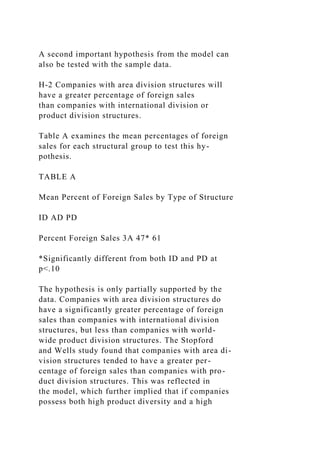
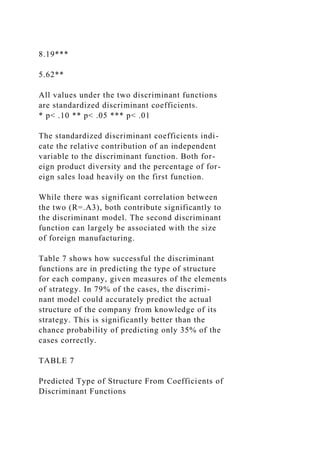
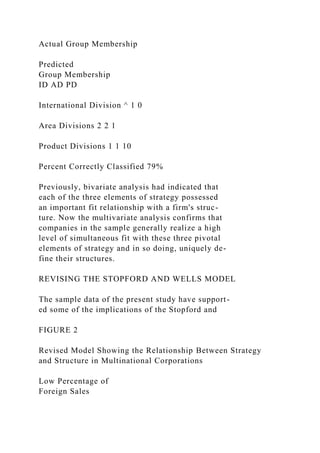
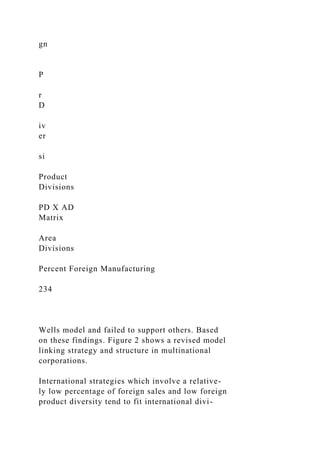
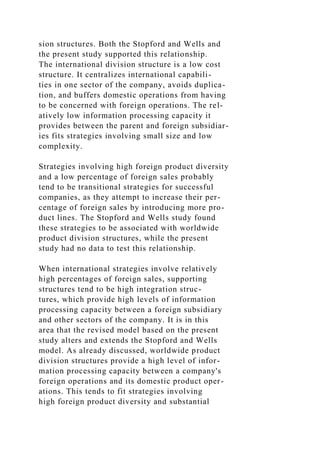
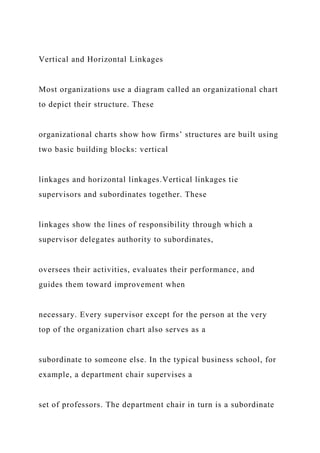
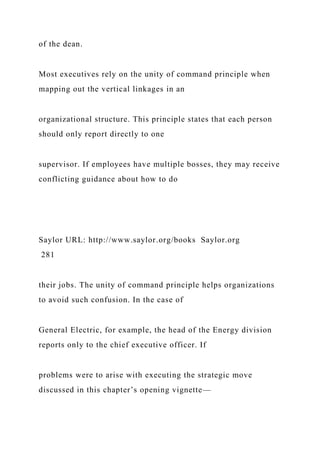
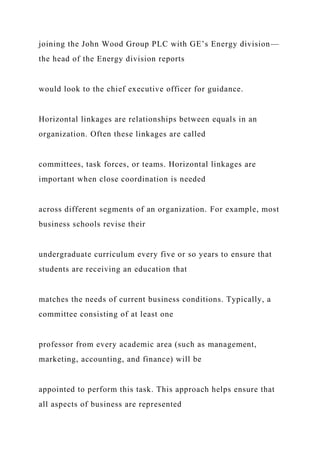
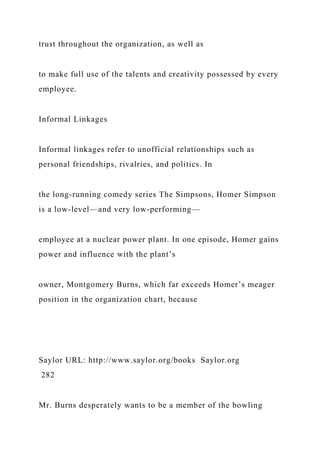
2/9/2018 Getting organizational redesign right | McKinsey &
Company
https://www.mckinsey.com/business-functions/organization/our-
insights/getting-organizational-redesign-right 1/12
Article
June 2015
McKinsey Quarterly
Getting organizational redesign right
By Steven Aronowitz, Aaron De Smet, and Deirdre McGinty
“I
Companies will better integrate their people, processes, and
structures by following nine golden rules.
f at first you don’t succeed, try, try, try again.” If W. E. Hickso
n, the British
author known for popularizing that familiar proverb in the mid-
19th century,
were alive today, he might easily be applying it (disparagingly)
to the efforts of modern
corporations to redesign their organizations.
Recent McKinsey research surveying a large set of global execu
tives suggests that many
companies, these days, are in a nearly permanent state of organi
zational flux. Almost 60
percent of the respondents, for example, told us they had experi
enced a redesign within
the past two years, and an additional 25 percent said they experi
enced a redesign three or
more years ago. A generation or two back, most executives mig
ht have experienced some
sort of organizational upheaval just a few times over the course
of their careers.
One plausible explanation for this new flurry of activity is the a
ccelerating pace of
strategic change driven by the disruption of industries. As a res
ult, every time a company
switches direction, it alters the organization to deliver the hope
d-for results. Rather than
McKinsey uses cookies to improve site functionality, provide
you with a better browsing experience, and to
enable our partners to advertise to you. Detailed information on
the use of cookies on this Site, and how you
can decline them, is provided in our cookie policy. By using
this Site or clicking on "OK", you consent to the
use of cookies.
OK
Organization
https://www.mckinsey.com/quarterly/overview
https://www.mckinsey.com/our-people/aaron-de-smet
https://www.mckinsey.com/cookie-policy
https://www.mckinsey.com/
https://www.mckinsey.com/business-functions/organization/our-
insights
2/9/2018 Getting organizational redesign right | McKinsey &
Company
https://www.mckinsey.com/business-functions/organization/our-
insights/getting-organizational-redesign-right 2/12
small, incremental tweaks of the kind that might have been appr
opriate in the past,
today’s organizations often need regular shake-
ups of the Big Bang variety.
Frustratingly, it also appears that the frequency of organizationa
l redesign reflects a high
level of disappointment with the outcome. According to McKins
ey’s research, less than a
quarter of organizational-redesign efforts succeed. Forty-
four percent run out of steam
after getting under way, while a third fail to meet objectives or i
mprove performance after
implementation.
The good news is that companies can do better—
much better. In this article, we’ll
describe what we learned when we compared successful and uns
uccessful organizational
redesigns and explain some rules of the road for executives seek
ing to improve the odds.
Success doesn’t just mean avoiding the expense, wasted time, a
nd morale-sapping
skepticism that invariably accompany botched attempts; in our e
xperience, a well-
executed redesign pays off quickly in the form of better-
motivated employees, greater
decisiveness, and a stronger bottom line.
Why redesign the organization?
Organizational redesign involves the integration of structure, pr
ocesses, and people to
support the implementation of strategy and therefore goes beyon
d the traditional
tinkering with “lines and boxes.” Today, it comprises the proces
ses that people follow, the
management of individual performance, the recruitment of talen
t, and the development
of employees’ skills. When the organizational redesign of a com
pany matches its strategic
intentions, everyone will be primed to execute and deliver them.
The company’s
structure, processes, and people will all support the most import
ant outcomes and
channel the organization’s efforts into achieving them.
When do executives know that an organization isn’t working we
ll and that they need to
consider a redesign? Sometimes the answer is obvious: say, afte
r the announcement of a
big new regional-
growth initiative or following a merger. Other signs may be less
visible—
for example, a sense that ideas agreed upon at or near the top of
the organization aren’t
being translated quickly into actions or that executives spend to
o much time in meetings.
These signs suggest that employees might be unclear about their
day-to-day work
2/9/2018 Getting organizational redesign right | McKinsey &
Company
https://www.mckinsey.com/business-functions/organization/our-
insights/getting-organizational-redesign-right 3/12
priorities or that decisions are not being implemented. A succes
sful organizational
redesign should better focus the resources of a company on its s
trategic priorities and
other growth areas, reduce costs, and improve decision making
and accountability.
The case of a consumer-packaged-
goods (CPG) company that chose to expand outside its
US home base illustrates one typical motivation for a redesign.
Under the group’s
previous organizational structure, the ostensibly global brand te
am responsible for
marketing was not only located in the United States but had also
been rewarded largely
on the performance of US operations; it had no systems for mon
itoring the performance
of products elsewhere. To support a new global strategy and to
develop truly
international brands and products, the company separated US m
arketing from its global
counterpart and put in place a new structure (including changes
to the top team), new
processes, new systems, and a new approach to performance ma
nagement. This intensive
redesign helped promote international growth, especially in key
emerging markets such
as Russia (where sales tripled) and China (where they have near
ly doubled).
Avoiding the pitfalls
That CPG company got it right—
but many others don’t, and the consequences can be
profoundly damaging. Leaders who fail to deliver the benefits t
hey promise not only
waste precious time but also encourage employees to dismiss or
even undermine the
redesign effort, because those employees sense that it will run o
ut of steam and be
replaced by a new one, with different aims, two to three years d
own the line.
We believe that companies can learn from the way successful re
designers overcome
challenges. By combining the results of our research and the ins
ights we’ve gained from
working with multiple companies on these issues, we’ve identifi
ed nine golden rules.
They cover everything from early alignment, redesign choices, a
nd reporting structures
to performance metrics, the nature of effective leadership, and t
he management of risks.
Individually, each of the rules is helpful. Our research shows, th
ough, that 73 percent of
the executives whose companies followed more than six of them
felt that the
organizational redesign had succeeded. Executives at these com
panies were six times
more likely to “declare victory” than those at companies that ad
opted just one or two.
2/9/2018 Getting organizational redesign right | McKinsey &
Company
https://www.mckinsey.com/business-functions/organization/our-
insights/getting-organizational-redesign-right 4/12
Following all nine rules in a structured approach yielded an eve
n higher success rate: 86
percent (exhibit).
2/9/2018 Getting organizational redesign right | McKinsey &
Company
https://www.mckinsey.com/business-functions/organization/our-
insights/getting-organizational-redesign-right 5/12
Exhibit
2/9/2018 Getting organizational redesign right | McKinsey &
Company
https://www.mckinsey.com/business-functions/organization/our-
insights/getting-organizational-redesign-right 6/12
The rules, it’s important to make clear, are not self-
evident. We tested more than 20
common approaches and found that upward of half of them were
n’t correlated with
success. We expected, for example, that benchmarking other co
mpanies and trying to
adopt some of their structural choices might be an important ing
redient of successful
redesigns—
but there is no evidence from the research that it is. Our rules, i
ncidentally,
are broadly relevant for different industries, regions, and compa
ny sizes. They also hold
true for redesigns prompted by different types of organizational
change, including end-
to-
end restructurings, postmerger integration, or more focused effo
rts (such as cost
cutting or improvements in governance).
1. Focus first on the longer-term strategic aspirations
Leaders often spend too much time on the current deficiencies o
f an organization. It’s
easy, of course, to get fixated on what’s wrong today and to be s
wayed by the vocal (and
seemingly urgent) complaints of frustrated teams and their leade
rs. However, redesigns
that merely address the immediate pain points often end up crea
ting a new set of
problems. Companies should therefore be clear, at the outset, ab
out what the redesign is
intended to achieve and ensure that this aspiration is inextricabl
y linked to strategy. One
retail company we know, strongly committed to creating a simpl
e customer experience,
stated that its chosen redesign option should provide “market se
gment–focused
managerial roles with clear accountability” for driving growth.
The specificity of that
strategic test proved much more helpful than simply declaring a
wish to “become
customer-centric.”
2. Take time to survey the scene
Sixty percent of the executives in our survey told us they didn’t
spend sufficient time
assessing the state of the organization ahead of the redesign. Ma
nagers can too easily
assume that the current state of affairs is clear and that they kno
w how all employees fit
into the organizational chart. The truth is that the data managers
use are often inaccurate
or out of date. A high-
profile international bank, for example, publicly announced it w
as
aiming to eliminate thousands of staff positions through an exte
nsive organizational
redesign. However, after starting the process, it discovered to it
s embarrassment that its
earlier information was inaccurate. Tens of thousands of positio
ns, already referenced in
2/9/2018 Getting organizational redesign right | McKinsey &
Company
https://www.mckinsey.com/business-functions/organization/our-
insights/getting-organizational-redesign-right 7/12
the press release, had been inaccurately catalogued, and in many
cases employees had
already left. This new organizational reality radically changed t
he scope and numbers
targeted in the redesign effort.
Knowing the numbers is just part of the story. Leaders must als
o take time to understand
where the lines and boxes are currently drawn, as well as the pr
ecise nature of talent and
other processes. That helps unearth the root causes of current pa
in points, thereby
mitigating the risk of having to revisit them through a second re
design a couple of years
down the road. By comparing this baseline, or starting point, wi
th the company’s strategic
aspirations, executives will quickly develop a nuanced understa
nding of the current
organization’s weaknesses and of the strengths they should buil
d on.
3. Be structured about selecting the right blueprint
Many companies base their preference for a new structure on un
tested hypotheses or
intuitions. Intuitive decision making can be fine in some situati
ons but involves little
pattern recognition, and there is too much at stake to rely on int
uition in organizational
redesign. Almost four out of five survey respondents who owne
d up to basing decisions on
“gut feel” acknowledged that their chosen blueprint was unsucc
essful. In our experience,
companies make better choices when they carefully weigh the re
design criteria, challenge
biases, and minimize the influence of political agendas.
Interestingly, Fortune magazine found that its Most Admired Co
mpanies had little in
common when it came to aspects of their organizational design,
beyond a flexible
operating model.
This finding is consistent with our experience that off-the-shelf
solutions aren’t likely to work. The unique mix of strategy, peo
ple, and other assets within
a company generally requires an individual answer to things lik
e role definition, decision-
making governance, and incentives, albeit one based on a prima
ry dimension of function,
geography, or customer segment. The key is to get the right set
of leaders reviewing
options with an open mind in the light of redesign criteria establ
ished by the strategic
aspiration.
Take a large public pension system we know. Its leaders convin
ced themselves that a new
organization must be set up along product lines. Challenged to r
econsider their approach,
they ultimately arrived at a functional model—
built around health, pensions, and
1
2/9/2018 Getting organizational redesign right | McKinsey &
Company
https://www.mckinsey.com/business-functions/organization/our-
insights/getting-organizational-redesign-right 8/12
investment—
that has served the system well over the past five years and und
erpinned
significant cost savings and the launch of innovative new produ
cts.
4. Go beyond lines and boxes
A company’s reporting structure is one of the most obvious and
controllable aspects of its
organization. Many leaders tend to ignore the other structure, pr
ocess, and people
elements that are part of a complete redesign, thereby rearrangi
ng the deck chairs but
failing to see that the good ship Titanic may still be sinking.
Companies such as Apple and Pixar are well known for going fa
r beyond lines and boxes,
taking into account questions such as where employees gather in
communal spaces and
how the organizational context shapes behavior. One small but f
ast-growing enterprise-
software player we know made some minor changes to senior ro
les and reporting as part
of a recent organizational redesign. But the biggest impact came
from changing the
performance-
management system so that the CEO could see which parts of th
e company
were embracing change and which were doing business as usual.
Surveyed companies that used a more complete set of levers to
design their organizations
were three times more likely to be successful in their efforts tha
n those that only used a
few. The strongest correlation was between successful redesigne
rs and companies that
targeted at least two structural-, two process-, and two people-
related redesign elements.
5. Be rigorous about drafting in talent
One of the most common—and commonly ignored—
rules of organizational redesign is to
focus on roles first, then on people. This is easier said than don
e. The temptation is to
work the other way around, selecting the seemingly obvious can
didates for key positions
before those positions are fully defined.
Competition for talent ratchets up anxiety and risk, creating a d
omino effect, with groups
poaching from one another to fill newly created gaps. This is di
sruptive and distracting. A
talent draft that gives all units access to the same people enable
s companies to fill each
level of the new organizational structure in an orderly and trans
parent way, so that the
most capable talent ends up in the most pivotal roles. This appr
oach promotes both the
perception and the reality of fairness.
2/9/2018 Getting organizational redesign right | McKinsey &
Company
https://www.mckinsey.com/business-functions/organization/our-
insights/getting-organizational-redesign-right 9/12
Powerful technology-
enabled solutions allow companies to engage hundreds of
employees in the redesign effort in real time, while identifying t
he cost and other
implications of possible changes. One web-
based tool we’ve seen in action—full
disclosure: it’s a McKinsey application called OrgLab—
helps leaders to create and
populate new organizational structures while tracking the result
s by cost, spans, and
layers. Such tools expand the number of people involved in plac
ing talent, accelerate the
pace, and increase the level of rigor and discipline.
6. Identify the necessary mind-set shifts—and change those
mind-sets
Leaders of organizational-
redesign efforts too often see themselves as engineers and see
people as cogs to be moved around the organizational machine.
Organizations, however,
are collections of human beings, with beliefs, emotions, hopes,
and fears. Ignoring
predictable, and sometimes irrational, reactions is certain to und
ermine an initiative in
the long run. The first step is to identify negative mind-
sets and seek to change the way
people think about how the organization works. Actions at this s
tage will likely include
communicating a compelling reason for change, role modeling t
he new mind-sets,
putting in place mechanisms that reinforce the case for change a
nd maintain
momentum, and building new employee skills and capabilities.
One company in the payments industry—
beset by changing consumer habits, technology-
led business models, and regulatory pressure—
understood the importance of shifting
mind-
sets as part of its recent redesign. The group’s sales team traditi
onally worked well
with large retailers and banks. But looking ahead, the company
knew it would be
important to establish a new set of relationships with high-
tech hardware and software
players. Simply appointing a new boss, changing role descriptio
ns, and drawing up a
revised process map wasn’t enough. The company therefore emb
arked on a program that
consciously sought to shift the thinking of its sales experts from
“we create value for our
customers” to “we create value with our partners.”
7. Establish metrics that measure short- and long-term success
2/9/2018 Getting organizational redesign right | McKinsey &
Company
https://www.mckinsey.com/business-functions/organization/our-
insights/getting-organizational-redesign-right 10/12
Nobody would drive a car without a functioning speedometer, y
et a surprising number of
companies roll out an organizational redesign without any new (
or at least specially
tailored) performance metrics. Some older ones might be releva
nt, but usually not the
whole set. New metrics, typically focusing on how a changed or
ganization is contributing
to performance over the short and long term, are best framed at
the aspiration-setting
stage. Simple, clear key performance indicators (KPIs) are the
way forward.
During the redesign effort of one high-
tech manufacturer, it set up a war room where it
displayed leading indicators such as orders received, orders ship
ped, supply-chain
performance, and customer complaints. This approach helped th
e company both to
measure the short-
term impact of the changes and to spot early warning signs of
disruption.
One utility business decided that the key metric for its efficienc
y-driven redesign was the
cost of management labor as a proportion of total expenditures
on labor. Early on, the
company realized that the root cause of its slow decision-
making culture and high cost
structure had been the combination of excessive management la
yers and small spans of
control. Reviewing the measurement across business units and a
t the enterprise level
became a key agenda item at monthly leadership meetings.
A leading materials manufacturer introduced a new design built
around functional
groups, such as R&D, manufacturing, and sales, but was rightly
anxious to retain a strong
focus on products and product P&Ls. To track performance and
avoid siloed thinking, the
company’s KPIs focused on pricing, incremental innovation, an
d resource allocation.
8. Make sure business leaders communicate
Any organizational redesign will have a deep and personal impa
ct on employees—it’s
likely, after all, to change whom they report to, whom they wor
k with, how work gets
done, and even where they work. Impersonal, mass communicati
on about these issues
from the corporate center or a program-
management office will be far less reassuring
than direct and personal messages from the leaders of the busine
ss, cascaded through the
organization. An interactive cascade (one that allows two-
way communication) gives
people an opportunity to ask questions and forces top leaders to
explain the rationale for
change and to spell out the impact of the new design in their ow
n words, highlighting the
things that really matter. This can take time and requires planni
ng at an early stage, as
2/9/2018 Getting organizational redesign right | McKinsey &
Company
https://www.mckinsey.com/business-functions/organization/our-
insights/getting-organizational-redesign-right 11/12
well as effort and preparation to make the messages compelling
and convincing. When a
top team has been talking about a change for weeks or months, i
t’s all too easy to forget
that lower-ranking employees remain in the dark.
One financial-services company encouraged employee buy-
in for an organizational
redesign by staging a town-
hall meeting that was broadcast in real time to all regional
offices and featured all its new leaders on a single stage. The vi
rtual gathering gave them
an opportunity to demonstrate the extent of their commitment an
d allowed the CEO to
tell her personal story. She shared the moment when she realize
d that the organization
needed a new design and the changes she herself was making to
ensure that it was
successful. All employees affected by the changes could simulta
neously talk to their
former managers, their new managers, and the relevant HR repr
esentatives.
9. Manage the transitional risks
In the rush to implement a new organizational design, many lea
ders fall into the trap of
going live without a plan to manage the risks. Every organizatio
nal redesign carries risks
such as interruptions to business continuity, employee defection
s, a lack of personal
engagement, and poor implementation. Companies can mitigate
the damage by
identifying important risks early on and monitoring them well af
ter the redesign goes
live. The CPG company mentioned earlier, for example, realized
that rolling out its
reorganization of sales and marketing ahead of the holiday seas
on might unsettle some of
those involved. By waiting, it made the transition with no impac
t on revenues.
Tracking operational, financial, and commercial metrics during
a design transition is
helpful, as are “pulse checks” on employee reactions in critical
parts of the company.
Clear leadership account-
ability for developing and executing risk-mitigation plans is so
important that this should be built into regular appraisals of ma
nagers.
In our experience the most successful organizations combine sta
ble design elements with
dynamic elements that change in response to evolving markets a
nd new strategic
directions. Corporate redesigns give organizations a rare opport
unity to identify the
stable backbone and set up those elements ripe for dynamic cha
nge. Successful leaders
2/9/2018 Getting organizational redesign right | McKinsey &
Company
https://www.mckinsey.com/business-functions/organization/our-
insights/getting-organizational-redesign-right 12/12
and successful companies take advantage of such changes to “re
build the future”—but a
landscape littered with failed efforts is a sobering reminder of w
hat’s at stake. Following
the nine simple rules described in this article will increase the o
dds of a happy outcome.
1. Mina Kimes, “What admired firms don’t have in common,”
Fortune, March 6, 2009,
archive.fortune.com.
About the author(s)
Steven Aronowitz is an associate principal in McKinsey’s San F
rancisco office, Aaron De
Smet is a principal in the Houston office, and Deirdre McGinty
is an associate principal
in the Philadelphia office.
The authors wish to thank McKinsey’s Wouter Aghina, Lili Dua
n, Monica Murarka, and
Kirsten Weerda for their contributions to this article.
2/9/2018 Leadership as the starting point of strategy | McKinsey
& Company
https://www.mckinsey.com/global-
themes/leadership/leadership-as-the-starting-point-of-strategy
1/8
Article
February 2005
McKinsey Quarterly
Leadership as the starting point of
strategy
By Tsun-Yan Hsieh and Sara Yik
W
Even the best strategy can fail if a corporation doesn’t have a ca
dre of
leaders with the right capabilities at the right levels of the
organization.
hen it comes time to implement a strategy, many companies find
themselves
stymied at the point of execution. Having identified the opportu
nities within
their reach, they watch as the results fall short of their aspiratio
ns. Too few companies
recognize the reason.
Mismatched capabilities, poor asset configurations, and inadequ
ate executioncan all play
their part in undermining a company's strategic objectives. Alth
ough well-regarded
corporations tend to keep these pitfalls squarely in their sights,
in our experience far
fewer companies recognize the leadership capacity that new stra
tegies will require, let
alone treat leadership as the starting point of strategy. This over
sight condemns many
such endeavors to disappointment.
McKinsey uses cookies to improve site functionality, provide
you with a better browsing experience, and to
enable our partners to advertise to you. Detailed information on
the use of cookies on this Site, and how you
can decline them, is provided in our cookie policy. By using
this Site or clicking on "OK", you consent to the
use of cookies.
OK
https://www.mckinsey.com/quarterly/overview
https://www.mckinsey.com/cookie-policy
https://www.mckinsey.com/
2/9/2018 Leadership as the starting point of strategy | McKinsey
& Company
https://www.mckinsey.com/global-
themes/leadership/leadership-as-the-starting-point-of-strategy
2/8
What do we mean by "leadership"? Whereas good managers deli
ver predictable results as
promised, as well as occasional incremental improvements, lead
ers generate
breakthroughs in performance. They create something that wasn'
t there before by
launching a new product, by entering a new market,or by more q
uickly attaining better
operational performance at lower cost, for example. A company'
s leadership reaches well
beyond a few good men and women at the top. It typically inclu
des the 3 to 5 percent of
employees throughout the organization who can deliver breakthr
oughs in performance.
Since bold strategies often require breakthroughs along a numbe
r of fronts,a company
needs stronger and more dominant leadership at all levels if thes
e strategies are to
succeed. A defining M&A transaction, for example, requires lea
dership throughout an
organization's business units and functions in order to piece tog
ether best practices and
wring out synergies while striving to carry on business as usual.
In addition, leaders
throughout both companies must transcend the technical tasks of
the merger to rally the
spirits of employees and to communicate a higher purpose.
As the number of strategic dimensions and corresponding initiat
ives increases, so does
the pressure on leadership. Not surprisingly, our work in many i
ndustries with
companies of all sizes has shown that high-
performers, especially those with lofty
aspirations, have the most difficulty meeting their leadership ne
eds. Of course,
companies that perform poorly are also lacking in leadership ca
pacity. The higher a
company's aspirations or the more radical its shift in strategic di
rection, the larger the
leadership gap. This rule holds true for high performers and lag
gards alike.
The consequences of inattention
Most CEOs will agree that leadership is important, yet few asse
ss their leadership gap
precisely. Fewer still build an engine to develop the right quanti
ty of leaders with the
right mix of capabilities, at the right time, to match opportunitie
s.
If the number of leaders needed to achieve a strategic goal—
for example, expanding
current operations or developing new businesses—
were set against the number of
existing leaders, a company could uncover the numeric leadersh
ip gap it must address.
Even if an organization has enough leaders, it may discover a sh
ortfall in their
capabilities. A company expanding internationally, for example,
could find that its
2/9/2018 Leadership as the starting point of strategy | McKinsey
& Company
https://www.mckinsey.com/global-
themes/leadership/leadership-as-the-starting-point-of-strategy
3/8
current leaders lacked the cultural sensitivity to operate in unfa
miliar geographies. Or a
corporation entering new markets could find it had too many en
gineers and not enough
business builders.
The failure to assess leadership capacity systematically before l
aunching strategic
initiatives can leave top executives scrambling to fill gaps at the
last minute—with
significant consequences.
In the short term, companies that undertake new strategies with
out the right leaders in
place are forced to burden their existing ones with additional re
sponsibilities. As such
leaders take on the new challenges, the demands from day-to-
day operations invariably
increase, leaving less time for other tasks. Often these leaders d
rop the activities with less
tangible outcomes, such as staff development, for which the effe
cts are not immediately
evident. If a company stretches its existing leaders too far, their
overall effectiveness
takes a nosedive. From the start, this trade-
off compromises strategic objectives.
Companies executing strategies under these circumstances assu
me either that they can
get by with suboptimal leadership or that achieving just part of t
heir initial objectives will
capture a corresponding percentage of the strategy's net present
value. We know from
experience that these assumptions can be fatally wrong: one crit
ical misstep can
jeopardize the entire investment.
In the longer term, a persistent leadership gap will be responsibl
e for an inexorable
decline in the number and quality of leaders. Companies create
a vicious cycle in which
good leaders become overextended or are moved haphazardly an
d thus have less time to
develop younger talent. The day will come when they hand over
the reins to a less
experienced, ill-
prepared group of successors. Left unchecked, this cycle can ult
imately
put the company's core operations and strategic growth at risk.
Leadership first
Given the severe consequences of a leadership gap—the best-
planned strategy is no more
than wishful thinking if it can't be translated from concept to re
ality—why do so many
companies discover their leadership shortfall only when executi
ng their strategies? This
2/9/2018 Leadership as the starting point of strategy | McKinsey
& Company
https://www.mckinsey.com/global-
themes/leadership/leadership-as-the-starting-point-of-strategy
4/8
question raises another, more fundamental one regarding strateg
y and leadership: which
is the chicken and which is the egg? Companies have taken a nu
mber of useful
approaches to this puzzle.
One successful US conglomerate with global operations routinel
y holds discussions that
integrate both strategy and leadership. Any consideration of a st
rategic initiative
invariably includes the question, "Who exactly will get this don
e?" If the company does
not have a sufficient number of the right leaders, the plan does
not proceed.
Another approach is to weigh a corporation's strategic options a
gainst its ability to launch
new businesses, new approaches, and other forms of breakthrou
gh performance—in
other words, its leadership. Consider, for example, the global-
expansion strategy for a
successful resource company. The effort included identifying th
e leadership required to
drive breakthrough performance over five years in areas such as
running and expanding
existing businesses, developing new ones, renovating corporate
processes such as risk
management, and providing overall change leadership. The com
pany then gauged its
leadership gap by comparing these requirements with the qualiti
es of its current
leadership bench. It made a number of strategic decisions to det
ermine, among other
things, which path was best for realizing the strategy, whether t
o revise its aspirations,
and whether to develop leaders internally or hire them from outs
ide.
A third approach is to plan the path toward a predetermined stra
tegic goal by taking into
account the quantity, timing, and mix of leaders that the various
alternatives require.
Companies using this framework may rule out some possibilities
if developing the
requisite depth of leadership is unrealistic in the time frame dict
ated by the marketplace.
A leading food company in Asia, for example, aspired to becom
e the dominant regional
player. With five strong national brands, it had at least three cle
ar options for how to
achieve that goal: take a cautious approach by launching one br
and as a pilot in each
overseas market before introducing other brands; focus on Chin
a by building a
beachhead with one brand in a single city, then sequentially roll
ing that brand out region
by region within China; or, finally, acquire a player in one regio
nal Chinese market, thus
gaining outlets and local expertise, and use this opening to roll
out all five brands to more
markets in China over time.
2/9/2018 Leadership as the starting point of strategy | McKinsey
& Company
https://www.mckinsey.com/global-
themes/leadership/leadership-as-the-starting-point-of-strategy
5/8
While many factors, including the company's appetite for risk,
weigh on these decisions,
in this case each option had distinct leadership requirements. Th
e first, for example,
would initially require at least five to ten well-
rounded leaders—entrepreneurs capable of
establishing local networks, operating under unfamiliar conditio
ns, and managing all five
brands. The second option called for a business builder who was
deeply familiar with the
beachhead city to direct a team of four to six emerging leaders
who could spearhead the
subsequent expansion. A business-
development leader would also be helpful in seeking
an alliance partner to speed up the company's pace and bolster it
s confidence during the
regional expansion. The third possibility, by contrast, would im
mediately require an
expert to structure, valuate, and negotiate deals and, in the medi
um term, a few
executives capable of operating in each of the regional Chinese
markets. After the
company critically reviewed its current and potential leaders, it
made the decision to
adopt the third of those options.
These three cases illustrate how thinking about leadership up fr
ont can affect a strategy's
direction, path, and outcome. But can a company bring leadershi
p considerations into its
strategic discussions even earlier, before it chooses a general di
rection? To do so, the
company must think rigorously about its current leadership pool
—the types of leaders
and their mix of capabilities—
and lay out the strategy accordingly. If a manufacturer's
strong suit is leaders with superb marketing capabilities, for exa
mple, a market-driven
strategy would be implied and might include selling another ma
nufacturer's products.
Taken to this level, leadership becomes the true starting point f
or strategy.
Filling the gap
A clear picture of the leadership gap can help guide strategic thi
nking, but to retain as
many options as possible, companies must also consider ways to
fill that gap. To reduce
the risk of strategic failure, they need to direct their approach to
leadership with three
time horizons in mind.
Long term: Position
2/9/2018 Leadership as the starting point of strategy | McKinsey
& Company
https://www.mckinsey.com/global-
themes/leadership/leadership-as-the-starting-point-of-strategy
6/8
Companies need to position themselves today to meet their strat
egic objectives during
the next three to five years. In an 18-
month period, for example, a South Korean
consumer goods company successfully expanded its core busine
ss into Japan, where it
diversified into noncore sectors such as low-
cost lodging. It achieved such deep
penetration of this notoriously closed and mature market so quic
kly by building its
leadership bench in advance. At least five years before the initia
tive's launch, the
company began hiring managers and sending them to Japan—
through exchanges with
friendly Japanese partners—
thereby creating a cadre of South Korean leaders trained to
operate in Japan.
In many of Asia's key growth markets, local leaders with a glob
al perspective are highly
sought after and often unavailable at almost any price. Returnin
g nationals, typically
trained in Europe or the United States, may be another option, b
ut many companies have
found these prospects to be expensive and lacking in the tacit kn
owledge needed to
operate successfully in the cultures of many corporations—
and the industries they
compete in. A company must hire and groom potential leaders a
s much as a decade or
more ahead of market need and then help them build the internal
networks necessary for
long-term success.
To cite another example, for decades a US financial-
services giant systematically hired
the best global talent, regardless of the market, and rotated thes
e leaders through every
critical aspect of its operations. This investment in human asset
s paid off handsomely. In
most of the new economies the company enters, it enjoys an alm
ost unparalleled ability
to field full-
service teams with strong leaders in the vanguard. Competitors,
by contrast,
are forced to expand more selectively or to offer expensive pack
ages to lure top talent.
Medium term: Cultivate
Companies must also begin cultivating leaders for specific roles
one to two years down
the road. This effort requires recognizing the skills, behavior, a
nd mind-set that leaders
must possess to be prepared for future roles. Many executives s
pend years building their
technical skills and industry knowledge but rarely develop expe
rtise in areas such as
managing stakeholders and building networks. In a prominent re
sources company, for
example, top executives identified potential successors for key l
eadership positions. It
highlighted the measures needed to bring each one up to speed,
including counseling,
2/9/2018 Leadership as the starting point of strategy | McKinsey
& Company
https://www.mckinsey.com/global-
themes/leadership/leadership-as-the-starting-point-of-strategy
7/8
training, and new assignments, by considering individual profile
s (strengths and
weaknesses, past experience, and skills) as well as the key succ
ess factors for upcoming
leadership positions (industry or functional expertise, personal
or change-management
skills, and local knowledge).
Another company informed appointees of their next assignment
six months ahead of
time and then enrolled them in self-
directed preparatory programs. All of the leaders
wrote a personal-
development contract related to the challenges of the new role a
nd
created a list of learning opportunities and developmental activi
ties that would prepare
them for their new responsibilities. These tasks could include, f
or instance, seeking
advice from veterans or drawing up a plan for the first 100 days
in the new role. The
company also provided four categories of learning modules: "le
ad self," for self-
awareness, skill mastery, and developmental planning; "lead oth
ers," for getting the best
performance from colleagues in specific settings; "lead context,
" for understanding and
identifying trends in the competitive environment; and "lead cha
nge," for aligning key
stakeholders, steering the organization to breakthroughs, and ch
allenging conventional
approaches and thinking.
Short term: Match
Job experiences and stretch assignments are the primary develop
ment vehicles for
leaders. Opportunities to achieve performance breakthroughs ar
e critical not just for
reaching a company's performance goals but also for developing
its best people.
Unfortunately, corporations that are particularly risk-
averse often match their people to
opportunities by looking at track records and job experiences, w
hich they see as
indicators of future performance. But such an approach is unlike
ly to succeed, since the
experience and skills needed for earlier successes are not necess
arily precursors for those
required to achieve performance breakthroughs in subsequent op
portunities.
A better approach is to use corporate-
performance objectives and personal-development
goals to match current and potential leaders with opportunities.
This multifaceted
approach uncovers a better fit between the individual and the op
portunity. For this
process to be successful, top managers need to acquire a holistic
understanding of each
individual, including professional abilities, such as leadership q
ualities, track record, and
potential, as well as key personal traits, such as style and prefer
ences, character and
2/9/2018 Leadership as the starting point of strategy | McKinsey
& Company
https://www.mckinsey.com/global-
themes/leadership/leadership-as-the-starting-point-of-strategy
8/8
motivation, and current attitudes and mind-
set. Companies can assess these qualities
through information—objective and subjective—
from superiors, peers, mentors, and
other sources.
To help leaders develop throughout any of these three time hori
zons, a company must
first accurately identify who its leaders are and then convince th
em of an opportunity's
potential. Companies often underestimate this challenge. Top m
anagers typically assume
they know which of their best people are willing and able to tak
e on new challenges, but
the reality is often very different. At one multinational corporati
on with an ambitious
growth agenda, the CEO asked the 20 members of his manageme
nt committee for written
nominations to fill leadership positions for 30 initiatives. Most
committee members
couldn't confidently name more than five to ten candidates, and
large overlaps existed
among the members' lists. Each had nominated the "usual suspe
cts"—managers who
were well known in the executive suites. If the company pursue
d all 30 initiatives
simultaneously, it would overload these candidates while denyin
g other potential leaders
the chance to develop and shine. Corporations must instead look
out along the three time
horizons we have described to build a more systematic leadershi
p engine.
Strategy will not succeed in a void, and leadership often makes
the difference between
merely reaching for great opportunities and actually realizing th
eir potential. Top
managers must assess their company's leadership gap and find w
ays to close it over the
short, medium, and long term. Better still, they should integrate
leadership with strategy
development and thoughtfully match their portfolio of leaders w
ith opportunities.
About the author(s)
Tsun-
yan Hsieh is a director and Sara Yik is a consultant in McKinse
y's Singapore office.
2/9/2018 It's Not The CEO, It's The Leadership Strategy That
Matters.
https://www.forbes.com/sites/joshbersin/2012/07/30/its-not-the-
ceo-its-the-leadership-strategy-that-matters/#45179d6d6db8 1/3
JUL 30, 2012 @ 05:14 PM
/
It's Not The CEO, It's The Leadership Strategy
That Matters.
Josh Bersin , CONTRIBUTOR
I analyze corporate HR, talent management and leadership.
Opinions expressed by Forbes Contributors are their own.
Let's face it. CEOs come and go. But leadership, if developed
in a comprehensive
way, endures.
In the last few years we've seen new CEO's at Yahoo, HP,
Apple, and other
prominent companies, and in each case we watch to see if the
CEO can "pull it off."
Well, while the CEO is a very important person, our research
shows that enduring
business performance is really driven at much deeper levels: a
focus on leadership
strategy. Long term business performance comes from
leadership culture and
careful and continuous development of leadership at all levels.
It's not all about the
CEO.
In this research we looked at hundreds of companies over the
last few years and
correlated their business performance to a variety of different
people and talent
practices.
After looking at many talent management practices (including
the purchase of
expensive software), we found that a company's level of
maturity in their leadership
development has a greater impact on their long term business
performance than
almost all else. And this impact transcends changes in the CEO.
Let me share some of these findings and best practices.
1. High-Performing organizations directly link leadership strate
gy to
business strategy.
https://www.forbes.com/leadership
https://www.forbes.com/
https://www.forbes.com/sites/joshbersin/
http://www.forbes.com/companies/yahoo/
http://www.forbes.com/companies/apple/
https://www.forbes.com/sites/joshbersin/
2/9/2018 It's Not The CEO, It's The Leadership Strategy That
Matters.
https://www.forbes.com/sites/joshbersin/2012/07/30/its-not-the-
ceo-its-the-leadership-strategy-that-matters/#45179d6d6db8 2/3
Regardless of who the CEO may be, operational execution takes
place at the mid-
level and supervisory level. When these individuals are well
aligned, coached, and
trained, the business thrives.
High-performing companies understand this, and they build a
leadership
development program which uniquely trains, supports, and
selects people who drive
their business's strategy. By doing this, they build execution
into the culture.
Fig 1: Leadership Linkage Model
A great example of this is UPS. UPS is a company which has
outperformed other
express companies for many years and it continues to transform
itself from its origin
as a horse and buggy delivery company. The company promotes
from within and
continues to promote a leadership culture of customer service,
safety, and
entrepreneurship. If the CEO were replaced, he or she would
come into a company
with a deep rooted leadership culture.
At times this culture needs to change. During my years at IBM
the company went
through a wrenching transformation as Lou Gerstner came in
and changed the
company from a "seller of solid technology" to a "deliverer of
high value services."
This meant bringing in many new leaders, building a consulting
mindset, and
driving a different type of innovation and creativity into the
management team.
(Xerox is going through this process today.)
http://blogs-images.forbes.com/joshbersin/files/2012/08/ld-
550w2.jpg
http://www.forbes.com/leadership/
http://www.forbes.com/companies/ibm/
http://www.forbes.com/companies/xerox/
2/9/2018 It's Not The CEO, It's The Leadership Strategy That
Matters.
https://www.forbes.com/sites/joshbersin/2012/07/30/its-not-the-
ceo-its-the-leadership-strategy-that-matters/#45179d6d6db8 3/3
While I'm sure Sam Palmisano had much to do with driving this
forward, now the
company has deep roots of leadership from which to grow this
base. And Ginny
Rometti can build and evolve this leadership into the future.
2. High-Performers develop leaders at all levels.
High performing companies understand that execution takes
place at the grass roots
level. It is the line managers, supervisors, and middle managers
who make things
happen. If the CEO doesn't push his or her leadership strategy
down effectively, it
wont take hold. In fact our research shows that the best
companies develop leaders
from the bottom up. Senior executives "serve" the needs of line
leaders, like an
inverse pyramid.
Recommended by Forbes
The "inverse pyramid" of leadership is one now widely used by
many agile
organizations. In our company we have a philosophy that
"everyone is a leader"
and each individual is given the responsibility to understand the
business and
make decisions which support the mission of the entire
organization. Accenture
calls this "stewardship" and they reinforce to managers that they
must "leave
work each day making Accenture a better organization."
“
2/9/2018 Business Need Different Strategic Approaches In
Different Circumstances
http://knowledge.wharton.upenn.edu/article/does-your-strategy-
need-a-strategy-part-i/ 1/7
Collaborations, St
BCG
Does Your Strategy Need a Strategy? Part I
DOWNLOADABLE PDF
Does Your Strategy Need a Strategy? Part I
Does Your Strategy Need a Strategy Part 1
http://knowledge.wharton.upenn.edu/category/partner-
collaborations/
http://knowledge.wharton.upenn.edu/category/strategic-
management/
http://knowledge.wharton.upenn.edu/category/video/
http://knowledge.wharton.upenn.edu/region/global-focus/
http://www.wharton.upenn.edu/
http://knowledge.wharton.upenn.edu/sponsor/bcg/
https://www.youtube.com/watch?v=Wcm9fZOfZks
2/9/2018 Business Need Different Strategic Approaches In
Different Circumstances
http://knowledge.wharton.upenn.edu/article/does-your-strategy-
need-a-strategy-part-i/ 2/7
� Download the PDF
Business environments have become so diverse that companies
today need di�erent
approaches to strategy in di�erent circumstances, says Martin
Reeves, senior partner and
managing director of BCG’s Bruce Henderson Institute and
author of the recently released
book, Your Strategy Needs a Strategy. Large companies in
particular should deploy separate
strategies for di�erent parts of business, and when they do so,
research shows they perform
better. In Part I of this [email protected] interview, Reeves
looks at the most common
approaches to strategies and the biggest traps companies fall
into when trying to formulate and
implement them. Part II will cover connecting strategy to
execution, the kind of leadership
needed to implement di�erent approaches to strategy and how
large companies can deploy the
right strategic approaches.
An edited transcript of the conversation appears below.
What is Your Strategy Needs a Strategy based upon?
Your Strategy Needs a Strategy is based on 10 years of research
on strategy in the BCG Bruce
Henderson Institute. We did a detailed survey of 150
multinationals, on their perceptions of
their environments, their elected approaches to strategy and
their actual strategizing behaviors.
We also analyzed performance data for all U.S. public
companies since 1950. We did in-depth
case studies and interviews with CEOs, which you see featured
in the book. Finally, we validated
our conclusions by constructing what we call our “universal
strategy simulator,” which is a
http://d1c25a6gwz7q5e.cloudfront.net/reports/092215-Does-
Your-Strategy-Need-Strategy-Part1.pdf
http://www.amazon.com/Your-Strategy-Needs-Execute-
Approach/dp/1625275862
2/9/2018 Business Need Different Strategic Approaches In
Different Circumstances
http://knowledge.wharton.upenn.edu/article/does-your-strategy-
need-a-strategy-part-i/ 3/7
simulation of what strategies work in what environments. That’s
the evidence on which the
book is based on.
What are the headline conclusions?
I’d say there are three main headline conclusions from the book.
Firstly, business environments are now so diverse that we need
di�erent approaches to strategy
in di�erent circumstances. And more particularly, the classical
style of strategy – analyzing,
planning and executing – is still perfectly �ne for some
situations, but it’s no longer a panacea.
Secondly, especially large companies need to deploy multiple
approaches to strategy in
di�erent parts of their business. We call this ambidexterity.
Thirdly, we need to modify our concept of leadership. Leaders
need able to lead, direct and
design the mosaic of strategies that are required by large
companies.
All of these things result in a demonstrable performance bene�t
for corporations.
The classical style of strategy – analyzing,
planning and executing – is still perfectly �ne for
some situations, but it’s no longer a panacea.
What are the most common strategies?
The most well known approach to strategy and implementation
is what we call the classical
approach. This is the one that most of us probably learned about
in business school.
Its key components are analyzing and planning, implementing in
a disciplined manner and
�nally following the plan. This is an approach which works
well in predictable environments
that are not shapeable. In these industries, demand grows
roughly at GDP levels, and volatility
is relatively low.
The second approach to strategy is what we call the adaptive
approach. This approach works
really well in highly unpredictable industries that are also not
easily shapeable. A good example
could be the software industry, in particular, say, the gaming
industry. Here, the competitive
conditions are highly volatile and the technology is constantly
changing. As this environment
2/9/2018 Business Need Different Strategic Approaches In
Different Circumstances
http://knowledge.wharton.upenn.edu/article/does-your-strategy-
need-a-strategy-part-i/ 4/7
doesn’t allow us to plan, we use a more biological approach.
Essentially, we create variation, we
select what works, we implement that and scale it. Then, the
cycle begins again. One could say
that this adaptive strategy emerges continuously from
experiments.
The third approach to strategy is what we call the visionary
approach. Here, conditions — at
least in the eyes of the entrepreneur — are both predictable and
shapeable. So this is not about
participating in an industry, but creating an industry. The
approach here is to envision a
possibility that others have not seen, then to realize it and
�nally to scale it.
We’ve all known entrepreneurs that have followed the visionary
approach. In our book, we give
the example of 23andme, which is a new genomics testing
services company with a novel
business concept. Large corporations are increasingly
vulnerable to upstart challenger
companies. In order to defend themselves, large corporations
need to master the visionary
style, which was probably present at their inception decades
ago.
Large corporations are increasingly vulnerable to
upstart challenger companies. In order to defend
themselves, large corporations need to master
the visionary style, which was probably present
at their inception decades ago.
The fourth approach to strategy is probably the most exotic and
unfamiliar one. It is what we
call the “shaping approach.” Here, conditions are both
shapeable and unpredictable. That
sounds almost like a contradiction, but it isn’t: This
environment it not based on single
companies competing against each other, but a whole ecosystem
of companies that are
collaboratively reshaping an industry. Good examples of this
are two-sided market places like
Alibaba, or ecosystem-based companies like Red Hat or
Amazon.
These companies have not only deployed a strategy at the level
of an individual company, but
they’ve created a successful position within a successful
ecosystem. Here, the recipe for
thinking about strategy is very di�erent: to orchestrate the
contributions of others in the
ecosystem and then to co-evolve that collaborative system.
The �fth approach to strategy is what we call “renewal.” It
applies to situations where
companies have gotten out of step with their competitive
environment. As a result, their
competitive or �nancial performance is su�ering. Renewal is
usually a very big bet for
2/9/2018 Business Need Different Strategic Approaches In
Different Circumstances
http://knowledge.wharton.upenn.edu/article/does-your-strategy-
need-a-strategy-part-i/ 5/7
companies. Seventy-�ve percent of renewal projects fail. The
di�erence between failure and
success in NPV (net present value) terms is roughly the
enterprise value of the company.
One should think about a renewal strategy in three steps.
Firstly, it’s important to anticipate the
need for renewal early. The sooner you start the renewal
exercise, the more successful you’re
likely to be. Secondly, it’s important to think about
economizing. It’s necessary to free up
resources, but not only for the purposes of �nancial viability,
but also to fund the journey back
to growth. The third critical stage is growth and innovation. The
company cannot cut its way to
success, it needs to fund the journey back to growth and
innovation. There are many examples
of successful renewal approaches: Amex, for example, did this
very well during the recent
�nancial crisis and pivoted very quickly back to growth and
innovation.
What is the biggest mistake companies make with strategy?
We deal with tricks and traps in the book. We looked closely at
how companies perceived their
environments and the strategies that they choose. We found that
there is a very human bias
towards perceiving business environments as more predictable
and more controllable than they
actually are. It’s very comforting to believe that one can control
and predict the surroundings.
The second big trap is to be stuck in one way of doing strategy.
Most often, it’s the classical
approach: analyze, plan, execute. Again, that’s not a bad
approach under the right
circumstances. However, if you are in a very fast-moving part
of your business, then it’s totally
inappropriate.
In particular, there are a couple of capabilities that large
corporations need to have in order to
succeed. One of them is the adaptive capability, the ability to
undertake disciplined
experimentation. Another one is the shaping capability, the
ability not just to participate in
their environments, but actually to shape them to their
advantage. And the third one is the
capability of ambidexterity, which is the ability to run di�erent
approaches to strategy in
di�erent parts of the organization.
So let me just expand on some of those capabilities. A company
building an adaptive capability
needs to create a process for experimentation. That includes
metrics for measuring the
e�ectiveness, speed and the return on investment from their
experimentation e�orts. In
addition, managers need to empower their employees to take
risks and to experiment.
2/9/2018 Business Need Different Strategic Approaches In
Different Circumstances
http://knowledge.wharton.upenn.edu/article/does-your-strategy-
need-a-strategy-part-i/ 6/7
We found that there is a very human bias
towards perceiving business environments as
more predictable and more controllable than
they actually are.
The second capability, shaping, is essentially an obsession with
what’s going on outside of the
company. What’s new in technology, what’s new with
customers, what’s new with disruptive
mavericks on the edge of the industry, what’s new with
regulation? Typically, large companies
are very introverted, they mainly care about what’s going on
inside them. But the strategic plan
of a shaping company consists in large part of a very deep
understanding of what’s going on
outside the company.
The third key capability for large companies is ambidexterity,
which means to run di�erent
types of strategy in di�erent parts of the company. Take the
digital industry in China, for
example. As a very fast-growing environment, successful
companies will either employ a
shaping or an adaptive approach. In any case, it will be a very
dynamic approach to strategy. The
printing industry, for example, is more stable and slow-growing.
Hence, it will typically be
more classical in nature.
So how do you achieve ambidexterity? The book outlines four
ways. The most common way is by
separation, for example separate business units that are allowed
to have di�erent cultures,
di�erent metrics, di�erent goals and di�erent performance
contracts.
The second way is switching. When products progress very
rapidly in their lifecycle, it may not
be expedient to actually separate the exploratory from the
exploitative. Therefore, we need what
we call a switching strategy: The same group of people need to
modify and modulate their
behaviors over time.
A third way of achieving ambidexterity is to employ an internal
ecosystem. For example, take,
Haier, the Chinese white goods manufacturer. Haier essentially
created an ecosystem of
hundreds of small business units that all negotiate with each
other to create a very �exible
enterprise system.
The last example of an ambidextrous strategy is to create
an external ecosystem. How could
Apple, a company that had never made a smart phone before,
defeat a 60% market share leader,
Nokia, in a highly technology-intensive, high-�xed cost, global
regulated complex industry?
2/9/2018 Business Need Different Strategic Approaches In
Different Circumstances
http://knowledge.wharton.upenn.edu/article/does-your-strategy-
need-a-strategy-part-i/ 7/7
All materials copyright of the Wharton School
(http://www.wharton.upenn.edu/) of the University of
Pennsylvania (http://www.upenn.edu/).
Well, the answer is they didn’t. Their multi-hundred company
collaborative ecosystem beat
Nokia. This shows the diversity that they employed. The
approaches to strategy and
implementation, if you like, were ‘outsourced’ to an ecosystem.
Additional BCG resources:
iPad game
Your Strategy Needs A Strategy on bcg.perspectives
Martin Reeves’s TED talk
http://www.wharton.upenn.edu/
http://www.upenn.edu/
https://itunes.apple.com/us/app/your-strategy-needs-
strategy/id951248714?mt=8
https://www.bcgperspectives.com/yourstrategyneedsastrategy
https://www.youtube.com/watch?v=YE_ETgaFVo8
2/9/2018 Corporations Need New Ways of Doing Strategy
http://knowledge.wharton.upenn.edu/article/does-your-strategy-
need-a-strategy-part-ii/ 1/6
BCG
Does Your Strategy Need a Strategy? Part II
DOWNLOADABLE PDF
Does Your Strategy Need a Strategy? Part II
Does Your Strategy Need a Strategy Part 2
� Download the PDF
http://knowledge.wharton.upenn.edu/category/partner-
collaborations/
http://knowledge.wharton.upenn.edu/category/strategic-
management/
http://knowledge.wharton.upenn.edu/category/video/
http://knowledge.wharton.upenn.edu/region/global-focus/
http://www.wharton.upenn.edu/
http://knowledge.wharton.upenn.edu/sponsor/bcg/
https://www.youtube.com/watch?v=KBdKX2fnarU
http://d1c25a6gwz7q5e.cloudfront.net/reports/2015-10-19-Does-
Your-Strategy-Need-Strategy-Part-2.pdf
2/9/2018 Corporations Need New Ways of Doing Strategy
http://knowledge.wharton.upenn.edu/article/does-your-strategy-
need-a-strategy-part-ii/ 2/6
In Part II of this [email protected] interview Martin Reeves,
senior partner and managing
director of the BCG Henderson Institute for strategy and author
of the recently released book,
Your Strategy Needs a Strategy, discusses how leaders can
connect strategy to execution. He
also looks at how large companies need to devise a variety of
strategies for di�erent parts of
their business.
An edited transcript of the conversation follows.
You spoke in our previous discussion about strategy. Why is it
critical to link strategy to
execution?
What we really need is not just di�erent approaches to
strategizing in di�erent environments,
but di�erent approaches to all aspects of business in each
environment: strategizing,
implementing, innovation, culture and leadership.
How can leaders follow the ideas in the book?
We deal with leadership in the book. Why would we cover
leadership in a book on strategy? It’s
because we’re interested in winning outcomes — the whole
point of strategy — and that
requires the execution and the orchestration of these approaches
in the ambidextrous
organization.
The problem is that the classical model of leadership —
cascading instructions based on
experience and judgment down a hierarchical organization, and
then managing execution
against those instructions — works perfectly �ne in a classical
environment. But it won’t work
in, say, an adaptive environment that is much more
unpredictable and where it’s simply not
possible for the leader to have a stable instruction set.
So the question becomes: How does a leader animate multiple
approaches across one
organization? In the book we deal with eight facets of
leadership that need to be considered in
the new environment. Let me just touch on a few of them.
Somebody needs to diagnose and segment these di�erent
approaches to strategy in order to
determine which approach applies to which part of the
organization. And somebody needs to
disrupt–in other words, to say, “that approach to strategy is not
the approach that we need
right now.” Somebody needs to coach and deploy — pick the
right people and develop them so
that they can be deployed against the right approach to strategy.
After all, each approach
requires a di�erent cognitive skill set.
http://www.amazon.com/Your-Strategy-Needs-Execute-
Approach/dp/1625275862/ref=sr_1_1?ie=UTF8&qid=143922983
6&sr=8-1&keywords=your+strategy+needs+a+strategy
2/9/2018 Corporations Need New Ways of Doing Strategy
http://knowledge.wharton.upenn.edu/article/does-your-strategy-
need-a-strategy-part-ii/ 3/6
We also talk about the need for inquisition, for questioning.
That is critical where we can’t have
a stable instruction set. In that case, leaders need to be really
good at getting to the bottom of
things by asking the right questions. All of this essentially
de�nes the skill set of the
ambidextrous leader.
How does a leader animate multiple approaches
across one organization? In the book we deal
with eight facets of leadership that need to be
considered in the new environment.
How does strategy connect to execution?
The title of the book is Your Strategy Need a Strategy and it
mentions the word “strategy” twice.
But in fact the book is not simply about strategy, it’s about
e�ective approaches to strategy.
And just as we have said that strategy is not one thing, we think
that implementation is also not
one thing.
The actions required to implement strategy vary according to
the situation. And the relationship
between implementing and strategizing also varies according to
the environment.
Let me give you two examples. In the classical environment,
strategizing may consist largely of
analyzing opportunities and deriving a plan. And
implementation may consist of remote
execution against that stable plan and monitoring of that
execution against the plan.
Now let’s think about a software company that’s implementing
an adaptive strategy. There the
equation is turned upside down and inside out because it starts
with experiments by empowered
employees on the company’s front lines. Some of those new
things work and are picked up,
communicated and ampli�ed. And what is the strategy? It is the
continuous stream of improved
ideas that result from those actions. So in this particular case
strategizing cannot be separated
from action. Actually, the action — the experiment — comes
before the strategy. The strategy is
a result of the implementation.
If we went through each of the styles of strategy, you’d �nd
that this relationship between
strategy and implementation, and the nature of implementation,
varies in each case.
2/9/2018 Corporations Need New Ways of Doing Strategy
http://knowledge.wharton.upenn.edu/article/does-your-strategy-
need-a-strategy-part-ii/ 4/6
The analysis in the book shows quite clearly that
the durability and the value of leadership
positions is increasingly tenuous.
How does the game created for the book work?
In the process of writing the book, we had a little strategic
problem of our own — in fact, two
problems. One of them was that our research showed that CEOs
would probably be interested in
what we had to say, but they may not read the whole book. We
needed a more concise form of
communication.
The second inconvenient truth, which we found in our survey of
150 multinationals, is that the
right beliefs about the environment and about the choice of
approaches to strategy did not
correlate perfectly with the right behaviors. So, understanding
the environment and which
strategy approach was appropriate was insu�cient – necessary,
but insu�cient — to ensure
companies are doing the right things.
The solution to these problems was really twofold. First, we
wrote a very compact, introductory
chapter to the book that could be read in its own right. Second,
we built a game for the iPad,
where we led with experience.
The game is quite fun. We take the �ve boroughs of New York
City. Why New York City? Because
it has �ve boroughs—and that’s the number of approaches to
strategy! And the idea is to win
against a �ctional opponent “Bruce”(named after our founder,
and a great strategist, Bruce
Henderson) in running a lemonade stand in each of these
environments.
The tricky part is that Bruce is a very �erce competitor and
each environment requires you to
not only identify, but more importantly, to implement, a very
di�erent approach to strategy. So
by experiencing these di�erent environments, you develop a
muscle memory for what an
adaptive strategy or a visionary strategy feels like. And that
allows you to essentially back into
the content. You can ask what happened in that game, you can
read a little bit about the
particular approach to strategy that was required in that
environment, and you can even click
through and buy the book if you’re interested.
What does this mean for large companies?
https://itunes.apple.com/us/app/your-strategy-needs-
strategy/id951248714?mt=8
2/9/2018 Corporations Need New Ways of Doing Strategy
http://knowledge.wharton.upenn.edu/article/does-your-strategy-
need-a-strategy-part-ii/ 5/6
All materials copyright of the Wharton School
(http://www.wharton.upenn.edu/) of the University of
Pennsylvania (http://www.upenn.edu/).
Many of the approaches that we detail in the book are
challenging, but not so challenging if
you’re doing them fresh, as a start up. If you’re an e-commerce
company and you’re putting in
place a digital marketplace, that may be hard in its own right.
But you don’t have to forget your
own history to do it.
Large corporations have an additional challenge: They have to
move away from a previously
successful recipe and adopt a new and unknown one. And they
have to pick the right timing and
the right rate of progression in doing so, both of which are
tough to do. So you might call it
“rejuvenating the corporation.”
I think the �rst success factor in this rejuvenation is to really
understand that need. The
analysis in the book shows quite clearly that the durability and
the value of leadership positions
is increasingly tenuous. So there really is a need for large
corporations to look ahead at new
ways of doing strategy.
And the second success factor boils down to having the right
capabilities. One of them is
adaptiveness or experimentation. The second is the capability of
shaping, which is not just
participating in environments, but actually shaping ecosystems.
And the third is ambidexterity,
which is comfort with diversity, comfort with a mosaic of
approaches, rather than a single
monolithic approach.
We recently saw the announcement that Google was dividing
itself into pieces under a new
holding called “Alphabet”. This is a great example, actually, of
structural ambidexterity. All of
this has to be managed not only as change in the organization,
but also as a change in people’s
minds. It requires familiarity with new ways of thinking that we
detail in the book.
Additional BCG resources:
iPad game
Your Strategy Needs A Strategy on bcg.perspectives
Martin Reeves’s TED talk
http://www.wharton.upenn.edu/
http://www.upenn.edu/
https://itunes.apple.com/us/app/your-strategy-needs-
strategy/id951248714?mt=8
https://www.bcgperspectives.com/yourstrategyneedsastrategy
https://www.youtube.com/watch?v=YE_ETgaFVo8
2/9/2018 Corporations Need New Ways of Doing Strategy
http://knowledge.wharton.upenn.edu/article/does-your-strategy-
need-a-strategy-part-ii/ 6/6
2/9/2018 Chapter 1 - Strategy and Corporate Culture - YouTube
https://www.youtube.com/watch?v=zC13IaTFtXg 1/3
Chapter 1 - Strategy and Corporate Culture
2,208 views
Fish Can't See Water
Published on Sep 12, 2013
Category People & Blogs
License Standard YouTube License
Up next AUTOPLAY
Aligning Culture and Strategy
Greg Lane
1.5K views
5:37
What Is Corporate Culture?
strategyandbusiness
102K views
2:32
What is Organisational Culture ?
Why Culture Matters To Your
Denison Consulting
143K views
5:52
Culture vs. Strategy
6 0 SHARE
SUBSCRIBE 38
https://www.youtube.com/channel/UCI8zIvCpHAftLISBiqPZW
ww
https://www.youtube.com/channel/UCI8zIvCpHAftLISBiqPZW
ww
https://www.youtube.com/channel/UC1vGae2Q3oT5MkhhfW8l
wjg
https://www.youtube.com/watch?v=wrV_RO8xhQk
https://www.youtube.com/watch?v=gficoigz1xs
https://www.youtube.com/watch?v=Rd0kf3wd120
https://www.youtube.com/watch?v=XDNyiS7zORI
https://www.youtube.com/
https://www.youtube.com/upload
Structure and Strategy in Multinational Corporations:
A Reexamination of the Stopford and Wells Model
William G. Egelhoff, N e w York University
ABSTRACT
The Stopford and Wells study of structure in multi-
national corporations produced a model relating
certain types of international structure to cer-
tain types of international strategy. This paper
reexamines the important relationships expressed
by the model, using data from a recent study of
50 large European and U.S. multinationals. Since
the data fail to support some important implica-
tions of the model, a revised model is developed.
INTRODUCTION
that the organization's structure also change to
support implementation of the new strategy. Ad-
ditional studies by Channon (1973), Rumelt (1974),
and Dyas and Thanheiser (1976) have also demon-
strated that certain strategies need to be sup-
ported by certain structures.
A number of empirical studies have also attempted
to describe the relationship between strategy and
structure for multinational corporations (Brooke
and Remmers, 1970; Stopford and Wells, 1972;
Franko, 1976). Of these, the Stopford and Wells
study was the largest and most comprehensive and
developed the most explicit theory linking stra-
tegy and structure in multinational corporations.
Designing an organization's structure has general-
ly been viewed as an important part of its strate-
gy implementation process (Christensen, Andrews,
and Bower, 1978). Despite this fact, relatively
little empirically supported theory exists to spe-
cify which elements of an organization's strategy
need to be considered when selecting the macro
structure of an organization. Macro structures of
organizations are generally characterized as func-
tional division structures, product division
structures, area or geographical region struc-
tures, and matrix or mixed structures.
Appropriate macro structure is important, since it
exerts a major influence on other features of the
organization's design and ultimately on its func-
tioning and performance. It defines the lines of
authority and much of the communications flow
within the organization, since it prescribes how
functions and responsibilities are divided among
major subunits.
The first empirical work which sought to relate
structure to the strategy of an organization was
Chandler's (1962) study of 70 large U.S. corpora-
tions. It tended to show that as a company's
product-market strategy changed, it was important
THE STOPFORD AND WELLS STUDY AND MODEL
While there were numerous findings associated
with the study, the model shown in Figure 1, or
some variant of it, is the best known and most
frequently reproduced result (Stopford and Wells,
1972:65). It depicts a contingency model linking
three different types of structure to two ele-
ments of the firm's international strategy. Whe-
ther a multinational firm possesses an interna-
tional division, worldwide product division, or
area division structure was observed to be large-
ly a function of the firm's foreign product di-
versity and the relative size of its foreign
sales. Although the model in Figure 1 expresses
a dynamic growth model for multinational compa-
nies, it was developed from cross-sectional data,
and it is the static strategy-structure fit or
congruence that is the issue in this paper.
This model was empirically derived from data col-
lected from 187 large U.S. multinational corpor-
ations. The sample consisted of those companies
in the Fortune 500 list in 1963 and 1964 that
owned 25% or more of the equity in manufacturing
facilities in six or more foreign countries.
FIGURE 1
The Stopford and Wells Model Showing the Relationship
Between
Strategy and Structure in Multinational Corporations
PD Path
AO Path
AD Area Divisions
ID International Division
PD Product Divisions
Foreign Sales (as % of total sales)
231
Foreign product diversity was measured by the
number of two digit SIC codes contained within
the product line the company offered for sale in
foreign markets.
Below the ID Boundary in Figure 1, foreign product
diversity and foreign sales are both relatively
low. Multinational corporations employing this
strategy tend to support it with an international
division structure. As foreign product diversity
increases, companies in the sample tended to use
product division structures, as reflected by the
PD Path. Similarly, companies pursuing strategies
leading to a relatively high percentage of for-
eign sales tended to use area division structures,
as depicted by the AD Path. As the two paths con-
verge and a company's strategy contains both high
foreign product diversity and a high percentage of
foreign sales, Stopford and Wells indicate that
multinational companies will tend to employ ma-
trix or mixed structures.
THE PRESENT STUDY
Sample Characteristics
While the present study also collected empirical
data on the strategies and structures of a number
of multinational companies, the sample differed
from the Stopford and Wells sample in two impor-
tant respects. First, it contained both U.S. and
E.uropean headquartered multinationals (24 U.S. and
26 European), while the earlier study had only in-
cluded U.S. headquartered companies. Second, the
present study attempted to select only the most
prominent and successful multinationals for inclu-
sion in the sample. Generally these companies
tended to be large and to have had extensive for-
eign operations for a considerable period of time.
It seems reasonable to assume that these companies
could not have achieved and maintained such promi-
nent international positions unless their struc-
tures tended to fit and support the international
strategies they were pursuing. In comparison, the
Stopford and Wells sample represented a somewhat
different population, that of U.S. multinational
corporations in general.
Data for the present study was collected through
interviews conducted at each company headquarters
and from published company documents. The study
measured both foreign product diversity and per-
centage of foreign sales, but also measured a
third potentially important contingency variable,
the percentage of foreign sales manufactured
abroad. Product diversity was measured by the num-
ber of broad product groups a company offered for
sale in foreign markets.
Among the 50 companies in the sample, 29 had one
of the three structures contained in the Stopford
and Wells model. Table 1 indicates that those
with an international division or area divisions
tended to be U.S. companies while those with world-
wide product divisions tended to be European.
As a result of differences in goals and environ-
ments, European companies may consistently possess
TABLE 1
Structure and Nationality of Companies
U.S. Europe Total
International Division 6 1 7
Area Divisions 8 2 10
Product Divisions 2 10 12
16 13 29
different international strategies than U.S. com-
panies, and, as a result, they may frequently re-
quire different structures than U.S. companies.
This is not an issue of the study. Rather, all
multinational companies must achieve a satisfactory
fit or congruence between their strategies and
structures if they are to be successful. There is
no reason why the nature of this fit between stra-
tegy and structure should differ with nationality
of the parent company, even though strategies and
their elements (such as the percentage of foreign
sales) will clearly vary with nationality.
Bivariate Analysis of the Data
Two types of analyses were performed on the data
from the present study. First, t-tests were used
to test two hypotheses developed from the Stopford
and Wells model. Then a multivariate discriminant
analysis was used to simultaneously examine the re-
lationship between structure and all three of the
contingency variables (elements of strategy). Ta-
ble 2 shows the correlation among the three contin-
gency variables.
TABLE 2
Pearson Correlation Among the Contingency Variables
1 2 3
1 Foreign product diversity .A3* -.22
2 Percentage foreign sales n=28 -.26
3 Percentage foreign mfg. n=2A n=2A
*p<.05
As one might expect in relatively mature, success-
ful multinational companies, there is a significant
positive correlation between foreign product diver-
sity and the percentage of foreign sales, but they
are still sufficiently independent elements of a
company's strategy to be considered separately.
One important hypothesis from the Stopford and
Wells model can be stated as follows:
H-1 Companies with international division and area
division structures will tend to have low le-
vels of foreign product diversity, while com-
panies with worldwide product division struc-
tures will tend to have relatively high levels
of foreign product diversity.
Table 3 examines the mean levels of foreign product
232
diversity associated with each type of structure
to see if data from the present study support this
hypothesis.
TABLE 3
Mean Number of Product Lines by Type of Structure
ID AD PD
Number of product lines 1.7 3.A 5.8*
*Significantly different from both ID and AD at
p<.01 level.
The sample data tend to support this hypothesis.
Companies with world-wide product division struc-
tures have significantly more foreign product
lines than do companies with either an internation-
al division or area division structure.
A second important hypothesis from the model can
also be tested with the sample data.
H-2 Companies with area division structures will
have a greater percentage of foreign sales
than companies with international division or
product division structures.
Table A examines the mean percentages of foreign
sales for each structural group to test this hy-
pothesis.
TABLE A
Mean Percent of Foreign Sales by Type of Structure
ID AD PD
Percent Foreign Sales 3A 47* 61
*Significantly different from both ID and PD at
p<.10
The hypothesis is only partially supported by the
data. Companies with area division structures do
have a significantly greater percentage of foreign
sales than companies with international division
structures, but less than companies with world-
wide product division structures. The Stopford
and Wells study found that companies with area di-
vision structures tended to have a greater per-
centage of foreign sales than companies with pro-
duct division structures. This was reflected in
the model, which further implied that if companies
possess both high product diversity and a high
percentage of foreign sales, they should tend to
have matrix or mixed structures. In the present
study, however, the group of prominent multina-
tional corporations operating with worldwide pro-
duct division structures tend to possess both high
foreign product diversity and a high percentage of
foreign sales.
The reason why multinationals in the present sample
with product division structures possess such a
high percentage of foreign sales undoubtedly lies
in the fact that the majority are European head-
quartered, while those in the Stopford and Wells
study were all U.S. headquartered. It is difficult
for European companies to become large, prominent
multinationals without having a high percentage of
foreign sales, due to the limited size of most home
country markets. While this explains, the relati.ve-
ly higher percentage of foreign sales in European
multinationals, it does not explain why these com-,
panies operate with worldwide product division
structures instead of matrixing or mixing world-
wide product divisions with area divisions as the
model would predict. A third contingency variable •
(element of strategy) helps to clarify th^ situa-.
tion. . .
The extent to which a multinational company sup-
ports its foreign sales with foreign manufacturing
versus exports from the parent country was inclu-
ded in the present study because conceptually it
should have an important influence on certain in-
terdependencies between the parent and foreign sub-
sidiaries and between the foreign subsidiaries
themselves. When companies support foreign sales
with exports, the primary interdependency is be-
tween a foreign subsidiary and the parent. When
the strategy is to support foreign sales with ex-
tensive local manufacture, important interdepen-
dencies usually develop between foreign subsidiar-
ies within a region, as the company now attempts to.
realize regional economies of scale to replace the
global economies of scale which were formerly pro-'
vided by centralizing production of the product in
the parent. As these two strategies produce dif-
ferent interdependencies within multinational com-
panies, it is reasonable to expect that they might
also be associated with different structures.
Table 5 shows how the percentage of foreign manu-
facturing varies across the three structures in
the sample.
TABLE 5
Percentage of Foreign Sales Manufactured Abroad by
Type of Structure
ID AD PD
Percent Manufactured
Abroad
76 91* 61
*Significantly different from PD at p<.01.
Multinationals with area division structures tend
to be associated with significantly higher levels
of foreign manufacturing than companies with
worldwide product division structures. Strategies
which provide for a high level of foreign manufac-
turing create high interdependencies between for-
eign subsidiaries within a region and reduce in-
terdependency between foreign subsidiaries and the
parent. The area division structure fits this
kind of interdependency. It provides a high level
of information processing capacity between subsi-
diaries within a region. A lower percentage of
foreign manufacturing and more exports means there
is less opportunity for economies of.scale.through
regional coordination and integration. Following
this strategy implies less interdependency.among
subsidiaries within a region and more interdepen-
233
dency between a subsidiary and the parent. The
worldwide product division structure provides the
kind of information processing which fits this
kind of interdependency.
Multivariate Analysis of the Data
In order to test the fit between structure and the
three elements of strategy simultaneously, a mul-
tiple discriminant analysis was run using the
three types of structure as the groups and the
three elements of strategy as the independent var-
iables. The results of this run appear in Table 6.
TABLE 6
Multiple Discriminant Analysis of the Three
Elements of Strategy on Type of Structure
Dependent Variable: Type
Independent Variable
Foreign product
diversity
Percentage foreign
sales
Percentage foreign mfg.
Canonical Correlation
Wilks Lamda
of Structure
Discriminant
Function
1 2
-.75 -.21
-.54 -.28
.38 -.93
.83 .49
.2A*** .76*
F-Value
12.93***
8.19***
5.62**
All values under the two discriminant functions
are standardized discriminant coefficients.
* p< .10 ** p< .05 *** p< .01
The standardized discriminant coefficients indi-
cate the relative contribution of an independent
variable to the discriminant function. Both for-
eign product diversity and the percentage of for-
eign sales load heavily on the first function.
While there was significant correlation between
the two (R=.A3), both contribute significantly to
the discriminant model. The second discriminant
function can largely be associated with the size
of foreign manufacturing.
Table 7 shows how successful the discriminant
functions are in predicting the type of structure
for each company, given measures of the elements
of strategy. In 79% of the cases, the discrimi-
nant model could accurately predict the actual
structure of the company from knowledge of its
strategy. This is significantly better than the
chance probability of predicting only 35% of the
cases correctly.
TABLE 7
Predicted Type of Structure From Coefficients of
Discriminant Functions
Actual Group Membership
Predicted
Group Membership
ID AD PD
International Division ^ 1 0
Area Divisions 2 2 1
Product Divisions 1 1 10
Percent Correctly Classified 79%
Previously, bivariate analysis had indicated that
each of the three elements of strategy possessed
an important fit relationship with a firm's struc-
ture. Now the multivariate analysis confirms that
companies in the sample generally realize a high
level of simultaneous fit with these three pivotal
elements of strategy and in so doing, uniquely de-
fine their structures.
REVISING THE STOPFORD AND WELLS MODEL
The sample data of the present study have support-
ed some of the implications of the Stopford and
FIGURE 2
Revised Model Showing the Relationship Between Strategy
and Structure in Multinational Corporations
Low Percentage of
Foreign Sales
High Percentage of
Foreign Sales
4
o
r>
T3 >)
O 4>
I- T-
CL. (/I
S-
c <u
D) >
ai o
o
Product
Divisions
International
Division
od
uc
t
ty
F
or
ei
gn
P
r
D
iv
er
si
Product
Divisions
PD X AD
Matrix
Area
Divisions
Percent Foreign Manufacturing
234
Wells model and failed to support others. Based
on these findings. Figure 2 shows a revised model
linking strategy and structure in multinational
corporations.
International strategies which involve a relative-
ly low percentage of foreign sales and low foreign
product diversity tend to fit international divi-
sion structures. Both the Stopford and Wells and
the present study supported this relationship.
The international division structure is a low cost
structure. It centralizes international capabili-
ties in one sector of the company, avoids duplica-
tion, and buffers domestic operations from having
to be concerned with foreign operations. The rel-
atively low information processing capacity it
provides between the parent and foreign subsidiar-
ies fits strategies involving small size and low
complexity.
Strategies involving high foreign product diversity
and a low percentage of foreign sales probably
tend to be transitional strategies for successful
companies, as they attempt to increase their per-
centage of foreign sales by introducing more pro-
duct lines. The Stopford and Wells study found
these strategies to be associated with worldwide
product division structures, while the present
study had no data to test this relationship.
When international strategies involve relatively
high percentages of foreign sales, supporting
structures tend to be high integration struc-
tures, which provide high levels of information
processing capacity between a foreign subsidiary
and other sectors of the company. It is in this
area that the revised model based on the present
study alters and extends the Stopford and Wells
model. As already discussed, worldwide product
division structures provide a high level of infor-
mation processing capacity between a company's
foreign operations and its domestic product oper-
ations. This tends to fit strategies involving
high foreign product diversity and substantial
exports from the parent to the foreign subsidiar-
ies. The latter increases operating interdepen-
dency between the company's foreign and domestic
operations and requires an appropriate structure
to provide the necessary coordination.
When the strategy involves manufacturing a high
percentage of the goods needed to support foreign
sales abroad, foreign subsidiaries become rela-
tively more interdependent with each other and
interdependency between the foreign and domestic
operations of the company decreases for operation-
al matters. The revised model shows that area
division structures provide the type of informa-
tion processing capacity to handle the interde-
pendency associated with this strategy.
When the international strategy involves both
high levels of foreign product diversity and for-
eign manufacturing, foreign subsidiaries will tend
to be highly dependent on the parent for product
and technical knowledge and highly interdependent
with neighboring subsidiaries in the area for op-
erating synergies and economies of scale. This
requires the dual information processing capaci-
ties provided by worldwide product divisions and
area divisions. The model shows that matrix
structures containing both product divisions and
area divisions should fit such strategies. It is
interesting to note that two companies in the
present study had such structures, aiid both had
high foreign product diversity and a high percent-
age of foreign manufacturing.
SUMMARY
The revised model has attempted to extend on the
relationships between strategy and structure or-
iginally contained in the Stopford and Wells model.
The present study has also sought to develop some
conceptual framework to relate strategy and struc-
ture. It has largely done this be describing the
intra-organizational interdependencies stemming
from certain strategies and the information pro-
cessing capacities provided by certain structures.
Both conceptually and empirically, the study has
established the importance of a third element of
strategy not included in the Stopford and Wells
study, the percentage of foreign sales supported
by foreign manufacturing. Inclusion of this ele-
ment has allowed the revised model to substantial-
ly alter a portion of the Stopford and Wells model.
REFERENCES
1. Brooke, M.Z. and Remmers, H.L. The Strategy
of Multinational Enterprise. New York:
American Elsevier Publishing, 1970.
2. Chandler, A.D. Strategy and Structure:
Chapters in the History of Industrial Enter-
prise. Cambridge: M.I.T. Press, 1962.
3. Channon, D.F. The Strategy and Structure of
British Enterprise. Boston: Division of Re-
search, Graduate School of Business Adminis-
tration, Harvard University, 1973.
4. Christensen, C.R., Andrews, K.R. and Bower,
J.L. Business Policy. Homewood, 111.:
Richard D. Irwin, 1978.
5. Dyas, G.P. and Thanheiser, H.T. The Emerging
European Enterprise: Strategy and Structure
in French and German Industry. London: Mac-
millan, 1976.
6. Franko, L.G. The European Multinationals: A
Renewed Challenge to American and British Big
Business. Stamford, Conn.: Greylock Pub-
lishing Co., 1976.
7. Rumelt, R.P. Strategy, Structure, and Eco-
nomic Performance. Boston: Division of Re-
search, Graduate School of Business Admin-
istration, Harvard University, 1974.
8. Stopford, J.M. and Wells, L.T. Jr. Managing
the Multinational Enterprise. New York:
Basic Books, 1972.
235
Saylor URL: http://www.saylor.org/books Saylor.org
273
Chapter 9
Executing Strategy through Organizational Design
L E A R N I N G O B J E C T I V E S
After reading this chapter, you should be able to understand and
articulate answers to the following
questions:
1. What are the basic building blocks of organizational
structure?
2. What types of structures exist, and what are advantages and
disadvantages of each?
3. What is control and why is it important?
4. What are the different forms of control and when should they
be used?
5. What are the key legal forms of business, and what
implications does the choice of a business form have
for organizational structure?
Can Oil Well Services Fuel Success for GE?
Chapter 9 from Mastering Strategic Management was adapted
by The Saylor Foundation under
a Creative Commons Attribution-NonCommercial-ShareAlike
3.0 license without attribution as requested
by the work’s original creator or licensee. © 2014, The Saylor
Foundation.
http://www.saylor.org/site/textbooks/Mastering%20Strategic%2
0Management.pdf
http://creativecommons.org/licenses/by-nc-sa/3.0/
Saylor URL: http://www.saylor.org/books Saylor.org
274
General Electric’s logo has changed little since its creation in
the 1890s, but the company has grown to become the
sixth largest in the United States.
Image courtesy of The General Electric Company,
http://en.wikipedia.org/wiki/File:Early_General_Electric_logo_
1899.png.
In February 2011, General Electric (GE) reached an agreement
to acquire the well-support division of
John Wood Group PLC for $2.8 billion. This was GE’s third
acquisition of a company that provides
services to oil wells in only five months. In October 2010, GE
added the deepwater exploration capabilities
of Wellstream Holdings PLC for $1.3 billion. In December
2010, part and equipment maker Dresser was
acquired for $3 billion. By spending more than $7 billion on
these acquisitions, GE executives made it
clear that they had big plans within the oil well services
business.
While many executives would struggle to integrate three new
companies into their firms, experts expected
GE’s leaders to smoothly execute the transitions. In describing
the acquisition of John Wood Group PLC,
for example, one Wall Street analyst noted, “This is a nice bolt-
on deal for GE.”[1] In other words, this
analyst believed that John Wood Group PLC could be
seamlessly added to GE’s corporate empire. The
way that GE was organized fueled this belief.
GE’s organizational structure includes six divisions, each
devoted to specific product categories: (1)
Energy (the most profitable division), (2) Capital (the largest
division), (3) Home & Business
Solution
s,
(4) Healthcare, (5) Aviation, and (6) Transportation. Within the
Energy division, there are three
subdivisions: (1) Oil & Gas, (2) Power & Water, and (3) Energy
Services. Rather than having the entire
organization involved with integrating John Wood Group PLC,
Wellstream Holdings PLC, and Dresser
into GE, these three newly acquired companies would simply be
added to the Oil & Gas subdivisions
within the Energy division.
In addition to the six product divisions, GE also had a division
devoted to Global Growth & Operations.
This division was responsible for all sales of GE products and
services outside the United States. The
Global Growth & Operations division was very important to
GE’s future. Indeed, GE’s CEO Jeffrey Immelt
expected that countries other than the United States will account
for 60 percent of GE’s sales in the
Saylor URL: http://www.saylor.org/books Saylor.org
275
future, up from 53 percent in 2010. To maximize GE’s ability to
respond to local needs, the Global Growth
& Operations was further divided into twelve geographic
regions: China, India, Southeast Asia,
Latin/South America, Russia, Canada, Australia, the Middle
East, Africa, Germany, Europe, and Japan. [2]
Finally, like many large companies, GE also provided some
centralized services to support all its units.
These support areas included public relations, business
development, legal, global research, human
resources, and finance. By having entire units of the
organization devoted to these functional areas, GE
hoped not only to minimize expenses but also to create
consistency across divisions.
Growing concerns about the environmental effects of drilling,
for example, made it likely that GE’s oil well
services operations would need the help of GE’s public relations
and legal departments in the future.
Other important questions about GE’s acquisitions remained
open as well. In particular, would the
organizational cultures of John Wood Group PLC, Wellstream
Holdings PLC, and Dresser mesh with the
culture of GE? Most acquisitions in the business world fail to
deliver the results that executives expect,
and the incompatibility of organizational cultures is one reason
why.
GE fits a dizzying array of businesses into a relatively simple
organizational chart.
Saylor URL: http://www.saylor.org/books Saylor.org
276
Adapted from company document posted at
http://www.ge.com/pdf/company/ge_organization_chart.pdf
The word executing used in this chapter’s title has two distinct
meanings. These meanings were cleverly
intertwined in a quip by John McKay. McKay had the
misfortune to be the head coach of a hapless
professional football team. In one game, McKay’s offensive unit
played particularly poorly. When McKay
was asked after the game what he thought of his offensive unit’s
execution, he wryly responded, “I am in
favor of it.”
In the context of business, execution refers to how well a firm
such as GE implements the strategies that
executives create for it. This involves the creation and operation
of both an appropriate organizational
structure and an appropriate organizational control processes.
Executives who skillfully orchestrate
structure and control are likely to lead their firms to greater
levels of success. In contrast, those executives
who fail to do so are likely to be viewed by stakeholders such as
employees and owners in much the same
way Coach McKay viewed his offense: as worthy of execution.
[1] Layne, R. 2011, February 14. GE agrees to buy $2.8 billion
oil-service unit; shares surge. Bloomsberg
Businessweek. Retrieved
fromhttp://www.businessweek.com/news/2011-02-14/ge-agrees-
to-buy-2-8-billion-oil-
service-unit-shares-surge.html
[2] GE names vice chairman John Rice to lead GE Global
Growth & Operations [Press release]. 2010, November 8.
GE website. Retrieved from http://www.genewscenter.com/
Press-Releases/GE-Names-Vice-Chairman-John-Rice-
to-Lead-GE-Global-Growth-Operations-2c8a.aspx
Saylor URL: http://www.saylor.org/books Saylor.org
277
9.1 The Basic Building Blocks of Organizational Structure
L E A R N I N G O B J E C T I V E S
1. Understand what division of labor is and why it is beneficial.
2. Distinguish between vertical and horizontal linkages and
know what functions each fulfills in an
organizational structure.
Division of Labor
General Electric (GE) offers a dizzying array of products and
services, including lightbulbs, jet engines,
and loans. One way that GE could produce its lightbulbs would
be to have individual employees work on
one lightbulb at a time from start to finish. This would be very
inefficient, however, so GE and most other
organizations avoid this approach. Instead, organizations rely
ondivision of labor when creating their
products. Division of labor is a process of splitting up a task
(such as the creation of lightbulbs)
into a series of smaller tasks, each of which is performed by a
specialist.
Saylor URL: http://www.saylor.org/books Saylor.org
279
The leaders at the top of organizations have long known that
division of labor can improve efficiency.
Thousands of years ago, for example, Moses’s creation of a
hierarchy of authority by delegating
responsibility to other judges offered perhaps the earliest known
example.
In the eighteenth century, Adam Smith’s book The Wealth of
Nations quantified the
tremendous advantages that division of labor offered for a pin
factory. If a worker performed all the
various steps involved in making pins himself, he could make
about twenty pins per day. By breaking the
process into multiple steps, however, ten workers could make
forty-eight thousand pins a day. In other
words, the pin factory was a staggering 240 times more
productive than it would have been without
relying on division of labor. In the early twentieth century,
Smith’s ideas strongly influenced Henry Ford
and other industrial pioneers who sought to create efficient
organizations.
Division of labor allowed eighteenth-century pin factories to
dramatically increase their efficiency.
While division of labor fuels efficiency, it also creates a
challenge—figuring out how to coordinate
different tasks and the people who perform them. The solution
is organizational structure, which is
defined as how tasks are assigned and grouped together with
formal reporting relationships. Creating a
structure that effectively coordinates a firm’s activities
increases the firm’s likelihood of success.
Meanwhile, a structure that does not match well with a firm’s
needs undermines the firm’s chances of
prosperity.
Saylor URL: http://www.saylor.org/books Saylor.org
280
Division of labor was central to Henry Ford’s development of
assembly lines in his automobile
factory. Ford noted, “Nothing is particularly hard if you divide
it into small jobs.”
Image courtesy of the Ford Company,
http://en.wikipedia.org/wiki/File:A-line1913.jpg.
Vertical and Horizontal Linkages
Most organizations use a diagram called an organizational chart
to depict their structure. These
organizational charts show how firms’ structures are built using
two basic building blocks: vertical
linkages and horizontal linkages.Vertical linkages tie
supervisors and subordinates together. These
linkages show the lines of responsibility through which a
supervisor delegates authority to subordinates,
oversees their activities, evaluates their performance, and
guides them toward improvement when
necessary. Every supervisor except for the person at the very
top of the organization chart also serves as a
subordinate to someone else. In the typical business school, for
example, a department chair supervises a
set of professors. The department chair in turn is a subordinate
of the dean.
Most executives rely on the unity of command principle when
mapping out the vertical linkages in an
organizational structure. This principle states that each person
should only report directly to one
supervisor. If employees have multiple bosses, they may receive
conflicting guidance about how to do
Saylor URL: http://www.saylor.org/books Saylor.org
281
their jobs. The unity of command principle helps organizations
to avoid such confusion. In the case of
General Electric, for example, the head of the Energy division
reports only to the chief executive officer. If
problems were to arise with executing the strategic move
discussed in this chapter’s opening vignette—
joining the John Wood Group PLC with GE’s Energy division—
the head of the Energy division reports
would look to the chief executive officer for guidance.
Horizontal linkages are relationships between equals in an
organization. Often these linkages are called
committees, task forces, or teams. Horizontal linkages are
important when close coordination is needed
across different segments of an organization. For example, most
business schools revise their
undergraduate curriculum every five or so years to ensure that
students are receiving an education that
matches the needs of current business conditions. Typically, a
committee consisting of at least one
professor from every academic area (such as management,
marketing, accounting, and finance) will be
appointed to perform this task. This approach helps ensure that
all aspects of business are represented
appropriately in the new curriculum.
Organic grocery store chain Whole Foods Market is a company
that relies heavily on horizontal linkages.
As noted on their website, “At Whole Foods Market we
recognize the importance of smaller tribal
groupings to maximize familiarity and trust. We organize our
stores and company into a variety of
interlocking teams. Most teams have between 6 and 100 Team
Members and the larger teams are divided
further into a variety of sub-teams. The leaders of each team are
also members of the Store Leadership
Team and the Store Team Leaders are members of the Regional
Leadership Team. This interlocking team
structure continues all the way upwards to the Executive Team
at the highest level of the
company.” [1] This emphasis on teams is intended to develop
trust throughout the organization, as well as
to make full use of the talents and creativity possessed by every
employee.
Informal Linkages
Informal linkages refer to unofficial relationships such as
personal friendships, rivalries, and politics. In
the long-running comedy series The Simpsons, Homer Simpson
is a low-level—and very low-performing—
employee at a nuclear power plant. In one episode, Homer gains
power and influence with the plant’s
owner, Montgomery Burns, which far exceeds Homer’s meager
position in the organization chart, because
Saylor URL: http://www.saylor.org/books Saylor.org
282
Mr. Burns desperately wants to be a member of the bowling
team that Homer captains. Homer tries to use
his newfound influence for his own personal gain and naturally
the organization as a whole suffers.
Informal linkages such as this one do not appear in
organizational charts, but they nevertheless can have
(and often do have) a significant influence on how firms
operate.
K E Y T A K E A W A Y
The concept of division of labor (dividing organizational
activities into smaller tasks) lies at the heart of
the study of organizational structure. Understanding vertical,
horizontal, and informal linkages helps
managers to organize better the different individuals and job
functions within a firm.
E X E R C I S E S
1. How is division of labor used when training college or
university football teams? Do you think you could
use a different division of labor and achieve more efficiency?
2. What are some formal and informal linkages that you have
encountered at your college or university?
What informal linkages have you observed in the workplace?
[1] John Mackey’s blog. 2010, March 9. Creating the high trust
organization [Web blog post]. Retrieved
fromhttp://www2.wholefoodsmarket.com/blogs/jmackey/2010/0
3/09/creating-the-high-trust-organization/
Saylor URL: http://www.saylor.org/books Saylor.org
283
9.2 Creating an Organizational Structure
L E A R N I N G O B J E C T I V E S
1. Know and be able to differentiate among the four types of
organizational structure.
2. Understand why a change in structure may be needed.
Within most firms, executives rely on vertical and horizontal
linkages to create a structure that they
hope will match the needs of their firm’s strategy. Four types of
structures are available to executives:
(1) simple, (2) functional, (3) multidivisional, and (4) matrix.
Like snowflakes, however, no two
organizational structures are exactly alike. When creating a
structure for their firm, executives will
take one of these types and adapt it to fit the firm’s unique
circumstances. As they do this,
executives must realize that the choice of structure will
influence their firm’s strategy in the future.
Once a structure is created, it constrains future strategic moves.
If a firm’s structure is designed to
maximize efficiency, for example, the firm may lack the
flexibility needed to react quickly
to exploit new opportunities.
Simple Structure
Many organizations start out with a simple structure. In this
type of structure, an organizational chart is
usually not needed. Simple structures do not rely on formal
systems of division of labor.
If the firm is a sole proprietorship, one person performs all the
tasks the organization
needs to accomplish. For example, on the TV series The
Simpsons, both bar owner Moe Szyslak and the
Comic Book Guy are shown handling all aspects of their
respective businesses.
Saylor URL: http://www.saylor.org/books Saylor.org
284
There is a good reason most sole proprietors do not bother
creating formal organizational charts.
If the firm consists of more than one person, tasks tend to be
distributed among them in an informal
manner rather than each person developing a narrow area of
specialization. In a family-run restaurant or
bed and breakfast, for example, each person must contribute as
needed to tasks, such as cleaning
restrooms, food preparation, and serving guests (hopefully not
in that order). Meanwhile, strategic
decision making in a simple structure tends to be highly
centralized. Indeed, often the owner of the firm
makes all the important decisions. Because there is little
emphasis on hierarchy within a simple structure,
organizations that use this type of structure tend to have very
few rules and regulations. The process of
evaluating and rewarding employees’ performance also tends to
be informal.
The informality of simple structures creates both advantages
and disadvantages. On the plus side, the
flexibility offered by simple structures encourages employees’
creativity and individualism. Informality
has potential negative aspects, too. Important tasks may be
ignored if no one person is specifically
assigned accountability for them. A lack of clear guidance from
the top of the organization can create
confusion for employees, undermine their motivation, and make
them dissatisfied with their jobs. Thus
when relying on a simple structure, the owner of a firm must be
sure to communicate often and openly
with employees.
Functional Structure
Saylor URL: http://www.saylor.org/books Saylor.org
285
As a small organization grows, the person in charge of it often
finds that a simple structure is no longer
adequate to meet the organization’s needs. Organizations
become more complex as they grow, and this
can require more formal division of labor and a strong emphasis
on hierarchy and vertical links. In many
cases, these firms evolve from using a simple structure to
relying on a functional structure.
Within a functional structure, employees are divided into
departments that each handle activities related
to a functional area of the business, such as marketing,
production, human resources, information
technology, and customer service. Each of these five areas
would be headed up by a manager
who coordinates all activities related to her functional area.
Everyone in a company that works on marketing
the company’s products, for example, would report to the
manager of the marketing department. The marketing
managers and the managers in charge of the other four areas in
turn would report to the chief executive officer.
An example of a functional structure
Reproduced with permission
Using a functional structure creates advantages and
disadvantages. An important benefit of adopting a
functional structure is that each person tends to learn a great
deal about his or her particular function. By
being placed in a department that consists entirely of marketing
professionals, an individual has a great
opportunity to become an expert in marketing. Thus a functional
structure tends to create highly skilled
specialists. Second, grouping everyone that serves a particular
function into one department tends to keep
costs low and to create efficiency. Also, because all the people
in a particular department share the same
Saylor URL: http://www.saylor.org/books Saylor.org
286
background training, they tend to get along with one another. In
other words, conflicts within
departments are relatively rare.
Using a functional structure also has a significant downside:
executing strategic changes can be very slow
when compared with other structures. Suppose, for example,
that a textbook publisher decides to
introduce a new form of textbook that includes “scratch and
sniff” photos that let students smell various
products in addition to reading about them. If the publisher
relies on a simple structure, the leader of the
firm can simply assign someone to shepherd this unique new
product through all aspects of the
publication process.
If the publisher is organized using a functional structure,
however, every department in the organization
will have to be intimately involved in the creation of the new
textbooks. Because the new product lies
outside each department’s routines, it may become lost in the
proverbial shuffle. And unfortunately for
the books’ authors, the publication process will be halted
whenever a functional area does not live up to its
responsibilities in a timely manner. More generally, because
functional structures are slow to execute
change, they tend to work best for organizations that offer
narrow and stable product lines.
The specific functional departments that appear in an
organizational chart vary across organizations that
use functional structures. In the example offered earlier in this
section, a firm was divided into five
functional areas: (1) marketing, (2) production, (3) human
resources, (4) information technology, and (5)
customer service. In the TV show The Office, a different
approach to a functional structure is used at the
Scranton, Pennsylvania, branch of Dunder Mifflin. As of 2009,
the branch was divided into six functional
areas: (1) sales, (2) warehouse, (3) quality control, (4) customer
service, (5) human resources, and (6)
accounting. A functional structure was a good fit for the branch
at the time because its product line was
limited to just selling office paper.
Saylor URL: http://www.saylor.org/books Saylor.org
287
Multidivisional Structure
Many organizations offer a wide variety of products and
services. Some of these organizations sell their
offerings across an array of geographic regions. These
approaches require firms to be very responsive to
Saylor URL: http://www.saylor.org/books Saylor.org
288
customers’ needs. Yet, as noted, functional structures tend to be
fairly slow to change. As a result, many
firms abandon the use of a functional structure as their offerings
expand. Often the new choice is
a multidivisional structure. In this type of structure, employees
are divided into departments based on
product areas and/or geographic regions.
General Electric (GE) is an example of a company organized
this way. As shown in the organization chart
that accompanies this chapter’s opening vignette, most of the
company’s employees belong to one of six
product divisions (Energy, Capital, Home & Business

292018 Getting organizational redesign right McKinsey & Co.docx

  • 1.
    2/9/2018 Getting organizationalredesign right | McKinsey & Company https://www.mckinsey.com/business-functions/organization/our- insights/getting-organizational-redesign-right 1/12 Article June 2015 McKinsey Quarterly Getting organizational redesign right By Steven Aronowitz, Aaron De Smet, and Deirdre McGinty “I Companies will better integrate their people, processes, and structures by following nine golden rules. f at first you don’t succeed, try, try, try again.” If W. E. Hickso n, the British author known for popularizing that familiar proverb in the mid- 19th century, were alive today, he might easily be applying it (disparagingly) to the efforts of modern corporations to redesign their organizations. Recent McKinsey research surveying a large set of global execu tives suggests that many companies, these days, are in a nearly permanent state of organi zational flux. Almost 60
  • 2.
    percent of therespondents, for example, told us they had experi enced a redesign within the past two years, and an additional 25 percent said they experi enced a redesign three or more years ago. A generation or two back, most executives mig ht have experienced some sort of organizational upheaval just a few times over the course of their careers. One plausible explanation for this new flurry of activity is the a ccelerating pace of strategic change driven by the disruption of industries. As a res ult, every time a company switches direction, it alters the organization to deliver the hope d-for results. Rather than McKinsey uses cookies to improve site functionality, provide you with a better browsing experience, and to enable our partners to advertise to you. Detailed information on the use of cookies on this Site, and how you can decline them, is provided in our cookie policy. By using this Site or clicking on "OK", you consent to the use of cookies. OK Organization https://www.mckinsey.com/quarterly/overview https://www.mckinsey.com/our-people/aaron-de-smet https://www.mckinsey.com/cookie-policy https://www.mckinsey.com/ https://www.mckinsey.com/business-functions/organization/our- insights
  • 3.
    2/9/2018 Getting organizationalredesign right | McKinsey & Company https://www.mckinsey.com/business-functions/organization/our- insights/getting-organizational-redesign-right 2/12 small, incremental tweaks of the kind that might have been appr opriate in the past, today’s organizations often need regular shake- ups of the Big Bang variety. Frustratingly, it also appears that the frequency of organizationa l redesign reflects a high level of disappointment with the outcome. According to McKins ey’s research, less than a quarter of organizational-redesign efforts succeed. Forty- four percent run out of steam after getting under way, while a third fail to meet objectives or i mprove performance after implementation. The good news is that companies can do better— much better. In this article, we’ll describe what we learned when we compared successful and uns uccessful organizational redesigns and explain some rules of the road for executives seek ing to improve the odds. Success doesn’t just mean avoiding the expense, wasted time, a nd morale-sapping skepticism that invariably accompany botched attempts; in our e xperience, a well- executed redesign pays off quickly in the form of better- motivated employees, greater decisiveness, and a stronger bottom line. Why redesign the organization?
  • 4.
    Organizational redesign involvesthe integration of structure, pr ocesses, and people to support the implementation of strategy and therefore goes beyon d the traditional tinkering with “lines and boxes.” Today, it comprises the proces ses that people follow, the management of individual performance, the recruitment of talen t, and the development of employees’ skills. When the organizational redesign of a com pany matches its strategic intentions, everyone will be primed to execute and deliver them. The company’s structure, processes, and people will all support the most import ant outcomes and channel the organization’s efforts into achieving them. When do executives know that an organization isn’t working we ll and that they need to consider a redesign? Sometimes the answer is obvious: say, afte r the announcement of a big new regional- growth initiative or following a merger. Other signs may be less visible— for example, a sense that ideas agreed upon at or near the top of the organization aren’t being translated quickly into actions or that executives spend to o much time in meetings. These signs suggest that employees might be unclear about their day-to-day work 2/9/2018 Getting organizational redesign right | McKinsey & Company
  • 5.
    https://www.mckinsey.com/business-functions/organization/our- insights/getting-organizational-redesign-right 3/12 priorities orthat decisions are not being implemented. A succes sful organizational redesign should better focus the resources of a company on its s trategic priorities and other growth areas, reduce costs, and improve decision making and accountability. The case of a consumer-packaged- goods (CPG) company that chose to expand outside its US home base illustrates one typical motivation for a redesign. Under the group’s previous organizational structure, the ostensibly global brand te am responsible for marketing was not only located in the United States but had also been rewarded largely on the performance of US operations; it had no systems for mon itoring the performance of products elsewhere. To support a new global strategy and to develop truly international brands and products, the company separated US m arketing from its global counterpart and put in place a new structure (including changes to the top team), new processes, new systems, and a new approach to performance ma nagement. This intensive redesign helped promote international growth, especially in key emerging markets such as Russia (where sales tripled) and China (where they have near ly doubled). Avoiding the pitfalls That CPG company got it right—
  • 6.
    but many othersdon’t, and the consequences can be profoundly damaging. Leaders who fail to deliver the benefits t hey promise not only waste precious time but also encourage employees to dismiss or even undermine the redesign effort, because those employees sense that it will run o ut of steam and be replaced by a new one, with different aims, two to three years d own the line. We believe that companies can learn from the way successful re designers overcome challenges. By combining the results of our research and the ins ights we’ve gained from working with multiple companies on these issues, we’ve identifi ed nine golden rules. They cover everything from early alignment, redesign choices, a nd reporting structures to performance metrics, the nature of effective leadership, and t he management of risks. Individually, each of the rules is helpful. Our research shows, th ough, that 73 percent of the executives whose companies followed more than six of them felt that the organizational redesign had succeeded. Executives at these com panies were six times more likely to “declare victory” than those at companies that ad opted just one or two. 2/9/2018 Getting organizational redesign right | McKinsey & Company https://www.mckinsey.com/business-functions/organization/our-
  • 7.
    insights/getting-organizational-redesign-right 4/12 Following allnine rules in a structured approach yielded an eve n higher success rate: 86 percent (exhibit). 2/9/2018 Getting organizational redesign right | McKinsey & Company https://www.mckinsey.com/business-functions/organization/our- insights/getting-organizational-redesign-right 5/12 Exhibit 2/9/2018 Getting organizational redesign right | McKinsey & Company https://www.mckinsey.com/business-functions/organization/our- insights/getting-organizational-redesign-right 6/12 The rules, it’s important to make clear, are not self- evident. We tested more than 20 common approaches and found that upward of half of them were n’t correlated with success. We expected, for example, that benchmarking other co mpanies and trying to adopt some of their structural choices might be an important ing redient of successful redesigns— but there is no evidence from the research that it is. Our rules, i ncidentally, are broadly relevant for different industries, regions, and compa
  • 8.
    ny sizes. Theyalso hold true for redesigns prompted by different types of organizational change, including end- to- end restructurings, postmerger integration, or more focused effo rts (such as cost cutting or improvements in governance). 1. Focus first on the longer-term strategic aspirations Leaders often spend too much time on the current deficiencies o f an organization. It’s easy, of course, to get fixated on what’s wrong today and to be s wayed by the vocal (and seemingly urgent) complaints of frustrated teams and their leade rs. However, redesigns that merely address the immediate pain points often end up crea ting a new set of problems. Companies should therefore be clear, at the outset, ab out what the redesign is intended to achieve and ensure that this aspiration is inextricabl y linked to strategy. One retail company we know, strongly committed to creating a simpl e customer experience, stated that its chosen redesign option should provide “market se gment–focused managerial roles with clear accountability” for driving growth. The specificity of that strategic test proved much more helpful than simply declaring a wish to “become customer-centric.” 2. Take time to survey the scene Sixty percent of the executives in our survey told us they didn’t spend sufficient time
  • 9.
    assessing the stateof the organization ahead of the redesign. Ma nagers can too easily assume that the current state of affairs is clear and that they kno w how all employees fit into the organizational chart. The truth is that the data managers use are often inaccurate or out of date. A high- profile international bank, for example, publicly announced it w as aiming to eliminate thousands of staff positions through an exte nsive organizational redesign. However, after starting the process, it discovered to it s embarrassment that its earlier information was inaccurate. Tens of thousands of positio ns, already referenced in 2/9/2018 Getting organizational redesign right | McKinsey & Company https://www.mckinsey.com/business-functions/organization/our- insights/getting-organizational-redesign-right 7/12 the press release, had been inaccurately catalogued, and in many cases employees had already left. This new organizational reality radically changed t he scope and numbers targeted in the redesign effort. Knowing the numbers is just part of the story. Leaders must als o take time to understand where the lines and boxes are currently drawn, as well as the pr ecise nature of talent and other processes. That helps unearth the root causes of current pa in points, thereby
  • 10.
    mitigating the riskof having to revisit them through a second re design a couple of years down the road. By comparing this baseline, or starting point, wi th the company’s strategic aspirations, executives will quickly develop a nuanced understa nding of the current organization’s weaknesses and of the strengths they should buil d on. 3. Be structured about selecting the right blueprint Many companies base their preference for a new structure on un tested hypotheses or intuitions. Intuitive decision making can be fine in some situati ons but involves little pattern recognition, and there is too much at stake to rely on int uition in organizational redesign. Almost four out of five survey respondents who owne d up to basing decisions on “gut feel” acknowledged that their chosen blueprint was unsucc essful. In our experience, companies make better choices when they carefully weigh the re design criteria, challenge biases, and minimize the influence of political agendas. Interestingly, Fortune magazine found that its Most Admired Co mpanies had little in common when it came to aspects of their organizational design, beyond a flexible operating model. This finding is consistent with our experience that off-the-shelf solutions aren’t likely to work. The unique mix of strategy, peo ple, and other assets within a company generally requires an individual answer to things lik e role definition, decision- making governance, and incentives, albeit one based on a prima
  • 11.
    ry dimension offunction, geography, or customer segment. The key is to get the right set of leaders reviewing options with an open mind in the light of redesign criteria establ ished by the strategic aspiration. Take a large public pension system we know. Its leaders convin ced themselves that a new organization must be set up along product lines. Challenged to r econsider their approach, they ultimately arrived at a functional model— built around health, pensions, and 1 2/9/2018 Getting organizational redesign right | McKinsey & Company https://www.mckinsey.com/business-functions/organization/our- insights/getting-organizational-redesign-right 8/12 investment— that has served the system well over the past five years and und erpinned significant cost savings and the launch of innovative new produ cts. 4. Go beyond lines and boxes A company’s reporting structure is one of the most obvious and controllable aspects of its organization. Many leaders tend to ignore the other structure, pr ocess, and people
  • 12.
    elements that arepart of a complete redesign, thereby rearrangi ng the deck chairs but failing to see that the good ship Titanic may still be sinking. Companies such as Apple and Pixar are well known for going fa r beyond lines and boxes, taking into account questions such as where employees gather in communal spaces and how the organizational context shapes behavior. One small but f ast-growing enterprise- software player we know made some minor changes to senior ro les and reporting as part of a recent organizational redesign. But the biggest impact came from changing the performance- management system so that the CEO could see which parts of th e company were embracing change and which were doing business as usual. Surveyed companies that used a more complete set of levers to design their organizations were three times more likely to be successful in their efforts tha n those that only used a few. The strongest correlation was between successful redesigne rs and companies that targeted at least two structural-, two process-, and two people- related redesign elements. 5. Be rigorous about drafting in talent One of the most common—and commonly ignored— rules of organizational redesign is to focus on roles first, then on people. This is easier said than don e. The temptation is to work the other way around, selecting the seemingly obvious can didates for key positions
  • 13.
    before those positionsare fully defined. Competition for talent ratchets up anxiety and risk, creating a d omino effect, with groups poaching from one another to fill newly created gaps. This is di sruptive and distracting. A talent draft that gives all units access to the same people enable s companies to fill each level of the new organizational structure in an orderly and trans parent way, so that the most capable talent ends up in the most pivotal roles. This appr oach promotes both the perception and the reality of fairness. 2/9/2018 Getting organizational redesign right | McKinsey & Company https://www.mckinsey.com/business-functions/organization/our- insights/getting-organizational-redesign-right 9/12 Powerful technology- enabled solutions allow companies to engage hundreds of employees in the redesign effort in real time, while identifying t he cost and other implications of possible changes. One web- based tool we’ve seen in action—full disclosure: it’s a McKinsey application called OrgLab— helps leaders to create and populate new organizational structures while tracking the result s by cost, spans, and layers. Such tools expand the number of people involved in plac ing talent, accelerate the pace, and increase the level of rigor and discipline.
  • 14.
    6. Identify thenecessary mind-set shifts—and change those mind-sets Leaders of organizational- redesign efforts too often see themselves as engineers and see people as cogs to be moved around the organizational machine. Organizations, however, are collections of human beings, with beliefs, emotions, hopes, and fears. Ignoring predictable, and sometimes irrational, reactions is certain to und ermine an initiative in the long run. The first step is to identify negative mind- sets and seek to change the way people think about how the organization works. Actions at this s tage will likely include communicating a compelling reason for change, role modeling t he new mind-sets, putting in place mechanisms that reinforce the case for change a nd maintain momentum, and building new employee skills and capabilities. One company in the payments industry— beset by changing consumer habits, technology- led business models, and regulatory pressure— understood the importance of shifting mind- sets as part of its recent redesign. The group’s sales team traditi onally worked well with large retailers and banks. But looking ahead, the company knew it would be important to establish a new set of relationships with high- tech hardware and software players. Simply appointing a new boss, changing role descriptio ns, and drawing up a revised process map wasn’t enough. The company therefore emb arked on a program that
  • 15.
    consciously sought toshift the thinking of its sales experts from “we create value for our customers” to “we create value with our partners.” 7. Establish metrics that measure short- and long-term success 2/9/2018 Getting organizational redesign right | McKinsey & Company https://www.mckinsey.com/business-functions/organization/our- insights/getting-organizational-redesign-right 10/12 Nobody would drive a car without a functioning speedometer, y et a surprising number of companies roll out an organizational redesign without any new ( or at least specially tailored) performance metrics. Some older ones might be releva nt, but usually not the whole set. New metrics, typically focusing on how a changed or ganization is contributing to performance over the short and long term, are best framed at the aspiration-setting stage. Simple, clear key performance indicators (KPIs) are the way forward. During the redesign effort of one high- tech manufacturer, it set up a war room where it displayed leading indicators such as orders received, orders ship ped, supply-chain performance, and customer complaints. This approach helped th e company both to measure the short- term impact of the changes and to spot early warning signs of disruption.
  • 16.
    One utility businessdecided that the key metric for its efficienc y-driven redesign was the cost of management labor as a proportion of total expenditures on labor. Early on, the company realized that the root cause of its slow decision- making culture and high cost structure had been the combination of excessive management la yers and small spans of control. Reviewing the measurement across business units and a t the enterprise level became a key agenda item at monthly leadership meetings. A leading materials manufacturer introduced a new design built around functional groups, such as R&D, manufacturing, and sales, but was rightly anxious to retain a strong focus on products and product P&Ls. To track performance and avoid siloed thinking, the company’s KPIs focused on pricing, incremental innovation, an d resource allocation. 8. Make sure business leaders communicate Any organizational redesign will have a deep and personal impa ct on employees—it’s likely, after all, to change whom they report to, whom they wor k with, how work gets done, and even where they work. Impersonal, mass communicati on about these issues from the corporate center or a program- management office will be far less reassuring than direct and personal messages from the leaders of the busine ss, cascaded through the organization. An interactive cascade (one that allows two- way communication) gives
  • 17.
    people an opportunityto ask questions and forces top leaders to explain the rationale for change and to spell out the impact of the new design in their ow n words, highlighting the things that really matter. This can take time and requires planni ng at an early stage, as 2/9/2018 Getting organizational redesign right | McKinsey & Company https://www.mckinsey.com/business-functions/organization/our- insights/getting-organizational-redesign-right 11/12 well as effort and preparation to make the messages compelling and convincing. When a top team has been talking about a change for weeks or months, i t’s all too easy to forget that lower-ranking employees remain in the dark. One financial-services company encouraged employee buy- in for an organizational redesign by staging a town- hall meeting that was broadcast in real time to all regional offices and featured all its new leaders on a single stage. The vi rtual gathering gave them an opportunity to demonstrate the extent of their commitment an d allowed the CEO to tell her personal story. She shared the moment when she realize d that the organization needed a new design and the changes she herself was making to ensure that it was successful. All employees affected by the changes could simulta neously talk to their former managers, their new managers, and the relevant HR repr
  • 18.
    esentatives. 9. Manage thetransitional risks In the rush to implement a new organizational design, many lea ders fall into the trap of going live without a plan to manage the risks. Every organizatio nal redesign carries risks such as interruptions to business continuity, employee defection s, a lack of personal engagement, and poor implementation. Companies can mitigate the damage by identifying important risks early on and monitoring them well af ter the redesign goes live. The CPG company mentioned earlier, for example, realized that rolling out its reorganization of sales and marketing ahead of the holiday seas on might unsettle some of those involved. By waiting, it made the transition with no impac t on revenues. Tracking operational, financial, and commercial metrics during a design transition is helpful, as are “pulse checks” on employee reactions in critical parts of the company. Clear leadership account- ability for developing and executing risk-mitigation plans is so important that this should be built into regular appraisals of ma nagers. In our experience the most successful organizations combine sta ble design elements with dynamic elements that change in response to evolving markets a nd new strategic directions. Corporate redesigns give organizations a rare opport unity to identify the
  • 19.
    stable backbone andset up those elements ripe for dynamic cha nge. Successful leaders 2/9/2018 Getting organizational redesign right | McKinsey & Company https://www.mckinsey.com/business-functions/organization/our- insights/getting-organizational-redesign-right 12/12 and successful companies take advantage of such changes to “re build the future”—but a landscape littered with failed efforts is a sobering reminder of w hat’s at stake. Following the nine simple rules described in this article will increase the o dds of a happy outcome. 1. Mina Kimes, “What admired firms don’t have in common,” Fortune, March 6, 2009, archive.fortune.com. About the author(s) Steven Aronowitz is an associate principal in McKinsey’s San F rancisco office, Aaron De Smet is a principal in the Houston office, and Deirdre McGinty is an associate principal in the Philadelphia office. The authors wish to thank McKinsey’s Wouter Aghina, Lili Dua n, Monica Murarka, and
  • 20.
    Kirsten Weerda fortheir contributions to this article. 2/9/2018 Leadership as the starting point of strategy | McKinsey & Company https://www.mckinsey.com/global- themes/leadership/leadership-as-the-starting-point-of-strategy 1/8 Article February 2005 McKinsey Quarterly Leadership as the starting point of strategy By Tsun-Yan Hsieh and Sara Yik W Even the best strategy can fail if a corporation doesn’t have a ca dre of leaders with the right capabilities at the right levels of the organization. hen it comes time to implement a strategy, many companies find themselves stymied at the point of execution. Having identified the opportu nities within their reach, they watch as the results fall short of their aspiratio ns. Too few companies recognize the reason.
  • 21.
    Mismatched capabilities, poorasset configurations, and inadequ ate executioncan all play their part in undermining a company's strategic objectives. Alth ough well-regarded corporations tend to keep these pitfalls squarely in their sights, in our experience far fewer companies recognize the leadership capacity that new stra tegies will require, let alone treat leadership as the starting point of strategy. This over sight condemns many such endeavors to disappointment. McKinsey uses cookies to improve site functionality, provide you with a better browsing experience, and to enable our partners to advertise to you. Detailed information on the use of cookies on this Site, and how you can decline them, is provided in our cookie policy. By using this Site or clicking on "OK", you consent to the use of cookies. OK https://www.mckinsey.com/quarterly/overview https://www.mckinsey.com/cookie-policy https://www.mckinsey.com/ 2/9/2018 Leadership as the starting point of strategy | McKinsey & Company https://www.mckinsey.com/global- themes/leadership/leadership-as-the-starting-point-of-strategy 2/8 What do we mean by "leadership"? Whereas good managers deli
  • 22.
    ver predictable resultsas promised, as well as occasional incremental improvements, lead ers generate breakthroughs in performance. They create something that wasn' t there before by launching a new product, by entering a new market,or by more q uickly attaining better operational performance at lower cost, for example. A company' s leadership reaches well beyond a few good men and women at the top. It typically inclu des the 3 to 5 percent of employees throughout the organization who can deliver breakthr oughs in performance. Since bold strategies often require breakthroughs along a numbe r of fronts,a company needs stronger and more dominant leadership at all levels if thes e strategies are to succeed. A defining M&A transaction, for example, requires lea dership throughout an organization's business units and functions in order to piece tog ether best practices and wring out synergies while striving to carry on business as usual. In addition, leaders throughout both companies must transcend the technical tasks of the merger to rally the spirits of employees and to communicate a higher purpose. As the number of strategic dimensions and corresponding initiat ives increases, so does the pressure on leadership. Not surprisingly, our work in many i ndustries with companies of all sizes has shown that high- performers, especially those with lofty aspirations, have the most difficulty meeting their leadership ne eds. Of course,
  • 23.
    companies that performpoorly are also lacking in leadership ca pacity. The higher a company's aspirations or the more radical its shift in strategic di rection, the larger the leadership gap. This rule holds true for high performers and lag gards alike. The consequences of inattention Most CEOs will agree that leadership is important, yet few asse ss their leadership gap precisely. Fewer still build an engine to develop the right quanti ty of leaders with the right mix of capabilities, at the right time, to match opportunitie s. If the number of leaders needed to achieve a strategic goal— for example, expanding current operations or developing new businesses— were set against the number of existing leaders, a company could uncover the numeric leadersh ip gap it must address. Even if an organization has enough leaders, it may discover a sh ortfall in their capabilities. A company expanding internationally, for example, could find that its 2/9/2018 Leadership as the starting point of strategy | McKinsey & Company https://www.mckinsey.com/global- themes/leadership/leadership-as-the-starting-point-of-strategy 3/8
  • 24.
    current leaders lackedthe cultural sensitivity to operate in unfa miliar geographies. Or a corporation entering new markets could find it had too many en gineers and not enough business builders. The failure to assess leadership capacity systematically before l aunching strategic initiatives can leave top executives scrambling to fill gaps at the last minute—with significant consequences. In the short term, companies that undertake new strategies with out the right leaders in place are forced to burden their existing ones with additional re sponsibilities. As such leaders take on the new challenges, the demands from day-to- day operations invariably increase, leaving less time for other tasks. Often these leaders d rop the activities with less tangible outcomes, such as staff development, for which the effe cts are not immediately evident. If a company stretches its existing leaders too far, their overall effectiveness takes a nosedive. From the start, this trade- off compromises strategic objectives. Companies executing strategies under these circumstances assu me either that they can get by with suboptimal leadership or that achieving just part of t heir initial objectives will capture a corresponding percentage of the strategy's net present value. We know from experience that these assumptions can be fatally wrong: one crit ical misstep can jeopardize the entire investment.
  • 25.
    In the longerterm, a persistent leadership gap will be responsibl e for an inexorable decline in the number and quality of leaders. Companies create a vicious cycle in which good leaders become overextended or are moved haphazardly an d thus have less time to develop younger talent. The day will come when they hand over the reins to a less experienced, ill- prepared group of successors. Left unchecked, this cycle can ult imately put the company's core operations and strategic growth at risk. Leadership first Given the severe consequences of a leadership gap—the best- planned strategy is no more than wishful thinking if it can't be translated from concept to re ality—why do so many companies discover their leadership shortfall only when executi ng their strategies? This 2/9/2018 Leadership as the starting point of strategy | McKinsey & Company https://www.mckinsey.com/global- themes/leadership/leadership-as-the-starting-point-of-strategy 4/8 question raises another, more fundamental one regarding strateg y and leadership: which is the chicken and which is the egg? Companies have taken a nu mber of useful approaches to this puzzle.
  • 26.
    One successful USconglomerate with global operations routinel y holds discussions that integrate both strategy and leadership. Any consideration of a st rategic initiative invariably includes the question, "Who exactly will get this don e?" If the company does not have a sufficient number of the right leaders, the plan does not proceed. Another approach is to weigh a corporation's strategic options a gainst its ability to launch new businesses, new approaches, and other forms of breakthrou gh performance—in other words, its leadership. Consider, for example, the global- expansion strategy for a successful resource company. The effort included identifying th e leadership required to drive breakthrough performance over five years in areas such as running and expanding existing businesses, developing new ones, renovating corporate processes such as risk management, and providing overall change leadership. The com pany then gauged its leadership gap by comparing these requirements with the qualiti es of its current leadership bench. It made a number of strategic decisions to det ermine, among other things, which path was best for realizing the strategy, whether t o revise its aspirations, and whether to develop leaders internally or hire them from outs ide. A third approach is to plan the path toward a predetermined stra tegic goal by taking into account the quantity, timing, and mix of leaders that the various
  • 27.
    alternatives require. Companies usingthis framework may rule out some possibilities if developing the requisite depth of leadership is unrealistic in the time frame dict ated by the marketplace. A leading food company in Asia, for example, aspired to becom e the dominant regional player. With five strong national brands, it had at least three cle ar options for how to achieve that goal: take a cautious approach by launching one br and as a pilot in each overseas market before introducing other brands; focus on Chin a by building a beachhead with one brand in a single city, then sequentially roll ing that brand out region by region within China; or, finally, acquire a player in one regio nal Chinese market, thus gaining outlets and local expertise, and use this opening to roll out all five brands to more markets in China over time. 2/9/2018 Leadership as the starting point of strategy | McKinsey & Company https://www.mckinsey.com/global- themes/leadership/leadership-as-the-starting-point-of-strategy 5/8 While many factors, including the company's appetite for risk, weigh on these decisions, in this case each option had distinct leadership requirements. Th e first, for example, would initially require at least five to ten well- rounded leaders—entrepreneurs capable of
  • 28.
    establishing local networks,operating under unfamiliar conditio ns, and managing all five brands. The second option called for a business builder who was deeply familiar with the beachhead city to direct a team of four to six emerging leaders who could spearhead the subsequent expansion. A business- development leader would also be helpful in seeking an alliance partner to speed up the company's pace and bolster it s confidence during the regional expansion. The third possibility, by contrast, would im mediately require an expert to structure, valuate, and negotiate deals and, in the medi um term, a few executives capable of operating in each of the regional Chinese markets. After the company critically reviewed its current and potential leaders, it made the decision to adopt the third of those options. These three cases illustrate how thinking about leadership up fr ont can affect a strategy's direction, path, and outcome. But can a company bring leadershi p considerations into its strategic discussions even earlier, before it chooses a general di rection? To do so, the company must think rigorously about its current leadership pool —the types of leaders and their mix of capabilities— and lay out the strategy accordingly. If a manufacturer's strong suit is leaders with superb marketing capabilities, for exa mple, a market-driven strategy would be implied and might include selling another ma nufacturer's products. Taken to this level, leadership becomes the true starting point f or strategy.
  • 29.
    Filling the gap Aclear picture of the leadership gap can help guide strategic thi nking, but to retain as many options as possible, companies must also consider ways to fill that gap. To reduce the risk of strategic failure, they need to direct their approach to leadership with three time horizons in mind. Long term: Position 2/9/2018 Leadership as the starting point of strategy | McKinsey & Company https://www.mckinsey.com/global- themes/leadership/leadership-as-the-starting-point-of-strategy 6/8 Companies need to position themselves today to meet their strat egic objectives during the next three to five years. In an 18- month period, for example, a South Korean consumer goods company successfully expanded its core busine ss into Japan, where it diversified into noncore sectors such as low- cost lodging. It achieved such deep penetration of this notoriously closed and mature market so quic kly by building its leadership bench in advance. At least five years before the initia tive's launch, the company began hiring managers and sending them to Japan— through exchanges with
  • 30.
    friendly Japanese partners— therebycreating a cadre of South Korean leaders trained to operate in Japan. In many of Asia's key growth markets, local leaders with a glob al perspective are highly sought after and often unavailable at almost any price. Returnin g nationals, typically trained in Europe or the United States, may be another option, b ut many companies have found these prospects to be expensive and lacking in the tacit kn owledge needed to operate successfully in the cultures of many corporations— and the industries they compete in. A company must hire and groom potential leaders a s much as a decade or more ahead of market need and then help them build the internal networks necessary for long-term success. To cite another example, for decades a US financial- services giant systematically hired the best global talent, regardless of the market, and rotated thes e leaders through every critical aspect of its operations. This investment in human asset s paid off handsomely. In most of the new economies the company enters, it enjoys an alm ost unparalleled ability to field full- service teams with strong leaders in the vanguard. Competitors, by contrast, are forced to expand more selectively or to offer expensive pack ages to lure top talent. Medium term: Cultivate
  • 31.
    Companies must alsobegin cultivating leaders for specific roles one to two years down the road. This effort requires recognizing the skills, behavior, a nd mind-set that leaders must possess to be prepared for future roles. Many executives s pend years building their technical skills and industry knowledge but rarely develop expe rtise in areas such as managing stakeholders and building networks. In a prominent re sources company, for example, top executives identified potential successors for key l eadership positions. It highlighted the measures needed to bring each one up to speed, including counseling, 2/9/2018 Leadership as the starting point of strategy | McKinsey & Company https://www.mckinsey.com/global- themes/leadership/leadership-as-the-starting-point-of-strategy 7/8 training, and new assignments, by considering individual profile s (strengths and weaknesses, past experience, and skills) as well as the key succ ess factors for upcoming leadership positions (industry or functional expertise, personal or change-management skills, and local knowledge). Another company informed appointees of their next assignment six months ahead of time and then enrolled them in self- directed preparatory programs. All of the leaders
  • 32.
    wrote a personal- developmentcontract related to the challenges of the new role a nd created a list of learning opportunities and developmental activi ties that would prepare them for their new responsibilities. These tasks could include, f or instance, seeking advice from veterans or drawing up a plan for the first 100 days in the new role. The company also provided four categories of learning modules: "le ad self," for self- awareness, skill mastery, and developmental planning; "lead oth ers," for getting the best performance from colleagues in specific settings; "lead context, " for understanding and identifying trends in the competitive environment; and "lead cha nge," for aligning key stakeholders, steering the organization to breakthroughs, and ch allenging conventional approaches and thinking. Short term: Match Job experiences and stretch assignments are the primary develop ment vehicles for leaders. Opportunities to achieve performance breakthroughs ar e critical not just for reaching a company's performance goals but also for developing its best people. Unfortunately, corporations that are particularly risk- averse often match their people to opportunities by looking at track records and job experiences, w hich they see as indicators of future performance. But such an approach is unlike ly to succeed, since the experience and skills needed for earlier successes are not necess
  • 33.
    arily precursors forthose required to achieve performance breakthroughs in subsequent op portunities. A better approach is to use corporate- performance objectives and personal-development goals to match current and potential leaders with opportunities. This multifaceted approach uncovers a better fit between the individual and the op portunity. For this process to be successful, top managers need to acquire a holistic understanding of each individual, including professional abilities, such as leadership q ualities, track record, and potential, as well as key personal traits, such as style and prefer ences, character and 2/9/2018 Leadership as the starting point of strategy | McKinsey & Company https://www.mckinsey.com/global- themes/leadership/leadership-as-the-starting-point-of-strategy 8/8 motivation, and current attitudes and mind- set. Companies can assess these qualities through information—objective and subjective— from superiors, peers, mentors, and other sources. To help leaders develop throughout any of these three time hori zons, a company must first accurately identify who its leaders are and then convince th em of an opportunity's
  • 34.
    potential. Companies oftenunderestimate this challenge. Top m anagers typically assume they know which of their best people are willing and able to tak e on new challenges, but the reality is often very different. At one multinational corporati on with an ambitious growth agenda, the CEO asked the 20 members of his manageme nt committee for written nominations to fill leadership positions for 30 initiatives. Most committee members couldn't confidently name more than five to ten candidates, and large overlaps existed among the members' lists. Each had nominated the "usual suspe cts"—managers who were well known in the executive suites. If the company pursue d all 30 initiatives simultaneously, it would overload these candidates while denyin g other potential leaders the chance to develop and shine. Corporations must instead look out along the three time horizons we have described to build a more systematic leadershi p engine. Strategy will not succeed in a void, and leadership often makes the difference between merely reaching for great opportunities and actually realizing th eir potential. Top managers must assess their company's leadership gap and find w ays to close it over the short, medium, and long term. Better still, they should integrate leadership with strategy development and thoughtfully match their portfolio of leaders w ith opportunities. About the author(s)
  • 35.
    Tsun- yan Hsieh isa director and Sara Yik is a consultant in McKinse y's Singapore office. 2/9/2018 It's Not The CEO, It's The Leadership Strategy That Matters. https://www.forbes.com/sites/joshbersin/2012/07/30/its-not-the- ceo-its-the-leadership-strategy-that-matters/#45179d6d6db8 1/3 JUL 30, 2012 @ 05:14 PM / It's Not The CEO, It's The Leadership Strategy That Matters. Josh Bersin , CONTRIBUTOR I analyze corporate HR, talent management and leadership. Opinions expressed by Forbes Contributors are their own. Let's face it. CEOs come and go. But leadership, if developed in a comprehensive way, endures. In the last few years we've seen new CEO's at Yahoo, HP, Apple, and other prominent companies, and in each case we watch to see if the CEO can "pull it off." Well, while the CEO is a very important person, our research shows that enduring
  • 36.
    business performance isreally driven at much deeper levels: a focus on leadership strategy. Long term business performance comes from leadership culture and careful and continuous development of leadership at all levels. It's not all about the CEO. In this research we looked at hundreds of companies over the last few years and correlated their business performance to a variety of different people and talent practices. After looking at many talent management practices (including the purchase of expensive software), we found that a company's level of maturity in their leadership development has a greater impact on their long term business performance than almost all else. And this impact transcends changes in the CEO. Let me share some of these findings and best practices. 1. High-Performing organizations directly link leadership strate gy to business strategy. https://www.forbes.com/leadership https://www.forbes.com/ https://www.forbes.com/sites/joshbersin/ http://www.forbes.com/companies/yahoo/ http://www.forbes.com/companies/apple/ https://www.forbes.com/sites/joshbersin/
  • 37.
    2/9/2018 It's NotThe CEO, It's The Leadership Strategy That Matters. https://www.forbes.com/sites/joshbersin/2012/07/30/its-not-the- ceo-its-the-leadership-strategy-that-matters/#45179d6d6db8 2/3 Regardless of who the CEO may be, operational execution takes place at the mid- level and supervisory level. When these individuals are well aligned, coached, and trained, the business thrives. High-performing companies understand this, and they build a leadership development program which uniquely trains, supports, and selects people who drive their business's strategy. By doing this, they build execution into the culture. Fig 1: Leadership Linkage Model A great example of this is UPS. UPS is a company which has outperformed other express companies for many years and it continues to transform itself from its origin as a horse and buggy delivery company. The company promotes from within and continues to promote a leadership culture of customer service, safety, and entrepreneurship. If the CEO were replaced, he or she would come into a company with a deep rooted leadership culture. At times this culture needs to change. During my years at IBM the company went through a wrenching transformation as Lou Gerstner came in
  • 38.
    and changed the companyfrom a "seller of solid technology" to a "deliverer of high value services." This meant bringing in many new leaders, building a consulting mindset, and driving a different type of innovation and creativity into the management team. (Xerox is going through this process today.) http://blogs-images.forbes.com/joshbersin/files/2012/08/ld- 550w2.jpg http://www.forbes.com/leadership/ http://www.forbes.com/companies/ibm/ http://www.forbes.com/companies/xerox/ 2/9/2018 It's Not The CEO, It's The Leadership Strategy That Matters. https://www.forbes.com/sites/joshbersin/2012/07/30/its-not-the- ceo-its-the-leadership-strategy-that-matters/#45179d6d6db8 3/3 While I'm sure Sam Palmisano had much to do with driving this forward, now the company has deep roots of leadership from which to grow this base. And Ginny Rometti can build and evolve this leadership into the future. 2. High-Performers develop leaders at all levels. High performing companies understand that execution takes place at the grass roots level. It is the line managers, supervisors, and middle managers who make things happen. If the CEO doesn't push his or her leadership strategy down effectively, it
  • 39.
    wont take hold.In fact our research shows that the best companies develop leaders from the bottom up. Senior executives "serve" the needs of line leaders, like an inverse pyramid. Recommended by Forbes The "inverse pyramid" of leadership is one now widely used by many agile organizations. In our company we have a philosophy that "everyone is a leader" and each individual is given the responsibility to understand the business and make decisions which support the mission of the entire organization. Accenture calls this "stewardship" and they reinforce to managers that they must "leave work each day making Accenture a better organization." “ 2/9/2018 Business Need Different Strategic Approaches In Different Circumstances http://knowledge.wharton.upenn.edu/article/does-your-strategy- need-a-strategy-part-i/ 1/7 Collaborations, St BCG
  • 40.
    Does Your StrategyNeed a Strategy? Part I DOWNLOADABLE PDF Does Your Strategy Need a Strategy? Part I Does Your Strategy Need a Strategy Part 1 http://knowledge.wharton.upenn.edu/category/partner- collaborations/ http://knowledge.wharton.upenn.edu/category/strategic- management/ http://knowledge.wharton.upenn.edu/category/video/ http://knowledge.wharton.upenn.edu/region/global-focus/ http://www.wharton.upenn.edu/ http://knowledge.wharton.upenn.edu/sponsor/bcg/ https://www.youtube.com/watch?v=Wcm9fZOfZks 2/9/2018 Business Need Different Strategic Approaches In Different Circumstances http://knowledge.wharton.upenn.edu/article/does-your-strategy- need-a-strategy-part-i/ 2/7 � Download the PDF Business environments have become so diverse that companies today need di�erent approaches to strategy in di�erent circumstances, says Martin Reeves, senior partner and managing director of BCG’s Bruce Henderson Institute and author of the recently released book, Your Strategy Needs a Strategy. Large companies in particular should deploy separate strategies for di�erent parts of business, and when they do so,
  • 41.
    research shows theyperform better. In Part I of this [email protected] interview, Reeves looks at the most common approaches to strategies and the biggest traps companies fall into when trying to formulate and implement them. Part II will cover connecting strategy to execution, the kind of leadership needed to implement di�erent approaches to strategy and how large companies can deploy the right strategic approaches. An edited transcript of the conversation appears below. What is Your Strategy Needs a Strategy based upon? Your Strategy Needs a Strategy is based on 10 years of research on strategy in the BCG Bruce Henderson Institute. We did a detailed survey of 150 multinationals, on their perceptions of their environments, their elected approaches to strategy and their actual strategizing behaviors. We also analyzed performance data for all U.S. public companies since 1950. We did in-depth case studies and interviews with CEOs, which you see featured in the book. Finally, we validated our conclusions by constructing what we call our “universal strategy simulator,” which is a http://d1c25a6gwz7q5e.cloudfront.net/reports/092215-Does- Your-Strategy-Need-Strategy-Part1.pdf http://www.amazon.com/Your-Strategy-Needs-Execute- Approach/dp/1625275862 2/9/2018 Business Need Different Strategic Approaches In
  • 42.
    Different Circumstances http://knowledge.wharton.upenn.edu/article/does-your-strategy- need-a-strategy-part-i/ 3/7 simulationof what strategies work in what environments. That’s the evidence on which the book is based on. What are the headline conclusions? I’d say there are three main headline conclusions from the book. Firstly, business environments are now so diverse that we need di�erent approaches to strategy in di�erent circumstances. And more particularly, the classical style of strategy – analyzing, planning and executing – is still perfectly �ne for some situations, but it’s no longer a panacea. Secondly, especially large companies need to deploy multiple approaches to strategy in di�erent parts of their business. We call this ambidexterity. Thirdly, we need to modify our concept of leadership. Leaders need able to lead, direct and design the mosaic of strategies that are required by large companies. All of these things result in a demonstrable performance bene�t for corporations. The classical style of strategy – analyzing, planning and executing – is still perfectly �ne for some situations, but it’s no longer a panacea. What are the most common strategies?
  • 43.
    The most wellknown approach to strategy and implementation is what we call the classical approach. This is the one that most of us probably learned about in business school. Its key components are analyzing and planning, implementing in a disciplined manner and �nally following the plan. This is an approach which works well in predictable environments that are not shapeable. In these industries, demand grows roughly at GDP levels, and volatility is relatively low. The second approach to strategy is what we call the adaptive approach. This approach works really well in highly unpredictable industries that are also not easily shapeable. A good example could be the software industry, in particular, say, the gaming industry. Here, the competitive conditions are highly volatile and the technology is constantly changing. As this environment 2/9/2018 Business Need Different Strategic Approaches In Different Circumstances http://knowledge.wharton.upenn.edu/article/does-your-strategy- need-a-strategy-part-i/ 4/7 doesn’t allow us to plan, we use a more biological approach. Essentially, we create variation, we select what works, we implement that and scale it. Then, the cycle begins again. One could say that this adaptive strategy emerges continuously from experiments.
  • 44.
    The third approachto strategy is what we call the visionary approach. Here, conditions — at least in the eyes of the entrepreneur — are both predictable and shapeable. So this is not about participating in an industry, but creating an industry. The approach here is to envision a possibility that others have not seen, then to realize it and �nally to scale it. We’ve all known entrepreneurs that have followed the visionary approach. In our book, we give the example of 23andme, which is a new genomics testing services company with a novel business concept. Large corporations are increasingly vulnerable to upstart challenger companies. In order to defend themselves, large corporations need to master the visionary style, which was probably present at their inception decades ago. Large corporations are increasingly vulnerable to upstart challenger companies. In order to defend themselves, large corporations need to master the visionary style, which was probably present at their inception decades ago. The fourth approach to strategy is probably the most exotic and unfamiliar one. It is what we call the “shaping approach.” Here, conditions are both shapeable and unpredictable. That sounds almost like a contradiction, but it isn’t: This environment it not based on single companies competing against each other, but a whole ecosystem of companies that are collaboratively reshaping an industry. Good examples of this
  • 45.
    are two-sided marketplaces like Alibaba, or ecosystem-based companies like Red Hat or Amazon. These companies have not only deployed a strategy at the level of an individual company, but they’ve created a successful position within a successful ecosystem. Here, the recipe for thinking about strategy is very di�erent: to orchestrate the contributions of others in the ecosystem and then to co-evolve that collaborative system. The �fth approach to strategy is what we call “renewal.” It applies to situations where companies have gotten out of step with their competitive environment. As a result, their competitive or �nancial performance is su�ering. Renewal is usually a very big bet for 2/9/2018 Business Need Different Strategic Approaches In Different Circumstances http://knowledge.wharton.upenn.edu/article/does-your-strategy- need-a-strategy-part-i/ 5/7 companies. Seventy-�ve percent of renewal projects fail. The di�erence between failure and success in NPV (net present value) terms is roughly the enterprise value of the company. One should think about a renewal strategy in three steps. Firstly, it’s important to anticipate the need for renewal early. The sooner you start the renewal exercise, the more successful you’re
  • 46.
    likely to be.Secondly, it’s important to think about economizing. It’s necessary to free up resources, but not only for the purposes of �nancial viability, but also to fund the journey back to growth. The third critical stage is growth and innovation. The company cannot cut its way to success, it needs to fund the journey back to growth and innovation. There are many examples of successful renewal approaches: Amex, for example, did this very well during the recent �nancial crisis and pivoted very quickly back to growth and innovation. What is the biggest mistake companies make with strategy? We deal with tricks and traps in the book. We looked closely at how companies perceived their environments and the strategies that they choose. We found that there is a very human bias towards perceiving business environments as more predictable and more controllable than they actually are. It’s very comforting to believe that one can control and predict the surroundings. The second big trap is to be stuck in one way of doing strategy. Most often, it’s the classical approach: analyze, plan, execute. Again, that’s not a bad approach under the right circumstances. However, if you are in a very fast-moving part of your business, then it’s totally inappropriate. In particular, there are a couple of capabilities that large corporations need to have in order to succeed. One of them is the adaptive capability, the ability to undertake disciplined
  • 47.
    experimentation. Another oneis the shaping capability, the ability not just to participate in their environments, but actually to shape them to their advantage. And the third one is the capability of ambidexterity, which is the ability to run di�erent approaches to strategy in di�erent parts of the organization. So let me just expand on some of those capabilities. A company building an adaptive capability needs to create a process for experimentation. That includes metrics for measuring the e�ectiveness, speed and the return on investment from their experimentation e�orts. In addition, managers need to empower their employees to take risks and to experiment. 2/9/2018 Business Need Different Strategic Approaches In Different Circumstances http://knowledge.wharton.upenn.edu/article/does-your-strategy- need-a-strategy-part-i/ 6/7 We found that there is a very human bias towards perceiving business environments as more predictable and more controllable than they actually are. The second capability, shaping, is essentially an obsession with what’s going on outside of the company. What’s new in technology, what’s new with customers, what’s new with disruptive mavericks on the edge of the industry, what’s new with regulation? Typically, large companies
  • 48.
    are very introverted,they mainly care about what’s going on inside them. But the strategic plan of a shaping company consists in large part of a very deep understanding of what’s going on outside the company. The third key capability for large companies is ambidexterity, which means to run di�erent types of strategy in di�erent parts of the company. Take the digital industry in China, for example. As a very fast-growing environment, successful companies will either employ a shaping or an adaptive approach. In any case, it will be a very dynamic approach to strategy. The printing industry, for example, is more stable and slow-growing. Hence, it will typically be more classical in nature. So how do you achieve ambidexterity? The book outlines four ways. The most common way is by separation, for example separate business units that are allowed to have di�erent cultures, di�erent metrics, di�erent goals and di�erent performance contracts. The second way is switching. When products progress very rapidly in their lifecycle, it may not be expedient to actually separate the exploratory from the exploitative. Therefore, we need what we call a switching strategy: The same group of people need to modify and modulate their behaviors over time. A third way of achieving ambidexterity is to employ an internal ecosystem. For example, take, Haier, the Chinese white goods manufacturer. Haier essentially
  • 49.
    created an ecosystemof hundreds of small business units that all negotiate with each other to create a very �exible enterprise system. The last example of an ambidextrous strategy is to create an external ecosystem. How could Apple, a company that had never made a smart phone before, defeat a 60% market share leader, Nokia, in a highly technology-intensive, high-�xed cost, global regulated complex industry? 2/9/2018 Business Need Different Strategic Approaches In Different Circumstances http://knowledge.wharton.upenn.edu/article/does-your-strategy- need-a-strategy-part-i/ 7/7 All materials copyright of the Wharton School (http://www.wharton.upenn.edu/) of the University of Pennsylvania (http://www.upenn.edu/). Well, the answer is they didn’t. Their multi-hundred company collaborative ecosystem beat Nokia. This shows the diversity that they employed. The approaches to strategy and implementation, if you like, were ‘outsourced’ to an ecosystem. Additional BCG resources: iPad game Your Strategy Needs A Strategy on bcg.perspectives
  • 50.
    Martin Reeves’s TEDtalk http://www.wharton.upenn.edu/ http://www.upenn.edu/ https://itunes.apple.com/us/app/your-strategy-needs- strategy/id951248714?mt=8 https://www.bcgperspectives.com/yourstrategyneedsastrategy https://www.youtube.com/watch?v=YE_ETgaFVo8 2/9/2018 Corporations Need New Ways of Doing Strategy http://knowledge.wharton.upenn.edu/article/does-your-strategy- need-a-strategy-part-ii/ 1/6 BCG Does Your Strategy Need a Strategy? Part II DOWNLOADABLE PDF Does Your Strategy Need a Strategy? Part II Does Your Strategy Need a Strategy Part 2 � Download the PDF http://knowledge.wharton.upenn.edu/category/partner- collaborations/ http://knowledge.wharton.upenn.edu/category/strategic- management/ http://knowledge.wharton.upenn.edu/category/video/ http://knowledge.wharton.upenn.edu/region/global-focus/ http://www.wharton.upenn.edu/
  • 51.
    http://knowledge.wharton.upenn.edu/sponsor/bcg/ https://www.youtube.com/watch?v=KBdKX2fnarU http://d1c25a6gwz7q5e.cloudfront.net/reports/2015-10-19-Does- Your-Strategy-Need-Strategy-Part-2.pdf 2/9/2018 Corporations NeedNew Ways of Doing Strategy http://knowledge.wharton.upenn.edu/article/does-your-strategy- need-a-strategy-part-ii/ 2/6 In Part II of this [email protected] interview Martin Reeves, senior partner and managing director of the BCG Henderson Institute for strategy and author of the recently released book, Your Strategy Needs a Strategy, discusses how leaders can connect strategy to execution. He also looks at how large companies need to devise a variety of strategies for di�erent parts of their business. An edited transcript of the conversation follows. You spoke in our previous discussion about strategy. Why is it critical to link strategy to execution? What we really need is not just di�erent approaches to strategizing in di�erent environments, but di�erent approaches to all aspects of business in each environment: strategizing, implementing, innovation, culture and leadership. How can leaders follow the ideas in the book? We deal with leadership in the book. Why would we cover
  • 52.
    leadership in abook on strategy? It’s because we’re interested in winning outcomes — the whole point of strategy — and that requires the execution and the orchestration of these approaches in the ambidextrous organization. The problem is that the classical model of leadership — cascading instructions based on experience and judgment down a hierarchical organization, and then managing execution against those instructions — works perfectly �ne in a classical environment. But it won’t work in, say, an adaptive environment that is much more unpredictable and where it’s simply not possible for the leader to have a stable instruction set. So the question becomes: How does a leader animate multiple approaches across one organization? In the book we deal with eight facets of leadership that need to be considered in the new environment. Let me just touch on a few of them. Somebody needs to diagnose and segment these di�erent approaches to strategy in order to determine which approach applies to which part of the organization. And somebody needs to disrupt–in other words, to say, “that approach to strategy is not the approach that we need right now.” Somebody needs to coach and deploy — pick the right people and develop them so that they can be deployed against the right approach to strategy. After all, each approach requires a di�erent cognitive skill set. http://www.amazon.com/Your-Strategy-Needs-Execute-
  • 53.
    Approach/dp/1625275862/ref=sr_1_1?ie=UTF8&qid=143922983 6&sr=8-1&keywords=your+strategy+needs+a+strategy 2/9/2018 Corporations NeedNew Ways of Doing Strategy http://knowledge.wharton.upenn.edu/article/does-your-strategy- need-a-strategy-part-ii/ 3/6 We also talk about the need for inquisition, for questioning. That is critical where we can’t have a stable instruction set. In that case, leaders need to be really good at getting to the bottom of things by asking the right questions. All of this essentially de�nes the skill set of the ambidextrous leader. How does a leader animate multiple approaches across one organization? In the book we deal with eight facets of leadership that need to be considered in the new environment. How does strategy connect to execution? The title of the book is Your Strategy Need a Strategy and it mentions the word “strategy” twice. But in fact the book is not simply about strategy, it’s about e�ective approaches to strategy. And just as we have said that strategy is not one thing, we think that implementation is also not one thing. The actions required to implement strategy vary according to the situation. And the relationship between implementing and strategizing also varies according to the environment.
  • 54.
    Let me giveyou two examples. In the classical environment, strategizing may consist largely of analyzing opportunities and deriving a plan. And implementation may consist of remote execution against that stable plan and monitoring of that execution against the plan. Now let’s think about a software company that’s implementing an adaptive strategy. There the equation is turned upside down and inside out because it starts with experiments by empowered employees on the company’s front lines. Some of those new things work and are picked up, communicated and ampli�ed. And what is the strategy? It is the continuous stream of improved ideas that result from those actions. So in this particular case strategizing cannot be separated from action. Actually, the action — the experiment — comes before the strategy. The strategy is a result of the implementation. If we went through each of the styles of strategy, you’d �nd that this relationship between strategy and implementation, and the nature of implementation, varies in each case. 2/9/2018 Corporations Need New Ways of Doing Strategy http://knowledge.wharton.upenn.edu/article/does-your-strategy- need-a-strategy-part-ii/ 4/6 The analysis in the book shows quite clearly that the durability and the value of leadership
  • 55.
    positions is increasinglytenuous. How does the game created for the book work? In the process of writing the book, we had a little strategic problem of our own — in fact, two problems. One of them was that our research showed that CEOs would probably be interested in what we had to say, but they may not read the whole book. We needed a more concise form of communication. The second inconvenient truth, which we found in our survey of 150 multinationals, is that the right beliefs about the environment and about the choice of approaches to strategy did not correlate perfectly with the right behaviors. So, understanding the environment and which strategy approach was appropriate was insu�cient – necessary, but insu�cient — to ensure companies are doing the right things. The solution to these problems was really twofold. First, we wrote a very compact, introductory chapter to the book that could be read in its own right. Second, we built a game for the iPad, where we led with experience. The game is quite fun. We take the �ve boroughs of New York City. Why New York City? Because it has �ve boroughs—and that’s the number of approaches to strategy! And the idea is to win against a �ctional opponent “Bruce”(named after our founder, and a great strategist, Bruce Henderson) in running a lemonade stand in each of these environments.
  • 56.
    The tricky partis that Bruce is a very �erce competitor and each environment requires you to not only identify, but more importantly, to implement, a very di�erent approach to strategy. So by experiencing these di�erent environments, you develop a muscle memory for what an adaptive strategy or a visionary strategy feels like. And that allows you to essentially back into the content. You can ask what happened in that game, you can read a little bit about the particular approach to strategy that was required in that environment, and you can even click through and buy the book if you’re interested. What does this mean for large companies? https://itunes.apple.com/us/app/your-strategy-needs- strategy/id951248714?mt=8 2/9/2018 Corporations Need New Ways of Doing Strategy http://knowledge.wharton.upenn.edu/article/does-your-strategy- need-a-strategy-part-ii/ 5/6 All materials copyright of the Wharton School (http://www.wharton.upenn.edu/) of the University of Pennsylvania (http://www.upenn.edu/). Many of the approaches that we detail in the book are challenging, but not so challenging if you’re doing them fresh, as a start up. If you’re an e-commerce company and you’re putting in place a digital marketplace, that may be hard in its own right. But you don’t have to forget your
  • 57.
    own history todo it. Large corporations have an additional challenge: They have to move away from a previously successful recipe and adopt a new and unknown one. And they have to pick the right timing and the right rate of progression in doing so, both of which are tough to do. So you might call it “rejuvenating the corporation.” I think the �rst success factor in this rejuvenation is to really understand that need. The analysis in the book shows quite clearly that the durability and the value of leadership positions is increasingly tenuous. So there really is a need for large corporations to look ahead at new ways of doing strategy. And the second success factor boils down to having the right capabilities. One of them is adaptiveness or experimentation. The second is the capability of shaping, which is not just participating in environments, but actually shaping ecosystems. And the third is ambidexterity, which is comfort with diversity, comfort with a mosaic of approaches, rather than a single monolithic approach. We recently saw the announcement that Google was dividing itself into pieces under a new holding called “Alphabet”. This is a great example, actually, of structural ambidexterity. All of this has to be managed not only as change in the organization, but also as a change in people’s minds. It requires familiarity with new ways of thinking that we detail in the book.
  • 58.
    Additional BCG resources: iPadgame Your Strategy Needs A Strategy on bcg.perspectives Martin Reeves’s TED talk http://www.wharton.upenn.edu/ http://www.upenn.edu/ https://itunes.apple.com/us/app/your-strategy-needs- strategy/id951248714?mt=8 https://www.bcgperspectives.com/yourstrategyneedsastrategy https://www.youtube.com/watch?v=YE_ETgaFVo8 2/9/2018 Corporations Need New Ways of Doing Strategy http://knowledge.wharton.upenn.edu/article/does-your-strategy- need-a-strategy-part-ii/ 6/6 2/9/2018 Chapter 1 - Strategy and Corporate Culture - YouTube https://www.youtube.com/watch?v=zC13IaTFtXg 1/3 Chapter 1 - Strategy and Corporate Culture 2,208 views Fish Can't See Water Published on Sep 12, 2013
  • 59.
    Category People &Blogs License Standard YouTube License Up next AUTOPLAY Aligning Culture and Strategy Greg Lane 1.5K views 5:37 What Is Corporate Culture? strategyandbusiness 102K views 2:32 What is Organisational Culture ? Why Culture Matters To Your Denison Consulting 143K views 5:52 Culture vs. Strategy 6 0 SHARE SUBSCRIBE 38 https://www.youtube.com/channel/UCI8zIvCpHAftLISBiqPZW ww https://www.youtube.com/channel/UCI8zIvCpHAftLISBiqPZW ww
  • 60.
    https://www.youtube.com/channel/UC1vGae2Q3oT5MkhhfW8l wjg https://www.youtube.com/watch?v=wrV_RO8xhQk https://www.youtube.com/watch?v=wrV_RO8xhQk https://www.youtube.com/watch?v=gficoigz1xs https://www.youtube.com/watch?v=gficoigz1xs https://www.youtube.com/watch?v=Rd0kf3wd120 https://www.youtube.com/watch?v=Rd0kf3wd120 https://www.youtube.com/watch?v=XDNyiS7zORI https://www.youtube.com/watch?v=XDNyiS7zORI https://www.youtube.com/ https://www.youtube.com/upload Structure and Strategyin Multinational Corporations: A Reexamination of the Stopford and Wells Model William G. Egelhoff, N e w York University ABSTRACT The Stopford and Wells study of structure in multi- national corporations produced a model relating certain types of international structure to cer- tain types of international strategy. This paper reexamines the important relationships expressed by the model, using data from a recent study of 50 large European and U.S. multinationals. Since the data fail to support some important implica- tions of the model, a revised model is developed. INTRODUCTION that the organization's structure also change to support implementation of the new strategy. Ad- ditional studies by Channon (1973), Rumelt (1974),
  • 61.
    and Dyas andThanheiser (1976) have also demon- strated that certain strategies need to be sup- ported by certain structures. A number of empirical studies have also attempted to describe the relationship between strategy and structure for multinational corporations (Brooke and Remmers, 1970; Stopford and Wells, 1972; Franko, 1976). Of these, the Stopford and Wells study was the largest and most comprehensive and developed the most explicit theory linking stra- tegy and structure in multinational corporations. Designing an organization's structure has general- ly been viewed as an important part of its strate- gy implementation process (Christensen, Andrews, and Bower, 1978). Despite this fact, relatively little empirically supported theory exists to spe- cify which elements of an organization's strategy need to be considered when selecting the macro structure of an organization. Macro structures of organizations are generally characterized as func- tional division structures, product division structures, area or geographical region struc- tures, and matrix or mixed structures. Appropriate macro structure is important, since it exerts a major influence on other features of the organization's design and ultimately on its func- tioning and performance. It defines the lines of authority and much of the communications flow within the organization, since it prescribes how functions and responsibilities are divided among major subunits. The first empirical work which sought to relate
  • 62.
    structure to thestrategy of an organization was Chandler's (1962) study of 70 large U.S. corpora- tions. It tended to show that as a company's product-market strategy changed, it was important THE STOPFORD AND WELLS STUDY AND MODEL While there were numerous findings associated with the study, the model shown in Figure 1, or some variant of it, is the best known and most frequently reproduced result (Stopford and Wells, 1972:65). It depicts a contingency model linking three different types of structure to two ele- ments of the firm's international strategy. Whe- ther a multinational firm possesses an interna- tional division, worldwide product division, or area division structure was observed to be large- ly a function of the firm's foreign product di- versity and the relative size of its foreign sales. Although the model in Figure 1 expresses a dynamic growth model for multinational compa- nies, it was developed from cross-sectional data, and it is the static strategy-structure fit or congruence that is the issue in this paper. This model was empirically derived from data col- lected from 187 large U.S. multinational corpor- ations. The sample consisted of those companies in the Fortune 500 list in 1963 and 1964 that owned 25% or more of the equity in manufacturing facilities in six or more foreign countries. FIGURE 1 The Stopford and Wells Model Showing the Relationship Between
  • 63.
    Strategy and Structurein Multinational Corporations PD Path AO Path AD Area Divisions ID International Division PD Product Divisions Foreign Sales (as % of total sales) 231 Foreign product diversity was measured by the number of two digit SIC codes contained within the product line the company offered for sale in foreign markets. Below the ID Boundary in Figure 1, foreign product diversity and foreign sales are both relatively low. Multinational corporations employing this strategy tend to support it with an international division structure. As foreign product diversity increases, companies in the sample tended to use product division structures, as reflected by the PD Path. Similarly, companies pursuing strategies leading to a relatively high percentage of for- eign sales tended to use area division structures, as depicted by the AD Path. As the two paths con- verge and a company's strategy contains both high foreign product diversity and a high percentage of foreign sales, Stopford and Wells indicate that multinational companies will tend to employ ma-
  • 64.
    trix or mixedstructures. THE PRESENT STUDY Sample Characteristics While the present study also collected empirical data on the strategies and structures of a number of multinational companies, the sample differed from the Stopford and Wells sample in two impor- tant respects. First, it contained both U.S. and E.uropean headquartered multinationals (24 U.S. and 26 European), while the earlier study had only in- cluded U.S. headquartered companies. Second, the present study attempted to select only the most prominent and successful multinationals for inclu- sion in the sample. Generally these companies tended to be large and to have had extensive for- eign operations for a considerable period of time. It seems reasonable to assume that these companies could not have achieved and maintained such promi- nent international positions unless their struc- tures tended to fit and support the international strategies they were pursuing. In comparison, the Stopford and Wells sample represented a somewhat different population, that of U.S. multinational corporations in general. Data for the present study was collected through interviews conducted at each company headquarters and from published company documents. The study measured both foreign product diversity and per- centage of foreign sales, but also measured a third potentially important contingency variable, the percentage of foreign sales manufactured abroad. Product diversity was measured by the num-
  • 65.
    ber of broadproduct groups a company offered for sale in foreign markets. Among the 50 companies in the sample, 29 had one of the three structures contained in the Stopford and Wells model. Table 1 indicates that those with an international division or area divisions tended to be U.S. companies while those with world- wide product divisions tended to be European. As a result of differences in goals and environ- ments, European companies may consistently possess TABLE 1 Structure and Nationality of Companies U.S. Europe Total International Division 6 1 7 Area Divisions 8 2 10 Product Divisions 2 10 12 16 13 29 different international strategies than U.S. com- panies, and, as a result, they may frequently re- quire different structures than U.S. companies. This is not an issue of the study. Rather, all multinational companies must achieve a satisfactory fit or congruence between their strategies and structures if they are to be successful. There is no reason why the nature of this fit between stra- tegy and structure should differ with nationality of the parent company, even though strategies and
  • 66.
    their elements (suchas the percentage of foreign sales) will clearly vary with nationality. Bivariate Analysis of the Data Two types of analyses were performed on the data from the present study. First, t-tests were used to test two hypotheses developed from the Stopford and Wells model. Then a multivariate discriminant analysis was used to simultaneously examine the re- lationship between structure and all three of the contingency variables (elements of strategy). Ta- ble 2 shows the correlation among the three contin- gency variables. TABLE 2 Pearson Correlation Among the Contingency Variables 1 2 3 1 Foreign product diversity .A3* -.22 2 Percentage foreign sales n=28 -.26 3 Percentage foreign mfg. n=2A n=2A *p<.05 As one might expect in relatively mature, success- ful multinational companies, there is a significant positive correlation between foreign product diver- sity and the percentage of foreign sales, but they are still sufficiently independent elements of a company's strategy to be considered separately.
  • 67.
    One important hypothesisfrom the Stopford and Wells model can be stated as follows: H-1 Companies with international division and area division structures will tend to have low le- vels of foreign product diversity, while com- panies with worldwide product division struc- tures will tend to have relatively high levels of foreign product diversity. Table 3 examines the mean levels of foreign product 232 diversity associated with each type of structure to see if data from the present study support this hypothesis. TABLE 3 Mean Number of Product Lines by Type of Structure ID AD PD Number of product lines 1.7 3.A 5.8* *Significantly different from both ID and AD at p<.01 level. The sample data tend to support this hypothesis. Companies with world-wide product division struc- tures have significantly more foreign product lines than do companies with either an internation- al division or area division structure.
  • 68.
    A second importanthypothesis from the model can also be tested with the sample data. H-2 Companies with area division structures will have a greater percentage of foreign sales than companies with international division or product division structures. Table A examines the mean percentages of foreign sales for each structural group to test this hy- pothesis. TABLE A Mean Percent of Foreign Sales by Type of Structure ID AD PD Percent Foreign Sales 3A 47* 61 *Significantly different from both ID and PD at p<.10 The hypothesis is only partially supported by the data. Companies with area division structures do have a significantly greater percentage of foreign sales than companies with international division structures, but less than companies with world- wide product division structures. The Stopford and Wells study found that companies with area di- vision structures tended to have a greater per- centage of foreign sales than companies with pro- duct division structures. This was reflected in the model, which further implied that if companies possess both high product diversity and a high
  • 69.
    percentage of foreignsales, they should tend to have matrix or mixed structures. In the present study, however, the group of prominent multina- tional corporations operating with worldwide pro- duct division structures tend to possess both high foreign product diversity and a high percentage of foreign sales. The reason why multinationals in the present sample with product division structures possess such a high percentage of foreign sales undoubtedly lies in the fact that the majority are European head- quartered, while those in the Stopford and Wells study were all U.S. headquartered. It is difficult for European companies to become large, prominent multinationals without having a high percentage of foreign sales, due to the limited size of most home country markets. While this explains, the relati.ve- ly higher percentage of foreign sales in European multinationals, it does not explain why these com-, panies operate with worldwide product division structures instead of matrixing or mixing world- wide product divisions with area divisions as the model would predict. A third contingency variable • (element of strategy) helps to clarify th^ situa-. tion. . . The extent to which a multinational company sup- ports its foreign sales with foreign manufacturing versus exports from the parent country was inclu- ded in the present study because conceptually it should have an important influence on certain in- terdependencies between the parent and foreign sub- sidiaries and between the foreign subsidiaries themselves. When companies support foreign sales
  • 70.
    with exports, theprimary interdependency is be- tween a foreign subsidiary and the parent. When the strategy is to support foreign sales with ex- tensive local manufacture, important interdepen- dencies usually develop between foreign subsidiar- ies within a region, as the company now attempts to. realize regional economies of scale to replace the global economies of scale which were formerly pro-' vided by centralizing production of the product in the parent. As these two strategies produce dif- ferent interdependencies within multinational com- panies, it is reasonable to expect that they might also be associated with different structures. Table 5 shows how the percentage of foreign manu- facturing varies across the three structures in the sample. TABLE 5 Percentage of Foreign Sales Manufactured Abroad by Type of Structure ID AD PD Percent Manufactured Abroad 76 91* 61 *Significantly different from PD at p<.01. Multinationals with area division structures tend to be associated with significantly higher levels of foreign manufacturing than companies with worldwide product division structures. Strategies
  • 71.
    which provide fora high level of foreign manufac- turing create high interdependencies between for- eign subsidiaries within a region and reduce in- terdependency between foreign subsidiaries and the parent. The area division structure fits this kind of interdependency. It provides a high level of information processing capacity between subsi- diaries within a region. A lower percentage of foreign manufacturing and more exports means there is less opportunity for economies of.scale.through regional coordination and integration. Following this strategy implies less interdependency.among subsidiaries within a region and more interdepen- 233 dency between a subsidiary and the parent. The worldwide product division structure provides the kind of information processing which fits this kind of interdependency. Multivariate Analysis of the Data In order to test the fit between structure and the three elements of strategy simultaneously, a mul- tiple discriminant analysis was run using the three types of structure as the groups and the three elements of strategy as the independent var- iables. The results of this run appear in Table 6. TABLE 6 Multiple Discriminant Analysis of the Three Elements of Strategy on Type of Structure
  • 72.
    Dependent Variable: Type IndependentVariable Foreign product diversity Percentage foreign sales Percentage foreign mfg. Canonical Correlation Wilks Lamda of Structure Discriminant Function 1 2 -.75 -.21 -.54 -.28 .38 -.93 .83 .49 .2A*** .76* F-Value 12.93***
  • 73.
    8.19*** 5.62** All values underthe two discriminant functions are standardized discriminant coefficients. * p< .10 ** p< .05 *** p< .01 The standardized discriminant coefficients indi- cate the relative contribution of an independent variable to the discriminant function. Both for- eign product diversity and the percentage of for- eign sales load heavily on the first function. While there was significant correlation between the two (R=.A3), both contribute significantly to the discriminant model. The second discriminant function can largely be associated with the size of foreign manufacturing. Table 7 shows how successful the discriminant functions are in predicting the type of structure for each company, given measures of the elements of strategy. In 79% of the cases, the discrimi- nant model could accurately predict the actual structure of the company from knowledge of its strategy. This is significantly better than the chance probability of predicting only 35% of the cases correctly. TABLE 7 Predicted Type of Structure From Coefficients of Discriminant Functions
  • 74.
    Actual Group Membership Predicted GroupMembership ID AD PD International Division ^ 1 0 Area Divisions 2 2 1 Product Divisions 1 1 10 Percent Correctly Classified 79% Previously, bivariate analysis had indicated that each of the three elements of strategy possessed an important fit relationship with a firm's struc- ture. Now the multivariate analysis confirms that companies in the sample generally realize a high level of simultaneous fit with these three pivotal elements of strategy and in so doing, uniquely de- fine their structures. REVISING THE STOPFORD AND WELLS MODEL The sample data of the present study have support- ed some of the implications of the Stopford and FIGURE 2 Revised Model Showing the Relationship Between Strategy and Structure in Multinational Corporations Low Percentage of Foreign Sales
  • 75.
    High Percentage of ForeignSales 4 o r> T3 >) O 4> I- T- CL. (/I S- c <u D) > ai o o Product Divisions International Division od uc t ty F or ei
  • 76.
    gn P r D iv er si Product Divisions PD X AD Matrix Area Divisions PercentForeign Manufacturing 234 Wells model and failed to support others. Based on these findings. Figure 2 shows a revised model linking strategy and structure in multinational corporations. International strategies which involve a relative- ly low percentage of foreign sales and low foreign product diversity tend to fit international divi-
  • 77.
    sion structures. Boththe Stopford and Wells and the present study supported this relationship. The international division structure is a low cost structure. It centralizes international capabili- ties in one sector of the company, avoids duplica- tion, and buffers domestic operations from having to be concerned with foreign operations. The rel- atively low information processing capacity it provides between the parent and foreign subsidiar- ies fits strategies involving small size and low complexity. Strategies involving high foreign product diversity and a low percentage of foreign sales probably tend to be transitional strategies for successful companies, as they attempt to increase their per- centage of foreign sales by introducing more pro- duct lines. The Stopford and Wells study found these strategies to be associated with worldwide product division structures, while the present study had no data to test this relationship. When international strategies involve relatively high percentages of foreign sales, supporting structures tend to be high integration struc- tures, which provide high levels of information processing capacity between a foreign subsidiary and other sectors of the company. It is in this area that the revised model based on the present study alters and extends the Stopford and Wells model. As already discussed, worldwide product division structures provide a high level of infor- mation processing capacity between a company's foreign operations and its domestic product oper- ations. This tends to fit strategies involving high foreign product diversity and substantial
  • 78.
    exports from theparent to the foreign subsidiar- ies. The latter increases operating interdepen- dency between the company's foreign and domestic operations and requires an appropriate structure to provide the necessary coordination. When the strategy involves manufacturing a high percentage of the goods needed to support foreign sales abroad, foreign subsidiaries become rela- tively more interdependent with each other and interdependency between the foreign and domestic operations of the company decreases for operation- al matters. The revised model shows that area division structures provide the type of informa- tion processing capacity to handle the interde- pendency associated with this strategy. When the international strategy involves both high levels of foreign product diversity and for- eign manufacturing, foreign subsidiaries will tend to be highly dependent on the parent for product and technical knowledge and highly interdependent with neighboring subsidiaries in the area for op- erating synergies and economies of scale. This requires the dual information processing capaci- ties provided by worldwide product divisions and area divisions. The model shows that matrix structures containing both product divisions and area divisions should fit such strategies. It is interesting to note that two companies in the present study had such structures, aiid both had high foreign product diversity and a high percent- age of foreign manufacturing. SUMMARY
  • 79.
    The revised modelhas attempted to extend on the relationships between strategy and structure or- iginally contained in the Stopford and Wells model. The present study has also sought to develop some conceptual framework to relate strategy and struc- ture. It has largely done this be describing the intra-organizational interdependencies stemming from certain strategies and the information pro- cessing capacities provided by certain structures. Both conceptually and empirically, the study has established the importance of a third element of strategy not included in the Stopford and Wells study, the percentage of foreign sales supported by foreign manufacturing. Inclusion of this ele- ment has allowed the revised model to substantial- ly alter a portion of the Stopford and Wells model. REFERENCES 1. Brooke, M.Z. and Remmers, H.L. The Strategy of Multinational Enterprise. New York: American Elsevier Publishing, 1970. 2. Chandler, A.D. Strategy and Structure: Chapters in the History of Industrial Enter- prise. Cambridge: M.I.T. Press, 1962. 3. Channon, D.F. The Strategy and Structure of British Enterprise. Boston: Division of Re- search, Graduate School of Business Adminis- tration, Harvard University, 1973. 4. Christensen, C.R., Andrews, K.R. and Bower, J.L. Business Policy. Homewood, 111.: Richard D. Irwin, 1978.
  • 80.
    5. Dyas, G.P.and Thanheiser, H.T. The Emerging European Enterprise: Strategy and Structure in French and German Industry. London: Mac- millan, 1976. 6. Franko, L.G. The European Multinationals: A Renewed Challenge to American and British Big Business. Stamford, Conn.: Greylock Pub- lishing Co., 1976. 7. Rumelt, R.P. Strategy, Structure, and Eco- nomic Performance. Boston: Division of Re- search, Graduate School of Business Admin- istration, Harvard University, 1974. 8. Stopford, J.M. and Wells, L.T. Jr. Managing the Multinational Enterprise. New York: Basic Books, 1972. 235 Saylor URL: http://www.saylor.org/books Saylor.org 273 Chapter 9 Executing Strategy through Organizational Design L E A R N I N G O B J E C T I V E S After reading this chapter, you should be able to understand and
  • 81.
    articulate answers tothe following questions: 1. What are the basic building blocks of organizational structure? 2. What types of structures exist, and what are advantages and disadvantages of each? 3. What is control and why is it important? 4. What are the different forms of control and when should they be used? 5. What are the key legal forms of business, and what implications does the choice of a business form have for organizational structure? Can Oil Well Services Fuel Success for GE? Chapter 9 from Mastering Strategic Management was adapted by The Saylor Foundation under a Creative Commons Attribution-NonCommercial-ShareAlike 3.0 license without attribution as requested by the work’s original creator or licensee. © 2014, The Saylor Foundation. http://www.saylor.org/site/textbooks/Mastering%20Strategic%2 0Management.pdf http://creativecommons.org/licenses/by-nc-sa/3.0/ Saylor URL: http://www.saylor.org/books Saylor.org
  • 82.
    274 General Electric’s logohas changed little since its creation in the 1890s, but the company has grown to become the sixth largest in the United States. Image courtesy of The General Electric Company, http://en.wikipedia.org/wiki/File:Early_General_Electric_logo_ 1899.png. In February 2011, General Electric (GE) reached an agreement to acquire the well-support division of John Wood Group PLC for $2.8 billion. This was GE’s third acquisition of a company that provides services to oil wells in only five months. In October 2010, GE added the deepwater exploration capabilities of Wellstream Holdings PLC for $1.3 billion. In December 2010, part and equipment maker Dresser was acquired for $3 billion. By spending more than $7 billion on these acquisitions, GE executives made it clear that they had big plans within the oil well services business. While many executives would struggle to integrate three new companies into their firms, experts expected GE’s leaders to smoothly execute the transitions. In describing the acquisition of John Wood Group PLC,
  • 83.
    for example, oneWall Street analyst noted, “This is a nice bolt- on deal for GE.”[1] In other words, this analyst believed that John Wood Group PLC could be seamlessly added to GE’s corporate empire. The way that GE was organized fueled this belief. GE’s organizational structure includes six divisions, each devoted to specific product categories: (1) Energy (the most profitable division), (2) Capital (the largest division), (3) Home & Business Solution s, (4) Healthcare, (5) Aviation, and (6) Transportation. Within the Energy division, there are three subdivisions: (1) Oil & Gas, (2) Power & Water, and (3) Energy Services. Rather than having the entire organization involved with integrating John Wood Group PLC, Wellstream Holdings PLC, and Dresser into GE, these three newly acquired companies would simply be
  • 84.
    added to theOil & Gas subdivisions within the Energy division. In addition to the six product divisions, GE also had a division devoted to Global Growth & Operations. This division was responsible for all sales of GE products and services outside the United States. The Global Growth & Operations division was very important to GE’s future. Indeed, GE’s CEO Jeffrey Immelt expected that countries other than the United States will account for 60 percent of GE’s sales in the Saylor URL: http://www.saylor.org/books Saylor.org 275 future, up from 53 percent in 2010. To maximize GE’s ability to respond to local needs, the Global Growth & Operations was further divided into twelve geographic
  • 85.
    regions: China, India,Southeast Asia, Latin/South America, Russia, Canada, Australia, the Middle East, Africa, Germany, Europe, and Japan. [2] Finally, like many large companies, GE also provided some centralized services to support all its units. These support areas included public relations, business development, legal, global research, human resources, and finance. By having entire units of the organization devoted to these functional areas, GE hoped not only to minimize expenses but also to create consistency across divisions. Growing concerns about the environmental effects of drilling, for example, made it likely that GE’s oil well services operations would need the help of GE’s public relations and legal departments in the future. Other important questions about GE’s acquisitions remained open as well. In particular, would the
  • 86.
    organizational cultures ofJohn Wood Group PLC, Wellstream Holdings PLC, and Dresser mesh with the culture of GE? Most acquisitions in the business world fail to deliver the results that executives expect, and the incompatibility of organizational cultures is one reason why. GE fits a dizzying array of businesses into a relatively simple organizational chart. Saylor URL: http://www.saylor.org/books Saylor.org 276 Adapted from company document posted at http://www.ge.com/pdf/company/ge_organization_chart.pdf The word executing used in this chapter’s title has two distinct meanings. These meanings were cleverly
  • 87.
    intertwined in aquip by John McKay. McKay had the misfortune to be the head coach of a hapless professional football team. In one game, McKay’s offensive unit played particularly poorly. When McKay was asked after the game what he thought of his offensive unit’s execution, he wryly responded, “I am in favor of it.” In the context of business, execution refers to how well a firm such as GE implements the strategies that executives create for it. This involves the creation and operation of both an appropriate organizational structure and an appropriate organizational control processes. Executives who skillfully orchestrate structure and control are likely to lead their firms to greater levels of success. In contrast, those executives who fail to do so are likely to be viewed by stakeholders such as employees and owners in much the same
  • 88.
    way Coach McKayviewed his offense: as worthy of execution. [1] Layne, R. 2011, February 14. GE agrees to buy $2.8 billion oil-service unit; shares surge. Bloomsberg Businessweek. Retrieved fromhttp://www.businessweek.com/news/2011-02-14/ge-agrees- to-buy-2-8-billion-oil- service-unit-shares-surge.html [2] GE names vice chairman John Rice to lead GE Global Growth & Operations [Press release]. 2010, November 8. GE website. Retrieved from http://www.genewscenter.com/ Press-Releases/GE-Names-Vice-Chairman-John-Rice- to-Lead-GE-Global-Growth-Operations-2c8a.aspx Saylor URL: http://www.saylor.org/books Saylor.org 277
  • 89.
    9.1 The BasicBuilding Blocks of Organizational Structure L E A R N I N G O B J E C T I V E S 1. Understand what division of labor is and why it is beneficial. 2. Distinguish between vertical and horizontal linkages and know what functions each fulfills in an organizational structure. Division of Labor General Electric (GE) offers a dizzying array of products and services, including lightbulbs, jet engines, and loans. One way that GE could produce its lightbulbs would be to have individual employees work on one lightbulb at a time from start to finish. This would be very inefficient, however, so GE and most other organizations avoid this approach. Instead, organizations rely ondivision of labor when creating their
  • 90.
    products. Division oflabor is a process of splitting up a task (such as the creation of lightbulbs) into a series of smaller tasks, each of which is performed by a specialist. Saylor URL: http://www.saylor.org/books Saylor.org 279 The leaders at the top of organizations have long known that division of labor can improve efficiency. Thousands of years ago, for example, Moses’s creation of a hierarchy of authority by delegating responsibility to other judges offered perhaps the earliest known example. In the eighteenth century, Adam Smith’s book The Wealth of Nations quantified the tremendous advantages that division of labor offered for a pin
  • 91.
    factory. If aworker performed all the various steps involved in making pins himself, he could make about twenty pins per day. By breaking the process into multiple steps, however, ten workers could make forty-eight thousand pins a day. In other words, the pin factory was a staggering 240 times more productive than it would have been without relying on division of labor. In the early twentieth century, Smith’s ideas strongly influenced Henry Ford and other industrial pioneers who sought to create efficient organizations. Division of labor allowed eighteenth-century pin factories to dramatically increase their efficiency. While division of labor fuels efficiency, it also creates a challenge—figuring out how to coordinate different tasks and the people who perform them. The solution is organizational structure, which is
  • 92.
    defined as howtasks are assigned and grouped together with formal reporting relationships. Creating a structure that effectively coordinates a firm’s activities increases the firm’s likelihood of success. Meanwhile, a structure that does not match well with a firm’s needs undermines the firm’s chances of prosperity. Saylor URL: http://www.saylor.org/books Saylor.org 280 Division of labor was central to Henry Ford’s development of assembly lines in his automobile factory. Ford noted, “Nothing is particularly hard if you divide it into small jobs.” Image courtesy of the Ford Company, http://en.wikipedia.org/wiki/File:A-line1913.jpg.
  • 93.
    Vertical and HorizontalLinkages Most organizations use a diagram called an organizational chart to depict their structure. These organizational charts show how firms’ structures are built using two basic building blocks: vertical linkages and horizontal linkages.Vertical linkages tie supervisors and subordinates together. These linkages show the lines of responsibility through which a supervisor delegates authority to subordinates, oversees their activities, evaluates their performance, and guides them toward improvement when necessary. Every supervisor except for the person at the very top of the organization chart also serves as a subordinate to someone else. In the typical business school, for example, a department chair supervises a set of professors. The department chair in turn is a subordinate
  • 94.
    of the dean. Mostexecutives rely on the unity of command principle when mapping out the vertical linkages in an organizational structure. This principle states that each person should only report directly to one supervisor. If employees have multiple bosses, they may receive conflicting guidance about how to do Saylor URL: http://www.saylor.org/books Saylor.org 281 their jobs. The unity of command principle helps organizations to avoid such confusion. In the case of General Electric, for example, the head of the Energy division reports only to the chief executive officer. If problems were to arise with executing the strategic move discussed in this chapter’s opening vignette—
  • 95.
    joining the JohnWood Group PLC with GE’s Energy division— the head of the Energy division reports would look to the chief executive officer for guidance. Horizontal linkages are relationships between equals in an organization. Often these linkages are called committees, task forces, or teams. Horizontal linkages are important when close coordination is needed across different segments of an organization. For example, most business schools revise their undergraduate curriculum every five or so years to ensure that students are receiving an education that matches the needs of current business conditions. Typically, a committee consisting of at least one professor from every academic area (such as management, marketing, accounting, and finance) will be appointed to perform this task. This approach helps ensure that all aspects of business are represented
  • 96.
    appropriately in thenew curriculum. Organic grocery store chain Whole Foods Market is a company that relies heavily on horizontal linkages. As noted on their website, “At Whole Foods Market we recognize the importance of smaller tribal groupings to maximize familiarity and trust. We organize our stores and company into a variety of interlocking teams. Most teams have between 6 and 100 Team Members and the larger teams are divided further into a variety of sub-teams. The leaders of each team are also members of the Store Leadership Team and the Store Team Leaders are members of the Regional Leadership Team. This interlocking team structure continues all the way upwards to the Executive Team at the highest level of the company.” [1] This emphasis on teams is intended to develop
  • 97.
    trust throughout theorganization, as well as to make full use of the talents and creativity possessed by every employee. Informal Linkages Informal linkages refer to unofficial relationships such as personal friendships, rivalries, and politics. In the long-running comedy series The Simpsons, Homer Simpson is a low-level—and very low-performing— employee at a nuclear power plant. In one episode, Homer gains power and influence with the plant’s owner, Montgomery Burns, which far exceeds Homer’s meager position in the organization chart, because Saylor URL: http://www.saylor.org/books Saylor.org 282 Mr. Burns desperately wants to be a member of the bowling
  • 98.
    team that Homercaptains. Homer tries to use his newfound influence for his own personal gain and naturally the organization as a whole suffers. Informal linkages such as this one do not appear in organizational charts, but they nevertheless can have (and often do have) a significant influence on how firms operate. K E Y T A K E A W A Y The concept of division of labor (dividing organizational activities into smaller tasks) lies at the heart of the study of organizational structure. Understanding vertical, horizontal, and informal linkages helps managers to organize better the different individuals and job functions within a firm. E X E R C I S E S 1. How is division of labor used when training college or
  • 99.
    university football teams?Do you think you could use a different division of labor and achieve more efficiency? 2. What are some formal and informal linkages that you have encountered at your college or university? What informal linkages have you observed in the workplace? [1] John Mackey’s blog. 2010, March 9. Creating the high trust organization [Web blog post]. Retrieved fromhttp://www2.wholefoodsmarket.com/blogs/jmackey/2010/0 3/09/creating-the-high-trust-organization/ Saylor URL: http://www.saylor.org/books Saylor.org 283 9.2 Creating an Organizational Structure L E A R N I N G O B J E C T I V E S
  • 100.
    1. Know andbe able to differentiate among the four types of organizational structure. 2. Understand why a change in structure may be needed. Within most firms, executives rely on vertical and horizontal linkages to create a structure that they hope will match the needs of their firm’s strategy. Four types of structures are available to executives: (1) simple, (2) functional, (3) multidivisional, and (4) matrix. Like snowflakes, however, no two organizational structures are exactly alike. When creating a structure for their firm, executives will take one of these types and adapt it to fit the firm’s unique circumstances. As they do this, executives must realize that the choice of structure will influence their firm’s strategy in the future. Once a structure is created, it constrains future strategic moves. If a firm’s structure is designed to
  • 101.
    maximize efficiency, forexample, the firm may lack the flexibility needed to react quickly to exploit new opportunities. Simple Structure Many organizations start out with a simple structure. In this type of structure, an organizational chart is usually not needed. Simple structures do not rely on formal systems of division of labor. If the firm is a sole proprietorship, one person performs all the tasks the organization needs to accomplish. For example, on the TV series The Simpsons, both bar owner Moe Szyslak and the Comic Book Guy are shown handling all aspects of their respective businesses.
  • 102.
    Saylor URL: http://www.saylor.org/booksSaylor.org 284 There is a good reason most sole proprietors do not bother creating formal organizational charts. If the firm consists of more than one person, tasks tend to be distributed among them in an informal manner rather than each person developing a narrow area of specialization. In a family-run restaurant or bed and breakfast, for example, each person must contribute as needed to tasks, such as cleaning restrooms, food preparation, and serving guests (hopefully not in that order). Meanwhile, strategic decision making in a simple structure tends to be highly centralized. Indeed, often the owner of the firm makes all the important decisions. Because there is little emphasis on hierarchy within a simple structure, organizations that use this type of structure tend to have very
  • 103.
    few rules andregulations. The process of evaluating and rewarding employees’ performance also tends to be informal. The informality of simple structures creates both advantages and disadvantages. On the plus side, the flexibility offered by simple structures encourages employees’ creativity and individualism. Informality has potential negative aspects, too. Important tasks may be ignored if no one person is specifically assigned accountability for them. A lack of clear guidance from the top of the organization can create confusion for employees, undermine their motivation, and make them dissatisfied with their jobs. Thus when relying on a simple structure, the owner of a firm must be sure to communicate often and openly with employees.
  • 104.
    Functional Structure Saylor URL:http://www.saylor.org/books Saylor.org 285 As a small organization grows, the person in charge of it often finds that a simple structure is no longer adequate to meet the organization’s needs. Organizations become more complex as they grow, and this can require more formal division of labor and a strong emphasis on hierarchy and vertical links. In many cases, these firms evolve from using a simple structure to relying on a functional structure. Within a functional structure, employees are divided into departments that each handle activities related to a functional area of the business, such as marketing, production, human resources, information
  • 105.
    technology, and customerservice. Each of these five areas would be headed up by a manager who coordinates all activities related to her functional area. Everyone in a company that works on marketing the company’s products, for example, would report to the manager of the marketing department. The marketing managers and the managers in charge of the other four areas in turn would report to the chief executive officer. An example of a functional structure Reproduced with permission Using a functional structure creates advantages and disadvantages. An important benefit of adopting a functional structure is that each person tends to learn a great deal about his or her particular function. By being placed in a department that consists entirely of marketing professionals, an individual has a great
  • 106.
    opportunity to becomean expert in marketing. Thus a functional structure tends to create highly skilled specialists. Second, grouping everyone that serves a particular function into one department tends to keep costs low and to create efficiency. Also, because all the people in a particular department share the same Saylor URL: http://www.saylor.org/books Saylor.org 286 background training, they tend to get along with one another. In other words, conflicts within departments are relatively rare. Using a functional structure also has a significant downside: executing strategic changes can be very slow when compared with other structures. Suppose, for example, that a textbook publisher decides to
  • 107.
    introduce a newform of textbook that includes “scratch and sniff” photos that let students smell various products in addition to reading about them. If the publisher relies on a simple structure, the leader of the firm can simply assign someone to shepherd this unique new product through all aspects of the publication process. If the publisher is organized using a functional structure, however, every department in the organization will have to be intimately involved in the creation of the new textbooks. Because the new product lies outside each department’s routines, it may become lost in the proverbial shuffle. And unfortunately for the books’ authors, the publication process will be halted whenever a functional area does not live up to its responsibilities in a timely manner. More generally, because functional structures are slow to execute
  • 108.
    change, they tendto work best for organizations that offer narrow and stable product lines. The specific functional departments that appear in an organizational chart vary across organizations that use functional structures. In the example offered earlier in this section, a firm was divided into five functional areas: (1) marketing, (2) production, (3) human resources, (4) information technology, and (5) customer service. In the TV show The Office, a different approach to a functional structure is used at the Scranton, Pennsylvania, branch of Dunder Mifflin. As of 2009, the branch was divided into six functional areas: (1) sales, (2) warehouse, (3) quality control, (4) customer service, (5) human resources, and (6) accounting. A functional structure was a good fit for the branch at the time because its product line was
  • 109.
    limited to justselling office paper. Saylor URL: http://www.saylor.org/books Saylor.org 287 Multidivisional Structure Many organizations offer a wide variety of products and services. Some of these organizations sell their offerings across an array of geographic regions. These approaches require firms to be very responsive to Saylor URL: http://www.saylor.org/books Saylor.org 288 customers’ needs. Yet, as noted, functional structures tend to be fairly slow to change. As a result, many firms abandon the use of a functional structure as their offerings expand. Often the new choice is
  • 110.
    a multidivisional structure.In this type of structure, employees are divided into departments based on product areas and/or geographic regions. General Electric (GE) is an example of a company organized this way. As shown in the organization chart that accompanies this chapter’s opening vignette, most of the company’s employees belong to one of six product divisions (Energy, Capital, Home & Business