1
Factors Affecting
Microbial Growth
Factors Affecting Microbial Growth 2
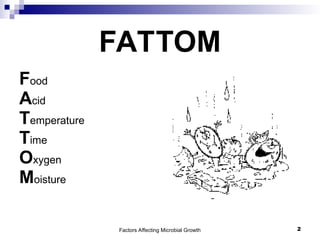
FATTOM
Food
Acid
Temperature
Time
Oxygen
Moisture
Factors Affecting Microbial Growth 3
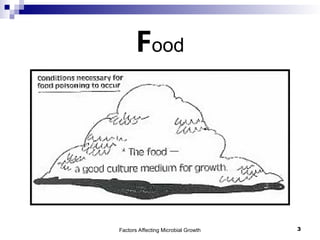
Food
Factors Affecting Microbial Growth 4
Food
 Nutrients needed by microorganisms include:
Carbon – carbon containing compounds are n
eeded as
 an energy source (ex. glucose)
 for building blocks.
Nitrogen
 needed for amino acids and nucleotides;
 some can synthesize all 20 amino acids;
 others have to have some provided in their
medium.
Factors Affecting Microbial Growth 5
Food
 Sulfur – needed for amino acids, coenzymes,
 Phosphorus – needed for ATP, phospholipids, and nu
cleotides
 Vitamins
 a vitamin is an organic substance that an organism
requires in small amounts and that is typically used
as a coenzyme;
 many bacteria make their own, but some are requir
ed in the medium;
 microbes living in the human intestine manufacture
vitamin K, needed for blood clotting, and some of t
he B vitamins, thus benefiting their host.
 Certain trace elements – ex. copper, iron, zinc, sodium
, chloride, potassium, calcium, etc.;
 often serve as cofactors in enzymatic reactions.
Factors Affecting Microbial Growth 6
Acid (pH)
 Measures alkalinity or acidity
 Most spoilage bacteria grow best near neutral
pH
 Most bacteria grow between pH 6.5-7.5
 Molds and yeasts grow between pH 5 and 6
 Most bacteria produce organic acids as they
grow and metabolize
 Buffers
Factors Affecting Microbial Growth 7
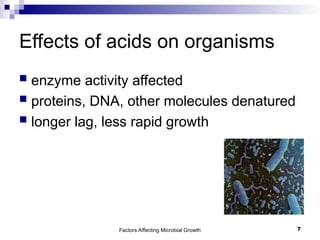
Effects of acids on organisms
 enzyme activity affected
 proteins, DNA, other molecules denatured
 longer lag, less rapid growth
Factors Affecting Microbial Growth 8
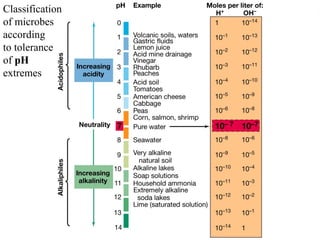
Classification
of microbes
according
to tolerance
of pH
extremes
Factors Affecting Microbial Growth 9
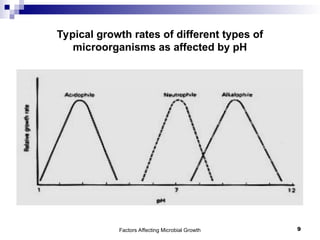
Typical growth rates of different types of
microorganisms as affected by pH
Factors Affecting Microbial Growth 10
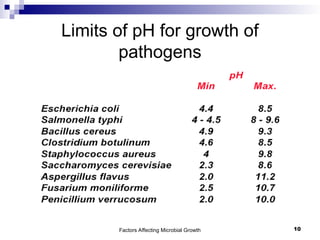
Limits of pH for growth of
pathogens
Factors Affecting Microbial Growth 11
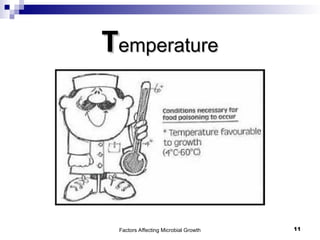
T
Temperature
emperature
Factors Affecting Microbial Growth 12
T
Temperature
emperature
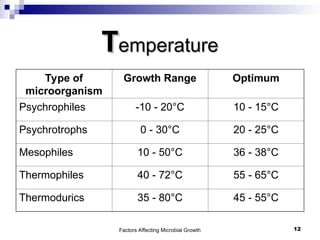
Type of
microorganism
Growth Range Optimum
Psychrophiles -10 - 20°C 10 - 15°C
Psychrotrophs 0 - 30°C 20 - 25°C
Mesophiles 10 - 50°C 36 - 38°C
Thermophiles 40 - 72°C 55 - 65°C
Thermodurics 35 - 80°C 45 - 55°C
Factors Affecting Microbial Growth 13
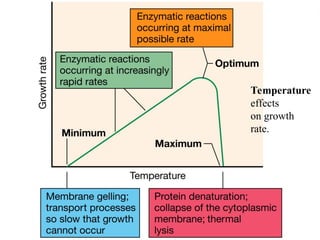
Temperature
effects
on growth
rate.
Factors Affecting Microbial Growth 14
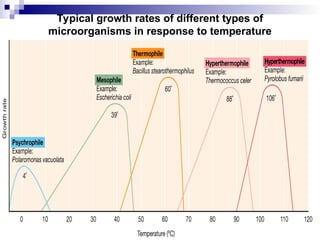
Typical growth rates of different types of
microorganisms in response to temperature
Factors Affecting Microbial Growth 15
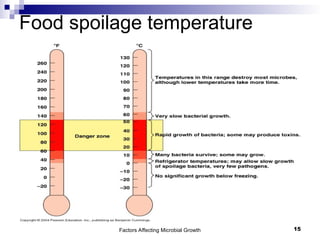
Food spoilage temperature
Factors Affecting Microbial Growth 16
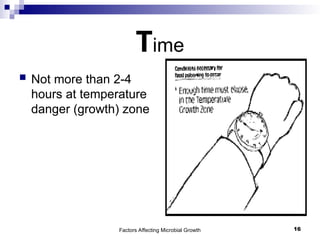
Time
 Not more than 2-4
hours at temperature
danger (growth) zone
Factors Affecting Microbial Growth 17
Oxygen
 Poisonous at high concentrations
 Often combined with hydrogen to form
water
 Microorganisms have variation in need to
metabolize oxygen
Factors Affecting Microbial Growth 18
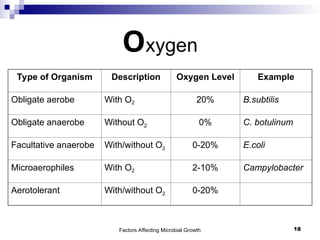
Oxygen
Type of Organism Description Oxygen Level Example
Obligate aerobe With O2 20% B.subtilis
Obligate anaerobe Without O2 0% C. botulinum
Facultative anaerobe With/without O2 0-20% E.coli
Microaerophiles With O2 2-10% Campylobacter
Aerotolerant With/without O2 0-20%
Factors Affecting Microbial Growth 19
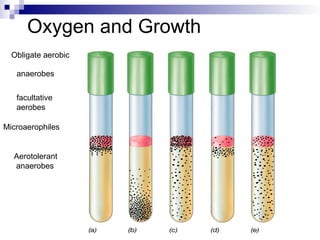
Oxygen and Growth
Obligate aerobic
anaerobes
facultative
aerobes
Microaerophiles
Aerotolerant
anaerobes
Factors Affecting Microbial Growth 20
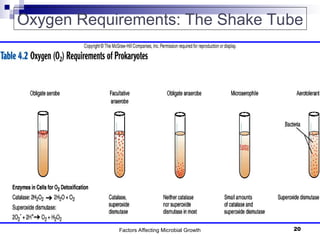
Oxygen Requirements: The Shake Tube
Factors Affecting Microbial Growth 21
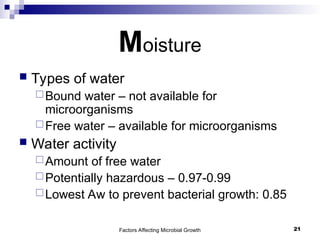
Moisture
 Types of water
Bound water – not available for
microorganisms
Free water – available for microorganisms
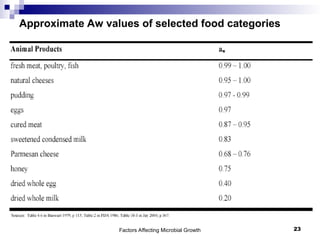
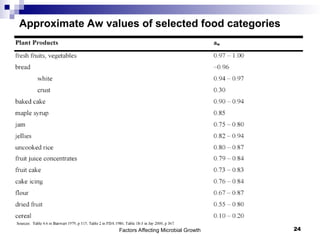
 Water activity
Amount of free water
Potentially hazardous – 0.97-0.99
Lowest Aw to prevent bacterial growth: 0.85
Factors Affecting Microbial Growth 22
Effects of low water levels
longer lag, slower growth
impaired transport
loss of membrane fluidity
Factors Affecting Microbial Growth 23
Approximate Aw values of selected food categories
Factors Affecting Microbial Growth 24
Approximate Aw values of selected food categories
Factors Affecting Microbial Growth 25
Addendum: Osmotic Pressure
 High osmotic pressures remove necessary water
from the cell
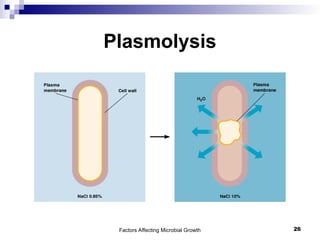
 Plasmolysis – shrinkage of the cell’s plasma
membrane
 Growth of cell is inhibited as the plasma
membrane pulls away from the cell wall
 Served as the basis of food preservation
methods using salt and sugar
Factors Affecting Microbial Growth 26
Plasmolysis
Factors Affecting Microbial Growth 27
Osmotic Pressure
 Halophiles
Can withstand high salt concentration
Obligate – require high salt concentrations
(30%)
Facultative – do not require high salt
concentration, but can survive high salt
concentrations (2-15%)
Factors Affecting Microbial Growth 28
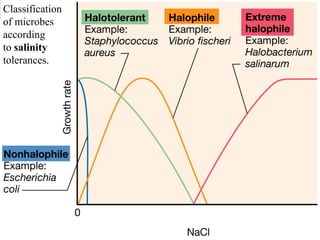
Classification
of microbes
according
to salinity
tolerances.

28447298-Factors-Affecting-Microbial-Growth.ppt

  • 1.
  • 2.
    Factors Affecting MicrobialGrowth 2 FATTOM Food Acid Temperature Time Oxygen Moisture
  • 3.
  • 4.
    Factors Affecting MicrobialGrowth 4 Food  Nutrients needed by microorganisms include: Carbon – carbon containing compounds are n eeded as  an energy source (ex. glucose)  for building blocks. Nitrogen  needed for amino acids and nucleotides;  some can synthesize all 20 amino acids;  others have to have some provided in their medium.
  • 5.
    Factors Affecting MicrobialGrowth 5 Food  Sulfur – needed for amino acids, coenzymes,  Phosphorus – needed for ATP, phospholipids, and nu cleotides  Vitamins  a vitamin is an organic substance that an organism requires in small amounts and that is typically used as a coenzyme;  many bacteria make their own, but some are requir ed in the medium;  microbes living in the human intestine manufacture vitamin K, needed for blood clotting, and some of t he B vitamins, thus benefiting their host.  Certain trace elements – ex. copper, iron, zinc, sodium , chloride, potassium, calcium, etc.;  often serve as cofactors in enzymatic reactions.
  • 6.
    Factors Affecting MicrobialGrowth 6 Acid (pH)  Measures alkalinity or acidity  Most spoilage bacteria grow best near neutral pH  Most bacteria grow between pH 6.5-7.5  Molds and yeasts grow between pH 5 and 6  Most bacteria produce organic acids as they grow and metabolize  Buffers
  • 7.
    Factors Affecting MicrobialGrowth 7 Effects of acids on organisms  enzyme activity affected  proteins, DNA, other molecules denatured  longer lag, less rapid growth
  • 8.
    Factors Affecting MicrobialGrowth 8 Classification of microbes according to tolerance of pH extremes
  • 9.
    Factors Affecting MicrobialGrowth 9 Typical growth rates of different types of microorganisms as affected by pH
  • 10.
    Factors Affecting MicrobialGrowth 10 Limits of pH for growth of pathogens
  • 11.
    Factors Affecting MicrobialGrowth 11 T Temperature emperature
  • 12.
    Factors Affecting MicrobialGrowth 12 T Temperature emperature Type of microorganism Growth Range Optimum Psychrophiles -10 - 20°C 10 - 15°C Psychrotrophs 0 - 30°C 20 - 25°C Mesophiles 10 - 50°C 36 - 38°C Thermophiles 40 - 72°C 55 - 65°C Thermodurics 35 - 80°C 45 - 55°C
  • 13.
    Factors Affecting MicrobialGrowth 13 Temperature effects on growth rate.
  • 14.
    Factors Affecting MicrobialGrowth 14 Typical growth rates of different types of microorganisms in response to temperature
  • 15.
    Factors Affecting MicrobialGrowth 15 Food spoilage temperature
  • 16.
    Factors Affecting MicrobialGrowth 16 Time  Not more than 2-4 hours at temperature danger (growth) zone
  • 17.
    Factors Affecting MicrobialGrowth 17 Oxygen  Poisonous at high concentrations  Often combined with hydrogen to form water  Microorganisms have variation in need to metabolize oxygen
  • 18.
    Factors Affecting MicrobialGrowth 18 Oxygen Type of Organism Description Oxygen Level Example Obligate aerobe With O2 20% B.subtilis Obligate anaerobe Without O2 0% C. botulinum Facultative anaerobe With/without O2 0-20% E.coli Microaerophiles With O2 2-10% Campylobacter Aerotolerant With/without O2 0-20%
  • 19.
    Factors Affecting MicrobialGrowth 19 Oxygen and Growth Obligate aerobic anaerobes facultative aerobes Microaerophiles Aerotolerant anaerobes
  • 20.
    Factors Affecting MicrobialGrowth 20 Oxygen Requirements: The Shake Tube
  • 21.
    Factors Affecting MicrobialGrowth 21 Moisture  Types of water Bound water – not available for microorganisms Free water – available for microorganisms  Water activity Amount of free water Potentially hazardous – 0.97-0.99 Lowest Aw to prevent bacterial growth: 0.85
  • 22.
    Factors Affecting MicrobialGrowth 22 Effects of low water levels longer lag, slower growth impaired transport loss of membrane fluidity
  • 23.
    Factors Affecting MicrobialGrowth 23 Approximate Aw values of selected food categories
  • 24.
    Factors Affecting MicrobialGrowth 24 Approximate Aw values of selected food categories
  • 25.
    Factors Affecting MicrobialGrowth 25 Addendum: Osmotic Pressure  High osmotic pressures remove necessary water from the cell  Plasmolysis – shrinkage of the cell’s plasma membrane  Growth of cell is inhibited as the plasma membrane pulls away from the cell wall  Served as the basis of food preservation methods using salt and sugar
  • 26.
    Factors Affecting MicrobialGrowth 26 Plasmolysis
  • 27.
    Factors Affecting MicrobialGrowth 27 Osmotic Pressure  Halophiles Can withstand high salt concentration Obligate – require high salt concentrations (30%) Facultative – do not require high salt concentration, but can survive high salt concentrations (2-15%)
  • 28.
    Factors Affecting MicrobialGrowth 28 Classification of microbes according to salinity tolerances.

Editor's Notes

  • #8 Figure: 06-22 Caption: The pH scale. Note that although some microorganisms can live at very low or very high pH, the cell’s internal pH remains near neutrality.
  • #13 Figure: 06-16 Caption: Effect of temperature on growth rate and the molecular consequences for the cell. The three cardinal temperatures vary by organism.
  • #19 Figure: 06-25a-e Caption: Aerobic, anaerobic, facultative, microaerophilic, and aerotolerant anaerobe growth, as revealed by the position of microbial colonies (depicted here as black dots) within tubes of thioglycolate broth culture medium. A small amount of agar has been added to keep the liquid from becoming disturbed and the redox dye, resazurin, which is pink when oxidized and colorless when reduced, is added as a redox indicator. (a) Oxygen penetrates only a short distance into the tube, so obligate aerobes grow only at the surface. (b) Anaerobes, being sensitive to oxygen, grow only away from the surface. (c) Facultative aerobes are able to grow in either the presence or the absence of oxygen and thus grow throughout the tube. However, better growth occurs near the surface because these organisms can respire. (d) Microaerophiles grow away from the most oxic zone. (e) Aerotolerant anaerobes grow throughout the tube. However, growth is no better near the surface because these organisms can only ferment. Obligate aerobes require O2 for growth; they use O2 as a final electron acceptor in aerobic respiration. Obligate anaerobes (occasionally called aerophobes) do not need or use O2 as a nutrient. In fact, O2 is a toxic substance, which either kills or inhibits their growth. Obligate anaerobic procaryotes may live by fermentation, anaerobic respiration, bacterial photosynthesis, or the novel process of methanogenesis. Facultative anaerobes (or facultative aerobes) are organisms that can switch between aerobic and anaerobic types of metabolism. Under anaerobic conditions (no O2) they grow by fermentation or anaerobic respiration, but in the presence of O2 they switch to aerobic respiration. Aerotolerant anaerobes are bacteria with an exclusively anaerobic (fermentative) type of metabolism but they are insensitive to the presence of O2. They live by fermentation alone whether or not O2 is present in their environment.
  • #28 Figure: 06-23 Caption: Effect of sodium ion concentration on growth of microorganisms of different salt tolerances or requirements. The optimum NaCl concentration for marine microorganisms such as V. fischeri is about 3%; for extreme halophiles, it is between 15 and 30%, depending on the organism.