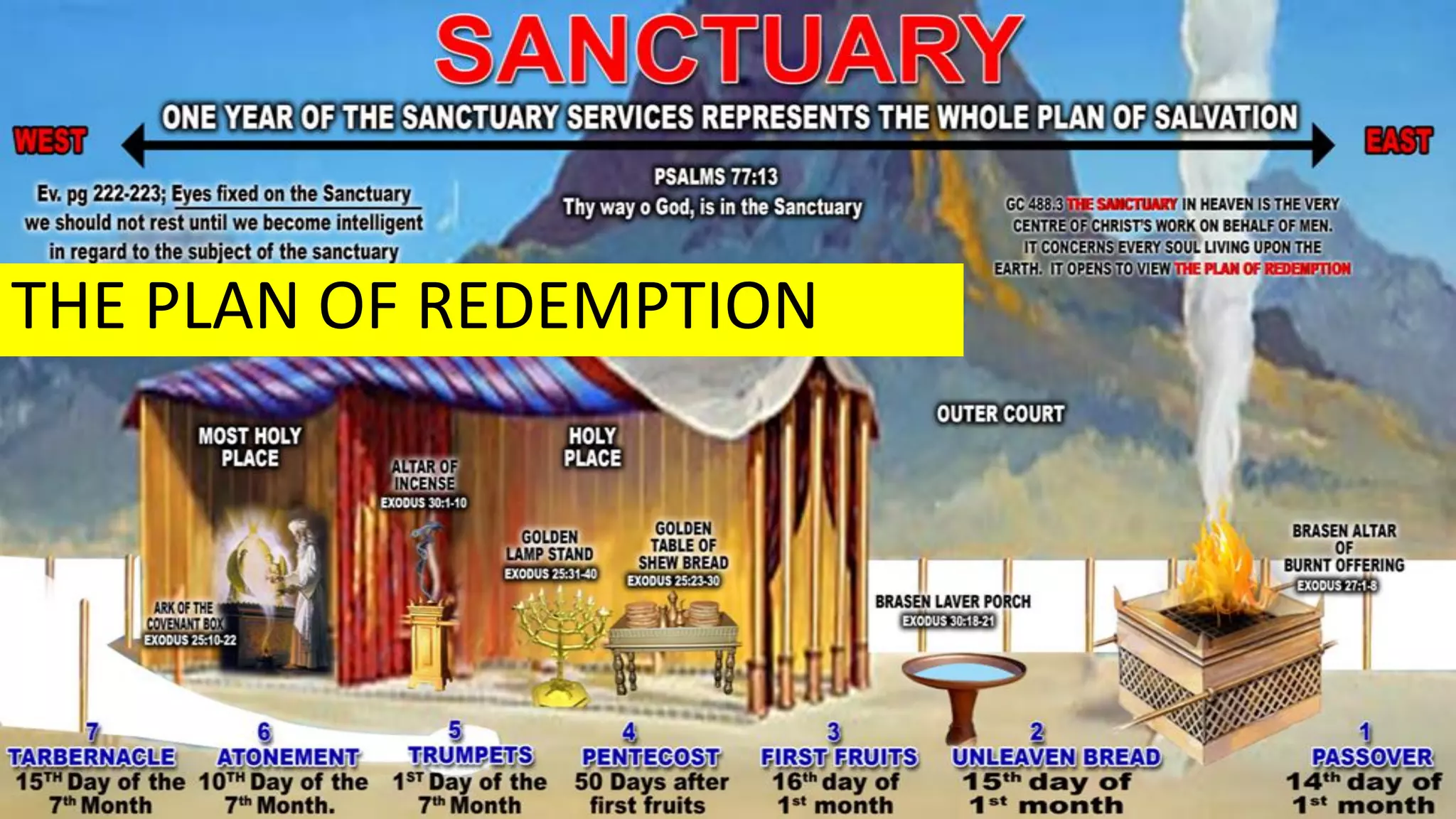
THE PLAN OF REDEMPTION
Gen 3:15 And I will put enmity between thee
and the woman, and between thy seed and her
seed; it shall bruise thy head, and thou shalt
bruise his heel.
Rev 12:7-10 And there was war in heaven: Michael and
his angels fought against the dragon; and the dragon
fought and his angels, And prevailed not; neither was
their place found any more in heaven. And the great
dragon was cast out, that old serpent, called the Devil,
and Satan, which deceiveth the whole world: he was
cast out into the earth, and his angels were cast out
with him. And I heard a loud voice saying in heaven,
Now is come salvation, and strength, and the kingdom
of our God, and the power of his Christ: for the accuser
of our brethren is cast down, which accused them
before our God day and night.
When Adam came from the Creator's
hand, he bore, in his physical, mental,
and spiritual nature, a likeness to his
Maker. "God created man in His own
image" (Genesis 1:27), and it was His
purpose that the longer man lived the
more fully he should reveal this. He was
of lofty stature and perfect symmetry. His
countenance bore the ruddy tint of
health and glowed with the light of life
and joy. Adam's height was much greater
than that of men who now inhabit the
earth. Eve was somewhat less in stature;
yet her form was noble, and full of
beauty.
Gen 3:8 And they heard the voice of the
LORD God walking in the garden in the cool
of the day: and Adam and his wife hid
themselves from the presence of the LORD
God amongst the trees of the garden. 3:9
And the LORD God called unto Adam, and
said unto him, Where [art] thou? 3:10 And
he said, I heard thy voice in the garden, and
I was afraid, because I [was] naked; and I
hid myself. 3:11 And he said, Who told thee
that thou [wast] naked? Hast thou eaten of
the tree, whereof I commanded thee that
thou shouldest not eat?
Sin has entered the world
But by disobedience this was forfeited.
Through sin the divine likeness was marred,
and well-nigh obliterated. Man's physical
powers were weakened, his mental capacity
was lessened, his spiritual vision dimmed.
He had become subject to death. Yet the
race was not left without hope.
By infinite love and mercy the plan of salvation had
been devised, and a life of probation was granted.
To restore in man the image of his Maker, to bring
him back to the perfection in which he was
created, to promote the development of body,
mind, and soul, that the divine purpose in his
creation might be realized--this was to be the great
work of redemption.
2:5 Let this mind be in you,
which was also in Christ
Jesus:
2:6 Who, being in the form of
God, thought it not robbery
to be equal with God:
2:7 But made himself of no
reputation, and took upon
him the form of a servant,
and was made in the likeness
of men:
2:8 And being found in
fashion as a man, he
humbled himself, and
became obedient unto death,
even the death of the cross.
PHIL 2
THE PLAN OF REDEMPTION
Search ye the scripture……John 5:39
The central theme of the Bible, the theme about which every
other in the whole book clusters, is the redemption plan, the
restoration in the human soul of the image of God. From the
first intimation of hope in the sentence pronounced in Eden to
that last glorious promise of the Revelation, "They shall see
His face; and His name shall be in their foreheads" (Revelation
22:4), the burden of every book and every passage of the
Bible is the unfolding of this wondrous theme,--man's
uplifting,--the power of God, "which giveth us the victory
through our Lord Jesus Christ." 1 Corinthians 15:57.
SACRIFICIAL SYSTEM IN THE OLD TESTAMENT
• ADAM
• CAIN AND ABEL
• ABRAHAM
• ISAAC
• JACOB---ISRAELITES ETC…….
• All this was a shadow, type, pattern of the great sacrifice of Jesus
Christ…1 Cor 10:11-
.
By the time the children of Israel had spent 400 years in Egypt as slaves to a pagan
nation, the Lord saw that His people needed a
- including their role and God's role in
cleansing them from their sins and restoring them to His image
This is why, when the children of Israel finally limped out of Egypt with scars on
their backs and visions of the Promised Land dancing in their minds, God didn't
immediately lead them north toward the Promised Land, but south toward Mt.
Sinai. He was about to deliver to this infant nation one of the most powerful and
enduring object lessons ever recorded. And He would do it almost entirely with
symbols.
The Lord told Moses, "Let them make me a sanctuary; that I may dwell
among them" (Exodus 25:8). Keep in mind that this earthly tabernacle
was never intended to be an edifice to shelter God from the
elements. Jehovah is not a homeless God. When Solomon was building
the first temple in Jerusalem, he said: "But will God indeed dwell on the
earth? behold, the heaven and heaven of heavens cannot contain thee;
how much less this house that I have builded?" (1 Kings 8:27).
As we consider the sanctuary symbols, let's look at the first earthly sanctuary -
the one that Moses had the people construct in the wilderness. This portable
tent was often called the "tabernacle." Moses did not simply dream up what he
thought this structure should look like. In the same way God spelled out the
precise dimensions for Noah's Ark, God gave Moses exact plans for everything
in the sanctuary, even to the minutest detail of the accessories. Ex 25: 9,40,
26:20.
? The structure and
ceremonies were to serve as symbols to illustrate the sequence and process of
salvation.
God's plan wasn't arbitrary either. He
already had a
. The earthly
sanctuary was to be a miniature
model, or shadow, of the heavenly.
God told Moses, "According to all
that I show thee, after the pattern of
the tabernacle [in heaven], and the
pattern of all the instruments thereof,
even so shall ye make it" (Exodus
25:9). Unlike any other building ever
constructed, the sanctuary would be
a three-dimensional, life-sized lesson
book.
GOD’S LOVE TO HUMANITY
• Experts have proven that one of the most successful methods of
memorization is through picture association. The Lord uses this
teaching technique because He knows that humans are extremely
visual creatures. This is one of the main reasons Jesus taught with
parables. Picture stories help people understand and remember the
many abstract principles of salvation by associating them with visual
images.
• God first illustrated the plan of salvation immediately after Adam and
Eve sinned by having them sacrifice a lamb. This process impressed
upon the first couple the heinous results of sin and foreshadowed the
ultimate death of the "Lamb of God" for their sins.
A Journey to God
Let's begin a brief tour through this
unusual structure and learn a few
basic lessons before examining the
deeper meanings of the sanctuary
system.
The sanctuary consisted of three
principal areas: the courtyard, the
holy place, and the most holy
place. These three locations
represent the three primary steps in
the process of salvation known as
justification, sanctification, and
glorification, and they correspond
with three phases of Christ's
ministry: the substitutionary
sacrifice, the priestly mediation,
and the final judgment.
God gave the sanctuary
to show us a
representation of the
story of redemption.
1.THE LAYOUT AND
FURNITURES OF THE
SANCTUARY
OUTER COURT
TABERNACLE
THE PLAN OF SALVATION
1. COURTYARD (earth)
Gate
Altar of burnt incense
Laver
2. HOLY PLACE(heaven)
Table of shew bread
7 branched candlesticks
Altar of burnt incense
3. MOST HOLY
PLACE(heaven)
Ark of the covenant-
Mercy seat
cherubs
Psalms 73:16-17 When I thought to
know this, it [was] too painful for me;
Until I went into the sanctuary of God;
[then] understood I their end.
Psalms 77:13-15 Thy way, O God, [is] in
the sanctuary: who [is so] great a God as
[our] God? Thou [art] the God that
doest wonders: thou hast declared thy
strength among the people. Thou hast
with [thine] arm redeemed thy people,
the sons of Jacob and Joseph. Selah.
JOHN
Psalms 73:2-3 But as for me, my feet
were almost gone; my steps had well
nigh slipped.
For I was envious at the foolish, [when] I
saw the prosperity of the wicked.
THE ALTAR OF BURNT SACRIFICE
The Door
The first thing we notice as we
approach the sanctuary is that there
is only one door. Not even a fire
exit! Remember Jesus' words: "I am
the door: by me if any man enter in,
he shall be saved" (John 10:9).
All that are saved are redeemed by
Jesus alone. "Neither is there
salvation in any other: for there is
none other name under heaven
given among men, whereby we
must be saved" (Acts 4:12). The
only way to God is through Christ,
the only Door.
THE DOOR TO SALVATION
The Altar of Burnt Offering
Immediately upon entering the door of
the courtyard sat the brazen altar of
burnt offerings. The altar was actually
made of acacia wood and overlaid with
brass. Some have likened the wood
portion to human works and the brass
to Christ's work. Without the brass, the
wooden frame would have been
consumed by the fire during the burning
of the offerings, just as we will be
consumed by the lake of fire if we do not
believe that Jesus' grace must eclipse
self. Exodus 27:1-7
JUSTIFICATION
When a sinner became convicted of sin
by the Holy Spirit and wanted to
confess, he came to the door of the
courtyard with a spotless animal
(usually a lamb) to sacrifice. He laid
his hands on the head of the innocent
victim and confessed his sin. This
symbolically transferred his sin and its
penalty to the lamb. Then with HIS
OWN hand he had to slay the animal
and shed its blood. This was to impress
upon the repentant sinner that his sins
would ultimately require the death of
the spotless Lamb of God.
HIGH PRIEST
SINNER
LAMB
PREREQUISITE OF SALVATION
 HIGH PRIEST
 SINNER
 LAMB
SINNER
After confessing his sin and slaying the lamb, the sinner went
away forgiven, his sin covered by the shed blood of the victim. Of
course the lamb's blood didn't cover the sin, but it represented the
blood of Christ, "the Lamb of God which taketh away the sin of
the world" (John 1:29).
After some of the blood was caught by the priest,
the rest was poured out on the ground at
the base of the altar and the animal was
burnt on the altar. The altar symbolized
the CROSS where Jesus was sacrificed for
the sins of the world. His blood was spilt on
the ground at the foot of the cross when the
centurion pierced His side (John 19:34).
The Laver
Between the altar of burnt offerings and the entrance to the holy
place stood the laver. It was also made of brass and was filled
with water for the cleansing of the priests.
The picture of the sinner's justification became clear in the
courtyard. Before God gave the Israelites His law on tables of
stone, He saved them from slavery in Egypt by virtue of their faith
in the Passover Lamb (symbolized by the altar) and baptized
them in the sea (represented by the laver).
When we accept Christ,
confess our sins, and ask for forgiveness, our heavenly record of
sin is covered by Jesus' blood. Then we are to be baptized.
The blood of the lamb, symbolically bearing the guilt of the
sinner, was then taken by the priest and transferred to the holy
place of the sanctuary. However, the priest NEVER went into the
sanctuary without first cleansing himself at the LAVER. This
washing is symbolic of baptism and is listed as on of the symbols
for salvation (Acts 2:38). The Israelites had to cross the Red Sea
before they were free from the bondage of Egypt. "And were all
baptized unto Moses in the cloud and in the sea" (1 Corinthians
10:2).
So in the courtyard we pass through the fire and water. Jesus said,
"Except a man be born of water and of the Spirit, he cannot enter
into the kingdom of God" (John 3:5).
One thing of I the Lord desire, for all my
Path has miry been: Be it by water or by
Fire, Oh , make me clean, oh make me
clean!
So wash me, Thou, without, within, Or
purge with fire, if that must be: No
matter how, if only sin Die out in me, die
out in me.
THE PLAN OF REDEMPTION IN
THE OUTER COURT
MINISTRY IN THE HOLY PLACE
The actual tabernacle stood in the west half of the courtyard. It was
divided into two compartments, or rooms. While the width of the two
rooms was the same, the length of the first room, the holy place, was
twice as long as that of the most holy place. The walls of the central
structure were made of acacia boards overlaid with gold and connected
with silver hardware (Exodus 26).
All who entered the holy place to minister saw themselves reflected in the
golden walls on every side, reminding them that the eyes of the Lord see
all. "And he made a covering for the tent of rams' skins dyed red, and a
covering of badgers' skins above that" (Exodus 36:19). The priests could
look up and see that they served under a red skin. Likewise, Christian are
a nation of priests that serve Jesus under His blood.
ITEMS IN THE HOLY
PLACE
 CANDLESTICKS-S
 TABLE OF SHEW
BREAD-N
 ALTAR OF
INCENSE-W
The Golden Lamp Stand
Just inside the holy place on the left (south) side, stood the golden
menorah that had seven candlestick branches (see Exodus 25:31-
40). They were not wax candles as we know them, but lamps fueled by
pure olive oil. The priests trimmed the wicks daily and refilled the bowls
with oil so that the menorah would constantly be a source of light for the
holy place. Jesus said, "I am the light of the world" (John 8:12).
He also said, "Ye are the light of the world" (Matthew 5:14). The Olive oil in
the lamps symbolized the Holy Spirit that illuminates the church. The lamp
is a symbol of the Word, as well (Psalm 119:105).
The altar of incense was located
directly across from the door standing
against the ornate veil that separated
the holy place from the most holy
place. Like several other items in the
sanctuary, it was also made of acacia
wood and covered with gold
(Exodus 30:1-3). It was much small
than the altar in the courtyard and
contained a brass pot that held hot
coals from the brazen altar of burnt
offerings. It was here that the priest
burned a very special blend of
incense which filled the sanctuary with
a sweet-smelling cloud, representing
the prayers of intercession and
confession of the believers sweetened
by the Holy Spirit (Exodus 30:8).
HOLY PLACE
The Holy Place represents the process of
sanctification. This corresponds to the
wilderness wanderings of Israel. The
pillar of fire was their menorah, and the
manna was their showbread. The pillar
of cloud was their cloud of incense.
Sanctification is the process in the
Christian's life of learning to obey.
Each time we sin we ask for forgiveness,
and we are justified again. However, God
offers more than forgiveness when we
confess. In 1 John 1:9, He promises us
that, "If we confess our sins, he is faithful
and just to forgive us our sins, and to
cleanse us from all unrighteousness."
INSIDE THE HOLY PLACE
POSITION=TIME
WORK(PRIEST)
WORK(AWAKE-
CONGREGATION)
Shall we not search the Scriptures, that
we may know where we are in this
world's history?(TIME) Shall we not
become intelligent in regard to the work
that is being accomplished for us at this
time, and the position that we as sinners
should occupy while this work of
atonement is going forward?{1 SM 125.2}
All need a knowledge for themselves of
the position and work of their great High
Priest. Otherwise it will be impossible for
them to exercise the faith which is
essential at this time or to occupy the
position which God designs them to fill.{GC
488.2}
ROM 13:11-14
The ark of the covenant contains
some of the most beautiful and
significant symbolism of God's
entire plan of salvation. Inside the
ark, between the golden bowl of
manna, symbolizing God's
providence, and Aaron's rod that
budded, symbolizing God's authority
and discipline, were the two tables
of stone on which God's finger
inscribed the law that has been
violated by all men (Romans
3:23). The breaking of that law is
sin (1 John 3:4) and the penalty for
sin is death (Romans 6:23).
LAW
POT
ROD
CHERUBIMS
GLORY
WRITTINGS
OF THE
PROPHET
The holy of holies, the tabernacle's most sacred spot, represents the
presence of God. The walls around the courtyard and the holy place
vividly illustrate man's separation from God. "But your iniquities have
separated between you and your God, and your sins have hid his face
from you, that he will not hear" (Isaiah 59:2). All of the sanctuary
services represent a sinner's journey back to God. In the first three
chapters of the Bible, sin enters the world and man is evicted from the
garden of Eden. In the last three chapters, sin is eradicated and man is
restored to the garden and communion with God.
Between the law which condemns
us to death and the all-consuming
presence of God is the mercy seat,
or the lid of the ark. This
arrangement illustrates that only
Jesus' mercy saves us from being
consumed by the fiery presence
and justice of God. But Jesus'
mercy isn't cheap. He bought it
with His own blood. He paid the
wages of sin so He could offer
mercy to all who will accept it.
PSALMS 85:10 Mercy and truth are
met together; righteousness and peace
have kissed [each other].
The Sanctuary in heaven is the very center
of Christ’s work in behalf of men. It
concerns every living soul upon the earth. It
opens to view the plan of redemption,
bringing us down to the very close of time,
and revealing the triumphant issue of the
contest between righteousness and sin. It is
of the utmost importance that all should
thoroughly investigate these subjects, and
be able to give the hope that is in them.
It opens to view a complete system of
truth, connected and harmonious, perfectly
calculated to explain the past, the present,
and establish faith in a certain glorious
future.
At any time during the year when a sinner presented his offering and
confessed over it his sins, an atonement was made for him. He was
forgiven (Lev 4:20, 26, 31, 35; 5:6, 10, 13, 16, 18; 6:7). His sin was
symbolically transferred to the sanctuary by the ministration of the
blood of the offering and the burning of its altar portions in some cases
by the priest eating a portion of it. Nevertheless, full atonement for his
sin had not been made. Though his sin was forgiven he must continue
in the way of obedience. Should he fail to do so and neglect to afflict
his soul upon the Day of Atonement (Lev 23:27 29), all of his
erstwhile forgiven sins would return upon him and he must die (Eze.
18:24; 33:13). His only safety lay in enduring to the end. Then, and
only then, could he expect to be saved (Matt. 24:13).
On the Day of Atonement the day of final and complete atonement
for all sins confessed and forgiven during the year (Lev. 16:16, 19;
Heb. 10:1 3) the blood of the Lord s goat symbolically removed
these sins from the sanctuary, making atonement for it also. It too
was now free from sin(Lev. 16:17, 20). On the first day of the
seventh month came the blowing of trumpets, which was to call the
attention of the people to the Day of Atonement, ten days later
(Num. 29:1). The intervening nine days became days of heart
searching, of preparation for the Day of Atonement, the day of
judgment that sealed their destiny. They believed that on that day
it is sealed who shall live and who are to die (Jewish
Encyclopedia, vol. 2, p. 286, art. Atonement, Day of ).
From the first
intimation of hope in
the sentence
pronounced in Eden
to that last glorious promise of the
Revelation, "They shall see his
face; and his name shall be in their
foreheads" (Revelation 22:4)
The central theme of the Bible, the theme about which every other in the whole book
clusters, is the redemption plan, the restoration in the human soul of the
image of God. From the first intimation of hope in the sentence pronounced in Eden
(Genesis 3:15) to that last glorious promise of the Revelation, "They shall see his face; and his
name shall be in their foreheads" (Revelation 22:4), the the burden of every book and every
passage of the Bible is the unfolding of this wondrous theme,--man's uplifting,--the power of
God, "which giveth us the victory through our Lord Jesus Christ." 1 Corinthians 15:57. {Ed
125.2}
He who grasps this thought has before him an infinite field for study. He has the key that
will unlock to him the whole treasure house of God's word. {Ed 126.1}
JEWISH CEREMONIES
• SPRING CEREMONIES -1st month
• THE PASSOVER-CRUCIFICATION
• THE FEAST OF UNLEAVENED BREAD-TOMB
REST
• THE WAVE SHEAF-RESSURECTION
• THE FEAST OF HARVEST: PENTECOST
• FALL CEREMONIES -7th month
• THE FEAST OFTRUMPETS-ADVENT
MOVEMENT
• THE DAY OF ATONEMENT-INVESTIGATIVE
JUDGEMENT
• THE FEAST OFTABERNACLES- MILLENIUM
The Old Testament is the ground where the
seeds of practical godliness were first sown.
This was repeated in Christ's words to his
disciples. We have yet to learn that the
whole Jewish economy is a compacted
prophecy of the gospel. It is the gospel in
figures. From the pillar of cloud, Christ
presented man's duty to God and to his
fellow men. His words to his appointed
agencies, both in the Old Testament and in
the New, point out plainly the Christian
virtues. Through all his teaching he scattered
the precious grains of truth. All will find these
to be as precious pearls, rich in value, if they
will practise the principles laid down. {RH,
February 21, 1899 par. 5}
The central theme of the Bible, the theme
about which every other in the whole book
clusters, is the redemption plan, the
restoration in the human soul of the image of
God. From the first intimation of hope in the
sentence pronounced in Eden (Genesis 3:15)
to that last glorious promise of the
Revelation, "They shall see his face; and his
name shall be in their foreheads" (Revelation
22:4), the the burden of every book and every
passage of the Bible is the unfolding of this
wondrous theme,--man's uplifting,--the
power of God, "which giveth us the victory
through our Lord Jesus Christ." 1 Corinthians
15:57. {Ed 125.2}
…..Not to see the marked
contrast between Christ and
ourselves is not to know
ourselves. He who does not
abhor himself can not
understand the meaning of
redemption. To be redeemed
means to cease from sin. No
heart that is stirred to
rebellion against the law of
God has any union with Christ,
who died to vindicate the law
and exalt it before all nations,
tongues, and peoples…" {RH,
September 25, 1900 par. 10}
The Christian walk
1st Step-
Accept Jesus
at the cross,
death to self
Study of the Word (Deut 8:3)
His HandsHis Hands
Baptism
Witnessing-
Matt 5:14-16
Prayer- Rev 8:3God’s purpose, to
lead us to perfect
conformity to His
law- Standard of
judgment
Justification-Romans 3:23-28,5:1Sanctification-John 17:17Perfection-col 1:28
BOUGHTBROUGHT
DAN 12:1
REV 6:17
2 PET 1:4,10

26. the plan of redemption

  • 1.
    THE PLAN OFREDEMPTION
  • 3.
    THE PLAN OFREDEMPTION
  • 4.
    Gen 3:15 AndI will put enmity between thee and the woman, and between thy seed and her seed; it shall bruise thy head, and thou shalt bruise his heel. Rev 12:7-10 And there was war in heaven: Michael and his angels fought against the dragon; and the dragon fought and his angels, And prevailed not; neither was their place found any more in heaven. And the great dragon was cast out, that old serpent, called the Devil, and Satan, which deceiveth the whole world: he was cast out into the earth, and his angels were cast out with him. And I heard a loud voice saying in heaven, Now is come salvation, and strength, and the kingdom of our God, and the power of his Christ: for the accuser of our brethren is cast down, which accused them before our God day and night.
  • 5.
    When Adam camefrom the Creator's hand, he bore, in his physical, mental, and spiritual nature, a likeness to his Maker. "God created man in His own image" (Genesis 1:27), and it was His purpose that the longer man lived the more fully he should reveal this. He was of lofty stature and perfect symmetry. His countenance bore the ruddy tint of health and glowed with the light of life and joy. Adam's height was much greater than that of men who now inhabit the earth. Eve was somewhat less in stature; yet her form was noble, and full of beauty.
  • 6.
    Gen 3:8 Andthey heard the voice of the LORD God walking in the garden in the cool of the day: and Adam and his wife hid themselves from the presence of the LORD God amongst the trees of the garden. 3:9 And the LORD God called unto Adam, and said unto him, Where [art] thou? 3:10 And he said, I heard thy voice in the garden, and I was afraid, because I [was] naked; and I hid myself. 3:11 And he said, Who told thee that thou [wast] naked? Hast thou eaten of the tree, whereof I commanded thee that thou shouldest not eat? Sin has entered the world
  • 7.
    But by disobediencethis was forfeited. Through sin the divine likeness was marred, and well-nigh obliterated. Man's physical powers were weakened, his mental capacity was lessened, his spiritual vision dimmed. He had become subject to death. Yet the race was not left without hope. By infinite love and mercy the plan of salvation had been devised, and a life of probation was granted. To restore in man the image of his Maker, to bring him back to the perfection in which he was created, to promote the development of body, mind, and soul, that the divine purpose in his creation might be realized--this was to be the great work of redemption.
  • 8.
    2:5 Let thismind be in you, which was also in Christ Jesus: 2:6 Who, being in the form of God, thought it not robbery to be equal with God: 2:7 But made himself of no reputation, and took upon him the form of a servant, and was made in the likeness of men: 2:8 And being found in fashion as a man, he humbled himself, and became obedient unto death, even the death of the cross. PHIL 2
  • 9.
    THE PLAN OFREDEMPTION
  • 10.
    Search ye thescripture……John 5:39 The central theme of the Bible, the theme about which every other in the whole book clusters, is the redemption plan, the restoration in the human soul of the image of God. From the first intimation of hope in the sentence pronounced in Eden to that last glorious promise of the Revelation, "They shall see His face; and His name shall be in their foreheads" (Revelation 22:4), the burden of every book and every passage of the Bible is the unfolding of this wondrous theme,--man's uplifting,--the power of God, "which giveth us the victory through our Lord Jesus Christ." 1 Corinthians 15:57.
  • 11.
    SACRIFICIAL SYSTEM INTHE OLD TESTAMENT • ADAM • CAIN AND ABEL • ABRAHAM • ISAAC • JACOB---ISRAELITES ETC……. • All this was a shadow, type, pattern of the great sacrifice of Jesus Christ…1 Cor 10:11- .
  • 12.
    By the timethe children of Israel had spent 400 years in Egypt as slaves to a pagan nation, the Lord saw that His people needed a - including their role and God's role in cleansing them from their sins and restoring them to His image This is why, when the children of Israel finally limped out of Egypt with scars on their backs and visions of the Promised Land dancing in their minds, God didn't immediately lead them north toward the Promised Land, but south toward Mt. Sinai. He was about to deliver to this infant nation one of the most powerful and enduring object lessons ever recorded. And He would do it almost entirely with symbols.
  • 13.
    The Lord toldMoses, "Let them make me a sanctuary; that I may dwell among them" (Exodus 25:8). Keep in mind that this earthly tabernacle was never intended to be an edifice to shelter God from the elements. Jehovah is not a homeless God. When Solomon was building the first temple in Jerusalem, he said: "But will God indeed dwell on the earth? behold, the heaven and heaven of heavens cannot contain thee; how much less this house that I have builded?" (1 Kings 8:27).
  • 14.
    As we considerthe sanctuary symbols, let's look at the first earthly sanctuary - the one that Moses had the people construct in the wilderness. This portable tent was often called the "tabernacle." Moses did not simply dream up what he thought this structure should look like. In the same way God spelled out the precise dimensions for Noah's Ark, God gave Moses exact plans for everything in the sanctuary, even to the minutest detail of the accessories. Ex 25: 9,40, 26:20. ? The structure and ceremonies were to serve as symbols to illustrate the sequence and process of salvation.
  • 15.
    God's plan wasn'tarbitrary either. He already had a . The earthly sanctuary was to be a miniature model, or shadow, of the heavenly. God told Moses, "According to all that I show thee, after the pattern of the tabernacle [in heaven], and the pattern of all the instruments thereof, even so shall ye make it" (Exodus 25:9). Unlike any other building ever constructed, the sanctuary would be a three-dimensional, life-sized lesson book.
  • 16.
    GOD’S LOVE TOHUMANITY • Experts have proven that one of the most successful methods of memorization is through picture association. The Lord uses this teaching technique because He knows that humans are extremely visual creatures. This is one of the main reasons Jesus taught with parables. Picture stories help people understand and remember the many abstract principles of salvation by associating them with visual images. • God first illustrated the plan of salvation immediately after Adam and Eve sinned by having them sacrifice a lamb. This process impressed upon the first couple the heinous results of sin and foreshadowed the ultimate death of the "Lamb of God" for their sins.
  • 17.
    A Journey toGod Let's begin a brief tour through this unusual structure and learn a few basic lessons before examining the deeper meanings of the sanctuary system. The sanctuary consisted of three principal areas: the courtyard, the holy place, and the most holy place. These three locations represent the three primary steps in the process of salvation known as justification, sanctification, and glorification, and they correspond with three phases of Christ's ministry: the substitutionary sacrifice, the priestly mediation, and the final judgment.
  • 18.
    God gave thesanctuary to show us a representation of the story of redemption. 1.THE LAYOUT AND FURNITURES OF THE SANCTUARY
  • 19.
  • 20.
  • 21.
    THE PLAN OFSALVATION 1. COURTYARD (earth) Gate Altar of burnt incense Laver 2. HOLY PLACE(heaven) Table of shew bread 7 branched candlesticks Altar of burnt incense 3. MOST HOLY PLACE(heaven) Ark of the covenant- Mercy seat cherubs
  • 22.
    Psalms 73:16-17 WhenI thought to know this, it [was] too painful for me; Until I went into the sanctuary of God; [then] understood I their end. Psalms 77:13-15 Thy way, O God, [is] in the sanctuary: who [is so] great a God as [our] God? Thou [art] the God that doest wonders: thou hast declared thy strength among the people. Thou hast with [thine] arm redeemed thy people, the sons of Jacob and Joseph. Selah. JOHN Psalms 73:2-3 But as for me, my feet were almost gone; my steps had well nigh slipped. For I was envious at the foolish, [when] I saw the prosperity of the wicked. THE ALTAR OF BURNT SACRIFICE
  • 23.
    The Door The firstthing we notice as we approach the sanctuary is that there is only one door. Not even a fire exit! Remember Jesus' words: "I am the door: by me if any man enter in, he shall be saved" (John 10:9). All that are saved are redeemed by Jesus alone. "Neither is there salvation in any other: for there is none other name under heaven given among men, whereby we must be saved" (Acts 4:12). The only way to God is through Christ, the only Door. THE DOOR TO SALVATION
  • 24.
    The Altar ofBurnt Offering Immediately upon entering the door of the courtyard sat the brazen altar of burnt offerings. The altar was actually made of acacia wood and overlaid with brass. Some have likened the wood portion to human works and the brass to Christ's work. Without the brass, the wooden frame would have been consumed by the fire during the burning of the offerings, just as we will be consumed by the lake of fire if we do not believe that Jesus' grace must eclipse self. Exodus 27:1-7
  • 25.
    JUSTIFICATION When a sinnerbecame convicted of sin by the Holy Spirit and wanted to confess, he came to the door of the courtyard with a spotless animal (usually a lamb) to sacrifice. He laid his hands on the head of the innocent victim and confessed his sin. This symbolically transferred his sin and its penalty to the lamb. Then with HIS OWN hand he had to slay the animal and shed its blood. This was to impress upon the repentant sinner that his sins would ultimately require the death of the spotless Lamb of God. HIGH PRIEST SINNER LAMB PREREQUISITE OF SALVATION  HIGH PRIEST  SINNER  LAMB SINNER
  • 26.
    After confessing hissin and slaying the lamb, the sinner went away forgiven, his sin covered by the shed blood of the victim. Of course the lamb's blood didn't cover the sin, but it represented the blood of Christ, "the Lamb of God which taketh away the sin of the world" (John 1:29). After some of the blood was caught by the priest, the rest was poured out on the ground at the base of the altar and the animal was burnt on the altar. The altar symbolized the CROSS where Jesus was sacrificed for the sins of the world. His blood was spilt on the ground at the foot of the cross when the centurion pierced His side (John 19:34).
  • 27.
    The Laver Between thealtar of burnt offerings and the entrance to the holy place stood the laver. It was also made of brass and was filled with water for the cleansing of the priests. The picture of the sinner's justification became clear in the courtyard. Before God gave the Israelites His law on tables of stone, He saved them from slavery in Egypt by virtue of their faith in the Passover Lamb (symbolized by the altar) and baptized them in the sea (represented by the laver). When we accept Christ, confess our sins, and ask for forgiveness, our heavenly record of sin is covered by Jesus' blood. Then we are to be baptized.
  • 28.
    The blood ofthe lamb, symbolically bearing the guilt of the sinner, was then taken by the priest and transferred to the holy place of the sanctuary. However, the priest NEVER went into the sanctuary without first cleansing himself at the LAVER. This washing is symbolic of baptism and is listed as on of the symbols for salvation (Acts 2:38). The Israelites had to cross the Red Sea before they were free from the bondage of Egypt. "And were all baptized unto Moses in the cloud and in the sea" (1 Corinthians 10:2). So in the courtyard we pass through the fire and water. Jesus said, "Except a man be born of water and of the Spirit, he cannot enter into the kingdom of God" (John 3:5).
  • 29.
    One thing ofI the Lord desire, for all my Path has miry been: Be it by water or by Fire, Oh , make me clean, oh make me clean! So wash me, Thou, without, within, Or purge with fire, if that must be: No matter how, if only sin Die out in me, die out in me. THE PLAN OF REDEMPTION IN THE OUTER COURT
  • 30.
    MINISTRY IN THEHOLY PLACE The actual tabernacle stood in the west half of the courtyard. It was divided into two compartments, or rooms. While the width of the two rooms was the same, the length of the first room, the holy place, was twice as long as that of the most holy place. The walls of the central structure were made of acacia boards overlaid with gold and connected with silver hardware (Exodus 26). All who entered the holy place to minister saw themselves reflected in the golden walls on every side, reminding them that the eyes of the Lord see all. "And he made a covering for the tent of rams' skins dyed red, and a covering of badgers' skins above that" (Exodus 36:19). The priests could look up and see that they served under a red skin. Likewise, Christian are a nation of priests that serve Jesus under His blood. ITEMS IN THE HOLY PLACE  CANDLESTICKS-S  TABLE OF SHEW BREAD-N  ALTAR OF INCENSE-W
  • 31.
    The Golden LampStand Just inside the holy place on the left (south) side, stood the golden menorah that had seven candlestick branches (see Exodus 25:31- 40). They were not wax candles as we know them, but lamps fueled by pure olive oil. The priests trimmed the wicks daily and refilled the bowls with oil so that the menorah would constantly be a source of light for the holy place. Jesus said, "I am the light of the world" (John 8:12). He also said, "Ye are the light of the world" (Matthew 5:14). The Olive oil in the lamps symbolized the Holy Spirit that illuminates the church. The lamp is a symbol of the Word, as well (Psalm 119:105).
  • 33.
    The altar ofincense was located directly across from the door standing against the ornate veil that separated the holy place from the most holy place. Like several other items in the sanctuary, it was also made of acacia wood and covered with gold (Exodus 30:1-3). It was much small than the altar in the courtyard and contained a brass pot that held hot coals from the brazen altar of burnt offerings. It was here that the priest burned a very special blend of incense which filled the sanctuary with a sweet-smelling cloud, representing the prayers of intercession and confession of the believers sweetened by the Holy Spirit (Exodus 30:8).
  • 34.
    HOLY PLACE The HolyPlace represents the process of sanctification. This corresponds to the wilderness wanderings of Israel. The pillar of fire was their menorah, and the manna was their showbread. The pillar of cloud was their cloud of incense. Sanctification is the process in the Christian's life of learning to obey. Each time we sin we ask for forgiveness, and we are justified again. However, God offers more than forgiveness when we confess. In 1 John 1:9, He promises us that, "If we confess our sins, he is faithful and just to forgive us our sins, and to cleanse us from all unrighteousness." INSIDE THE HOLY PLACE
  • 35.
    POSITION=TIME WORK(PRIEST) WORK(AWAKE- CONGREGATION) Shall we notsearch the Scriptures, that we may know where we are in this world's history?(TIME) Shall we not become intelligent in regard to the work that is being accomplished for us at this time, and the position that we as sinners should occupy while this work of atonement is going forward?{1 SM 125.2} All need a knowledge for themselves of the position and work of their great High Priest. Otherwise it will be impossible for them to exercise the faith which is essential at this time or to occupy the position which God designs them to fill.{GC 488.2} ROM 13:11-14
  • 36.
    The ark ofthe covenant contains some of the most beautiful and significant symbolism of God's entire plan of salvation. Inside the ark, between the golden bowl of manna, symbolizing God's providence, and Aaron's rod that budded, symbolizing God's authority and discipline, were the two tables of stone on which God's finger inscribed the law that has been violated by all men (Romans 3:23). The breaking of that law is sin (1 John 3:4) and the penalty for sin is death (Romans 6:23). LAW POT ROD CHERUBIMS GLORY WRITTINGS OF THE PROPHET The holy of holies, the tabernacle's most sacred spot, represents the presence of God. The walls around the courtyard and the holy place vividly illustrate man's separation from God. "But your iniquities have separated between you and your God, and your sins have hid his face from you, that he will not hear" (Isaiah 59:2). All of the sanctuary services represent a sinner's journey back to God. In the first three chapters of the Bible, sin enters the world and man is evicted from the garden of Eden. In the last three chapters, sin is eradicated and man is restored to the garden and communion with God.
  • 37.
    Between the lawwhich condemns us to death and the all-consuming presence of God is the mercy seat, or the lid of the ark. This arrangement illustrates that only Jesus' mercy saves us from being consumed by the fiery presence and justice of God. But Jesus' mercy isn't cheap. He bought it with His own blood. He paid the wages of sin so He could offer mercy to all who will accept it. PSALMS 85:10 Mercy and truth are met together; righteousness and peace have kissed [each other]. The Sanctuary in heaven is the very center of Christ’s work in behalf of men. It concerns every living soul upon the earth. It opens to view the plan of redemption, bringing us down to the very close of time, and revealing the triumphant issue of the contest between righteousness and sin. It is of the utmost importance that all should thoroughly investigate these subjects, and be able to give the hope that is in them. It opens to view a complete system of truth, connected and harmonious, perfectly calculated to explain the past, the present, and establish faith in a certain glorious future.
  • 38.
    At any timeduring the year when a sinner presented his offering and confessed over it his sins, an atonement was made for him. He was forgiven (Lev 4:20, 26, 31, 35; 5:6, 10, 13, 16, 18; 6:7). His sin was symbolically transferred to the sanctuary by the ministration of the blood of the offering and the burning of its altar portions in some cases by the priest eating a portion of it. Nevertheless, full atonement for his sin had not been made. Though his sin was forgiven he must continue in the way of obedience. Should he fail to do so and neglect to afflict his soul upon the Day of Atonement (Lev 23:27 29), all of his erstwhile forgiven sins would return upon him and he must die (Eze. 18:24; 33:13). His only safety lay in enduring to the end. Then, and only then, could he expect to be saved (Matt. 24:13).
  • 39.
    On the Dayof Atonement the day of final and complete atonement for all sins confessed and forgiven during the year (Lev. 16:16, 19; Heb. 10:1 3) the blood of the Lord s goat symbolically removed these sins from the sanctuary, making atonement for it also. It too was now free from sin(Lev. 16:17, 20). On the first day of the seventh month came the blowing of trumpets, which was to call the attention of the people to the Day of Atonement, ten days later (Num. 29:1). The intervening nine days became days of heart searching, of preparation for the Day of Atonement, the day of judgment that sealed their destiny. They believed that on that day it is sealed who shall live and who are to die (Jewish Encyclopedia, vol. 2, p. 286, art. Atonement, Day of ).
  • 41.
    From the first intimationof hope in the sentence pronounced in Eden to that last glorious promise of the Revelation, "They shall see his face; and his name shall be in their foreheads" (Revelation 22:4) The central theme of the Bible, the theme about which every other in the whole book clusters, is the redemption plan, the restoration in the human soul of the image of God. From the first intimation of hope in the sentence pronounced in Eden (Genesis 3:15) to that last glorious promise of the Revelation, "They shall see his face; and his name shall be in their foreheads" (Revelation 22:4), the the burden of every book and every passage of the Bible is the unfolding of this wondrous theme,--man's uplifting,--the power of God, "which giveth us the victory through our Lord Jesus Christ." 1 Corinthians 15:57. {Ed 125.2} He who grasps this thought has before him an infinite field for study. He has the key that will unlock to him the whole treasure house of God's word. {Ed 126.1}
  • 42.
    JEWISH CEREMONIES • SPRINGCEREMONIES -1st month • THE PASSOVER-CRUCIFICATION • THE FEAST OF UNLEAVENED BREAD-TOMB REST • THE WAVE SHEAF-RESSURECTION • THE FEAST OF HARVEST: PENTECOST • FALL CEREMONIES -7th month • THE FEAST OFTRUMPETS-ADVENT MOVEMENT • THE DAY OF ATONEMENT-INVESTIGATIVE JUDGEMENT • THE FEAST OFTABERNACLES- MILLENIUM The Old Testament is the ground where the seeds of practical godliness were first sown. This was repeated in Christ's words to his disciples. We have yet to learn that the whole Jewish economy is a compacted prophecy of the gospel. It is the gospel in figures. From the pillar of cloud, Christ presented man's duty to God and to his fellow men. His words to his appointed agencies, both in the Old Testament and in the New, point out plainly the Christian virtues. Through all his teaching he scattered the precious grains of truth. All will find these to be as precious pearls, rich in value, if they will practise the principles laid down. {RH, February 21, 1899 par. 5}
  • 43.
    The central themeof the Bible, the theme about which every other in the whole book clusters, is the redemption plan, the restoration in the human soul of the image of God. From the first intimation of hope in the sentence pronounced in Eden (Genesis 3:15) to that last glorious promise of the Revelation, "They shall see his face; and his name shall be in their foreheads" (Revelation 22:4), the the burden of every book and every passage of the Bible is the unfolding of this wondrous theme,--man's uplifting,--the power of God, "which giveth us the victory through our Lord Jesus Christ." 1 Corinthians 15:57. {Ed 125.2} …..Not to see the marked contrast between Christ and ourselves is not to know ourselves. He who does not abhor himself can not understand the meaning of redemption. To be redeemed means to cease from sin. No heart that is stirred to rebellion against the law of God has any union with Christ, who died to vindicate the law and exalt it before all nations, tongues, and peoples…" {RH, September 25, 1900 par. 10}
  • 44.
    The Christian walk 1stStep- Accept Jesus at the cross, death to self Study of the Word (Deut 8:3) His HandsHis Hands Baptism Witnessing- Matt 5:14-16 Prayer- Rev 8:3God’s purpose, to lead us to perfect conformity to His law- Standard of judgment Justification-Romans 3:23-28,5:1Sanctification-John 17:17Perfection-col 1:28 BOUGHTBROUGHT DAN 12:1 REV 6:17 2 PET 1:4,10