EDMA 612
Rolyn V.Manansala
CHANGING WORK
ENVIRONMENTS AND
FUTURE TRENDS
Presenter
Dr. Lilian Uy
Professor
2.
OVERVIEW:
• Benefits ofpermitting employees to work from home
• Disadvantages of permitting employees to work from home
• Ethical dilemmas related to telecommuting and some of the solutions
• Workplace Campuses
Workplace of Yesterday
Workplace of Present
Workplace of Future
• The Ethical Challenges presented by the use of Artificial Intelligence
3.
Continuing technological changeshave
further altered the way people work and
even the time and place where they do
so. Growing numbers of people now
spend some of their time working at
home. Job sharing and flexible work
schedules have emerged as alternatives
to traditional patterns of work.
INTRODUCTION
4.
• The termtelecommuting emerged in the 1970s to
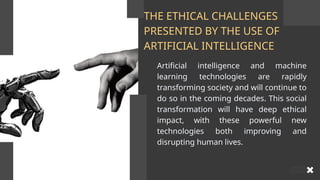
describe the practice of working at a specific
location, whether the employee’s home or an
alternate office, to reduce commuting time to a
centrally located office space or store.
TELECOMMUTING AND ITS ADVANTAGES
5.
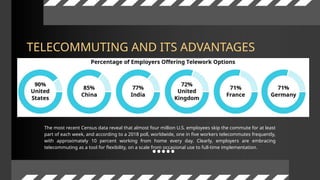
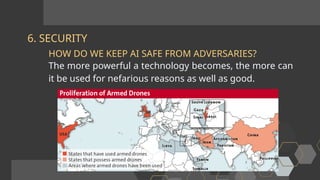
TELECOMMUTING AND ITSADVANTAGES
The most recent Census data reveal that almost four million U.S. employees skip the commute for at least
part of each week, and according to a 2018 poll, worldwide, one in five workers telecommutes frequently,
with approximately 10 percent working from home every day. Clearly, employers are embracing
telecommuting as a tool for flexibility, on a scale from occasional use to full-time implementation.
6.
BENEFITS OF PERMITTINGEMPLOYEES TO WORK FROM
HOME
• Flexibility and Agility
Home working enables more agility and flexibility in working
arrangements. With employees no longer tied to an office,
they may be better placed and more willing to work flexible
hours such as earlier or later in the day or even at weekends.
This may help you meet certain business needs eg if you are
trading with customers residing in a different time zone.
7.
BENEFITS OF PERMITTINGEMPLOYEES TO WORK FROM
HOME
• Improved employee retention
Home working can help retain employees as the flexibility of
home working can help them meet childcare needs, reduce
their commute and enable them to fit their work around
their personal life. Being allowed to work from home, staff
will also feel increased levels of trust from their employer,
which can contribute greatly to staff loyalty.
8.
BENEFITS OF PERMITTINGEMPLOYEES TO WORK FROM
HOME
• Increased productivity
Due to fewer interruptions, which would normally occur in an
office environment. By contrast, working from home allows
for a quieter environment that can facilitate more focused
work. You may also find that some employees may wish to
increase their paid contractual hours as they save time that
was previously spent commuting to and from the workplace.
9.
BENEFITS OF PERMITTINGEMPLOYEES TO WORK FROM
HOME
• Increased staff motivation
By working from home staff will feel more trusted by their
employer as the working relationship isn't as closely
monitored and employees are allowed a degree of autonomy
to get on with their work. Staff will also be happier
developing a home working routine that suits them better
and this can contribute towards them feeling more
motivated to give their best.
10.
BENEFITS OF PERMITTINGEMPLOYEES TO WORK FROM
HOME
• Improved staff health and wellbeing
Working from home eliminates the need for a commute to
work that can be stressful to your employees. Time savings
such as this also enables staff to get extra health benefits
such as additional sleep, spending more time with family,
exercising, or preparing healthier meals.
11.
BENEFITS OF PERMITTINGEMPLOYEES TO WORK FROM
HOME
• Financial benefits
Savings on office space, office supplies, utility bills and other
facilities. Staff may also be able to take advantage of the tax
relief available from HM Revenue & Customs (HMRC) for
working from home - see
claim tax relief for your job expenses - working from home
12.
BENEFITS OF PERMITTINGEMPLOYEES TO WORK FROM
HOME
• Better work/life balance
Savings on office space, office supplies, utility bills and other
facilities. Staff may also be able to take advantage of the tax
relief available from HM Revenue & Customs (HMRC) for
working from home - see
claim tax relief for your job expenses - working from home
13.
BENEFITS OF PERMITTINGEMPLOYEES TO WORK FROM
HOME
• Technology makes it easier
The internet has made it possible for staff to be continually
connected to the office. Tools such as Skype have made
communication between colleagues and teams much easier
and at times can lead to more efficient and effective
meetings.
14.
BENEFITS OF PERMITTINGEMPLOYEES TO WORK FROM
HOME
• Lower sickness absences
Staff are more likely to feel happier and more energised
working from home and therefore less chance of their
immune system being negatively impacted by burnout. Also
the fact that employees are working in isolation there is less
chance of infections spreading as would be the case within
an office environment.
15.
DISADVANTAGES OF EMPLOYEESWORKING FROM
HOME
• Working from home doesn't suit everyone
• Staff feeling isolated
• Difficulty monitoring performance
• Home distractions
• Cost of working from home
• Information security risk
16.
DISADVANTAGES OF EMPLOYEESWORKING FROM
HOME
• Negative impact on mental health
• Decreased staff morale
• Poor broadband speeds
17.
ETHICAL DILEMMAS RELATEDTO TELECOMMUTING
AND SOME OF THE SOLUTIONS
Privacy Concerns
Fair Compensation
Work-Life Balance
Isolation and Loneliness
Security Risks
18.
ETHICAL DILEMMAS RELATEDTO TELECOMMUTING
AND SOME OF THE SOLUTIONS
Performance Monitoring
Environmental Impact
Work-Life Balance
Isolation and Loneliness
Security Risks
Performance Monitoring
19.
WORKPLACE CAMPUSES
Physical Presence
WORKPLACEOF YESTERDAY (HISTORICAL PERSPECTIVE):
In the workplace of yesterday, physical presence at a
centralized office location was the norm. Employees typically
worked fixed hours and commuted daily.
Hierarchical Structure
Hierarchies were prevalent, with clear chains of command
and limited opportunities for collaboration across
departments or teams.
20.
WORKPLACE CAMPUSES
Paper-Based Processes
WORKPLACEOF YESTERDAY (HISTORICAL PERSPECTIVE):
Documentation and communication relied heavily on physical
paperwork, resulting in slower processes and limited
accessibility to information.
Rigid Workspaces
Employees often had assigned desks or cubicles, and there
was little flexibility in terms of where or how work could be
done.
21.
WORKPLACE CAMPUSES
Limited Technology
WORKPLACEOF YESTERDAY (HISTORICAL PERSPECTIVE):
Technology was basic, with limited access to computers, the
internet, and digital tools. Communication primarily occurred
through phone calls and in-person meetings.
Job Security
Job security was often high, and long-term employment with
a single company was common.
22.
WORKPLACE CAMPUSES
Remote andHybrid Work
WORKPLACE OF TODAY (CURRENT PERSPECTIVE)
Remote work and flexible work arrangements have become
more common, allowing employees to work from different
locations and offering greater work-life balance.
Flatter Organizations
Many companies have moved towards flatter organizational
structures, promoting teamwork, cross-functional
collaboration, and a more agile approach.
23.
WORKPLACE CAMPUSES
Digital Transformation
WORKPLACEOF TODAY (CURRENT PERSPECTIVE)
The workplace of today relies heavily on digital tools and
platforms for communication, project management, and
collaboration.
Flexible Workspaces
Open office plans, co-working spaces, and hot desking are
more common, providing employees with more choice in
where they work.
24.
WORKPLACE CAMPUSES
Technology Integration
WORKPLACEOF TODAY (CURRENT PERSPECTIVE)
Advancements in technology, including AI, automation, and
cloud computing, have reshaped how work is done, with a focus
on efficiency and data-driven decision-making.
Gig Economy
The gig economy has grown, with more contract and
freelance workers, and a shift away from traditional full-time
employment.
25.
WORKPLACE CAMPUSES
Hybrid WorkNorm
WORKPLACE OF THE FUTURE (PREDICTED TRENDS):
The future workplace is expected to continue embracing hybrid
work models, with employees splitting their time between
remote and office work.
AI and Automation:
Artificial intelligence and automation will play a larger role,
handling routine tasks and allowing employees to focus on
creative and strategic work.
26.
WORKPLACE CAMPUSES
Virtual andAugmented Reality
WORKPLACE OF THE FUTURE (PREDICTED TRENDS):
These technologies will enable virtual meetings, training,
and simulations, reducing the need for physical presence
Wellness and Mental Health
Employers will prioritize employee well-being, offering
mental health resources and flexible schedules to support a
healthier work-life balance.
27.
WORKPLACE CAMPUSES
Sustainability
WORKPLACE OFTHE FUTURE (PREDICTED TRENDS):
There will be a greater emphasis on sustainable and eco-
friendly practices in the workplace, from energy-efficient
buildings to eco-conscious supply chains.
Diversity and Inclusion
Companies will strive for more inclusive and diverse
workforces, promoting equity and belonging among
employees.
28.
WORKPLACE CAMPUSES
Continuous Learning
WORKPLACEOF THE FUTURE (PREDICTED TRENDS):
Lifelong learning and upskilling will be essential as job roles
evolve rapidly due to technological advancements.
Data Privacy and Security:
Protecting sensitive data and ensuring privacy in an
increasingly digital workplace will be a top priority.
29.
WORKPLACE CAMPUSES
Continuous Learning
WORKPLACEOF THE FUTURE (PREDICTED TRENDS):
Lifelong learning and upskilling will be essential as job roles
evolve rapidly due to technological advancements.
Data Privacy and Security:
Protecting sensitive data and ensuring privacy in an
increasingly digital workplace will be a top priority.
30.
THE ETHICAL CHALLENGES
PRESENTEDBY THE USE OF
ARTIFICIAL INTELLIGENCE
Artificial intelligence and machine
learning technologies are rapidly
transforming society and will continue to
do so in the coming decades. This social
transformation will have deep ethical
impact, with these powerful new
technologies both improving and
disrupting human lives.
2. INEQUALITY
Our economicsystem is based on compensation for
contribution to the economy, often assessed using an hourly
wage. The majority of companies are still dependent on
hourly work when it comes to products and services.
HOW DO WE DISTRIBUTE THE WEALTH CREATED BY
MACHINES?
33.
3. HUMANITY
Machines havetransformed the way we communicate, access
information, perform tasks, make decisions, and maintain our
health. While these changes offer numerous benefits, they also
present challenges that require careful consideration and
responsible use.
HOW DO MACHINES AFFECT OUR BEHAVIOUR AND
INTERACTION?
34.
4. ARTIFICIAL STUPIDITY
Intelligencecomes from learning, whether you’re human or
machine. Systems usually have a training phase in which they "learn"
to detect the right patterns and act according to their input. Once a
system is fully trained, it can then go into test phase, where it is hit
with more examples and we see how it performs.
HOW CAN WE GUARD AGAINST MISTAKES?
35.
5. RACIST ROBOTS
Thoughartificial intelligence is capable of a speed and
capacity of processing that’s far beyond that of
humans, it cannot always be trusted to be fair and
neutral.
HOW DO WE ELIMINATE AI BIAS?
36.
6. SECURITY
The morepowerful a technology becomes, the more can
it be used for nefarious reasons as well as good.
HOW DO WE KEEP AI SAFE FROM ADVERSARIES?
37.
7. EVIL GENIES
Themore powerful a technology becomes, the more can
it be used for nefarious reasons as well as good.
HOW DO WE PROTECT AGAINST UNINTENDED
CONSEQUENCES?
38.
8. SINGULARITY
Human dominanceis almost entirely due to our
ingenuity and intelligence. We can get the better of
bigger, faster, stronger animals because we can create
and use tools to control them: both physical tools such
as cages and weapons, and cognitive tools like training
and conditioning.
HOW DO WE STAY IN CONTROL OF A COMPLEX INTELLIGENT
SYSTEM?
39.
9. ROBOT RIGHTS
Whileneuroscientists are still working on unlocking the
secrets of conscious experience, we understand more
about the basic mechanisms of reward and aversion.
HOW DO WE DEFINE THE HUMANE TREATMENT OF AI?