southasiadisasters.net
August 2017 1
southasiadisasters.net August 2017
2
ABOUT THIS ISSUE
INTRODUCTION
Floods as an Opportunity
In 2017 South Asia was ravaged by
unprecedented flooding that affected
close to 41 million people across India,
Bangladesh and Nepal. While the death
and destruction unleashed by these
floods is tragic, it also represents an
opportunity to learn the necessary
lessons to set South Asia firmly onto a
safer and greener development trajectory.
By highlighting the existing gaps in the
response, preparedness and relief
activities undertaken by various state
and non-state actors the key problems
have been identified. This present issue
of Southasiadisasters.net aims to just that.
Local flood studies that explore and
account for local action, results, and
opportunities are needed to build up
bottom up knowledge resources for
South Asia wide actions on floods.
River basin or national flood plans are
a first step but not enough any more.
AIDMI's recent work in Nepal and
Bangladesh finds that two items in
flood management can be made more
effective. One, delivering flood
management results and two, working
in partnership with government and
non-government actors in flood
management. There two need more
attention.
It is time to move ahead from project
and programme approach to systemic
approach to flood management and
mitigation. In recent years, the political
leadership has greatly influenced
national and sub-national priorities and
processes of development. How can
these influences be directed to
unfinished development agendas such
as decentralised and ecosystem-based
flood mitigation in a time bound manner?
Floods simply do not result in the
inundation of an area alone; they also
result in the displacement of people,
halting of economic activity and
largescale livelihood disruption. These
are just a few of the detrimental impacts
of floods which pose a challenge to the
local and national institutions. It is time
to look ahead to even greater systemic
challenges — poor connectivity, limited
role of private sector, and knowledge
management — and start evolving
suitable solutions for them till 2030.
Floods do not spare the hotspots of
terrorism or conflict and as a result pose
a threat to people and prosperity in
recovery. Estimates suggest over 100
districts in India alone suffer from such
a double threat. Almost each country
in South Asia has similar conflict
affected areas. Thus, floods impact local
security, governance, and human rights
protection.
Local faith based organisation can be
brought in more directly to think find
a way out. In India Shri Sadguru has
taken on initiative titled "Save our
rivers" that can be one such example.
In Colombo, Partnership for Faith and
Development is organising largest ever
event titled “Localizing Response to
Humanitarian Need: The Role of
Religious and Faith-based
Organisations”, October 16 to 18, 2017,
for local faith organisations.
For years Asian Disaster Preparedness
Center (ADPC) in Bangkok has run
regional training courses on disaster
management providing necessary and
fundamental knowledge and skills in
flood risk management. Inputs for first
sources came from Duryog Nivaran.
Perhaps it is time to take such capacity
building initiatives to empower local
communities with the adequate
response and preparedness capacities to
respond to the challenges of flooding.
Traditional knowledge systems for
flood management have existed for
centuries in South Asia. It is vital that
we leverage this traditional wisdom
and use it in conjunction with modern
DRR techniques. One of the most
eminent scenographers of our times,
Rajeev Sethi, calls South Asia's legacy
of traditional knowledge systems,
including of local flood management,
has awed the world but will wither away
if not conserved. – Mihir R. Bhatt
In 2017, South Asia was
ravaged by devastating
floods that caused
widespread death and
destruction. It has been
estimated that these floods
have led to 1,200 casualties
and affected 40 million
people across India, Nepal
and Bangladesh. India is
perhaps one of the most
flood prone countries in the
world. The 2017 floods have
raised some very serious and
inconvenient questions
about the country's
preparedness to such floods.
This issue of
Southasiadisasters.net is titled
"India Floods 2017" and
focuses on how the floods in
2017 have affected different
regions of country and the
damage suffered by them. It
also tries to examine India's
underlying vulnerability to
floods which has been
exacerbated in recent years
mainly due to unplanned
development, high
population density &
settlement of people in flood
plains, old infrastructure,
weak river embankments
and also increase in extreme
events, including high
rainfall in a short duration.
This issue analyses these
repeated incidents of
flooding in the country
through a systemic lens that
takes an interdisciplinary
and multi-sectoral
perspective of India's
flooding problem.
– Kshitij Gupta
southasiadisasters.net
August 2017 3
EFFECTIVE PREPAREDNESS
Note on Flood Situation
Bihar, Assam, Uttar Pradesh and
Arunachal Pradesh continue to
bear the brunt of floods as the death
toll rises. According to the state
disaster management authorities of
Uttar Pradesh and Bihar, 415 people
have died in the floods in two states
where more than 10 million people
were affected.
According to the Bihar State Disaster
Management Authority (BSDMA)
229,000 people had been
rehabilitated across 1,085 relief
camps in the state. Even Prime
Minister Narendra Modi conducted
an aerial survey to assess the extent
of flood damage on Saturday.
"We have 21 teams that are working
across Uttar Pradesh and several
teams working in Bihar. With
assistance from the Indian Air Force,
a lot of affected people have been
airlifted to safety. The relief and
rescue operations are ongoing in
both states," a National Disaster
Response Force (NDRF) release
stated.
A home ministry official stated that
even though relief work was
ceaselessly being carried out across
both states in the flood affected
districts, the overflowing of several
rivers and constant rains tended to
slow down rescue operations.
Besides claiming hundreds of lives,
the floods have also destroyed
villages and crops across the north-
eastern region. Hundreds of
thousands of people across several
states are living in relief camps.
But it is not just humans, thousands
of animals including cattle are also
suffering and fighting for their lives.
Meanwhile, the death toll from
floods sweeping entire South Asia
has climbed above 1,000
notwithstanding the brave efforts of
the rescue teams who have done an
exceptional job to reach out to
millions of stranded people by the
region's worst monsoon disaster in
recent years.
Thousands of army soldiers and
disaster management force and para
military troops have been deployed
across India, Bangladesh and Nepal,
where authorities say a total of 1,013
bodies have been recovered since 10
August, when intense rainfall begun
causing floods in Indian states and
neighbouring Nepal and
Bangladesh.
Though all three countries suffer
frequent flooding during the
monsoon rains, the Red Cross has
termed the latest disaster as "the
worst in decades" in some parts of
South Asia. It says entire
communities have been cut off and
many are short of food and clean
water as the tragedy prolongs
amidst continuing rains.
"It has been a difficult year," said
Anil Shekhawat, spokesman for
India's National Disaster Response
Force (NDRF). "In the last few
months there have been floods in
western, eastern and northern parts
of the country," Shekhawat said.
In Bihar, the state disaster
management authorities said death
toll climbed to 367. According to
Anirudh Kumar, a top state disaster
management official, there are still
nearly 11 million people affected in
19 districts of the state. He added
nearly 450,000 flood evacuees had
taken shelter in government refuges.
In neighbouring Uttar Pradesh,
floods have swamped nearly half of
this vast state of 220 million, the
country's most populous region.
Disaster management agency
spokesman Mr. T.P. Gupta said that
86 people had died and more than
two million were affected by the
disaster there.
The state borders Nepal, where 146
people have died and 80,000 homes
destroyed in what the United
Nations is calling the worst flooding
in 15 years. Nepal's home ministry
warned the death toll could rise as
relief teams reach more remote parts
of the impoverished country.
The situation was slowly easing in
West Bengal and Assam, two states
where 223 people had already died.
Floods in Assam—the second wave
to hit the state in less than four
months—have wrought widespread
destruction, killing 71 people and
forcing animals to seek higher
ground. One Bengal tiger and 15 rare
one-horned rhinos were found dead
and conservationists feared there
could be further loss of life.
In West Bengal, where 152 people
have died, hundreds of thousands
have escaped submerged villages by
boats and makeshift rafts to reach
government aid stations set up by
the state administration.
Across the border in Bangladesh,
water levels were slowly returning
to normal in the main Brahmaputra
and Ganga rivers. The government's
disaster response body said the death
toll stood at 137, with more than 7.5
million affected since flooding hit
the riverine nation.
Every year hundreds die in
landslides and floods during the
monsoon season that hits India's
southern tip in early June and sweeps
across the South Asia region for four
months.
– AIDMI Team
southasiadisasters.net August 2017
4
REDUCING RISK
India Floods 2017
Floods have been a recurrent
phenomenon in India that lead
to huge losses to lives, properties,
livelihood systems, infrastructure
and public utilities. As a matter of
fact, 12% of the total landmass of the
country (40 million hectare) is flood
prone1.
Furthermore, as on August 18, 2017,
25 states2 in the country are
susceptible to floods, the most
vulnerable States are Assam, Bihar,
Uttar Pradesh, Gujarat, West Bengal,
Madhya Pradesh, Odisha, Andhra
Pradesh, Maharashtra, Punjab and
Jammu & Kashmir. Similarly as
many as 137 districts3 are vulnerable
to floods.
In the recent years, the vulnerability
of the states to floods has increased
exponentially, mainly due to
unplanned development, high
population density & settlement of
people in flood plains, old
infrastructure, weak river
embankments and also increase in
extreme events, including high
rainfall in a short duration. In July
2017, India experienced yet another
wave of flooding due to excessive
rains in the monsoon season. The
states of Assam, Gujarat, Rajasthan,
Odisha, Madhya Pradesh, Tripura
and West Bengal faced massive
floods in many parts, which led to
human casualties in hundreds,
extensive damage to infrastructure
and also severely affected the
animals. The Inter-Ministerial
Central Team visited Assam to take
stock of situation, and Prime
Minister Mr. Modi himself visited
Gujarat flood affected areas. It shows
seriousness at the apex level.
The cumulative rainfall was
recorded in excess, in June and July
2017, in most States of India. In India,
Central Water Commission is Nodal
Agency for flood forecasting. They
have at present 221 Flood
Forecasting Stations4 spread across
24 States & UTs. They are expected
to provide flood advisories to State
Governments with help of IMD.
Country also has National Guidelines
for Management of Floods (2008,
NDMA). However there is a long
way to go for flood prevention and
mitigation in India. It's high time to
take concrete actions by all concerned
agencies on the ground to address
this pertinent issue.
Gujarat Floods
Incessant torrential rain due to
simultaneous activation of Arabian
Sea and Bay of Bengal low-pressure
systems (a rare phenomenon) has
resulted into floods in many part of
Gujarat this year. Districts of
Banaskantha, Patan, Rajkot,
1 NDMA Guidelines 2008
2 BMTPC Vulnerability Atlas 2007
3 Flood Management Module, NIDM, 2012
4 Central Water Commission Website
5 https://sphereindiablog.files.wordpress.com/2017/07/28-07-2017-sitrep-2-situation-reports-in-india.pdf (July 28, 2017)
6 http://ahmedabadmirror.indiatimes.com/news/india/rains-batter-ahmedabad-gandhinagar-over-54000-relocated/
articleshow/59797361.cms (July 27, 2017)
7 http://timesofindia.indiatimes.com/city/ahmedabad/rs-6-lakh-compensation-for-kin-of-deceased/articleshow/
59780580.cms (July 27, 2017)
8 http://www.business-standard.com/article/economy-policy/torrential-rain-flood-damage-25-kharif-sowing-in-gujarat-
117072700069_1.html (July 27, 2017)
Surendranagar, Ahmedabad, Morbi,
Gandhinagar, Kutch, Mehsana and
Valsad are hit by the large-scale
flooding. Banaskantha and Patan are
among the worst-hit districts in the
state due to heavy rains and flooding
of the Banas and Sipu rivers.
Dhanera block Banaskatha district
was worst affected and was
inaccessible therefore the damages
are estimated to be higher in the
block as reported by IAG members5.
The floods have impacted lives and
livelihoods, including education and
public transportation by damaging
roads, highways, rail lines and
airports. Besides the State Disaster
Response Force and fire brigade
personnel, the National Disaster
Response Force (NDRF), the Air
Force and the Army were deployed
for the rescue of marooned villagers.
According to state administration
officials 54,517 people were shifted
to safer places over the last one-week
due to flooding of low-lying areas6.
So far, 119 deaths have been reported
from across the state since monsoon
began7. 'Torrential rain and flooding,
especially in north and Saurashtra,
have resulted in at least 25 per cent
loss in kharif sowing across crops
such as cotton, groundnut, castor,
pulses, guar and cereals.'8 About 492
villages have no power supply, out
southasiadisasters.net
August 2017 5
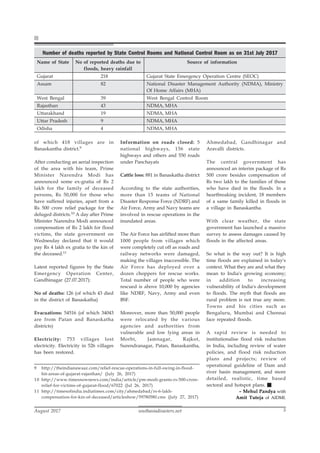
Number of deaths reported by State Control Rooms and National Control Room as on 31st July 2017
Name of State No of reported deaths due to Source of information
floods, heavy rainfall
Gujarat 218 Gujarat State Emergency Operation Centre (SEOC)
Assam 82 National Disaster Management Authority (NDMA), Ministry
Of Home Affairs (MHA)
West Bengal 39 West Bengal Control Room
Rajasthan 43 NDMA, MHA
Uttarakhand 19 NDMA, MHA
Uttar Pradesh 9 NDMA, MHA
Odisha 4 NDMA, MHA
of which 418 villages are in
Banaskantha district.9
After conducting an aerial inspection
of the area with his team, Prime
Minister Narendra Modi has
announced some ex-gratia of Rs 2
lakh for the family of deceased
persons, Rs 50,000 for those who
have suffered injuries, apart from a
Rs 500 crore relief package for the
deluged districts.10 A day after Prime
Minister Narendra Modi announced
compensation of Rs 2 lakh for flood
victims, the state government on
Wednesday declared that it would
pay Rs 4 lakh ex gratia to the kin of
the deceased.11
Latest reported figures by the State
Emergency Operation Center,
Gandhinagar (27.07.2017):
No of deaths: 126 (of which 43 died
in the district of Banaskatha)
Evacuations: 54516 (of which 34043
are from Patan and Banaskatha
districts)
Electricity: 753 villages lost
electricity. Electricity in 526 villages
has been restored.
Information on roads closed: 5
national highways, 156 state
highways and others and 550 roads
under Panchayats
Cattle loss: 881 in Banaskatha district
According to the state authorities,
more than 15 teams of National
Disaster Response Force (NDRF) and
Air Force, Army and Navy teams are
involved in rescue operations in the
inundated areas.
The Air Force has airlifted more than
1000 people from villages which
were completely cut off as roads and
railway networks were damaged,
making the villages inaccessible. The
Air Force has deployed over a
dozen choppers for rescue works.
Total number of people who were
rescued is above 10,000 by agencies
like NDRF, Navy, Army and even
BSF.
Moreover, more than 50,000 people
were relocated by the various
agencies and authorities from
vulnerable and low lying areas in
Morbi, Jamnagar, Rajkot,
Surendranagar, Patan, Banaskantha,
9 http://theindianawaaz.com/relief-rescue-operations-in-full-swing-in-flood-
hit-areas-of-gujarat-rajasthan/ (July 26, 2017)
10 http://www.timesnownews.com/india/article/pm-modi-grants-rs-500-crore-
relief-for-victims-of-gujarat-flood/67022 (Jul 26, 2017)
11 http://timesofindia.indiatimes.com/city/ahmedabad/rs-6-lakh-
compensation-for-kin-of-deceased/articleshow/59780580.cms (July 27, 2017)
Ahmedabad, Gandhinagar and
Aravalli districts.
The central government has
announced an interim package of Rs
500 crore besides compensation of
Rs two lakh to the families of those
who have died in the floods. In a
heartbreaking incident, 18 members
of a same family killed in floods in
a village in Banaskantha.
With clear weather, the state
government has launched a massive
survey to assess damages caused by
floods in the affected areas.
So what is the way out? It is high
time floods are explained in today's
context. What they are and what they
mean to India's growing economy;
in addition to increasing
vulnerability of India's development
to floods. The myth that floods are
rural problem is not true any more.
Towns and his cities such as
Bengaluru, Mumbai and Chennai
face repeated floods.
A rapid review is needed to
institutionalise flood risk reduction
in India, including review of water
policies, and flood risk reduction
plans and projects; review of
operational guideline of Dam and
river basin management, and more
detailed, realistic, time based
sectoral and hotspot plans.
– Mehul Pandya with
Amit Tuteja of AIDMI.
southasiadisasters.net August 2017
6
SUSTAINABLE RECOVERY
Floods in Bihar in 2017
The flooding situation
experienced by India is
deteriorating severely. The floods
wreaked havoc in the states of Assam,
Odisha, Gujarat, West Bengal and
Manipur. They are now unleashing
their wrath on the state of Bihar.
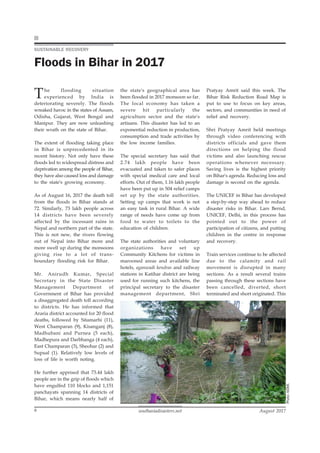
The extent of flooding taking place
in Bihar is unprecedented in its
recent history. Not only have these
floods led to widespread distress and
deprivation among the people of Bihar,
they have also caused loss and damage
to the state's growing economy.
As of August 16, 2017 the death toll
from the floods in Bihar stands at
72. Similarly, 73 lakh people across
14 districts have been severely
affected by the incessant rains in
Nepal and northern part of the state.
This is not new, the rivers flowing
out of Nepal into Bihar more and
more swell up during the monsoons
giving rise to a lot of trans-
boundary flooding risk for Bihar.
Mr. Anirudh Kumar, Special
Secretary in the State Disaster
Management Department of
Government of Bihar has provided
a disaggregated death toll according
to districts. He has informed that
Araria district accounted for 20 flood
deaths, followed by Sitamarhi (11),
West Champaran (9), Kisanganj (8),
Madhubani and Purnea (5 each),
Madhepura and Darbhanga (4 each),
East Champaran (3), Sheohar (2) and
Supual (1). Relatively low levels of
loss of life is worth noting.
He further apprised that 73.44 lakh
people are in the grip of floods which
have engulfed 110 blocks and 1,151
panchayats spanning 14 districts of
Bihar, which means nearly half of
the state's geographical area has
been flooded in 2017 monsoon so far.
The local economy has taken a
severe hit particularly the
agriculture sector and the state's
artisans. This disaster has led to an
exponential reduction in production,
consumption and trade activities by
the low income families.
The special secretary has said that
2.74 lakh people have been
evacuated and taken to safer places
with special medical care and local
efforts. Out of them, 1.16 lakh people
have been put up in 504 relief camps
set up by the state authorities.
Setting up camps that work is not
an easy task in rural Bihar. A wide
range of needs have come up from
food to water to toilets to the
education of children.
The state authorities and voluntary
organizations have set up
Community Kitchens for victims in
marooned areas and available line
hotels, aganwadi kendras and railway
stations in Katihar district are being
used for running such kitchens, the
principal secretary to the disaster
management department, Shri
Pratyay Amrit said this week. The
Bihar Risk Reduction Road Map is
put to use to focus on key areas,
sectors, and communities in need of
relief and recovery.
Shri Pratyay Amrit held meetings
through video conferencing with
districts officials and gave them
directions on helping the flood
victims and also launching rescue
operations whenever necessary.
Saving lives is the highest priority
on Bihar's agenda. Reducing loss and
damage is second on the agenda.
The UNICEF in Bihar has developed
a step-by-step way ahead to reduce
disaster risks in Bihar. Lars Bernd,
UNICEF, Delhi, in this process has
pointed out to the power of
participation of citizens, and putting
children in the centre in response
and recovery.
Train services continue to be affected
due to the calamity and rail
movement is disrupted in many
sections. As a result several trains
passing through these sections have
been cancelled, diverted, short
terminated and short originated. This
Photo:
AIDMI.
southasiadisasters.net
August 2017 7
means delay in the supply of relief
materials to the victims.
Bihar is a leader in forging civil
society partnership for disaster risk
reduction in India. In these floods
the state is making its relief
governance more responsive,
decision making more decentralized,
and civil society participation wider.
Shri Surya Prakash, faculty at
National Institute of Disaster
Management (NIDM) and a flood
and drought expert has argued for
reaching out to local networks and
private sector establishments for
flood relief and recovery.
The following are possible key ways
to address the challenges and looking
beyond relief: building resilience.
1. Disaster insurance, if suitably
designed, can be a valuable risk
management tool to support
adaptation. Bihar can show the
way to other states of India by
designing disaster insurance
pilot in at least 7 to 10 districts.
2. Looking at high flood risk
reducing the number of affected
people and direct disaster related
economic loss is challenging.
Bihar needs to build a better
understanding to deal with loss
and damage due to extreme
events such as floods. Bihar may
not have effective DRR investment
without building understanding
and database on loss and damage
across its governance system.
3. Bihar has shown a strong
performance of building
awareness on school safety. This
performance needs to be continued
by capacity development actions
for making key schools and
hospitals safer in Bihar.
'Remember that relief is the enemy
of recovery, so minimize relief to
maximize recovery' said by Otto
Koenigsberger (1978).
– Vishal Pathak and
Vipul Nakum of AIDMI.
Between the night of 28th August
and the sundown of 29th August
2017, Mumbai once again witnessed
a deluge. The city received
precipitation amounting to 315 m.m.
in 12 hours, the heaviest since the
downpour of 26th July 2005 (944
m.m.). Normalcy was disrupted in
this "busier than the bee" metropolis.
Suburban trains, supposed to be the
life-lines of Mumbai, came to a
standstill in most sectors of the
network serviced by three different
lines. Water-logging resulted in to
most other public transport systems
also coming to a grinding halt in the
middle of their journeys.
This resulted in to people getting
stranded in places they were visiting
or working at. Most people were far
from their homes. Family members
were in different places in the city.
There was chaos. Pedestrians waded
through waters with the fear of
getting drowned or getting sucked
in manholes. The official agencies
were alert and well spread out in
the city. However, what was
striking this time was the selfless
help offered by individuals,
voluntary organisations and self-
motivated groups (either residential
societies or religious groups).
What they offered was amazingly
simple and practical. They offered
facilities to trapped commuters to
relieve themselves from nature's
calls. They offered place to rest, even
lie down. Large community halls,
auditoria were converted to
dormitories for tired people who
had no choice but to wade back
home through knee–deep waters.
They also offered snacks, meals, tea,
coffee and water. Mobile numbers
of individuals or organisations were
broadcast by WhatsApp messages to
be called for emergencies and
rescue. Most messages were warm
and welcoming.
SUSTAINABLE RECOVERY
Mumbai Deluge and the Civil
Society
A sampler of one such message read
like this: "We stay at Matunga /
Dadar (East) very close to both the
stations. Anyone needing help in
any manner whatsoever, including
stay, meals, need to use washroom,
dry clothes, etc. for self, family or
friends, please feel free to connect
to–(Two numbers were given)... Be
safe and enjoy the rains. Regards,
(two names of citizens)."
All the religious organisations also
played their role by offering space
to relax, relieve and refresh for people
on seeking respite from the water–
logged streets of the "over planned"
city. In this case also, though the
resources might be of the organisations,
the initiative and efforts were of
volunteers from the civil society.
Among these religious groups were
Jain groups, Christian churches, Sikh
Gurudwaras and Hindu temples.
The municipal corporation had
published the contact numbers of
the disaster management control
rooms of all the wards. And, during
and after the downpour, hundreds
of citizens posted messages
reporting about trapped citizens
requiring help, learning from which,
police and other rescue workers
reached these sites.
In my opinion, this is what is known
as Community Based Disaster
Management (CBDM): owned,
managed and controlled largely by
the civil society on its own initiative.
It reflects love for fellow citizens,
concern for the discomforted,
sensitivity towards needs of others,
warmth of fraternity and faith in
humanity. This takes us a step
forward in the process of
strengthening the civil society vis-
à-vis the State and the Market. This
is surely a sign of progress.
– Rajesh Bhat, Managing Trustee,
Swapath Trust, Ahmedabad
southasiadisasters.net August 2017
8
Floods are not new to Assam. The
people of the state are so used to
floods in the monsoons that it is
almost called the 'flood season' in
Assam. What is new is the duration
and severity of these floods in 2017.
As on August 19, 2017, in what seems
to be the state's worst deluge in three
decades, the death toll in the second
wave of floods rose to 15, with 10
more deaths reported on last
Sunday. With over 10 lakh people
affected, the total number of flood
victims shot up to 15 lakh across 21
out of 27 districts in Assam. Over
85% of the Kaziranga National Park
(KNP) was inundated causing loss of
wild life.
Relief camps are not easy to set up
in flood hit Assam as roads get
submerged, delaying supplies and
raising the number of affected people.
More than 1.83 lakh displaced
people have taken shelter in 439
relief camps. Rescue operations by
the Army, Indian Air Force,
National Disaster Response Force
and the State Disaster Response
Force personnel are underway, said
state project co-coordinator of Assam
State Disaster Management
Authority (ASDMA) Rajib Prakash
Baruah. About 3,000 villagers were
rescued and shifted to relief camps
on Sunday, said defence PRO Lt Col
S Newton of Armed Forces.
ECHO has offered Euro 200,000 to
IFRC to respond to the needs of the
most vulnerable 25,000 individuals
in Assam. Focus is on reducing
suffering of these individuals. Local
civil society has shown rapid
response with Inter Agency Group
calling coordination meetings for
relief distribution. Sphere India has
taken measures to coordinate relief
efforts in Assam.
UNICEF in Assam has focused on
children and their role in flood
response.
Besides Assam, incessant rain in the
last five days has wreaked havoc in
Meghalaya and claimed three lives.
Nearly 800 people were rendered
homeless in South and West Garo
Hills district in western Meghalaya,
officials said. There were reports of
flash floods and landslides in different
parts of Khasi Hills causing loss of
agriculture and local horticulture.
Dr. Muzaffar Ahmed, Ex-member
NDMA, has suggested relief as an
investment into resilience to floods.
This includes not only investments
in recovery but also in risk transfer
and micro-insurance.
Dr. Santosh Kumar, policy and
planning faculty at National Institute
of Disaster Management (NIDM), has
often called for an HRD plan for the
states to continuously improve the
quality of humanitarian response.
Flood fury has claimed at least three
lives and affected over five lakh
people in West Bengal. Rail and road
communication has been severely hit.
Cooch Behar district was virtually cut
off from the rest of India with
vehicular and train movement coming
to a stop. Around 2.87 lakh people
were displaced in Cooch Behar, and
another two lakh in Jalpaiguri and
Alipurduar districts and over 50,000
were hit in Malda, North Dinajpur,
Darjeeling and South Dinajpur
district. World Bank has taken initial
steps to reach out to these victims with
food, water and other relief supplies.
The ASDMA is one of the few state
authorities in India to have picked
up the integration of Disaster Risk
Reduction (DRR) and Climate
Change Adaptation (CCA) in all its
work.
SUSTAINABLE RECOVERY
Floods in Assam in 2017
Overall, as many as 20 states in the
country have been affected during
the current southwest monsoon
season in the country. According to
the available information, 600
people have lost their lives; 24,811
cattle heads have perished; 63,215
houses/huts damaged and about 2.8
lakh hectare of crop reportedly
affected due to heavy rains; floods
and landslides. Data is still being
gathered and compiled to get a
clearer picture of the loss and
damage brought about by these
floods.
Assam has plans, people, and
resources to respond to the
challenge. What may be added is
expert third party monitoring and
evaluation (M&E).
Assam has taken up several
initiatives to improve its response
and preparedness capacities against
disasters particularly – floods and
earthquakes. These includes but is
not limited to a series of city-wide
emergency management exercises;
training, mock drills and plan of
disaster management in schools in
all the districts; community-based
early warning; developing and
reviewing the district disaster
management plans; and a review of
flood studies.
Possible key steps that can support
the flood preparedness in the state
include higher investment on flood
protection; strong actions to protect
wetlands; introducing water storage
areas; closer and stronger linked
DRR and CCA actions; constructing
buildings above flood levels (it is in
the tradition of the Assam that needs
to remind in current time); and
stronger implementation of land
usage (for construction) norms.
– Vandana Chauhan and
Vishal Pathak of AIDMI.
southasiadisasters.net
August 2017 9
memories of the most devastating
urban flooding in India's recent
history,2 the 'deluge' of Mumbai in
2005, wherein record rainfall (944
mm within 24 hours) precipitated a
disaster that caused hundreds of
fatalities and massive economic
damages.
The complex picture of this disaster
is bigger than climate change
Climate change, in both the cities
cases, is held in parts responsible for
precipitating more intense and
extreme weather events that
contribute to disasters. On the other
hand, scientific uncertainties remain
regarding how far climate change
can be held accountable for specific
regional or local weather events.
CLIMATE CHANGE AND DRR
A Tale of Two Cities: Flooding in Houston and
Mumbai — Time to Learn?
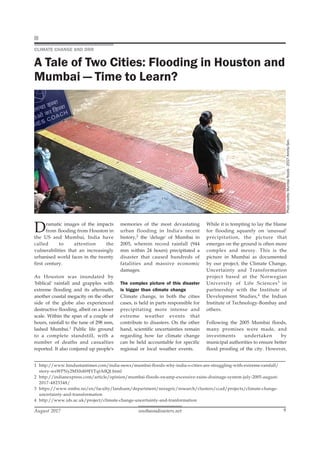
Photo
credits:
Mumbai
floods
-
2017:
Amrita
Sen.
Dramatic images of the impacts
from flooding from Houston in
the US and Mumbai, India have
called to attention the
vulnerabilities that an increasingly
urbanised world faces in the twenty
first century.
As Houston was inundated by
'biblical' rainfall and grapples with
extreme flooding and its aftermath,
another coastal megacity on the other
side of the globe also experienced
destructive flooding, albeit on a lesser
scale. Within the span of a couple of
hours, rainfall to the tune of 298 mm,
lashed Mumbai.1 Public life ground
to a complete standstill, with a
number of deaths and casualties
reported. It also conjured up people's
While it is tempting to lay the blame
for flooding squarely on 'unusual'
precipitation, the picture that
emerges on the ground is often more
complex and messy. This is the
picture in Mumbai as documented
by our project, the Climate Change,
Uncertainty and Transformation
project based at the Norwegian
University of Life Sciences3 in
partnership with the Institute of
Development Studies,4 the Indian
Institute of Technology-Bombay and
others.
Following the 2005 Mumbai floods,
many promises were made, and
investments undertaken by
municipal authorities to ensure better
flood proofing of the city. However,
1 http://www.hindustantimes.com/india-news/mumbai-floods-why-india-s-cities-are-struggling-with-extreme-rainfall/
story-wsWPNy2MXh4b9JYTqtA0QJ.html
2 http://indianexpress.com/article/opinion/mumbai-floods-swamp-excessive-rains-drainage-system-july-2005-august-
2017-4823348/
3 https://www.nmbu.no/en/faculty/landsam/department/noragric/research/clusters/ccad/projects/climate-change-
uncertainty-and-transformation
4 http://www.ids.ac.uk/project/climate-change-uncertainty-and-tranformation
southasiadisasters.net August 2017
10
more than a decade later, the
dominant approaches of urban
governance and development have
not changed much at all and chronic
water logging and flooding remain
a yearly occurrence.
The disappearance of flood plains
and patches, protective mangrove
cover, coastal wetlands, and massive
infrastructure expansion on the
fragile coastline continue unabated.
Major drainage channels remain
obstructed and sky-high real estate
prices drive contractors to
appropriate and develop land in
low-lying and flood prone zones.
All of these aggravate threats from
natural disasters and reveal a
structurally unequal city wherein the
poor, who constitute a large
proportion of the city's population,
regularly face the brunt from the
double impacts of development
interventions (e.g displacement, loss
of livelihoods) and flooding.
Flood mitigation strategies in
Mumbai rely dominantly on built-
up infrastructure (e.g pump stations,
embankments, renovating storm
water drains) but, as evidenced yet
again, have had only very limited
success. Often, these interventions
serve to shift points of inundation
from one area to another, creating
new vulnerable hotspots. Arguably,
improvements in immediate disaster
response have taken place but they
tend to function inefficiently.
What lessons can be learnt from the
recent Mumbai floods?
Poor uptake of information from
early warning systems contributed
to ordinary people being caught
totally unaware this time around. In
the face of such adversity,
Mumbaikars and commentators
comment with pride on the Mumbai
spirit and resilience,5 which allows
things to bounce back to normal
quickly. While commendable, this
can translate into a lack of protest
and also serve as an excuse for state
authorities to do nothing. In
addition, the 'spirit of Mumbai'
discourse hides larger inequalities in
disaster impacts and outcomes. What
lessons do these recent experiences
hold then?
Coastal megacities such as Mumbai
have emerged as centres for
population growth, wealth
accumulation, and valuable material
assets. At the same time, they are
becoming increasingly vulnerable to
extreme weather events, natural
disasters and climatic changes.
Investing in and modifying urban
cityscapes appropriately is a long-
term exercise with potential lock-in
effects, necessitating great diligence.
The recent events in Mumbai
illustrate that addressing flood
threats can't be separated from
wider urban development trends,
strategies of environmental
management and linked
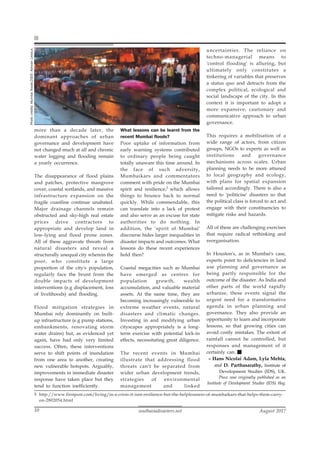
Photo
credits:
Mumbai
floods-2005:
Ashwan
Lewis.e.
uncertainties. The reliance on
techno-managerial means to
'control flooding' is alluring, but
ultimately only constitutes a
tinkering of variables that preserves
a status quo and detracts from the
complex political, ecological and
social landscape of the city. In this
context it is important to adopt a
more expansive, cautionary and
communicative approach to urban
governance.
This requires a mobilisation of a
wide range of actors, from citizen
groups, NGOs to experts as well as
institutions and governance
mechanisms across scales. Urban
planning needs to be more attuned
to local geography and ecology,
with plans for spatial expansion
tailored accordingly. There is also a
need to 'politicise' disasters so that
the political class is forced to act and
engage with their constituencies to
mitigate risks and hazards.
All of these are challenging exercises
that require radical rethinking and
reorganisation.
In Houston's, as in Mumbai's case,
experts point to deficiencies in land
use planning and governance as
being partly responsible for the
outcome of the disaster. As India and
other parts of the world rapidly
urbanise, these events signal the
urgent need for a transformative
agenda in urban planning and
governance. They also provide an
opportunity to learn and incorporate
lessons, so that growing cities can
avoid costly mistakes. The extent of
rainfall cannot be controlled, but
responses and management of it
certainly can.
– Hans Nicolai Adam, Lyla Mehta,
and D. Parthasarathy, Institute of
Development Studies (IDS), UK.
Piece was originally published as an
Institute of Development Studies (IDS) blog.
5 http://www.firstpost.com/living/in-a-crisis-it-isnt-resilience-but-the-helplessness-of-mumbaikars-that-helps-them-carry-
on-2802054.html
southasiadisasters.net
August 2017 11
DRR AND ECOLOGY
When Nature Rears its Head: Flash Flooding,
and The Loss of Lakes in Bengaluru
In the recent monsoon, residents of
Bengaluru have experienced
unprecedented rainfall that wreaked
havoc on the fragile infrastructure
of the city, breaching 4 lakes, and
with 4 other lakes overflowing. The
rising waters uprooted dozens of
trees, submerged many homes and
vehicles, inundated the central bus
terminus and the sports stadium,
and led to at least a dozen recorded
deaths. Blame games abound - with
residents, activists, and researchers
blaming unplanned urban sprawl
and Government apathy. On the
other hand, the city municipality
blames residents for encroaching
upon channels, and for improper
waste management practices that
lead to clogged channels
exacerbating the floods.
Bengaluru is not a stranger to flash
flooding. In the last year alone, the
Karnataka State Natural Disaster
Monitoring Center identified 174
localities flood prone locations.
Many of these areas are localities
built upon lake beds, floodplains, or
storm water channels. This pattern
of development is proving
catastrophic for a city that has
evolved around its networked water
system for centuries. Building on
wetlands and water channels has
disrupted the natural flow of water
across the topographical gradient.
Water accumulates in natural
depressions (often areas where a lake
was once located) and with a lack of
appropriate outlets for drainage,
results in incidents of flash flooding.
Our research has shown that lakes
began to be disregarded once piped
drinking water began to be supplied
in the late 19th century. By the
middle of the 20th century, the
Sampangi lake was converted into
the Kanteerava sports stadium, and
the Dharmambudhi lake into the
city's central Majestic bus terminus.
The loss of a single water body had
larger ramifications — it disrupted
the connectivity of a networked sub-
system of lakes, creating drainage
problems for the city. The
conversion of Dharmambudhi lake,
for instance, was accompanied by
the destruction of channels that
connected it to at least seven other
lakes. Unsurprisingly, only two of
those lakes remain today.
Today's incidents of flash flooding
are concentrated around former lake
beds: such as the Dharmambudhi,
Sampangi, Koramangala, Ejipura,
and Miller's lake series. What is the
solution? Given the scale of
urbanization in Bengaluru today, it
seems impossible to reclaim the lost
waterscape. Efforts need to focus
upon rejuvenating and sustaining the
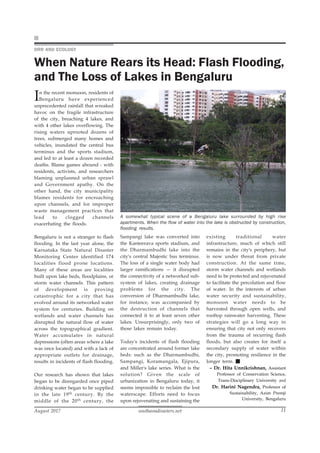
A somewhat typical scene of a Bengaluru lake surrounded by high rise
apartments. When the flow of water into the lake is obstructed by construction,
flooding results.
existing traditional water
infrastructure, much of which still
remains in the city's periphery, but
is now under threat from private
construction. At the same time,
storm water channels and wetlands
need to be protected and rejuvenated
to facilitate the percolation and flow
of water. In the interests of urban
water security and sustainability,
monsoon water needs to be
harvested through open wells, and
rooftop rainwater harvesting. These
strategies will go a long way in
ensuring that city not only recovers
from the trauma of recurring flash
floods, but also creates for itself a
secondary supply of water within
the city, promoting resilience in the
longer term.
– Dr. Hita Unnikrishnan, Assistant
Professor of Conservation Science,
Trans-Disciplinary University and
Dr. Harini Nagendra, Professor of
Sustainability, Azim Premji
University, Bengaluru
southasiadisasters.net August 2017
12
INVESTING IN INFRASTRUCTURE
Resilient Water?
Can water be resilient? We know
that water is essential for our
survival but it can be destructive in
an equal measure too. One of the
possible ways of thinking about
resilient water is to think of drought
in the times of floods. Imagine a
house surrounded by a plenty of
flood waters without clean water to
drink inside. And for a while there
has not been a more flooded
monsoon in India, nay in South Asia,
in fact in the world, than the past
three months. But let us focus on
India where over 35 million people
have been affected by floods in the
recent months covering over
estimated one-third of its land mass.
There is more rainfall. There are
more rainy days. The rivers have
narrowed and river beds are
increasingly full of landfill. The trees
that slow down and retain rain water
from running off into the rivers have
disappeared. And cities, small and
large, come in the way of the rain
water to flow. All this leads us to
believe that there will be more
floods and the flood water will not
be retained to reduce the chances of
possible droughts.
It is the water in its source—dams,
tanks, ponds, wells, lakes, and canals
in addition to rivers and streams and
deltas—that need to be viewed from
the perspective of climate
compatible development in India.
Both, surface water conditions as
well as the groundwater situation is
deteriorating fast. According to the
World Bank1, more than 60% of
irrigated agriculture and 85% of
drinking water supplies are
dependent on groundwater now.
Based on its sub-national work in
drafting District Disaster
Management Plans (DDMPs) in 9
states of India, the All India Disaster
Mitigation Institute (AIDMI) has
found that a national review of water
insecurity and water infrastructure
is warranted. Such a review will help
in assessing how resilient is India's
water programme.
India has more people in rural areas–
63.4 million–living without access to
clean water than any other country,
according to Wild Water, State of the
World's Water 2017, new report by
WaterAid2, a global advocacy group
on water and sanitation. The most
effective and efficient approach of
conducting such a review will be one
that is bottom-up from block,
district, state and up to the national
level. Such a review also necessitates
a participatory approach to be jointly
conducted by the State Disaster
Management Authority (SDMA)
along with Water Resource and
Irrigation Departments as well as
with civil society organizations.
Another important finding from
AIDMI's work with IDS in UK and
University of Norway in the
Sunderbans and the Kutch desert is
1 http://www.worldbank.org/en/news/feature/2012/03/06/india-groundwater-critical-diminishing
2 http://www.hindustantimes.com/india-news/6-3-crore-indians-do-not-have-access-to-clean-drinking-water/story-
dWIEyP962FnM8Mturbc52N.html
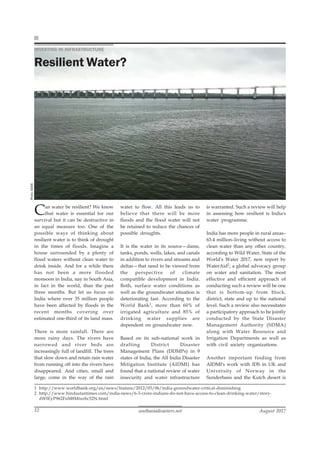
Photo:
AIDMI.
southasiadisasters.net
August 2017 13
that there is no simple and effective
communication mechanism of top to
bottom and bottom to top on climate
risks and uncertainty. Evolving a
mechanism that facilitates such a
communication will be the first step
in the right direction. Dr. Shibaji
Bose of Indian Institute of Health
Management Research, Jaipur has
developed a method, Photo Voices,
which gives a voice to the bottom
and the top to communicate with
each other. Such DDMPs in fact
represent an opportunity for
conducting such a national review
at local level.
Key systems such as water supply,
health, power, communication,
housing and agriculture need to be
taken into account when reviewing
water insecurity and infrastructure.
This can be done well if the hazard
and risk mapping of potential
disasters is scrupulously conducted.
Since the DDMP drafting process
depends upon a detailed hazard, risk
and vulnerability assessment
(HVRA) of the above stated systems,
it surely represents a formative
building block to conduct the
national review. National Institute
of Disaster Management (NIDM)
under the leadership of Dr. Santosh
Kumar is best suited to initiate such
a review with a competent team of
institutions. This will be a one more
concrete step towards
implementation of India's National
Disaster Management Plan (NDMP)
launched by the Prime Minister of
India in June 2016.
Another important step is finding
and involving the right stakeholders
at all stages of such a process. Such
stakeholders may be the authorities
or people's movements or unions or
cooperatives or universities and
beyond. Recently Inter Agency
Groups (IAGs) have played a key
role involving the right stakeholders
in each state affected by floods.
AIDMI's work of risk reduction for
the poor and marginalized
communities of India and South Asia
is based upon local systems of risk
reduction that emerge from
traditional knowledge of
communities that have been coping
with extreme events for too long.
There is a considerable body of
scientific evidence that suggests that
climate change has been a major
contributing factor for the increasing
severity and frequency of weather
extremes like floods and droughts.
However, the line departments of
the government possess only a
limited understanding on this issue.
Capacity building of these line
departments on understanding the
concepts and impacts of climate
change can also improve the
understanding of these 'decision-
implementers' to better coordinate
between the varying climate
extremes of floods and droughts at
the sub-national level in India.
Odisha has already worked on this
sensitive area through a Training
Needs Assessment (TNA) through
it’s the Odisha State Disaster
Management Authority (OSDMA).
The coastal state of Andhra Pradesh
in India is often ravaged by floods,
droughts and heatwaves. These
climate extremes affect different
regions of the state at different
seasons all around the year.
Government of Andhra Pradesh in
collaboration with UNDP India
drafted departmental disaster
management plans for all the major
departments of the state
government. Among the
departments included were those of
agriculture, animal husbandry,
cooperatives, fisheries, rural
development, urban development,
panchayati raj and water resources.
A common theme in all these plans
was to plan for the efficient usage of
water so that it benefits the state in
a wide range of extreme weather.
Next step is for more nurturance of
the points of entry to such a process
of building resilience of water
infrastructure.
The key gap is the institutional
capacity for such ongoing
assessments, for existing and new
infrastructure as well as limited
capabilities for design and finance.
Water security or the lack thereof,
can push the column of vulnerability
for entire communities. The above
organisations, authorities and
institutions have been consistently
working to transform this
vulnerability into resilience. Perhaps
it is time that these measures are
scaled up by many more relevant
stakeholders.
– Vandana Chauhan with
Kshitij Gupta of AIDMI.
Photo:
AIDMI.
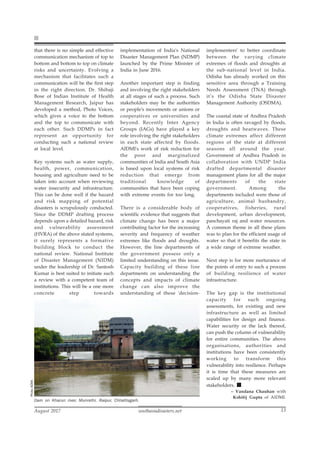
Dam on Kharun river, Munrethi, Raipur, Chhattisgarh.
southasiadisasters.net August 2017
14
DRR AND WASH
Floods, Sanitation and Access to Clean
Water
Sanitation is a chief determinant
of life expectancy, which in turn
is a critical component of the Human
Development Index (HDI). The
theme of sanitation includes
personal hygiene, home sanitation,
safe water, garbage disposal, excreta
disposal and waste water disposal.
Inadequate sanitation is thus the lack
of improved facilities (toilets,
conveyance, and treatment systems),
and hygienic practices (hand
washing, proper water handling,
personal hygiene, etc.). While India
is now in the front ranks of fast-
growing emerging economies, it is
still lagged behind in health and
sanitation practices compared to
other countries. According to data
from a World Health Organization
(WHO) report, India continues to be
a country with the highest number
of people that practice open defecation.
Globally, India is the second most
flood-affected country with one-
eighth of its geographical area
categorized as flood-prone and the
estimated total loss caused by flood
annually is US $575 million (Dutta
& Watts, 2010). Poor sanitation and
lack of access to water compounds
the negative impacts of flooding.
Consumption of contaminated
drinking water, improper disposal
of human excreta, improper
environmental sanitation and lack of
personal and food hygiene are the
major causes of many water-borne
diseases. It also gives rise to
associated losses in productivity due
to sickness and toilet access, and
increases healthcare costs. A detailed
explanation of the detrimental
impact of flooding on sanitation
follows.
Firstly, floods impair clean water
sources and food supply with
pollutants such as debris and waste
products, carcasses of dead animals,
animal and human waste. Direct and
indirect contact with the
contaminants – whether through
direct food intakes, vector insects
such as flies, unclean hands, or dirty
plates and utensils – result in
waterborne illnesses and life-
threatening infectious diseases such
as diarrhoea, cholera, escherichia
coli, skin diseases and eye infections.
Faecal contamination of livestock
and crops can also lead to the spread
of infectious diseases (Casteel et al.,
2006).
Secondly, the pollutants saturate into
the ground water and infiltrate into
sanitary sewer lines through the
ground. In some areas of India, hand
pumps are the main source of water
for drinking and domestic purposes.
As the hand pumps are usually
installed at ground level rather than
on raised platforms, they get
submerged in floodwaters and
become contaminated. Wastewater
treatment plants, if flooded and
malfunctioned, could result into
backflows of raw sewage to homes
and low lying grounds.
Thirdly, due to unavailability of
household toilet or dry land for
defecation, the flood affected
communities often defecate in the
floodwater, which increases further
risks for waterborne disease and
related infections. Open defecation
also seriously affects the mental
health of women when they 'have
to fight with shame and shock to
relieve themselves on the crowded
embankment or nearby' (The Hindu,
2016).
Finally, during floods, patients
generally suffer from loss of
medical services and find it more
difficult to access health care. In
flood and post-flood conditions, the
burden on health facilities is
exceptionally heavy due to the high
number of patients affected by
water-borne and vector-borne
diseases (Kumar, 2011). The poor
health care service delivery and
limited health service access then
leads to delay in treatment, and
increase the severity of the disease,
sometimes with fatal consequences.
Experiences from floods in other
countries also show the similar
results, unclean drinking and
washing water and sanitation,
coupled with lack of adequate
sewage treatment have lead to
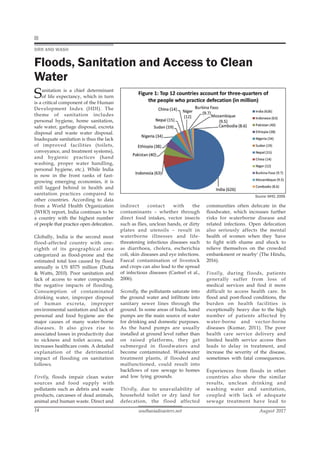
Source: WHO, 2009.
southasiadisasters.net
August 2017 15
disease outbreaks in Bangladesh and
New Orleans (Minamiguchi, 2010).
In India, one in every ten deaths is
linked to poor sanitation and
hygiene; 37.7 million Indians are
affected by waterborne diseases
annually (WSP, 2010). India is home
to 48 million stunted children under
age 5 – the highest rate the world.
Over 140,000 children die every year
from diarrhea caused by unsafe
water and poor sanitation (WSP,
2010). Sanitation-linked diseases in
early years of children also hamper
children's cognition, which have in
a lifelong impact on their development.
Promoting safety and hygiene in
flood-affected areas is one of key
pillars in the intervention of All
India Disaster Mitigation Institute
(AIDMI). Understanding the link
between sanitation-linked diseases
and children's development, AIDMI
has been supporting schools and
related institutions to prepare School
Disaster Management Plan (SDMP).
An SDMP includes three main
components: water safety, hygiene
issues and food safety. AIDMI plays
the role as technical support and
community mobilization in SDMP
preparation, implementation, and
monitoring and evaluation. This
support resulted into 915 SDMPs
prepared by schools from Gujarat,
Assam, and Maharashtra during
2016-2017.
Additionally, at community level,
AIDMI provides training 'Safe
hygiene practices' in the training
session 'Community Based Disaster
Preparedness' with community
leaders and CBOs with practical
exercise. So far, during the period
2016-2017, 27 trainings have been
conducted with 1080 participants
from different fields including
community leaders, NGOs,
government officers, etc. A
promising result of all these efforts
is the high participation and the
leading roles of women in the
community. Such efforts have lead
to positive behavioral changes in the
community, which are frequently
led by women leaders at the local
level.
Risk transfer and insurance is another
key tool that helps to promote
sanitation at local level in disaster
preparedness. This includes tailor
made insurance product/s,
community water tanks, uplift of
water pumps, promotion of savings,
water and food safety and safe
hygiene practices. For example, in
flood affected areas, AIDMI with
local institutions and PRIs promoted
and supported hand pumps with
higher level of platforms as micro
DRR/ mitigation measures.
All in all, intervention projects will
not result in sustained benefit unless
accompanied by: effective community
involvement in determining
appropriate water and sanitation
systems that accommodate social
norms; education about the
relationship between illness,
sanitation, and hygiene; and political
commitment to infrastructure
improvements (PAHO, 2006). As
enunciated by Prime Minister
Narendra Modi, it should be 'Pehle
shauchalaya, phir devalaya' (Toilets
first, temples later) (First Post, 2014).
India needs to take considerable
strides to honour the commitment
of reducing open defecation and
advancing health and sanitation by
2020.
– Do Ngoc Thao and
Vishal Pathak with AIDMI.
References:
1. Casteel, M. J., Sobsey, M. D., &
Mueller, J. P. (2006). Fecal
contamination of agricultural soils
before and after hurricane-associated
flooding in north carolina. Journal of
Environmental Science and Health,
Part A, 41(2), 173-184.
2. Curry, M. D., et al.(2001). Impacts
of a flood disaster on an ambulatory
pediatric clinic population. Clinical
Pediatrics, 40(10), 571.
3. Dutta, R., & Watts, H. (2010).
FACTBOX - annual loss from floods
in India. Reuters India.
4. Firstpost. (2014). India's missing
toilets: Poor sanitation leads to
malnutrition, stunted babies.
Accessed at http://
www.firstpost.com/india/awash-
poopy-trash-india-must-take-loo-
route-protect-babies-1619899.html
6. Freshwater Action Network South
Asia (FANSA). (2011). Drinking
water and sanitation security.
7. Kumar, V., Cheng, S., and Singh, A.
(2010). Impact of floods on rural
populations and strategies for
mitigation: A case study on Darbhanga
District, Bihar State, India.
8. Minamiguchi, N. (2010). Health
risks and hazards caused by floods.
10. Ministry of Rural Development.
(2011). Enhanced Quality of Life
through Sustained Sanitation.
India Country Paper.
11. Pan American Health
Organization. (2006). The Challenge
in Disaster Reduction for the Water
and Sanitation Sector.
12. The Hindu. (2016). Women fight
shame in flood hit Bihar. http://
www.thehindu.com/news/
national/other-states/women-
fight-shame-in-flood-hit-bihar/
article6356043.ece
13. Water and Sanitation Program
(WSP), ADB, & AusAID. (2010).
The economic impacts of inadequate
sanitation in India.
14. WHO. (2009). Water sanitation
hygiene. Fast facts WHO/UNICEF
joint monitoring report 2012.
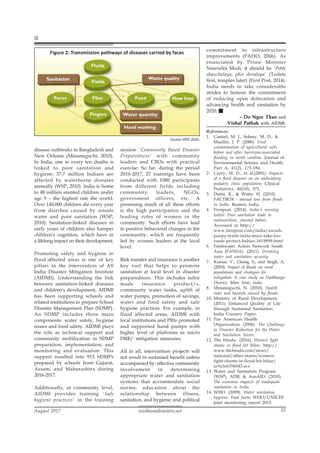
Figure 2: Transmission pathways of diseases carried by faces
Source: WSP, 2010.
southasiadisasters.net August 2017
16
Editorial Advisors:
ALL INDIA DISASTER MITIGATION INSTITUTE
411 Sakar Five, Behind Old Natraj Cinema, Near Mithakhali Railway Crossing, Ashram Road,
Ahmedabad–380 009 India. Tele/Fax: +91-79-2658 2962
E-mail: bestteam@aidmi.org, Website: http://www.aidmi.org, www.southasiadisasters.net
Denis Nkala
Regional Coordinator, South-South Cooperation
and Country Support (Asia-Pacific), United
Nations Development Programme, New York
Ian Davis
Visiting Professor in Disaster Risk Management in
Copenhagen, Lund, Kyoto and Oxford Brookes
Universities
Dr. John Twigg
Senior Research Associate, Department of Civil,
Environmental and Geomatic Engineering,
University College London, London
Madhavi Malalgoda Ariyabandu
Sub-Regional Coordinator, Central Asia & South
Caucasus, United Nations Office for Disaster Risk
Reduction (UNISDR), Kazakhstan
Mihir R. Bhatt
All India Disaster Mitigation Institute, India
Dr. Satchit Balsari, MD, MPH
The University Hospital of Columbia and Cornell,
New York, USA
T. Nanda Kumar
Chairman, Institute of Rural Management Anand
(IRMA), Anand, Gujarat, India
In 2017 India has been ravaged by
unprecedented flooding. The
floods have substantially affected
thousands of households across the
states of Assam, Bihar, Gujarat,
Rajasthan and Uttarakhand.
Many reports in the recent past have
highlighted India's vulnerability to
recurrent flooding and effects of
climate change are worsening the
situation. As per the recent UN
report, India's average annual
economic loss due to disasters is
estimated to be $9.8 billion; this
includes more than $7 billion loss
on account of floods. The poor and
vulnerable are finding it extremely
difficult to recover from such
repeated financial losses every year.
In this regard, we wish to draw your
attention toward the potential of
flood insurance for the poor and
vulnerable.
Investment in micro-insurance can
minimize financial impact of
recurrent flooding on the poor and
vulnerable and decrease dependency
on external assistance for recovery,
which is often delayed and remains
unpredictable. The insurance sector
in India is rapidly expanding and
this growth is effectively facilitated
by Insurance Regulatory and
Development Authority (IRDA) and
government of India. However, a
significant proportion of population
in India remains uncovered and does
not benefit from the booming
growth in the insurance sector.
There is plenty of empirical evidence
that micro-insurance can help in
building resilience. Evidence
suggests that availability and access
to micro-insurance can facilitate
much faster recovery of disaster
affected people as it puts cash into
the hands of recovering
communities. In the past ten years
across India, through its innovative
micro-insurance product called "Afat
Vimo" (Disaster Insurance) the All
India Disaster Mitigation Institute
(AIDMI) has successfully
demonstrated that the convergence
of micro-insurance with risk
reduction support can help victims
recover faster and build resilience.
The role of micro-insurance has been
recognized in India's National
Disaster Management Plan (NDMP),
several State Disaster Management
Plans (SDMPs) as well as in the
Sendai Framework for Disaster Risk
Reduction (SFDRR).
Most importantly, the real potential
of micro-insurance for floods, to
make financial losses bearable to the
victims by can be assessed by:
1. Setting up a working group to
measure demand and explore
potential of micro-insurance for
flood mitigation;
2. Designing a suitable product
with national insurance
providers; and
3. Launching such a product to
support risk reduction efforts of
the poor and vulnerable
households.
– AIDMI Team
RISK REDUCTION
Micro Insurance for Floods

2.5.1 India Floods 2017.pdf

  • 1.
  • 2.
    southasiadisasters.net August 2017 2 ABOUTTHIS ISSUE INTRODUCTION Floods as an Opportunity In 2017 South Asia was ravaged by unprecedented flooding that affected close to 41 million people across India, Bangladesh and Nepal. While the death and destruction unleashed by these floods is tragic, it also represents an opportunity to learn the necessary lessons to set South Asia firmly onto a safer and greener development trajectory. By highlighting the existing gaps in the response, preparedness and relief activities undertaken by various state and non-state actors the key problems have been identified. This present issue of Southasiadisasters.net aims to just that. Local flood studies that explore and account for local action, results, and opportunities are needed to build up bottom up knowledge resources for South Asia wide actions on floods. River basin or national flood plans are a first step but not enough any more. AIDMI's recent work in Nepal and Bangladesh finds that two items in flood management can be made more effective. One, delivering flood management results and two, working in partnership with government and non-government actors in flood management. There two need more attention. It is time to move ahead from project and programme approach to systemic approach to flood management and mitigation. In recent years, the political leadership has greatly influenced national and sub-national priorities and processes of development. How can these influences be directed to unfinished development agendas such as decentralised and ecosystem-based flood mitigation in a time bound manner? Floods simply do not result in the inundation of an area alone; they also result in the displacement of people, halting of economic activity and largescale livelihood disruption. These are just a few of the detrimental impacts of floods which pose a challenge to the local and national institutions. It is time to look ahead to even greater systemic challenges — poor connectivity, limited role of private sector, and knowledge management — and start evolving suitable solutions for them till 2030. Floods do not spare the hotspots of terrorism or conflict and as a result pose a threat to people and prosperity in recovery. Estimates suggest over 100 districts in India alone suffer from such a double threat. Almost each country in South Asia has similar conflict affected areas. Thus, floods impact local security, governance, and human rights protection. Local faith based organisation can be brought in more directly to think find a way out. In India Shri Sadguru has taken on initiative titled "Save our rivers" that can be one such example. In Colombo, Partnership for Faith and Development is organising largest ever event titled “Localizing Response to Humanitarian Need: The Role of Religious and Faith-based Organisations”, October 16 to 18, 2017, for local faith organisations. For years Asian Disaster Preparedness Center (ADPC) in Bangkok has run regional training courses on disaster management providing necessary and fundamental knowledge and skills in flood risk management. Inputs for first sources came from Duryog Nivaran. Perhaps it is time to take such capacity building initiatives to empower local communities with the adequate response and preparedness capacities to respond to the challenges of flooding. Traditional knowledge systems for flood management have existed for centuries in South Asia. It is vital that we leverage this traditional wisdom and use it in conjunction with modern DRR techniques. One of the most eminent scenographers of our times, Rajeev Sethi, calls South Asia's legacy of traditional knowledge systems, including of local flood management, has awed the world but will wither away if not conserved. – Mihir R. Bhatt In 2017, South Asia was ravaged by devastating floods that caused widespread death and destruction. It has been estimated that these floods have led to 1,200 casualties and affected 40 million people across India, Nepal and Bangladesh. India is perhaps one of the most flood prone countries in the world. The 2017 floods have raised some very serious and inconvenient questions about the country's preparedness to such floods. This issue of Southasiadisasters.net is titled "India Floods 2017" and focuses on how the floods in 2017 have affected different regions of country and the damage suffered by them. It also tries to examine India's underlying vulnerability to floods which has been exacerbated in recent years mainly due to unplanned development, high population density & settlement of people in flood plains, old infrastructure, weak river embankments and also increase in extreme events, including high rainfall in a short duration. This issue analyses these repeated incidents of flooding in the country through a systemic lens that takes an interdisciplinary and multi-sectoral perspective of India's flooding problem. – Kshitij Gupta
  • 3.
    southasiadisasters.net August 2017 3 EFFECTIVEPREPAREDNESS Note on Flood Situation Bihar, Assam, Uttar Pradesh and Arunachal Pradesh continue to bear the brunt of floods as the death toll rises. According to the state disaster management authorities of Uttar Pradesh and Bihar, 415 people have died in the floods in two states where more than 10 million people were affected. According to the Bihar State Disaster Management Authority (BSDMA) 229,000 people had been rehabilitated across 1,085 relief camps in the state. Even Prime Minister Narendra Modi conducted an aerial survey to assess the extent of flood damage on Saturday. "We have 21 teams that are working across Uttar Pradesh and several teams working in Bihar. With assistance from the Indian Air Force, a lot of affected people have been airlifted to safety. The relief and rescue operations are ongoing in both states," a National Disaster Response Force (NDRF) release stated. A home ministry official stated that even though relief work was ceaselessly being carried out across both states in the flood affected districts, the overflowing of several rivers and constant rains tended to slow down rescue operations. Besides claiming hundreds of lives, the floods have also destroyed villages and crops across the north- eastern region. Hundreds of thousands of people across several states are living in relief camps. But it is not just humans, thousands of animals including cattle are also suffering and fighting for their lives. Meanwhile, the death toll from floods sweeping entire South Asia has climbed above 1,000 notwithstanding the brave efforts of the rescue teams who have done an exceptional job to reach out to millions of stranded people by the region's worst monsoon disaster in recent years. Thousands of army soldiers and disaster management force and para military troops have been deployed across India, Bangladesh and Nepal, where authorities say a total of 1,013 bodies have been recovered since 10 August, when intense rainfall begun causing floods in Indian states and neighbouring Nepal and Bangladesh. Though all three countries suffer frequent flooding during the monsoon rains, the Red Cross has termed the latest disaster as "the worst in decades" in some parts of South Asia. It says entire communities have been cut off and many are short of food and clean water as the tragedy prolongs amidst continuing rains. "It has been a difficult year," said Anil Shekhawat, spokesman for India's National Disaster Response Force (NDRF). "In the last few months there have been floods in western, eastern and northern parts of the country," Shekhawat said. In Bihar, the state disaster management authorities said death toll climbed to 367. According to Anirudh Kumar, a top state disaster management official, there are still nearly 11 million people affected in 19 districts of the state. He added nearly 450,000 flood evacuees had taken shelter in government refuges. In neighbouring Uttar Pradesh, floods have swamped nearly half of this vast state of 220 million, the country's most populous region. Disaster management agency spokesman Mr. T.P. Gupta said that 86 people had died and more than two million were affected by the disaster there. The state borders Nepal, where 146 people have died and 80,000 homes destroyed in what the United Nations is calling the worst flooding in 15 years. Nepal's home ministry warned the death toll could rise as relief teams reach more remote parts of the impoverished country. The situation was slowly easing in West Bengal and Assam, two states where 223 people had already died. Floods in Assam—the second wave to hit the state in less than four months—have wrought widespread destruction, killing 71 people and forcing animals to seek higher ground. One Bengal tiger and 15 rare one-horned rhinos were found dead and conservationists feared there could be further loss of life. In West Bengal, where 152 people have died, hundreds of thousands have escaped submerged villages by boats and makeshift rafts to reach government aid stations set up by the state administration. Across the border in Bangladesh, water levels were slowly returning to normal in the main Brahmaputra and Ganga rivers. The government's disaster response body said the death toll stood at 137, with more than 7.5 million affected since flooding hit the riverine nation. Every year hundreds die in landslides and floods during the monsoon season that hits India's southern tip in early June and sweeps across the South Asia region for four months. – AIDMI Team
  • 4.
    southasiadisasters.net August 2017 4 REDUCINGRISK India Floods 2017 Floods have been a recurrent phenomenon in India that lead to huge losses to lives, properties, livelihood systems, infrastructure and public utilities. As a matter of fact, 12% of the total landmass of the country (40 million hectare) is flood prone1. Furthermore, as on August 18, 2017, 25 states2 in the country are susceptible to floods, the most vulnerable States are Assam, Bihar, Uttar Pradesh, Gujarat, West Bengal, Madhya Pradesh, Odisha, Andhra Pradesh, Maharashtra, Punjab and Jammu & Kashmir. Similarly as many as 137 districts3 are vulnerable to floods. In the recent years, the vulnerability of the states to floods has increased exponentially, mainly due to unplanned development, high population density & settlement of people in flood plains, old infrastructure, weak river embankments and also increase in extreme events, including high rainfall in a short duration. In July 2017, India experienced yet another wave of flooding due to excessive rains in the monsoon season. The states of Assam, Gujarat, Rajasthan, Odisha, Madhya Pradesh, Tripura and West Bengal faced massive floods in many parts, which led to human casualties in hundreds, extensive damage to infrastructure and also severely affected the animals. The Inter-Ministerial Central Team visited Assam to take stock of situation, and Prime Minister Mr. Modi himself visited Gujarat flood affected areas. It shows seriousness at the apex level. The cumulative rainfall was recorded in excess, in June and July 2017, in most States of India. In India, Central Water Commission is Nodal Agency for flood forecasting. They have at present 221 Flood Forecasting Stations4 spread across 24 States & UTs. They are expected to provide flood advisories to State Governments with help of IMD. Country also has National Guidelines for Management of Floods (2008, NDMA). However there is a long way to go for flood prevention and mitigation in India. It's high time to take concrete actions by all concerned agencies on the ground to address this pertinent issue. Gujarat Floods Incessant torrential rain due to simultaneous activation of Arabian Sea and Bay of Bengal low-pressure systems (a rare phenomenon) has resulted into floods in many part of Gujarat this year. Districts of Banaskantha, Patan, Rajkot, 1 NDMA Guidelines 2008 2 BMTPC Vulnerability Atlas 2007 3 Flood Management Module, NIDM, 2012 4 Central Water Commission Website 5 https://sphereindiablog.files.wordpress.com/2017/07/28-07-2017-sitrep-2-situation-reports-in-india.pdf (July 28, 2017) 6 http://ahmedabadmirror.indiatimes.com/news/india/rains-batter-ahmedabad-gandhinagar-over-54000-relocated/ articleshow/59797361.cms (July 27, 2017) 7 http://timesofindia.indiatimes.com/city/ahmedabad/rs-6-lakh-compensation-for-kin-of-deceased/articleshow/ 59780580.cms (July 27, 2017) 8 http://www.business-standard.com/article/economy-policy/torrential-rain-flood-damage-25-kharif-sowing-in-gujarat- 117072700069_1.html (July 27, 2017) Surendranagar, Ahmedabad, Morbi, Gandhinagar, Kutch, Mehsana and Valsad are hit by the large-scale flooding. Banaskantha and Patan are among the worst-hit districts in the state due to heavy rains and flooding of the Banas and Sipu rivers. Dhanera block Banaskatha district was worst affected and was inaccessible therefore the damages are estimated to be higher in the block as reported by IAG members5. The floods have impacted lives and livelihoods, including education and public transportation by damaging roads, highways, rail lines and airports. Besides the State Disaster Response Force and fire brigade personnel, the National Disaster Response Force (NDRF), the Air Force and the Army were deployed for the rescue of marooned villagers. According to state administration officials 54,517 people were shifted to safer places over the last one-week due to flooding of low-lying areas6. So far, 119 deaths have been reported from across the state since monsoon began7. 'Torrential rain and flooding, especially in north and Saurashtra, have resulted in at least 25 per cent loss in kharif sowing across crops such as cotton, groundnut, castor, pulses, guar and cereals.'8 About 492 villages have no power supply, out
  • 5.
    southasiadisasters.net August 2017 5 Numberof deaths reported by State Control Rooms and National Control Room as on 31st July 2017 Name of State No of reported deaths due to Source of information floods, heavy rainfall Gujarat 218 Gujarat State Emergency Operation Centre (SEOC) Assam 82 National Disaster Management Authority (NDMA), Ministry Of Home Affairs (MHA) West Bengal 39 West Bengal Control Room Rajasthan 43 NDMA, MHA Uttarakhand 19 NDMA, MHA Uttar Pradesh 9 NDMA, MHA Odisha 4 NDMA, MHA of which 418 villages are in Banaskantha district.9 After conducting an aerial inspection of the area with his team, Prime Minister Narendra Modi has announced some ex-gratia of Rs 2 lakh for the family of deceased persons, Rs 50,000 for those who have suffered injuries, apart from a Rs 500 crore relief package for the deluged districts.10 A day after Prime Minister Narendra Modi announced compensation of Rs 2 lakh for flood victims, the state government on Wednesday declared that it would pay Rs 4 lakh ex gratia to the kin of the deceased.11 Latest reported figures by the State Emergency Operation Center, Gandhinagar (27.07.2017): No of deaths: 126 (of which 43 died in the district of Banaskatha) Evacuations: 54516 (of which 34043 are from Patan and Banaskatha districts) Electricity: 753 villages lost electricity. Electricity in 526 villages has been restored. Information on roads closed: 5 national highways, 156 state highways and others and 550 roads under Panchayats Cattle loss: 881 in Banaskatha district According to the state authorities, more than 15 teams of National Disaster Response Force (NDRF) and Air Force, Army and Navy teams are involved in rescue operations in the inundated areas. The Air Force has airlifted more than 1000 people from villages which were completely cut off as roads and railway networks were damaged, making the villages inaccessible. The Air Force has deployed over a dozen choppers for rescue works. Total number of people who were rescued is above 10,000 by agencies like NDRF, Navy, Army and even BSF. Moreover, more than 50,000 people were relocated by the various agencies and authorities from vulnerable and low lying areas in Morbi, Jamnagar, Rajkot, Surendranagar, Patan, Banaskantha, 9 http://theindianawaaz.com/relief-rescue-operations-in-full-swing-in-flood- hit-areas-of-gujarat-rajasthan/ (July 26, 2017) 10 http://www.timesnownews.com/india/article/pm-modi-grants-rs-500-crore- relief-for-victims-of-gujarat-flood/67022 (Jul 26, 2017) 11 http://timesofindia.indiatimes.com/city/ahmedabad/rs-6-lakh- compensation-for-kin-of-deceased/articleshow/59780580.cms (July 27, 2017) Ahmedabad, Gandhinagar and Aravalli districts. The central government has announced an interim package of Rs 500 crore besides compensation of Rs two lakh to the families of those who have died in the floods. In a heartbreaking incident, 18 members of a same family killed in floods in a village in Banaskantha. With clear weather, the state government has launched a massive survey to assess damages caused by floods in the affected areas. So what is the way out? It is high time floods are explained in today's context. What they are and what they mean to India's growing economy; in addition to increasing vulnerability of India's development to floods. The myth that floods are rural problem is not true any more. Towns and his cities such as Bengaluru, Mumbai and Chennai face repeated floods. A rapid review is needed to institutionalise flood risk reduction in India, including review of water policies, and flood risk reduction plans and projects; review of operational guideline of Dam and river basin management, and more detailed, realistic, time based sectoral and hotspot plans. – Mehul Pandya with Amit Tuteja of AIDMI.
  • 6.
    southasiadisasters.net August 2017 6 SUSTAINABLERECOVERY Floods in Bihar in 2017 The flooding situation experienced by India is deteriorating severely. The floods wreaked havoc in the states of Assam, Odisha, Gujarat, West Bengal and Manipur. They are now unleashing their wrath on the state of Bihar. The extent of flooding taking place in Bihar is unprecedented in its recent history. Not only have these floods led to widespread distress and deprivation among the people of Bihar, they have also caused loss and damage to the state's growing economy. As of August 16, 2017 the death toll from the floods in Bihar stands at 72. Similarly, 73 lakh people across 14 districts have been severely affected by the incessant rains in Nepal and northern part of the state. This is not new, the rivers flowing out of Nepal into Bihar more and more swell up during the monsoons giving rise to a lot of trans- boundary flooding risk for Bihar. Mr. Anirudh Kumar, Special Secretary in the State Disaster Management Department of Government of Bihar has provided a disaggregated death toll according to districts. He has informed that Araria district accounted for 20 flood deaths, followed by Sitamarhi (11), West Champaran (9), Kisanganj (8), Madhubani and Purnea (5 each), Madhepura and Darbhanga (4 each), East Champaran (3), Sheohar (2) and Supual (1). Relatively low levels of loss of life is worth noting. He further apprised that 73.44 lakh people are in the grip of floods which have engulfed 110 blocks and 1,151 panchayats spanning 14 districts of Bihar, which means nearly half of the state's geographical area has been flooded in 2017 monsoon so far. The local economy has taken a severe hit particularly the agriculture sector and the state's artisans. This disaster has led to an exponential reduction in production, consumption and trade activities by the low income families. The special secretary has said that 2.74 lakh people have been evacuated and taken to safer places with special medical care and local efforts. Out of them, 1.16 lakh people have been put up in 504 relief camps set up by the state authorities. Setting up camps that work is not an easy task in rural Bihar. A wide range of needs have come up from food to water to toilets to the education of children. The state authorities and voluntary organizations have set up Community Kitchens for victims in marooned areas and available line hotels, aganwadi kendras and railway stations in Katihar district are being used for running such kitchens, the principal secretary to the disaster management department, Shri Pratyay Amrit said this week. The Bihar Risk Reduction Road Map is put to use to focus on key areas, sectors, and communities in need of relief and recovery. Shri Pratyay Amrit held meetings through video conferencing with districts officials and gave them directions on helping the flood victims and also launching rescue operations whenever necessary. Saving lives is the highest priority on Bihar's agenda. Reducing loss and damage is second on the agenda. The UNICEF in Bihar has developed a step-by-step way ahead to reduce disaster risks in Bihar. Lars Bernd, UNICEF, Delhi, in this process has pointed out to the power of participation of citizens, and putting children in the centre in response and recovery. Train services continue to be affected due to the calamity and rail movement is disrupted in many sections. As a result several trains passing through these sections have been cancelled, diverted, short terminated and short originated. This Photo: AIDMI.
  • 7.
    southasiadisasters.net August 2017 7 meansdelay in the supply of relief materials to the victims. Bihar is a leader in forging civil society partnership for disaster risk reduction in India. In these floods the state is making its relief governance more responsive, decision making more decentralized, and civil society participation wider. Shri Surya Prakash, faculty at National Institute of Disaster Management (NIDM) and a flood and drought expert has argued for reaching out to local networks and private sector establishments for flood relief and recovery. The following are possible key ways to address the challenges and looking beyond relief: building resilience. 1. Disaster insurance, if suitably designed, can be a valuable risk management tool to support adaptation. Bihar can show the way to other states of India by designing disaster insurance pilot in at least 7 to 10 districts. 2. Looking at high flood risk reducing the number of affected people and direct disaster related economic loss is challenging. Bihar needs to build a better understanding to deal with loss and damage due to extreme events such as floods. Bihar may not have effective DRR investment without building understanding and database on loss and damage across its governance system. 3. Bihar has shown a strong performance of building awareness on school safety. This performance needs to be continued by capacity development actions for making key schools and hospitals safer in Bihar. 'Remember that relief is the enemy of recovery, so minimize relief to maximize recovery' said by Otto Koenigsberger (1978). – Vishal Pathak and Vipul Nakum of AIDMI. Between the night of 28th August and the sundown of 29th August 2017, Mumbai once again witnessed a deluge. The city received precipitation amounting to 315 m.m. in 12 hours, the heaviest since the downpour of 26th July 2005 (944 m.m.). Normalcy was disrupted in this "busier than the bee" metropolis. Suburban trains, supposed to be the life-lines of Mumbai, came to a standstill in most sectors of the network serviced by three different lines. Water-logging resulted in to most other public transport systems also coming to a grinding halt in the middle of their journeys. This resulted in to people getting stranded in places they were visiting or working at. Most people were far from their homes. Family members were in different places in the city. There was chaos. Pedestrians waded through waters with the fear of getting drowned or getting sucked in manholes. The official agencies were alert and well spread out in the city. However, what was striking this time was the selfless help offered by individuals, voluntary organisations and self- motivated groups (either residential societies or religious groups). What they offered was amazingly simple and practical. They offered facilities to trapped commuters to relieve themselves from nature's calls. They offered place to rest, even lie down. Large community halls, auditoria were converted to dormitories for tired people who had no choice but to wade back home through knee–deep waters. They also offered snacks, meals, tea, coffee and water. Mobile numbers of individuals or organisations were broadcast by WhatsApp messages to be called for emergencies and rescue. Most messages were warm and welcoming. SUSTAINABLE RECOVERY Mumbai Deluge and the Civil Society A sampler of one such message read like this: "We stay at Matunga / Dadar (East) very close to both the stations. Anyone needing help in any manner whatsoever, including stay, meals, need to use washroom, dry clothes, etc. for self, family or friends, please feel free to connect to–(Two numbers were given)... Be safe and enjoy the rains. Regards, (two names of citizens)." All the religious organisations also played their role by offering space to relax, relieve and refresh for people on seeking respite from the water– logged streets of the "over planned" city. In this case also, though the resources might be of the organisations, the initiative and efforts were of volunteers from the civil society. Among these religious groups were Jain groups, Christian churches, Sikh Gurudwaras and Hindu temples. The municipal corporation had published the contact numbers of the disaster management control rooms of all the wards. And, during and after the downpour, hundreds of citizens posted messages reporting about trapped citizens requiring help, learning from which, police and other rescue workers reached these sites. In my opinion, this is what is known as Community Based Disaster Management (CBDM): owned, managed and controlled largely by the civil society on its own initiative. It reflects love for fellow citizens, concern for the discomforted, sensitivity towards needs of others, warmth of fraternity and faith in humanity. This takes us a step forward in the process of strengthening the civil society vis- à-vis the State and the Market. This is surely a sign of progress. – Rajesh Bhat, Managing Trustee, Swapath Trust, Ahmedabad
  • 8.
    southasiadisasters.net August 2017 8 Floodsare not new to Assam. The people of the state are so used to floods in the monsoons that it is almost called the 'flood season' in Assam. What is new is the duration and severity of these floods in 2017. As on August 19, 2017, in what seems to be the state's worst deluge in three decades, the death toll in the second wave of floods rose to 15, with 10 more deaths reported on last Sunday. With over 10 lakh people affected, the total number of flood victims shot up to 15 lakh across 21 out of 27 districts in Assam. Over 85% of the Kaziranga National Park (KNP) was inundated causing loss of wild life. Relief camps are not easy to set up in flood hit Assam as roads get submerged, delaying supplies and raising the number of affected people. More than 1.83 lakh displaced people have taken shelter in 439 relief camps. Rescue operations by the Army, Indian Air Force, National Disaster Response Force and the State Disaster Response Force personnel are underway, said state project co-coordinator of Assam State Disaster Management Authority (ASDMA) Rajib Prakash Baruah. About 3,000 villagers were rescued and shifted to relief camps on Sunday, said defence PRO Lt Col S Newton of Armed Forces. ECHO has offered Euro 200,000 to IFRC to respond to the needs of the most vulnerable 25,000 individuals in Assam. Focus is on reducing suffering of these individuals. Local civil society has shown rapid response with Inter Agency Group calling coordination meetings for relief distribution. Sphere India has taken measures to coordinate relief efforts in Assam. UNICEF in Assam has focused on children and their role in flood response. Besides Assam, incessant rain in the last five days has wreaked havoc in Meghalaya and claimed three lives. Nearly 800 people were rendered homeless in South and West Garo Hills district in western Meghalaya, officials said. There were reports of flash floods and landslides in different parts of Khasi Hills causing loss of agriculture and local horticulture. Dr. Muzaffar Ahmed, Ex-member NDMA, has suggested relief as an investment into resilience to floods. This includes not only investments in recovery but also in risk transfer and micro-insurance. Dr. Santosh Kumar, policy and planning faculty at National Institute of Disaster Management (NIDM), has often called for an HRD plan for the states to continuously improve the quality of humanitarian response. Flood fury has claimed at least three lives and affected over five lakh people in West Bengal. Rail and road communication has been severely hit. Cooch Behar district was virtually cut off from the rest of India with vehicular and train movement coming to a stop. Around 2.87 lakh people were displaced in Cooch Behar, and another two lakh in Jalpaiguri and Alipurduar districts and over 50,000 were hit in Malda, North Dinajpur, Darjeeling and South Dinajpur district. World Bank has taken initial steps to reach out to these victims with food, water and other relief supplies. The ASDMA is one of the few state authorities in India to have picked up the integration of Disaster Risk Reduction (DRR) and Climate Change Adaptation (CCA) in all its work. SUSTAINABLE RECOVERY Floods in Assam in 2017 Overall, as many as 20 states in the country have been affected during the current southwest monsoon season in the country. According to the available information, 600 people have lost their lives; 24,811 cattle heads have perished; 63,215 houses/huts damaged and about 2.8 lakh hectare of crop reportedly affected due to heavy rains; floods and landslides. Data is still being gathered and compiled to get a clearer picture of the loss and damage brought about by these floods. Assam has plans, people, and resources to respond to the challenge. What may be added is expert third party monitoring and evaluation (M&E). Assam has taken up several initiatives to improve its response and preparedness capacities against disasters particularly – floods and earthquakes. These includes but is not limited to a series of city-wide emergency management exercises; training, mock drills and plan of disaster management in schools in all the districts; community-based early warning; developing and reviewing the district disaster management plans; and a review of flood studies. Possible key steps that can support the flood preparedness in the state include higher investment on flood protection; strong actions to protect wetlands; introducing water storage areas; closer and stronger linked DRR and CCA actions; constructing buildings above flood levels (it is in the tradition of the Assam that needs to remind in current time); and stronger implementation of land usage (for construction) norms. – Vandana Chauhan and Vishal Pathak of AIDMI.
  • 9.
    southasiadisasters.net August 2017 9 memoriesof the most devastating urban flooding in India's recent history,2 the 'deluge' of Mumbai in 2005, wherein record rainfall (944 mm within 24 hours) precipitated a disaster that caused hundreds of fatalities and massive economic damages. The complex picture of this disaster is bigger than climate change Climate change, in both the cities cases, is held in parts responsible for precipitating more intense and extreme weather events that contribute to disasters. On the other hand, scientific uncertainties remain regarding how far climate change can be held accountable for specific regional or local weather events. CLIMATE CHANGE AND DRR A Tale of Two Cities: Flooding in Houston and Mumbai — Time to Learn? Photo credits: Mumbai floods - 2017: Amrita Sen. Dramatic images of the impacts from flooding from Houston in the US and Mumbai, India have called to attention the vulnerabilities that an increasingly urbanised world faces in the twenty first century. As Houston was inundated by 'biblical' rainfall and grapples with extreme flooding and its aftermath, another coastal megacity on the other side of the globe also experienced destructive flooding, albeit on a lesser scale. Within the span of a couple of hours, rainfall to the tune of 298 mm, lashed Mumbai.1 Public life ground to a complete standstill, with a number of deaths and casualties reported. It also conjured up people's While it is tempting to lay the blame for flooding squarely on 'unusual' precipitation, the picture that emerges on the ground is often more complex and messy. This is the picture in Mumbai as documented by our project, the Climate Change, Uncertainty and Transformation project based at the Norwegian University of Life Sciences3 in partnership with the Institute of Development Studies,4 the Indian Institute of Technology-Bombay and others. Following the 2005 Mumbai floods, many promises were made, and investments undertaken by municipal authorities to ensure better flood proofing of the city. However, 1 http://www.hindustantimes.com/india-news/mumbai-floods-why-india-s-cities-are-struggling-with-extreme-rainfall/ story-wsWPNy2MXh4b9JYTqtA0QJ.html 2 http://indianexpress.com/article/opinion/mumbai-floods-swamp-excessive-rains-drainage-system-july-2005-august- 2017-4823348/ 3 https://www.nmbu.no/en/faculty/landsam/department/noragric/research/clusters/ccad/projects/climate-change- uncertainty-and-transformation 4 http://www.ids.ac.uk/project/climate-change-uncertainty-and-tranformation
  • 10.
    southasiadisasters.net August 2017 10 morethan a decade later, the dominant approaches of urban governance and development have not changed much at all and chronic water logging and flooding remain a yearly occurrence. The disappearance of flood plains and patches, protective mangrove cover, coastal wetlands, and massive infrastructure expansion on the fragile coastline continue unabated. Major drainage channels remain obstructed and sky-high real estate prices drive contractors to appropriate and develop land in low-lying and flood prone zones. All of these aggravate threats from natural disasters and reveal a structurally unequal city wherein the poor, who constitute a large proportion of the city's population, regularly face the brunt from the double impacts of development interventions (e.g displacement, loss of livelihoods) and flooding. Flood mitigation strategies in Mumbai rely dominantly on built- up infrastructure (e.g pump stations, embankments, renovating storm water drains) but, as evidenced yet again, have had only very limited success. Often, these interventions serve to shift points of inundation from one area to another, creating new vulnerable hotspots. Arguably, improvements in immediate disaster response have taken place but they tend to function inefficiently. What lessons can be learnt from the recent Mumbai floods? Poor uptake of information from early warning systems contributed to ordinary people being caught totally unaware this time around. In the face of such adversity, Mumbaikars and commentators comment with pride on the Mumbai spirit and resilience,5 which allows things to bounce back to normal quickly. While commendable, this can translate into a lack of protest and also serve as an excuse for state authorities to do nothing. In addition, the 'spirit of Mumbai' discourse hides larger inequalities in disaster impacts and outcomes. What lessons do these recent experiences hold then? Coastal megacities such as Mumbai have emerged as centres for population growth, wealth accumulation, and valuable material assets. At the same time, they are becoming increasingly vulnerable to extreme weather events, natural disasters and climatic changes. Investing in and modifying urban cityscapes appropriately is a long- term exercise with potential lock-in effects, necessitating great diligence. The recent events in Mumbai illustrate that addressing flood threats can't be separated from wider urban development trends, strategies of environmental management and linked Photo credits: Mumbai floods-2005: Ashwan Lewis.e. uncertainties. The reliance on techno-managerial means to 'control flooding' is alluring, but ultimately only constitutes a tinkering of variables that preserves a status quo and detracts from the complex political, ecological and social landscape of the city. In this context it is important to adopt a more expansive, cautionary and communicative approach to urban governance. This requires a mobilisation of a wide range of actors, from citizen groups, NGOs to experts as well as institutions and governance mechanisms across scales. Urban planning needs to be more attuned to local geography and ecology, with plans for spatial expansion tailored accordingly. There is also a need to 'politicise' disasters so that the political class is forced to act and engage with their constituencies to mitigate risks and hazards. All of these are challenging exercises that require radical rethinking and reorganisation. In Houston's, as in Mumbai's case, experts point to deficiencies in land use planning and governance as being partly responsible for the outcome of the disaster. As India and other parts of the world rapidly urbanise, these events signal the urgent need for a transformative agenda in urban planning and governance. They also provide an opportunity to learn and incorporate lessons, so that growing cities can avoid costly mistakes. The extent of rainfall cannot be controlled, but responses and management of it certainly can. – Hans Nicolai Adam, Lyla Mehta, and D. Parthasarathy, Institute of Development Studies (IDS), UK. Piece was originally published as an Institute of Development Studies (IDS) blog. 5 http://www.firstpost.com/living/in-a-crisis-it-isnt-resilience-but-the-helplessness-of-mumbaikars-that-helps-them-carry- on-2802054.html
  • 11.
    southasiadisasters.net August 2017 11 DRRAND ECOLOGY When Nature Rears its Head: Flash Flooding, and The Loss of Lakes in Bengaluru In the recent monsoon, residents of Bengaluru have experienced unprecedented rainfall that wreaked havoc on the fragile infrastructure of the city, breaching 4 lakes, and with 4 other lakes overflowing. The rising waters uprooted dozens of trees, submerged many homes and vehicles, inundated the central bus terminus and the sports stadium, and led to at least a dozen recorded deaths. Blame games abound - with residents, activists, and researchers blaming unplanned urban sprawl and Government apathy. On the other hand, the city municipality blames residents for encroaching upon channels, and for improper waste management practices that lead to clogged channels exacerbating the floods. Bengaluru is not a stranger to flash flooding. In the last year alone, the Karnataka State Natural Disaster Monitoring Center identified 174 localities flood prone locations. Many of these areas are localities built upon lake beds, floodplains, or storm water channels. This pattern of development is proving catastrophic for a city that has evolved around its networked water system for centuries. Building on wetlands and water channels has disrupted the natural flow of water across the topographical gradient. Water accumulates in natural depressions (often areas where a lake was once located) and with a lack of appropriate outlets for drainage, results in incidents of flash flooding. Our research has shown that lakes began to be disregarded once piped drinking water began to be supplied in the late 19th century. By the middle of the 20th century, the Sampangi lake was converted into the Kanteerava sports stadium, and the Dharmambudhi lake into the city's central Majestic bus terminus. The loss of a single water body had larger ramifications — it disrupted the connectivity of a networked sub- system of lakes, creating drainage problems for the city. The conversion of Dharmambudhi lake, for instance, was accompanied by the destruction of channels that connected it to at least seven other lakes. Unsurprisingly, only two of those lakes remain today. Today's incidents of flash flooding are concentrated around former lake beds: such as the Dharmambudhi, Sampangi, Koramangala, Ejipura, and Miller's lake series. What is the solution? Given the scale of urbanization in Bengaluru today, it seems impossible to reclaim the lost waterscape. Efforts need to focus upon rejuvenating and sustaining the A somewhat typical scene of a Bengaluru lake surrounded by high rise apartments. When the flow of water into the lake is obstructed by construction, flooding results. existing traditional water infrastructure, much of which still remains in the city's periphery, but is now under threat from private construction. At the same time, storm water channels and wetlands need to be protected and rejuvenated to facilitate the percolation and flow of water. In the interests of urban water security and sustainability, monsoon water needs to be harvested through open wells, and rooftop rainwater harvesting. These strategies will go a long way in ensuring that city not only recovers from the trauma of recurring flash floods, but also creates for itself a secondary supply of water within the city, promoting resilience in the longer term. – Dr. Hita Unnikrishnan, Assistant Professor of Conservation Science, Trans-Disciplinary University and Dr. Harini Nagendra, Professor of Sustainability, Azim Premji University, Bengaluru
  • 12.
    southasiadisasters.net August 2017 12 INVESTINGIN INFRASTRUCTURE Resilient Water? Can water be resilient? We know that water is essential for our survival but it can be destructive in an equal measure too. One of the possible ways of thinking about resilient water is to think of drought in the times of floods. Imagine a house surrounded by a plenty of flood waters without clean water to drink inside. And for a while there has not been a more flooded monsoon in India, nay in South Asia, in fact in the world, than the past three months. But let us focus on India where over 35 million people have been affected by floods in the recent months covering over estimated one-third of its land mass. There is more rainfall. There are more rainy days. The rivers have narrowed and river beds are increasingly full of landfill. The trees that slow down and retain rain water from running off into the rivers have disappeared. And cities, small and large, come in the way of the rain water to flow. All this leads us to believe that there will be more floods and the flood water will not be retained to reduce the chances of possible droughts. It is the water in its source—dams, tanks, ponds, wells, lakes, and canals in addition to rivers and streams and deltas—that need to be viewed from the perspective of climate compatible development in India. Both, surface water conditions as well as the groundwater situation is deteriorating fast. According to the World Bank1, more than 60% of irrigated agriculture and 85% of drinking water supplies are dependent on groundwater now. Based on its sub-national work in drafting District Disaster Management Plans (DDMPs) in 9 states of India, the All India Disaster Mitigation Institute (AIDMI) has found that a national review of water insecurity and water infrastructure is warranted. Such a review will help in assessing how resilient is India's water programme. India has more people in rural areas– 63.4 million–living without access to clean water than any other country, according to Wild Water, State of the World's Water 2017, new report by WaterAid2, a global advocacy group on water and sanitation. The most effective and efficient approach of conducting such a review will be one that is bottom-up from block, district, state and up to the national level. Such a review also necessitates a participatory approach to be jointly conducted by the State Disaster Management Authority (SDMA) along with Water Resource and Irrigation Departments as well as with civil society organizations. Another important finding from AIDMI's work with IDS in UK and University of Norway in the Sunderbans and the Kutch desert is 1 http://www.worldbank.org/en/news/feature/2012/03/06/india-groundwater-critical-diminishing 2 http://www.hindustantimes.com/india-news/6-3-crore-indians-do-not-have-access-to-clean-drinking-water/story- dWIEyP962FnM8Mturbc52N.html Photo: AIDMI.
  • 13.
    southasiadisasters.net August 2017 13 thatthere is no simple and effective communication mechanism of top to bottom and bottom to top on climate risks and uncertainty. Evolving a mechanism that facilitates such a communication will be the first step in the right direction. Dr. Shibaji Bose of Indian Institute of Health Management Research, Jaipur has developed a method, Photo Voices, which gives a voice to the bottom and the top to communicate with each other. Such DDMPs in fact represent an opportunity for conducting such a national review at local level. Key systems such as water supply, health, power, communication, housing and agriculture need to be taken into account when reviewing water insecurity and infrastructure. This can be done well if the hazard and risk mapping of potential disasters is scrupulously conducted. Since the DDMP drafting process depends upon a detailed hazard, risk and vulnerability assessment (HVRA) of the above stated systems, it surely represents a formative building block to conduct the national review. National Institute of Disaster Management (NIDM) under the leadership of Dr. Santosh Kumar is best suited to initiate such a review with a competent team of institutions. This will be a one more concrete step towards implementation of India's National Disaster Management Plan (NDMP) launched by the Prime Minister of India in June 2016. Another important step is finding and involving the right stakeholders at all stages of such a process. Such stakeholders may be the authorities or people's movements or unions or cooperatives or universities and beyond. Recently Inter Agency Groups (IAGs) have played a key role involving the right stakeholders in each state affected by floods. AIDMI's work of risk reduction for the poor and marginalized communities of India and South Asia is based upon local systems of risk reduction that emerge from traditional knowledge of communities that have been coping with extreme events for too long. There is a considerable body of scientific evidence that suggests that climate change has been a major contributing factor for the increasing severity and frequency of weather extremes like floods and droughts. However, the line departments of the government possess only a limited understanding on this issue. Capacity building of these line departments on understanding the concepts and impacts of climate change can also improve the understanding of these 'decision- implementers' to better coordinate between the varying climate extremes of floods and droughts at the sub-national level in India. Odisha has already worked on this sensitive area through a Training Needs Assessment (TNA) through it’s the Odisha State Disaster Management Authority (OSDMA). The coastal state of Andhra Pradesh in India is often ravaged by floods, droughts and heatwaves. These climate extremes affect different regions of the state at different seasons all around the year. Government of Andhra Pradesh in collaboration with UNDP India drafted departmental disaster management plans for all the major departments of the state government. Among the departments included were those of agriculture, animal husbandry, cooperatives, fisheries, rural development, urban development, panchayati raj and water resources. A common theme in all these plans was to plan for the efficient usage of water so that it benefits the state in a wide range of extreme weather. Next step is for more nurturance of the points of entry to such a process of building resilience of water infrastructure. The key gap is the institutional capacity for such ongoing assessments, for existing and new infrastructure as well as limited capabilities for design and finance. Water security or the lack thereof, can push the column of vulnerability for entire communities. The above organisations, authorities and institutions have been consistently working to transform this vulnerability into resilience. Perhaps it is time that these measures are scaled up by many more relevant stakeholders. – Vandana Chauhan with Kshitij Gupta of AIDMI. Photo: AIDMI. Dam on Kharun river, Munrethi, Raipur, Chhattisgarh.
  • 14.
    southasiadisasters.net August 2017 14 DRRAND WASH Floods, Sanitation and Access to Clean Water Sanitation is a chief determinant of life expectancy, which in turn is a critical component of the Human Development Index (HDI). The theme of sanitation includes personal hygiene, home sanitation, safe water, garbage disposal, excreta disposal and waste water disposal. Inadequate sanitation is thus the lack of improved facilities (toilets, conveyance, and treatment systems), and hygienic practices (hand washing, proper water handling, personal hygiene, etc.). While India is now in the front ranks of fast- growing emerging economies, it is still lagged behind in health and sanitation practices compared to other countries. According to data from a World Health Organization (WHO) report, India continues to be a country with the highest number of people that practice open defecation. Globally, India is the second most flood-affected country with one- eighth of its geographical area categorized as flood-prone and the estimated total loss caused by flood annually is US $575 million (Dutta & Watts, 2010). Poor sanitation and lack of access to water compounds the negative impacts of flooding. Consumption of contaminated drinking water, improper disposal of human excreta, improper environmental sanitation and lack of personal and food hygiene are the major causes of many water-borne diseases. It also gives rise to associated losses in productivity due to sickness and toilet access, and increases healthcare costs. A detailed explanation of the detrimental impact of flooding on sanitation follows. Firstly, floods impair clean water sources and food supply with pollutants such as debris and waste products, carcasses of dead animals, animal and human waste. Direct and indirect contact with the contaminants – whether through direct food intakes, vector insects such as flies, unclean hands, or dirty plates and utensils – result in waterborne illnesses and life- threatening infectious diseases such as diarrhoea, cholera, escherichia coli, skin diseases and eye infections. Faecal contamination of livestock and crops can also lead to the spread of infectious diseases (Casteel et al., 2006). Secondly, the pollutants saturate into the ground water and infiltrate into sanitary sewer lines through the ground. In some areas of India, hand pumps are the main source of water for drinking and domestic purposes. As the hand pumps are usually installed at ground level rather than on raised platforms, they get submerged in floodwaters and become contaminated. Wastewater treatment plants, if flooded and malfunctioned, could result into backflows of raw sewage to homes and low lying grounds. Thirdly, due to unavailability of household toilet or dry land for defecation, the flood affected communities often defecate in the floodwater, which increases further risks for waterborne disease and related infections. Open defecation also seriously affects the mental health of women when they 'have to fight with shame and shock to relieve themselves on the crowded embankment or nearby' (The Hindu, 2016). Finally, during floods, patients generally suffer from loss of medical services and find it more difficult to access health care. In flood and post-flood conditions, the burden on health facilities is exceptionally heavy due to the high number of patients affected by water-borne and vector-borne diseases (Kumar, 2011). The poor health care service delivery and limited health service access then leads to delay in treatment, and increase the severity of the disease, sometimes with fatal consequences. Experiences from floods in other countries also show the similar results, unclean drinking and washing water and sanitation, coupled with lack of adequate sewage treatment have lead to Source: WHO, 2009.
  • 15.
    southasiadisasters.net August 2017 15 diseaseoutbreaks in Bangladesh and New Orleans (Minamiguchi, 2010). In India, one in every ten deaths is linked to poor sanitation and hygiene; 37.7 million Indians are affected by waterborne diseases annually (WSP, 2010). India is home to 48 million stunted children under age 5 – the highest rate the world. Over 140,000 children die every year from diarrhea caused by unsafe water and poor sanitation (WSP, 2010). Sanitation-linked diseases in early years of children also hamper children's cognition, which have in a lifelong impact on their development. Promoting safety and hygiene in flood-affected areas is one of key pillars in the intervention of All India Disaster Mitigation Institute (AIDMI). Understanding the link between sanitation-linked diseases and children's development, AIDMI has been supporting schools and related institutions to prepare School Disaster Management Plan (SDMP). An SDMP includes three main components: water safety, hygiene issues and food safety. AIDMI plays the role as technical support and community mobilization in SDMP preparation, implementation, and monitoring and evaluation. This support resulted into 915 SDMPs prepared by schools from Gujarat, Assam, and Maharashtra during 2016-2017. Additionally, at community level, AIDMI provides training 'Safe hygiene practices' in the training session 'Community Based Disaster Preparedness' with community leaders and CBOs with practical exercise. So far, during the period 2016-2017, 27 trainings have been conducted with 1080 participants from different fields including community leaders, NGOs, government officers, etc. A promising result of all these efforts is the high participation and the leading roles of women in the community. Such efforts have lead to positive behavioral changes in the community, which are frequently led by women leaders at the local level. Risk transfer and insurance is another key tool that helps to promote sanitation at local level in disaster preparedness. This includes tailor made insurance product/s, community water tanks, uplift of water pumps, promotion of savings, water and food safety and safe hygiene practices. For example, in flood affected areas, AIDMI with local institutions and PRIs promoted and supported hand pumps with higher level of platforms as micro DRR/ mitigation measures. All in all, intervention projects will not result in sustained benefit unless accompanied by: effective community involvement in determining appropriate water and sanitation systems that accommodate social norms; education about the relationship between illness, sanitation, and hygiene; and political commitment to infrastructure improvements (PAHO, 2006). As enunciated by Prime Minister Narendra Modi, it should be 'Pehle shauchalaya, phir devalaya' (Toilets first, temples later) (First Post, 2014). India needs to take considerable strides to honour the commitment of reducing open defecation and advancing health and sanitation by 2020. – Do Ngoc Thao and Vishal Pathak with AIDMI. References: 1. Casteel, M. J., Sobsey, M. D., & Mueller, J. P. (2006). Fecal contamination of agricultural soils before and after hurricane-associated flooding in north carolina. Journal of Environmental Science and Health, Part A, 41(2), 173-184. 2. Curry, M. D., et al.(2001). Impacts of a flood disaster on an ambulatory pediatric clinic population. Clinical Pediatrics, 40(10), 571. 3. Dutta, R., & Watts, H. (2010). FACTBOX - annual loss from floods in India. Reuters India. 4. Firstpost. (2014). India's missing toilets: Poor sanitation leads to malnutrition, stunted babies. Accessed at http:// www.firstpost.com/india/awash- poopy-trash-india-must-take-loo- route-protect-babies-1619899.html 6. Freshwater Action Network South Asia (FANSA). (2011). Drinking water and sanitation security. 7. Kumar, V., Cheng, S., and Singh, A. (2010). Impact of floods on rural populations and strategies for mitigation: A case study on Darbhanga District, Bihar State, India. 8. Minamiguchi, N. (2010). Health risks and hazards caused by floods. 10. Ministry of Rural Development. (2011). Enhanced Quality of Life through Sustained Sanitation. India Country Paper. 11. Pan American Health Organization. (2006). The Challenge in Disaster Reduction for the Water and Sanitation Sector. 12. The Hindu. (2016). Women fight shame in flood hit Bihar. http:// www.thehindu.com/news/ national/other-states/women- fight-shame-in-flood-hit-bihar/ article6356043.ece 13. Water and Sanitation Program (WSP), ADB, & AusAID. (2010). The economic impacts of inadequate sanitation in India. 14. WHO. (2009). Water sanitation hygiene. Fast facts WHO/UNICEF joint monitoring report 2012. Figure 2: Transmission pathways of diseases carried by faces Source: WSP, 2010.
  • 16.
    southasiadisasters.net August 2017 16 EditorialAdvisors: ALL INDIA DISASTER MITIGATION INSTITUTE 411 Sakar Five, Behind Old Natraj Cinema, Near Mithakhali Railway Crossing, Ashram Road, Ahmedabad–380 009 India. Tele/Fax: +91-79-2658 2962 E-mail: bestteam@aidmi.org, Website: http://www.aidmi.org, www.southasiadisasters.net Denis Nkala Regional Coordinator, South-South Cooperation and Country Support (Asia-Pacific), United Nations Development Programme, New York Ian Davis Visiting Professor in Disaster Risk Management in Copenhagen, Lund, Kyoto and Oxford Brookes Universities Dr. John Twigg Senior Research Associate, Department of Civil, Environmental and Geomatic Engineering, University College London, London Madhavi Malalgoda Ariyabandu Sub-Regional Coordinator, Central Asia & South Caucasus, United Nations Office for Disaster Risk Reduction (UNISDR), Kazakhstan Mihir R. Bhatt All India Disaster Mitigation Institute, India Dr. Satchit Balsari, MD, MPH The University Hospital of Columbia and Cornell, New York, USA T. Nanda Kumar Chairman, Institute of Rural Management Anand (IRMA), Anand, Gujarat, India In 2017 India has been ravaged by unprecedented flooding. The floods have substantially affected thousands of households across the states of Assam, Bihar, Gujarat, Rajasthan and Uttarakhand. Many reports in the recent past have highlighted India's vulnerability to recurrent flooding and effects of climate change are worsening the situation. As per the recent UN report, India's average annual economic loss due to disasters is estimated to be $9.8 billion; this includes more than $7 billion loss on account of floods. The poor and vulnerable are finding it extremely difficult to recover from such repeated financial losses every year. In this regard, we wish to draw your attention toward the potential of flood insurance for the poor and vulnerable. Investment in micro-insurance can minimize financial impact of recurrent flooding on the poor and vulnerable and decrease dependency on external assistance for recovery, which is often delayed and remains unpredictable. The insurance sector in India is rapidly expanding and this growth is effectively facilitated by Insurance Regulatory and Development Authority (IRDA) and government of India. However, a significant proportion of population in India remains uncovered and does not benefit from the booming growth in the insurance sector. There is plenty of empirical evidence that micro-insurance can help in building resilience. Evidence suggests that availability and access to micro-insurance can facilitate much faster recovery of disaster affected people as it puts cash into the hands of recovering communities. In the past ten years across India, through its innovative micro-insurance product called "Afat Vimo" (Disaster Insurance) the All India Disaster Mitigation Institute (AIDMI) has successfully demonstrated that the convergence of micro-insurance with risk reduction support can help victims recover faster and build resilience. The role of micro-insurance has been recognized in India's National Disaster Management Plan (NDMP), several State Disaster Management Plans (SDMPs) as well as in the Sendai Framework for Disaster Risk Reduction (SFDRR). Most importantly, the real potential of micro-insurance for floods, to make financial losses bearable to the victims by can be assessed by: 1. Setting up a working group to measure demand and explore potential of micro-insurance for flood mitigation; 2. Designing a suitable product with national insurance providers; and 3. Launching such a product to support risk reduction efforts of the poor and vulnerable households. – AIDMI Team RISK REDUCTION Micro Insurance for Floods