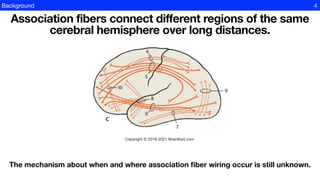
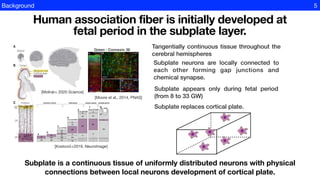
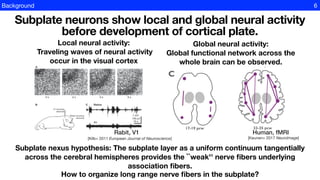
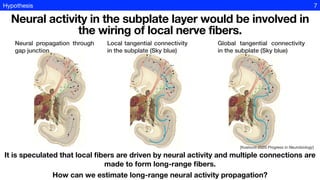
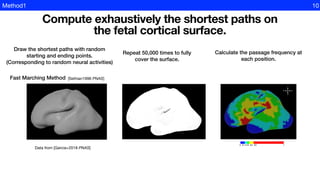
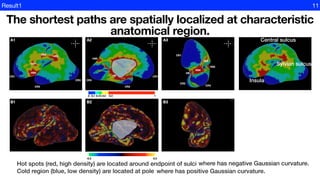
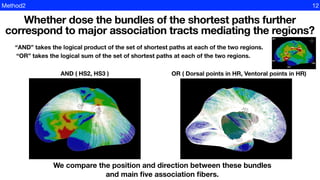
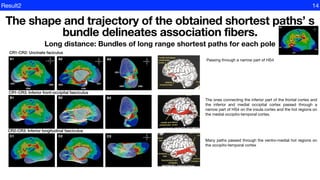
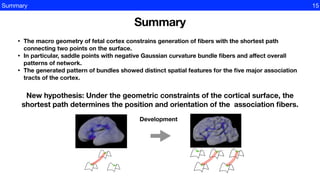
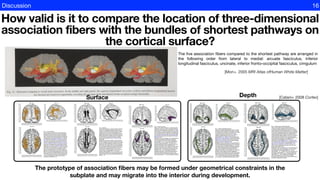
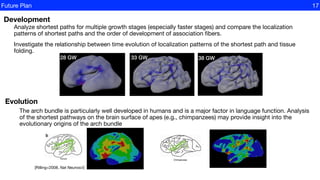
This document proposes that association fibers in the human fetal brain emerge from minimizing connectivity on the cortical geometry. It presents a computational model showing that the shortest paths between random points on the fetal cortical surface spatially localize in characteristic regions and form bundles that correspond to the trajectories of major association tracts. This provides a new hypothesis that the geometric constraints of the cortical surface determine the position and orientation of association fibers during early development. Future work is needed to analyze shortest path patterns at different growth stages and their relationship to tissue folding and fiber development over time.