Supply
• To examine the other side of the market we
examines the behavior of sellers.
• The quantity supplied of any good or service
is the amount that sellers are willing and able
to sell.
The Law of Supply
• There is a direct relationship between price
and quantity supplied.
– Quantity supplied rises as price rises, other things
constant.
– Quantity supplied falls as price falls, other things
constant.
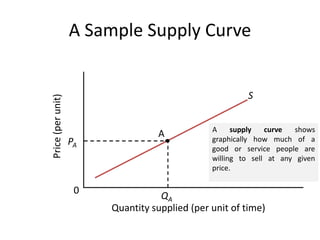
The Supply Curve
• The supply curve is the graphic representation of the
law of supply.
• The supply curve slopes upward to the right.
• The slope tells us that the quantity supplied varies
directly – in the same direction – with the price.
S
A
Quantity supplied (per unit of time)
0
Price
(per
unit)
PA
QA
A Sample Supply Curve
A supply curve shows
graphically how much of a
good or service people are
willing to sell at any given
price.
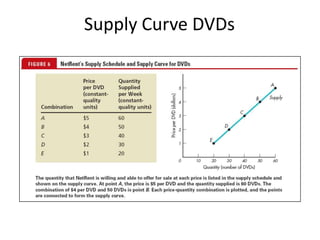
Supply Curve DVDs
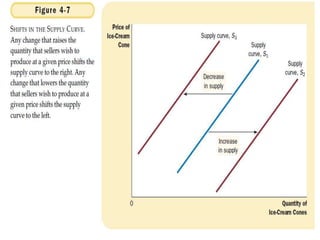
Shifts in Supply Versus Movements Along a
Supply Curve
• Supply refers to a schedule of quantities a
seller is willing to sell per unit of time at
various prices, other things constant.
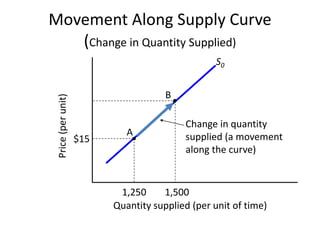
Change in quantity
supplied (a movement
along the curve)
Movement Along Supply Curve
(Change in Quantity Supplied)
Price
(per
unit)
Quantity supplied (per unit of time)
S0
$15
A
1,250 1,500
B
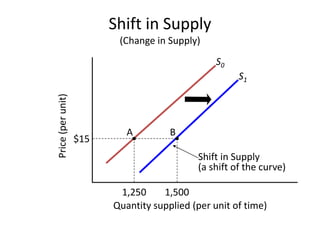
Shift in Supply
(Change in Supply)
Price
(per
unit)
Quantity supplied (per unit of time)
S0
Shift in Supply
(a shift of the curve)
S1
$15
A B
1,250 1,500
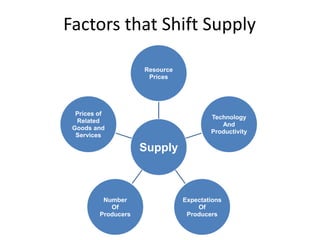
Factors that Shift Supply
Supply
Resource
Prices
Technology
And
Productivity
Expectations
Of
Producers
Number
Of
Producers
Prices of
Related
Goods and
Services
An Increase in Supply
• The entry of Vietnam
into the coffee bean
business generated an
increase in supply—a
rise in the quantity
supplied at any given
price.
• This event is
represented by the two
supply schedules—one
showing supply before
Vietnam’s entry, the
other showing supply
after Vietnam came in.
Supply Schedule for Coffee Beans
Price of
coffee beans
(per pound)
Quantity of beans supplied
(billions of pounds)
Before entry After entry
$2.00 11.6 13.9
1.75 11.5 13.8
1.50 11.2 13.4
1.25 10.7 12.8
1.00 10.0 12.0
0.75 9.1 10.9
0.50 8.0 9.6
An Increase in Supply
A shift of the supply curve is a change in the quantity supplied of a good at any given
price.
7
0 9 11 13 15 17
$2.00
1.75
1.50
1.25
1.00
0.75
0.50
S
1
S
2
Price of coffee
beans (per
pound)
Quantity of coffee beans
(billions of pounds)
… is not the
same thing as a
shift of the
supply curve
A movement
along the supply
curve…
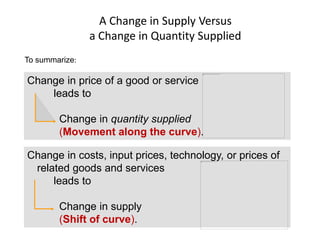
A Change in Supply Versus
a Change in Quantity Supplied
To summarize:
Change in price of a good or service
leads to
Change in quantity supplied
(Movement along the curve).
Change in costs, input prices, technology, or prices of
related goods and services
leads to
Change in supply
(Shift of curve).
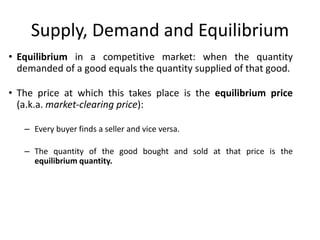
Supply, Demand and Equilibrium
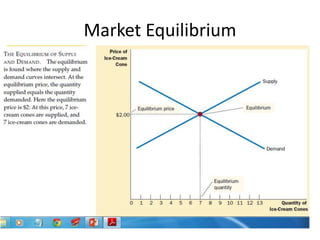
• Equilibrium in a competitive market: when the quantity
demanded of a good equals the quantity supplied of that good.
• The price at which this takes place is the equilibrium price
(a.k.a. market-clearing price):
– Every buyer finds a seller and vice versa.
– The quantity of the good bought and sold at that price is the
equilibrium quantity.
Market Equilibrium
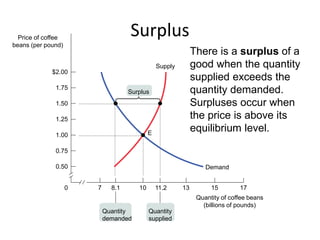
There is a surplus of a
good when the quantity
supplied exceeds the
quantity demanded.
Surpluses occur when
the price is above its
equilibrium level.
7
0 10 15
13 17
$2.00
1.75
1.50
1.25
1.00
0.75
0.50
Supply
Demand
8.1 11.2
E
Surplus
Quantity
demanded
Quantity
supplied
Price of coffee
beans (per pound)
Quantity of coffee beans
(billions of pounds)
Surplus
7
0 10 15
13 17
$2.00
1.75
1.50
1.25
1.00
0.75
0.50
Supply
Demand
9.1 11.5
E
Shortage
Quantity
demanded
Quantity
supplied
Price of
coffee beans
(per pound)
Quantity of coffee beans
(billions of pounds)
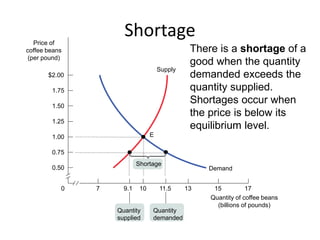
There is a shortage of a
good when the quantity
demanded exceeds the
quantity supplied.
Shortages occur when
the price is below its
equilibrium level.
Shortage
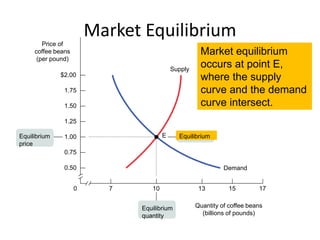
Market equilibrium
occurs at point E,
where the supply
curve and the demand
curve intersect.
Price of
coffee beans
(per pound)
Quantity of coffee beans
(billions of pounds)
7
0 10 15
13 17
$2.00
1.75
1.50
1.25
1.00
0.75
0.50
Supply
Demand
E Equilibrium
Equilibrium
price
Equilibrium
quantity
Market Equilibrium
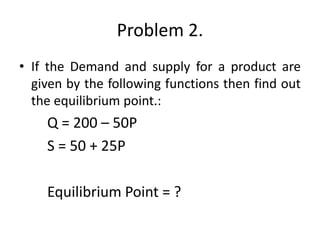
Problem 2.
• If the Demand and supply for a product are
given by the following functions then find out
the equilibrium point.:
Q = 200 – 50P
S = 50 + 25P
Equilibrium Point = ?
2.2 Supply, Demand and Equilibrium Point.pptx

2.2 Supply, Demand and Equilibrium Point.pptx

  • 1.
    Supply • To examinethe other side of the market we examines the behavior of sellers. • The quantity supplied of any good or service is the amount that sellers are willing and able to sell.
  • 2.
    The Law ofSupply • There is a direct relationship between price and quantity supplied. – Quantity supplied rises as price rises, other things constant. – Quantity supplied falls as price falls, other things constant.
  • 3.
    The Supply Curve •The supply curve is the graphic representation of the law of supply. • The supply curve slopes upward to the right. • The slope tells us that the quantity supplied varies directly – in the same direction – with the price.
  • 4.
    S A Quantity supplied (perunit of time) 0 Price (per unit) PA QA A Sample Supply Curve A supply curve shows graphically how much of a good or service people are willing to sell at any given price.
  • 5.
  • 6.
    Shifts in SupplyVersus Movements Along a Supply Curve • Supply refers to a schedule of quantities a seller is willing to sell per unit of time at various prices, other things constant.
  • 7.
    Change in quantity supplied(a movement along the curve) Movement Along Supply Curve (Change in Quantity Supplied) Price (per unit) Quantity supplied (per unit of time) S0 $15 A 1,250 1,500 B
  • 8.
    Shift in Supply (Changein Supply) Price (per unit) Quantity supplied (per unit of time) S0 Shift in Supply (a shift of the curve) S1 $15 A B 1,250 1,500
  • 10.
    Factors that ShiftSupply Supply Resource Prices Technology And Productivity Expectations Of Producers Number Of Producers Prices of Related Goods and Services
  • 11.
    An Increase inSupply • The entry of Vietnam into the coffee bean business generated an increase in supply—a rise in the quantity supplied at any given price. • This event is represented by the two supply schedules—one showing supply before Vietnam’s entry, the other showing supply after Vietnam came in. Supply Schedule for Coffee Beans Price of coffee beans (per pound) Quantity of beans supplied (billions of pounds) Before entry After entry $2.00 11.6 13.9 1.75 11.5 13.8 1.50 11.2 13.4 1.25 10.7 12.8 1.00 10.0 12.0 0.75 9.1 10.9 0.50 8.0 9.6
  • 12.
    An Increase inSupply A shift of the supply curve is a change in the quantity supplied of a good at any given price. 7 0 9 11 13 15 17 $2.00 1.75 1.50 1.25 1.00 0.75 0.50 S 1 S 2 Price of coffee beans (per pound) Quantity of coffee beans (billions of pounds) … is not the same thing as a shift of the supply curve A movement along the supply curve…
  • 13.
    A Change inSupply Versus a Change in Quantity Supplied To summarize: Change in price of a good or service leads to Change in quantity supplied (Movement along the curve). Change in costs, input prices, technology, or prices of related goods and services leads to Change in supply (Shift of curve).
  • 14.
    Supply, Demand andEquilibrium • Equilibrium in a competitive market: when the quantity demanded of a good equals the quantity supplied of that good. • The price at which this takes place is the equilibrium price (a.k.a. market-clearing price): – Every buyer finds a seller and vice versa. – The quantity of the good bought and sold at that price is the equilibrium quantity.
  • 15.
  • 16.
    There is asurplus of a good when the quantity supplied exceeds the quantity demanded. Surpluses occur when the price is above its equilibrium level. 7 0 10 15 13 17 $2.00 1.75 1.50 1.25 1.00 0.75 0.50 Supply Demand 8.1 11.2 E Surplus Quantity demanded Quantity supplied Price of coffee beans (per pound) Quantity of coffee beans (billions of pounds) Surplus
  • 17.
    7 0 10 15 1317 $2.00 1.75 1.50 1.25 1.00 0.75 0.50 Supply Demand 9.1 11.5 E Shortage Quantity demanded Quantity supplied Price of coffee beans (per pound) Quantity of coffee beans (billions of pounds) There is a shortage of a good when the quantity demanded exceeds the quantity supplied. Shortages occur when the price is below its equilibrium level. Shortage
  • 18.
    Market equilibrium occurs atpoint E, where the supply curve and the demand curve intersect. Price of coffee beans (per pound) Quantity of coffee beans (billions of pounds) 7 0 10 15 13 17 $2.00 1.75 1.50 1.25 1.00 0.75 0.50 Supply Demand E Equilibrium Equilibrium price Equilibrium quantity Market Equilibrium
  • 21.
    Problem 2. • Ifthe Demand and supply for a product are given by the following functions then find out the equilibrium point.: Q = 200 – 50P S = 50 + 25P Equilibrium Point = ?