Networks: Vol. 12, Issue 1 Spring 2010
Roof & Kreutter 1
An Interactive Storytelling Puzzle:
Building a Positive Environment in a Second Language
Classroom
Lisa M. Roof and Cheryl A. Kreutter
Abstract
The Teaching Proficiency through Reading and Storytelling (TPRS) method promised superior
results in a second language classroom. However, experiences using the method in a middle school
Spanish classroom were not always positive. Classroom structure dissolved during the interactive
storytelling sessions when students’ disruptive responses overshadowed the benefits of the
teaching method. This paper describes an action research project designed to analyze student
engagement during two different TPRS lessons. In the first lesson, the classroom teacher followed
the TPRS procedures with no modifications. In the second lesson, the teacher revised the lesson
procedures by (a) explicitly stating clear expectations and giving the students a concrete
measurement of expectations, (b) providing an added visual element, and (c) giving the students
opportunities to respond chorally during the storytelling. Students were more positively engaged
for the second lesson as evidenced by their active response to the story in the target language.
Results suggest that, along with providing clear expectations for the students’ role during the
lesson, adding strong classroom management, story-related props and choral response are useful
ways to support student learning using TPRS in a second language classroom.
The Teaching Proficiency through Reading
and Storytelling (TPRS) method promised
superior results in a second language
classroom. However, experiences using the
method in a middle school Spanish classroom
were not always positive. Classroom structure
dissolved during the interactive storytelling
sessions when students’ disruptive responses
overshadowed the benefits of the teaching
method. Through Lisa’s writer voice, we tell
the story of an action research project
designed to investigate how modifications to a
TPRS lesson might assist students in
becoming more engaged and less disruptive.
Lisa’s Story
When I was a small child, I attempted a
difficult jigsaw puzzle. However, I did not
want to spend my time with the mundane
outer edges. I was drawn to the colors and
shapes that were elsewhere within the puzzle.
Unfortunately, the difficult task eventually
eroded my enthusiasm and I gave it up
altogether.
Similarly to working with that first jigsaw
puzzle, I found using the Teaching Proficiency
through Reading and Storytelling (TPRS)
method to be overwhelming. When I first
read articles about the method, it resonated
with my linguistic and literacy training. As a
Spanish teacher at a rural middle school, I
saw the glazed expression on my students’
faces whenever I introduced a new grammar
concept. I knew through my undergraduate
linguistic training that introducing rules and
teaching vocabulary out of context was not
the way that children acquired their first
language—so why did I expect it to be
Networks: Vol. 12, Issue 1 Spring 2010
Roof & Kreutter 2
successful in teaching a second language? I
also learned, through my graduate literacy
studies, the importance of context in teaching
a child to read. Context seemed equally
important in teaching children how to
understand vocabulary in a new language.
The TPRS method offered promise as an
innovative and exciting way to teach Spanish
to my students in a contextualized manner
that mirrored my students’ acquisition of
their first language. I was drawn to pieces of
the method in the same way as I had been
drawn to the different colors and shapes in
the jigsaw puzzle; but as I attempted to use
aspects of TPRS instruction in my classroom,
my enthusiasm faded. During the interactive,
storytelling format of the method, students
became disruptive and distracted, causing the
structured atmosphere of my classroom to
break down. Surprisingly, the students
usually were not disruptive because of
boredom or lack of engagement, but because
they became absorbed in the story to the
point that they strayed from the Spanish
narrative and many of them, consequently,
talked out of turn. The TPRS picture in my
classroom did not look like the promising
picture on the box of the “TPRS jigsaw
puzzle”—it was just a pile of unconnected
pieces.
To address my concerns about this
breakdown in classroom structure during the
TPRS instruction, I developed an action
research project that focused on modifying
the TPRS method in ways that kept students
engaged within a well-managed classroom. I
conducted the research in my combined 7th
and 8th grade Spanish class in a rural school
district in Western New York where I have
taught for three years. My colleague, (second
author) provided guidance as I developed the
study and remained a critical friend
throughout the data collection process and
initial analysis of the findings. Cheryl actively
participated in analyzing the final study
results and co-authoring this article.
Two key questions guided my research:
In teaching a TPRS lesson, how can I
actively involve students, yet still
maintain positive classroom
management so that the students are
engaged in learning?
What factors are affecting my negative
perception of the lessons, and how can I
improve my technique so that I feel
comfortable with the results?
This paper is my development of the
framework involving the puzzle of TPRS. By
focusing on the outer structure, I made room
to create the entire picture successfully. In
the following pages, I first explain the
Teaching Proficiency through Reading and
Storytelling (TPRS) method. Second, I
explore recent research on classroom
management and its role in student
achievement. After laying the foundation for
this study, I describe the participants,
research methods, and findings. Finally, I
discuss the conclusions I reached about the
effectiveness of the intervention and suggest
areas for future research.
The Teaching Proficiency through
Reading and Storytelling (TPRS)
Teaching Method
The TPRS teaching method originates from a
kinesthetic instructional approach entitled,
“Total Physical Response” (TPR). In the 1960s
and 1970s, Dr. James Asher introduced the
method, in which students physically
responded to various commands in the target
language (Davidheiser, 2002). The instructor
began by demonstrating simple commands,
such as “sit down” and “stand up” in the
target language. Through practice and
repetition, the students learn to respond to
the teacher’s commands. The teacher
gradually builds on the students’ growing
repertoire of words until students can
respond to complex directions (e.g. “Stand up,
turn around three times, walk to the
whiteboard, and write your name with a
marker.”) (Asher, 2000).
Blaine Ray expanded this method in the
1990s to include simple stories created in the
target language that used TPR commands as
the foundation and added details to further
students’ language experience. His method,
Networks: Vol. 12, Issue 1 Spring 2010
Roof & Kreutter 3
Figure 1. A Sample TPRS Lesson (format was adapted from Ray & Seely (1998).
canta fuerte – he/she sings loudly
baila – he/she dances
está enojada(a) – he/she is angry
se ríen – they laugh
Step 1 – Gesture – The phrases above are written on the board in English and Spanish.
Students invent a gesture to coincide with each word or phrase (e.g., for “baila,” students mime
dancing). The students mime the actions when the teacher says the words in Spanish. This is
practiced until the students can mime the actions easily without referring to what the words
mean in English.
Step 2 – Personalized Questions and Answers – Students are asked questions based on
the above words to begin to personalize the vocabulary. The questions are asked in Spanish:
Who sings? Do you sing loudly or softly? Who sings like Hannah Montana? Who sings like
Elvis? Do you sing romantically? What do you sing? Do you sing at home, in the car, or at
school? Where do you sing?
Step 3 – Story – Using the answers to the question from the previous step, the teacher creates
a personalized story about the students in the classroom. The following is a framework for a
basic short story.
Federico es estudiante. Federico canta fuerte en la clase de matemáticas. Canta y baila en el
pupitre. La profesora está enojada. Los estudiantes se ríen.
Translation: Fred is a student. Fred sings loudly in math class. He sings and dances on the
desk. The teacher is angry. The students laugh.
Step 4 – Dramatize – Using students as actors, the instructor retells the story and has the
students act it out.
called “TPRS,” was the basis of my lesson
plans (Ray & Seely, 1998).
TPRS begins with “comprehensible input,”
which are phrases in the target language that
the teacher translates for the students into
their native tongue. In a TPRS lesson, the
teacher often begins with four phrases written
in both English and Spanish on the classroom
whiteboard (see Figure 1). First, the
instructor displays the phrases on the board
and teaches a gesture to go along with each
phrase. The students perform the action as
the teacher says the new phrases. Next, the
teacher asks questions that refer to the
phrases. For example, if a phrase is “El chico
canta,” (“the boy sings”) the teacher might
ask, “Canta el chico como Elvis o Hannah
Montana?” (“Does the boy sing like Elvis or
Hannah Montana?”). The students answer
and the teacher continues to ask more
questions in the target language based on the
phrase (e.g., “Do you like to sing?” “Who likes
to sing?” “How does the boy sing?”). In this
way, the students hear the target word
(“sing”) many times. The answers that the
students give to the various questions, as well
as the key phrases introduced at the
beginning of class, form the structure of the
story that the instructor proceeds to tell (Ray
& Seely, 1998). Through this method, the
teacher creates a personalized story that
integrates the new vocabulary. Then the
students act out the story, further reinforcing
Networks: Vol. 12, Issue 1 Spring 2010
Roof & Kreutter 4
the vocabulary and creating an interactive
learning situation. An example of a TPRS
lesson is shown in Figure 1.
Studies comparing TPR and TPRS methods
with traditional teaching methods have shown
that students scored significantly higher on
vocabulary retention tests when the TPR or
TPRS methods were used (Davidheiser, 2002;
Kariuki & Bush, 2008). These studies not
only reported the methods were effective as
measured by test scores, but also the students
stated that they enjoyed learning with the
TPR and TPRS approach (Davidheiser, 2002;
Skala, 2003).
However, even proponents of this method
delineated various drawbacks. Skala (2003)
discussed the complexity of using the TPRS
method. She seemed surprised at the
students’ positive reaction to the method in
her study, despite what she considered the
“awkwardness” in teaching the material.
Catania (2007), another promoter of the
TPRS method, created a curriculum of stories
to use in the TPRS classroom. One of the
purposes of creating the curriculum was to
help bring structure to the method. In the
forward of her book, she noted that the TPRS
classroom can become “rather chaotic”
(Catania, 2007, p 3). Thus, despite students’
positive reception of TPRS, teachers
sometimes may abandon it due to its
complexity and lack of structure. A teacher
may be concerned about sacrificing student
behavior expectations and classroom
organization to implement this teaching
method.
Classroom Management
Teachers’ concerns about classroom
management seem merited in light of the
research of the characteristics of highly
effective teachers. Parris and Block (2007)
surveyed 70 literacy teacher supervisors
representing all 50 states in the United States.
The supervisors were asked to identify the
characteristics of highly effective literacy
teachers. Even though this survey specifically
concerned literacy teachers, I believe it can be
generalized to apply to many types of
teachers. Researchers separated the survey
responses into eight different categories to
define a highly effective literacy teacher.
“Superior classroom management” was a
characteristic common to all of these
teachers. One indication of this quality was
“excellent learning management (ability to
keep students focused on work, minimal
discipline problems)” (Parris & Block, 2007,
p. 588). I concluded that if students were not
able to stay focused on the lesson because
they are distracted by the method, then the
method was ineffective.
For this study, I needed to evaluate the
behavior-management issues and improve the
classroom atmosphere in order to effectively
use TPRS. In trying to define the problems in
the class, I examined behavior methods in the
classroom context. Simonsen et al (2008)
explored effective classroom management
procedures and developed a checklist of
management areas to evaluate five categories
of strategies: a) structure and predictability,
b) positively stated expectations, c) actively
engaged students, d) continuum of strategies
to acknowledge appropriate behavior, and e) a
continuum of strategies to respond to
inappropriate behavior. I used this checklist
to guide my observation of students during
TPRS lessons (See Appendix B).
Other research supports a focus on these
five classroom management areas. For
example, a study by Lohrmann and Talerico
(2004) demonstrated a positive correlation
between explicit expectations and student
behavior. When the instructor gave ten
students with learning disabilities structured
and predictable guidelines for behavior and
the guidelines were monitored and
reinforced, the students’ behavior improved.
Johnson, Stoner, and Green (1996) further
supported this approach. These researchers
observed twenty-five 7th grade students
across five classrooms. They found that three
behavioral interventions were most effective
in decreasing behavior problems: directly
stating the rules, monitoring expectations,
and reinforcing the rules.
Networks: Vol. 12, Issue 1 Spring 2010
Roof & Kreutter 5
In seeking ways to increase opportunities for
active student engagement, Christle and
Schuster (2003) studied a fourth- grade math
class where students were given a response
card (a whiteboard) for some lessons and
were asked one-on-one questions about other
similar lessons. Using the whiteboards
created the expectation that all students
would respond to the teacher’s questions,
rather than allowing one student to respond.
Study results indicated that when the teacher
gave students more opportunities to respond
during the lesson, the students’ time-on-task,
positive behavior, and achievement increased.
Similarly, in a classroom for students with
emotional behavior disorders, researchers
gave the students increased response
opportunities and they found that behavior
problems decreased as students responded
more to the teacher’s questions (Sutherland,
Alder, & Gunter, 2003).
This research suggests there is a correlation
between some classroom-management
strategies, student engagement, and
achievement. Giving students clear
expectations and modeling and reinforcing
these expectations may effectively influence
behavior in the classroom. Also, by providing
students with ample opportunities to respond
to the lesson, an instructor may positively
impact student engagement and lesson
effectiveness. In light of these research
results, I used Simonsen et al’s checklist to
evaluate my classroom- management
strengths and weaknesses during the study
(See Appendix C).
The Research Project
Participants and Setting
The students in this study were 7th and 8th
graders in a rural school district in Western
New York. I observed a classroom of fifteen
students. Thirteen students were 7th graders
and two students were 8th graders. I focused
on seven students because these students
attended all three of the observation sessions
and were able to be observed during each
session (i.e., the view of the students was not
obstructed on the video by other students or
desks). This was their first year learning
Spanish. The Spanish class met daily for forty
minutes. Pseudonyms are used for all of the
participants in this study.
Research Design
I videotaped two lessons. Lesson A was
recorded as a baseline lesson to observe the
effectiveness of the method without any
modifications. After observing the lesson, I
determined what changes needed to be made
and used the “Classroom Assessment
Checklist” (Simonsen et al., 2008) to identify
factors that may have affected students’
behavior (Appendixes B & C). I also
categorized the sections of the lessons and
noted my thoughts as I watched the video
(Appendixes D & E). I then filmed Lesson B,
a second lesson in which I had changed the
lesson based on my observation of the first
lesson. Due to time constraints, the second
lesson was split into two different class
periods. After both lessons, I coded the
behavior of the seven students who attended
all three sessions and who were easily visible
on the videotape. Their behavior was
recorded on a scale of 0-3 in one-minute
intervals. A score of “3” denoted - “strongly
engaged” behavior (student seemed engaged
and was looking at the teacher or lesson
presentation and responding to teacher
prompts); “2” represented a student who was
looking away from the presentation, but still
seem engaged in the lesson (responds to
teacher prompts or makes comments that
indicate some level attentiveness); and a “1”
indicated the student was being disruptive in
ways that inhibited learning. Such behaviors
included talking or visually distracting other
students. Because of the variance in Lessons
A and B, I used the sections of the two lessons
that were the same. For both lessons, I coded
the behavior for the first five minutes of the
storytelling section of the lesson and for the
first five minutes of the dramatization time of
the lesson (See Appendix A).
The storytelling section of the lessons, as well
as the dramatization, were based on the TPRS
lesson structure as shown in Figure 1. The
TPRS stories I used for the lesson were
included as part of the first- year Spanish
Networks: Vol. 12, Issue 1 Spring 2010
Roof & Kreutter 6
Figure 2: Level of Student Engagement, Lesson A.
curriculum, En Español, (Gahala, Carlin,
Heining-Boynton, Otheguy, Rupert, 2004).
The stories, written by Fritze (n.d.), coincided
with the vocabulary of Unit Two, Lesson
Three in the textbook. Both stories, with
translations, are included in the appendixes
(Appendixes F and G). As I read the story to
the students, I asked questions to clarify
meaning and check the students’
comprehension level. Then, I called on
students to act out the story and read the
story again as the students dramatized the
action.
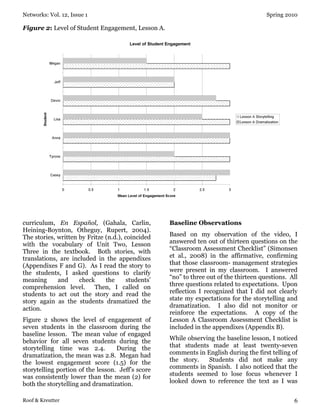
Figure 2 shows the level of engagement of
seven students in the classroom during the
baseline lesson. The mean value of engaged
behavior for all seven students during the
storytelling time was 2.4. During the
dramatization, the mean was 2.8. Megan had
the lowest engagement score (1.5) for the
storytelling portion of the lesson. Jeff’s score
was consistently lower than the mean (2) for
both the storytelling and dramatization.
Baseline Observations
Based on my observation of the video, I
answered ten out of thirteen questions on the
“Classroom Assessment Checklist” (Simonsen
et al., 2008) in the affirmative, confirming
that those classroom- management strategies
were present in my classroom. I answered
“no” to three out of the thirteen questions. All
three questions related to expectations. Upon
reflection I recognized that I did not clearly
state my expectations for the storytelling and
dramatization. I also did not monitor or
reinforce the expectations. A copy of the
Lesson A Classroom Assessment Checklist is
included in the appendixes (Appendix B).
While observing the baseline lesson, I noticed
that students made at least twenty-seven
comments in English during the first telling of
the story. Students did not make any
comments in Spanish. I also noticed that the
students seemed to lose focus whenever I
looked down to reference the text as I was
Networks: Vol. 12, Issue 1 Spring 2010
Roof & Kreutter 7
reading the story. A complete list of these
general observations is included in the
appendixes (Appendixes D and E).
What We Learned
Discussion of Lesson A
I was surprised at how engaged students were
during the baseline lesson. Even without
modifications, TPRS seems to be a lesson
technique that holds students’ attention. The
primary exceptions to engaged behavior were
Megan and Jeff.
At the end of lesson A, which focused on the
story of a girl misbehaving in Spanish class, I
asked the students some more questions
about the story to check comprehension. Jeff
and I had the following conversation:
Me: Jeff, ¿Está en la clase de matemáticas
o la clase de español? (Is she in math class
or Spanish class?)
Jeff: (scribbling in his notebook) I'm
trying to figure out what the "aspieces" or
whatever is. (I think this is his
interpretation of “matemáticas”)
(I repeat the question more slowly.)
Jeff: (whispers to students) What does
that mean?
Jeff’s comments at the end of the baseline
lesson revealed the cause of his inattention
during the lesson. When I asked him a
question about the lesson, he had difficulty
understanding the vocabulary used in my
question. In successfully employing the TPRS
method, it is important to conduct frequent
comprehension checks to be sure that
students like Jeff are receiving
comprehensible input. I believe that Jeff
stopped paying attention because he did not
understand the story.
I suspect that Megan did not pay attention for
different reasons. Megan became fascinated
with the dynamics of a piece of string
throughout the storytelling time of the lesson
and talked to other classmates during the
storytelling session. However, she was much
more attentive when students were acting out
the story. I suspect that Megan is a visual
learner. Without pictures or a drama to focus
her attention, she created her own visual
stimulus during the storytelling. This was
confirmed by the complete attention she
showed to the dramatization of the story.
Tyrone and Lisa also received somewhat
lower scores for engagement level. Lisa
frequently looked down at her desk, although
she appeared to be listening throughout the
lesson. Tyrone was listening, because he
interrupted the lesson to ask a question in
English about a minor point in the story.
Although this was distracting for me and
probably some other students in the class, it
actually confirmed his attentiveness.
My frustration with the TPRS method
originated from two factors that were present
in the baseline lesson: (a) students made
many comments in English during the
storytelling time, and (b) I was dependent
upon the text to tell the story, and I had to
refer to it many times. The comments in
English were quick and short; however, I
believe that these comments were related to
my negative feelings toward the TPRS
lessons. Like a buzzing mosquito, these
constant distractions inhibited a clear and
focused lesson. This was clearly a missing
edge piece to the puzzle. My dependency
upon the text also diverted the lesson focus.
At first, I was unsure how I could resolve the
problem, but using pictures not only helped
me to become less dependent upon the text,
but it also supported student attentiveness.
The pieces were falling into place.
Modifications. Based on these results, I
decided to modify the next lesson - Lesson B.
First, I realized that I needed to provide clear
expectations for the TPRS lesson. At the
beginning of Lesson B, I explained that
students were not allowed to respond in
English, but could only respond to the story in
Spanish. To monitor this expectation, I gave
one student a whiteboard divided into two
sections. Her role was to record every time a
student responded in English and every time
a student responded in Spanish. I rewarded
Networks: Vol. 12, Issue 1 Spring 2010
Roof & Kreutter 8
Figure 3. Level of Student Engagement, Lessons A and B.
the students with an extra “chili-pepper
point” (my method of positive behavior
reinforcement) if they were able to respond
primarily in Spanish.
In order to facilitate the students’ ability to
respond in Spanish, I provided them with
three phrases that they could use throughout
the story (¡Qué cómico!- That’s funny!; ¡No
me digas! - You’re kidding!, and ¡Qué lástima!
- That’s too bad!). One student held up the
sign with the phrase he chose at various
points in the story. The students responded
by stating each phrase. This provided
students with a positive behavior to replace
their previous behavior of yelling out
comments in English that increased the
opportunities for students to respond.
The other way I modified the lesson was to
use eight pictures to illustrate the story. I
projected the pictures on the overhead for the
students to see during the initial storytelling
time. The pictures are included in Appendix
H.
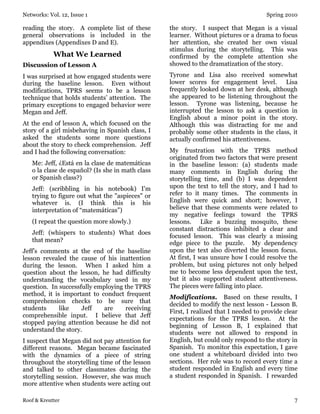
As shown in Figure 3, the amount of average
student engagement either increased or
remained the same for the seven students
observed. The mean engagement behavior for
all seven students was 2.9 out of 3 for the
storytelling portion of Lesson B and 2.9 out of
3 for the dramatization.
Observations. For the second lesson, I
answered “yes” to all thirteen areas included
on the Classroom Assessment Checklist
(Simonsen et al., 2008). During the second
lesson, students made thirteen comments in
Spanish and two in English during the
storytelling time. I saw no incidences of off-
task behavior while I told the story. While I
reviewed the story, four students seemed
slightly distracted, but they did not disrupt
other students, and their inattentiveness was
brief. Jeff fidgeted during the lesson and put
his head down on his desk, but he did not
Networks: Vol. 12, Issue 1 Spring 2010
Roof & Kreutter 9
disrupt other students, and he was engaged
during most of the lesson. Megan helped to
direct the other students during the
dramatization. She mimed eating to help the
actor remember that he was supposed to eat a
pork rind.
Reflections on Lesson B. Using pictures
was effective in keeping students engaged
during the storytelling time. Both Megan’s
and Jeff’s level of engagement scores
improved. I argue that the pictures aided
both learners. Jeff was able to understand the
story better through the illustrations, and
Megan was able to remain attentive.
I felt more comfortable delivering the second
lesson. In delineating expectations for the
students, I was less distracted in telling the
story because students were not making
comments in English. Instead, they were
responding chorally in Spanish. Secondly, by
providing pictures to illustrate the storytelling
time, I was able to tell the story without
referring to the text. The pictures helped me
to maintain more eye contact with students
and to be able to monitor students’ responses
to the story, instead of having to continue to
reference the text. These factors were
definitely “edge pieces” in the TPRS jigsaw.
Conclusions
The observations that I made in the
preliminary lesson motivated me to make
focused changes in the second lesson.
Through explicitly stating expectations, using
drawings to illustrate the story, and by
providing opportunities for choral responses,
I was able to fit many pieces of the TPRS
jigsaw together. These modifications gave
students opportunities for active involvement,
yet still enabled me to maintain positive
classroom management.
I will continue to place the edges and corners
of the TPRS method in my classroom; with
the modifications I developed to help guide
this process. Still, there are some colorful
jigsaw pieces in the box that catch my eye.
These considerations for further research
would be the affective component of the
lessons. The humor in the first story seemed
to have a strong effect on the students’
positive feelings about the lesson. Does this
humor also affect the students’ vocabulary
retention and motivation to learn? Another
factor of the TPRS lesson is the personalized
question and answer time. How can this part
of the lesson be used to best aid
comprehension? Although there are still
many more details about the teaching method
that I need to master, I feel that I have built a
framework for future success with storytelling
in my classroom.
References
Asher, James. (2000). Learning another
language through actions (7th ed.). Sky Oaks,
CA: Sky Oaks Productions.
Catania, A.B. (2007). Cuentos fantasticos:
TPR storytelling for the first year of Spanish.
Saranac Lake, NY: Good Teaching Stuff
Publishing.
Christle, C., & Schuster, J. (2003, September).
The effects of using response cards on student
participation, academic achievement, and on-
task behavior during whole-class math
instruction. Journal of Behavioral Education,
12(3), 147-165.
Davidheiser, J. (2002). Teaching German
with TPRS (Total Physical Response
Storytelling). Unterrichtspraxis/Teaching
German, 35(1), 25-35.
Fritze, J. (n.d.) Total physical response
storytelling. Evanston, Illinois: McDougal
Littell.
Gahala, E., Carlin, P. H., Heining-Boynton,
A.L., Otheguy, R. & Rupert, B. J. (Eds.).
(2004). En Español. Evanston, IL: McDougal
Littell.
Johnson, T., Stoner, G., & Green, S. (1996).
Demonstrating the experimenting society
model with classwide behavior management
interventions. School Psychology Review,
25(2), 199-214.
Kariuki, P., & Bush, E. (2008). The effects of
Total Physical Response by Storytelling and
the traditional teaching styles of a foreign
language in a selected high school. Annual
Networks: Vol. 12, Issue 1 Spring 2010
Roof & Kreutter 10
Conference, Mid-South Educational Research
Association. Knoxville, TN November 5-7,
2008. Reading.
Lohrmann, S., & Talerico, J. (2004). Anchor
the boat: A classwide intervention to reduce
problem behavior. Journal of Positive
Behavior Interventions, 6(2), 113-120.
Parris, S., & Block, C. (2007, April 1). The
expertise of adolescent literacy teachers.
Journal of Adolescent & Adult Literacy,
50(7), 582-596.
Ray, B., & Seely, C. (1998). Fluency through
TPR storytelling: Achieving real language
acquisition in school (2nd ed.). Berkeley, CA:
Command Performance Language Institute.
Simonsen, B., Fairbanks, S., Briesch, A.,
Myers, D., & Sugai, G. (2008). Evidence-
based practices in classroom management:
Considerations for research to practice.
Education and Treatment of Children, 31(3),
351-380.
Skala, C. (2003). Optimizing basic French
skills utilizing multiple teaching techniques.
(ERIC Document Reproduction Service No.
ED479988) Retrieved April 20, 2009, from
ERIC database.
Sutherland, K., Alder, N., & Gunter, P.
(2003). The effect of varying rates of
opportunities to respond to academic
requests on the classroom behavior of
students with EBD. Journal of Emotional and
Behavioral Disorders, 11(4), 239-248.

206 1593-1-pb

  • 1.
    Networks: Vol. 12,Issue 1 Spring 2010 Roof & Kreutter 1 An Interactive Storytelling Puzzle: Building a Positive Environment in a Second Language Classroom Lisa M. Roof and Cheryl A. Kreutter Abstract The Teaching Proficiency through Reading and Storytelling (TPRS) method promised superior results in a second language classroom. However, experiences using the method in a middle school Spanish classroom were not always positive. Classroom structure dissolved during the interactive storytelling sessions when students’ disruptive responses overshadowed the benefits of the teaching method. This paper describes an action research project designed to analyze student engagement during two different TPRS lessons. In the first lesson, the classroom teacher followed the TPRS procedures with no modifications. In the second lesson, the teacher revised the lesson procedures by (a) explicitly stating clear expectations and giving the students a concrete measurement of expectations, (b) providing an added visual element, and (c) giving the students opportunities to respond chorally during the storytelling. Students were more positively engaged for the second lesson as evidenced by their active response to the story in the target language. Results suggest that, along with providing clear expectations for the students’ role during the lesson, adding strong classroom management, story-related props and choral response are useful ways to support student learning using TPRS in a second language classroom. The Teaching Proficiency through Reading and Storytelling (TPRS) method promised superior results in a second language classroom. However, experiences using the method in a middle school Spanish classroom were not always positive. Classroom structure dissolved during the interactive storytelling sessions when students’ disruptive responses overshadowed the benefits of the teaching method. Through Lisa’s writer voice, we tell the story of an action research project designed to investigate how modifications to a TPRS lesson might assist students in becoming more engaged and less disruptive. Lisa’s Story When I was a small child, I attempted a difficult jigsaw puzzle. However, I did not want to spend my time with the mundane outer edges. I was drawn to the colors and shapes that were elsewhere within the puzzle. Unfortunately, the difficult task eventually eroded my enthusiasm and I gave it up altogether. Similarly to working with that first jigsaw puzzle, I found using the Teaching Proficiency through Reading and Storytelling (TPRS) method to be overwhelming. When I first read articles about the method, it resonated with my linguistic and literacy training. As a Spanish teacher at a rural middle school, I saw the glazed expression on my students’ faces whenever I introduced a new grammar concept. I knew through my undergraduate linguistic training that introducing rules and teaching vocabulary out of context was not the way that children acquired their first language—so why did I expect it to be
  • 2.
    Networks: Vol. 12,Issue 1 Spring 2010 Roof & Kreutter 2 successful in teaching a second language? I also learned, through my graduate literacy studies, the importance of context in teaching a child to read. Context seemed equally important in teaching children how to understand vocabulary in a new language. The TPRS method offered promise as an innovative and exciting way to teach Spanish to my students in a contextualized manner that mirrored my students’ acquisition of their first language. I was drawn to pieces of the method in the same way as I had been drawn to the different colors and shapes in the jigsaw puzzle; but as I attempted to use aspects of TPRS instruction in my classroom, my enthusiasm faded. During the interactive, storytelling format of the method, students became disruptive and distracted, causing the structured atmosphere of my classroom to break down. Surprisingly, the students usually were not disruptive because of boredom or lack of engagement, but because they became absorbed in the story to the point that they strayed from the Spanish narrative and many of them, consequently, talked out of turn. The TPRS picture in my classroom did not look like the promising picture on the box of the “TPRS jigsaw puzzle”—it was just a pile of unconnected pieces. To address my concerns about this breakdown in classroom structure during the TPRS instruction, I developed an action research project that focused on modifying the TPRS method in ways that kept students engaged within a well-managed classroom. I conducted the research in my combined 7th and 8th grade Spanish class in a rural school district in Western New York where I have taught for three years. My colleague, (second author) provided guidance as I developed the study and remained a critical friend throughout the data collection process and initial analysis of the findings. Cheryl actively participated in analyzing the final study results and co-authoring this article. Two key questions guided my research: In teaching a TPRS lesson, how can I actively involve students, yet still maintain positive classroom management so that the students are engaged in learning? What factors are affecting my negative perception of the lessons, and how can I improve my technique so that I feel comfortable with the results? This paper is my development of the framework involving the puzzle of TPRS. By focusing on the outer structure, I made room to create the entire picture successfully. In the following pages, I first explain the Teaching Proficiency through Reading and Storytelling (TPRS) method. Second, I explore recent research on classroom management and its role in student achievement. After laying the foundation for this study, I describe the participants, research methods, and findings. Finally, I discuss the conclusions I reached about the effectiveness of the intervention and suggest areas for future research. The Teaching Proficiency through Reading and Storytelling (TPRS) Teaching Method The TPRS teaching method originates from a kinesthetic instructional approach entitled, “Total Physical Response” (TPR). In the 1960s and 1970s, Dr. James Asher introduced the method, in which students physically responded to various commands in the target language (Davidheiser, 2002). The instructor began by demonstrating simple commands, such as “sit down” and “stand up” in the target language. Through practice and repetition, the students learn to respond to the teacher’s commands. The teacher gradually builds on the students’ growing repertoire of words until students can respond to complex directions (e.g. “Stand up, turn around three times, walk to the whiteboard, and write your name with a marker.”) (Asher, 2000). Blaine Ray expanded this method in the 1990s to include simple stories created in the target language that used TPR commands as the foundation and added details to further students’ language experience. His method,
  • 3.
    Networks: Vol. 12,Issue 1 Spring 2010 Roof & Kreutter 3 Figure 1. A Sample TPRS Lesson (format was adapted from Ray & Seely (1998). canta fuerte – he/she sings loudly baila – he/she dances está enojada(a) – he/she is angry se ríen – they laugh Step 1 – Gesture – The phrases above are written on the board in English and Spanish. Students invent a gesture to coincide with each word or phrase (e.g., for “baila,” students mime dancing). The students mime the actions when the teacher says the words in Spanish. This is practiced until the students can mime the actions easily without referring to what the words mean in English. Step 2 – Personalized Questions and Answers – Students are asked questions based on the above words to begin to personalize the vocabulary. The questions are asked in Spanish: Who sings? Do you sing loudly or softly? Who sings like Hannah Montana? Who sings like Elvis? Do you sing romantically? What do you sing? Do you sing at home, in the car, or at school? Where do you sing? Step 3 – Story – Using the answers to the question from the previous step, the teacher creates a personalized story about the students in the classroom. The following is a framework for a basic short story. Federico es estudiante. Federico canta fuerte en la clase de matemáticas. Canta y baila en el pupitre. La profesora está enojada. Los estudiantes se ríen. Translation: Fred is a student. Fred sings loudly in math class. He sings and dances on the desk. The teacher is angry. The students laugh. Step 4 – Dramatize – Using students as actors, the instructor retells the story and has the students act it out. called “TPRS,” was the basis of my lesson plans (Ray & Seely, 1998). TPRS begins with “comprehensible input,” which are phrases in the target language that the teacher translates for the students into their native tongue. In a TPRS lesson, the teacher often begins with four phrases written in both English and Spanish on the classroom whiteboard (see Figure 1). First, the instructor displays the phrases on the board and teaches a gesture to go along with each phrase. The students perform the action as the teacher says the new phrases. Next, the teacher asks questions that refer to the phrases. For example, if a phrase is “El chico canta,” (“the boy sings”) the teacher might ask, “Canta el chico como Elvis o Hannah Montana?” (“Does the boy sing like Elvis or Hannah Montana?”). The students answer and the teacher continues to ask more questions in the target language based on the phrase (e.g., “Do you like to sing?” “Who likes to sing?” “How does the boy sing?”). In this way, the students hear the target word (“sing”) many times. The answers that the students give to the various questions, as well as the key phrases introduced at the beginning of class, form the structure of the story that the instructor proceeds to tell (Ray & Seely, 1998). Through this method, the teacher creates a personalized story that integrates the new vocabulary. Then the students act out the story, further reinforcing
  • 4.
    Networks: Vol. 12,Issue 1 Spring 2010 Roof & Kreutter 4 the vocabulary and creating an interactive learning situation. An example of a TPRS lesson is shown in Figure 1. Studies comparing TPR and TPRS methods with traditional teaching methods have shown that students scored significantly higher on vocabulary retention tests when the TPR or TPRS methods were used (Davidheiser, 2002; Kariuki & Bush, 2008). These studies not only reported the methods were effective as measured by test scores, but also the students stated that they enjoyed learning with the TPR and TPRS approach (Davidheiser, 2002; Skala, 2003). However, even proponents of this method delineated various drawbacks. Skala (2003) discussed the complexity of using the TPRS method. She seemed surprised at the students’ positive reaction to the method in her study, despite what she considered the “awkwardness” in teaching the material. Catania (2007), another promoter of the TPRS method, created a curriculum of stories to use in the TPRS classroom. One of the purposes of creating the curriculum was to help bring structure to the method. In the forward of her book, she noted that the TPRS classroom can become “rather chaotic” (Catania, 2007, p 3). Thus, despite students’ positive reception of TPRS, teachers sometimes may abandon it due to its complexity and lack of structure. A teacher may be concerned about sacrificing student behavior expectations and classroom organization to implement this teaching method. Classroom Management Teachers’ concerns about classroom management seem merited in light of the research of the characteristics of highly effective teachers. Parris and Block (2007) surveyed 70 literacy teacher supervisors representing all 50 states in the United States. The supervisors were asked to identify the characteristics of highly effective literacy teachers. Even though this survey specifically concerned literacy teachers, I believe it can be generalized to apply to many types of teachers. Researchers separated the survey responses into eight different categories to define a highly effective literacy teacher. “Superior classroom management” was a characteristic common to all of these teachers. One indication of this quality was “excellent learning management (ability to keep students focused on work, minimal discipline problems)” (Parris & Block, 2007, p. 588). I concluded that if students were not able to stay focused on the lesson because they are distracted by the method, then the method was ineffective. For this study, I needed to evaluate the behavior-management issues and improve the classroom atmosphere in order to effectively use TPRS. In trying to define the problems in the class, I examined behavior methods in the classroom context. Simonsen et al (2008) explored effective classroom management procedures and developed a checklist of management areas to evaluate five categories of strategies: a) structure and predictability, b) positively stated expectations, c) actively engaged students, d) continuum of strategies to acknowledge appropriate behavior, and e) a continuum of strategies to respond to inappropriate behavior. I used this checklist to guide my observation of students during TPRS lessons (See Appendix B). Other research supports a focus on these five classroom management areas. For example, a study by Lohrmann and Talerico (2004) demonstrated a positive correlation between explicit expectations and student behavior. When the instructor gave ten students with learning disabilities structured and predictable guidelines for behavior and the guidelines were monitored and reinforced, the students’ behavior improved. Johnson, Stoner, and Green (1996) further supported this approach. These researchers observed twenty-five 7th grade students across five classrooms. They found that three behavioral interventions were most effective in decreasing behavior problems: directly stating the rules, monitoring expectations, and reinforcing the rules.
  • 5.
    Networks: Vol. 12,Issue 1 Spring 2010 Roof & Kreutter 5 In seeking ways to increase opportunities for active student engagement, Christle and Schuster (2003) studied a fourth- grade math class where students were given a response card (a whiteboard) for some lessons and were asked one-on-one questions about other similar lessons. Using the whiteboards created the expectation that all students would respond to the teacher’s questions, rather than allowing one student to respond. Study results indicated that when the teacher gave students more opportunities to respond during the lesson, the students’ time-on-task, positive behavior, and achievement increased. Similarly, in a classroom for students with emotional behavior disorders, researchers gave the students increased response opportunities and they found that behavior problems decreased as students responded more to the teacher’s questions (Sutherland, Alder, & Gunter, 2003). This research suggests there is a correlation between some classroom-management strategies, student engagement, and achievement. Giving students clear expectations and modeling and reinforcing these expectations may effectively influence behavior in the classroom. Also, by providing students with ample opportunities to respond to the lesson, an instructor may positively impact student engagement and lesson effectiveness. In light of these research results, I used Simonsen et al’s checklist to evaluate my classroom- management strengths and weaknesses during the study (See Appendix C). The Research Project Participants and Setting The students in this study were 7th and 8th graders in a rural school district in Western New York. I observed a classroom of fifteen students. Thirteen students were 7th graders and two students were 8th graders. I focused on seven students because these students attended all three of the observation sessions and were able to be observed during each session (i.e., the view of the students was not obstructed on the video by other students or desks). This was their first year learning Spanish. The Spanish class met daily for forty minutes. Pseudonyms are used for all of the participants in this study. Research Design I videotaped two lessons. Lesson A was recorded as a baseline lesson to observe the effectiveness of the method without any modifications. After observing the lesson, I determined what changes needed to be made and used the “Classroom Assessment Checklist” (Simonsen et al., 2008) to identify factors that may have affected students’ behavior (Appendixes B & C). I also categorized the sections of the lessons and noted my thoughts as I watched the video (Appendixes D & E). I then filmed Lesson B, a second lesson in which I had changed the lesson based on my observation of the first lesson. Due to time constraints, the second lesson was split into two different class periods. After both lessons, I coded the behavior of the seven students who attended all three sessions and who were easily visible on the videotape. Their behavior was recorded on a scale of 0-3 in one-minute intervals. A score of “3” denoted - “strongly engaged” behavior (student seemed engaged and was looking at the teacher or lesson presentation and responding to teacher prompts); “2” represented a student who was looking away from the presentation, but still seem engaged in the lesson (responds to teacher prompts or makes comments that indicate some level attentiveness); and a “1” indicated the student was being disruptive in ways that inhibited learning. Such behaviors included talking or visually distracting other students. Because of the variance in Lessons A and B, I used the sections of the two lessons that were the same. For both lessons, I coded the behavior for the first five minutes of the storytelling section of the lesson and for the first five minutes of the dramatization time of the lesson (See Appendix A). The storytelling section of the lessons, as well as the dramatization, were based on the TPRS lesson structure as shown in Figure 1. The TPRS stories I used for the lesson were included as part of the first- year Spanish
  • 6.
    Networks: Vol. 12,Issue 1 Spring 2010 Roof & Kreutter 6 Figure 2: Level of Student Engagement, Lesson A. curriculum, En Español, (Gahala, Carlin, Heining-Boynton, Otheguy, Rupert, 2004). The stories, written by Fritze (n.d.), coincided with the vocabulary of Unit Two, Lesson Three in the textbook. Both stories, with translations, are included in the appendixes (Appendixes F and G). As I read the story to the students, I asked questions to clarify meaning and check the students’ comprehension level. Then, I called on students to act out the story and read the story again as the students dramatized the action. Figure 2 shows the level of engagement of seven students in the classroom during the baseline lesson. The mean value of engaged behavior for all seven students during the storytelling time was 2.4. During the dramatization, the mean was 2.8. Megan had the lowest engagement score (1.5) for the storytelling portion of the lesson. Jeff’s score was consistently lower than the mean (2) for both the storytelling and dramatization. Baseline Observations Based on my observation of the video, I answered ten out of thirteen questions on the “Classroom Assessment Checklist” (Simonsen et al., 2008) in the affirmative, confirming that those classroom- management strategies were present in my classroom. I answered “no” to three out of the thirteen questions. All three questions related to expectations. Upon reflection I recognized that I did not clearly state my expectations for the storytelling and dramatization. I also did not monitor or reinforce the expectations. A copy of the Lesson A Classroom Assessment Checklist is included in the appendixes (Appendix B). While observing the baseline lesson, I noticed that students made at least twenty-seven comments in English during the first telling of the story. Students did not make any comments in Spanish. I also noticed that the students seemed to lose focus whenever I looked down to reference the text as I was
  • 7.
    Networks: Vol. 12,Issue 1 Spring 2010 Roof & Kreutter 7 reading the story. A complete list of these general observations is included in the appendixes (Appendixes D and E). What We Learned Discussion of Lesson A I was surprised at how engaged students were during the baseline lesson. Even without modifications, TPRS seems to be a lesson technique that holds students’ attention. The primary exceptions to engaged behavior were Megan and Jeff. At the end of lesson A, which focused on the story of a girl misbehaving in Spanish class, I asked the students some more questions about the story to check comprehension. Jeff and I had the following conversation: Me: Jeff, ¿Está en la clase de matemáticas o la clase de español? (Is she in math class or Spanish class?) Jeff: (scribbling in his notebook) I'm trying to figure out what the "aspieces" or whatever is. (I think this is his interpretation of “matemáticas”) (I repeat the question more slowly.) Jeff: (whispers to students) What does that mean? Jeff’s comments at the end of the baseline lesson revealed the cause of his inattention during the lesson. When I asked him a question about the lesson, he had difficulty understanding the vocabulary used in my question. In successfully employing the TPRS method, it is important to conduct frequent comprehension checks to be sure that students like Jeff are receiving comprehensible input. I believe that Jeff stopped paying attention because he did not understand the story. I suspect that Megan did not pay attention for different reasons. Megan became fascinated with the dynamics of a piece of string throughout the storytelling time of the lesson and talked to other classmates during the storytelling session. However, she was much more attentive when students were acting out the story. I suspect that Megan is a visual learner. Without pictures or a drama to focus her attention, she created her own visual stimulus during the storytelling. This was confirmed by the complete attention she showed to the dramatization of the story. Tyrone and Lisa also received somewhat lower scores for engagement level. Lisa frequently looked down at her desk, although she appeared to be listening throughout the lesson. Tyrone was listening, because he interrupted the lesson to ask a question in English about a minor point in the story. Although this was distracting for me and probably some other students in the class, it actually confirmed his attentiveness. My frustration with the TPRS method originated from two factors that were present in the baseline lesson: (a) students made many comments in English during the storytelling time, and (b) I was dependent upon the text to tell the story, and I had to refer to it many times. The comments in English were quick and short; however, I believe that these comments were related to my negative feelings toward the TPRS lessons. Like a buzzing mosquito, these constant distractions inhibited a clear and focused lesson. This was clearly a missing edge piece to the puzzle. My dependency upon the text also diverted the lesson focus. At first, I was unsure how I could resolve the problem, but using pictures not only helped me to become less dependent upon the text, but it also supported student attentiveness. The pieces were falling into place. Modifications. Based on these results, I decided to modify the next lesson - Lesson B. First, I realized that I needed to provide clear expectations for the TPRS lesson. At the beginning of Lesson B, I explained that students were not allowed to respond in English, but could only respond to the story in Spanish. To monitor this expectation, I gave one student a whiteboard divided into two sections. Her role was to record every time a student responded in English and every time a student responded in Spanish. I rewarded
  • 8.
    Networks: Vol. 12,Issue 1 Spring 2010 Roof & Kreutter 8 Figure 3. Level of Student Engagement, Lessons A and B. the students with an extra “chili-pepper point” (my method of positive behavior reinforcement) if they were able to respond primarily in Spanish. In order to facilitate the students’ ability to respond in Spanish, I provided them with three phrases that they could use throughout the story (¡Qué cómico!- That’s funny!; ¡No me digas! - You’re kidding!, and ¡Qué lástima! - That’s too bad!). One student held up the sign with the phrase he chose at various points in the story. The students responded by stating each phrase. This provided students with a positive behavior to replace their previous behavior of yelling out comments in English that increased the opportunities for students to respond. The other way I modified the lesson was to use eight pictures to illustrate the story. I projected the pictures on the overhead for the students to see during the initial storytelling time. The pictures are included in Appendix H. As shown in Figure 3, the amount of average student engagement either increased or remained the same for the seven students observed. The mean engagement behavior for all seven students was 2.9 out of 3 for the storytelling portion of Lesson B and 2.9 out of 3 for the dramatization. Observations. For the second lesson, I answered “yes” to all thirteen areas included on the Classroom Assessment Checklist (Simonsen et al., 2008). During the second lesson, students made thirteen comments in Spanish and two in English during the storytelling time. I saw no incidences of off- task behavior while I told the story. While I reviewed the story, four students seemed slightly distracted, but they did not disrupt other students, and their inattentiveness was brief. Jeff fidgeted during the lesson and put his head down on his desk, but he did not
  • 9.
    Networks: Vol. 12,Issue 1 Spring 2010 Roof & Kreutter 9 disrupt other students, and he was engaged during most of the lesson. Megan helped to direct the other students during the dramatization. She mimed eating to help the actor remember that he was supposed to eat a pork rind. Reflections on Lesson B. Using pictures was effective in keeping students engaged during the storytelling time. Both Megan’s and Jeff’s level of engagement scores improved. I argue that the pictures aided both learners. Jeff was able to understand the story better through the illustrations, and Megan was able to remain attentive. I felt more comfortable delivering the second lesson. In delineating expectations for the students, I was less distracted in telling the story because students were not making comments in English. Instead, they were responding chorally in Spanish. Secondly, by providing pictures to illustrate the storytelling time, I was able to tell the story without referring to the text. The pictures helped me to maintain more eye contact with students and to be able to monitor students’ responses to the story, instead of having to continue to reference the text. These factors were definitely “edge pieces” in the TPRS jigsaw. Conclusions The observations that I made in the preliminary lesson motivated me to make focused changes in the second lesson. Through explicitly stating expectations, using drawings to illustrate the story, and by providing opportunities for choral responses, I was able to fit many pieces of the TPRS jigsaw together. These modifications gave students opportunities for active involvement, yet still enabled me to maintain positive classroom management. I will continue to place the edges and corners of the TPRS method in my classroom; with the modifications I developed to help guide this process. Still, there are some colorful jigsaw pieces in the box that catch my eye. These considerations for further research would be the affective component of the lessons. The humor in the first story seemed to have a strong effect on the students’ positive feelings about the lesson. Does this humor also affect the students’ vocabulary retention and motivation to learn? Another factor of the TPRS lesson is the personalized question and answer time. How can this part of the lesson be used to best aid comprehension? Although there are still many more details about the teaching method that I need to master, I feel that I have built a framework for future success with storytelling in my classroom. References Asher, James. (2000). Learning another language through actions (7th ed.). Sky Oaks, CA: Sky Oaks Productions. Catania, A.B. (2007). Cuentos fantasticos: TPR storytelling for the first year of Spanish. Saranac Lake, NY: Good Teaching Stuff Publishing. Christle, C., & Schuster, J. (2003, September). The effects of using response cards on student participation, academic achievement, and on- task behavior during whole-class math instruction. Journal of Behavioral Education, 12(3), 147-165. Davidheiser, J. (2002). Teaching German with TPRS (Total Physical Response Storytelling). Unterrichtspraxis/Teaching German, 35(1), 25-35. Fritze, J. (n.d.) Total physical response storytelling. Evanston, Illinois: McDougal Littell. Gahala, E., Carlin, P. H., Heining-Boynton, A.L., Otheguy, R. & Rupert, B. J. (Eds.). (2004). En Español. Evanston, IL: McDougal Littell. Johnson, T., Stoner, G., & Green, S. (1996). Demonstrating the experimenting society model with classwide behavior management interventions. School Psychology Review, 25(2), 199-214. Kariuki, P., & Bush, E. (2008). The effects of Total Physical Response by Storytelling and the traditional teaching styles of a foreign language in a selected high school. Annual
  • 10.
    Networks: Vol. 12,Issue 1 Spring 2010 Roof & Kreutter 10 Conference, Mid-South Educational Research Association. Knoxville, TN November 5-7, 2008. Reading. Lohrmann, S., & Talerico, J. (2004). Anchor the boat: A classwide intervention to reduce problem behavior. Journal of Positive Behavior Interventions, 6(2), 113-120. Parris, S., & Block, C. (2007, April 1). The expertise of adolescent literacy teachers. Journal of Adolescent & Adult Literacy, 50(7), 582-596. Ray, B., & Seely, C. (1998). Fluency through TPR storytelling: Achieving real language acquisition in school (2nd ed.). Berkeley, CA: Command Performance Language Institute. Simonsen, B., Fairbanks, S., Briesch, A., Myers, D., & Sugai, G. (2008). Evidence- based practices in classroom management: Considerations for research to practice. Education and Treatment of Children, 31(3), 351-380. Skala, C. (2003). Optimizing basic French skills utilizing multiple teaching techniques. (ERIC Document Reproduction Service No. ED479988) Retrieved April 20, 2009, from ERIC database. Sutherland, K., Alder, N., & Gunter, P. (2003). The effect of varying rates of opportunities to respond to academic requests on the classroom behavior of students with EBD. Journal of Emotional and Behavioral Disorders, 11(4), 239-248.