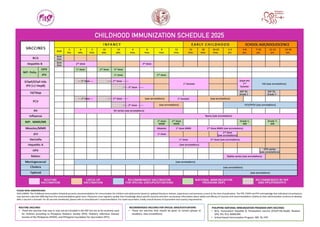
PLEASE READ ANNOTATIONS
DISCLAIMER:The Childhood Immuniza8on Schedule presents recommenda8ons for immuniza8on for children and adolescents based on updated literature reviews, experiences and premises current at the 8me of publica8on. The PPS, PIDSP and PFV acknowledge that individual circumstances
may warrant a decision differing from the recommenda8ons given here. Physicians must regularly update their knowledge about specific vaccines and their use because informa8on about safety and efficacy of vaccines and recommenda8ons rela8ve to their administra8on con8nue to develop
aNer a vaccine is licensed. For all vaccines men8oned, please refer to manufacturer’s recommenda8on. For travel vaccina8on, kindly consult Bureau of Quaran8ne and country requirements.
PHILIPPINE NATIONAL IMMUNIZATION PROGRAM (NIP) VACCINES:
• BCG, monovalent Hepa00s B, Pentavalent vaccine (DTwP-Hib-HepB), Bivalent
OPV, IPV, PCV, MMR/MR
• School-based Immuniza0on Program: MR, Td, HPV
ROUTINE VACCINES:
• These are vaccines that may or may not be included in the NIP but are to be rou0nely used
for children according to Philippine Pediatric Society (PPS), Pediatric Infec0ous Disease
Society of the Philippines (PIDSP), and Philippine Founda0on for Vaccina0on (PFV).
RECOMMENDED VACCINES FOR SPECIAL GROUP/SITUATIONS:
• These are vaccines that should be given to certain groups or
situa0ons. (See annota0ons)
2.
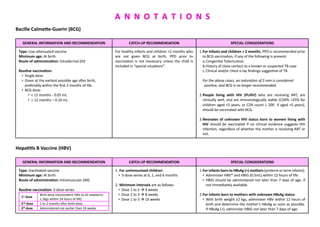
Bacille Calme*e-Guerin (BCG)
GENERALINFORMATION AND RECOMMENDATION CATCH-UP RECOMMENDATION SPECIAL CONSIDERATIONS
Type: Live-a(enuated vaccine
Minimum age: At birth
Route of administraDon: Intradermal (ID)
RouDne vaccinaDon:
• Single dose
• Given at the earliest possible age a>er birth,
preferably within the first 2 months of life.
• BCG dose:
• < 12 months - 0.05 mL
• ³ 12 months – 0.10 mL
For healthy infants and children >2 months who
are not given BCG at birth, PPD prior to
vaccinaQon is not necessary unless the child is
included in “special situaQons”.
1.For Infants and children > 2 months, PPD is recommended prior
to BCG vaccinaQon, if any of the following is present:
a.Congenital Tuberculosis
b.History of close contact to a known or suspected TB case
c.Clinical and/or chest x-ray findings suggesQve of TB
For the above cases, an indura2on of 5 mm is considered
posi2ve, and BCG is no longer recommended.
2.People living with HIV (PLHIV) who are receiving ART, are
clinically well, and are immunologically stable (CD4% >25% for
children aged <5 years, or CD4 count ³ 200 if aged >5 years),
should be vaccinated with BCG.
3.Neonates of unknown HIV status born to women living with
HIV should be vaccinated if no clinical evidence suggests HIV
infecQon, regardless of whether the mother is receiving ART or
not.
Hepa44s B Vaccine (HBV)
GENERAL INFORMATION AND RECOMMENDATION CATCH-UP RECOMMENDATION SPECIAL CONSIDERATIONS
Type: InacQvated vaccine
Minimum age: At birth
Route of administraDon: Intramuscular (IM)
RouDne vaccinaDon: 3-dose series
1st dose
Birth dose (monovalent HBV to all newborns
≥ 2kgs within 24 hours of life)
2nd dose 1 to 2 months a>er birth dose
3rd dose Administered not earlier than 24 weeks
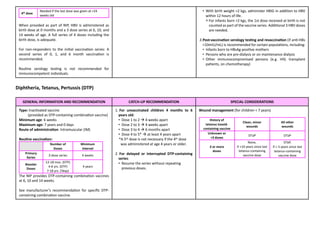
1. For unimmunized children:
• 3-dose series at 0, 1, and 6 months
2. Minimum intervals are as follows:
• Dose 1 to 2 à 4 weeks
• Dose 2 to 3 à 8 weeks
• Dose 1 to 3 à 16 weeks
1.For infants born to HBsAg (+) mothers (preterm or term infants):
• Administer HBV* and HBIG (0.5mL) within 12 hours of life.
• HBIG should be administered not later than 7 days of age, if
not immediately available.
2.For infants born to mothers with unknown HBsAg status:
• With birth weight ≥2 kgs, administer HBV within 12 hours of
birth and determine the mother’s HBsAg as soon as possible.
If HBsAg (+), administer HBIG not later than 7 days of age.
A N N O T A T I O N S
3.
4th dose
Needed ifthe last dose was given at <24
weeks old
When provided as part of NIP, HBV is administered as
birth dose at 0 months and a 3 dose series at 6, 10, and
14 weeks of age. A full series of 4 doses including the
birth dose, is adequate.
For non-responders to the iniQal vaccinaQon series: A
second series of 0, 1, and 6 month vaccinaQon is
recommended.
RouQne serology tesQng is not recommended for
immunocompetent individuals.
• With birth weight <2 kgs, administer HBIG in addiQon to HBV
within 12 hours of life.
> For infants born <2 kgs, the 1st dose received at birth is not
counted as part of the vaccine series. AddiQonal 3 HBV doses
are needed.
3.Post-vaccinaDon serology tesDng and revaccinaDon (if anQ-HBs
<10mIU/mL) is recommended for certain populaQons, including:
• Infants born to HBsAg-posiQve mothers
• Persons who are pre-dialysis or on maintenance dialysis
• Other immunocompromised persons (e.g. HIV, transplant
paQents, on chemotherapy)
Diphtheria, Tetanus, Pertussis (DTP)
GENERAL INFORMATION AND RECOMMENDATION CATCH-UP RECOMMENDATION SPECIAL CONSIDERATIONS
Type: InacQvated vaccine
(provided as DTP-containing combinaQon vaccine)
Minimum age: 6 weeks
Maximum age: 7 years and 0 days
Route of administraDon: Intramuscular (IM)
RouDne vaccinaDon:
Number of
Doses
Minimum
Interval
Primary
Series
3-dose series 4 weeks
Booster
Doses
12-18 mos. (DTP)
4-6 yrs. (DTP)
7-18 yrs. (Tdap)
4 years
The NIP provides DTP-containing combinaQon vaccines
at 6, 10 and 14 weeks.
See manufacturer’s recommendaQon for specific DTP-
containing combinaQon vaccine.
1. For unvaccinated children 4 months to 6
years old:
• Dose 1 to 2 à 4 weeks apart
• Dose 2 to 3 à 4 weeks apart
• Dose 3 to 4 à 6 months apart
• Dose 4 to 5* à at least 4 years apart
*A 5th dose is not necessary if the 4th dose
was administered at age 4 years or older.
2. For delayed or interrupted DTP-containing
series:
• Resume the series without repeating
previous doses.
Wound management (for children < 7 years)
History of
tetanus toxoid-
containing vaccine
Clean, minor
wounds
All other
wounds
Unknown or
<3 doses
DTaP DTaP
3 or more
doses
None,
if <10 years since last
tetanus-containing
vaccine dose
DTaP,
if ³ 5 years since last
tetanus-containing
vaccine dose
4.
Poliovirus Vaccine
GENERAL INFORMATIONAND RECOMMENDATION CATCH-UP RECOMMENDATION SPECIAL CONSIDERATIONS
Types: InacQvated Polio Vaccine (IPV)
Live-a(enuated Oral Polio Vaccine (OPV)
Minimum age: 6 weeks
Route of administraDon:
IPV - Intramuscular (IM)
OPV - Per orem (PO)
RouDne vaccinaDon:
IPV-only Schedule:
Primary
Series
3-dose series
Minimum age: 6 weeks old
Minimum interval: 4 weeks
1st booster
12-18 months old (interval of 6 months
from 3rd dose)
2nd booster 4-6 years old
NIP Schedule:
OPV 3 doses at 6, 10, 14 weeks old
IPV
1st dose: 14 weeks old
2nd dose: 9 months old
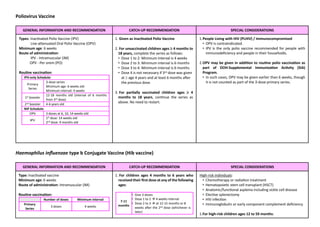
1. Given as InacDvated Polio Vaccine
2. For unvaccinated children ages ³ 4 months to
18 years, complete the series as follows:
• Dose 1 to 2: Minimum interval is 4 weeks
• Dose 2 to 3: Minimum interval is 6 months
• Dose 3 to 4: Minimum interval is 6 months
• Dose 4 is not necessary if 3rd dose was given
at ³ age 4 years and at least 6 months a>er
the previous dose.
3. For parDally vaccinated children ages ³ 4
months to 18 years, conQnue the series as
above. No need to restart.
1.People Living with HIV (PLHIV) / Immunocompromised
• OPV is contraindicated.
• IPV is the only polio vaccine recommended for people with
immunodeficiency and people in their households.
2.OPV may be given in addiDon to rouDne polio vaccinaDon as
part of DOH-Supplemental ImmunizaDon AcDvity (SIA)
Program.
• In such cases, OPV may be given earlier than 6 weeks, though
it is not counted as part of the 3-dose primary series.
Haemophilus influenzae type b Conjugate Vaccine (Hib vaccine)
GENERAL INFORMATION AND RECOMMENDATION CATCH-UP RECOMMENDATION SPECIAL CONSIDERATIONS
Type: InacQvated vaccine
Minimum age: 6 weeks
Route of administraDon: Intramuscular (IM)
RouDne vaccinaDon:
Number of doses Minimum Interval
Primary
Series
3 doses 4 weeks
1. For children ages 4 months to 6 years who
received their first dose at any of the following
ages:
7-11
months
• Give 3 doses
• Dose 1 to 2 à 4 weeks interval
• Dose 2 to 3 à at 12-15 months or 8
weeks a>er the 2nd dose (whichever is
later)
High-risk individuals:
• Chemotherapy or radiaQon treatment
• HematopoieQc stem cell transplant (HSCT)
• Anatomic/funcQonal asplenia including sickle cell disease
• ElecQve splenectomy
• HIV infecQon
• Immunoglobulin or early component complement deficiency
1.For high-risk children ages 12 to 59 months:
5.
Booster
Dose
1 dose
age: 12-15months,
with interval of 6 mos.
from the 3rd dose
Given in combinaWon with DTP-containing vaccine
12-14
months
• Give 2 doses only
• Dose 1 to 2 à 8 weeks interval
³15
months
• No further doses needed
2.For unvaccinated children aged 5 years or
older who are not considered high-risk
• Catch-up vaccinaQon not required.
• Unimmunized or with one Hib vaccine dose received before
age 12 months à give 2 addiQonal doses 8 weeks apart.
• With ³ 2 Hib vaccine doses received before age 12 months
à give 1 addiQonal dose, at least 8 weeks a>er previous dose.
2.For children £ 5 years old who received a Hib vaccine dose(s)
during or within 14 days of starDng therapy or during therapy
• Repeat the dose(s) of Hib vaccine at least 3 months a>er
compleQon of therapy (based on the recommended schedule
for high-risk children).
3. For children who are hematopoieDc stem cell transplant
recipients
• RevaccinaQon with 3 doses of Hib vaccine 4 weeks apart,
starQng 6 to 12 months a>er transplant, regardless of age and
vaccinaQon history.
4.For unimmunized children
• >15 months of age and undergoing elecQve splenectomy
should be given 1 dose of Hib-containing vaccine at least 14
days before the procedure.
• 5 to 18 years old and with either anatomic or funcQonal
asplenia (including cell disease) or HIV infecQon, should be
given 1 dose of Hib vaccine.
Tetanus and Diphtheria Toxoid (Td) / Tetanus and Diphtheria Toxoid and Acellular Pertussis (Tdap) Vaccine
GENERAL INFORMATION AND RECOMMENDATION CATCH-UP RECOMMENDATION SPECIAL CONSIDERATIONS
Type: InacQvated vaccine
Minimum age: 7 years
Route of administraDon: Intramuscular (IM)
RouDne vaccinaDon:
• Ages 7-18 years à 1 dose Tdap (considered as 3rd
booster for DTP)
Tdap booster doses should be given every 10 years for
those who have completed* their DTP doses. If Tdap is
not available, Td can be given.
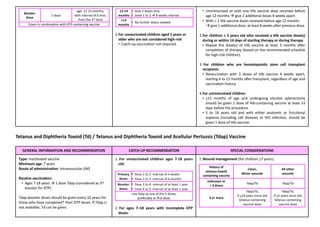
1. For unvaccinated children ages 7-18 years
old:
Primary
doses
• Dose 1 to 2: interval of 4 weeks
• Dose 2 to 3: interval of 6 months
Booster
doses
• Dose 3 to 4: interval of at least 1 year
• Dose 4 to 5: interval of at least 1 year
Use Tdap as one of the 5 doses,
preferably as first dose.
2. For ages 7–18 years with incomplete DTP
doses:
1.Wound management (for children >7 years)
History of
tetanus-toxoid
containing vaccine
Clean,
Minor wounds
All other
wounds
Unknown or
< 3 doses
Tdap/Td Tdap/Td
3 or more
Tdap/Td,
if >10 years since last
tetanus-containing
vaccine dose
Tdap/Td,
if >5 years since last
tetanus-containing
vaccine dose
6.
*Completed DTP dosesà having received 5 doses of
DTP, or 4 doses of DTP if the 4th dose was given on
or a>er the 4th birthday.
The NIP provides Td vaccine at Grade 1 and Grade 7 as
part of their school-based immunizaQon program.
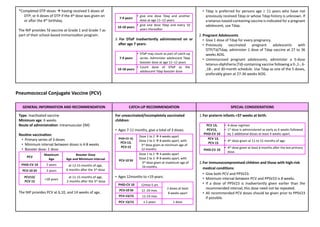
7-9 years
• give one dose Tdap and another
dose at age 11–12 years.
10-18 years
• give one dose Tdap and every 10
years therea>er
3. For DTaP inadvertently administered on or
aber age 7 years:
7-9 years
• DTaP may count as part of catch-up
series. Administer adolescent Tdap
booster dose at age 11–12 years
10-18 years
• Count dose of DTaP as the
adolescent Tdap booster dose
• Tdap is preferred for persons age ³ 11 years who have not
previously received Tdap or whose Tdap history is unknown. If
a tetanus-toxoid-containing vaccine is indicated for a pregnant
adolescent, use Tdap.
2.Pregnant Adolescents
• Give 1 dose of Tdap for every pregnancy.
• Previously vaccinated pregnant adolescents with
DTP/Td/Tdap, administer 1 dose of Tdap vaccine at 27 to 36
weeks AOG.
• Unimmunized pregnant adolescents, administer a 5-dose
tetanus-diphtheria (Td)-containing vaccine following a 0-,1-, 6-
,18-, and 30-month schedule. Use Tdap as one of the 5 doses,
preferably given at 27-36 weeks AOG.
Pneumococcal Conjugate Vaccine (PCV)
GENERAL INFORMATION AND RECOMMENDATION CATCH-UP RECOMMENDATION SPECIAL CONSIDERATIONS
Type: InacQvated vaccine
Minimum age: 6 weeks
Route of administraDon: Intramuscular (IM)
RouDne vaccinaDon:
• Primary series of 3 doses
• Minimum interval between doses is 4-8 weeks
• Booster dose: 1 dose
PCV
Maximum
Age
Booster Dose
Age and Minimum Interval
PHiD-CV 10 5 years at 12-15 months of age,
6 months a>er the 3rd dose
PCV-10 SII 2 years
PCV13/
PCV 15
>18 years
at 11-15 months of age,
2 months a>er the 3rd dose
The NIP provides PCV at 6,10, and 14 weeks of age.
For unvaccinated/incompletely vaccinated
children:
• Ages 7-11 months, give a total of 3 doses.
• Ages 12months to <19 years:
PHiD-CV 10 12mos-5 yrs
2 doses at least
8 weeks apart
PCV-10 SII 12 -24 mos.
PCV-13/15 12-23 mos
PCV 13/15 ≥ 2 years 1 dose
PHiD-CV 10,
PCV-13,
PCV-15
Dose 1 to 2 à 4 weeks apart
Dose 2 to 3 à 8 weeks apart, with
3rd dose given at minimum age of
12 months.
PCV-10 SII
Dose 1 to 2 à 4 weeks apart
Dose 2 to 3 à 8 weeks apart, with
3rd dose given at maximum age of
24 months.
1.For preterm infants <37 weeks at birth:
PCV 13,
PCV15,
PHiD-CV 10
• 4-dose regimen
• 1st dose is administered as early as 6 weeks followed
by 2 addiWonal doses at least 4 weeks apart.
PCV 13,
PCV 15
• 4th dose given at 11 to 15 months of age.
PHiD-CV 10
• 4th dose given at least 6 months a>er the last primary
dose.
2.For immunocompromised children and those with high-risk
medical condiDons:
• Give both PCV and PPSV23.
• Minimum interval between PCV and PPSV23 is 8 weeks.
• If a dose of PPSV23 is inadvertently given earlier than the
recommended interval, this dose need not be repeated.
• All recommended PCV doses should be given prior to PPSV23
if possible.
7.
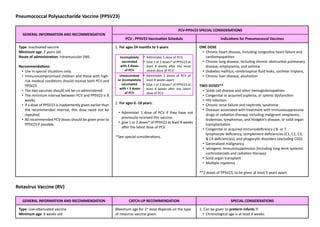
Pneumococcal Polysaccharide Vaccine(PPSV23)
GENERAL INFORMATION AND RECOMMENDATION
PCV-PPSV23 SPECIAL CONSIDERATIONS
PCV - PPSV23 VaccinaDon Schedule IndicaDons for Pneumococcal Vaccines
Type: InacQvated vaccine
Minimum age: 2 years old
Route of administraDon: Intramuscular (IM)
RecommendaDons:
• Use in special situaQons only.
• Immunocompromised children and those with high-
risk medical condiQons should receive both PCV and
PPSV23.
• The two vaccines should not be co-administered.
• The minimum interval between PCV and PPSV23 is 8
weeks.
• If a dose of PPSV23 is inadvertently given earlier than
the recommended interval, this dose need not be
repeated.
• All recommended PCV doses should be given prior to
PPSV23 if possible.
1. For ages 24 months to 5 years:
Incompletely
vaccinated
with 3 doses
of PCV
• Administer 1 dose of PCV;
• Give 1 or 2 doses* of PPSV23 at
least 8 weeks a>er the most
recent dose of PCV.
Unvaccinated
or incompletely
vaccinated
with < 3 doses
of PCV
• Administer 2 doses of PCV at
least 8 weeks apart;
• Give 1 or 2 doses* of PPSV23 at
least 8 weeks a>er the latest
dose of PCV.
2. For ages 6 -18 years:
• Administer 1 dose of PCV if they have not
previously received this vaccine.
• give 1 or 2 doses* of PPSV23 at least 8 weeks
a>er the latest dose of PCV.
*See special consideraQons.
ONE DOSE
• Chronic heart disease, including congesQve heart failure and
cardiomyopathies
• Chronic lung disease, including chronic obstrucQve pulmonary
disease, emphysema, and asthma
• Diabetes mellitus, cerebrospinal fluid leaks, cochlear implant,
• Chronic liver disease, alcoholism
TWO DOSES**
• Sickle cell disease and other hemoglobinopathies
• Congenital or acquired asplenia, or splenic dysfuncQon
• HIV infecQon
• Chronic renal failure and nephroQc syndrome
• Diseases associated with treatment with immunosuppressive
drugs or radiaQon therapy, including malignant neoplasms,
leukemias, lymphomas, and Hodgkin’s disease, or solid organ
transplantaQon
• Congenital or acquired immunodeficiency ( B- or T
lymphocyte deficiency, complement deficiencies (C1, C2, C3,
& C4 deficiencies), and phagocyQc disorders (excluding CGD)
• Generalized malignancy
• Iatrogenic immunosuppression (including long-term systemic
corQcosteroids and radiaQon therapy)
• Solid organ transplant
• MulQple myeloma
**2 doses of PPSV23, to be given at least 5 years apart.
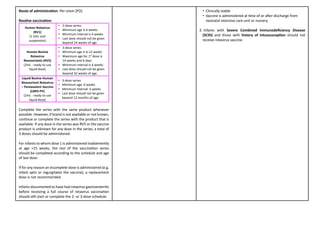
Rotavirus Vaccine (RV)
GENERAL INFORMATION AND RECOMMENDATION CATCH-UP RECOMMENDATION SPECIAL CONSIDERATIONS
Type: Live-a(enuated vaccine
Minimum age: 6 weeks old
Maximum age for 1st dose depends on the type
of rotavirus vaccine given.
1. Can be given to preterm infants if:
• Chronological age is at least 6 weeks.
8.
Route of administraDon:Per orem (PO)
RouDne vaccinaDon:
Human Rotavirus
(RV1)
(1.5mL oral
suspension)
• 2-dose series
• Minimum age is 6 weeks
• Minimum interval is 4 weeks
• Last dose should not be given
beyond 24 weeks of age.
Human-Bovine
Rotavirus
Reassortants (RV5)
(2mL - ready to use
liquid dose)
• 3-dose series
• Minimum age is 6-12 weeks
• Maximum age for 1st dose is
14 weeks and 6 days
• Minimum interval is 4 weeks
• Last dose should not be given
beyond 32 weeks of age.
Liquid Bovine-Human
Reassortant Rotavirus
– Pentavalent Vaccine
(LBRV-PV)
(2mL - ready to use
liquid dose)
• 3-dose series
• Minimum age: 6 weeks
• Minimum interval: 4 weeks
• Last dose should not be given
beyond 12 months of age.
Complete the series with the same product whenever
possible. However, if brand is not available or not known,
conQnue or complete the series with the product that is
available. If any dose in the series was RV5 or the vaccine
product is unknown for any dose in the series, a total of
3 doses should be administered.
For infants to whom dose 1 is administered inadvertently
at age >15 weeks, the rest of the vaccinaQon series
should be completed according to the schedule and age
of last dose.
If for any reason an incomplete dose is administered (e.g.
infant spits or regurgitates the vaccine), a replacement
dose is not recommended.
Infants documented to have had rotavirus gastroenteriQs
before receiving a full course of rotavirus vaccinaQon
should sQll start or complete the 2- or 3-dose schedule.
• Clinically stable
• Vaccine is administered at Qme of or a>er discharge from
neonatal intensive care unit or nursery.
2. Infants with Severe Combined Immunodeficiency Disease
(SCID) and those with history of intussuscepDon should not
receive rotavirus vaccine.
9.
Influenza Vaccine [Trivalent(TIV) / Quadrivalent (QIV)]
GENERAL INFORMATION AND RECOMMENDATION CATCH-UP RECOMMENDATION SPECIAL CONSIDERATIONS
Type: InacQvated vaccine
Minimum age: 6 months
Route of administraDon:
• TIV à Intramuscular (IM) or Subcutaneous (SC)
• QIV à Intramuscular (IM)
RouDne vaccinaDon:
1st Influenza
Vaccina[on
• 6 mos. to 8 yrs. à 2 doses; 4 weeks apart
• 9 yrs. to 18 yrs. à one dose yearly
Annual
vaccina[on
• Preferably given in February but may be
given throughout the year.
• Minimum interval between annual doses
is 4 weeks
For incompletely vaccinated children ages 6
months to 8 years:
• if only one dose was given during the
previous season (as 1st influenza
vaccinaQon), give 2 doses of the vaccine at
least 4 weeks apart then one dose yearly
therea>er.
1.Influenza vaccine is rouQnely recommended for all children
specially immunocompromised children or those with special
chronic medical condiQons.
2.Influenza vaccine is available for high-risk individuals through the
NaQonal ImmunizaQon Program.
3.Individuals with previous influenza infecQon should sQll receive
their annual influenza vaccinaQon.
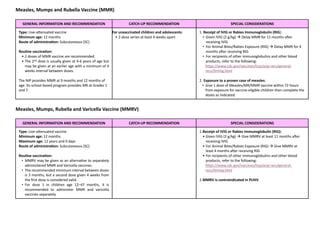
Measles Vaccine
GENERAL INFORMATION AND RECOMMENDATION CATCH-UP RECOMMENDATION SPECIAL CONSIDERATIONS
Type: Live-a(enuated vaccine
Minimum age: 9 months
Route of administraDon: Subcutaneous (SC)
RouDne vaccinaDon:
• If monovalent measles vaccine is not available, then
MMR/MR vaccine may be given as subsQtute for
infants below 12 months of age. In such cases, the
recipient should receive 2 more MMR vaccines
starQng at 1 year of age, following the recommended
schedules.
1.In cases of outbreaks as declared by public health authoriQes,
measles vaccine can be given as early as age 6 months.
2. Receipt of IVIG or Rabies Immunoglobulin (RIG):
• Given IVIG (2 g/kg) à Delay MMR for 11 months a>er
receiving IVIG
• For Animal Bites/Rabies Exposure (RIG) à Delay MMR for 4
months a>er receiving RIG
• For recipients of other immunoglobulins and other blood
products, refer to the following:
h(ps://www.cdc.gov/vaccines/hcp/acip-recs/general-
recs/Qming.html
3. Exposure to a proven case of measles:
• Give 1 dose of Measles/MR/MMR vaccine within 72 hours
from exposure for vaccine-eligible children then complete the
doses as indicated.
10.
Measles, Mumps andRubella Vaccine (MMR)
GENERAL INFORMATION AND RECOMMENDATION CATCH-UP RECOMMENDATION SPECIAL CONSIDERATIONS
Type: Live-a(enuated vaccine
Minimum age: 12 months
Route of administraDon: Subcutaneous (SC)
RouDne vaccinaDon:
• 2 doses of MMR vaccine are recommended.
• The 2nd dose is usually given at 4-6 years of age but
may be given at an earlier age with a minimum of 4
weeks interval between doses.
The NIP provides MMR at 9 months and 12 months of
age. Its school-based program provides MR at Grades 1
and 7.
For unvaccinated children and adolescents:
• 2-dose series at least 4 weeks apart
1. Receipt of IVIG or Rabies Immunoglobulin (RIG):
• Given IVIG (2 g/kg) à Delay MMR for 11 months a>er
receiving IVIG
• For Animal Bites/Rabies Exposure (RIG) à Delay MMR for 4
months a>er receiving RIG
• For recipients of other immunoglobulins and other blood
products, refer to the following:
h(ps://www.cdc.gov/vaccines/hcp/acip-recs/general-
recs/Qming.html
2. Exposure to a proven case of measles:
• Give 1 dose of Measles/MR/MMR vaccine within 72 hours
from exposure for vaccine-eligible children then complete the
doses as indicated.
Measles, Mumps, Rubella and Varicella Vaccine (MMRV)
GENERAL INFORMATION AND RECOMMENDATION CATCH-UP RECOMMENDATION SPECIAL CONSIDERATIONS
Type: Live-a(enuated vaccine
Minimum age: 12 months
Maximum age: 12 years and 0 days
Route of administraDon: Subcutaneous (SC)
RouDne vaccinaDon:
• MMRV may be given as an alternaQve to separately
administered MMR and Varicella vaccines.
• The recommended minimum interval between doses
is 3 months, but a second dose given 4 weeks from
the first dose is considered valid.
• For dose 1 in children age 12–47 months, it is
recommended to administer MMR and varicella
vaccines separately.
1.Receipt of IVIG or Rabies Immunoglobulin (RIG):
• Given IVIG (2 g/kg) à Give MMRV at least 11 months a>er
receiving IVIG
• For Animal Bites/Rabies Exposure (RIG) à Give MMRV at
least 4 months a>er receiving RIG
• For recipients of other immunoglobulins and other blood
products, refer to the following:
h(ps://www.cdc.gov/vaccines/hcp/acip-recs/general-
recs/Qming.html
2.MMRV is contraindicated in PLHIV.
11.
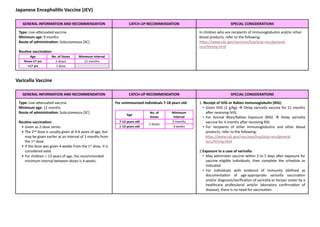
Japanese Encephali4s Vaccine(JEV)
GENERAL INFORMATION AND RECOMMENDATION CATCH-UP RECOMMENDATION SPECIAL CONSIDERATIONS
Type: Live-a(enuated vaccine
Minimum age: 9 months
Route of administraDon: Subcutaneous (SC)
RouDne vaccinaDon:
Age No. of Doses Minimum Interval
9mos-17 yrs 2 doses 12 months
>17 yrs 1 dose
In children who are recipients of immunoglobulins and/or other
blood products, refer to the following:
h(ps://www.cdc.gov/vaccines/hcp/acip-recs/general-
recs/Qming.html
Varicella Vaccine
GENERAL INFORMATION AND RECOMMENDATION CATCH-UP RECOMMENDATION SPECIAL CONSIDERATIONS
Type: Live-a(enuated vaccine
Minimum age: 12 months
Route of administraDon: Subcutaneous (SC)
RouDne vaccinaDon:
• Given as 2-dose series.
• The 2nd dose is usually given at 4-6 years of age, but
may be given earlier at an interval of 3 months from
the 1st dose.
• If the dose was given 4 weeks from the 1st dose, it is
considered valid.
• For children ³ 13 years of age, the recommended
minimum interval between doses is 4 weeks.
For unimmunized individuals 7-18 years old:
Age
No. of
Doses
Minimum
Interval
7-12 years old
2 doses
3 months
³ 13 years old 4 weeks
1. Receipt of IVIG or Rabies Immunoglobulin (RIG):
• Given IVIG (2 g/kg) à Delay varicella vaccine for 11 months
a>er receiving IVIG.
• For Animal Bites/Rabies Exposure (RIG) à Delay varicella
vaccine for 4 months a>er receiving RIG.
• For recipients of other immunoglobulins and other blood
products, refer to the following:
h(ps://www.cdc.gov/vaccines/hcp/acip-recs/general
recs/Qming.html
2.Exposure to a case of varicella:
• May administer vaccine within 3 to 5 days a>er exposure for
vaccine eligible individuals, then complete the schedule as
indicated.
• For individuals with evidence of immunity (defined as
documentaQon of age-appropriate varicella vaccinaQon
and/or diagnosis/verificaQon of varicella or herpes zoster by a
healthcare professional and/or laboratory confirmaQon of
disease), there is no need for vaccinaQon.
12.
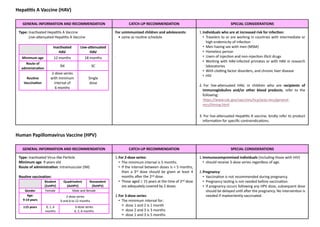
Hepa44s A Vaccine(HAV)
GENERAL INFORMATION AND RECOMMENDATION CATCH-UP RECOMMENDATION SPECIAL CONSIDERATIONS
Type: InacQvated HepaQQs A Vaccine
Live-a(enuated HepaQQs A Vaccine
InacDvated
HAV
Live-agenuated
HAV
Minimum age 12 months 18 months
Route of
administra1on
IM SC
Rou1ne
Vaccina1on
2-dose series
with minimum
interval of
6 months
Single
dose
For unimmunized children and adolescents:
• same as rouQne schedule
.
1.Individuals who are at increased risk for infecDon:
• Travelers to or are working in countries with intermediate or
high endemicity of infecQon
• Men having sex with men (MSM)
• Homeless person
• Users of injecQon and non-injecQon illicit drugs
• Working with HAV-infected primates or with HAV in research
laboratories
• With closng factor disorders, and chronic liver disease
• HIV
2. For live-a(enuated HAV, in children who are recipients of
immunoglobulins and/or other blood products, refer to the
following:
h(ps://www.cdc.gov/vaccines/hcp/acip-recs/general-
recs/Qming.html
3. For live-a(enuated HepaQQs A vaccine, kindly refer to product
informaQon for specific contraindicaQons.
Human Papillomavirus Vaccine (HPV)
GENERAL INFORMATION AND RECOMMENDATION CATCH-UP RECOMMENDATION SPECIAL CONSIDERATIONS
Type: InacQvated Virus-like ParQcle
Minimum age: 9 years old
Route of administraDon: Intramuscular (IM)
Routine vaccination:
Bivalent
(2vHPV)
Quadrivalent
(4vHPV)
Nonavalent
(9vHPV)
Gender Female Male and female
Age:
9-14 years
2-dose series
0 and 6 to 12 months
³15 years 0, 1, 6
months
3-dose series
0, 2, 6 months
1.For 2-dose series:
• The minimum interval is 5 months.
• If the interval between doses is < 5 months,
then a 3rd dose should be given at least 4
months a>er the 2nd dose.
• Those aged ³ 15 years at the time of 2nd dose
are adequately covered by 2 doses.
2.For 3-dose series:
• The minimum interval for:
> dose 1 and 2 is 1 month
> dose 2 and 3 is 3 months
> dose 1 and 3 is 5 months
1.Immunocompromised individuals (including those with HIV)
• should receive 3-dose series regardless of age.
2.Pregnancy:
• VaccinaQon is not recommended during pregnancy.
• Pregnancy tesQng is not needed before vaccinaQon.
• If pregnancy occurs following any HPV dose, subsequent dose
should be delayed unQl a>er the pregnancy. No intervenQon is
needed if inadvertently vaccinated.
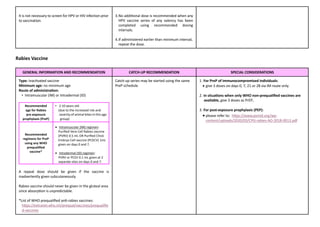
13.
It is notnecessary to screen for HPV or HIV infection prior
to vaccination.
3.No addiQonal dose is recommended when any
HPV vaccine series of any valency has been
completed using recommended dosing
intervals.
4.If administered earlier than minimum interval,
repeat the dose.
Rabies Vaccine
GENERAL INFORMATION AND RECOMMENDATION CATCH-UP RECOMMENDATION SPECIAL CONSIDERATIONS
Type: InacQvated vaccine
Minimum age: no minimum age
Route of administraDon:
• Intramuscular (IM) or Intradermal (ID)
Recommended
age for Rabies
pre-exposure
prophylaxis (PreP)
• 2-10 years old
(due to the increased risk and
severity of animal bites in this age
group)
Recommended
regimens for PreP
using any WHO
prequalified
vaccine*
• Intramuscular (IM) regimen:
Purified Vero Cell Rabies vaccine
(PVRV) 0.5 mL OR Purified Chick
Embryo Cell vaccine (PCECV) 1mL
given on days 0 and 7.
• Intradermal (ID) regimen:
PVRV or PCEV 0.1 mL given at 2
separate sites on days 0 and 7.
A repeat dose should be given if the vaccine is
inadvertently given subcutaneously.
Rabies vaccine should never be given in the gluteal area
since absorpQon is unpredictable.
*List of WHO prequalified anQ-rabies vaccines:
h(ps://extranet.who.int/prequal/vaccines/prequalifie
d-vaccines
Catch-up series may be started using the same
PreP schedule.
1. For PreP of immunocompromised individuals:
• give 3 doses on days 0, 7, 21 or 28 via IM route only.
2. In situaDons when only WHO non-prequalified vaccines are
available, give 3 doses as PrEP.
3. For post-exposure prophylaxis (PEP):
• please refer to: h(ps://www.psmid.org/wp-
content/uploads/2020/03/CPG-rabies-AO-2018-0013.pdf
14.
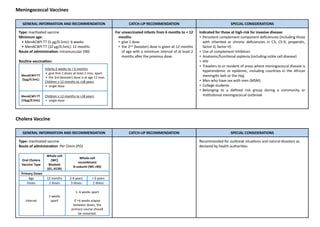
Meningococcal Vaccines
GENERAL INFORMATIONAND RECOMMENDATION CATCH-UP RECOMMENDATION SPECIAL CONSIDERATIONS
Type: InacQvated vaccine
Minimum age:
• MenACWY-TT (5 µg/0.5mL): 6 weeks
• MenACWY-TT (10 µg/0.5mL): 12 months
Route of administraDon: Intramuscular (IM)
RouDne vaccinaDon:
MenACWY-TT
(5µg/0.5mL)
Infants 6 weeks to < 6 months:
• give first 2 doses at least 2 mos. apart
• the 3rd (booster) dose is at age 12 mos.
Children ≥ 12 months to >18 years:
• single dose
MenACWY-TT
(10µg/0.5mL)
Children ≥ 12 months to >18 years:
• single dose
For unvaccinated infants from 6 months to < 12
months:
• give 1 dose
• the 2nd (booster) dose is given at 12 months
of age with a minimum interval of at least 2
months a>er the previous dose.
Indicated for those at high-risk for invasive disease:
• Persistent complement component deficiencies (including those
with inherited or chronic deficiencies in C3, C5-9, properdin,
factor D, factor H)
• Use of complement inhibitors
• Anatomic/funcQonal asplenia (including sickle cell disease)
• HIV
• Travelers to or resident of areas where meningococcal disease is
hyperendemic or epidemic, including countries in the African
meningiQs belt or the Hajj
• Men who have sex with men (MSM)
• College students
• Belonging to a defined risk group during a community or
insQtuQonal meningococcal outbreak
Cholera Vaccine
GENERAL INFORMATION AND RECOMMENDATION CATCH-UP RECOMMENDATION SPECIAL CONSIDERATIONS
Type: InacQvated vaccine
Route of administraDon: Per Orem (PO)
Oral Cholera
Vaccine Type
Whole-cell
(WC)
Bivalent
(01, 0139)
Whole-cell
recombinant
B-subunit (WC-rBS)
Primary Doses
Age 12 months 2-6 years > 6 years
Doses 2 doses 3 doses 2 doses
Interval
2 weeks
apart
1- 6 weeks apart
If >6 weeks elapse
between doses, the
primary course should
be restarted.
Recommended for outbreak situaQons and natural disasters as
declared by health authoriQes.
15.
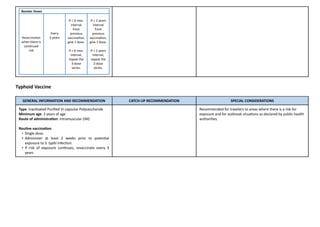
Booster Doses
Revaccina(on
when thereis
conWnued
risk
Every
3 years
If £ 6 mos.
interval
from
previous
vaccinaWon,
give 1 dose.
If > 6 mos.
interval,
repeat the
3-dose
series.
If £ 2 years
interval
from
previous
vaccinaWon,
give 1 dose.
If > 2 years
interval,
repeat the
2-dose
series.
Typhoid Vaccine
GENERAL INFORMATION AND RECOMMENDATION CATCH-UP RECOMMENDATION SPECIAL CONSIDERATIONS
Type: InacQvated Purified Vi-capsular Polysaccharide
Minimum age: 2 years of age
Route of administraDon: Intramuscular (IM)
RouDne vaccinaDon:
• Single dose.
• Administer at least 2 weeks prior to potenQal
exposure to S. typhi infecQon.
• If risk of exposure conQnues, revaccinate every 3
years
Recommended for travelers to areas where there is a risk for
exposure and for outbreak situaQons as declared by public health
authoriQes.
![Influenza Vaccine [Trivalent (TIV) / Quadrivalent (QIV)]
GENERAL INFORMATION AND RECOMMENDATION CATCH-UP RECOMMENDATION SPECIAL CONSIDERATIONS
Type: InacQvated vaccine
Minimum age: 6 months
Route of administraDon:
• TIV à Intramuscular (IM) or Subcutaneous (SC)
• QIV à Intramuscular (IM)
RouDne vaccinaDon:
1st Influenza
Vaccina[on
• 6 mos. to 8 yrs. à 2 doses; 4 weeks apart
• 9 yrs. to 18 yrs. à one dose yearly
Annual
vaccina[on
• Preferably given in February but may be
given throughout the year.
• Minimum interval between annual doses
is 4 weeks
For incompletely vaccinated children ages 6
months to 8 years:
• if only one dose was given during the
previous season (as 1st influenza
vaccinaQon), give 2 doses of the vaccine at
least 4 weeks apart then one dose yearly
therea>er.
1.Influenza vaccine is rouQnely recommended for all children
specially immunocompromised children or those with special
chronic medical condiQons.
2.Influenza vaccine is available for high-risk individuals through the
NaQonal ImmunizaQon Program.
3.Individuals with previous influenza infecQon should sQll receive
their annual influenza vaccinaQon.
Measles Vaccine
GENERAL INFORMATION AND RECOMMENDATION CATCH-UP RECOMMENDATION SPECIAL CONSIDERATIONS
Type: Live-a(enuated vaccine
Minimum age: 9 months
Route of administraDon: Subcutaneous (SC)
RouDne vaccinaDon:
• If monovalent measles vaccine is not available, then
MMR/MR vaccine may be given as subsQtute for
infants below 12 months of age. In such cases, the
recipient should receive 2 more MMR vaccines
starQng at 1 year of age, following the recommended
schedules.
1.In cases of outbreaks as declared by public health authoriQes,
measles vaccine can be given as early as age 6 months.
2. Receipt of IVIG or Rabies Immunoglobulin (RIG):
• Given IVIG (2 g/kg) à Delay MMR for 11 months a>er
receiving IVIG
• For Animal Bites/Rabies Exposure (RIG) à Delay MMR for 4
months a>er receiving RIG
• For recipients of other immunoglobulins and other blood
products, refer to the following:
h(ps://www.cdc.gov/vaccines/hcp/acip-recs/general-
recs/Qming.html
3. Exposure to a proven case of measles:
• Give 1 dose of Measles/MR/MMR vaccine within 72 hours
from exposure for vaccine-eligible children then complete the
doses as indicated.](https://image.slidesharecdn.com/2025-pidsp-immunization-calendar-250721142308-b387b378/85/2025-PIDSP-Immunization-Calendar-pdf-9-320.jpg)