Michelle Ryan
Global Institute for Women’s Leadership
michelle.ryan@anu.edu.au
To Advance Equality for Women,
Use the Evidence:
Three Missteps We Make
Three missteps:
1. An overemphasis
on quantity
2. Trying to ‘fix’
women
3. Over-
optimism
By Michelle
Ryan
Michelle Ryan is the
inaugural director of
the Global Institute of
Women’s Leadership
at the Australian
National University in
Canberra.
e-mail: michelle.
ryan@anu.edu.au
It is not
women
who need
fixing, but
entrenched
systems of
inequality.”
To advance equalityfor
women, use the evidence
These are three mistakes universities make
when they attempt to improve gender equity.
I
’m an academic who studies women in leadership roles
and also heads an institute devoted to this topic at the
Australian National University in Canberra. So I spend
a lot of time thinking about what it takes to achieve
gender equity in workplaces. By now, the vast majority
of universities, research institutions and funding bodies
have some sort of initiative aimed at gender parity. In 2005,
the Athena Swan accreditation programme to promote
gender equity at universities was launched in the United
Kingdom and later adopted in North America, Australia and
elsewhere. In 2011, China’s ministry of science and tech-
nology issued a policy to help advance women in science
and technology careers. In 2020, ambitious programmes
began in the European Research Area and India.
Yet the most recent European Commission data show
that women make up about half of doctoral graduates and
only about one-quarter of senior academics and people in
decision-making positions. In North America and Western
Europe, only 33% of those employed in research and devel-
opment are women; this drops to 24% in east Asia and the
Pacific area, and to 18.5% in south and west Asia.
Why this inertia? In my view, progress could be faster if
institutions that trumpet efforts to promote equity applied
established research in their initiatives.
Here are three common missteps.
First, an overemphasis on quantity. Yes, metrics such as
the proportion of female professors and grant winners are
important. But simple tallies erase disparities in quality.
Any tracking must capture the experiences and influence
that awards and positions bestow. Do those given to women
bring the same visibility, recognition and resources as those
given to men? The proportion of women achieving author-
ships and professorships matters less if these are concen-
trated in sub-optimal, low-influence or temporary roles.
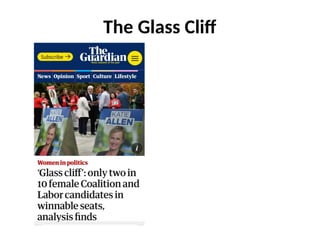
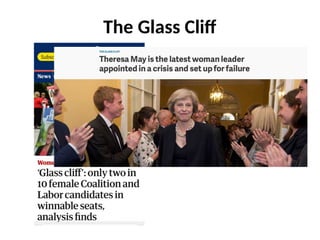
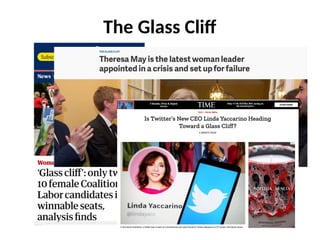
Consider the ‘glass-cliff’ phenomenon. Fifteen years ago,
my colleagues and I reported that women are more likely
than men to be given leadership roles that are risky, precari-
ous andevendoomedtofailure (M. K. Ryanand S. A. Haslam
Acad. Mgmt Rev. 32, 549–572; 2007). Archival, experimen-
tal and qualitative research provided evidence for this
‘poisoned chalice’, which holds from firms in the FTSE 100,
the main U K share index, to chief librarians and heads of
state. As institutions try to navigate a pandemic, as well as
rising costs and increasing societal divisions, such consid-
erations matter more than ever. The crucial question is, are
women getting the same quality of promotions as men?
A second mistake is emphasizing training for individuals,
instead of overhauling systems and cultures. Again and
again, I see women offered extra coaching to encourage
them to take career risks, overcome ‘impostor syndrome’
and boost their skills in leadership and grant writing. But
the evidence is clear: it is not women who need fixing, but
entrenched systems of inequality.
Our research demonstrates that women’s confidence
and ambition are not inherently lower than men’s, but are
eroded by experiences in unequal workplace cultures — not
having role models, and being treated differently from
male counterparts. Similarly, women are not inherently
risk-averse; they operate within systems that reward men
for risk-taking, but punish women for the same behaviour.
Individually targeted interventions, at best, provide a
short-term fix for a few already privileged women, and, at
worst, reinforce the assumptions of success and leadership
that underlie systemic gender inequality. Indeed, train-
ing programmes for women can have perverse effects by
becoming yet another unrewarding demand on their time.
And the third mistake undermines all sorts of efforts:
over-optimism. Yes, improvements are real and should be
celebrated. Still, surveys of representation in boardrooms,
films and various professions show that men and women
consistently overestimate women’s representation.
In one of our studies, we found that veterinary surgeons
who felt that sexism is no longer a problem in their pro-
fession were the most likely to pay a female member of
staff less than a male member and to give her fewer career
opportunities. In another study, men who overestimated
the proportion of women in the medical profession were
the least likely to support gender-equality initiatives.
What’s needed are interventions that genuinely address
gender inequality in all its complexity and nuance.
There are good examples of concrete things that can be
done: (1) systematic changes that improve the visibility
and voice of women, such as prohibiting ‘manels’ (all-male
panels), or requiring conference organizers to report
proportions of women who are keynote speakers and
panel members; (2) making senior leaders accountable
for progress towards gender equality, as the Australian
Champions for Change programme does, in which mem-
bers track factors such as pay, promotions and employment
experiences; and (3) making research funding contingent
on having a transparent and appropriately resourced
gender-equality plan in place, as happens in the European
Union’s research and innovation strategy. Downgrading
such requirements, as Britain announced in 2020 that it
would do, exemplifies the sorts of backsliding on women’s
progress that is happening all too often now times are tough.
Good intentions are not enough to bring about change;
nor are simple tallies, training programmes or unwarranted
rosy views. Change requires sustained investment, appro-
priate incentives and evidence-backed interventions.
JA
M
I
E
K
I
D
S
T
O
N
/
A
N
U
Nature | Vol 604 | 21 April 2022 | 403
A personal take on science and society
World view
ˬ ʝ ʛ ʝ ʝ S/1(-%#1 Na341# L(,(3#"ʲ A++ 1(%'32
1#2#15#"ʲ
An Overemphasis on Quantity
The Glass Cliff
The Glass Cliff
The Glass Cliff
The Glass Cliff
The glass cliff
• Extending the metaphor of the ‘glass ceiling’, we argue women
are more likely than men to
confront a ‘glass cliff’, such that their
leadership appointments are more likely to be made in
problematic organizational
circumstances and are thus more precarious.
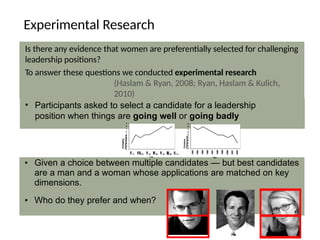
Is there any evidence that women are preferentially selected for challenging
leadership positions?
To answer these questions we conducted experimental research
(Haslam & Ryan, 2008; Ryan, Haslam & Kulich,
2010)
Experimental Research
• Given a choice between multiple candidates — but best candidates
are a man and a woman whose applications are matched on key
dimensions.
• Who do they prefer and when?
• Participants asked to select a candidate for a leadership
position when things are going well or going badly
6
5
4
3
2
1
0
8
7
9
199
3
199
4
199
5
199
6
199
7
199
8
199
9
200
0
200
1
200
2
Year
Company
Performance
6
5
4
3
2
1
0
8
7
9
1993
1994
1995
1996
1997
1998
1999
2000
2001
2002
Year
Company
Performance
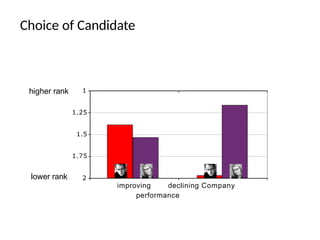
Choice of Candidate
1
1.25
1.5
1.75
2
improving declining Company
performance
higher rank
lower rank
A female candidate is more likely to be appointed to a leadership
position when the position is risky and there is an increased risk of
failure.
Experimental Research
Demonstrated with:
• Lead lawyer of a risky and highly criticised case
• Financial director of a poorly performing company
• Youth representative for a festival experiencing declining
popularity
• Political candidate for an unwinnable seat
The Glass Cliff
• Archival, experimental, case study, and qualitative
work demonstrates that women are more
likely to appointed to leadership positions in
times of crisis
• These positions are risky, precarious, and stressful
• Impact women’s experiences and their tenure
• Risk reinforcing stereotypes that women are not
suitable for leadership
Implications
• A focus on the number of
women in leadership
positions, ignores the nature
of these positions.
• Need to ask when and why
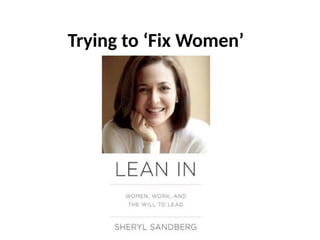
Trying to ‘Fix Women’
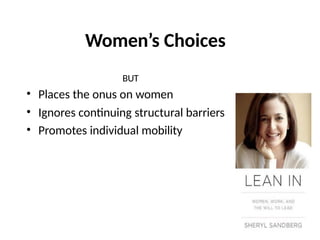
Women’s Choices
BUT
• Places the onus on women
Women’s Choices
BUT
• Places the onus on women
• Ignores continuing structural barriers
Women’s Choices
BUT
• Places the onus on women
• Ignores continuing structural barriers
• Promotes individual mobility
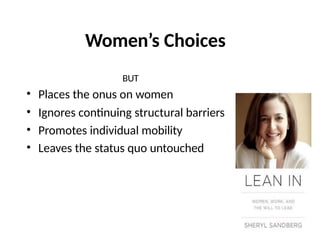
Women’s Choices
BUT
• Places the onus on women
• Ignores continuing structural barriers
• Promotes individual mobility
• Leaves the status quo untouched
Context Constrains Women’s Choices
Our ambition and
willingness to
sacrifice do not
occur within a
social vacuum
Context Constrains Women’s Choices
Women’s career
choices are shaped
and constrained by
organisational and
social contexts
Our ambition and
willingness to
sacrifice do not
occur within a
social vacuum
Ambition
26
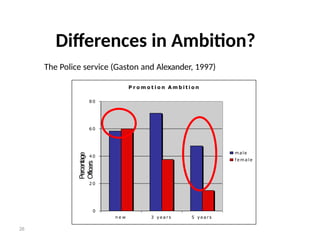
Differences in Ambition?
P r o m o t i o n A m b i t i o n
0
2 0
4 0
6 0
8 0
n e w 3 y e a r s 5 y e a r s
Percentage
Officers
male
f e m a l e
The Police service (Gaston and Alexander, 1997)
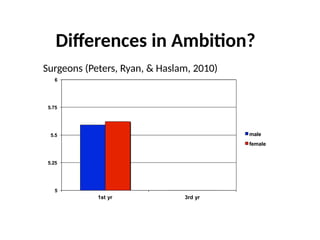
Surgeons (Peters, Ryan, & Haslam, 2010)
5
5.25
5.5
5.75
6
1st yr 3rd yr
male
female
Differences in Ambition?
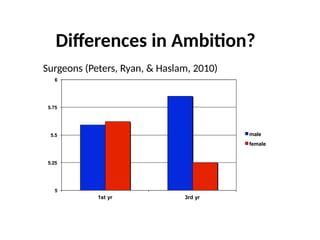
5
5.25
5.5
5.75
6
1st yr 3rd yr
male
female
Differences in Ambition?
Surgeons (Peters, Ryan, & Haslam, 2010)
3.0
3.5
4.0
4.5
5.0
5.5
6.0
Year 1 Year 3 Year 1 Year 3 Year 1 Year 3
Year 2
Sciences
Year 2
Life Sciences
Year 2
Other
Male
Female
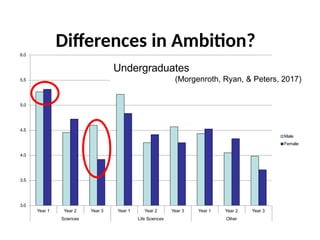
Differences in Ambition?
Undergraduates
(Morgenroth, Ryan, & Peters, 2017)
31
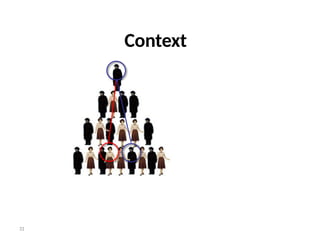
Context
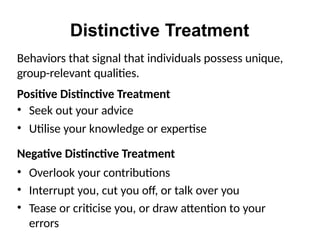
Distinctive Treatment
Behaviors that signal that individuals possess unique,
group-relevant qualities.
Positive Distinctive Treatment
• Seek out your advice
• Utilise your knowledge or expertise
Negative Distinctive Treatment
• Overlook your contributions
• Interrupt you, cut you off, or talk over you
• Tease or criticise you, or draw attention to your
errors
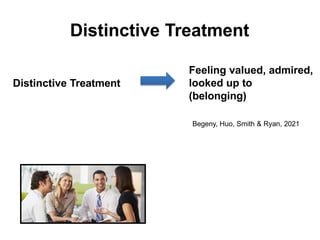
Distinctive Treatment
Feeling valued, admired,
looked up to
(belonging)
Distinctive Treatment
Begeny, Huo, Smith & Ryan, 2021
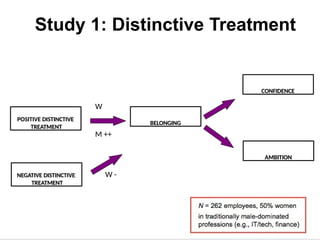
Study 1: Distinctive Treatment
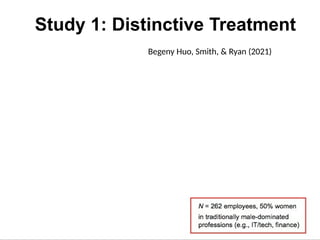
Begeny Huo, Smith, & Ryan (2021)
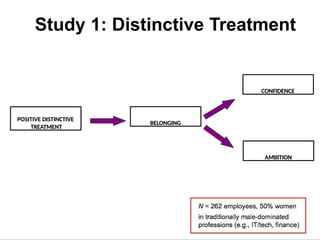
Study 1: Distinctive Treatment
BELONGING
CONFIDENCE
AMBITION
POSITIVE DISTINCTIVE
TREATMENT
Study 1: Distinctive Treatment
BELONGING
CONFIDENCE
AMBITION
POSITIVE DISTINCTIVE
TREATMENT
W
M ++
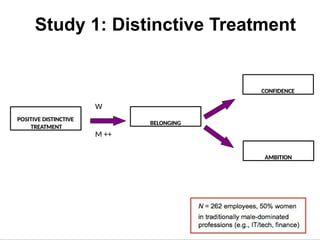
Study 1: Distinctive Treatment
BELONGING
CONFIDENCE
AMBITION
POSITIVE DISTINCTIVE
TREATMENT
W
M ++
NEGATIVE DISTINCTIVE
TREATMENT
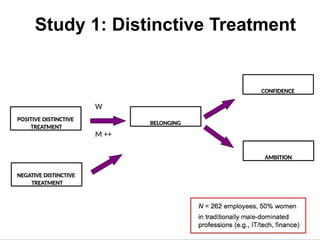
Study 1: Distinctive Treatment
BELONGING
CONFIDENCE
AMBITION
POSITIVE DISTINCTIVE
TREATMENT
W
M ++
NEGATIVE DISTINCTIVE
TREATMENT
W -
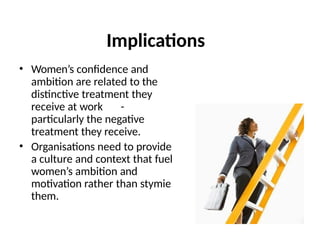
Implications
• Women’s confidence and
ambition are related to the
distinctive treatment they
receive at work -
particularly the negative
treatment they receive.
• Organisations need to provide
a culture and context that fuel
women’s ambition and
motivation rather than stymie
them.
Authenticity
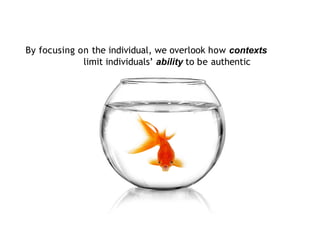
By focusing on the individual, we overlook how contexts
limit individuals’ ability to be authentic
Organisationally-Impacted
Authenticity
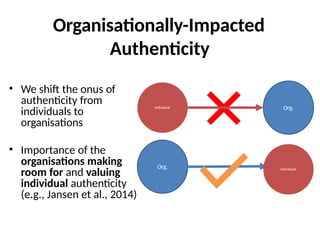
• We shift the onus of
authenticity from
individuals to
organisations
• Importance of the
organisations making
room for and valuing
individual authenticity
(e.g., Jansen et al., 2014)
Individual Org.
Org. Individual
Study 2
388 UK residents, ages 25-65, employed
Completed 1 of 3 possible measures of authenticity
(from Kernis & Goldman, 2005)
1. Trait Authenticity
2. State Authenticity at Work
3. Organisationally-Impacted Authenticity (OIA)
Job Satisfaction ( =.93) and Commitment (
=.87)
• I feel satisfied with my job
• I am committed to maintaining my role in my
organization
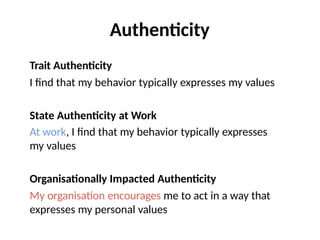
Authenticity
Trait Authenticity
I find that my behavior typically expresses my values
State Authenticity at Work
At work, I find that my behavior typically expresses
my values
Organisationally Impacted Authenticity
My organisation encourages me to act in a way that
expresses my personal values
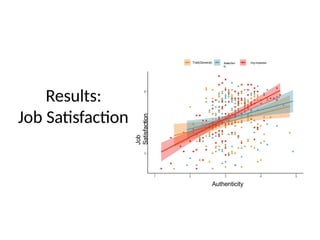
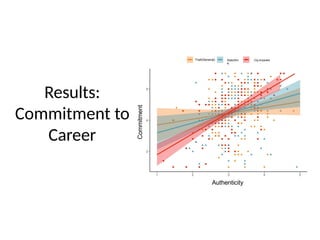
Results:
Job Satisfaction
Authenticity
Job
Satisfaction
Org-Impacted
State(Wor
k)
Results:
Commitment to
Career
Org-Impacted
Authenticity
Authenticity
Commitment
State(Wor
k)
Study 3
343 UK employed participants (98 men, 1 non-binary individual,
244 women; Mage = 37.85, SDage = 10.64)
Randomly assigned to 1 of 3 possible conditions:
1. Write about three instances when organisation allowed
you to express your true or authentic self
[Facilitated Condition]
2. Write about three instances when organisation did not
allow you to express your true or authentic self
[Constrained Condition]
3. No writing task [Control Condition]
Job Satisfaction ( = .93) and Commitment (= .87)
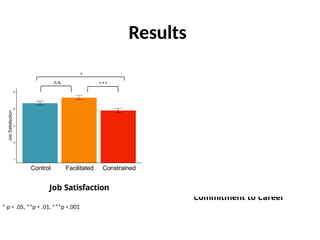
Results
Control Facilitated Constrained
*
***
n.s.
n.s.
* **
Control Facilitated
Constrained
Commitment to Career
Job Satisfaction
* p < .05, **p < .01, ***p <.001
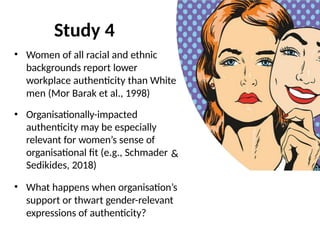
Study 4
&
• Women of all racial and ethnic
backgrounds report lower
workplace authenticity than White
men (Mor Barak et al., 1998)
• Organisationally-impacted
authenticity may be especially
relevant for women’s sense of
organisational fit (e.g., Schmader
Sedikides, 2018)
• What happens when organisation’s
support or thwart gender-relevant
expressions of authenticity?
Study 4
579 employed women (Mage = 37.86, SDage = 10.28;
Imagined 1 of 2 possible gender-specific scenarios:
– Constrained Authenticity
– Facilitated Authenticity
Fit (with Leaders; 3 items;  = .84; Morgenroth et al., 2021)
• When I look at successful people in this organisation, I would
have a lot in common with them
Job Satisfaction ( = .94)
Commitment ( = .82; Rusbult, Martz, & Agnew, 1998)
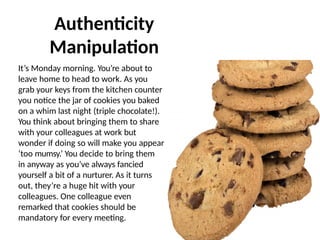
It’s Monday morning. You’re about to
leave home to head to work. As you
grab your keys from the kitchen counter
you notice the jar of cookies you baked
on a whim last night (triple chocolate!).
You think about bringing them to share
with your colleagues at work but
wonder if doing so will make you appear
‘too mumsy.’ You decide to bring them
in anyway as you’ve always fancied
yourself a bit of a nurturer. As it turns
out, they’re a huge hit with your
colleagues. One colleague even
remarked that cookies should be
mandatory for every meeting.
Authenticity
Manipulation
Authenticity Manipulation
Facilitated
At the end of the
meeting, your boss
comments that bringing
cookies to meetings
makes you stand out
professionally as well as
how much everyone
enjoyed them.
Constrained
At the end of the
meeting, however,
your
boss cautions that
bringing cookies to
meetings makes you
stand out as
unprofessional despite
how much everyone
enjoyed them.
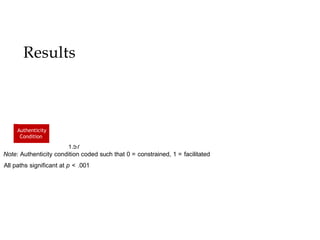
a =
1.18
b = .71
Job
Satisfacti
on
c’ = .73
c =
1.57
a*b = .84
Organisational
Fit
a*b = .74
Organisational
a = 1.18 Fit b = .62
Authenticity c’ = .57 Career
Condition c = 1.31 Commitment
Results
Authenticity
Condition
Note: Authenticity condition coded such that 0 = constrained, 1 = facilitated
All paths significant at p < .001
Implications
• Organisations are gatekeepers of employee
authenticity and they can improve employee
outcomes
• Organisations can mobilise to increase ‘fit’ for
employees whose social identities have been
marginalised or historically excluded in the
workplace
Over-optimism
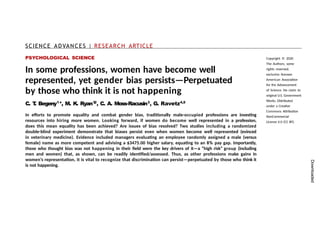
SCIENCE ADVANCES | RESEARCH ARTICLE
PSYCHOLOGICAL SCIENCE
In some professions, women have become well
represented, yet gender bias persists—Perpetuated
by those who think it is not happening
C. T
. Begeny1
*, M. K. Ryan1
,
2
, C. A. Moss-Racusin3
, G. Ravetz4,5
In efforts to promote equality and combat gender bias, traditionally male-occupied professions are investing
resources into hiring more women. Looking forward, if women do become well represented in a profession,
does this mean equality has been achieved? Are issues of bias resolved? Two studies including a randomized
double-blind experiment demonstrate that biases persist even when women become well represented (evinced
in veterinary medicine). Evidence included managers evaluating an employee randomly assigned a male (versus
female) name as more competent and advising a $3475.00 higher salary, equating to an 8% pay gap. Importantly,
those who thought bias was not happening in their field were the key drivers of it—a “high risk” group (including
men and women) that, as shown, can be readily identified/assessed. Thus, as other professions make gains in
women’s representation, it is vital to recognize that discrimination can persist—perpetuated by those who think it
is not happening.
Copyright © 2020
The Authors, some
rights reserved;
exclusive licensee
American Association
for the Advancement
of Science. No claim to
original U.S. Government
Works. Distributed
under a Creative
Commons Attribution
NonCommercial
License 4.0 (CC BY).
Downloaded
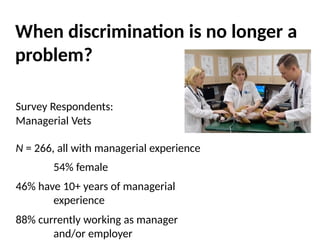
Survey Respondents:
Managerial Vets
N = 266, all with managerial experience
54% female
46% have 10+ years of managerial
experience
88% currently working as manager
and/or employer
When discrimination is no longer a
problem?
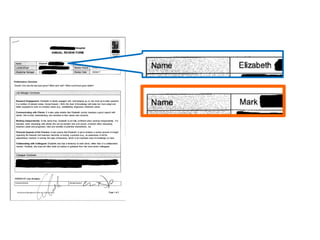
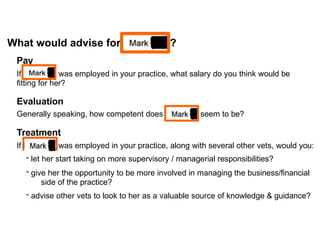
What would advise for Elizabeth?
Pay
If Elizabeth was employed in your practice, what salary do you think would be
fitting for her?
Evaluation
Generally speaking, how competent does Elizabeth seem to be?
Treatment
If Elizabeth was employed in your practice, along with several other vets, would you:
- let her start taking on more supervisory / managerial responsibilities?
- give her the opportunity to be more involved in managing the business/financial
side of the practice?
- advise other vets to look to her as a valuable source of knowledge & guidance?
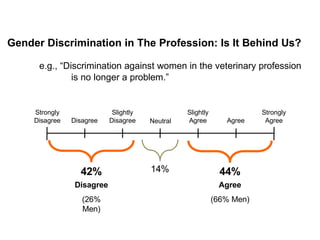
Gender Discrimination in The Profession: Is It Behind Us?
e.g., “Discrimination against women in the veterinary profession
is no longer a problem.”
14%
42%
Disagree
(26%
Men)
44%
Agree
(66% Men)
Strongly Slightly Slightly Strongly
Disagree Disagree Disagree Neutral Agree Agree Agree
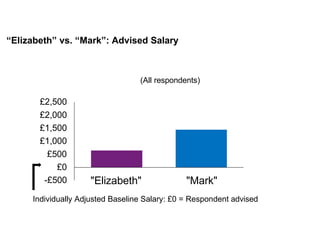
“Elizabeth” vs. “Mark”: Advised Salary
£2,500
£2,000
£1,500
£1,000
£500
£0
-£500
Individually Adjusted Baseline Salary: £0 = Respondent advised
"Elizabeth" "Mark"
(All respondents)
£2,500
£2,000
£1,500
£1,000
£500
£0
-£500
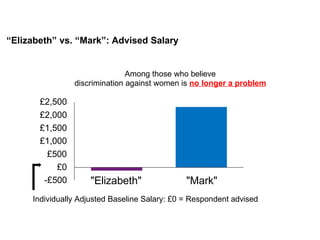
Individually Adjusted Baseline Salary: £0 = Respondent advised
"Elizabeth" "Mark"
“Elizabeth” vs. “Mark”: Advised Salary
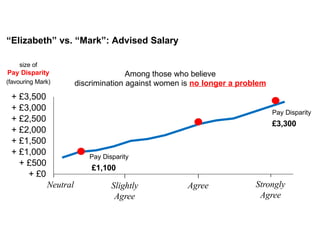
Among those who believe
discrimination against women is no longer a problem
+ £3,500
+ £3,000
+ £2,500
+ £2,000
+ £1,500
+ £1,000
+ £500
+ £0
Neutral Strongly
Agree
Slightly
Agree
Agree
“Elizabeth” vs. “Mark”: Advised Salary
Pay Disparity
£1,100
Pay Disparity
£3,300
size of
Pay Disparity
(favouring Mark)
Among those who believe
discrimination against women is no longer a problem
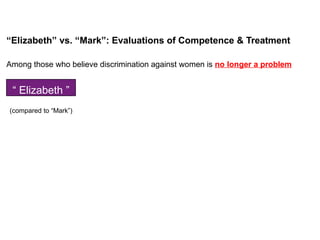
“Elizabeth” vs. “Mark”: Evaluations of Competence & Treatment
(compared to “Mark”)
Among those who believe discrimination against women is no longer a problem
“ Elizabeth ”
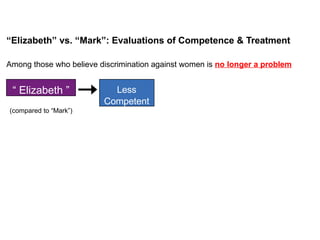
“Elizabeth” vs. “Mark”: Evaluations of Competence & Treatment
(compared to “Mark”)
Among those who believe discrimination against women is no longer a problem
“ Elizabeth ” Less
Competent
“Elizabeth” vs. “Mark”: Evaluations of Competence & Treatment
(compared to “Mark”)
Provide Fewer Opportunities
to take on new managerial responsibilities
Offer Less Encouragement
to pursue promotions, other opportunities
for advancement
Express More Reservation
about others looking to Elizabeth [Mark]
as a valuable source of knowledge,
guidance
Among those who believe discrimination against women is no longer a problem
“ Elizabeth ” Less
Competent
Poorer Treatment
in the Workplace
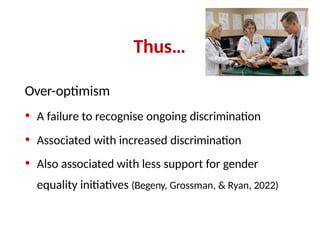
Thus…
Over-optimism
• A failure to recognise ongoing discrimination
• Associated with increased discrimination
• Also associated with less support for gender
equality initiatives (Begeny, Grossman, & Ryan, 2022)
Conclusions
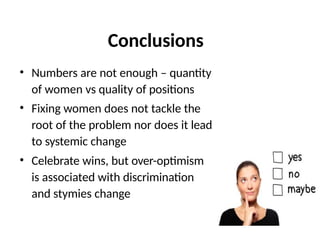
• Numbers are not enough – quantity
of women vs quality of positions
• Fixing women does not tackle the
root of the problem nor does it lead
to systemic change
• Celebrate wins, but over-optimism
is associated with discrimination
and stymies change
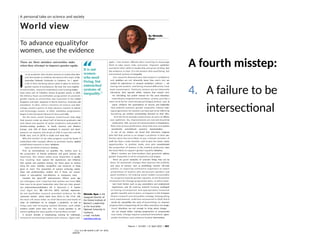
A fourth misstep:
4. A failure to be
intersectional
By Michelle
Ryan
Michelle Ryan is the
inaugural director of
the Global Institute of
Women’s Leadership
at the Australian
National University in
Canberra.
e-mail: michelle.
ryan@anu.edu.au
It is not
women
who need
fixing, but
entrenched
systems of
inequality.”
To advance equalityfor
women, use the evidence
These are three mistakes universities make
when they attempt to improve gender equity.
I
’m an academic who studies women in leadership roles
and also heads an institute devoted to this topic at the
Australian National University in Canberra. So I spend
a lot of time thinking about what it takes to achieve
gender equity in workplaces. By now, the vast majority
of universities, research institutions and funding bodies
have some sort of initiative aimed at gender parity. In 2005,
the Athena Swan accreditation programme to promote
gender equity at universities was launched in the United
Kingdom and later adopted in North America, Australia and
elsewhere. In 2011, China’s ministry of science and tech-
nology issued a policy to help advance women in science
and technology careers. In 2020, ambitious programmes
began in the European Research Area and India.
Yet the most recent European Commission data show
that women make up about half of doctoral graduates and
only about one-quarter of senior academics and people in
decision-making positions. In North America and Western
Europe, only 33% of those employed in research and devel-
opment are women; this drops to 24% in east Asia and the
Pacific area, and to 18.5% in south and west Asia.
Why this inertia? In my view, progress could be faster if
institutions that trumpet efforts to promote equity applied
established research in their initiatives.
Here are three common missteps.
First, an overemphasis on quantity. Yes, metrics such as
the proportion of female professors and grant winners are
important. But simple tallies erase disparities in quality.
Any tracking must capture the experiences and influence
that awards and positions bestow. Do those given to women
bring the same visibility, recognition and resources as those
given to men? The proportion of women achieving author-
ships and professorships matters less if these are concen-
trated in sub-optimal, low-influence or temporary roles.
Consider the ‘glass-cliff’ phenomenon. Fifteen years ago,
my colleagues and I reported that women are more likely
than men to be given leadership roles that are risky, precari-
ous andevendoomedtofailure (M. K. Ryanand S. A. Haslam
Acad. Mgmt Rev. 32, 549–572; 2007). Archival, experimen-
tal and qualitative research provided evidence for this
‘poisoned chalice’, which holds from firms in the FTSE 100,
the main U K share index, to chief librarians and heads of
state. As institutions try to navigate a pandemic, as well as
rising costs and increasing societal divisions, such consid-
erations matter more than ever. The crucial question is, are
women getting the same quality of promotions as men?
A second mistake is emphasizing training for individuals,
instead of overhauling systems and cultures. Again and
again, I see women offered extra coaching to encourage
them to take career risks, overcome ‘impostor syndrome’
and boost their skills in leadership and grant writing. But
the evidence is clear: it is not women who need fixing, but
entrenched systems of inequality.
Our research demonstrates that women’s confidence
and ambition are not inherently lower than men’s, but are
eroded by experiences in unequal workplace cultures — not
having role models, and being treated differently from
male counterparts. Similarly, women are not inherently
risk-averse; they operate within systems that reward men
for risk-taking, but punish women for the same behaviour.
Individually targeted interventions, at best, provide a
short-term fix for a few already privileged women, and, at
worst, reinforce the assumptions of success and leadership
that underlie systemic gender inequality. Indeed, train-
ing programmes for women can have perverse effects by
becoming yet another unrewarding demand on their time.
And the third mistake undermines all sorts of efforts:
over-optimism. Yes, improvements are real and should be
celebrated. Still, surveys of representation in boardrooms,
films and various professions show that men and women
consistently overestimate women’s representation.
In one of our studies, we found that veterinary surgeons
who felt that sexism is no longer a problem in their pro-
fession were the most likely to pay a female member of
staff less than a male member and to give her fewer career
opportunities. In another study, men who overestimated
the proportion of women in the medical profession were
the least likely to support gender-equality initiatives.
What’s needed are interventions that genuinely address
gender inequality in all its complexity and nuance.
There are good examples of concrete things that can be
done: (1) systematic changes that improve the visibility
and voice of women, such as prohibiting ‘manels’ (all-male
panels), or requiring conference organizers to report
proportions of women who are keynote speakers and
panel members; (2) making senior leaders accountable
for progress towards gender equality, as the Australian
Champions for Change programme does, in which mem-
bers track factors such as pay, promotions and employment
experiences; and (3) making research funding contingent
on having a transparent and appropriately resourced
gender-equality plan in place, as happens in the European
Union’s research and innovation strategy. Downgrading
such requirements, as Britain announced in 2020 that it
would do, exemplifies the sorts of backsliding on women’s
progress that is happening all too often now times are tough.
Good intentions are not enough to bring about change;
nor are simple tallies, training programmes or unwarranted
rosy views. Change requires sustained investment, appro-
priate incentives and evidence-backed interventions.
JA
M
I
E
K
I
D
S
T
O
N
/
A
N
U
Nature | Vol 604 | 21 April 2022 | 403
A personal take on science and society
World view
ˬ ʝ ʛ ʝ ʝ S/1(-%#1 Na341# L(,(3#"ʲ A++ 1(%'32
1#2#15#"ʲ
Thekla Morgenroth
Kim Peters
Alex Haslam
Chris Begeny
Floor Rink
Janka Stoker
Cordelia Fine
Loes Meeussen
Renata Bongiorno
Sarah White
THANKS to
Michelle Ryan
Global Institute for Women’s Leadership
michelle.ryan@anu.edu.au

2024 4 gender equality missteps UQ pdf.pptx

  • 1.
    Michelle Ryan Global Institutefor Women’s Leadership michelle.ryan@anu.edu.au
  • 2.
    To Advance Equalityfor Women, Use the Evidence: Three Missteps We Make
  • 3.
    Three missteps: 1. Anoveremphasis on quantity 2. Trying to ‘fix’ women 3. Over- optimism By Michelle Ryan Michelle Ryan is the inaugural director of the Global Institute of Women’s Leadership at the Australian National University in Canberra. e-mail: michelle. ryan@anu.edu.au It is not women who need fixing, but entrenched systems of inequality.” To advance equalityfor women, use the evidence These are three mistakes universities make when they attempt to improve gender equity. I ’m an academic who studies women in leadership roles and also heads an institute devoted to this topic at the Australian National University in Canberra. So I spend a lot of time thinking about what it takes to achieve gender equity in workplaces. By now, the vast majority of universities, research institutions and funding bodies have some sort of initiative aimed at gender parity. In 2005, the Athena Swan accreditation programme to promote gender equity at universities was launched in the United Kingdom and later adopted in North America, Australia and elsewhere. In 2011, China’s ministry of science and tech- nology issued a policy to help advance women in science and technology careers. In 2020, ambitious programmes began in the European Research Area and India. Yet the most recent European Commission data show that women make up about half of doctoral graduates and only about one-quarter of senior academics and people in decision-making positions. In North America and Western Europe, only 33% of those employed in research and devel- opment are women; this drops to 24% in east Asia and the Pacific area, and to 18.5% in south and west Asia. Why this inertia? In my view, progress could be faster if institutions that trumpet efforts to promote equity applied established research in their initiatives. Here are three common missteps. First, an overemphasis on quantity. Yes, metrics such as the proportion of female professors and grant winners are important. But simple tallies erase disparities in quality. Any tracking must capture the experiences and influence that awards and positions bestow. Do those given to women bring the same visibility, recognition and resources as those given to men? The proportion of women achieving author- ships and professorships matters less if these are concen- trated in sub-optimal, low-influence or temporary roles. Consider the ‘glass-cliff’ phenomenon. Fifteen years ago, my colleagues and I reported that women are more likely than men to be given leadership roles that are risky, precari- ous andevendoomedtofailure (M. K. Ryanand S. A. Haslam Acad. Mgmt Rev. 32, 549–572; 2007). Archival, experimen- tal and qualitative research provided evidence for this ‘poisoned chalice’, which holds from firms in the FTSE 100, the main U K share index, to chief librarians and heads of state. As institutions try to navigate a pandemic, as well as rising costs and increasing societal divisions, such consid- erations matter more than ever. The crucial question is, are women getting the same quality of promotions as men? A second mistake is emphasizing training for individuals, instead of overhauling systems and cultures. Again and again, I see women offered extra coaching to encourage them to take career risks, overcome ‘impostor syndrome’ and boost their skills in leadership and grant writing. But the evidence is clear: it is not women who need fixing, but entrenched systems of inequality. Our research demonstrates that women’s confidence and ambition are not inherently lower than men’s, but are eroded by experiences in unequal workplace cultures — not having role models, and being treated differently from male counterparts. Similarly, women are not inherently risk-averse; they operate within systems that reward men for risk-taking, but punish women for the same behaviour. Individually targeted interventions, at best, provide a short-term fix for a few already privileged women, and, at worst, reinforce the assumptions of success and leadership that underlie systemic gender inequality. Indeed, train- ing programmes for women can have perverse effects by becoming yet another unrewarding demand on their time. And the third mistake undermines all sorts of efforts: over-optimism. Yes, improvements are real and should be celebrated. Still, surveys of representation in boardrooms, films and various professions show that men and women consistently overestimate women’s representation. In one of our studies, we found that veterinary surgeons who felt that sexism is no longer a problem in their pro- fession were the most likely to pay a female member of staff less than a male member and to give her fewer career opportunities. In another study, men who overestimated the proportion of women in the medical profession were the least likely to support gender-equality initiatives. What’s needed are interventions that genuinely address gender inequality in all its complexity and nuance. There are good examples of concrete things that can be done: (1) systematic changes that improve the visibility and voice of women, such as prohibiting ‘manels’ (all-male panels), or requiring conference organizers to report proportions of women who are keynote speakers and panel members; (2) making senior leaders accountable for progress towards gender equality, as the Australian Champions for Change programme does, in which mem- bers track factors such as pay, promotions and employment experiences; and (3) making research funding contingent on having a transparent and appropriately resourced gender-equality plan in place, as happens in the European Union’s research and innovation strategy. Downgrading such requirements, as Britain announced in 2020 that it would do, exemplifies the sorts of backsliding on women’s progress that is happening all too often now times are tough. Good intentions are not enough to bring about change; nor are simple tallies, training programmes or unwarranted rosy views. Change requires sustained investment, appro- priate incentives and evidence-backed interventions. JA M I E K I D S T O N / A N U Nature | Vol 604 | 21 April 2022 | 403 A personal take on science and society World view ˬ ʝ ʛ ʝ ʝ S/1(-%#1 Na341# L(,(3#"ʲ A++ 1(%'32 1#2#15#"ʲ
  • 4.
  • 5.
  • 6.
  • 7.
  • 8.
  • 9.
    The glass cliff •Extending the metaphor of the ‘glass ceiling’, we argue women are more likely than men to confront a ‘glass cliff’, such that their leadership appointments are more likely to be made in problematic organizational circumstances and are thus more precarious.
  • 10.
    Is there anyevidence that women are preferentially selected for challenging leadership positions? To answer these questions we conducted experimental research (Haslam & Ryan, 2008; Ryan, Haslam & Kulich, 2010) Experimental Research • Given a choice between multiple candidates — but best candidates are a man and a woman whose applications are matched on key dimensions. • Who do they prefer and when? • Participants asked to select a candidate for a leadership position when things are going well or going badly 6 5 4 3 2 1 0 8 7 9 199 3 199 4 199 5 199 6 199 7 199 8 199 9 200 0 200 1 200 2 Year Company Performance 6 5 4 3 2 1 0 8 7 9 1993 1994 1995 1996 1997 1998 1999 2000 2001 2002 Year Company Performance
  • 11.
    Choice of Candidate 1 1.25 1.5 1.75 2 improvingdeclining Company performance higher rank lower rank
  • 12.
    A female candidateis more likely to be appointed to a leadership position when the position is risky and there is an increased risk of failure. Experimental Research Demonstrated with: • Lead lawyer of a risky and highly criticised case • Financial director of a poorly performing company • Youth representative for a festival experiencing declining popularity • Political candidate for an unwinnable seat
  • 13.
    The Glass Cliff •Archival, experimental, case study, and qualitative work demonstrates that women are more likely to appointed to leadership positions in times of crisis • These positions are risky, precarious, and stressful • Impact women’s experiences and their tenure • Risk reinforcing stereotypes that women are not suitable for leadership
  • 14.
    Implications • A focuson the number of women in leadership positions, ignores the nature of these positions. • Need to ask when and why
  • 15.
  • 16.
  • 18.
  • 20.
    Women’s Choices BUT • Placesthe onus on women • Ignores continuing structural barriers
  • 21.
    Women’s Choices BUT • Placesthe onus on women • Ignores continuing structural barriers • Promotes individual mobility
  • 22.
    Women’s Choices BUT • Placesthe onus on women • Ignores continuing structural barriers • Promotes individual mobility • Leaves the status quo untouched
  • 23.
    Context Constrains Women’sChoices Our ambition and willingness to sacrifice do not occur within a social vacuum
  • 24.
    Context Constrains Women’sChoices Women’s career choices are shaped and constrained by organisational and social contexts Our ambition and willingness to sacrifice do not occur within a social vacuum
  • 25.
  • 26.
    26 Differences in Ambition? Pr o m o t i o n A m b i t i o n 0 2 0 4 0 6 0 8 0 n e w 3 y e a r s 5 y e a r s Percentage Officers male f e m a l e The Police service (Gaston and Alexander, 1997)
  • 27.
    Surgeons (Peters, Ryan,& Haslam, 2010) 5 5.25 5.5 5.75 6 1st yr 3rd yr male female Differences in Ambition?
  • 28.
    5 5.25 5.5 5.75 6 1st yr 3rdyr male female Differences in Ambition? Surgeons (Peters, Ryan, & Haslam, 2010)
  • 29.
    3.0 3.5 4.0 4.5 5.0 5.5 6.0 Year 1 Year3 Year 1 Year 3 Year 1 Year 3 Year 2 Sciences Year 2 Life Sciences Year 2 Other Male Female Differences in Ambition? Undergraduates (Morgenroth, Ryan, & Peters, 2017)
  • 31.
  • 32.
    Distinctive Treatment Behaviors thatsignal that individuals possess unique, group-relevant qualities. Positive Distinctive Treatment • Seek out your advice • Utilise your knowledge or expertise Negative Distinctive Treatment • Overlook your contributions • Interrupt you, cut you off, or talk over you • Tease or criticise you, or draw attention to your errors
  • 33.
    Distinctive Treatment Feeling valued,admired, looked up to (belonging) Distinctive Treatment Begeny, Huo, Smith & Ryan, 2021
  • 34.
    Study 1: DistinctiveTreatment Begeny Huo, Smith, & Ryan (2021)
  • 35.
    Study 1: DistinctiveTreatment BELONGING CONFIDENCE AMBITION POSITIVE DISTINCTIVE TREATMENT
  • 36.
    Study 1: DistinctiveTreatment BELONGING CONFIDENCE AMBITION POSITIVE DISTINCTIVE TREATMENT W M ++
  • 37.
    Study 1: DistinctiveTreatment BELONGING CONFIDENCE AMBITION POSITIVE DISTINCTIVE TREATMENT W M ++ NEGATIVE DISTINCTIVE TREATMENT
  • 38.
    Study 1: DistinctiveTreatment BELONGING CONFIDENCE AMBITION POSITIVE DISTINCTIVE TREATMENT W M ++ NEGATIVE DISTINCTIVE TREATMENT W -
  • 39.
    Implications • Women’s confidenceand ambition are related to the distinctive treatment they receive at work - particularly the negative treatment they receive. • Organisations need to provide a culture and context that fuel women’s ambition and motivation rather than stymie them.
  • 40.
  • 44.
    By focusing onthe individual, we overlook how contexts limit individuals’ ability to be authentic
  • 45.
    Organisationally-Impacted Authenticity • We shiftthe onus of authenticity from individuals to organisations • Importance of the organisations making room for and valuing individual authenticity (e.g., Jansen et al., 2014) Individual Org. Org. Individual
  • 46.
    Study 2 388 UKresidents, ages 25-65, employed Completed 1 of 3 possible measures of authenticity (from Kernis & Goldman, 2005) 1. Trait Authenticity 2. State Authenticity at Work 3. Organisationally-Impacted Authenticity (OIA) Job Satisfaction ( =.93) and Commitment ( =.87) • I feel satisfied with my job • I am committed to maintaining my role in my organization
  • 47.
    Authenticity Trait Authenticity I findthat my behavior typically expresses my values State Authenticity at Work At work, I find that my behavior typically expresses my values Organisationally Impacted Authenticity My organisation encourages me to act in a way that expresses my personal values
  • 48.
  • 49.
  • 50.
    Study 3 343 UKemployed participants (98 men, 1 non-binary individual, 244 women; Mage = 37.85, SDage = 10.64) Randomly assigned to 1 of 3 possible conditions: 1. Write about three instances when organisation allowed you to express your true or authentic self [Facilitated Condition] 2. Write about three instances when organisation did not allow you to express your true or authentic self [Constrained Condition] 3. No writing task [Control Condition] Job Satisfaction ( = .93) and Commitment (= .87)
  • 51.
    Results Control Facilitated Constrained * *** n.s. n.s. *** Control Facilitated Constrained Commitment to Career Job Satisfaction * p < .05, **p < .01, ***p <.001
  • 52.
    Study 4 & • Womenof all racial and ethnic backgrounds report lower workplace authenticity than White men (Mor Barak et al., 1998) • Organisationally-impacted authenticity may be especially relevant for women’s sense of organisational fit (e.g., Schmader Sedikides, 2018) • What happens when organisation’s support or thwart gender-relevant expressions of authenticity?
  • 53.
    Study 4 579 employedwomen (Mage = 37.86, SDage = 10.28; Imagined 1 of 2 possible gender-specific scenarios: – Constrained Authenticity – Facilitated Authenticity Fit (with Leaders; 3 items;  = .84; Morgenroth et al., 2021) • When I look at successful people in this organisation, I would have a lot in common with them Job Satisfaction ( = .94) Commitment ( = .82; Rusbult, Martz, & Agnew, 1998)
  • 54.
    It’s Monday morning.You’re about to leave home to head to work. As you grab your keys from the kitchen counter you notice the jar of cookies you baked on a whim last night (triple chocolate!). You think about bringing them to share with your colleagues at work but wonder if doing so will make you appear ‘too mumsy.’ You decide to bring them in anyway as you’ve always fancied yourself a bit of a nurturer. As it turns out, they’re a huge hit with your colleagues. One colleague even remarked that cookies should be mandatory for every meeting. Authenticity Manipulation
  • 55.
    Authenticity Manipulation Facilitated At theend of the meeting, your boss comments that bringing cookies to meetings makes you stand out professionally as well as how much everyone enjoyed them. Constrained At the end of the meeting, however, your boss cautions that bringing cookies to meetings makes you stand out as unprofessional despite how much everyone enjoyed them.
  • 56.
    a = 1.18 b =.71 Job Satisfacti on c’ = .73 c = 1.57 a*b = .84 Organisational Fit a*b = .74 Organisational a = 1.18 Fit b = .62 Authenticity c’ = .57 Career Condition c = 1.31 Commitment Results Authenticity Condition Note: Authenticity condition coded such that 0 = constrained, 1 = facilitated All paths significant at p < .001
  • 57.
    Implications • Organisations aregatekeepers of employee authenticity and they can improve employee outcomes • Organisations can mobilise to increase ‘fit’ for employees whose social identities have been marginalised or historically excluded in the workplace
  • 58.
  • 59.
    SCIENCE ADVANCES |RESEARCH ARTICLE PSYCHOLOGICAL SCIENCE In some professions, women have become well represented, yet gender bias persists—Perpetuated by those who think it is not happening C. T . Begeny1 *, M. K. Ryan1 , 2 , C. A. Moss-Racusin3 , G. Ravetz4,5 In efforts to promote equality and combat gender bias, traditionally male-occupied professions are investing resources into hiring more women. Looking forward, if women do become well represented in a profession, does this mean equality has been achieved? Are issues of bias resolved? Two studies including a randomized double-blind experiment demonstrate that biases persist even when women become well represented (evinced in veterinary medicine). Evidence included managers evaluating an employee randomly assigned a male (versus female) name as more competent and advising a $3475.00 higher salary, equating to an 8% pay gap. Importantly, those who thought bias was not happening in their field were the key drivers of it—a “high risk” group (including men and women) that, as shown, can be readily identified/assessed. Thus, as other professions make gains in women’s representation, it is vital to recognize that discrimination can persist—perpetuated by those who think it is not happening. Copyright © 2020 The Authors, some rights reserved; exclusive licensee American Association for the Advancement of Science. No claim to original U.S. Government Works. Distributed under a Creative Commons Attribution NonCommercial License 4.0 (CC BY). Downloaded
  • 60.
    Survey Respondents: Managerial Vets N= 266, all with managerial experience 54% female 46% have 10+ years of managerial experience 88% currently working as manager and/or employer When discrimination is no longer a problem?
  • 62.
    What would advisefor Elizabeth? Pay If Elizabeth was employed in your practice, what salary do you think would be fitting for her? Evaluation Generally speaking, how competent does Elizabeth seem to be? Treatment If Elizabeth was employed in your practice, along with several other vets, would you: - let her start taking on more supervisory / managerial responsibilities? - give her the opportunity to be more involved in managing the business/financial side of the practice? - advise other vets to look to her as a valuable source of knowledge & guidance?
  • 63.
    Gender Discrimination inThe Profession: Is It Behind Us? e.g., “Discrimination against women in the veterinary profession is no longer a problem.” 14% 42% Disagree (26% Men) 44% Agree (66% Men) Strongly Slightly Slightly Strongly Disagree Disagree Disagree Neutral Agree Agree Agree
  • 64.
    “Elizabeth” vs. “Mark”:Advised Salary £2,500 £2,000 £1,500 £1,000 £500 £0 -£500 Individually Adjusted Baseline Salary: £0 = Respondent advised "Elizabeth" "Mark" (All respondents)
  • 65.
    £2,500 £2,000 £1,500 £1,000 £500 £0 -£500 Individually Adjusted BaselineSalary: £0 = Respondent advised "Elizabeth" "Mark" “Elizabeth” vs. “Mark”: Advised Salary Among those who believe discrimination against women is no longer a problem
  • 66.
    + £3,500 + £3,000 +£2,500 + £2,000 + £1,500 + £1,000 + £500 + £0 Neutral Strongly Agree Slightly Agree Agree “Elizabeth” vs. “Mark”: Advised Salary Pay Disparity £1,100 Pay Disparity £3,300 size of Pay Disparity (favouring Mark) Among those who believe discrimination against women is no longer a problem
  • 67.
    “Elizabeth” vs. “Mark”:Evaluations of Competence & Treatment (compared to “Mark”) Among those who believe discrimination against women is no longer a problem “ Elizabeth ”
  • 68.
    “Elizabeth” vs. “Mark”:Evaluations of Competence & Treatment (compared to “Mark”) Among those who believe discrimination against women is no longer a problem “ Elizabeth ” Less Competent
  • 69.
    “Elizabeth” vs. “Mark”:Evaluations of Competence & Treatment (compared to “Mark”) Provide Fewer Opportunities to take on new managerial responsibilities Offer Less Encouragement to pursue promotions, other opportunities for advancement Express More Reservation about others looking to Elizabeth [Mark] as a valuable source of knowledge, guidance Among those who believe discrimination against women is no longer a problem “ Elizabeth ” Less Competent Poorer Treatment in the Workplace
  • 70.
    Thus… Over-optimism • A failureto recognise ongoing discrimination • Associated with increased discrimination • Also associated with less support for gender equality initiatives (Begeny, Grossman, & Ryan, 2022)
  • 71.
    Conclusions • Numbers arenot enough – quantity of women vs quality of positions • Fixing women does not tackle the root of the problem nor does it lead to systemic change • Celebrate wins, but over-optimism is associated with discrimination and stymies change
  • 72.
    A fourth misstep: 4.A failure to be intersectional By Michelle Ryan Michelle Ryan is the inaugural director of the Global Institute of Women’s Leadership at the Australian National University in Canberra. e-mail: michelle. ryan@anu.edu.au It is not women who need fixing, but entrenched systems of inequality.” To advance equalityfor women, use the evidence These are three mistakes universities make when they attempt to improve gender equity. I ’m an academic who studies women in leadership roles and also heads an institute devoted to this topic at the Australian National University in Canberra. So I spend a lot of time thinking about what it takes to achieve gender equity in workplaces. By now, the vast majority of universities, research institutions and funding bodies have some sort of initiative aimed at gender parity. In 2005, the Athena Swan accreditation programme to promote gender equity at universities was launched in the United Kingdom and later adopted in North America, Australia and elsewhere. In 2011, China’s ministry of science and tech- nology issued a policy to help advance women in science and technology careers. In 2020, ambitious programmes began in the European Research Area and India. Yet the most recent European Commission data show that women make up about half of doctoral graduates and only about one-quarter of senior academics and people in decision-making positions. In North America and Western Europe, only 33% of those employed in research and devel- opment are women; this drops to 24% in east Asia and the Pacific area, and to 18.5% in south and west Asia. Why this inertia? In my view, progress could be faster if institutions that trumpet efforts to promote equity applied established research in their initiatives. Here are three common missteps. First, an overemphasis on quantity. Yes, metrics such as the proportion of female professors and grant winners are important. But simple tallies erase disparities in quality. Any tracking must capture the experiences and influence that awards and positions bestow. Do those given to women bring the same visibility, recognition and resources as those given to men? The proportion of women achieving author- ships and professorships matters less if these are concen- trated in sub-optimal, low-influence or temporary roles. Consider the ‘glass-cliff’ phenomenon. Fifteen years ago, my colleagues and I reported that women are more likely than men to be given leadership roles that are risky, precari- ous andevendoomedtofailure (M. K. Ryanand S. A. Haslam Acad. Mgmt Rev. 32, 549–572; 2007). Archival, experimen- tal and qualitative research provided evidence for this ‘poisoned chalice’, which holds from firms in the FTSE 100, the main U K share index, to chief librarians and heads of state. As institutions try to navigate a pandemic, as well as rising costs and increasing societal divisions, such consid- erations matter more than ever. The crucial question is, are women getting the same quality of promotions as men? A second mistake is emphasizing training for individuals, instead of overhauling systems and cultures. Again and again, I see women offered extra coaching to encourage them to take career risks, overcome ‘impostor syndrome’ and boost their skills in leadership and grant writing. But the evidence is clear: it is not women who need fixing, but entrenched systems of inequality. Our research demonstrates that women’s confidence and ambition are not inherently lower than men’s, but are eroded by experiences in unequal workplace cultures — not having role models, and being treated differently from male counterparts. Similarly, women are not inherently risk-averse; they operate within systems that reward men for risk-taking, but punish women for the same behaviour. Individually targeted interventions, at best, provide a short-term fix for a few already privileged women, and, at worst, reinforce the assumptions of success and leadership that underlie systemic gender inequality. Indeed, train- ing programmes for women can have perverse effects by becoming yet another unrewarding demand on their time. And the third mistake undermines all sorts of efforts: over-optimism. Yes, improvements are real and should be celebrated. Still, surveys of representation in boardrooms, films and various professions show that men and women consistently overestimate women’s representation. In one of our studies, we found that veterinary surgeons who felt that sexism is no longer a problem in their pro- fession were the most likely to pay a female member of staff less than a male member and to give her fewer career opportunities. In another study, men who overestimated the proportion of women in the medical profession were the least likely to support gender-equality initiatives. What’s needed are interventions that genuinely address gender inequality in all its complexity and nuance. There are good examples of concrete things that can be done: (1) systematic changes that improve the visibility and voice of women, such as prohibiting ‘manels’ (all-male panels), or requiring conference organizers to report proportions of women who are keynote speakers and panel members; (2) making senior leaders accountable for progress towards gender equality, as the Australian Champions for Change programme does, in which mem- bers track factors such as pay, promotions and employment experiences; and (3) making research funding contingent on having a transparent and appropriately resourced gender-equality plan in place, as happens in the European Union’s research and innovation strategy. Downgrading such requirements, as Britain announced in 2020 that it would do, exemplifies the sorts of backsliding on women’s progress that is happening all too often now times are tough. Good intentions are not enough to bring about change; nor are simple tallies, training programmes or unwarranted rosy views. Change requires sustained investment, appro- priate incentives and evidence-backed interventions. JA M I E K I D S T O N / A N U Nature | Vol 604 | 21 April 2022 | 403 A personal take on science and society World view ˬ ʝ ʛ ʝ ʝ S/1(-%#1 Na341# L(,(3#"ʲ A++ 1(%'32 1#2#15#"ʲ
  • 73.
    Thekla Morgenroth Kim Peters AlexHaslam Chris Begeny Floor Rink Janka Stoker Cordelia Fine Loes Meeussen Renata Bongiorno Sarah White THANKS to
  • 76.
    Michelle Ryan Global Institutefor Women’s Leadership michelle.ryan@anu.edu.au